They are Jews, Muslims, Christians, Druze, Bedouin, and others. They are children going to school, parents going to work, soldiers defending their country, and grandparents hoping to see their families thrive. Like people everywhere, they seek safety, opportunity, dignity, and peace.
Those aspirations should not be controversial.
Yet few nations are asked to justify their existence as frequently as Israel.
That is why the phrase “Let Israel Live” matters.
At its most basic level, it is an affirmation of a simple principle: a people has the right to live in security in its homeland. Israeli children should not grow up under the threat of rockets, missiles, terrorism, kidnappings, or calls for their destruction. Families should not have to wonder whether a bus ride, a concert, or a holiday celebration will become the target of violence.
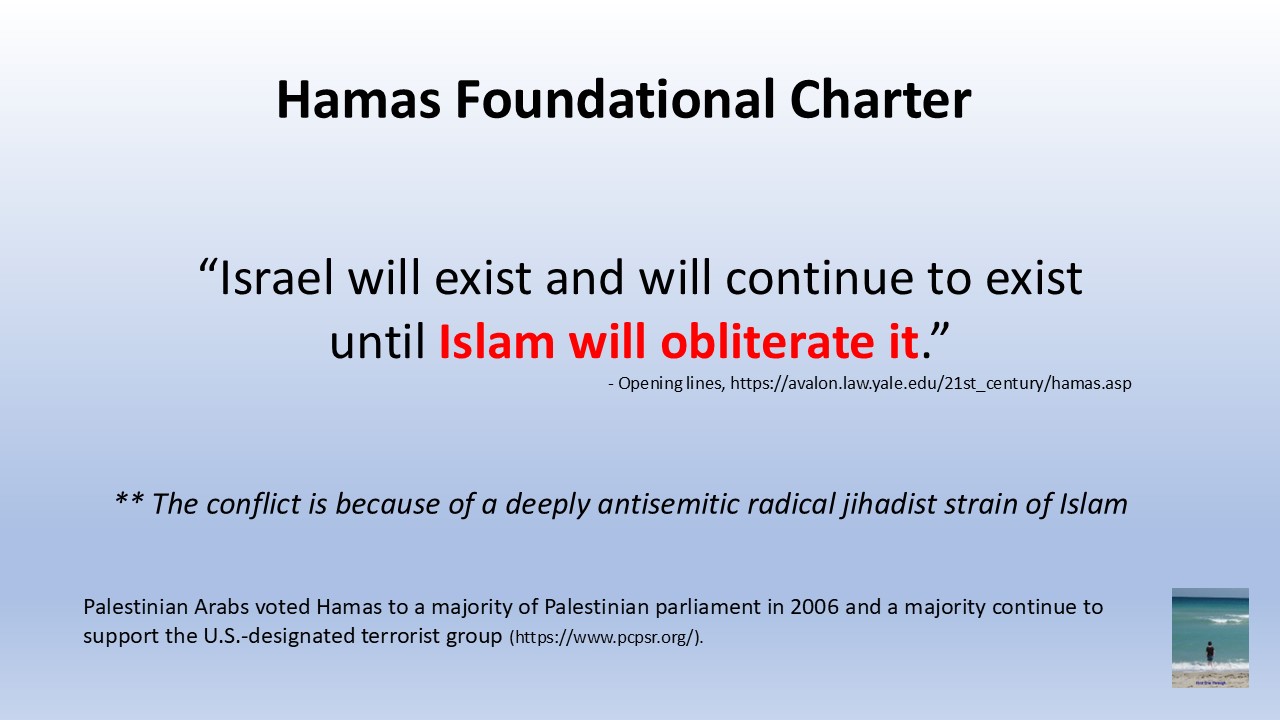
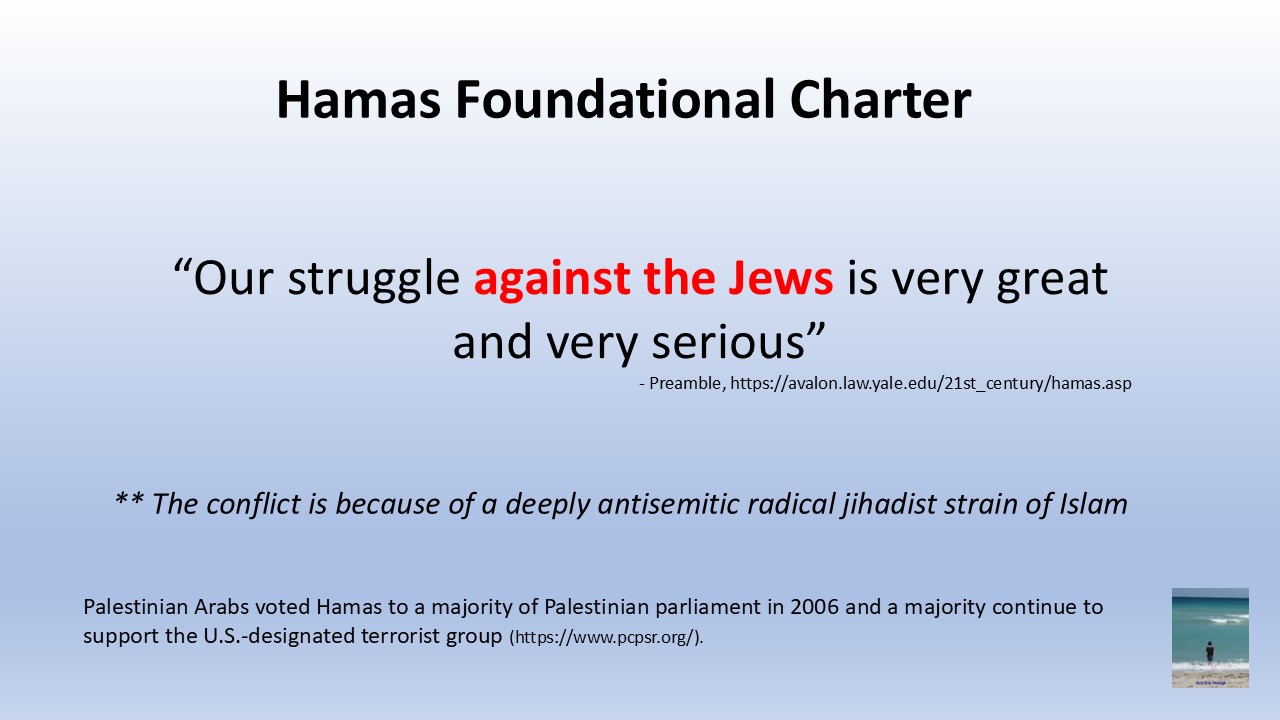
In October 2003 – well before there was a blockade of Gaza – 89% of Palestinian Arabs supported killing Jewish civilians in the West Bank and Gaza; 54% supported killing Jewish civilians inside of Israel. Gazans were much more blood-thirsty than West Bank Arabs.
Security is not a privilege. It is a right.
To say “Let Israel Live” is to recognize that Israelis are human beings rather than symbols in a political debate. Discussions about Israel often revolve around governments, borders, diplomacy, and conflict. Lost in those discussions are the millions of ordinary people whose lives are directly affected by them.
The phrase carries an even deeper meaning for the Jewish people.
For centuries, Jews lived at the mercy of rulers, empires, and majorities. Again and again they were expelled, persecuted, or denied the ability to determine their own future. Israel represents the restoration of Jewish self-determination in the ancestral homeland of the Jewish people.
To say “Let Israel Live” is therefore not merely a statement about physical security. It is an affirmation that the Jewish people, like all peoples, possess the right to govern themselves and shape their own destiny.
The phrase “Let Israel Live” asks for nothing extraordinary.
It asks that Israel be granted what every people seeks for itself: the right to live, the right to flourish, and the right to exist in peace.
On the evening of June 16, 2017, 23-year-old Border Police officer Hadas Malka was standing guard near Jerusalem’s Damascus Gate, one of the busiest entrances to the Old City.
Before the night was over, she would be dead.
Border Police officer Hadas Malka, who was killed on June 16, 2017, in a stabbing attack near Damascus Gate in Jerusalem
Three Palestinian terrorists from villages near Ramallah launched coordinated attacks using knives and firearms. As officers responded, one of the attackers rushed Malka and stabbed her repeatedly. Four others were wounded before security forces killed the terrorists.
Malka, from Ashdod, died of her injuries shortly afterward.
What followed made the attack unusual even by the standards of the Israeli-Palestinian conflict.
ISIS claimed responsibility.
“lions of the caliphate carried out a blessed operation in the city of Jerusalem.” –ISIS
“The three hero martyrs who executed the Jerusalem operation have no connection to Daesh [ISIS], they are affiliated with the [Popular Front for the Liberation of Palestine] and Hamas,” Hamas official Izzat El-Reshiq tweeted.
The argument was never about the murder itself. It was about who deserved recognition for carrying it out.
For many outside the Middle East, ISIS represents a uniquely dangerous form of extremism. Yet in Jerusalem that night, the distinction mattered little to the victim. Whether carried out in the name of ISIS, Hamas, or the PFLP, the result was the same: a young policewoman was murdered while protecting the public.
The attack came years before October 7, but it reflected a pattern that long predates both events. Terrorist groups may differ in ideology, tactics, and leadership. Their rivalry often centers on who can claim the mantle of “resistance” and the vile prestige that follows a successful attack.
On June 16, 2017, that competition played out in plain sight.
A young Israeli officer lay dead. Three terrorist organizations wanted the world to know the attack belonged to them.
The Palestinian Authority has announced plans to transform Solomon’s Pools, between Bethlehem and Efrat, into a major Palestinian tourist, cultural, and religious destination. The project includes a mosque, tourism infrastructure, educational programs, international advocacy campaigns, and efforts to preserve what officials describe as the site’s historical and demographic character.
The irony is hard to miss.
Solomon’s Pools are among the most important surviving engineering works of ancient Judea. Built during the Second Temple period, the reservoirs and aqueducts supplied water to Jerusalem and the Jewish Temple. Their existence is evidence of the Jewish civilization that built and governed Jerusalem over two thousand years ago, that grew the city towards the end of the Second Temple period to approximately 50,0000 people.
Mazar, A.A. 2002. Survey of the aqueducts to Israel. In The Aqueducts of Israel, ed. Amit D., Patrich J., and Hirschfeld Y., 212–244.
Without Jewish Jerusalem, there would be no Solomon’s Pools.
Yet Palestinian officials speak of preserving the site’s historical character while proposing changes that have no connection to the history that made the site significant.
If the goal is to preserve the site’s historical character, why alter it?
If the goal is to protect its demographic character, what demographic character existed when the reservoirs were built?
The people who built Solomon’s Pools were Jews. The reservoirs were built to serve a Jewish capital. The aqueducts carried water to the Jewish Temple. The site’s significance is inseparable from ancient Jewish Jerusalem.
Solomon’s Pools c. 1890
So why place a mosque at a reservoir built by Jews to serve Jewish Jerusalem while claiming to preserve its historical character?
The answer appears in the language of the project itself. Officials speak of strengthening Palestinian presence, reinforcing Palestinian identity, and mobilizing international support for Palestinian claims.
This is not preservation. This is a battle of historical replacement.
A generation from now, visitors may encounter a mosque, Palestinian tourism facilities, and Palestinian historical narratives. What may become increasingly distant is the reason the site exists at all: it was built by Jews to serve Jerusalem, the capital of the Jewish people.
“We know that the prime Zionist goal is emptying this land of its Christians and Muslims. They [the Jews] don’t want anyone here other than themselves. The Christians before the Muslims, because the Christians were here on this land before the Muslims… the Christian is the brother of the Muslim. They celebrate together, suffer together, live together, work together, and fight together against their enemy, because we have been the owners of this land since this land’s existence… We will remain in this land forever, while the attackers [the Jews] have no place in Jerusalem and no place here.” – Palestinian Authority President Mahmoud Abbas March 2023
That is how historical replacement works. The monument is not destroyed. The identity of its builders is replaced.
Solomon’s Pools stand as evidence of Jewish statehood, Jewish engineering, and Jewish life in the land of Israel long before the rise of Christianity, Islam, or modern Palestinian nationalism.
Solomon’s Pools is located off Road 60, between Efrat and Bethlehem
Palestinians’ nationalism is being built on erasing Jewish history and heritage. Today, it is clearly evident at Solomon’s Pools.
One of the most common claims in the Arab-Israeli conflict is that Jews took the land from Palestinian Arabs and denied them self-government.
History tells a different story.
For four hundred years, the Holy Land was ruled by the Ottoman Empire. There was no Palestinian Arab state.
After World War I, Britain took control under the Mandate for Palestine. Again, there was no Palestinian Arab state.
In 1947, the United Nations proposed creating both a Jewish state and an Arab state. The Jewish leadership accepted the plan. Arab leaders rejected it and chose war.
When the fighting ended, Jordan occupied the West Bank and East Jerusalem while Egypt controlled Gaza. For the next nineteen years, neither country established a Palestinian state. Neither granted sovereignty to the local Arab population. Neither created independent Palestinian governing institutions.
The first meaningful Palestinian self-government did not emerge under Ottoman rule, British rule, Jordanian rule, or Egyptian rule.
It emerged through agreements with Israel.
The Oslo Accords created the Palestinian Authority and transferred governing responsibilities in Palestinian cities to Palestinian leaders. For the first time in modern history, Palestinian Arabs exercised substantial self-rule in the territory where they lived.
Signing of Oslo II Accords
Then in 2005, Israel withdrew every soldier and civilian from Gaza, leaving the territory entirely under Palestinian administration.
Israel is often accused by Israel haters of having stolen a Palestinian state. Yet no Palestinian state existed under Ottoman rule, British rule, Jordanian rule, or Egyptian rule. The first meaningful Palestinian self-government emerged only through agreements negotiated with Israel.
United Nations Secretary-General António Guterres recently declared that he supports “a monopoly on weapons by the Lebanese Government.”
He is right.
No sovereign state can exist when an organization maintains its own army outside central government control. Hezbollah may hold seats in parliament and participate in Lebanese politics, but that does not give it the right to possess an independent military force and wage war outside the direction of the government.
The obvious question is why the Secretary-General does not apply the same principle to Gaza.
If Lebanon requires a state monopoly on force, then so does any future Palestinian state. Hamas must be disarmed. There is no path to peace while an independent army remains outside governmental authority.
Yet the United Nations does not say so. Instead, it issues endless calls for ceasefires, negotiations, and diplomacy while avoiding the central reality that an armed movement dedicated to Israel’s destruction cannot simultaneously be the foundation for coexistence.
That double standard helps sustain the current conflict. Israelis and Gazans continue to suffer while international institutions refuse to confront the most basic requirement for ending the war.
But today’s war is not the real danger.
The real danger is what comes next.
Every major Palestinian poll points in the same direction. Palestinians are increasingly likely to hand control of the Palestinian Authority itself to Hamas or leaders who share Hamas’s objectives.
The result will not be a Palestinian Authority that replaces Hamas but Hamas becoming the Palestinian Authority.
At that point, Hamas will no longer be an armed movement operating from Gaza. It will be the internationally recognized government of Palestinian Arabs in Gaza and the West Bank. Its army will no longer be described as a militia but the armed forces of Palestine, internationally recognized, and still committed to the destruction of the Jewish state.
If so, the suffering of Israelis and Gazans today will pale in comparison to the conflict that follows.
Difficult situations are sometimes referred to as being between a rock and a hard place. The popular Palestinian terrorist group places the Middle East between a double standard and a destructive standard.
When Turkish President Recep Tayyip Erdoğan attacked Israel this week, most English-language reports focused on his accusations of genocide, his attacks on Israeli Prime Minister Benjamin Netanyahu, and his warnings about regional instability.
But Arabic and Turkish media focused on a different line.
According to Turkey’s own state-run Anadolu Agency, Erdoğan declared:
“We know very well what the ultimate objective of the delusions of the Promised Land is, and God willing, we will never allow it.”
It is a line he has used for years. It’s a headline phrase across the Arab world. Al Jazeera highlighted it. Egypt’s Al-Ahram highlighted it. Al-Quds Al-Arabi highlighted it. He uses it as a charge that Israel is coming for Turkey itself.
Yet the English-language media ignored it.
That omission matters because Erdoğan was no longer criticizing Israeli policy. He was ridiculing a foundational Jewish belief.
The Promised Land is not a policy of Benjamin Netanyahu. It is not a platform of the Israeli government. It is a central element of Jewish faith, history, and identity dating back more than three thousand years. It appears throughout the Hebrew Bible and has been part of Jewish religious life through centuries of exile.
Calling that belief a “delusion” is no different than mocking Christian belief in the Resurrection or Muslim belief in the divine revelation of the Quran.
There is a word for dismissing the core religious beliefs of Jews as uniquely illegitimate: antisemitism.
Yet English-language audiences were shielded from that reality. Readers were told Erdoğan was criticizing Israel. They were not told he was deriding one of Judaism’s foundational beliefs. That this is a Muslim war against the Jews.
For years, Western audiences have been told that criticism of Israel must be distinguished from hostility toward Jews. But when a foreign leader publicly mocks a core tenet of Judaism and the press translates it into a story solely about Israeli policy, the distinction is being used in reverse. Anti-Jewish rhetoric is sanitized and repackaged as ordinary criticism of Israel.
Arabic readers saw what Erdoğan actually chose to emphasize. English readers did not, guided on a narrow path to direct the public.
The UN Secretary-General’s latest statement on June 8 warns about conflict in Lebanon, Iran, and Gaza.
Yet Israel appears only as the actor, never as the target.
Iranian missiles are fired at Israel. Hezbollah drones cross into Israel. Houthi missiles target Israeli cities. Millions of Israelis live under the threat of attack.
But in much of the international conversation, the war is always somewhere else.
The fighting is “in Lebanon.” It is “in Iran.” It is “in Gaza.”
The reality is that Israel enters the story primarily when it responds.
This framing matters. It transforms Israel from a country under attack into a country that simply attacks. The missiles disappear. The drones disappear. The civilians running to shelters disappear.
A missile launched from Iran toward Haifa is not a conflict “in Iran.”
A drone launched from Lebanon toward Kiryat Shmona is not a conflict “in Lebanon.”
They are attacks on Israel.
Yet too often Israel appears in international statements only after it fires back.
That does not merely distort the geography of the war. It distorts who started it.
The UN Secretary General once again showed its victims of preference and that the global body is not concerned about the fate of Israelis.
The children who dominate New York’s Israel parade are no longer the children who dominate Jewish education.
Each spring, Fifth Avenue fills with students from Modern Orthodox and Religious Zionist schools waving Israeli flags, singing Hebrew songs, and celebrating the Jewish state. Yet these students represent only a small fraction of Jewish children in the New York metropolitan area. The largest group of Jewish children attends public and secular private schools. The largest group attending Jewish schools is Chassidic and Yeshivish.
Jewish yeshiva day school students and faculty march up Fifth Avenue in New York City’s Israel parade, May 31, 2026 (photo: First One Through)
That reality raises an important question about the future of one of American Jewry’s most visible public events.
The parade’s own history reflects the evolution of American Jewish identity.
When it was founded in 1964, it was called the Youth Salute to Israel Parade. The name reflected its era. Israel was only sixteen years old. The Holocaust was still within living memory. American Jews were not merely celebrating Israel; they were standing with it.
In 2011, the event became the Celebrate Israel Parade. Israel was no longer a struggling young state. It was a global technology center, a military power, and home to millions of Jews. The emphasis shifted from solidarity to celebration.
After October 7, the parade adopted a third name: Israel Day on Fifth.
The parade’s three names trace the evolution of American Zionism itself. The first generation saluted Israel. The second celebrated Israel.
Today, the challenge is different. Support for Israel can no longer be assumed, and Jewish unity can no longer be taken for granted. The question is whether Israel can continue to serve as a bridge connecting an increasingly diverse Jewish community.
The challenge is particularly visible when looking at Jewish children in the greater NYC area.
The best available estimates suggest that roughly 450,000 to 500,000 Jewish school-age children live in the greater New York metropolitan area. About 170,000 attend Jewish day schools and yeshivot.
Of those, roughly 130,000 to 140,000 attend Chassidic and Yeshivish schools, compared with only 20,000 to 25,000 in Modern Orthodox schools. Outside the day-school world are another 280,000 to 330,000 Jewish children attending public schools, secular private schools, Catholic schools, and other educational settings.
Yet anyone watching the parade could be forgiven for drawing the opposite conclusion.
The schools most visible on Fifth Avenue are overwhelmingly Modern Orthodox and Religious Zionist institutions. They are among the most committed supporters of Israel in American Jewish life. But they represent only a small share of Jewish youth. The fastest-growing segment of Jewish education is Chassidic and Yeshivish. The largest segment of Jewish children overall attends public and secular private schools.
The parade therefore showcases some of the most engaged Jewish children in America, but not necessarily the full spectrum of Jewish youth.
That matters because Israel remains one of the few ideas capable of connecting Jews across denominational, ideological, and educational lines. At a moment when Jewish attachment to Israel is increasingly challenged on college campuses, contested on social media, and questioned in parts of American public life, institutions that connect young Jews to Israel have become more important, not less.
If the goal is Jewish unity in the decades ahead, the parade may need to ask a different question.
Rather than “How do we celebrate Israel?” the question may be “How do we bring the Jewish people together around Israel?”
A future parade organized around Am Yisrael rather than a particular expression of Zionism could create room for every community to participate in its own way.
Charedi schools could march under banners celebrating Torah in the Land of Israel.
Public-school students could march through camps, youth groups, synagogue programs, and community organizations.
Modern Orthodox schools could continue expressing their Religious Zionist vision.
Israeli cultural groups, charities, universities, first responders, and innovation organizations would all still have their place.
This would be Am Yisrael Day on Fifth Avenue.
The original parade was created to demonstrate solidarity with a young Jewish state. The next challenge is ensuring that future generations of American Jews remain connected both to Israel and to one another.
Should the future of the parade remain with the niche schools that already fill Fifth Avenue, it will become a symbol of the fragmentation of Israel support even within the Jewish community, let around the broader world. That would not bode well for Jewish New Yorkers or Israel.
The first generation saluted Israel. The second celebrated Israel. The challenge for the third generation is to ensure that Israel remains a force capable of uniting the Jewish people.
On May 28, 1964, the Palestinian National Charter was adopted in Jordanian-controlled Jerusalem. At that time, the West Bank was under Jordanian rule and Gaza was under Egyptian rule.
The Charter explicitly excluded both territories from its claims. It focused on Israel.
“This Organization does not exercise any regional sovereignty over the West Bank in the Hashemite Kingdom of Jordan, on the Gaza Strip or in the Himmah Area.”
The Charter did not challenge Arab sovereignty. It only challenged Jewish sovereignty.
Palestinian leaders supplied the national cause; Arab governments supplied the armies.
The Charter left little doubt about its objective. It declared:
“The partition of Palestine in 1947 and the establishment of the State of Israel are entirely illegal.” – Article 17
And that “liberation” of the land is the common cause of all Arabs:
“Arab unity leads to the liberation of Palestine, and the liberation of Palestine leads to Arab unity.” – Article 12
The Palestinian movement was therefore born not as a campaign against an Israeli occupation of the West Bank and Gaza, but as a movement that denied the legitimacy of Israel itself, and one in which the entire Arab world must unite.
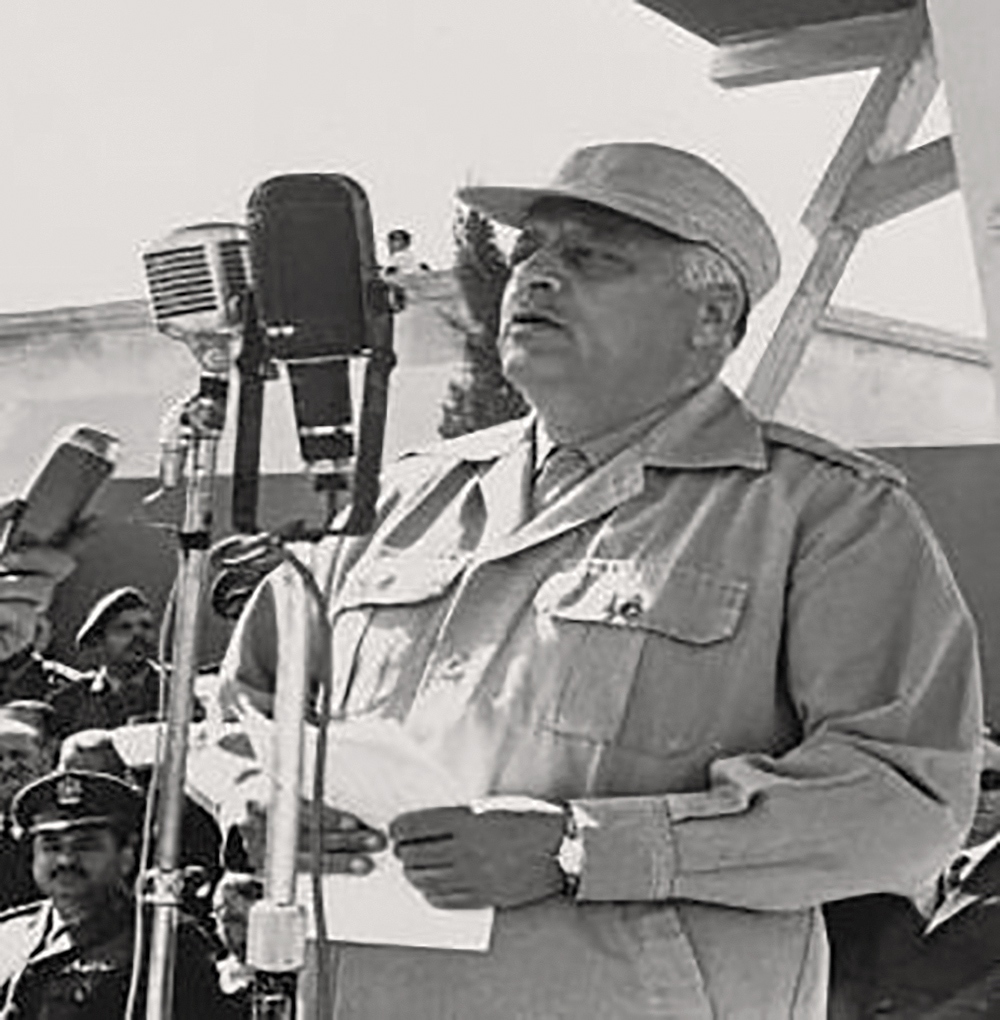
The Charter’s author, Ahmad Shukeiri, was born in Lebanon and was Saudi Arabia’s ambassador to the United Nations from 1957 to 1962. His pan-Arab worldview called for Arab armies to destroy Israel:
“Those who survive will remain in Palestine, but I estimate that none of them will survive.” – Ahmad Shukeiri June 1, 1967
Another widely reported statement attributed to him declared:
“The Jews of Palestine will have to leave…We shall destroy Israel and its inhabitants and as for the survivors – if there are any – the boats are ready to deport them.“
Ahmad Shukeiri, circa 1965
Shukeiri’s brothers-in-arms said much the same.
In October 1964, Syrian leader Salah Jadid declared:
“Our army will be satisfied with nothing less than the disappearance of Israel.”
“The Arab national aim is the elimination of Israel.”
That same year, Egyptian President Gamal Abdel Nasser proclaimed:
“We shall not enter Palestine with its soil covered in sand; we shall enter it with its soil saturated in blood.”
Iraqi President Abdul Rahman Arif described Israel as:
“an error which must be rectified.”
In June 1967, the Palestinian movement and the surrounding Arab states were speaking a common language. The PLO and Arab leaders denied Israel’s legitimacy and spoke openly of its disappearance, elimination, and destruction.
The rhetoric was matched by action. Egypt expelled the United Nations Emergency Force from Sinai, followed by Egyptian troops pouring into the peninsula. The Straits of Tiran were closed to Israeli shipping. Military alliances linked Egypt, Syria, Jordan, and Iraq. Arab armies massed on Israel’s borders.
Against that backdrop, Nasser announced on May 26, 1967:
“The battle will be a general one and our basic objective will be to destroy Israel.“
Nine days later, war began.
Today, one of the most recognizable slogans associated with the Palestinian movement is “From the River to the Sea.” People often pretend that it is a call to free the West Bank and Gaza from “occupation” but the Arabic phrase speaks to the deeper truth as outlined by history.
“Min al-nahr ila al-bahr, Filastin ‘arabiyyah” meaning “from the river to the sea, Palestine will be Arab.”
Whether controlled by Jordan or Egypt or a hoped for Palestine, the Palestinian movement at its core has always been an anti-Israel movement to destroy the presence of Jews in “any part of Palestine.”
The June 1967 Six-Day War did not create the current dynamic in the Israel-Arab conflict. It was the conclusion of the first chapter of the Palestinian-led pan-Arab rejection of Jews living in and having sovereignty in land they view as purely Arab.
Parshat Beha’alotcha opens with the lighting of the Menorah.
The Haftorah from Zechariah returns to the same image but adds a remarkable detail. The prophet sees a golden Menorah fed by two olive trees, one on each side, supplying a continuous flow of oil.
Confused by the vision, Zechariah asks what it means. The answer contains one of the most famous lines in the Bible:
“Not by might, nor by power, but by My spirit, says the Lord of Hosts.” – Zechariah 4:6
The vision came during the rebuilding of Jerusalem and the Second Temple. A small Jewish community had returned from Babylonian exile and faced the daunting task of restoring both a city and a nation.
Many readers focus on the famous verse. The prophet, however, devotes considerable attention to the two olive trees.
Rashi, following the Talmud, identifies the two olive trees with Joshua the High Priest and Zerubbabel the governor. One represented the spiritual leadership of the nation. The other represented its political and civic restoration.
The symbolism is powerful.
The Menorah stands between spiritual leadership and political leadership. Between the Temple and the city. Between faith and statecraft.
The vision’s message was not that politics would save the Jewish people. Nor was it that spiritual life alone would rebuild Jerusalem.
The Temple could not stand without a city. A city could not fulfill its purpose without the values embodied by the Temple.
That lesson echoed throughout Jewish history.
Kings and prophets, priests and governors, rabbis and communal leaders each played different roles in sustaining Jewish life. Sometimes they cooperated. Sometimes they clashed. Yet Jewish continuity depended on both the preservation of spiritual purpose and the institutions capable of carrying that purpose into the world.
Today, Israel’s state emblem places a Menorah at its center, flanked by olive branches. The design was inspired by the Menorah depicted on the Arch of Titus in Rome, commemorating the destruction of Jerusalem nearly two thousand years ago. Yet the image also echoes Zechariah’s vision of a Menorah being reestablished in Jerusalem, standing between olive trees.
A people of faith needs security, institutions, and leadership. A nation needs purpose, values, and a mission greater than itself.
Zechariah’s vision does not place the Menorah beneath a single olive tree.
It stands between two.
The light of Israel emerges from the meeting point of spiritual purpose and national life.