
The Palestinian Authority has declared the Temple Mount — the holiest site in Judaism — the “exclusive right of Muslims.”
That is not the historic status quo. It is an attempt to rewrite it.
After Israel took control of Jerusalem’s Old City in 1967, day-to-day religious administration of the Temple Mount/Haram al-Sharif remained with the Islamic Waqf, while Israel retained responsibility for security and substantial control over access. The Waqf permitted Muslims to pray on the Mount, while non-Muslims could visit, prayer was restricted.
The arrangement governed administration, access and worship. It did not declare the Temple Mount the exclusive possession or religious entitlement of Muslims.
The Palestinian Authority’s Jerusalem Governorate crossed that line explicitly on September 6. It condemned Jews conducting “Talmudic rituals and prayers” as attempts to “alter its religious character,” declared the entire 144-dunam compound the “exclusive right of Muslims” and warned against changing its “identity.”
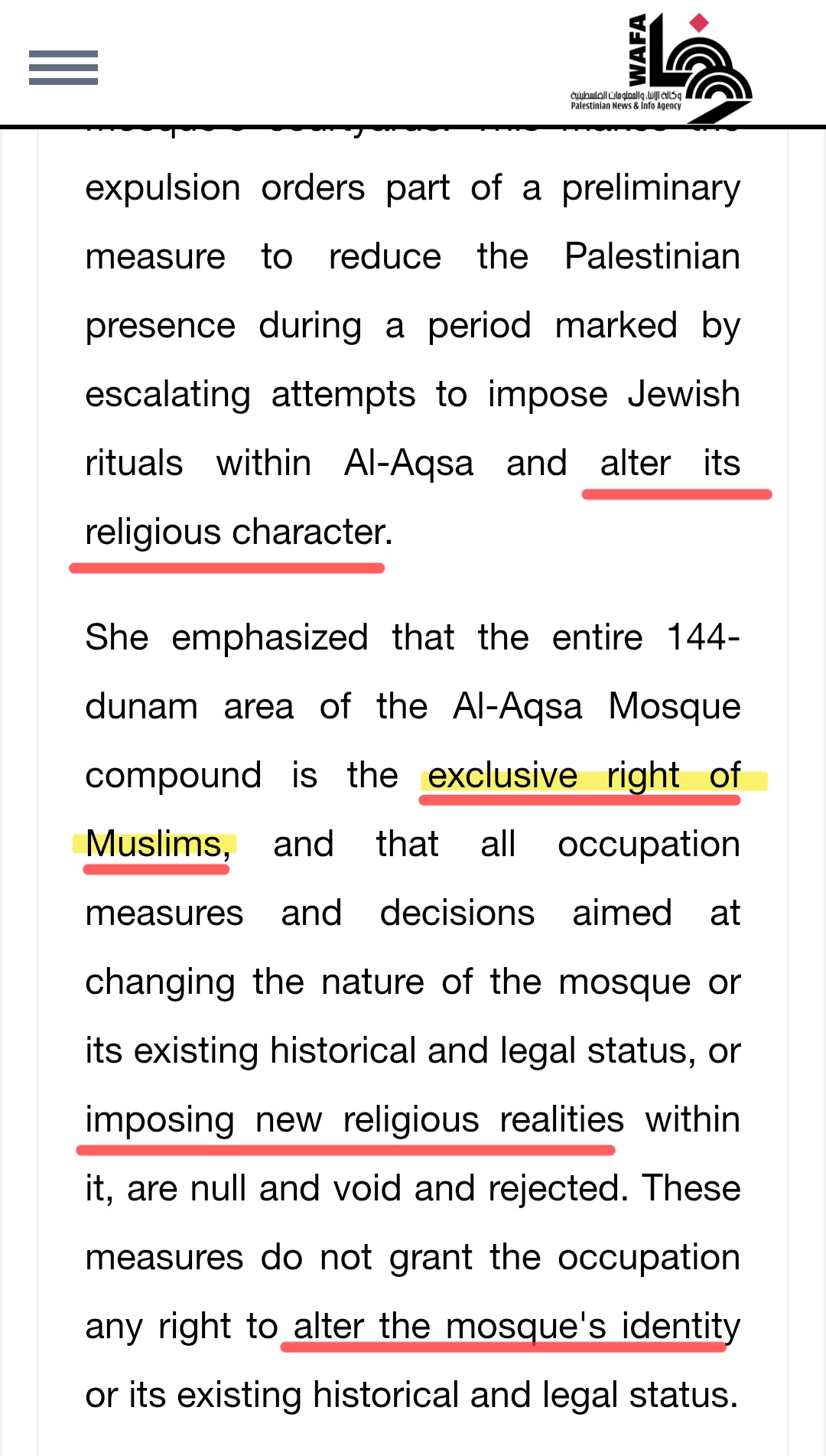
Those words matter.
Waqf administration is one thing. Restrictions on Jewish prayer are another. Declaring the site itself the “exclusive right” of Muslims is something else entirely.
The status quo regulates what Jews may do there. It never determined what the place is.
The First and Second Jewish Temples stood on the Temple Mount. Jewish prayer has faced Jerusalem for millennia. Jewish liturgy, mourning and hopes for redemption are bound to it. Many observant Jews have historically declined to walk upon portions of the Mount precisely because they consider the ground too holy to enter without the required ritual purity.
For some Jews, not ascending is itself an expression of the Mount’s extraordinary Jewish sanctity.
That makes the new language especially provocative. Jews visiting Judaism’s holiest place become “settlers” conducting “incursions.” Jewish prayer becomes threatening “Talmudic rituals.” A restriction accepted to preserve religious peace is transformed into evidence that Jewish religious expression does not belong there at all.
Jewish restraint was supposed to preserve coexistence. It cannot become a permission slip for Jewish erasure.
The international reaction sharpens that dynamic. The United Nations itself has called upon the parties to refrain from “provocative actions, incitement and inflammatory rhetoric,” especially in places of “religious and cultural sensitivity.” In the very next paragraph, it demanded that Jerusalem’s historic status quo be respected “in word and practice” and urged “all sides” to halt provocations and incitement at the holy sites.
By the UN’s own standard, words can threaten the status quo. Yet when an official Palestinian governmental authority declares Judaism’s holiest site the “exclusive right of Muslims,” it is greeted with a silent nod of approval.
And this occurs as the anti-Israel horde discusses so-called “Jewish supremacy.” Zohran Mamdani has attacked privileging one religion over another (meaning Jews over Muslims). Hasan Piker denounces “ethnoreligious supremacist values.” At the Jewish Temple Mount, the principle stripped of abstraction: one religion claiming exclusive entitlement to the holiest site of another.
And that raises a more fundamental question about the status quo itself.
Perhaps placing religious administration of a multi-faith holy site exclusively in the hands of one of the religions claiming it was always structurally unstable.
The Waqf is not a neutral administrator. It is an Islamic religious institution representing one faith at a site sacred to several. That arrangement can function while custodianship means administration. It becomes difficult to justify when the authority entrusted with the site participates in or endorses a doctrine that denies another faith any legitimate claim to it.
The test should be remarkably simple: Can the authorities administering the Temple Mount state unambiguously that it is Judaism’s holiest site?
Acknowledging that fact surrenders nothing about Islam’s attachment to Al-Aqsa. But an administrator that cannot acknowledge the most basic religious identity of the people whose holiest site it administers has a profound conflict with the responsibilities of custodianship.
If the Waqf and Jordan cannot pass that test, their fitness to exercise exclusive administration should be questioned.
The logical alternative is administration by a political authority obligated to protect multiple religions rather than a religious authority representing one of them. Israel already bears responsibility for security at the compound and exercises substantial control over access. Any new arrangement would have to fully protect Muslim worship and Islamic holy places while recognizing rather than suppressing the religious attachments of others.
The status quo was built on the assumption that Islamic administration could coexist with Jewish restraint. The assertion of “Muslim exclusivity” is breaking that bargain.
If the Waqf cannot acknowledge Judaism at Judaism’s holiest site, it should no longer be entrusted to administer it.
Related:
US Embassy In Israel Only Invites Muslims To US To Study (September 2023)


Pingback: A Siddur on the Temple Mount Is Now a “Highly Dangerous Development” | First One Through