Brooklyn Chanukah Donut Crawl 2025

As the first evening and last night of Chanukah were on Sundays, we are posting this blog a bit late, as we could only make it out to Brooklyn for the second Sunday. Despite being late to the festivities, we had a very aggressive agenda (below in planned order of the route):

  • Ostrovitsky Bakery, 1124 Avenue J, Brooklyn, NY 11230
  • Pomegranate Supermarket, 1507 Coney Island Ave, Brooklyn, NY 11230
  • Sesame – Flatbush, 1540 Coney Island Ave, Brooklyn, NY 11230
  • Taste of Israel, 1322 Avenue M, Brooklyn, NY 11230
  • Patis Bakery, 1716 Avenue M, Brooklyn, NY 11230
  • Schreiber’s Homestyle Bakery, 424 Avenue M, Brooklyn, NY 11230
  • Viva La Dough, 501 Avenue M, Brooklyn, NY 11230
  • LUNCH: Sunflower Cafe, 1223 Quentin Rd, Brooklyn, NY 11229
  • Pita Sababa, 540 Kings Hwy, Brooklyn, NY 11223
  • Taam Eden Bakery, 4603 13th Ave, Brooklyn, NY 11219
  • Weiss Kosher Bakery, 5011 13th Ave, Brooklyn, NY 11219
  • XMAS LIGHTS: Dyker Heights Christmas Lights

As Tevye said in Fiddler on the Roof, “sounds crazy, no?”

Reality (sugar rush and other responsibilities) crashed on us and we didn’t make it through the entire list but here are the reviews.

A public announcement before beginning – be prepared. Bring water bottles and some other items like plates, plastic knives and wipes. Quartering the donuts is a must if you want a healthy sampling.

Donut crawl “kit”

Ostrovitsky’s Bakery

Last year, we came to Ostrovitsky’s in the afternoon and they were out of some of their best flavors, including chocolate mousse, napoleon and rosemarie, so we came here first. We picked up one of each, an Oreo and a plain jelly (we were seven people).

Before getting into the flavor and quality of each, I want to share that as opposed to prior years when we arrived at the beginning of the holiday to fight large lines, there was no line here or any pandemonium at the other stores. Eight days of deep fried foods must tap the strength of even the greatest Maccabee.

We made a new friend at the store, a caterer, who very much likes the bakery and shared a story how many bakeries actually get their sufganiyut (filled donuts) from Ostrovitsky’s.

The chocolate mousse was the biggest fan favorite of the reviewers, deeper in flavor than the lighter rosemarie. The napoleon actually tasted like a napoleon- not a donut, which isn’t necessarily a bad mark but wasn’t expected. The jelly and Oreo were both good.

selection from Ostrovitsky’s bakery

Pomegranate

The big supermarket had a wide variety this year. This year’s selection was good. However, the plain jelly was watery and the “long john” variety had little jelly in it.

The halvah was good but other bakeries were much better.

Pita Sababa

We were lucky to have friends get to Brooklyn before us and pick up a selection at Pita Sababa before we got there on the itinerary, as it is not close to the other bakeries and often has a line. The sampling was fantastic! The halvah was simply outrageous – with lacy halvah on top and rich full flavor inside.

Donuts from Pita Sababa

The caramel was okay as was the plain sugar coated. The Dubai Chocolate was divine with great flavor and fullness of filling. It hit the top place this year, knocking Sesame for the first time in our seven year crawl.

Sesame

Sesame has been top of the charts for each of our crawls since 2019. This year, it continued to impress, with plentiful varieties and flavors in both pareve and dairy. People buy them buy the dozens – literally.

Patis Bakery

We stopped into Patis for lunch (as well as Koma sushi) and to try just one donut – a dairy cookies and cream. It was light and flavorful. There wasn’t a very big selection of donuts, and they don’t make them at the location as they do in the other bakeries, so we were very satisfied in light of the difficult competition.

Schreiber’s Homestyle Bakery

We got a few dairy donuts at Schreiber’s, and lace cookies which we consider the best in the category. The strawberry was fine and the marshmallow wasn’t very good, especially as we had it the following day.

Schreiber’s donuts

Viva La Dough

Viva La Dough was new to our crawl. It did not disappoint. The dough was excellent – even the following morning which is unheard of for sufganiyut. The tiramasu was light and airy – they way you would expect. The coffee filling was tasty, as though you were eating an expensive dessert at a restaurant.

Tiramasu donut and the inside of a creamy strawberry jelly – almost tasted like a cream cheese and jelly sandwich – from Viva La Dough

We ran out of energy and did not make it to Taam Eden or Weiss’s Bakery. Taste of Israel had no donuts for walk in.

Overall

As this was our seventh year of the crawl, we have pruned the poorer bakeries and now left with only good selections. Pita Sababa’s Dubai chocolate and halvah were the rockstars of the day. Sesame continues to do well with pistachio, nutella, peanut butter, but some did not like the dairy milk lotus. We give high marks to Viva la Dough, even though the selection is lighter than the others.

The New York Times’ Year in Pictures and the Architecture of Moral Inversion

Hamas does not rule Gaza against the will of its people. It rules because large numbers of Gazans want it to. Hamas articulates aims that many in Gaza accept: “armed struggle,” permanent war, and the eradication of Israel. This is not an imposed ideology. It is a shared one.

That reality is the reason the war has not ended.

Hamas refuses to disarm. It promises to fight again. It rejects coexistence as a moral crime. And Palestinian Arabs have not rejected Hamas. There has been no uprising, no mass refusal, no turning inward to say this has destroyed us and must stop. The tunnels remain. The rockets are rebuilt. The hostages were hidden in plain sight and with complicity.

The Arab world understands this. So does the Muslim world and international community, quietly if not publicly. No money will rebuild Gaza while Hamas governs. No state will guarantee security for a territory whose leadership is openly genocidal. Even those who chant Gaza’s cause from afar refuse to absorb the cost of dismantling its rulers. Words are cheap. Responsibility is not.

And so the world fractures.

One side insists Gaza deserves unlimited sympathy—stripped of agency, frozen as a permanent victim, absolved of all consequence. The other side sees a society that has embraced a war of annihilation and asks the world whether moral condemnation is not only justified, but necessary. This divide is not about compassion versus cruelty. It is about whether moral judgment still matters.

What cannot be sustained is the fiction that Gaza is merely trapped between Hamas and Israel. Gaza is trapped— by leaders and parents who have chosen martyrdom over future, ideology over life, and war over their own children’s survival.

That is where sympathy collapses.

Because the only people in Gaza whose moral claim is uncontested are the children—and they are being sacrificed by a society willing to place guns in schools, tunnels under bedrooms, and hostages among families. A society that teaches its children that nothing is nobler than dying for the cause of destroying the Jewish State.

Sympathy cannot be demanded for that choice. It can only be extended—narrowly, painfully—to those who never had one.

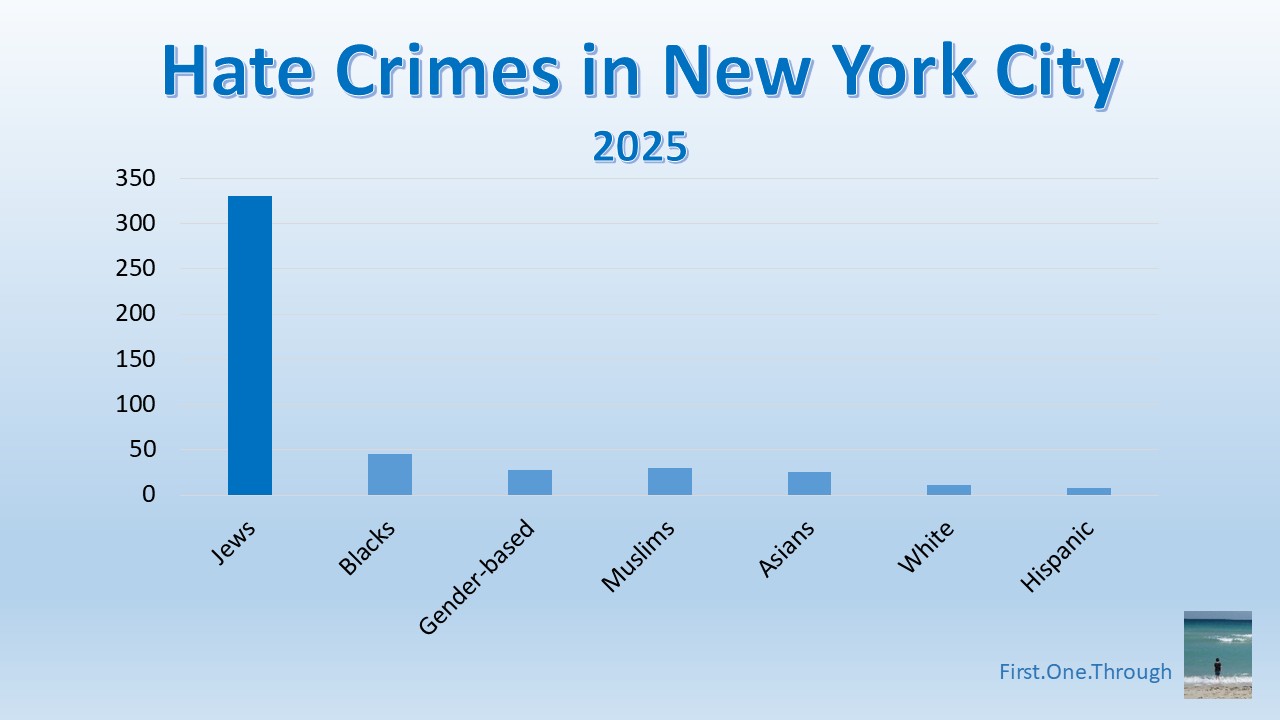
That is why the ritualized outrage of the West’s most powerful institutions now feels so hollow. Each year, The New York Times publishes its Year in Pictures, and the selection itself becomes an argument. In 2025, the year with the largest spike in antisemitism including several incidents of mass murder, there were no pictures of Jewish victims. Instead, page after page of Gaza: rubble, smoke, bloodied streets, dust-covered children. Destruction, repeated until it acquires the authority of inevitability. Israel appears only as force. Gaza appears only as suffering. Context is stripped away. Agency is erased. The camera becomes a verdict.

Two-page spread in New York Times’ 2025 year in pictures showing Gaza rubble. The only other 2-page spread was the election of Zohran Mamdani, an anti-Israel member of the DSA, as mayor of New York City

But the depravity lies not only in what is shown—it lies in what is omitted.

There are no photographs of Jewish life under siege: no police guards posted outside synagogues, no concrete barriers and metal fences erected around schools, no quiet images of fear normalized into daily routine. There are no frames of mourning for Jewish victims abroad, the couple shot in Washington, D.C., the arson at the home of the Jewish governor of Pennsylvania over Passover. No recognition of the global consequences of a war whose ideology has traveled far beyond Gaza. Violence against Jews outside Israel didn’t even make a footnote.

New security fence erected outside synagogue in 2025 (photo: First One Through)

When Israeli hostages appear in the Times, they are reduced to a single visual trope: a large military helicopter, as if their captivity were a logistical problem rather than a crime. Even Jewish victims of Gazan atrocities are set against a large Israeli military. The human cost of hostage-taking is laundered into abstraction.

New York Times only picture of a Jewish victim is a tiny speck in a large Israeli military helicopter

What does receive sympathetic attention are arrests—multiple images of pro-Palestinian demonstrators detained by police, framed as moral courage meeting state power. Advocacy for Israel’s destruction is softened into dissent. The pages preen about resistance while refusing to name what that “resistance” seeks to accomplish.

This is not journalism. It is moral choreography.

The pictures ask only one question—who suffered more?—while carefully avoiding the only one that matters: who chose this war? To launch it? To continue it? They do not show Hamas leaders refusing disarmament. They do not show weapons beneath nurseries. They do not show the ideological choice to sacrifice children for permanence of war.

In this telling, Israel becomes the aggressor by existing, and Gaza becomes sympathetic by persisting in annihilation. The refusal to surrender is recast as resilience. The willingness to sacrifice children is aestheticized as tragedy rather than condemned as crime. Sympathy is manufactured by amputating responsibility. The global anti-Israel advocates are embalmed in the moral light; Jewish victims disappear off the pages.

When the world’s most influential newspaper presents destruction without causation, suffering without choice, and death without ideology, it does not advance peace. It sanctifies perpetual war. It promotes a global blood libel. And it teaches readers that moral clarity is cruelty, while moral confusion is virtue.

The far-left media hopes that history will remember its curated selection of photographs and the modern moment will gather sympathy for the anti-Israel and anti-Jewish horde. Hopefully they are proved very wrong, and this time capsule will forever mark The New York Times for its profound antisemitism and moral depravity.

Related:

Every Picture Tells A Story: There Are No Genocidal Leaders In Iran, Just Fancy Women (November 2024)

Every Picture And Headline Tells A Story: Columbia’s Pro-Palestinian Students Are NOT Antisemitic (April 2024)

Every Picture Tells A Story: No Brutal Slaughter Of Israeli Civilians (October 2023)

Every Picture Tells A Story: Palestinian Terrorists are Victims (November 2020)

Every Picture Tells a Story: Anti-Semitism (February 2017)

Whether by Wisdom or Strength, One North Star

Joseph and the Maccabees stand at opposite ends of Jewish history, yet they are oriented toward the same destination.

Joseph saved lives through wisdom. He read the moment correctly, understood power as it existed, and worked within it with discipline and restraint. His brilliance was not only in interpreting Pharaoh’s dreams but in translating vision into policy. Grain was stored since hunger was anticipated. Life survived because Joseph learned how to operate inside a dominant civilization without surrendering his inner compass.

The Maccabees faced a different landscape. Jewish practice itself was under assault, the Temple desecrated, identity mocked and criminalized. In that moment, preservation required action of a different kind. Physical courage and sacrifice to restore the possibility of Jewish continuity. Their strength reopened a future that had been closing.

Both paths flow from the same conviction: Jewish life must continue.

That shared conviction matters more than the method used to defend it. Jewish tradition does not freeze history into a single playbook. It records multiple responses to pressure, exile, and threat, each shaped by its circumstances, each measured by whether it protects life and meaning.

This tension feels immediate today. Jews in Western societies sense the ground shifting beneath them. Institutions once assumed to be neutral now tolerate or excuse intimidation. Public expressions of Jewish identity invite scrutiny, hostility, or worse. Families quietly debate whether to double down on civic engagement, legal advocacy, and cultural participation, or whether to seek physical concentration, communal withdrawal, and in some cases departure altogether.

Jews gather at candle lighting ceremony in Carl Schurz Park in New York City, hours after the mass murder of Jews in Sydney Australia (photo: First One Through)

Both instincts draw from deep Jewish memory.

Some respond like Joseph, believing that wisdom, professionalism, and moral clarity can still carve out space within complex societies. Others hear the echo of the Maccabees and sense that when identity becomes negotiable, consolidation and self-defense are no longer optional.

The danger is not that Jews choose different strategies. The danger is losing sight of the common north star and turning strategy into accusation.

Chanukah, read alongside Parshat Miketz, offers a sobering reminder. Joseph’s Egypt eventually transforms from refuge into bondage. The Maccabees’ victory secures a moment of light, not a permanent settlement. Jewish history does not promise stability; it demands attentiveness. Survival in the long-term cannot happen without survival in the present.

Each generation inherits the same responsibility: to read its moment honestly, to choose its tools carefully, and to ensure that the flame continues—whether through wisdom, through strength, or through the careful discipline of knowing when to shift from one to the other.

Time to Say Goodbye, With Love and Sorrow

I was sitting in the audience at an Andrea Bocelli concert at Madison Square Garden in New York City, the lights dimmed, the hall hushed in anticipation for the encore “Con Te Partiro,” (Time to Say Goodbye), his most iconic song. He teased the audience with “New York, New York” and headed for the exit once more. The crowd cheered and he came back to sing the song they craved.

Andrea Bocelli at Madison Square Garden (photo: First One Through)

Beside me sat a close Jewish friend who grew up in Australia. We had come for the music, for the beauty of a voice that carries memory as much as sound. Yet, as the first familiar notes rose, I saw her mind was in another world.

She was thinking of her parents and brother’s family back in Melbourne.

Only days earlier, they had been at a Chabad Chanukah party—children, candles, singing, the ordinary holiness of Jewish joy. Then the news broke of the shooting in Sydney. Phones buzzed. Conversations stopped. Parents gathered children closer. And out. What had begun as celebration turned into a flight of urgency. They left with the unmistakable instinct that something precious had become fragile. Perhaps lost.

As Bocelli sang of leaving—of standing alone and dreaming of the horizon—the words landed differently. “It’s time to say goodbye,” he sings, not with bitterness, but with ache. He sings of departing lands once fully lived in, of moving forward while carrying love along. The song understands that some goodbyes are spoken precisely because the bonds mattered.

Time to say goodbye
Countries I have never
Seen and experienced with you

Australia has been such a land for Jews. Around 115,000 strong, the community was built in large part by Holocaust survivors and their children, who arrived determined to create lives of dignity and contribution. They succeeded. Jewish schools flourished. Synagogues filled. Jewish families felt Australian in the fullest sense—rooted, confident, woven into the national fabric. It was a beloved home.

That is why this moment feels so melancholy.

When antisemitism intrudes into Jewish life—when Chanukah gatherings require calculation, when news of violence travels faster than reassurance—something internal shifts. Families begin to think not only about safety today, but about continuity tomorrow. They listen closely for the voice of government, for the firmness of protection, for the sense that Jewish life is fully defended. When that reassurance feels thin – no, absent – dark history whispers.

Yes, I know there is no light in a room when there is no sun
If you’re not there with me, with me

For two years my friend had been speaking to her parents and brother about leaving Australia as antisemitic incidents surged and the government seemed unwilling to do anything. Now, the threats had crossed to violence. Murder. On a mass scale.

At the concert, Bocelli sang on. “With you I will leave,” he promises. The line felt written for this generation of Jews. Leaving does not mean erasing. It means carrying Australia forward: the beaches, the friendships, the generosity, the years of building a good life. Love will not dissolve at the airport gate.

For children, aliyah after moments like these is not politics. It is the air they breathe. It is the desire to grow where Jewishness fills the public calendar, where holidays are shared rather than guarded, where identity settles into the background instead of standing on alert. Israel becomes the horizon the song gestures toward—not as fantasy, but as alignment.

But they know some parents – many Holocaust survivors – will not be able to make the journey. They will stay behind in a land they thought of as home while their children and grandchildren head to their homeland.

When you’re far away I dream of the horizon and words fail
And I, yes, I know that you are with me, with me

As the music swelled, my friend wiped away tears. They were for her brother’s children, who should have stayed longer at a Chanukah party. They were for her parents’ generation, who believed Australia was the final chapter. They were also for something enduring: the knowledge that the Jewish story includes movement, discernment, and the courage to know when it is time.

I will leave with you
On ships at sea
Which, I know
No, no, they don’t exist anymore

The concert ended. The applause lingered. We walked out quietly, in a world darkly distinct from the thousands of other concert-goers heading to their homes.

Somewhere between Melbourne and Jerusalem, between a beloved home and a homeland, the song kept playing, softly affirming the discussions of long goodbyes that were taking place in Jewish homes throughout Australia.

The Revolutionary Theology Has Gone Operational

The arrests came just before New Year’s Eve.

Federal authorities charged members of a group calling itself the Turtle Island Liberation Front with planning coordinated bomb attacks in Southern California. Investigators described discussions of explosives, targets, and timing. The plan was operational, deliberate, and aimed at creating fear and mass harm.

The group’s own words revealed how its members understood their actions. Posters and social media tied to the suspects declared “death to America,” hostility toward federal institutions, and solidarity with “Palestine” framed as “liberation.” The suspects did not describe their plans as criminal. They viewed them as morally required.

That distinction is critical. It explains why violence felt justified rather than transgressive. And why young people can cheer the assassinations of healthcare executives and the massacres by Hamas terrorists, rather than ponder the moral swamp that has taken over their minds.

A World Reduced to Moral Absolutes

At the core of this twisted ideology is a belief that America, Israel, and capitalism are systems of permanent oppression. They are described as forces that keep a foot on the throat of the common man—extracting labor, denying dignity, enforcing hierarchy through violence.

DSA member Rep. Rashida Tlaib (MI) reciting her version of Hitler’s Mein Kampf to the DSA conference in 2021

Within this framework, reform loses meaning. Coexistence is treated as betrayal. Opposition becomes a duty. Violence becomes resistance.

Once that moral threshold is crossed, escalation is no longer radical. It is faithful.

How Far-Left Activism Removed the Guardrails

This worldview is not confined to clandestine cells. Its language has circulated for years inside far-left activist spaces, including factions associated with the Democratic Socialists of America.

DSA-linked rallies, resolutions, and affiliated campus groups have repeatedly adopted language that frames politics as existential struggle rather than democratic contest. Israel is described as a settler-colonial project that must be dismantled. Zionism is labeled racism. Capitalism is defined as violence. America is cast as an imperial force whose institutions lack legitimacy.

The phrasing matters. Calls for “by any means necessary,” “intifada revolution,” and declarations that there can be “no peace on stolen land” are not metaphors. They are moral instructions. They announce that outcomes justify methods and that limits no longer apply.

The rhetoric has infiltrated American schools, both K-12 and universities. Young people are being taught that they have a moral duty to dismantle systems of oppression and that the oppressors are capitalism, the American government, and powerful Jews. Stealing from stores is no longer a crime but means of reparations. Shooting up a kosher store is a form of “restorative justice.”

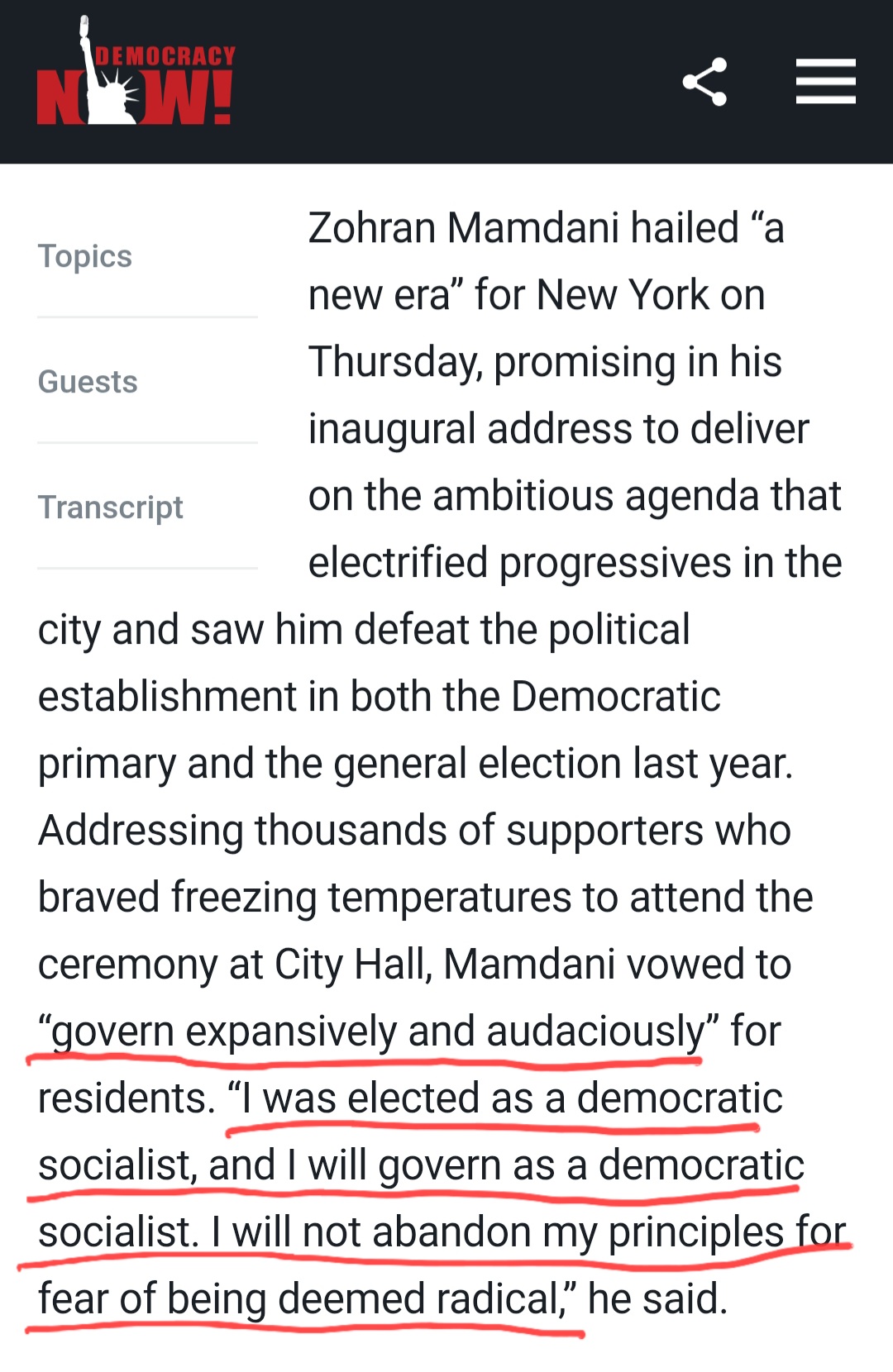
And the DSA rhetoric and candidates have infiltrated the Democratic Party. It began in 2017 and has accelerated. Rashida Tlaib is the most noxious example, but incoming mayor of New York City, Zohran Mamdani may become the most visible, leading the largest American city, the center of American capitalism, and the city with the largest number of Jews outside of Israel.

Where will this lead? Will Jews and capitalists become daily targets?

Movements are shaped by the permissions they grant. When activists normalize the idea that destruction is justice, someone eventually decides to carry it out literally.

Why Israel and Jews Become the Inevitable Focus

Israel occupies a singular place in this ideological ecosystem. It represents sovereignty, national identity, military power, economic success, and Jewish self-determination. For movements defined by opposition to perceived power, Israel becomes the ultimate symbol.

Criticism shifts from policy to existence. Zionism is no longer debated; it is pathologized. Jewish presence becomes suspect. Exclusion is reframed as moral clarity.

And this is not just aired on TikTok but taught at leading American schools, often funded by Islamic regimes.

This pattern is familiar. When a people are defined as embodying the system itself, harm against them begins to feel righteous. Antisemitism thrives wherever absolutist ideologies divide humanity into victims and irredeemable oppressors.

Iran’s Revolutionary Language, Recycled

The structure of this worldview is not new.

Iran’s Islamic Revolution articulated it decades ago. America was cast as the Great Satan. Israel as the Little Satan. Zionism as a cancer that must be removed. These were not rhetorical excesses. They were moral justifications for perpetual violence.

Over time, the religious vocabulary faded, but the framework endured. Imperialism replaced heresy. Capitalism replaced idolatry. “Liberation” replaced salvation. The certainty remained intact in a secularized lexicon. It was internalized as faith for the common man.

What once animated clerical revolution now circulates through Western classrooms and social media feeds, stripped of theology but retaining its absolutism.

A Warning, Not a Theory

The Turtle Island arrests are not an anomaly. They, the election of DSA candidate Zohran Mamdani, and the Luigi Magione fandom are an American signal flare that has been brewing for years for the Jewish community. They mark the moment when revolutionary language stops being symbolic and becomes operational against Americans on a mass scale.

Harvard students rally to Hamas in the aftermath of the brutal slaughter of 1,200 people in Israel

Societies do not collapse because extremists speak. They collapse when eliminationist ideas are normalized, when calls for destruction are treated as moral expression, and when institutions charged with defending pluralism hesitate to draw lines.

Once a culture accepts the premise that entire nations, peoples, or systems deserve to be erased, violence is no longer a question of if. It is a question of when.

What Chants Are Antisemitic?

In Britain, a jury recently decided that the so‑called Khaybar chant is not antisemitic. The chant invokes Khaybar, a seventh‑century battle in which Jewish communities were slaughtered by the armies of Muhammad. The actual chant in Arabic, “Khaybar, Khaybar Ya Yahud, Jaish Mohammed Sauf Ya’ud” means “Watch Out Jews, Remember Khaybar, the Army of Mohammed is returning”. Its meaning is not subtle. It is a threat dressed up as history: remember what happened to the Jews then—remember what can happen again.

If that chant is deemed legally innocuous, what else must now be tolerated?

Would crowds chanting, “Jews, remember the ovens—the Nazis are coming,” be waved through as historical commentary about the Holocaust? What about “We love October 7—it will happen again, in your neighborhood,” explicitly celebrating the mass murder of Jews in Israel and promising its repetition elsewhere? These are not metaphors. They are incitement through remembrance, violence recalled as promise.

The problem is not that the law is incapable of recognizing hate. It plainly can. Careers are ended for misgendering. A single racial slur can bring swift institutional punishment. Speech codes are enforced with zeal—except, it seems, when the targets are Jews.

When courts insist on laundering openly antisemitic chants into something more refined and dignified—while other forms of bigotry are policed to the syllable—Jews are stripped of basic protections. Uniquely so. They are told to absorb the abuse, to endure the menace, to treat threats as culture and calls to murder as mere politics.

Law enforcement, under this logic, will intervene only—perhaps—after Jewish blood is spilled. Until then, Jews are instructed to tolerate the intolerable.

The divergence between the United States and the United Kingdom is often overstated. America claims the shield of the First Amendment; Britain claims the precision of hate‑speech law. In practice, both systems now converge on the same result: maximal latitude for antisemitic intimidation, coupled with maximal scrutiny of everyone else.

In the U.S., threats are dismissed as protected speech until they metastasize into action. In the U.K., chants that openly celebrate or foreshadow Jewish slaughter are judicially sanitized as cultural or historical expression. Different doctrines, identical outcomes.

San Francisco Hillel torched and vandalized in December 2025

This is not neutrality. It is a re‑creation of an old status under a modern name: Jews may live here, but only on sufferance; they may speak, but only quietly; they may appeal to the law, but not expect its protection.

If Western societies imagine that this posture will buy peace—by indulging jihadist rhetoric while disciplining polite speech—they are deluding themselves. A legal order that cannot name antisemitism, that cannot distinguish remembrance from menace, has already corroded from within.

History’s lesson is not subtle. The moment a society teaches Jews to absorb threats, it has decided that Jewish safety is optional. And when the law makes that decision, it is only a matter of time before others learn the same lesson.

Liberal Democracy, on Edge

A liberal democracy begins with a belief in pluralism—that a society can remain open even when its people profoundly disagree.

It assumes citizens will hold incompatible views about religion, morality, identity, and history, and that the state’s role is not to arbitrate truth but to preserve space. Speech is therefore protected broadly, even when it is crude, offensive, or deeply wrong. A liberal democracy does not require enlightenment. It requires freedom.

That freedom extends even to haters. But it is not unlimited.

Pluralism does not mean surrender. A society can protect speech while still drawing firm lines against coercion. The distinction is simple and essential: ideas are free; intimidation is not.

This is why liberal democracy depends on strong law enforcement. Courts, police, and prosecutors are the infrastructure of freedom. Without enforcement, rights exist only for those willing to defend themselves physically.

The law must intervene before intimidation hardens into violence. Waiting for broken windows or spilled blood is not neutrality—it is negligence. Fear does its work quietly. People leave long before they are injured.

This is not theoretical.

Across the West today, Jews are being harassed in public spaces, on campuses, and in neighborhoods—not for what they say or do, but for who they are. They are told their presence is a provocation. That they should leave “for their own safety.” That public space belongs to others now.

Jewish man in Montreal Canada out shopping with his family told to leave area because his physical presence was a provocation to anti-Israel protestors in November 2024

This is a flashing warning sign.

When Jews are asked to disappear so that others may feel comfortable, liberal democracy is already failing. When the burden shifts from the intimidator to the target—when minorities are told to lower their profile, avoid certain areas, or conceal their identity—the law has retreated.

President Biden’s Jewish liaison, Aaron Keyak, tells Jewish Americans to hide their religion in May 2021

The logic is dangerous: if you weren’t here, there wouldn’t be trouble.

That logic ends pluralism.

A liberal democracy does not require Jews—or any minority—to justify their presence. It does not ask them to trade visibility for safety. It does not treat their normal lives as inflammatory acts.

When intimidation succeeds, speech becomes theoretical and freedom selective. The public square shrinks until only the loudest remain, and those vicious groups with whom the government aligns. Elections may continue, courts may still issue rulings, but the civic bargain is broken.

The test of a liberal democracy is therefore how it responds when minorities are told to leave, either directly by government officials or with their tacit approval. If the state allows harassment to drive people out—quietly, gradually, without intervention—it has abandoned its most basic duty.

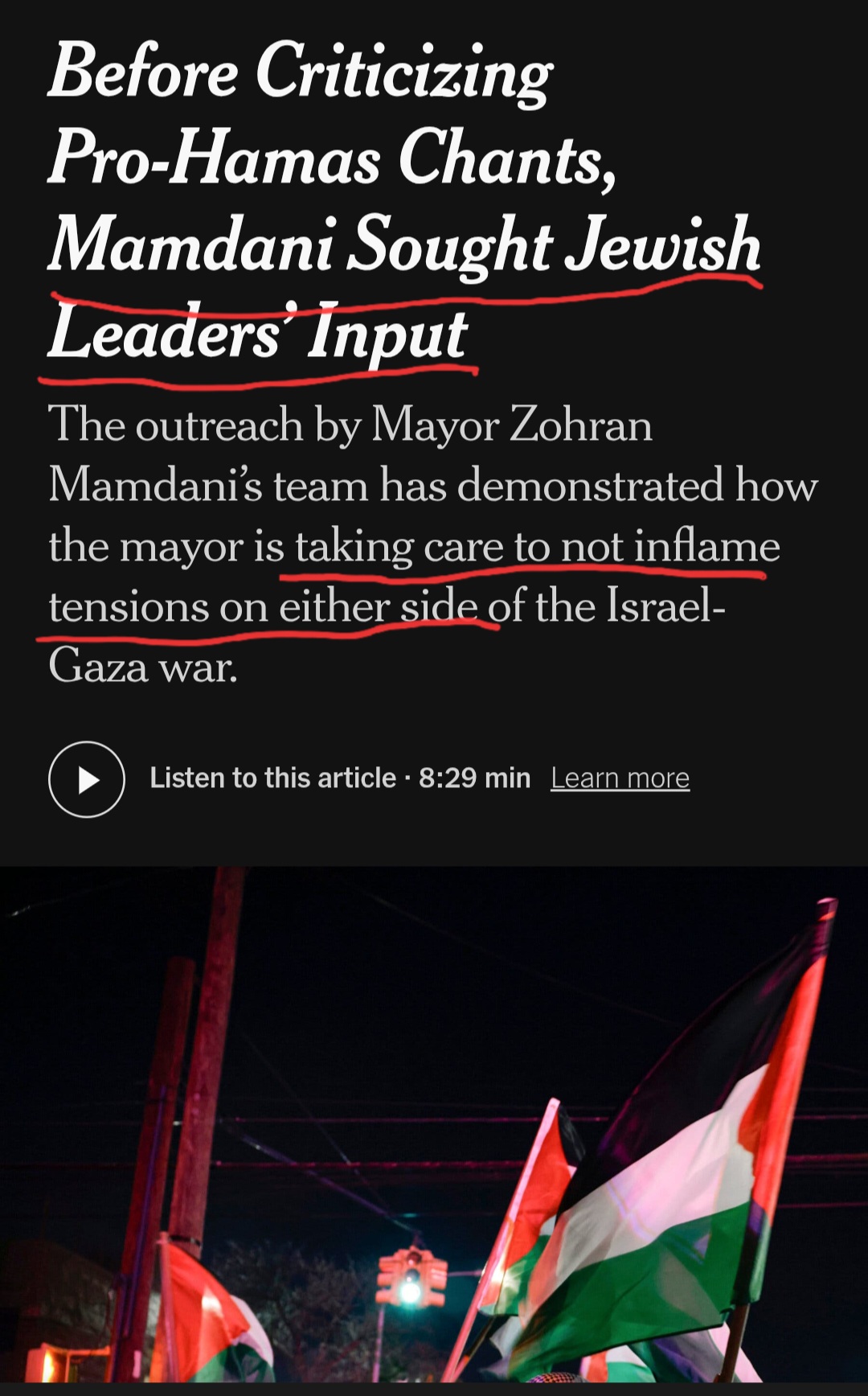
Zohran Mamdani, the incoming mayor of New York City who is comfortable with the phrase “globalize the Intifada,” will be in charge of law enforcement in the city with the greatest number of Jews.

  • How will he respond when Baruch College at the City University of New York suggests Jews cancel holiday events because antisemites have the run of the school and the institution cannot (will not) assure their safety?
  • What will he do when Jewish students at New York University cannot enjoy the school’s facilities because of gross failures to protect students?
  • Who will send in the police when Columbia University Jewish students are forced to walk a tight direct line between classrooms with an escort, because the university cannot secure the campus for everyone?
  • Where will the courts and law enforcement be when Jewish students and faculty at CUNY Hunter College are forced to cancel or not attend classes because of widespread harassment and intimidation?

Students at Cooper Union in downtown NYC lock themselves in a library while anti-Israel protestors threaten them outside

A successful liberal democracy welcomes immigrants and may elect a Ugandan born mayor. Yet it fails to be a liberal democracy when Jews are forced to flee the streets because governmental officials give a free pass to harassment, intimidation and discrimination.

The West is on the cusp of learning whether it remains a liberal democracy. And whether it cares.

Chabad Caught In a Thicket

There are Jews who keep their heads down. And then there is Chabad.

From Bondi Beach to Mumbai, from Barcelona to American college campuses, Chabad does the opposite of what fear would counsel. It does not retreat inward. It goes outward—publicly, cheerfully, stubbornly—lighting candles, setting tables, opening doors.

And for that, it bleeds.

In Australia, Chabad helped organize a large public Chanukah gathering near Bondi Beach—sun, music, children, light. A Jewish holiday celebrated exactly as it was meant to be: openly, without apology. Antisemites came – because, as they say of bank robbers robbing banks – that’s where the Jews are. Violence came to eradicate the joy.

In India, Chabad paid an even heavier price. During the 2008 Mumbai attacks, terrorists deliberately sought out the Chabad House. This was not collateral damage in a geopolitical struggle between India and Pakistan. It was targeted slaughter. The rabbi and his wife were tortured and murdered because they were Jews—and because they were visible Jews, serving other Jews. The attackers bypassed many targets to reach them. They knew exactly who they were looking for.

This pattern repeats itself with chilling consistency. Chabad emissaries—shluchim—are not anonymous. They live openly as Jews in places where Jews are few, where governments barely register their presence, let alone prioritize their safety. Some countries have only dozens of Jews. Some have none at all, except for Chabad.

And still Chabad goes.

On Friday nights in Barcelona, Jewish life gathers around Chabad tables. Tourists, locals, students—many unaffiliated, many unsure—find Judaism not as a political identity or an abstract cause, but as food, song, wine, warmth. As Shabbat.

On university campuses across North America, Chabad events now regularly outshine Hillel. This is not accidental. Where Hillel has often drifted toward “wokeness,” flattening Judaism into a vague social-justice aesthetic, Chabad offers something older and sturdier: tradition without embarrassment. Commandments without footnotes. Jewish joy without ideological permission slips.

That, too, draws attention. And danger.

Chabad rabbis and their families know they wear a mark, and not metaphorically. They live without anonymity. They publish their addresses. They welcome strangers. They light menorahs in public squares at a moment in history when public Jewishness has been recast as a provocation.

Chabad lighting “the largest menorah” on the sixth night of Chanukah in Brooklyn’s Grand Army Plaza in 2017 (photo: First One Through)

Chanukah, of all holidays, insists on this. It is not meant to be hidden. The lights are placed in windows, at doorways, facing the street. Pirsumei nisa—publicizing the miracle—is the law. Chabad takes it seriously, even when the risk feels immediate.

In a world where Jew-hatred has resurged with startling comfort, Chabad has become something else as well: exposed in the spotlight.

There is an old biblical image for this.

When Abraham is told to sacrifice Isaac, the knife is raised but the sacrifice is halted. Instead, a ram appears, caught in a thicket by its horns. The ram is offered in Isaac’s place.

Chabad, today, feels like that ram.

Silhouette of two Chabad men at a Chankah lighting ceremony on the Upper East Side of Manhattan, shortly after the massacre of Jews in Bondi Beach, Australia in December 2025. Just a few hundred feet away sits Gracie Mansion, soon-to-be home of New York City’s new mayor, Zohran Mamdani, who refuses to repudiate the phrase “Globalize the Intifada,” a call to kill diaspora Jews. (photo: First One Through)

Not because Chabad seeks martyrdom—it emphatically does not. It absorbs the blows meant for Jewish visibility itself. It becomes the target because it brings together Jews to celebrate Judaism with gladness – the ultimate point of inflammation for antisemites.

The world often says it wants Jews to be “normal.” Chabad refuses that bargain. It insists on being Jewish instead—fully, visibly, joyfully—even when the cost is high.

Chabad is not actually caught in a thicket; it takes its position openly. But antisemites hear a calling that is not divine but grotesque when they see joyful Jews, and are willing to sacrifice themselves and their sons – like the murderers of Bondi Beach – to feed the poisoned passion.

Stop With the Hanukkah Miracle and Declare the Hanukkah MESSAGE

The Book of the Maccabees lays out that the war against the Jews did not start with violence but with policy. The Syrian-Greeks initiated the battle by denying Jews their right to religious practice. Jewish life was made illegal through decrees and prohibitions, through the quiet insistence that Jews no longer have standing in their own holiest spaces.

The Temple Mount was seized. Jewish worship was banned. Foreign rites were imposed in its place. The text is precise and unsparing:

“And forbid burnt offerings, and sacrifice, and drink offerings, in the temple; and that they should profane the sabbaths and festival days…. They set up the abomination of desolation upon the altar, and built idol altars throughout the cities of Juda on every side.”
1 Maccabees 1:45
, 1 Maccabees 1:54

When the Maccabees returned to Jerusalem, the devastation they witnessed was total. The enemies of the Jews intended humiliation. A holy place was turned into a ruin so complete that nature itself began to reclaim it.

“They saw the sanctuary desolate, the altar profaned, and the gates burned. In the courts shrubs had grown up as in a forest.”
1 Maccabees 4:38

Judas and his brothers refuse to accept erasure as permanent and took action:

“Then Judas and his brothers said: ‘Behold, our enemies are crushed. Let us go up to cleanse the sanctuary and dedicate it…. They tore down the altar and stored the stones in a suitable place on the temple hill until a prophet should come to tell what to do with them.”
— 1 Maccabees 4:36, 44–46
“They purified the sanctuary and made another altar of sacrifice… and offered burnt offerings according to the law….They celebrated the dedication of the altar for eight days, and offered burnt offerings with gladness.
— 1 Maccabees 4:48–56

And then memory was mandated.

“Judas and his brethren with the whole congregation of Israel ordained, that the days of the dedication of the altar should be kept in their season from year to year by the space of eight days, from the five and twentieth day of the month Casleu, with mirth and gladness.”
1 Maccabees 4:59

Why legislate remembrance? Why must it be done with joy?

Because danger does not end with victory nor complacency. The danger is forgetting how erasure begins—how denial of access precedes denial of life. Enemies rarely announce extermination at the start. They begin by declaring Jews illegitimate, unworthy of presence, unfit to practice their own traditions.

Guard blocks entry of a Jewish man onto the Jewish Temple Mount at the Cotton Merchant’s Gate, because he is a Jew, in November 2025. (Photo: First One Through)

The Maccabees understood something timeless: when Jews accept exclusion as normal, the battle has already been lost. When they are told to make do with less than basic human rights demand, they can never really have a full heart.

Hanukkah is the refusal to let others define Jewish legitimacy. It is the insistence that Jewish rights—to worship, to gather, to exist openly—are not privileges granted by empires or overseers, but as the opening lines of America’s Declaration of Independence state, “endowed by their Creator.”

So it was in their days. So it is in ours.

Bondi Attack: Can Jews Be Victims in the Media?

There are moments when a headline tells you everything by what it refuses to say.

A mass shooting took place at a Hanukkah party in Sydney, Australia. A Jewish holiday. A Jewish gathering.

Yet when major global outlets reported the story, something curious happened.

The New York Times headline did not mention Jews. Only the sub-header caught the significance of the attack, but did not say Jews were targeted.

More disturbing, follow-up articles did not focus on the horrific spike in antisemitism in Australia these past two years. Instead, the Times posted an article about… Bondi Beach, and how beautiful and popular it is.

The BBC followed a similar path. So did The Guardian. So did others like CNN. The event was flattened into abstraction: a “shooting,” a “disturbance,” a “tragedy,” untethered from identity.

By contrast, The Telegraph named Jews. The Jerusalem Post did as well. The New York Post and CNBC, too. Al Jazeera did not. Actually, Qatari-owned Al Jazeera attempted to whitewash the entire incident that there was “no information.”

This divide is not accidental. It reflects something deeper and more uncomfortable.

Because at the same moment that major Western media hesitated to name Jewish victimhood, the global Jewish community had no such confusion. WhatsApp groups lit up within minutes. Videos circulated—not to sensationalize, but to bear witness. The injured were named, not as statistics but as people. Hebrew names were shared so strangers across continents could pray for them.

No one asked whether Jews had been targeted. They knew.

The only uncertainty discussed privately was not if the attack was antisemitic, but which strain of antisemitism it represented. Neo-Nazis? Radical Islamists? A lone actor steeped in online hate? Jews have learned, painfully, to recognize the pattern even before the authorities finish their press conference.

So why the hesitation in public framing?

Why is Jewish identity often erased precisely when Jews are attacked?

Part of the answer lies in a narrative trap the modern media has built for itself. Jews, especially Israeli Jews, are increasingly cast in a single role: power holders, enforcers, aggressors. In that framework, Jews are permitted to be actors—but not victims. Agents—but not targets. Perpetrators—but not innocents.

Victimhood, in today’s moral economy, is rationed. And Jews often find themselves disqualified from it in favor of victims of preference.

Naming Jews as victims complicates the preferred storyline. It disrupts the binary of oppressor and oppressed. It forces an uncomfortable reckoning: that a people portrayed relentlessly as powerful are still being hunted in synagogues, homes, and holiday celebrations—from Pittsburgh to Poway, from Paris to Copenhagen, from Jerusalem to Sydney.

And so the language softens. The identity disappears. The motive is delayed, blurred, or left unexplored. The story becomes about the setting, not the target. About the neighborhood, not the people. About ambience, not intent.

The question is not whether Jews are under attack. That is beyond dispute.

The question is whether the world’s most influential media institutions are willing to say so plainly—or whether Jews may only appear in headlines when they are accused, never when they are wounded.

Part of the answer to the disgraceful shrug to the barbaric October 7 massacre in Israel is the systemic brainwashing that has been going on, that Jews cannot be viewed as innocent victims. Even when they plainly are, half a world away.