We are in the middle of the Jewish holiday season, and Judaism has demanded a lot from us.
Rosh Hashanah asked us to stand in judgment. The Ten Days of Repentance asked us to examine ourselves. Yom Kippur demanded confession, fasting and repentance.
And then Judaism tells us to be happy.
Sukkot is zman simchateinu — the time of our joy.
The pivot can feel jarring. The melodies of Yom Kippur are still in our heads when we leave the synagogue, eat, begin building the sukkah and prepare for a holiday explicitly defined by happiness.
Kohelet, which Jews read on Sukkot, provides an answer: “There is a time for everything, and a season for every activity under the heavens.”
A time to weep and a time to laugh. A time to mourn and a time to dance. A time to be silent and a time to speak. A time for war and a time for peace.
Kohelet does not suggest that human beings experience only one emotion at a time. We can mourn and feel gratitude. We can love and be angry. We can be frightened and hopeful.
But Kohelet points somewhere else: that emotions and activities do not only exist in time, but time is defined by emotion and activity.
Different moments call for different responses. The emotions we might personally carry do not relieve us of the obligation to recognize what the present moment demands.
Israel offers a powerful example today.
Israel has inflicted extraordinary damage on enemies that sought its destruction. Hamas and Hezbollah have been badly degraded, and Iran has suffered devastating blows. Israelis can feel enormous relief at what Israel has survived and accomplished.
At the same time, Israel faces extraordinary international hostility and diplomatic isolation. The image at the United Nations this week captured that reality starkly: as Prime Minister Benjamin Netanyahu took the podium, dozens of delegations walked out, leaving him addressing a largely empty chamber.
So what should Israelis feel today? Relief? Alarm? Both?
Kohelet does not require one feeling to vanquish the other. The challenge is recognizing which response the present moment calls for.
Rabbi Lord Jonathan Sacks captured something similar in describing the distinctive nature of joy: “Joy lives in the moment. It asks no questions about tomorrow. It celebrates the power of now.”
That may explain why Sukkot follows Yom Kippur so quickly. Judaism does not give us weeks to transition from solemnity to celebration. We finish fasting and begin building a sukkah. We do not need to resolve every worry before experiencing joy. As Rabbi Sacks continued, joy “knows that yesterday has gone and tomorrow is unknown.”
Tomorrow will bring whatever tomorrow brings. Kohelet asks us to recognize today.
“Genocide” is usually treated as a description: a word often intended to characterize what is happening in Gaza. People unpack the actual definition and bring dozens of examples to prove why the accusation is not just false but slander, or accurate.
But it distracts from the environment the word lives in. The word functions as a tool of the accuser.
The same word serves different purposes for different groups.
Humanitarian organizations use it as a bullhorn to protect Palestinians.
Anti-Israel protestors use it to undermine military support for Israel.
Political actors in the Arab and Muslim world use it to keep the Abraham Accords from expanding.
Antisemites use it to attack Zionists and Jews.
Palestinian Arabs use it as a form of absolution.
And in response to the tool being worked into their sides and hearts, Jews are being forced to consider what the charge means for their relationship with Israel, with one another and with the people making it.
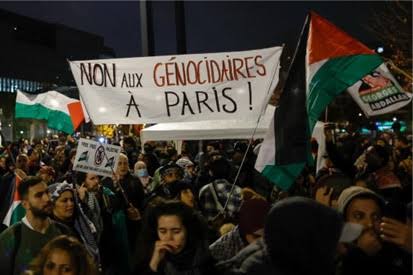
Signs in Paris
The first function is humanitarian.
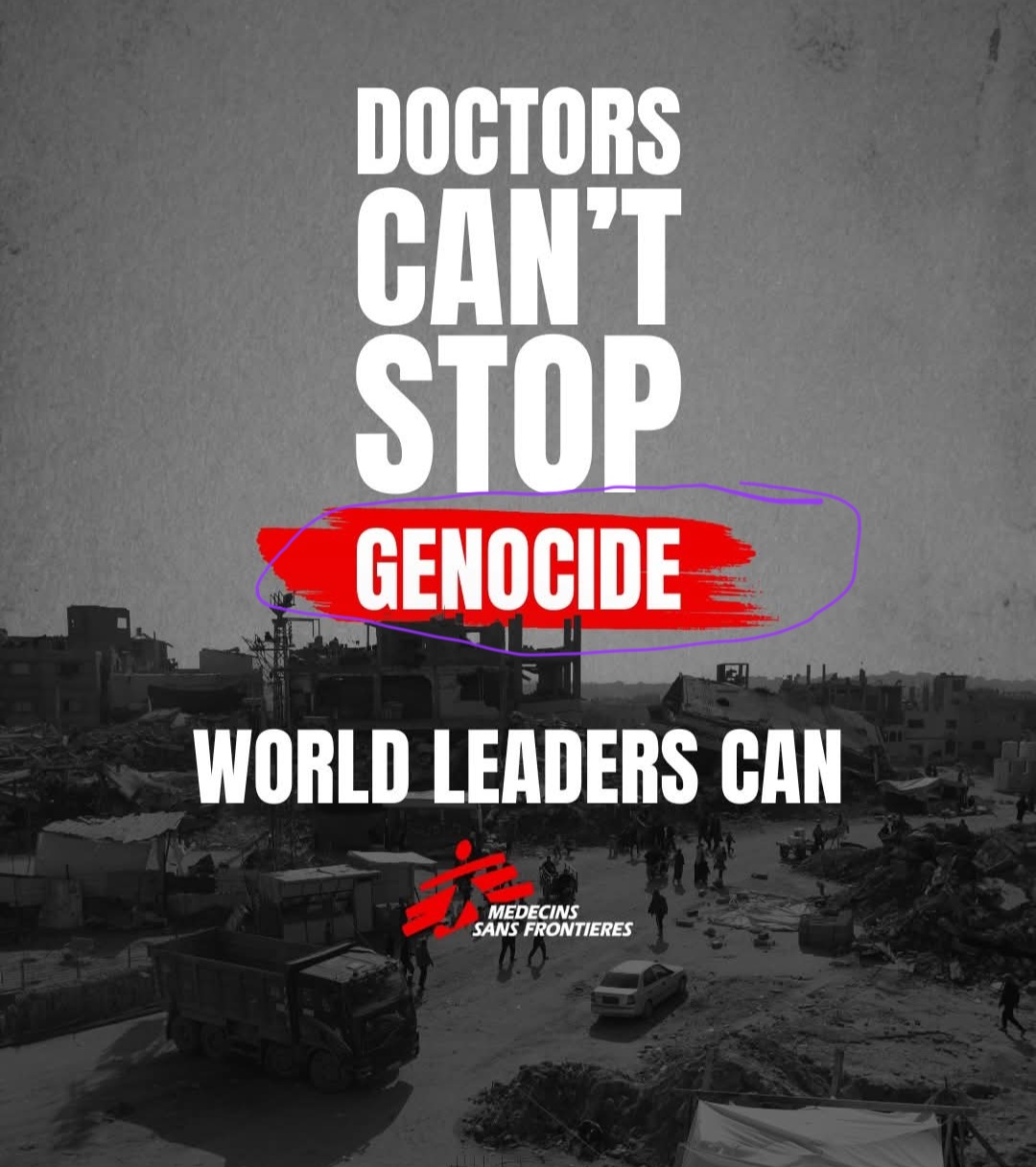
Pro-Palestinian activists and human rights organizations, use the accusation of “genocide” to create the greatest possible urgency around Palestinian Arab suffering. It makes the world jump the queue of Somalia, Sudan, Yemen, Ukraine or any number of regions suffering massive death.
In common terminology, calling civilian deaths a “tragedy” demands sympathy. Calling them “disproportionate” raises questions about military conduct. Calling them “war crimes” demands investigation. But calling them “genocide” demands that they stop. Immediate intervention becomes the imperative.
Doctors Without Borders
The second function is policy.
For activists seeking to weaken or end Western support for Israel, the genocide accusation transforms the argument over weapons. Countries supplying Israel with arms can be accused of enabling genocide. The target expands from Israeli military conduct to the governments, companies and institutions that make that conduct possible. Arms sales become complicity. Military assistance becomes something that must be stopped rather than merely conditioned.
Protest outside General Dynamics in Maine
It similarly pressures would be allies of Israel to pause. One of the reasons Hamas launched the war when it did was that Saudi Arabia was getting very close to joining the Abraham Accords and normalizing relations with the Jewish State. The masses would rebel if the kingdom normalized such relations when a “genocide” was unfolding against Muslims nearby.
The third function is social — external.
For antisemites, “genocide” provides an extraordinarily powerful accusation to direct against Zionists and Jews.
Once Israel is placed in that category, the accusation travels outward. Zionists become supporters of genocide. Jewish organizations defending Israel become its enablers. Jews associated with Zionism are pressed to answer for it.
The argument has traveled from Gaza to Jews themselves. “Genocide” becomes a means of stigmatizing Zionists, excluding them from institutions and social spaces, and targeting Jews who refuse to disassociate themselves from Israel.
Graffiti in Scarsdale, NY
The fourth function is absolution via inversion.
Palestinian Arabs and their supporters divert attention away from the truly genocidal acts and intentions of Hamas, Palestinian Islamic Jihad, dozens of jihadi terrorist groups and thousands of Palestinian Arabs. Attaching a label of genocide on Israel reorients the viewers and grants amnesty to the heinous acts of October 7, and allows room for people to rationalize the action.
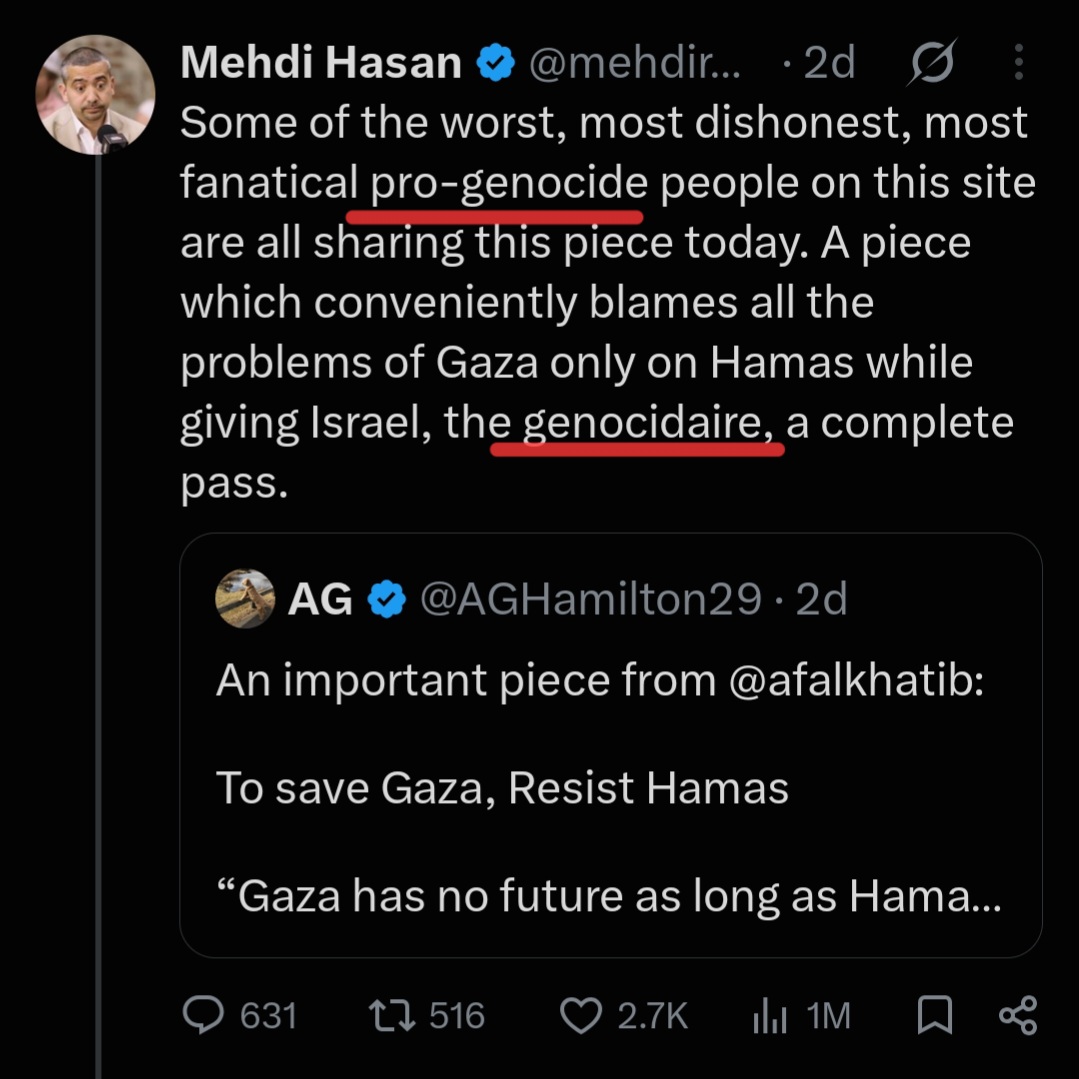
Media personality Mehdi Hasan repeatedly invokes “genocide” associated with Israel and its supporters
The fifth function is social — internal.
Here the audience is the Jewish community itself. Jews are being asked to not only look at the war, but at one another and at the people deploying the accusation.
They must decide what they believe Israel is doing. They must decide whether other Jews who reach a different conclusion remain inside a shared communal tent. And they must decide how to regard the organizations, movements, individuals and governments using the word “genocide” – as humanitarian advocates, political adversaries, antisemites, jihadists or some combination of them.
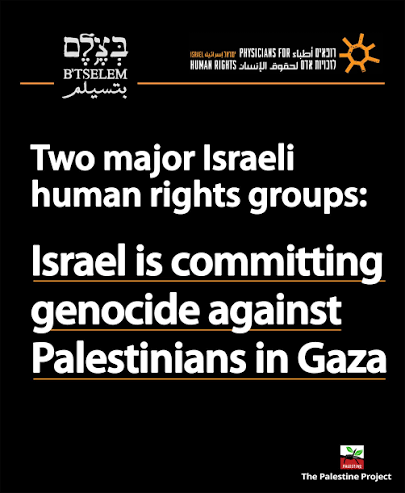
Far-left Israeli group B’Tselem
“Genocide” is much more than a smear in this war. It acts. And to miss that point is to miss the invisible war that has permeated society.
The Gilder Lehrman Institute of American History has a good rule for teaching history: let students read primary sources.
So when it teaches September 11, students can encounter Osama bin Laden in his own words. That should make the origins of 9/11 unusually difficult to sanitize.
Bin Laden’s 1996 document was a Declaration of Jihad Against the Americans Occupying the Land of the Two Holy Mosques. Its principal immediate grievance was the presence of American forces in Saudi Arabia, home to Mecca and Medina. He condemned the Saudi government for permitting what he called an army of “infidels” into land containing Islam’s holiest places and called on Muslims to drive them out.
The bipartisan 9/11 Commission described the document plainly. Bin Laden objected to “an army of infidels in a land with the sites most sacred to Islam.” He saw himself as following in the footsteps of the Prophet and organizing a new kind of war against America.
This was not simply a dispute over where the Pentagon stationed troops. Their being non-Muslims was central to the offense.
The declaration said Muslims should kill Americans, including civilians, wherever they could be found.
“The ruling to kill the Americans and their allies — civilians and military — is an individual duty for every Muslim who can do it in any country in which it is possible to do it, in order to liberate the al-Aqsa Mosque and the holy mosque [Mecca] from their grip, and in order for their armies to move out of all the lands of Islam, defeated and unable to threaten any Muslim. This is in accordance with the words of Almighty Allah, “and fight the pagans all together as they fight you all together,” and “fight them until there is no more tumult or oppression, and there prevail justice and faith in Allah.”” – 1998 Fatwa
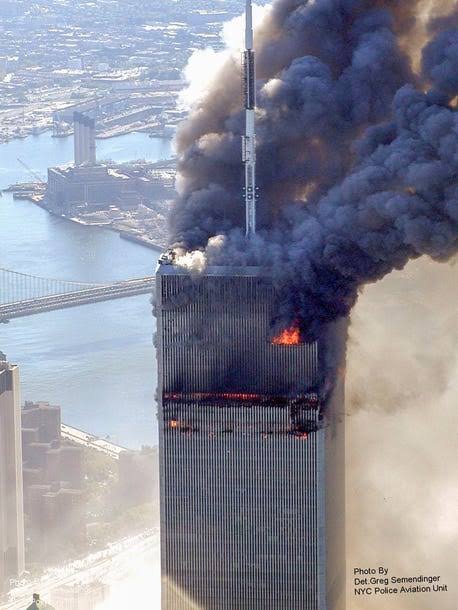
Then came the jihadi terrorist attacks of September 11.
That is where Gilder Lehrman’s lesson becomes peculiar.
Its current historical background accurately identifies al-Qaeda as an “international terrorist group.” But its explanation of bin Laden’s motivation says he “claimed that he was defending Islam” before quickly translating the dispute into political language: “He blamed the United States for supporting Israel and oppressing Muslims around the world.” It adds his opposition to American support for governments such as the Saudi monarchy.
It never uses the word “jihad” a single time, even when Bin Laden’s own 1996 and 1998 declarations both use “jihad” in the titles. The narrative is recast as a political dispute rather than a religious holy war.
The American presence in Saudi Arabia wasn’t objectionable to bin Laden merely because he disliked an American military deployment. His declaration treated an army of infidels in Islam’s sacred land as an offense demanding jihad.
His organization didn’t subsequently call itself the International Front Against American Middle East Policy. It invoked Jews and Crusaders – both words never used in the GLI lesson plan.
The curriculum directs students toward questions about American foreign policy. Its broader narrative proceeds rapidly from the attacks to American intelligence failures, the Patriot Act, surveillance, Guantánamo Bay, civil-liberties concerns, anti-Muslim discrimination, Afghanistan and Iraq.
Those are all legitimate subjects in a history of the War on Terror, AFTER 9/11.
But before asking about American actions after September 11, students should understand why 19 men believed murdering thousands of civilians was righteous in the first place. It does not require blaming Islam or all Muslims for September 11.
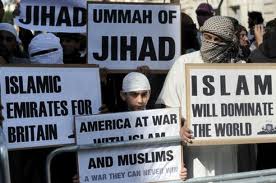
The distinction is straightforward: Islam is not al-Qaeda, and Muslims are not responsible for al-Qaeda. But al-Qaeda is a jihadist movement whose leaders explicitly justify their violence in religious terms.
There is another revealing asymmetry.
Gilder Lehrman makes sure students learn that hate crimes and discrimination against Muslim Americans increased after September 11. That belongs in the history. President George W. Bush’s insistence that America’s enemy was terrorism rather than Islam belongs there too.
But if prejudice against a religious group after the attack deserves explicit attention, surely the religious ideology of the men who carried it out deserves the same scrutiny.
Imagine reading a Declaration of Jihad filled with God, Islam, infidels, sacred territory and martyrdom—and being trained to search everywhere except religion for the explanation.
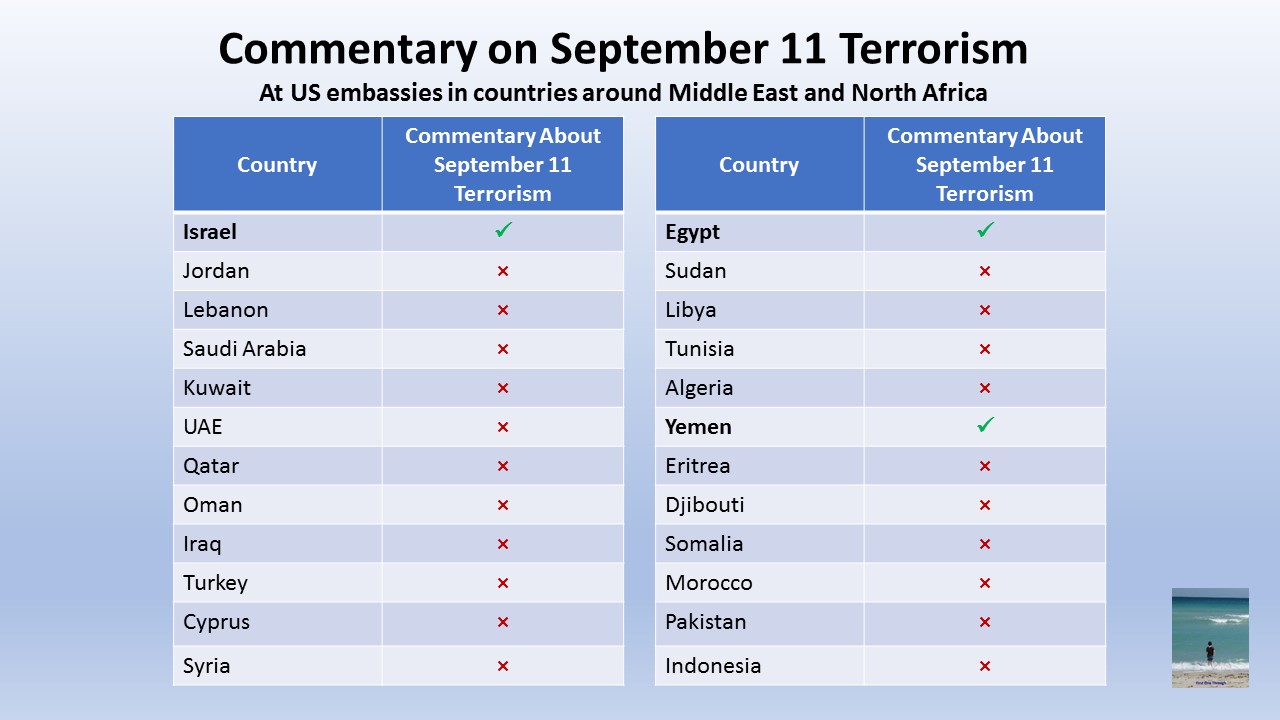
On September 11, 2022, only three American embassies in the Middle East posted commentary about the horrific jihadi attacks in the United States in 2001 – Israel, Egypt and Yemen – seemingly trying to avoid upsetting the Muslim majority countries
Gilder Lehrman’s great educational principle is that students should encounter history through original documents rather than having someone else tell them what happened. But here, the documents are presented and then the lesson redirects students toward American foreign policy and the subsequent War on Terror. It shifts the center of the 9/11 story from genocidal jihadists murdering thousands of innocent Americans to Muslims suffering from American policies, wars, discrimination and backlash.
That is an extraordinary inversion. And an insult to thousands of Americans who were murdered.
For two years, Europe’s movement against Israel looked like a one-way ratchet.
After October 7, governments that had resisted recognizing a Palestinian state for decades suddenly did so. Spain, Ireland, Norway and Slovenia moved in 2024, followed by additional countries in 2025. Each recognition was celebrated as permanent diplomatic progress for the Palestinians and another irreversible loss for Israel.
But then Slovenia held an election and the government that recognized Palestine lost. The new right-of-center government is dramatically more pro-Israel, with discussion of reversing Palestinian recognition and moving Slovenia’s embassy to Jerusalem.
Palestine didn’t lose Slovenia because Israel won an argument. It lost Slovenia because Slovenia changed governments.
Slovenia is small but the precedent isn’t.
France and Spain vote in 2027. Both have been important forces behind Europe’s turn against Israel. Both could move rightward. Spain, in particular, has become one of Israel’s most antagonistic governments in Western Europe under Pedro Sánchez, and parties on the right are predicted to do well.
If Slovenia is a preview, the supposedly permanent European diplomatic shift after October 7 may prove to have been something much less permanent: the policies of a particular collection of governments at a particular moment.
But before France and Spain vote comes Israeli elections in October 2026.
A new Israeli government could deprive European politicians of the convenient ability to present hostility toward Israel as merely opposition to Benjamin Netanyahu. Or a reelected Netanyahu would carry something different: a fresh democratic mandate from Israelis after October 7 and the wars that followed.
Whichever way Israeli elections go, France and Spain would be making their choices in a new political environment.
And Donald Trump will still be in the White House.
That matters particularly for Spain. Trump and Sánchez have already clashed repeatedly, while Washington remains closely aligned with Israel. A future Spanish government could therefore inherit not merely an opportunity to repair relations with Jerusalem, but an incentive to move closer to Washington at the same time.
Israel should be preparing for that possibility now. That means building relationships with plausible future governments before they take office.
Israel and pro-Israel organizations – including global evangelical groups – should be talking now with the parties, parliamentarians, foreign-policy advisers and prospective ministers who could govern France and Spain in 2027. And those conversations should extend beyond defending Israel to demonstrating what closer relations offer: defense, intelligence, technology and trade.
Israel should also have a menu ready for the morning after an election: reconsider Palestinian recognition, change hostile UN voting, reverse restrictions on Israel and deepen bilateral relations—including, where politically possible, moving embassies to Jerusalem. Importantly, in the immediate present, Israel can show the world via Slovenia the benefits of close diplomatice ties.
For the past two years, Israel has treated every European move toward Palestine as another irreversible diplomatic loss. Slovenia just demonstrated that the ratchet works both ways.
Governments can change. And when they do, Israel should be ready to make the ratchet click backward again.
A predator attacks a porcupine expecting an easy meal. Instead, it gets a face full of quills.
Photograph the predator afterward and it may look like the victim. Its wounds are real. Its suffering is real. But the photograph is missing the most important fact: it attacked the porcupine.
That injured predator Nakba’d itself.
Consider Argentina in 1982. It invaded the Falkland Islands expecting Britain to accept the conquest. Britain sailed across the Atlantic, fought back and retook them. Hundreds of Argentine servicemen died, including 323 when a British submarine sank the General Belgrano.
Begin the story with the sinking and Britain looks like the aggressor. Begin it with Argentina’s invasion and you understand why British forces were there. Chronology changes the story.
Which is core of the word Nakba.
In 1947, the United Nations proposed Jewish and Arab states for two people with long ties to the area of Palestine, one for Jews who had ruled for hundreds of years in the land, and one for local Arabs who aspired to their own country. Jewish leaders accepted partition while Arab leaders rejected it. After Israel declared independence in May 1948, armies of five neighboring Arab states entered the war against the reborn Jewish state.
The Arab calculation was breathtaking.
Only three years after the Holocaust, a tiny Jewish state was filled in part with survivors and refugees. Six million Jews had just been murdered. Its enemies looked at a shattered people surrounded by a much larger Arab world and saw weakness.
They mistook vulnerability for helplessness.
They attacked the porcupine. And they lost.
Israel survived. Hundreds of thousands of Palestinian Arabs fled the battlefield as they waited for their Arab brothers to wipe out the Jews. And they lost the war they launched. In the end, Israel ended the fighting with more territory than the UN partition plan had allocated it.
Palestinian Arabs named their defeat “al-Nakba” — the Catastrophe. But over time, their catastrophe became a romanticized socialist-jihadi word stripped of its rejection of coexistence and fervor for extermination of Jews, even as the sentiments remained deeply embedded in Arab culture.
Still, the photojournalists showed the wounds as evidence of who must have been the victim.
So the Nakba lives on.
Hamas demonstrated that Israel was vulnerable, murdering 1,200 civilians and soldiers and abducting 250 hostages. When Israel fought back Gaza suffered terrible destruction. Once again, the world’s camera focused on the wounded predator rather than the beginning of the encounter.
The Gazans Nakba’d themselves again. They attacked, suffered, and then pointed to their injuries in a plee.
The animal kingdom does it. The quills can be devastating. But the story is clear.
Stop the hatred. Stop the attacks. Stop the complaining after losing the fight you sought and launched.
The Promised Land is repeatedly described as “a land flowing with milk and honey.” It sounds like a simple promise of abundance. But for the Israelites, food carried a deeper meaning. Food was the reason their ancestors ended up in Egypt.
Three times in Genesis, famine strikes Canaan. Abraham leaves for Egypt. Isaac faces another famine but is commanded by God to remain. When famine comes in Jacob’s generation, his sons go to Egypt for grain. Eventually the entire family follows. They go because their land cannot feed them. They stay long enough to become slaves.
Seen against that history, “a land flowing with milk and honey” is more than a promise of fertile soil. It is a promise of independence. You will have a land that can feed you. You will not have to leave it to survive or depend upon another nation for the food that keeps you alive.
Deuteronomy makes the promise explicit: “a land in which you will eat bread without scarcity, in which you will lack nothing.”
The Exodus therefore does not really end when Israel leaves Egypt. Nor does it end in the desert, where the people remain dependent upon manna falling each morning. It ends when they can live from their own land.
That makes the report of the spies remarkable. They enter Canaan and find exactly what God promised. They return carrying its enormous fruit and concede: “It indeed flows with milk and honey.” They cannot say the land will not feed Israel. So they invert the warning. “It is a land that eats its inhabitants.” Eretz ochelet yoshveha. A land that eats those who live in it.
Genesis presented the danger of a land that could not feed the Jews, forcing them to leave. The spies imagine the opposite danger. The land will produce abundantly, but the Jews who enter it will be consumed.
The Promised Land will become their tomb.
The dispute is therefore not really about agriculture. Everyone has seen the fruit. It is about whether Jews can survive in their own land. Joshua and Caleb believe they can. The other spies do not. They can imagine Jews surviving in Egypt, even as slaves. They have watched Jews survive in the desert through miracles. What they cannot imagine is Jews entering their own land, defending it, cultivating it and sustaining themselves there.
Jewish history would give that argument an extraordinary afterlife.
Jews established themselves in the land, lost their sovereignty and spent centuries living among other nations, dependent upon those nations for permission to remain. They were welcomed and expelled, protected and persecuted. Again and again, Jews had to leave one place and seek survival somewhere else.
The modern return to Israel was therefore a return not merely to territory, but to the promise behind the milk and honey: Jews would once again sustain themselves, defend themselves and build a society that did not depend upon another country’s willingness to shelter them.
They succeeded beyond what the spies could have imagined. A poor and vulnerable country became one of the Middle East’s most advanced economies, producing food, technology, medicine and military power and selling its innovations around the world.
Yet the ancient question has not disappeared. Israel still depends upon alliances, foreign markets and imported goods, as modern nations do. It worries whether its most talented people will remain and build there. It receives substantial American military support while hostile powers seek increasingly dangerous weapons and some openly call for the destruction of the Jewish state.
Self-sufficiency does not mean isolation. No modern country survives alone. The deeper promise is that Jews should possess enough economic, military and human strength that they are never again forced to abandon their home simply to survive.
For centuries, Jews were forced to leave one country after another. They finally returned to the land their ancestors had feared entering and built a country capable of feeding, defending and sustaining them.
Yet the spies’ fear still hovers over the Jewish state: could the land in which Jews finally learned to defend themselves also become the place where their enemies destroy them? The question is as old as the spies and as current as Israel itself.
I have a somewhat different view of cemeteries from many people in Orthodox Jewish circles.
Many Jews visit the graves of famous rabbis and holy figures to pray. Friends travel to the Ohel in Queens, where the last Lubavitcher Rebbe is buried, or to the graves of Maimonides and other celebrated rabbis in Israel. I have never felt comfortable doing so.
My inclination begins with the Bible’s account of Moses. He died alone, outside the Land of Israel, and his burial place remains unknown. That detail does not appear incidental. In the Torah’s final lines, it seems almost deliberate: Moses was the greatest prophet, yet his grave was not to become a shrine. His teachings were to remain sacred, but his physical remains were not to become a destination or an intermediary.
When I asked friends why they visit the graves of holy people, they offered several explanations.
The first was that a righteous person enjoyed a special relationship with God, and that the place where such a person is buried therefore offers a closer portal to the divine.
The second was that a place where people have gathered in prayer for generations acquires a special spiritual character.
The third was that traveling deliberately to a particular place changes the visitor. The journey creates focus, humility and a frame of mind that may be difficult to achieve in ordinary surroundings.
The first explanation, I believe, is both the most common and the most troubling. The suggestion that the physical remains of a holy person can function as a medium to God comes dangerously close to the very impulse the Torah appears to guard against by concealing Moses’s grave. It risks replacing the person’s teachings with the person’s body.
A better way to preserve a righteous person’s connection to God is to study that person’s work, absorb his ideas and live according to his example. His thoughts, not his remains, should serve as the conduit. A grave contains the body he left behind. His Torah contains what he gave the world.
The second and third explanations are different. They do not necessarily treat the deceased as an intermediary. Instead, they recognize the power of place.
A site shaped by centuries of prayer may carry historical and emotional meaning. A family grave may help a child remember a parent, confront loss, express gratitude or recover a sense of continuity. Some people can reach that state of reflection anywhere. Others need a physical place that separates the moment from ordinary life.
And here is where the role of rabbis becomes interesting. How to handle a common situation and desire whose motivation is the dividing line between something permissible and not?
Orthodox Judaism frequently erects legal fences around conduct that may lead toward something prohibited. The belief that a deceased holy person can provide privileged access to God would seem to warrant precisely such caution. The practice risks sliding from remembrance into mediation, and from reverence into something uncomfortably close to worship.
But visiting a grave for memory, history, mourning or personal reflection does not necessarily carry the same danger. The distinction lies in what the visitor believes is happening there. Is the dead person being asked to act, or is the living person being moved to remember, think and pray?
That distinction deserves serious consideration as the Jewish community buries soldiers and victims of terror, cares for those carrying lasting injuries, remembers those who uplifted and supported the community, and confronts antisemitism on a scale not experienced in decades. Cemeteries will inevitably become increasingly powerful places of collective visitation and reflection.
They can remind us of sacrifice, courage, wisdom and the unfinished obligations of the living. But the grave should point beyond itself. It should direct us not toward the power of the dead, but toward the lives they led, the ideas they carried and the responsibilities they have left to us.
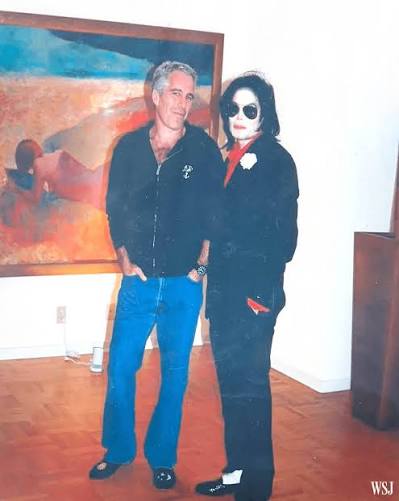
Today, one corner of the internet insists Jeffrey Epstein wasn’t merely a criminal but part of a vast Mossad operation. It emerged in the mainstream as recently parroted by Vice President JD Vance.
Another conspiracy theory surrounds UFOs visiting Earth for decades, governments hiding crashed spacecraft, and ordinary Americans being routinely abducted in the middle of the night.
Oddly enough, these two groups have spent years talking past one another.
Until now.
Because once you’ve accepted both theories, there is only one remaining conclusion: Jews are from outer space, just as Mel Brooks told you years ago.
The conspiracy theorists spent years saying Epstein worked for Mossad and that aliens walk among us. Maybe Epstein wasn’t working for the Mossad as much as the Mossad was working for the aliens.
You think it’s a coincidence that Israel – a country smaller than New Jersey – has more technology startups per capita than almost anywhere else on Earth? Back on their home planet, Israeli cybersecurity is considered an eighth-grade science project. Artificial intelligence? Homework.
Israeli entrepreneurs don’t invent technology. They import it.
Because Israel isn’t merely a country. It’s the portal.
Jerusalem became holy because that’s where the first extraterrestrials landed. Long before Abraham, the Galactic Federation designated the site as Landing Zone One.
Humans eventually built temples there because they mistook the landing pad for sacred architecture.
The Western Wall? The only surviving section of the original intergalactic arrival terminal after the Romans demolished the rest during an unfortunate urban renewal project.
The Dead Sea Scrolls? Maintenance manuals.
The menorah? A seven-port charging station.
Moses didn’t part the Red Sea. He accidentally activated the anti-gravity system.
Today, the signals are in plain sight:
Cholent isn’t food. It’s fusion-reactor fuel. It cooks overnight because spacecraft recharge slowly.
Challah is braided because that’s the optimal shape for stabilizing wormholes.
The shofar isn’t a ram’s horn. It’s an beacon transmitting, “Landing corridor clear.”
Payot—the long curls worn by some Hasidim—aren’t a religious custom. They’re simply this season’s fashion on Planet Zion-7.
Hebrew reads from right to left because that’s how navigation displays work in the Andromeda Galaxy.
The “Chosen People” weren’t chosen by God. They were selected for the Interstellar Exchange Program.
“Next year in Jerusalem” isn’t a prayer. It’s the annual shuttle schedule.
Matzah is actually 3,500-year old space snacks.
Tzizit aren’t really ritual fringes. They are the remnants of the original interstellar safety harnesses.
Mobileye was originally invented to avoid comets.
Sounds too hard to believe? Jews introduced the world to staring up to the skies in prayer when everyone else looked straight ahead at idols.
Jeffrey Epstein and a space alien
Roswell is actually an Israeli startup incubator that experienced an unfortunate product launch.
NASA? Quietly run by rabbis since 1969.
University professors aren’t so much anti-Israel as they are frustrated that their grant proposal to study the portal was rejected.
The United Nations doesn’t pass so many resolutions about Israel because of geopolitics. It’s desperately trying to establish jurisdiction over extraterrestrial affairs.
As to Epstein being involved with underage girls: in space, it has long been legalized because of the time-gravity equation that someone that presents young on earth might in fact be quite a bit older.
Naturally, skeptics ask the same tiresome question. “If this is true, where’s the evidence?”
Exactly.
If archaeologists don’t find alien technology, that’s proof the cover-up is working. If they do find something unusual, it proves the aliens slipped up.
If experts disagree, they’ve been compromised. If experts agree, they’re coordinating.
If there is no evidence, that’s the strongest evidence of all.
As the theories converge, someone will release a multi-part podcast revealing these findings under a header “I’m just asking questions.” There will be a chart with forty-three arrows, twelve highlighted Bible verses, three satellite images, and a blurry photograph of a pigeon in Jerusalem.
Millions of people will solemnly connect the dots. They will call themselves the “idiots.”
Another voice from the void will likely ask a more subtle question: if Jews are really from space, why do they wait for the Messiah in coach in the back of the plane?
The World Cup’s final stages are being played in the United States, home to the largest Jewish community in the diaspora. Jews fill stadiums and gather in homes, bars, and public squares to cheer for their favorite teams. Many of the Jewish fans are descendants of families who fled persecution in the final four team countries, who found refuge in America.
By a remarkable twist of history, three of the four semifinalists are themselves home to three of the five largest Jewish communities in the diaspora: France (#2), the United Kingdom (#4), and Argentina (#5). Spain, whose once-great Jewish civilization was destroyed by the expulsion of 1492, today has only a small Jewish community.
The four teams were not traveling to America alone. Each arrived with ghosts.
England’s ghosts date to 1290, when King Edward I expelled all Jews from his kingdom. A Jewish community that had lived there for generations was driven out and would not officially return for more than three and a half centuries.
Spain’s ghosts carry the keys of 1492, when Ferdinand and Isabella ordered Jews to convert or leave. One of the world’s great Jewish civilizations disappeared almost overnight, scattering Sephardic communities across the Mediterranean, the Middle East, and eventually the Americas.
France’s ghosts stretch from repeated medieval expulsions to the Vichy regime, when French authorities enacted antisemitic laws and helped arrest and deport tens of thousands of Jews. They include the children rounded up in the Vel d’Hiv before being sent east.
Argentina’s ghosts are more recent. After World War II, the country became a refuge for Nazi fugitives, including Adolf Eichmann. Then, in 1994, the AMIA Jewish community center in Buenos Aires was bombed, killing 85 people. More than three decades later, those accused of orchestrating the attack have never stood trial in Argentina.
Now these four nations compete for soccer’s greatest prize before enormous crowds in the very country where so many descendants of those earlier Jewish communities ultimately built new lives.
Jewish fans cheer for England, Spain, France, and Argentina. They wear the jerseys, sing the anthems, and celebrate spectacular goals like everyone else.
But perhaps there are other spectators in the stands. Quietly observing.
The rabbi who clutched Torah scrolls as England closed its gates. A Sephardic mother who had cried as she locked the door of her home in Toledo for the last time. A Jewish child wearing a yellow star in Paris. Families standing outside the shattered AMIA building praying for loved ones.
Those ghosts would see something they could scarcely have imagined: not only the world’s largest Jewish diaspora community hosting the World Cup, but thriving Jewish communities once again in England, France, and Argentina. Against every expectation, Jewish life somehow endured.
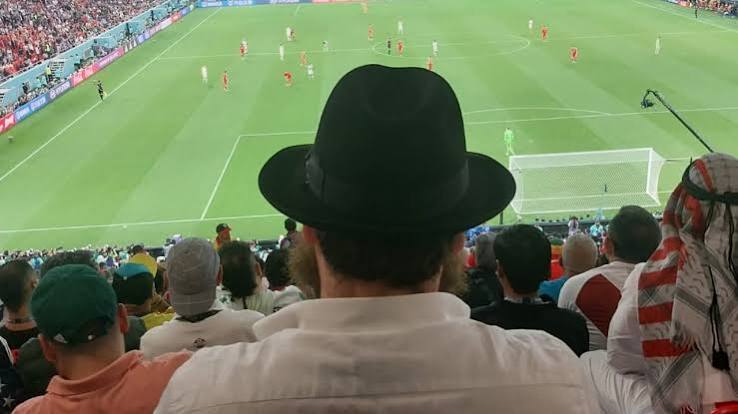
ABBI ELI CHITRIK watches a World Cup match, wearing a traditional Orthodox Jewish hat, even as a Muslim wearing a keffiyeh is among the other fans sitting nearby.(photo credit: Rabbi Mendy Chitrik)
Then, they would whisper.
They would remind us that England, Spain, France, and Argentina were all, in their own time, places where Jews believed they belonged until history proved otherwise.
Their warning would not be that America is destined to follow the same path. History never repeats itself so neatly. Their warning would be simpler: antisemitism rarely arrives all at once. It begins with words, exclusion, indifference, and the comforting belief that it cannot happen here.
As the Jewish descendants cheer from the stands, they wonder if they are hearing voices directed at them above the roar. The whispering ghosts watch too, not only the game, but today’s generation of Jews feeling both at home and increasingly distinct from their home countries.
The soccer tournament will end on Sunday. And Jews will consider their jerseys in a very different way than every other fan, in the days and weeks after they take theirs off and have to consider life beyond the game.
Why would a vigilante movie cause international controversy in 2026?
After all, Hollywood has been making vigilante films for more than half a century. Death Wish, Taxi Driver, The Equalizer, Taken, John Wick. Millions have watched ordinary people take justice into their own hands. Critics warned they would inspire copycats but by and large, they did not.
Because this film is not simply about revenge. It is set against one of the most divisive political questions of our time: immigration.
The story follows a man who concludes that his government has abandoned its most basic duty: to protect its own citizens. He begins targeting migrants whom he sees as responsible for violent crime while officials either refuse or fail to act. Critics argue the film risks legitimizing violence against immigrants. Supporters respond that it dramatizes the consequences of government paralysis rather than endorsing vigilantism.
Whether one agrees with either side, the film did not emerge in a vacuum.
Across Britain, years of revelations about organized child sexual exploitation gangs – most involving men of Pakistani heritage in towns such as Rotherham, Rochdale, and other communities – left many citizens convinced that authorities failed to protect vulnerable girls and, in some instances, were reluctant to confront offenders for fear of inflaming racial tensions. The scandals produced multiple official inquiries and enduring public anger over institutional failures. For many viewers, Citizen Vigilante taps into that frustration: the fear that government sees, knows, and still does not act, while the mainstream media diverts attention away from it.
That fear is not unique to Britain. In the United States, the conflict is different but follows a similar pattern.
Immigration enforcement is primarily a federal responsibility. Yet the Biden administration allowed a constant flow of illegal immigrants to enter the US – multiple times as many who arrived legally. It was a contributing factor of Donald Trump being elected in 2024.
In response to Trump’s crackdown on illegal immigrants, liberal municipalities declared themselves “sanctuaries,” limiting cooperation with U.S. Immigration and Customs Enforcement (ICE). Federal officials argue that dangerous offenders remain because local jurisdictions refuse to honor immigration detainers. Sanctuary jurisdictions answer that they are respecting constitutional limits on federal power and preserving trust between immigrant communities and local police.
The legal arguments belong in court but the psychological consequences live in society.
When one level of government says, “We must enforce the law,” and another responds, “We will not help you,” ordinary citizens no longer see a single sovereign speaking with one voice. They see governments arguing over who bears responsibility while serious problems remain unresolved.
That is ripe ground for the vigilante to enter, not because movies create him, but because confidence in public institutions has eroded.
Every stable democracy rests on one indispensable principle: the state holds a monopoly on the legitimate use of force. Citizens may vote, petition, protest, organize, criticize, litigate, and campaign for new laws. They may not decide for themselves who should be detained, punished, expelled, or attacked. The moment private groups begin enforcing their own version of justice, the rule of law gives way to competing factions.
South Africa illustrates how quickly that line can blur. Recent anti-migrant demonstrations included many people calling for stricter enforcement of immigration law. But alongside lawful protest came reports of intimidation, assaults, and migrants fleeing violence. The movement did not remain solely a political demand. In some instances, private citizens began acting as if enforcement belonged to them.
People will seek alternatives if they begin to doubt that the government will protect them.
Consider New York’s Jewish community. Antisemitic incidents have reached historic levels in recent years. At the same time, some prominent political figures have used language that many Jews regard as deeply dehumanizing or have expressed intense hostility toward Zionism, which many Jews see as an integral part of their collective identity. When Jewish New Yorkers hear rhetoric describing Zionists as “monsters,” some inevitably ask a question that no democratic society should want its citizens to ask: If violence comes, will the government protect us with the same determination that it protects everyone else?
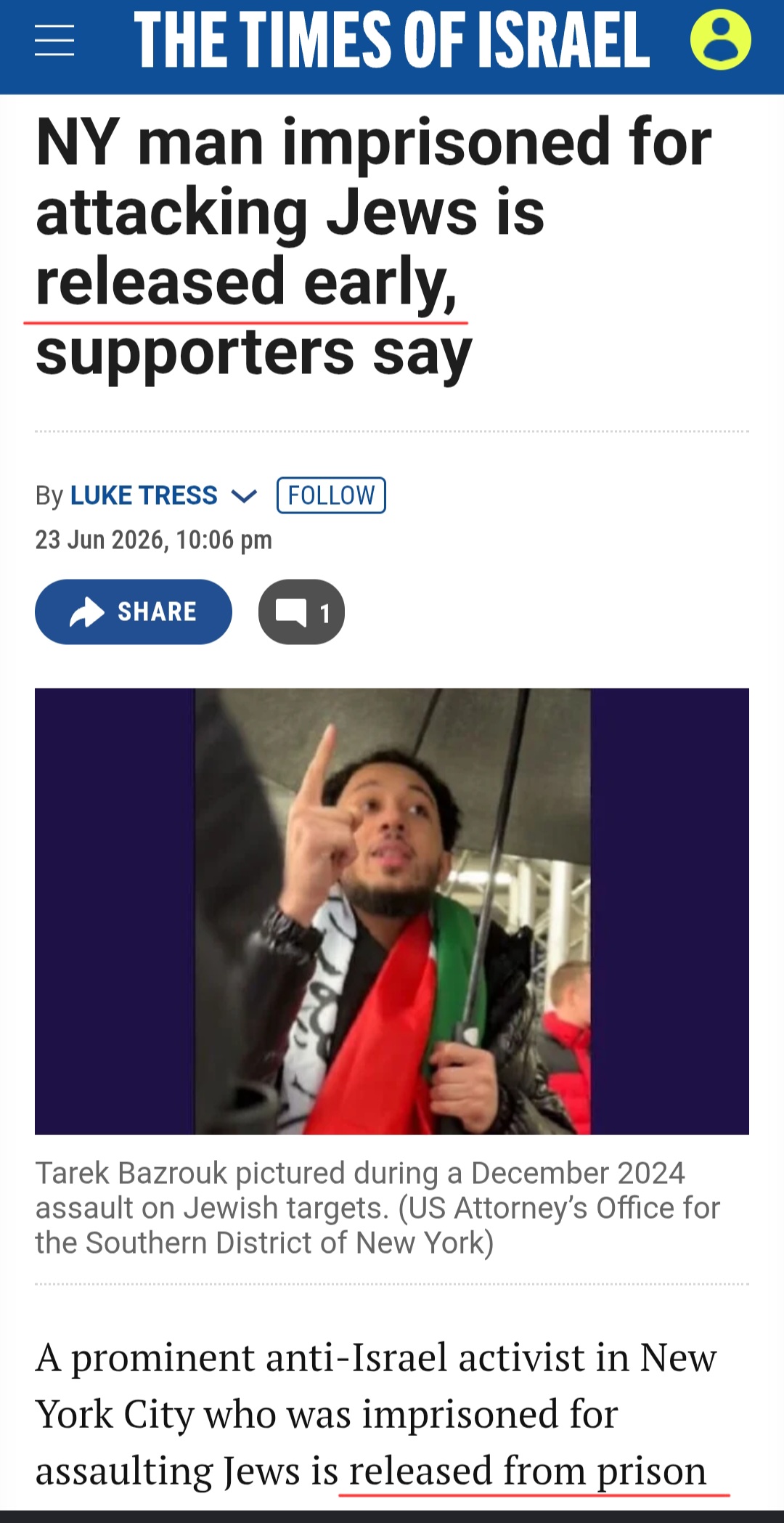
“He [Tarek Bazrouk] targeted these New Yorkers based on their religion and national origin. And he was undeterred by multiple arrests following these assaults, instead quickly returning to violently targeting Jews. The prosecution of this case and the sentence imposed make clear that New Yorkers will not tolerate hate-based violence and that this Office will aggressively prosecute those who perpetrate senseless crimes of hate.” – Jay Clayton, the United States Attorney for the Southern District of New York; Christopher G. Raia, the Assistant Director in Charge of the New York Field Office of the Federal Bureau of Investigation (“FBI”) October 31, 2025. Released early on June 23, 2026 under NYC DSA Mayor Zohran Mamdani
The appeal of the vigilante has never really been about revenge. It has always been about confidence. People cheer the vigilante only after they conclude that the institutions designed to provide justice have failed.
That is why the debate over Citizen Vigilante is larger than one controversial film.
It is about whether citizens still believe that governments – federal, state, and local – are willing and able to carry out their most fundamental obligation: to enforce the law fairly, protect the innocent, and maintain a single, legitimate monopoly on force.
If that confidence disappears, the next vigilante will not step out of a movie theater. He will step out of a society that has stopped believing the state will do its job.