When Jews Come Home from India and Are Called Colonizers

There is something almost miraculous about Operation Wings of Dawn.

This week, Israel began bringing the first members of the Bnei Menashe community from northeast India to Israel, the latest chapter in one of the most improbable stories in Jewish history. These are Jews who have long understood themselves as descendants of the Tribe of Manasseh, one of the Ten Lost Tribes of Israel, exiled by the Assyrian Empire nearly 2,700 years ago. Across centuries, empires, languages, and continents, they preserved fragments of ritual, memory, and identity tied to ancient Israel. In modern times, after study, rabbinic engagement, and formal recognition, thousands have made aliyah. Hundreds more are now on their way. For the Jewish world, it is an extraordinary scene: a people scattered to the farthest reaches of the earth still finding their way home.

That is the Jewish story in miniature.

Exile was never meant to be permanent. The Jewish calendar, Jewish prayer, and Jewish memory are saturated with return. From The Hebrew Bible to the modern Zionist movement, the idea of ingathering has been the central thread of Jewish continuity. Operation Wings of Dawn is not an immigration program in the ordinary sense. It is the continuation of that ancient civilizational arc.

It is also a reminder that Jewish peoplehood never fit modern racial categories. Jews came back to Israel from Ethiopia, from Iraq, from Yemen, from Russia, from France, and now again from India. Different languages. Different appearances. Different histories of exile. One people.

That should be a remarkable human story.

And yet, in some corners of the media world, it became something else.

Quds News Network ran a story framing the arrival as a “settlement push” of “new colonizers” in northern “Occupied Palestine”, reducing the Bnei Menashe to instruments of a political project rather than recognizing them as Jews returning to join the Jewish people in the Jewish state. The framing is familiar: Jewish return is recoded as colonial expansion.

This is not an isolated habit of language. Across anti-Israel activist media and parts of the NGO ecosystem, Jewish presence in Israel is increasingly interpreted through a “settler-colonial” framework in “Occupied Palestine,” meaning anywhere in Israel. Amnesty International’s apartheid framework leans heavily on this vocabulary, turning Jewish sovereignty itself into a structural offense rather than a legitimate act of national self-determination. That language then migrates outward, shaping how journalists, activists, and political movements speak about Jews in Israel. The result is a moral inversion in which Jewish return becomes aggression by definition.

And this is where the word colonizer collapses under its own weight.

Colonialism has an actual meaning. It is when an imperial center sends its people outward to dominate foreign land for extraction and rule. Britain in India. Spain in the Americas. France in Algeria.

Operation Wings of Dawn is the reverse movement: A dispersed people carrying an ancient memory of Israel, choosing to gather into the one Jewish homeland.

Calling that colonialism empties the word of meaning.

And the asymmetry is impossible to ignore.

When Palestinian Arabs preserve the memory of villages lost 77 years ago, the world treats it as sacred inheritance, a claim passed from generation to generation. Even when those same Arabs live just a few miles away from their grandparents’ homes, in the same land, with the same people, language and culture, people advocate for their relocation.

Yet when Jews preserve the memory of exile in distant lands and act on it, the same world increasingly calls it colonization.

That difference tells you everything.

The issue has never been whether Jews are European or Middle Eastern, white or brown, indigenous or diasporic. The Bnei Menashe expose how flimsy those categories always were. Indian Jews arriving in Israel should shatter the lazy caricature of Zionism as European implantation.

Instead, the caricature simply repeats the mantra:

A Jew from Poland returns as a colonizer.
A Jew from Iraq returns as a colonizer.
A Jew from Ethiopia returns as a colonizer.
A Jew from India returns as a colonizer.

For those committed to denying Jewish belonging, even a homecoming from India must be rewritten as invasion.

NYC, Now It’s at Your Front Door

It looked like a technical vote. In New York City, a proposed buffer zone around houses of worship. A few feet of space so people could enter synagogues, churches, and mosques without confrontation.

And the Democratic Socialists of America bloc on the City Council voted no.

Shahana Hanif (District 39), Alexa Avilés (District 38), Tiffany Cabán (District 22), Chi Ossé (District 36), and Kayla Santosuosso (District 47) held the same line. Protect protest at all costs. Treat any restriction as a threat to speech. Keep the sidewalks open, no matter what is happening on them.

Shahana Hanif (District 39)

On paper, that sounds principled. In practice, it lands somewhere else entirely.

Because in this city, right now, protests are not showing up randomly. They are showing up outside synagogues in growing numbers. The line between Israel and the Jew has been erased, and the synagogue has become a stand-in.

This is where ideology stops being abstract.

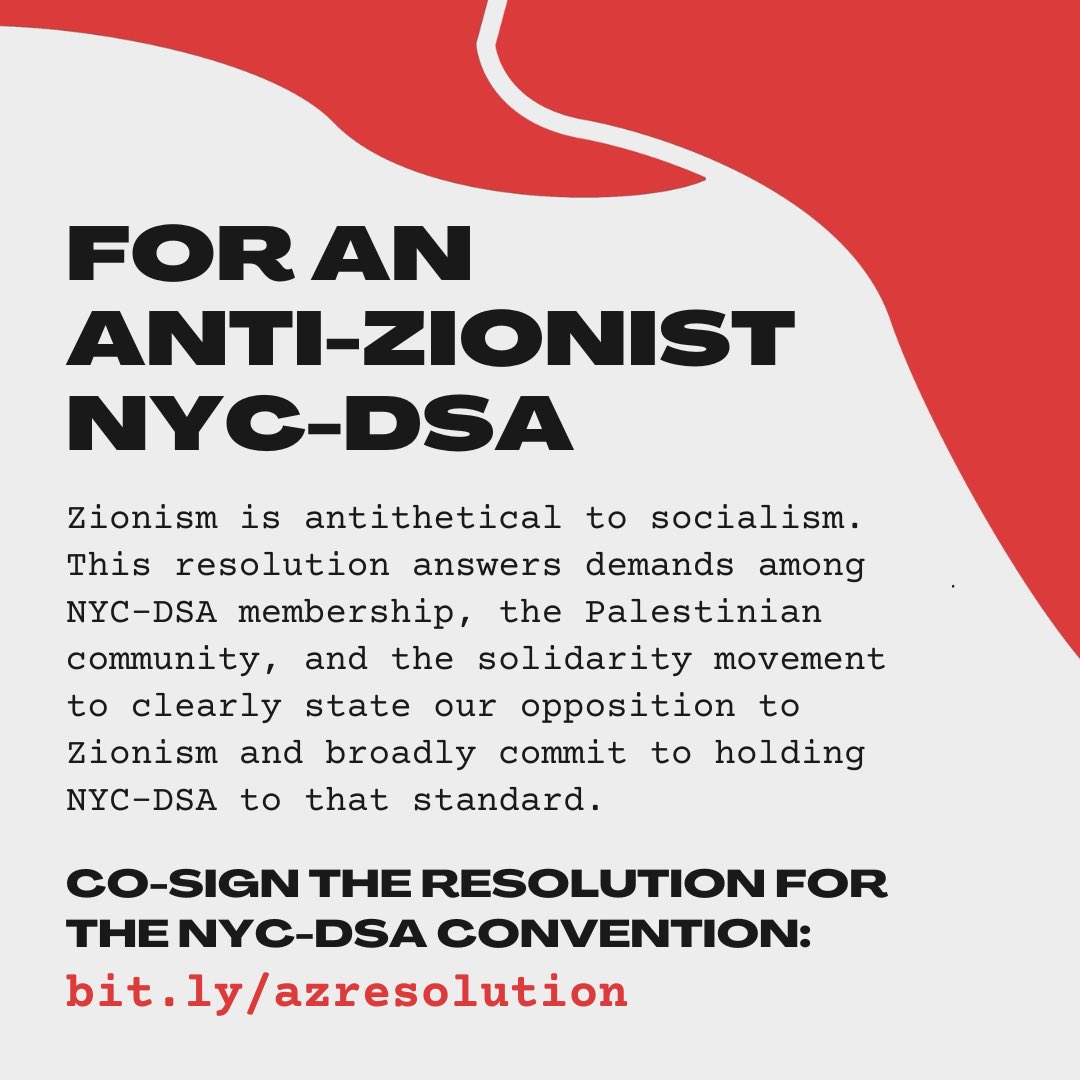
For years, the DSA has defined itself through opposition to Israel. That posture has moved from foreign policy into local reality. When Zionism is framed as uniquely illegitimate, and most Jews see it as part of who they are, the translation is inevitable. The target shifts.

No manifesto is needed. The pattern speaks for itself.

Vote against a resolution recognizing hatred against Jews. Argue about the sponsors instead of the substance. Reject a minimal buffer around houses of worship at a moment when Jewish institutions in New York are under visible pressure.

That movement is no longer adjacent to power in New York City; it has the power. With Zohran Mamdani as the city’s new mayor, the worldview is moving from activist circles into the city’s governing core.

New York City Mayor Zohran Mamdani is a member of the DSA

And the expansion is already underway.

On Tuesday April 28’s special primary day, Mamdani has backed Lindsey Boylan, a member of the DSA to take another seat on the City Council. Jewish City Council Speaker Julie Menin has endorsed Carl Wilson in an effort to stop the radical left gaining even more power in New York.

In the June primaries, NYC-DSA is backing a coordinated slate:

  • Darializa Avila Chevalier (Upper Manhattan/Bronx)
  • Claire Valdez (Brooklyn/Queens)
  • David Orkin (Queens)
  • Diana Moreno

—alongside a broader Assembly slate backed by the same network.

Endorsements from figures like Jamaal Bowman and Mamdani for radical anti-capitalists, anti-west, anti-Israel DSA members like Aber Kawas reinforce the same ideological through-line—where opposition to Israel is no longer one issue among many, but a defining filter.

Aber Kawas has long supported the dismantling of the Jewish State, now running as part of the DSA to gain a seat in the New York State Senate. She is backed by Zohran Mamdani and Jamaal Bowman

This is how local elections stop being local.

When protests move from slogans to synagogue doors in Brooklyn, Queens, and Manhattan, who holds the line?

Will NYPD treat intimidation outside Jewish institutions as a line to be enforced—or a situation to be managed?

Power shapes behavior. When activists see their worldview reflected in City Hall and Albany, boundaries loosen. What once felt marginal begins to feel sanctioned. The distance between protest and confrontation narrows.

The question is no longer what DSA believes about Israel where they believe every man, woman and child is a fair target for violence. The question for New York voters is what they are comfortable normalizing here.

On sidewalks outside synagogues. At the doors of people trying to pray. In the space between protest and intimidation.

The City Council vote on buffer zones answered part of that question.

The rest will be answered this coming Tuesday and in June—at the ballot box, and on the sidewalks outside your door.

ACTION ITEM

Support Carl Wilson in the primary on April 28.

Support opponents to the DSA candidates in the June elections.

Related:

Three Multinational Antisemitic Arcs, And World Jewry

Over the past century, pressure on Jews has scaled, shifting from borders to regions to institutions, changing form while carrying a familiar direction.

The story begins in Europe 1938 with the Anschluss. Persecution inside Germany extends outward as Austria is absorbed and its Jewish population is pulled into the same system. Expansion of antisemitic forces follows conquest. Poland, France, Hungary, the Netherlands become extensions of a single design as control spreads across the continent.

An den Fenstern j¸discher Geschfte werden von Nationalsozialisten Plakate mit der Aufforderung “Deutsche, wehrt euch, kauft nicht bei Juden” angebracht.

Policy matures into infrastructure. Collaboration, coercion, and indifference form a landscape in which Jewish survival is unlikely. At the Wannsee Conference, extermination is organized across borders, ministries, and railways. The Holocaust becomes a continental system aligned toward a single end: the genocide of Jews.

That system collapses with the war’s end but the pattern carries forward, reshaped and redirected.

After 1948, pressure reappears across the Middle East and North Africa (MENA). Jewish communities rooted for centuries in Iraq, Egypt, Yemen, Morocco and elsewhere begin to unravel with striking speed.

Baghdad Iraq’s 1941 slaughter of Jews

Each country follows its own path. Laws restrict, property is seized, pressure builds, departures accelerate. In Iraq, the Farhud foreshadows a collapse that soon becomes mass departure. In Yemen, Operation Magic Carpet lifts an entire community into exile. In Egypt, the Suez Crisis accelerates expulsions. Across North Africa, uncertainty and nationalism press communities toward exit. By the 1970s, nearly one million Jews leave and a regional Jewish presence that endured for centuries nearly vanishes completely.

By the 1970s, the arena shifts again. The contest moves from territory into legitimacy itself.

In 1975, the United Nations adopts United Nations General Assembly Resolution 3379, recasting Jewish self-determination as a moral offense within the central forum of international diplomacy.

US Ambassador to the United Nations, Daniel Patrick Moynihan reversing the Zionism is Racism resolution

The repeal arrives in 1991 through United Nations General Assembly Resolution 46/86, yet the framing travels beyond formal votes. It resurfaces at the World Conference Against Racism in Durban in 2001 and diffuses through NGOs, campuses, and international forums, where evolving language carries forward an enduring challenge to Jewish sovereignty.

From there, the argument migrates into the civic fabric of Western democracies. In the United States, United Kingdom, Canada, and Australia, vile ideas become chants in universities, media, and politics.

The mechanisms differ from earlier eras, yet the effects shape daily life. Jewish institutions increase security. Synagogues that once stood open now operate behind layers of protection. Public expressions of Jewish identity carry new calculations. Debates about Israel expand into broader judgments about Jews, blurring lines that once held more clearly.

Across these shifts, the effect becomes visible in the map of Jewish life.

President Joe Biden’s Jewish liaison person suggests that Jews should hide their religious symbols in 2021

A century ago, Jewish communities spanned continents, anchored in Europe and present across the Middle East, North Africa, and the Americas. The destruction of European Jewry removed the largest center. The unraveling of communities across the Middle East and North Africa compressed what remained. Many moved to Israel. Others built new lives in the United States.

Today, roughly 85 percent of the world’s Jews live in those two countries. There are only seventeen countries with more than 25,000 Jews when there used to be dozens just a century ago.

That concentration follows a century in which environments that sustained Jewish life across dozens of countries collapsed, expelled, or eroded. Dispersion gave way to consolidation. Geography followed pressure.

The forces shaping that consolidation continue to evolve. As legitimacy is contested in broader arenas, communities orient toward places able to sustain security, identity, and continuity. The gravitational pull toward Israel strengthens under those conditions, even as the United States remains a central pillar of Jewish life.

While Yom Ha’atzmaut marks Israel’s independence, it also marks the emergence of a center of gravity forged through history rather than theory. Across a century, shifting forms of pressure reshaped where Jews could live, how they gathered, and where they anchored their future.

Three arcs across a century redrew the Jewish map. As the narrative arc is still underway, Israel’s percentage of world Jewry will likely become a majority from a plurality, in just a few years.

Centuries of Kashrut, Now in Question

The laws in Parshat Shemini do something unusual. They take holiness out of the abstract and force it into the body. This is permitted; that is not. Eat this; reject that. The categories are exact, and they carry consequences.

Kashrut is not belief. It is execution.

It depends on classification, preparation, and one decisive act: a method of slaughter. Remove any part of that sequence and the system collapses into theory.

For centuries, it did not collapse. It moved intact into daily life, into kitchens and markets, into habits that required no defense because they were simply practiced. By the 19th century, that system was functioning inside modern Europe. Jews in FrankfurtVienna, and Budapest were citizens, participants, integrated—and still able to keep kosher.

The paintings of Moritz Daniel Oppenheim and Isidor Kaufmann quietly confirm that reality. They show a world where nothing needs to be argued. The system works. The meal appears. The law reaches the plate.

That is the baseline: not tolerance of identity, but permission of practice.

The modern shift begins where the system is most exposed—at the knife.

Kosher meat depends on shechita, a method of slaughter that prohibits pre-stunning. Increasingly, that is where democratic states have drawn a line. Across Europe, bans or effective prohibitions have taken hold:

  • Belgium
  • Denmark
  • Sweden
  • Norway
  • Iceland
  • Switzerland
  • New Zealand

Others—GermanyFranceNetherlands—permit it only through narrowing exemptions.

The language used is procedural. They argue that animal welfare requires stunning the animal before slaughter. It sounds neutral but it ends kashrut.

That pressure has forced a new response. Not abandonment, but adaptation. Across Europe and Israel, efforts are underway to reconcile halachic requirements with regulatory demands:

  • Post-cut stunning, applied immediately after the kosher slaughter
  • Reversible stunning technologies, designed to preserve the animal’s halachic status at the moment of the cut
  • Greater integration of veterinary oversight with rabbinic supervision

None of this is settled. Many rabbinic authorities resist any modification that risks invalidating the historic process. Regulators resist exceptions that fragment uniform standards. The space for compromise is narrow and technical.

But the direction is unmistakable. The debate has moved from theology to engineering.

Liberal democracies pride themselves on protecting religious freedom. Yet during ritual slaughter for kosher meat, they are testing a boundary: whether they will protect belief while constraining the mechanisms required to live it.

Storming Words, Not Mosques

The jihadi war begins in the headline: “Israeli colonists storm Al-Aqsa Mosque under police protection.” Before a single fact appears, the verdict is already written—by the Palestinian Authority’s media outlet—in words designed to inflame.

  • Colonists erases history, recasting Jews as foreign intruders with no connection to the Temple Mount. 
  • Storm supplies violence whether any occurred or not. 
  • Al-Aqsa Mosque collapses the entire compound into the most sensitive Islamic structure to heighten the sense of desecration. 
  • Under police protection reframes standard security by the Israel Police, coordinated with the Jerusalem Islamic Waqf, as state-backed aggression.

Then the language tightens. “Talmudic and provocative rituals.” “Frequent Israeli provocations, including repeated raids.” These aren’t descriptions. They’re verdicts. Quiet presence becomes intent. Routine visits become raids. Silent prayer becomes something suspect.

And then the omission that completes the frame. The site is only described as Islam’s third holiest. It is never described as Judaism’s holiest. The reader is left with a single conclusion: sanctity on one side, violation on the other.

This is narrative design. Islamic Supremacy.

Strip legitimacy. Recast presence as desecration. Elevate exclusive holiness. Repeat it daily through a state-backed outlet overseen by the Palestinian Authority.

That is how a holy war is narrated into existence. By the “moderate” Palestinian Authority.

Make Hamantaschen

Make hamentaschen.

Yes, Purim is over. Make them anyway.

Because hamentaschen were never just for a holiday. They are a response to something permanent. Every generation produces its own Haman. Today it comes dressed as an Iranian proxy war, spread across governments and militias that still build their purpose around destroying the Jewish people and the Jewish state.

The language changes. The intent does not.

So make hamentaschen.

Out of season. On purpose. As a refusal to let Jewish life run only on the calendar of threats. The lesson of Purim does not expire in Adar. It lives in every moment when enemies of the Jews believe time is on their side.

Knead the dough. Fill it. Fold it. Bake it.

There is something defiant in that simplicity. Jewish survival has never rested only on armies, though they matter. It lives in continuity. In ritual. In memory. In the quiet insistence on remaining who we are while others plan our disappearance.

That is what they never understand.

So make hamentaschen. Feed your family. Share them with friends. Mark the fact that Jewish life continues on its own terms, not theirs.

And pray.

Pray that those who seek Jewish destruction are defeated. Pray that their power breaks. Pray that the story ends the way it did before.

Purim is over. The story is not.

Make hamentaschen.

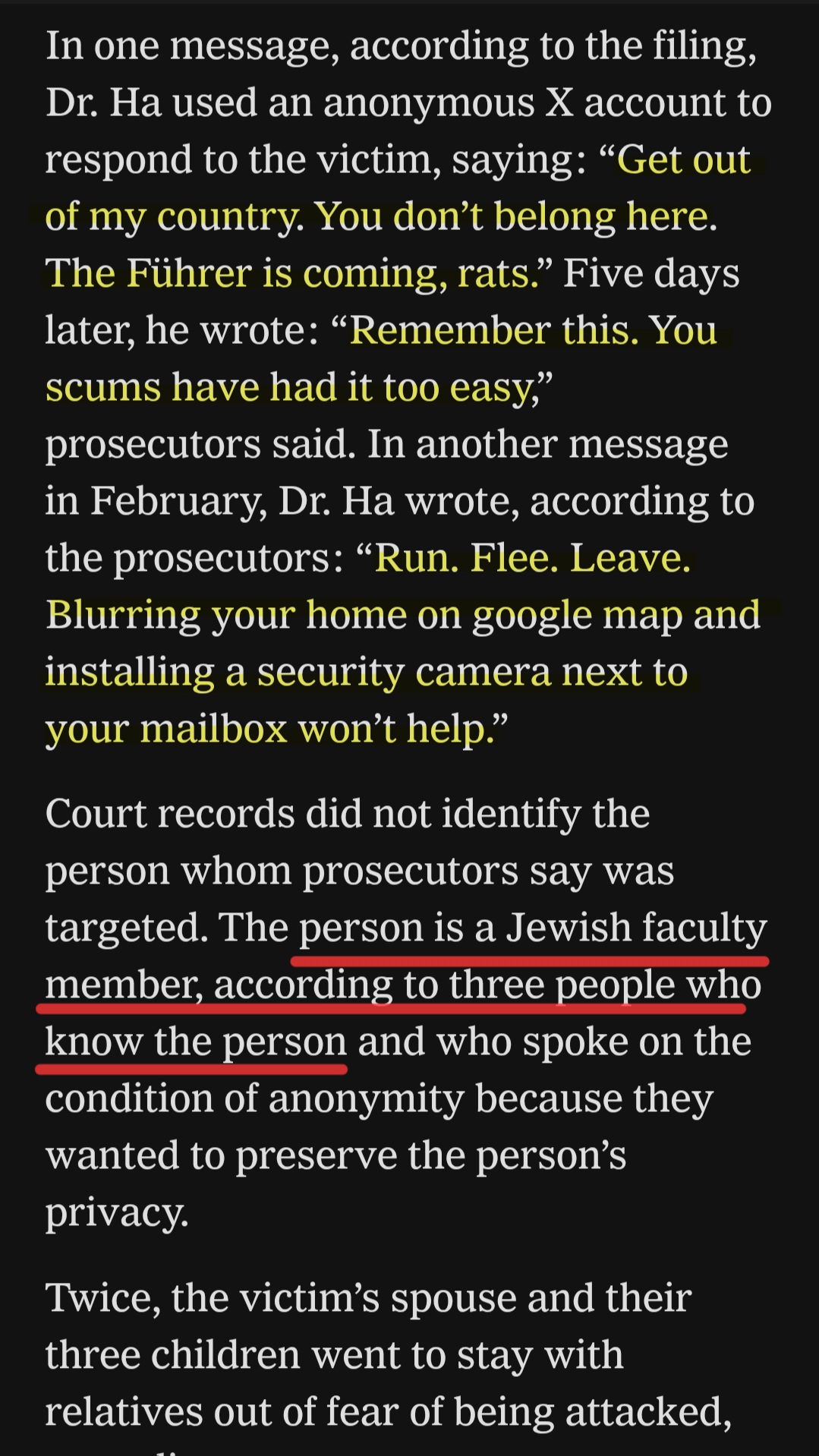
NY Times Issues Warning About “Resurgence” of “Far-Right” Jews

The latest The New York Times piece on a JDL-linked murder plot tells a very specific story—and then stretches it into something much larger than it is.

Start with the facts. One individual in a fringe offshoot movement, often described as a ghost of the old Jewish Defense League, allegedly plotted a murder that never happened because law enforcement stopped it. That is the entire event. Not a movement. Not a wave. Not a trend. A single actor orbiting a marginal group.

And the target was not randomly selected. This was not an attack on “Muslims” or a civilian population. The alleged target was a highly visible anti-Israel agitator who celebrates violence against Jews and calls for the destruction of the Jewish state. That context matters. It does not justify anything but explains a motive. Erasing that distinction flattens reality into propaganda.

Yet from this narrow incident, the long article pulls a wide arc—Meir Kahane, Baruch Goldstein, decades-old ideology, insinuations about modern Israel. The reader is led to see not one unstable actor, but a resurfacing Jewish extremism problem.

apparent resurgence of far-right Zionism” – The New York Times

That framing collapses under the weight of what is actually happening.

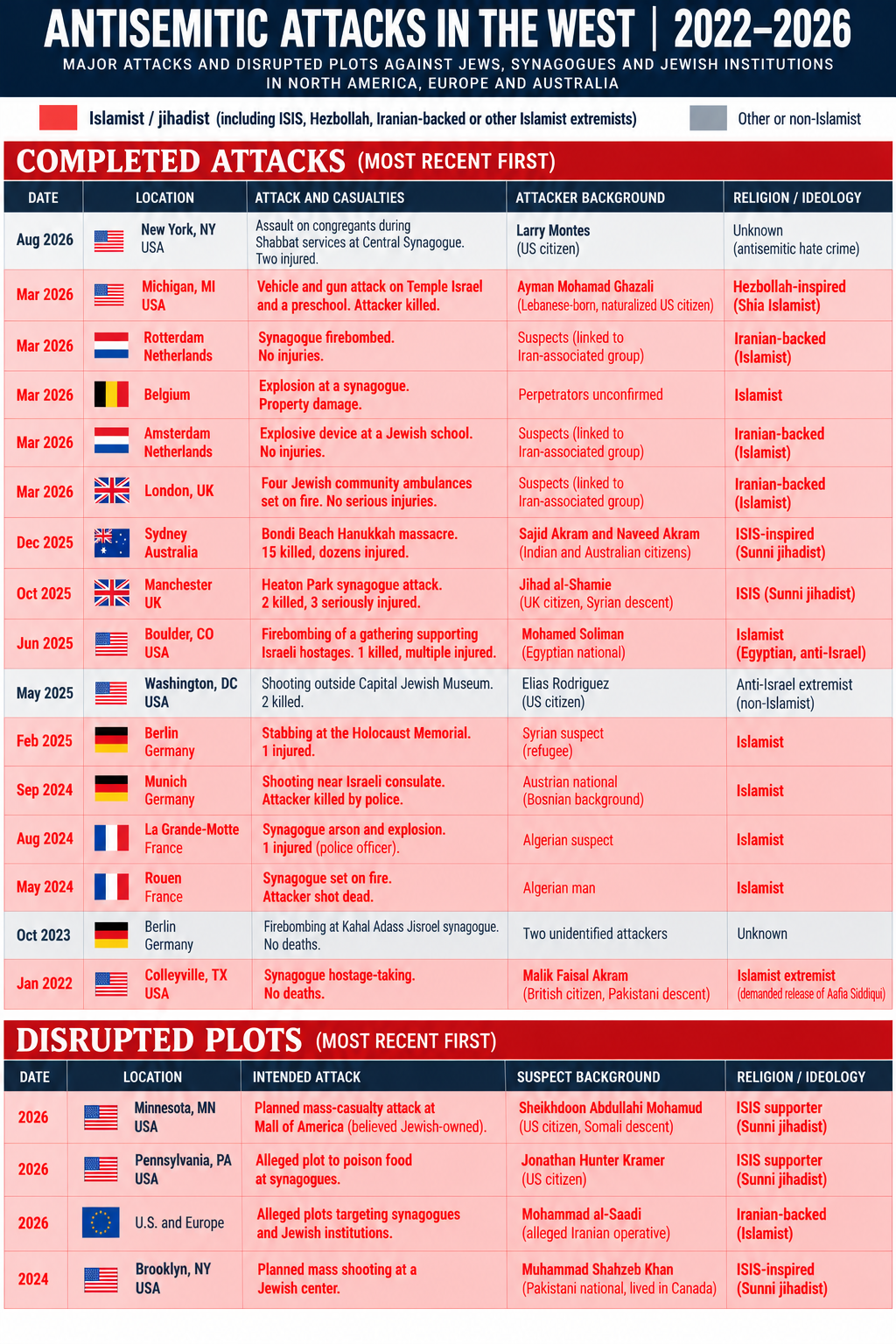
2025 saw the highest number of Jews murdered in antisemitic attacks in over thirty years. Not plots—killings, specifically because they are Jews. Across cities and continents. In New York, Jews remain the primary target of hate crimes by a wide margin. Assaults are not hypothetical. They are routine. Visible Jews are attacked on the street, not in theory but in daylight.

So the inversion becomes obvious.

A stopped act by one fringe Jewish extremist becomes a sweeping narrative. A global surge in antisemitic violence becomes less than background noise.

a disturbing message to New York City: the ideology of the Jewish Defense League has resurfaced.” – The New York Times

This is not balance. It is misdirection.

Every society has extremists at its edges. Jewish communities are no exception. They should be confronted early and without hesitation. But scale matters. Sequence matters. When coverage elevates a single fringe actor into a defining story while minimizing the sustained targeting of Jews, it sends a clear signal about whose fear counts and whose does not.

voted for President Trump,” – The New York Times non-sequitur about member of the JDL, seemingly painting all Jews who voted for Trump as a potential extremists

And it feeds something deeper: the growing belief among Jews that institutions—from media to politics—are more comfortable scrutinizing Jewish reaction than confronting antisemitic aggression.

The real story is not that somewhere on the margins there are Jews capable of violence. Every people has that margin.

The real story is that Jews, in New York and across the diaspora, are once again living with a level of threat that is measurable, visible, and rising—and that too many prefer to mock the real security fear of Jews and cast Jews as the crux of the problem.

Mock the Dead, Police the Living

The uniform matters. The place matters more.

At Buchenwald concentration camp, the ground holds ash. It exists for a single purpose: to remember the industrial murder of Jews. The expectations are clear without being written—restraint, silence, humility.

Buchenwald concentration camp

Bring a keffiyeh into that space and call it “expression” and the word collapses under the weight of context. Symbols do not travel untouched. In that setting, it reads as intrusion—present politics laid over a site of extermination. Memory for mockery.

Yet the pro-Palestinian Arab mob wants to remind Jews that the genocide of Jews is not just in the past but in the present. They want their right of “free expression” precisely where it can hurt Jews the most. The right to bring a cause onto ground that was meant to remind people “never again” was targeted with “again now.”

In their antisemitic zeal, they push the opposite at Temple Mount, the holiest site in Judaism. For centuries, Jewish prayer has pointed toward this place. Yet the pro-Palestinian crowd demands Jews be barred- not only no free expression but no freedom of religion.

“Status quo!” and “Provocation!” used very selectively, when Jews are the target.

The same principle—expression—stretches in one place and shrinks in another.

Expanded to override the norms of a concentration camp. Constrained to block prayer at Judaism’s holiest site.

That is the pattern.

It is not only a double standard. It is a antisemitism squared.

The past is diluted when a site of Jewish death is treated as open terrain for contemporary symbolism. The present is constrained when Jewish prayer is treated as a threat rather than a right.

Buchenwald should demand humility before the dead.
The Temple Mount should allow the living to pray.

When those principles reverse, the fracture is not rhetorical. It is civilizational. And the pro-Palestinian camp continues to reveal the profound “deformity in its culture,” and how it revels in Jew hatred.

Campus Jewish Life Needs a Mainstream Voice

On elite campuses, something more consequential than protest is unfolding. Jewish life is being redefined by extremists.

Groups like Jewish Voice for Peace and “Jews for Liberation” present themselves as the authentic moral voice of Jewish students. They speak in the language of justice, liberation, and equality that resonates with their peers. But strip away the branding and the position is blunt: the Jewish state is illegitimate and cast as a project of racial supremacy, apartheid, even genocide.

That is not critique. That is an argument for erasure.

The danger is not only that these claims are false. It is that they are being laundered into the mainstream through the fig leaf of Jewish identity. When anti-Israel activism is voiced by non-Jews, it is political. When it is voiced by Jews, it is marketed as moral truth. Then the fringe becomes credible and slogans become scholarship. Eliminationist ideas acquire the authority of internal dissent.

That shift matters.

Once Israel is no longer seen as a flawed state – much like others – but as an illegitimate one, every boundary collapses. If the state itself is the crime, dismantling it becomes justice, and whatever follows can be rationalized as liberation.

This is how language is turned into a weapon.

Mainstream Jewish campus institutions have not met this moment with equal clarity. Groups like Hillel are focused, rightly, on building Jewish life: community, ritual, continuity. They create space. They avoid litmus tests. They keep doors open. But when the central attack is not on Jewish practice but on Jewish legitimacy, generality reads as hesitation.

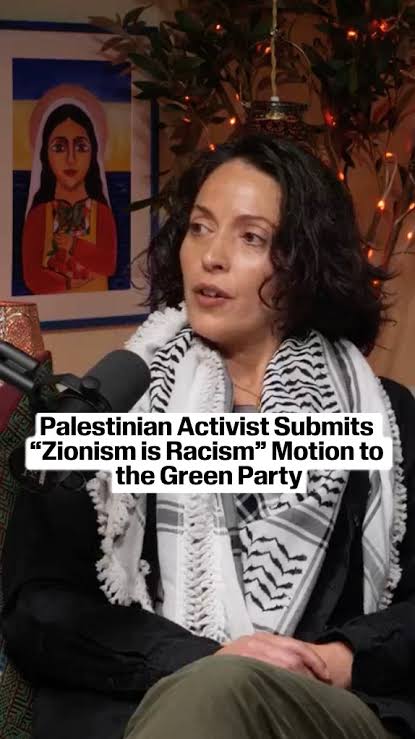
When others define Zionism as racism, it is not enough to respond with programming and belonging. The argument has moved to first principles. It demands an answer at that level.

And so a vacuum has opened.

Into that vacuum have stepped the loudest voices, not the most representative ones. The result is a distorted picture of Jewish opinion, one in which the extremes are visible and the center is absent.

That center needs a voice of its own.

Not a mirror image of the anti-Zionist fringe. Not a reaction that turns legitimate security concerns into collective hostility toward all Arabs. But a clear, unapologetic articulation of what most Jews actually believe, and what a sustainable future requires.

That position is not complicated.

The Jewish people have a right to sovereignty in their historic homeland. Israel must remain secure and capable of defending itself against those who seek its destruction. Terrorism and the glorification of violence are disqualifying, not contextual. No serious political future can be built on a culture that celebrates October 7 or teaches that murder is resistance.

The “two-state solution” is treated as moral doctrine, as if repeating it resolves the conflict. It does not. Self-determination is not a slogan tied to a single map. It can take different forms across different political arrangements. Millions of Palestinian Arabs have held Jordanian citizenship. Others live under varying structures of autonomy. The real question is not whether self-determination exists in theory, but whether any proposed structure can produce stability rather than violence.

A future Palestinian state, if it is ever to emerge, must come after a profound transformation: demilitarization, institutional reform, and an educational shift away from incitement and toward coexistence. Statehood is not an entitlement. It is a responsibility.

This is baseline reality, yet it is rarely stated plainly on campus.

A new kind of Jewish student group is needed, one that is explicit where others are cautious and disciplined where others are reckless. A group that centers Israel not as an abstraction but as a living, embattled state. One that can say, without hedging, that Jewish self-determination is legitimate, that its delegitimization is dangerous, and that moral seriousness requires both strength and restraint.

Such a group would do three things differently.

  • It would reject the language trap. Words like apartheid and genocide would be treated not as serious analysis but as distortions that inflame rather than illuminate.
  • It would refuse the false binary. Supporting Israel does not require abandoning moral judgment. Rejecting terror does not require rejecting an entire people.
  • It would re-anchor the conversation in reality. Israel exists. Threats are real. Peace requires conditions, not just intentions.

The goal is not to win an argument in a seminar room. It is to prevent a generation from being taught that the existence of the world’s only Jewish state is a moral error to be undone.

Campus Jewish life needs a mainstream voice that is willing to speak clearly – and be heard.

Pope Leo Leaves Room For Antisemitism

There are moments when language has to carry more than meaning. It has to carry memory. It has to carry consequence. When the subject is the death of Jesus and the role of Jewish leadership in that story, every word is loaded with two thousand years of fallout.

That is the backdrop to a recent homily reported by Vatican News, where the Pope recounts how members of the Sanhedrin planned to put Jesus to death and frames the decision as a political calculation rooted in fear.

On its face, this is familiar terrain. The Gospel of John tells that story. The Pope emphasizes fear, power, and the instinct of leadership to preserve order when threatened. He broadens the lesson, warning about “hidden schemes of powerful authorities” and concluding that not much has changed when we look at the world today. It is a universal moral frame, the kind clergy have used for centuries to draw a line from ancient texts to modern behavior.

But this is not a normal moment, and that is not neutral language.

We are living through a surge in antisemitism that is not subtle, not isolated, and not theoretical. Jews are being targeted in cities, on campuses, and online. The State of Israel is being recast in mainstream discourse as uniquely illegitimate, even genocidal. The old accusations have not disappeared. They have been updated, rebranded, and redeployed. In that environment, the space between what is said and what is heard narrows dangerously.

The Catholic Church knows this better than anyone. For centuries, Christian teaching around the Passion narrative fed the idea that Jews, as a people, bore responsibility for the death of Jesus. That charge—deicide—did not stay in theology. It moved into law, into mobs, into expulsions and massacres. It became part of the architecture of antisemitism in Europe.

The Church confronted that history in Nostra Aetate, a landmark statement of the Second Vatican Council. The declaration made clear that Jews as a whole, then or now, cannot be blamed for the death of Christ. That was not a minor clarification. It was a doctrinal line drawn after catastrophe, an effort to shut down a pattern of interpretation that had proven lethal.

Successive Popes understood what that required in practice. Pope John Paul II did not rely on implication. He spoke directly, repeatedly, calling Jews “our elder brothers” and making visible gestures that reinforced the message. Pope Benedict XVI went further in precision, arguing explicitly that references to “the Jews” in the Gospel of John describe a specific leadership group, not a people across time. They closed interpretive doors because history showed what happens when those doors are left ajar.

That is why the current language matters. “Religious leaders saw Him as a threat.” “Hidden schemes of powerful authorities.” “Not much has changed.” None of these phrases, standing alone, violates Church teaching. None explicitly assigns blame to Jews today or draws a line to the modern State of Israel. But they operate in a space that has been misused for centuries, and they leave enough room for that misuse to return.

In a different era, that looseness might pass without consequence. Today, it does not. The categories are too easily mapped by those already inclined to do so. “Religious leaders” becomes “rabbis and synagogues.” “Powerful authorities” becomes a stand-in for Jewish power, whether the government of Israel or leaders in the Jewish diaspora. “Not much has changed” becomes an argument for continuity from the first century to the present. And in a climate where Israel is already being portrayed as a moral outlier among nations, the slide from scripture to contemporary politics is not a leap. It is a small step.

This is not about intent. The Pope is speaking in a long Christian tradition of drawing moral lessons from the Passion. The emphasis on fear and political calculation is, in fact, a move away from older, more dangerous framings. But intent does not control reception, especially when the subject has such a charged history.

The standard here cannot be whether the words are technically defensible. It has to be whether they are tight enough to prevent foreseeable distortion.

Because the distortion is not hypothetical. It is already happening in the broader culture. Jews are being pushed out of public spaces, treated by default as representatives of a state and a government they may or may not support, whether they live there or not. Israel is singled out in ways that strip context and complexity, recast as uniquely evil in a world that has no shortage of brutality. In that environment, any rhetoric that can be bent toward those narratives will be bent.

The Church has done the hard work of confronting its past. It has the doctrine. It has the precedent. What it needs, in moments like this, is the discipline to match.