In the 20th century, the term “G.I. Joe” was meant to describe the average American serviceman. He was the embodiment of a regular patriot fighting for America and American values.
Alas, today’s generation has Jihad Joe.
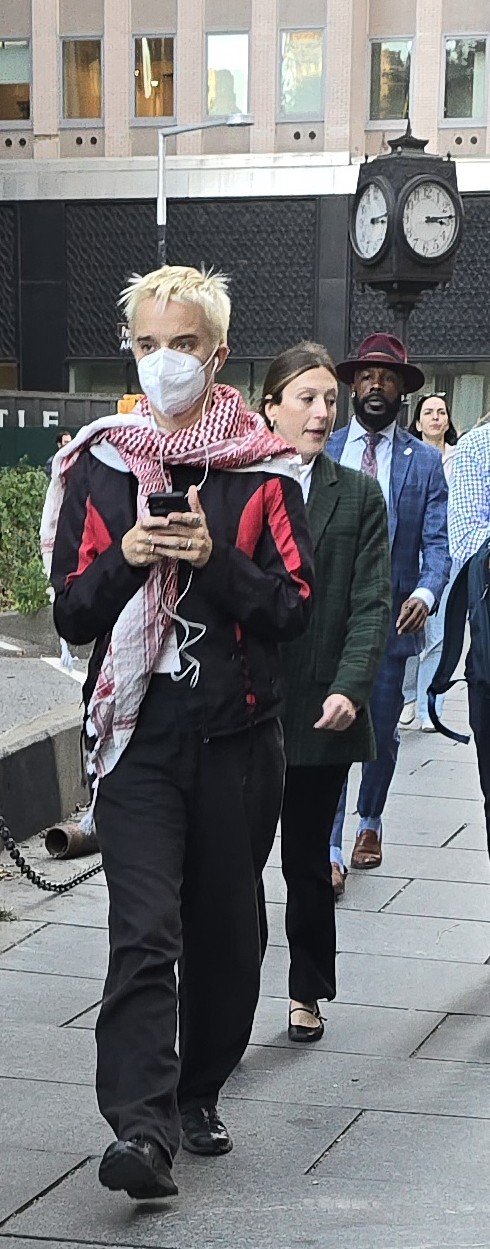
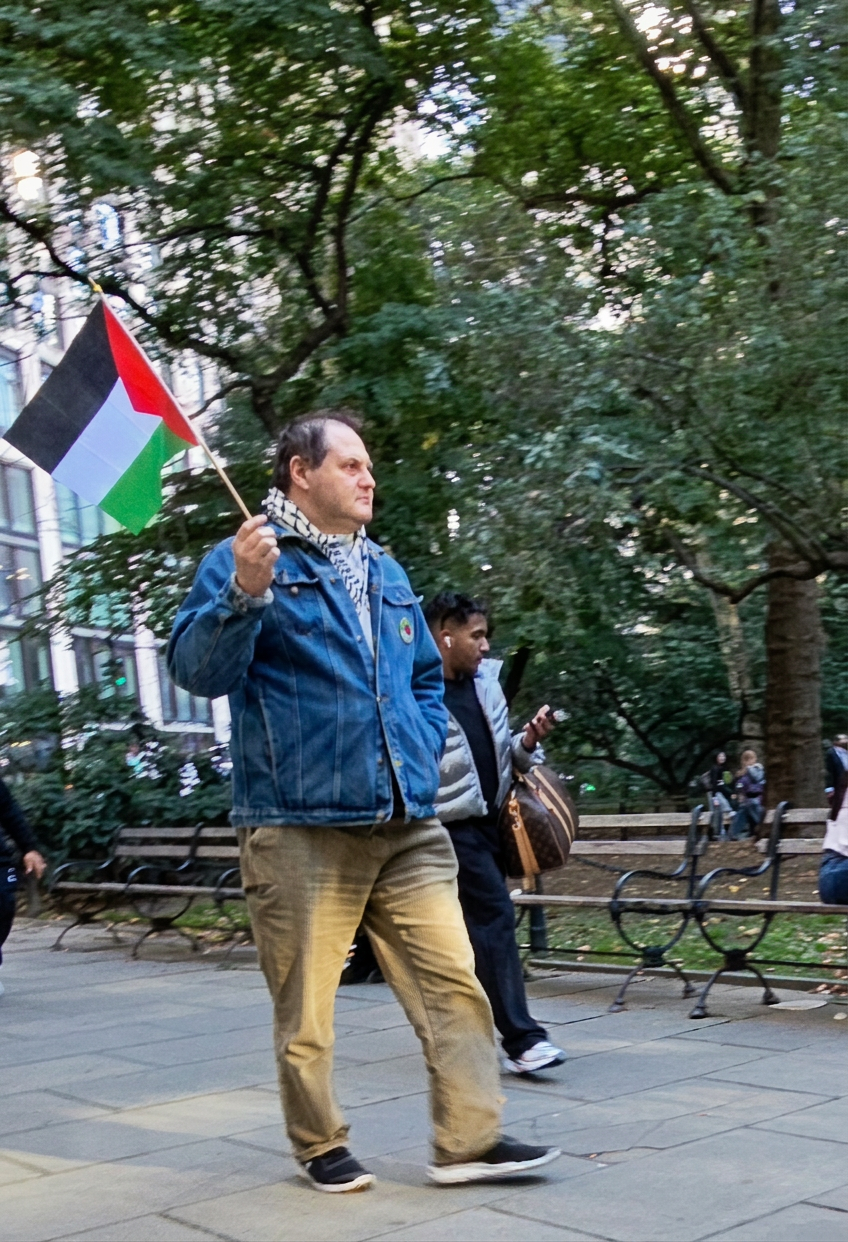
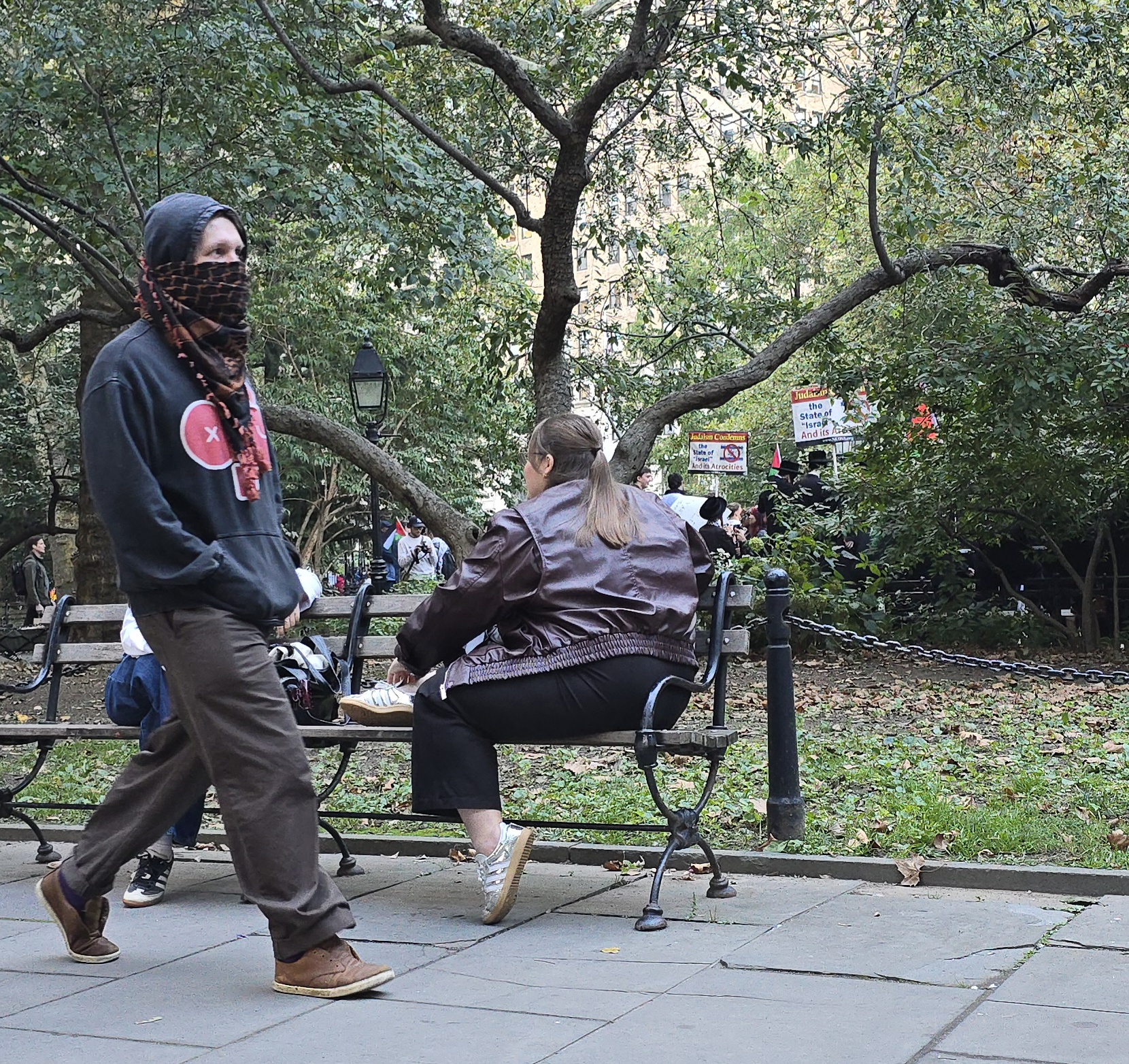
Pro-Palestinian man heading to protest Israel in front of City Hall in Manhattan on October 7, 2026 (photo: First One Through)
Jihad Joe celebrates the murder of Americans and American allies. He/ she uses anniversaries of the massacres of civilians – like 9/11/01 and 10/7/23 – to mock the death of thousands of innocent civilians. The Jihad Joes cheer ISIS, Hamas and the Islamic Republic of Iran.
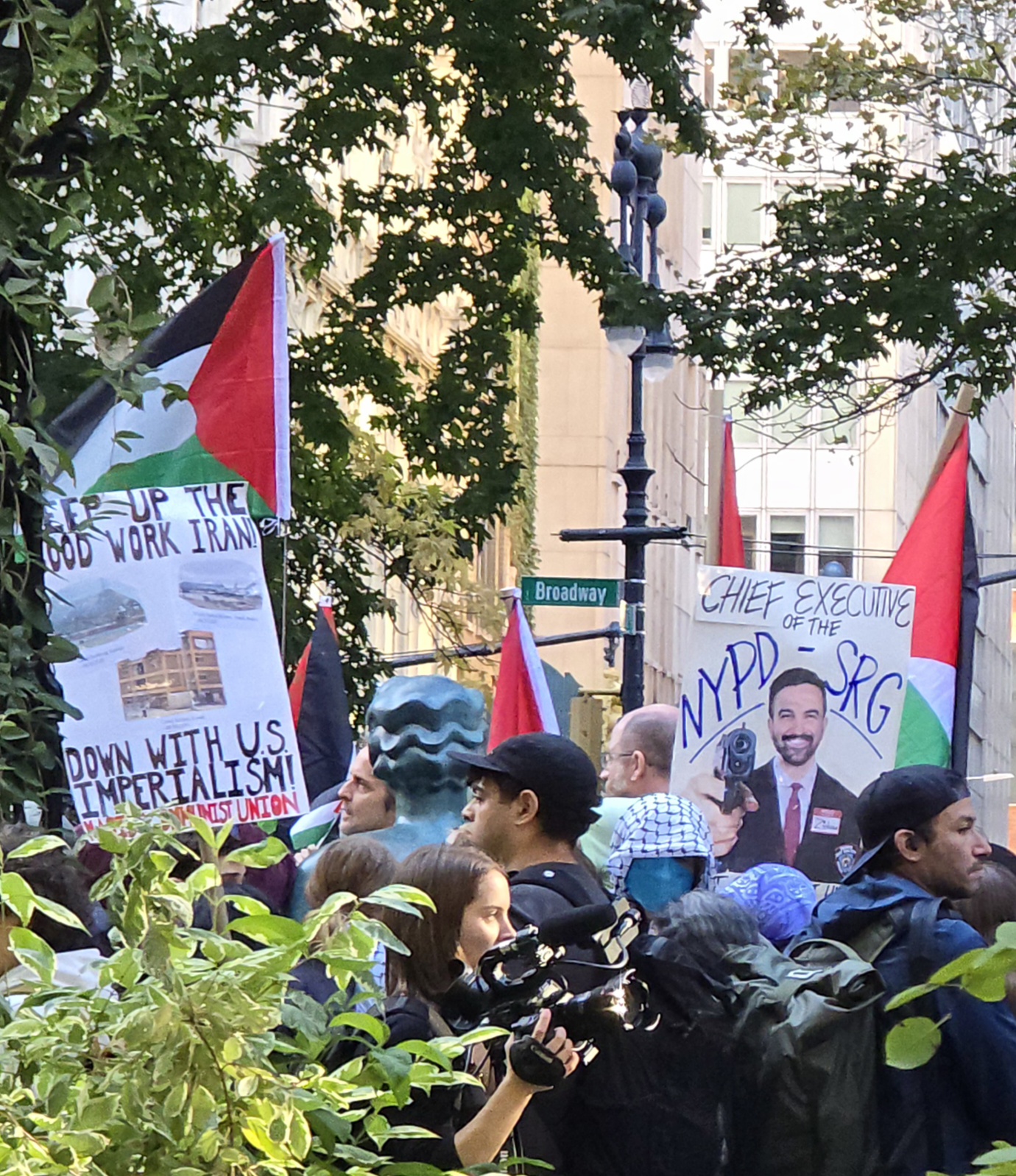
Anti-Israel protestors at City Hall in NYC on October 7, 2026 with posters mocking Mayor Zohran Mamdani as a Zionist and “Keep up the good work Iran! Down with U.S. Imperialism!” (photo: First One Through)
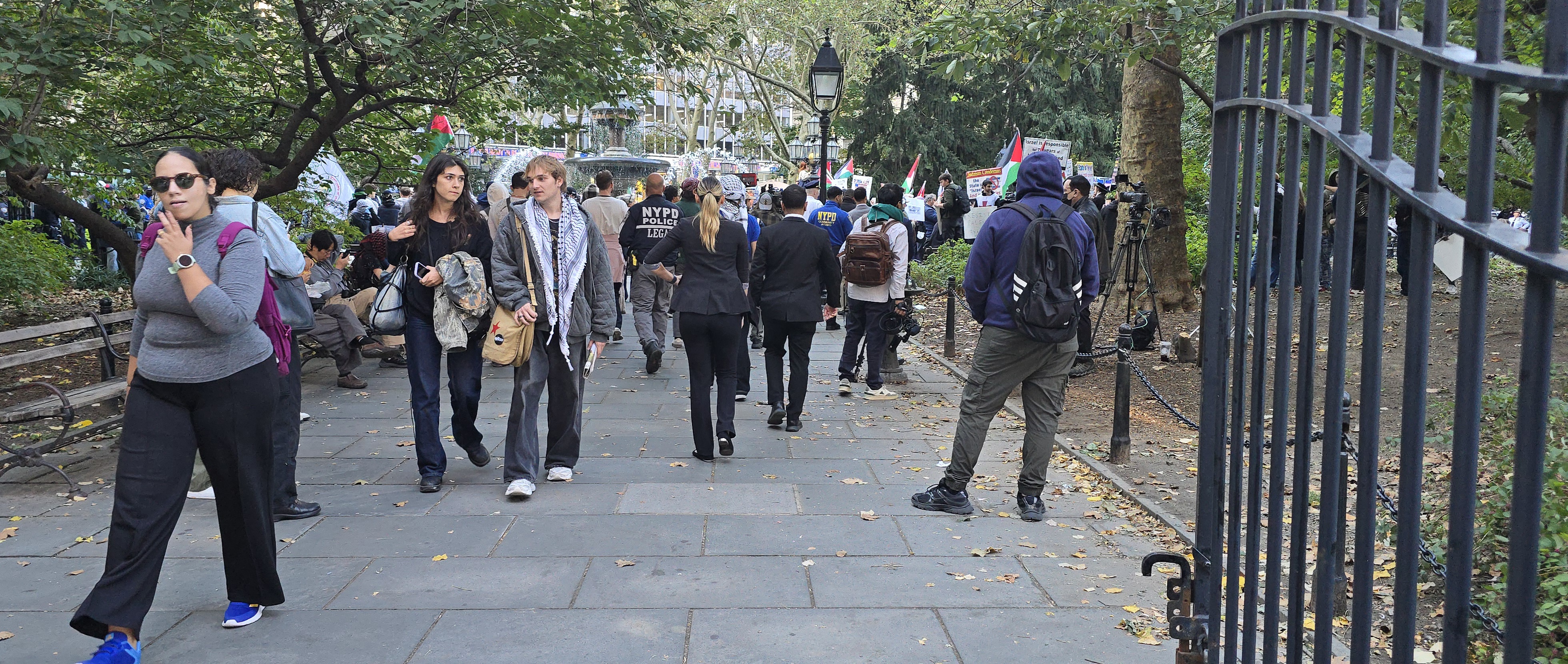
The crowd that gathered on October 7, 2026 at City Hall in New York City was mixed, with religious Muslims and anti-Israel Neturei Karta posing for the media. But there were also many White people in their 20s to 40s sporting Hamas headbands, chanting for the destruction of Israel, and that Jews are pedophiles.
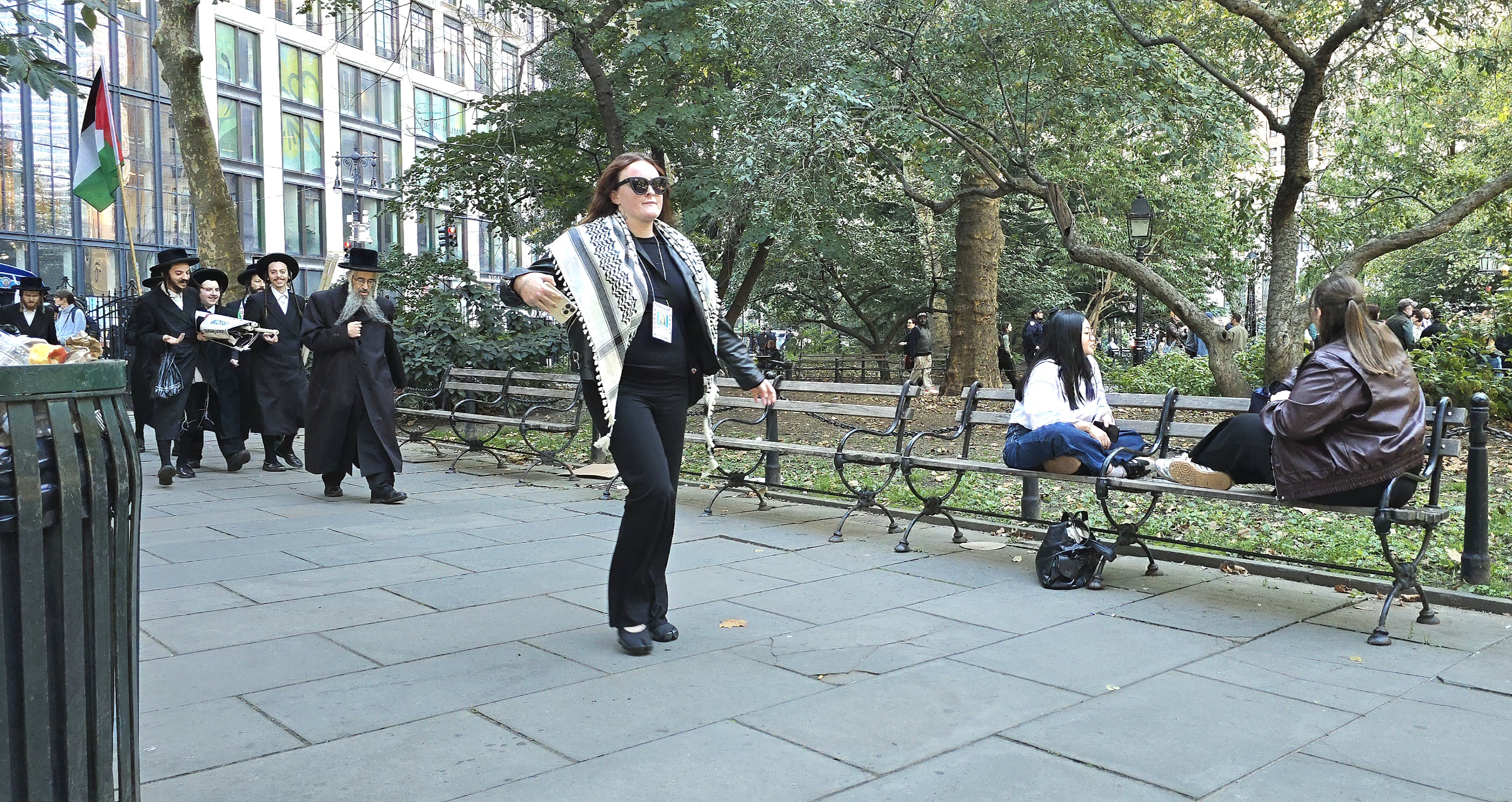
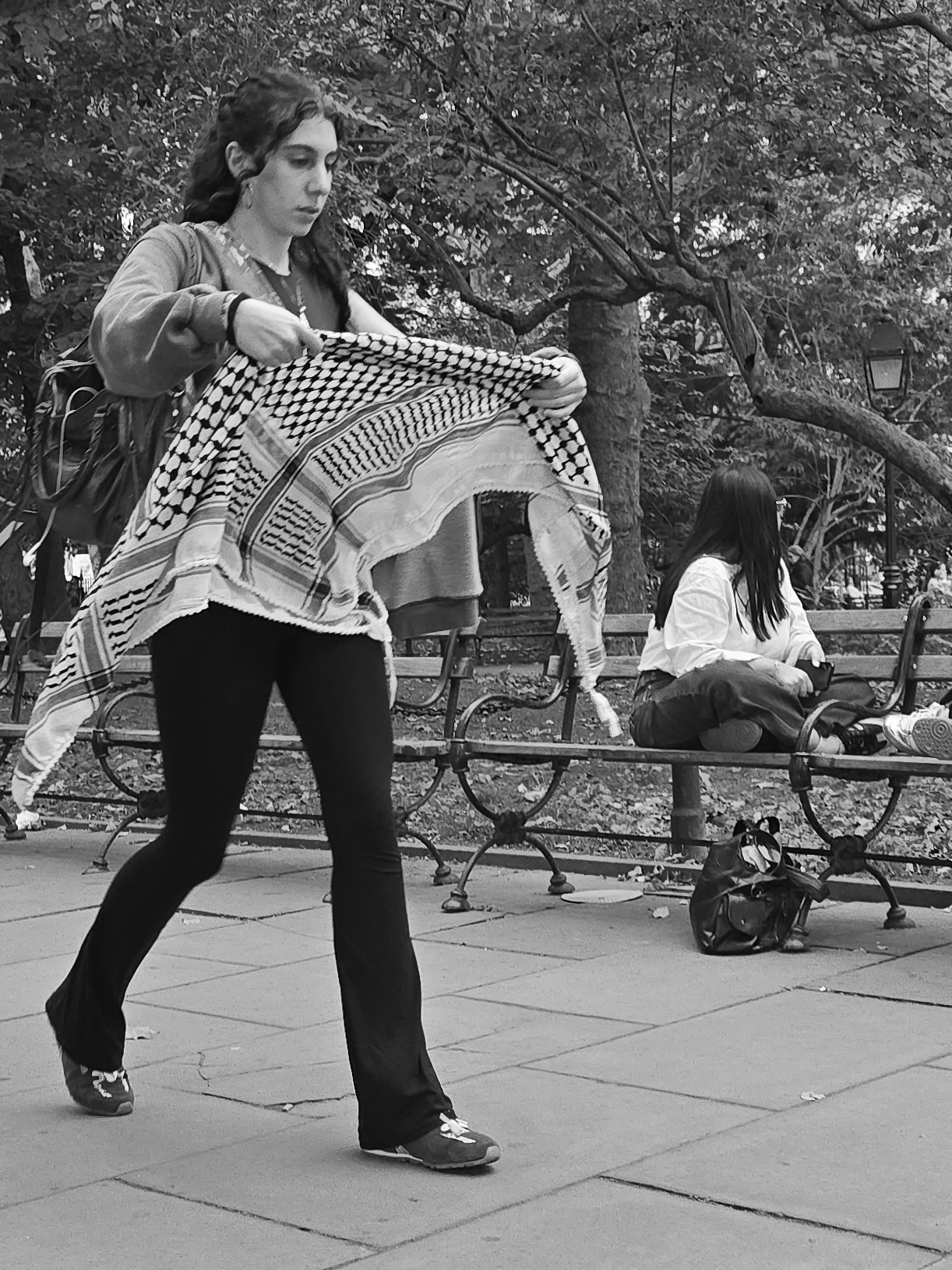
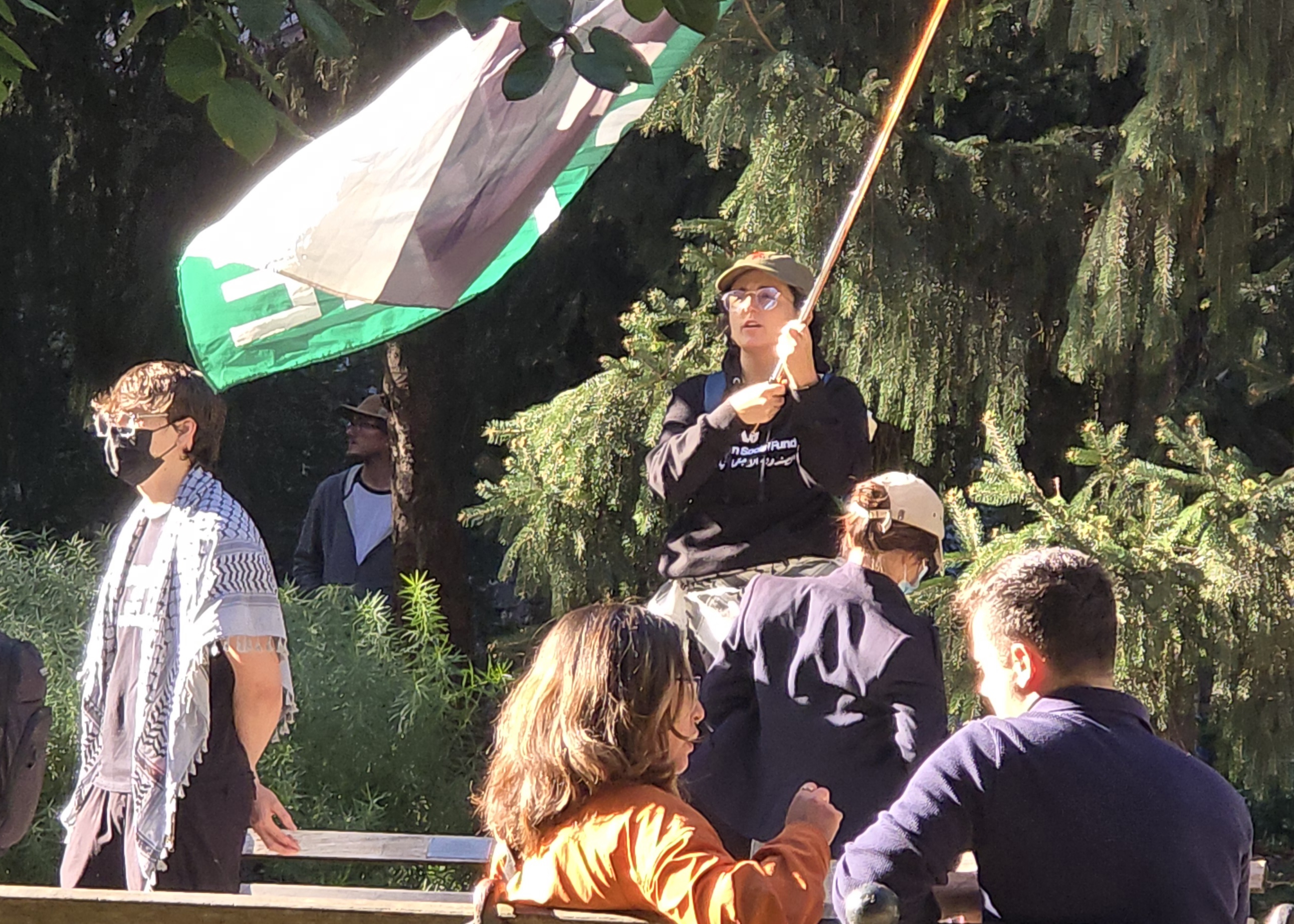
Woman with press credentials sporting a keffiyeh walking to anti-Israel protest at City Hall on October 26, 2026, ahead of group from Neturei Karta holding a Palestinian flag (photo: First One Through)Woman getting ready to join the anti-Israel protest, pulling out her keffiyeh at City Hall on October 7, 2026 (photo: First One Through)
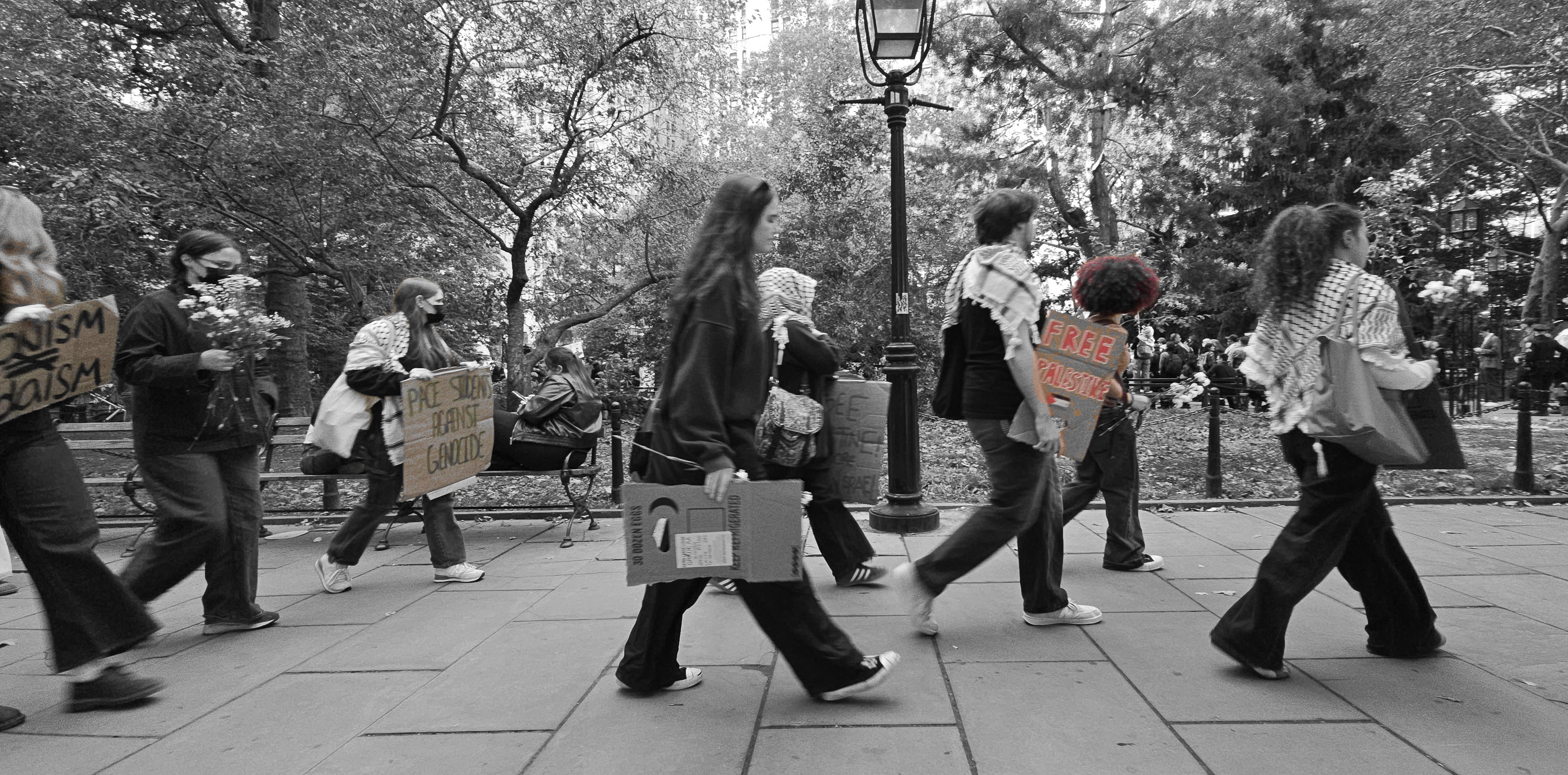
A group of students from nearby Pace University came by with placards to “Free Palestine” and “Zionism is not Judaism.” They joined crowds yelling things much more violent:
“Intifada revolution!”
“Zionism will fall!”
“Liberation is near!”
“We don’t want two states. We want ’48!”
“Mobilize the Intifada!”
Students from Pace University join an anti-Israel protest at City Hall on the anniversary of the slaughter of roughly 1,200 people in Israel and seizure of 251 hostages,on October 7, 2026 (photo: First One Through)
Today’s Jihad Joe doesn’t put his life at risk for America, American allies or American values. He mocks all of those things. Jihad Joe wishes them vanquished, celebrates their setbacks and chants for the jihadi vision for the U.S. and Israel, all from the quiet and comfortable streets that affords the freedom of speech and assembly not found in Islamic republics.
Jihad Joe sees G.I. Joe as an old and racist dead White man.
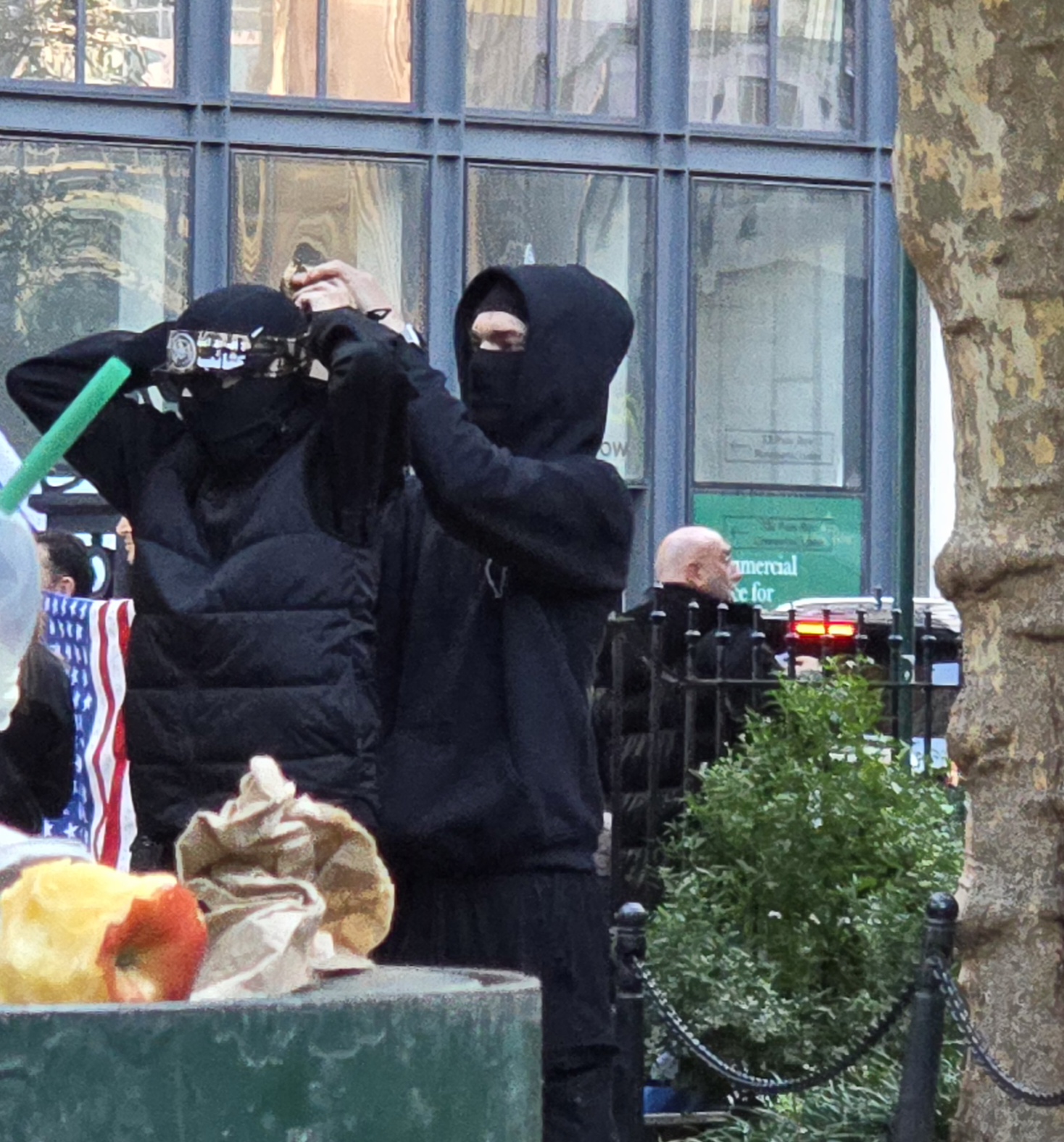
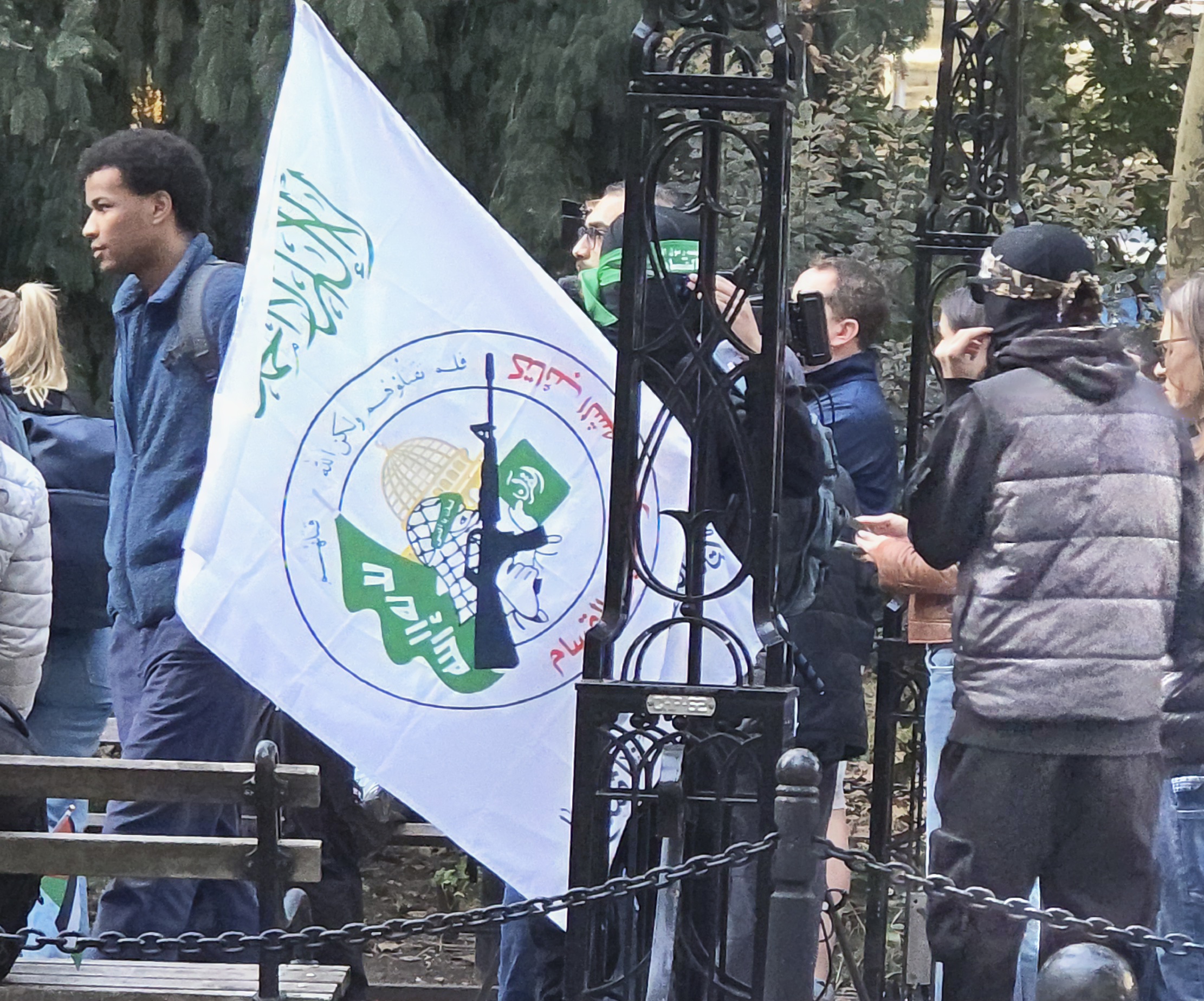
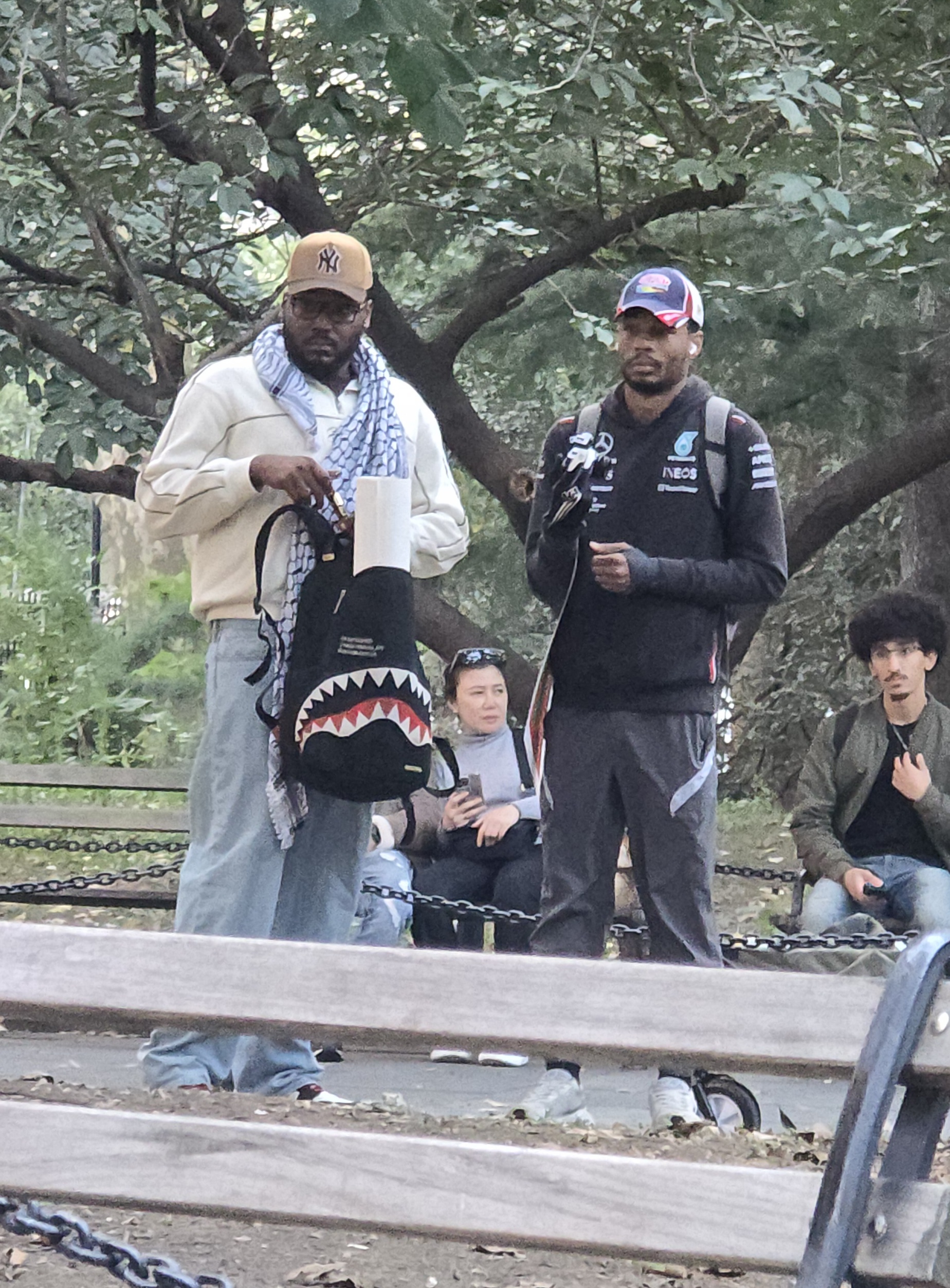
Two young men covering faces and sporting headbands with Hadiths for MohammedYoung men waving flag of armed Arab before Dome of the Rock
Imagine Canadians holding a march on September 11, 2026 cheering the work of the jihadists who killed nearly 3,000 people in the U.S., calling for the destruction of America. Yes, it is protected speech; but so what? It is repulsive and sick.
More, it reveals the depravity of a significant swath of Americans.
Crowd of people scream support for the antisemitic genocidal jihadists of Hamas, on third anniversary of the October 7 massacre (photo: First One Through)
Eighty years ago, America produced the Greatest Generation. G.I. Joe was its everyman: the ordinary American who put on his country’s uniform, crossed an ocean and fought against fascism and tyranny. Today we see a very different American archetype walking the streets of New York. He puts on the keffiyeh, embraces the symbols and slogans of foreign jihadist revolutionary movements, and mocks America, its allies and the rape and slaughter of its citizens.
In less than a century, we have descended from G.I. Joe to Jihad Jane.
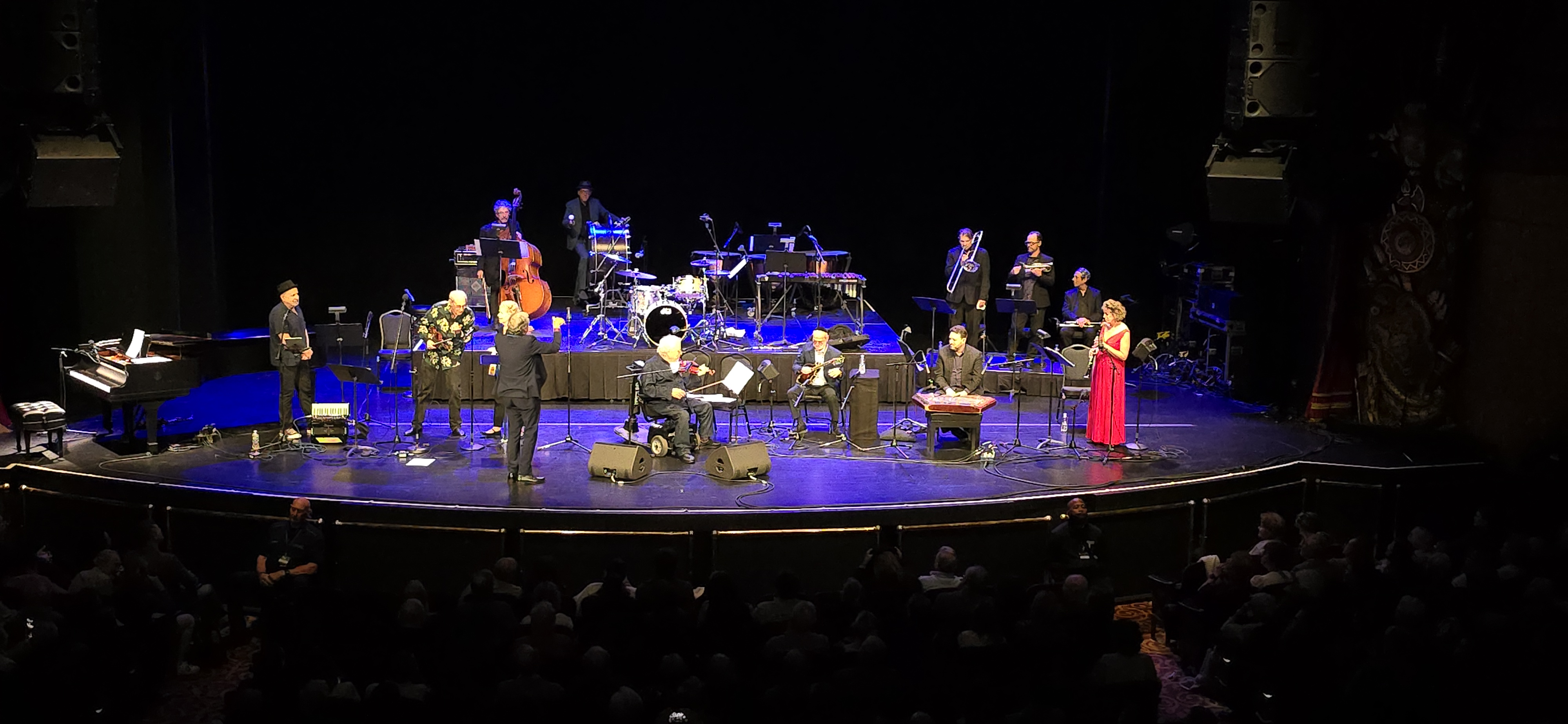
At the Beacon Theatre, Itzhak Perlman offered a reminder that Jewish memory is not only something Jews mourn; it is something they dance to.
Four days after New York marked the 25th anniversary of September 11, and just after Rosh Hashanah ushered in another Jewish year, Itzhak Perlman sat at center stage at the Beacon Theatre and played klezmer.
The concert celebrated Perlman’s 81st birthday and roughly three decades since In the Fiddler’s House, his landmark embrace of the music of his Jewish roots. Perlman said he wanted people “to dance in the aisles.”
Itzhak Perlman, with members of the Klezmatics and Andy Statman at the Beacon Theater September 15, 2026 (photo: First One Through)
That is where klezmer belongs.
The word comes from the Hebrew klei zemer – “vessels of song” – but klezmer was never simply a genre of music. It was music woven into the life of Eastern European Jews, played at celebrations and, most famously, weddings.
It sounds like the world that created it. The violin can plead like prayer. The clarinet can cry, tease and laugh. A melody can begin in longing and, almost without warning, become a demand to get out of your chair.
Klezmer can sound sad without being sad music. It carries memory into celebration.
Even more, klezmer turns Jewish memory into Jewish motion.
Much of the Eastern European Jewish world that created this music was eventually destroyed. Whether Jews fled pogroms of the 19th and 20th century or were wiped out in the Holocaust, the ground which birthed klezmer has lost almost all of its Jewish feet.
But the music crossed oceans and generations. Jewish immigrants carried it to America, where later musicians recovered and revived the tradition. Andy Statman, who joined Perlman on stage at the Beacon, became one of its great modern interpreters. Perlman’s In the Fiddler’s House brought klezmer to audiences who knew him primarily as one of the world’s greatest classical violinists.
That makes the choice itself significant.
Perlman could have celebrated his birthday playing Bach, Beethoven or Brahms. Instead, he gathered klezmer musicians at the Beacon to play the music of Jewish weddings and Jewish celebrations.
And there was something particularly striking about hearing it in New York at this moment in time.
The city outside the Beacon has been experiencing a terrible surge in antisemitism. Jews have been harassed and assaulted on New York streets, while antisemitic incidents have repeatedly represented a disproportionate share of reported hate crimes. America’s youth has largely moved away from Israel and the Jewish State, leaving the future very uncertain.
That was the world outside the theater doors.
Inside was a different New York.
The audience appeared predominantly Jewish and older. For many, these melodies likely carried associations extending beyond a night at the Beacon: to parents and grandparents, weddings and synagogues, holidays and communities. To the Yiddish language rarely spoken anymore – let alone sung by a woman in public.
But the audience was not exclusively Jewish or old. The handful of younger people mostly wore kippahs or were Asian. Some may have come for klezmer; others simply for the opportunity to hear one of the greatest violinists alive.
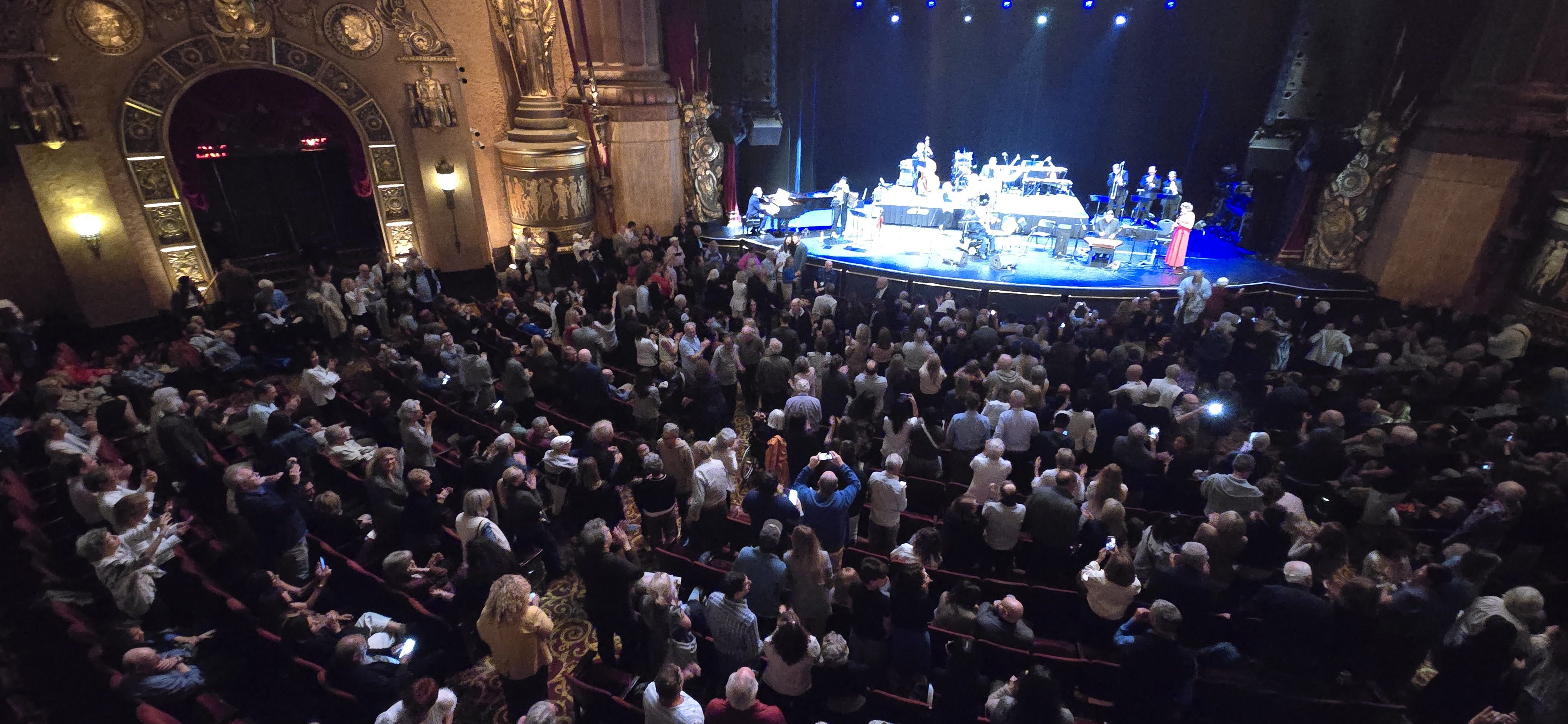
And then Perlman got his wish. People got out of their seats, filled the aisles and danced.
Crowd at the Beacon took to the aisles and started dancing around the theater as Perlman and the band played wedding music (photo: First One Through)
The scene captured something that yet another speech condemning antisemitism could not. Outside were the streets of a city where Jewish identity has increasingly been met with hostility and Jews hid their identity. Inside, an 81-year-old Jewish violinist who cannot walk himself, was playing unmistakably Jewish music inherited from communities that no longer exist – and Jews and Asians alike were on their feet celebrating it.
Dancing in the aisles at The Fiddler’s House to music by Itzhak Perlman and the Klezmatics at The Beacon in NYC, September 15, 2026
The timing made the scene still richer.
The Jewish year had just begun with the blast of the shofar. Rosh Hashanah demands reflection. Yom Kippur will demand repentance and fasting. But the Jewish calendar does not end there. It moves to Sukkot and then Simchat Torah, when Jews take the Torah from the ark, hold it in their arms and dance.
That progression says something essential about Judaism. It remembers the good and the bad. It prays. It fasts. It builds. It dances.
And it refuses to make sorrow the destination.
On a September night in New York, with antisemitism again confronting Jews on the streets outside, an old Jewish musical legend lifted his violin and played old Jewish melodies. And Jews clapped and danced in the aisles.
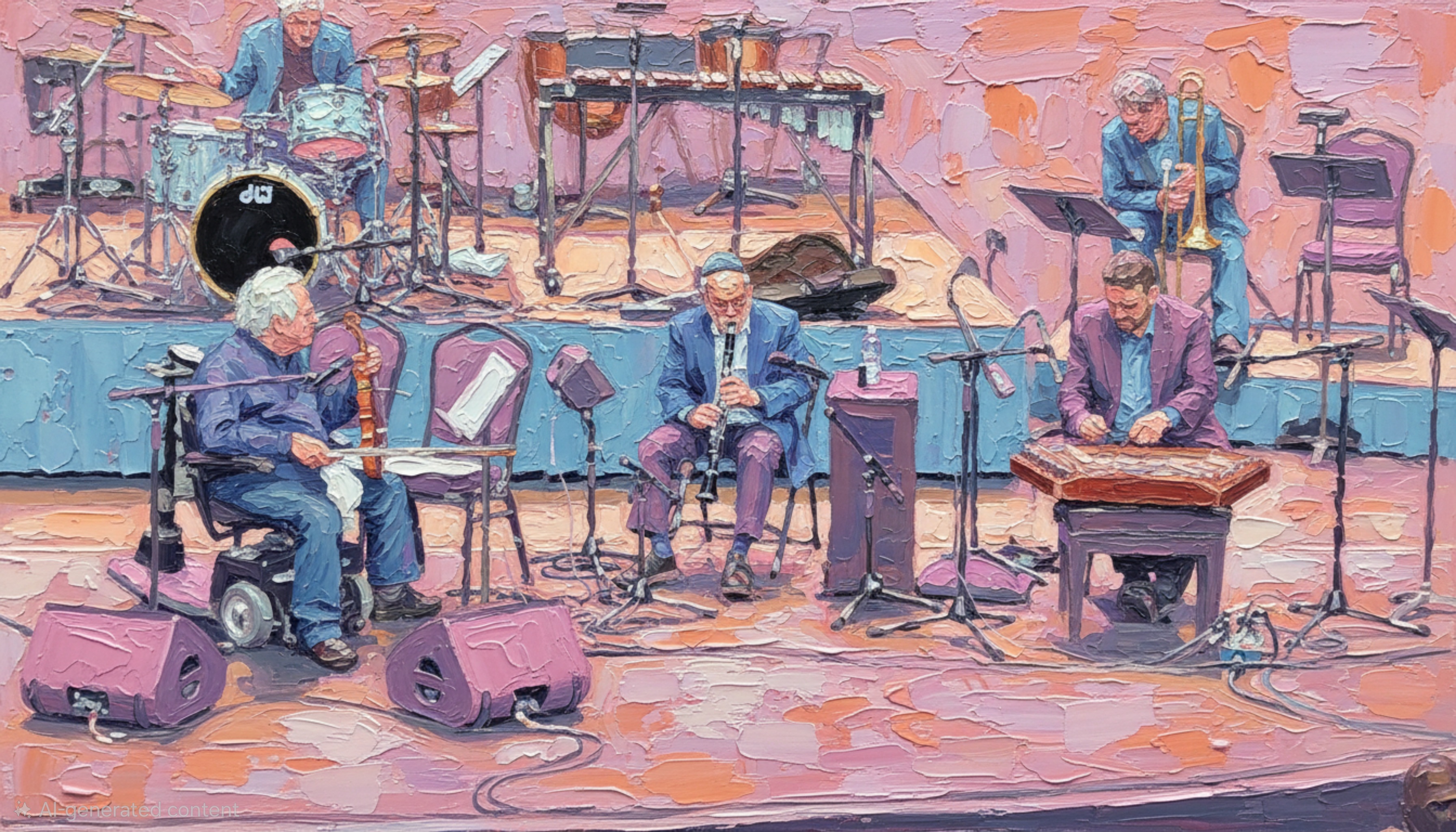
Itzhak Perlman and Andy Statman at The Beacon in NYC for Itzhak’s 81st birthday (made by First One Through with AI)
There was a time when many New Yorkers dismissed the Democratic Socialists of America (DSA) as a fringe movement. Their rallies were loud. Their rhetoric was provocative. But surely the city that built Wall Street, welcomed millions of immigrants, and was attacked on September 11 would never hand real political power to a movement whose rhetoric after October 7 shocked so many Americans.
Rally in Times Square the day after the massacre of 1,200 people in Israel and abduction of 251.
Yet here we are.
The new mayor is part of the DSA. DSA-backed candidates continue to win elections across New York City.
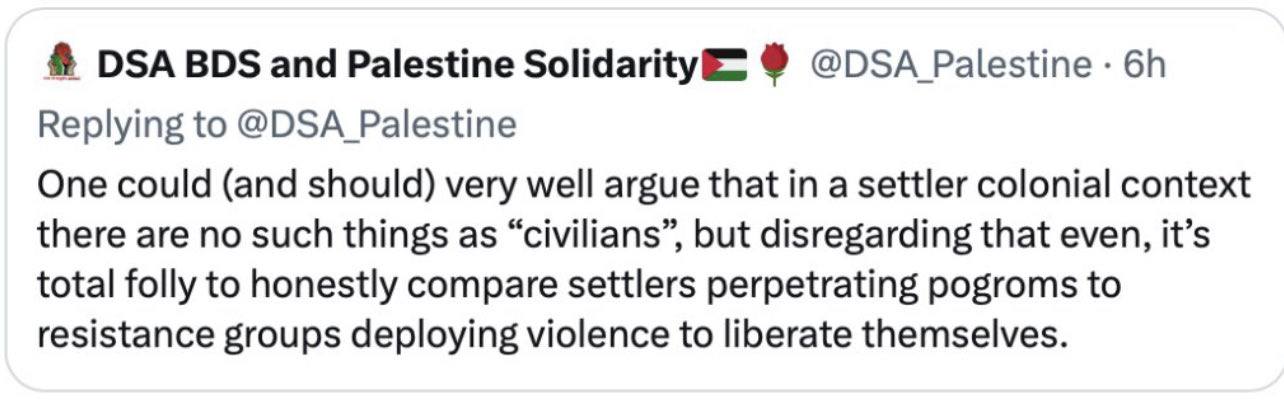
This is not merely a debate over tax rates or rent control. After Hamas murdered more than 1,200 Israelis on October 7, the New York City chapter of DSA helped organize demonstrations almost immediately afterward. Slogans and statements in Times Square celebrated the attack as “resistance” and chanted for it to continue “long live the Intifada!” DSA-NYC had long argued that Israeli civilians should not be viewed as innocent because they were participants in a “settler-colonial” society.
One might have expected that such rhetoric would permanently marginalize it. Instead, it grew. How?
Because its opponents fought the wrong war.
Organizations such as AIPAC concentrated enormous resources on defeating individual candidates where the ground game already indicated it could win. Sometimes they succeeded spectacularly. Millions of dollars were spent. Headlines proclaimed another victory over the anti-Israel Left.
But every expensive primary also reinforced the story DSA wanted to tell.
They were no longer simply neighborhood activists. They became the underdogs standing up to a wealthy political establishment. Every television advertisement became another fundraising email. Every outside dollar became another recruiting tool. Every victory over one candidate left the movement itself intact and often stronger.
AIPAC won campaigns but DSA built a movement.
Politics is ultimately about culture before it is about elections. Elections simply reveal where the culture already stands.
While establishment organizations measured success by defeating a particular candidate, DSA measured success by opening another neighborhood chapter, training another organizer, recruiting another volunteer, and persuading another generation that its worldview represented justice.
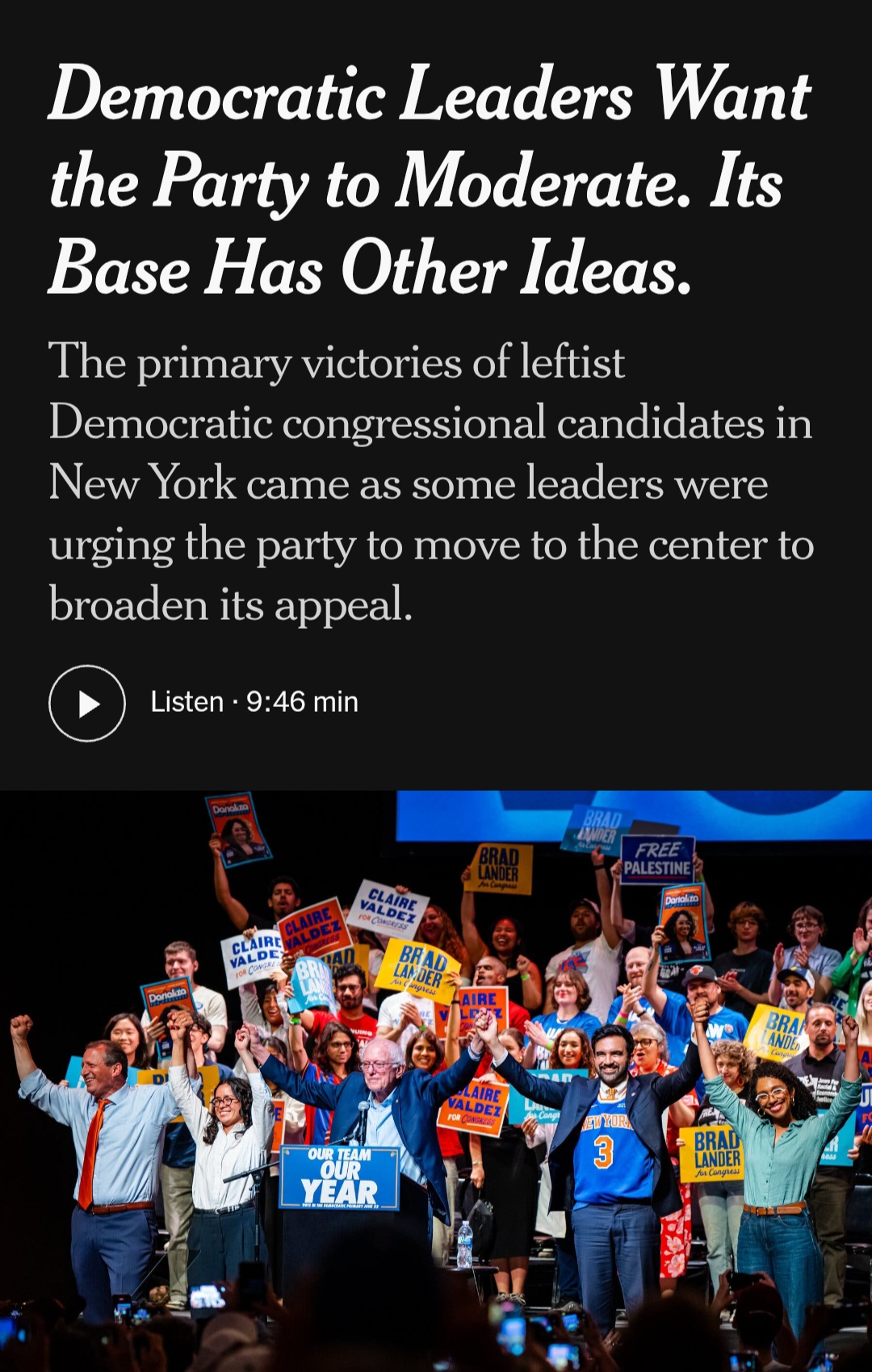
The results are now visible. A virtual sweep of DSA candidates in New York this week.
New York did not suddenly become socialist. It was organized into becoming more receptive to socialist candidates over many years. One neighborhood at a time. One group at a time.
J Street spent considerable time and effort over the past few years bashing AIPAC to build better alliances with the far-left. Now that multiple anti-Israel extremists have entered office while effectively echoing J Street’s smears of AIPAC, the left-wing “pro-Israel” group stayed mum and didn’t print a single press release.
That should be the lesson – not only for those who support Israel, but for anyone concerned about the city’s future.
Money can influence an election. It cannot substitute for a movement.
If New York is to change course, it will not happen because one organization writes larger checks. It will happen because people who believe in liberal democracy, civic responsibility, pluralism, and the moral distinction between murdering civilians and defending them begin organizing with the same patience and persistence that their opponents have displayed for years.
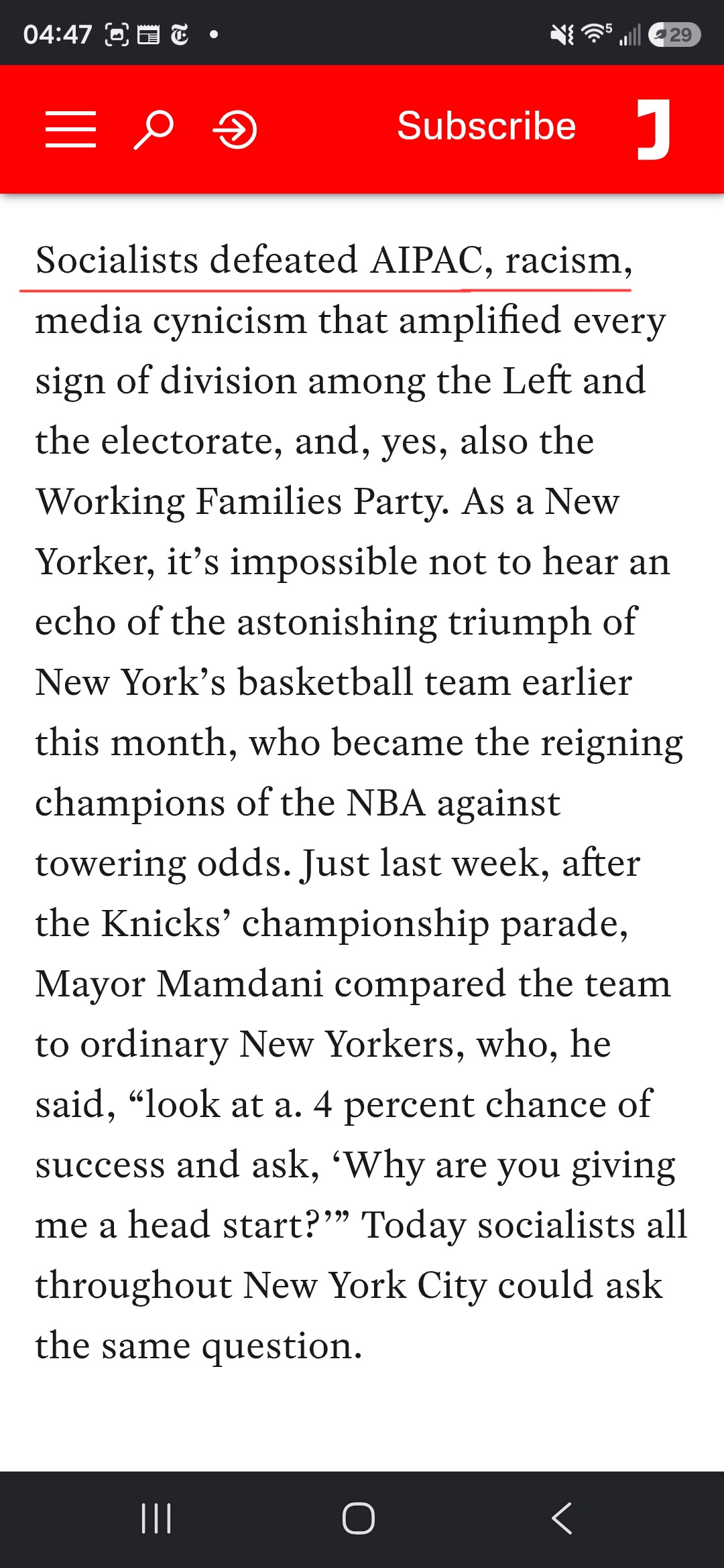
Jacobin lead is that Socialists defeated “AIPAC, racism” before anything else
Cities are not lost in a single election. They are lost one neighborhood at a time.
The children who dominate New York’s Israel parade are no longer the children who dominate Jewish education.
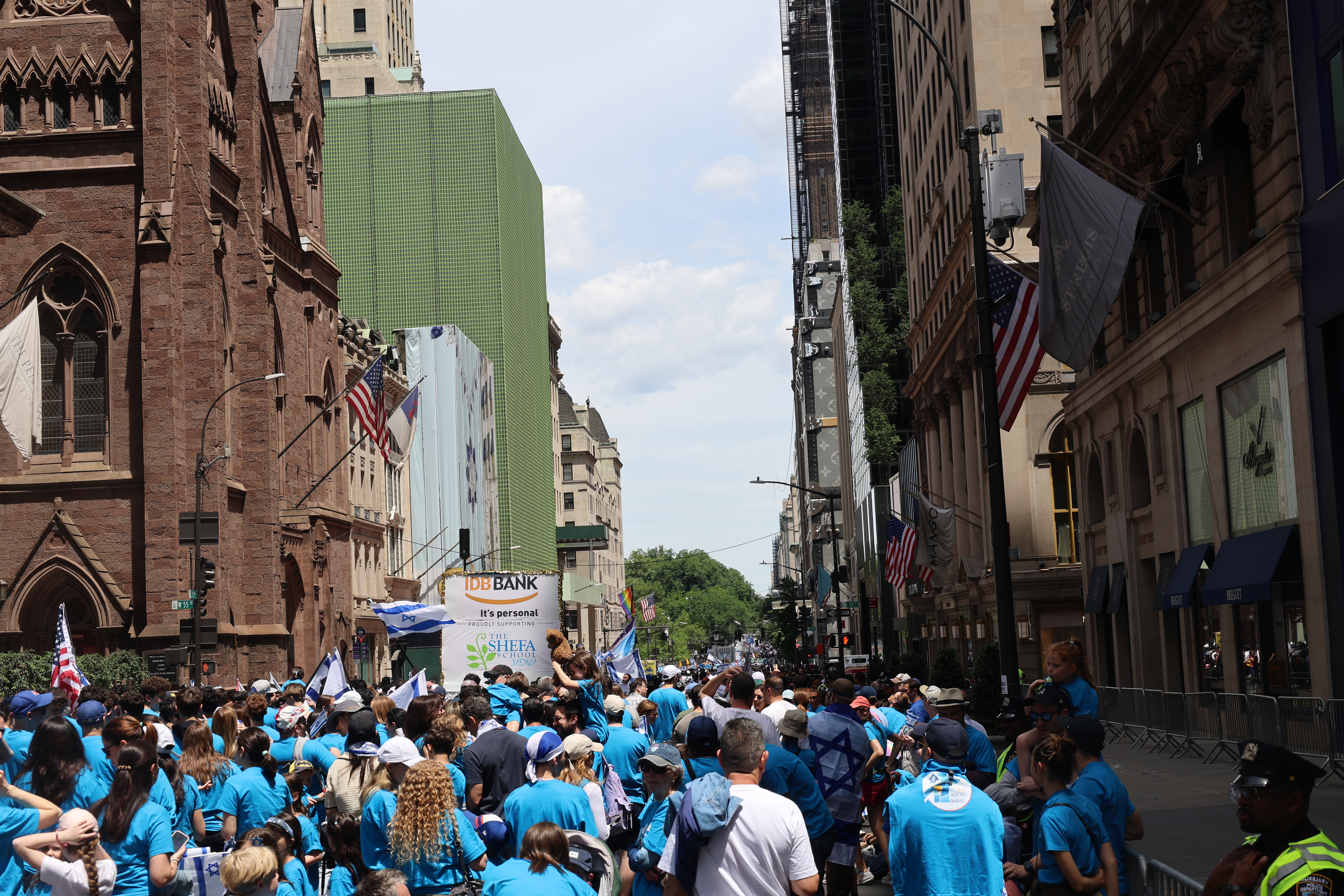
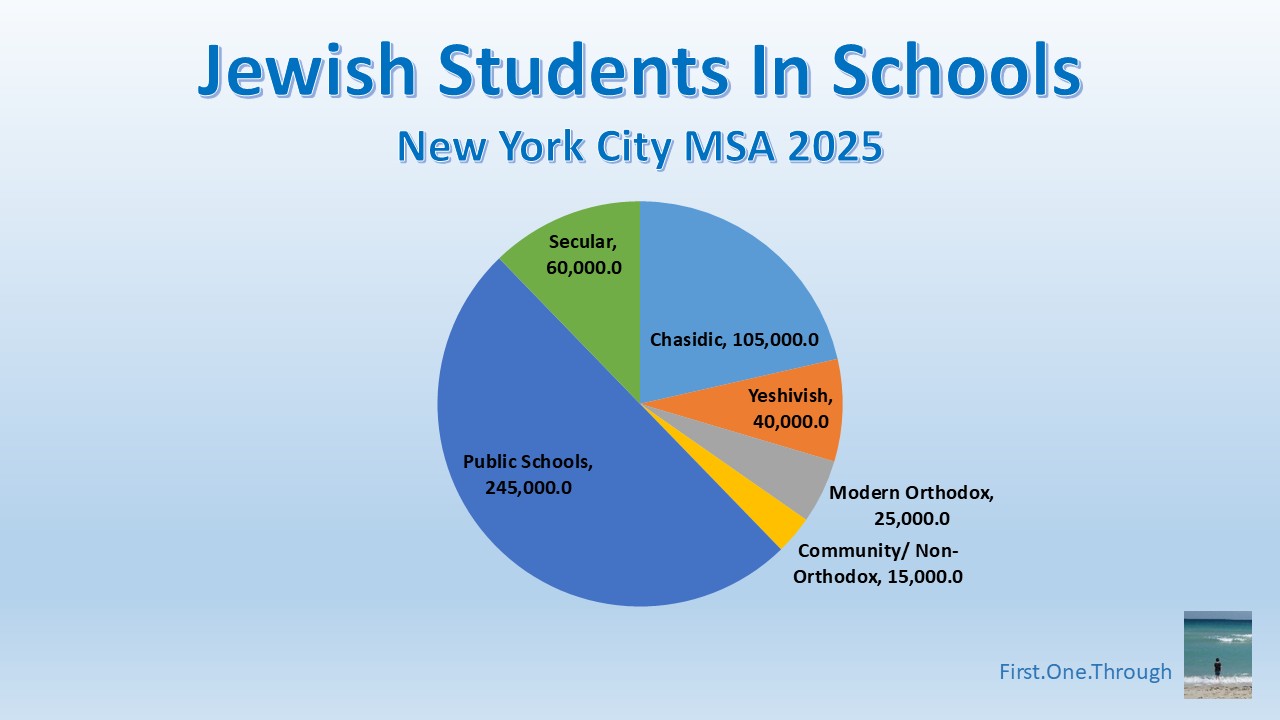
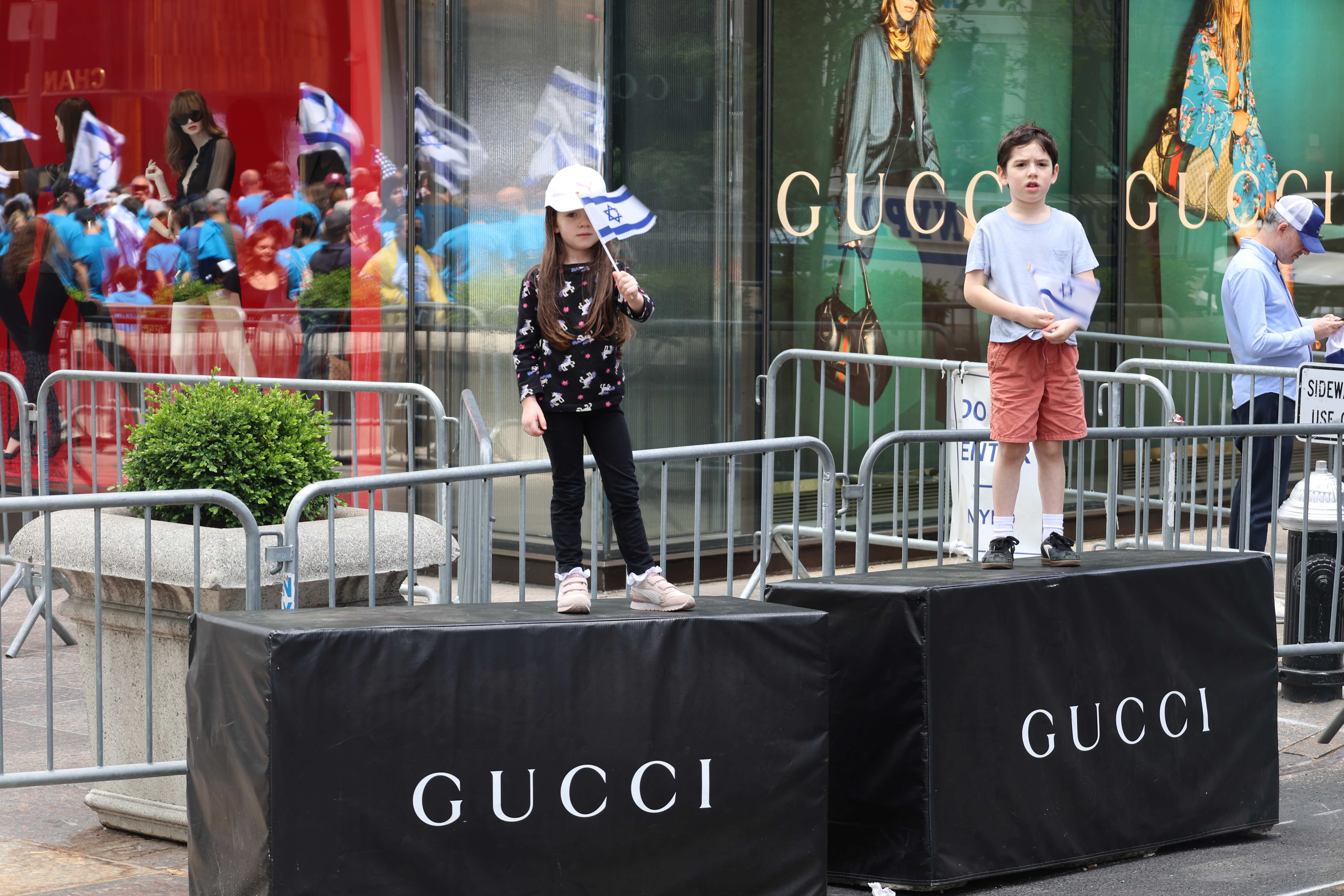
Each spring, Fifth Avenue fills with students from Modern Orthodox and Religious Zionist schools waving Israeli flags, singing Hebrew songs, and celebrating the Jewish state. Yet these students represent only a small fraction of Jewish children in the New York metropolitan area. The largest group of Jewish children attends public and secular private schools. The largest group attending Jewish schools is Chassidic and Yeshivish.
Jewish yeshiva day school students and faculty march up Fifth Avenue in New York City’s Israel parade, May 31, 2026 (photo: First One Through)
That reality raises an important question about the future of one of American Jewry’s most visible public events.
The parade’s own history reflects the evolution of American Jewish identity.
When it was founded in 1964, it was called the Youth Salute to Israel Parade. The name reflected its era. Israel was only sixteen years old. The Holocaust was still within living memory. American Jews were not merely celebrating Israel; they were standing with it.
In 2011, the event became the Celebrate Israel Parade. Israel was no longer a struggling young state. It was a global technology center, a military power, and home to millions of Jews. The emphasis shifted from solidarity to celebration.
After October 7, the parade adopted a third name: Israel Day on Fifth.
The parade’s three names trace the evolution of American Zionism itself. The first generation saluted Israel. The second celebrated Israel.
Today, the challenge is different. Support for Israel can no longer be assumed, and Jewish unity can no longer be taken for granted. The question is whether Israel can continue to serve as a bridge connecting an increasingly diverse Jewish community.
The challenge is particularly visible when looking at Jewish children in the greater NYC area.
The best available estimates suggest that roughly 450,000 to 500,000 Jewish school-age children live in the greater New York metropolitan area. About 170,000 attend Jewish day schools and yeshivot.
Of those, roughly 130,000 to 140,000 attend Chassidic and Yeshivish schools, compared with only 20,000 to 25,000 in Modern Orthodox schools. Outside the day-school world are another 280,000 to 330,000 Jewish children attending public schools, secular private schools, Catholic schools, and other educational settings.
Yet anyone watching the parade could be forgiven for drawing the opposite conclusion.
The schools most visible on Fifth Avenue are overwhelmingly Modern Orthodox and Religious Zionist institutions. They are among the most committed supporters of Israel in American Jewish life. But they represent only a small share of Jewish youth. The fastest-growing segment of Jewish education is Chassidic and Yeshivish. The largest segment of Jewish children overall attends public and secular private schools.
The parade therefore showcases some of the most engaged Jewish children in America, but not necessarily the full spectrum of Jewish youth.
That matters because Israel remains one of the few ideas capable of connecting Jews across denominational, ideological, and educational lines. At a moment when Jewish attachment to Israel is increasingly challenged on college campuses, contested on social media, and questioned in parts of American public life, institutions that connect young Jews to Israel have become more important, not less.
If the goal is Jewish unity in the decades ahead, the parade may need to ask a different question.
Rather than “How do we celebrate Israel?” the question may be “How do we bring the Jewish people together around Israel?”
A future parade organized around Am Yisrael rather than a particular expression of Zionism could create room for every community to participate in its own way.
Charedi schools could march under banners celebrating Torah in the Land of Israel.
Public-school students could march through camps, youth groups, synagogue programs, and community organizations.
Modern Orthodox schools could continue expressing their Religious Zionist vision.
Israeli cultural groups, charities, universities, first responders, and innovation organizations would all still have their place.
This would be Am Yisrael Day on Fifth Avenue.
The original parade was created to demonstrate solidarity with a young Jewish state. The next challenge is ensuring that future generations of American Jews remain connected both to Israel and to one another.
Should the future of the parade remain with the niche schools that already fill Fifth Avenue, it will become a symbol of the fragmentation of Israel support even within the Jewish community, let around the broader world. That would not bode well for Jewish New Yorkers or Israel.
The first generation saluted Israel. The second celebrated Israel. The challenge for the third generation is to ensure that Israel remains a force capable of uniting the Jewish people.
Two years ago at New York City’s Celebrate Israel Parade, Holocaust survivors climbed down from their float and danced with the children marching beside them. This year the children climbed up onto the float and sat beside the survivors.
The change captured something unmistakable: distance in years sometimes requires an inverse relationship in physical space.
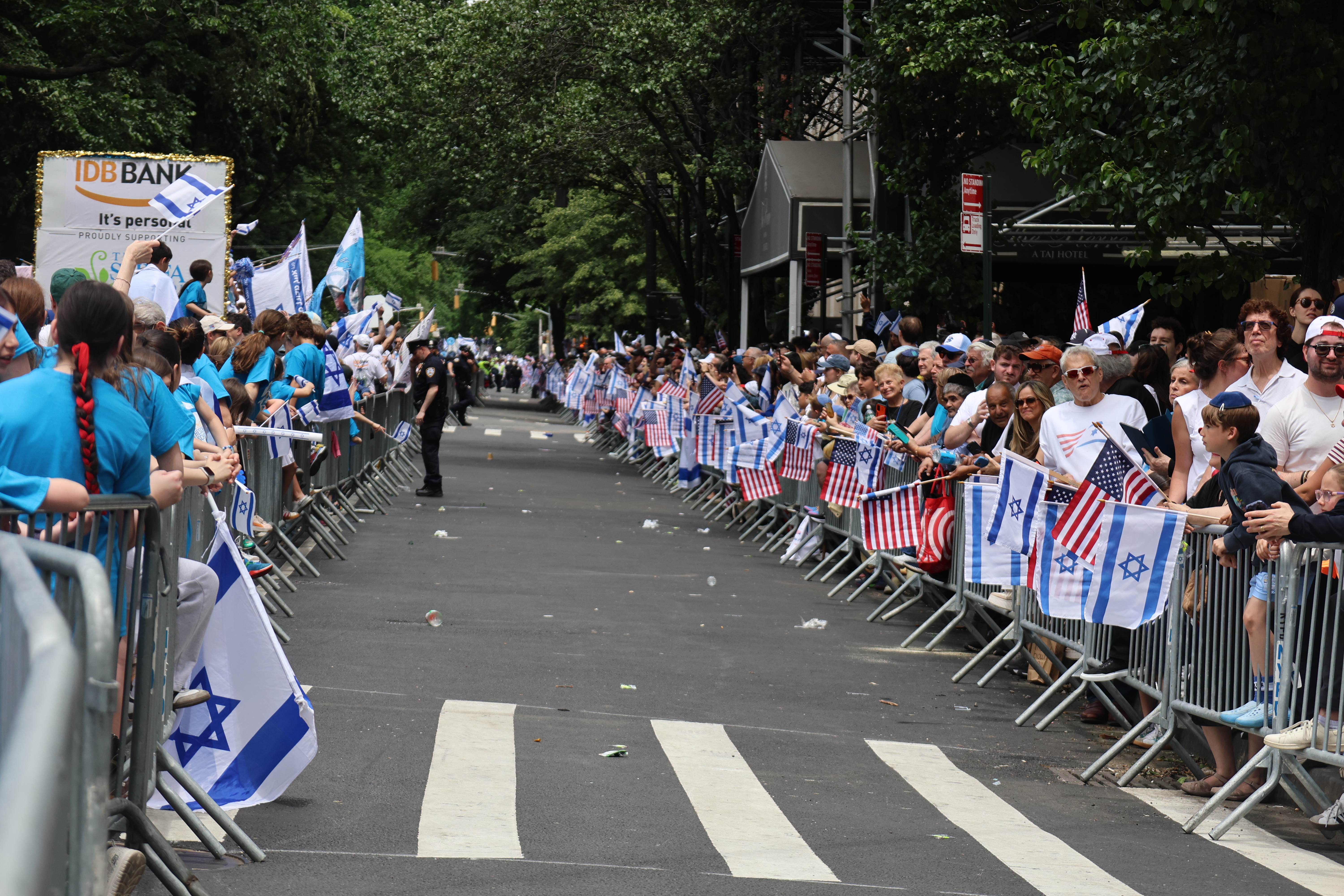
As the float moved down Fifth Avenue, Holocaust survivors waved Israeli flags toward the crowd. Around them stood students, children, grandchildren, and thousands of New Yorkers carrying American and Israeli flags. Some of those cheering were the children and grandchildren of Survivors who are no longer here.
Children of Holocaust Survivors march alongside float carrying Survivors (photo: First One Through)
They felt what we saw: how much smaller the group of survivors had become.
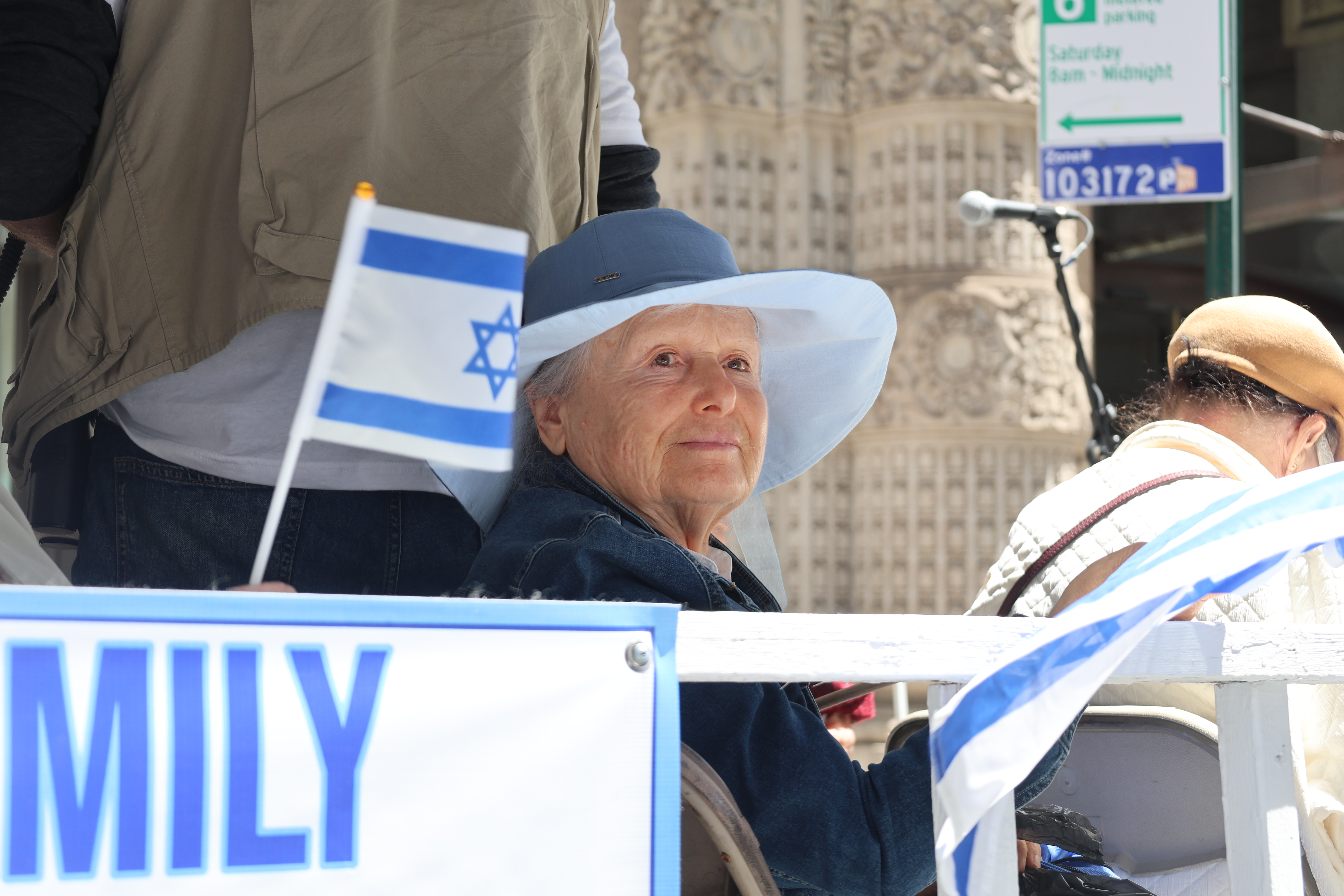
An elderly woman sat quietly beneath a blue hat, an Israeli flag resting beside her. Nearby, several other survivors smiled and waved to the crowd. Looking across the float, one could not help noticing who was missing.
Holocaust Survivor at Celebrate Israel Parade 2026 (photo: First One Through)
The men are disappearing.
Every year there are fewer survivors able to spend a day riding through Manhattan. Husbands, brothers, and friends who once shared these memories are no longer there. Increasingly, the survivors are women carrying stories that were once held by entire families and communities.
The Holocaust is passing from lived experience into history.
Holocaust Survivors at Celebrate Israel Parade 2026 (photo: First One Through)
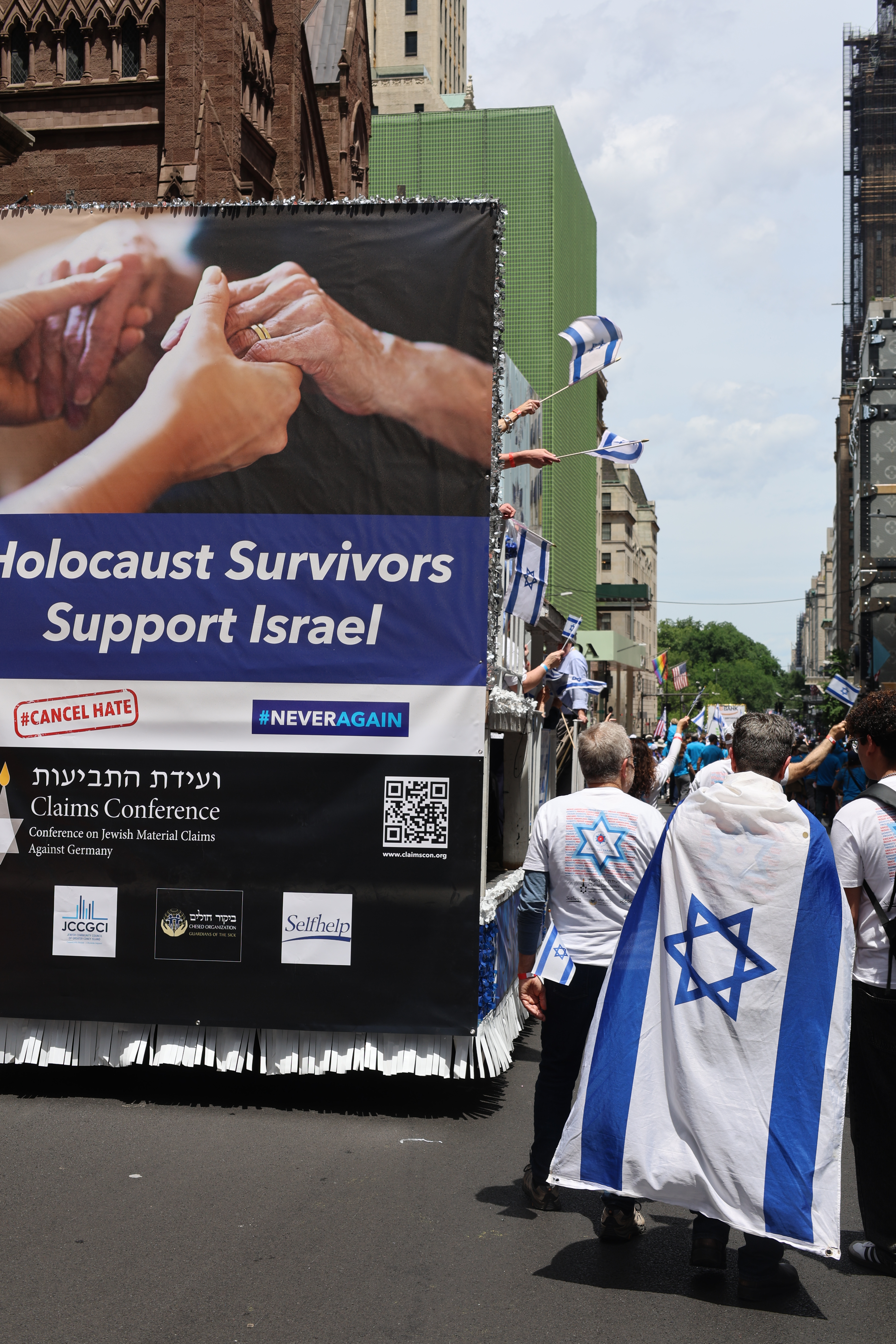
The banner on the float read simply: “Holocaust Survivors Support Israel.”
For many aboard, Israel is not a political issue. They remember something most Jews today know only from books: a world in which there was no Jewish state. A world in which the doors of country after country remained closed while European Jewry was destroyed.
That reality gave the float a weight extending far beyond the parade itself.
Claims Conference float at Celebrate Israel Parade 2026 (photo: First One Through)
Yet the most moving scenes took place between the survivors and the young people gathered around them.
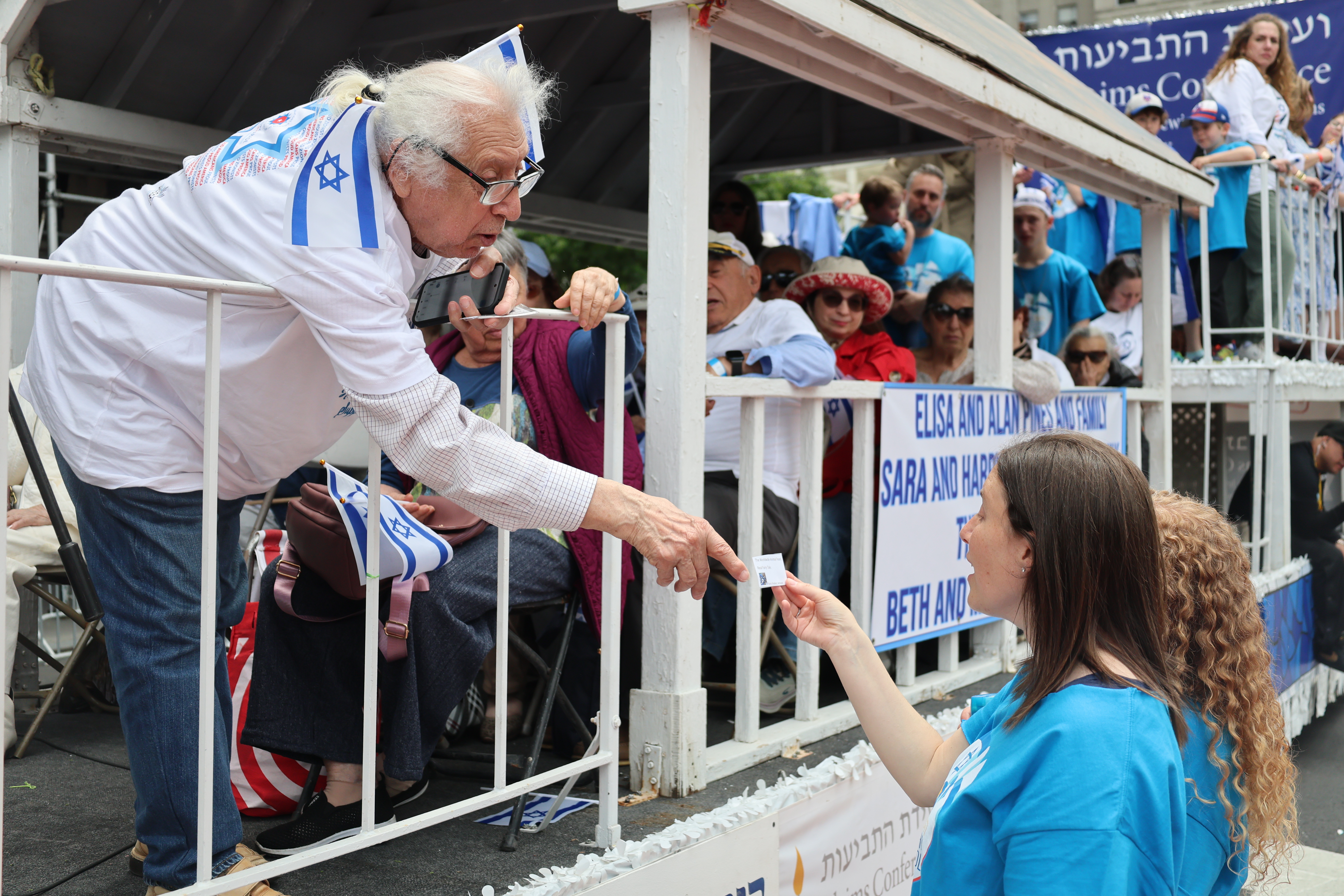
Some students and families from the Heschel School spent part of the afternoon alongside the survivors. Conversations unfolded between people separated by seventy or eighty years, yet connected by a common story. One survivor leaned over the railing to hand a parent a reference to a book he had written. Others stopped to speak with children standing beside the float.
The survivors can no longer carry these memories alone.
Holocaust Survivor at Celebrate Israel Parade 2026 talking to people from the Heschel School (photo: First One Through)
Others must carry them forward.
Perhaps that is why they continue to come.
Waving for hours on a hot day is not easy at ninety years old. Yet year after year they return because memory survives only when it enters public life and passes from one generation to the next.
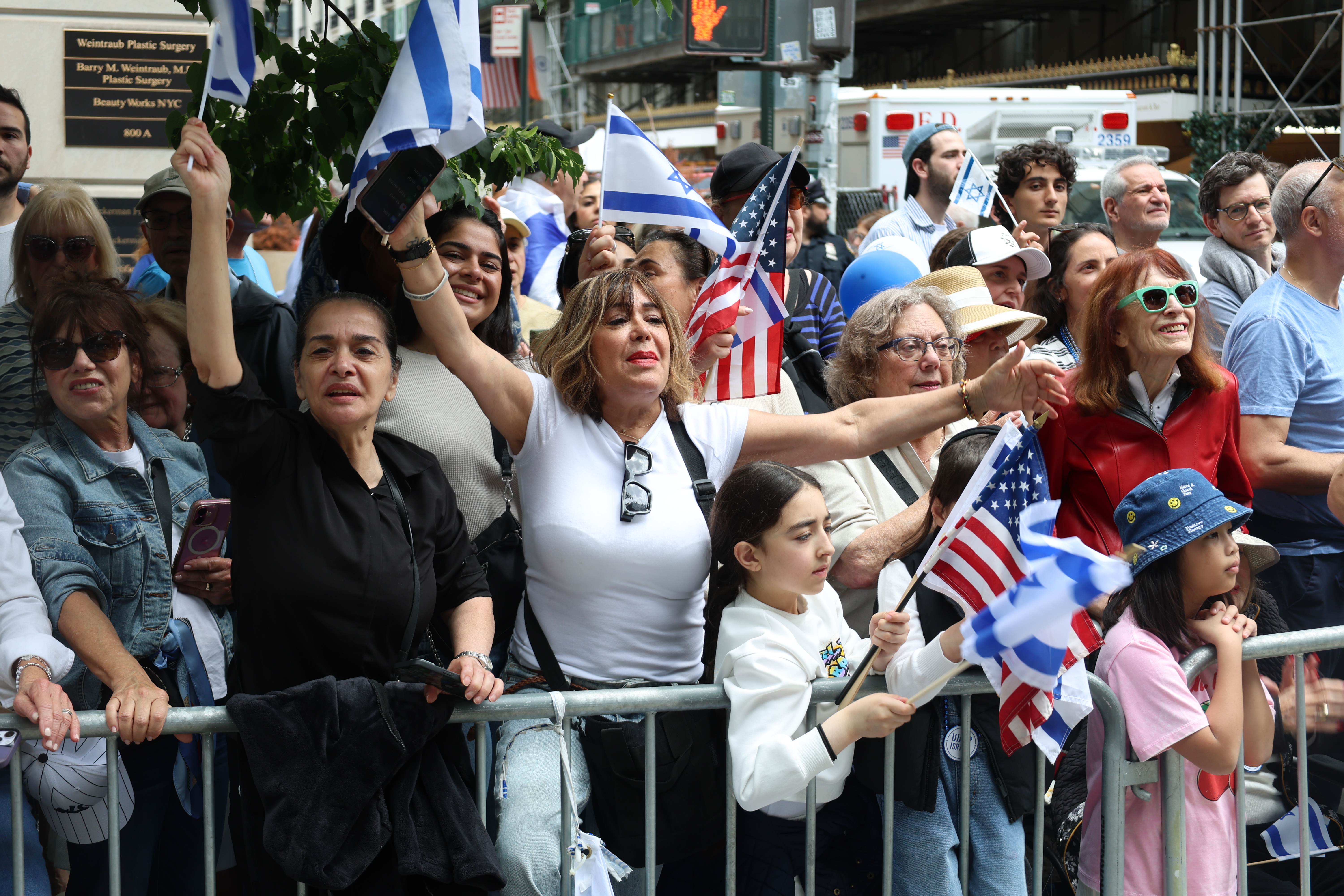
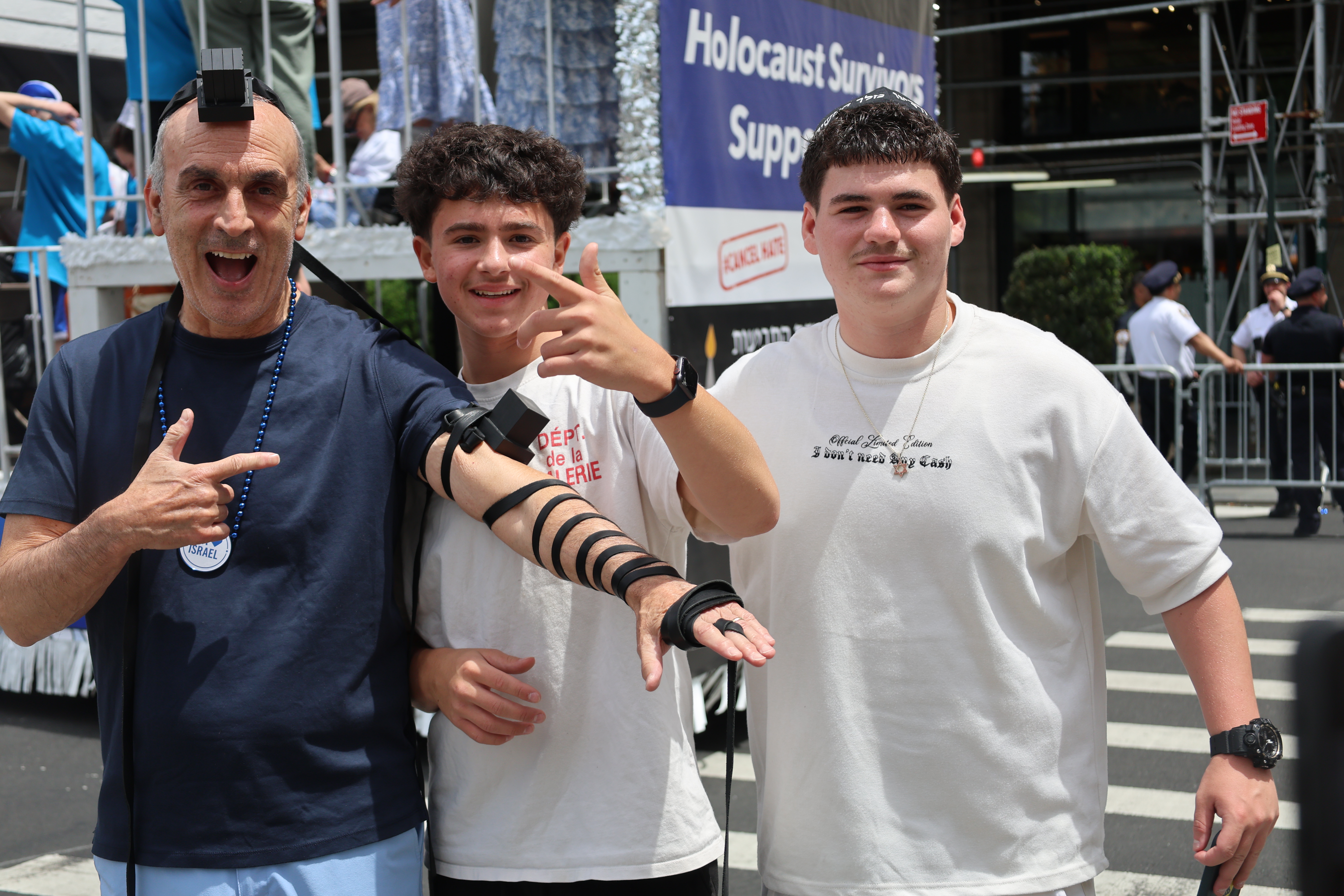
Around them, the parade moved forward. Families lined the route waving American and Israeli flags. Children danced in the streets. Chabad volunteers helped Jewish men put on tefillin along the sidewalks. The crowd cheered as marchers passed.
Young men put tefillin on Jewish men at Celebrate Israel Parade 2026 (photo: First One Through)
The city itself felt different than it had a few years ago.
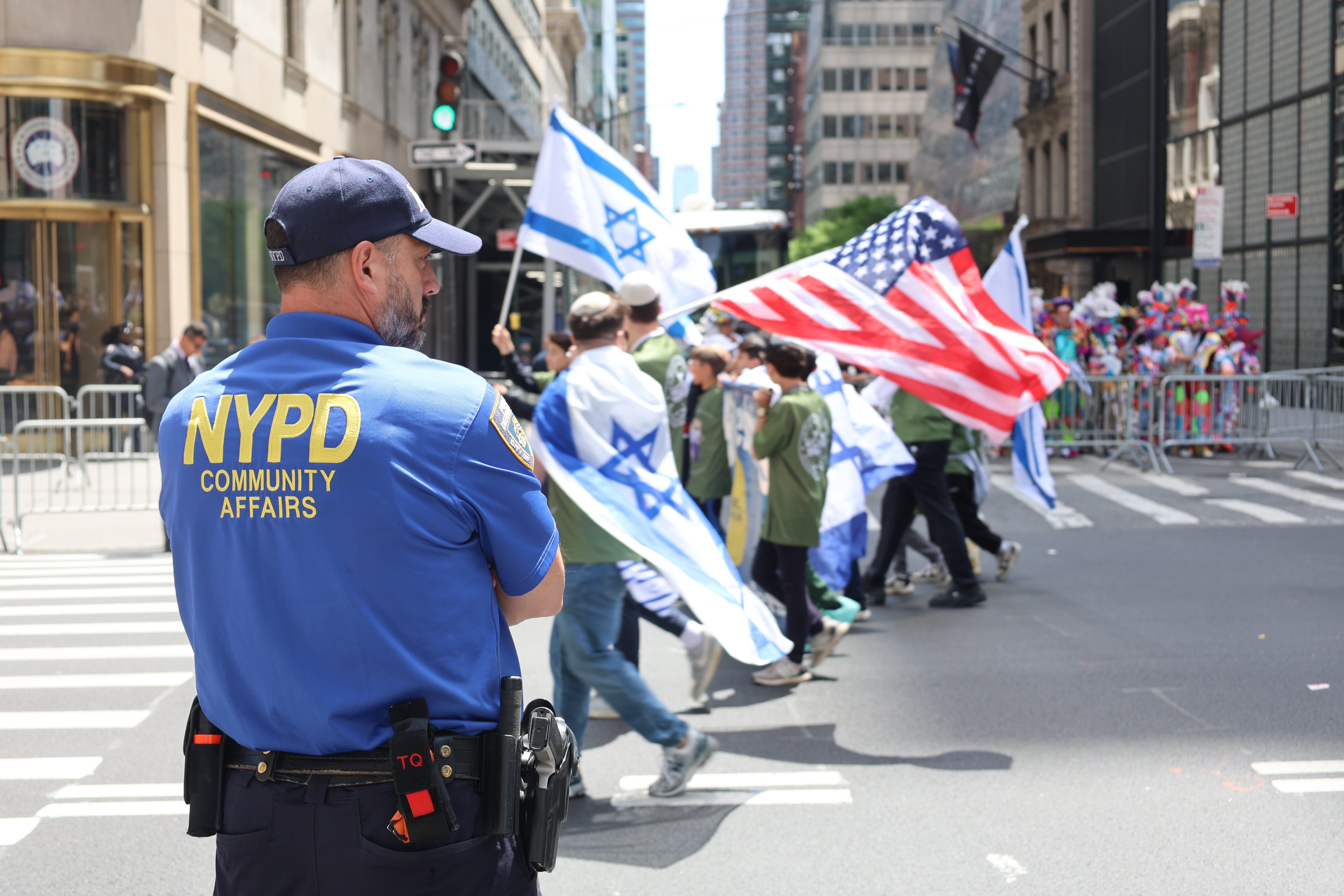
The parade was peaceful, but the precautions were impossible to miss. Police officers lined the route. Barricades stood farther from the crowd than in years past – perhaps twelve feet this year up from eight in years past.
NY Police watching over the Celebrate Israel Parade 2026 (photo: First One Through)Enormous twelve foot-plus separation along the Celebrate Israel Parade route on Fifth Avenue (photo: First One Through)
There was another difference as well.
Two years ago New York City’s mayor proudly marched in the parade. This year the mayor made a big show of not showing up because of his anti-Israel opinions. Support for Israel, once treated as an easy civic consensus, now feels more contested amid the ongoing Iranian proxy war on Israel.
The survivors understood such realities better than anyone. They have seen societies become less welcoming before.
Yet as the float rolled down Fifth Avenue, those tensions faded into the background. What remained was something older and more enduring.
Young people sat beside Holocaust survivors. They waved Israeli flags.
The scene compressed centuries of Jewish history. Survivors who remembered Europe before the Holocaust sat beside children growing up in America after the creation of Israel. The last witnesses shared space with those who will soon become witnesses for them.
Soon there will be no Holocaust survivors left to ride down Fifth Avenue.
The children waving beside them will inherit stories they never experienced themselves. They will become the custodians of memories that once belonged to the people sitting beside them.
Holocaust Survivor at Celebrate Israel Parade 2026 (photo: First One Through)
Two years ago the survivors climbed down from the float and danced with the children. This year the children climbed onto the float and sat beside the survivors.
The time distance between those moments is only two years. The physical distance between those generations has shrunk by necessity.
Holocaust Survivor at Celebrate Israel Parade 2026 (photo: First One Through)
When New Yorkers hear “private schools,” many still picture the old stereotype: elite Manhattan prep schools, hedge-fund families, sprawling campuses, and tuition bills that rival college.
That image is politically useful for progressives. It makes any fight over “private school funding” sound like a fight over privilege.
But in New York City, that is no longer the reality.
The largest private-school system in the city is not Dalton, Horace Mann, or Trinity School. It is the yeshiva system.
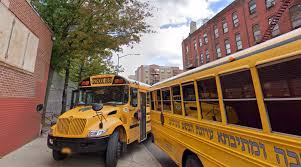
More than 100,000 students in New York City attend Jewish day schools and yeshivas (45% of the total in private schools), making them the largest single bloc in the city’s private education sector. Catholic schools, once the backbone of private education in the city, now rank second with 29% of the total. The political image of private education has not caught up with the demographic reality.
The latest battleground is special education reimbursement.
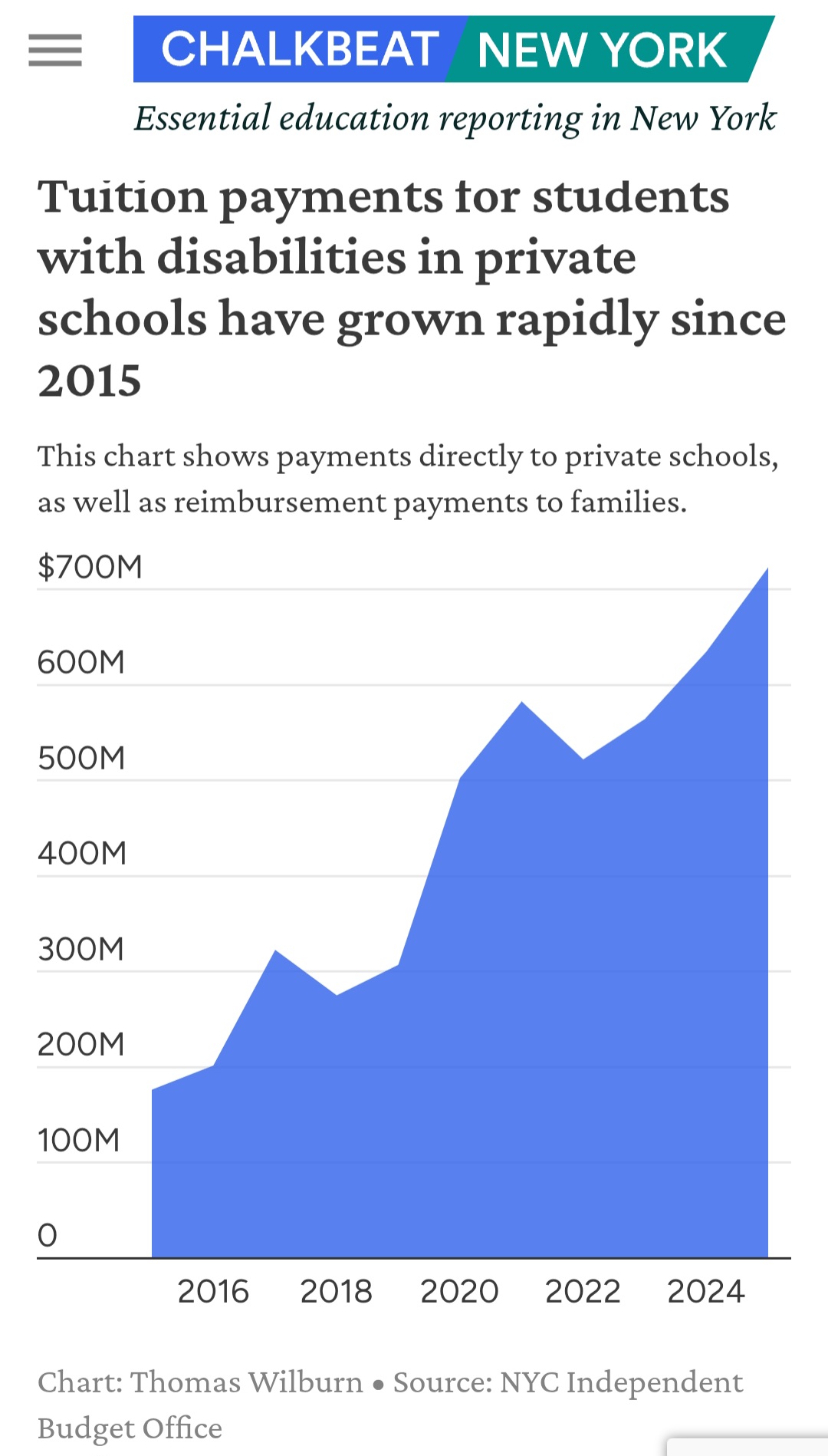
These are not subsidies for luxury education. They are legal remedies for families of children with disabilities whose needs the public-school system failed to meet. Under federal law, when the city cannot provide an appropriate education, parents can seek private placement and reimbursement.
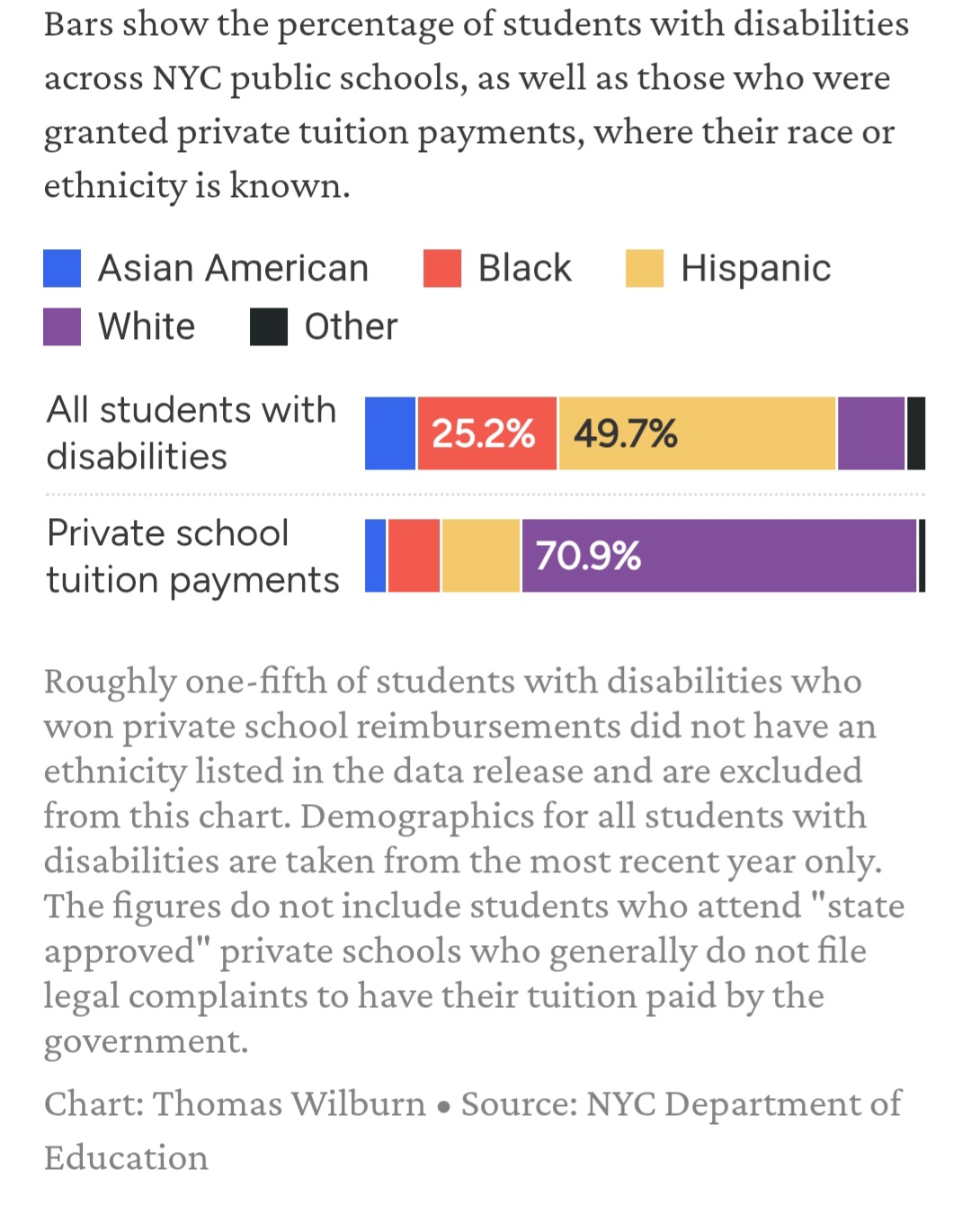
That system has grown dramatically in cost. Critics argue it disproportionately benefits families with the resources to hire lawyers, navigate hearings, and front tuition costs. And White families in particular.
The rising cost is a legitimate policy concern.
But the answer cannot be to jump to the conclusion that yeshiva kids are taking too much; it must be to evaluate the various needs of children and figure out how to provide for them.
Unfortunately, we are living in a time and with a mayor in New York City who prefers class and racial warfare and is portraying this as a matter of “equity” and confronting “private-school privilege.” It is not. It would primarily target students with special needs at Jewish and Catholic schools.
It would hit communities that already shoulder the cost of religious education while also paying taxes into a public system they largely do not use.
It would hit families with children who need specialized services.
And it would hit institutions that serve as the backbone of Jewish continuity in New York.
Because yeshivas are not just schools. They are where tradition is transmitted, where Hebrew is spoken, where Torah is learned, where identity is formed, and where Jewish continuity is secured across generations. It is civilizational infrastructure.
And once government begins treating private educational alternatives as a fiscal problem rather than a parental right, the pressure rarely stops with one category. First special education reimbursements. Then transportation. Then security funding. Then textbooks. The pattern is familiar: reduce the supports, increase the burden, narrow the choice.
Zohran Mamdani built his politics around redistribution and expanding public provision. His next target seems to be thousands of Jewish children with special educational needs.
In the legends of Prague, the Golem came into being when civic order failed Jews in predictable ways. Blood libels circulated, crowds gathered, and authorities hesitated at the decisive moment. Rabbi Judah Loew, the Maharal (c.1512-1609), recognized the pattern. He shaped a human form from the mud of the Vltava River—from the city itself—and animated it with sacred words. The choice of material mattered. The defender of Jews was made from the ground beneath their feet. Even if the city’s leaders would not protect Jews, the city itself would.
The Golem patrolled the Jewish quarter, broke the rhythm of violence, and restored deterrence. When the danger passed, it was deactivated and laid to rest in the attic of the Old New Synagogue, the Altneuschul. The legend recorded a hard truth: when the state falters, protection is improvised; when the state recovers, emergency power sleeps.
Altneuschul in Prague (photo: First One Through)
That memory traveled.
The melody of Hatikvah, the national anthem of the Jewish State of Israel, traces back through the musical world of that same Prague river Vltava, famously shaped by Bedřich Smetana (1824-1884). Exile and return share a river. The Golem embodies survival within exile; Zionism embodies the resolve to end exile. One guards a community where it stands, the other builds sovereignty so guarding becomes policy.
Yet the Golem never disappears. It waits for the moment when trust in authority thins again.
New York, Upper East Side
New York City holds one of the world’s largest and most visible Jewish populations. Jewish life here is open and proud. Synagogues, schools, and community institutions operate in public view, anchored by the assumption that their protection is a foundational duty of government.
That assumption has been tested.
On the Upper East Side in November 2025, an anti-Israel crowd swarmed a synagogue hosting a pro–Land of Israel event. The scene echoed an old shape: shouting at the doors of a Jewish house of worship, intimidation in a public park, the expectation that Jews would need to justify gathering openly as Jews. Instead of drawing a clear perimeter around the synagogue and condemning the mob, Zohran Mamdani, the incoming mayor of New York City, scolded the shul for holding a Zionist event, shifting the burden of restraint onto the Jewish institution.
For Jews who carry history close, the signal was unmistakable. Cities fail their minorities first through language, then through hesitation, and only later through force. When the synagogue itself surrounded by an angry crowd is framed as the problem, safety has become conditional.
Conditional safety never endures.
How the Modern Golem Forms
The Golem of New York does not rise from clay. It forms from memory.
Private guards appear where confidence once lived. Volunteer patrols lengthen into the evening. Parents coordinate entrances and exits. Institutions harden quietly, without ceremony.
These are the incremental steps of adaptation. Communities organize when clarity blurs. Parallel systems take shape when weak reassurance yields to experience.
Other minority groups get municipal funding and public declarations of support while Jews are only lumped into a general “other” category, as in White Plains, the capital of Westchester County just north of New York City. Jews learn that they must fend for themselves, because their basic protection offends many. Frighteningly, even for local politicians.
On the Upper East Side, a growing and proudly Zionist congregation bears a name heavy with inheritance: Altneu Synagogue. Old–New. It is a spin-off of the Park East Synagogue where the anti-Israel mob harassed and intimidated Jews. The echo of Prague’s Altneuschul may also prove prescient. Old dangers return wearing contemporary language. Rivers change. Cities change. But the logic persists.
Natan Sharansky, a famous Russian “refusenik” who was jailed for years before being allowed to leave to Israel, knows the dangers of antisemitic regimes. He came to Washington, D.C. in November 2023 to address 300,000 people about the need to fight back: “We, together, will fight against those who try to give legitimacy to Hamas. We will fight for Israel. We will fight for every Jew. We will fight against antisemitism. We will fight for the values and against corruption of those values which are at the center of our Jewish identity and American identity.”
For the moment, things may be OK. Mamdani appointed Jessica Tisch as police commissioner, a role she has had for several years. She is Jewish and no-nonsense leader, widely supported by the city’s Jewish community. If she can do her job without anti-Zionist and antisemitic politicians limiting her mandate, Jews will be fine. Otherwise, a new golem will rise in the New World, hundreds of years after the Golem of Prague went to sleep in the attic of the Altneuschul.
It took New York City barely a decade to move from Michael Bloomberg (mayor 2002-2014) to Zohran Mamdani — from a billionaire moderate who built a global business to an anti-capitalist socialist who’s never built anything.
Mike Bloomberg winning third term as NYC mayor
Bloomberg personified competence, merit, and modernity. He was a technocrat with a work ethic forged in markets — the quintessential New Yorker who believed that numbers mattered, that data and pragmatism could solve problems, and that capitalism, however imperfect, was the engine that kept the city alive.
Mamdani is the inversion of that story. He’s the smiling avatar of grievance politics — a man who’s never signed a paycheck, raised capital, or met a payroll, yet rails against the very system that feeds the city’s workers. He doesn’t want to grow the pie; he wants to break the plate.
So what happened to New York? How did a city that once celebrated builders and innovators — from bankers to artists, from garment manufacturers to tech founders — turn to someone who blames success itself for society’s ills?
Did New Yorkers Change — or Did the World?
Some say it was Donald Trump — the Queens developer turned president — who poisoned the well. For many New Yorkers, capitalism’s swagger became indistinguishable from his brashness. “Moderate” began to sound like “complicit.” Every problem was blamed on “the system,” and every system was condemned as oppressive.
Others blame social media, the great amplifier of outrage. The algorithms rewarded passion over proof, hashtags over homework. The loudest became the leaders, and anger became authenticity. The more you despised the system, the more followers you gained.
Still others point to federal polarization — a country at war with itself. Washington became tribal, and so did New York. To be anti-Republican meant embracing anything that wasn’t Republican, even if it was radical.
The Fall of the Striver Ideal
Bloomberg embodied a uniquely American, and particularly Jewish, story — the son of immigrants who rose by grinding harder, thinking smarter, and building bigger. For generations, that was the city’s moral code: earn it.
Mamdani represents something new — or perhaps something lost. He is not the striver, but the symbol. The story isn’t one of building, but belonging. It’s politics as identity and resentment rather than responsibility and results.
When a city stops admiring those who build and starts rewarding those who only protest, decline is not far behind.
A Mirror, Not a Moment
New York’s journey from Bloomberg to Mamdani isn’t just a change in politics — it’s a cultural inversion. The Jewish billionaire who built an empire has been replaced by a Ugandan Muslim who campaigns against empires. The technocrat gave way to the ideologue. The achiever to the accuser.
The city once responded to horrible radical Islamic terrorism in downtown Manhattan by electing a proven builder to remake the city. Now the city has responded to that vile terrorism in southern Israel by rallying behind a novice who vilified the victims.
It’s tempting to say the city changed. But perhaps it merely revealed what it had become: a place where envy now outshouts excellence, and where tearing down is easier than building up.
Frank Sinatra sang the city’s theme song “New York, New York,” that “if I can make it there, I’ll make it anywhere.” The city was a mark of excellence and competence. To win in New York City was the proving ground to anywhere and everywhere.
Does that now mean that grievance is the current marker of greatness in America? That radicalism and revolutionaries are the vanguard? Anti-capitalist socialism will come for cities around the United States?
The tragedy isn’t only that the city chose Mamdani. It’s that so many think it’s progress.
To watch a political novice backed by a far-left extremist group rise to the brink of becoming mayor of the largest city in America is frightening enough. To realize that he will have the full backing of a Democratic governor and a compliant state legislature to enact his radical agenda is terrifying. Zohran Mamdani, a darling of the antisemitic Democratic Socialists of America, has weaponized a friendly smile and promises of “free” everything into a populist movement ready to capture real power.
The race is effectively over. The weakness and fragmentation of his opponents make his November 4 election almost certain. But that does not mean New Yorkers are powerless. Far from it.
1. Register Democratic — and block the radicals. While national elections generate headlines, your single vote barely registers on a national scale. Local elections, however, can be swung by a few hundred ballots. In a deep-blue state like New York, the real election is the Democratic primary. That’s where the socialists gain power — because moderates stay home or remain registered as independents. If you want to stop extremists from running your city, county and state, you must register as a Democrat and vote against the zealots in the primaries.
2. Vote Republican in the general election — everywhere. Even outside New York City, every voter can help slow the DSA’s march. New York State operates under a blue-wall trifecta: a Democratic governor and supermajorities in both the State Senate and Assembly. Republicans have no effective voice. Governor Kathy Hochul’s open endorsement of Mamdani means his far-left policies will move through Albany unchecked unless the state’s Republican vote share grows.
Far-left media Jacobin advances “to govern, the Left needs many Zohrans.”
So yes — in this strange political moment — the smart play for moderates and centrists is tactical: register Democratic to stop radicals in primaries, and vote Republican to blunt their power in office.
If New Yorkers don’t act now, the most radical city government in America won’t just run New York — it will set the agenda for the entire country.
When the heckler’s veto becomes public policy, liberty dies by degrees.
The world rallied in Paris when jihadi radicals murdered staff at Charlie Hebdo in 2015. Leaders raised banners for free speech and spoke of defending the liberties that make liberal democracies possible. The same chorus rose after other political murders like Charlie Kirk in 2025: condemnations, eulogies, brief outrage.
Yet the Global North has a quieter, more corrosive surrender under way — a surrender not to a foreign army but to the heckler’s veto. When threats of violence can shape who is allowed to speak, to march, to play, or to pray, freedom has already been bargained away.
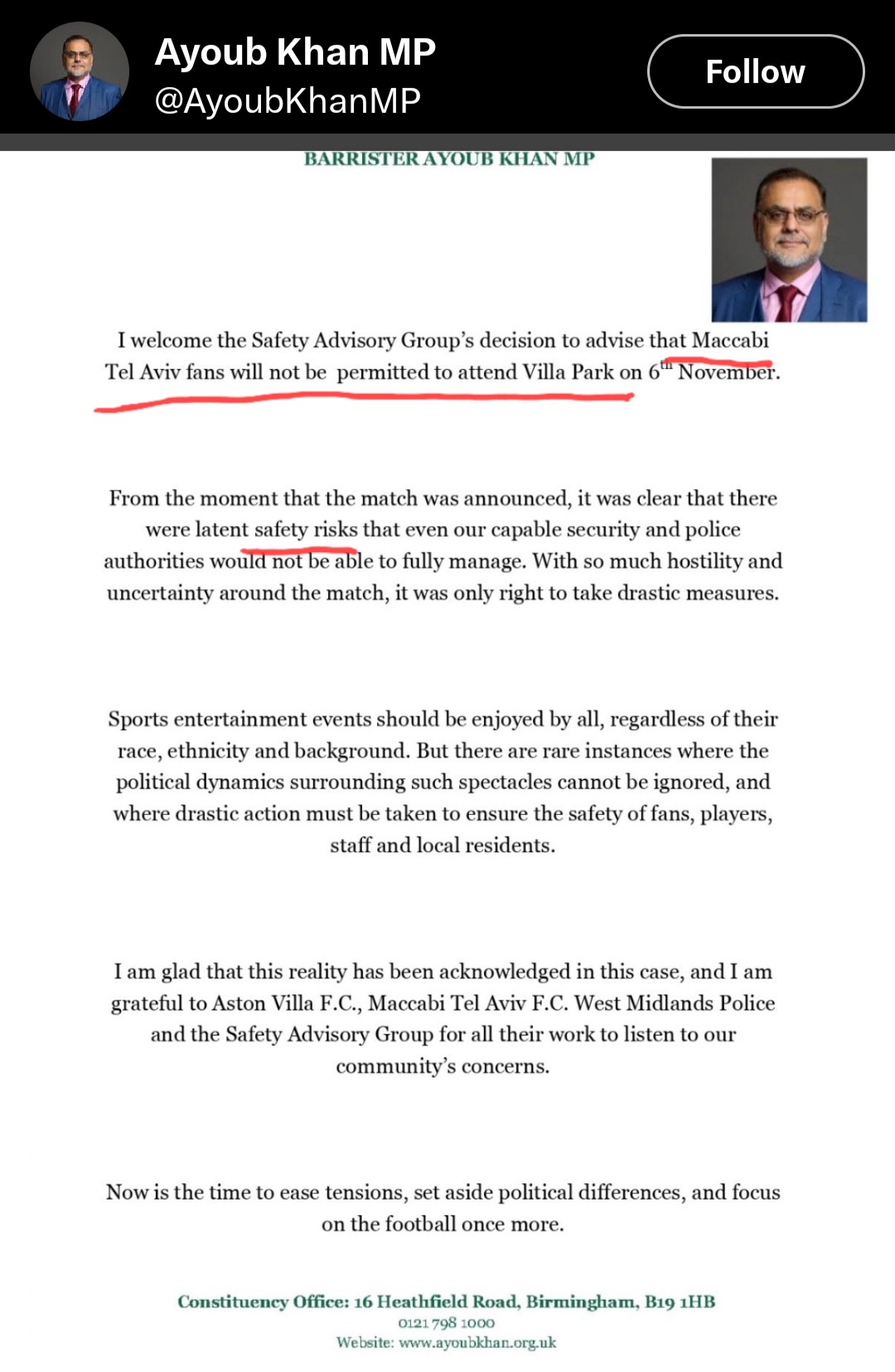
UK’s MP Ayoub Khan celebrating the banning of Tel Aviv fans from a game because their presence might bring out protestors. Other fans were welcomed to attend in October 2025.
Too often now the mere presence of Jews is treated as a provocation that must be managed by erasure. In Britain, politicians warn that protests will make events “unsafe” and ask organizers to exclude Israeli athletes and fans, Jewish speakers, or symbols rather than arrest the thugs who threaten violence. In 1929, after brutal attacks in Hebron, British authorities removed all Jews from their homes to suppress further bloodshed — an act that punished the innocent to placate the violent. That precedent echoes when modern officials choose exclusion over enforcement.
Call it what it is: when a state lets intimidation determine who may appear in public, it substitutes coercion for law. When politicians cave to the loudest violent faction to avoid a headline, they have abandoned the first duty of government — to protect the rights of every citizen, not to negotiate them away.
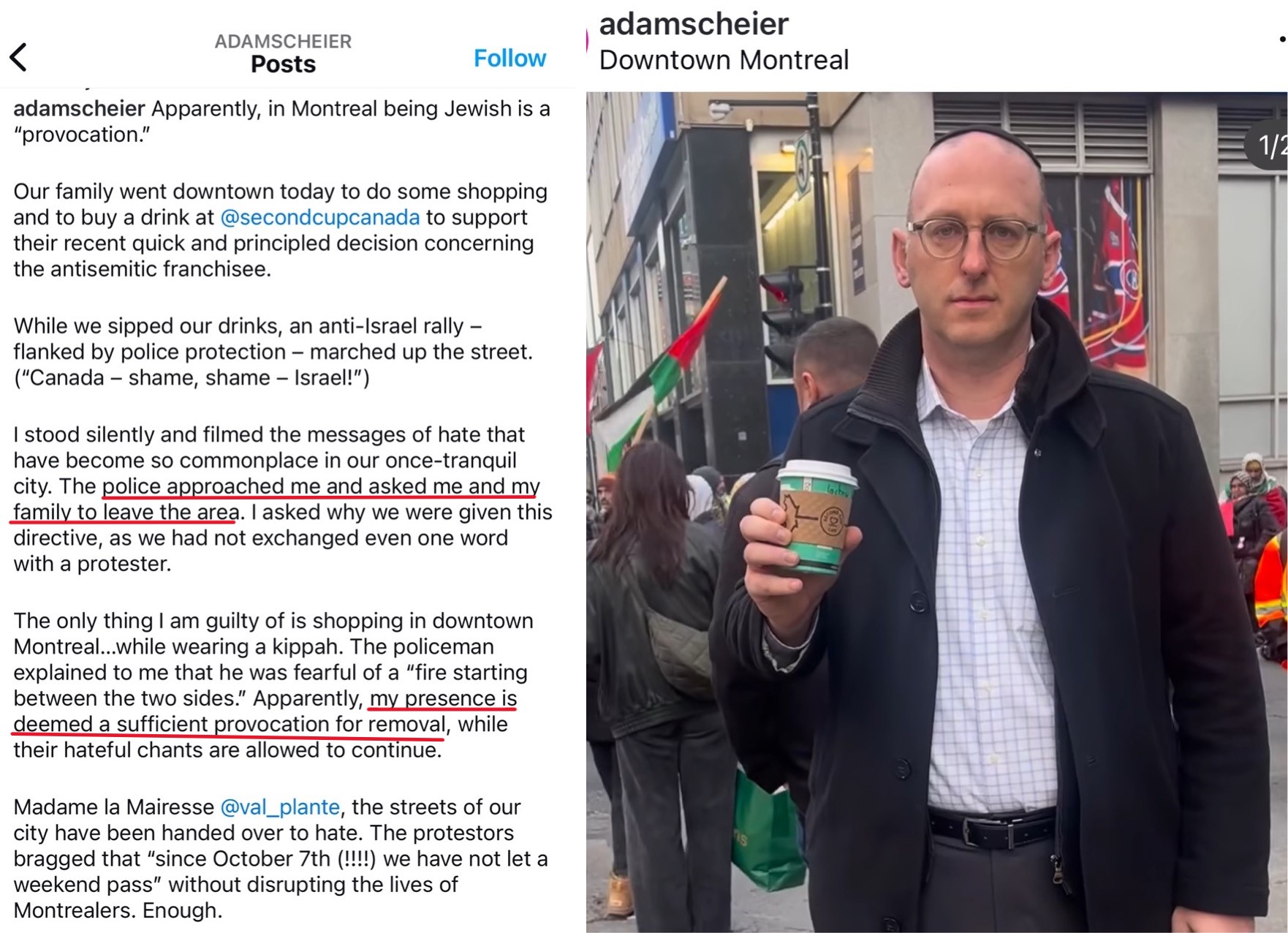
Canadian police ask Jewish family to leave the street since their “presence is deemed a sufficient provocation for removal,” in November 2024.
This is not a critique of a religion; it is an indictment of extremism and of political cowardice. The problem is not Muslim faith but those within it who preach and practice violence — and the leaders who, for fear or for votes, let those violent actors set the rules.
A democracy that permits the heckler’s veto on principle is no longer democratic; it is ruled by fear. If we are to remain free, the test is simple: do we defend rights when it is inconvenient, or only when it is safe? If the answer is the latter, then we are well on the way to living under a very different law — one written by radical mobs and enforced by silence.
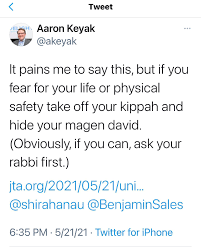
US President Obama advisor Aaron Keyak tells Jews to “take off your kippah and hide your magen david” to avoid being targeted in May 2021.
President Biden set this in motion in the U.S. in May 2021 when his own Jewish advisor, Aaron Keyak, told Jews to hide their Jewishness, presumably because they should not assume that the government would protect them showing their faith publicly. In September 2024, school officials at New York’s Baruch College said it explicitly, telling Jews that they could not “guarantee their security” if they held a celebration for Rosh Hashana.
We have set the stage for Democratic-Socialist Zohran Mamdani to become mayor of the city with the largest Jewish diaspora community in the world. Where police will not only suggest that Jews stay off the streets but may be directed by the mayor to arrest Jews because their very presence is deemed a provocation.