We know that every death is a tragedy. We all wish there wasn’t war. Yet wars happen.
There have been several attempts to portray the current Gazans war against Israel in various lights. Some people have used the civilian-to-death ratio in this war of roughly 2-to-1 as historically low compared to any urban combat in modern times, especially one in which the army hides underneath the homes and hospitals of the civilian population.
Here, we lay out the civilian death figures relative to other modern wars which had many civilian deaths.
Assuming:
73,356 reported total deaths in Gaza from October 7, 2023 to August 2, 2026
25,000 of those were Hamas or other militants (a rough figure supplied by the Israeli army in January 2026)
Average civilian mortality per month: 2.19% ÷ 34 = 0.055% per month.
That yields the following comparison:
Case
Estimated monthly percentage killed
Multiple of Gaza civilian rate (0.055%/month)
Gaza [2023-present]
0.055%
1×
Guatemala (Ixil) [1981-3]
0.10%
1.8×
Darfur [2003-5]
0.11%–0.17%
2.0-3.1x
Roma genocide [1939-45]
0.20%–0.69%
3.6–12.5×
Anfal (Kurds) [1987-8]
0.22%–0.44%
4–8×
Ustaše genocide [1941-5]
0.36%
6.5×
Cambodia [1975-9]
0.44%–0.59%
8–10.7×
Rohingya [2017-8]
at least 0.67%
12.1×
Holodomor [1932-3]
0.73%–1.04%
13.2–18.9×
Holocaust [1941-5]
1.32%
24×
Yazidi genocide [2014-7]
0.65%–2.5%
11.8–45.4×
Rwanda [1994]
13.8%–22%
250.9–400×
Srebrenica (monthly equivalent) [1995]
~80%
~1,454×
Monthly toll of civilian deaths in wars over last 100 years, as a percentage of the total population, in comparison to current Gazan war against Israel
Yazidis are a non-Muslim ethnic group in and around Iraq targeted for persecution and annihilation by ISIS. They continue to suffer persecution from Muslims in Turkey and Iraq.
“IS fighters invaded Yazidi villages and towns in Northern Iraq and Iraqi Kurdistan, rounding up men, women, and children. Yazidi men were ordered to convert to Islam; those who did not, and even some who did, were executed in mass graves. Yazidi women and girls were abducted and sold into sexual slavery, being forcibly “married” to jihadists and other individuals in Iraq, Syria, and other countries. Yazidi boys were also kidnapped by the Islamic State and sent to training camps, where they were indoctrinated into the group’s severe interpretation of Islam and trained to become soldiers. IS glorified its atrocities online in gruesome videos, propaganda magazines, and religious publications, emphasizing its commitment to eradicating Yazidi identity.” – Vicken Cheterian, “ISIS Genocide against the Yazidis and Mass Violence in the Middle East,” British Journal of Middle Eastern Studies 48, no. 4 (2019): 1-7, doi:10.1080/13530194.2019.1683718.
Measured against the last century’s ethnic group civilian deaths, the war in Gaza has produced a far smaller death toll than the wars that shaped recent history. Yet few conflicts of comparable scale have generated such an extraordinary level of international media attention, UN action, street protests, and campus activism.
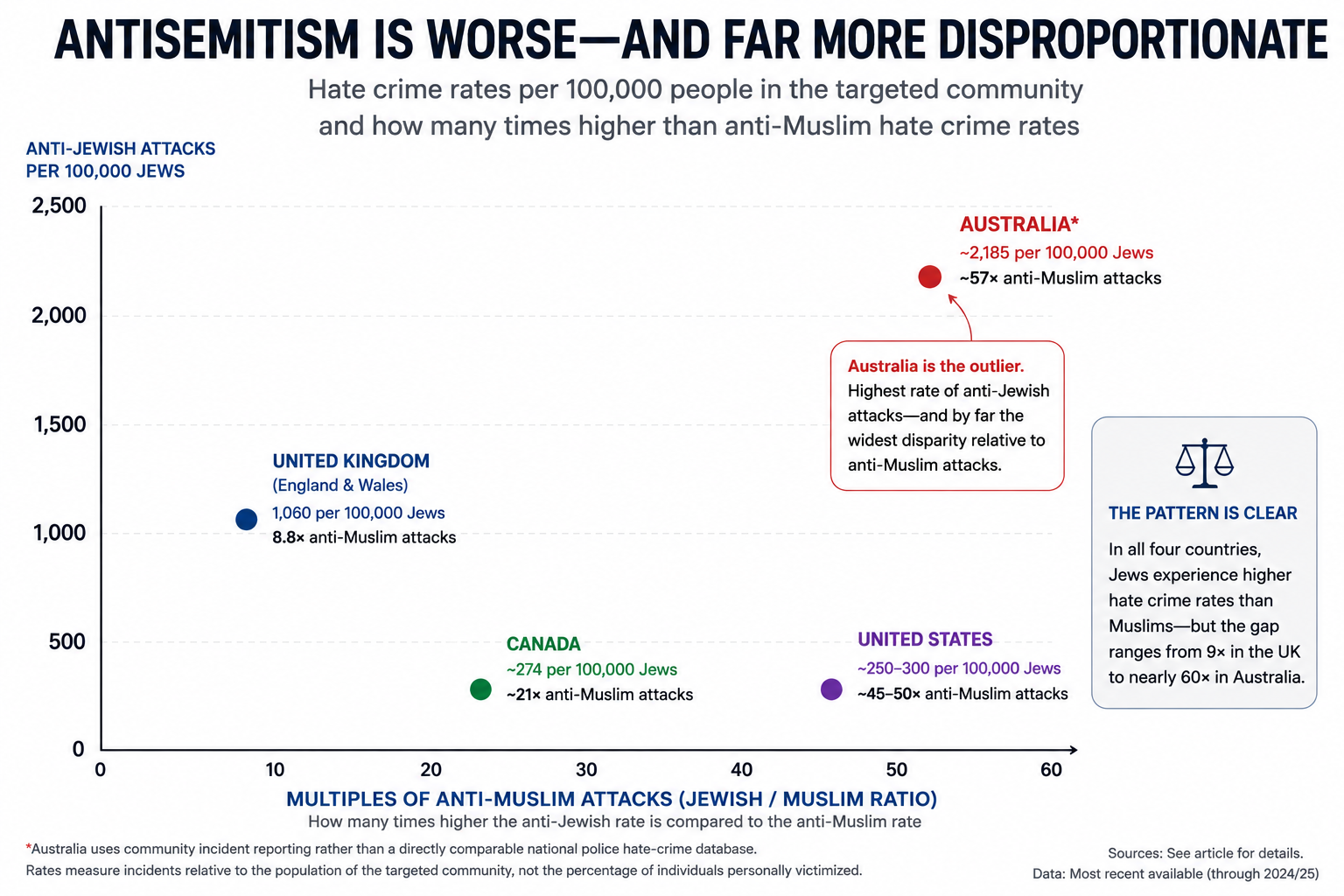
The conflict has spilled far beyond the battlefield. Around the world, Israelis and Jewish communities have increasingly become targets of hostility, harassment, and violence tied to the war. Whatever one’s views of the prosecution of the war, the global reaction has extended well beyond criticism of a government and the borders of Israel unlike every other conflict, raising profound questions about why this war has become so singular in international political and cultural life.
The numbers remind us that history matters. A world that loses its sense of proportion does not become more moral but selective, narrow and biased.
For generations, antisemitism sought to remove Jews from the future. Today, it increasingly seeks to remove them from the past.
That is the deeper significance of the growing campaign to recast Jewish history as Palestinian history. It is not simply a dispute over archaeology or competing national narratives. It is an effort to strip the Jewish people of their origins, their memory, and ultimately their legitimacy and basic human rights.
The examples are becoming impossible to ignore.
The Holocaust—the systematic murder of six million Jews—is routinely appropriated as a metaphor for Palestinian suffering. Jewish victims become a rhetorical device rather than a people with a unique history. The descendants of Holocaust survivors are cast as the new Nazis, while the actual genocide of European Jewry is emptied of its historical meaning.
Some Europeans have taken the Jewish girl, Anne Frank, and dressed her in an Arab kefiyeh as if she were a Palestinian Arab or would have supported the murder of Jews. During World War II, Anne hid in an attic while Nazis hunted her and other Jews for years, before the Nazis took her and murdered her in a concentration camp.
Now even Jesus is being rewritten.
Rather than acknowledging the historical reality that Jesus was a Jew who lived, taught, and died among the Jewish people in Judea, activists increasingly describe him as “Palestinian.” The purpose is to transplant one of history’s most influential Jews from the Jewish story into a Palestinian national narrative that not only didn’t exist in his lifetime, but Arabs didn’t invade the Jewish holy land until the seventh and eighth century CE, hundreds of years after Jesus lived.
The same pattern extends across nearly every cornerstone of Jewish civilization.
The First and Second Temples become myths or located in far-way lands. The Western Wall is detached from Jewish history. Jerusalem is reframed as an exclusively Muslim city. The Jewish patriarchs and matriarchs are recast. Ancient Israel is dismissed as colonial fiction. Hebrew becomes a borrowed language rather than the indigenous language of the Jewish people. Even Jewish holy sites are repeatedly described as exclusively Islamic or Christian.
United Nations 1949 map of of holy sites in Jerusalem lists the Jewish Temple Mount as only holy to Muslims
Each claim may appear isolated. Together they reveal a coherent project.
The goal is not simply to elevate a Palestinian Arab identity or an Islamic one. Every people is entitled to tell its own story. But no national movement has the right to build its identity by erasing another people’s history, heritage and human rights.
If a Palestinian Arab national identity is legitimate, it should be able to stand on its own. It shouldn’t require denying that Jews are indigenous to the Land of Israel. It does not require pretending the Temples never stood in Jerusalem. It does not require transforming Jesus into an Arab. It wouldn’t require appropriating appropriating words and people from their national tragedies.
Anti-Israel author Susan Abulhawa repeatedly uses terms like “Holocaust” to turn Jews into Nazis, in an attempt at misdirection from the popular Palestinian Arab political-terrorist group Hamas, which are actual modern-day Nazis
Yet this pattern of historical theft has increasingly been accompanied by something darker: the revival of some of Europe’s oldest antisemitic ideas.
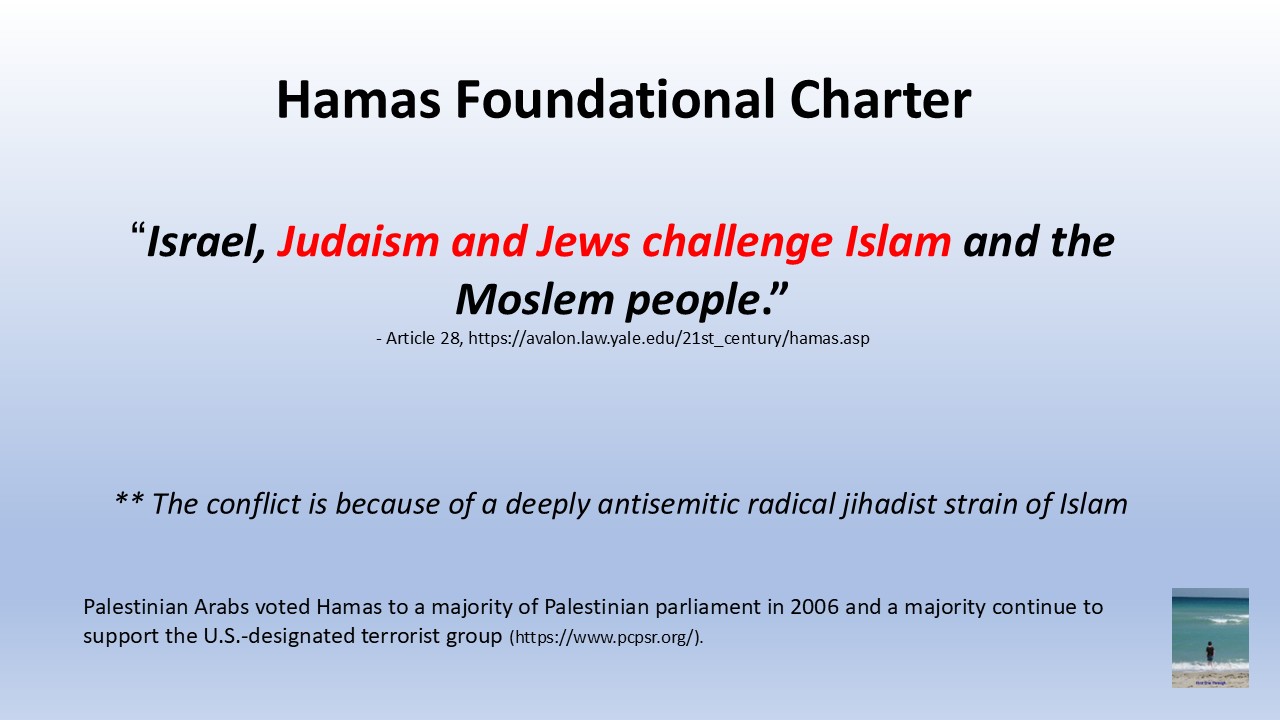
The Hamas Charter drew explicitly from antisemitic conspiracy theories and echoed themes long propagated by Nazi ideology. Since October 7, the world has again witnessed chants, slogans, and propaganda that do not merely oppose Israeli government policies but deny the legitimacy of Jewish peoplehood itself. Public figures, writers, and activists have too often trafficked in narratives that portray Jews not as an indigenous people with a continuous history, but as impostors who fabricated their past.
If Jews can be separated from Jerusalem, from the Temple, from Abraham and Sarah, from David, from Hebrew, from the Holocaust, and even from Jesus, then they become a people without roots. A nation without ancestors is easier to portray as foreign. A foreign people is easier to cast as colonizers. And colonizers, in the moral framework of today’s activists, can be removed. Should be removed.
Historical negation is not an academic exercise. It prepares the ground for political exclusion, eviction, and violence.
The attempt to steal Jewish history is not ultimately about the past. It is about deciding whether the Jewish people have any legitimate place in the future.
For most of human history, people did not belong to countries. They belonged to tribes.
Family came first. Then clan. Then religion. Then ethnicity. Your protection did not come from an impartial government but from the people who shared your blood and your history.
The modern nation-state asked humanity to do something profoundly unnatural. It asked millions of strangers to trust one another more than they trusted their tribe.
That may be civilization’s greatest political achievement.
Political scientist Francis Fukuyama has argued that human beings are naturally wired for tribalism. The genius of the modern state was not that it erased those instincts, but that it redirected them. Loyalty shifted from clan to constitution, from ancestry to citizenship, from family name to the rule of law.
No nation embodied that experiment more successfully than the United States.
America was never united by blood. It became a nation because generation after generation chose to believe that citizenship mattered more than ancestry. Irish immigrants, Jewish refugees, engineers from India, scientists from Taiwan, and millions of others came from different histories but increasingly shared one future.
“The Citizens of the United States of America have a right to applaud themselves for having given to mankind examples of an enlarged and liberal policy: a policy worthy of imitation. All possess alike liberty of conscience and immunities of citizenship. It is now no more that toleration is spoken of, as if it was by the indulgence of one class of people, that another enjoyed the exercise of their inherent natural rights. For happily the Government of the United States, which gives to bigotry no sanction, to persecution no assistance requires only that they who live under its protection should demean themselves as good citizens, in giving it on all occasions their effectual support.” – George Washington’s letter to the synagogue in Newport, RI in 1790
George Washington’s letter to the synagogue in Newport, RI in 1790
America never eliminated tribes. It simply made being American more important than belonging to one.
But that civic bargain rested on something deeper than patriotism. It rested on hope.
America has never been a perfect nation. It never claimed to be.
Slavery contradicted its founding ideals. Women were denied the vote. Segregation mocked the promise of equal protection. Entire groups were excluded from opportunities others took for granted.
Yet what distinguished America was not the absence of injustice. It was the belief that injustice could be corrected.
The nation repeatedly expanded the circle of citizenship. Slavery was abolished. Constitutional amendments extended the franchise. The civil rights movement dismantled legalized segregation. Immigration laws evolved. Opportunity broadened. Each generation inherited an imperfect republic and, however incompletely, tried to leave it more just than it found it.
People can tolerate inequality longer than they can tolerate hopelessness. They can accept that today’s America is imperfect if they believe tomorrow’s America will offer greater opportunity for themselves and for their children.
For much of our history, that belief proved remarkably resilient. Yet today it is under strain.
The reason is not simply that inequality has grown. It is that many Americans increasingly question whether the civic bargain still works.
Over the past two decades, extraordinary wealth has accumulated among roughly the wealthiest one-tenth of one percent of American households—families whose wealth is roughly $50 million and more. Together they now control a remarkable share of the nation’s wealth, much of it held not in homes or factories but in ownership stakes in software companies, semiconductor firms, and cloud infrastructure.
The question for ordinary Americans is whether they believe they have a realistic chance of becoming tomorrow’s winners.
Yet much of the political debate on the left uses the moral vocabulary of the twentieth century to explain the economics of the twenty-first. Progressives point to slavery, segregation, redlining, and inherited privilege. They therefore demand reparations. But that’s the lexicon and proposals of a period past.
Today’s economy is not dominated by inherited railroad empires or industrial monopolies. It is dominated by technological innovation.
According to Forbes, roughly two-thirds of America’s 400 richest people built their fortunes themselves rather than inheriting them. Many of the largest fortunes were created within a single generation through software, semiconductors, venture capital, and artificial intelligence. America continues to produce extraordinary upward mobility. Immigrants account for roughly one in seven American billionaires, and more than nine in ten of those immigrant billionaires are self-made, many arriving from India, Israel, Taiwan, and China before building companies at the forefront of the technology revolution.
America is still the land of remarkable opportunity for all but it is predominantly happening inside an innovation economy that relatively few people understand—and even fewer know how to enter.
That distinction changes the political conversation. And it is magnified by the fear of artificial intelligence.
As the AI economy concentrates wealth, the identities of many of its most visible participants also become politically salient. Many of America’s leading technology founders, investors, and executives are white, Asian, or Jewish—groups often associated with educational and entrepreneurial success. That should be irrelevant in a civic republic. But in a society increasingly tempted by tribal politics, economic frustration is often translated into identity politics. The result is a dangerous feedback loop: the far left explains disparities through privilege and oppression, while the far right responds with conspiracy theories about ethnic or religious elites. Both abandon the American principle that citizens should be judged primarily as individuals rather than as members of competing tribes.
Alexandr Wang, 29, Chief AI Officer at Meta, worth an estimated $3.3 billion
And the concern is no longer merely that the rich will become richer. It is that AI will automate millions of middle-class jobs. Lawyers, accountants, software developers, analysts, designers, customer service representatives, and countless others increasingly wonder whether they are watching the economic ladder disappear beneath them. That is not just the rich getting richer and the poor getting poorer. It is everyone below the 0.1% – the entire lower, middle and upper middle class – becoming significantly poorer.
That anxiety helps explain proposals such as far-left Senator Bernie Sanders’ American AI Sovereign Wealth Fund Act. Sanders argues that because artificial intelligence is trained on humanity’s collective knowledge, the extraordinary wealth it creates should not belong solely to a handful of technology companies and investors. Whether one agrees with that proposal or not, it marks a profound shift. The political debate is moving beyond redistributing wealth after it is created, toward seizing and controlling the technologies that create the wealth in the first place.
Never has the U.S. government considered inserting itself so forcefully into the leading drivers of innovation, jobs and wealth, and pitted itself against those “elites” spearheading the effort.
On one side, the far-left is organizing around tribalism focused on race, gender, and “privilege,” which produces a counter-movement on the far-right around White nationalism. Both movements are inherently anti-American and undermine the founders’ ideals of a grand civic bargain. Each tells its followers that the other tribe is responsible for the country’s decline. Both play a part.
America fractures as both right and left move towards tribalism, and no longer trust the “establishment” political class, mainstream media and failing schools. Meanwhile, the real enormous promise and fear of the future for both groups is playing out in real-time before everyone: that AI will exacerbate the inability to trust people, information and institutions, while simultaneously creating a cohort of individuals – seemingly of only a few tribes – with remarkable wealth as the middle class loses its wealth.
If AI becomes a dominant technology that only a tiny club understands, owns, and profits from, the civic bargain weakens. Citizens begin searching for smaller communities that promise protection and belonging. Race becomes more important than citizenship. Class becomes more important than opportunity. Tribe becomes more important than country.
That is a future we can, should and must avoid.
America has solved this problem before. Every great technological revolution—from the steam engine to electricity to the internet—created extraordinary fortunes for its pioneers. Yet each ultimately generated industries, professions, suppliers, entrepreneurs, investors, educators, and workers whose prosperity far exceeded that of the original inventors. The wealth did not remain confined to those who built the breakthrough. It spread through the countless derivative businesses, careers, and opportunities that followed.
Artificial intelligence should be no different. America should not punish the innovators building the future or discourage the investment and risk-taking that made these breakthroughs possible. The challenge is to ensure that the AI economy develops the same broad ecosystem that previous technological revolutions produced—new companies, new professions, new skills, new services, new capital formation, and new pathways into prosperity for millions of Americans.
Just as importantly, we must prevent the far left and the far right from hijacking this technological revolution for their own political ends. The left should resist reducing innovation to a story of privilege and oppression, while the right should resist turning successful innovators into symbols of ethnic or cultural conspiracy. Both narratives encourage Americans to see AI through the lens of tribe rather than citizenship, resentment rather than opportunity.
For 250 years, Americans repeatedly chose the civic bargain over tribalism because they believed each generation would inherit greater opportunity than the last. Artificial intelligence now puts that bargain to the test. The defining question of the AI age is not whether America can continue producing extraordinary innovators. It is whether the prosperity they create becomes the foundation for millions of new success stories.
The American experiment has never depended on preventing greatness. It has depended on ensuring that greatness inspires opportunity rather than resentment, and that every generation believes it still has a place in the nation’s future. If AI expands opportunity as dramatically as previous technological revolutions ultimately did, it will strengthen the civic bargain that has made America history’s most successful multiethnic republic.
America’s next century can be truly remarkable, if we avoid the partisan pitfalls that plague us.
Fair enough. But where is the equivalent sentence for the Palestinian claim?
What evidence was presented that the warehouse contained only medical supplies? Who independently verified it was not also being used by Hamas? The reporting does not say.
Reuters and CNN took the Palestinian Authority version of events as plain facts but left a question outstanding about the Israeli account. The reader is left with one side making a factual assertion, while the other appears to be offering an unsupported excuse.
Journalists should demand evidence from Israel. They should also demand it from Palestinian authorities. If neither side has independently substantiated its account, then neither claim should receive a presumption of truth.
In war, the burden of proof should not belong to only one side. Journalism earns trust when it applies the same evidentiary standard to everyone.