The name made sense at Israel’s founding. Israel fought wars against the armies of Egypt, Jordan, Syria, Iraq and other Arab states. The conflict was understood principally as one between the Jewish State and the surrounding Arab world.
Then the map changed.
Egypt made peace with Israel in 1979. Jordan followed in 1994. During the horrific Second Intifada, the suicide bombings, shootings and other attacks were overwhelmingly part of a localized war involving Palestinian Arabs. The terminology narrowed accordingly. The Arab-Israeli Conflict increasingly became the Palestinian-Israeli Conflict.
That description is now inadequate too as the map evolved again over the past several years.
The Abraham Accords fundamentally changed the regional picture. The United Arab Emirates, Bahrain and Morocco normalized relations with Israel. Trade, tourism, investment and security cooperation followed. Other Muslim-majority countries have also maintained or developed relations with the Jewish State.
Yet at the same time, Israel has faced repeated war from Hamas in Gaza, Hezbollah in Lebanon, the Houthis in Yemen and, increasingly directly, the Islamic Republic of Iran. These forces are separated by borders, ethnicity and even the Sunni-Shiite divide. What connects them is not Arab identity. It is a radical Islamist rejectionism that refuses to accept a sovereign Jewish state in the Middle East.
It is therefore time for the terminology to catch up. This is increasingly the Jihadi-Israel Conflict.
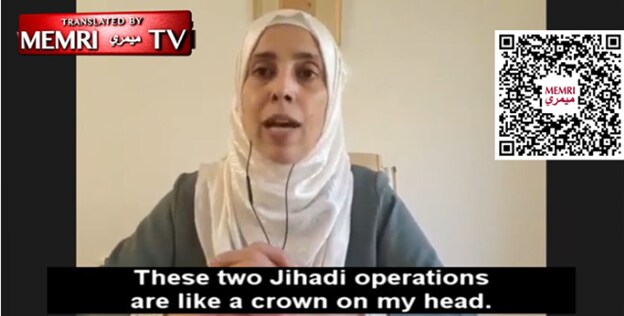
Ahlam Tamimi, who helped plan and transported the suicide bomber to the 2001 Sbarro restaurant bombing in Jerusalem and now lives in Jordan.
The term captures the venom, vitriol and violence of Hamas and the armed Islamist movements aligned against Israel. It encompasses Hezbollah and the Houthis and, most importantly, the Islamic Republic of Iran that has armed, financed and supported much of the network surrounding Israel.
It also leaves room to describe the roles of Qatar and Turkey, whose close relationships with Hamas and fierce political hostility toward Israel place them in a very different category from Muslim and Arab governments pursuing normalization.
Most importantly, the new terminology does something the old terminology cannot: it separates Muslims and Arabs who seek peace with Israel from radical Islamists committed to its destruction and the slaughter of Jews.
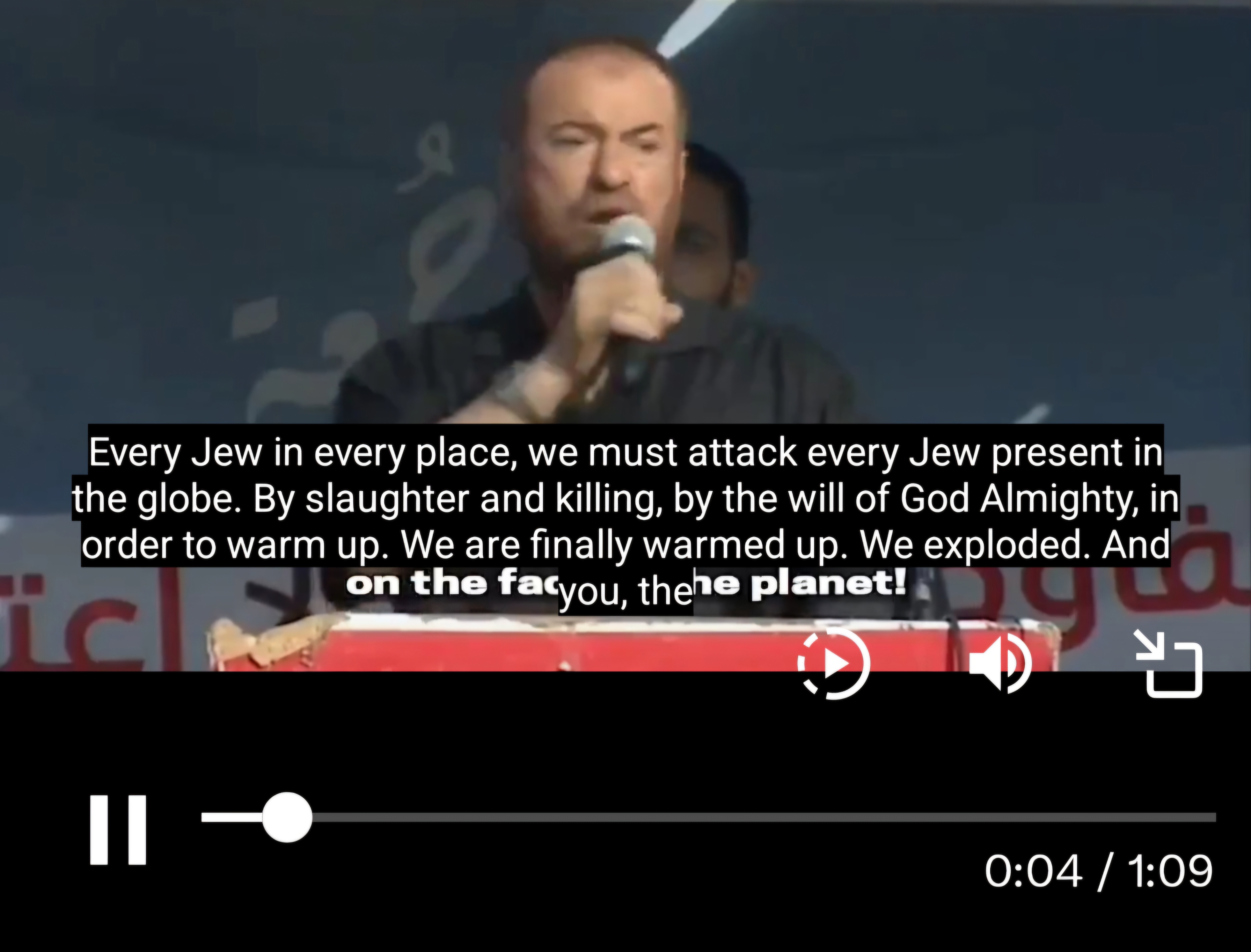
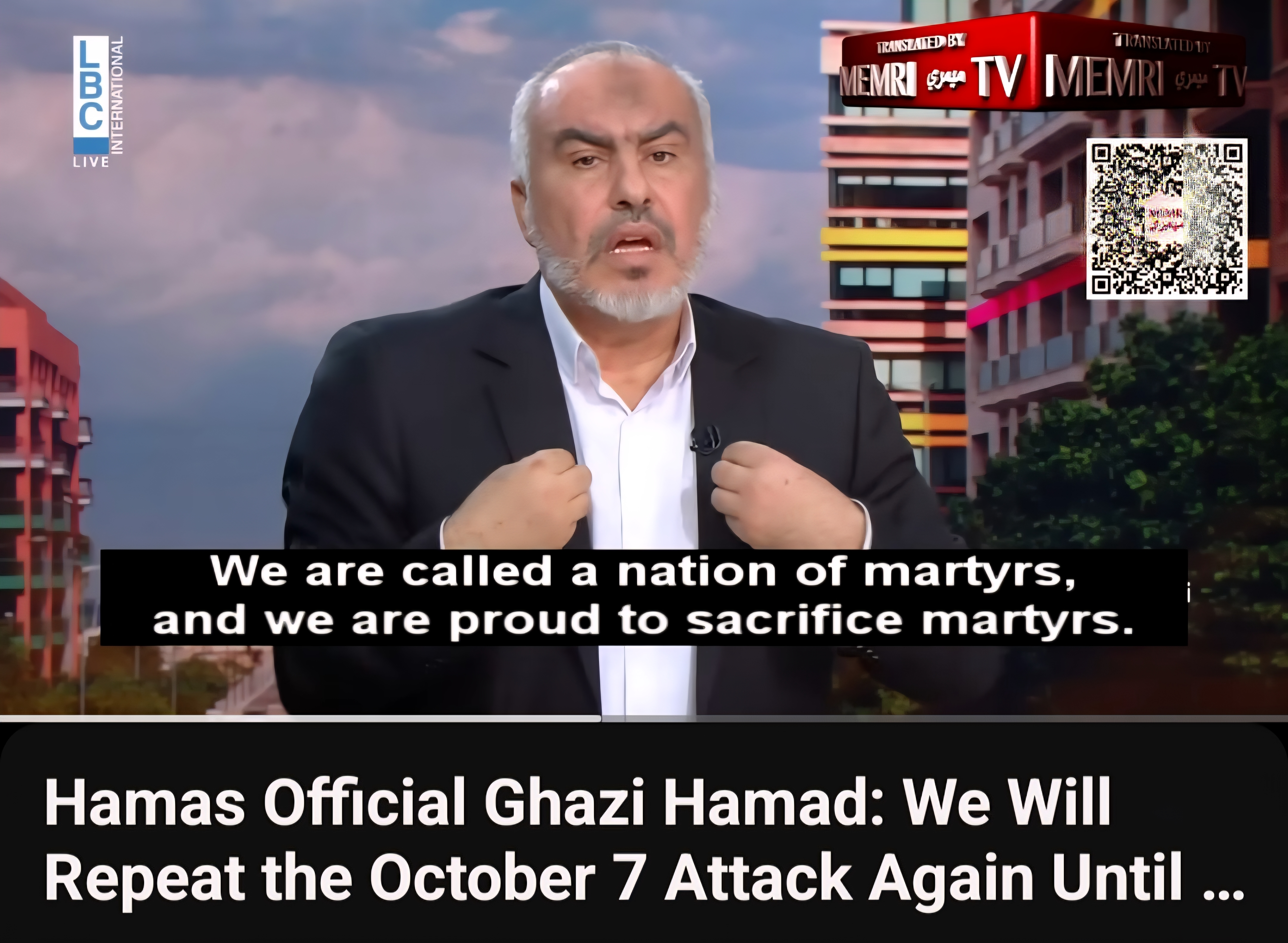
Hamas leader calling for slaughtering Jews as a religious Islamic principle
The dividing line has moved.
And that makes the choices facing Lebanon, Syria and Saudi Arabia especially important. They can move toward a Middle East built around trade and coexistence, or remain trapped in a conflict driven by radical Islamist movements that reject Jewish sovereignty, basic human rights and self-determination.
The conflict has become crystallized for what it likely always was: the Jihadi-Israel Conflict.
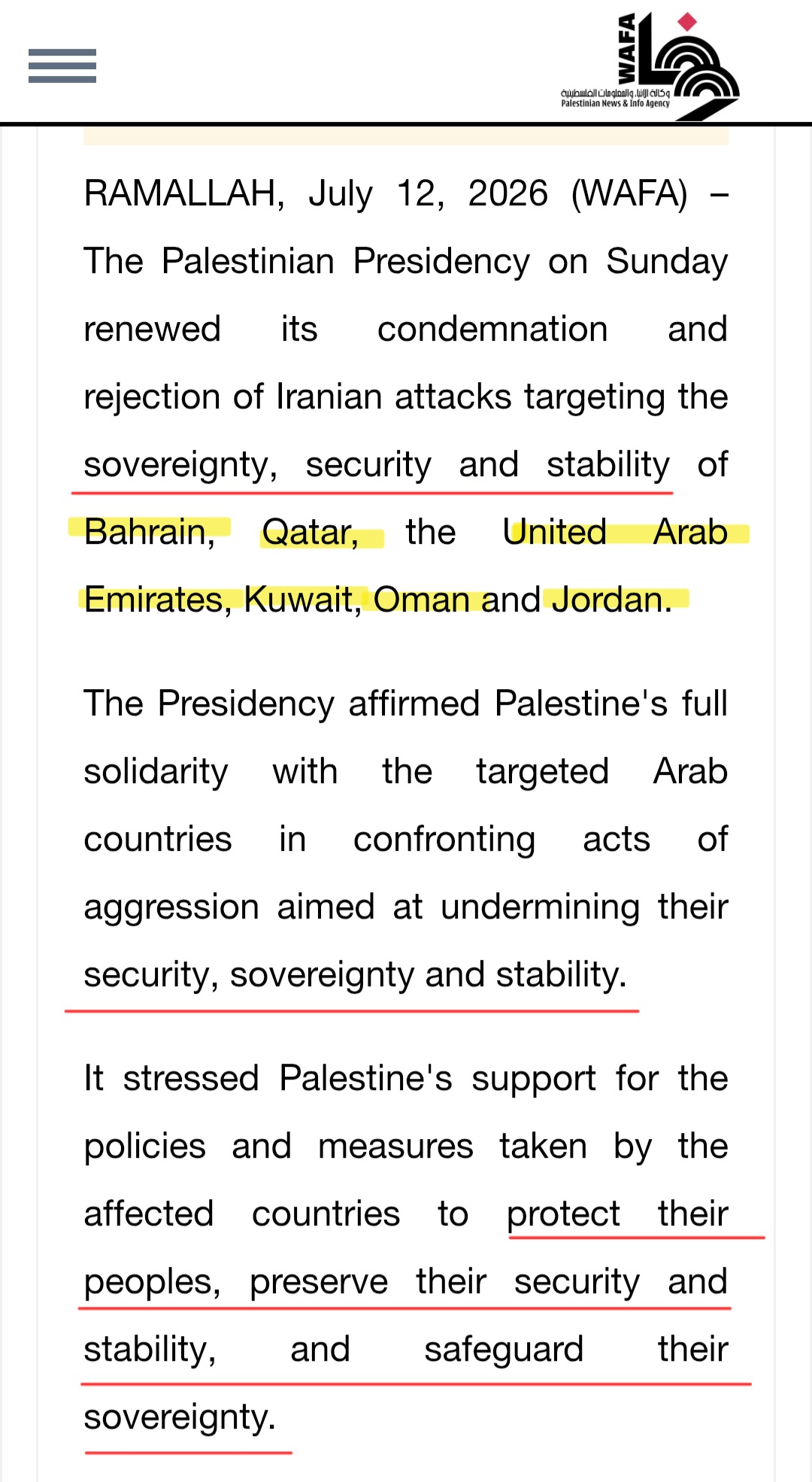
The Palestinian Authority had no trouble explaining what every nation deserves.
In a statement condemning Iran’s attacks on Bahrain, Qatar, the United Arab Emirates, Kuwait, Oman, and Jordan, the PA repeatedly invokes the same principles: sovereignty, security, stability, and protection of civilians.
Where were these principles when Israel was attacked?
When Iran launched missiles at Israel, did the Palestinian Authority defend Israel’s sovereignty?
When Hezbollah rained rockets on Israeli cities for months, did it affirm Israel’s right to security and stability?
states “refrain… from the threat or use of force against the territorial integrity or political independence of any state.” UN Charter (Article 2(4))
When the Houthis fired missiles toward Israel, did it support Israel’s right to protect its people?
And most pointedly, when Hamas – fellow local Arabs of the Palestinian parliament – crossed an international border on October 7, murdered civilians, kidnapped hostages, and occupied Israeli communities, did the PA condemn it as an assault on Israel’s sovereignty?
“the inherent right of individual or collective self-defence if an armed attack occurs against a Member of the United Nations.” UN Charter (Article 51)
A principle that applies only to friends is not a principle. It is a preference.
The Palestinian Authority’s own statement demonstrates that it understands exactly what every nation deserves. Its silence when those same principles are violated openly and repeatedly against Israel says just as much as its words.
The debate over American support for Ukraine and Israel has largely focused on the cost. Politicians argue over billions of dollars appropriated, weapons transferred, and whether American taxpayers are carrying too much of the burden. Far less attention has been paid to the return on that investment.
Since 2022, the United States has authorized roughly $195 billion related to Ukraine and approximately $16–22 billion in supplemental wartime assistance for Israel. Critics see enormous expenditures. Strategically, however, those dollars have enabled two allies to inflict historic damage on two of America’s principal adversaries – Russia and Iran – without the United States deploying large combat formations or suffering the thousands of battlefield casualties that defined Vietnam, Iraq, and Afghanistan.
That comparison matters.
The wars in Iraq and Afghanistan cost the United States more than $5 trillion in direct and related costs, with broader post-9/11 war obligations rising above $8 trillion when future veteran care, interest, and long-term commitments are included. Nearly 7,000 American service members were killed. More than 52,000 were wounded.
And what was the lasting strategic benefit?
Afghanistan ended with the Taliban back in power. Iraq removed Saddam Hussein, but the aftermath empowered Iran, fractured the region, drained American credibility, and produced years of instability. The United States paid in terrible blood and treasure, and the final balance sheet is hard to defend.
Ukraine and Israel present a very different model.
Consider Russia.
More than four years after launching its invasion of Ukraine, Russia has suffered an estimated1.4 million military casualties, including approximately 450,000 dead. Its armored forces have been severely depleted. The Black Sea Fleet has largely been driven from its historic operating areas. Ukraine has repeatedly demonstrated the ability to strike deep inside Russian territory. The military once regarded as NATO’s greatest conventional threat has been dramatically weakened.
“The number of Russian casualties and fatalities are astonishing. Since World War II, no major power has suffered anywhere near these numbers of casualties or fatalities in any war…. Russia’s economy is in distress, and Russia’s wartime spending may be increasingly untenable.” – Center for Strategic and International Studies July 2026
Now consider Iran.
For four decades the leading state sponsor of terrorism invested billions of dollars constructing what it proudly called the “Axis of Resistance” – a network stretching from Iran through Iraq and Syria to Lebanon and Gaza. Hamas, Hezbollah, Shiite militias, the Houthis, and the Assad regime were components of a single strategy designed to project Iranian power, surround Israel and challenge American influence in the region and threaten much of the global oil supply.
That strategy has suffered a tremendous setback.
Hamas has lost much of its military and infrastructure. Hezbollah has absorbed devastating blows to its command structure and missile capabilities. The Assad regime in Syria – Tehran’s indispensable Arab ally and the geographic bridge connecting Iran to Hezbollah – has fallen, shattering the land corridor that Iran spent decades building. The regional network that once appeared to surround Israel and terrorize America’s Arab allies now is dramatically weakened.
Iran’s nuclear ambitions have suffered major setbacks as well. Israeli and American strikes severely damaged key nuclear facilities, disrupted important elements of Iran’s enrichment infrastructure, and forced Tehran to devote enormous resources simply to rebuilding capabilities it once assumed were secure. Intelligence agencies continue to debate precisely how long the program has been delayed, but there is broad agreement that it suffered one of the most significant setbacks in its history.
None of this diminishes the immense human suffering. Ukraine has endured staggering casualties and destruction. Israel suffered the deadliest attack in its history on October 7 and has paid a heavy military, economic, and emotional price ever since.
But viewed through an American lens of grand strategy, another reality emerges.
Rather than sending hundreds of thousands of American troops to fight Russia or Iran directly as was done in Afghanistan and Iraq, the United States enabled allies already under attack to defend themselves. Those allies have imposed extraordinary military and strategic costs on governments that have spent decades challenging American interests.
This is what is so often missing from the public debate.
The wars are typically discussed separately. Ukraine is presented as a European conflict while Israel is portrayed as a Middle Eastern conflict. Yet both Russia and Iran were strategic partners, cooperating militarily, economically, and diplomatically while sharing an interest in weakening the United States and the Western alliance. Seen together, Ukraine and Israel have not merely been fighting for their own survival, they have been successfully degrading two pillars of a powerful anti-Western axis.
The long-term upside could be enormous. A surviving, Western-aligned Ukraine would become one of Europe’s most battle-tested militaries, a major reconstruction market, an energy and agricultural partner, and a permanent barrier to Russian expansion. A stronger Israel, with Iran weakened and Syria and Lebanon no longer functioning as Tehran’s strategic bridge, could help reshape the Middle East around technology, defense cooperation, energy corridors, trade, and normalization with Arab states that increasingly fear Iran more than they resent Israel.
That is the opportunity Iraq and Afghanistan never produced. Those wars consumed American power and America left no assets behind. These wars, fought by allies, may extend American power with powerful allies at the vanguard.
History may conclude that this period represents one of the most effective uses of American alliance power in generations. For roughly $215 billion – less than one-twentieth of the direct and related cost of Iraq and Afghanistan – the United States helped enable allies to severely weaken Russia’s conventional military, fracture Iran’s regional proxy empire, remove Syria and Lebanon from Tehran’s sphere of influence, and significantly set back Iran’s nuclear program, all without committing large American ground forces or sustaining the massive battlefield casualties that characterized previous generations of U.S. warfare.
America’s greatest military victory in the past 75 years may ultimately be its most subtle.
Human rights organizations earn credibility by applying the same principles to everyone. The moment they tell only half the story, they cease to document conflict and begin shaping a narrative.
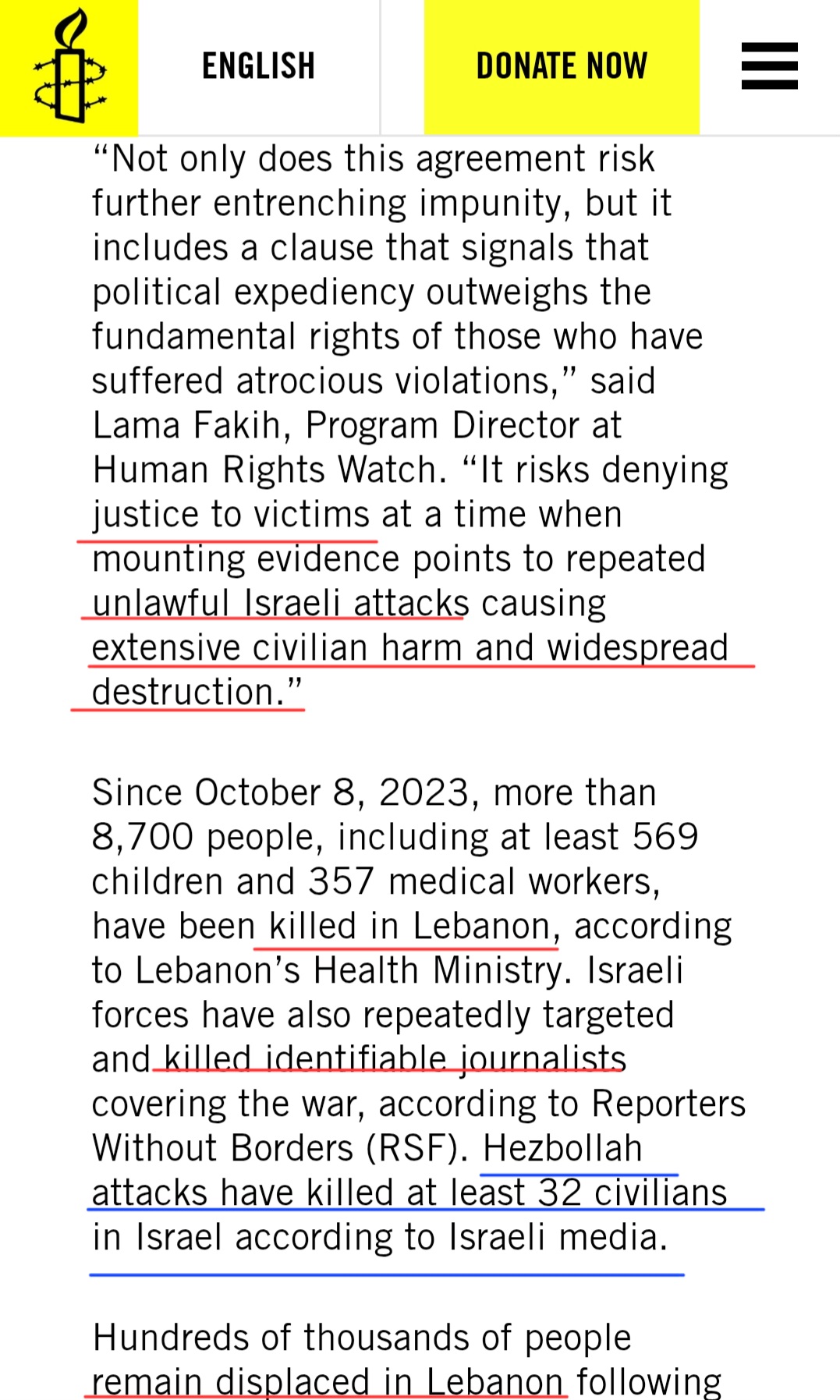
That has been the history of Amnesty International‘s sole focus on Israel as it fights a multifront war. It showed why it deserves no support again this week as it took aim on Israel’s fight against Hezbollah, the Iranian proxy terrorist group inside Lebanon.
The report argues that a proposed ceasefire agreement could deny Lebanese victims an avenue to pursue justice for alleged Israeli war crimes. Astonishingly absent from Amnesty’s presentation is the war that made the agreement necessary in the first place and justice for Israeli victims.
There is virtually no discussion of Hezbollah’s decision to begin attacking Israel on October 8, 2023, opening a second front one day after the Hamas massacre. There is no meaningful discussion of the years Hezbollah spent building an armed state within a state in southern Lebanon despite international commitments to disarm. There is no recognition that Israeli towns endured months of rockets, missiles and drones, forcing tens of thousands of civilians from their homes. Instead, 98 percent of the focus is on alleged Israeli violations and on preserving legal avenues to prosecute Israel.
Perspective matters.
Imagine writing about the Second World War while barely mentioning who invaded whom. Or discussing a peace agreement without explaining why civilians had to flee their homes on both sides of the border. A report that omits the conflict’s central facts cannot claim to provide a complete moral picture.
Even when Hezbollah is mentioned, it is a single sentence in passing. The sustained campaign against Israeli communities, the human cost borne by Israeli civilians, and Hezbollah’s own violations of the laws of war receive scant attention compared with the extensive treatment of allegations against Israel.
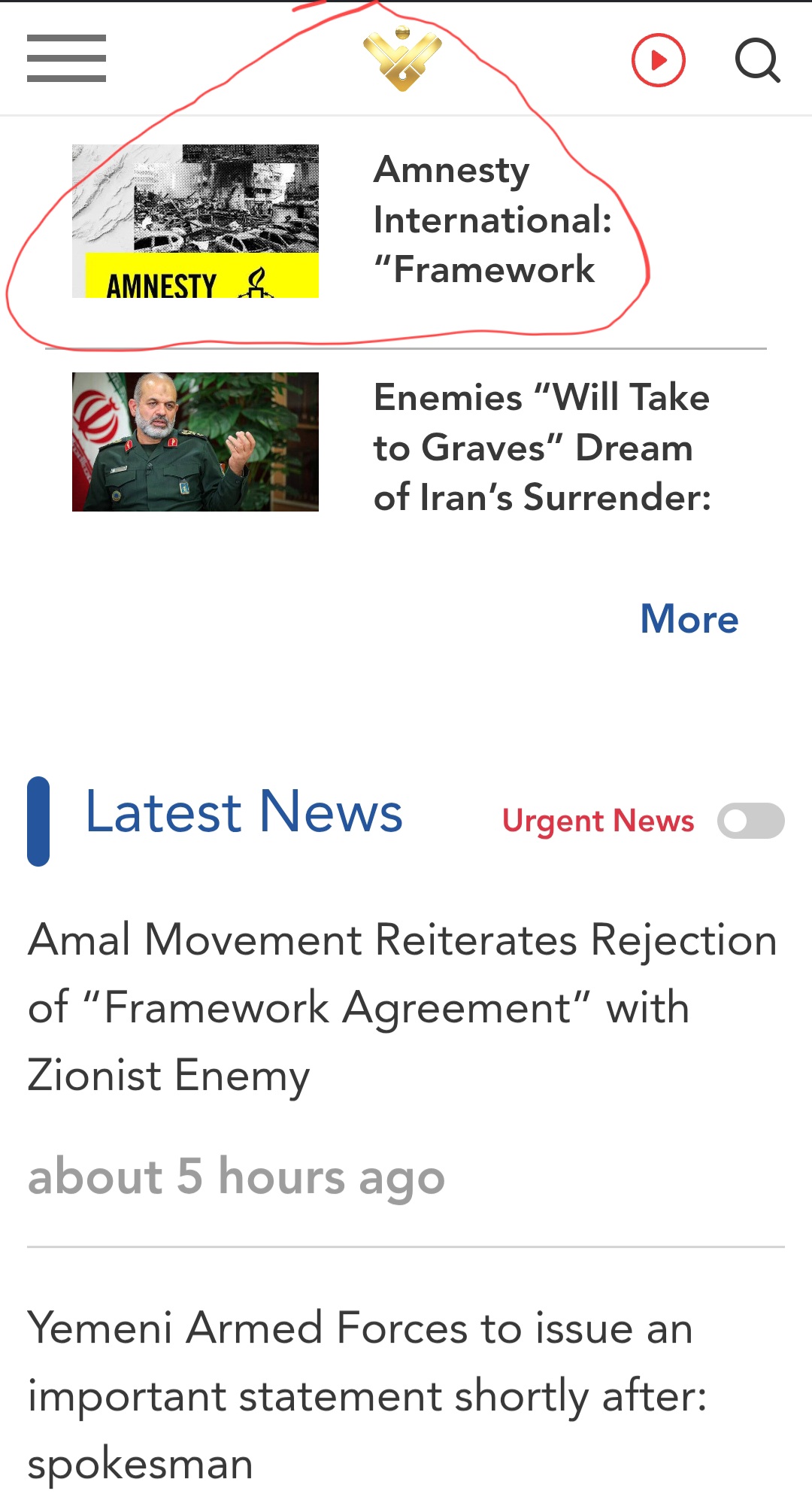
Perhaps the clearest indication of how this report is perceived came not from Israel, but from Hezbollah’s own media ecosystem.
Al-Manar, Hezbollah’s media network, prominently highlighted the report’s conclusions.
When the propaganda outlet of a terrorist group that initiated the northern front eagerly amplifies your work, it is time to confront the reality that your organization no longer serves the cause of universal human rights.
On June 27, 1976, Palestinian terrorists hijacked Air France Flight 139, a civilian airliner traveling from Tel Aviv to Paris. The operation by the Popular Front for the Liberation of Palestine‘s external operations network diverted the aircraft to Entebbe, Uganda, where the hijackers, aided by Idi Amin’s regime, held more than one hundred civilians hostage while demanding the release of imprisoned terrorists.
Then came the moment that revealed the deeper nature of the conflict.
The hijackers separated Israeli and non-Israeli Jewish passengers from the rest of those on board. Many other passengers were eventually released. The Israelis and Jews remained in captivity.
Had nationality been the only issue, non-Israeli Jews would have been released alongside the other foreign passengers. Instead, Jewish identity itself became grounds for continued imprisonment. The selection demonstrated that the target extended beyond the State of Israel to the Jewish people themselves. Decades after the Holocaust, Jewish civilians once again found themselves sorted from their fellow passengers because they were Jews.
The crimes committed during the hijacking were numerous. Palestinian terrorists seized a civilian aircraft, held innocent men, women and children hostage, threatened mass murder to secure political concessions, and singled out Jews for continued captivity. Three hostages died during the Israeli rescue operation, and Dora Bloch, an elderly Jewish hostage who had been taken to a hospital in Kampala, was later murdered by Ugandan authorities.
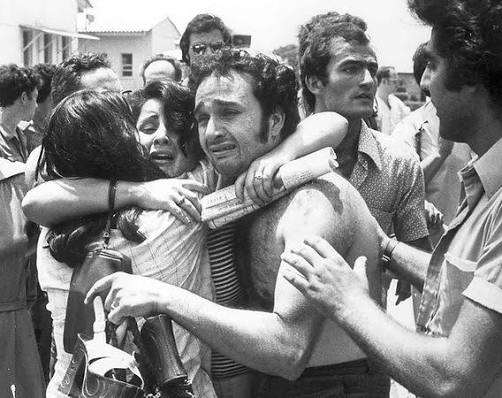
Hostages saved from Palestinian terrorists in Entebbe Airport, Uganda, July 4, 1976
Palestinian terrorists and their sympathizers have often come for non-Israeli Jews. Synagogues and Jewish community centers were attacked in cities far removed from the Middle East battlefield. Rome. Athens. Istanbul. Hezbollah and Iran often acted in support of Palestinian Arabs, just as they have since October 7, 2023.
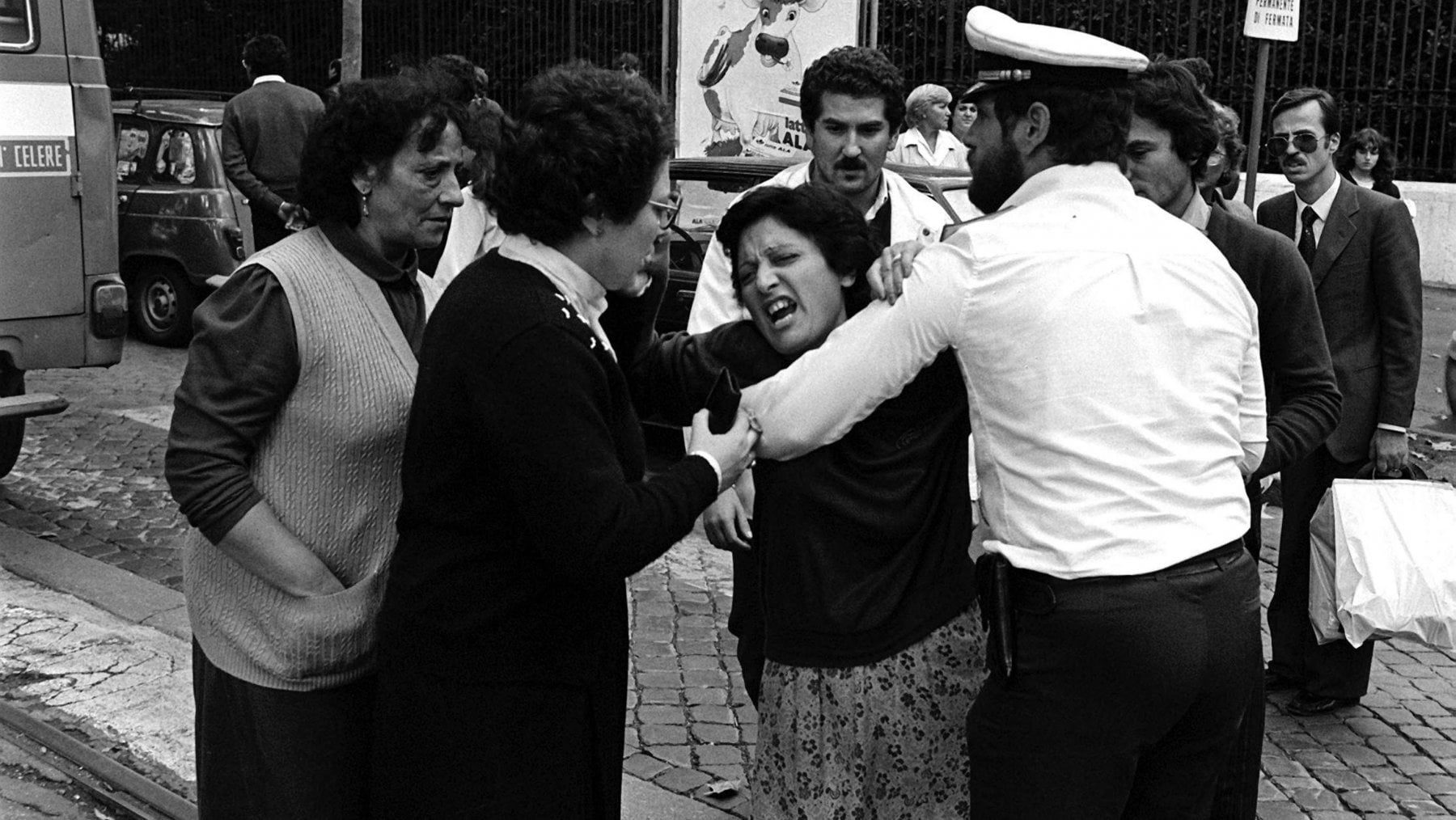
Palestinian Arab opened fire in the Great Synagogue in Rome, Italy October, 1982, killing a 2-year old and wounding 37
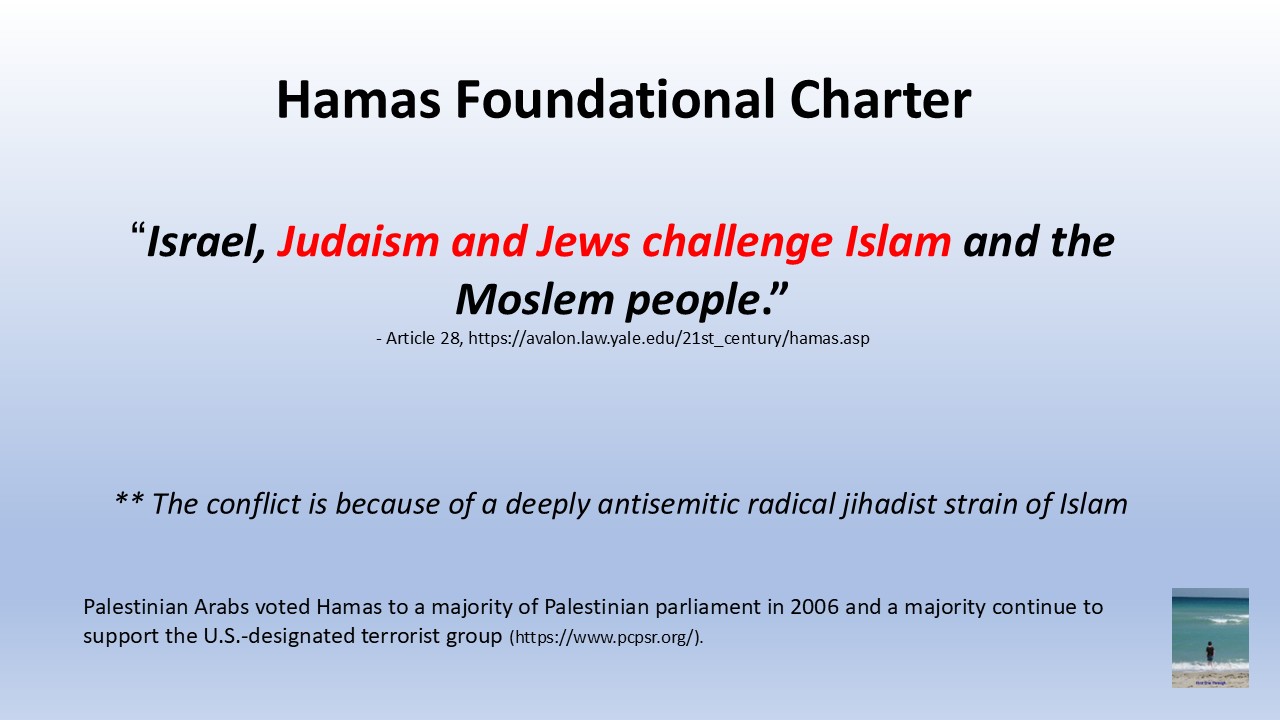
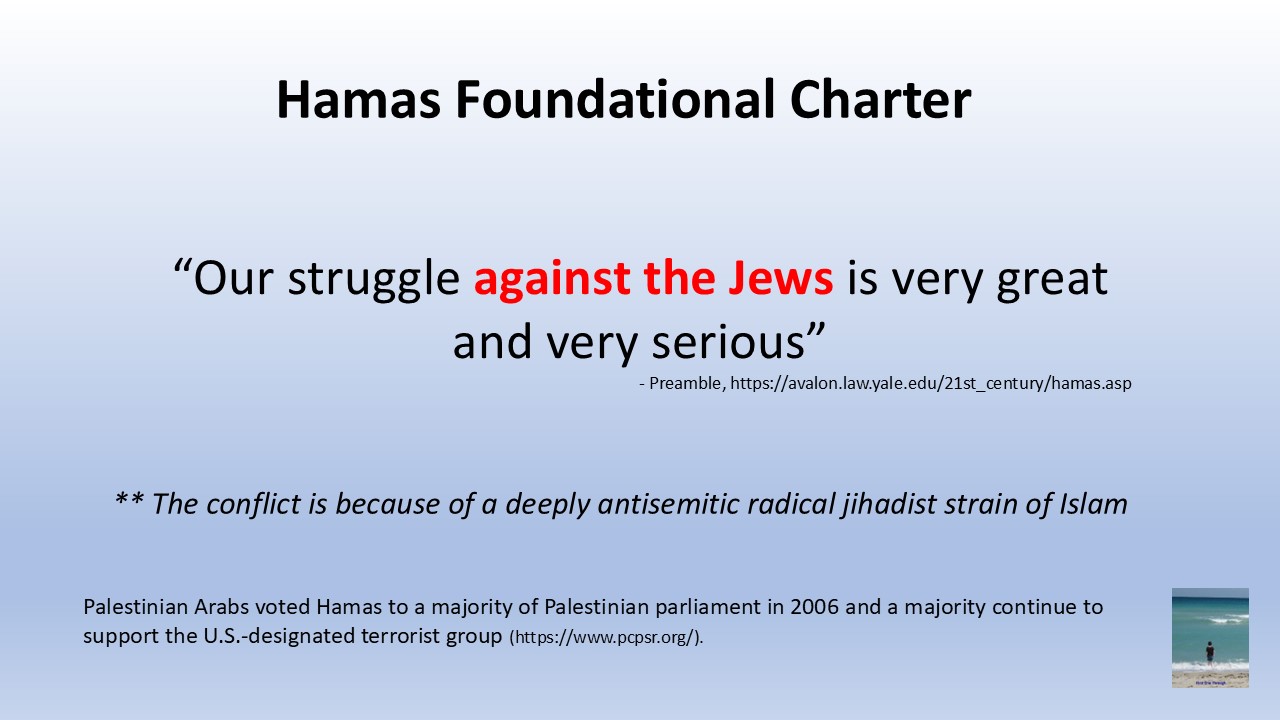
And the Palestinian Arabs don’t hide it. The 1988 Hamas Charter is not simply a terrorist manifesto, but a deeply antisemitic one. Palestinians voted Hamas to 56% of parliament with such screed and continue to vote for the group over Fatah in every poll.
Fifty years ago, on July 4, 1976, the Israeli Defense Forces saved over 100 Israeli and non-Israeli Jews who were held hostage by terrorists. The rescue operation only killed Ugandan soldiers and the terrorists themselves – no Ugandan nor Gazan civilian was harmed.
Libya: “Israel’s wanton aggression is a serious and grave crime against international law.”
Benin: “act of aggression committed by Israel against Uganda.”
Somalia: “Israel’s flagrant aggression against the sovereignty and territorial integrity of Uganda.”
Cuba: “The action of Israel… unquestionably constitutes a flagrant violation of the basic provisions of the United Nations Charter.”
Mauritius: “act of aggression.”
Pakistan: “the Council should demand that compensation for the great loss of life and property caused by the Israeli action be paid to Uganda.”
Mauritania, sponsored the complaint on behalf of the African Group.
“the Western Powers have manifested a racist and fanatic solidarity with the white minority settlement in Palestine. For them, the Israeli aggression merely demonstrated a highly successful operation performed by the white man against the blacks of Africa and against the browns of the Arab lands -against the blacks and the browns of another and hostile world, that of the Arab-African community.” – Libya regarding Israeli rescue of 100+ hostages held by Palestinian Arabs in Uganda
The total populations of Uganda and the countries above is roughly 373 million. The Jewish population in all of these countries combined is under 5,000, 0.001%. They are unwelcome and unwanted.
Wheelchair-bound, 69-year old American Leon Klinghoffer, killed by Palestinian terrorists October 8, 1985
Palestinian Arabs and their supporters in the Global South are ingrained with a deeply hostile view of Jews and the Global North. The latest manifestation has been seen since the barbaric attacks of October 7, 2023, but can be seen just as clearly fifty years ago, when Israel rescued other Jewish hostages.
Every sports fan understands the pressure of an elimination game. One team takes the field knowing that a loss ends its season. There are no adjustments, no second chances. Everything rests on one contest.
The opposing team may desperately want to win, but the consequences of defeat are entirely different. It can return for another attempt with a new strategy, a new line up.
The scoreboard is the same. The stakes are not.
Now imagine a tournament where one team disappears forever if it loses, while its opponent simply waits for the next season. We would never describe that as an even contest. Yet that is remarkably close to the strategic reality Israel has faced throughout its history.
For Israel’s enemies, wars are not elimination games.
Egypt fought Israel repeatedly and lost. Egypt survived and eventually chose peace.
Syria launched major wars in 1948, 1967 and 1973. Each ended in defeat. Syria remained Syria.
Jordan lost territory but continued as a kingdom.
The pattern extends beyond states. Hamas has suffered repeated military defeats, lost senior leaders, and watched much of its military infrastructure destroyed. Yet after every conflict it has sought to rebuild. Hezbollah has absorbed devastating blows over decades while remaining a powerful force in Lebanon. Military defeat has never meant the end of either organization. They regroup, recruit, rearm and wait for another opportunity.
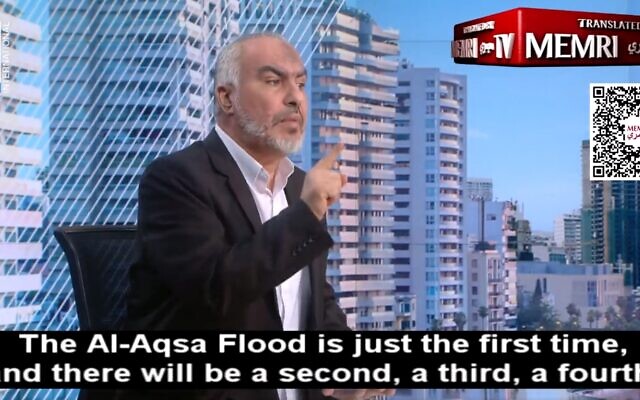
Hamas official stating that it will repeat the massacres of October 7 again and again
Israel has fought many opponents. Repeatedly.
That is because Israel’s war aims have been limited. Israel seeks to remove the military threat confronting its citizens. It has not sought the disappearance of Egypt, Syria, Lebanon or Iran. Even against terrorist organizations, its objective has been to dismantle military capabilities, not to eradicate an entire population.
Conversely, Israel’s adversaries have declared that the Jewish state should be destroyed. The objective was not merely to reverse a battlefield defeat or gain negotiating leverage. It was to eliminate Israel altogether.
That changes the meaning of every war.
Israel believes it cannot afford to lose an existential conflict because defeat would not simply mean surrendering territory, replacing a government, or rebuilding an army. Defeat would mean the destruction of the Jewish state.
Its adversaries have confronted a different calculation. If they fail, they survive. Their governments continue. Their organizations recruit new members. Their ideology remains intact. History gives them another chance.
Israel never assumes it will receive that luxury.
This asymmetry is one of the least understood aspects of the Arab-Israeli conflict. Outside observers often judge each round of fighting as though both sides enter the contest with identical risks and identical objectives.
They do not.
One side has repeatedly demonstrated that it can lose wars and return years later to fight again. The other has long believed that losing an existential war would leave no opportunity for a comeback.
Israel has lived for nearly eight decades in what often feels like a permanent one-sided elimination game. Its opponents have repeatedly lost wars and returned for another season. Israel has never believed it would be granted that same privilege.
That is why Israelis often see war differently than much of the world. The debate is rarely about this season’s standings. It is about whether there will be another season at all.
One of the most enduring images of the American Revolution is not a musket fired at Lexington or a cannon at Yorktown. It is a flag.
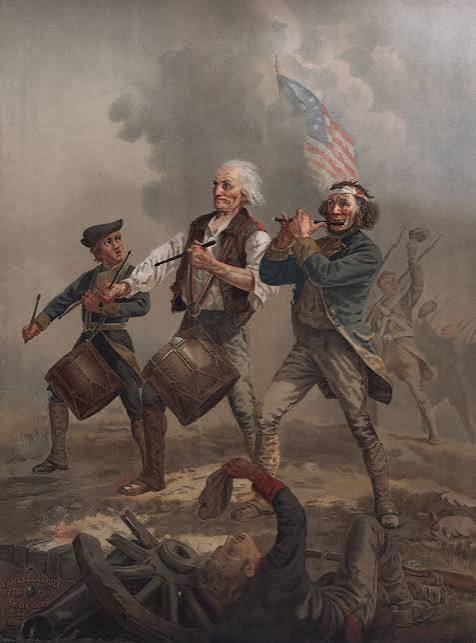
“Spirit of ’76” by Archibald Willard, 1875
In paintings celebrating the American Revolution, men advance carrying banners while drummer boys beat the cadence beside them. Often these figures are unarmed or lightly armed. To a modern observer, this seems irrational. Why would an army send men into battle carrying flags and drums instead of rifles?
Because they were not there to fight but to remind others why the fight mattered.
The flag represented the regiment, the cause, and the emerging nation. The drum provided rhythm and cohesion amid the chaos of battle. Neither was a weapon. Yet both were indispensable.
While tools like weapons help achieve an objective, symbols give meaning to the objective.
The Declaration of Independence was not a weapon. Neither was the America flag. Yet without them, the American Revolution would have been little more than a military rebellion. The cause and symbols transformed a collection of armed colonists into a people united by a common purpose.
The same lesson appeared thousands of years earlier in the Torah.
Moses’ staff began as an ordinary shepherd’s stick. In Egypt it became a symbol of divine authority. It was present during the plagues, at the splitting of the sea, and throughout Israel’s journey in the wilderness.
Similarly, during the battle against Amalek, Moses stood on a hill overlooking the fighting. When he raised his hands, Israel prevailed.
The rabbis famously ask whether Moses’ hands actually won the battle. Of course not. Joshua and the soldiers were the actual fighters. Like the flag carried by a Revolutionary soldier, the Moses’ raised arms pointed upwards. It reminded the warriors that victory depended not only on military strength but on the faith that united them.
Moses’ arms raised during fight with Amalek
Unfortunately, Moses later forgot the important distinction between symbol and tool. In Numbers 20, God instructs Moses to speak to a rock to make it produce water but instead Moses used the staff to hit the rock.
“And the LORD spake unto Moses, saying, Take the tent and gather the congregation together, you and Aaron your brother, and speak to the rock before their eyes, and give them water from it,… And Moses lifted up his hand, and smote the rock with his rod, and there came out abundant water,… And the LORD said unto Moses and unto Aaron, Because ye believed me not, to sanctify me in the sight of the children of Israel, therefore ye shall not bring this congregation into the land which I have given them.”
Had Moses held the staff and spoken to the rock, it would have been clear that Moses was acting as an agent of God. However, by using the staff to hit the rock, the appearance to the congregation was that Moses produced the water through his physical actions. The important symbol was converted into a mere tool.
That temptation remains with every generation.
Today, neither America nor Israel doubts the superiority of its weapons. The United States and Israel possess military capabilities far beyond those of the jihadist movements that seek their destruction.
But this war is not only about weapons and short-term military victory.
The jihadists understand the power of symbols. They flew their flags over burned civilian homes and corpses of families. Their propaganda celebrates martyrdom of their own people. Their movements are built around vile narratives and identity.
So the engagement with the enemies must be beyond tools and include symbols.
The challenge facing America as it approaches its 250th birthday, and Israel as it continues its long war against jihadist movements sworn to its destruction, is not merely maintaining military superiority. It is ensuring that the superiority of their cause is just as visible.
For Israel, that means rebuilding the communities of the Gaza Envelope, returning families to their homes, raising the flag over places terrorists tried to erase, and celebrating Jewish life where jihadists sought death.
For America, it means reclaiming the language of the Declaration of Independence, speaking unapologetically about liberty and human rights, and using international forums not merely to condemn violence in general but to condemn noxious jihadist violence specifically.
The free world must repeatedly denounce genocidal jihadists like Hamas and Hezbollah and pass resolutions that celebrate democracy, defend religious freedom, and affirm the dignity of every human being.
The current fight matters more than military victory. It requires weapons, and also a proud display of enduring Jewish and Democratic values.
Tools win battles. Symbols sustain civilizations. They are both distinct and required at pivotal moments like today.
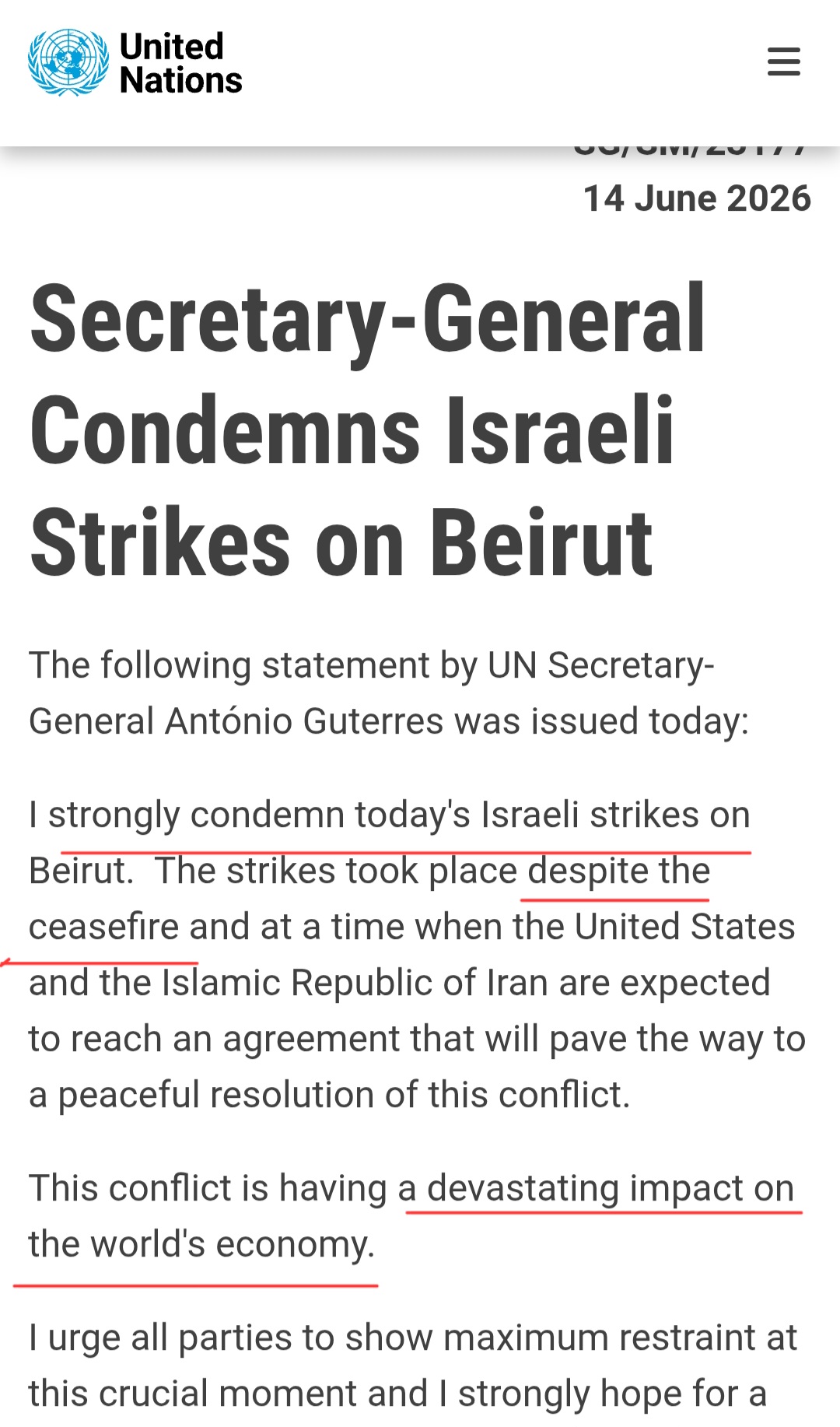
The United Nations Secretary-General issued a statement yesterday condemning Israeli strikes on Hezbollah targets in Beirut.
That was expected.
What was remarkable was his explanation.
Guterres wrote that the strikes occurred “despite the ceasefire” and at a moment when the United States and Iran were expected to reach an agreement that would “pave the way to a peaceful resolution of this conflict.” He then added that “this conflict is having a devastating impact on the world’s economy.”
The statement raises an obvious question: what do his comments have to do with Israel and Hezbollah?
The negotiations were between the United States and Iran. Israel was not a participant. Israel did not negotiate the terms. Israel did not sign the agreement. American officials themselves stated that Israeli withdrawal from Lebanon was not a condition of the deal.
Yet Guterres presented Israel’s actions as though they were undermining an agreement to which Israel was never a party.
The logic becomes even stranger when he turns to the economy.
The conflict affecting global markets is not the war between Israel and Hezbollah. The economic concern revolves around the American war with Iran which threatens energy supplies and disrupts shipping routes. Markets do not react because Hezbollah fires rockets into northern Israel or because Israel strikes Hezbollah positions in Beirut.
But in the Secretary-General’s telling, Israel is the root cause.
A Hezbollah-Israel clash suddenly becomes a threat to the world economy. A U.S.-Iran negotiation suddenly becomes Israel’s responsibility. An agreement Israel never joined suddenly becomes grounds to condemn Israel.
This is absurd.
But it is a continuation of the farce that is the United Nations.
The UN Secretary General is so obsessed with vilifying Israel and getting the world to join in, that he manufactures reasons that are devoid of any logic.
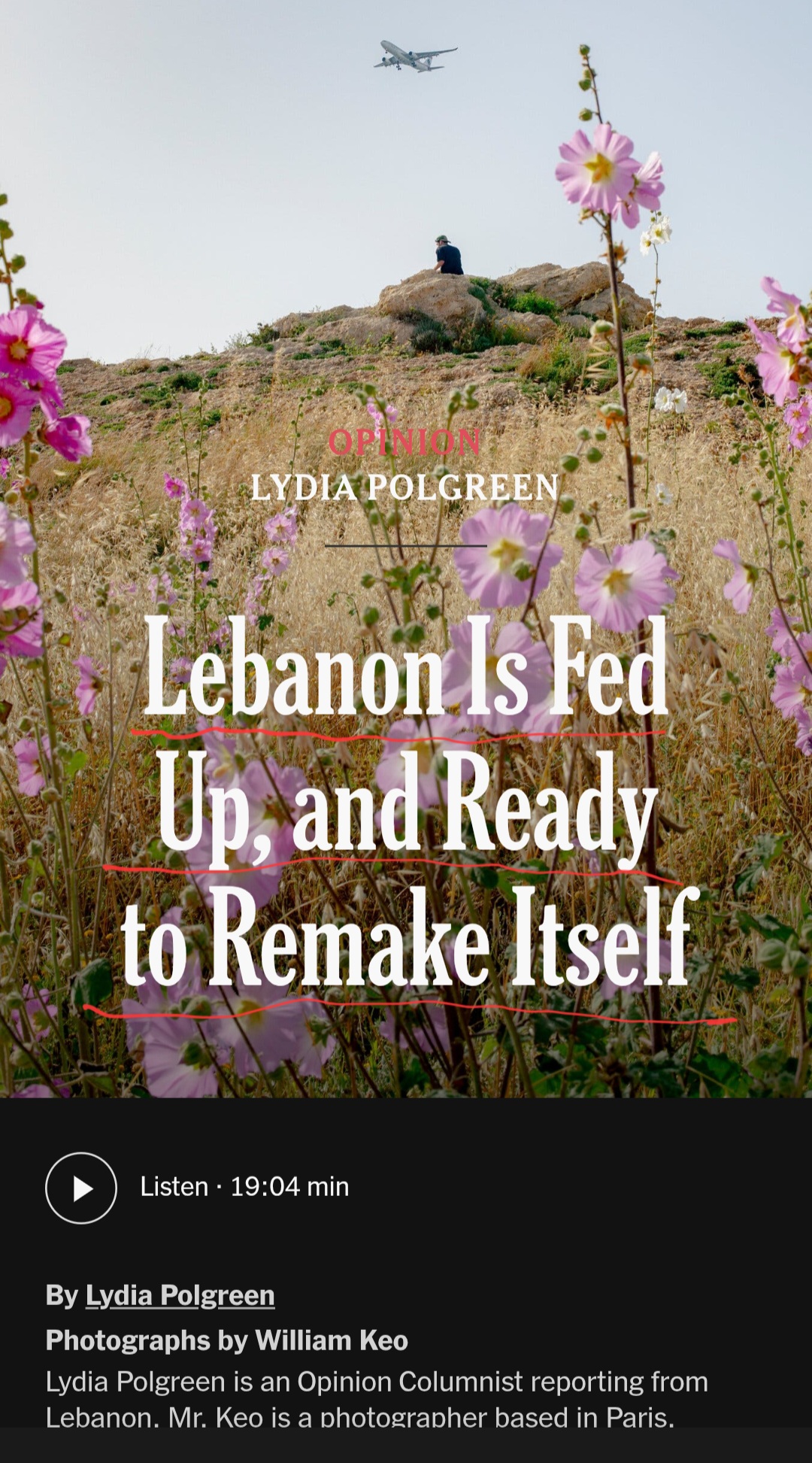
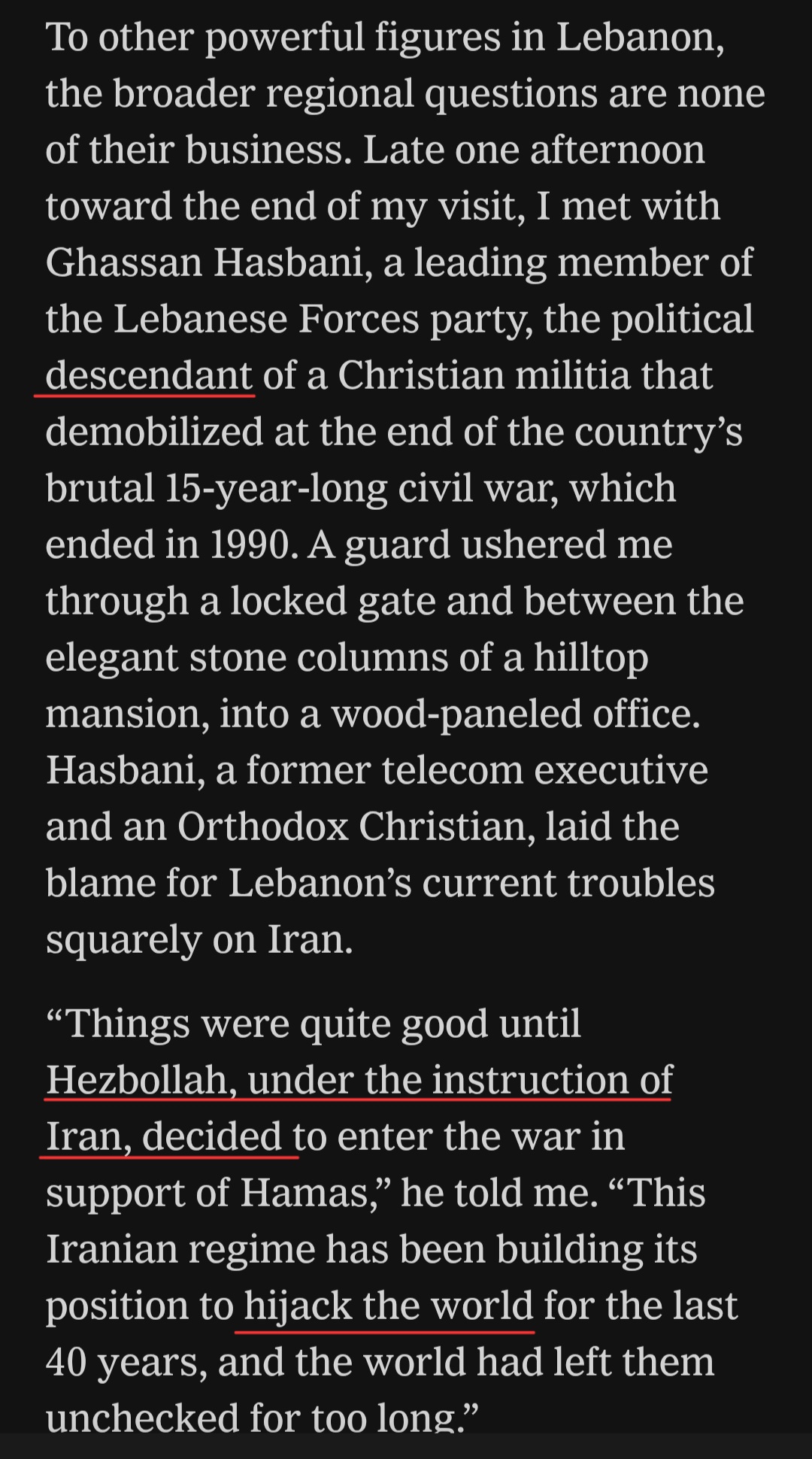
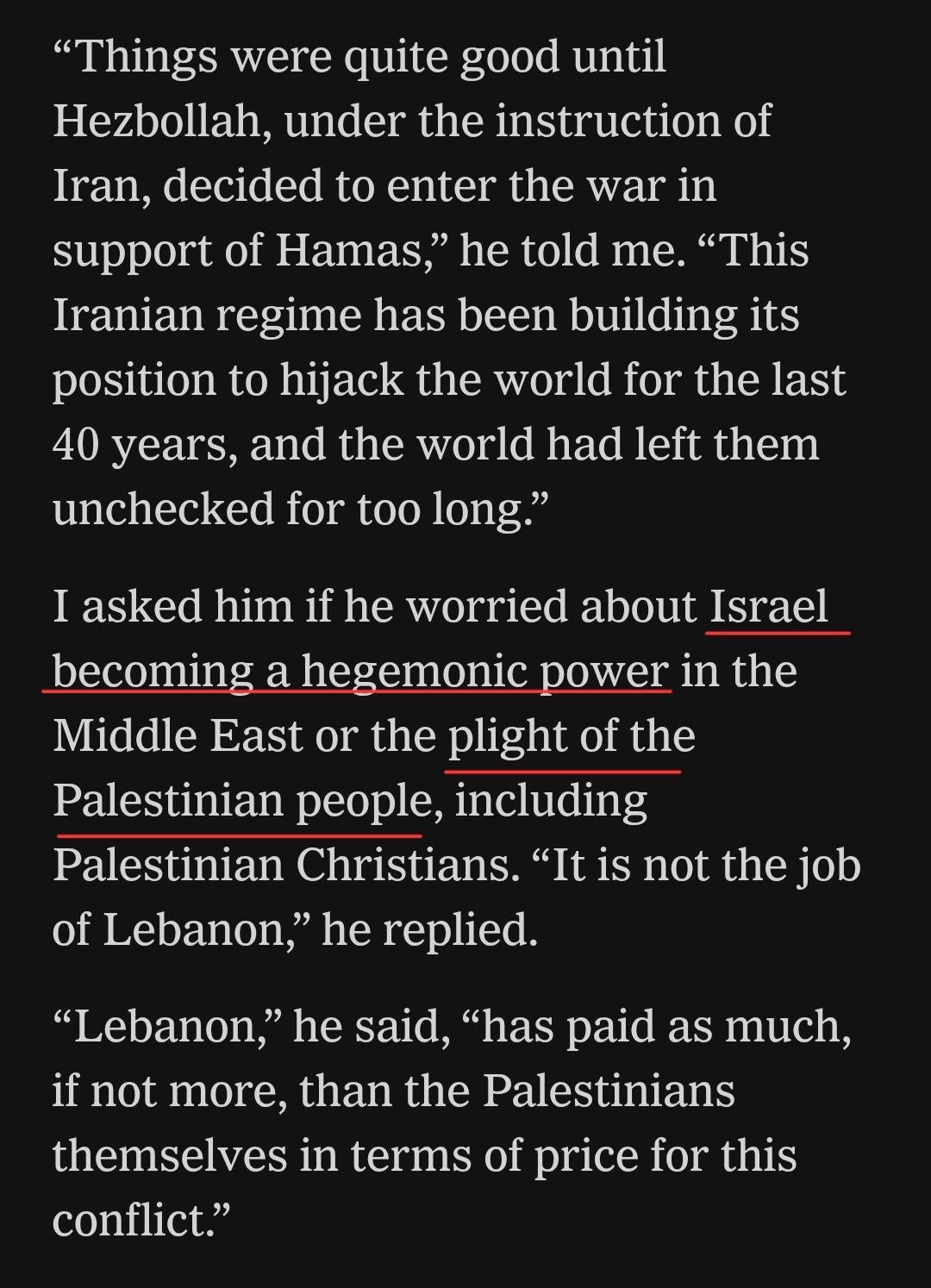
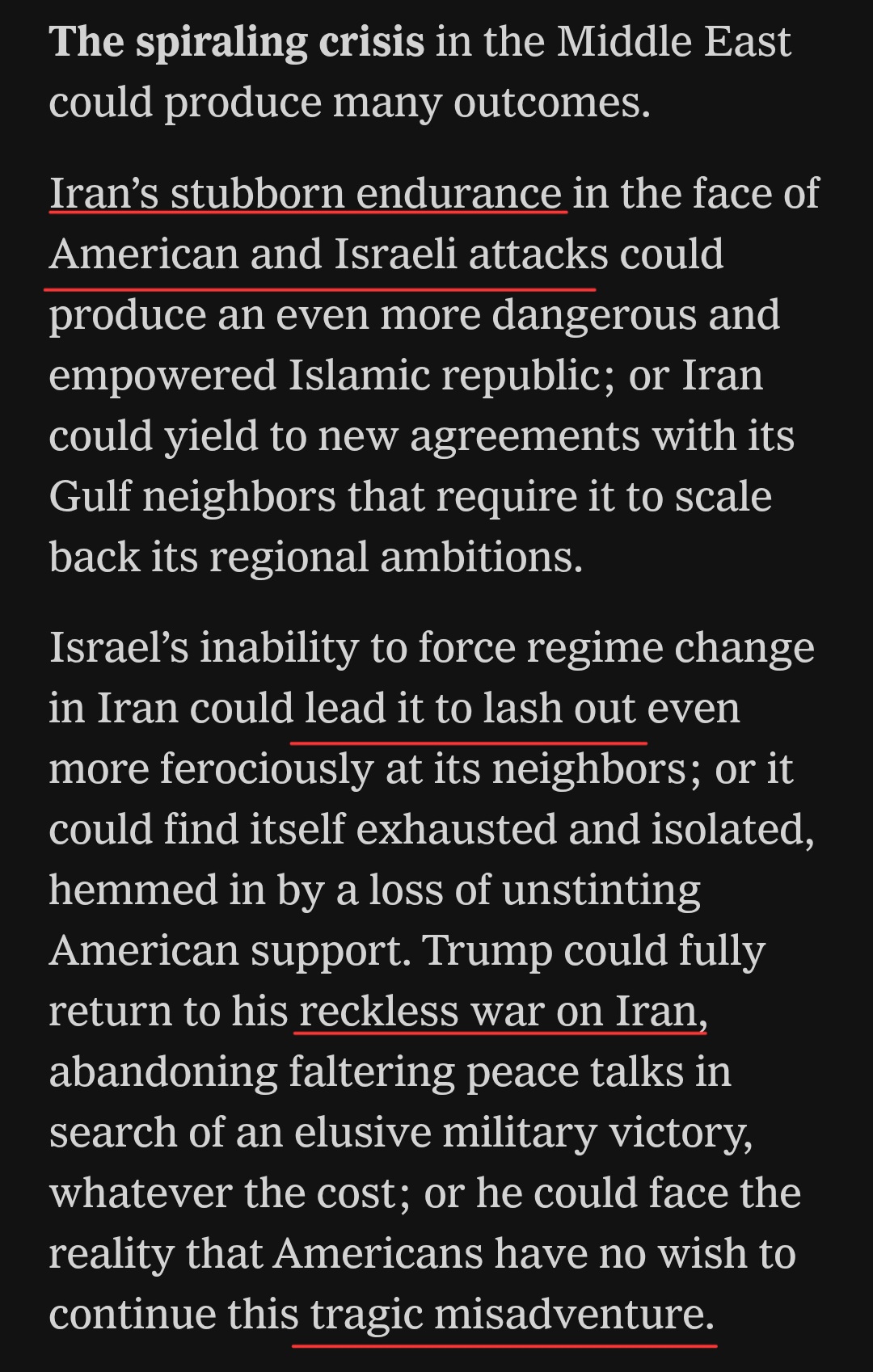
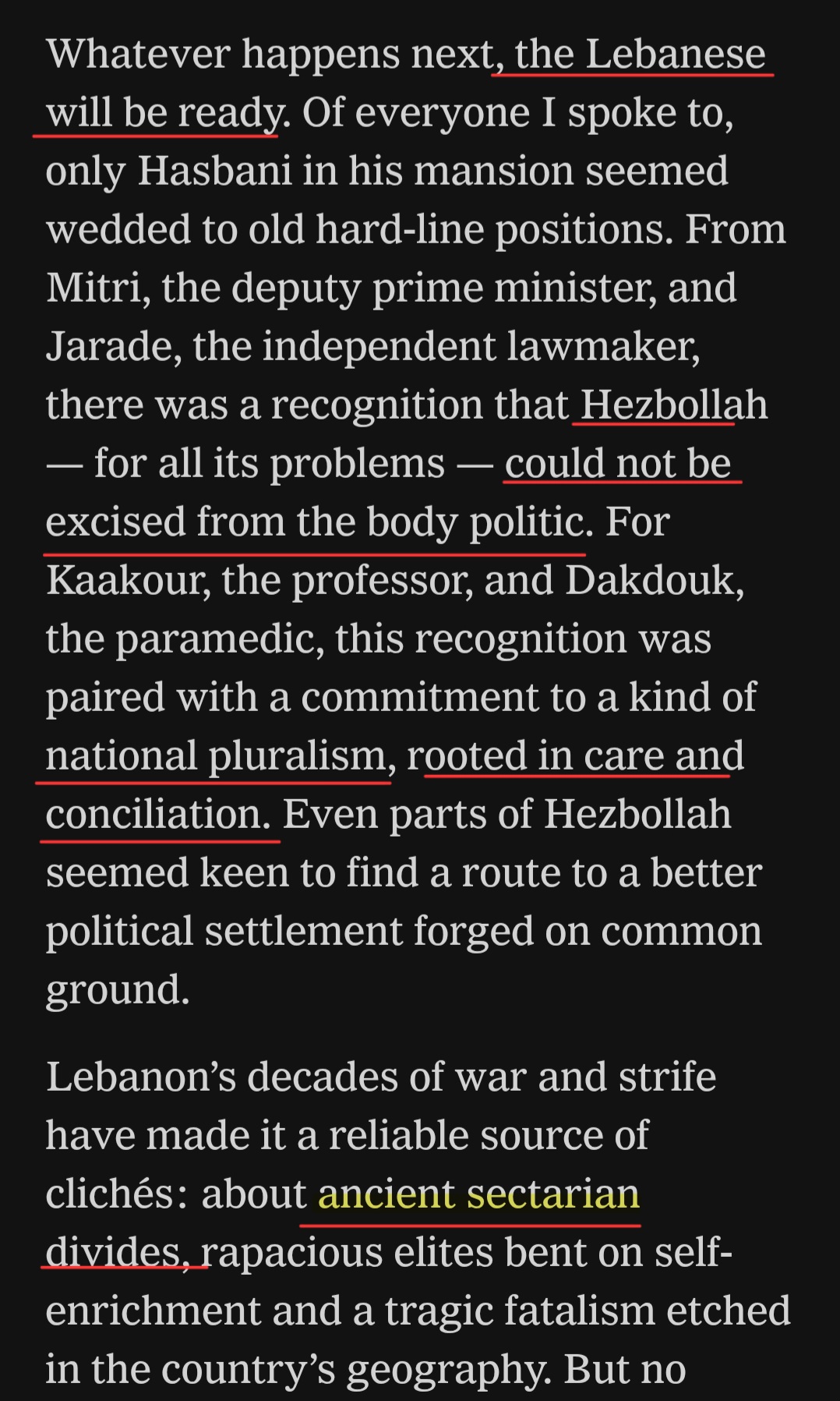
Readers are taken through a long 3,200-word editorial about an “ancient” country recovering from war. They meet civilians, politicians, intellectuals, and even Hezbollah supporters. They hear about sovereignty, reconstruction, and national renewal.
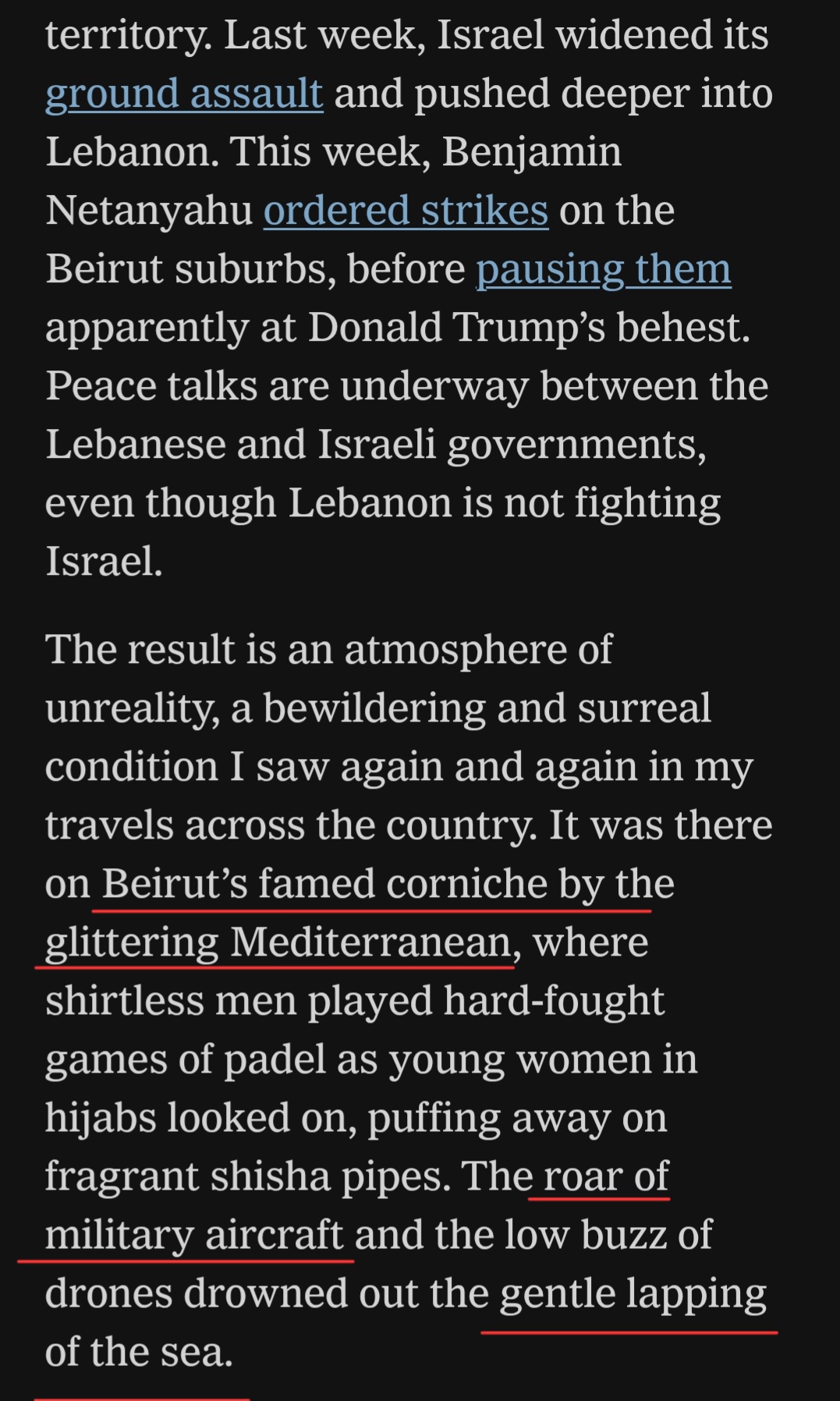
Picture accompanying 3,200-word article by Lydia Polgreen, placing a person sitting on a rock between a field of flowers and a plane overhead, a metaphor between its “ancient” beautiful land and foreign forces overhead or the temptation of leaving out of fear and disgust.
Then the focus shifts.
What begins as a reflection on Lebanon’s future gradually becomes a discussion of whether Israel should continue to exist in its present form.
That turn reveals the essay’s central assumption.
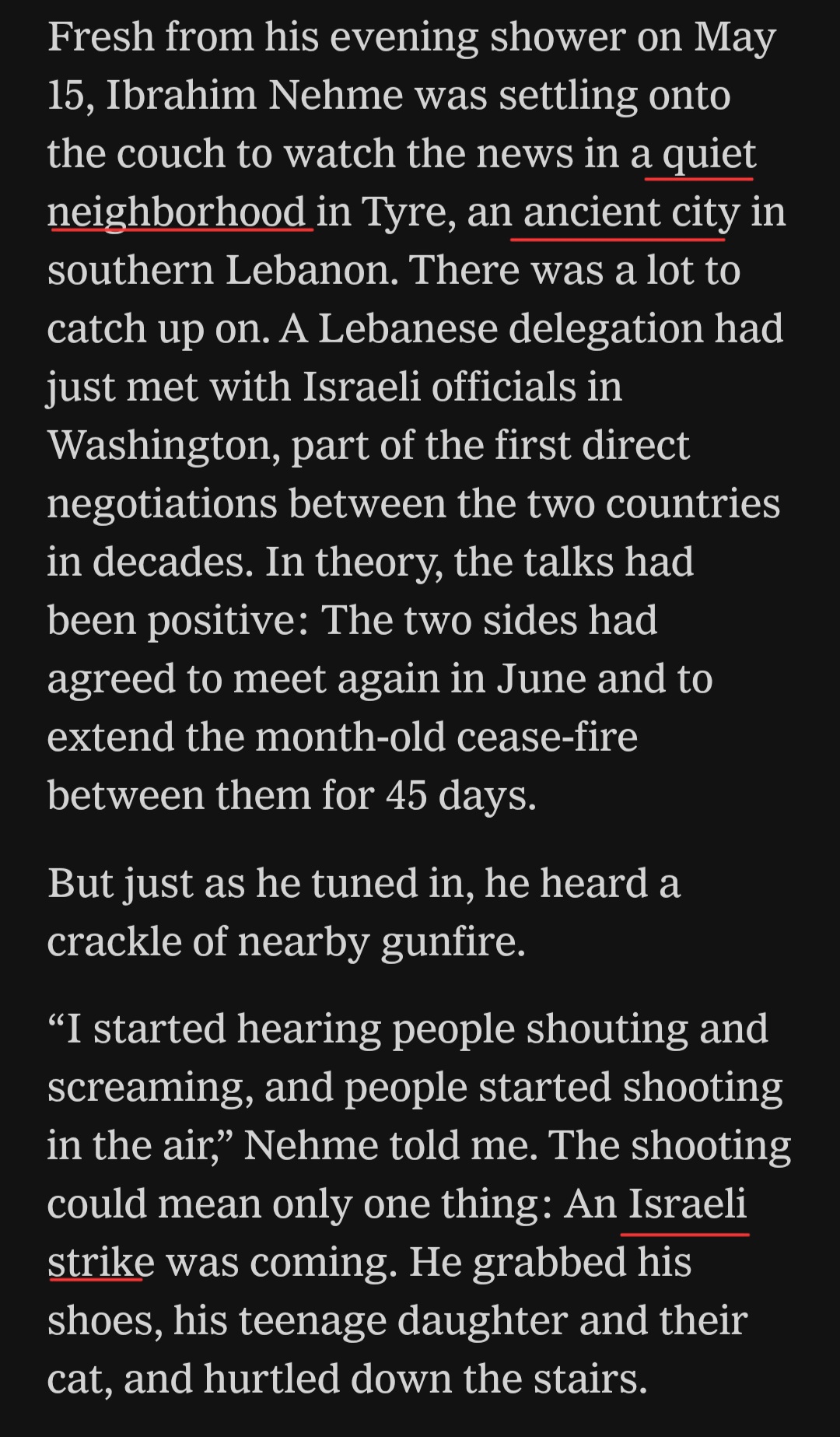
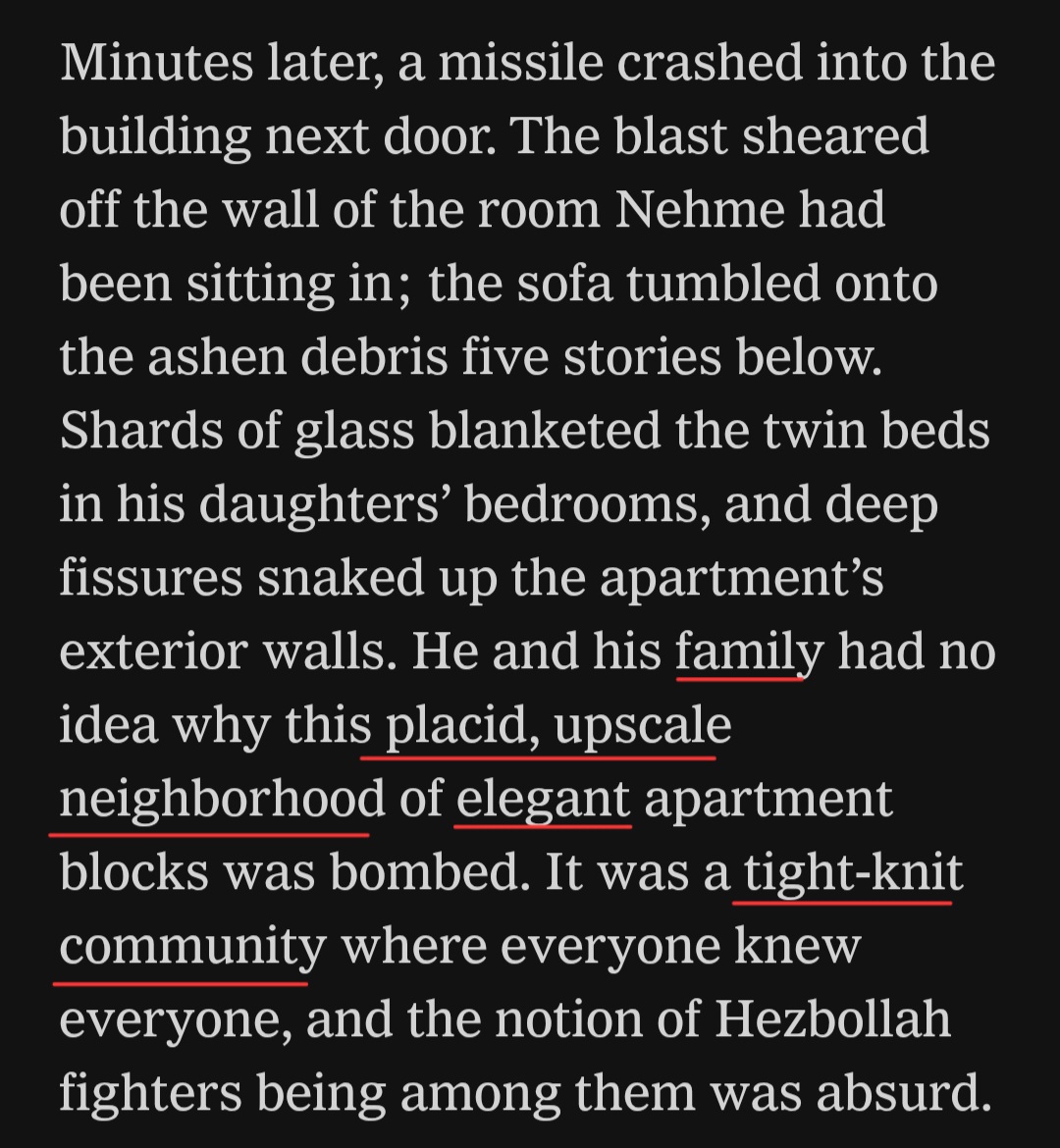
Lebanon is introduced through the language of continuity. Tyre is an “ancient city.” Villages are “ancestral.” Sectarian divisions are “ancient.” The country is presented as a society with deep roots struggling to reclaim its future.
Israel receives a different vocabulary.
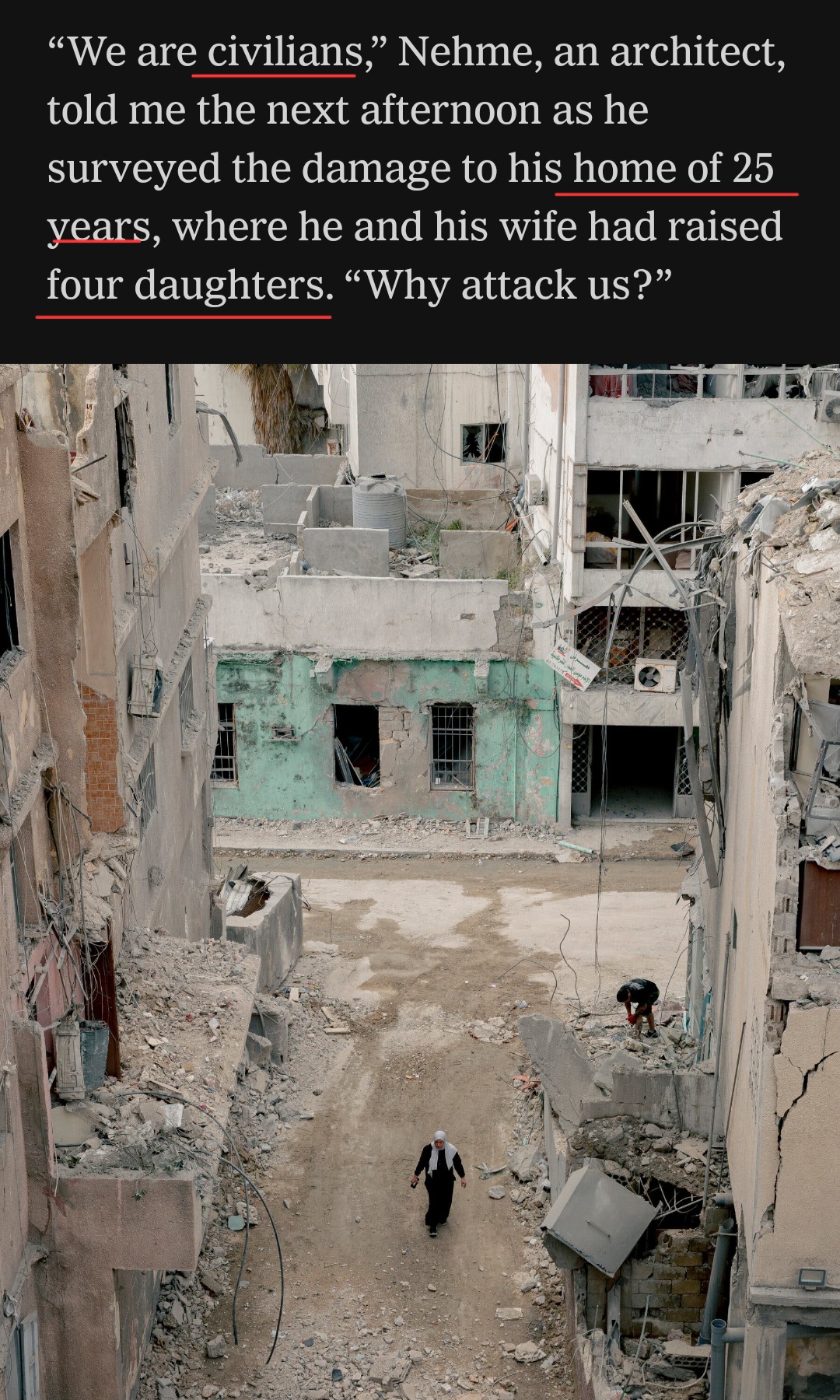
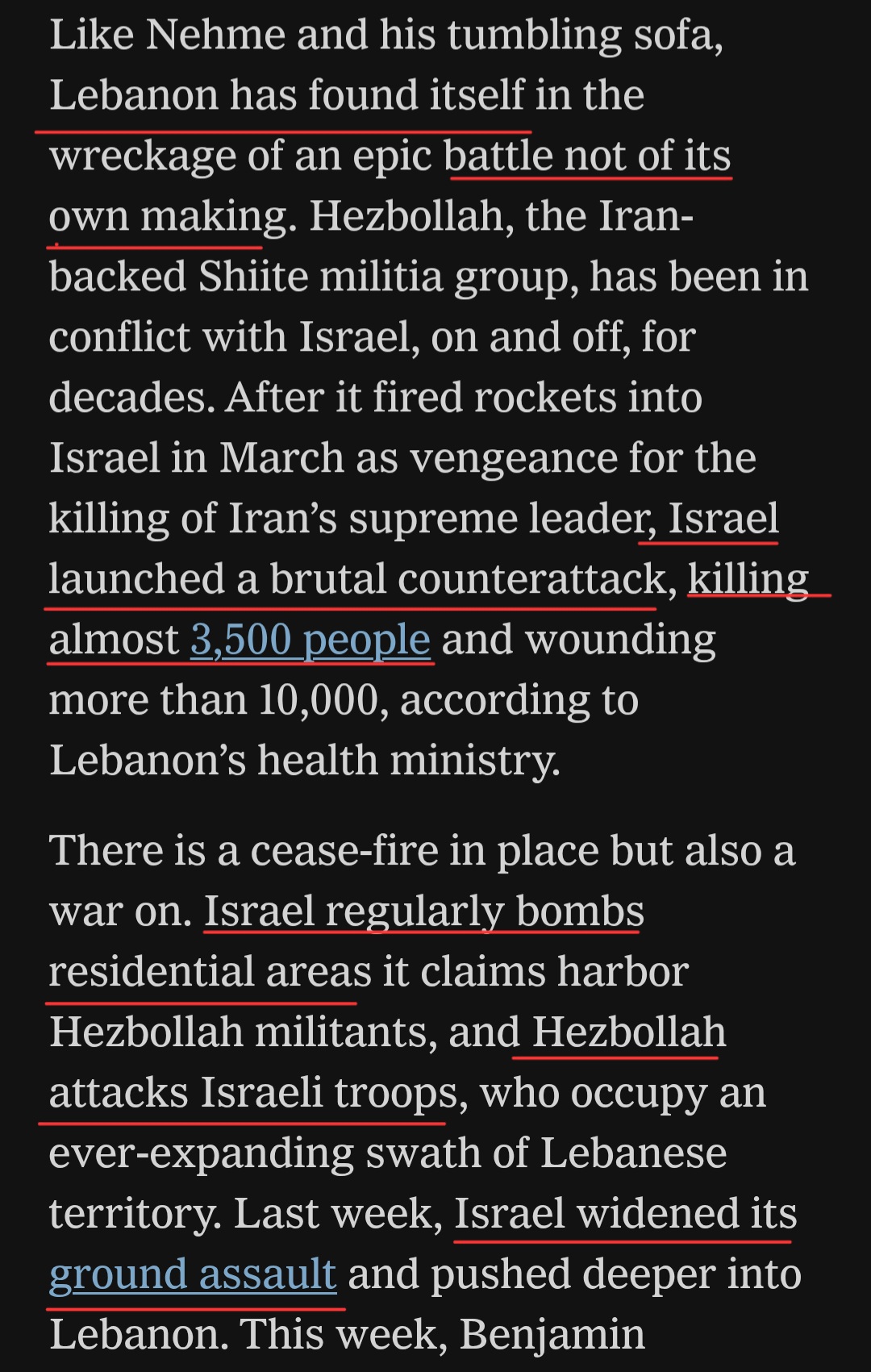
Israel occupies. Israel expands. Israel bombs. Israeli troops hold an “ever-expanding swath” of territory. The Israel is a “foreign military” operating inside another country. Israeli actions are repeatedly interpreted through ideological labels such as a “maximum-war doctrine.”
One nation is described through history and belonging. The other through power and force.
The contrast becomes more striking when the essay turns to sovereignty.
The preferred frame is Israeli intrusion into Lebanese sovereignty. Yet the defining political reality of modern Lebanon is that sovereignty itself remains unresolved.
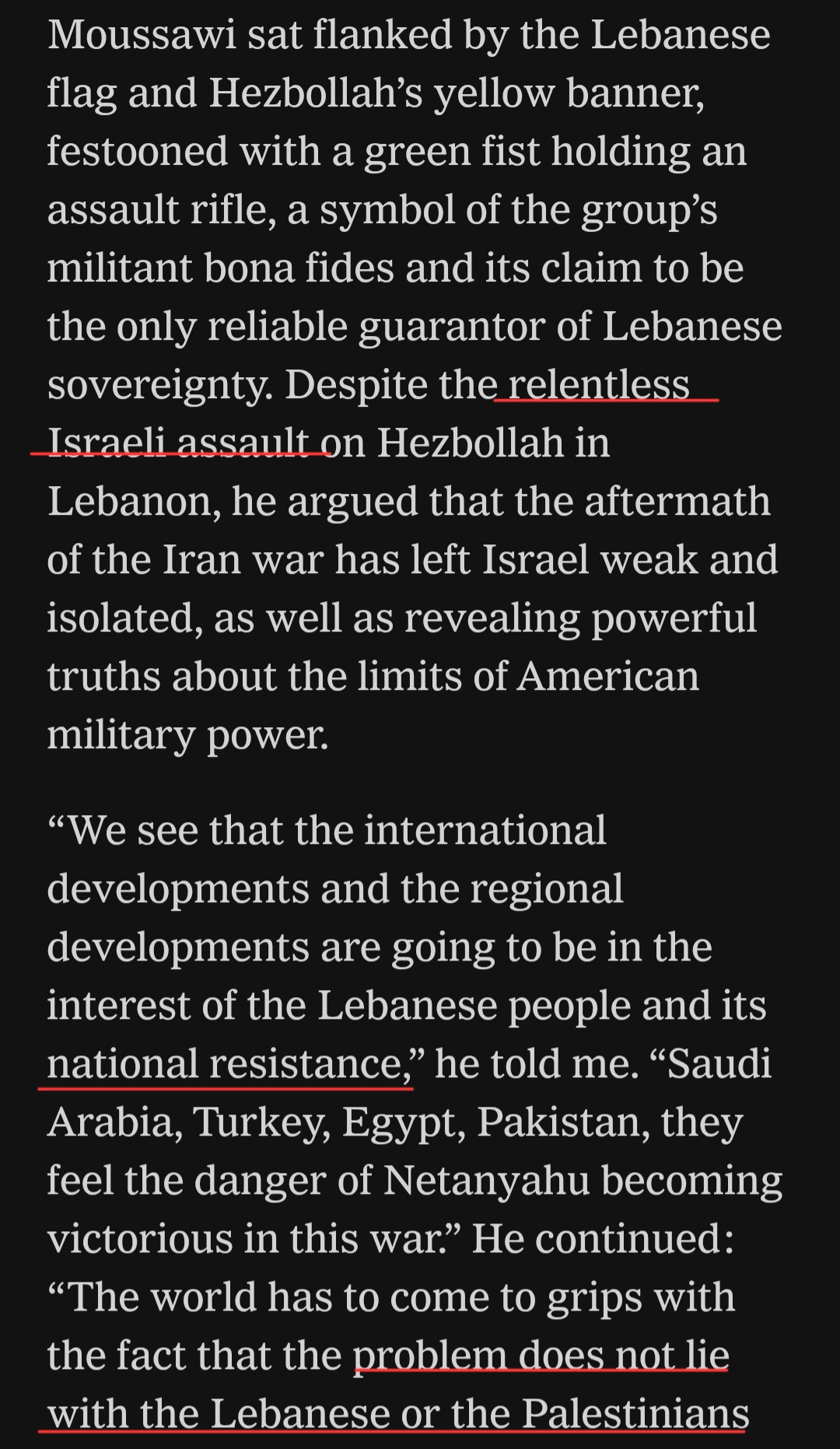
Hezbollah maintains an independent army outside the authority of Beirut. It receives funding, weapons, and strategic direction from Iran. It launched attacks on Israel after October 7 without authorization from the Lebanese government. For decades, Lebanese governments have struggled to establish a monopoly on force within their own borders.
The central question facing Lebanon is not merely reconstruction. It is sovereignty. Who governs southern Lebanon? Who decides questions of war and peace? Who controls the country’s most powerful armed force?
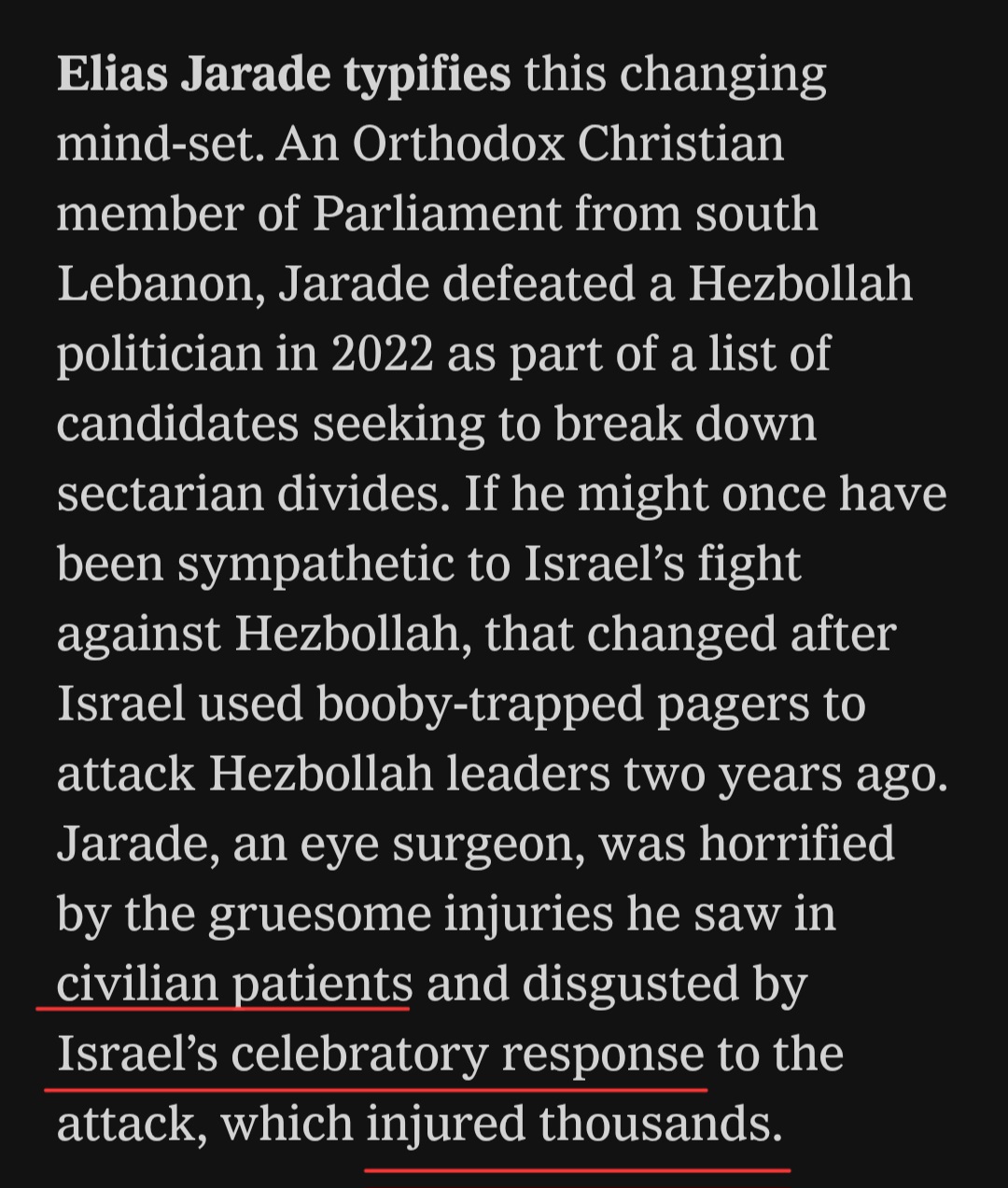
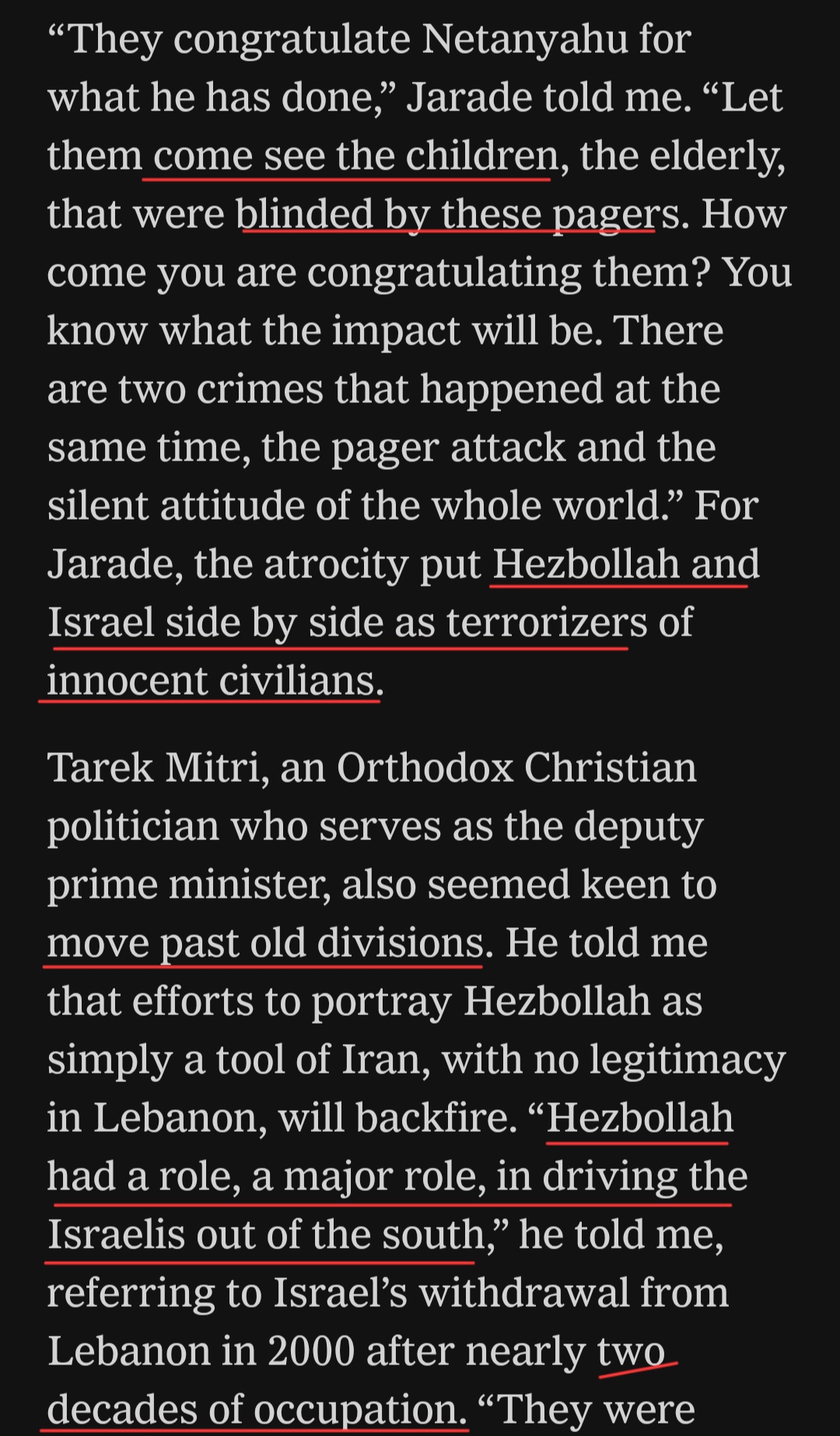
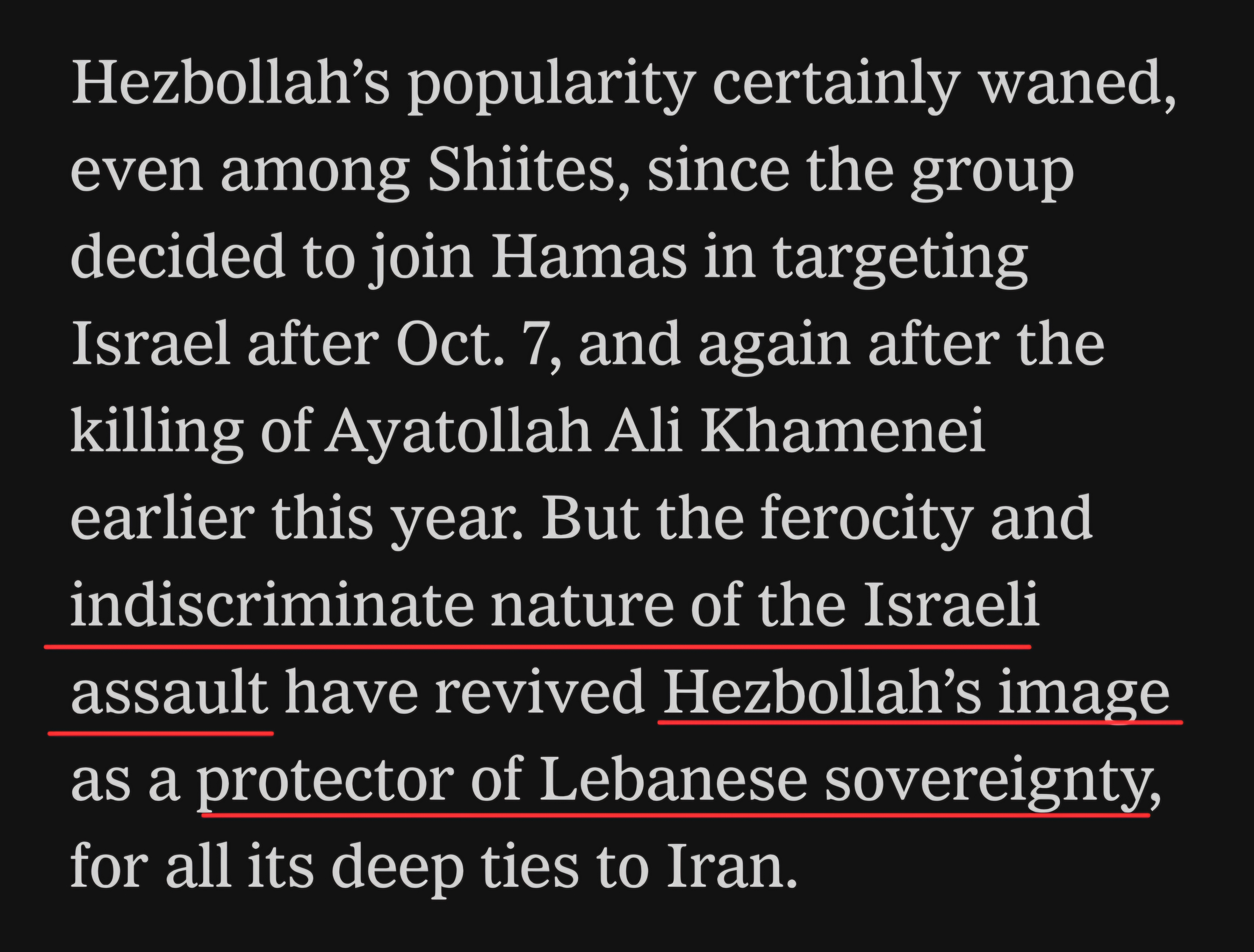
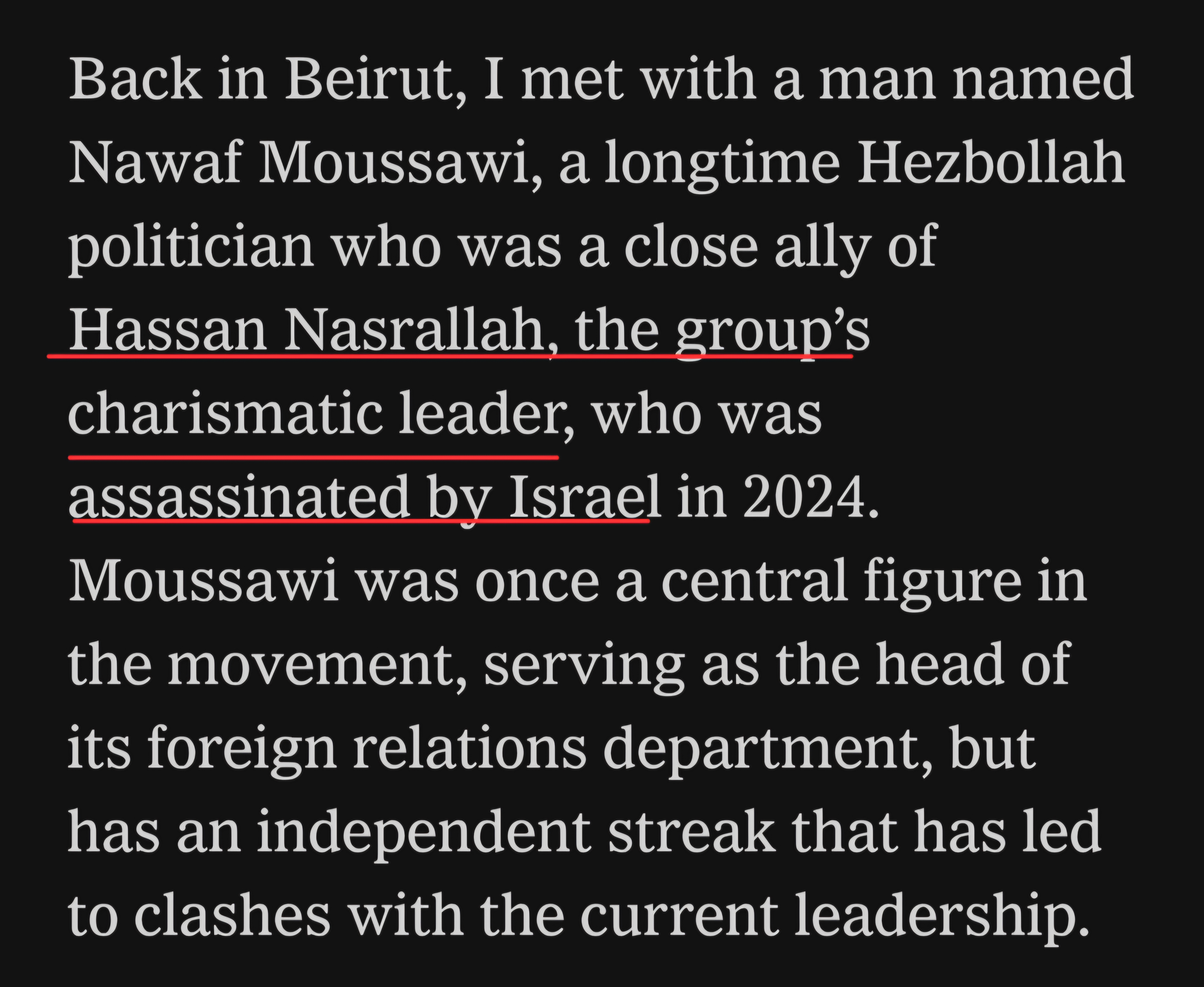
Those questions sit surprisingly close to the margins of the essay. Polgreen concludes that Hezbollah – even after the demise of its “charismatic leader” Hassan Nasrallah – will endure and be part of a “pluralistic” Lebanese society (“pluralism” and “pluralistic” show up four times in the article).
Readers learn far more about Israeli power than about Lebanese weakness.
Near the end, the essay abandons its own logic.
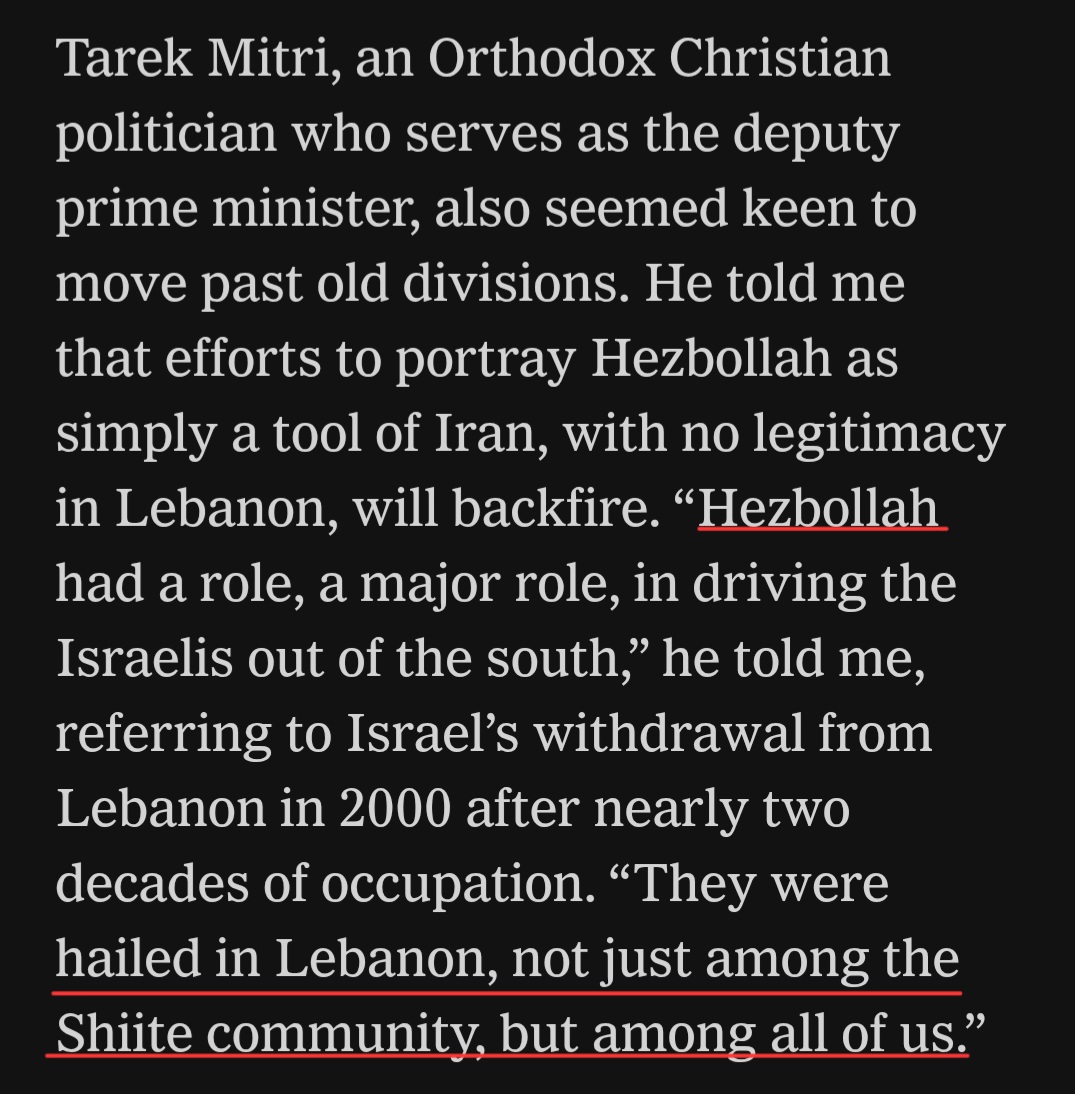
At one point readers are told that Hezbollah “could not be excised from the body politic.” Political reality, in other words, must be acknowledged. Hezbollah has supporters, influence, institutions, and representation. Lebanon’s future must somehow accommodate that reality.
Yet that principle vanishes when the discussion turns to Israel.
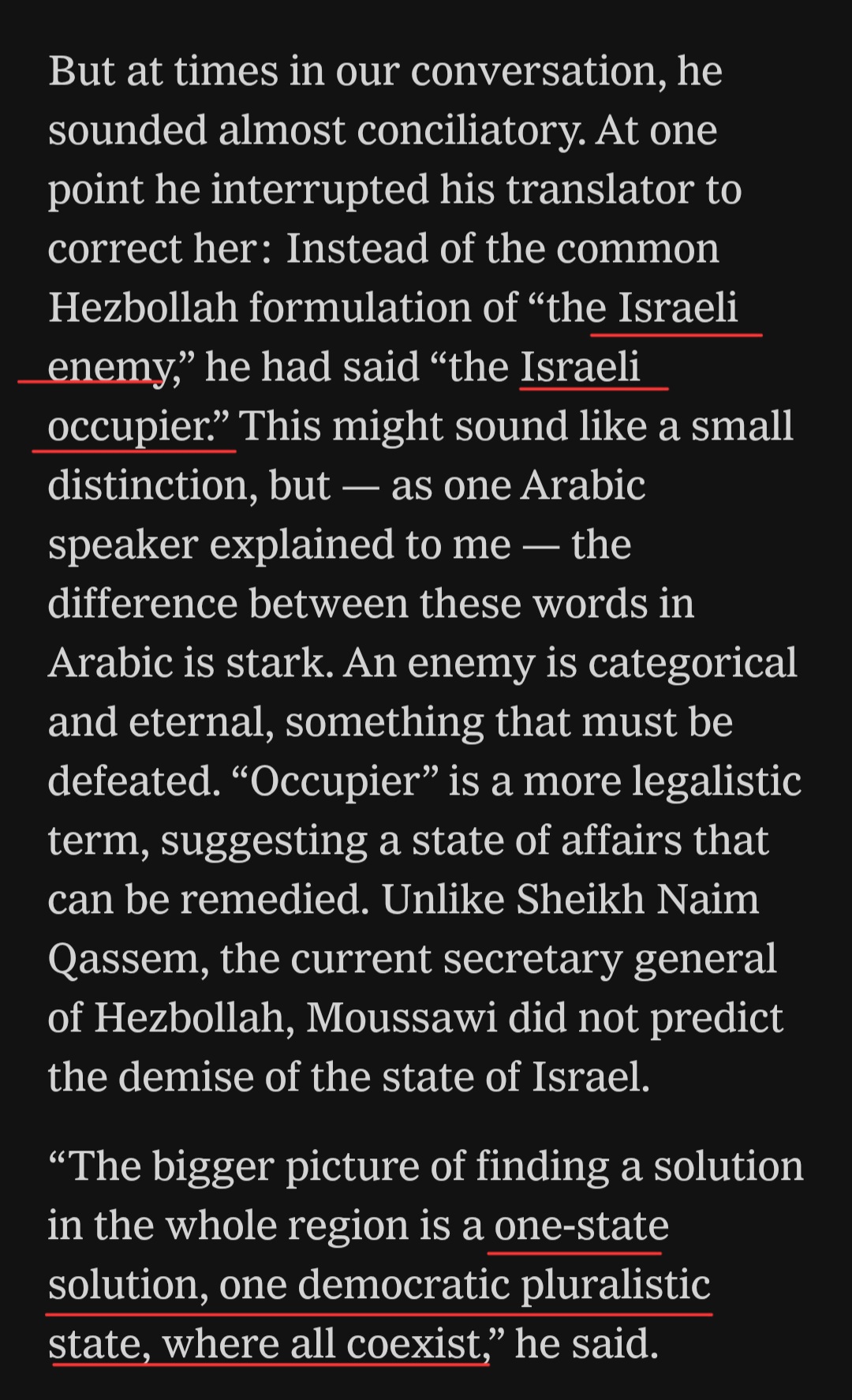
After thousands of words about Lebanon, readers are introduced to arguments for a one-state future that would effectively end Israel as the Jewish nation-state. An “emerging international consensus” suddenly becomes relevant to determining Israel’s future.
The contrast is revealing.
When discussing Lebanon, the essay asks Lebanese people what they want. Readers hear from civilians, intellectuals, politicians, and Hezbollah supporters. Their aspirations become the measure of Lebanon’s future, which we are informed will be pluralistic and peaceful, even when including Hezbollah.
When discussing Israel, Israelis are nowhere to be found. Readers have no context what the average Israeli wants. They are not told that overwhelming majorities support maintaining Israel as a Jewish state. Instead, the relevant question becomes what an international consensus believes should happen.
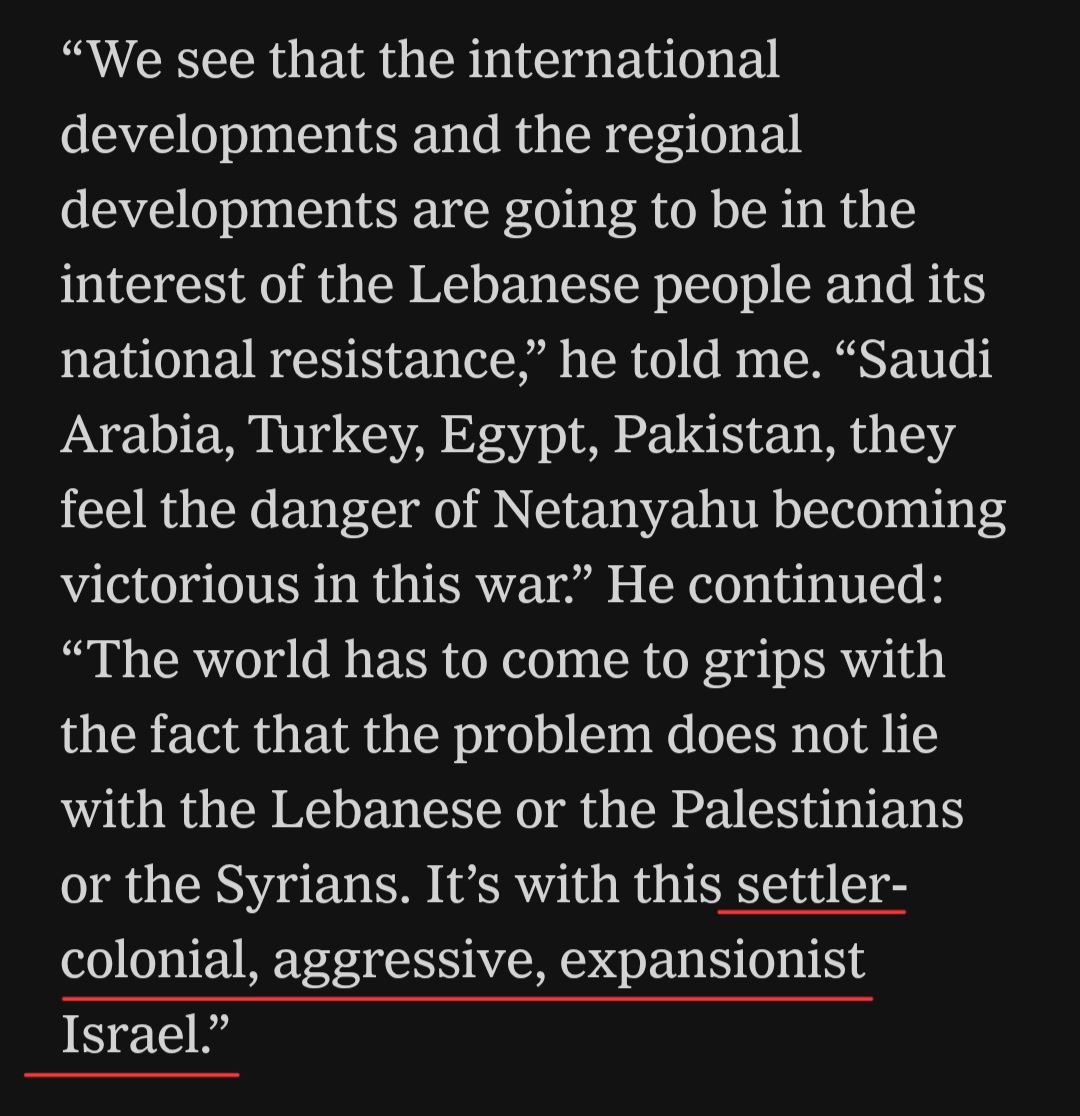
The people whose “settler-colonial, aggressive, expansionist” state is cast as being temporary are absent from the discussion. Presumably, the readers are being led to the conclusion that international pressure must be placed on Israel to let Lebanon live.
Lebanon’s future belongs to the Lebanese. Israel’s future belongs to everyone else.
By the end, readers know that Lebanon is an ancient nation whose sovereignty deserves restoration. Hezbollah is an enduring political reality that must be accommodated. Israel is a state whose identity should be reshaped by outside opinion.
Hezbollah is never properly labeled a US-designated foreign terrorist organization. Israel is never described as an American ally. Lebanon is not painted as a failed country which cannot control its failed economy or borders or manage a distinct military force outside governmental control.
A country that struggles to control its own territory is granted unquestioned legitimacy. A country with functioning institutions, competitive elections, and one of the region’s strongest economies is presented as a candidate for political reinvention.
The essay asks readers to accept permanence for Hezbollah, self-determination for Lebanon, and international supervision for Israel.
It begins by asking how Lebanon should recover from war. It ends by asking whether Israel should remain Israel.
For an essay about Lebanon, that is an oddly revealing destination.
Iran did not remake the Middle East by conquering it. It reshaped sovereignty from within.
Through the Islamic Revolutionary Guard Corps and its expeditionary arm, the Quds Force, Tehran spent decades cultivating armed movements inside other countries. Groups like Hezbollah, Hamas, and the Houthis operate locally while drawing training, funding, and strategic direction from Iran.
The method repeated. Build armed actors inside weak systems. Arm them. Fund them. Legitimize them. Let them grow until they rival the state itself.
The outcome depends on how far that process runs.
Start with Yemen.
The Houthis moved from insurgency to control, seizing the capital and displacing the recognized government. Authority fractured across multiple centers while regional powers deepened the conflict. The country unraveled into competing zones of control, each backed by different patrons.
Yemen reflects the far end of the spectrum. Sovereignty has fractured, authority is dispersed, and the state exists largely in name while power is contested on the ground.
Lebanon presents a more intricate equilibrium.
The government still operates. Ministries function. The army deploys. Daily life continues within the framework of a state.
Power, however, runs on a parallel track.
Hezbollah has evolved from militia to dominant armed and political actor. It maintains a military force outside state control, exerts significant influence within the political system, and operates along the southern frontier with Israel.
In a system where power sits outside the state, accountability thins out.
The Beirut port explosion laid that reality bare. The blast- largely attributable to Hezbollah stockpiling of weapons – devastated the capital and accelerated economic collapse.
Lebanon endures as a state whose authority is constrained and divided. Institutions remain, while decisive power is shared, contested, and at times displaced.
Gaza and the West Bank reflect an earlier phase of the same pattern.
Here, no single authority controls territory, force, and governance at once. Hamas governs Gaza, while the Palestinian Authority administers parts of the West Bank. Armed groups operate alongside political structures, and internal divisions prevent the emergence of a unified system.
Under these conditions, sovereignty never fully coheres.
Iran’s role reinforces these fractures. Support to armed factions strengthens one side of divided systems and complicates any path toward unified governance.
Three arenas. Three outcomes.
Yemen: the state fractures. Lebanon: the state is captured from within. Gaza and the West Bank: the state never coheres.
Systems that weaken the state at home rarely stay contained. They travel.
In Yemen, fragmentation has produced a prolonged humanitarian crisis. In Lebanon, economic collapse and institutional weakness have eroded daily life and public trust. In Gaza, civilians live within a structure where governance and armed control are tightly fused, with recurring cycles of conflict.
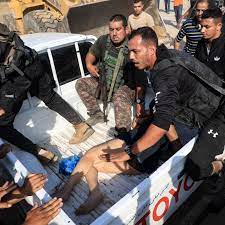
Members of Hamas bring back body of young Israeli woman into Gaza after killing her on October 7, 2023
These same structures project force outward. Hamas, Hezbollah and the Houthis have all attacked Israel over the past few years. As has Iran.
And these forces are now all degraded, perhaps on their way to being defeated. The regional implication extends beyond Israel’s immediate security.
Weakening these groups can shift the balance inside the countries they inhabit. Space can reopen for state authority—unevenly, imperfectly, and with no guarantee—but space nonetheless.
Israel is acting out of its own security needs. It is very possible that the entire region will benefit once the Iranian proxies are removed.