Bring Israel Into NATO’s Orbit

Wars do not simply end; they force institutions to confront whether they still address the world they are meant to secure.

As the regional war against Israel recedes from its most intense phase, one conclusion is increasingly difficult to ignore: Israel has been operating inside the West’s security perimeter while remaining formally outside the principal institution designed to defend it.

That institution is the North Atlantic Treaty Organization, NATO.

This gap is structural—and increasingly consequential.

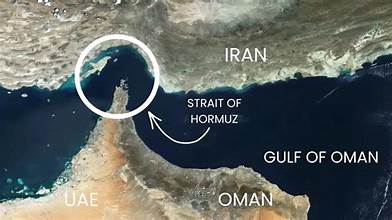
When Iran shut down the Strait of Hormuz, crippling access to one-fifth of the global oil supply, the countries inside of NATO barely budged. Spain went so far as to send the United States a big middle finger.

Only Israel worked together with the U.S. in managing this global threat.

Israel already maintains deep bilateral ties with key NATO members, particularly the United States. Intelligence sharing, joint exercises, and technological collaboration are well established. The problem is that this cooperation remains fragmented, dependent on individual relationships rather than embedded within NATO’s institutional framework. In an era defined by interconnected threats, fragmentation is a liability.

Those threats no longer arrive neatly organized by geography. For more than two decades, Europe has experienced the effects of Islamist extremism within its own borders. Attacks tied to networks such as ISIS in Paris, Brussels, and Berlin were not isolated events. They reflected a broader system—ideological, financial, and operational—that crosses borders with ease. That same ecosystem includes actors such as Hamas, whose attacks triggered the current war.

These are not separate challenges. They are different manifestations of two networks confronting the western world: the jihadi axis of Iran, Hezbollah, Hamas and Houthis, as well as the national threats from Russia, China and Iran.

Israel has been confronting the jihadi network as a whole—mapping it, disrupting it, and adapting to it in real time. Europe, by contrast, has often encountered it in fragments.

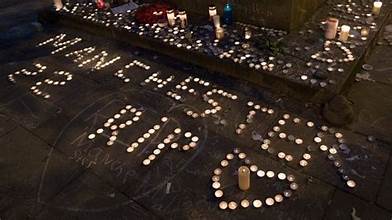
Memorial for people killed from jihadi bombing at Ariana Grande concert

The two confrontational axis are linked by Iran. A NATO established to be a defense against Russia and communism must adapt to the new reality that the Russia-China-Iran alliance is buttressing jihadi regimes and terrorist groups to destabilize the west.

NATO, as currently structured, is positioned to respond to effects—naval patrols, sanctions, diplomatic signaling—but lacks a formal mechanism to integrate with the actor most deeply engaged in countering the source.

Israel is not a peripheral partner. It is a central node of capability.

Its missile defense systems operate under continuous pressure. Its counter-drone technologies are refined in live environments. Its intelligence capabilities integrate multiple theaters into a single operational picture. Its cyber operations are embedded directly into conflict environments that NATO is still working to fully integrate.

This is a partner NATO needs.

Geography reinforces the argument. NATO’s traditional focus on its eastern flank remains essential, particularly in relation to Russia. But the critical infrastructure of modern security—energy routes, maritime corridors, and digital networks—runs through the Eastern Mediterranean, the Red Sea, and the Gulf. Stability in these regions is now directly tied to European and transatlantic security.

Israel sits at that intersection with capability, proximity, and alignment.

At the same time, pressures within the alliance itself are becoming more visible. U.S. political leaders—most notably Donald Trump—have underscored a structural imbalance: the United States continues to underwrite a disproportionate share of European defense while facing expanding global demands. That pressure reflects a broader need for NATO to adapt—both in burden sharing and in how it structures partnerships to address evolving threats.

Parallel to this, U.S. policy has begun to shift in the Middle East. Efforts to draw regional actors, including emerging leadership in Syria, away from Russian influence and toward Western engagement signal a changing geopolitical landscape. The region is no longer peripheral to transatlantic security. It is central to it.

Against that backdrop, integrating Israel into NATO’s partnership structure is not an isolated step. It is part of a broader realignment responding to the growing influence of Russia and Iran across multiple theaters.

This does not mean that Israel should join NATO as a full member with Article 5 protections. This proposal refers to formal integration within NATO’s Enhanced Opportunities Partner framework. It does not create automatic military obligations, nor does it commit NATO forces to regional conflicts.

It creates structure where there is currently fragmentation.

NATO should take three immediate steps.

  • First, designate Israel as an Enhanced Opportunities Partner, formalizing its integration into NATO planning, intelligence, and interoperability frameworks.
  • Second, establish a standing NATO–Israel coordination mechanism focused on counter-drone warfare, missile defense, cyber operations, and maritime security.
  • Third, integrate Israel into NATO’s southern and maritime operational planning, particularly in relation to the Eastern Mediterranean, Red Sea, and Gulf energy corridors.

These steps would not expand NATO’s defense obligations. They would enhance its operational effectiveness.

Wars clarify.

This one has clarified that European security is shaped by forces operating far beyond its borders and that the countries are not up to the task of dealing with their own security needs. That terrorism, energy coercion, and hybrid warfare now form a single continuum. That regional boundaries no longer define strategic risk.

And that Israel is already operating at the center of that reality.

NATO was built to defend the system. It now needs to include those already defending it.

The Shadow Of Trump’s Ukraine On The Middle East

The two major wars grabbing world attention for the past couple of years has been Russia-Ukraine and Iranian Proxies led by Gaza-Israel. While Russia invaded Ukraine and the two have largely faced off with Russia maintaining about 20% of Ukraine, Gazans invaded Israel and got decimated.

President Trump’s recent interaction with Ukrainian President Zelenskyy this week has made some in the pro-Israel community nervous. If Trump will side with the aggressor (Russia), will he also back Gazans and Iran against Israel?

Devolution of exchange starts at 40:00, when Zelenskyy challenges ability to have diplomacy with Russia which does not abide by agreements

I believe that it is a misreading of Trump’s policy of America First.

Trump likes winners. Winners have the strength and position to negotiate deals, whereas losers ask for handouts. If Russia is declared the winner in the midst of the war and able to annex large chunks of Ukraine, the United States will negotiate important mineral deals with Russia rather than with Ukraine.

Gaza has nothing to offer America other than real estate. The region is in shambles and will require billions of dollars to redevelop. The political-terrorist group Hamas still rules the strip and Gazans have proven themselves morally bankrupt in supporting the massacre of innocent people in Israel. Why would Trump want to engage with the initiators of a war which they completely lost? His inclination would be to side with the Israeli victors who have a thriving liberal society and economy with leading technology to trade with the United States.

President Trump just approved nearly $3 billion in arms sales to Israel to help replenish its arsenal over the multi-front war with Iran, Lebanon, Syria, Yemen, Gaza and the West Bank. Those arms should help neuter various terrorist groups and position the United States to negotiate an end to Iran’s nuclear weapons program.

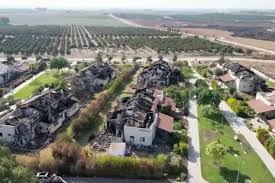
Kibbutz Be’eri burned by Gazan invaders during massacre on October 7, 2023

People think such action is based on short-term thinking but it is about long-term planning. If the parties in conflict have assets and relationships which the U.S. covets, it will engage with those in charge who can deliver. If they are the more moral and ethical as is the case for Israel, so much the better.

Jason Greenblatt, who worked for Donald Trump for decades in his real estate office before working in the first Trump administration developing a new roadmap to peace between Israel and its neighbors made clear that Zelenskyy butchered a chance to help Ukrainians by not understanding how Trump operates, tweeting “Whoever prepared President @ZelenskyyUa for the Oval Office meeting with @POTUS & @VP did an absolutely terrible job! Zelenskyy did not pay attention to the messaging that was coming out of @WhiteHouse for a while now. President Trump is interested in protecting interests 1st & foremost. That’s his job, no matter how people feel about Ukraine. He also wants to end the death & destruction in Ukraine if a logical deal can be made. Hard to believe how Zelenskyy let this devolve instead of taking the cues. What a shame for Ukraine.”

In 2017, during Trump’s first term, Palestinian Authority President Mahmoud Abbas failed to understand and capitalize on Trump’s efforts for Palestinian Arabs and let the relationship completely devolve. Abbas is trying to play catch up now by trying to arrest terrorists east of the 1949 Armistice Lines (E49AL / “West Bank”). It is unclear if that will be enough to impress the administration that has watched Israel be a strong partner.

Trump’s “America First” policy may sometimes run against the wronged party, as in Ukraine. In the Middle East, Americans will have comfort that Trump has an ally which is strong, moral, has much intellectual property to benefit Americans and deeply appreciates the relationship with the U.S.

Related articles:

First Time In History, People Under ‘Genocide’ Reject Ceasefire. Repeatedly. (December 2024)

Naked Trades in the Middle East (September 2020)

Israel, the Liberal Country of the Middle East (March 2015)

Lessons for Israel From Russia’s Invasion Of Ukraine

The pictures and stories coming out of Ukraine are horrible. The suffering of the people of Ukraine and the hands of Russian forces is hard to fathom – or is it?

Neighboring countries go to war all of the time. Before the invention of the airplane, it was basically the only way to wage war. Iran-Iraq was the typical format, not U.S.-Afghanistan. When Russia and the United States engaged in the “Cold War,” they mostly used adjacent proxy states.

Today, vulnerable countries at the edge of war are watching the Russian invasion in horror for the suffering of Ukrainian civilians, as well as for important lessons to be gleaned about their own situations.

Ethno-nationalism surpasses borders. Vladimir Putin of Russia claimed that Ukraine is not a valid country, as its people are actually Russian by identity, language and culture. Palestinian Arabs believe the same, as outlined in the opening of the Palestinian National Charter, “Palestine is the homeland of the Arab Palestinian people; it is an indivisible part of the Arab homeland, and the Palestinian people are an integral part of the Arab nation.” Russia does not believe it is invading a distinct foreign entity but bringing its own people back into the fold, much as the Arab countries surrounding Israel thought (and think) nothing of invading the sovereign State of Israel. Everyone should only use the term ‘Israeli Arabs’ and not ‘Palestinian Citizens of Israel’, as the latter serves the aim of invasion.

The pretext of preventing ‘genocide’ convinces hordes of morons to back warfare. Putin claimed that Russian-speakers in Ukraine were being slaughtered in a “genocide” and was therefore coming to their aid. Arabs – and increasingly “human rights organizations”, the liberal media and the United Nations – are falsely alleging that Israel is committing a “genocide” of Palestinian Arabs and engaging in “ethnic cleansing,” despite the plain facts that the number of Arabs in Israel has grown at a faster pace than Israeli Jews and Arabs in surrounding countries. The Russian propaganda to rally its people against Ukraine is much the same as the insidious jihad of anti-Zionists who are preparing to wage economic, psychological and military warfare against the Jewish State. The vile libel must be fought aggressively.

Concession of a small amount of land is an invitation for more. When Russia invaded Crimea and took over part of Ukraine, the world barely uttered a protest, pleased that the bloodshed was minimal. The larger problem was that a dangerous lesson had been taught that even Ukraine did not believe in the sanctity of its borders and Russia could claim more on the same grounds. While Israel handed over lands in the West Bank to the Palestinian Authority during the late 1990’s and then Gaza in 2005, as opposed to losing them in battle, the Palestinian Authority believes much like Russia that it should have more – whether the entirety of the West Bank or all of Israel.

A country cannot overly rely on security agreements and guarantees. In 1994, Ukraine signed the Budapest Moratorium – also executed by Russia, Britain, and the U.S. – in which Ukraine gave up its nuclear weapons in exchange for assurances of its territorial integrity. Not only did Russia not abide by the agreement in its invasion of Crimea, the U.S. and Britain did not come to the aid of Ukraine. Today, Israel may appreciate the statements from the United States that its commitments to the Jewish State’s security is “enduring and ironclad“, but Israel must fully plan and operate under the assumption it must be able to defend itself by itself.

Don’t have a capital city on the border. The Russian forces quickly penetrated deep into Ukrainian land early in the war. As the capital city of Kyiv is far from the border with Russia, the country has managed to survive the initial onslaught and continues to defend itself. Israel, a very small country surrounded by Arab Muslim countries, cannot allow its capital city of Jerusalem to sit on a border as well. Not only should the city never be divided again as it was for eighteen years 1949 to 1967, but Israel must secure many miles around the city as well.

Beware the Alter of Large Players. Russia’s size and clout are enabling it to get away with murder. As an enormous military and economic force, many countries are refusing to hold Russia to account. Israel is similarly surrounded by the vast Muslim Arab world, with much of it refusing to recognize its existence and some openly demanding Israel’s destruction. In that backdrop, Israel’s primary sponsor, the United States, is working with the Islamic Republic of Iran to maintain a semblance of a nuclear weapons program, even as Iran has threatened to destroy Israel. The situation threatens Israel existentially on one side and economically and psychologically on the other.

Democracies are vulnerable to war when abutting dictatorships. For many years, the western world convinced itself that wars were only for authoritarian regimes. Wars in Africa and the Middle East were considered alien matters between tribal warlords. Intellectuals convinced themselves that a free people with a functioning democracy would simply vote out corrupt or ineffectual leaders and would embrace peace as has existed in Europe since World War II. Lost in that arithmetic is when a democracy abuts a dictatorship, as is the case with Ukraine and Russia. As it is for Israel and all of its neighbors.

There are unfortunately many similarities between the Ukrainians suffering at the hands of its Russian neighbor since 1994 on the one hand, and Israel’s treatment by its Muslim and Arabs neighbors since the reestablishment of the Jewish State, on the other.

Related articles:

Israel and Wars

Netanyahu’s View of Obama: Trust and Consequences

Israel’s Peers and Neighbors

Ban Ki Moon Understands Why People Kill Israelis

On December 19, 2016, a Turkish policeman assassinated the Russian Ambassador to Turkey. The killer loudly proclaimed in front of rolling cameras that he did so because of the killings happening in Syria in the civil war that has claimed 500,000 lives. He called out the city of Aleppo, which was under siege by the Syrian Assad regime with the assistance of Russia.

russian-ambassador-killed

The murder of Russian diplomat Andrey Karlov in Ankara.
(Photo: REUTERS)

The United Nations outgoing Secretary General Ban Ki Moon condemned the assassination.  His comment implied that there was no basis for the attack.

“The Secretary-General is appalled by this senseless act of terror and emphasizes that there can be no justification for the targeting of diplomatic personnel and civilians.”

Did Ban Ki Moon not watch the video or read the transcript of why the murderer committed the act? Did he not appreciate Russia’s role in the massacre in Aleppo? Or did he feel that the murder of a Russian diplomat had nothing to do with alleviating the suffering of the Syrian people?

By way of comparison, consider how Ban Ki Moon discussed the Palestinian Arab terrorism against Israelis in 2014.  He said:

“We must address these underlying issues – including mutual recognition, occupation, despair and the denial of dignity — so people do not feel they have to resort to violence as a means of expressing their grievances.”

When it came to the murder of Israeli civilians, the UNSG seemed to sympathize with the Palestinian Arab murderers. He did not speak of “senseless acts of terror,” but of the “underlying issues” behind the attacks.  He did not say that there was “no justification” for the murder of innocents, but that the killings were a natural means of “expressing their grievances.”

As discussed in “The United Nations’ Adoption of Palestinians, Enables It to Only Find Fault With Israel,” the United Nations was established as a forum for countries to engage with each other. However, the UN actively advocates for the Palestinian Arabs, as it considers that the UN itself as the guardians of these stateless wards. As such, it views all attacks against Israeli civilians – including children – through a unique lens of empathy and support for the Palestinian Arab narrative.

While more Syrians have been killed in the year 2016 than the combined total of all Palestinian Arabs, Egyptians, Jordanians, Lebanese and Syrians in every war with Israel since 1948, the UN cannot comprehend the grievances of Syrians or why they might “resort to violence.”

While at the same time, no murder of Israelis can ever be “senseless” for the United Nations.


Related First.One.Through articles:

The Palestinians aren’t “Resorting to Violence”; They are Murdering and Waging War

Ban Ki Moon Has No Solidarity with Israel

Ban Ki Moon Stands with Gaza

The United Nation’s Ban Ki Moon is Unqualified to Discuss the Question of Palestine

Subscribe YouTube channel: FirstOneThrough

Join Facebook group: FirstOne Through  Israel Analysis