An Israeli construction company sees a government tender to build residential housing. It prepares a bid and submits it.
It does not have to win the tender or break ground. Merely submitting the bid would be enough to expose it to American sanctions.
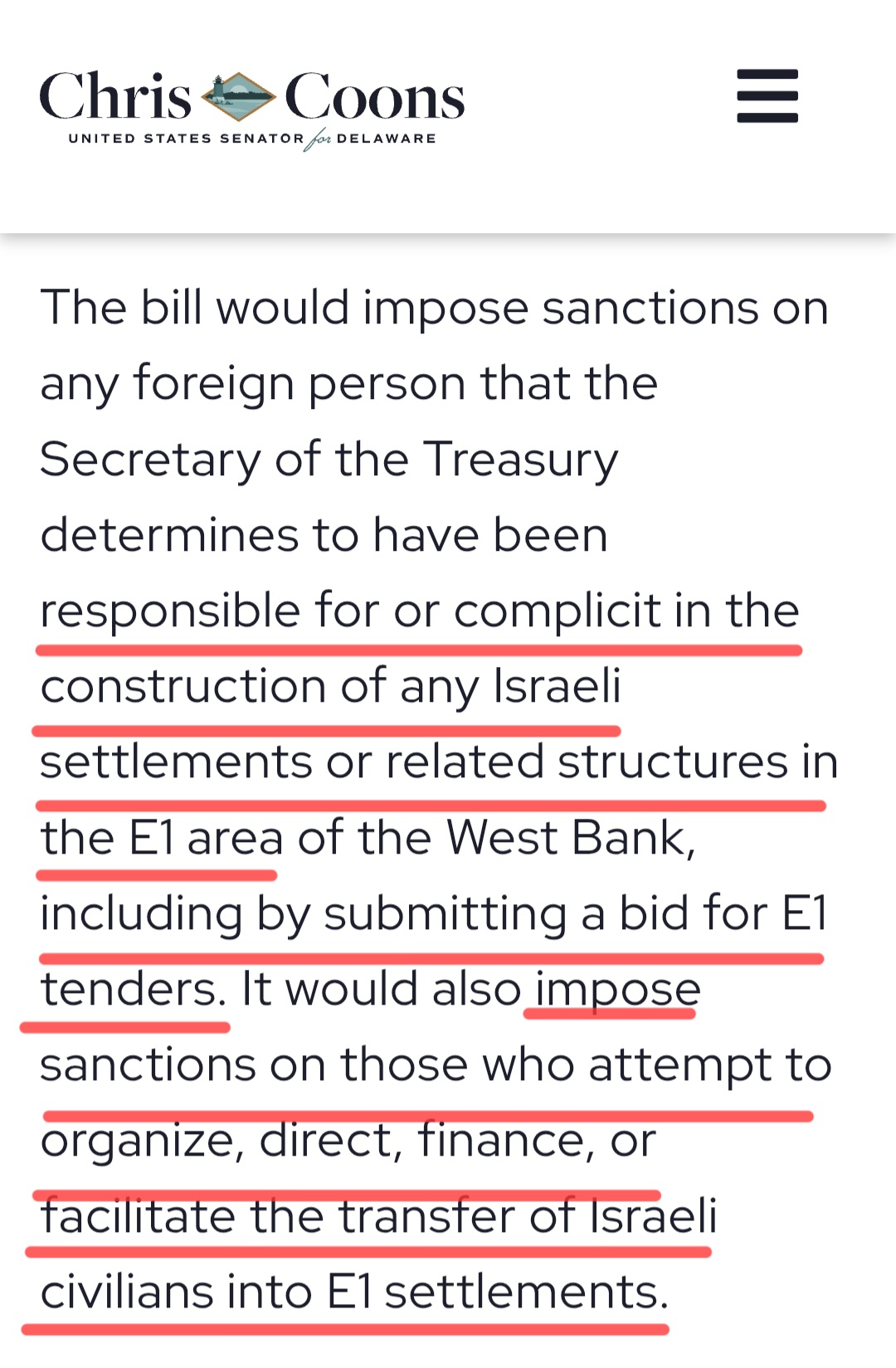
Senators Chris Coons (Delaware), Elizabeth Warren (Massachusetts), Ron Wyden (Oregon) and Ruben Gallego (Arizona) have introduced legislation targeting construction in E1, the area between Jerusalem and Ma’ale Adumim. The legislation would impose sanctions on foreign persons involved in construction there, expressly including those “submitting a bid for E1 tenders.”
Warren makes the consequence explicit: those who facilitate construction in E1 should understand that they “risk losing access to the U.S. financial system.”
That is an extraordinary penalty for bidding to build homes in an allied country.
And the piece of land that has generated this response is remarkably small. E1 covers roughly 12 square kilometers, or 4.6 square miles. The entire West Bank is roughly 5,655 square kilometers. E1 therefore represents about 0.2% of the West Bank—roughly one five-hundredth of its territory.
And that sliver of undeveloped land has generated calls to reach for one of America’s most powerful economic weapons.
The United States has long used its dominance of the international financial system as one of its most powerful foreign-policy tools. Iran has faced sanctions over its nuclear program and other activities. North Korea has been subjected to extensive sanctions over its nuclear and ballistic-missile programs. Russia has faced sweeping sanctions connected to its military aggression.
American sanctions can also reach companies outside those countries. Do business with an American adversary and a foreign company may discover that it has to choose between that relationship and access to the American financial system.
Congress has occasionally been willing to impose that choice on allies.
Turkey is a NATO member. Yet the United States sanctioned Turkey’s Presidency of Defense Industries after Ankara purchased Russia’s S-400 air-defense system from Rosoboronexport, Russia’s state arms exporter. The transaction involved an advanced weapons system, an American adversary and concerns about the security of American military technology.
European companies encountered the same American financial power over Nord Stream 2. Congress enacted sanctions aimed at companies participating in construction of the pipeline, including businesses from American allies, for engaging with a Russian pipeline carrying Russian gas into Europe. Congress viewed it as increasing European dependence on Russian energy and strengthening Moscow’s geopolitical leverage.
E1 presents something completely different.
There is no Russia on the other side of the transaction. No Iran. No North Korea. No weapons purchase or nuclear technology. No American adversary receiving the proceeds.
There is an Israeli government tender to construct residential homes in the immediate suburb of its capital.
Nor is this simply an initiative of four senators.
Fifteen additional Democratic senators have joined them: Michael Bennet (Colorado), Tammy Duckworth (Illinois), Martin Heinrich (New Mexico), Tim Kaine (Virginia), Mark Kelly (Arizona), Andy Kim (New Jersey), Jeff Merkley (Oregon), Chris Murphy (Connecticut), Patty Murray (Washington), Jack Reed (Rhode Island), Brian Schatz (Hawaii), Adam Schiff (California), Elissa Slotkin (Michigan), Chris Van Hollen (Maryland) and Peter Welch (Vermont).
That brings the proposal’s Democratic Senate support to 19 senators.
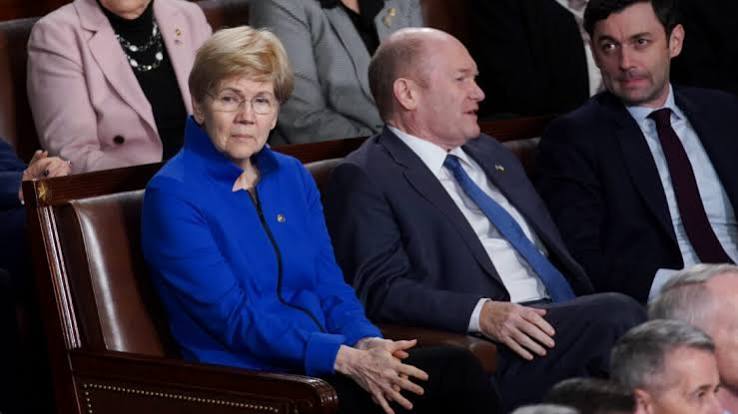
Senators Elizabeth Warren and Chris Coons
The United States developed financial sanctions to confront hostile states, weapons programs and transactions with American adversaries. It is a powerful tool meant to confront grave risks to America. Yet in this proposal, the triggering transaction is an Israeli housing project occupying roughly one five-hundredth of the West Bank, which poses zero threat to the United States.
The Democratic senators sponsoring the legislation describe E1 construction as a threat to a future Palestinian state, presumably because the Palestinian Authority demands a country devoid of any Jews and it must include Jerusalem. Their proposed response is to make companies and individuals participating in that construction grounds for exclusion from the American financial system.
For these 19 Democratic senators, countering Palestinian Arab aspirations has become a threat to the United States.
That is the question their bill puts before Congress: Should the financial weapon America has used against adversaries and national-security threats now be turned against businesses of a close ally because they bid to build homes on 0.2% of the West Bank?
ACTION ITEM
Contact these senators about their proposed bill on E1 and find out whether the Democratic Party has become so unmoored from its mission of protecting Americans that it is using its greatest financial weapon to serve Palestinian Arabs objecting to Jewish homes.
Sen. Chris Coons Washington office (202) 224-5042, Wilmington (302) 573-6345, Dover (302) 736-5601
Sen. Elizabeth Warren Washington office (202) 224-4543, Boston (617) 565-3170, Springfield (413) 788-2690
The United States has maintained an official list of Foreign Terrorist Organizations since 1997. After September 11, that list increasingly became a catalogue of jihadist groups: al-Qaeda, al-Shabaab, Boko Haram, ISIS-K, ISIS-West Africa, JNIM, Hizbul Mujahideen, the Islamic Jihad Union and the Haqqani Network.
By George W. Bush’s second term, every organization he designated that remains on the list today was Islamist. Roughly 91% of Barack Obama’s first-term additions were Islamist, as were nearly all of his second-term additions. Every surviving FTO designated during Donald Trump’s first term was Islamist.
Then the designations nearly stopped.
Joe Biden added just four organizations that remain designated today, all during 2021: two ISIS affiliates in Africa and two Colombian FARC splinter groups.
Trump returned to office and immediately took the list somewhere else. On his first day back, he initiated a process to designate international cartels and transnational criminal organizations as FTOs. A month later, the Sinaloa Cartel, Jalisco New Generation Cartel, Gulf Cartel, Cartel del Noreste, La Nueva Familia Michoacana, Carteles Unidos, MS-13 and Tren de Aragua were added.
The terrorist list was heading south of the border.
Administration
Current FTOs originally designated during term
Islamist
Islamist share
Clinton II
15
7
47%
George W. Bush I
12
8
67%
George W. Bush II
3
3
100%
Obama I
11
10
91%
Obama II
12
11–12
92–100%
Trump I
10
10
100%
Biden
4
2
50%
Trump II*
25
3
12%
*Through September 2026. Counts reflect organizations currently designated as FTOs and assign each to the presidential term of its original designation. Organizations subsequently removed from the list are excluded.
The numbers reveal two abrupt breaks. Biden’s four years produced only four surviving additions, all during his first year. Trump II has already produced 25 – more than Obama over two full terms – while the Islamist share has collapsed from 100% during Trump’s first term to 12% during his second.
The explanation lies partly 2,000 miles south of Washington, DC.
The Biden years brought close to an open border policy for America’s southern border. Behind the millions of encounters stood another problem: criminal organizations controlling routes north, smuggling people and narcotics, collecting payments and using violence to protect their territory and businesses.
Trump returned treating that infrastructure as a national-security threat.
His January 20, 2025 order described cartels as using assassination, terror and brute force to control illegal traffic across the southern border. That same day, he declared a national emergency there and directed the government to target cartels, foreign gangs, smugglers and trafficking networks.
“It is the policy of the United States to ensure the total elimination of these organizations’ presence in the United States and their ability to threaten the territory, safety, and security of the United States through their extraterritorial command-and-control structures, thereby protecting the American people and the territorial integrity of the United States.” – President Trump order on making cartels specially designated terrorist organizations
A month later, eight of them were FTOs.
That sequence helps explain one of the stranger contradictions surrounding Trump. He is frequently portrayed as a president whose terrorism policies are particularly focused on Muslims, yet his second administration has directed the FTO machinery overwhelmingly toward non-Islamist organizations in Latin America and elsewhere.
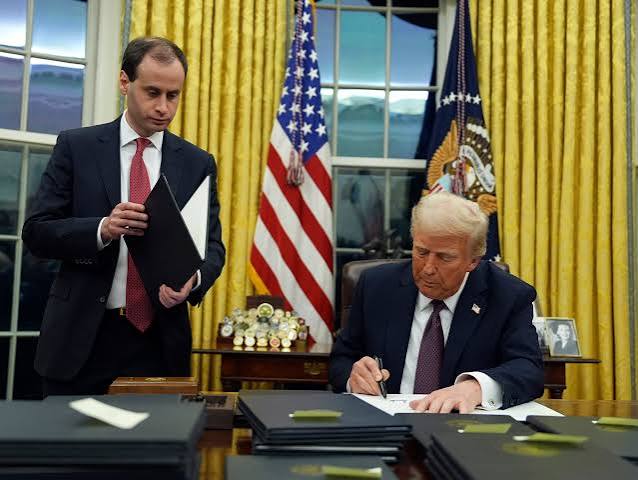
President Donald Trump signs order making drug cartels in Latin America FTOs
The geography of American counterterrorism has moved.
After September 11, Washington looked thousands of miles east for foreign organizations threatening Americans. But the border crisis forced attention south, where cartels and gangs profit from the movement of people, drugs and money toward the United States.
For years, the border debate concentrated on the person arriving: who should enter, who qualifies for asylum and who should be removed. Trump’s FTO policy moves the focus farther upstream, toward the organizations controlling the routes that bring them there.
After September 11, America built an enormous counterterrorism apparatus to pursue foreign organizations threatening Americans from the other side of the world.
Trump is increasingly turning that apparatus toward the ones operating on America’s doorstep.
Two events separated by three months in 2021 delivered the same message to Islamist movements confronting more powerful enemies:
Keep fighting. Keep waiting. Eventually the infidels leave.
The first came in Israel.
In May 2021, Hamas launched rockets toward Jerusalem and Israeli cities, casting itself as the defender of Al-Aqsa and Palestinian Arab families facing possible eviction in Sheikh Jarrah.
Eleven days later came a ceasefire and the Israelis never moved forward with the evictions.
Immediately after the fight, the Palestinian Center for Policy and Survey Research’s June 2021 poll described a “paradigm shift” toward Hamas and armed struggle. 77% of Palestinian Arabs believed Hamas had won, versus 1% who thought Israel had won. And 65% believed Hamas had achieved its declared objectives regarding Sheikh Jarrah and Al-Aqsa.
The perceived lesson was simple: Violence worked.
Then came Afghanistan a few months later.
On August 15, 2021, the Taliban returned to Kabul, twenty years after the United States had removed it from power. The lesson for jihadist movements was not that they needed to defeat a stronger enemy. They needed to outlast it.
As described at the time in Gaza, The Terrorist Enclave, Hamas met with the Taliban and congratulated it for expelling Western forces from Afghanistan.
By June 2023, Palestinian confidence had moved beyond believing Hamas could win a confrontation. PCPSR asked Palestinian Arabs whether Israel, then celebrating its 75th anniversary, would survive to celebrate its 100th. 66% said no. Only 27% believed Israel would still exist. Another 51% believed Palestinian Arabs would eventually recover historic Palestine and return refugees to their former villages and cities.
Just four months later came October 7.
Nearly three years of war have weakened that opinion – in the near-term. As FirstOneThrough detailed in Palestinian Arabs Turn Inward, But Not Away From Hamas, support for armed struggle has fallen sharply and only 20% of Palestinian Arabs now believe Hamas won the Gaza war but 89% believe Hamas will continue to exist in some capacity.
Weakened but waiting. “Resistance” with resolve.
Which brings the argument from the Taliban and Hamas to the Islamic Republic of Iran.
Iran is making the same wager on time. That it can outlast the United States and send it packing much as the Taliban did in Afghanistan.
But for the United States, Iran is not Afghanistan.
Iran has called America the “Great Satan” since 1979 and built a regional military network directed against American forces and allies. Iran has developed increasingly long-range ballistic missiles and pursued nuclear weapons capabilities that could threaten far beyond its borders.
Afghanistan did neither.
Iran also sits on the Strait of Hormuz, through which roughly one-fifth of the world’s petroleum consumption passes. Disruption there reaches energy markets and economies around the world.
Afghanistan had no comparable leverage over the global economy.
America had no long-term goals of staying in Afghanistan. It was not going to keep thousands of troops and pour billions of dollars in a region thousands of miles from its shores to make sure girls went to school and women had equal rights.
But Iran is a real concern for the entire western world, both militarily and economically.
The current U.S. war has already achieved important aims by severely degrading Iran’s nuclear, missile and proxy capabilities. But degraded is not finished.
Iran does not need to reverse its losses today. It only needs to survive long enough for politics to change.
And two elections are approaching. Israelis vote on October 27 and Americans vote in November 3.
For Iran, Hamas and the broader jihadist world, those are more than elections. They are milestones testing the strategy of patience.
While the strategic logic for Israel and U.S. to continue the fight may be sound, their citizens may vote differently. And that is what the jihadists are waiting to observe.
Israel cannot leave Israel. America cannot simply walk away from an Iran threatening its forces and allies, pursuing nuclear and long-range missile capabilities, and holding a critical artery of the global economy at risk.
But jihadist strategy places a different bet: Can they wait until Israelis and Americans vote to stop fighting?
The summer of 2021 taught Islamists that they don’t have to win the wars against more powerful foes. Iran has ten more weeks to stall negotiations and wait for democracies to decide whether to pursue long-term strategic benefits or move on to more immediate matters.
Democracies have elections. Their enemies know it.
Will Israelis and Americans turn their elections into the jihadists’ exit strategy.
Data centers have become one of America’s favorite environmental villains. Critics argue that they use too much land, consume too much water and strain the electric grid. Communities increasingly fight proposed facilities on environmental grounds.
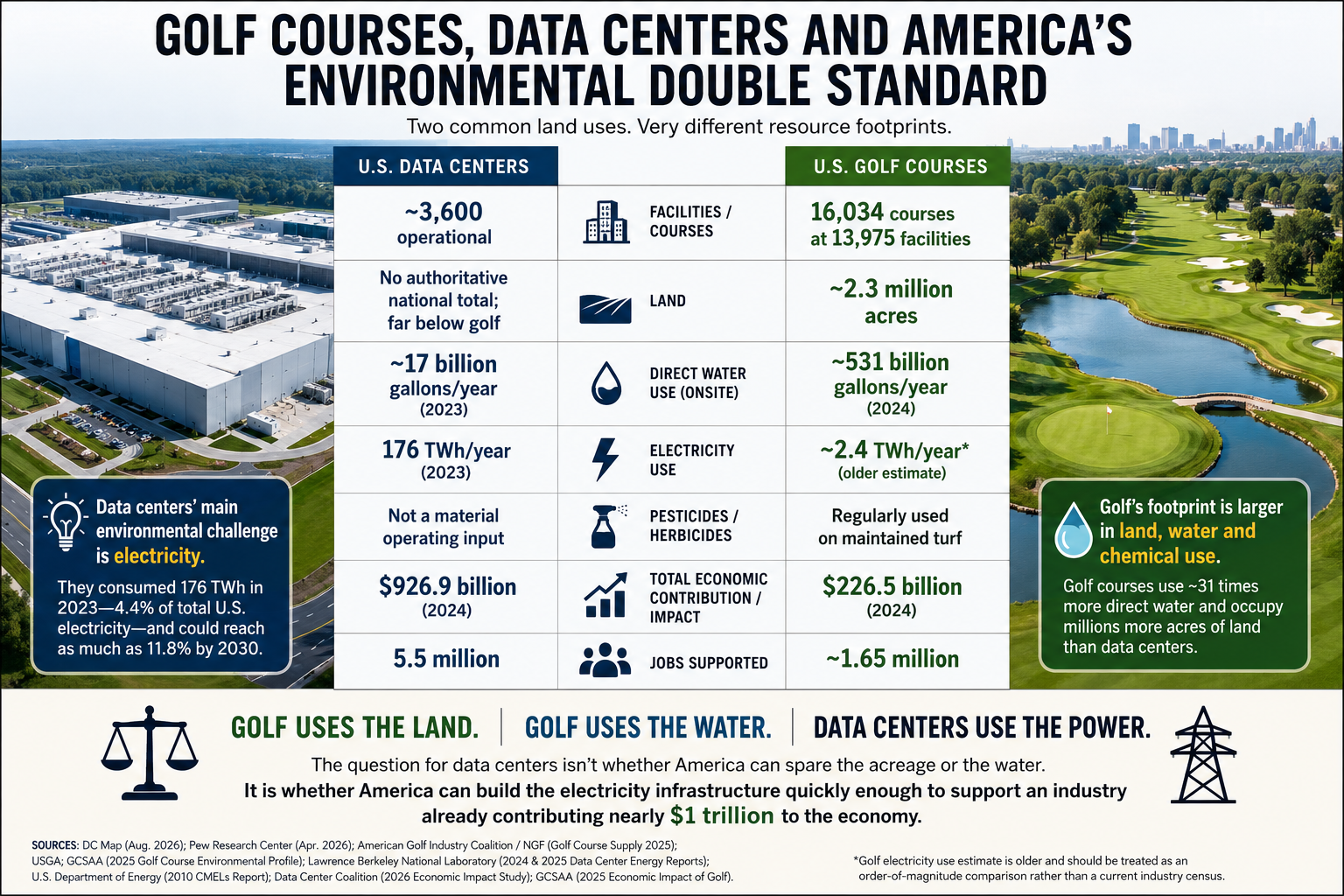
The concerns over electricity are real. But put data centers alongside another ubiquitous American land use — golf courses — and the environmental picture looks very different.
Golf uses dramatically more land and direct water and requires harmful pesticides to maintain its turf. Data centers consume dramatically more electricity. And data centers produce roughly four times the overall economic impact already – before the upcoming artificial intelligence boom kicks in.
Metric
U.S. Data Centers
U.S. Golf Courses
Facilities / courses
~3,600 operational
16,034 courses at 13,975 facilities
Land
No authoritative national total; far below golf
~2.3 million acres
Direct water use
~17 billion gallons/year (2023)
~531 billion gallons/year (2024)
Electricity
176 TWh/year (2023)
~2.4 TWh/year*
Pesticides / herbicides
Not material
Regularly used on maintained turf
Total economic contribution / impact
$926.9 billion (2024)
$226.5 billion
Jobs supported
5.5 million
~1.65 million
*The national golf electricity estimate is older and should be treated as an order-of-magnitude comparison rather than a current industry census.
Start with volume. There is no universally accepted definition of a data center, so counts vary depending on whether campuses, buildings and individual facilities are counted separately. An August 2026 tracker identifies about 3,579 operational U.S. data centers and roughly 4,700 when facilities under construction and planned are included. Pew Research Center similarly reported in April that the country had more than 3,000 operational data centers. (DC Map) Golf is considerably more widespread. The latest National Golf Foundation figures count 16,034 courses at 13,975 facilities in the United States. (American Golf Industry Coalition)
Then there is land.
The USGA has estimated that American golf courses occupy nearly 2.3 million acres. (USGA) There is no similarly authoritative national accounting of the acreage occupied by data centers. Rather than manufacture precision from commercial databases, the relevant comparison is scale: America’s golf footprint runs into millions of acres, while several thousand data centers occupy a small fraction of that amount.
Water produces an even more startling comparison.
American golf facilities applied 1.63 million acre-feet of water in 2024, according to the latest Golf Course Environmental Profile survey. That equals approximately 531 billion gallons. To golf’s credit, that represents a 31% decline since 2005 as courses have closed and surviving facilities have become more efficient. (GCSAA)
Lawrence Berkeley National Laboratory estimated that U.S. data centers directly consumed approximately 66 billion liters of water in 2023, or roughly 17 billion gallons. (Lawrence Berkeley National Laboratory) So American golf courses use roughly 31 times as much water as data centers directly consume onsite.
Data centers also have an indirect water footprint because generating electricity can consume substantial amounts of water. Golf similarly has indirect resource requirements associated with electricity, fertilizer, chemicals, equipment and maintenance. The 31-to-1 comparison is specifically between water applied at golf facilities and direct water consumed at data centers — not their respective total lifecycle water footprints.
Chemicals produce another imbalance, although one that cannot responsibly be reduced to a current national poundage figure.
Golf courses maintain enormous areas of highly managed turf using fungicides, herbicides, insecticides and other treatments. GCSAA’s national pest-management research confirms continued use of those conventional chemicals while also finding greater use of non-pesticide practices and reductions or little change in reliance on conventional chemistries between its major surveys. (GCSAA)
Data centers, by contrast, do not require herbicides, fungicides and insecticides as a significant part of their core operation. They may have ordinary landscaping needs, but chemicals are not to computing what turf treatment is to golf.
There is one environmental measure where the comparison flips completely: electricity.
Lawrence Berkeley National Laboratory estimated that U.S. data centers consumed 176 terawatt-hours of electricity in 2023, approximately 4.4% of total U.S. electricity consumption. Its June 2026 update projects that data centers could reach 11.8% of U.S. electricity consumption by 2030, with scenarios ranging from 9.5% to 15.3%. (Lawrence Berkeley National Laboratory)
Golf isn’t remotely comparable. A U.S. Department of Energy analysis estimated golf-course electricity consumption at approximately 2.4 TWh annually, with a typical course consuming about 250,000 to 500,000 kWh and irrigation pumping accounting for 25% to 50% of course electricity use. The estimate is old, so it should not be mistaken for a current measurement. But even substantial growth would leave golf far below the electricity requirements of data centers. (U.S. Department of Energy)
Data centers are power infrastructure in a way golf courses simply are not. But power is being converted into something: economic output.
A 2026 PwC study commissioned by the Data Center Coalition calculated that the U.S. data-center industry contributed $926.9 billion to GDP in 2024, supported 5.5 million jobs and generated $204.4 billion in federal, state and local taxes. (Data Center Coalition)
Golf is also a significant American industry. Its national economic-impact study calculated $101.7 billion in direct economic activity and $226.5 billion when direct, indirect and induced effects are included, supporting nearly 1.65 million jobs and $80.1 billion of wage income. (GCSAA)
America has decided that using millions of acres and hundreds of billions of gallons of water for recreation is ordinary, while communities increasingly treat far smaller amounts of land and direct water used for digital infrastructure as an environmental crisis.
That doesn’t make data centers environmentally harmless. It identifies the environmental challenge they actually present: Power.
Data centers consumed 176 TWh in 2023 and could approach 12% of America’s electricity consumption by 2030. That growth demands generation, transmission and grid investment on an extraordinary scale.
The country should scrutinize where that electricity will come from, who pays for the infrastructure required to deliver it and whether utilities can add generation quickly enough without shifting costs onto existing customers.
Golf uses the land. Golf uses the water. Data centers use the power.
The question for data centers isn’t whether America can spare the acreage or the water. It is whether America can build the electricity infrastructure quickly enough to support an industry already contributing nearly $1 trillion to the economy and will drive the innovation and jobs of the future.
Congress did not arrive at legislation protecting Hamas overnight. It arrived there one bill at a time.
For decades, debates over Israel revolved around diplomacy. Republicans and Democrats argued over settlements, negotiations, Jerusalem, and the contours of a future Palestinian state. Even lawmakers sharply critical of Israel generally framed their proposals around advancing a negotiated two-state solution. The disagreement was over how peace should be achieved, not whether Israel had the right to defend itself against terrorist organizations.
In 2020, as the Trump Administration unveiled its peace plan and Israel considered extending sovereignty to portions of the West Bank, progressive lawmakers introduced legislation preventing American assistance from supporting annexation. Whether one believed annexation was prudent or unwise, the objective remained fundamentally political. These bills sought to influence the outcome of negotiations and preserve the possibility of a future Palestinian state. The debate was about borders, diplomacy, and competing visions for peace.
That bill did not stand in isolation.
In 2019, Representative Betty McCollum (D-MN) also introduced legislation prohibiting U.S. assistance from supporting the military detention of Palestinian minors. On its face, the proposal carried moral appeal. No civilized society wants children caught in war, and few slogans resonate more powerfully than protecting minors.
Yet the legislation missed the point. Israel’s military justice system does not prosecute minors because they are children. It prosecutes minors accused of security offenses, including violent rioting, firebomb attacks, shootings, stabbings, and participation in terrorist organizations. Hamas, Palestinian Islamic Jihad, and the Popular Front for the Liberation of Palestine have all recruited teenagers into violent activity for decades.
Arab minors caught on camera right before they stab Israelis
The debate was no longer centered on where Israel’s borders should ultimately lie. It was becoming a debate over whether Congress should restrict Israel’s ability to prosecute those participating in terrorism.
That evolution became unmistakable after October 7.
The largest massacre of Jews since the Holocaust might reasonably have been expected to produce overwhelming congressional support for dismantling Hamas. Instead, it accelerated an entirely different legislative movement.
Arabs in Gaza take the body of Israeli woman they had just killed into Gaza where the crowds pelted her body and spat on her
One proposal after another sought to block the military tools Israel argued were necessary to fight the war. Senator Bernie Sanders (D-VT) repeatedly forced votes to halt major arms sales. Representative Rashida Tlaib (D-MI), Representative Pramila Jayapal (D-WA), Representative Delia Ramirez (D-IL), and others introduced the Block the Bombs Act. Senator Chris Van Hollen (D-MD) sought to impose additional legal restrictions before military assistance could proceed.
US Senator Chris Van Hollen attends a Senate subcommittee on the Justice Departments proposed 2027 budget, on Capitol Hill in Washington, May 19, 2026.
Supporters presented these bills as humanitarian safeguards designed to protect civilians and uphold international law. Their practical effect, however, would have been to deny or delay weapons while Israel was engaged in combat against a U.S.-designated terrorist organization that had murdered, raped, tortured, kidnapped, and burned civilians alive.
Congress was no longer principally debating the contours of a future peace agreement. It was debating how much of Israel’s wartime capability should be withheld while the war itself was still being fought.
And it continued.
In July 2026, Representative Thomas Massie (R-KY) introduced an amendment eliminating the entire $3.3 billion annual Foreign Military Financing package for Israel. Previous proposals had sought to condition aid or block particular weapons systems. Massie’s proposal went much further. It would have ended America’s regular military assistance altogether.
The amendment failed by a wide margin. But 104 members of Congress voted for it, including 103 Democrats alongside the bill’s Republican author.
That vote tells a larger story than the amendment itself.
Over the course of a few years, the legislative progression moved from opposing territorial annexation, to restricting Israeli counterterrorism practices, to limiting the weapons available to fight Hamas, and finally to questioning whether the United States should continue military assistance at all. Each bill built upon the political space created by the one before it. What once occupied the outer edge of congressional debate gradually became part of mainstream legislative discussion.
The coalition itself is unusual. Rashida Tlaib approaches the issue through Palestinian nationalism. Bernie Sanders emphasizes humanitarian law and civilian casualties. Chris Van Hollen argues for greater legal oversight of military assistance. Thomas Massie opposes foreign aid as a matter of constitutional principle. They arrive from very different ideological traditions, yet increasingly find themselves casting the same vote.
For generations, support for Israel was one of Washington’s few enduring bipartisan constants. That consensus has not disappeared; overwhelming majorities in Congress still support the alliance. But the terms of the debate have unmistakably changed.
Six years ago, Congress debated how American policy might influence a two-state solution. Today, members openly introduce legislation that would limit—or eliminate altogether—the military support Israel says it needs to defeat jihadist organizations committed not to coexistence, but to its destruction.
That is the real story of the Jihadi Protection Bills. Not that any single measure became law. But that, one bill at a time, the center of the American political conversation migrated from shaping the peace process to constraining Israel’s ability to wage war against jihadist movements to its basic ability to protect itself in a deeply hostile region.
For most of human history, people did not belong to countries. They belonged to tribes.
Family came first. Then clan. Then religion. Then ethnicity. Your protection did not come from an impartial government but from the people who shared your blood and your history.
The modern nation-state asked humanity to do something profoundly unnatural. It asked millions of strangers to trust one another more than they trusted their tribe.
That may be civilization’s greatest political achievement.
Political scientist Francis Fukuyama has argued that human beings are naturally wired for tribalism. The genius of the modern state was not that it erased those instincts, but that it redirected them. Loyalty shifted from clan to constitution, from ancestry to citizenship, from family name to the rule of law.
No nation embodied that experiment more successfully than the United States.
America was never united by blood. It became a nation because generation after generation chose to believe that citizenship mattered more than ancestry. Irish immigrants, Jewish refugees, engineers from India, scientists from Taiwan, and millions of others came from different histories but increasingly shared one future.
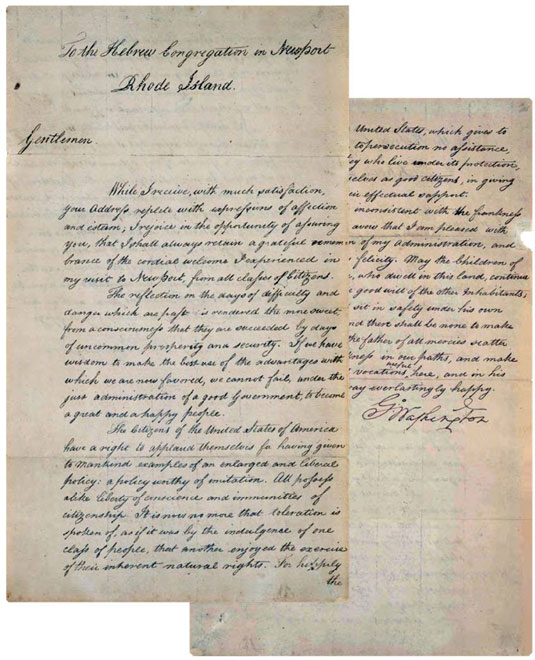
“The Citizens of the United States of America have a right to applaud themselves for having given to mankind examples of an enlarged and liberal policy: a policy worthy of imitation. All possess alike liberty of conscience and immunities of citizenship. It is now no more that toleration is spoken of, as if it was by the indulgence of one class of people, that another enjoyed the exercise of their inherent natural rights. For happily the Government of the United States, which gives to bigotry no sanction, to persecution no assistance requires only that they who live under its protection should demean themselves as good citizens, in giving it on all occasions their effectual support.” – George Washington’s letter to the synagogue in Newport, RI in 1790
George Washington’s letter to the synagogue in Newport, RI in 1790
America never eliminated tribes. It simply made being American more important than belonging to one.
But that civic bargain rested on something deeper than patriotism. It rested on hope.
America has never been a perfect nation. It never claimed to be.
Slavery contradicted its founding ideals. Women were denied the vote. Segregation mocked the promise of equal protection. Entire groups were excluded from opportunities others took for granted.
Yet what distinguished America was not the absence of injustice. It was the belief that injustice could be corrected.
The nation repeatedly expanded the circle of citizenship. Slavery was abolished. Constitutional amendments extended the franchise. The civil rights movement dismantled legalized segregation. Immigration laws evolved. Opportunity broadened. Each generation inherited an imperfect republic and, however incompletely, tried to leave it more just than it found it.
People can tolerate inequality longer than they can tolerate hopelessness. They can accept that today’s America is imperfect if they believe tomorrow’s America will offer greater opportunity for themselves and for their children.
For much of our history, that belief proved remarkably resilient. Yet today it is under strain.
The reason is not simply that inequality has grown. It is that many Americans increasingly question whether the civic bargain still works.
Over the past two decades, extraordinary wealth has accumulated among roughly the wealthiest one-tenth of one percent of American households—families whose wealth is roughly $50 million and more. Together they now control a remarkable share of the nation’s wealth, much of it held not in homes or factories but in ownership stakes in software companies, semiconductor firms, and cloud infrastructure.
The question for ordinary Americans is whether they believe they have a realistic chance of becoming tomorrow’s winners.
Yet much of the political debate on the left uses the moral vocabulary of the twentieth century to explain the economics of the twenty-first. Progressives point to slavery, segregation, redlining, and inherited privilege. They therefore demand reparations. But that’s the lexicon and proposals of a period past.
Today’s economy is not dominated by inherited railroad empires or industrial monopolies. It is dominated by technological innovation.
According to Forbes, roughly two-thirds of America’s 400 richest people built their fortunes themselves rather than inheriting them. Many of the largest fortunes were created within a single generation through software, semiconductors, venture capital, and artificial intelligence. America continues to produce extraordinary upward mobility. Immigrants account for roughly one in seven American billionaires, and more than nine in ten of those immigrant billionaires are self-made, many arriving from India, Israel, Taiwan, and China before building companies at the forefront of the technology revolution.
America is still the land of remarkable opportunity for all but it is predominantly happening inside an innovation economy that relatively few people understand—and even fewer know how to enter.
That distinction changes the political conversation. And it is magnified by the fear of artificial intelligence.
As the AI economy concentrates wealth, the identities of many of its most visible participants also become politically salient. Many of America’s leading technology founders, investors, and executives are white, Asian, or Jewish—groups often associated with educational and entrepreneurial success. That should be irrelevant in a civic republic. But in a society increasingly tempted by tribal politics, economic frustration is often translated into identity politics. The result is a dangerous feedback loop: the far left explains disparities through privilege and oppression, while the far right responds with conspiracy theories about ethnic or religious elites. Both abandon the American principle that citizens should be judged primarily as individuals rather than as members of competing tribes.
Alexandr Wang, 29, Chief AI Officer at Meta, worth an estimated $3.3 billion
And the concern is no longer merely that the rich will become richer. It is that AI will automate millions of middle-class jobs. Lawyers, accountants, software developers, analysts, designers, customer service representatives, and countless others increasingly wonder whether they are watching the economic ladder disappear beneath them. That is not just the rich getting richer and the poor getting poorer. It is everyone below the 0.1% – the entire lower, middle and upper middle class – becoming significantly poorer.
That anxiety helps explain proposals such as far-left Senator Bernie Sanders’ American AI Sovereign Wealth Fund Act. Sanders argues that because artificial intelligence is trained on humanity’s collective knowledge, the extraordinary wealth it creates should not belong solely to a handful of technology companies and investors. Whether one agrees with that proposal or not, it marks a profound shift. The political debate is moving beyond redistributing wealth after it is created, toward seizing and controlling the technologies that create the wealth in the first place.
Never has the U.S. government considered inserting itself so forcefully into the leading drivers of innovation, jobs and wealth, and pitted itself against those “elites” spearheading the effort.
On one side, the far-left is organizing around tribalism focused on race, gender, and “privilege,” which produces a counter-movement on the far-right around White nationalism. Both movements are inherently anti-American and undermine the founders’ ideals of a grand civic bargain. Each tells its followers that the other tribe is responsible for the country’s decline. Both play a part.
America fractures as both right and left move towards tribalism, and no longer trust the “establishment” political class, mainstream media and failing schools. Meanwhile, the real enormous promise and fear of the future for both groups is playing out in real-time before everyone: that AI will exacerbate the inability to trust people, information and institutions, while simultaneously creating a cohort of individuals – seemingly of only a few tribes – with remarkable wealth as the middle class loses its wealth.
If AI becomes a dominant technology that only a tiny club understands, owns, and profits from, the civic bargain weakens. Citizens begin searching for smaller communities that promise protection and belonging. Race becomes more important than citizenship. Class becomes more important than opportunity. Tribe becomes more important than country.
That is a future we can, should and must avoid.
America has solved this problem before. Every great technological revolution—from the steam engine to electricity to the internet—created extraordinary fortunes for its pioneers. Yet each ultimately generated industries, professions, suppliers, entrepreneurs, investors, educators, and workers whose prosperity far exceeded that of the original inventors. The wealth did not remain confined to those who built the breakthrough. It spread through the countless derivative businesses, careers, and opportunities that followed.
Artificial intelligence should be no different. America should not punish the innovators building the future or discourage the investment and risk-taking that made these breakthroughs possible. The challenge is to ensure that the AI economy develops the same broad ecosystem that previous technological revolutions produced—new companies, new professions, new skills, new services, new capital formation, and new pathways into prosperity for millions of Americans.
Just as importantly, we must prevent the far left and the far right from hijacking this technological revolution for their own political ends. The left should resist reducing innovation to a story of privilege and oppression, while the right should resist turning successful innovators into symbols of ethnic or cultural conspiracy. Both narratives encourage Americans to see AI through the lens of tribe rather than citizenship, resentment rather than opportunity.
For 250 years, Americans repeatedly chose the civic bargain over tribalism because they believed each generation would inherit greater opportunity than the last. Artificial intelligence now puts that bargain to the test. The defining question of the AI age is not whether America can continue producing extraordinary innovators. It is whether the prosperity they create becomes the foundation for millions of new success stories.
The American experiment has never depended on preventing greatness. It has depended on ensuring that greatness inspires opportunity rather than resentment, and that every generation believes it still has a place in the nation’s future. If AI expands opportunity as dramatically as previous technological revolutions ultimately did, it will strengthen the civic bargain that has made America history’s most successful multiethnic republic.
America’s next century can be truly remarkable, if we avoid the partisan pitfalls that plague us.
When Iran offered condolences after the death of former Qatari emir Sheikh Hamad bin Khalifa Al Thani, the gesture appeared incongruous. Iran had recently been firing missiles and drones at Qatar and across the Gulf. So why the words of consolation?
Iran was not primarily attacking Qatar as a Muslim or Arab society. It was targeting the American military presence on Qatari soil. The same pattern has extended across the region: U.S. facilities and assets in Qatar, Bahrain, Kuwait and Jordan, as well as American positions in Iraq and Syria, have come under Iranian attack. Recent strikes included an early-warning installation in Qatar, Patriot systems in Kuwait, a U.S. fuel depot in Bahrain and military facilities in Jordan.
That reveals the real fault line in the Middle East.
It is not simply Sunni against Shia, Arab against Persian or even Muslim country against Muslim country. It is increasingly a divide over how to handle the United States: between governments and movements determined to expel American power and those that invite it in and then seek to shape it.
Iran represents the first model. Since 1979, its hostility has been explicit. It calls America the enemy, demands the removal of U.S. forces and uses missiles, drones and proxies against American military positions. Its war is visible. It announces its contempt and fires at the flag.
Qatar perfected a more nuanced model.
Under Sheikh Hamad, Qatar financed and expanded Al Udeid Air Base, which became central to U.S. operations in Afghanistan, Iraq and across the region. At the same time, Doha built influence inside the United States, financing American university campuses, purchased entry into American television distribution, invested in think tanks and businesses, hired lobbyists and cultivated political relationships. It also hosted anti-Western terrorist groups including Hamas leaders and Muslim Brotherhood figures, and used Al Jazeera to broadcast narratives often deeply hostile to the West and its allies.
Iran attacks American power from the outside. Qatar embraces it corrodes it from within.
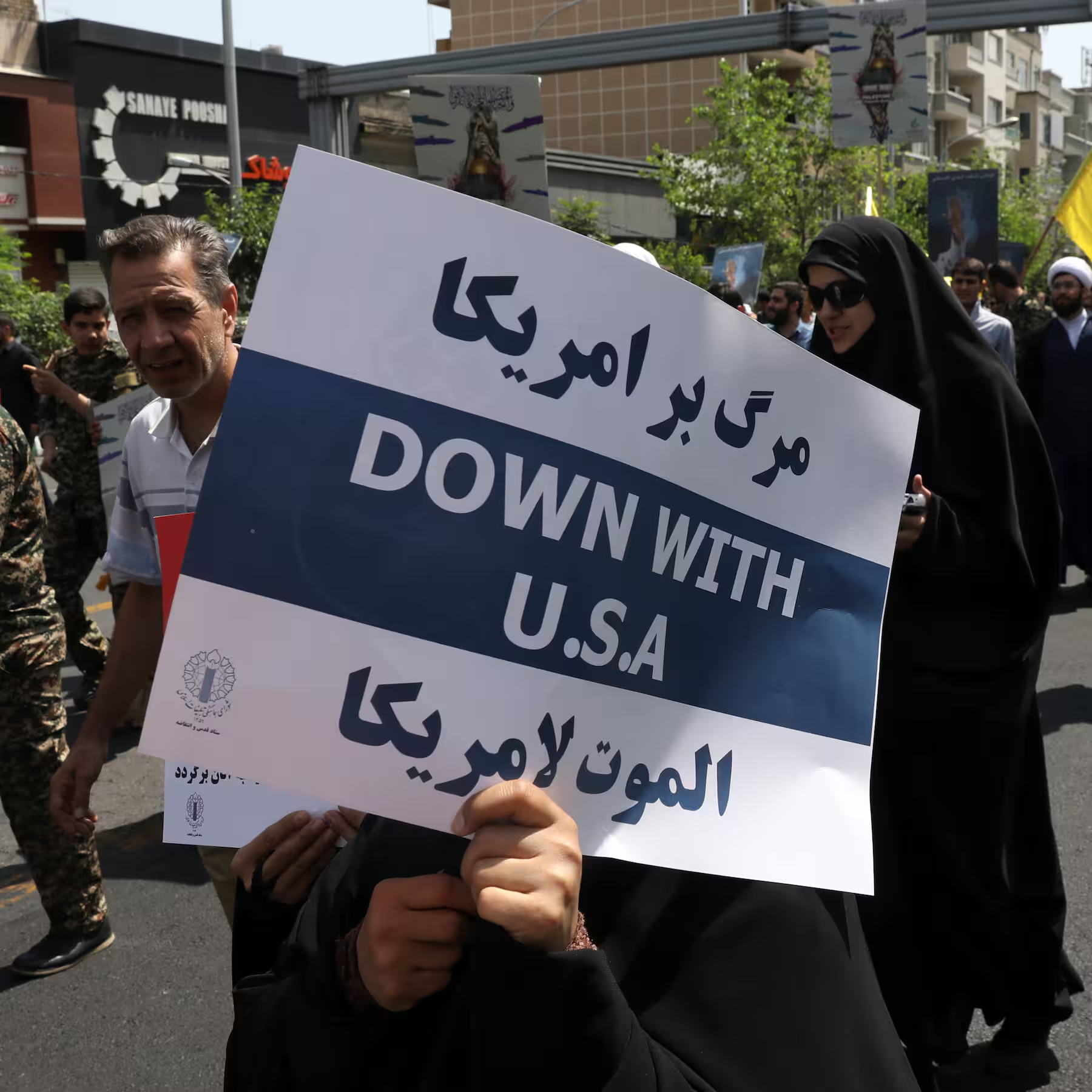
anti-American Iranians
Iran seeks direct confrontation; Qatar seeks leverage.Iran’s weapons are missiles and militias. Qatar’s are money, access, prestige and indispensability.
The West is naturally more alarmed by Iran’s model. And Qatar’s model is harder to confront because it arrives as partnership.
The military base protects American interests. The university campus carries a prestigious name. The investment creates jobs. Each relationship is defensible in isolation. Together, however, they create influence on a scale no tiny monarchy could achieve through military power alone.
The broader contest is therefore not between countries that love America and countries that hate it. Iran and Qatar represent different tactics of genocidal jihadists. One strategy attacks the fortress. The other purchases rooms inside it.
Iran’s war is louder. Qatar’s may prove more insidious and enduring.
Sometimes, sudden death is simply that. But conspiracy theories rarely leave a vacuum unfilled.
The first kind of conspiracy theory follows ordinary logic. It begins with motive.
If someone believes Lindsey Graham was murdered, the obvious suspects would be the governments whose interests he spent years opposing: Russia or Iran, or some combined efforts by both. Perhaps it was an American anti-war agitator. Whether true or false, at least the theory follows a recognizable chain of reasoning.
The second kind works very differently.
It begins with a worldview that history is shaped by hidden forces operating behind governments and public events. Facts are gathered afterward to support that assumption.
For centuries, one of the most enduring versions of that worldview has been antisemitic: the claim that Jews secretly manipulate governments, wars, finance, or the media. The alleged hidden actor changes with the era, but the underlying story remains remarkably consistent.
Antisemites from Nazi Germany to Rep. Rashida Tlaib (D-MI) talk about Jews operating in the shadows
That helps explain why some recent conspiracy theories about the murder of Charlie Kirk have implicated Israel or Mossad where the alleged motive is counterintuitive. The target is chosen less because of the evidence than because it fits an existing narrative about hidden power.
One conspiracy theory asks, “Who had the motive?” The other asks, “Who do I already believe secretly runs the world?”
The first can be tested against evidence, the second is designed to survive it.
Today’s front pages will convey that a strong advocate of American allies’ defense against common American foes has died. He will be mourned by conservatives in the United States and supporters of Ukraine and Israel. In the not too distant future in our crazy conspiratorial-laden present, new distinct strains of headlines are likely to emerge.
The debate over American support for Ukraine and Israel has largely focused on the cost. Politicians argue over billions of dollars appropriated, weapons transferred, and whether American taxpayers are carrying too much of the burden. Far less attention has been paid to the return on that investment.
Since 2022, the United States has authorized roughly $195 billion related to Ukraine and approximately $16–22 billion in supplemental wartime assistance for Israel. Critics see enormous expenditures. Strategically, however, those dollars have enabled two allies to inflict historic damage on two of America’s principal adversaries – Russia and Iran – without the United States deploying large combat formations or suffering the thousands of battlefield casualties that defined Vietnam, Iraq, and Afghanistan.
That comparison matters.
The wars in Iraq and Afghanistan cost the United States more than $5 trillion in direct and related costs, with broader post-9/11 war obligations rising above $8 trillion when future veteran care, interest, and long-term commitments are included. Nearly 7,000 American service members were killed. More than 52,000 were wounded.
And what was the lasting strategic benefit?
Afghanistan ended with the Taliban back in power. Iraq removed Saddam Hussein, but the aftermath empowered Iran, fractured the region, drained American credibility, and produced years of instability. The United States paid in terrible blood and treasure, and the final balance sheet is hard to defend.
Ukraine and Israel present a very different model.
Consider Russia.
More than four years after launching its invasion of Ukraine, Russia has suffered an estimated1.4 million military casualties, including approximately 450,000 dead. Its armored forces have been severely depleted. The Black Sea Fleet has largely been driven from its historic operating areas. Ukraine has repeatedly demonstrated the ability to strike deep inside Russian territory. The military once regarded as NATO’s greatest conventional threat has been dramatically weakened.
“The number of Russian casualties and fatalities are astonishing. Since World War II, no major power has suffered anywhere near these numbers of casualties or fatalities in any war…. Russia’s economy is in distress, and Russia’s wartime spending may be increasingly untenable.” – Center for Strategic and International Studies July 2026
Now consider Iran.
For four decades the leading state sponsor of terrorism invested billions of dollars constructing what it proudly called the “Axis of Resistance” – a network stretching from Iran through Iraq and Syria to Lebanon and Gaza. Hamas, Hezbollah, Shiite militias, the Houthis, and the Assad regime were components of a single strategy designed to project Iranian power, surround Israel and challenge American influence in the region and threaten much of the global oil supply.
That strategy has suffered a tremendous setback.
Hamas has lost much of its military and infrastructure. Hezbollah has absorbed devastating blows to its command structure and missile capabilities. The Assad regime in Syria – Tehran’s indispensable Arab ally and the geographic bridge connecting Iran to Hezbollah – has fallen, shattering the land corridor that Iran spent decades building. The regional network that once appeared to surround Israel and terrorize America’s Arab allies now is dramatically weakened.
Iran’s nuclear ambitions have suffered major setbacks as well. Israeli and American strikes severely damaged key nuclear facilities, disrupted important elements of Iran’s enrichment infrastructure, and forced Tehran to devote enormous resources simply to rebuilding capabilities it once assumed were secure. Intelligence agencies continue to debate precisely how long the program has been delayed, but there is broad agreement that it suffered one of the most significant setbacks in its history.
None of this diminishes the immense human suffering. Ukraine has endured staggering casualties and destruction. Israel suffered the deadliest attack in its history on October 7 and has paid a heavy military, economic, and emotional price ever since.
But viewed through an American lens of grand strategy, another reality emerges.
Rather than sending hundreds of thousands of American troops to fight Russia or Iran directly as was done in Afghanistan and Iraq, the United States enabled allies already under attack to defend themselves. Those allies have imposed extraordinary military and strategic costs on governments that have spent decades challenging American interests.
This is what is so often missing from the public debate.
The wars are typically discussed separately. Ukraine is presented as a European conflict while Israel is portrayed as a Middle Eastern conflict. Yet both Russia and Iran were strategic partners, cooperating militarily, economically, and diplomatically while sharing an interest in weakening the United States and the Western alliance. Seen together, Ukraine and Israel have not merely been fighting for their own survival, they have been successfully degrading two pillars of a powerful anti-Western axis.
The long-term upside could be enormous. A surviving, Western-aligned Ukraine would become one of Europe’s most battle-tested militaries, a major reconstruction market, an energy and agricultural partner, and a permanent barrier to Russian expansion. A stronger Israel, with Iran weakened and Syria and Lebanon no longer functioning as Tehran’s strategic bridge, could help reshape the Middle East around technology, defense cooperation, energy corridors, trade, and normalization with Arab states that increasingly fear Iran more than they resent Israel.
That is the opportunity Iraq and Afghanistan never produced. Those wars consumed American power and America left no assets behind. These wars, fought by allies, may extend American power with powerful allies at the vanguard.
History may conclude that this period represents one of the most effective uses of American alliance power in generations. For roughly $215 billion – less than one-twentieth of the direct and related cost of Iraq and Afghanistan – the United States helped enable allies to severely weaken Russia’s conventional military, fracture Iran’s regional proxy empire, remove Syria and Lebanon from Tehran’s sphere of influence, and significantly set back Iran’s nuclear program, all without committing large American ground forces or sustaining the massive battlefield casualties that characterized previous generations of U.S. warfare.
America’s greatest military victory in the past 75 years may ultimately be its most subtle.
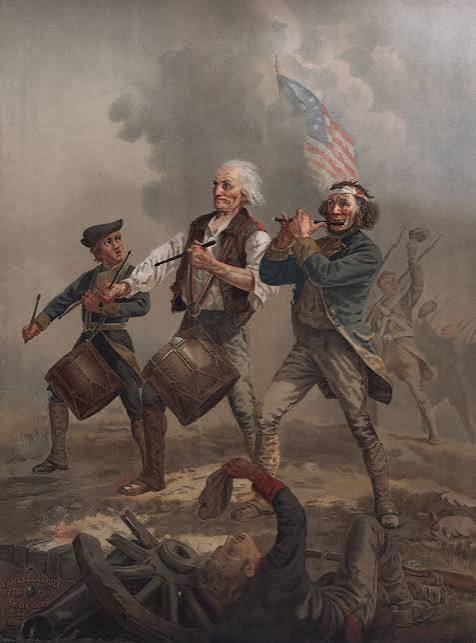
One of the most enduring images of the American Revolution is not a musket fired at Lexington or a cannon at Yorktown. It is a flag.
“Spirit of ’76” by Archibald Willard, 1875
In paintings celebrating the American Revolution, men advance carrying banners while drummer boys beat the cadence beside them. Often these figures are unarmed or lightly armed. To a modern observer, this seems irrational. Why would an army send men into battle carrying flags and drums instead of rifles?
Because they were not there to fight but to remind others why the fight mattered.
The flag represented the regiment, the cause, and the emerging nation. The drum provided rhythm and cohesion amid the chaos of battle. Neither was a weapon. Yet both were indispensable.
While tools like weapons help achieve an objective, symbols give meaning to the objective.
The Declaration of Independence was not a weapon. Neither was the America flag. Yet without them, the American Revolution would have been little more than a military rebellion. The cause and symbols transformed a collection of armed colonists into a people united by a common purpose.
The same lesson appeared thousands of years earlier in the Torah.
Moses’ staff began as an ordinary shepherd’s stick. In Egypt it became a symbol of divine authority. It was present during the plagues, at the splitting of the sea, and throughout Israel’s journey in the wilderness.
Similarly, during the battle against Amalek, Moses stood on a hill overlooking the fighting. When he raised his hands, Israel prevailed.
The rabbis famously ask whether Moses’ hands actually won the battle. Of course not. Joshua and the soldiers were the actual fighters. Like the flag carried by a Revolutionary soldier, the Moses’ raised arms pointed upwards. It reminded the warriors that victory depended not only on military strength but on the faith that united them.
Moses’ arms raised during fight with Amalek
Unfortunately, Moses later forgot the important distinction between symbol and tool. In Numbers 20, God instructs Moses to speak to a rock to make it produce water but instead Moses used the staff to hit the rock.
“And the LORD spake unto Moses, saying, Take the tent and gather the congregation together, you and Aaron your brother, and speak to the rock before their eyes, and give them water from it,… And Moses lifted up his hand, and smote the rock with his rod, and there came out abundant water,… And the LORD said unto Moses and unto Aaron, Because ye believed me not, to sanctify me in the sight of the children of Israel, therefore ye shall not bring this congregation into the land which I have given them.”
Had Moses held the staff and spoken to the rock, it would have been clear that Moses was acting as an agent of God. However, by using the staff to hit the rock, the appearance to the congregation was that Moses produced the water through his physical actions. The important symbol was converted into a mere tool.
That temptation remains with every generation.
Today, neither America nor Israel doubts the superiority of its weapons. The United States and Israel possess military capabilities far beyond those of the jihadist movements that seek their destruction.
But this war is not only about weapons and short-term military victory.
The jihadists understand the power of symbols. They flew their flags over burned civilian homes and corpses of families. Their propaganda celebrates martyrdom of their own people. Their movements are built around vile narratives and identity.
So the engagement with the enemies must be beyond tools and include symbols.
The challenge facing America as it approaches its 250th birthday, and Israel as it continues its long war against jihadist movements sworn to its destruction, is not merely maintaining military superiority. It is ensuring that the superiority of their cause is just as visible.
For Israel, that means rebuilding the communities of the Gaza Envelope, returning families to their homes, raising the flag over places terrorists tried to erase, and celebrating Jewish life where jihadists sought death.
For America, it means reclaiming the language of the Declaration of Independence, speaking unapologetically about liberty and human rights, and using international forums not merely to condemn violence in general but to condemn noxious jihadist violence specifically.
The free world must repeatedly denounce genocidal jihadists like Hamas and Hezbollah and pass resolutions that celebrate democracy, defend religious freedom, and affirm the dignity of every human being.
The current fight matters more than military victory. It requires weapons, and also a proud display of enduring Jewish and Democratic values.
Tools win battles. Symbols sustain civilizations. They are both distinct and required at pivotal moments like today.