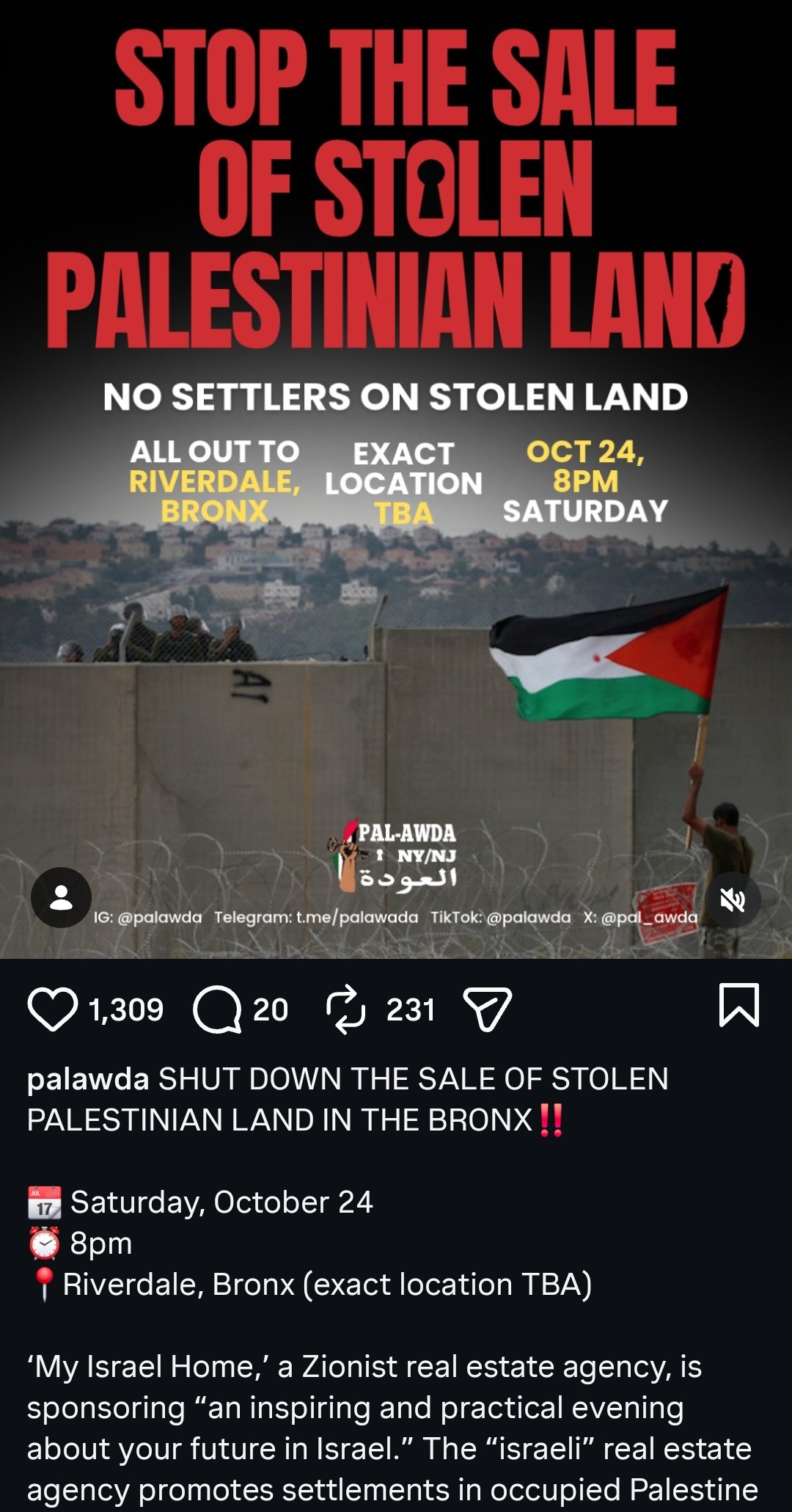
Pal-Awda is organizing a protest in Riverdale, Bronx, on October 24 to stop what it calls the sale of “stolen Palestinian land.” Its target is a Jewish real estate event organized by My Israel Home.
The accusation is enormous. The evidence is missing.
The protesters identify no stolen property, no dispossessed owner, no fraudulent deed and no evidence that anyone offering a home for sale acquired it unlawfully. They simply declare the land stolen and demand that the sale be stopped.
And what exactly makes a privately owned home “Palestinian land”?
There has never been an independent sovereign country called Palestine. Even if there had been, that would establish nothing about ownership of a particular house.
Imagine a homeowner in Dallas selling a house to someone from Los Angeles. Protesters descend on the transaction, shouting, “Stop the sale of stolen Dallas land!”
Stolen from whom? The homeowner? The city? Everyone who ever lived in Dallas?
Dallas describes an actual place. It does not own every home within its boundaries. A homeowner can sell to another person, regardless of where the buyer was born or lives.
The same is true in Judea and Samaria. Land owned by an Arab is the property of that owner, just as land owned by a Jew is the property of that owner. Lawful ownership can change hands. A property’s location or the ethnicity of its former owner establishes neither permanent ownership nor theft.
Pal-Awda previously celebrated forcing a Jewish gathering out of Queens. It targeted an event at a synagogue in Manhattan. Now it is targeting Riverdale, seeking to stop Jewish families from gathering to consider buying homes in Israel.
“It is our duty to make them think twice before holding these events. We need to make them scared! We need to make them scared! We need to make them scared.” – people at PAL-Awda protest in front of a synagogue event helping Jews move to Israel in November 2025
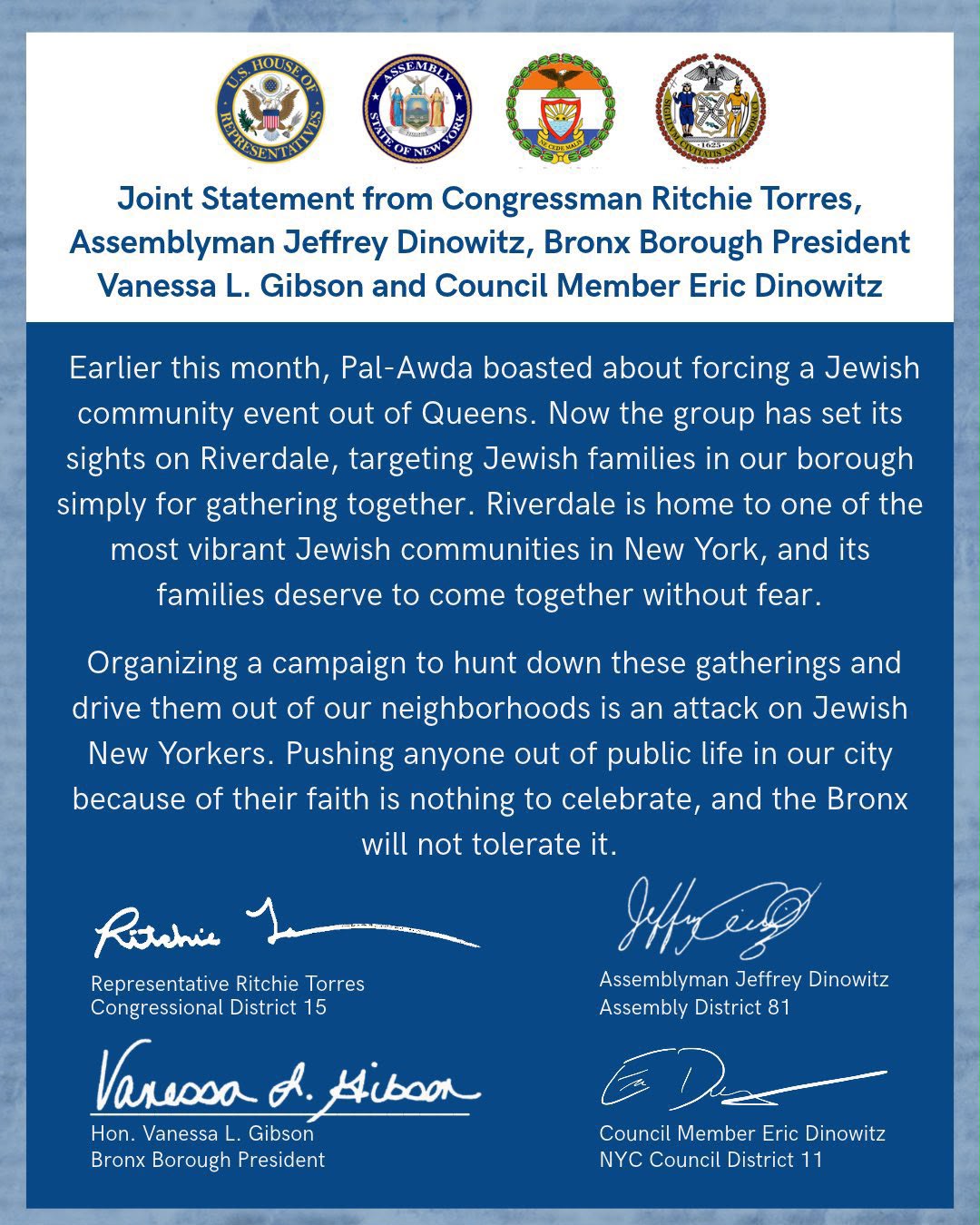
Congressman Ritchie Torres, Assemblyman Jeffrey Dinowitz, Bronx Borough President Vanessa Gibson and Council Member Eric Dinowitz condemned the campaign in a joint statement, calling it “an attack on Jewish New Yorkers” and declaring that “the Bronx will not tolerate it.”
The campaign has a documented pattern: targeting Jewish real estate gatherings, pressuring venues and celebrating when Jewish events are driven out of New York City. And this is in regards to ALL of Israel, as Pal-Awda has condemned all Jews making aliyah regardless of where they intend to live.
“Settler, settler, go back home, Palestine is ours alone!” – PAL-Awda’s Instagram
The protesters have identified no stolen home. But they have identified their target: Jews.
Simply allowing the event to take place is an inadequate response. The entire Riverdale community – Jewish and non-Jewish alike – should stand together in visible opposition to those who gather to harass and intimidate Jewish homebuyers. Elected officials who condemn antisemitism in statements should stand alongside the people being targeted.
Antisemites should never be allowed to decide where Jews can gather, where they can buy homes or whether they can live openly as Jews. Riverdale should make that unmistakably clear.
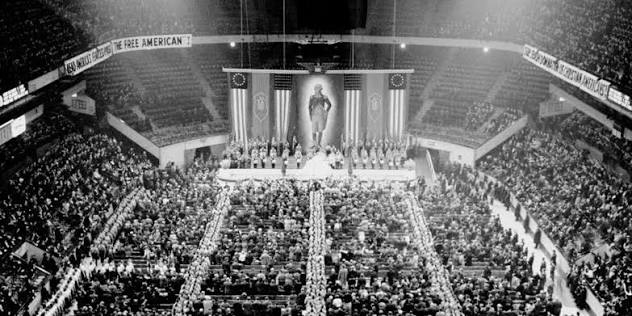
On February 20, 1939, more than 20,000 Americans packed Madison Square Garden beneath enormous swastikas, American flags and a portrait of George Washington. The German American Bund called its rally “Free America,” while its leader, Fritz Kuhn (1896–1951), promoted Nazi ideology, denounced Jewish influence and envisioned a radically different American society.
The crowd looked admiringly toward Hitler’s Germany, but its ambitions were directed toward America.
Crowd at Madison Square Garden allied with Nazi Germany, February 1939
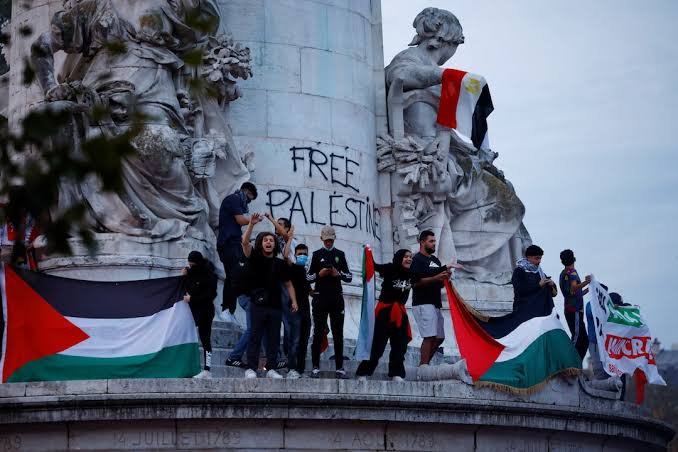
On October 17, 2026, France erupted in demonstrations over living costs, public services and economic inequality. Rioters burned vehicles, looted businesses and attacked public buildings. In Paris, protesters climbed the monument to Marianne, symbol of the French Republic, and raised the French tricolor alongside a Palestinian flag.
The grievances were French. The revolutionary symbolism was international.
A Palestinian flag at a demonstration about Gaza represents a foreign cause. At a demonstration about French economic policy, it suggests something more: a foreign struggle adopted as a symbol of domestic upheaval.
Across different eras and ideologies, foreign struggles have supplied the symbols for movements seeking to remake their own countries.
A Generation Looking for a Different Future
Revolutionary politics becomes attractive when people lose faith in their institutions and their prospects for a better life.
The Great Depression shattered economic security for millions of Americans. The German American Bund exploited the resulting insecurity, offering national renewal, authoritarian certainty and enemies to blame for the country’s troubles.
Nearly a century later, Bernie Sanders’s 2016 campaign mobilized younger Americans disillusioned with an establishment they believed protected wealthy donors and political insiders. Revelations about Democratic National Committee favoritism toward Hillary Clinton reinforced those suspicions, while subsequent political upheaval deepened distrust of established leadership.
COVID disrupted education and livelihoods, inflation and housing costs eroded economic opportunity, and artificial intelligence raised fears about the future of employment. The concealment of Biden’s decline and Harris’s selection without a new nationwide primary reinforced perceptions of political decisions controlled by insiders. Harvard’s 2026 Youth Poll found that only 15% of young Americans trusted the federal government.
For people who believe established institutions protect the wealthy and powerful while their own opportunities diminish, promises to redistribute wealth, ownership and political authority become increasingly attractive. That dissatisfaction is producing electoral victories.
The Revolution Enters City Hall
The Democratic Socialists of America have translated economic frustration into electoral power, most visibly through Zohran Mamdani’s 2025 election as mayor of New York City.
Celebrating his victory, the DSA described a defeat for billionaires, corporations and the Democratic Party establishment. Its agenda connected housing, public transportation, childcare, policing and for some bizarre non-local reason, “Palestinian liberation,” within a campaign for what the organization explicitly called a “political revolution.”
The DSA advocates public ownership of major industries, higher taxes on wealth, stronger tenant protections and a larger government role in housing and essential services. These proposals would change who owns economic resources, who makes investment decisions and how much authority government exercises over everyday life.
The movement also reaches younger Americans through influential online broadcasters. Hasan Piker, one of the most prominent socialist commentators on the internet, combines criticism of American capitalism with outspoken support for Palestinian Arab violence. He promoted Mamdani’s successful mayoral campaign, hosted him on his livestream and appeared at campaign events. In April 2026, Piker extended his electoral involvement to Michigan, campaigning alongside Abdul El-Sayed in his U.S. Senate race.
Anti-Israel influencers of the alt-left Mehdi Hasan, Hasan Piker and Jamaal Bowman celebrate Zohran Mandani’s victory for NYC mayor in November 2025
The revolution has an economic program, a political organization, influential broadcasters and elected officials. It also has a flag.
Why Palestine Became the Revolutionary Symbol
Palestine offers a ready-made narrative for movements organized around the struggle between privilege and liberation. The popular revolutionary image casts wealthy, technologically advanced, Western-backed White Israelis against poorer, brown Palestinians fighting dispossession. That imagery translates readily into American arguments about racial inequality, colonialism, policing and economic power.
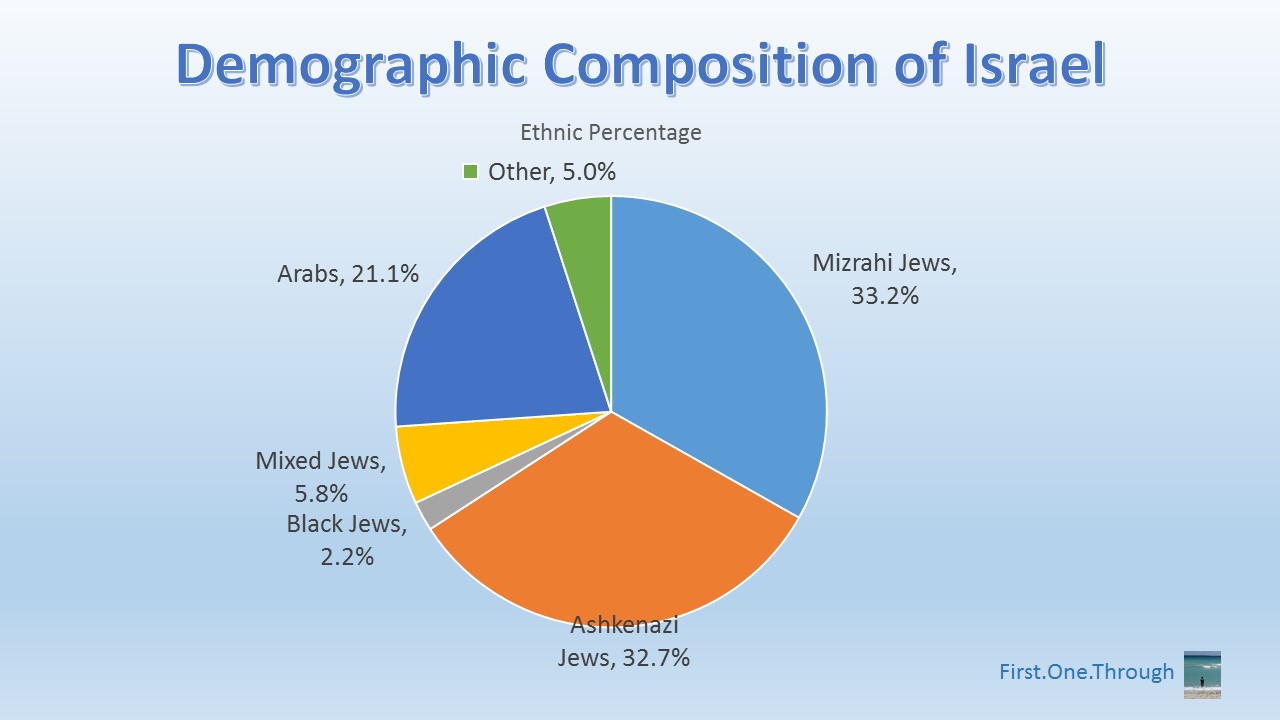
The narrative fictionalizes history and present. Jews are indigenous to Israel, and its “white” Ashkenazi population is less than one-third of the Israeli population. But Israel’s prosperity makes the image of privileged rulers and dispossessed subjects politically compelling.
Representative Rashida Tlaib and former Ohio state senator Nina Turner made the domestic connection explicit in their 2024 essay Black Liberation and Palestinian Liberation Are Interconnected, linking Detroit, Cleveland and Gaza through a common struggle against injustice. Others have done the same like CNN’s Marc Lamont Hill back in 2015.
The anti-Israel organization Within Our Lifetime has combined “Globalize the Intifada” with slogans including “Land Back,” “Kill Capitalism” and “Defund the Police.” The vocabulary connects Palestinian nationalism with American disputes over property, policing and political authority.
On October 8, 2023, one day after Hamas massacred Israeli civilians, demonstrators gathered beneath Palestinian flags in Times Square. A speaker mocked the victims of the Nova music festival, while protesters chanted slogans including “Resistance is justified” and “Globalize the intifada.”
The latter slogan called for extending a Palestinian Arab slaughter beyond its original geography, invoking a violent history which included suicide bombings and attacks on civilians.
Across Western democracies, Palestine has become more than a foreign policy cause for many revolutionary activists. It offers a common identity for movements seeking substantial changes to established economic and political institutions.
Canary Mission video on the socialist-jihadi alliance coming for the United States
The Old Accusation Returns
Every revolutionary narrative needs an explanation for why some people possess wealth and power while others struggle. When that explanation turns into a search for a privileged group supposedly responsible for everyone else’s suffering, an ancient accusation becomes available: Jews control the system.
The German American Bund accused Jews of exercising illegitimate influence over American finance, politics and public opinion. Father Charles Coughlin (1891–1979) brought similar conspiracies into millions of American homes through radio, presenting Jewish power as an explanation for the economic suffering of ordinary Americans.
The accusation survives across otherwise opposing political camps. On the far right, Nick Fuentes promotes conspiracies about Jewish control of American institutions. In entertainment, Ye has accused Jewish executives of controlling and exploiting Black performers. In a different context, American Federation of Teachers president Randi Weingarten described American Jews in 2021 as part of the “ownership class,” arguing that Jews were keeping minorities down.
The danger intensifies when the language of liberation is used to excuse violence against people assigned to the category of oppressor.
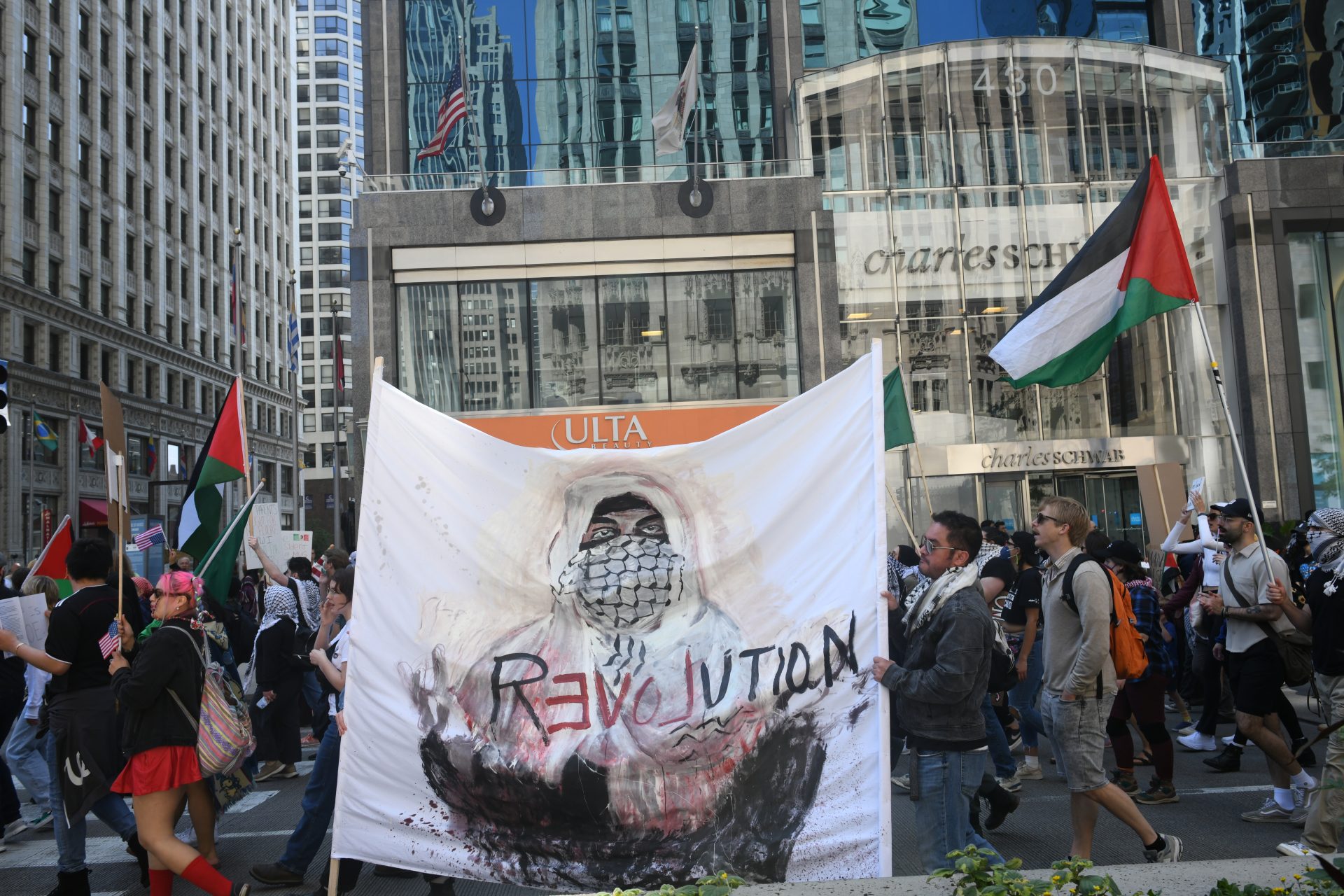
“No Kings Rally and March” in Chicago on June 14, 2025 featured Palestinian flags and call for “Revolution” (Photo by The TRiiBE)
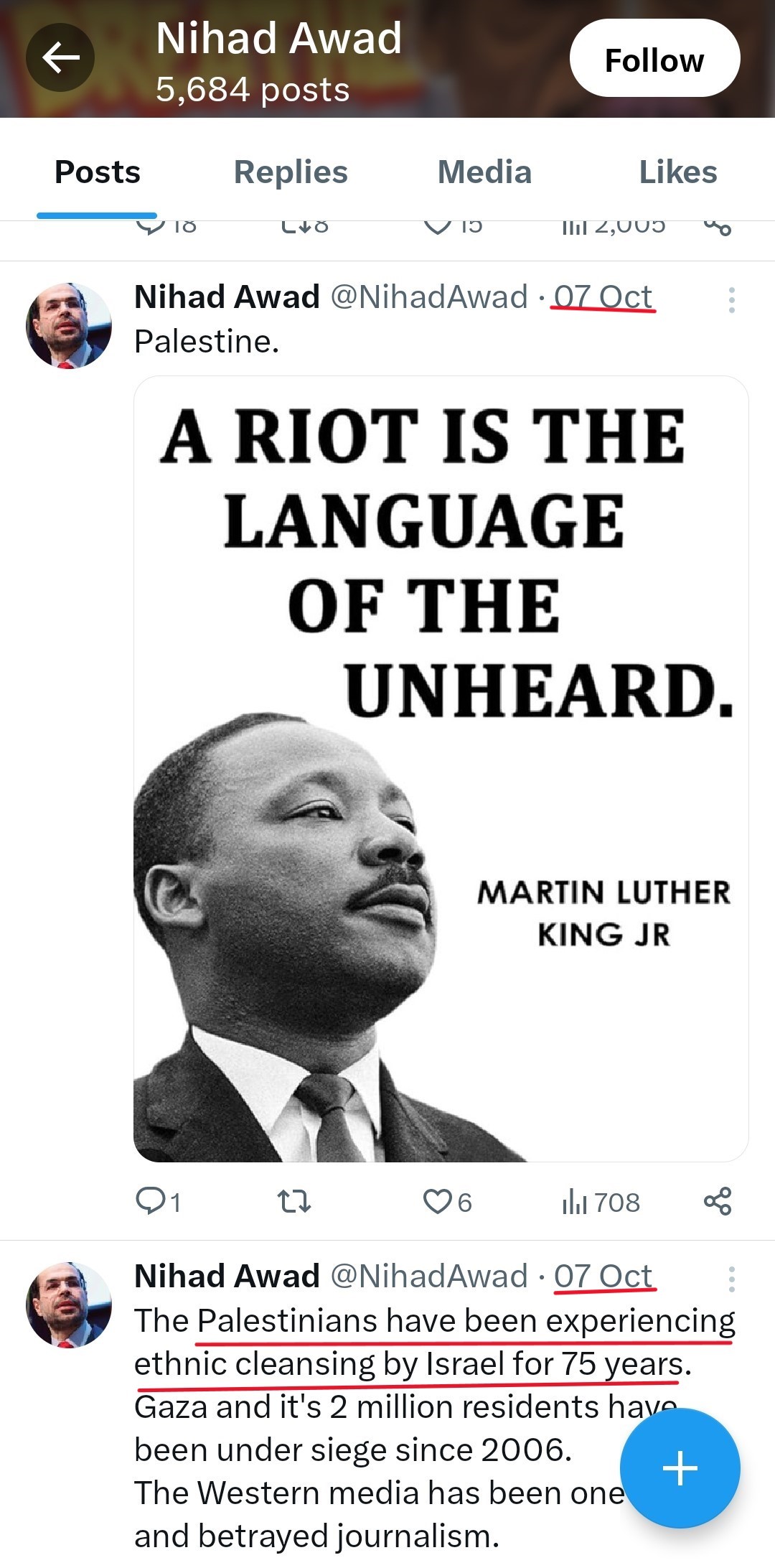
Following October 7, Cornell professor Russell Rickford described Hamas’s breach of the Gaza barrier as “exhilarating.” CAIR executive director Nihad Awad invoked Martin Luther King Jr.’s observation about riots on the morning of the massacre and later expressed happiness that Palestinians had broken through the barrier.
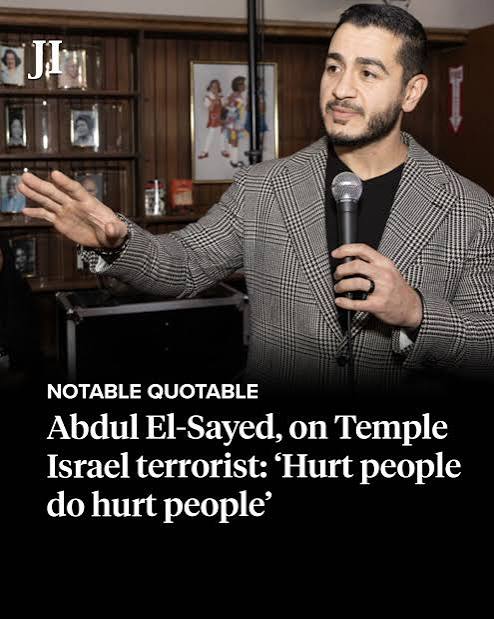
The consequences of importing a foreign conflict into American life became terrifyingly tangible in March 2026, when an attacker drove a vehicle carrying incendiary materials into Temple Israel in suburban Detroit while children and adults were inside. Abdul El-Sayed, then campaigning for the United States Senate, condemned the attack but also discussed the attacker’s family losses in Lebanon, explaining that “hurt people hurt people.”
The attacker brought a foreign war to an American synagogue. The political explanation brought the grievances of that war into the response. The victims were Americans, including children gathered in a place of worship who had nothing to do with a war thousands of miles away, yet the socialist-revolutionary lens pivoted longingly to the attacker.
The Stakes Extend Beyond Jews
The German American Bund’s vision in 1939 threatened far more than America’s Jews. Its members admired an authoritarian foreign power and sought to transform the political and social character of their own country.
Today’s movements pursue different visions through different means, including democratic elections. Their ambitions to change ownership, wealth distribution, policing, education and government authority will shape the lives of Americans far beyond those attending demonstrations.
Jews have particular reason to recognize the danger when political movements portray them as privileged beneficiaries of an unjust system. History has shown how readily that accusation becomes collective blame. But the consequences of sweeping transformations of political and economic power extend far beyond the Jewish community. Jews will suffer twice – first as Jews and then as Americans – regardless of whether they refer to themselves as American Jews or Jewish Americans.
The revolution is local. It waves a foreign flag. And the country it seeks to remake is our own.
In October 2023, Cornell professor Russell Rickford described Hamas’s massacre of Israelis as “exhilarating” and “energizing.” Weeks later, a Cornell student threatened to shoot Jewish students, rape Jewish women and murder Jewish babies. Three years later, Rickford remains on the faculty, socialist organizations have gained political influence across campus, and anti-Israel activists have transformed Cornell’s student government and political culture.
Cornell Professor celebrated the October 7 massacre of 1,200 in Israel
Cornell’s socialist revolution has unfolded alongside a disturbing deterioration in the environment for Jewish students. Organizations promoting socialism and campaigning against Israel have become political partners, winning elections, organizing demonstrations and challenging the university’s institutional relationships with Israel.
Rickford’s October 2023 remarks were captured on video just days after Hamas terrorists murdered, raped and kidnapped Israelis. Jewish students questioned whether they could safely express opposing views in his classroom. Cornellians for Israel president Zoe Bernstein and Hillel executive vice president Simone Shteingart publicly challenged his remarks. Rickford apologized, took a leave of absence and eventually returned to teaching, including a course titled Socialism in America.
Within weeks, Cornell student Patrick Dai threatened to attack the university’s kosher dining hall, shoot Jewish students, rape Jewish women and murder Jewish babies. The threats terrified Cornell’s Jewish community, prompting a police investigation. Dai was arrested, pleaded guilty and sentenced to federal prison.
Cornell student Patrick Dai
Cornell’s Young Democratic Socialists of America chapter lists more than 300 members in the university’s student organization directory. One Cornell organizer advanced to national YDSA leadership, while another won election to Ithaca’s Common Council.
YDSA increasingly works alongside Students for Justice in Palestine, Jewish Voice for Peace and Cornell Progressives. Their joint campaigns seek divestment from weapons manufacturers, opposition to Israeli institutions and an end to Cornell’s relationship with Israel’s Technion. The broader Coalition for Mutual Liberation has claimed participation by more than 40 campus and community organizations.
The transformation is particularly striking when measured against Cornell’s recent history.
In 2014, Cornell’s Student Assembly voted 15–8–1 to table an Israel divestment resolution. A decade later, nearly 70% of participating undergraduates supported a divestment referendum. Graduate students approved another referendum in 2025. By 2026, every Student Assembly candidate jointly endorsed by SJP, YDSA and Cornell Progressives had won.
That political ascent was accompanied by increasingly confrontational activism. Protesters established encampments, disrupted a career fair involving defense contractors and interrupted an appearance by former Israeli foreign minister Tzipi Livni. Cornell imposed disciplinary sanctions and temporarily suspended SJP before reinstating it under conditions.
The Anti-Defamation League assigned Cornell a C in its 2026 campus antisemitism report card.
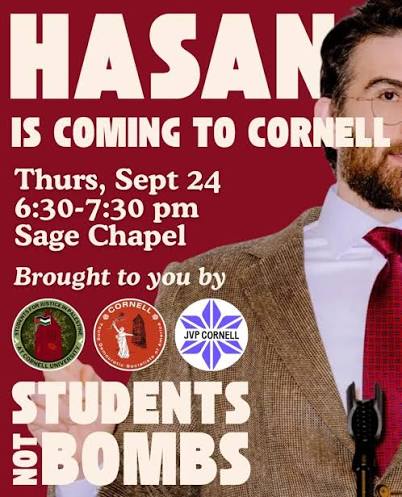
The relationship between socialism and anti-Zionism became especially visible in September 2026, when Hasan Piker addressed approximately 450 students inside Cornell’s Sage Chapel at an event involving YDSA and other anti-Israel organizations.
Piker had previously declared that Hamas was a thousand times better than Israel. When challenged about that comparison on Pod Save America, he responded, “I stand by that.”
At Cornell, Piker celebrated socialist electoral victories, including the rise of New York City Mayor Zohran Mamdani, and joined a chant of “From the river to the sea, Palestine will be free.”
Governor Hochul sits on Cornell’s Board of Trustees by virtue of her office. Together, the university’s leadership and trustees bear responsibility for protecting the freedom of political expression while ensuring that Jewish students can participate in university life without intimidation.
Cornell has spent three years demonstrating how much ideological extremism its academic culture can accommodate. A professor celebrated the slaughter of Israelis. A student threatened to murder Jews. Socialist and anti-Israel organizations expanded their political influence, and a speaker who publicly stood by his favorable comparison of Hamas to Israel was welcomed into Sage Chapel.
Cornell’s Jewish students have watched this transformation from the receiving end of threats and intimidation.
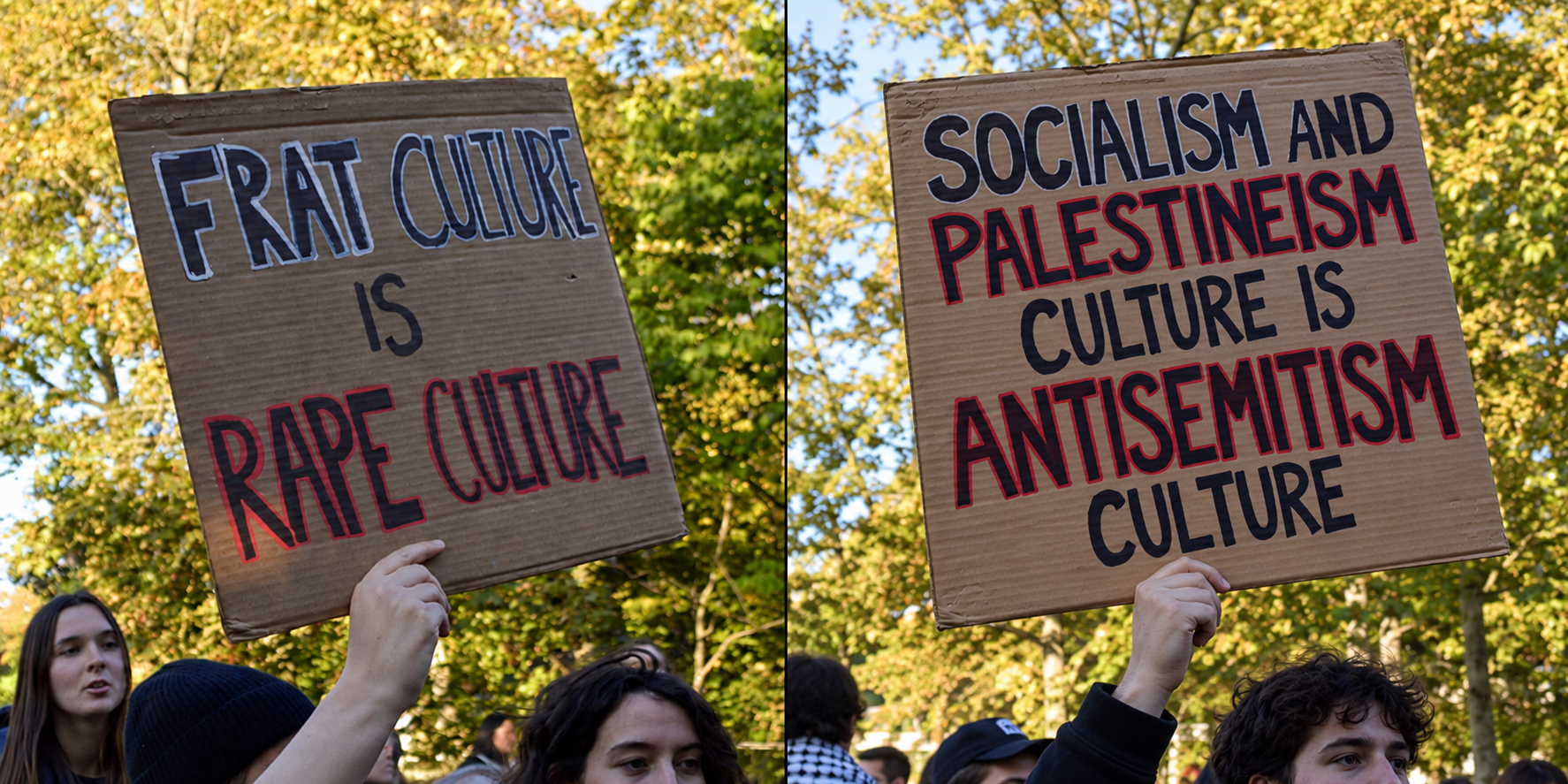
Cornell has decided to shut down fraternity events and parties for the rest of the year after a suit alleging gang rape at a fraternity in 2024 came to public attention. Will the school take similar action against the socialism and anti-Israel clubs?
This is going to be part of a new series of articles under the header “Ramifications.” We often see and hear the news but we don’t often consider the underlying consequences of the information, as well as the lack of it.
The News:
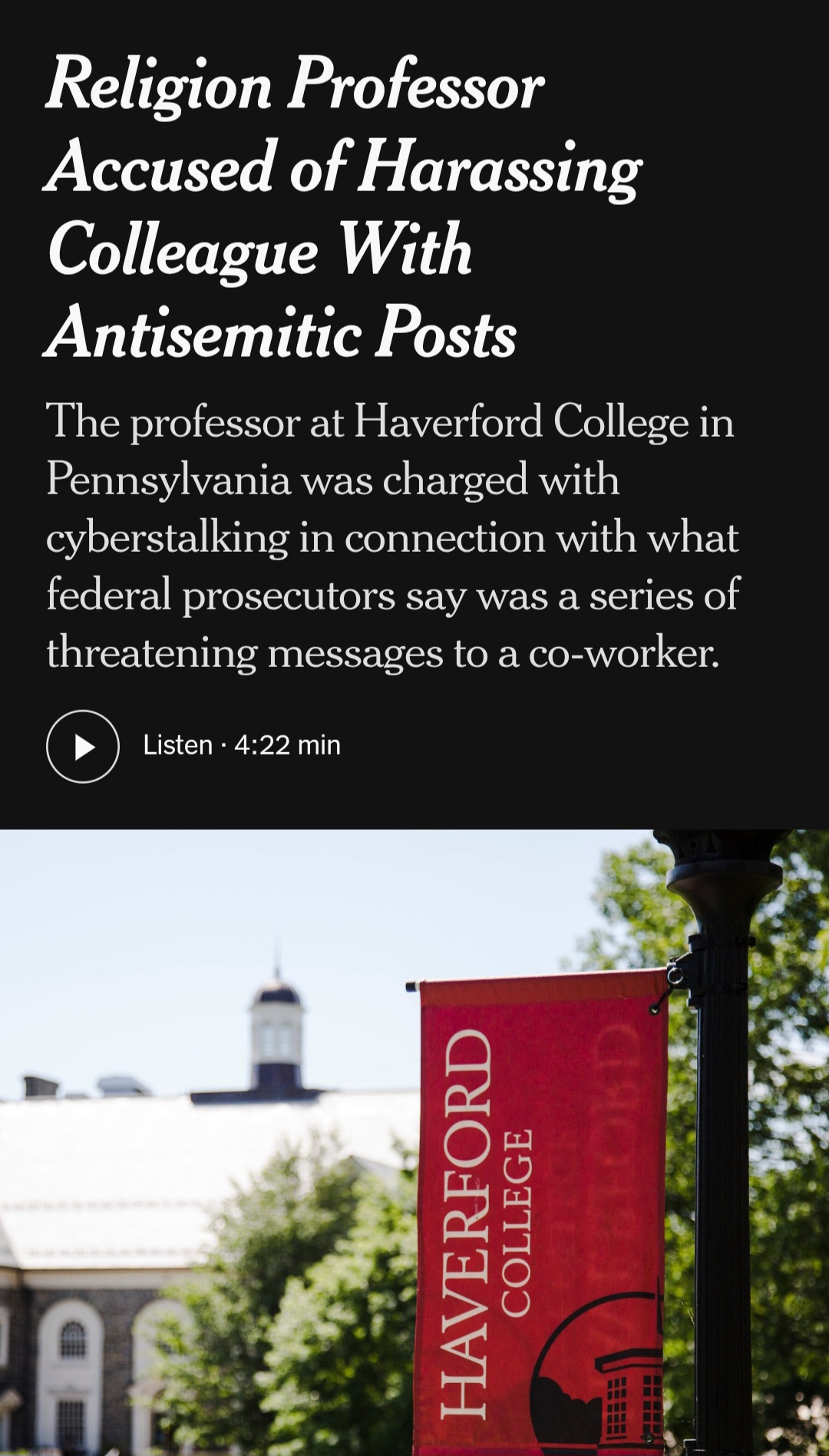
Guangtian Ha earned his doctorate at Columbia University and spent eight years teaching religion at Haverford College, the elite Pennsylvania liberal arts institution. His courses included Introduction to Islam, Blackness in Islam, Gender and Sexuality in Islamic Texts and Practices, and studies of Islamic culture in China.
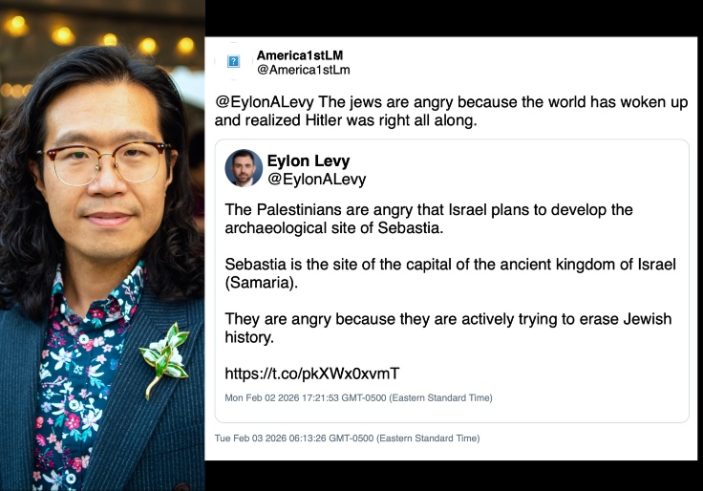
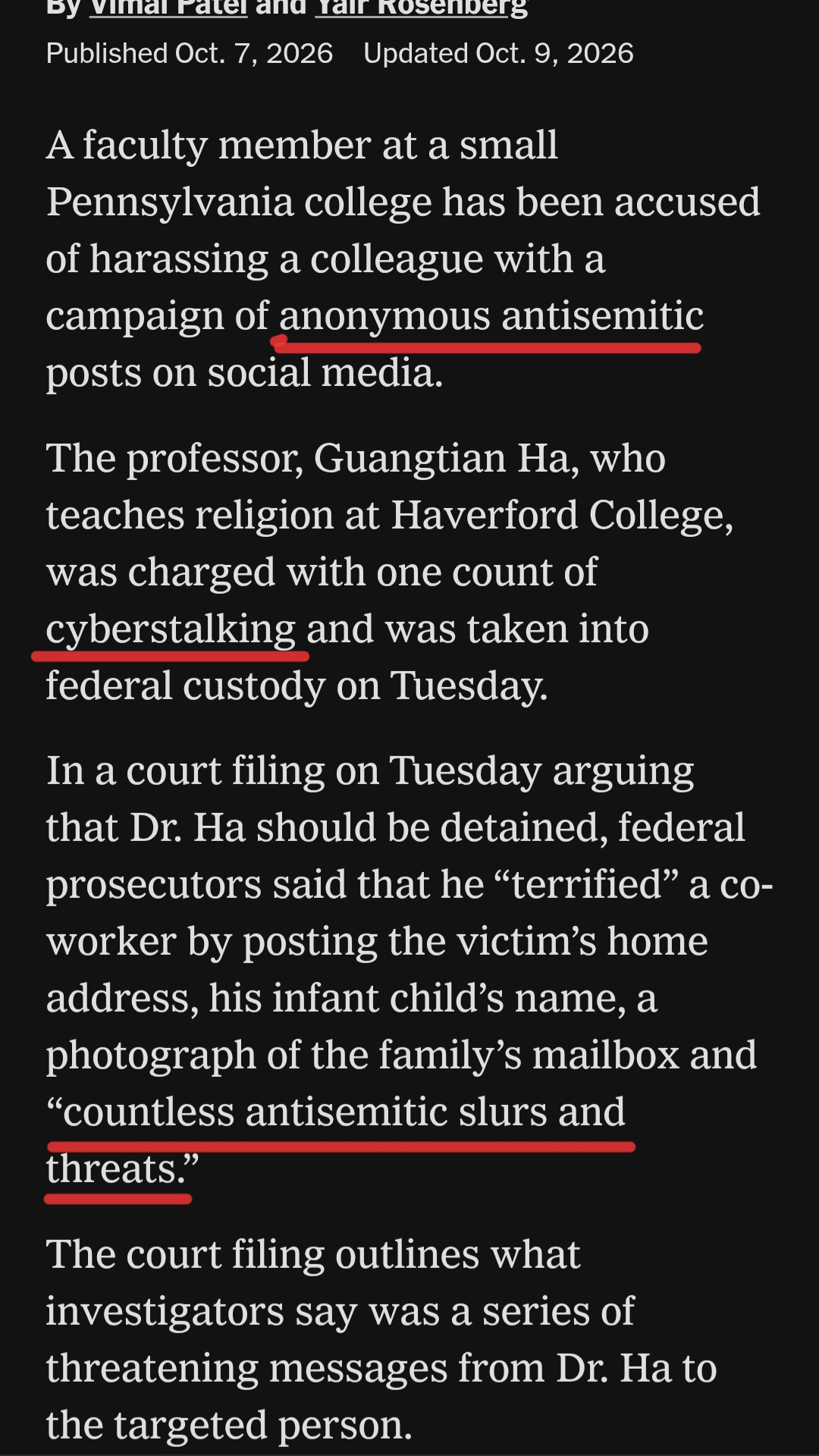
On October 6, 2026, federal authorities arrested Ha on charges of cyberstalking a Jewish colleague. Prosecutors allege he operated at least four anonymous social media accounts, sending approximately 50 threatening messages between October 2025 and May 2026. The messages invoked Hitler, the Holocaust, the extermination of Jews and the victim’s children.
The indictment describes a campaign of terror directed at a Jewish family. Ha allegedly published photographs of the colleague’s mailbox, identified his home and referenced his children by name. The colleague’s wife and three children fled their home twice. The children were prevented from playing in their front yard or waiting outside for the school bus.
“If jews are so special then they should also be placed in special camps.”
“Eliminate the jewish cockroaches.”
“Give it another 10 years, and you shall see a true Holocaust.”
“The jews are angry because the world has woken up and realized Hitler was right all along.”
“the end of American Jews is close.”
To Sen. Ted Cruz “You are a slave to the rapist, bloodsucking jews,”
In a post directed at Jewish Columbia professor Shai Davidai, Ha allegedly asked what flavor of gas he would prefer.
Another post directed at Jewish congressman Randy Fine invoked making candles from his body fat.
Clearly horrible. Clearly anti-Jewish and not anti-Israel.
But what you didn’t see or hear is worse.
Ramification: Teaching Antisemitism
Over eight years, potentially hundreds of students passed through his classrooms, learning about religion, race, culture and society from a professor whom Haverford granted tenure in February 2024. Jewish students were aghast as Ha had long promoted a hateful and divisive environment on campus and filed a lawsuit against the university in May 2024.
In June 2025, the House Education and Workforce Committee specifically asked Haverford president Wendy Raymond whether the college had investigated Ha’s statements equating Zionists with Nazis and advocating their exclusion. Eventually, the college settled the students’ lawsuit in August 2026.
Consider that this vile antisemite wasn’t an irrelevant lunatic ranting on the streets of Times Square.
He is a Columbia-trained professor.
He was hired at a leading liberal arts school.
He taught religion.
He was granted tenure.
His students relied on him to explain unfamiliar histories, cultures and beliefs. And he used his credentials, his tenure and his position to teach his rabid antisemitism to over a thousand students over his teaching career. Ha taught that Jews are “filth” as fact, not noxious opinion.
And like all students know, to get a good grade, they needed to parrot the poisonous professor.
CONCERN: Extremist ideas circulate through American academic institutions under the authority of scholarship, tenure and “political expression.” Your tax dollars go to support this student indoctrination in Jew-hatred to poison society.
Ramification: Whitewashing Antisemitism
The New York Times covered the story – and minimized the vicious Jew-hatred.
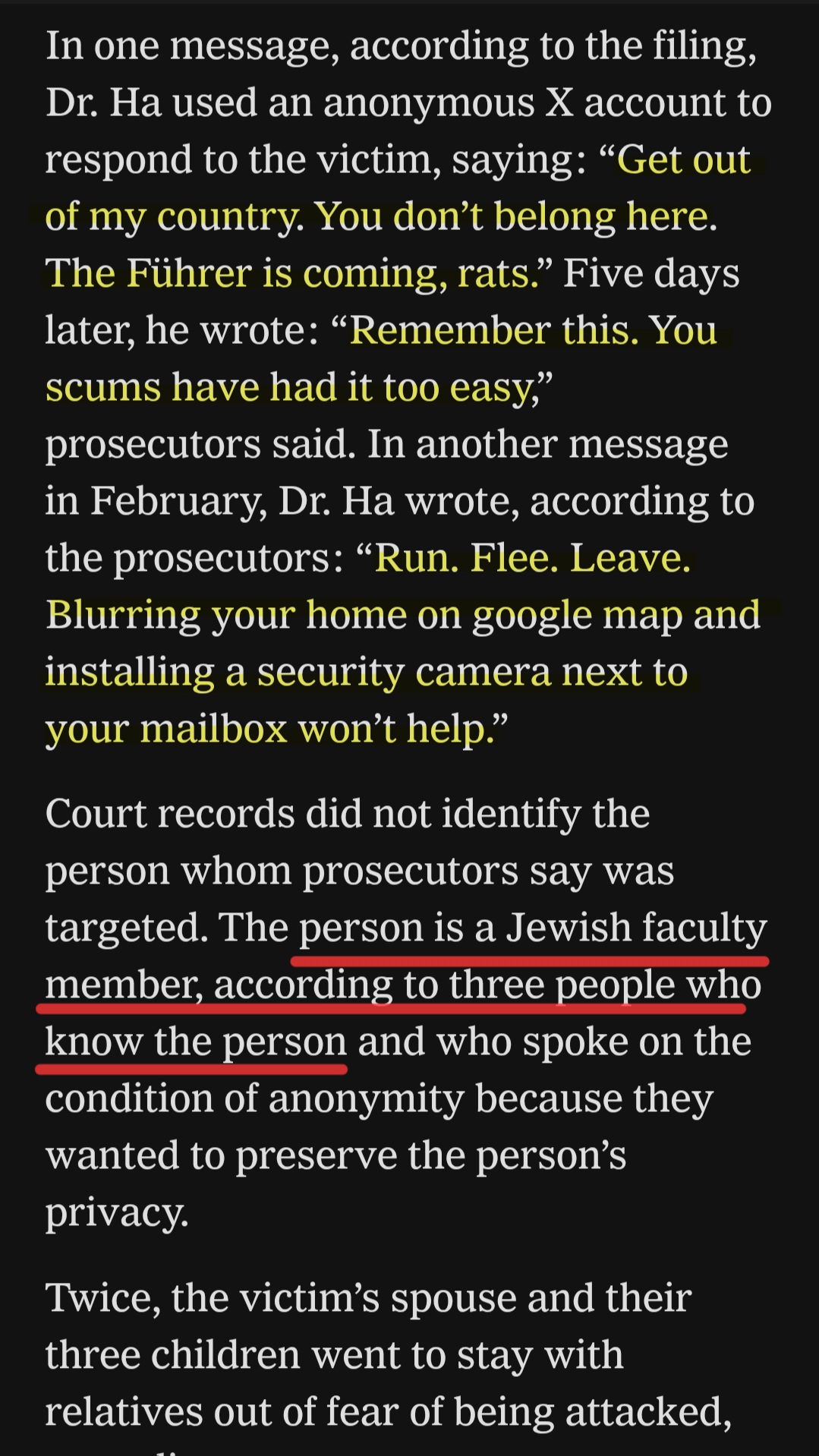
In the three Ha quotes the Times decided to showcase, none said the word “Jew.” None described his deep hatred – instead they pointed to making the targeted person feel unwelcome with language of “Get out of my country,” “you scums have had it too easy” and “Run. Flee. Leave.” Note that according to court filings, the end of the second post was “Goyim are taking America back, blood-guzzling demons,” which the Times omitted.
To further confuse the Times readers, the article said the targeted “person is a Jewish faculty member, according to three people who know the person.” A reader had to INFER that the get-out-of-town comments were about the person being Jewish – or maybe Ha just had a general beef with this other faculty member.
Were the “jew filth”, “jewish cockroaches” and “rapist, bloodsucking jews” comments too clear that this professor is a vile antisemite?
The New York Times has twisted itself for years to say that hating the Jewish State doesn’t mean hating Jews. Is it also trying to whitewash plain Jew-hatred into a squabble between two faculty members in which one of them could be Jewish according to people who know him?
CONCERN: If even clear and blatant broadcast Jew-hatred cannot be called out clearly and explicitly in leading mainstream media (perhaps because the Jew-hating professor is a minority teaching Islam), there is no chance that more subtle forms of antisemitism will be reported.
RAMIFICATIONS
Americans are being educated in their colleges and in left-wing media that hating Jews is appropriate, and if Jews complain – especially if the actions come from so-called minority groups – they are overly sensitive and should make room for victims of preference. That is a movement of systematic exclusion and expulsion of Jews from the American promise, a much bigger story than a “professor being accused of harassing a colleague.”
ACTION ITEMS
Haverford College. Please read the statement by President Wendy Raymond. She is upset that a professor was harassed. By what about the Jewish students on campus? What about the thousand students who were taught by this evil person? Demand a full audit and review of all class materials that the professor used over his time at the university, and interview the students who took his classes to learn more about how antisemitism might have infused his lectures. president@haverford.edu(610) 896-1021
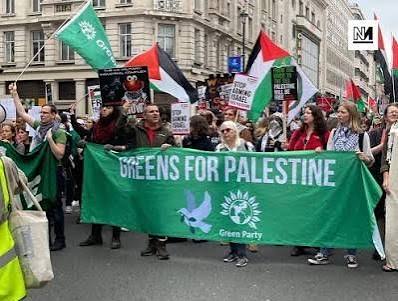
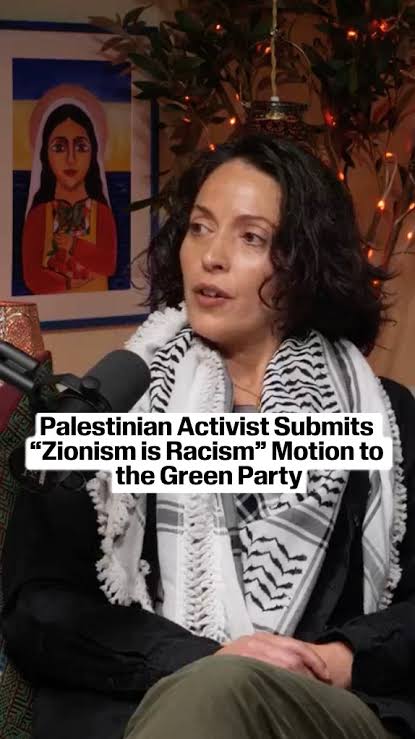
On October 4, 2026, as Jews marked Simchat Torah and the third Jewish-calendar anniversary of the Hamas-led massacre that killed about 1,200 people and saw 251 taken hostage, Britain’s Green Party voted to declare Zionism a form of racism.
By 1,022 votes to 813, the party formally declared itself anti-Zionist and endorsed replacing Israel with a single Palestinian state throughout the pre-1948 region of Palestine.
An earlier vote at the same conference was even more revealing about the party’s attitude towards Jews.
Jewish Green member Sam Alston proposed an amendment protecting Jewish members from being pressured or disciplined because they belonged to synagogues and other Jewish institutions associated with Zionism. He warned that without such protection the policy could result in “indirect religious discrimination.”
The Greens rejected his safeguard, 1,026 to 684.
So at this same conference, Jewish members were provided a safe room because some feared for their safety during the debate about Jews and the Jewish State, while rejecting their proposed protection from its new racism policy.
“We continue to see antisemitic sentiment appearing with increasing frequency,” – Laurence Taylor, the head of counter-terrorism policing
There may also be a legal problem.
Adam Wagner KC, a prominent British human-rights barrister, has warned of a “strong risk” that the resolution contravenes the Equality Act 2010. British law protects qualifying philosophical beliefs, and Wagner argues that Zionism is likely capable of qualifying for that protection.
There is already precedent from the other direction. David Miller, the former University of Bristol professor, successfully established before an employment tribunal that his anti-Zionism qualified as a protected philosophical belief under the Equality Act. Greens for Palestine cited the Miller case in defending anti-Zionist beliefs before the conference.
British law may already protect both the anti-Zionist and the Zionist.
The Green Party is no longer a fringe environmental entity. Membership has surged above 200,000, tripling its total in a single year.
Their electorate also looks markedly different from Britain as a whole. Analysis of the 2024 Green vote found an average age of 42 compared with 49 across the electorate. Green voters were more female, much more likely to be university graduates and less likely to own their homes. They were also twice as likely to be Muslim – 6 percent versus 3 percent nationally – and considerably more likely to have no religion.
The two conference votes reveal something more troubling.
While the voters against Zionism and protection for Jews stayed roughly the same – 1,022 and 1,026, respectively – 16 percent of those supporting Israel did not vote on protections for Britain’s Jewish community.
That leaves a question extending well beyond this conference: As hostility to Zionism moves deeper into the politics of the alt-left, who will insist on protecting Jews whose religious and communal lives remain connected to it?
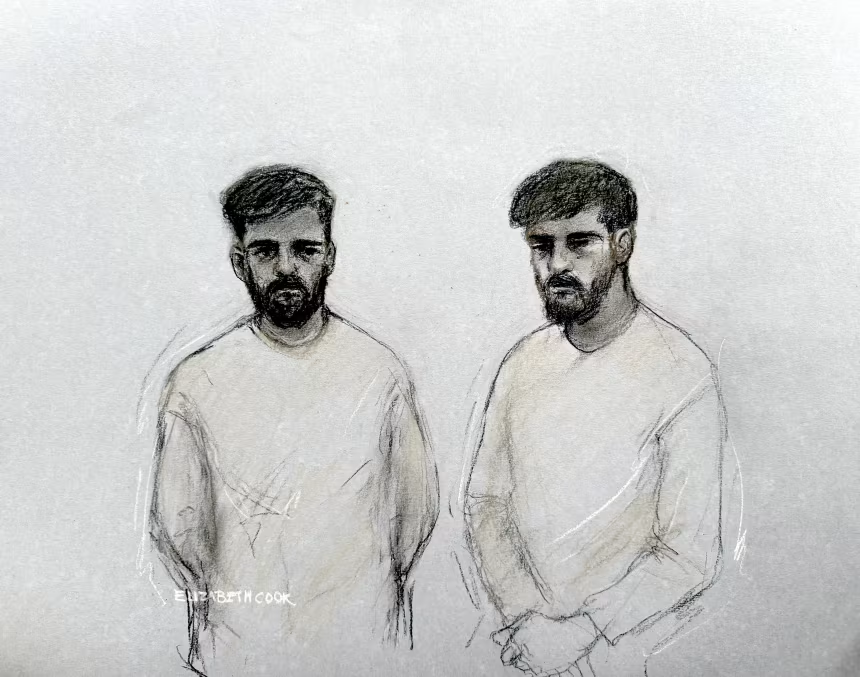
Two Iranian men – Salam Ahmadyan, 36, and Rahman Salehi, 34 – charged with attempting to bomb a synagogue in Manchester on Yom Kippur 2026, one year after other Jews were stabbed to death in the city
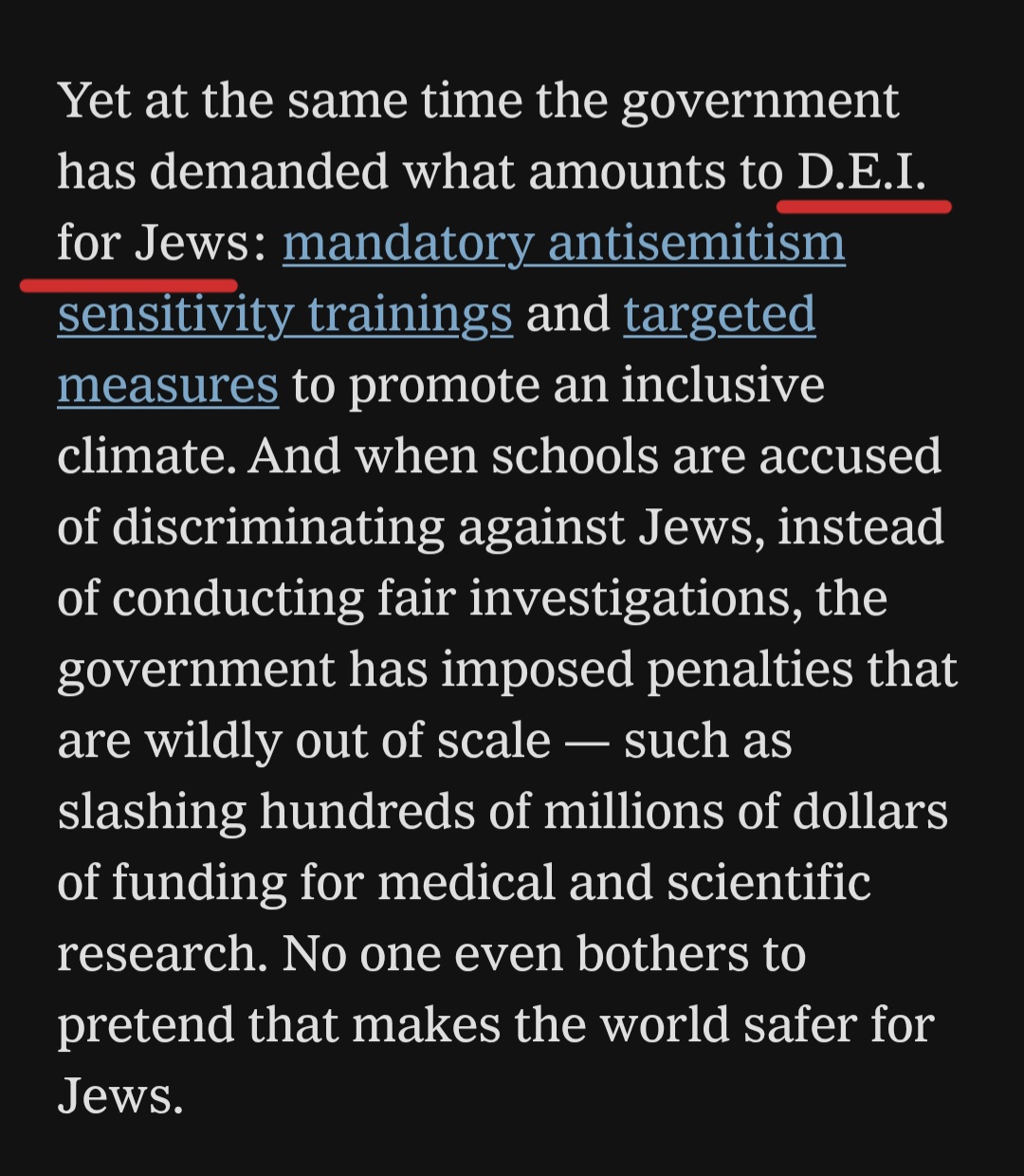
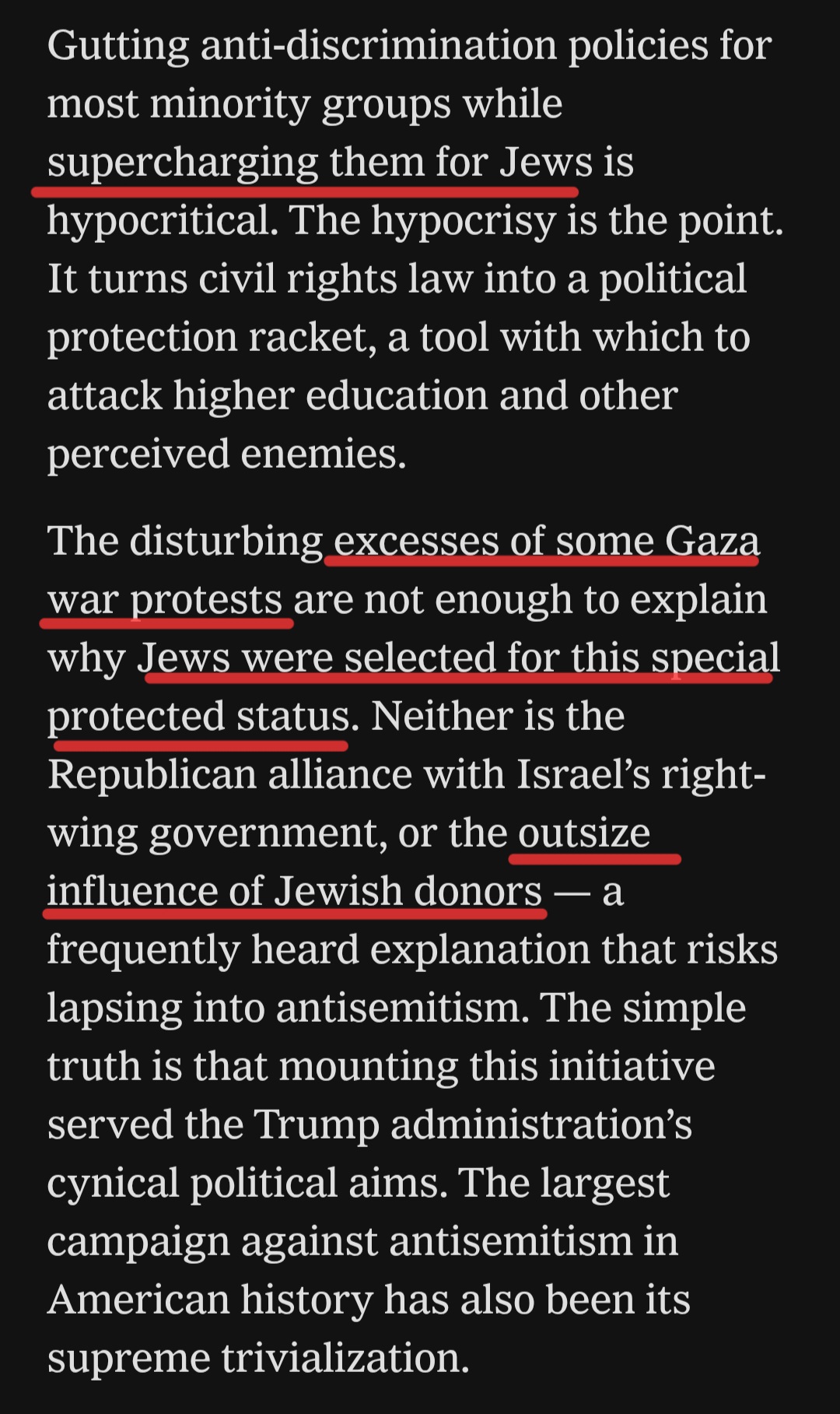
The Trump administration, he writes, has demanded “what amounts to D.E.I. for Jews.”
What he means is antisemitism training and measures intended to ensure that Jewish students can attend classes, use campus facilities and participate in university life without harassment or intimidation.
That is not D.E.I. It is equal protection.
D.E.I. programs may use identity-conscious policies to pursue representation or other preferred outcomes. On the other hand, civil-rights law imposes a simpler rule: institutions receiving federal funds may not discriminate against students because of their race, ethnicity or shared ancestry.
Preferred outcomes and equal protection are not just not the same thing.They are opposites.
If Black students are targeted, the law protects them. If Muslim or Arab students are targeted, the law protects them. If Jewish students are targeted, the law protects them. Applying the same rule to Jews does not create a Jewish preference.
Loeffler nevertheless describes Jews as having been selected for special protection. That is absurd. Title VI has long covered antisemitic discrimination, just as it covers comparable discrimination against other groups. Whether a particular penalty is proportionate is a separate question from whether protecting Jewish students constitutes D.E.I.
Loeffler avoids that basic distinction by reducing the conduct surrounding Gaza protests to “excesses.” But the issue was not criticism of Israel or a few offensive placards. Jewish students faced ongoing intimidation, exclusion, celebrations of Hamas murderers and rapists, and chants invoking violence while universities failed to enforce their own rules.
The relevant question is whether universities tolerated treatment of Jewish students that they would have confronted had another minority been targeted. Instead, Loeffler makes the government’s response the scandal. His essay moves away from the students suffering harassment toward theories about Trump, demographic change, white panic and “Jewish donors.” The people seeking protection disappear into an argument about the motives of those enforcing the law.
That this comes from a professor of modern Jewish history is difficult to understand. Loeffler is not an uninformed commentator stumbling over the difference between a preference and a right. His credentials rest on Jewish history, antisemitism and civil liberties. He is a research fellow at the Shalom Hartman Institute which promoted the article on its website.
How does a scholar with that background look at the present condition of American Jews and identify their protection as the suspicious development? How does he see Jewish students threatened and excluded, yet reserve his strongest language for the government finally acting? How does an authority on antisemitism mistake equal treatment for Jewish favoritism?
The New York Times paraded an “As A Jew” with Trump Derangement Syndrome to encourage students coming back to school to come after their Jewish classmates once more and vote against Republicans in the mid-term elections.
Disliking the administration enforcing the law does not transform the law into D.E.I. Equal protection does not become preferential treatment when the people receiving it are Jews.
You can also share your thoughts with the Shalom Hartman Institute for having Loeffler be an ongoing research fellow and promoting his article at 212-268-0300.
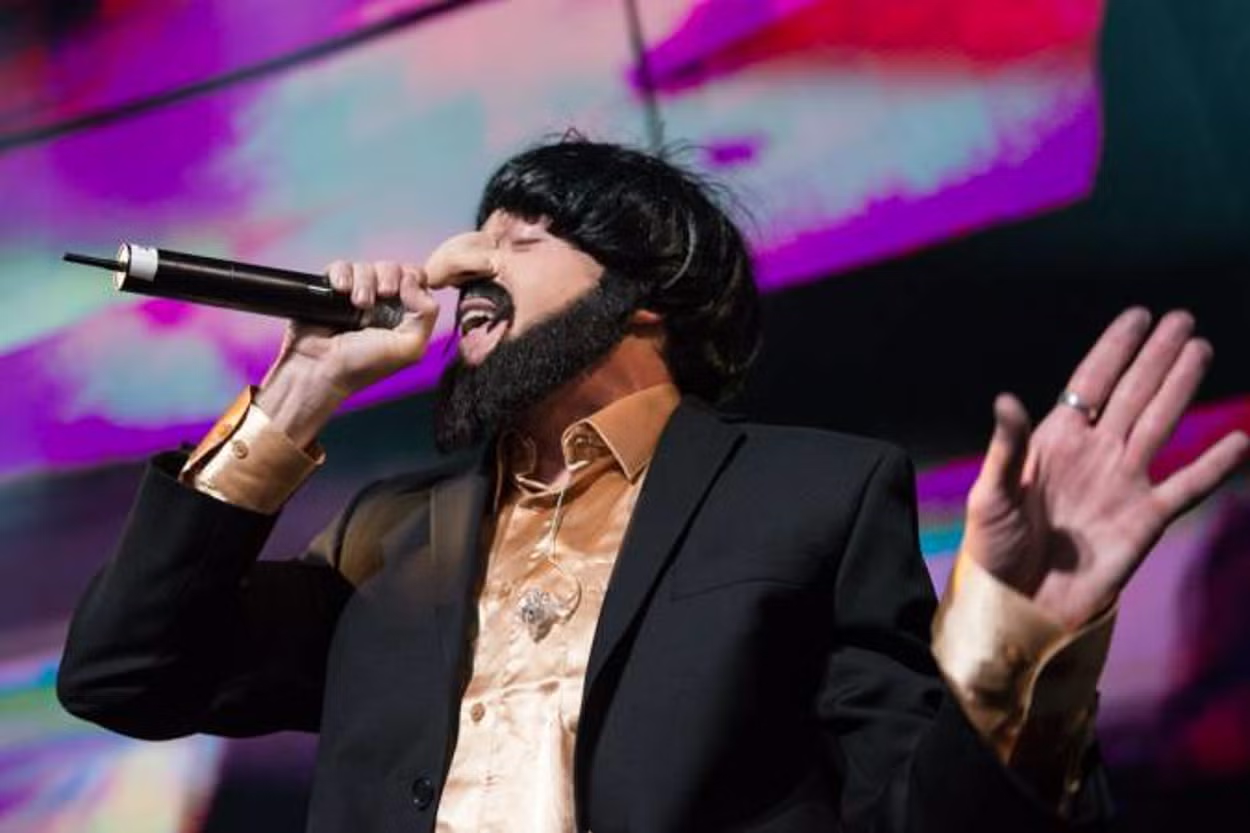
In May 2014, Macklemore walked onto a Seattle stage wearing a large prosthetic nose, dark wig, beard and black suit. Then he performed “Thrift Shop,” a song about being cheap.
Macklemore in Jewface in 2014, singing about being cheap
It would be difficult to construct a more recognizable antisemitic spectacle: the exaggerated Jewish nose, the beard, the dark clothes, all while singing about bargain hunting. Actor Seth Rogen mocked Macklemore’s explanation that it was merely a random disguise: if someone were instructed to assemble an antisemitic Jewish costume, Rogen wrote, “they’d have that exact shopping list.”
As criticism mounted, Macklemore apologized. He acknowledged that the outfit could be understood as a Jewish caricature but maintained that no Jewish stereotype had crossed his mind.
Yeah, right. That should have been a simple moment for the Anti-Defamation League to clearly denounce the spectacle.
Instead, the ADL chose absolution.
“We take him at his word that he did not have any ill intent,” then-ADL director Abraham Foxman said, “and unreservedly accept his apology.” And then Macklemore gave the ADL a promotional shout-out. “Through this situation I’ve got hip to some incredible groups like the ADL,” he wrote, encouraging people to check out their “great work.”
The country’s best-known antisemitism organization publicly and “unreservedly” accepted his apology and also his advertisement. It is unclear whether there was a quid-pro-quo and whether the ADL was trying to promote its antisemitism study it released the week before.
As they say in text-land: “WTF?”
Twelve Years Later
It is now 2026, and antisemitism is raging through American public life. Much of it no longer arrives wearing a fake nose and beard. It travels under political banners, frequently through rhetoric about Zionists and Israel.
And Macklemore is back on a concert stage.
Opening for Ed Sheeran at MetLife Stadium, he told tens of thousands of people why he had joined the tour: so that he could stand in stadiums and say, “Free Palestine.” He accused Israel of genocide, performed “Hind’s Hall” against a backdrop of footage from pro-Palestinian campus encampments and turned part of the concert into a political demonstration.
This time, the ADL wasn’t offering absolution.
“They came for a concert, not performative, biased and hateful anti-Israel ‘activism’ from his opener, Macklemore,” the organization declared. It pointed to what it describes as his record of demonizing Israel and Israelis, falsely accusing Israel of genocide and engaging in antisemitic rhetoric and behavior.
When Macklemore was subsequently removed from the remainder of Sheeran’s tour, head of ADL Jonathan Greenblatt applauded the decision, saying that “for years, Macklemore has pushed antisemitic tropes and demonized Israel and Israelis.”
What a difference twelve years makes.
The Permission Slip
The problem in 2014 wasn’t only that the ADL accepted an apology. It was that it seemingly confused forgiving the man with minimizing the act.
America’s leading antisemitism organization effectively told the public that Macklemore’s updated and revised intentions settled the matter. A concocted and forced apology after multiple attempts to satisfy the offended, became another chip on the accused – I’m sorry you were offended, not I’m sorry that I have done something terrible that offended you.
Jews are the subject. Always. The antisemite is a victim of Jewish sensitivity.
The ADL granted a permission slip of sorts to this vulgarity and inanity. Permission for American culture to treat an astonishingly recognizable Jewish caricature as something that could be quickly explained away if the right person said he hadn’t meant it.
Now, the ADL that once took Macklemore at his word is no longer particularly interested in his assurances about what he means. It considers impact. The false charge of “genocide” against Israel in Israel’s defensive war is a common pretext to attack Jews today. Macklemore’s appeal to thousands wasn’t a call for peace but incitement to pogrom.
But that was precisely the lesson the ADL could have taught in 2014.
There is an important role for forgiveness in fighting hatred. People must be allowed to recognize mistakes, apologize and change. That is what the Ten Days of Repentance we are in right now is about.
But forgiveness without the party internalizing the matter coupled with contrition is meaningless. It is actually much worse. It is a wink with a get-out-of-jail card. Carry on with spreading antisemitism; we’ll only call it out when the situation becomes intolerable.
Neither October 7, 2023 nor October 8 appeared magically. First One Through has been writing about this phenomenon nearly every day since those same days in May 2014, when it wrote about the UN’s Richard Falk stating that Israel’s “criminal intention [toward Palestinians] is genocidal.”
Does that word have a familiar ring to it? The UN has been using it constantly for well over a decade; before the wars of 2014, 2021 or 2023.
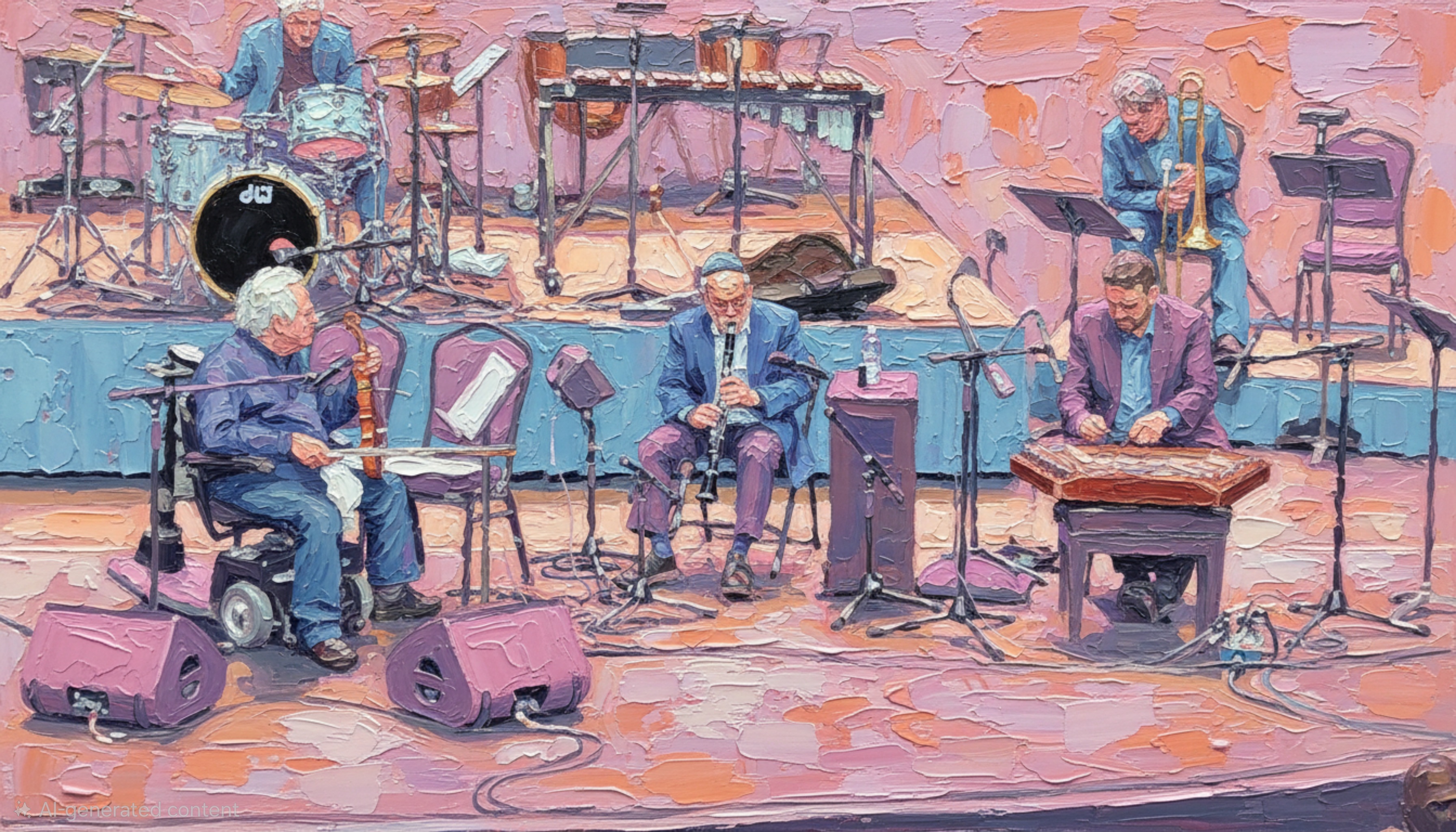
At the Beacon Theatre, Itzhak Perlman offered a reminder that Jewish memory is not only something Jews mourn; it is something they dance to.
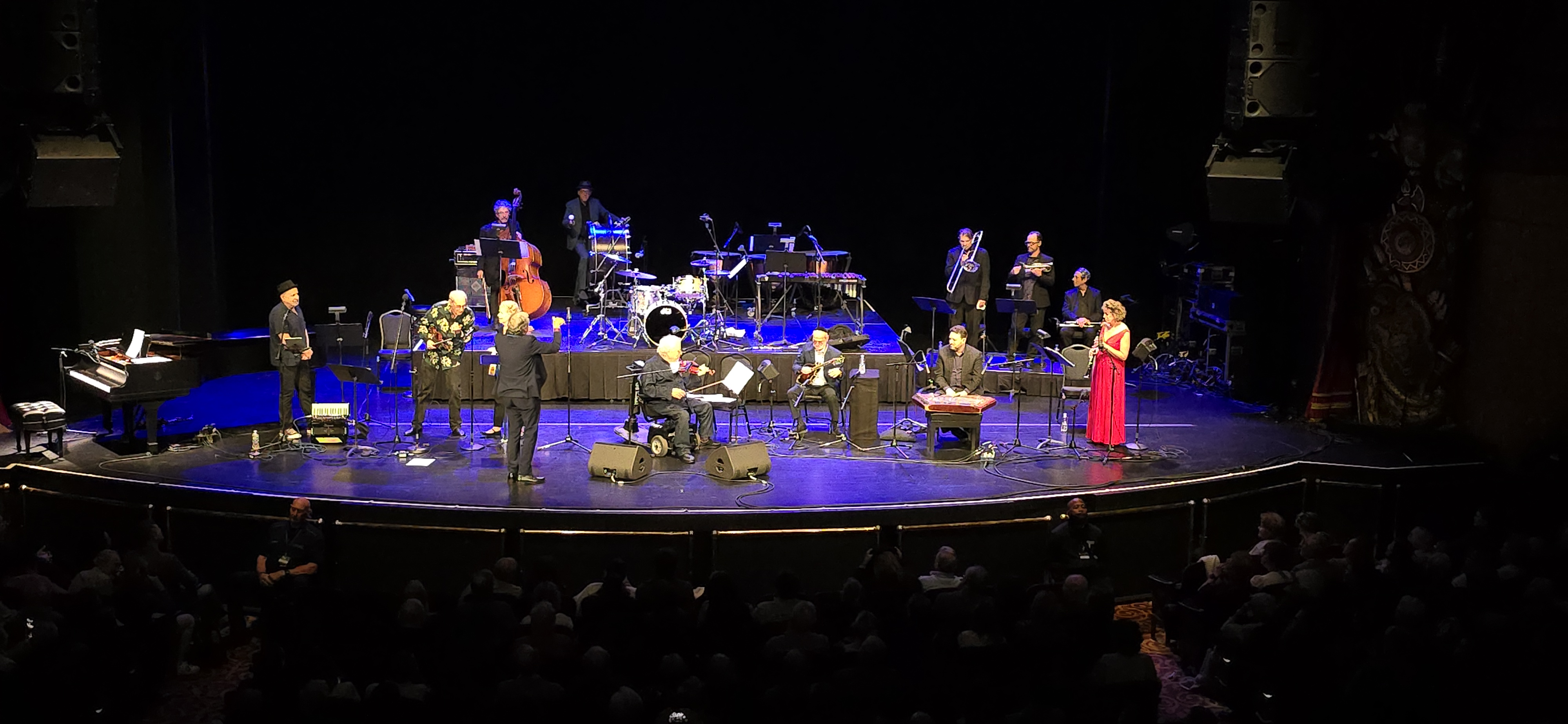
Four days after New York marked the 25th anniversary of September 11, and just after Rosh Hashanah ushered in another Jewish year, Itzhak Perlman sat at center stage at the Beacon Theatre and played klezmer.
The concert celebrated Perlman’s 81st birthday and roughly three decades since In the Fiddler’s House, his landmark embrace of the music of his Jewish roots. Perlman said he wanted people “to dance in the aisles.”
Itzhak Perlman, with members of the Klezmatics and Andy Statman at the Beacon Theater September 15, 2026 (photo: First One Through)
That is where klezmer belongs.
The word comes from the Hebrew klei zemer – “vessels of song” – but klezmer was never simply a genre of music. It was music woven into the life of Eastern European Jews, played at celebrations and, most famously, weddings.
It sounds like the world that created it. The violin can plead like prayer. The clarinet can cry, tease and laugh. A melody can begin in longing and, almost without warning, become a demand to get out of your chair.
Klezmer can sound sad without being sad music. It carries memory into celebration.
Even more, klezmer turns Jewish memory into Jewish motion.
Much of the Eastern European Jewish world that created this music was eventually destroyed. Whether Jews fled pogroms of the 19th and 20th century or were wiped out in the Holocaust, the ground which birthed klezmer has lost almost all of its Jewish feet.
But the music crossed oceans and generations. Jewish immigrants carried it to America, where later musicians recovered and revived the tradition. Andy Statman, who joined Perlman on stage at the Beacon, became one of its great modern interpreters. Perlman’s In the Fiddler’s House brought klezmer to audiences who knew him primarily as one of the world’s greatest classical violinists.
That makes the choice itself significant.
Perlman could have celebrated his birthday playing Bach, Beethoven or Brahms. Instead, he gathered klezmer musicians at the Beacon to play the music of Jewish weddings and Jewish celebrations.
And there was something particularly striking about hearing it in New York at this moment in time.
The city outside the Beacon has been experiencing a terrible surge in antisemitism. Jews have been harassed and assaulted on New York streets, while antisemitic incidents have repeatedly represented a disproportionate share of reported hate crimes. America’s youth has largely moved away from Israel and the Jewish State, leaving the future very uncertain.
That was the world outside the theater doors.
Inside was a different New York.
The audience appeared predominantly Jewish and older. For many, these melodies likely carried associations extending beyond a night at the Beacon: to parents and grandparents, weddings and synagogues, holidays and communities. To the Yiddish language rarely spoken anymore – let alone sung by a woman in public.
But the audience was not exclusively Jewish or old. The handful of younger people mostly wore kippahs or were Asian. Some may have come for klezmer; others simply for the opportunity to hear one of the greatest violinists alive.
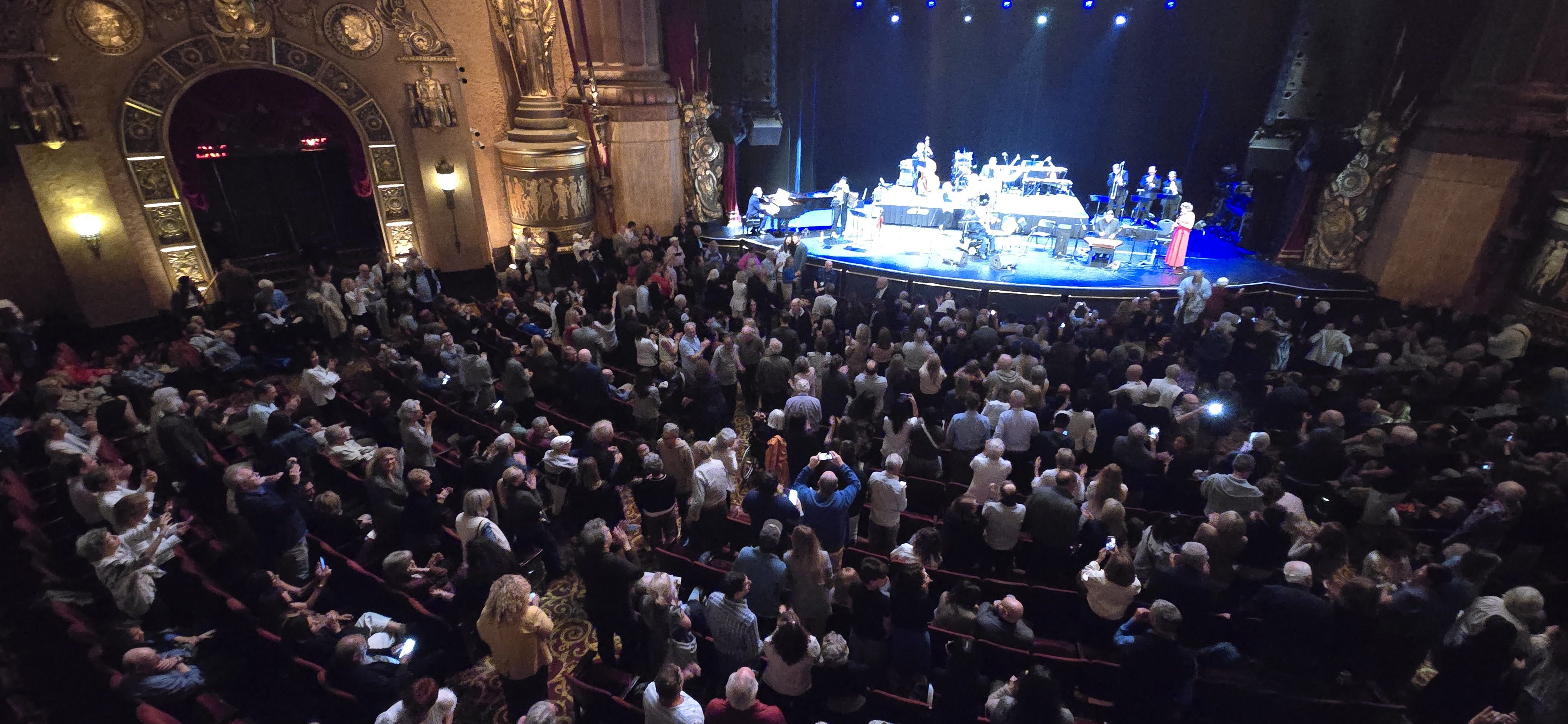
And then Perlman got his wish. People got out of their seats, filled the aisles and danced.
Crowd at the Beacon took to the aisles and started dancing around the theater as Perlman and the band played wedding music (photo: First One Through)
The scene captured something that yet another speech condemning antisemitism could not. Outside were the streets of a city where Jewish identity has increasingly been met with hostility and Jews hid their identity. Inside, an 81-year-old Jewish violinist who cannot walk himself, was playing unmistakably Jewish music inherited from communities that no longer exist – and Jews and Asians alike were on their feet celebrating it.
Dancing in the aisles at The Fiddler’s House to music by Itzhak Perlman and the Klezmatics at The Beacon in NYC, September 15, 2026
The timing made the scene still richer.
The Jewish year had just begun with the blast of the shofar. Rosh Hashanah demands reflection. Yom Kippur will demand repentance and fasting. But the Jewish calendar does not end there. It moves to Sukkot and then Simchat Torah, when Jews take the Torah from the ark, hold it in their arms and dance.
That progression says something essential about Judaism. It remembers the good and the bad. It prays. It fasts. It builds. It dances.
And it refuses to make sorrow the destination.
On a September night in New York, with antisemitism again confronting Jews on the streets outside, an old Jewish musical legend lifted his violin and played old Jewish melodies. And Jews clapped and danced in the aisles.
Itzhak Perlman and Andy Statman at The Beacon in NYC for Itzhak’s 81st birthday (made by First One Through with AI)
On May 21, 2025, Yaron Lischinsky and Sarah Milgrim walked out of a reception at the Capital Jewish Museum in Washington, DC. They were young Israeli Embassy employees and a couple. Lischinsky had bought a ring and planned to propose.
Alas, Elias Rodriguez, a pro-Palestinian anarchist, fired approximately 20 rounds at the couple shouting “free Palestine.” Inside the museum afterward, he allegedly said, “I did it for Palestine. I did it for Gaza.”
Rodriguez had brought an explanation with him.
His manifesto, Explication, dated the previous day, defended the “morality of armed demonstration.” He wrote that he had considered such violence justified during the 2014 Gaza war, but understood that most Americans then would have found it “illegible” and “insane.”
By 2025, he believed America was different. “I am glad that today at least there are many Americans for which the action will be highly legible and, in some funny way, the only sane thing to do.”
In his mind, the violence had not changed. The audience had.
Rodriguez described armed action as “theater and spectacle.” He had watched enormous demonstrations against Israel, accusations of genocide become commonplace and supporters of Israel portrayed as complicit in mass killing. Yet, he complained, “the rhetoric has not amounted to much.”
The violence would be the spectacle. The manifesto would tell the audience how to read it.
Especially because of the timing: May 20, 2025.
Rodriguez penned his manifesto on the same day that UN humanitarian chief Tom Fletcher told the BBC that 14,000 babies in Gaza would die within 48 hours unless aid reached them.
The claim was completely false. The comment was a distorted derivative of a report that approximately 14,000 cases of severe acute malnutrition among young children might occur over the next year. And he placed all of the blame on Israel.
The accusation spread quickly. That afternoon, CAIR issued a call for action after the UN said 14,000 Palestinian babies could die under what CAIR called Israel’s “forced starvation campaign.” Genocide supplied the larger charge.
Shortly before his murder the next day, Lischinsky reportedly shared criticism of Fletcher’s claim that called it a “blood libel.” The blood libel was much more than a charge of accusing Jews of killing children; it gave license to an audience to kill Jews in their defense.
Rodriguez had another word for encouraging the crowds to murder: Legible.
And he was right.
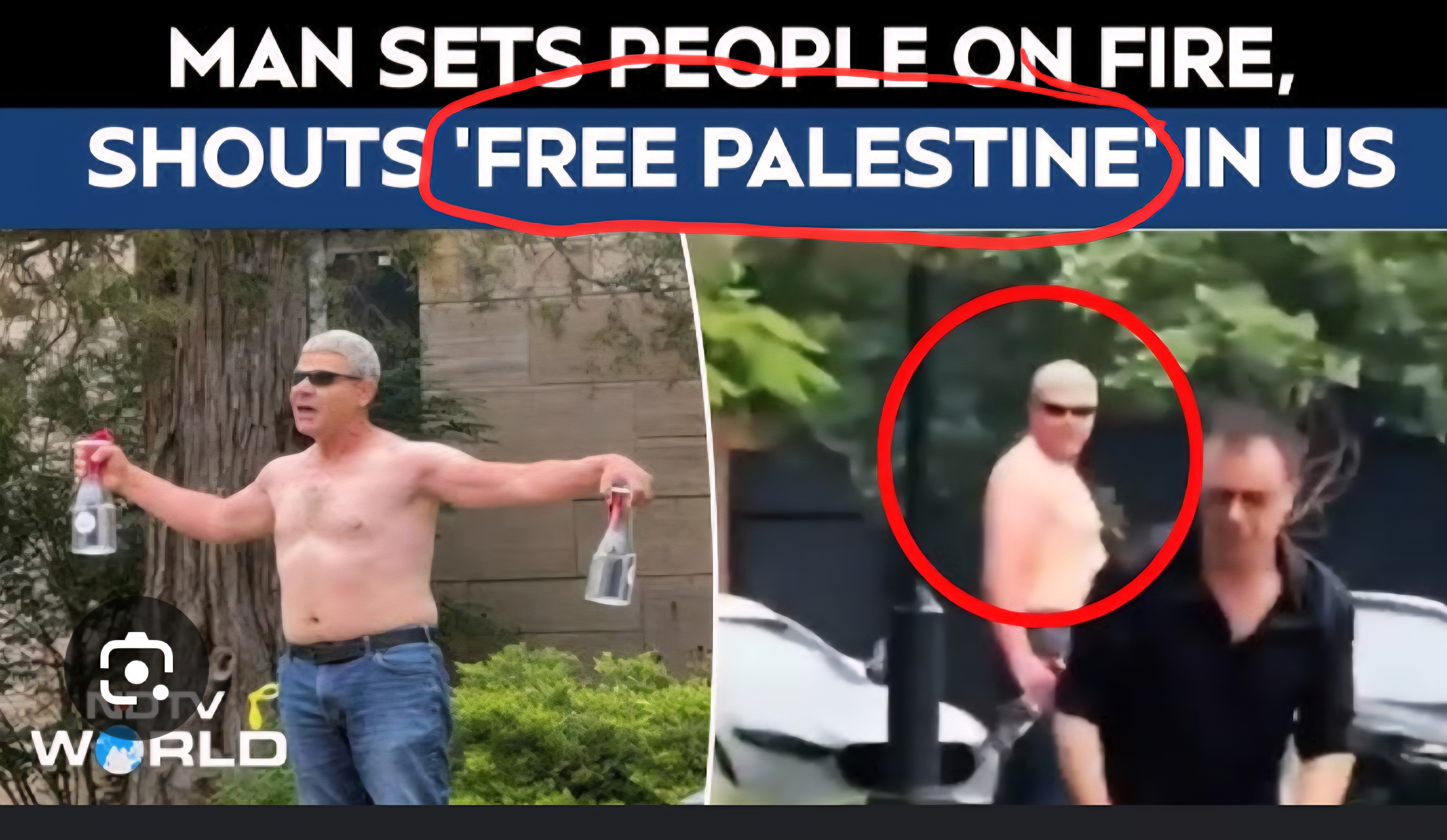
Eleven days later, in Boulder, Colorado, prosecutors say a man attacked a peaceful gathering supporting Israeli hostages with Molotov cocktails while shouting “Free Palestine.” One victim died.
In August 2026, popular pro-Palestinian podcaster Hasan Piker said that if American Jews continued publicly associating themselves with Israel, “eventually someone’s going to come around and take action, not against the State of Israel, mind you, but against American Jews.” Keep associating with those falsely accused of genocide, and people will come for you.
Anger and frustration are being harnessed through podcasts and manifestos to inflame passions and violence. The audience is all too happy to join the spectacle these days.
Because the violence is legible.
So crowds cheer on the killer of a United Healthcare executive, gunned down in the streets. They listen to their alt-left congressman shout on the streets that the rape of Jewish women never happened, to turn the victims into aggressors. They watch an Ariane Grande video of a frustrated musician cutting old white men to pieces to rapture and applause.
Zeteo’s Mehdi Hasan at the alt-left Zohran Mamdani NYC mayoral victory party with Hasan Piker and Jamaal Bowman, November 2025. (start at 52:00)
Legible.
Once upon a time – say 2010 – the mass murder by an angry person was viewed through a lens of pity and disbelief. What did we do as a society that enabled isolation and frustration to turn into heinous violence? Pearl Jam’s Jeremy is a cry out of pain – for the victims and the shooter. There are no winners, just anguish.
No longer. The audience has changed. We revel in the spectacle. If the dead are cast as privileged and powerful, part of a caste that keeps people down, the revolution will celebrate the rolled heads.
More, they will want to participate.
There has always been violence, assassinations and terrorism. But we are no longer appalled universally, only selectively. The crowds have read the jihadi-socialist manifestos and they appallingly read “sane.” LEGIBLE.
James Zogby, President of the Arab American Institute, spoke to the United Nations in June 2023 – months before the October 7 massacre of Israelis by Gazans – and bemoaned “that a recent poll shows a majority of Palestinians rejecting moderate leadership, despairing of peaceful change and now favouring armed struggle? That tragic deformity in Palestinian political culture is the result of the continued brutality of the occupation.” He warned that the mob – his own people – had become so twisted that they were itching for Jewish blood.
That same deformity showed itself on American university campuses right after October 7. It has continued to spread outward to American streets as false charges of genocide and mass starvation make the violence “the only sane thing to do.“
And it is no longer just the alt-left drowning in the empathy swamp. All of those little screens that we carry every waking second make us an addicted audience, barraged by posts and podcasts, amplified by bots and armies of American foes. We listen to idiots and lies openly and frequently, and have lost our moral compass in the process.
We have reached a point where the reluctant assassin may become more willing to join the anarchy, believing the crowd might finally understand and appreciate mass murder as a noble cause, rather than a heinous crime.
We have crossed the tipping point of moral collapse. Sensing the panic, we point a finger at artificial intelligence as the problem, willfully blind that the toxin is already in the bloodstream. AI is just an accelerant, not the root of the sickness.
We are entering a new year in the Jewish calendar. As we read from the special Rosh Hashanah prayer book and ask God to have mercy on humanity, consider how many people have internalized very different – and deeply evil – texts and messages. Pray that the sound of the shofar will not only reach Heaven, but awaken the audience on earth from the hypnotic spell that has deformed their moral judgment.
Fear of Muslims is called Islamophobia. Hatred of Jews is called antisemitism.
One word announces fear (phobia) while the other focuses on hatred (anti).
Graffiti in London, England blames Jews on the September 11 terrorist attack that was committed by jihadi terrorists, in December 2019 during Hanukkah, or perhaps that terrorism was coming for Jews
Yet much of antisemitism has always been built on fear: fear of Jewish money, Jewish influence, Jewish intelligence, Jewish loyalty, Jewish networks, Jewish control. The classic antisemite does not merely dislike Jews. He believes Jews possess too much power and have things that do not rightfully belong to them.
That makes antisemitism, in a very literal sense, a phobia.
And comparing it with Islamophobia reveals something important about how the two prejudices work.
In Whole or Part
There are roughly 2 billion Muslims in the world and radical jihadists constitute a tiny fraction of them. Yet that fringe has caused extraordinary damage. Nineteen radical Islamic hijackers carried out September 11. ISIS murdered thousands and terrorized millions while representing a small share of the world’s Muslims.
That creates a fear rooted in uncertainty. The danger from jihadists is real; Islamophobia spreads that danger to innocent non-jihadi Muslims.
Antisemitism runs in the opposite direction.
There are only about 15 million Jews in the world. Their tiny numbers become part of the conspiracy. Jews constitute a fraction of one percent of humanity, yet Jews have achieved prominence in business, finance, academia, science, politics, media and culture.
The antisemite sees those accomplishments and converts disproportionate success into disproportionate power. Individual Jews disappear. There is only the Jews, a coordinated power.
Zero Sum Grievance Versus Sporadic Safety
There is a crucial difference between the fears.
Islamophobia begins with the violent actions of some Muslims and enlarges the circle of suspicion. Even the person consumed by fear of jihadism understands that every Muslim cannot be a jihadist. But the Muslim stranger becomes frightening because he might belong to the dangerous subset. There could be an attack at discrete moments in time.
Fear of Jews is about undeserved and evil coordinated power. It has an economic component which makes the fear especially combustible: Jews have something at the expense of others. The view of a zero sum game is that the Jewish power comes at the expense of your power; their wealth is taken from your wealth. If someone believes Jews control banks, corporations, universities, governments or the media, almost any personal grievance can acquire a Jewish culprit.
Movement
That difference in the fears makes its spread very distinct. Those disillusioned with their status in life can find a scapegoat in Jews. Poor or lost a job? Probably the fault of the Jews. Your favorite politician lost? Probably Jewish money and influence. Your culture going in a direction you don’t like? Jews control the media and Hollywood. Don’t have a functioning country? Must be the fault of the Jews.
Antisemitism takes fear and a zero-sum philosophy and allows it to travel to the corners of the world which don’t even have Jews. It is inherently portable.
But Islamophobia is a localized fear. It is not within your mind about everything that makes you upset; it is a tangible fear of your physical safety. It has an address.
Consequent Actions of Antisemitism and Islamophobia
With such orientation, the vectors to attack Jews become multiple. Remove them from positions of power: vote them out of office, get them off boards of directors, expunge them from teaching positions. Make it impossible for them to live nearby through banning kosher meat, circumcision, an eruv. Cast their lobbying group as uniquely nefarious compared to vastly larger and more powerful non-Jewish lobbying groups.
The Islamophobes’ battle against Muslims is not removal of a handful of people but placing a barrier from admitting billions of people. Limit immigration from Muslim-majority countries. Block mosques or Islamic centers from being built in the community. Keep the tsunami at bay before they overwhelm.
Between Fear and Hate
We readily describe fear surrounding Muslims with a word ending in phobia. It inherently carries the meaning “irrational.” There really is no reason to fear Muslims is the embedded argument – despite the global terrorism committed by jihadi terrorists. The language tells us that one’s fear is really a bias.
Antisemitism runs in a different direction.
There have been centuries obsessed with Jewish power, Jewish influence, Jewish wealth, Jewish loyalty and Jewish control without putting fear anywhere in its name. Doing so gives the hatred the comfort of being rational. There are data points – there’s a wealthy Jewish man! – and the cascade of evil thoughts that he must be responsible for anything wrong in your life is not a crazy leap but an endorsed component of a corroding society. The cure for this toxin is being promoted by teachers’ unions and radical politicians: that Jews must be stripped of any wealth, possessions, title, honor or business and their inherently illegal items given to victims of preference.
“Islamophobia” tells us to stop the irrational fear which leads us to hateful actions; “Antisemitism” is wired as an accelerant in a society whose foundation is grievance and victimhood.
We are arriving at the 25th anniversary of the September 11 jihadi attacks on the United States and subsequent War on Terror. It was a battle against the radical Islamic terrorist group al Qaeda, and the various sister organizations such as the Taliban, ISIS and Boko Haram to different extents.
We are also coming to the third anniversary of the October 7 jihadi massacre in Israel and its subsequent multi-front war with the Islamic Republic of Iran and its various proxies of Hezbollah, the Houthis and Hamas.
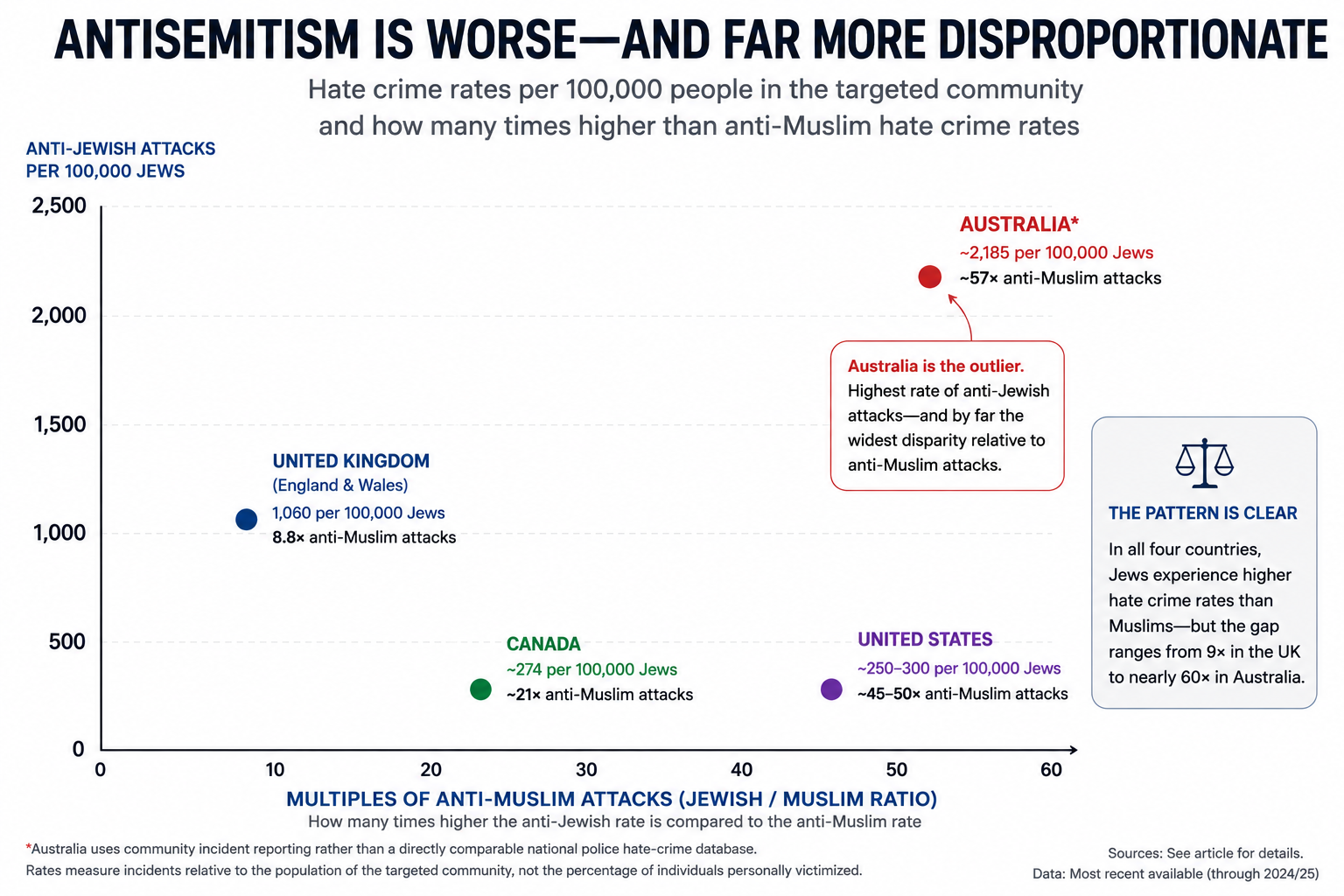
Lost in these anniversaries and large military battles against global jihadism is the softer war of words. Of civilian fear and hatred taking place on city streets and school campuses. Of the vastly disproportionate attacks on Jews than on Muslims in the English-speaking world.
There is no quick fix to stopping the torrent of attacks on Jews. But perhaps it is time to change the English term for Jew hatred to something like “Jewphobia” which forces people to confront their hatred as both irrational and anchored in fear. And then maybe the United Nations would finally recognize it the way it has elevated the less common “Islamophobia,” encourage governments and institutions to fight the scourge, as well as confront its own deep hostility for Jews around the world.