
In February 2001, long before Hamas ruled Gaza, long before Israel withdrew from Gaza, long before the security barrier, and long before the phrase “genocide in Gaza” became a campus chant, a United Nations “anti-racism” conference in Tehran was already accusing Israel of being a racist apartheid state guilty of crimes against humanity and “a form of genocide.”
The language was not improvised after October 7. It was drafted decades earlier.
Buried in the archives of the UN World Conference Against Racism sits a document that now reads like the prototype for today’s anti-Israel activism. Hosted by the Islamic Republic of Iran as the Asian preparatory meeting for the infamous Durban Conference, the 2001 declaration accused Israel of “racial discrimination,” “settler ideology,” “apartheid,” and genocide years before the events now routinely cited to justify those accusations.
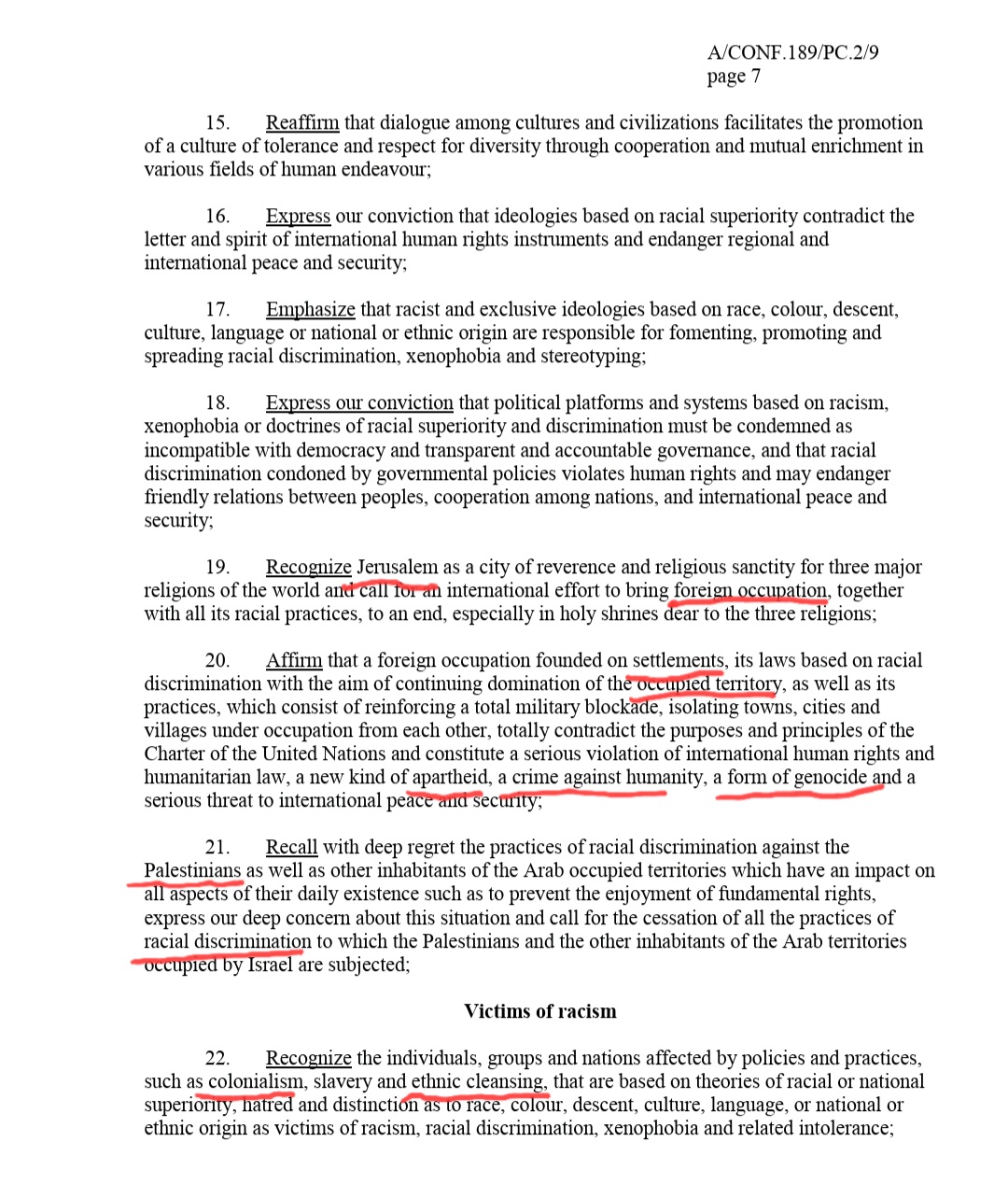
The Tehran declaration described Israeli policy as “a new kind of apartheid,” “a crime against humanity,” and “a form of genocide.” It condemned “foreign occupation founded on settlements” and portrayed Israel as a uniquely racist state. It attacked Israel’s Law of Return as “racially based” while endorsing a Palestinian “right of return,” and framed the conflict almost exclusively through the language of colonialism and racial supremacy.
This was February 2001. Hamas would not seize Gaza for another six years. Israel had not yet disengaged from Gaza. The major Gaza wars had not occurred. There was no October 7 massacre. There were no TikTok videos, no encampments, no “Globalize the Intifada” marches winding through Western capitals.
Yet the ideological framework already existed in complete form.
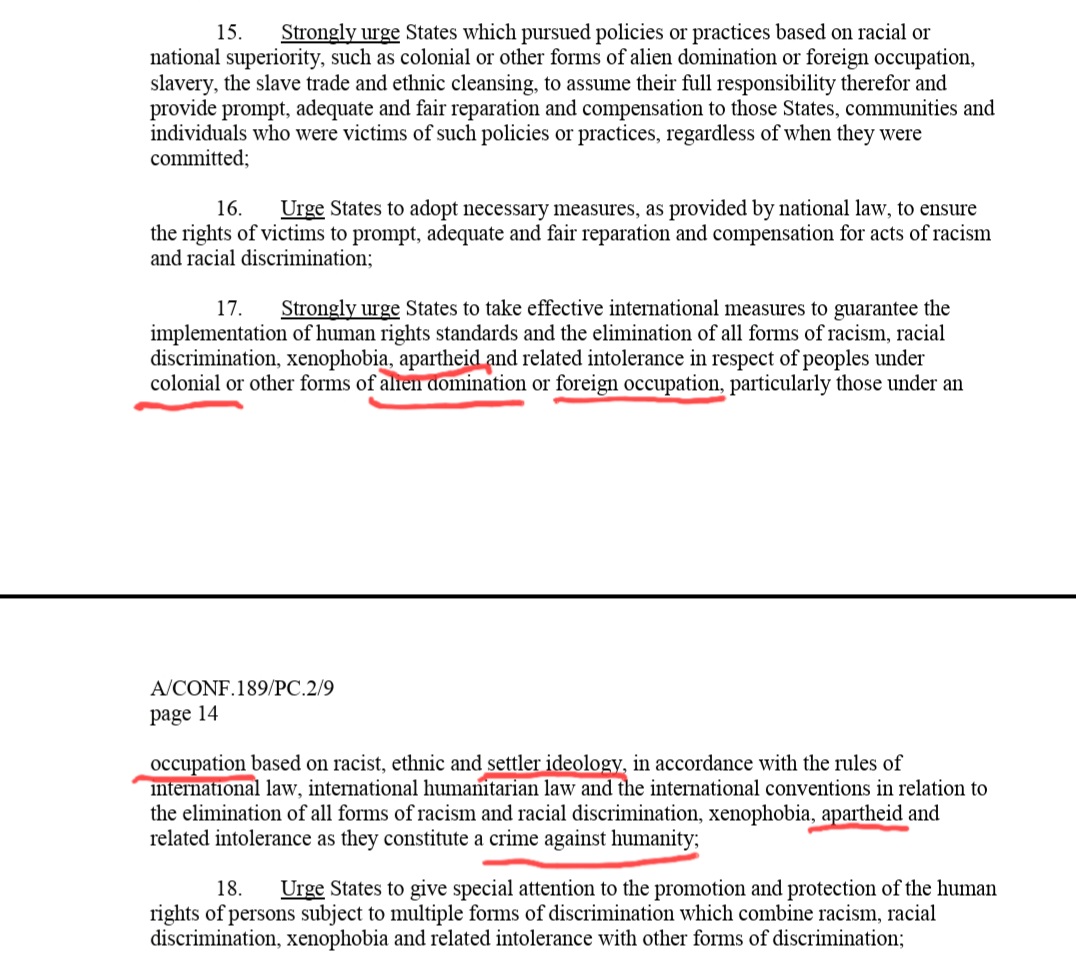
The core vocabulary was already there:
- apartheid
- settler colonialism
- genocide
- racial supremacy
- alien domination
- decolonization
The slogans were set. The distribution system under the framework of “anti-racism” needed time to become global.
Iran understood this battlefield earlier than much of the West did.
The Islamic Republic did not wage war against Israel on only one front. It developed a multi-front strategy: terror proxies, missile programs, regional encirclement, propaganda networks, diplomatic campaigns, university activism, NGO penetration and information warfare. The battlefield extended from southern Lebanon to UN conference halls.
Iran understood something many Western governments failed to grasp: narratives can outlive battlefields. Terror attacks shock people temporarily. Moral frameworks reshape generations.
The achievement of the campaign was not inventing new hatred. It was laundering their own very old anti-Jew hatred through the moral vocabulary of human rights.
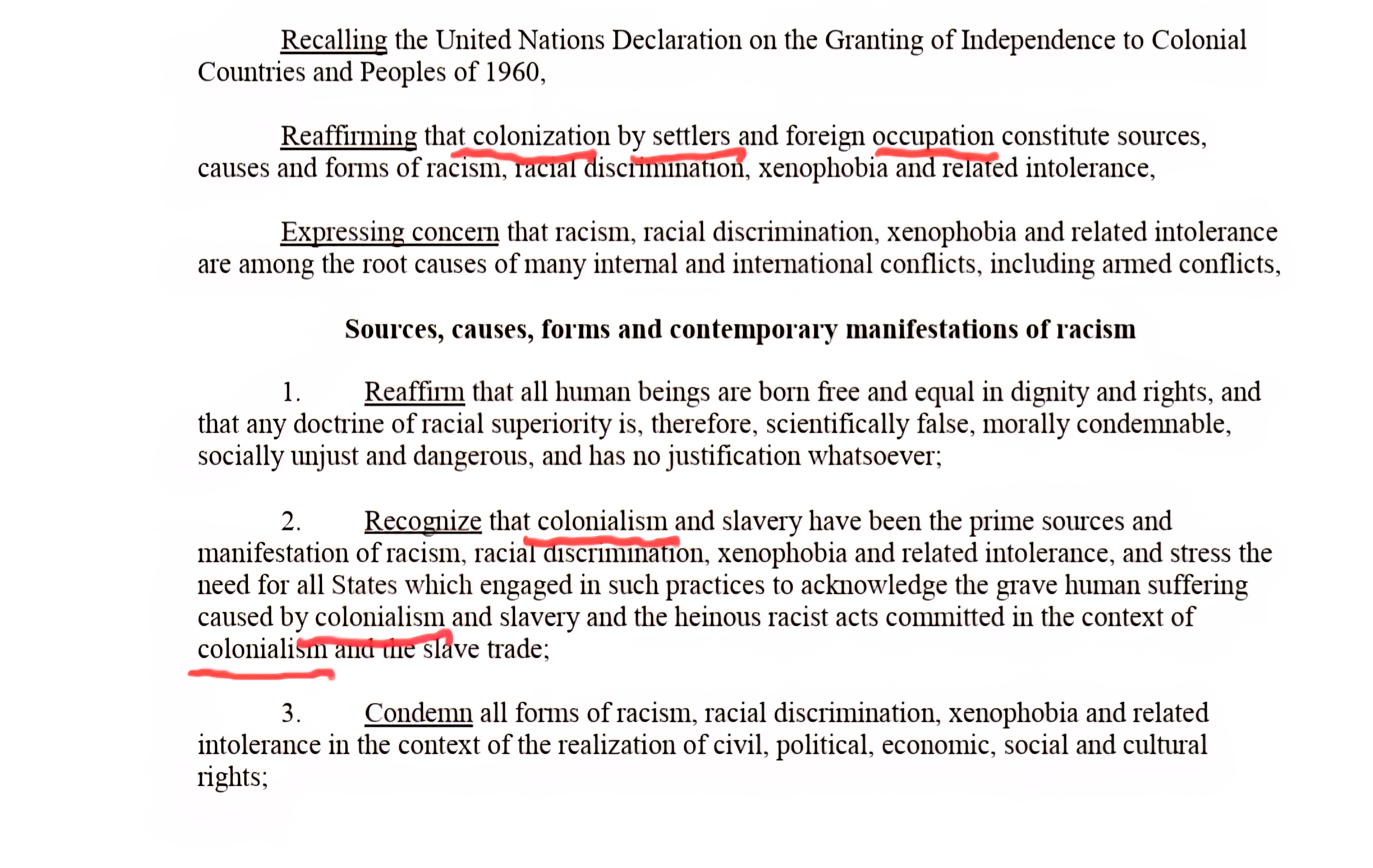
The regime in Tehran openly sought the destruction of the Jewish state while simultaneously helping construct an international framework portraying the Jewish state itself as the great racist evil of the modern world. The inversion was deliberate. A regime animated by antisemitism and eliminationist rhetoric repositioned itself as an anti-racist moral authority while recasting Israel as a global pariah.
Reality itself had to be inverted for the framework to function:
- The Jewish people had to be stripped of indigenous identity despite Judaism being born in the Land of Israel and the core of the Hebrew Bible.
- Jerusalem had to be detached from Jewish history despite being the holiest city in Judaism for three thousand years, and the direction of daily Jewish prayer.
- Hebrew had to become the language of “colonizers” despite originating in the same soil activists insist Jews have no connection to.
And Israel had to be recast as uniquely illegitimate despite being the most liberal, democratic and pluralistic society for a thousand miles in any direction.
The objective was to transform the Jewish state from a country that could be criticized into a moral obscenity that could not legitimately exist.
The Tehran document placed Israel into the moral category occupied by apartheid South Africa, colonial domination and crimes against humanity. Once a country is assigned that status, compromise becomes collaboration and coexistence becomes moral surrender.
Iran supplied the ideological fuel. Large parts of the Western activist ecosystem supplied the distribution network. The result was one of the most successful political rebranding campaigns of the modern era.
NGOs, academics, journalists, activist groups and eventually corporate and educational institutions absorbed the vocabulary and repackaged it as the language of progressive morality. Traditional antisemitism had become morally discredited after the Holocaust, so hostility toward the Jewish state was translated into the vocabulary of anti-racism, anti-colonialism and social justice.
The old image of the malevolent Jew became the malevolent Zionist.
Ancient hatreds were repackaged as the language of anti-racism and liberation.
The old demand that Jews disappear became “decolonization.”
And because the rhetoric arrived wrapped in the language of human rights, millions of educated Westerners could participate while imagining themselves enlightened rather than radicalized.
The asymmetry inside the Tehran declaration is particularly revealing. The document devoted extraordinary attention to portraying Israel as the embodiment of racism while saying nothing about antisemitism in the Arab world, terrorism against Israeli civilians, the expulsion of Jews from Arab countries, or the openly eliminationist ideologies as the bedrock of Hamas and Hezbollah.
The imbalance was not accidental.
The conference was not constructing a universal anti-racism framework. It was constructing a hierarchy of permissible outrage in which Jewish sovereignty itself could increasingly be reframed as a moral offense.
The Durban process that followed later became notorious for antisemitic incidents, anti-Israel propaganda and efforts to revive the old “Zionism is racism” framework using newer terminology. Western democracies eventually began boycotting later Durban conferences because they viewed them as platforms for anti-Israel demonization masquerading as anti-racism initiatives.
But by then the political grammar had already escaped containment.
Over time, phrases first drafted in Iran migrated into university syllabi, NGO reports, newsroom style guides, faculty petitions, diversity trainings and street protests. Students who have never heard of the Tehran conference now repeat its vocabulary almost word for word, unaware they are echoing a political script written decades earlier by regimes that openly sought Israel’s destruction.
Long before October 7, the architecture had been built, the slogans drafted, and the moral categories assigned. More powerful than even the 1975 UN resolution equating Zionism with racism, the new format for the 21st century is anti-Zionism is anti-racism.
For twenty years the distribution system slowly penetrated the world, and reframed Jew-hatred as morally acceptable under willing and unwilling eyes.
October 7 did not write the script. It activated one that had been waiting since 2001.

 First One Through