The international community keeps reaching for the same tool and calling it a solution.
It wasn’t in southern Lebanon. It won’t be in Gaza.
After the 2006 Lebanon War, the United Nations Security Council passed Resolution 1701 with clarity: no armed groups south of the Litani River except the Lebanese state and United Nations Interim Force in Lebanon. Hezbollah would withdraw. The area would be demilitarized.
It never happened.
Hezbollah didn’t disarm. It adapted. Fighters disappeared into civilian life. Weapons moved into homes and tunnels. Infrastructure embedded deeper. Over time, Hezbollah became stronger in the very zone it was supposed to vacate.
UNIFIL patrolled. It reported. It de-escalated when it could.
It did not enforce.
It could not.
That is not a tactical failure. It is the model.
A peacekeeping force without the authority or backing to impose outcomes becomes a bystander to violations it is tasked to prevent.
UNIFIL soldiers
Now the same model is being proposed for Gaza.
Disarm Hamas. Install a new authority. Deploy a multinational force to secure the peace.
It sounds familiar because it is.
Hamas, like Hezbollah, is not just a militia. It is a political and social organism backed by the Islamic Republic of Iran that is embedded in the population, sustained by ideology, and built to survive pressure. It will not voluntarily disarm into irrelevance.
And no external force—operating with limited mandate, constrained rules, and no appetite for sustained combat—will disarm it for them.
This is where the illusion breaks.
Peacekeeping works when peace already exists. It locks in outcomes. It does not create them. When deployed in the absence of resolution, it manages conflict. It does not end it.
That is what happened under 1701.
The “demilitarized zone” became a monitored one. Violations became routine. The temporary became permanent.
Hezbollah didn’t defy the system. It learned how to live inside it.
There is every reason to expect Hamas would do the same.
The problem is not execution. It is the belief that presence equals control. Blue helmets, patrols, liaison offices—they project order. They do not establish it.
Without a force willing and able to dismantle armed infrastructure and impose monopoly on violence, disarmament is not policy. It is aspiration.
Lebanon already ran this experiment. It didn’t produce peace.
Every year, the United Nations marks the International Day for Mine Awareness and Assistance in Mine Action, a day meant to focus the world on one of war’s most enduring dangers: explosives that linger long after the fighting ends. It is supposed to be about clarity, about identifying risks so civilians can return home safely.
Instead, it has become a case study in how language can blur reality.
The Secretary-General’s message follows a familiar script. Landmines, explosive remnants of war, improvised explosive devices—all grouped into a single, undifferentiated threat facing millions. Then comes the quiet insertion: Gaza. Not explained, not distinguished, simply placed alongside countries like Colombia, Ethiopia, Lebanon, Myanmar, and Syria—places long associated with entrenched landmine contamination. With that single move, a narrative is constructed without ever being explicitly stated.
The problem begins with the collapse of categories. Landmines, IEDs, and explosive remnants are not interchangeable. Landmines are deliberately planted, often victim-activated and designed to persist. IEDs are improvised weapons, most commonly used by non-state actors. Explosive remnants of war are what’s left behind—unexploded bombs, artillery shells, rockets. In Gaza, those distinctions are not academic; they are the entire story.
Hamas and other Palestinian militant groups have relied heavily on IEDs and booby traps as a core tactic. Not Israel. There does remain unexploded ordnance buried in rubble after extensive Israeli strikes. But the UN language compresses all three categories into one phrase and drops Gaza into the middle of it, allowing implication to do what evidence does not.
Just as telling is the disappearance of agency. The United Nations Mine Action Service and related reporting have acknowledged encountering IEDs in Gaza. But in public-facing messaging, the actor behind those devices vanishes. There is no mention of Hamas, the governing authority in Gaza that initiated this war with the October 7 attacks. There is no mention of homes rigged with explosives, of tunnels wired for ambush, of civilian infrastructure turned into tactical hazards. The war did not emerge from nowhere; it was launched by Gaza’s rulers, and Israel did not seek it. Yet in the UN’s framing, explosives simply exist, detached from the decisions and strategies that put them there. When agency disappears, accountability follows.
The rhetorical effect is powerful. By placing Gaza alongside countries defined by decades of landmine contamination, the UN shifts perception. Gaza becomes, in the public mind, a classic minefield. But it is not. It is a dense urban battlefield littered with booby traps and complicated by the deliberate use of improvised explosives by militant groups embedded within civilian areas.
The reality is that Gaza is a public hazard of itself. The mines, the terror tunnels under homes and schools, the embedded terrorists throughout neighborhoods is a tragedy the UN helped foster.
Rather than take a modicum of responsibility or lay blame on its adopted wards, the UN’s language pivots the blame on the victims of October 7. It deliberately has tried to change history and public perception that Israel deliberately turned Hamas into a large minefield when Gazans did that to themselves.
The International Day for Mine Awareness was created to expose hidden dangers, to name them clearly so they can be removed. Here, the danger is not only in the ground. It is in the language. When distinctions collapse and responsibility dissolves, understanding becomes another casualty. And in a conflict already defined by competing narratives, what remains unexploded in the words can be just as damaging as what lies beneath the rubble.
Religious liberty is not complicated. It does not require panels, frameworks, or warnings about artificial intelligence. It requires clarity.
The right to choose your faith. The right to practice it as you see fit. The right to pray openly, in your way, at your holy places. The right to walk away from it—without fear, without punishment, without death.
This is not a modern reinterpretation. It is the original standard.
In 1948, in the aftermath of a world war that exposed the catastrophic consequences of state control over belief and identity, the United Nations adopted the Universal Declaration of Human Rights. At its core sat Article 18, crafted with precision that set religious freedom as a benchmark of human rights.
“Everyone has the right to freedom of thought, conscience and religion; this right includes freedom to change his religion or belief, and freedom, either alone or in community with others and in public or private, to manifest his religion or belief in teaching, practice, worship and observance.” – UN Declaration of Human Rights, Article 18
Change it. Practice it. Live it.
That was the UN at its founding: defining principles meant to bind nations, not accommodate them.
If the speech had stayed anchored to Article 18, the omissions would have been impossible to ignore: apostasy treated as a crime, in some places a capital one; the right to convert denied in law; and access to holy sites restricted where it is most visible and most contested, to Jews on the Temple Mount in Jerusalem.
These are not edge cases. They are direct contradictions of the standard set in 1948.
They went unmentioned.
The reason is not subtle. The United Nations that wrote Article 18 was asserting principle in the shadow of catastrophe. The United Nations that speaks today operates at the consent and behest of large voting blocs. Many of those blocs come from the Global South, including dozens of Muslim-majority states that reject the core of Article 18 where it matters most: the right to change religion and the expectation that religious access should be reciprocal.
Within that reality, the boundaries of acceptable language narrow.
No mention of apostasy laws. No mention of capital punishment for conversion. No mention of restricted prayer where it cuts closest to the principle.
So the language adapts. The sharp edges of Article 18 are rounded into generalities that everyone can endorse, including those who, in practice, deny them. The result is a version of “religious liberty” that survives as rhetoric while its substance is negotiated away.
This is not an evolution of human rights. It is a retreat from them.
The United Nations once set a standard that stood above politics. Today, it reflects the ugly politics of those who sit within it. And as the Pope will tell you, there can be no peace without religious liberty. Ergo, the UN has become one of the primary sources of discord and violence in the world today.
The United Nations has released yet another report on violence against women. It reads like a catalogue of human depravity – Sudan, Congo, Haiti, Ukraine, Gaza – each documented, each calibrated to shock the conscience.
And it does but not for the reason the authors intend.
Because one of the most documented episodes of mass sexual violence in recent history is missing. Not debated. Not contextualized.
Absent.
On October 7, an estimated 6,000 Gazans invaded Israel and carried out atrocities that included the systematic rape and mutilation of women. This is not a matter of competing narratives. It has been documented by eyewitnesses, first responders, forensic teams, and subsequent investigations.
And yet, in a sweeping global report about violence against women, these victims disappear.
The report finds space for a child raped every half hour in the Democratic Republic of the Congo, for the explosion of abuse in Haiti, for war deaths in Ukraine, and for casualty figures in Gaza. Horrific and worthy of attention.
But the omission is not accidental. It is instructive.
Because what the United Nations is quietly establishing is a hierarchy of victims. Some suffering is elevated. Some is ignored. And some – when it disrupts a preferred political narrative – is erased altogether.
Jewish women fall into that last category.
That is not human rights reporting. It is narrative management.
And that distortion does not stay confined to UN documents. It bleeds outward. When the international system refuses to clearly name and center atrocities committed against Jews, it creates a form of moral cover. The record itself becomes a kind of absolution.
So when figures in the West – like the wife of New York City Mayor Zohran Mamdani, Rama Duwaji – publicly express approval for the October 7 massacre, the reaction is muted, rationalized, or ignored. The most grotesque elements of that day, including the sexual violence, have already been softened, blurred, or omitted by institutions that claim to stand for universal rights.
If the crime is not fully acknowledged, then the celebration of it can be more easily excused.
That is the downstream consequence of selective memory and outrage.
The United Nations is not failing to see. It is choosing not to look and remind the world about violent antisemitism. And in doing so, it transforms a report about protecting women into something far more revealing: a document that tells us which victims matter and which ones are inconvenient.
In that calculus, the rape and murder of Jewish women is not denied. It is deemed unworthy of inclusion. Perhaps even harmful, lest it paint its forever wards, the Stateless Arabs from Palestine (SAPs) in an unfavorable light.
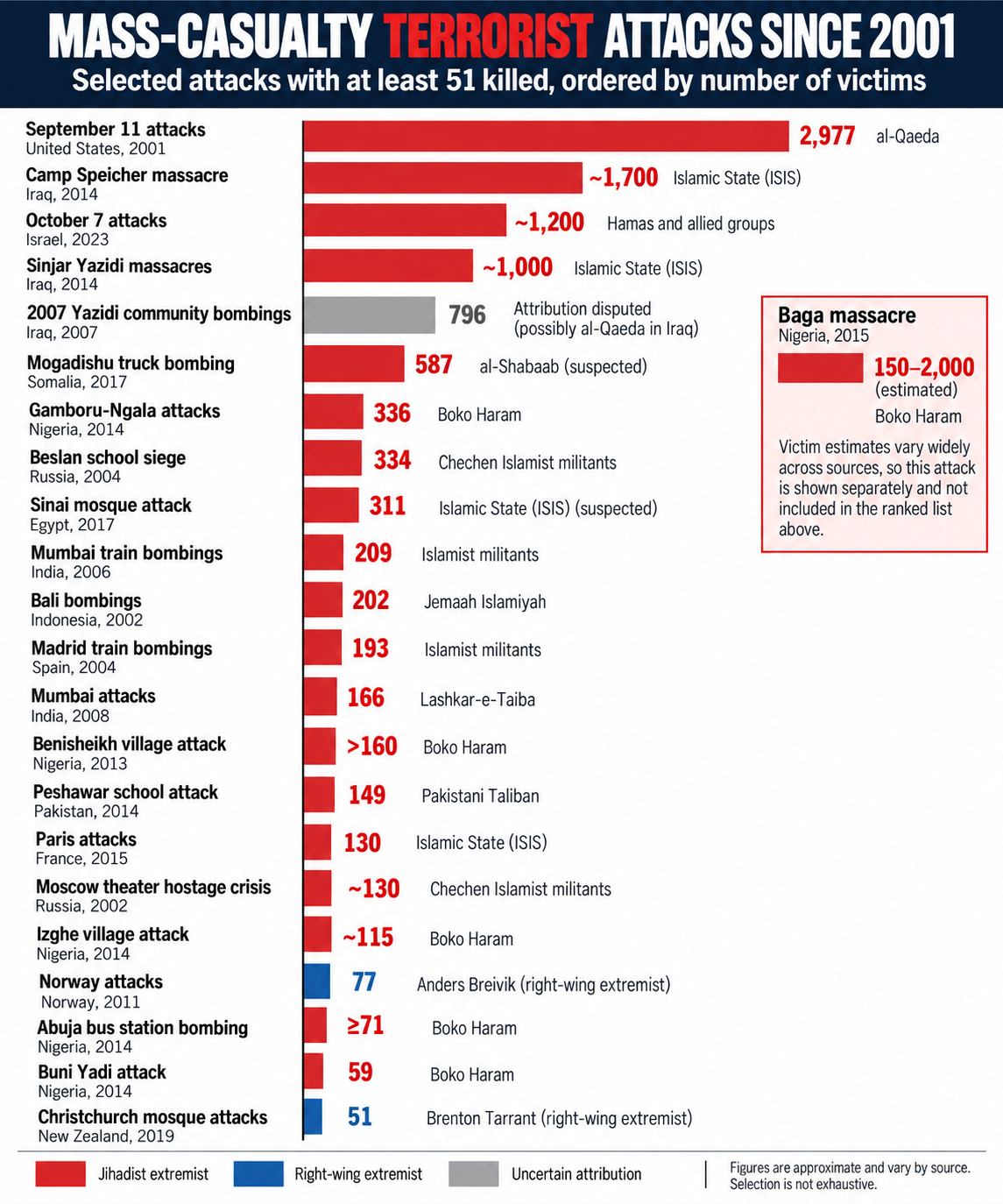
In 2022, the United Nations created the International Day to Combat Islamophobia, observed each year on March 15.
The date commemorates the victims of the Christchurch mosque shootings in New Zealand, where worshippers were murdered during a terrorist attack in 2019.
Hatred directed at any religious community deserves condemnation. But the decision raises an uncomfortable question: why is Islam the only religion granted a dedicated global day to combat hatred?
Islam is hardly a marginal faith. With roughly two billion followers, it is one of the largest and fastest-growing religions in the world and the majority religion across dozens of countries stretching from North Africa through the Middle East and into Asia. Within the UN itself it is represented by a powerful diplomatic coalition, the Organization of Islamic Cooperation, a bloc of 57 states that frequently coordinates its positions inside the General Assembly.
Yet Islam is the only religion singled out for a specific UN observance addressing prejudice against its followers.
Other religious communities facing persistent hatred receive no comparable recognition.
There is no UN day dedicated specifically to combating antisemitism today, despite the fact that Jews are the most frequently targeted religious minorities per capita in many countries. While the UN does observe International Holocaust Remembrance Day each January to commemorate the genocide of Jews during The Holocaust, that observance focuses on crimes committed eighty years ago. There is no equivalent UN day focused on antisemitism in the present.
Nor is there an observance addressing anti-Christian persecution, even though research by organizations such as Open Doors and studies by Pew Research Center consistently show that Christians face some of the largest levels of religious persecution globally in absolute numbers.
The UN does maintain a broader commemoration—the International Day Commemorating Victims of Acts of Violence Based on Religion or Belief—but that observance focuses on victims after violence occurs, not on confronting the ideologies that fuel it.
Except in one case: Islam.
The religion which dominates the countries where Christians are most persecuted, including: Somalia, Libya, Eritrea, Yemen, Nigeria, Pakistan, Sudan and Iran.
Violence the UN Does Not Mark
The choice of March 15 highlights another inconsistency.
Deadly attacks on synagogues have occurred repeatedly in recent years.
In 2018, eleven Jews were murdered in the Pittsburgh synagogue shooting at the Tree of Life synagogue, the deadliest antisemitic attack in American history. In Germany, a terrorist attempted to massacre Jews during Yom Kippur in the Halle synagogue shooting.
And in October 2025, a Jewish man was fatally stabbed outside a synagogue in Manchester, England, in an attack carried out on Yom Kippur, the holiest day in Judaism, when Jews gather in synagogues around the world for prayer and reflection.
Synagogues across Europe and North America have repeatedly been targets of shootings, stabbings, and attempted massacres.
Yet no comparable United Nations observance exists dedicated specifically to combating antisemitism tied to those attacks.
If the UN can create a global day tied to violence against mosques, why has it never created one tied to attacks on synagogues?
Politics Behind the Principle
The explanation lies less in theology than in politics.
For decades the powerful Organization of Islamic Cooperation has used its diplomatic weight to advance religious protection initiatives inside the UN system. Beginning in the late 1990s, the bloc pushed resolutions condemning what it called the “defamation of religions,” efforts widely understood as attempts to restrict criticism of Islam.
Western democracies resisted those proposals on free-speech grounds, and by around 2010 the campaign stalled.
So the strategy evolved.
Instead of defending religion from criticism, the focus shifted toward defending believers from discrimination under the banner of Islamophobia.
Opposing the initiative could now be portrayed as defending prejudice against Muslims, even if the broader debate still involved questions of speech, ideology, and religious critique.
In 2022 the effort succeeded with the creation of the UN’s International Day to Combat Islamophobia.
When Institutions Reflect Power
The episode reveals something fundamental about how the modern UN operates.
The organization does not function as a neutral body weighing global injustices. It functions as a political arena shaped by large voting blocs.
In the General Assembly—where every state has one vote regardless of size or political system—coordinated coalitions wield enormous influence. The 57 countries of the Organization of Islamic Cooperation represent a significant force in that system, often aligned with broader coalitions such as the Non-Aligned Movement.
Together these alliances can shape the symbolic agenda of the institution. They determine what the United Nations chooses to highlight and what it chooses not to see.
A Test of Moral Consistency
The United Nations was founded after World War II to defend universal human rights. But institutions derive legitimacy not only from their ideals, but from their consistency.
When some hatreds receive global recognition, others historical remembrance, and still others little acknowledgement at all, the institution begins to reflect political influence more than universal principle.
Combating religious hatred is a noble goal. But when that effort becomes selective, it reveals the farce and the forces controlling the United Nations.
The Jewish state is offered acceptance on two terms: 1) become less Jewish, and 2) take in those who want to end the Jewish State permanently.
The first demand asks the Jewish state to thin the very idea that created it. The national home is treated as temporary, acceptable only if its defining character softens and disappears.
People learning and praying at the Western Wall (Photo: First One Through)
The second demand asks the state to normalize existential risk. The perpetual state of war and support for killing Jewish civilians is ignored is rationalized under the rubric of Arab “frustration.”
Each demand strains reality. Together they form a toxic contradiction.
A country cannot weaken the basis of its existence while expanding exposure to those who challenge that existence, and still promise a degree of safety to its citizens. The condition for global approval erodes the basic condition for survival.
This is the impossible conditional embedded in international language, highlighted in UN resolutions. Acceptance in the Middle East and the community of nations is framed as the reward for steps that make recognition unnecessary because the conflict’s central object -the Jewish state – is expected to disappear into a new secular bi-national entity at best, and from the face of the Earth at worst.
Unsurprisingly, Israel cannot accept such terms. So the UN blesses the violence against it.
Remarkably, the world cannot understand why Israelis will not embrace the offer of acceptance coupled with the demand for self-immolation.
“These are people who went overseas supporting Islamic State and went there to provide support for people who basically want a caliphate.” – Australian Prime Minister Anthony Albanese
That is how states function.
Family members of suspected Islamic State militants who are Australian nationals walk toward a van bound for the airport in Damascus during the first repatriation operation of the year at Roj Camp in eastern Syria, Monday, Feb. 16, 2026. Thirty-four Australian citizens from 11 families departed the camp. (AP Photo/Baderkhan Ahmad)
Then the rule changes.
The United Nations insists Israel must accept the DESCENDANTS of people who were NEVER ISRAELI CITIZENS, who NEVER LIVED IN ISRAEL, and whose political movement LAUNCHED A WAR TO DESTROY ISRAEL. Entry is framed as a permanent right. Citizenship becomes an instrument of conflict.
This is not mere hypocrisy. It is a flawed and fatal doctrine.
The standard for Australia preserves states. The other pressures a single state to absorb a demographic outcome tied directly to a war against its existence.
“They are terrible situations. But they have been brought on entirely by horrific decisions that their parents made.” – Australia Home Affairs Minister Tony Burke, about banning the children of Australian “ISIS brides” from being allowed into Australia
The refugee framework applied to Palestinians is unique in modern history. It has its own bloated organization in which “refugee” (not even “internally displaced” for Arabs in Gaza and the “West Bank”) passes through generations indefinitely. International institutions reinforce it. Political leadership is incentivized to promise return rather than build final compromise.
That incentive has consequences.
If millions are told the conflict ends inside Israel rather than beside it, negotiations stall. If international bodies validate that expectation, maximalism becomes rational. If maximalism is rational, violence remains politically useful. Understood. Blessed.
This mindset has cost tens of thousands of lives because it keeps the central dispute unresolved. Each cycle of violence is fueled by the belief that time, pressure, and international legitimacy will deliver what negotiation has not.
States everywhere are allowed to defend sovereignty and security. Israel is told sovereignty and security is a matter for international bodies to determine.
Black Americans have long used a phrase that captures a structural grievance: over-policed and under-protected.
The complaint is that disproportionate scrutiny produces disproportionate outcomes. If people in one neighborhood are stopped more often, searched more often, cited more often, it will generate more arrests. Those arrests are then cited as proof that the scrutiny was justified. The cycle validates itself.
Israel occupies a similar structural position in international institutions.
At the United Nations Human Rights Council, Israel is the only country assigned a permanent, standalone agenda item — Item 7: “Human rights situation in Palestine and other occupied Arab territories.” Every regular session includes debate under this item. No other state – not China, not Iran, not North Korea – is subject to a standing country-specific agenda item.
The numbers reinforce the asymmetry. Since its creation in 2006, the Council has adopted more condemnatory resolutions against Israel than against any other country. In multiple sessions, Israel alone has faced more resolutions than the rest of the world combined.
Volume creates narrative.
Layer onto that the density of global media in Jerusalem – more permanent foreign correspondents than in most active war zones – and the scrutiny becomes constant. Every military action is instantly internationalized. Allegations become juridical language before investigations conclude. Terms like “war crimes” and “genocide” enter discourse early and stick.
The latest war began with an attack Israel did not initiate and repeatedly stated it did not seek. It conditioned an end to fighting simply on the return of hostages and disarmament, to which Gazans repeatedly refused. While urban combat against embedded fighters produces tragic civilian loss, the reported civilian-to-combatant ratios in this conflict fell well below ranges seen in other recent urban wars. That context rarely leads headlines.
Black Americans understand how presumption operates. When systems assume danger, data accumulates accordingly. When institutions assume guilt, findings follow.
“It’s the broader narrative of who belongs and who doesn’t, which allows certain groups to tap in the police department, to use the police department or weaponized the police department in ways that are conducive to violence against Black people” – Lallen T. Johnson, Department of Justice, Law and Criminology at American University
Similarly, the United Nations decided that Jews do not belong in Jerusalem – the holiest city in Judaism – or east of the 1949 Armistice Lines / the “West Bank”, so have developed a criminal system that specifically and persistently targets Jews. The mere presence of Jews is labelled “illegal” and an affront to international law.
“Condemning all measures aimed at altering the demographic composition, [presence of Jews] character and status of the Palestinian Territory occupied since 1967, including East Jerusalem,” – UN Security Council Resolution 2334
The United Nations made a law declaring Jewish presence at their holiest location to be illegal
When one minority community, whether it be racial or national, lives under permanent investigation, outcomes will look like confirmation of wrongdoing, even when standards are warped and unevenly applied.
Over-policing corrodes trust at home. Over-condemnation corrodes credibility abroad.
Justice requires symmetry. Blacks and Jews know it all too well.
In November 1943, Heinrich Himmler sent a telegram to Haj Amin al-Husseini on the anniversary of the Balfour Declaration.
He wrote of a “shared recognition of the enemy” and “the joint fight against it.”
“The enemy” meant world Jewry.
That phrasing did real work. It turned a people into a threat. Once Jews were cast as a civilizational danger – “Jewish invaders” – their removal became a duty. Vocabulary cleared the ground and policy followed. Then came the machinery.
This is how collective persecution begins: define a group as the problem.
Eighty years later, the same grammar keeps resurfacing.
In Doha, Francesca Albanese, the United Nations Special Rapporteur on the occupied Palestinian territories, used the phrase “common enemy” to describe Israel. The target was the world’s only Jewish state. The effect was to cast Jewish sovereignty itself as something humanity must oppose.
That language strips legitimacy and treats existence as offense. It moves from argument to exclusion with the implied goal of eradication.
The pattern appears in American activism as well. Speaking at a conference hosted by American Muslims for Palestine, Zahra Billoo of the Council on American-Islamic Relations urged audiences to “oppose the polite Zionists too,” grouping mainstream Jewish institutions — synagogues, federations, Hillel chapters, civil-rights groups — into the camp of adversaries, “they are your enemies.”
The construction never changes.
Nazi Himmler: Jews are the common enemy. CAIR Billoo: Zionists are the enemy. UN Albanese: Israel is the common enemy.
Different decades. Different accents. Identical structure.
Demonization targets identity. Once identity becomes the indictment, anything feels justified and the line between debate and dehumanization disappears.
After World War II, the human-rights system was built to prevent precisely this logic — the idea that an entire people could be pushed outside the moral community. Yet the vocabulary has returned, polished and respectable, spoken from podiums that claim the language of justice.
When the Nazis called Jews “the enemy,” the world should have drawn the line right there. No conferences. No nuance. No excuses. Anyone who speaks that way disqualifies themselves.
That same rule applies now.
Human-rights officials who talk like antisemitic propagandists should lose their mandates. Activists who label Jews the enemy lose the claim to civil-rights leadership positions. Institutions that tolerate this language lose credibility.
The mob put a yellow Jewish Star on Jews 80 years ago and told everyone that they are the enemy. The mob is labelling Jews as Zionists today and doing the same. We shouldn’t pause to take action, if “never again” means anything.
When Jews are murdered in synagogues in Europe, the United Nations speaks plainly. The attacks are labeled antisemitic. The violence is called terrorism. Solidarity with the Jewish community is explicit, and justice is demanded.
When Jews are murdered in synagogues in Jerusalem, that clarity vanishes.
The same act—killing Jews at prayer—suddenly requires “context.” Terrorism is softened into “violence.” Antisemitism dissolves into “tensions.” Victims are anonymized, motives left unexplored, ideology carefully avoided. Language that flows easily in Europe locks up entirely in Israel’s capital.
UN Secretary-General never calls killing of Jews in Jerusalem rooted in “antisemitism.”
This is not rhetorical drift. It is doctrine.
The UN has formally adopted the Palestinian demand that Jews should not live in Jerusalem. Through measures such as UN Security Council Resolution 2334, it asserts that Jews may not alter the city’s “demographic composition.” That position freezes Jerusalem at a moment immediately following the Jordanian army’s ethnic cleansing of all Jews from the eastern half of the city between 1948 and 1967. Jewish expulsion is accepted as a legitimate baseline. Jewish return is treated as a violation of international law.
This is not neutrality. It is the institutionalization of an antisemitic premise: that Jews, uniquely among peoples, have no right to live in their holiest city.
Once that premise is accepted, Jewish life in Jerusalem becomes conditional. Jewish neighborhoods are labeled illegal. Jewish prayer is framed as provocation. Jewish presence itself is cast as destabilizing. Violence against Jews no longer reads as antisemitism but as political reaction to an allegedly illegitimate reality.
Under those conditions, motive cannot be named. Calling synagogue murders in Jerusalem “antisemitic terrorism” would require acknowledging that Jews are being targeted for who they are, in a city where the UN has already ruled they should not be. It would expose the connection between UN doctrine and the moral evasions that follow.
So the motive is omitted.
Aftermath of Jews slaughtered in synagogue
The UN does not merely tolerate the idea of Jews being removed from Jerusalem; it has encoded it. The language is bureaucratic—demographics, international law, peace—but the result is stark: a city where Jewish existence is treated as unlawful, and Jewish murder as a political complication.
The contrast with the rest of the world makes the pattern undeniable. The UN knows exactly how to speak about antisemitism. That moral vocabulary disappears only in Judaism’s holiest city, in the Jewish State’s capital, because the United Nations has endorsed the antisemitic wishes of radical jihadists.