For more than fifteen years, Boko Haram has waged one of the world’s deadliest terrorist insurgencies. Since 2009, the group has been responsible for the deaths of more than 35,000 people, with some estimates placing the toll significantly higher when indirect deaths from the conflict are included. It has massacred civilians in villages, churches, mosques, schools, and marketplaces. It has bombed public places, murdered those who refused to submit to its rule, and driven millions from their homes across Nigeria and neighboring countries.
Kidnapping has been one of its defining tactics. The 2014 abduction of 276 schoolgirls from Chibok drew worldwide attention, but it was only one of thousands of kidnappings. Women and girls have been forced into marriage and been raped. Boys have been recruited as child soldiers. Entire communities have lived for years under the constant threat of murder, abduction, and terror.
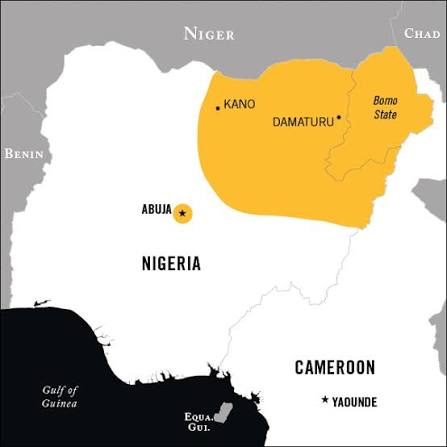
Boko Haram rejects the legitimacy of Nigeria, a United Nations-member state. It seeks to replace it with its own extremist Islamist regime.
Yet almost no one argues that Boko Haram deserves its own country. No demonstrations demand that its leaders be rewarded with sovereignty. No governments argue that decades of massacres, hostage-taking, and terrorism should culminate in international legitimacy.
There are now 157 countries that recognize Palestine. That look at the war between Israel and Palestine as one between two sovereign states, one which invaded another, raped and burned people alive, and took 251 hostages. These nations didn’t pause to question whether Palestine has a right to exist, but got three more countries to join in their sadistic effort.
Perhaps it is time for the 36 countries which do not recognize Palestine to put a resolution before the UN to recognize Boko Haram as the legitimate government of Nigeria, or at least a breakaway state in the northeastern corner which they control.
Most people think UNRWA exists to care for Palestinian refugees until a Palestinian state is created.
Not so.
If that were its purpose, its schools, healthcare, and social services would have gradually been transferred to the Palestinian Authority as Palestinian self-government expanded these past many years, especially in the “West Bank” / East of the 1949 Armistice Lines.
UNRWA’s mission would shrink as Palestinian institutions grew stronger. Instead, UNRWA has remained a permanent parallel system that continues to grow every year.
Unlike every other refugee agency in the world, UNRWA passes refugee status across generations, creating an ever-growing population of registered refugees. That population’s political claim is not to a future Palestinian state, but to a claimed so-called “right of return” to towns in Israel.
That distinction is critical.
A “two-state solution” is based on two peoples exercising self-determination in two states. A mass movement of millions of Arabs who never lived in Israel into Israel would produce 1.5 states for Arabs and 0.5 states for Jews. Further, stripping Israel of its right to determine who gets to enter its country means it doesn’t have basic sovereignty.
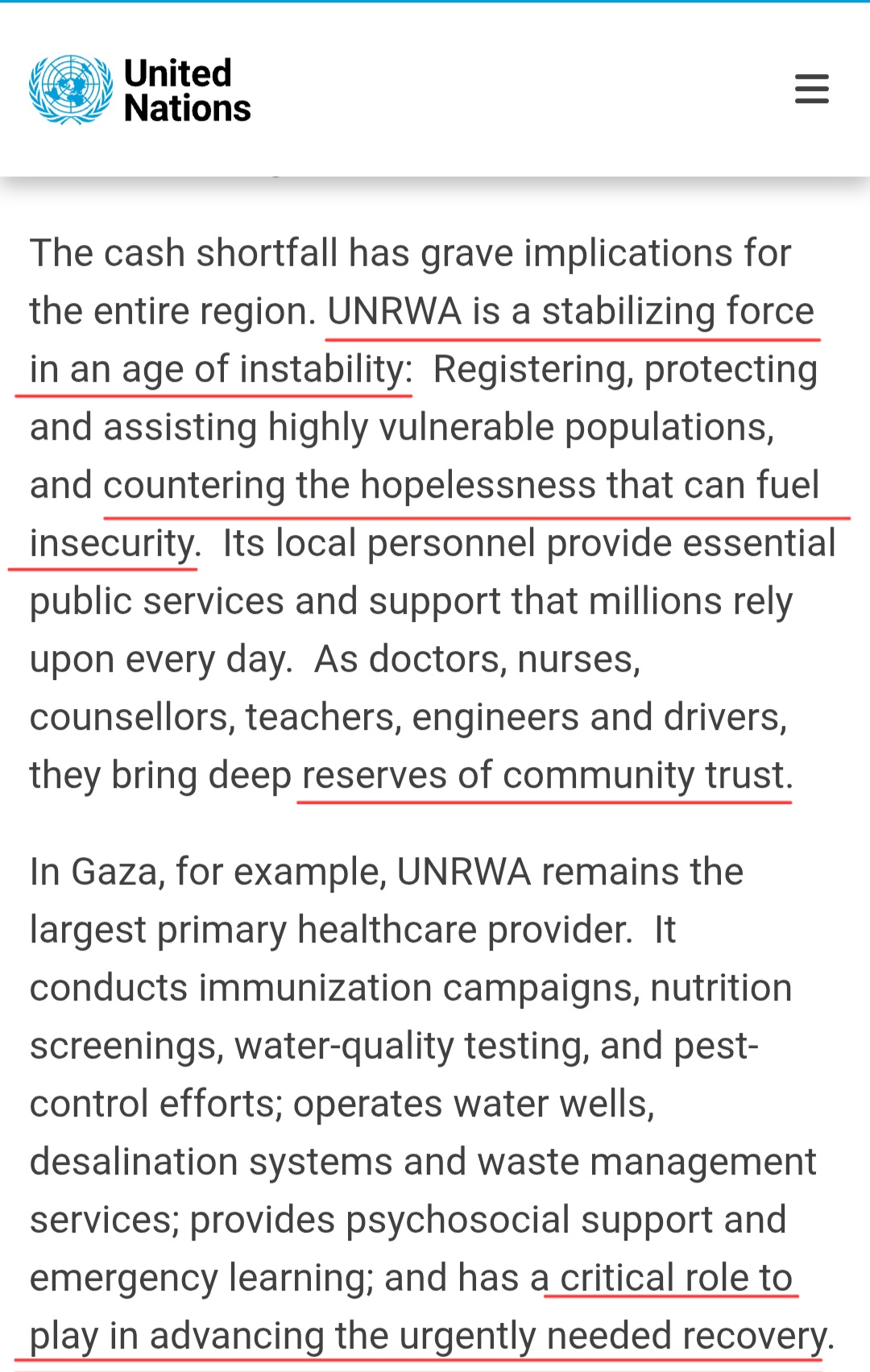
While UN Secretary-General Antonio Guterres claims that “UNRWA is a stabilizing force” it is precisely the opposite. As he urges the world to fund the immoral project, he lies that the agency is the force for “countering the hopelessness that can fuel insecurity.”
UNRWA has fed the lie that – and demands that it will continue to exist until – 6 million Arabs will move into Israel. Such mission is precisely opposite the goal of an Arab and Jewish state living in coexistence.
At its core, UNRWA is a political organization that negates Israel’s sovereignty, cloaked as a humanitarian organization. If the goal is truly a Palestinian state living alongside Israel, then UNRWA must be closed permanently as well as the discussion of a so-called “right of return” .
The United Nations has a Pact for the Future. It looks ahead to artificial intelligence, digital governance, climate change, sustainable development, financing, debt and even discussions of global taxation. The underlying premise is that humanity faces challenges unlike those of previous generations and that international cooperation must evolve accordingly.
Yet there is one omission that is difficult to ignore. While the international community has developed increasingly sophisticated frameworks to protect biodiversity, endangered languages, cultural artifacts and World Heritage Sites, it has produced no comparable vision for preserving one of humanity’s oldest living inheritances: its religions.
We have become remarkably good at preserving the products of civilization. Archaeologists restore temples after earthquakes. UNESCO protects historic churches, synagogues and mosques. Museums conserve ancient manuscripts while linguists race to document disappearing languages before the last native speakers die. We understand instinctively that once these treasures are lost, they cannot truly be recreated. Yet we devote far less attention to the living communities that gave those monuments meaning. A restored monastery is no substitute for the monks who once prayed there. An ancient synagogue is just beautiful stone if the Jewish community that sustained it for centuries has vanished. Preserving the architecture while allowing the faith itself to disappear is to save the shell while losing the civilization.
This is no longer a hypothetical concern. In only a generation, ISIS nearly exterminated the Yazidis while devastating ancient Christian communities whose roots stretched back to the earliest centuries of Christianity. The Taliban’s return to power accelerated the disappearance of Afghanistan’s Hindu and Sikh communities and forced Christians even deeper underground. Across parts of Africa, jihadist movements have burned churches, murdered clergy and displaced entire Christian villages. Indigenous and tribal religions continue to fade through modernization, migration and demographic collapse, while Jewish communities that had flourished across much of the Middle East and North Africa (MENA) for two millennia have largely disappeared. These are different stories unfolding on different continents, but together they reveal the same pattern: humanity’s religious diversity is steadily shrinking.
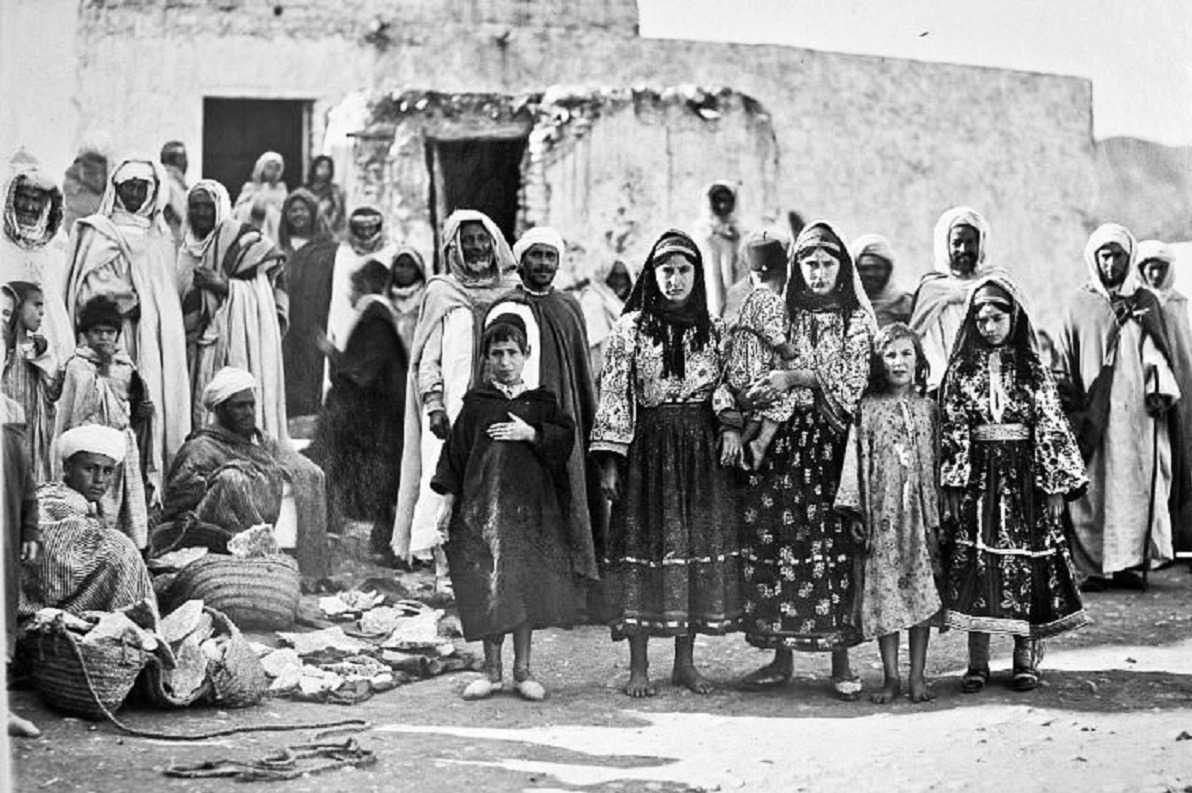
There were once an estimated 250,000 Jews in Morocco. They are have almost all left since 1948
Recent years have demonstrated how fragile minority religious and ethnic groups can be. Christians have seen ancient churches destroyed or emptied by war. Pilgrimages have been disrupted by conflict in multiple regions. Jews continue to be barred from praying openly at the Temple Mount in Jerusalem, the holiest site in Judaism.
The legal foundations for religious liberty already exist. Article 18 of the Universal Declaration of Human Rights recognizes the freedom of thought, conscience and religion, including the right to change one’s religion. Yet millions still live where that freedom exists only on paper. Apostasy remains punishable under law or through the application of religious law in several countries, while blasphemy laws continue to imprison people or expose them to severe punishment simply for changing or expressing their beliefs. At the same time, digital surveillance, online incitement and transnational extremist movements have created entirely new forms of religious persecution that the architects of the postwar human rights system could scarcely have imagined.
Radical Islamists call for killing converts from Islam
Perhaps the world needs a Pact for the Future of Religious Heritage – one that treats living religious communities with the same urgency that we reserve for endangered species, disappearing languages and historic monuments. Such a framework would protect sacred sites, preserve endangered faith traditions, defend freedom of conscience, encourage the repeal of laws criminalizing apostasy and blasphemy, establish rapid international responses to religious persecution, and affirm that followers of every religion should be able to freely, safely and openly worship at their sacred sites and undertake traditional pilgrimages.
Civilizations are remembered not only for the monuments they leave behind, but for the beliefs that inspired them and the communities that kept those beliefs alive. Humanity has learned to preserve forests, wildlife, manuscripts and archaeological treasures. The next step is to preserve something even older and even more fragile: the living faiths that have shaped civilizations for thousands of years.
The United Nations Secretary-General issued a statement yesterday condemning Israeli strikes on Hezbollah targets in Beirut.
That was expected.
What was remarkable was his explanation.
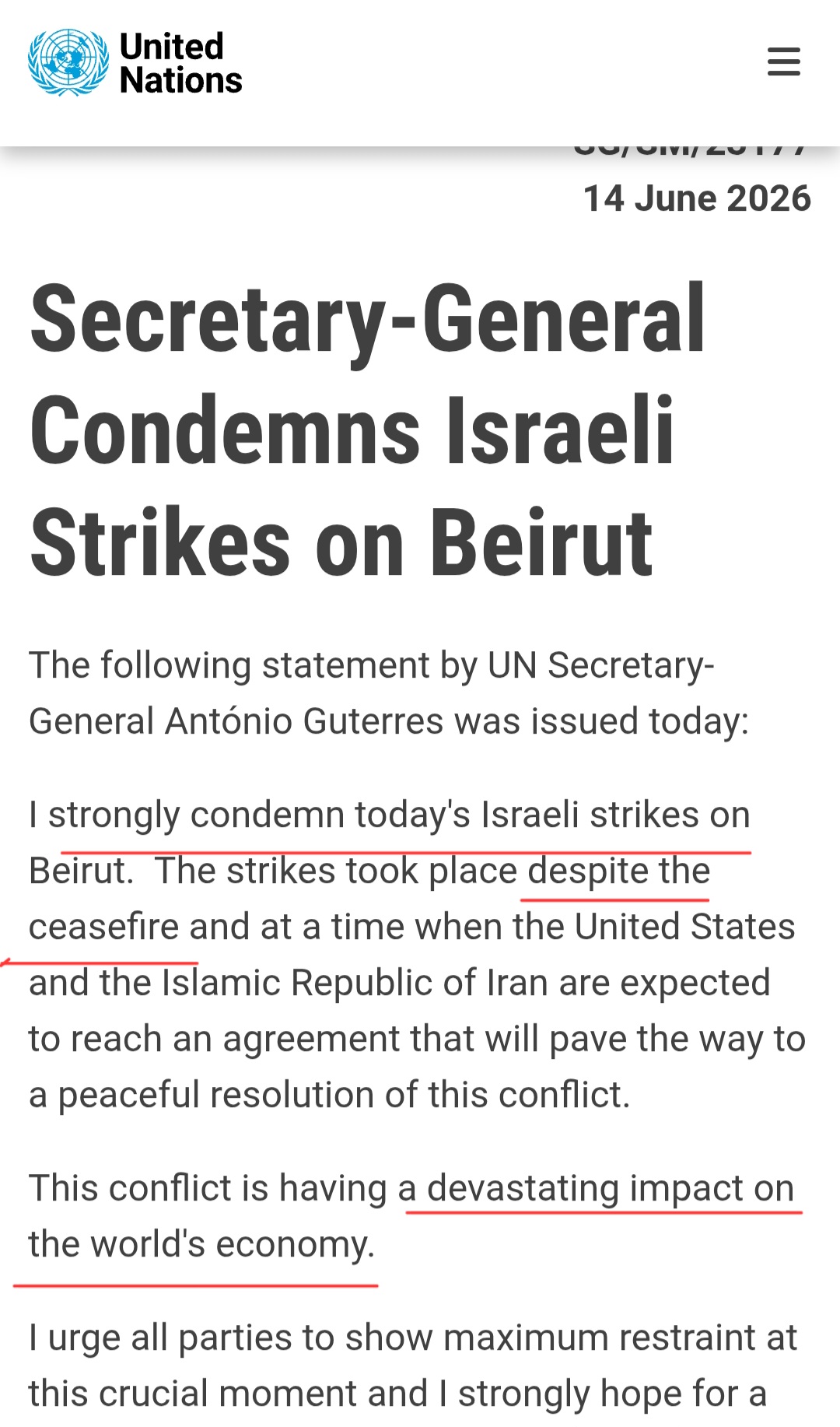
Guterres wrote that the strikes occurred “despite the ceasefire” and at a moment when the United States and Iran were expected to reach an agreement that would “pave the way to a peaceful resolution of this conflict.” He then added that “this conflict is having a devastating impact on the world’s economy.”
The statement raises an obvious question: what do his comments have to do with Israel and Hezbollah?
The negotiations were between the United States and Iran. Israel was not a participant. Israel did not negotiate the terms. Israel did not sign the agreement. American officials themselves stated that Israeli withdrawal from Lebanon was not a condition of the deal.
Yet Guterres presented Israel’s actions as though they were undermining an agreement to which Israel was never a party.
The logic becomes even stranger when he turns to the economy.
The conflict affecting global markets is not the war between Israel and Hezbollah. The economic concern revolves around the American war with Iran which threatens energy supplies and disrupts shipping routes. Markets do not react because Hezbollah fires rockets into northern Israel or because Israel strikes Hezbollah positions in Beirut.
But in the Secretary-General’s telling, Israel is the root cause.
A Hezbollah-Israel clash suddenly becomes a threat to the world economy. A U.S.-Iran negotiation suddenly becomes Israel’s responsibility. An agreement Israel never joined suddenly becomes grounds to condemn Israel.
This is absurd.
But it is a continuation of the farce that is the United Nations.
The UN Secretary General is so obsessed with vilifying Israel and getting the world to join in, that he manufactures reasons that are devoid of any logic.
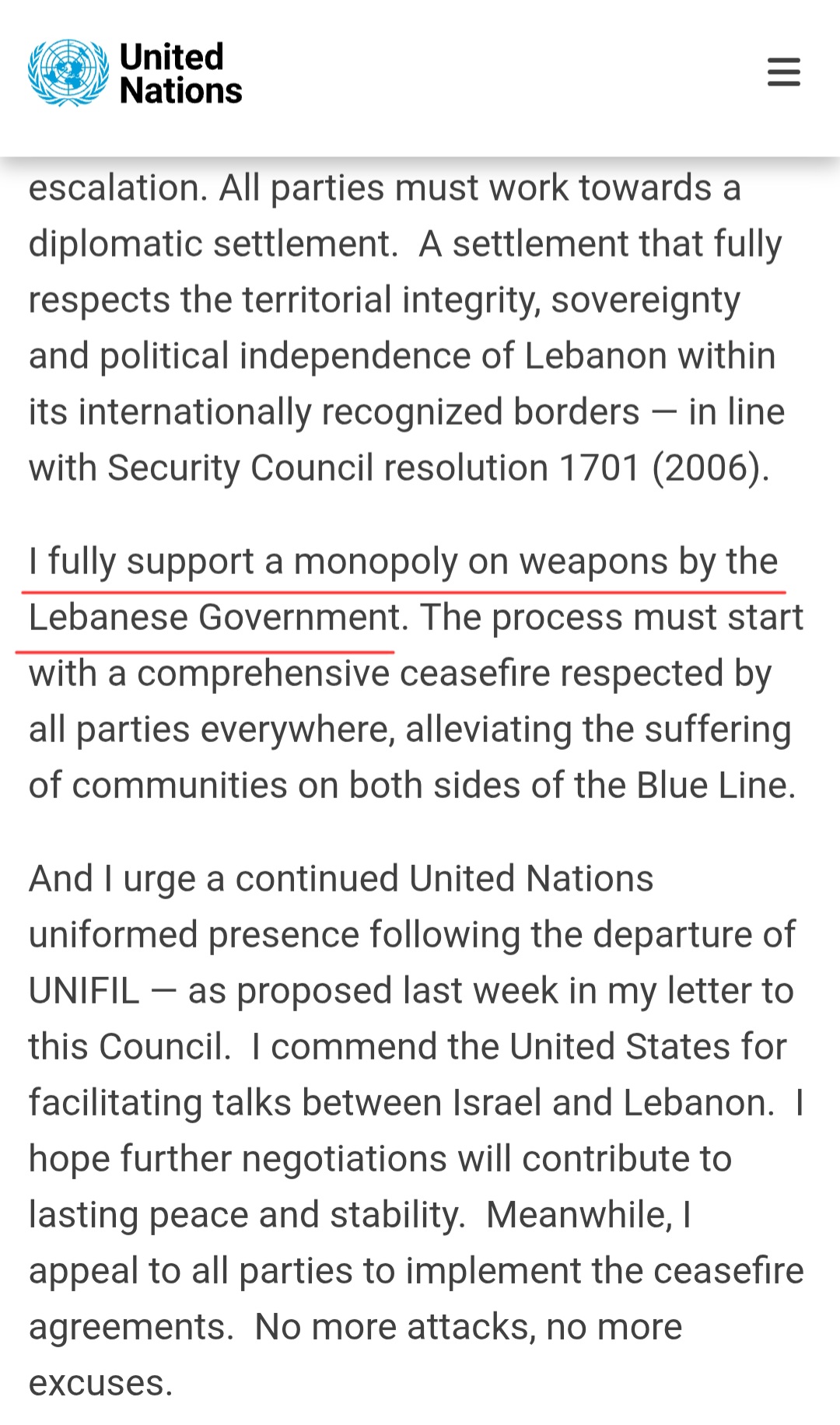
United Nations Secretary-General António Guterres recently declared that he supports “a monopoly on weapons by the Lebanese Government.”
He is right.
No sovereign state can exist when an organization maintains its own army outside central government control. Hezbollah may hold seats in parliament and participate in Lebanese politics, but that does not give it the right to possess an independent military force and wage war outside the direction of the government.
The obvious question is why the Secretary-General does not apply the same principle to Gaza.
If Lebanon requires a state monopoly on force, then so does any future Palestinian state. Hamas must be disarmed. There is no path to peace while an independent army remains outside governmental authority.
Yet the United Nations does not say so. Instead, it issues endless calls for ceasefires, negotiations, and diplomacy while avoiding the central reality that an armed movement dedicated to Israel’s destruction cannot simultaneously be the foundation for coexistence.
That double standard helps sustain the current conflict. Israelis and Gazans continue to suffer while international institutions refuse to confront the most basic requirement for ending the war.
But today’s war is not the real danger.
The real danger is what comes next.
Every major Palestinian poll points in the same direction. Palestinians are increasingly likely to hand control of the Palestinian Authority itself to Hamas or leaders who share Hamas’s objectives.
The result will not be a Palestinian Authority that replaces Hamas but Hamas becoming the Palestinian Authority.
At that point, Hamas will no longer be an armed movement operating from Gaza. It will be the internationally recognized government of Palestinian Arabs in Gaza and the West Bank. Its army will no longer be described as a militia but the armed forces of Palestine, internationally recognized, and still committed to the destruction of the Jewish state.
If so, the suffering of Israelis and Gazans today will pale in comparison to the conflict that follows.
Difficult situations are sometimes referred to as being between a rock and a hard place. The popular Palestinian terrorist group places the Middle East between a double standard and a destructive standard.
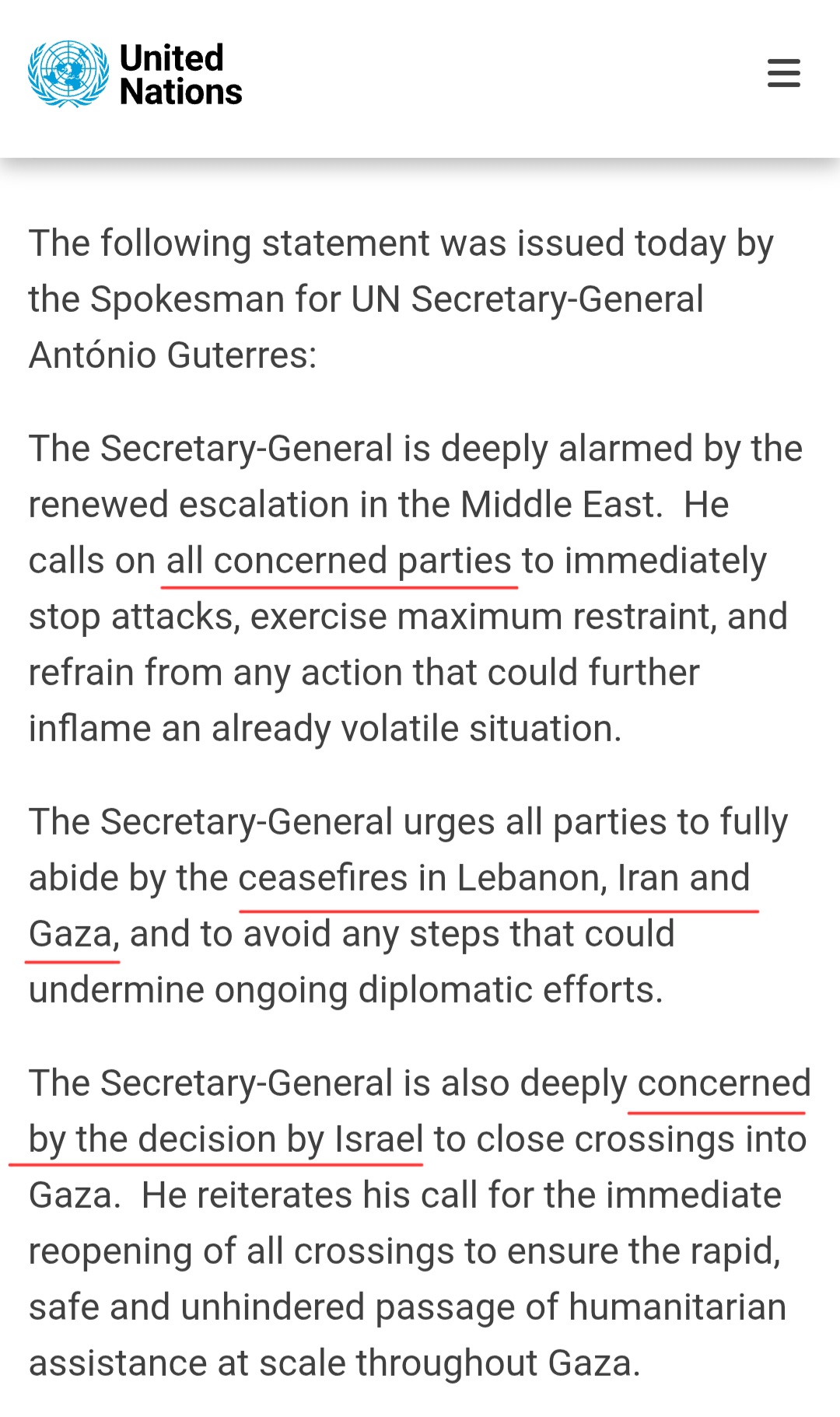
The UN Secretary-General’s latest statement on June 8 warns about conflict in Lebanon, Iran, and Gaza.
Yet Israel appears only as the actor, never as the target.
Iranian missiles are fired at Israel. Hezbollah drones cross into Israel. Houthi missiles target Israeli cities. Millions of Israelis live under the threat of attack.
But in much of the international conversation, the war is always somewhere else.
The fighting is “in Lebanon.” It is “in Iran.” It is “in Gaza.”
The reality is that Israel enters the story primarily when it responds.
This framing matters. It transforms Israel from a country under attack into a country that simply attacks. The missiles disappear. The drones disappear. The civilians running to shelters disappear.
A missile launched from Iran toward Haifa is not a conflict “in Iran.”
A drone launched from Lebanon toward Kiryat Shmona is not a conflict “in Lebanon.”
They are attacks on Israel.
Yet too often Israel appears in international statements only after it fires back.
That does not merely distort the geography of the war. It distorts who started it.
The UN Secretary General once again showed its victims of preference and that the global body is not concerned about the fate of Israelis.
For nearly two thousand years, Jews have ended prayers with the hope of returning to Jerusalem and rebuilding what once stood there. It is the location of the First and Second Temples. Jewish longing for Jerusalem is woven into daily prayers, holidays, weddings, and mourning rituals.
Yet major international bodies have passed resolutions referring to the site primarily through its Muslim names while minimizing or omitting its central place in Jewish history. Imagine a resolution discussing the Vatican without mentioning Christianity, or Mecca without mentioning Islam. The absurdity would be obvious.
The issue extends beyond language.
Official United Nations map labeling the Temple Mount as holy only to Muslims
The international community supports a protocol under which Muslims may pray freely on the Temple Mount while Jews are restricted from praying at Judaism’s holiest site. The result is extraordinary: the world’s only Jewish state is expected to enforce a policy under which Jews do not support a basic human right at their holiest location in favor of members of another faith.
The Temple Mount is not merely a religious site. It sits at the heart of a larger question: whether the Jewish people are entitled to the same rights afforded to every other people.
Around the world, international institutions celebrate indigenous peoples reconnecting with ancestral lands, reviving ancient languages, protecting sacred sites, and preserving cultural traditions. Yet only in the case of the Jewish people does a return to the place where their civilization, language, religion, and national identity were born become a form of “colonialism.“
International institutions routinely describe the Temple Mount and the Jewish Quarter as part of “occupied Palestinian territory.” Yet these are the very places where Jewish civilization was born, where the ancient Temples stood, and where Jewish communities lived for centuries.
Jordan’s capture of eastern Jerusalem in 1948 resulted in the expulsion of its Jewish population and the denial of Jewish access to the Western Wall, the Temple Mount, and the Jewish Quarter for nineteen years. It granted citizenship to residents as long as they weren’t Jewish. The UN seemingly liked this. International discussion of the Old City of Jerusalem begins after the expulsion of Jews, as though their absence were the natural condition and their return the disruption.
The same pattern appears in discussions of territory.
The Green Line was never intended to be a permanent border. The 1949 Armistice Agreements explicitly stated that the line was not a political boundary and would not prejudice future negotiations. It was a military ceasefire line drawn after a war.
Yet decades later, much of international law treats that armistice line as though it were a sacred border whose crossing transforms ordinary Jews into international criminals.
A Jew who moves across that line becomes a “settler.” An Arab who moves into the same building does not. The geography is identical. The identity of the resident is what changes.
International institutions frequently oppose changes to the “demographic character” of eastern Jerusalem. But demographic character relative to what date?
The answer is effectively 1949, the year after Jordan captured eastern Jerusalem and expelled every Jew from the Jewish Quarter and surrounding areas. Why should the demographic baseline for justice be the moment immediately following the ethnic cleansing of Jews?
Why not 1980? Why not 2000? Why not today?
Human beings move. Cities evolve. Neighborhoods change.
The only way to preserve a specific demographic snapshot forever is to decide that one particular population must be prevented from returning.
In Jerusalem, that population happens to be Jews.
Then there is the question of refugees.
The same international system that opposes Jews moving into neighborhoods beyond the Green Line frequently endorses claims that millions of Palestinian refugees and descendants should be allowed to settle inside Israel.
Movement in one direction is described as a right. Movement in the other direction is described as a violation of international law.
The asymmetry is impossible to miss.
Every era develops its own vocabulary for antisemitism. In medieval Europe it often spoke the language of theology. In the nineteenth century it spoke the language of race. Today it increasingly speaks the language of international law.
Around the world, international institutions celebrate indigenous peoples reclaiming ancestral lands, reviving ancient languages, protecting sacred sites, and restoring cultural traditions.
Jews have done all of those things.
They returned to the land where their civilization was born. They revived Hebrew from a language of prayer into a language of everyday life. They restored Jewish sovereignty to the city that has stood at the center of Jewish life for three millennia. They reestablished communities at many of their most ancient holy sites.
Yet only in the case of the Jewish people does this story become one of colonialism rather than return.
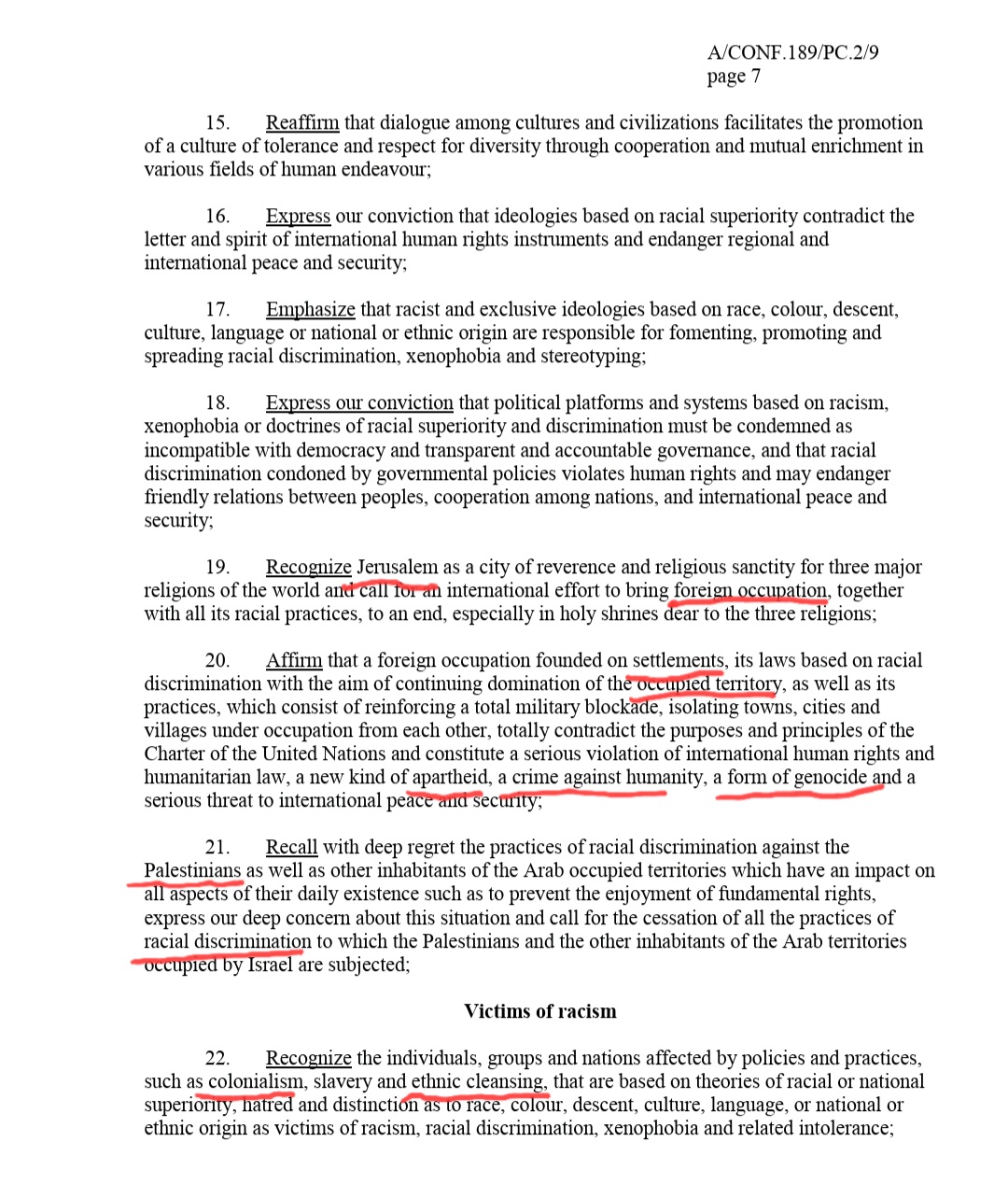
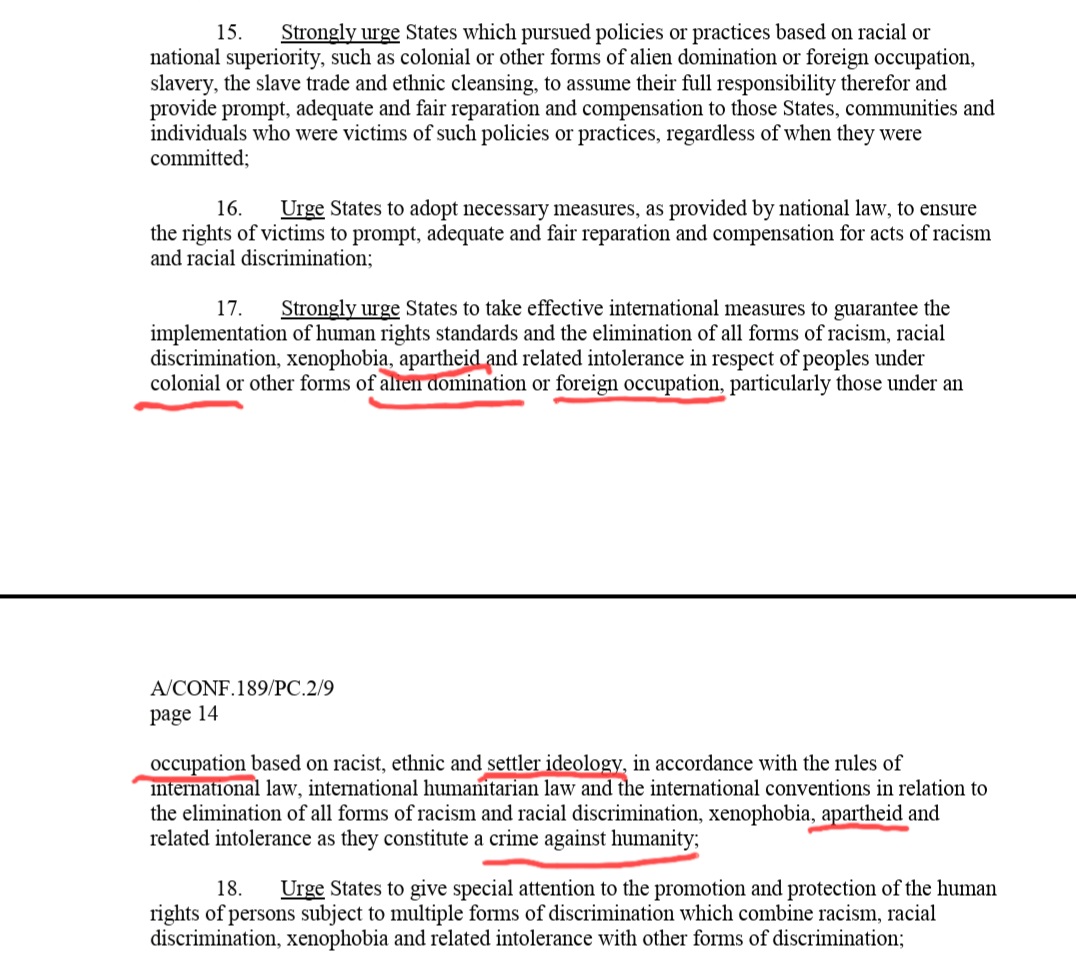
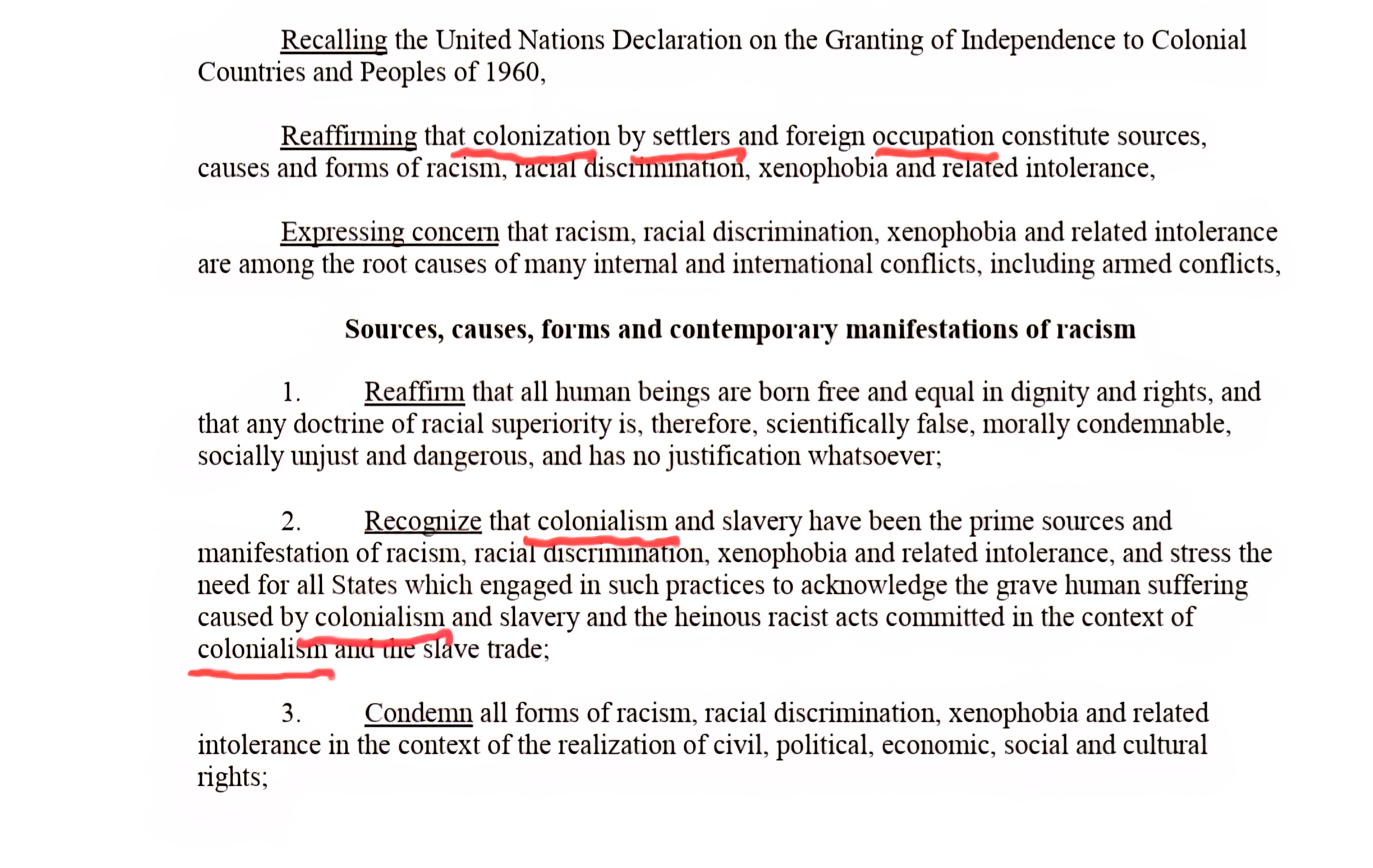
In February 2001, long before Hamas ruled Gaza, long before Israel withdrew from Gaza, long before the security barrier, and long before the phrase “genocide in Gaza” became a campus chant, a United Nations “anti-racism” conference in Tehran was already accusing Israel of being a racist apartheid state guilty of crimes against humanity and “a form of genocide.”
The language was not improvised after October 7. It was drafted decades earlier.
Buried in the archives of the UN World Conference Against Racism sits a document that now reads like the prototype for today’s anti-Israel activism. Hosted by the Islamic Republic of Iran as the Asian preparatory meeting for the infamous Durban Conference, the 2001 declaration accused Israel of “racial discrimination,” “settler ideology,” “apartheid,” and genocide years before the events now routinely cited to justify those accusations.
The Tehran declaration described Israeli policy as “a new kind of apartheid,” “a crime against humanity,” and “a form of genocide.” It condemned “foreign occupation founded on settlements” and portrayed Israel as a uniquely racist state. It attacked Israel’s Law of Return as “racially based” while endorsing a Palestinian “right of return,” and framed the conflict almost exclusively through the language of colonialism and racial supremacy.
This was February 2001. Hamas would not seize Gaza for another six years. Israel had not yet disengaged from Gaza. The major Gaza wars had not occurred. There was no October 7 massacre. There were no TikTok videos, no encampments, no “Globalize the Intifada” marches winding through Western capitals.
Yet the ideological framework already existed in complete form.
The core vocabulary was already there:
apartheid
settler colonialism
genocide
racial supremacy
alien domination
decolonization
The slogans were set. The distribution system under the framework of “anti-racism” needed time to become global.
Iran understood this battlefield earlier than much of the West did.
The Islamic Republic did not wage war against Israel on only one front. It developed a multi-front strategy: terror proxies, missile programs, regional encirclement, propaganda networks, diplomatic campaigns, university activism, NGO penetration and information warfare. The battlefield extended from southern Lebanon to UN conference halls.
Iran understood something many Western governments failed to grasp: narratives can outlive battlefields. Terror attacks shock people temporarily. Moral frameworks reshape generations.
The achievement of the campaign was not inventing new hatred. It was laundering their own very old anti-Jew hatred through the moral vocabulary of human rights.
The regime in Tehran openly sought the destruction of the Jewish state while simultaneously helping construct an international framework portraying the Jewish state itself as the great racist evil of the modern world. The inversion was deliberate. A regime animated by antisemitism and eliminationist rhetoric repositioned itself as an anti-racist moral authority while recasting Israel as a global pariah.
Reality itself had to be inverted for the framework to function:
The Jewish people had to be stripped of indigenous identity despite Judaism being born in the Land of Israel and the core of the Hebrew Bible.
Jerusalem had to be detached from Jewish history despite being the holiest city in Judaism for three thousand years, and the direction of daily Jewish prayer.
Hebrew had to become the language of “colonizers” despite originating in the same soil activists insist Jews have no connection to.
The objective was to transform the Jewish state from a country that could be criticized into a moral obscenity that could not legitimately exist.
The Tehran document placed Israel into the moral category occupied by apartheid South Africa, colonial domination and crimes against humanity. Once a country is assigned that status, compromise becomes collaboration and coexistence becomes moral surrender.
Iran supplied the ideological fuel. Large parts of the Western activist ecosystem supplied the distribution network. The result was one of the most successful political rebranding campaigns of the modern era.
NGOs, academics, journalists, activist groups and eventually corporate and educational institutions absorbed the vocabulary and repackaged it as the language of progressive morality. Traditional antisemitism had become morally discredited after the Holocaust, so hostility toward the Jewish state was translated into the vocabulary of anti-racism, anti-colonialism and social justice.
The old image of the malevolent Jew became the malevolent Zionist.
Ancient hatreds were repackaged as the language of anti-racism and liberation.
The old demand that Jews disappear became “decolonization.”
And because the rhetoric arrived wrapped in the language of human rights, millions of educated Westerners could participate while imagining themselves enlightened rather than radicalized.
The asymmetry inside the Tehran declaration is particularly revealing. The document devoted extraordinary attention to portraying Israel as the embodiment of racism while saying nothing about antisemitism in the Arab world, terrorism against Israeli civilians, the expulsion of Jews from Arab countries, or the openly eliminationist ideologies as the bedrock of Hamas and Hezbollah.
The imbalance was not accidental.
The conference was not constructing a universal anti-racism framework. It was constructing a hierarchy of permissible outrage in which Jewish sovereignty itself could increasingly be reframed as a moral offense.
The Durban process that followed later became notorious for antisemitic incidents, anti-Israel propaganda and efforts to revive the old “Zionism is racism” framework using newer terminology. Western democracies eventually began boycotting later Durban conferences because they viewed them as platforms for anti-Israel demonization masquerading as anti-racism initiatives.
But by then the political grammar had already escaped containment.
Over time, phrases first drafted in Iran migrated into university syllabi, NGO reports, newsroom style guides, faculty petitions, diversity trainings and street protests. Students who have never heard of the Tehran conference now repeat its vocabulary almost word for word, unaware they are echoing a political script written decades earlier by regimes that openly sought Israel’s destruction.
Long before October 7, the architecture had been built, the slogans drafted, and the moral categories assigned. More powerful than even the 1975 UN resolution equating Zionism with racism, the new format for the 21st century is anti-Zionism is anti-racism.
For twenty years the distribution system slowly penetrated the world, and reframed Jew-hatred as morally acceptable under willing and unwilling eyes.
October 7 did not write the script. It activated one that had been waiting since 2001.
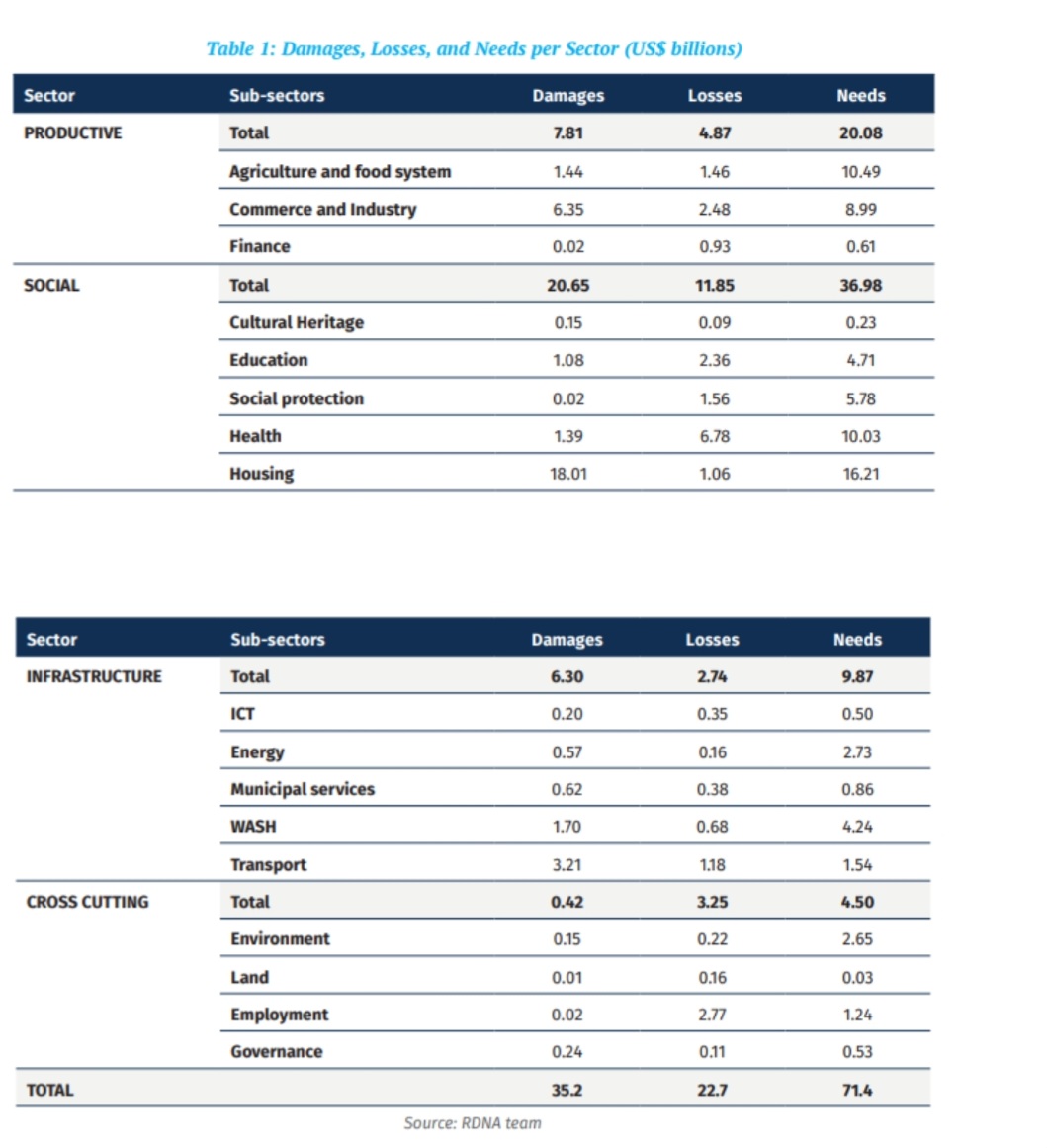
The world now knows what Gaza costs to rebuild: $71.4 billion. What it still does not know is what Gaza is supposed to become.
That is the number in the 2026 Rapid Damage and Needs Assessment (RDNA), produced by the United Nations with the World Bank and the European Union in April 2026. It is a vast and meticulous ledger of destruction, broken into sectors, sub-sectors, losses, and needs. It is also a revealing document, because the table tells you what the world thinks Gaza is.
A physical problem.
Housing: $16.21 billion.
Health: $10.03 billion.
Agriculture: $10.49 billion.
Commerce and industry: $8.99 billion.
Social protection: $5.78 billion.
Education: $4.71 billion.
Water and sanitation: $4.24 billion.
Energy: $2.73 billion.
Transport: $1.54 billion.
Total direct damages: $35.2 billion. Total economic losses: $22.7 billion. Total reconstruction needs: $71.4 billion.
RDNA assessment of cost to rebuild Gaza, April 2026
It is a complete inventory of physical devastation. Buildings crushed into powder. Water systems ruptured. Hospitals crippled. Roads fractured. Farms destroyed. Markets emptied.
The UN has priced the debris.
It has even priced the removal of the debris: $1.7 billion just to clear more than 68 million metric tons of wreckage.
But the table reveals something else.
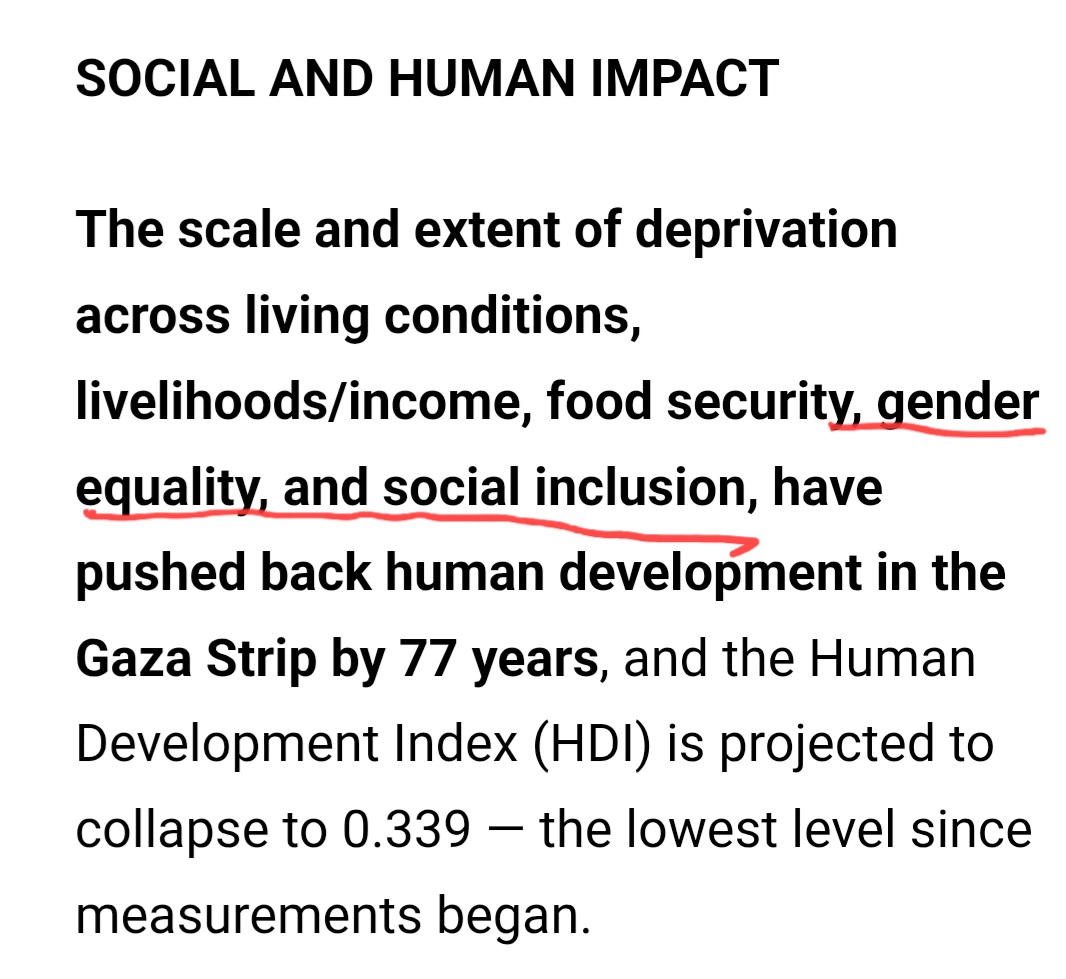
There is no line item for civic reconstruction. That is the missing category. There is something for “social protection” and even calls to improve “gender equality, and social inclusion,” but a refocus on building a healthy culture is absent.
RDNA report on rebuilding Gaza, April 2026
Not because it is unimportant. Because it is the hard. And the public may still be unwilling to accept it.
Civic reconstruction is the rebuilding of the political and social architecture of a society: education, norms, legitimacy, coexistence, rule of law, pluralism, and the delegitimization of political violence as a governing method.
Without it, reconstruction is replacement. There will be new buildings but the same “deformity” of ideology, to quote James Zogby in his testimony to the United Nations in June 2023.
Civic reconstruction requires power. And commitment. The UN has frameworks, funding channels, and institutional tools. It does not have sovereignty. It cannot rewrite a society by decree.
And that only makes the omission more consequential.
The UN report itself hints at the deeper crisis. It states that Gaza’s human development has been pushed back 77 years, with the Human Development Index projected to collapse to 0.339, the lowest level ever recorded.
Human development is not just electricity and sewage. It is the civic conditions that make human flourishing possible.
The report includes gender equality. Social inclusion. Employment. Governance.
All necessary.
But governance itself is budgeted at just $530 million, and that is administrative. Municipal function, institutional capacity and service delivery. Not civic transformation.
That distinction matters.
There is no budget line for:
coexistence education
curriculum reform
dismantling political incitement
independent civil society
women’s civic and legal empowerment beyond emergency protection
minority rights
ideological deradicalization
That is not a technical omission. It is the central question.
Postwar Germany was rebuilt through more than roads and housing. It went through total defeat, disarmament, a state monopoly on force, educational overhaul, and the systematic delegitimization of the ideology that had led it into catastrophe.
Postwar Japan followed the same path: constitutional redesign, political restructuring, educational transformation, and a new civic contract.
The physical debris mattered. But so did the ideological debris.
And ideological debris is harder to clear.
It does not sit in the streets. It lives in textbooks, political institutions, media ecosystems, religious messaging, and the stories a society tells itself about violence and legitimacy.
That debris remains.
The UN has measured Gaza’s physical debris. It has priced the roads, the hospitals, the pipes, the farms, the power grid. What it has not priced is the ideological wreckage underneath them.
That is the danger.
Physical reconstruction without civic reconstruction does not produce peace. It produces restoration.
And restoration means returning to the conditions that made destruction inevitable.
Schools can teach coexistence or sanctify martyrdom. Hospitals can preserve life or sustain armed rule. Roads can carry commerce or carry war.
A rebuilt Gaza can become the foundation of peace or the staging ground for the next war.
You can clear 68 million tons of rubble and still leave the most dangerous ruins standing.
Over the past century, pressure on Jews has scaled, shifting from borders to regions to institutions, changing form while carrying a familiar direction.
The story begins in Europe 1938 with the Anschluss. Persecution inside Germany extends outward as Austria is absorbed and its Jewish population is pulled into the same system. Expansion of antisemitic forces follows conquest. Poland, France, Hungary, the Netherlands become extensions of a single design as control spreads across the continent.
An den Fenstern j¸discher Geschfte werden von Nationalsozialisten Plakate mit der Aufforderung “Deutsche, wehrt euch, kauft nicht bei Juden” angebracht.
Policy matures into infrastructure. Collaboration, coercion, and indifference form a landscape in which Jewish survival is unlikely. At the Wannsee Conference, extermination is organized across borders, ministries, and railways. The Holocaust becomes a continental system aligned toward a single end: the genocide of Jews.
That system collapses with the war’s end but the pattern carries forward, reshaped and redirected.
After 1948, pressure reappears across the Middle East and North Africa (MENA). Jewish communities rooted for centuries in Iraq, Egypt, Yemen, Morocco and elsewhere begin to unravel with striking speed.
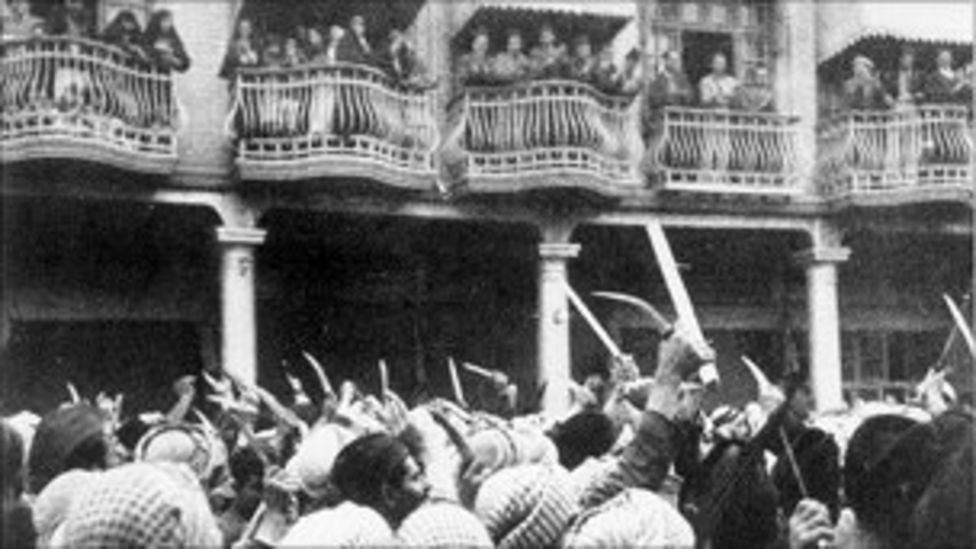
Baghdad Iraq’s 1941 slaughter of Jews
Each country follows its own path. Laws restrict, property is seized, pressure builds, departures accelerate. In Iraq, the Farhud foreshadows a collapse that soon becomes mass departure. In Yemen, Operation Magic Carpet lifts an entire community into exile. In Egypt, the Suez Crisis accelerates expulsions. Across North Africa, uncertainty and nationalism press communities toward exit. By the 1970s, nearly one million Jews leave and a regional Jewish presence that endured for centuries nearly vanishes completely.
By the 1970s, the arena shifts again. The contest moves from territory into legitimacy itself.
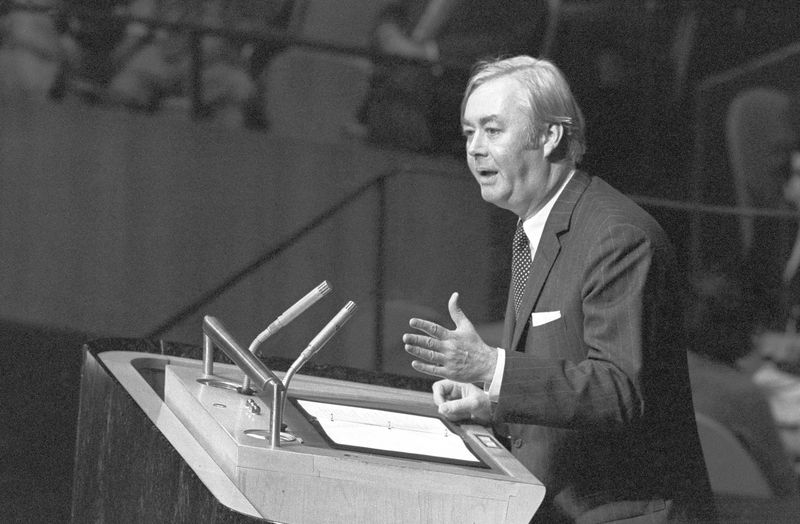
In 1975, the United Nations adopts United Nations General Assembly Resolution 3379, recasting Jewish self-determination as a moral offense within the central forum of international diplomacy.
US Ambassador to the United Nations, Daniel Patrick Moynihan reversing the Zionism is Racism resolution
The repeal arrives in 1991 through United Nations General Assembly Resolution 46/86, yet the framing travels beyond formal votes. It resurfaces at the World Conference Against Racism in Durban in 2001 and diffuses through NGOs, campuses, and international forums, where evolving language carries forward an enduring challenge to Jewish sovereignty.
From there, the argument migrates into the civic fabric of Western democracies. In the United States, United Kingdom, Canada, and Australia, vile ideas become chants in universities, media, and politics.
The mechanisms differ from earlier eras, yet the effects shape daily life. Jewish institutions increase security. Synagogues that once stood open now operate behind layers of protection. Public expressions of Jewish identity carry new calculations. Debates about Israel expand into broader judgments about Jews, blurring lines that once held more clearly.
Across these shifts, the effect becomes visible in the map of Jewish life.
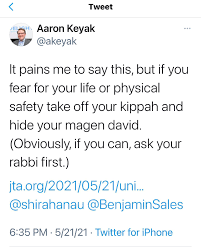
President Joe Biden’s Jewish liaison person suggests that Jews should hide their religious symbols in 2021
A century ago, Jewish communities spanned continents, anchored in Europe and present across the Middle East, North Africa, and the Americas. The destruction of European Jewry removed the largest center. The unraveling of communities across the Middle East and North Africa compressed what remained. Many moved to Israel. Others built new lives in the United States.
Today, roughly 85 percent of the world’s Jews live in those two countries. There are only seventeen countries with more than 25,000 Jews when there used to be dozens just a century ago.
That concentration follows a century in which environments that sustained Jewish life across dozens of countries collapsed, expelled, or eroded. Dispersion gave way to consolidation. Geography followed pressure.
The forces shaping that consolidation continue to evolve. As legitimacy is contested in broader arenas, communities orient toward places able to sustain security, identity, and continuity. The gravitational pull toward Israel strengthens under those conditions, even as the United States remains a central pillar of Jewish life.
While Yom Ha’atzmaut marks Israel’s independence, it also marks the emergence of a center of gravity forged through history rather than theory. Across a century, shifting forms of pressure reshaped where Jews could live, how they gathered, and where they anchored their future.
Three arcs across a century redrew the Jewish map. As the narrative arc is still underway, Israel’s percentage of world Jewry will likely become a majority from a plurality, in just a few years.