This Simchat Torah, I keep thinking about what is missing.
For some families, the absence is unbearable and permanent. A child, a parent, a spouse, a friend who was alive on the last Simchat Torah before October 7 and is no longer here. Every holiday marks time, but an anniversary holiday also measures absence. Another year has passed. Another place at the table remains empty. Another circle forms with someone missing from it.
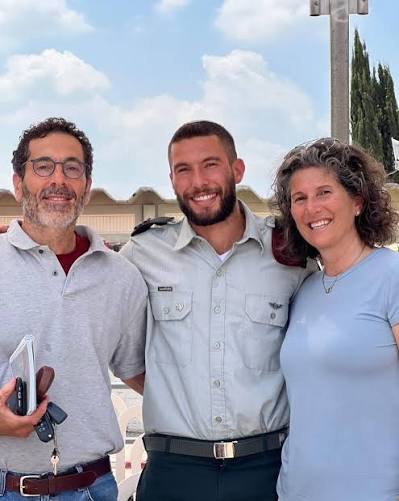
Aryeh Ziering with his parents, killed as he responded to the massacre by Gazans on October 7, 2023
Loss is embedded in Simchat Torah itself. We reach the end of the Torah and lose Moses.
The man who confronted Pharaoh, led us through the sea, brought down the commandments and carried an impossible people through the wilderness does not cross into the Jewish Promised Land. The Torah does not soften his death or pretend it did not happen. It records it and we read it aloud.
Moses seeing the Promised Land before he dies by James Tissot (1896-1902)
Over the past three years, other things have felt as though they have gone missing as well.
I have watched context disappear from too much of the media coverage of Israel and the Middle East. Iran can threaten Israel and the region through proxies, missiles and terrorism, yet somehow vanish from the frame through which individual events are reported.
I have watched the United Nations lose all credibility as an institution capable of treating Israel with the same standards it applies elsewhere. Its institutions can devote extraordinary attention to Israel while regimes and movements that openly threaten Jews and Israelis often recede into the background.
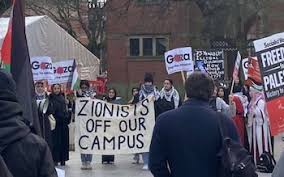
I have watched universities where “Globalize the Intifada” could become part of the vocabulary of protest after Jews had just experienced the deadliest day since the Holocaust. A recent report on American antisemitism could devote enormous attention to Israel, Palestinian Arabs, race and politics while ignoring the jihadist antisemitism that helped produce October 7 in the first place.
And increasingly, I wonder whether I am losing the Democratic Party I knew.
Senator Chris Coons is not someone I associated with the anti-Israel fringe. Yet he spearheaded legislation that would authorize American sanctions connected to construction in E1, including against foreign persons who simply submit bids for construction tenders. Threatening private parties with the force of the American financial system for bidding on residential construction near Jerusalem represents a place in that debate I never expected mainstream Democrats to reach.
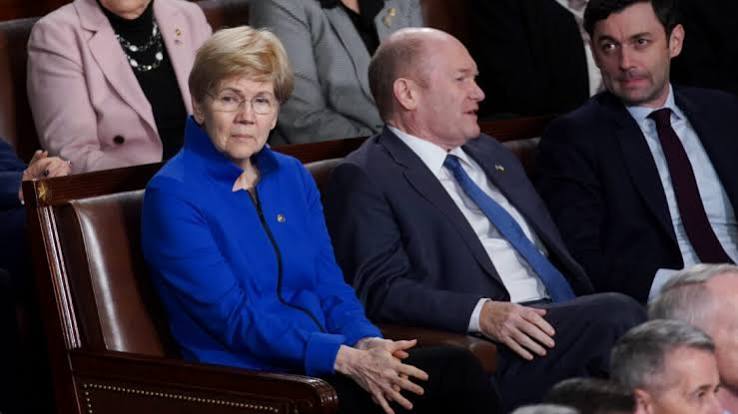
Senators Elizabeth Warren and Chris Coons threaten financial retribution against firms considering building residential homes in Jerusalem suburbs
Some losses happened in a morning. Others have accumulated slowly enough that it took me time to recognize them.
Judaism does not ask us to pretend that loss isn’t real. The Torah certainly doesn’t.
Moses dies. But then we do something remarkable.
We don’t pause to mourn Moses on Simchat Torah. We stand up, sing and dance. We lift the Torahs and our children. And when we have read the Torah’s final words, we refuse to leave the scroll there. We immediately return to Bereishit, to the beginning.
We don’t erase the loss or manufacture comforting explanations for it. We don’t avert our eyes from the people and institutions we have lost or from the lessons their loss may teach us. But neither do we build our lives around the empty spaces.
That may be the lesson I need most this Simchat Torah.
Notice who is missing. Remember them. Look clearly at what else we have lost since October 7 and understand why. Fight where something worth preserving can still be preserved.
Then look around the circle and see who is still there. Hold them a little closer.
The U.S. Commission on Civil Rights released a 220-page report on September 26, 2026 on the explosion of antisemitism on American college campuses after October 7, 2023. Search those 220 pages for “jihad,” “Islamist” or “radical Islam” and you find nothing.
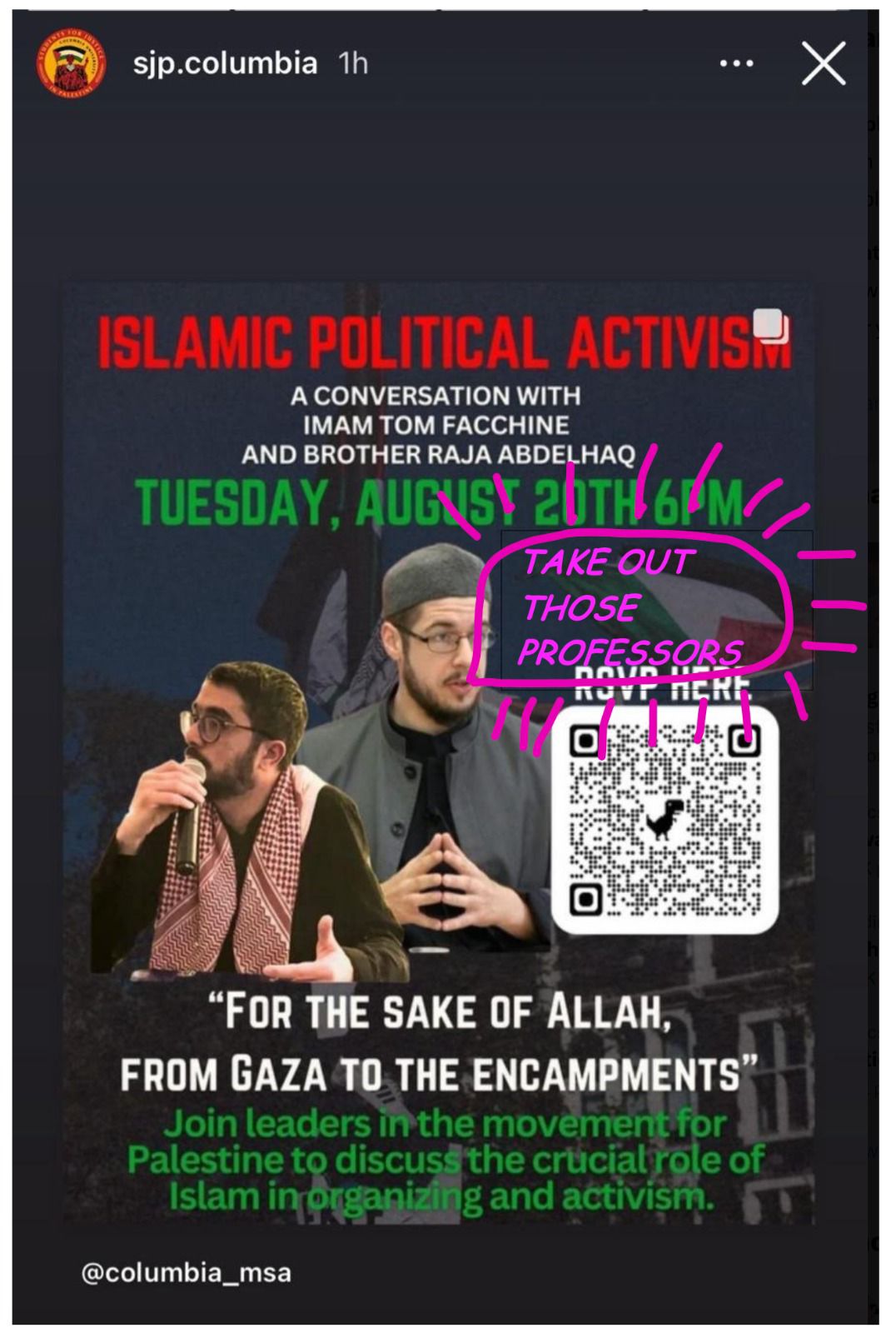
Columbia University’s SJP chapter featured “Islamic political activism”
That is an extraordinary omission because October 7 was not the opening battle in a campus dispute between supporters of Israel and Palestine. It was a massacre carried out by Hamas, a jihadist organization with a long history of explicit antisemitism. Yet the Commission largely interprets what followed through a political framework: Jewish and Israeli students on one side, Muslim and Palestinian students on the other, each reporting hostility and discrimination while universities struggled to balance Title VI, political expression and the First Amendment. Indeed, the Commission describes its own inquiry principally in terms of institutional and federal responses to allegations of antisemitism following the Hamas attack, with substantial attention to the distinction between unlawful discrimination and protected political expression.
In that framework, Jews increasingly become the pro-Israel constituency in an Israeli-Palestinian political dispute. What largely disappears is that some of what erupted on campuses reflected a very different phenomenon: jihadist antisemitism.
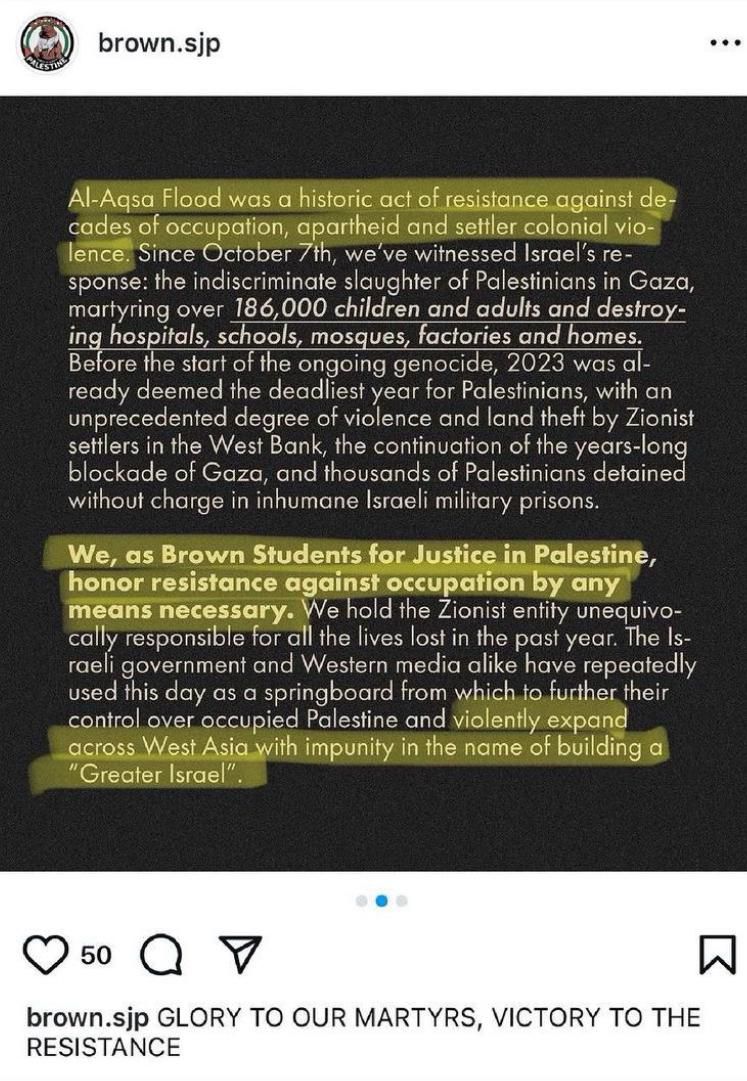
Brown University chapter of Students for Justice in Palestine “by any means necessary”
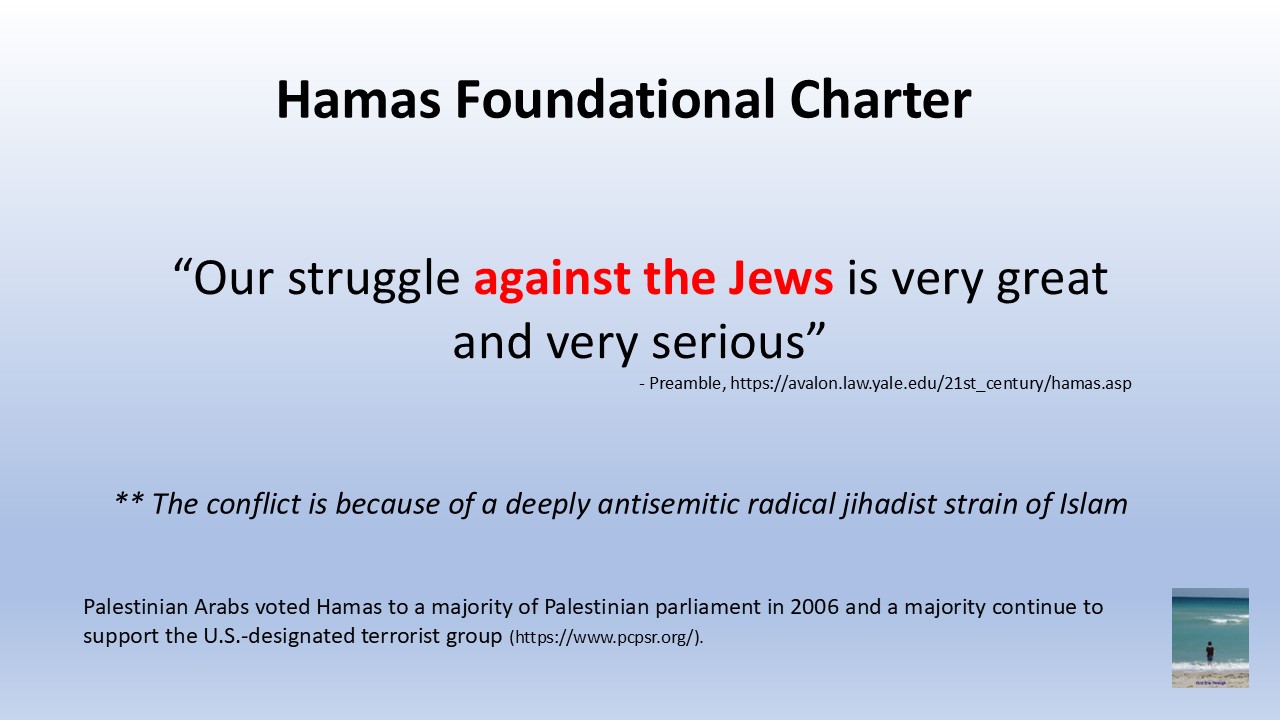
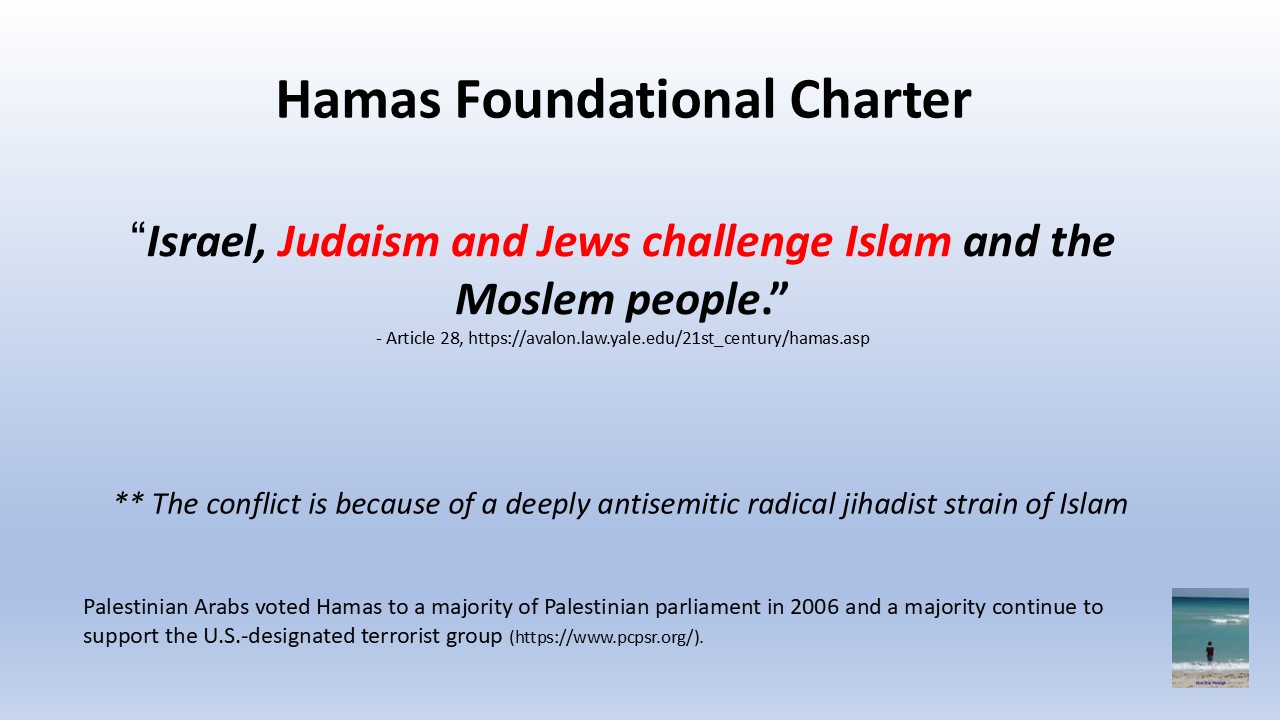
Hamas’s history should have made that an obvious subject of inquiry. Its 1988 founding covenant placed the struggle within an Islamic religious framework, declared that there was “no solution” to the Palestinian question except jihad, trafficked in antisemitic conspiracy theories and invoked a hadith envisioning Muslims fighting Jews.
Gazan jihadist calls parents to celebrate his slaughter of Jewish civilians
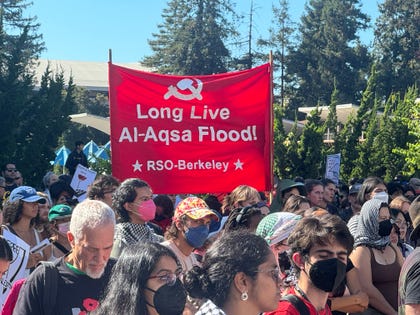
Nor did Hamas remain thousands of miles away from the American campus debate as an abstraction. The Commission itself received evidence of faculty-sponsored protests featuring “Long Live Al-Aqsa Flood,” Hamas’s name for its October 7 operation, along with a flag of the Popular Front for the Liberation of Palestine, which the report identifies as a U.S.-designated terrorist organization.
Berkeley celebrates the “Al-Aqsa Flood” massacre, named for the Islamic shrine atop the Jewish Temple Mount in Jerusalem
The Commission saw the evidence but never seriously followed the ideological trail.
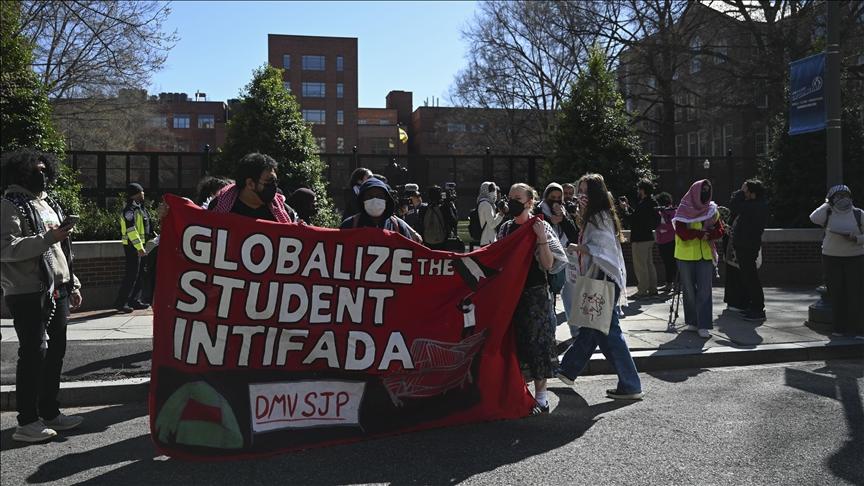
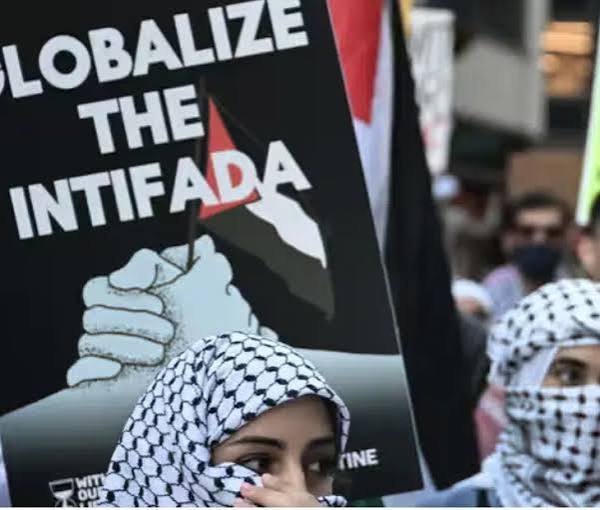
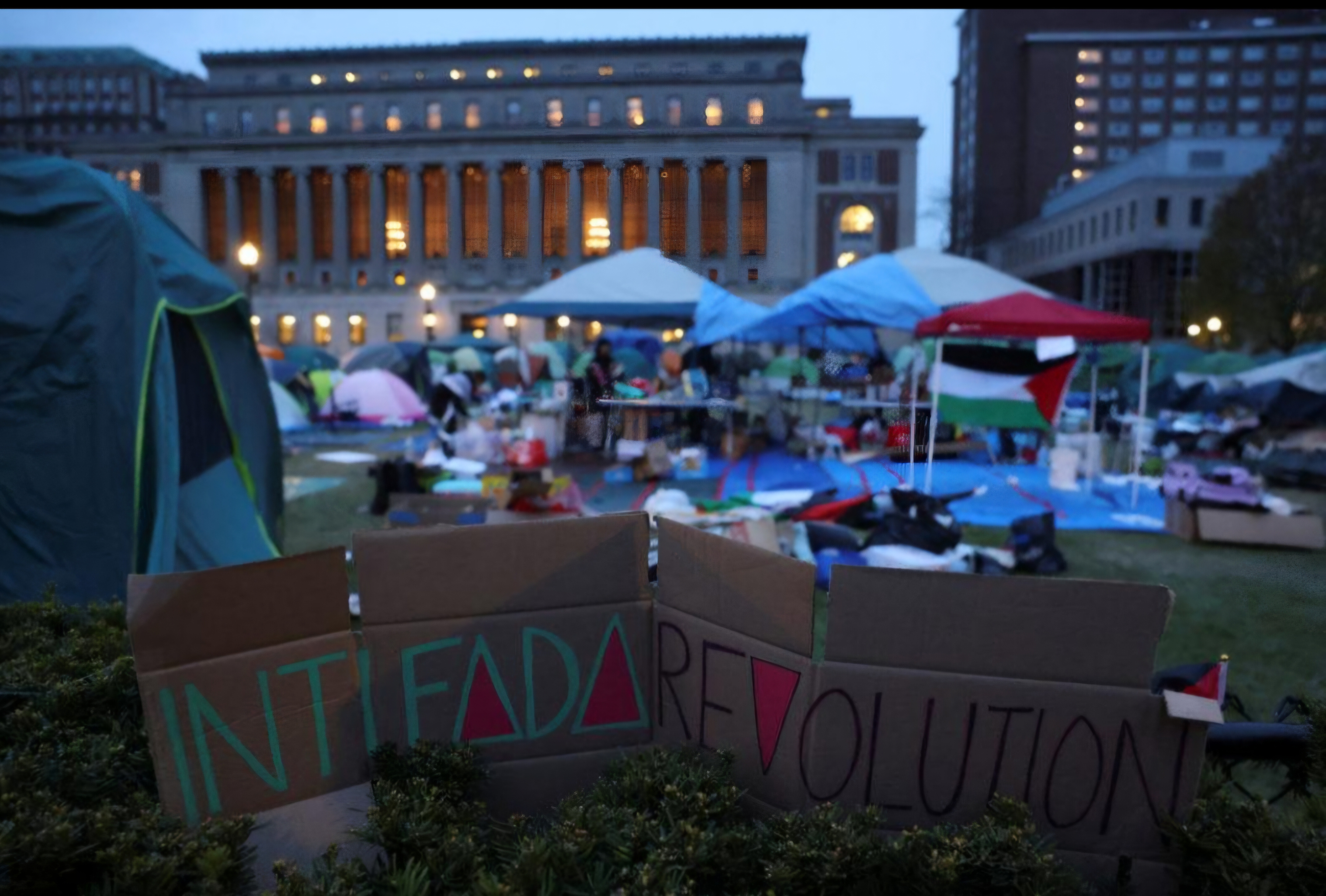
Consider “Globalize the Intifada.” The phrase appears only once in the report, in its discussion of Rutgers. Yet contemporary campus reporting documented it many times among the very universities the Commission selected for study. At Stanford, students chanted “From Stanford to Gaza, globalize the Intifada.” At Cornell, protesters chanted both “globalize the intifada” and “There is only one solution, intifada revolution.”
SJP chapter for D.C., Maryland and Virginia
Cornell was not some campus the Commission lacked information about. The university supplied nearly 2,000 pages of material and received one of the longest individual university treatments in the report. Yet “Intifada Revolution” appears zero times.
Cornell professor said he was “exhilarated” by the October 7 massacre of Jews. The NY Times reported a story about Jews taking away public funds from students.
The gap becomes even more striking when compared with the Commission’s treatment of other ideological sources of antisemitism. The report examines far-right antisemitism, describing Jews portrayed as conspiratorial financial elites, competitors with white Americans and secret manipulators of political power. It discusses neo-Nazis and white nationalism. It also examines antisemitism arising from the political left, including depictions of Jews as privileged, capitalist or oppressive and the intersection between those ideas and hostility toward Israel.
Where is the corresponding examination of jihadi antisemitism?
Where is the history of Hamas’s antisemitic ideology, the examination of Hamas rhetoric about Jews, or the investigation of how the language and symbols of violent extremist organizations appeared in American campus protests immediately after October 7?
The Commission instead devotes considerable attention to deciding when anti-Israel rhetoric should be understood as political speech rather than discrimination. It examines “From the River to the Sea” at length, including competing interpretations of the slogan. It notes that “Intifada” can be frightening while remaining protected expression. At Rutgers, for example, it records “Globalize the Intifada” among the protest activity Jewish students said made them feel unsafe.
Imagine – feeling unsafe around a jihadist cry to kill non-Muslims everywhere.
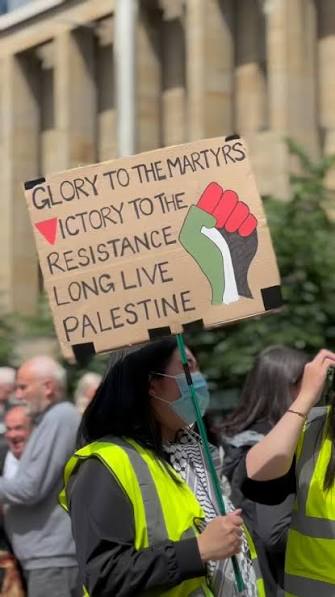
Rutgers “Glory to the martyrs”, praising the jihadists murderers
But cataloguing whether a slogan is legally protected is different from investigating the ideology being expressed by the people using it. The First Amendment can protect vile political speech. That does not make its ideological origin irrelevant to a federal investigation trying to understand antisemitism.
The omission is particularly consequential because the language of the campus protests did not develop in an intellectual vacuum. American universities have increasingly employed professors who view Israel through a settler-colonial framework. In its most categorical form, that theory casts Jews as foreign colonizers and Palestinians as the indigenous population resisting them. This screed is about Jewish presence in their homeland, not particular Israeli policies. It attempts to sever Jews from the land at the center of their history, religion, language and national identity and then uses that manufactured foreignness to challenge Jewish national self-determination. It is rank antisemitism that provides a logic other than Islamic supremacism to excuse Muslims preventing Jews from living and having self-determination “in any part of Palestine.”
“The conflict is cast in western circles as a local conflict over land between Jews and Arabs which can find compromise, but radical Islamists see it as a global religious matter between Muslims and Jews.” – First One Through July 2025
In such distorted worldview, October 7 becomes “resistance.” Hamas’s “Al-Aqsa Flood” becomes liberation. The intifada becomes something to globalize. Zionists become people to exclude, while Jews who object to any of this are reduced to the pro-Israel participants in a contentious political debate.
This is where the Commission missed the virulent strain of antisemitism it was supposed to investigate. The fear that swept through many Jewish communities after October 7 was not simply that Palestinian students disagreed with Jews about Israeli policy or conduct. Jews had watched an organization steeped in antisemitic ideology slaughter Israelis and take hostages. They then watched people in the West celebrate or rationalize the attack with the vocabulary of “resistance,” “intifada” and “Al-Aqsa Flood.”
While the Commission’s own evidence contained pieces of that story, its analytical framework never assembled them.
Columbia University encampment with “Intifada Revolution”
That failure has consequences. America has learned to recognize white-supremacist antisemitism – your father’s antisemitism – as an ideology rather than merely a collection of offensive statements. A swastika does not need to be accompanied by a dissertation on National Socialism before institutions understand the hatred behind it. The same intellectual seriousness should apply when antisemitism emerges from another extremist tradition.
Instead, this federal civil-rights report has provided universities with a framework that can make jihadist antisemitism remarkably difficult to see. While Jew hatred expressed in the vocabulary of white supremacy arrives already classified as extremism, similar hostility wrapped in the language of decolonization, resistance and intifada can be processed as politics, scholarship or protest. The Jewish student confronting it becomes the “pro-Israel” participant in a dispute, rather than a target of noxious hatred.
Jihadi antisemitism does not become benign when its vocabulary is translated for an American campus. Leaving that vector out of a federal investigation leaves universities less prepared to identify it, challenge it or protect the Jews it threatens.
The Commission set out to expose the forces driving contemporary campus antisemitism and instead helped preserve one of their safest hiding places: the assumption that when hatred of Jews arrives speaking the language of “resistance,” it is merely politics.
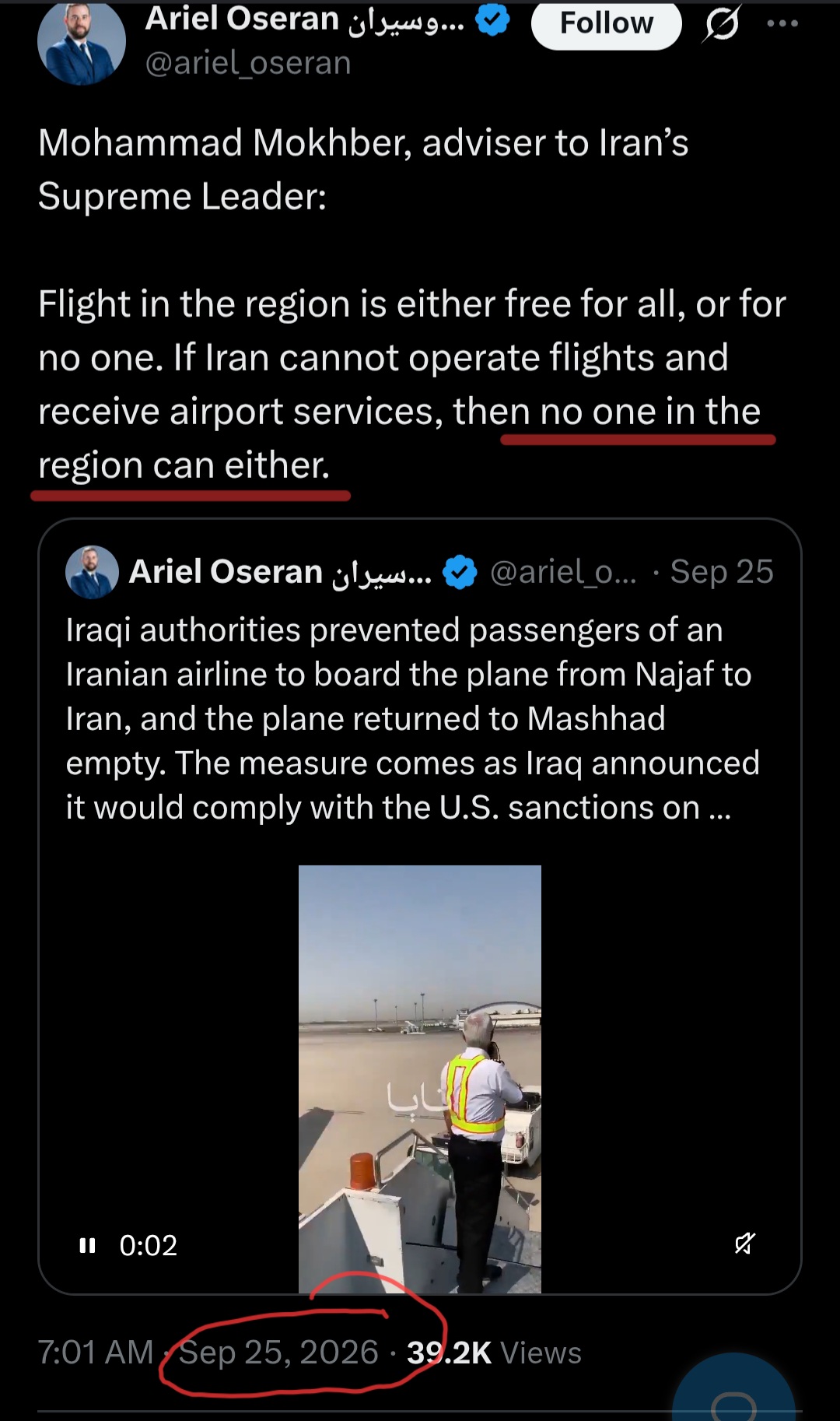
Major news organizations covering the extraordinary Flydubai incident have omitted a striking piece of context: five days earlier, a senior adviser to Iran’s Supreme Leader warned that if Iranian aircraft could not use regional airports, nobody else should expect to fly either.
On September 25, Mohammad Mokhber, Iran’s former acting president and current adviser to Ayatollah Ali Khamenei, declared:
“Flight in the region is either free for all, or for no one.”
He added: “If Iran is denied the possibility of flight and access to airport services, no country in the region will have this possibility either.”
Days earlier, another senior Iranian official, Mohsen Rezaei, had issued a similar warning concerning neighboring airports.
Five days after Mokhber’s statement, a Flydubai aircraft carrying mostly Israelis from Dubai to Tel Aviv suffered an attempted hijacking. The captain was attacked, the aircraft rapidly lost altitude and the flight made an emergency landing in Saudi Arabia. The motive remains under investigation. There is no immediate evidence connecting Iran to the incident.
But Iran’s warning is missing from major coverage reviewed from Reuters, the Associated Press, the Guardian, Al Jazeera and The National. Reuters had itself reported Mokhber’s statement when he made it.
That omission is difficult to understand. A senior Iranian official had publicly warned that regional aviation could be disrupted. Five days later, an Emirati aircraft carrying over one hundred Israelis is put at risk by an Omani pilot.
Consider that Al Jazeera and the Guardian continue to say that Israel is at war with Iran even though that hasn’t been true for many months. They insert Israel into the war against Iran while they leave Iran out of the discussion about a potential killing of nearly two hundred Israelis.
Readers are being lied to by acts of insertion and omission, especially about Israel and Iran. It is critical to understand those basic facts and begin to ask why.