
On October 27, 2026, Israel witnessed an extraordinary demonstration of democracy. Preliminary estimates put Israeli Arab voter turnout at approximately 80%, potentially exceeding that of Israeli Jews. Nearly a million Israeli Arabs may have voted, with Arab-led parties projected to win 17 to 18 seats in Israel’s 120-member Knesset. It was among the highest Arab turnouts in decades.
The New York Times chose a different story. Adam Rasgon’s headline declared: “Israeli elections have great consequences for Palestinians, but they don’t get to vote.”
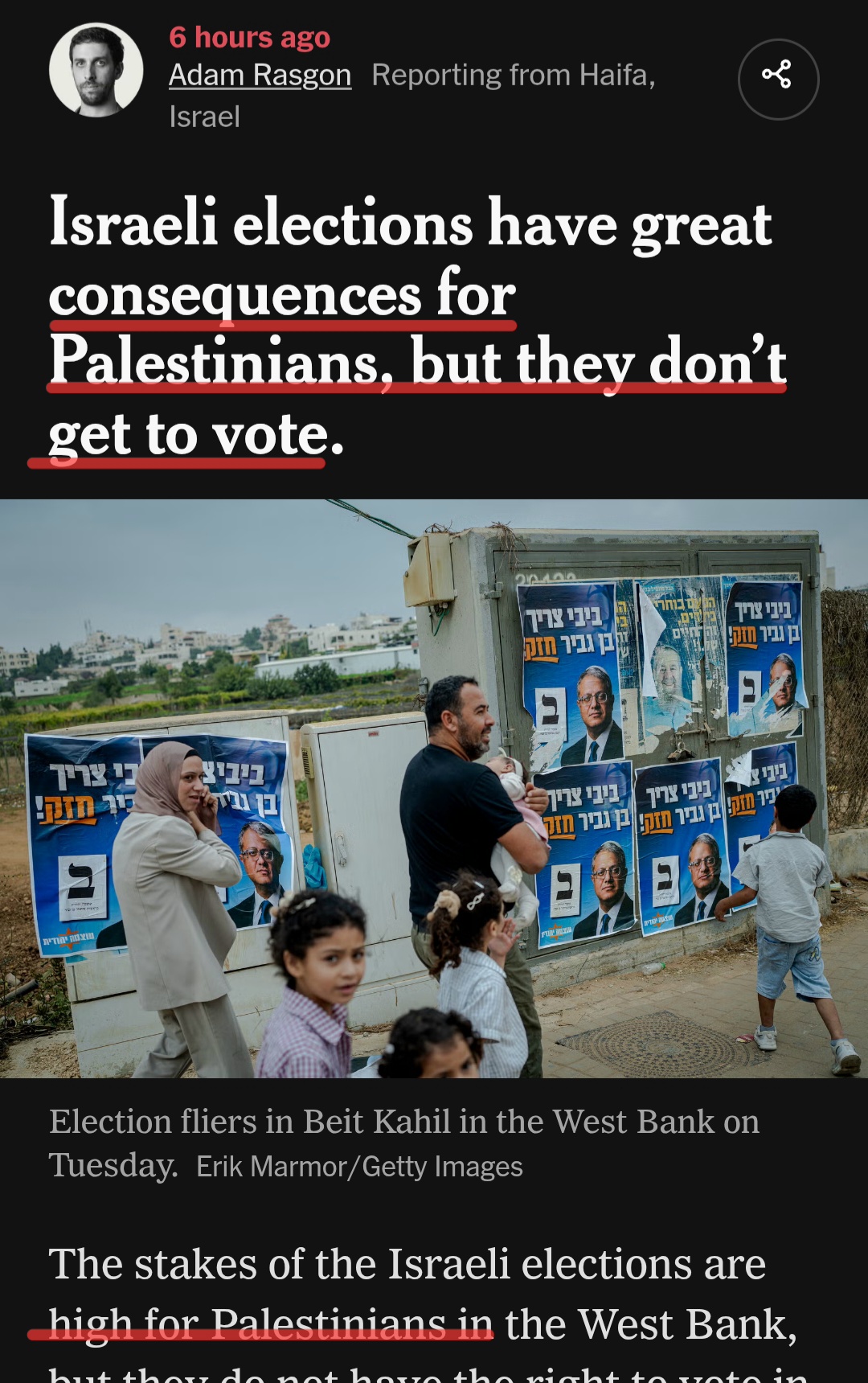
On a day of remarkable Arab political participation, the Times focused on Palestinian Arabs in the West Bank who cannot vote in Israeli elections – who aren’t Israeli citizens. An achievement of Israeli democracy became another story of Israeli power and exclusion.
The last Palestinian parliamentary election took place in January 2006, when the US- designated foreign terrorist group Hamas defeated Fatah. The last presidential election was in January 2005, when Mahmoud Abbas, who wrote his doctoral thesis on Holocaust denial, won a four-year term that expired in 2009. He remains president today.
Hamas violently seized control of Gaza in 2007, while the Palestinian Authority continued governing parts of the West Bank. Neither has renewed its national electoral mandate. An entire generation of Palestinians has reached adulthood without electing its national leadership.
That’s not a story for the Times.
Meanwhile, Israeli Arabs regularly elect representatives to the Knesset, organize opposition parties and participate in governing coalitions. In 2021, Mansour Abbas’s Ra’am party joined Israel’s government, helping sustain a coalition headed by Naftali Bennett. Arab political parties can help determine who governs the Jewish state.
That’s not a story for the Times.
Israel is routinely accused of being an “apartheid” state that excludes Arabs from political power. Yet Israeli Arabs, roughly one-fifth of the country’s population, exercise the same national voting rights as Jews, hold parliamentary seats and serve as judges. Rather than educate the public about the democracy in Israel, the Times wants its readers to continue to perceive of Israel in racist terms.
It is an antisemitic lens, and the far left continues to be conditioned to view Jews and the Jewish state through a deeply jaundiced perspective.


