For decades, the world has been told that Palestinians live under conditions of extraordinary deprivation. Yet before October 7, 2023, several important demographic and social indicators told a very different story.
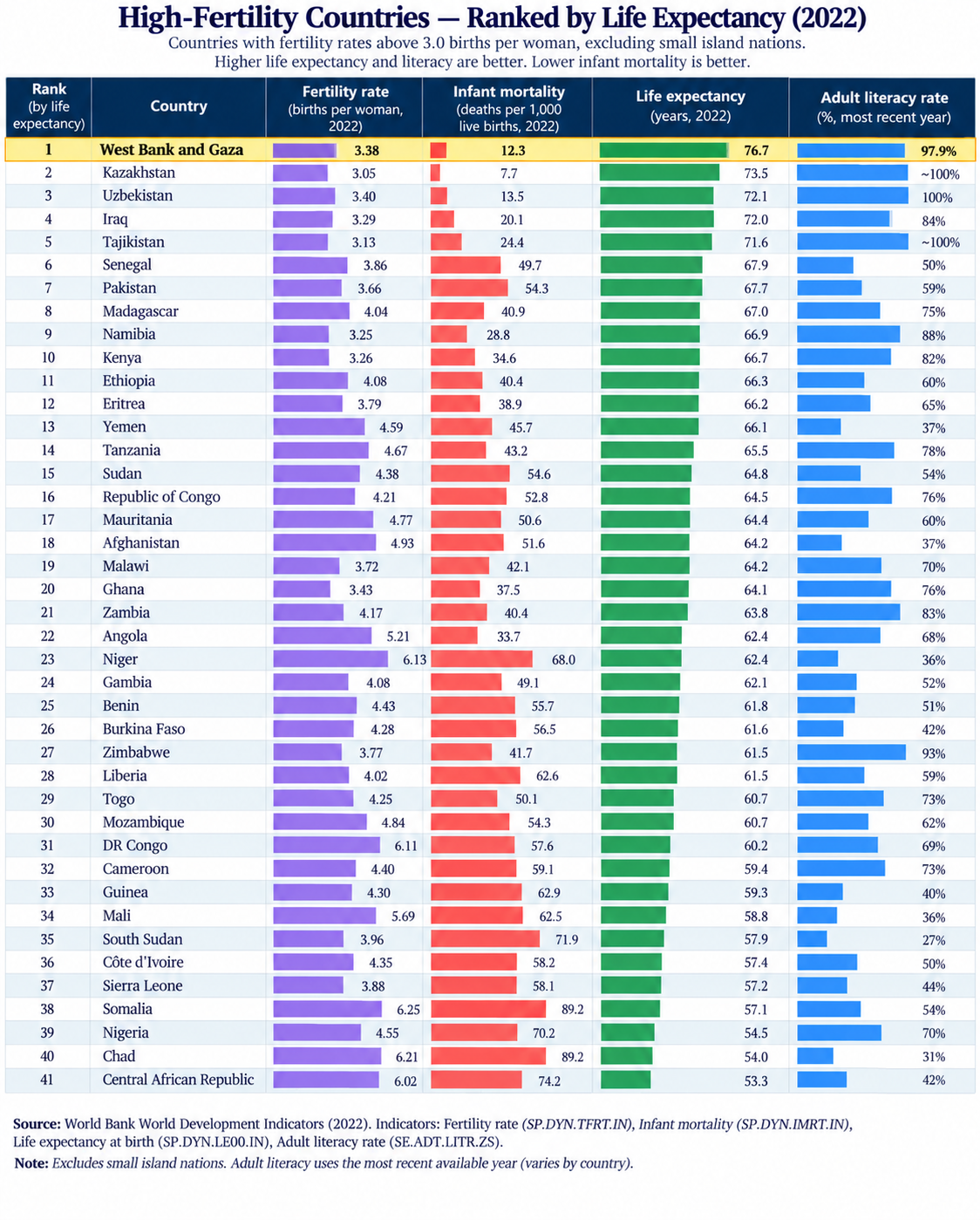
In 2022, the West Bank and Gaza had a fertility rate of approximately 3.4 children per woman. Among countries with fertility rates above three, the Palestinian territories also reported relatively high life expectancy, low infant mortality and exceptionally high adult literacy.
Uniquely among its Arab peers. Only Kazakhstan and Uzbekistan (neither Arab) among high fertility countries, have quality of life statistics remotely close to Palestinian Arabs.
Palestinian Arab adult literacy was 98%. Infant mortality was far below that of many other high-fertility populations. Reported life expectancy was in the mid-70s, although estimates vary by source.
These were meaningful achievements, particularly in a region marked by conflict, poverty and political instability. They reflected billions of dollars of investment in education, extensive public health and educational services.
These incredible quality of life statistics came principally from the charity of western countries. The United States, Germany, the United Kingdom, France, Japan, Norway, Ireland and other countries have provided extensive financial assistance to Palestinian Arabs, both directly and through international institutions such as UNRWA.
Yet these charitable countries face an entirely different demographic reality.
In 2022, fertility in Norway was approximately 1.4 children per woman. Ireland and Germany were around 1.5. Japan approximately 1.3, and the United States around 1.7. All were below the roughly 2.1 births per woman associated with long-term population replacement in low-mortality societies.
The Palestinian territories, meanwhile, averaged approximately 3.4.
So the countries financing Palestinian schools, hospitals and social services were experiencing declining birth rates and aging populations at home. And their taxpayers were helping support a population having roughly twice as many children per woman as their own societies.
And despite the western generosity and much better quality of life than surrounding Arabs, these same Palestinians decided to launch a genocidal war against Israel and destroy the world that Europeans and Americans financed.
Member of Gazan terrorist group during massacre of Israelis on October 7, 2023
The uncomfortable question for international donors is whether charity to a people who prioritize destroying their neighbor over building a society is logical. Or moral.
Norway, Ireland, Germany and Japan cannot purchase peace simply by financing another generation’s schools and hospitals.
A society’s children deserve more than the opportunity to survive infancy, learn to read and live long lives. They deserve leaders who will not gamble away those achievements in war, and an ideology that values coexistence with a Jewish State.
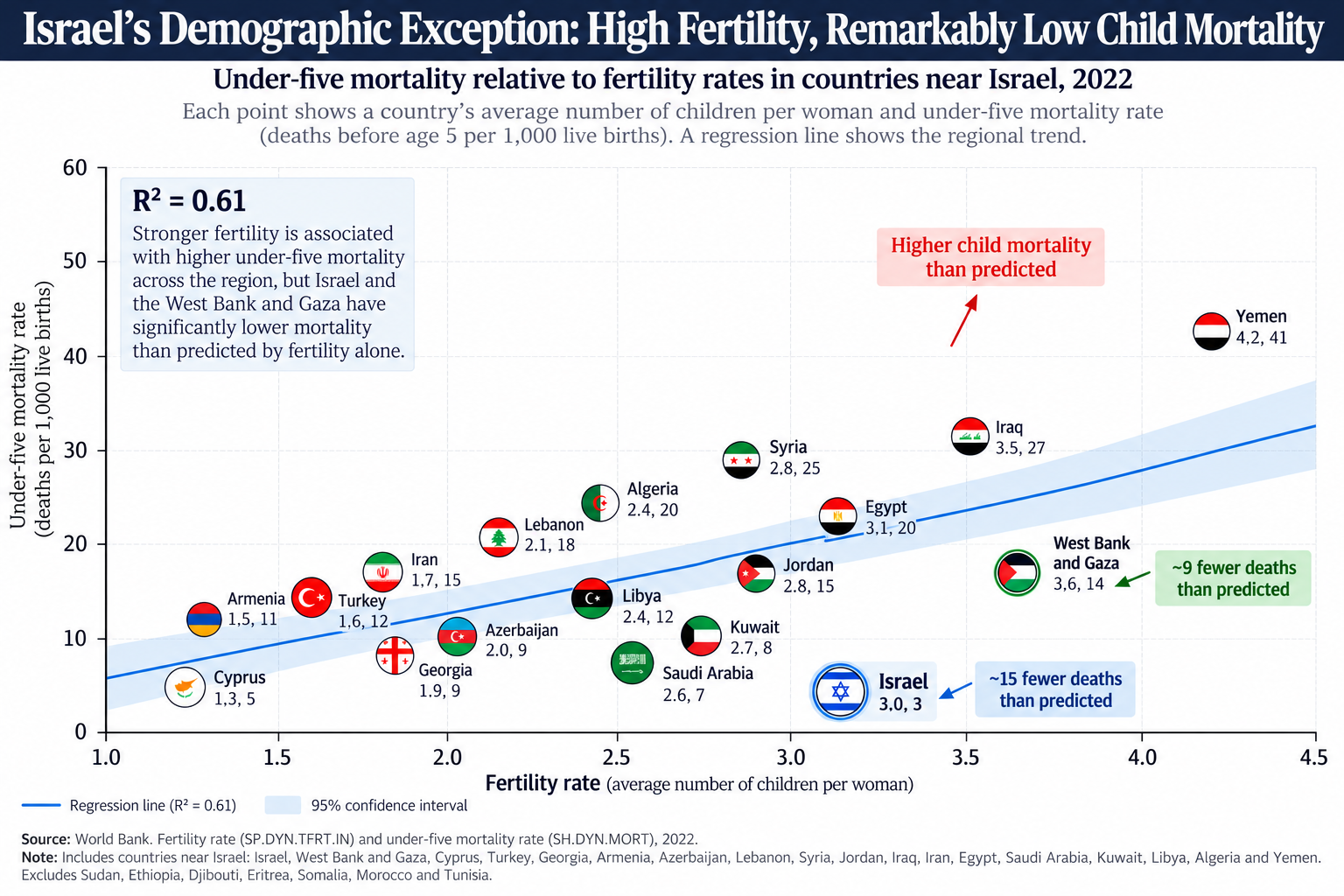
Before the October 7, 2023 Gazan massacre of Israelis and the subsequent war in Gaza, Palestinian Arabs enjoyed one of the most favorable combinations of high fertility and low childhood mortality in the surrounding Arab world.
Typically, wealthy countries like Saudi Arabia and Kuwait have few children and lower infant mortality, defined as a child dying before five years old. Poorer countries and those in conflict have more children and higher infant mortality, like Yemen, Iraq and Syria.
Yet in 2022, Palestinian women had approximately 3.6 children each, while the under-five mortality rate in the West Bank and Gaza was roughly 14 deaths per 1,000 live births.
Compare that with Syria, where approximately 21 children per 1,000 died before their fifth birthday. In Iraq, the figure was 23. In Yemen, 41. The difference was enormous. West Bank and Gaza Arabs were much closer to the exceptional high fertility and low infant mortality rates of Israel.
If one were to expand the regional focus to Sudan, Eritrea, Ethiopia and Djibouti, one would see an even more dramatic gap – Sudan (4.38; 51.7), Ethiopia (4.2; 46.5), Eritrea (3.79; 36.6) and Djibouti (2.7; 51.9). On the other extreme for wealthy Gulf states are UAE (1.15; 5.3) and Qatar (1.74; 6.1).
Applying Syria’s childhood mortality rate to approximately 144,000 Palestinian births in 2022 would imply roughly 950 additional deaths before age five. Iraq’s rate would imply another 1,300 deaths compared with the Palestinian rate. Yemen’s would imply nearly 3,900 additional deaths.
Extend those differences illustratively across 20 annual birth cohorts, assuming similar numbers of births and mortality differences, and the results are striking: approximately 19,000 additional Palestinian childhood survivors compared with Syria’s rate, 26,500 compared with Iraq’s, and 78,000 compared with Yemen’s. Using the same methodology for Sudan or Djibouti would result in nearly 110,000 Palestinian Arabs childhood deaths.
The Palestinian territories benefited from robust vaccination programs, maternal healthcare, hospitals, and medical services developed over decades, including services provided through United Nations and Palestinian institutions, international organizations, and cooperation with Israel.
Despite the incremental 19,000 to 110,000 young Palestinian Arabs alive today because of healthcare investment and coordination with Israel, anti-Israel organizations have been accusing Israel of pursuing a “genocide” and the destruction of the Palestinian population. These figures illustrate the precise opposite. Israel is a Palestinian Arab child MAKER.
The demographic record deserves to be confronted: Palestinian Arabs were raising large families, with child survival outcomes that compared extremely favorably with much of the neighboring Arab world.
An Israeli construction company sees a government tender to build residential housing. It prepares a bid and submits it.
It does not have to win the tender or break ground. Merely submitting the bid would be enough to expose it to American sanctions.
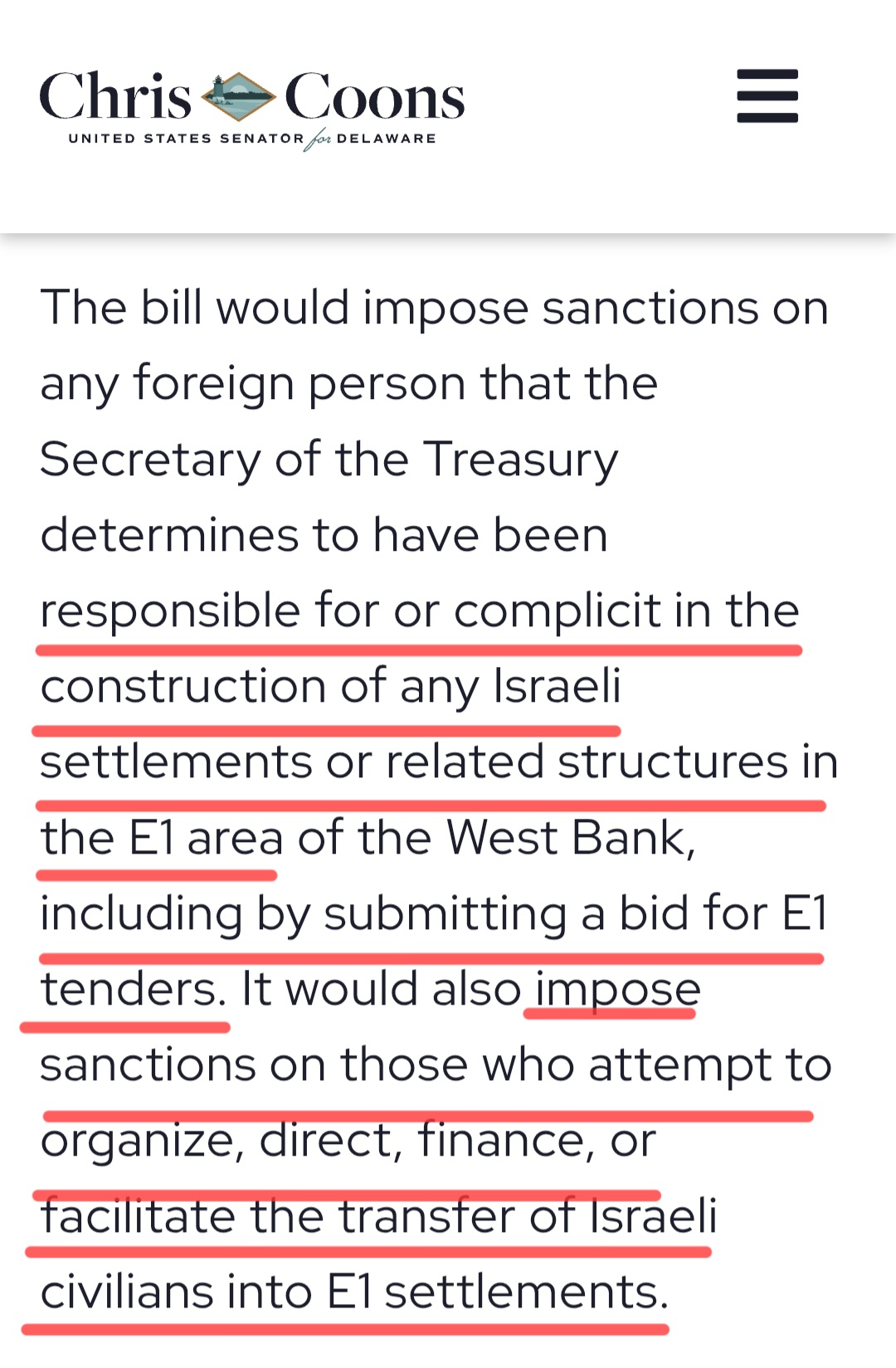
Senators Chris Coons (Delaware), Elizabeth Warren (Massachusetts), Ron Wyden (Oregon) and Ruben Gallego (Arizona) have introduced legislation targeting construction in E1, the area between Jerusalem and Ma’ale Adumim. The legislation would impose sanctions on foreign persons involved in construction there, expressly including those “submitting a bid for E1 tenders.”
Warren makes the consequence explicit: those who facilitate construction in E1 should understand that they “risk losing access to the U.S. financial system.”
That is an extraordinary penalty for bidding to build homes in an allied country.
And the piece of land that has generated this response is remarkably small. E1 covers roughly 12 square kilometers, or 4.6 square miles. The entire West Bank is roughly 5,655 square kilometers. E1 therefore represents about 0.2% of the West Bank—roughly one five-hundredth of its territory.
And that sliver of undeveloped land has generated calls to reach for one of America’s most powerful economic weapons.
The United States has long used its dominance of the international financial system as one of its most powerful foreign-policy tools. Iran has faced sanctions over its nuclear program and other activities. North Korea has been subjected to extensive sanctions over its nuclear and ballistic-missile programs. Russia has faced sweeping sanctions connected to its military aggression.
American sanctions can also reach companies outside those countries. Do business with an American adversary and a foreign company may discover that it has to choose between that relationship and access to the American financial system.
Congress has occasionally been willing to impose that choice on allies.
Turkey is a NATO member. Yet the United States sanctioned Turkey’s Presidency of Defense Industries after Ankara purchased Russia’s S-400 air-defense system from Rosoboronexport, Russia’s state arms exporter. The transaction involved an advanced weapons system, an American adversary and concerns about the security of American military technology.
European companies encountered the same American financial power over Nord Stream 2. Congress enacted sanctions aimed at companies participating in construction of the pipeline, including businesses from American allies, for engaging with a Russian pipeline carrying Russian gas into Europe. Congress viewed it as increasing European dependence on Russian energy and strengthening Moscow’s geopolitical leverage.
E1 presents something completely different.
There is no Russia on the other side of the transaction. No Iran. No North Korea. No weapons purchase or nuclear technology. No American adversary receiving the proceeds.
There is an Israeli government tender to construct residential homes in the immediate suburb of its capital.
Nor is this simply an initiative of four senators.
Fifteen additional Democratic senators have joined them: Michael Bennet (Colorado), Tammy Duckworth (Illinois), Martin Heinrich (New Mexico), Tim Kaine (Virginia), Mark Kelly (Arizona), Andy Kim (New Jersey), Jeff Merkley (Oregon), Chris Murphy (Connecticut), Patty Murray (Washington), Jack Reed (Rhode Island), Brian Schatz (Hawaii), Adam Schiff (California), Elissa Slotkin (Michigan), Chris Van Hollen (Maryland) and Peter Welch (Vermont).
That brings the proposal’s Democratic Senate support to 19 senators.
Senators Elizabeth Warren and Chris Coons
The United States developed financial sanctions to confront hostile states, weapons programs and transactions with American adversaries. It is a powerful tool meant to confront grave risks to America. Yet in this proposal, the triggering transaction is an Israeli housing project occupying roughly one five-hundredth of the West Bank, which poses zero threat to the United States.
The Democratic senators sponsoring the legislation describe E1 construction as a threat to a future Palestinian state, presumably because the Palestinian Authority demands a country devoid of any Jews and it must include Jerusalem. Their proposed response is to make companies and individuals participating in that construction grounds for exclusion from the American financial system.
For these 19 Democratic senators, countering Palestinian Arab aspirations has become a threat to the United States.
That is the question their bill puts before Congress: Should the financial weapon America has used against adversaries and national-security threats now be turned against businesses of a close ally because they bid to build homes on 0.2% of the West Bank?
ACTION ITEM
Contact these senators about their proposed bill on E1 and find out whether the Democratic Party has become so unmoored from its mission of protecting Americans that it is using its greatest financial weapon to serve Palestinian Arabs objecting to Jewish homes.
Sen. Chris Coons Washington office (202) 224-5042, Wilmington (302) 573-6345, Dover (302) 736-5601
Sen. Elizabeth Warren Washington office (202) 224-4543, Boston (617) 565-3170, Springfield (413) 788-2690
Britain is suddenly alarmed about supposed “ethnic cleansing” in the West Bank.
The British government warns that Israeli policies could force Palestinian Arabs from parts of Judea and Samaria. It is sanctioning Israelis, condemning “settlements” and portraying demographic change in territory claimed by Palestinians as a grave moral offense.
Britain has seen ethnic cleansing in this territory before. Its reaction was very different.
In 1948, The Kingdom of Transjordan crossed the Jordan River and conquered Judea and Samaria and eastern Jerusalem. It then destroyed and expelled the Jewish communities that had lived across the territory. The ancient Jewish Quarter of Jerusalem’s Old City was emptied of its Jews. Jews were then barred from their holiest sites, as synagogues were destroyed or desecrated.
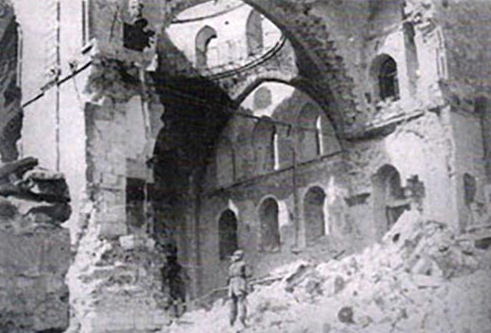
Jordanian soldiers destroyed the Hurva Synagogue in 1949
The result was remarkably complete: the territory Jordan occupied was ethnically cleansed of Jews. And less than two years later, Britain formally recognized Jordan’s union with the territory it had invaded and conquered, one of the only countries in the world to do so.
Jordan then made the demographic principle explicit. Its 1954 nationality law extended Jordanian nationality to former Palestinian citizens residing in the kingdom while expressly carving out “the Jews.”
Jordan expelled and excluded the Jews in its holy land, and Britain’s response was recognition.
In 2005, Britain would celebrate again, this time in Gaza.
Israel decided to dismantle every Jewish community in the Gaza Strip. Israeli soldiers physically removed roughly 8,000 Jews from their homes and twenty-one Jewish communities disappeared. A Jew-free Gaza emerged.
Britain did not describe this as ethnic cleansing. Prime Minister Tony Blair praised Israeli Prime Minister Ariel Sharon’s “courage” and offered Britain’s “full support” for the withdrawal. His foreign secretary called it a hugely significant step toward peace.
Now consider 2026.
Britain warns against the possible displacement of Palestinian Arabs from Area C of the West Bank, territory that has remained under Israeli civil and security control under the Oslo framework pending a final agreement. It speaks of forcible displacement, imposes sanctions and treats the prospect of Palestinian Arabs losing their communities as intolerable.
The moral principle sounds admirable. It would be more convincing if Britain had ever applied it equally to Jews in the region.
When some Palestinian Arabs might be displaced from territory it hopes to use in a future Palestinian state, Britain suddenly discovers that removing a particular ethnic population from its homes is beyond the pale. Instead, England demands that the region be ethnically cleansed – of Jews – citing the antisemitic UN Security Council Resolution 2334.
There is a British consistency here: ethnic cleansing is only appropriate when Jews are removed.
For generations, British policy has treated the removal of Jews from disputed territory as compatible with peace. A Palestinian Gaza without Jews was progress. A Jordanian West Bank without Jews was acceptable. A future Palestinian state is still routinely imagined as a place where Jewish communities cannot remain.
Only the possibility of some Arab relocation produces moral outrage.
That exposes the deeper problem with the diplomatic vocabulary surrounding the conflict. “Two states” has quietly come to mean one multicultural Jewish state containing a large Arab minority alongside one Palestinian state expected to contain no Jews. One and one-half states for Arabs; half a state for Jews.
England understands the ethnic cleansing of Jews – it did it itself in 1290 – the only minority group to ever be expelled from the country. It seems to continue to only have a taste for that kind of hatred and ethnic cleansing, including in the Jewish homeland.
Israel’s decision to move forward with construction in E1 produced the familiar headlines: settlers, seized Palestinian land, displacement and the death of a Palestinian state.
WAFA reported that Israel issued a tender for 1,234 “settlement units” in E1, presenting it as “one of the most controversial settlement schemes” in a colonial project designed to fragment Palestinian territory.
Before debating E1, start with what is actually being built, where, on whose property and for whom.
An Extension of Ma’ale Adumim
E1 is an approximately 12,000-dunam, or 12-square-kilometer, planning area between Jerusalem and the existing community of Ma’ale Adumim.
It lies in Area C, where the Palestinian Authority and Israel agreed under the Oslo framework would be under Israeli security control and civil administration. Israel is building within the municipal planning jurisdiction of Ma’ale Adumim, not a new area. E1 has not been annexed to Israel.
The current project is E1 South, one part of that larger area. The 1,234 units are in apartment blocks adjacent to the existing city, not isolated houses spread across 12 square kilometers of West Bank hills. The plans contemplate the infrastructure of a normal urban community: elementary schools, kindergartens and daycare, synagogues and a mikveh, community buildings, parks and gardens, commercial facilities, roads and infrastructure.
E1 is not a new project of the current Israeli government. Its planning dates back roughly three decades to the Rabin era. Roads and the Judea and Samaria District police headquarters were built there years ago, even as residential construction remained frozen under international pressure.
Building Does Not Draw the Border
Area C was created under Oslo as an interim administrative arrangement, not a permanent international border. Borders, settlements and Jerusalem were reserved for permanent-status negotiations, and Israel subsequently transferred authority over the major Palestinian population centers to the Palestinian Authority as part of Area A.
E1 South could therefore ultimately remain with Israel, become part of a Palestinian state, or be addressed through a negotiated territorial exchange. Construction changes the facts future negotiators confront; it does not establish sovereignty.
E1 does not make a Palestinian state geographically impossible simply because it creates a narrow connection between northern and southern Palestinian population centers. Israel itself has long existed with a narrow neck across its principal population center, historically only about nine miles wide at its narrowest point. If a narrow neck makes statehood impossible, Israel itself should have been geographically impossible for decades.
Palestinian north-south travel east of the 1949 Armistice Lines (E49)/ Judea and Samaria already happens and is being made easier. A route already exists east of Ma’ale Adumim, and Israel is constructing additional roads intended to connect current Palestinian Arab communities around E1.
A Land System Older Than Israel
Much of E1 is classified by Israel as state or government land, but Israel did not invent that category in 1967.
The underlying system begins with the Ottoman Land Code of 1858, which established categories of land and rules involving government ownership, registration, possession and cultivation. The Ottomans created the system, the British Mandate retained and amended it, and Jordan continued administering and registering West Bank land under it. Israel inherited that legal structure after 1967 and subsequently administered and modified it through military orders.
Private Palestinian Property Was Excluded
Approximately 775 dunams — about 6.5% of E1 — consist of recognized private Palestinian parcels interspersed through the area.
Israel did not classify those parcels as state land, and they were excluded from the official E1 plans. Bimkom, an Israeli planning organization opposed to E1, notes the importance of continued agricultural cultivation to the status of some private parcels.
Critics argue that surrounding development could make access to some excluded private parcels more difficult. That is a legitimate issue, but does not suddenly turn building these apartments into theft of privately owned Palestinian land.
1.55% of E1
The scale of the current project is considerably smaller than the overall E1 map suggests.
On August 18, 2026, Israel issued Tender 186/2026 for E1 South, Plan 420/4/7: 1,234 apartments divided among seven construction complexes. Bids are due October 19, 2026.
The current development parcels therefore occupy about 22.7% of E1 South and only 1.55% of the entire E1 planning area.
A companion residential plan, 420/4/10, contemplates another 2,173 apartments. The current tender, however, is specifically for the 1,234 units in E1 South.
The Bedouin Question
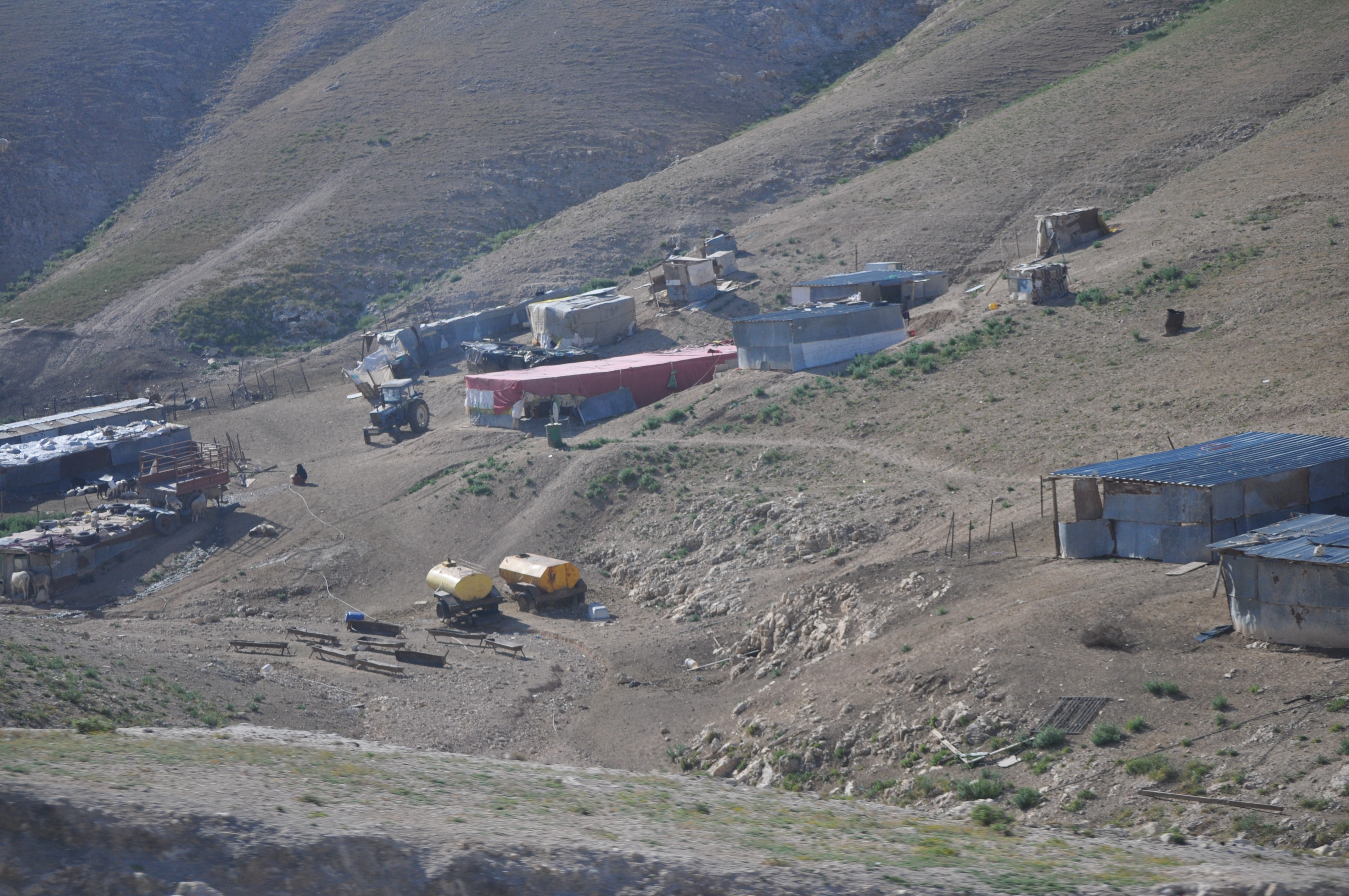
There is a separate Bedouin issue. Jahalin Bedouin communities live and graze animals throughout the broader Ma’ale Adumim/E1 area, and B’Tselem and OCHA argue that development, roads, demolition orders and restrictions threaten their residence, grazing and movement. Israel has previously considered relocating Jahalin families, including a 2005 plan involving approximately 200 families that was never implemented.
Bedouins in E1 (photo: FirstOneThrough)
Who Owns It — and Who Can Live There?
The seven parcels are being marketed in the tender as government/state land. Developers receive development rights over government property. The precise ultimate leasehold or ownership structure for apartment purchasers depends on the final land agreements.
Tender 186/2026 is a regular public tender, not a direct allocation to a religious or ideological organization. Foreign-controlled developers may face additional governmental approval requirements, but there is no requirement that bidders be Jewish-owned.
Nor do the E1 planning and tender provisions identify a religious or ethnic restriction reserving the apartments for Jews. Israeli Arabs could purchase or develop these apartments.
A Palestinian Arab resident presents a more complicated property-law question because the West Bank retains layers of Jordanian law, including a 1953 Jordanian law restricting certain sales and long-term leases to foreigners. The ability of a Palestinian from Abu Dis or a Jahalin Bedouin to acquire and register the same long-term property interest as an Israeli citizen therefore depends on the applicable land and registration rules. That complication is because of old Jordanian law, not Israeli.
Three Questions, Not One
The E1 controversy really involves three different legal questions: whether privately owned Palestinian property is being taken; whether Israel properly classified government land under the inherited Ottoman-British-Jordanian system; and whether international law permits Israel to use even legitimately public land in Area C for Israeli civilian development.
The first concerns ownership. The second concerns land law. The third concerns the law of occupation and sovereignty.
They are not the same question.
What Does “Palestinian Land” Mean?
That brings the argument back to WAFA’s description of E1 as Israeli construction on “Palestinian land” via “land seizure.”
The phrase can mean property privately owned by a Palestinian, public land geographically located in the West Bank, or territory Palestinians want incorporated into a future Palestinian state.
Those are three very different things.
E1 can be challenged because of its impact on future negotiations, Israel’s interpretation of inherited land law, international law or nearby Bedouin communities. But none of those arguments turns government property into privately owned Palestinian land, an urban extension of Ma’ale Adumim into the destruction of a Palestinian village, or housing without a religious purchaser restriction into “Jewish-only” apartments.
And construction today does not determine where tomorrow’s negotiated border must run.
E1 is controversial enough on the facts. There is no reason to blur them.
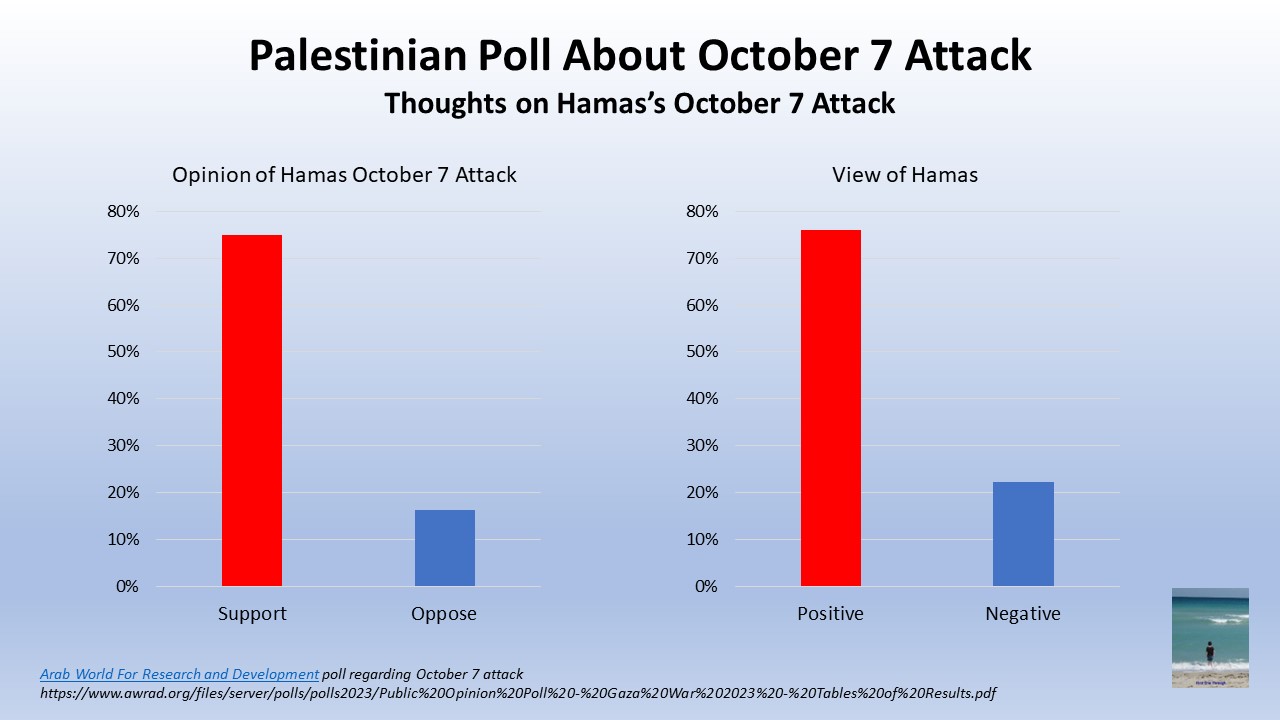
Three years ago, Palestinian Arabs thought October 7 might change their future by changing Israel. Polls show how much that ambition has changed.
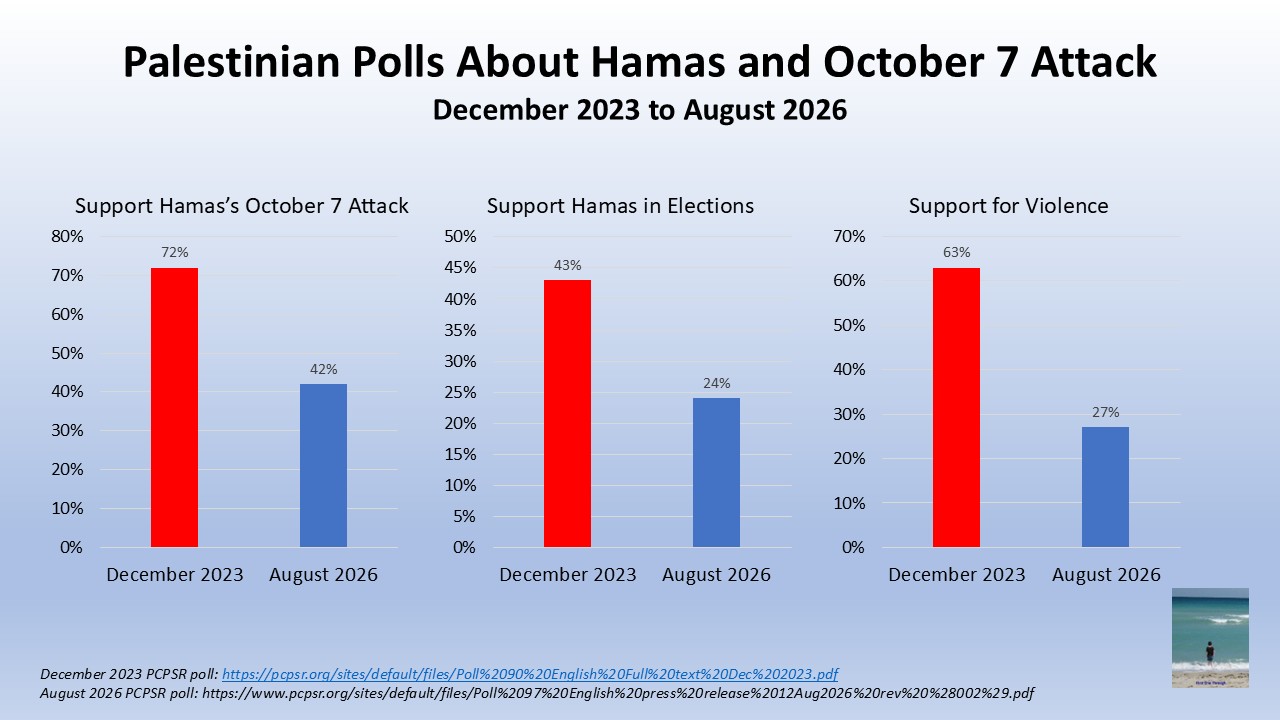
In December 2023, 72% of Palestinian Arabs said Hamas was correct to launch the October 7 attack.70% believed Hamas would emerge victorious.63% preferred armed struggle as the best way to achieve Palestinian goals.
Nearly three years of war produced something very different.
According to PCPSR’s August 2026 poll, only 20% now believe Hamas won the Gaza war. Hamas political support has fallen to 24%. Half of Palestinian Arabs say “armed resistance” (aka massacring Jewish civilians) failed to protect them or end the “Israeli occupation” and instead brought destruction. Among Gazans, 65% say so.
Support for armed struggle has fallen from 63% to 27%. 44% now choose negotiations as the most effective strategy.
Their priorities have shifted with it.
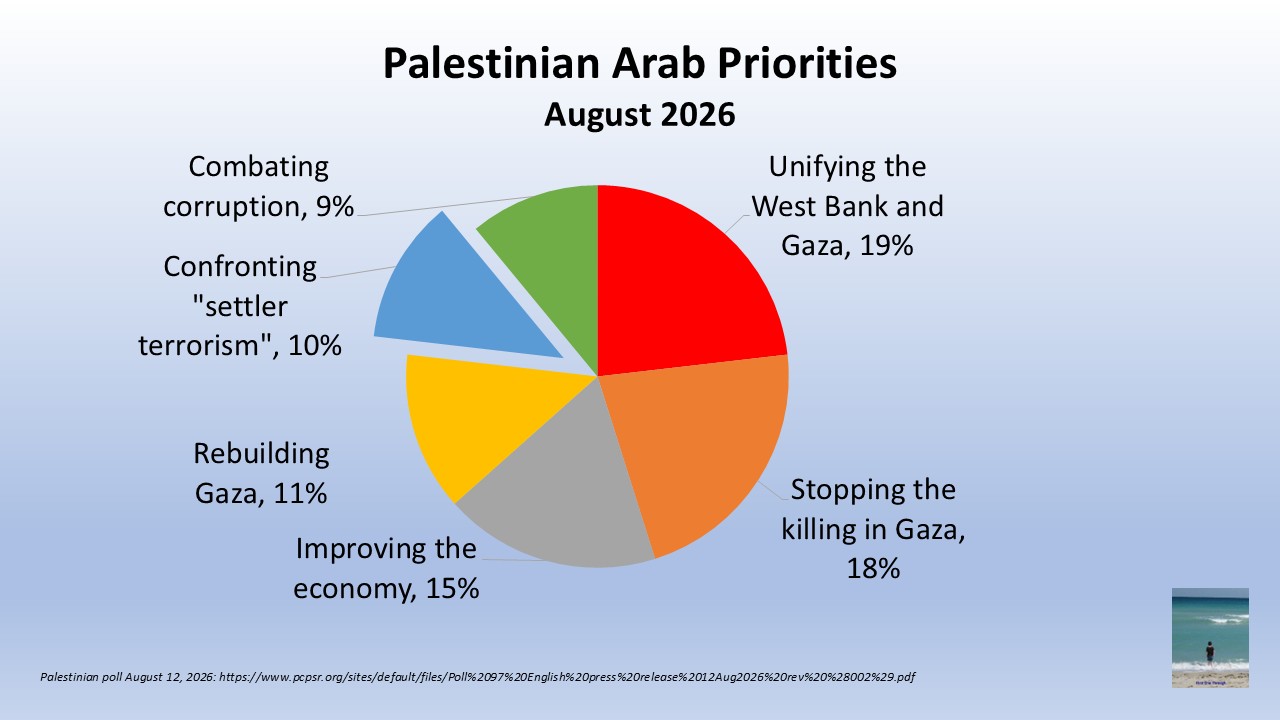
Asked in the August 2026 poll what the next Palestinian legislature should address, Palestinian Arabs answered:
19% — Unifying the West Bank and Gaza
18% — Stopping the killing in Gaza
15% — Improving the economy
11% — Rebuilding Gaza
10% — Confronting “settler terrorism”
9% — Combating corruption
Settler violence ranks fifth.
That is a very different Palestinian Arab story from the one dominating international headlines. Palestinian Arabs put reunification, ending the Gaza fighting, economic recovery and rebuilding Gaza ahead of attacks from West Bank Jews.
While the ambitions of October 2023 were directed outward, towards ending the Jewish State, the priorities of August 2026 are directed inward, to unification, rebuilding and recovering.
And Hamas remains part of that project.
The Palestinian Authority wants candidates in the coming elections to accept the commitments of the Palestine Liberation Organization, including its agreements with Israel. 66% of Palestinian Arabs oppose that requirement. Only 27% support it.
Because Palestinian Arabs envision Hamas remaining part of their future.
Asked what Hamas would become if it gave up its weapons, 53% said it would remain both an armed resistance and political movement. Another 36% said it would become solely a political movement. That means 89% see Hamas continuing as a political movement in some form.
There is a historical lesson in what happens after a genocidal society launches a disastrous war and loses.
Postwar Germany did not rebuild by simply disarming the Nazi Party and inviting it to contest elections. The Nazi Party was abolished and banned. Its political structures were dismantled. Germany’s reconstruction required a break with the movement that had led it into catastrophe.
Palestinian Arabs are not making that equivalent break. While they increasingly recognize that Hamas’s war failed, they want Hamas to be part of the Palestinian future.
As the western media and United Nations narrows a focus on violence committed by Israeli Jews against Palestinian Arabs, those same Arabs are no longer focused on those Jews. Instead, the Arabs prioritize rebuilding after the disaster while maintaining the eliminationist ideology in their society for a future war.
When a head of state opens a student conference, the message extends far beyond procedural remarks. It is a statement about the values and aspirations a society hopes to pass to its next generation.
That is why Palestinian Authority President Mahmoud Abbas’s patronage of the 11th General Conference of the General Union of Palestinian Students (GUPS) deserves careful attention. In its official announcement, the conference proudly celebrated the organization’s history by declaring that it produced leaders including Yasser Arafat, George Habash, Nayef Hawatmeh, Faisal Husseini, Hanan Ashrawi, and Walid Khalidi.
Three of those names stand apart.
George Habash founded and led the Popular Front for the Liberation of Palestine (PFLP), responsible for airline hijackings, bombings, and attacks on civilians. Nayef Hawatmeh founded the Democratic Front for the Liberation of Palestine (DFLP), whose history likewise includes attacks targeting civilians. Yasser Arafat led Fatah during decades in which its armed wing carried out numerous attacks against civilians before the Oslo era.
No one reading the official announcement could miss the point. This was not merely a history lesson. It was an effort to present these figures as part of the proud lineage of Palestinian student leadership.
That should concern anyone who hopes for a future of coexistence.
Every society chooses whom to celebrate before its young people. Some elevate scientists, entrepreneurs, doctors, artists, and peacemakers. Others elevate military heroes. But when organizations whose leaders orchestrated attacks on civilians are held up as exemplars at a student conference, the lesson is unmistakable: these are people worthy of admiration and emulation.
PA President Mamoud Abbas continued that the program is “a school for developing future leaders, and a bridge connecting generations of Palestinian students in the homeland and the diaspora,” and the hope that Palestinian Arabs who “invest in the education and awareness of their youth cannot be defeated by occupation or have their cause extinguished.”
Defenders may argue that these figures are important because they shaped the Palestinian national movement. History should indeed be taught honestly. But there is an important distinction between teaching history and celebrating it. Germany teaches students about Adolf Hitler without holding him up as a model. The United States studies the Ku Klux Klan without celebrating its founders. Context matters. So does moral judgment.
A student organization launching a new generation of leaders has every opportunity to highlight Palestinians who built universities, hospitals, businesses, charities, diplomatic institutions, or scientific achievements. Instead, its official narrative deliberately included men whose names are inseparable from campaigns of terrorism.
If Palestinian leaders genuinely seek to prepare young people for peace, they should be encouraging students to surpass the generation that embraced violence—not to walk in its footsteps.
Peace requires more than negotiations. It requires choosing different heroes.
In July 1980, the Knesset passed the Basic Law: Jerusalem, Capital of Israel. Its opening declaration remains one of the clearest statements of Zionist purpose ever enacted by the State of Israel:
“Jerusalem, complete and united, is the capital of Israel.”
The law settled a question that had haunted Jewish history for centuries. Jerusalem would never again be divided by barbed wire, minefields, and sniper positions. The city reunited in 1967 would remain the political and spiritual heart of the Jewish state.
Forty-six years later, it is worth asking a simple question:
What does “united” mean?
The answer cannot be limited to municipal boundaries. It cannot be measured solely by roads, tax collection, or police jurisdiction. A united city is ultimately a civic reality. It is a city whose residents share a common framework of governance and belonging.
Image of man walking through Herod’s Gate in Old City of Jerusalem (FirstOneThrough with AI)
When Israel reunited Jerusalem in 1967, the decision to grant permanent residency rather than citizenship to the Arab residents made practical sense. The future of the broader Arab-Israeli conflict remained uncertain, and the status of Jerusalem itself was still contested internationally.
But those residents’ children are no longer children.
An Arab born in eastern Jerusalem in 1981 is now in his mid-forties. He has spent his entire life under Israeli administration. He attended schools in Jerusalem, received healthcare through Israeli institutions, worked in Jerusalem businesses, and raised a family in Jerusalem. For an entire generation born after the Jerusalem Law, the temporary arrangement has become a permanent condition.
An Arab born in Nazareth in 1981 became an Israeli citizen at birth. An Arab born in Jerusalem in 1981 generally remained a permanent resident. Both have lived under Israeli sovereignty their entire lives. One votes in national elections while the other does not.
If Jerusalem is truly united, how should that distinction be understood nearly half a century after the Basic Law was enacted?
The question is no longer theoretical. In recent years, thousands of eastern Jerusalem Arabs have applied for Israeli citizenship, reflecting a significant shift from earlier decades. The demand exists. What many applicants encounter instead is a cumbersome process that can stretch for years.
The issue has taken on added significance since October 7.
Hamas named its attack the “Al-Aqsa Flood” because it sought to seize sovereignty in Jerusalem. For decades, Hamas and other rejectionist movements have portrayed Jerusalem as a city temporarily under Jewish control and awaiting liberation.
A confident nation answers such claims by strengthening the institutions of sovereignty.
The ramifications would extend far beyond voting rights in Israel.
The Palestinian Authority presents “East Jerusalem” as the capital of a future Palestinian state. International organizations continue to describe “East Jerusalem” as occupied territory, while critics accuse Israel of apartheid and permanent disenfranchisement.
Yet what would happen if large numbers of Arabs born in Jerusalem after 1980 chose Israeli citizenship?
Hamas would struggle to explain why residents supposedly awaiting liberation had instead chosen participation in Israeli democracy. The Palestinian Authority would find it difficult to claim as its constituency citizens voting in Israeli elections. International institutions would confront a reality more complicated than diplomatic formulas unchanged since 1967. Critics would have to reconcile accusations of apartheid with a policy that expands citizenship and voting rights.
Jerusalem also offers a practical test for Israel’s broader sovereignty debate. Politicians who advocate annexing parts or all of Judea and Samaria should first explain their position regarding Arabs born after 1980 in Israel’s declared and united capital. If no consensus exists in Jerusalem, it is difficult to imagine one elsewhere.
Every party seeking to govern Israel should therefore answer a simple question: Do you support an expedited path to citizenship for Arabs born in eastern Jerusalem after the passage of the Jerusalem Law?
Such a program could include security screening, an oath of loyalty to the State of Israel and its laws, and a streamlined administrative process. Those who prefer permanent residency could retain it. Those seeking citizenship would no longer spend years navigating bureaucratic obstacles.
Jerusalem was reunited in 1967 and anchored in law in 1980. As the fiftieth anniversary of the Jerusalem Law approaches, Israelis should decide whether the next step is to complete the city’s civic integration.
The question is larger than citizenship. It is about the meaning of a united Jerusalem and the confidence of a sovereign nation in its eternal capital.
One of the most common claims in the Arab-Israeli conflict is that Jews took the land from Palestinian Arabs and denied them self-government.
History tells a different story.
For four hundred years, the Holy Land was ruled by the Ottoman Empire. There was no Palestinian Arab state.
After World War I, Britain took control under the Mandate for Palestine. Again, there was no Palestinian Arab state.
In 1947, the United Nations proposed creating both a Jewish state and an Arab state. The Jewish leadership accepted the plan. Arab leaders rejected it and chose war.
When the fighting ended, Jordan occupied the West Bank and East Jerusalem while Egypt controlled Gaza. For the next nineteen years, neither country established a Palestinian state. Neither granted sovereignty to the local Arab population. Neither created independent Palestinian governing institutions.
The first meaningful Palestinian self-government did not emerge under Ottoman rule, British rule, Jordanian rule, or Egyptian rule.
It emerged through agreements with Israel.
The Oslo Accords created the Palestinian Authority and transferred governing responsibilities in Palestinian cities to Palestinian leaders. For the first time in modern history, Palestinian Arabs exercised substantial self-rule in the territory where they lived.
Signing of Oslo II Accords
Then in 2005, Israel withdrew every soldier and civilian from Gaza, leaving the territory entirely under Palestinian administration.
Israel is often accused by Israel haters of having stolen a Palestinian state. Yet no Palestinian state existed under Ottoman rule, British rule, Jordanian rule, or Egyptian rule. The first meaningful Palestinian self-government emerged only through agreements negotiated with Israel.
On May 28, 1964, the Palestinian National Charter was adopted in Jordanian-controlled Jerusalem. At that time, the West Bank was under Jordanian rule and Gaza was under Egyptian rule.
The Charter explicitly excluded both territories from its claims. It focused on Israel.
“This Organization does not exercise any regional sovereignty over the West Bank in the Hashemite Kingdom of Jordan, on the Gaza Strip or in the Himmah Area.”
The Charter did not challenge Arab sovereignty. It only challenged Jewish sovereignty.
Palestinian leaders supplied the national cause; Arab governments supplied the armies.
The Charter left little doubt about its objective. It declared:
“The partition of Palestine in 1947 and the establishment of the State of Israel are entirely illegal.” – Article 17
And that “liberation” of the land is the common cause of all Arabs:
“Arab unity leads to the liberation of Palestine, and the liberation of Palestine leads to Arab unity.” – Article 12
The Palestinian movement was therefore born not as a campaign against an Israeli occupation of the West Bank and Gaza, but as a movement that denied the legitimacy of Israel itself, and one in which the entire Arab world must unite.
The Charter’s author, Ahmad Shukeiri, was born in Lebanon and was Saudi Arabia’s ambassador to the United Nations from 1957 to 1962. His pan-Arab worldview called for Arab armies to destroy Israel:
“Those who survive will remain in Palestine, but I estimate that none of them will survive.” – Ahmad Shukeiri June 1, 1967
Another widely reported statement attributed to him declared:
“The Jews of Palestine will have to leave…We shall destroy Israel and its inhabitants and as for the survivors – if there are any – the boats are ready to deport them.“
Ahmad Shukeiri, circa 1965
Shukeiri’s brothers-in-arms said much the same.
In October 1964, Syrian leader Salah Jadid declared:
“Our army will be satisfied with nothing less than the disappearance of Israel.”
“The Arab national aim is the elimination of Israel.”
That same year, Egyptian President Gamal Abdel Nasser proclaimed:
“We shall not enter Palestine with its soil covered in sand; we shall enter it with its soil saturated in blood.”
Iraqi President Abdul Rahman Arif described Israel as:
“an error which must be rectified.”
In June 1967, the Palestinian movement and the surrounding Arab states were speaking a common language. The PLO and Arab leaders denied Israel’s legitimacy and spoke openly of its disappearance, elimination, and destruction.
The rhetoric was matched by action. Egypt expelled the United Nations Emergency Force from Sinai, followed by Egyptian troops pouring into the peninsula. The Straits of Tiran were closed to Israeli shipping. Military alliances linked Egypt, Syria, Jordan, and Iraq. Arab armies massed on Israel’s borders.
Against that backdrop, Nasser announced on May 26, 1967:
“The battle will be a general one and our basic objective will be to destroy Israel.“
Nine days later, war began.
Today, one of the most recognizable slogans associated with the Palestinian movement is “From the River to the Sea.” People often pretend that it is a call to free the West Bank and Gaza from “occupation” but the Arabic phrase speaks to the deeper truth as outlined by history.
“Min al-nahr ila al-bahr, Filastin ‘arabiyyah” meaning “from the river to the sea, Palestine will be Arab.”
Whether controlled by Jordan or Egypt or a hoped for Palestine, the Palestinian movement at its core has always been an anti-Israel movement to destroy the presence of Jews in “any part of Palestine.”
The June 1967 Six-Day War did not create the current dynamic in the Israel-Arab conflict. It was the conclusion of the first chapter of the Palestinian-led pan-Arab rejection of Jews living in and having sovereignty in land they view as purely Arab.