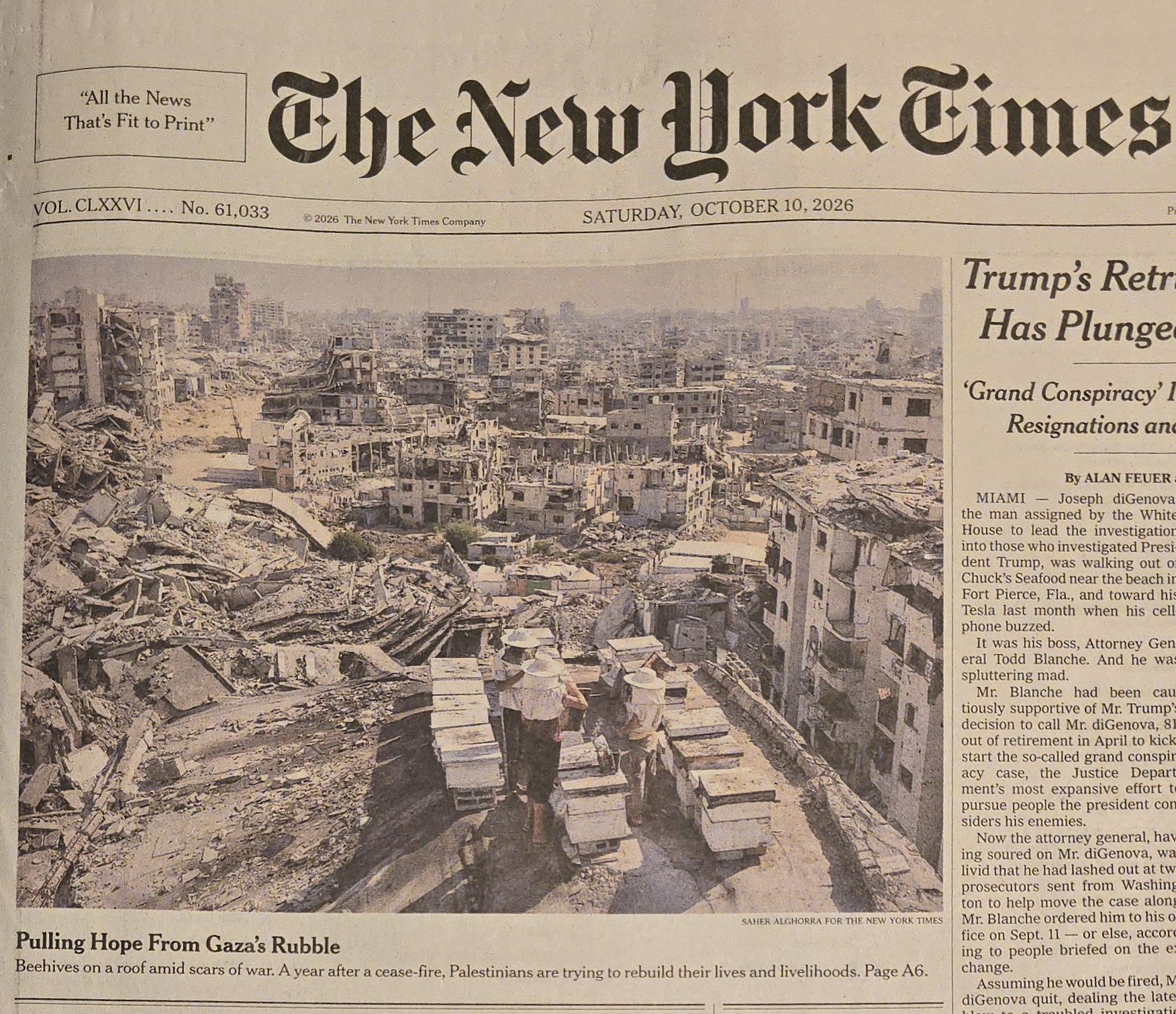
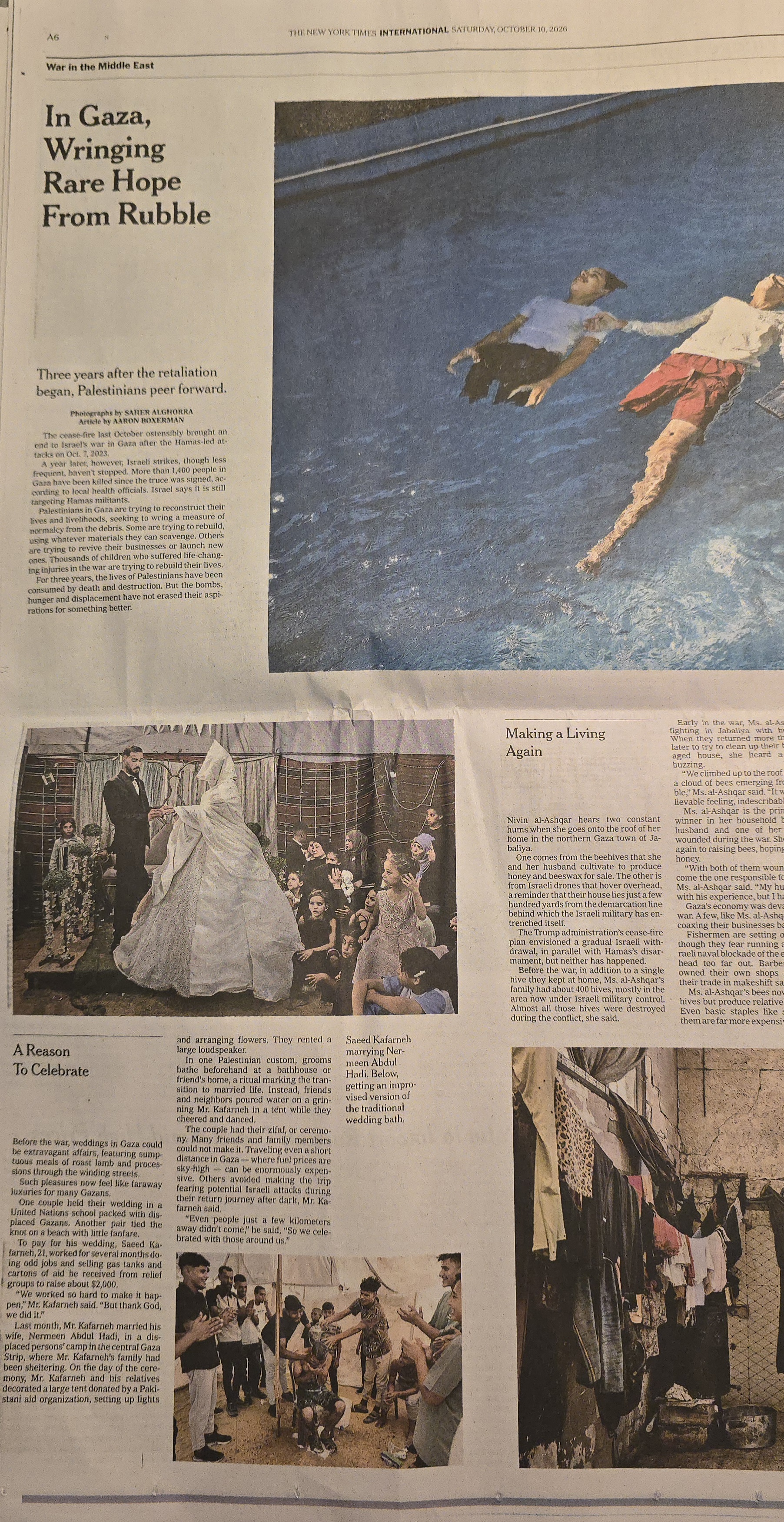
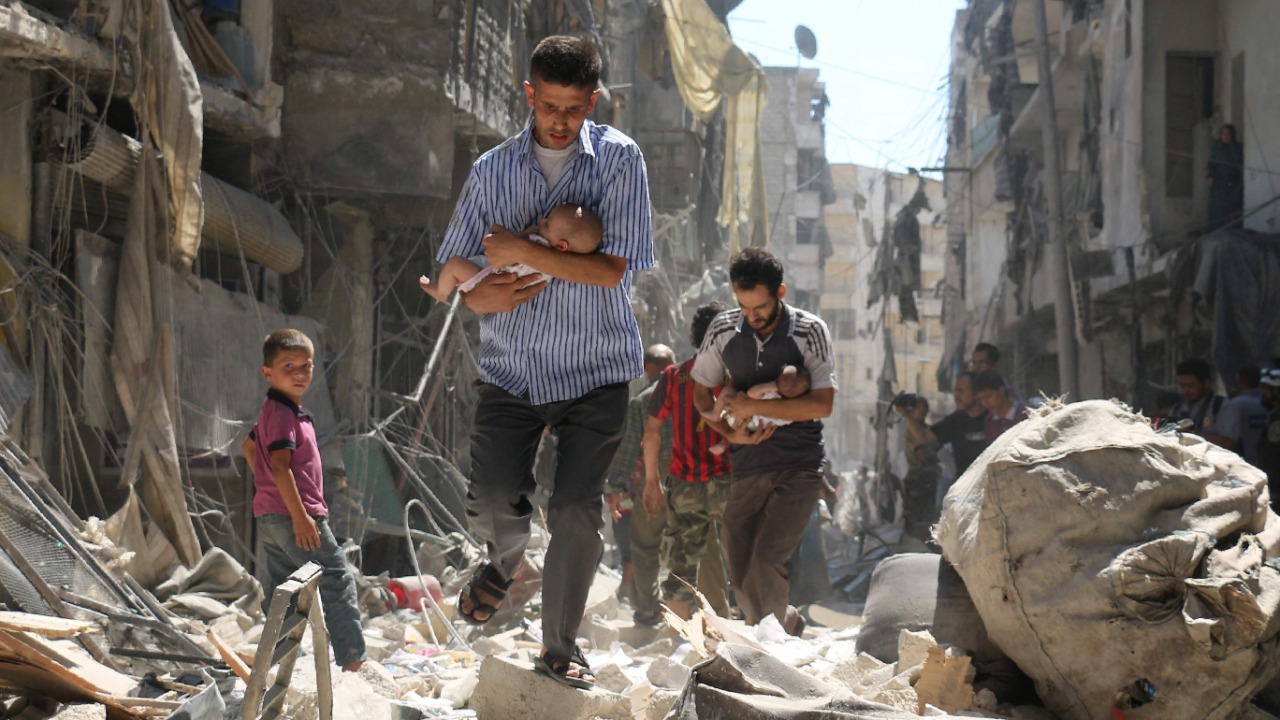
Three days after the third anniversary of Hamas’s October 7 massacre, The New York Times devoted its dominant front-page photograph and two full inside pages to the “hopes” and aspirations of Gazans. There were weddings, swimming, barbershops, reopened businesses and families trying to rebuild their lives amid the rubble.
It was a touching portrait of ordinary dreams – at least for normal people in the western world. But what about the extraordinary support among Gazans for killing Israeli civilians that preceded the war?
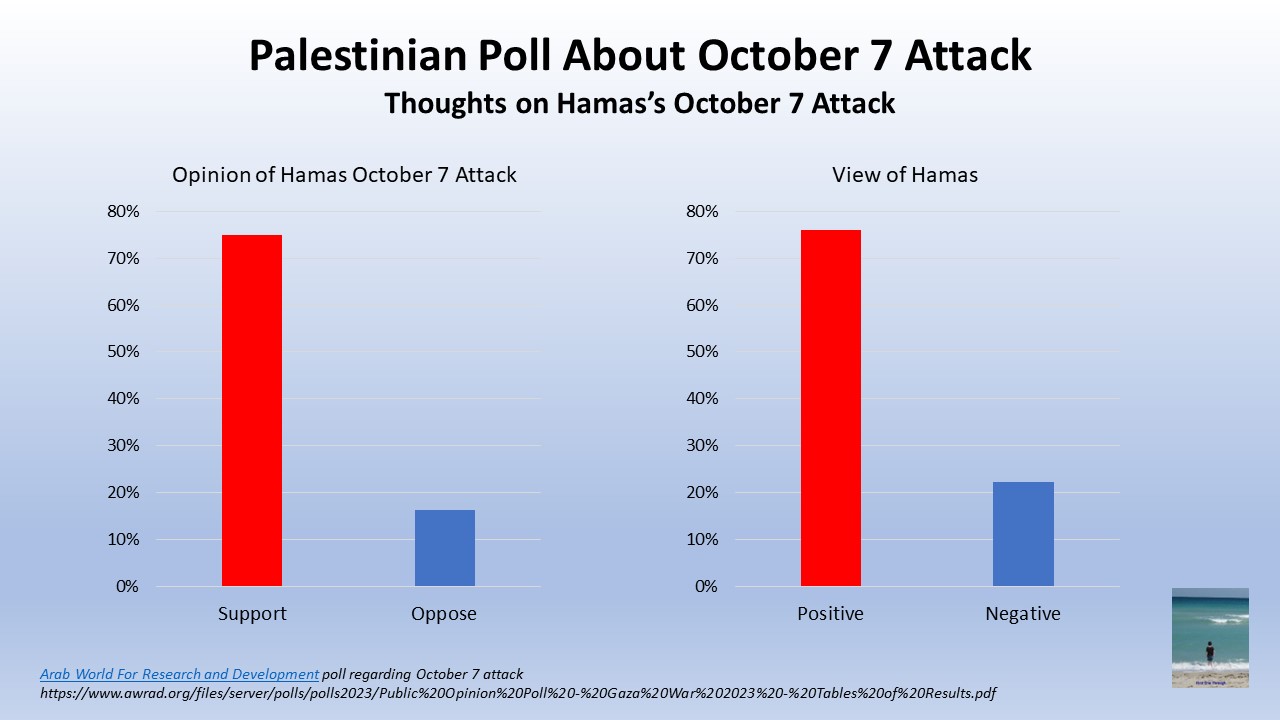
In June 2022, the Palestinian Center for Policy and Survey Research found that 73% of Gazans supported armed attacks inside Israel similar to those had been recently carried out. Fifteen months later, Hamas invaded Israel, slaughtered civilians, kidnapped families and celebrated the massacre. By March 2024, five months into the war and amid Gaza’s devastation, 71% of Gazans still considered Hamas’s decision to launch October 7 correct, according to the same polling organization.
Two-thirds of Gazans on average since 2001 have supported killing Jewish civilians inside of Israel according to PCPSR polls
These were majority attitudes, measured before the massacre and after its consequences became devastatingly clear.
Hamas is Gaza’s government, controlling the territory since 2007. It operated ministries, schools, police and security forces alongside its military apparatus. It is Gaza’s political life. Before October 7, PCPSR polling showed Hamas leading Fatah in hypothetical Palestinian parliamentary voting and Hamas leader Ismail Haniyeh defeating Mahmoud Abbas in a two-candidate presidential contest. Hamas continues to lead Fatah, which is why PA President Mahmoud Abbas continues to delay elections.
Yet the Times’ sprawling photographic treatment of Gaza’s aspirations ignored the genocidal ideology that permeates Gaza and helped produce October 7. The newspaper deliberately failed to show what Gazans truly hope for: dead Jews and the destruction of the Jewish State.
Imagine the same treatment of Sudan’s Rapid Support Forces. Three days after the anniversary of an RSF massacre, would the Times devote its front page and two inside pages to swimming, weddings and employment in communities governed by the militia, with little examination of the violence and political support behind it?
The Times showed readers Gazans dreaming of a swim. Its own society’s polling shows overwhelming support for killing Jewish civilians both before and after the October 7 massacre.
The Times has whitewashed the genocidal ideology of Gazans and portrayed them as victims of the jihadi war they launched. Doing so is not just anti-Israel, it is a promotion of radical Islam deployed against Jews.
Or perhaps worse – the Times is educating its readers that those who want to rape and kill Jews are very much like us.
Hamas has been a U.S.-designated Foreign Terrorist Organization since 1997, when the list was first developed. On October 7, 2023, Hamas-led attackers invaded Israel, deliberately murdered civilians and kidnapped over 250 people.
It was designated terrorists committing terrorism.
Yet “terrorist” became a troublesome word for mainstream media and alt-left politicians.
The Associated Press advises journalists to describe specific acts and generally attribute the terms terrorism and terrorist to people or organizations, rather than independently apply them. Amnesty International has gone further, explaining that it generally avoids the terms because they lack an agreed legal definition and carry strong political and emotional connotations.
That restraint evaporates around “genocide.”
Genocide is the more demanding accusation. Death, destruction and even war crimes do not establish it. The Genocide Convention requires the specific intent to destroy, in whole or in part, a protected group as such. Israel emphatically denies that intent, maintaining that it went to war to defeat Hamas – the terrorists which had committed mass terrorism – and recover its hostages, not destroy Palestinian Arabs.
Amnesty nevertheless declares that Israel is committing genocide. The same organization that will not call Hamas a terrorist organization after its deliberate slaughter and kidnapping of civilians has no hesitation resolving the vastly more difficult question of Israeli intent.
Progressive politicians follow the same linguistic path. Rashida Tlaib (D-MI) was accusing Israel of genocide within weeks of October 7 and later called Benjamin Netanyahu a “genocidal maniac.” Zohran Mamdani repeatedly describes the October 7 massacre as a “horrific war crime” rather than a terrorist act, while calling Israel’s war “genocide” and Netanyahu the “architect of a horrific genocide.”
The burden of proof has been turned upside down.
Calling October 7 terrorism requires looking simply at what Hamas did: a designated terrorist organization deliberately murdered and kidnapped civilians for political and ideological purposes. It is plainly terrorism.
Calling Israel’s war genocide requires establishing why Israel fought it: that its actual intent was to destroy Palestinian Arabs as a people rather than defeat Hamas in a defensive war.
Yet the first conclusion is treated as dangerously judgmental while the second is repeated as established fact.
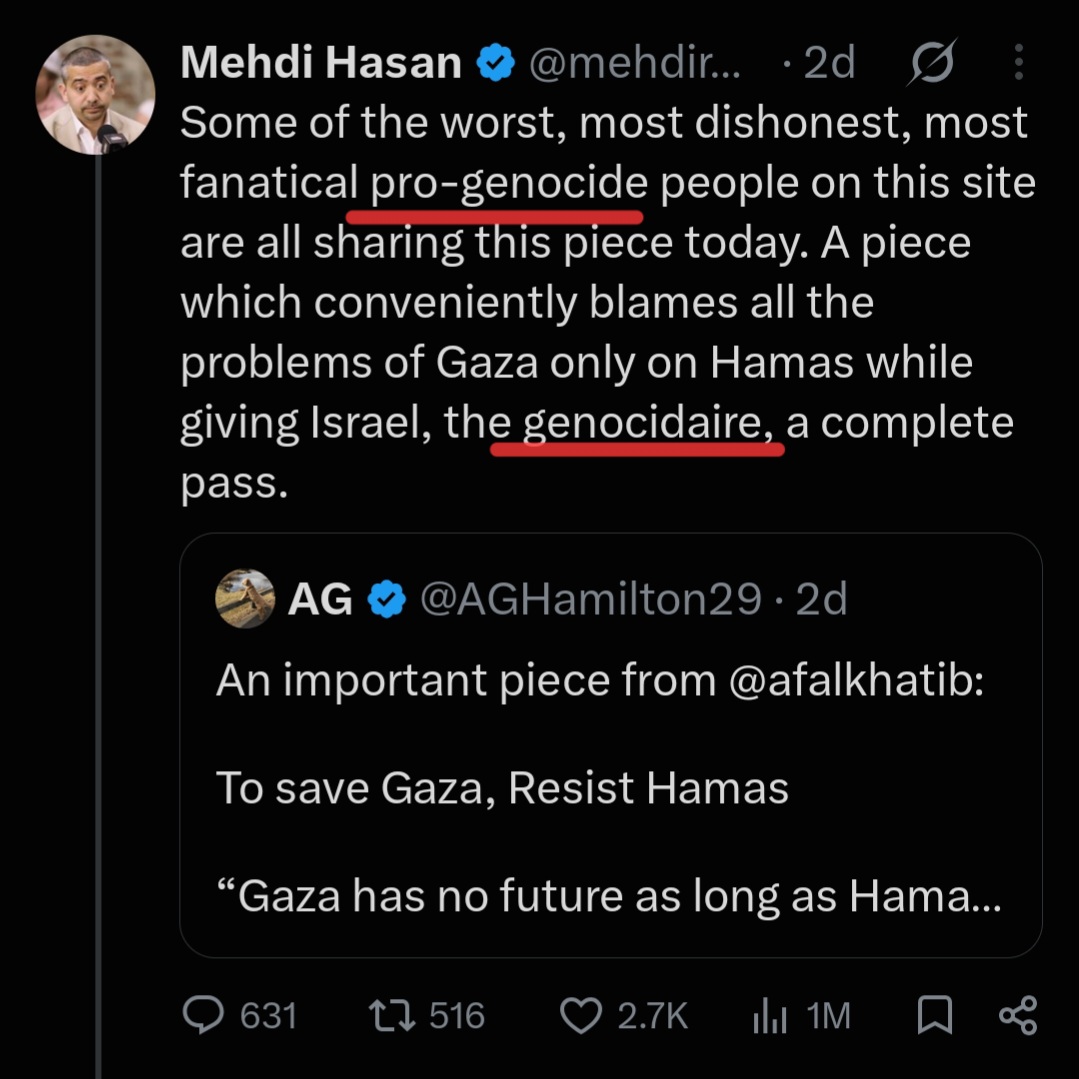
Mehdi Hasan offered an almost grotesque demonstration this week while attacking a New York Times essay by Gazan Palestinian Ahmed Fouad Alkhatib urging Palestinians to resist Hamas. Hasan called people sharing the essay “pro-genocide people,” Israel “the genocidaire,” the essay “a pro genocide piece” and the war “this current genocide.”
Hasan suffers a genocide stutter.
He cannot bring himself to say clearly and unambiguously that Hamas is a terrorist group and committed a heinous terrorist act, but cannot get the word “genocide” out of his mouth as he tries to hypnotize viewers into believing the unbelievable about Israel.
And the accusation does not remain attached to Israel’s government. Once genocide becomes the premise, anyone defending Israel can become pro-genocide. Even a Palestinian Arab arguing that his own people must resist Hamas can produce a pro-genocide piece for the obsessive compulsive stutterer.
That is how a defamatory vocabulary spreads.
Genocide is among the gravest accusations that can be made against a people or state. Repeating it as established fact without establishing the specific intent the crime requires does more than distort a war. It tells millions of people that Israel is deliberately destroying Palestinian Arabs and that those who defend Israel are defending that destruction.
That is an incendiary allegation in a world where Jews and Israelis are already threatened and attacked over Gaza.
Meanwhile, terrorist is handled delicately when describing the organization that deliberately slaughtered civilians on October 7 in the worst slaughter of Jews since the Holocaust.
The asymmetry is morally grotesque. Hasan, Tlaib, Mamdani are trafficking in the asymmetry of whataboutery as a heinous veneer to protect antisemitic terrorists, plain and simple.
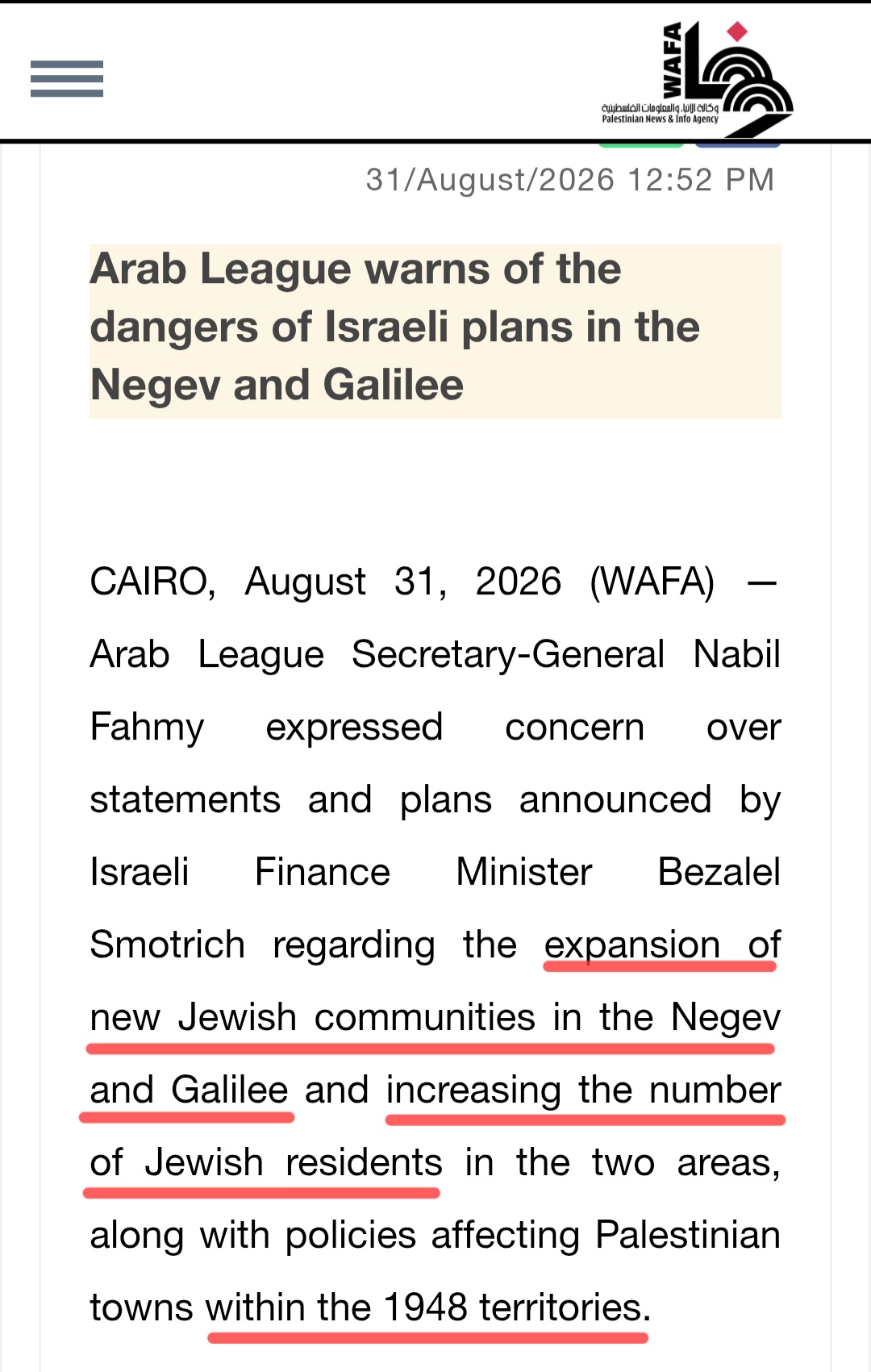
The Arab League issued a remarkable condemnation of Israel: it objects to the “expansion of new Jewish communities in the Negev and Galilee and increasing their Jewish populations.”
These are not settlements in the West Bank. They are areas inside Israel’s pre-1967 borders.
Further, Israel is described as “1948 territories.”
That makes the statement difficult to reconcile with the Arab League’s simultaneous support for a Palestinian state based on the June 4, 1967 lines. Under that formula, the Negev and Galilee remain part of Israel. And why suggest that Israel is just part of Palestine, calling the entire state “1948 territories?”
The question is particularly relevant to Egypt.
Egypt was the first Arab country to recognize Israel and signed a peace treaty with Israel in 1979, ending the two countries’ state of war. Nearly fifty years later, Cairo continues to endorse a two-state solution: a Palestinian state based on the 1967 lines alongside a secure Israel.
That position should carry a simple implication: Israel’s right to develop its own communities within its own territory.
Egyptian officials should therefore answer a straightforward question: Does Egypt believe Israel has the same right to develop Jewish communities within its territory that a future Palestinian state would have to develop its own communities?
If the answer is yes, Cairo should say so.
If the answer is no, then the issue is not simply the borders of a future Palestinian state. It is whether Jewish demographic and community development inside Israel is itself considered illegitimate. It reeks of antisemitism.
But is their another way to think of these hateful remarks?
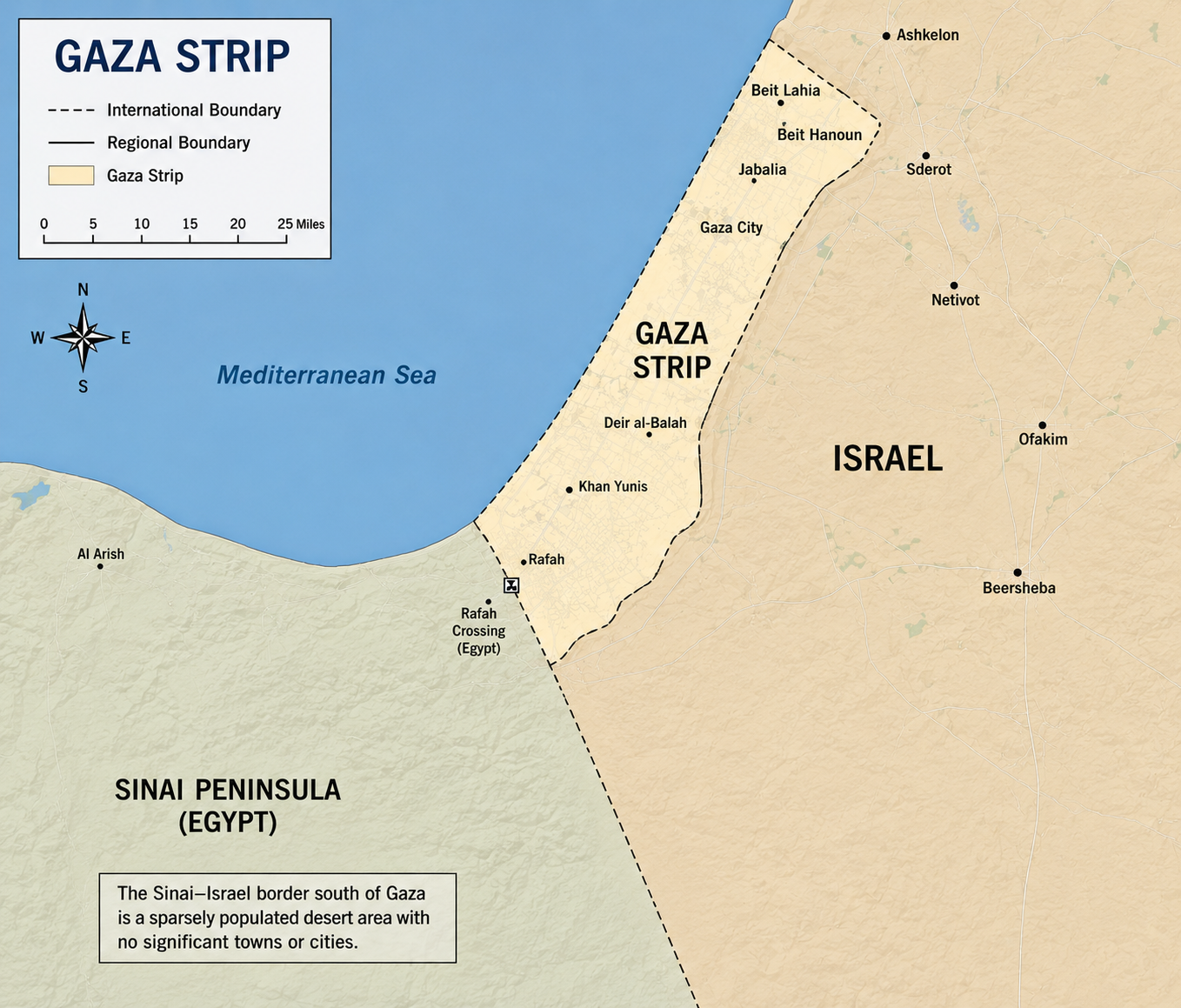
Egypt made peace with Israel nearly half a century ago to get back the Sinai Peninsula it lost in the 1967 Six Day War. Is Egypt deliberately opening cracks in that treaty? Is it preparing to push Israel to hand some of the Negev to Gazans now – alongside its own contribution of part of the Sinai – as Gazans hope to rebuild the strip after its failed war on Israel?
Is the Arab League simply being antisemitic or is it deliberately setting the course for a new map for Gaza?
On September 11, 2001, jihadi terrorists turned passenger airplanes into missiles and murdered nearly 3,000 Americans.
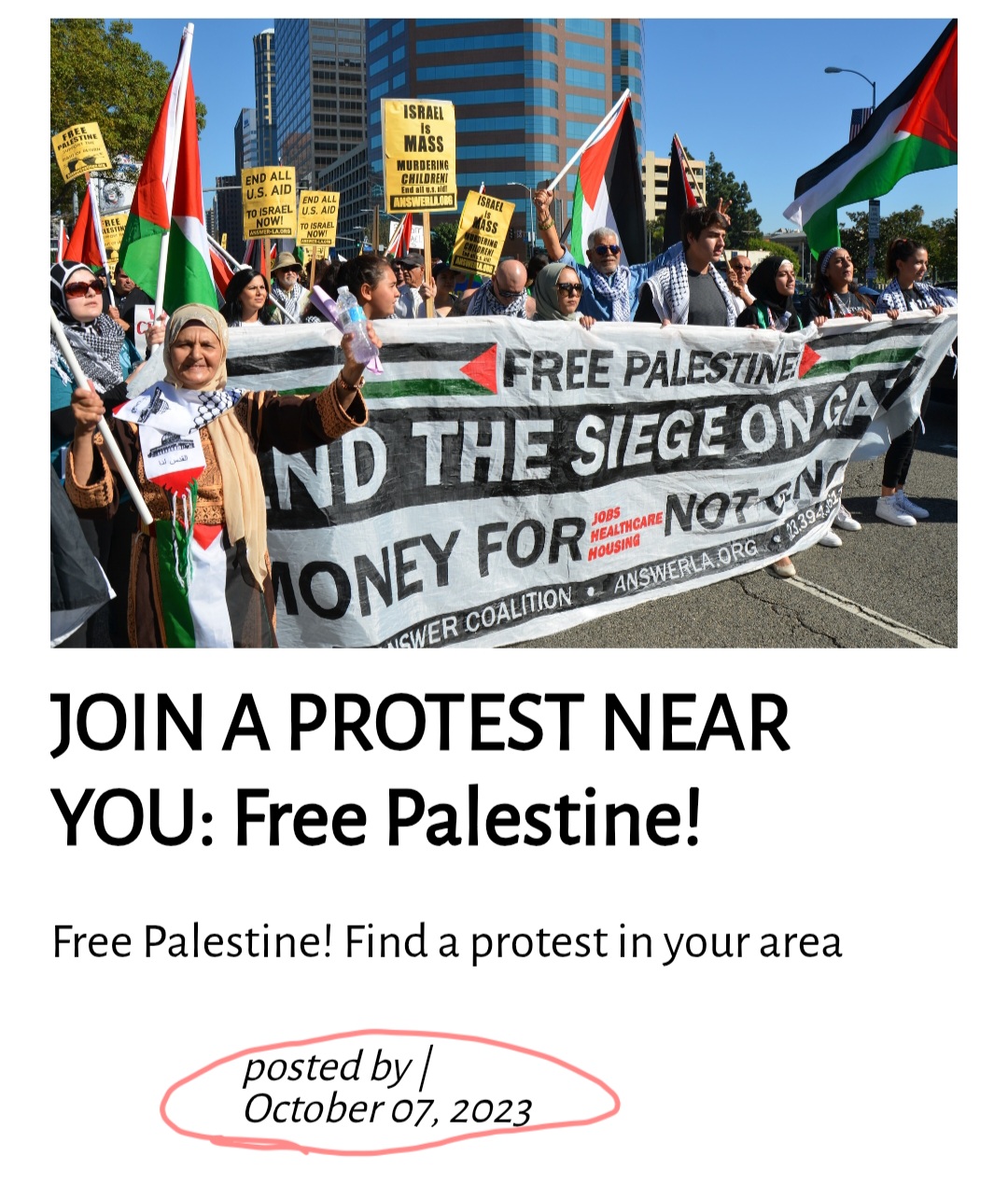
Only three days later, while bodies were still being recovered, ANSWER—Act Now to Stop War and End Racism—was formed to protest what America might do in response.
The name was important.
ANSWER viewed American military power abroad and racism at home as pieces of the same system: a wealthy, largely Western “Global North” dominating the poorer, disproportionately black and brown “Global South.”
For this anti-Western group, America was not defending itself. It was exercising imperial power. Those fighting it could be engaged in “resistance.”
Seven months after 9/11, Israel was pulled into the same framework.
On April 20, 2002, ANSWER organized more than 100,000 people in Washington under “Free Palestine, No War on Iraq.”
The Iraq War had not even begun.
Later that year, Medea Benjamin, Jodie Evans and others founded CODEPINK to oppose the coming Iraq War. The organizations forming around it had a broader worldview: America and its allies represented imperialism, while their opponents represented oppressed peoples fighting back.
Israel became another perfect target.
It was democratic, prosperous, militarily powerful and allied with America. It therefore became part of the “Global North.”
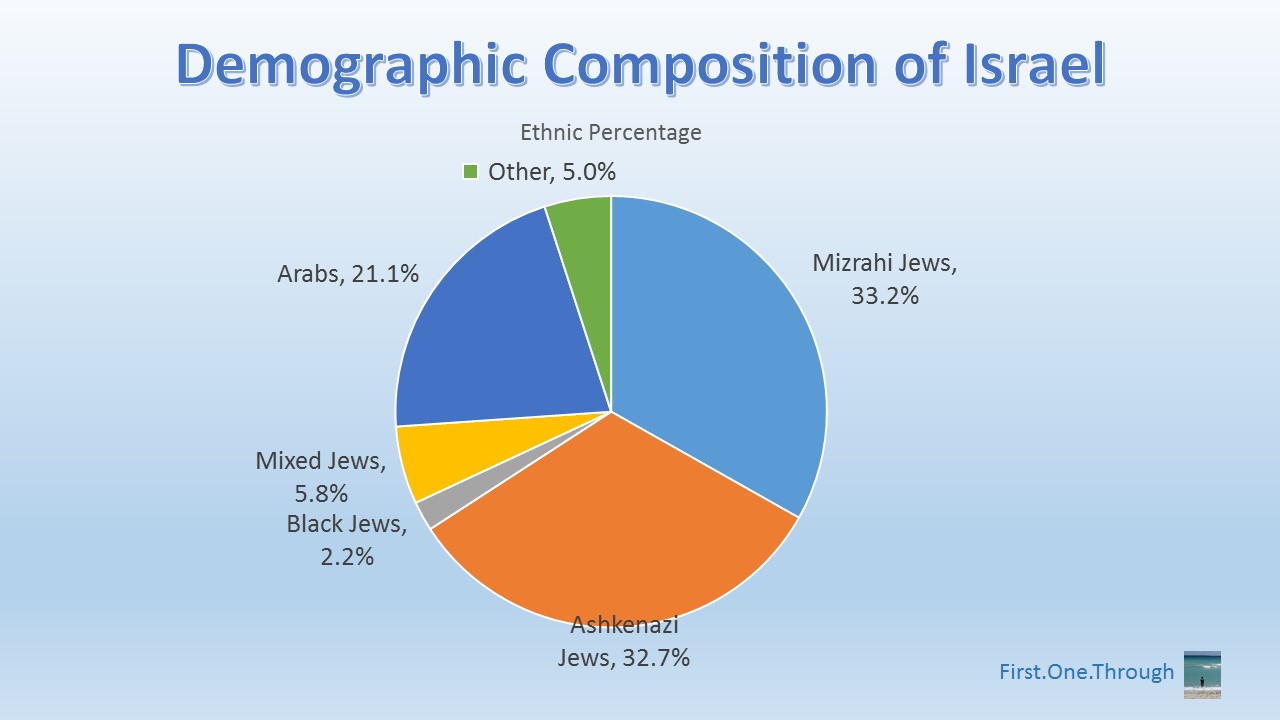
Never mind that roughly half of Israeli Jews have roots in the Middle East and North Africa. Never mind that Israel’s citizens include Arabs, Druze and other minorities. The supposedly racial framework somehow classified this remarkably diverse Middle Eastern country as the white colonialist.
That classification did something important.
It determined who was allowed to fight back.
Palestinian Arab jihadi violence could be “resistance.” Israeli force became “aggression.” ANSWER could call itself an antiwar organization while defending Palestinian attacks because it wasn’t really applying a rule against war. It was applying different rules to different sides.
Then came October 7, 2023. Thousands of Gazan terrorists invaded Israel, murdered roughly 1,200 people and kidnapped more than 250.
Israelis were still recovering bodies when ANSWER was mobilizing for “Free Palestine.”
The parallel with September 11 was remarkable. America gets attacked. Focus immediately turns to restraining America. Israel gets attacked. Focus immediately turns to restraining Israel.
Twenty-two years separated the attacks, but the ideological framework had barely moved.
The liberal societies being condemned have been spectacularly successful. People from every race, religion and continent continue trying to move to the United States, Canada, Europe and other liberal democracies. Israel itself absorbed Jews fleeing Europe, the Soviet Union, Ethiopia and the Arab and Muslim worlds.
People vote with their feet. They generally flee toward societies with elections, property rights, women’s equality, education, religious freedom and economic opportunity—not away from them.
The divide is not really white versus brown or North versus South. It is between those who view successful liberal societies as achievements worth defending and those who view their success and power as evidence of oppression.
September 11 exposed that divide in America. October 7 exposed it again in Israel.
The anti-Global North’s victims of preference changed from Afghanistan to Iraq to Palestine. And the vocabulary remained: imperialism, colonialism, oppression and resistance.
And so did the fundamental question: When terrorists attack a successful liberal society, who has the right to resist whom?
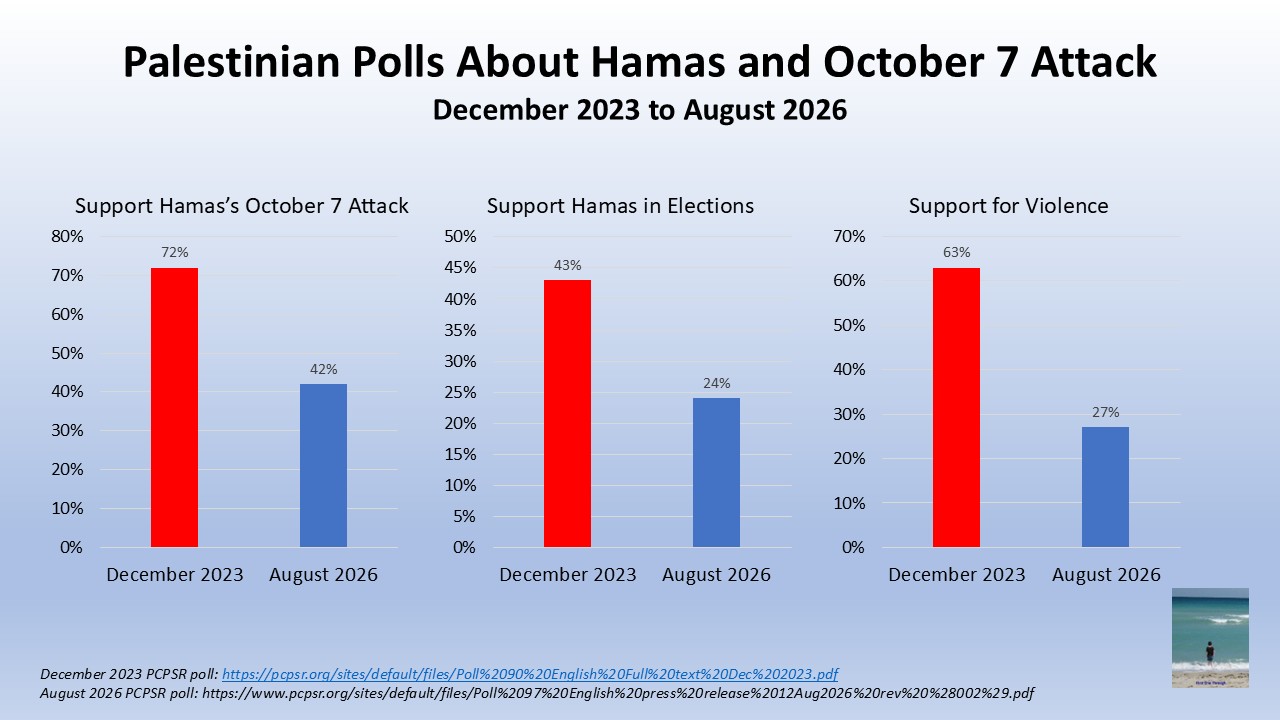
Three years ago, Palestinian Arabs thought October 7 might change their future by changing Israel. Polls show how much that ambition has changed.
In December 2023, 72% of Palestinian Arabs said Hamas was correct to launch the October 7 attack.70% believed Hamas would emerge victorious.63% preferred armed struggle as the best way to achieve Palestinian goals.
Nearly three years of war produced something very different.
According to PCPSR’s August 2026 poll, only 20% now believe Hamas won the Gaza war. Hamas political support has fallen to 24%. Half of Palestinian Arabs say “armed resistance” (aka massacring Jewish civilians) failed to protect them or end the “Israeli occupation” and instead brought destruction. Among Gazans, 65% say so.
Support for armed struggle has fallen from 63% to 27%. 44% now choose negotiations as the most effective strategy.
Their priorities have shifted with it.
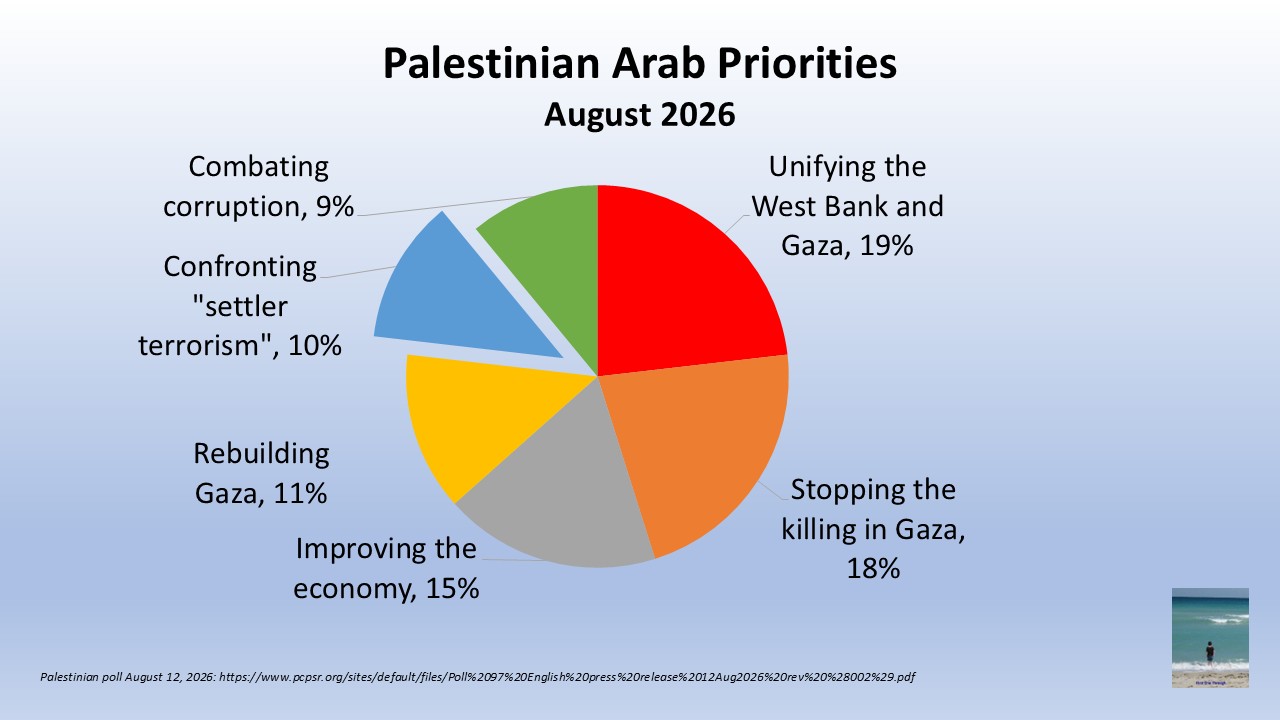
Asked in the August 2026 poll what the next Palestinian legislature should address, Palestinian Arabs answered:
19% — Unifying the West Bank and Gaza
18% — Stopping the killing in Gaza
15% — Improving the economy
11% — Rebuilding Gaza
10% — Confronting “settler terrorism”
9% — Combating corruption
Settler violence ranks fifth.
That is a very different Palestinian Arab story from the one dominating international headlines. Palestinian Arabs put reunification, ending the Gaza fighting, economic recovery and rebuilding Gaza ahead of attacks from West Bank Jews.
While the ambitions of October 2023 were directed outward, towards ending the Jewish State, the priorities of August 2026 are directed inward, to unification, rebuilding and recovering.
And Hamas remains part of that project.
The Palestinian Authority wants candidates in the coming elections to accept the commitments of the Palestine Liberation Organization, including its agreements with Israel. 66% of Palestinian Arabs oppose that requirement. Only 27% support it.
Because Palestinian Arabs envision Hamas remaining part of their future.
Asked what Hamas would become if it gave up its weapons, 53% said it would remain both an armed resistance and political movement. Another 36% said it would become solely a political movement. That means 89% see Hamas continuing as a political movement in some form.
There is a historical lesson in what happens after a genocidal society launches a disastrous war and loses.
Postwar Germany did not rebuild by simply disarming the Nazi Party and inviting it to contest elections. The Nazi Party was abolished and banned. Its political structures were dismantled. Germany’s reconstruction required a break with the movement that had led it into catastrophe.
Palestinian Arabs are not making that equivalent break. While they increasingly recognize that Hamas’s war failed, they want Hamas to be part of the Palestinian future.
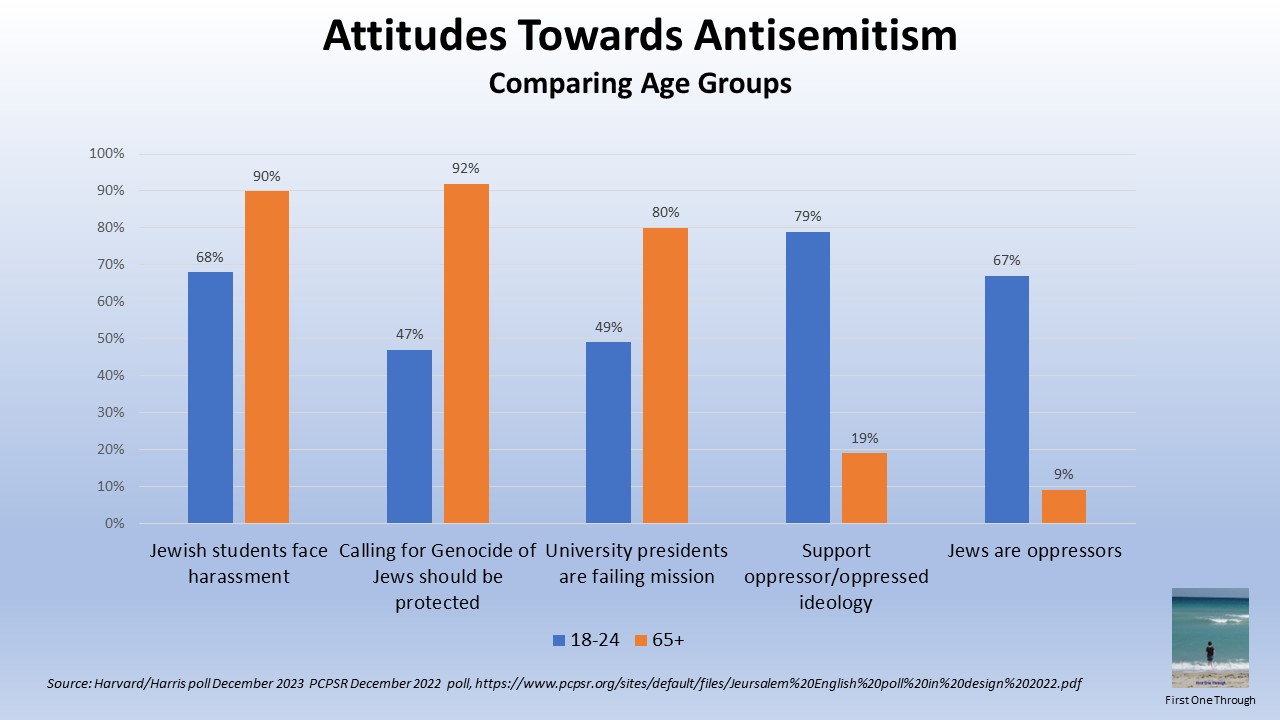
As the western media and United Nations narrows a focus on violence committed by Israeli Jews against Palestinian Arabs, those same Arabs are no longer focused on those Jews. Instead, the Arabs prioritize rebuilding after the disaster while maintaining the eliminationist ideology in their society for a future war.
Congress did not arrive at legislation protecting Hamas overnight. It arrived there one bill at a time.
For decades, debates over Israel revolved around diplomacy. Republicans and Democrats argued over settlements, negotiations, Jerusalem, and the contours of a future Palestinian state. Even lawmakers sharply critical of Israel generally framed their proposals around advancing a negotiated two-state solution. The disagreement was over how peace should be achieved, not whether Israel had the right to defend itself against terrorist organizations.
In 2020, as the Trump Administration unveiled its peace plan and Israel considered extending sovereignty to portions of the West Bank, progressive lawmakers introduced legislation preventing American assistance from supporting annexation. Whether one believed annexation was prudent or unwise, the objective remained fundamentally political. These bills sought to influence the outcome of negotiations and preserve the possibility of a future Palestinian state. The debate was about borders, diplomacy, and competing visions for peace.
That bill did not stand in isolation.
In 2019, Representative Betty McCollum (D-MN) also introduced legislation prohibiting U.S. assistance from supporting the military detention of Palestinian minors. On its face, the proposal carried moral appeal. No civilized society wants children caught in war, and few slogans resonate more powerfully than protecting minors.
Yet the legislation missed the point. Israel’s military justice system does not prosecute minors because they are children. It prosecutes minors accused of security offenses, including violent rioting, firebomb attacks, shootings, stabbings, and participation in terrorist organizations. Hamas, Palestinian Islamic Jihad, and the Popular Front for the Liberation of Palestine have all recruited teenagers into violent activity for decades.
Arab minors caught on camera right before they stab Israelis
The debate was no longer centered on where Israel’s borders should ultimately lie. It was becoming a debate over whether Congress should restrict Israel’s ability to prosecute those participating in terrorism.
That evolution became unmistakable after October 7.
The largest massacre of Jews since the Holocaust might reasonably have been expected to produce overwhelming congressional support for dismantling Hamas. Instead, it accelerated an entirely different legislative movement.
Arabs in Gaza take the body of Israeli woman they had just killed into Gaza where the crowds pelted her body and spat on her
One proposal after another sought to block the military tools Israel argued were necessary to fight the war. Senator Bernie Sanders (D-VT) repeatedly forced votes to halt major arms sales. Representative Rashida Tlaib (D-MI), Representative Pramila Jayapal (D-WA), Representative Delia Ramirez (D-IL), and others introduced the Block the Bombs Act. Senator Chris Van Hollen (D-MD) sought to impose additional legal restrictions before military assistance could proceed.
US Senator Chris Van Hollen attends a Senate subcommittee on the Justice Departments proposed 2027 budget, on Capitol Hill in Washington, May 19, 2026.
Supporters presented these bills as humanitarian safeguards designed to protect civilians and uphold international law. Their practical effect, however, would have been to deny or delay weapons while Israel was engaged in combat against a U.S.-designated terrorist organization that had murdered, raped, tortured, kidnapped, and burned civilians alive.
Congress was no longer principally debating the contours of a future peace agreement. It was debating how much of Israel’s wartime capability should be withheld while the war itself was still being fought.
And it continued.
In July 2026, Representative Thomas Massie (R-KY) introduced an amendment eliminating the entire $3.3 billion annual Foreign Military Financing package for Israel. Previous proposals had sought to condition aid or block particular weapons systems. Massie’s proposal went much further. It would have ended America’s regular military assistance altogether.
The amendment failed by a wide margin. But 104 members of Congress voted for it, including 103 Democrats alongside the bill’s Republican author.
That vote tells a larger story than the amendment itself.
Over the course of a few years, the legislative progression moved from opposing territorial annexation, to restricting Israeli counterterrorism practices, to limiting the weapons available to fight Hamas, and finally to questioning whether the United States should continue military assistance at all. Each bill built upon the political space created by the one before it. What once occupied the outer edge of congressional debate gradually became part of mainstream legislative discussion.
The coalition itself is unusual. Rashida Tlaib approaches the issue through Palestinian nationalism. Bernie Sanders emphasizes humanitarian law and civilian casualties. Chris Van Hollen argues for greater legal oversight of military assistance. Thomas Massie opposes foreign aid as a matter of constitutional principle. They arrive from very different ideological traditions, yet increasingly find themselves casting the same vote.
For generations, support for Israel was one of Washington’s few enduring bipartisan constants. That consensus has not disappeared; overwhelming majorities in Congress still support the alliance. But the terms of the debate have unmistakably changed.
Six years ago, Congress debated how American policy might influence a two-state solution. Today, members openly introduce legislation that would limit—or eliminate altogether—the military support Israel says it needs to defeat jihadist organizations committed not to coexistence, but to its destruction.
That is the real story of the Jihadi Protection Bills. Not that any single measure became law. But that, one bill at a time, the center of the American political conversation migrated from shaping the peace process to constraining Israel’s ability to wage war against jihadist movements to its basic ability to protect itself in a deeply hostile region.
We know that every death is a tragedy. We all wish there wasn’t war. Yet wars happen.
There have been several attempts to portray the current Gazans war against Israel in various lights. Some people have used the civilian-to-death ratio in this war of roughly 2-to-1 as historically low compared to any urban combat in modern times, especially one in which the army hides underneath the homes and hospitals of the civilian population.
Here, we lay out the civilian death figures relative to other modern wars which had many civilian deaths.
Assuming:
73,356 reported total deaths in Gaza from October 7, 2023 to August 2, 2026
25,000 of those were Hamas or other militants (a rough figure supplied by the Israeli army in January 2026)
Average civilian mortality per month: 2.19% ÷ 34 = 0.055% per month.
That yields the following comparison:
Case
Estimated monthly percentage killed
Multiple of Gaza civilian rate (0.055%/month)
Gaza [2023-present]
0.055%
1×
Guatemala (Ixil) [1981-3]
0.10%
1.8×
Darfur [2003-5]
0.11%–0.17%
2.0-3.1x
Roma genocide [1939-45]
0.20%–0.69%
3.6–12.5×
Anfal (Kurds) [1987-8]
0.22%–0.44%
4–8×
Ustaše genocide [1941-5]
0.36%
6.5×
Cambodia [1975-9]
0.44%–0.59%
8–10.7×
Rohingya [2017-8]
at least 0.67%
12.1×
Holodomor [1932-3]
0.73%–1.04%
13.2–18.9×
Holocaust [1941-5]
1.32%
24×
Yazidi genocide [2014-7]
0.65%–2.5%
11.8–45.4×
Rwanda [1994]
13.8%–22%
250.9–400×
Srebrenica (monthly equivalent) [1995]
~80%
~1,454×
Monthly toll of civilian deaths in wars over last 100 years, as a percentage of the total population, in comparison to current Gazan war against Israel
Yazidis are a non-Muslim ethnic group in and around Iraq targeted for persecution and annihilation by ISIS. They continue to suffer persecution from Muslims in Turkey and Iraq.
“IS fighters invaded Yazidi villages and towns in Northern Iraq and Iraqi Kurdistan, rounding up men, women, and children. Yazidi men were ordered to convert to Islam; those who did not, and even some who did, were executed in mass graves. Yazidi women and girls were abducted and sold into sexual slavery, being forcibly “married” to jihadists and other individuals in Iraq, Syria, and other countries. Yazidi boys were also kidnapped by the Islamic State and sent to training camps, where they were indoctrinated into the group’s severe interpretation of Islam and trained to become soldiers. IS glorified its atrocities online in gruesome videos, propaganda magazines, and religious publications, emphasizing its commitment to eradicating Yazidi identity.” – Vicken Cheterian, “ISIS Genocide against the Yazidis and Mass Violence in the Middle East,” British Journal of Middle Eastern Studies 48, no. 4 (2019): 1-7, doi:10.1080/13530194.2019.1683718.
Measured against the last century’s ethnic group civilian deaths, the war in Gaza has produced a far smaller death toll than the wars that shaped recent history. Yet few conflicts of comparable scale have generated such an extraordinary level of international media attention, UN action, street protests, and campus activism.
The conflict has spilled far beyond the battlefield. Around the world, Israelis and Jewish communities have increasingly become targets of hostility, harassment, and violence tied to the war. Whatever one’s views of the prosecution of the war, the global reaction has extended well beyond criticism of a government and the borders of Israel unlike every other conflict, raising profound questions about why this war has become so singular in international political and cultural life.
The numbers remind us that history matters. A world that loses its sense of proportion does not become more moral but selective, narrow and biased.
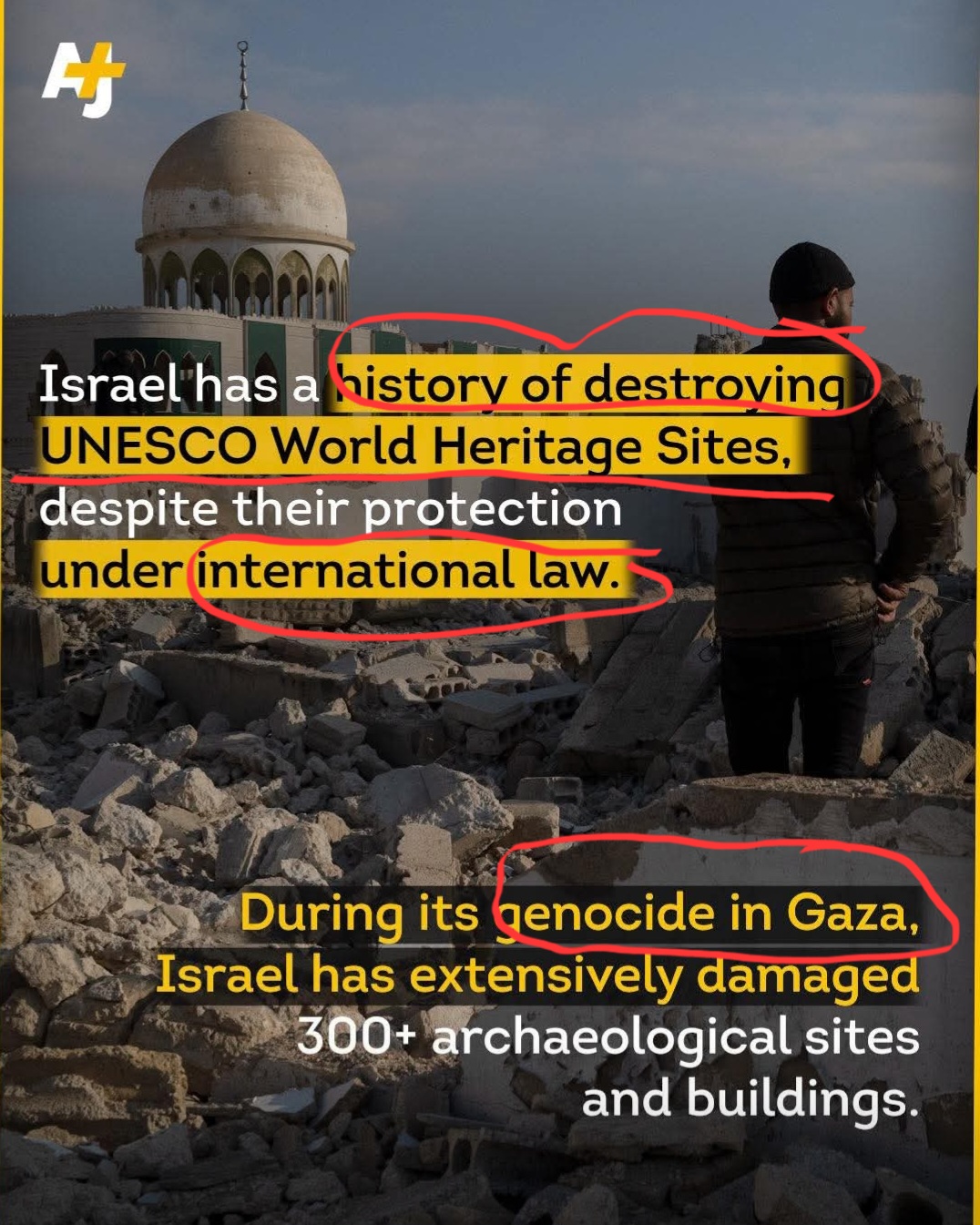
Al Jazeera is the global media company funded by Qatar, governed through a board appointed by the Qatari state and used to project Qatari influence around the world. Its digital arm, AJ+, was built in 2013 specifically for younger Americans who consume news through social media rather than television. By the late 2010s, it had become one of Facebook’s largest news-video publishers, generating billions of views and millions of followers while focusing heavily on race, social justice and the Israeli-Palestinian conflict, a peculiar cocktail of a socialist-jihadi alliance at that time, which is now mainstreamed.
AJ+ has a long history of peddling Hamas propaganda
In September 2020, the Trump Justice Department concluded that AJ+ was acting on behalf of a foreign principal and ordered it to register under the Foreign Agents Registration Act (FARA). Registration would not have restricted its journalism, but simply would have required public disclosure of its relationship with Qatar and periodic reporting similar to that required of other foreign state-backed media organizations like those from Turkey (TRT), China (CGTN) and Russia (RT).
AJ+ refused to register. Republican lawmakers including Chuck Grassley, Marco Rubio, Tom Cotton, Ted Cruz and Todd Young pressed DOJ to enforce its own determination.
Then, in May 2022, the Biden Justice Department withdrew the order after reviewing additional information submitted by AJ+. What changed has never been publicly explained. DOJ has not identified the decisive new facts, released its legal analysis or explained why AJ+ was treated differently from other foreign state-funded broadcasters.
“AJ+’s reporting ‘supports an inference’ that its broadcasts are ‘designed to influence the opinions and perspectives of its U.S. audience as directed by the foreign principals and for their principal benefit.’…
Given Al Jazeera’s and TikTok’s public prominence in the U.S., mounting evidence of their use to advance foreign agendas, and the Biden Administration’s own national security concerns with the two companies, the Committee is puzzled that the Department appears to have either ceased or paused enforcement of FARA registration requirements for the companies without explanation.” – February 8, 2024 letter from the Committee on Oversight and Accountability
The timing naturally raises questions.
Only months earlier, the United States had completed its withdrawal from Afghanistan. Qatar had become indispensable to Washington—hosting negotiations with the Taliban, assisting the evacuation from Kabul and serving as one of America’s principal diplomatic intermediaries in the region.
There is no public evidence that the FARA reversal was connected to Qatar’s diplomatic role but it is reasonable to ask whether a government relying heavily on Doha’s cooperation became less interested in forcing Qatar’s flagship media network to register as a foreign agent.
The same question now confronts the second Trump administration. Although Trump’s first Justice Department initiated the FARA action, his current administration has not publicly reopened the case. That may simply reflect DOJ’s legal judgment or competing priorities. It may also reflect Qatar’s continuing importance as a partner in addressing Iran, Gaza and other regional crises.
A final question – closer to home – may be the most consequential. During this same period, antisemitism reached levels not seen in decades while anti-Israel activism surged across American campuses and social media, principally from young people. And AJ+ was one of the most influential foreign state-funded digital news brands reaching young Americans, peddling such hatred over this time.
The unanswered question is whether Washington accepted greater Qatari influence inside the United States – including directly and indirectly promoting antisemitism – in exchange for Qatar’s assistance abroad.
Whether making Al Jazeera and AJ+ register under FARA would suddenly change these trends is unknown. But it is also unknown and curious why the government stopped asking the Qatari media powerhouse to do so.
Long before the current war began, prominent advocates for the Palestinian cause were describing Gaza as “hell on earth.”
In January 2009, Palestinian Queen Rania of Jordan released a video for UNRWA titled “Hell on Earth.” Eight months later, speaking at UNRWA’s 60th anniversary, she recalled that video and lamented that Gaza was still “Hell on Earth.”
Palestinian Queen of Jordan Rania called Gaza “Hell on Earth” in 2009
In May 2021, UN Secretary-General António Guterres declared, “If there is a hell on earth, it is the lives of children in Gaza today.”
When Israel began to respond to the war waged by Gazans in 2023, UNRWA Commissioner-General Philippe Lazzarini said Gaza had become “a living hell.” In January 2024, UN humanitarian coordinator Sigrid Kaag told the Security Council, “Gaza is hell on earth.”
The description has been remarkably consistent. What has often been missing is the question: Why?
Hell is not merely a place of suffering. It is a place where evil reigns.
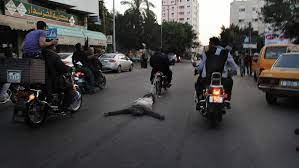
Hamas violently seized Gaza in 2007 after defeating Fatah in a brief but brutal civil war. Fighters executed political rivals, threw some from rooftops, publicly brutalized opponents, and dragged the bodies of alleged collaborators through the streets. Those who challenged Hamas risked imprisonment, torture, or death. Independent political life disappeared, and an entire generation grew up under the rule of an armed Islamist movement that prioritized rockets, tunnels, and perpetual conflict over building a prosperous society.
Hamas drags a disloyal Gazan through the streets to his death
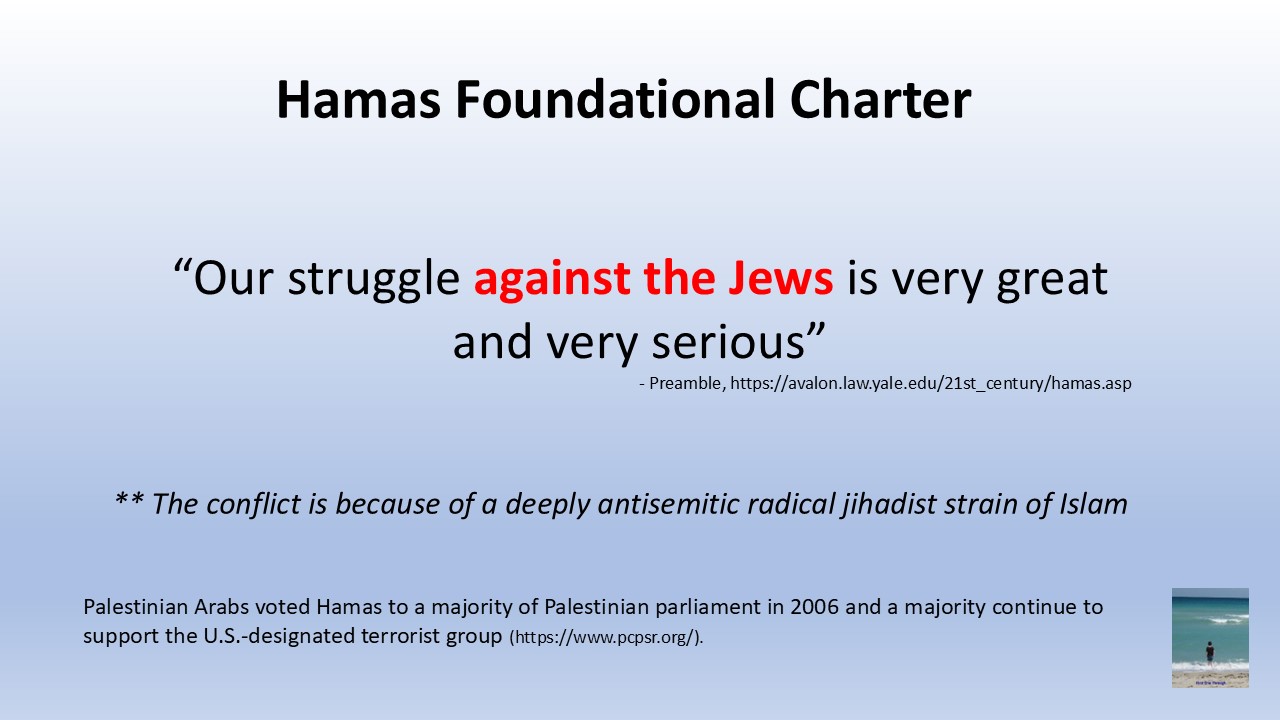
And Hamas was a known entity, a political party which won 56% of Palestinian parliament in elections with the most antisemitic political charter ever written. It remains the most popular political group to this day, expected to win Palestinian elections in every poll.
Calling Gaza “hell on earth” without acknowledging who built that system leaves the story unfinished. Should people want to transform the region, they must work to end the evil rule and worldview that turned part of the holy land into such a place in the first place.
Much of the discussion about Israel’s security focuses on borders, settlements, or ceasefires. Less attention is paid to a more fundamental reality: Israel is surrounded by governments that have failed – or have yet to demonstrate they can function as sovereign states.
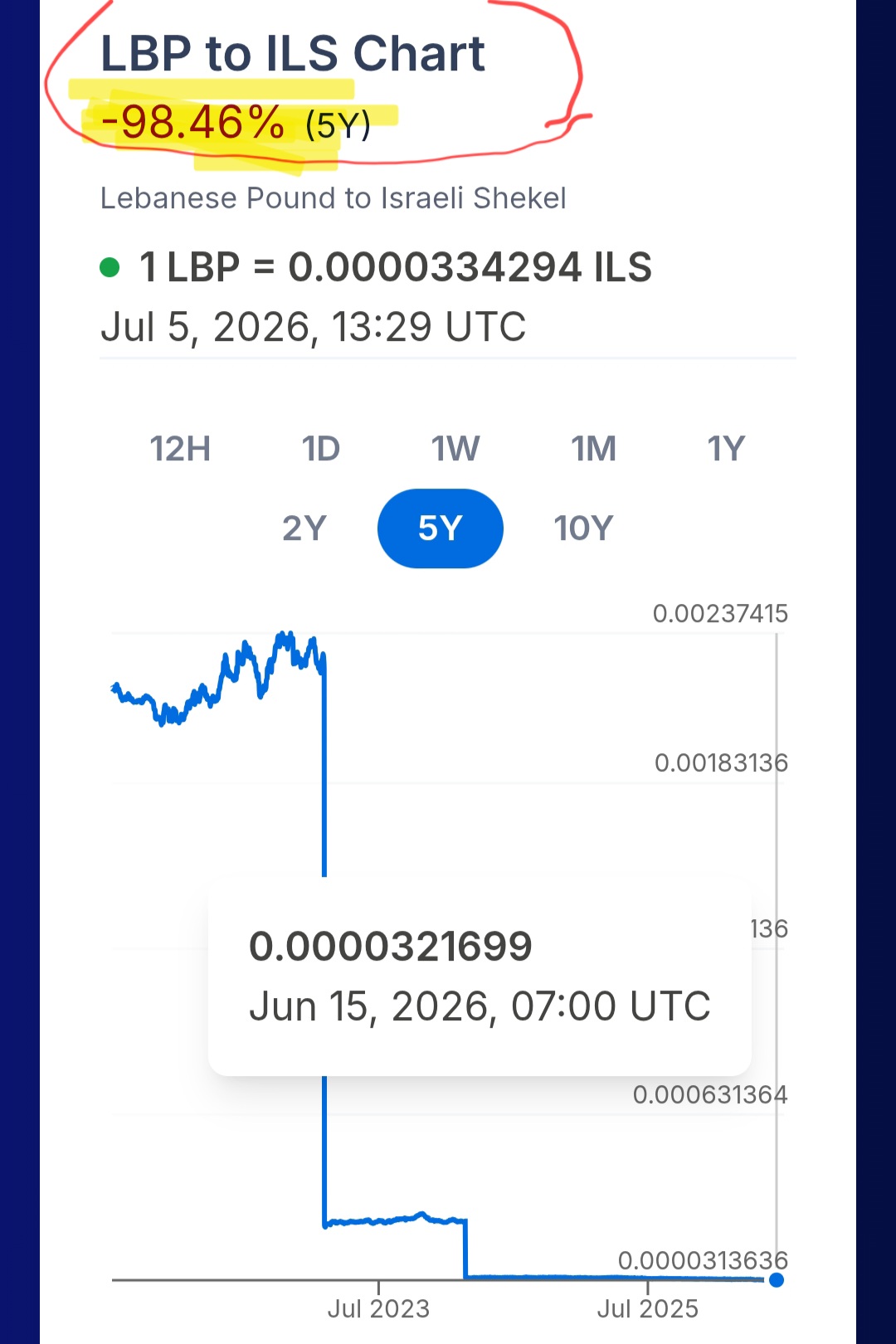
To Israel’s north lies Lebanon, a country where the government spent years unable to enforce a monopoly on force within its own territory. While the Lebanese Army wore the national uniform, Hezbollah built an independent army, amassed an enormous missile arsenal, dug tunnels, launched drones, and ultimately dragged the country into war. A sovereign state that cannot control its own territory has surrendered one of the defining responsibilities of statehood.
Lebanese pound to Israeli shekel exchange rate, defaulting on debt in March 2020, enormous explosion in Beirut for stored Hezbollah weapons in August 2020. The bank devalued currency by 90% in February 2023 and again in February 2024
Next to Lebanon is Syria. More than a decade of civil war shattered the country’s institutions, fractured its territory among competing armed groups and foreign militaries, and left millions displaced. Syria has long stood as one of the clearest examples of state failure in the modern Middle East.
Syrian civil war killed nearly 600,000 and dispersed 13 million. It is now ruled by Abu Mohammad al-Jolani who headed ISIS in the region
To Israel’s south lies Gaza. Hamas spent years and billions of dollars to build an underground military fortress instead of a functional society. The result was war after war after war. Destruction and death.
Hamas on October 7, 2023 slaughtered 1,200 people in Israel and brought over 250 people as hostages into Gaza to cheering crowds.
In the West Bank, the picture is different but equally troubling. The Palestinian Authority maintains civil institutions in parts of the territory, yet it has never established a monopoly on force or unified governance. Rival armed factions continue to operate, political legitimacy remains deeply contested, and governance has been divided from Gaza for nearly two decades.
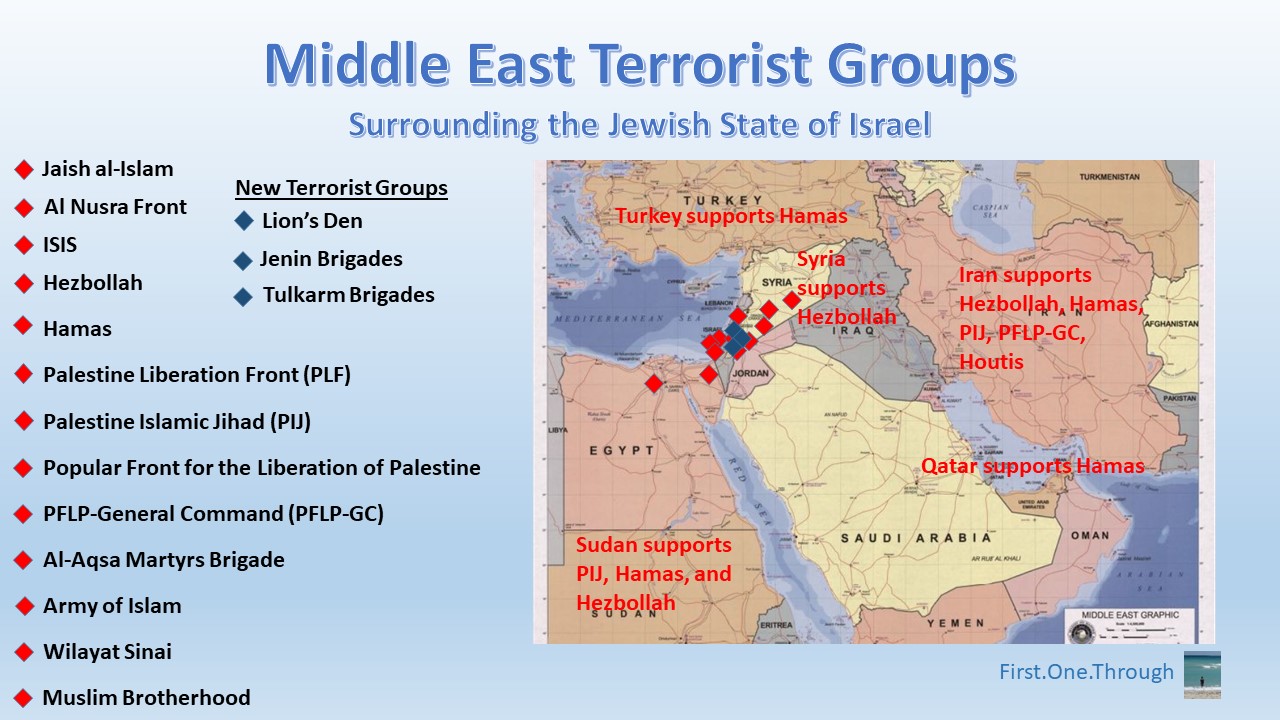
The collapse of governance in the states surrounding Israel has turned the region into one of the world’s greatest concentrations of terrorist groups. This is the strategic reality Israel faces every day.
Its neighbors are not peaceful democracies with settled borders and accountable institutions. They are governments weakened by civil war, dominated by militias, or unable to establish unified authority. Israel is repeatedly asked to take security risks on the assumption that these entities will prevent terrorism and enforce agreements, even though their recent history demonstrates the opposite.
The tragedy is not only Israel’s. The greatest victims of failed governance are the Lebanese, Syrians, and Stateless Arabs from Palestine (SAPs) themselves. They deserve governments that build economies instead of militias, schools instead of tunnels, courts instead of armed factions, and national institutions instead of perpetual conflict.
Peace agreements are negotiated between states because states can make commitments and enforce them. Militias cannot. Failed governments cannot. A failed state in waiting cannot.
Until the governments surrounding Israel control their territory, uphold the rule of law, and prioritize their people over perpetual conflict, Israel’s security challenges will remain the consequence of failed governance, not simply hostile neighbors.