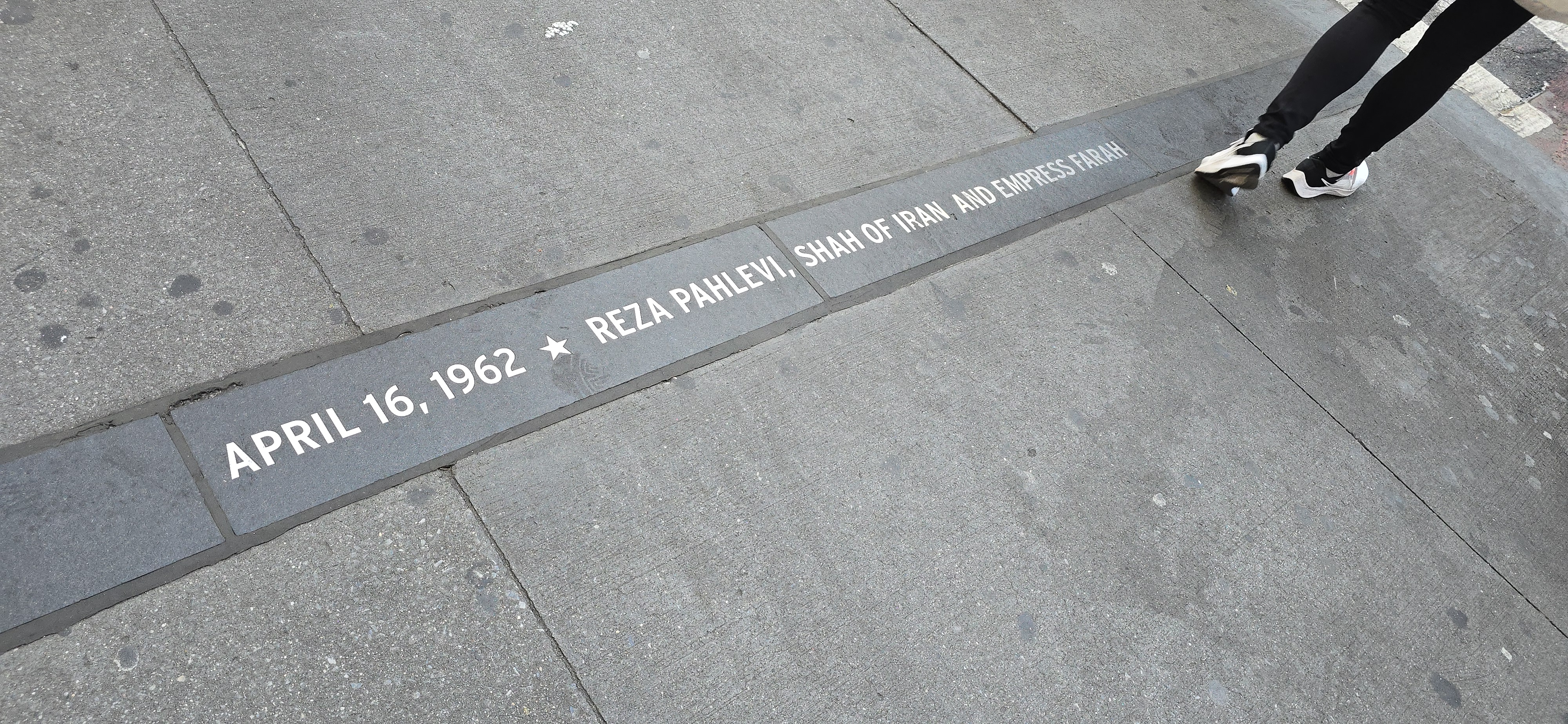
On April 16, 1962, New Yorkers lined Broadway to welcome Mohammad Reza Pahlavi, the Shah of Iran, and Empress Farah. The ruler of a Muslim-majority American ally received a ticker-tape parade through Lower Manhattan’s Canyon of Heroes. A plaque embedded in the sidewalk still commemorates their visit.
Marker on downtown Broadway sidewalk commemorating ticker tape parade for Shah of Iran and his wife (photo: First One Through)
Seventeen years later, the Islamic Revolution overthrew the Shah. Ayatollah Khomeini established a theocratic regime that called America the Great Satan, sought Israel’s destruction and held 52 Americans hostage for 444 days.
America had welcomed a Muslim ally. The jihadists who seized power declared America their enemy.
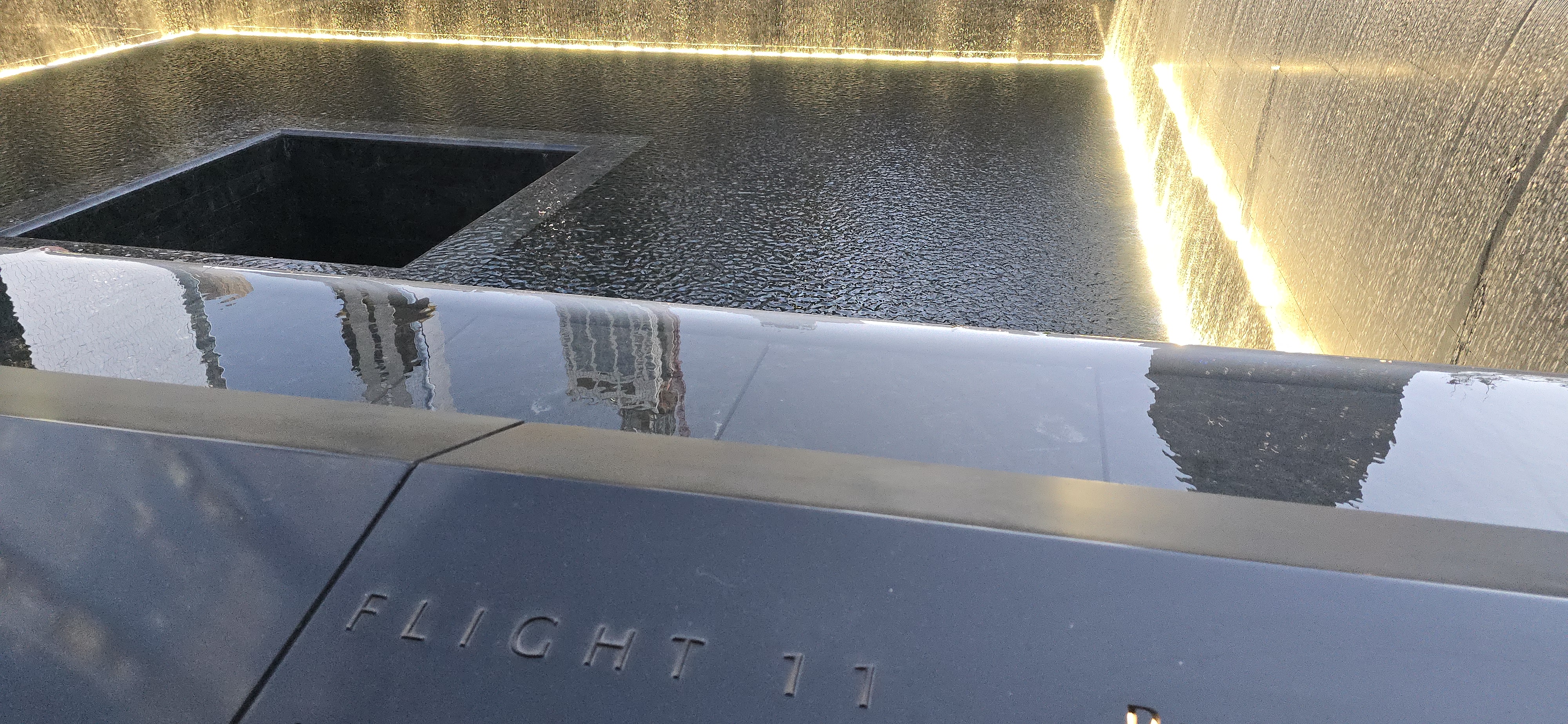
Their war against the West did not remain in the Middle East. Iranian revolutionaries seized Americans in Tehran, while Sunni jihadists carried their violence to American soil. Just blocks from the Shah’s parade route, Islamist terrorists bombed the World Trade Center in 1993 and destroyed its towers on September 11, 2001, murdering nearly 3,000 people.
World Trade Center memorial for those who died in the jihadi war on America on September 11, 2001 (photo: First One Through)
Different branches of radical Islam pursued their own visions of religious domination. ISIS declared a caliphate spanning national borders. Hamas, supported by Iran, sought an Islamist Palestine in place of Israel, massacring approximately 1,200 people and abducting 251 on October 7, 2023.
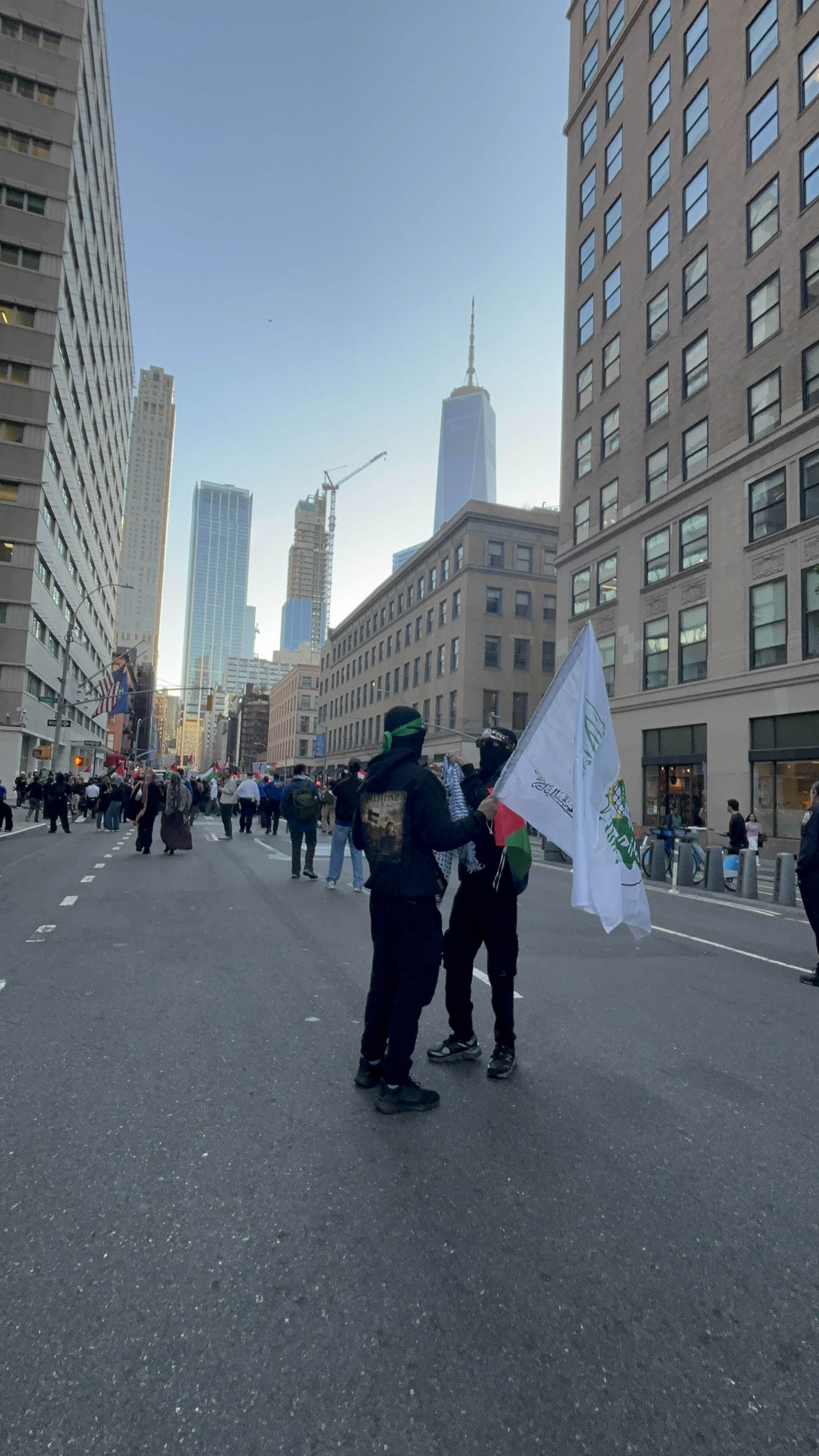
Three years later, masked demonstrators wearing green headbands marched along Lower Broadway displaying Hamas-associated symbols, with City Hall nearby and the rebuilt One World Trade Center rising behind them.
Young men with faces covered and Hamas headbands sporting jihadi flag, stand on Broadway before the World Trade Center to call for the continued war on Israel on the third anniversary of the October 7, 2023 jihadi massacre in Israel (photo: Gideon Askowitz)
Within a few blocks, the Canyon of Heroes had become the setting for three extraordinary encounters: Americans celebrating a Muslim ally, mourning the victims of Islamist terrorism and tolerating demonstrators displaying the symbols of a jihadi movement responsible for massacring Jews.
For decades, America has welcomed Muslims as allies, immigrants and citizens, embracing religious freedom and coexistence. At the same time, jihadist movements have declared their own war against the West, seeking religious and political domination. They carried that confrontation beyond the Middle East, taking American hostages, destroying American landmarks and massacring American allies.
The intersections of narrow streets in downtown Manhattan seemingly have compressed history into a web of toxins poisoned by Islamic radicals. Coexistence will only be permissible “under the wing of Islam,” as their “struggle” is perpetual and voracious.
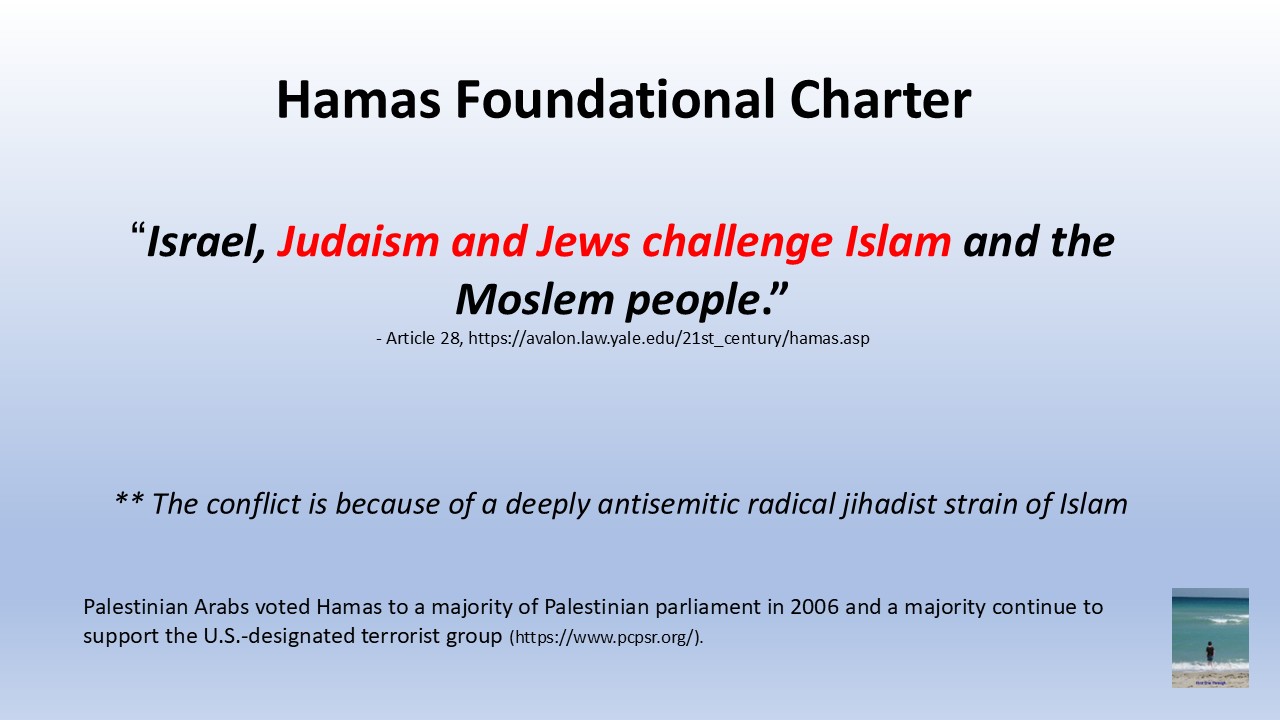
“under the wing of Islam followers of all religions can coexist in security and safety where their lives, possessions and rights are concerned. In the absence of Islam, strife will be rife, oppression spreads, evil prevails and schisms and wars will break out.” – 1988 Hamas foundational charter
The West is in a defensive war against radical Islam. One can see the progression clearly on the streets of lower Broadway.
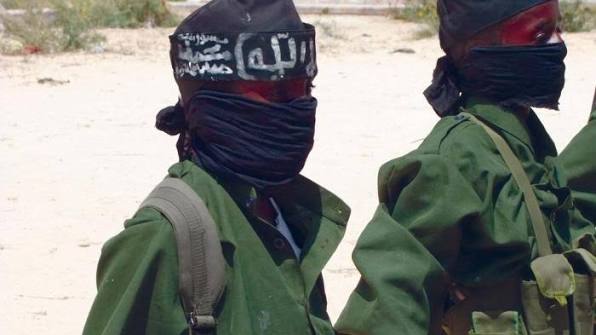
Summary: Millions of children do not attend school in Somalia; many of those who do are trained in jihad to fight “infidels” by al Shabab. It is a terrifying story of radical Islamic terrorism mapped for generations.
“I was always worried when they were at school,” a Somali mother told Human Rights Watch after her 17-year-old daughter was abducted by Al-Shabaab during a school tea break in Mogadishu. “Every day you get your child back at the end you are thankful.”
For parents in most countries, back to school means teachers, books, friends and homework. In parts of Somalia, it can mean wondering whether the child who left for school in the morning will return in the afternoon – or whether the school itself will become the beginning of a journey into jihad.
Somalia has one of the world’s most severe education crises. UNICEF says more than three million Somali children are out of school, while its more recent educational work puts the out-of-school rate at approximately 65% for primary-age children and 75% at the secondary level. Poverty, displacement, drought, insecurity, distance and a shortage of teachers all contribute to the enormous educational vacuum.
Into that vacuum has stepped Al-Shabaab, an Al-Qaeda affiliate.
The European Union Agency for Asylum estimated that Al-Shabaab controls around 30% of Somalia’s territory, including large rural areas and numerous district capitals, while exercising influence or forms of co-governance well beyond the territory it directly controls. Its leadership remains intact, and the group has continued making territorial gains.
That combination should be terrifying: millions of children disconnected from conventional education alongside a jihadist organization controlling substantial territory and building an education system of its own.
A “Jihadi Worldview”
The Hiraal Institute, a Mogadishu-based security research organization, examined Al-Shabaab’s education system in a report appropriately titled The Fighters Factory. Its description should receive far more attention than it has.
“Children are indoctrinated in the Islamic institutes and made to understand current affairs through a Jihadi worldview. Additionally, the illegitimacy of the Somali government and the obligatory nature of the AS Jihad are ingrained upon them. Quran teaching is done at a faster pace than in traditional schools in order to make time for Jihadi literature. Most children graduate within two years, with many being sent directly to a training camp if they have passed age 15, the Islamic age of maturity.” – Hiraal Institute
The objective is not hidden. Hiraal concluded that Al-Shabaab built the system to create “a steady stream of ideologically pure fighters.”
The U.S. State Department independently documented what that ideology means inside Al-Shabaab-controlled schools: that students should wage war against those the organization considers “infidels,” including people in neighboring countries as well as Somalia’s federal government and international forces.
Consider the progression.
A child does not begin with an assault rifle. He begins with an explanation of the world.
The government is illegitimate. Jihad is obligatory. There are infidels against whom war should be waged. Martyrdom is honorable. The organization providing the lesson possesses religious authority.
This is hatred taught; prejudice as obligation.
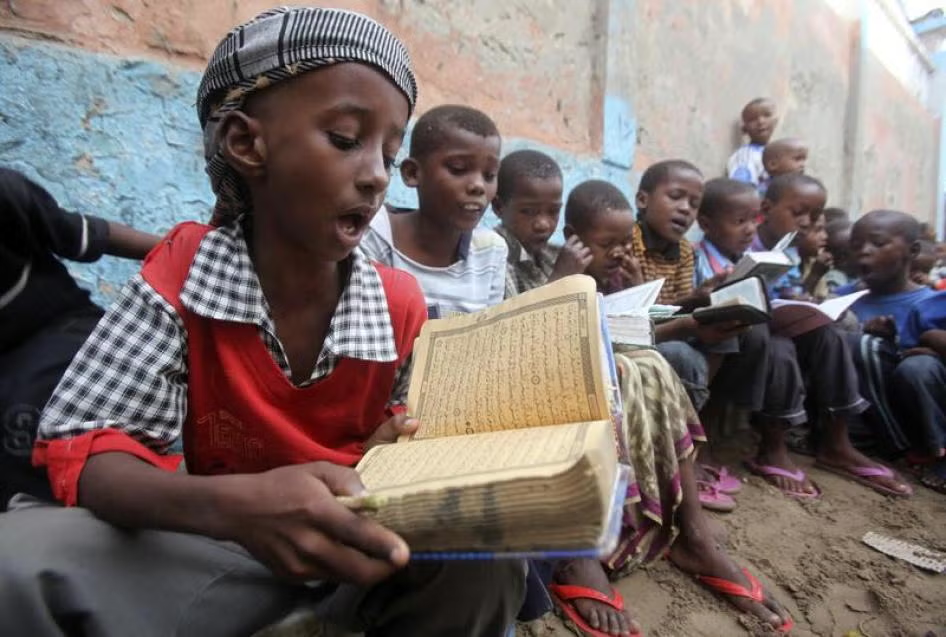
Children learning to read the Quran at the Gaabow Islamic school in Somalia’s capital, Mogadishu, August 2013. (photo: REUTERS/Ismail Taxta)
From Classroom to Training Camp
The distinction between education and recruitment consequently begins to disappear.
Hiraal reported that children educated entirely inside the Al-Shabaab system could become some of its most ideological and fanatical fighters because they had never been exposed to an opposing argument.
American and international reporting describes what can happen next.
The State Department has repeatedly documented Al-Shabaab raiding schools, madrassas and mosques, coercing families and clan elders and recruiting children into its ranks. Children in its camps have undergone physical and religious training alongside weapons training. They have been used to carry ammunition, gather intelligence, plant explosives, fight in combat and serve as human shields and suicide bombers.
The State Department reported that training has even included forcing children to punish and execute other children.
This is not merely recruitment of child soldiers – already a war crime. It is the attempted manufacture of a worldview capable of reproducing violence from one generation to the next.
Young child in al Shabab training camp in Somalia
The Lesson Does Not Stay in Somalia
The categories taught in the classroom can become categories for selecting who lives and who dies. “Infidel” is not merely an ugly word; it is placing a target according to religion to facilitate murder.
That is why the education system deserves to be studied as part of Al-Shabaab’s terrorist infrastructure.
The Jihad Factory
The individual facts have been documented for years. What has been missing is the decision to put them in the same frame.
One institution records children out of school.
Another documents Al-Shabaab’s curriculum.
Another counts child recruitment.
Another records religious persecution.
Terrorism researchers count the dead.
Each is describing a different station along the same potential pathway: educational vacuum, ideological instruction, identification of the infidel, glorification of jihad, weapons training, recruitment and violence.
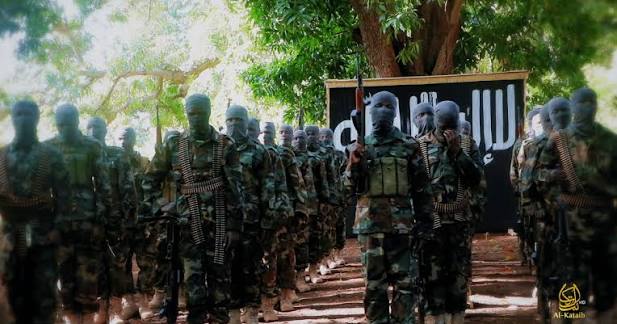
Al Shabab fighters in Somalia
That is why Al-Shabaab’s schools matter far beyond Somalia’s education statistics. A terrorist killed on a battlefield is one fewer terrorist. A child taught a “Jihadi worldview” represents something altogether different: a wager that the ideology can survive the men currently fighting for it.
Millions of Somali children remain outside school today. Across substantial territory, the organization positioned to exploit that vacuum has already demonstrated what it wants children to learn and, in documented cases, what it has subsequently demanded that children do.
The frightening question is therefore not how many Al-Shabaab fighters can be killed this year. It is how many replacements are sitting in classrooms.
Look at the world’s prominent terrorist organizations in the 1960s and 1970s and something is striking: religion is largely absent.
The PLO and its factions pursued Palestinian nationalism. The IRA fought over Northern Ireland. ETA sought Basque independence. The Red Brigades in Italy, Red Army Faction in Germany and Japanese Red Army embraced revolutionary leftist ideologies.
An analysis by RAND captures what happened next. In 1968, it identified zero religiously motivated international terrorist groups. In 1980, there were two among 64. By 1992 there were 11 among 48. By 1995, 25 of 58—43 percent—were religiously motivated.
Some point to 1979 as the pivotal year, when radical Islam found permanent footholds and inspiration.
In Iran, Ayatollah Ruhollah Khomeini’s revolution overthrew the Shah and established an Islamic Republic. Political Islam had demonstrated that it could overthrow a western-aligned government.
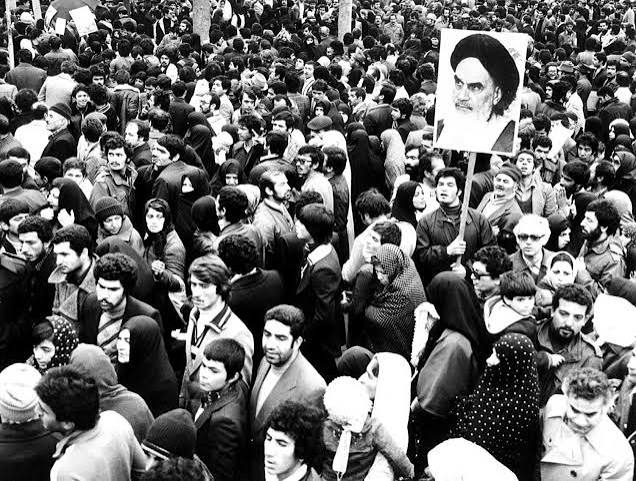
Iranian revolution of 1979
Iran then exported its revolutionary ideology and supported armed Shiite Islamist movements. Hezbollah, established in Lebanon in the early 1980s, became its most consequential manifestation.
Then came Afghanistan.
The Soviet Union invaded in December 1979. Resistance to a non-Muslim foreign army occupying a Muslim country became an international Islamic cause. Saudi and other Gulf money flowed to the “resistance.” Pakistan became its essential staging ground. The United States supplied extensive assistance as part of its Cold War campaign against Moscow.
Afghanistan became a transnational incubator for Sunni jihad. Militants from different countries met, fought together and developed recruiting, financing and logistical networks. Osama bin Laden joined this world, and al-Qaeda eventually emerged from it.
Fondapol calls the Soviet-Afghan war the “matrix of contemporary Islamist terrorism.”
Other events show 1979 to be a pivotal year.
Islamist militants seized the Grand Mosque in Mecca, denouncing the Saudi monarchy as corrupt and insufficiently Islamic. The episode helped push Saudi Arabia toward greater religious conservatism just as it entered an intensifying competition with revolutionary Iran for leadership and influence across the Muslim world.
Meanwhile, Egypt and Israel made peace. Along with it, secular Arab nationalism, which had dominated much of Middle Eastern politics, began to lose prestige. Islamist movements increasingly presented themselves as the alternative. [Think of Hamas’s 2023 attempt to disrupt the expanding Abraham Accords].
The consequences of radical Islamism entering global terrorism developed gradually and then exploded.
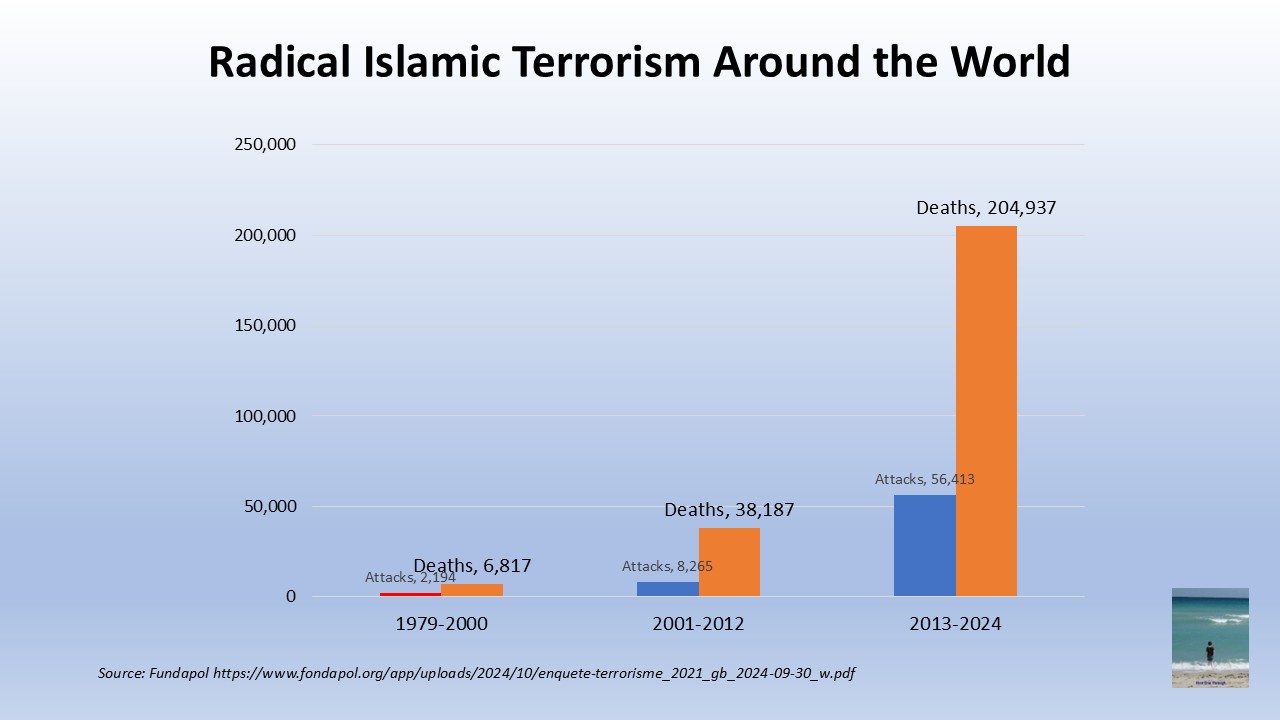
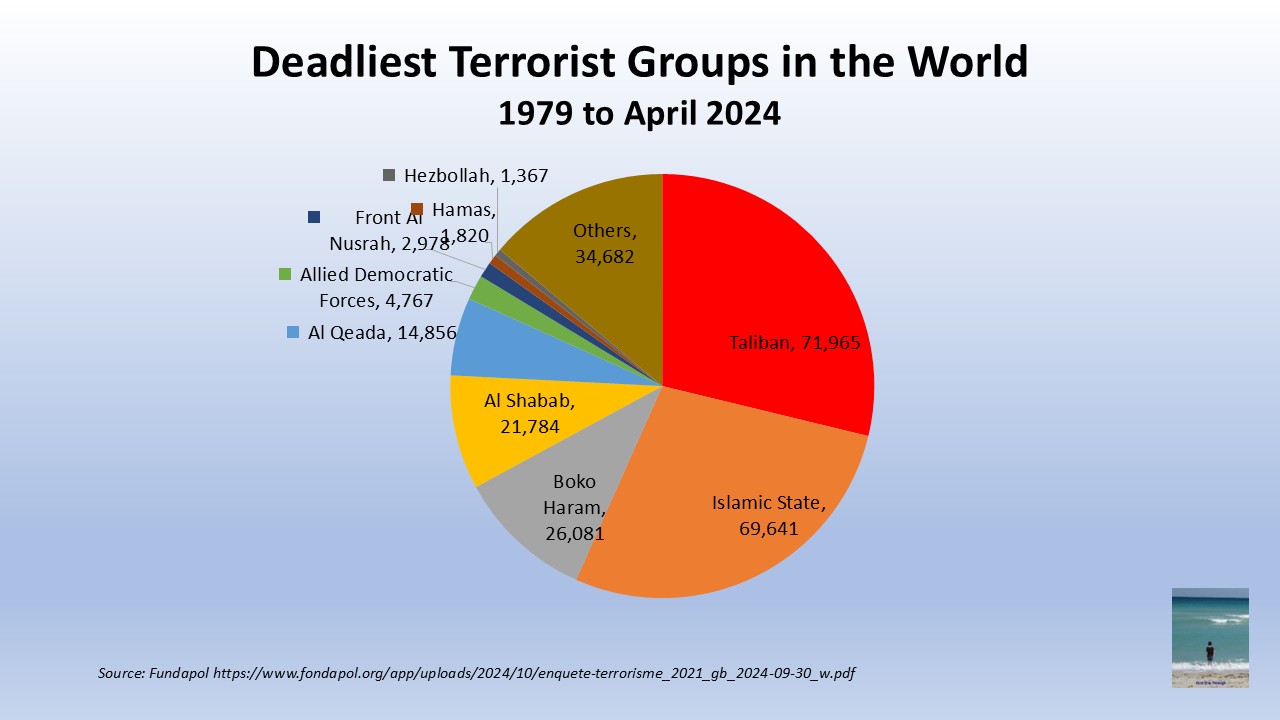
Fondapol records 2,194 Islamist terrorist attacks and 6,817 deaths from 1979 through 2000. From 2001 through 2012, it records 8,265 attacks and more than 38,000 deaths. From 2013 through April 2024, the toll surged to more than 56,000 attacks and roughly 205,000 deaths.
Altogether, its database catalogs 66,872 Islamist terrorist attacks killing nearly 250,000 people between 1979 and April 2024.
And this is not principally a story of Muslims attacking the West. Nearly 89 percent of those deaths occurred in Muslim-majority countries. The Taliban, Islamic State, Boko Haram, al-Shabaab and al-Qaeda became the five deadliest organizations in the database.
The transformation was both ideological and geographic. Al-Qaeda built affiliates. ISIS built provinces. Boko Haram devastated communities around Lake Chad. Al-Shabaab entrenched itself in Somalia and East Africa. Jihadist organizations spread across the Middle East, South Asia and increasingly Africa.
Iran demonstrated the revolutionary potential of political Islam; Afghanistan created the great transnational Sunni jihadist network; Mecca exposed another radical Islamist current; and the decline of secular Arab nationalism created room for Islamism to expand.
1979 was the year several forces converged and the center of gravity began to shift.
We readily study how nationalism, communism, fascism, white supremacy and other ideologies produced political violence. Jihadism has become the leading driver of terrorism in the world and must have the same intellectual clarity.
Twenty-five years after September 11, the United Nations remembered the 2,977 people murdered in what it called the “heinous terrorist attacks” of September 11, 2001, “an assault on humanity itself.” It declared that “the fight against terrorism is a shared, unfinished task.”
But something rather important was missing.
Who were the terrorists? What did they believe? Why did they do it?
There was no al-Qaeda. No Osama bin Laden. No Islamist extremism. No jihadism. Nothing about an ideology whose most famous declaration called for jihad against “Jews and Crusaders.”
Perhaps the United Nations simply avoids attaching ideologies to terrorism. It does not.
After a white supremacist murdered 49 Muslims at two Christchurch mosques in 2019, the UN spoke explicitly about “anti-Muslim hatred,” “anti-Islamic sentiments” and Islamophobia. Secretary-General António Guterres described the Pittsburgh Tree of Life massacre as the “worst antisemitic attack in the history of the United States.” Discussing the Halle synagogue attack and related violence, the UN warned about “antisemitic hatred,” “Neo-Nazis and white supremacists” and their “poisonous ideology.”
That is exactly what an institution confronting extremism should do. Terrorism is an act; ideology can explain its motivation.
Then consider Sri Lanka.
On Easter Sunday 2019, radical Islamist suicide bombers attacked churches and hotels, killing roughly 270 people. Sri Lanka subsequently told the UN that the terrorists had been “inspired and indoctrinated” by extremist organizations including ISIL/Daesh and had “specifically targeted churches.”
Yet on the seventh anniversary in 2026, the UN remembered the victims of the “Easter Sunday attacks.” Not terrorist attacks. Not ISIS-inspired terrorism. Not jihadism or Islamist extremism. Not anti-Christian hatred. The killers’ ideology had vanished.
That makes the 9/11 omission considerably harder to dismiss as an unfortunate choice of words. When Muslims are murdered by an anti-Muslim extremist, the ideology matters. When Jews are murdered by antisemites or neo-Nazis, the ideology matters. But when jihadists murder Americans or ISIS-inspired suicide bombers slaughter Christians at Easter, the UN retreats into the bloodless vocabulary of “terrorism” and “attacks.”
The problem is not that the UN says Islamophobia, antisemitism, white supremacy or neo-Nazism. The problem is its apparent inability to apply the same principle to jihadism.
That is no longer merely a question of consistency.
A 2024 study by the French think tank Fondapol catalogued 66,872 Islamist terrorist attacks since 1979, killing nearly 250,000 people. Roughly 243,000 of those deaths occurred after 2001. Almost 89 percent of the dead were killed in Muslim-majority countries. The Taliban, Islamic State, Boko Haram, al-Shabaab and al-Qaeda accounted for more than four-fifths of the victims.
“Islamist attacks around the world are more numerous today than ever before.” – Fondapol study
Jihadist ideology is therefore hardly an extinct doctrine being dredged up to explain a 25-year-old atrocity. Al-Qaeda survives. ISIS and its affiliates survive. Jihadist organizations continue to recruit and kill around the world, with Muslims overwhelmingly among their victims.
Calling that ideology jihadist or Islamist extremism no more condemns Muslims generally than calling an ideology neo-Nazi condemns Germans. In fact, refusing to make that distinction does Muslims no favor. It obscures an extremist ideology that has slaughtered enormous numbers of Muslims themselves.
Nor are the extremists coy about what they believe. They publish it, preach it, recruit with it and murder in its name. It is the international institutions confronting them that increasingly seem afraid to repeat what the killers themselves say.
So the UN should answer a straightforward question: Why can it say “white supremacist” and “neo-Nazi,” but not “jihadist”?
Has fear of accusations of Islamophobia—or pressure from states and organizations determined to shield Islamist ideology from scrutiny—become so powerful that jihadist supremacy alone receives a linguistic sanctuary at the United Nations?
Whatever the explanation, the consequence is dangerous. An ideology does not become less lethal because international institutions refuse to name it. It simply becomes harder to confront.
When terrorists can proclaim their ideology more plainly than the United Nations can describe it, sensitivity has crossed the line into surrender.
On September 11, 2001, nineteen al-Qaeda terrorists hijacked four airplanes and murdered nearly 3,000 people. They were followers of Osama bin Laden, who had declared jihad against the United States and explicitly invoked religion, Jews and “Crusaders” in explaining the war he believed he was fighting.
The Council on American-Islamic Relations (CAIR) has a guide for teaching September 11 to American children in grades 6 through 12. Its approach to that history is remarkable: don’t call the people who committed 9/11 “jihadists,” but make sure students learn extensively about Muslims as victims after 9/11.
CAIR’s Remembering and Reflecting on Sep. 11, 2001 in the Classroom tells educators to avoid language that “associates” the mass murder with Islam and Muslims. It specifically identifies three terms it considers “inaccurate and inflammatory”: “Islamic terrorists,” “jihadists” and “radical Islamic terrorists.”
“Avoid using language that validates the claims of the 9/11 attackers by associating their acts of mass murder with Islam and Muslims. For example, avoid using inaccurate and inflammatory terms such as “Islamic terrorists,” “jihadists,” or “radical Islamic terrorists.”” – CAIR teaching guide
The objection to “jihadists” is particularly revealing. The word does not describe Muslims generally. Quite the opposite: it distinguishes a radical movement from the enormous population of Muslims who do not subscribe to it. Likewise, adding “radical” to Islamic terrorism is an explicit qualifier. A teacher can explain precisely what al-Qaeda believed while simultaneously making clear that its ideology was rejected by countless Muslims.
CAIR instead recommends removing the distinction.
That might seem like a dispute over terminology until one reaches the guide’s recommended reading list. Then the editorial direction becomes unmistakable.
Among the eleven articles CAIR recommends are “Commemorate 9/11 by Confronting Islamophobia,” “9/11 at 10: Lessons Learned From Anti-Muslim Haters,” “Muslims in America, post 9/11,” “Hope and Despair: Being Muslim in America After 9/11,” “How Being Muslim In America Has Changed Since 9/11,” “Remembering the Muslims who were killed in the 9/11 attacks,” and “How 9/11 Caused An Increase In Islamophobic Hate Crimes.”
Seven of the eleven titles are explicitly centered on Muslims, Islamophobia or anti-Muslim discrimination. Another recommended reading concerns federal civil-rights engagement with Arab and Muslim communities.
The videos follow much the same path. Students are offered “How 9/11 Shaped the Lives of American Muslims,” “Minorities targeted in 9/11 ‘revenge attacks,’” “9/11 Changed Life For American Muslims,” and “Post 9/11 Detention Of American Muslims.”
What is conspicuously absent from CAIR’s article list is a comparable body of material about why September 11 happened in the first place and who conducted the heinous acts of mass murder.
There is no recommended article devoted to al-Qaeda’s ideology. None to the development of jihadism. None examining bin Laden’s religious declarations. None exploring why al-Qaeda spoke of Jews and “Crusaders,” or why its followers believed their mass murder of civilians was justified as jihad.
Instead, CAIR explicitly tells teachers what they should add: Muslim condemnations of the attacks, solidarity from Muslim-majority countries, Muslim leaders joining President George W. Bush at a mosque and Muhammad Ali participating in a fundraiser. When discussing the aftermath, teachers are instructed to include hate crimes and bigotry against Muslims, Sikhs, Arabs and other minorities.
Those are legitimate subjects. Americans who attacked innocent Muslims, Sikhs or Arabs after September 11 committed reprehensible crimes. Muslim Americans who died in the World Trade Center deserve to be remembered alongside every other innocent victim.
But that is precisely why the imbalance matters.
A history lesson should be capable of holding two ideas simultaneously: radical Islamists murdered nearly 3,000 innocent people on September 11, and innocent Muslims subsequently became targets of bigotry by people who wrongly held them responsible.
In fact, accurately naming the first proposition makes the second easier to understand. “Jihadist” separates the extremists from Muslims generally. “Radical Islamist” identifies an ideology rather than an ethnicity or an entire faith. Students can then examine that ideology, understand why most Muslims reject it and understand why blaming ordinary Muslims for al-Qaeda’s crimes is both factually wrong and morally indefensible.
CAIR takes the opposite route.
Religion becomes something educators should carefully detach from the perpetrators, even though the perpetrators themselves repeatedly invoked it. Then religious identity becomes central when discussing the victims of the aftermath.
The inversion is extraordinary.
Consider what a student following CAIR’s bibliography is encouraged to encounter. The student can read about anti-Muslim haters, Islamophobic hate crimes, Muslim life after 9/11, Muslim heroes, Muslim victims, Muslim detention and civil rights for Muslim communities.
But where is the corresponding invitation to study the jihadists?
Where is bin Laden’s worldview? Where is al-Qaeda’s theology? Where are its declarations? Where is its obsession with “Crusaders” and Jews? Where is the intellectual history that transformed religious extremism into airplanes crashing into buildings filled with civilians?
September 11 did not begin with Islamophobia. It began with an ideology and 19 men prepared to murder thousands of strangers in the name of radical Islam.
CAIR is not asking schools merely to protect Muslim students from collective blame. It is asking educators to perform something far more consequential: strip the perpetrators of the language that identifies their radical ideology while repeatedly directing students toward the victimization of Muslims that followed their attack.
That is not historical sensitivity. It is historical inversion.
And it invites conspiracy theories that Jews committed 9/11, when the slaughter was done in the name of genocidal jihad.
Graffiti in London in 2019 claiming that Jews did 9/11, or that another mass murder is coming for Jews
CAIR’s approach leaves students with a grotesquely rearranged history: the Muslims who suffered bigotry after 9/11 retain their religious identity, while the jihadists who caused 9/11 are stripped of theirs.
CAIR calls that responsible teaching. A better description is laundering the ideology of the killers out of the history of their crime.
Fear of Muslims is called Islamophobia. Hatred of Jews is called antisemitism.
One word announces fear (phobia) while the other focuses on hatred (anti).
Graffiti in London, England blames Jews on the September 11 terrorist attack that was committed by jihadi terrorists, in December 2019 during Hanukkah, or perhaps that terrorism was coming for Jews
Yet much of antisemitism has always been built on fear: fear of Jewish money, Jewish influence, Jewish intelligence, Jewish loyalty, Jewish networks, Jewish control. The classic antisemite does not merely dislike Jews. He believes Jews possess too much power and have things that do not rightfully belong to them.
That makes antisemitism, in a very literal sense, a phobia.
And comparing it with Islamophobia reveals something important about how the two prejudices work.
In Whole or Part
There are roughly 2 billion Muslims in the world and radical jihadists constitute a tiny fraction of them. Yet that fringe has caused extraordinary damage. Nineteen radical Islamic hijackers carried out September 11. ISIS murdered thousands and terrorized millions while representing a small share of the world’s Muslims.
That creates a fear rooted in uncertainty. The danger from jihadists is real; Islamophobia spreads that danger to innocent non-jihadi Muslims.
Antisemitism runs in the opposite direction.
There are only about 15 million Jews in the world. Their tiny numbers become part of the conspiracy. Jews constitute a fraction of one percent of humanity, yet Jews have achieved prominence in business, finance, academia, science, politics, media and culture.
The antisemite sees those accomplishments and converts disproportionate success into disproportionate power. Individual Jews disappear. There is only the Jews, a coordinated power.
Zero Sum Grievance Versus Sporadic Safety
There is a crucial difference between the fears.
Islamophobia begins with the violent actions of some Muslims and enlarges the circle of suspicion. Even the person consumed by fear of jihadism understands that every Muslim cannot be a jihadist. But the Muslim stranger becomes frightening because he might belong to the dangerous subset. There could be an attack at discrete moments in time.
Fear of Jews is about undeserved and evil coordinated power. It has an economic component which makes the fear especially combustible: Jews have something at the expense of others. The view of a zero sum game is that the Jewish power comes at the expense of your power; their wealth is taken from your wealth. If someone believes Jews control banks, corporations, universities, governments or the media, almost any personal grievance can acquire a Jewish culprit.
Movement
That difference in the fears makes its spread very distinct. Those disillusioned with their status in life can find a scapegoat in Jews. Poor or lost a job? Probably the fault of the Jews. Your favorite politician lost? Probably Jewish money and influence. Your culture going in a direction you don’t like? Jews control the media and Hollywood. Don’t have a functioning country? Must be the fault of the Jews.
Antisemitism takes fear and a zero-sum philosophy and allows it to travel to the corners of the world which don’t even have Jews. It is inherently portable.
But Islamophobia is a localized fear. It is not within your mind about everything that makes you upset; it is a tangible fear of your physical safety. It has an address.
Consequent Actions of Antisemitism and Islamophobia
With such orientation, the vectors to attack Jews become multiple. Remove them from positions of power: vote them out of office, get them off boards of directors, expunge them from teaching positions. Make it impossible for them to live nearby through banning kosher meat, circumcision, an eruv. Cast their lobbying group as uniquely nefarious compared to vastly larger and more powerful non-Jewish lobbying groups.
The Islamophobes’ battle against Muslims is not removal of a handful of people but placing a barrier from admitting billions of people. Limit immigration from Muslim-majority countries. Block mosques or Islamic centers from being built in the community. Keep the tsunami at bay before they overwhelm.
Between Fear and Hate
We readily describe fear surrounding Muslims with a word ending in phobia. It inherently carries the meaning “irrational.” There really is no reason to fear Muslims is the embedded argument – despite the global terrorism committed by jihadi terrorists. The language tells us that one’s fear is really a bias.
Antisemitism runs in a different direction.
There have been centuries obsessed with Jewish power, Jewish influence, Jewish wealth, Jewish loyalty and Jewish control without putting fear anywhere in its name. Doing so gives the hatred the comfort of being rational. There are data points – there’s a wealthy Jewish man! – and the cascade of evil thoughts that he must be responsible for anything wrong in your life is not a crazy leap but an endorsed component of a corroding society. The cure for this toxin is being promoted by teachers’ unions and radical politicians: that Jews must be stripped of any wealth, possessions, title, honor or business and their inherently illegal items given to victims of preference.
“Islamophobia” tells us to stop the irrational fear which leads us to hateful actions; “Antisemitism” is wired as an accelerant in a society whose foundation is grievance and victimhood.
We are arriving at the 25th anniversary of the September 11 jihadi attacks on the United States and subsequent War on Terror. It was a battle against the radical Islamic terrorist group al Qaeda, and the various sister organizations such as the Taliban, ISIS and Boko Haram to different extents.
We are also coming to the third anniversary of the October 7 jihadi massacre in Israel and its subsequent multi-front war with the Islamic Republic of Iran and its various proxies of Hezbollah, the Houthis and Hamas.
Lost in these anniversaries and large military battles against global jihadism is the softer war of words. Of civilian fear and hatred taking place on city streets and school campuses. Of the vastly disproportionate attacks on Jews than on Muslims in the English-speaking world.
There is no quick fix to stopping the torrent of attacks on Jews. But perhaps it is time to change the English term for Jew hatred to something like “Jewphobia” which forces people to confront their hatred as both irrational and anchored in fear. And then maybe the United Nations would finally recognize it the way it has elevated the less common “Islamophobia,” encourage governments and institutions to fight the scourge, as well as confront its own deep hostility for Jews around the world.
Western governments have developed a familiar vocabulary.
“Hate is rising.”
“Religious intolerance is increasing.”
“Antisemitism and Islamophobia must be confronted.”
Every minority deserves protection. But treating victims equally does not require pretending they are being targeted equally.
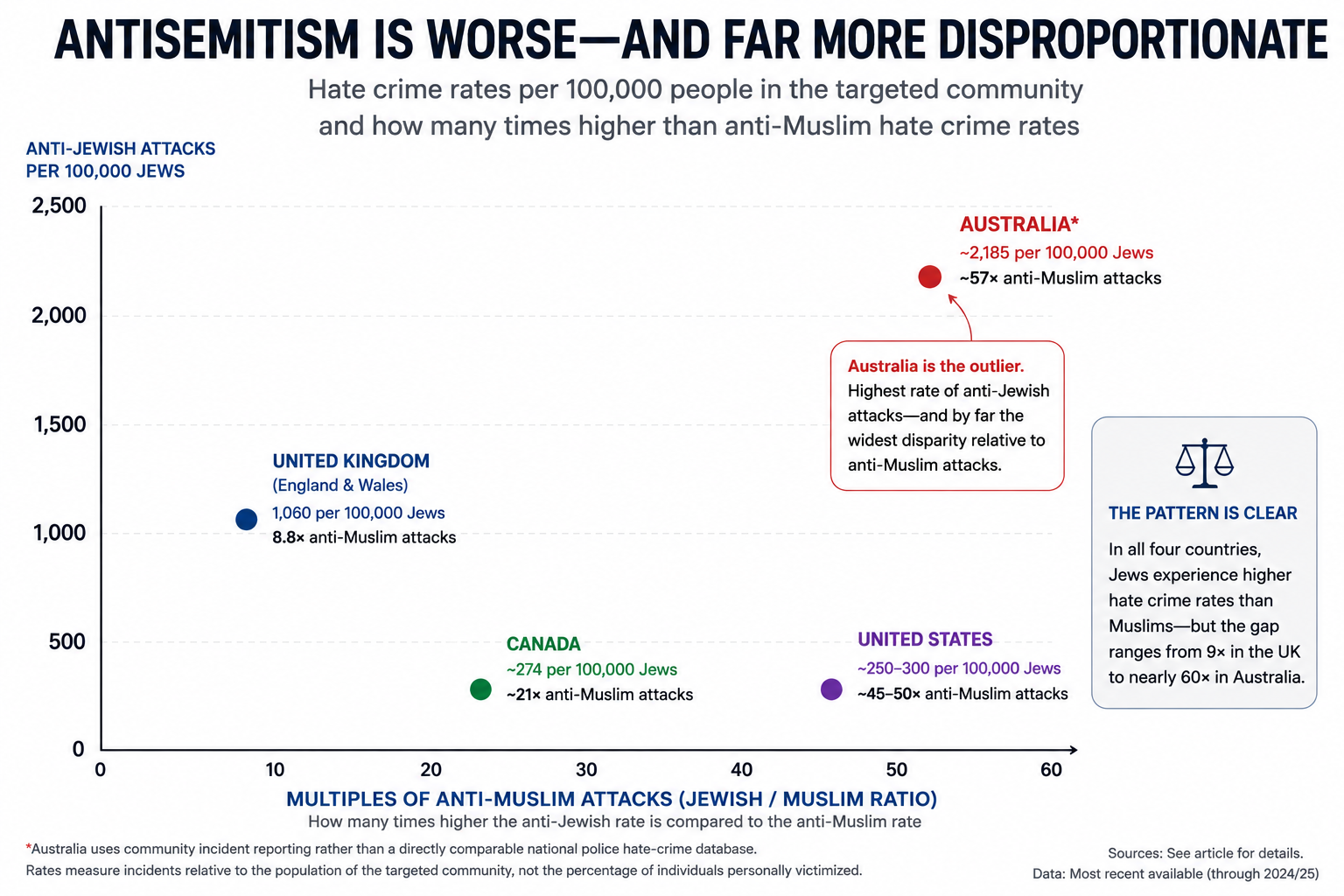
Country
Anti-Jewish
Anti-Muslim
Jewish / Muslim Ratio
UK (England & Wales)
1,060 per 100,000
120 per 100,000
8.8×
Canada
~274 per 100,000
~13 per 100,000
~21×
United States
~250–300 per 100,000
~5–6 per 100,000
~45–50×
Australia*
~2,185 per 100,000
~38 per 100,000
~57×
*Australia uses community incident reporting rather than a directly comparable national police hate-crime database.
Britain clearly has a religious-hatred problem. Muslims and Jews suffer substantial levels of hate crime, well above that of other English-speaking countries, while Jews are targeted at almost nine times the rate of Muslims. Canada and USA show fewer hate crimes per population, and a wider disparity between Jews and Muslims being attacked.
Then there is Australia.
For the decade before October 7, 2023, Australia averaged 342 reported anti-Jewish incidents annually. That exploded to 2,062 in 2023/24 and remained at 1,654 in 2024/25. In New South Wales, police-recorded hate incidents against Jews rose from 40 in 2020 to 841 in 2025.
Then statistics became bodies.
On December 14, 2025, gunmen attacked Chanukah by the Sea at Bondi Beach. Fifteen people were murdered while celebrating the Jewish holiday.
Australia subsequently established a Royal Commission on Antisemitism and Social Cohesion, which is examining the circumstances surrounding the attack and whether authorities adequately recognized the threat to Jewish events.
Australia had been warned.
It had also begun responding. The government appointed Jewish communal leader Jillian Segal as Special Envoy to Combat Antisemitism. Her national plan followed extensive consultation with Australian Jews, and the government adopted all 13 recommendations.
Yet Australia continues to struggle with whether antisemitism is a distinct threat or another part of generalized “hate.”
Its Combatting Antisemitism, Hate and Extremism Act puts antisemitism in the title – along with more generic terms of “hate” and “extremism.” There is nothing wrong with fighting all forms of hatred. The question is whether symmetry in government policy reflects the reality on the ground.
Australia’s available community data indicate roughly 38 anti-Muslim incidents per 100,000 Muslims and 2,185 anti-Jewish incidents per 100,000 Jews.
That is roughly 57-to-1.
Indeed, Australia’s Islamophobia envoy (in a federal post strictly devoted to “Islamophobia” and no other forms of hate) has urged the Royal Commission on Antisemitism to approach antisemitism through the broader causes of identity-based hatred and the common roots of antisemitism, Islamophobia and other prejudice.
“antisemitism, Islamophobia and other forms of prejudice share common causes, such as polarisation, online environments and declining trust in institutions. Tackling these underlying factors can strengthen outcomes for all communities.” – Australia’s Special Envoy to Combat Islamophobia, Aftab Malik, June 2026
What? If they were all the same, why are Jews attacked at a 57-to-1 ratio?
Australia does not have a generic hate problem that happens to include Jews. It has an extraordinary antisemitism problem that generic language about hate must not be allowed to hide.
The name made sense at Israel’s founding. Israel fought wars against the armies of Egypt, Jordan, Syria, Iraq and other Arab states. The conflict was understood principally as one between the Jewish State and the surrounding Arab world.
Then the map changed.
Egypt made peace with Israel in 1979. Jordan followed in 1994. During the horrific Second Intifada, the suicide bombings, shootings and other attacks were overwhelmingly part of a localized war involving Palestinian Arabs. The terminology narrowed accordingly. The Arab-Israeli Conflict increasingly became the Palestinian-Israeli Conflict.
That description is now inadequate too as the map evolved again over the past several years.
The Abraham Accords fundamentally changed the regional picture. The United Arab Emirates, Bahrain and Morocco normalized relations with Israel. Trade, tourism, investment and security cooperation followed. Other Muslim-majority countries have also maintained or developed relations with the Jewish State.
Yet at the same time, Israel has faced repeated war from Hamas in Gaza, Hezbollah in Lebanon, the Houthis in Yemen and, increasingly directly, the Islamic Republic of Iran. These forces are separated by borders, ethnicity and even the Sunni-Shiite divide. What connects them is not Arab identity. It is a radical Islamist rejectionism that refuses to accept a sovereign Jewish state in the Middle East.
It is therefore time for the terminology to catch up. This is increasingly the Jihadi-Israel Conflict.
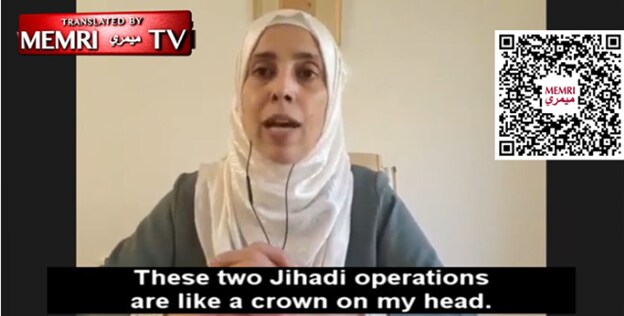
Ahlam Tamimi, who helped plan and transported the suicide bomber to the 2001 Sbarro restaurant bombing in Jerusalem and now lives in Jordan.
The term captures the venom, vitriol and violence of Hamas and the armed Islamist movements aligned against Israel. It encompasses Hezbollah and the Houthis and, most importantly, the Islamic Republic of Iran that has armed, financed and supported much of the network surrounding Israel.
It also leaves room to describe the roles of Qatar and Turkey, whose close relationships with Hamas and fierce political hostility toward Israel place them in a very different category from Muslim and Arab governments pursuing normalization.
Most importantly, the new terminology does something the old terminology cannot: it separates Muslims and Arabs who seek peace with Israel from radical Islamists committed to its destruction and the slaughter of Jews.
Hamas leader calling for slaughtering Jews as a religious Islamic principle
The dividing line has moved.
And that makes the choices facing Lebanon, Syria and Saudi Arabia especially important. They can move toward a Middle East built around trade and coexistence, or remain trapped in a conflict driven by radical Islamist movements that reject Jewish sovereignty, basic human rights and self-determination.
The conflict has become crystallized for what it likely always was: the Jihadi-Israel Conflict.
Staring at the sun is dangerous. It can permanently damage your eyes.
That is true today, during a solar eclipse. It was true yesterday. And it will be true tomorrow.
Yet almost no one spends an ordinary sunny day warning people not to stare at the sun. There are no news alerts. No public-service campaigns. No rush to buy protective glasses.
Then an eclipse arrives, and suddenly everyone is talking about retinal damage.
The eclipse does not make the sun more dangerous. It makes us more likely to look.
On an ordinary day, the sun is painfully bright. We instinctively turn away. During an eclipse, the moon covers much of that brightness. The sun becomes darker, stranger and irresistible. Curiosity tells us to keep looking precisely when the covering makes the danger easier to underestimate. We look at the danger precisely when the danger hides behind a mask.
The danger was always there. What changed was our behavior.
Violent jihad presents a darker version of the same phenomenon.
An ideology that glorifies murdering civilians, suicide bombings and religious war does not become less dangerous because something is placed in front of it. Yet organizations, activists and politicians can provide a kind of ideological eclipse—describing jihadist violence primarily through the language of “resistance,” “liberation” or Palestinian Arab self-determination.
October 7 should have been impossible to romanticize. Thousands of Hamas terrorists murdered families in their homes, slaughtered young people at a music festival and dragged hostages into Gaza. Yet almost immediately, people began searching for language that could place a covering over the horror.
“Palestinian self-determination” became one such covering. It transformed a discussion about what Hamas actually did and what it openly sought into a more familiar political argument about nationalism, borders and statehood. The words did not change the violence. They changed how people were invited to look at it.
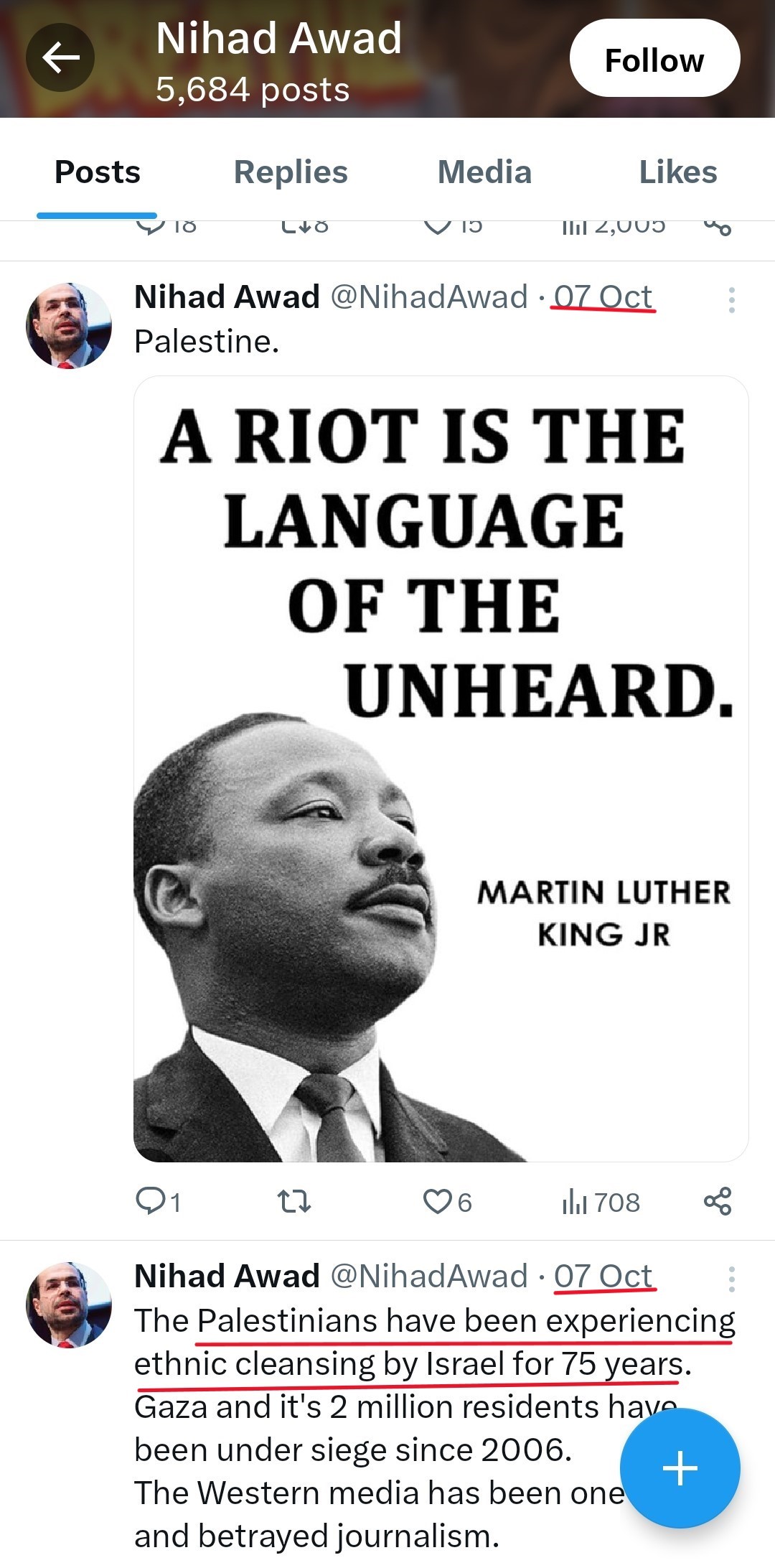
The head of the CAIR posted that October 7 was a Martin Luther King moment for Palestinian Arabs while the massacre in Israel was ongoing
And once the horror is covered, something disturbing happens. What should repel people can become a passing fascination. Violence acquires slogans, symbols and intellectual rationalizations. Terrorists are recast as revolutionaries; psychopaths and cowards as heroes. People who would instinctively recoil from the naked ideology are encouraged to stare at a filtered version of it.
That is the danger of an eclipse. It does not destroy the source of the danger. It obscures enough of it to change human behavior.
The sun was dangerous before the moon passed in front of it. It will remain dangerous when the moon moves away.
Violent jihad was dangerous before October 7. It remained dangerous while people explained its atrocities through socialist-jihadi language. And it will remain dangerous after today’s political fascination moves somewhere else.
The eclipse does not change the sun nor does political covering change violent jihad. It only changes whether people recognize the danger when they look at it.
Congress did not arrive at legislation protecting Hamas overnight. It arrived there one bill at a time.
For decades, debates over Israel revolved around diplomacy. Republicans and Democrats argued over settlements, negotiations, Jerusalem, and the contours of a future Palestinian state. Even lawmakers sharply critical of Israel generally framed their proposals around advancing a negotiated two-state solution. The disagreement was over how peace should be achieved, not whether Israel had the right to defend itself against terrorist organizations.
In 2020, as the Trump Administration unveiled its peace plan and Israel considered extending sovereignty to portions of the West Bank, progressive lawmakers introduced legislation preventing American assistance from supporting annexation. Whether one believed annexation was prudent or unwise, the objective remained fundamentally political. These bills sought to influence the outcome of negotiations and preserve the possibility of a future Palestinian state. The debate was about borders, diplomacy, and competing visions for peace.
That bill did not stand in isolation.
In 2019, Representative Betty McCollum (D-MN) also introduced legislation prohibiting U.S. assistance from supporting the military detention of Palestinian minors. On its face, the proposal carried moral appeal. No civilized society wants children caught in war, and few slogans resonate more powerfully than protecting minors.
Yet the legislation missed the point. Israel’s military justice system does not prosecute minors because they are children. It prosecutes minors accused of security offenses, including violent rioting, firebomb attacks, shootings, stabbings, and participation in terrorist organizations. Hamas, Palestinian Islamic Jihad, and the Popular Front for the Liberation of Palestine have all recruited teenagers into violent activity for decades.
Arab minors caught on camera right before they stab Israelis
The debate was no longer centered on where Israel’s borders should ultimately lie. It was becoming a debate over whether Congress should restrict Israel’s ability to prosecute those participating in terrorism.
That evolution became unmistakable after October 7.
The largest massacre of Jews since the Holocaust might reasonably have been expected to produce overwhelming congressional support for dismantling Hamas. Instead, it accelerated an entirely different legislative movement.
Arabs in Gaza take the body of Israeli woman they had just killed into Gaza where the crowds pelted her body and spat on her
One proposal after another sought to block the military tools Israel argued were necessary to fight the war. Senator Bernie Sanders (D-VT) repeatedly forced votes to halt major arms sales. Representative Rashida Tlaib (D-MI), Representative Pramila Jayapal (D-WA), Representative Delia Ramirez (D-IL), and others introduced the Block the Bombs Act. Senator Chris Van Hollen (D-MD) sought to impose additional legal restrictions before military assistance could proceed.
US Senator Chris Van Hollen attends a Senate subcommittee on the Justice Departments proposed 2027 budget, on Capitol Hill in Washington, May 19, 2026.
Supporters presented these bills as humanitarian safeguards designed to protect civilians and uphold international law. Their practical effect, however, would have been to deny or delay weapons while Israel was engaged in combat against a U.S.-designated terrorist organization that had murdered, raped, tortured, kidnapped, and burned civilians alive.
Congress was no longer principally debating the contours of a future peace agreement. It was debating how much of Israel’s wartime capability should be withheld while the war itself was still being fought.
And it continued.
In July 2026, Representative Thomas Massie (R-KY) introduced an amendment eliminating the entire $3.3 billion annual Foreign Military Financing package for Israel. Previous proposals had sought to condition aid or block particular weapons systems. Massie’s proposal went much further. It would have ended America’s regular military assistance altogether.
The amendment failed by a wide margin. But 104 members of Congress voted for it, including 103 Democrats alongside the bill’s Republican author.
That vote tells a larger story than the amendment itself.
Over the course of a few years, the legislative progression moved from opposing territorial annexation, to restricting Israeli counterterrorism practices, to limiting the weapons available to fight Hamas, and finally to questioning whether the United States should continue military assistance at all. Each bill built upon the political space created by the one before it. What once occupied the outer edge of congressional debate gradually became part of mainstream legislative discussion.
The coalition itself is unusual. Rashida Tlaib approaches the issue through Palestinian nationalism. Bernie Sanders emphasizes humanitarian law and civilian casualties. Chris Van Hollen argues for greater legal oversight of military assistance. Thomas Massie opposes foreign aid as a matter of constitutional principle. They arrive from very different ideological traditions, yet increasingly find themselves casting the same vote.
For generations, support for Israel was one of Washington’s few enduring bipartisan constants. That consensus has not disappeared; overwhelming majorities in Congress still support the alliance. But the terms of the debate have unmistakably changed.
Six years ago, Congress debated how American policy might influence a two-state solution. Today, members openly introduce legislation that would limit—or eliminate altogether—the military support Israel says it needs to defeat jihadist organizations committed not to coexistence, but to its destruction.
That is the real story of the Jihadi Protection Bills. Not that any single measure became law. But that, one bill at a time, the center of the American political conversation migrated from shaping the peace process to constraining Israel’s ability to wage war against jihadist movements to its basic ability to protect itself in a deeply hostile region.