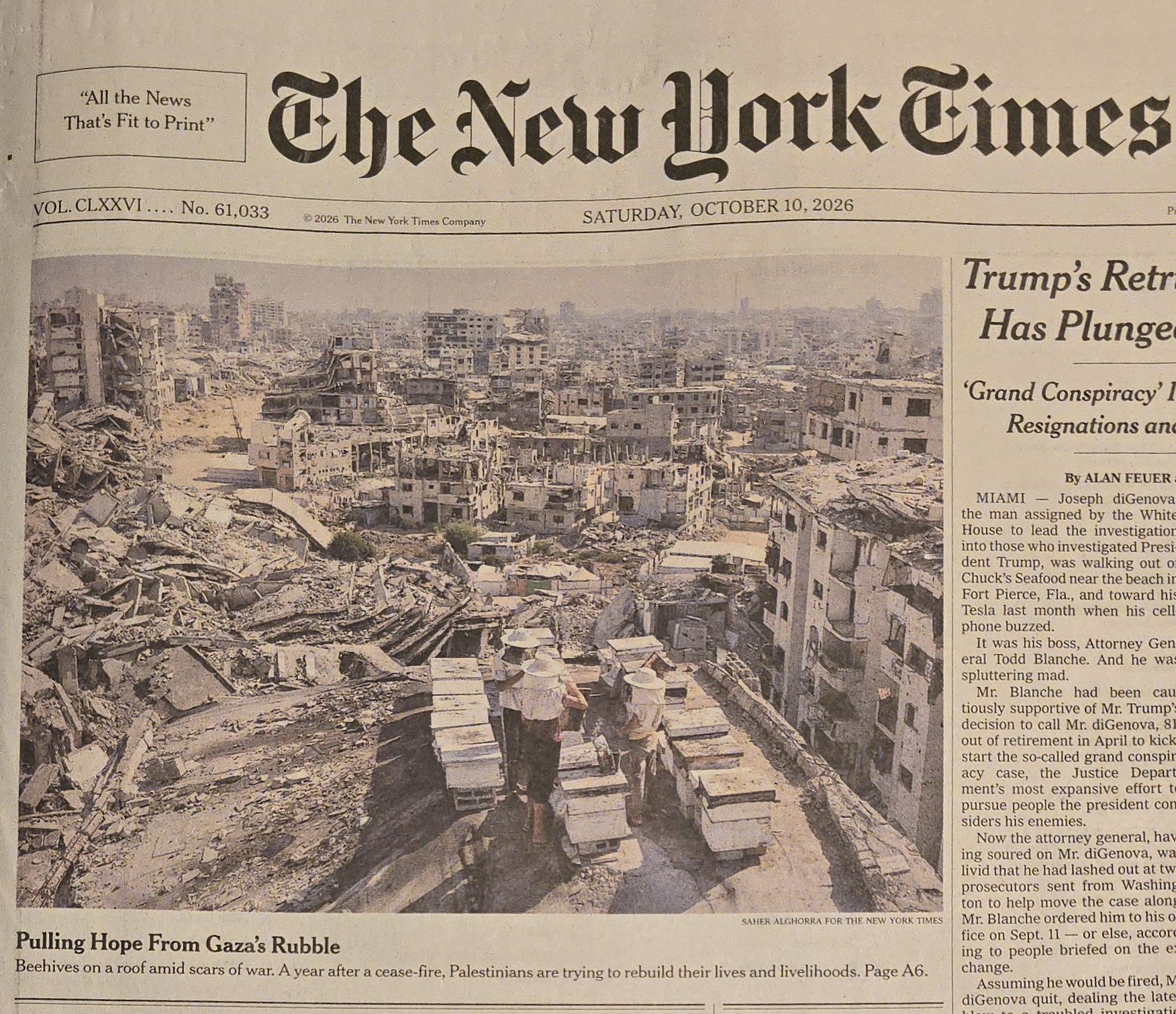
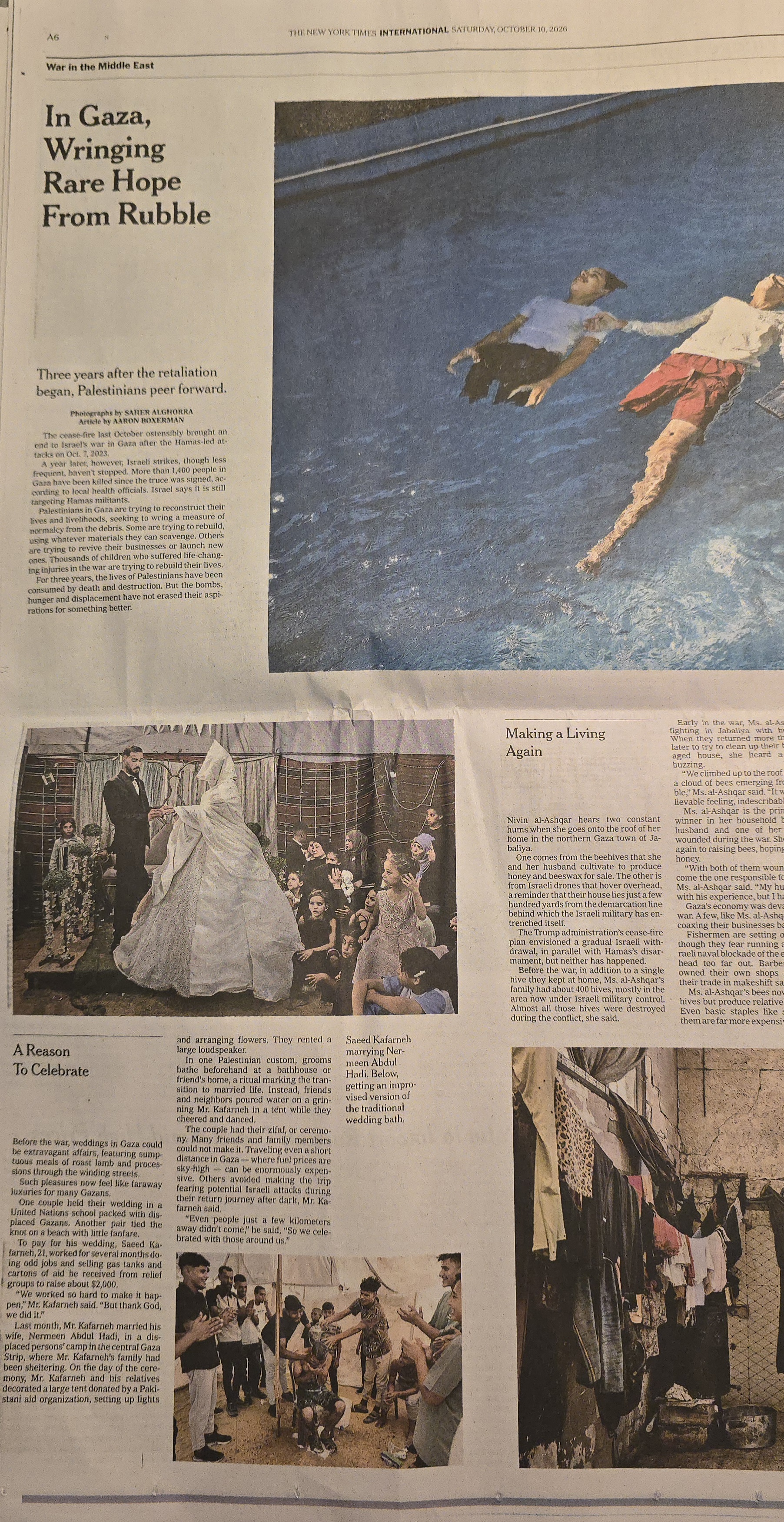
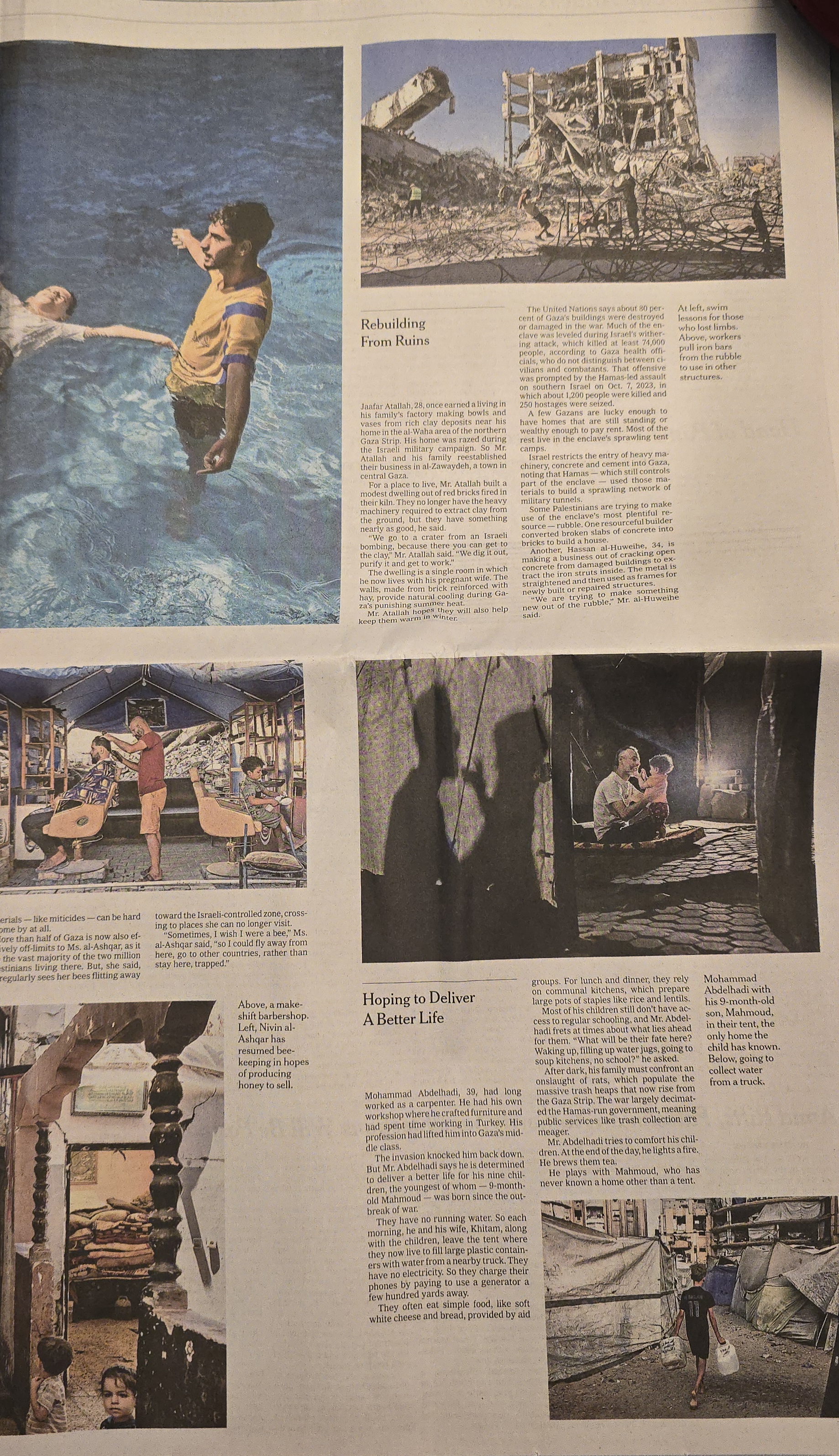
Three days after the third anniversary of Hamas’s October 7 massacre, The New York Times devoted its dominant front-page photograph and two full inside pages to the “hopes” and aspirations of Gazans. There were weddings, swimming, barbershops, reopened businesses and families trying to rebuild their lives amid the rubble.
It was a touching portrait of ordinary dreams – at least for normal people in the western world. But what about the extraordinary support among Gazans for killing Israeli civilians that preceded the war?
In June 2022, the Palestinian Center for Policy and Survey Research found that 73% of Gazans supported armed attacks inside Israel similar to those had been recently carried out. Fifteen months later, Hamas invaded Israel, slaughtered civilians, kidnapped families and celebrated the massacre. By March 2024, five months into the war and amid Gaza’s devastation, 71% of Gazans still considered Hamas’s decision to launch October 7 correct, according to the same polling organization.
Two-thirds of Gazans on average since 2001 have supported killing Jewish civilians inside of Israel according to PCPSR polls
These were majority attitudes, measured before the massacre and after its consequences became devastatingly clear.
Hamas is Gaza’s government, controlling the territory since 2007. It operated ministries, schools, police and security forces alongside its military apparatus. It is Gaza’s political life. Before October 7, PCPSR polling showed Hamas leading Fatah in hypothetical Palestinian parliamentary voting and Hamas leader Ismail Haniyeh defeating Mahmoud Abbas in a two-candidate presidential contest. Hamas continues to lead Fatah, which is why PA President Mahmoud Abbas continues to delay elections.
Yet the Times’ sprawling photographic treatment of Gaza’s aspirations ignored the genocidal ideology that permeates Gaza and helped produce October 7. The newspaper deliberately failed to show what Gazans truly hope for: dead Jews and the destruction of the Jewish State.
Imagine the same treatment of Sudan’s Rapid Support Forces. Three days after the anniversary of an RSF massacre, would the Times devote its front page and two inside pages to swimming, weddings and employment in communities governed by the militia, with little examination of the violence and political support behind it?
The Times showed readers Gazans dreaming of a swim. Its own society’s polling shows overwhelming support for killing Jewish civilians both before and after the October 7 massacre.
The Times has whitewashed the genocidal ideology of Gazans and portrayed them as victims of the jihadi war they launched. Doing so is not just anti-Israel, it is a promotion of radical Islam deployed against Jews.
Or perhaps worse – the Times is educating its readers that those who want to rape and kill Jews are very much like us.
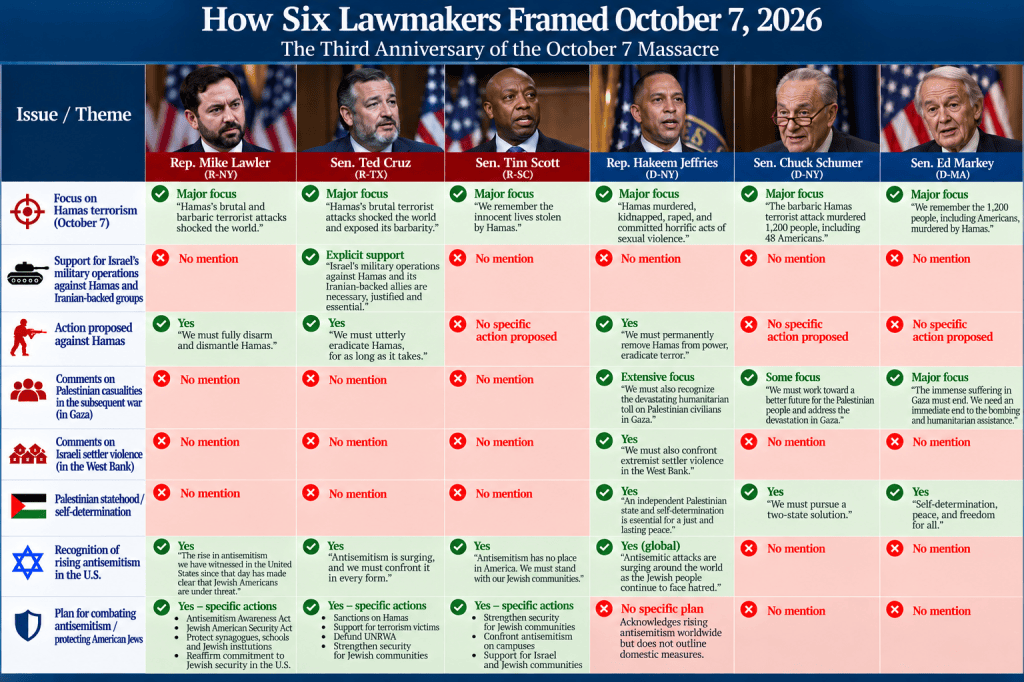
Three years after Hamas invaded Israel and slaughtered roughly 1,200 people, leading Democrats marked October 7 by remembering the murdered Israelis… but then immediately called out Palestinian Arabs who suffered in the war that they launched while condemning Israel.
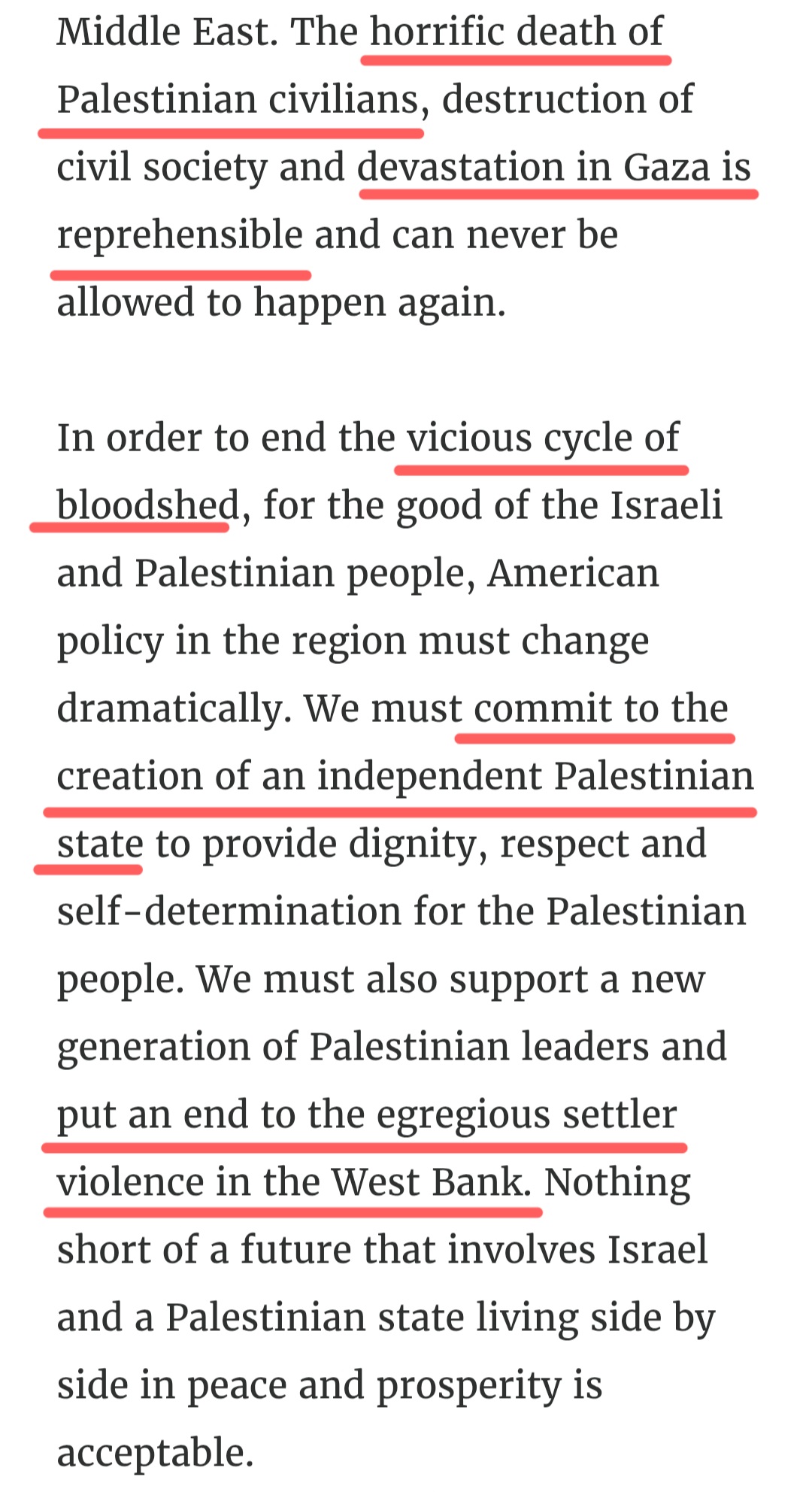
House Democratic Leader Hakeem Jeffries (D-NY) began appropriately. He described “Hamas terrorists intent on destroying Israel” who murdered, kidnapped and raped innocent civilians. Then he turned the anniversary toward Palestinians, calling civilian deaths and the devastation of Gaza “reprehensible,” demanding the “creation of an independent Palestinian state” and condemning Israeli settler violence.
Senator Ed Markey (D-MA) similarly remembered Hamas’s “heinous terror attack,” the 1,200 murdered and the hostages. Then came the turn: “Three years into the brutality of the war in Gaza,” followed by demands to stop the bombing, deliver aid and secure Palestinian self-determination.
Senate Democratic Leader Chuck Schumer (D-NY) devoted most of his statement to the massacre and hostages, but his conclusion expanded the October 7 commemoration to “the aid and well-being of the Palestinian people,” Gaza’s devastation, reconstruction and Palestinian statehood.
Hakeem Jeffries and Chuck Schumer
Apparently, commemorating a terrorist massacre now requires remembering the people who suffered when the country that was attacked went to war.
Well… only when it comes to the massacre of Jews.
Just four weeks ago, Markey commemorated the 25th anniversary of 9/11. He remembered the nearly 3,000 people murdered, the families in Massachusetts who lost loved ones, America’s resilience and the need to prevent another terrorist attack. He used the anniversary to demand better funding for the TSA.
Afghans and Iraqis never entered his statement.
Jeffries has followed the same convention. His 9/11 statement remembered the 2,977 people murdered by Al Qaeda and then extended the remembrance to first responders who became sick from exposure at Ground Zero. He noted that more FDNY responders had died from 9/11-related diseases than were killed in the attack itself.
Iraqis and Afghans never entered his statement.
Schumer went even further this September. In a lengthy address marking 25 years since 9/11, he remembered the dead, their families, sick first responders, people who developed cancer after working at Ground Zero, the rebuilding of Lower Manhattan and America’s resilience.
Iraqis and Afghans never entered his statement either.
And there were plenty of them to remember.
Brown University’s Costs of War project estimates that more than 940,000 people were killed directly in the major post-9/11 war zones, including more than 432,000 civilians. When indirect deaths from destroyed health systems, infrastructure, food insecurity and other consequences of war are included, Brown estimates 4.5 million to 4.7 million people died. More than 38 million people were displaced. Brown says the number wounded or made ill was higher still.
Yet nobody apparently told Jeffries, Markey or Schumer that a September 11 remembrance had to be balanced by those that Americans killed.
Because they knew that September 11 belongs to the people murdered on September 11. It belongs to the passengers who boarded airplanes that morning, the people who went to work in the World Trade Center and Pentagon, the families who never saw them again and the firefighters and police officers who ran toward burning buildings.
There are other days to debate Afghanistan, Iraq, American military policy and the enormous suffering those wars produced. But not the anniversary of the heinous jihadi terrorism.
These leading Democratic politicians know that. But they don’t care to apply the same decency when Jews are slaughtered and raped.
Jews slaughtered in their homes must share their anniversary with an accounting of their country’s subsequent conduct. The young people murdered at a music festival in Israel must make room for Gaza policy. The women sexually assaulted by Hamas terrorists must share the day with discussions of Palestinian statehood. The hostages dragged into Gaza become the introduction to a statement about Palestinian suffering.
These LEADING DEMOCRATS REVERSED THEIR BASIC HUMAN INSTINCT FOR COMPASSION in just a couple of weeks when the victims were Jews.
Why, when the victims are Jews, must the anniversary of their massacre become a day to remember everyone except just them?
In the 20th century, the term “G.I. Joe” was meant to describe the average American serviceman. He was the embodiment of a regular patriot fighting for America and American values.
Alas, today’s generation has Jihad Joe.
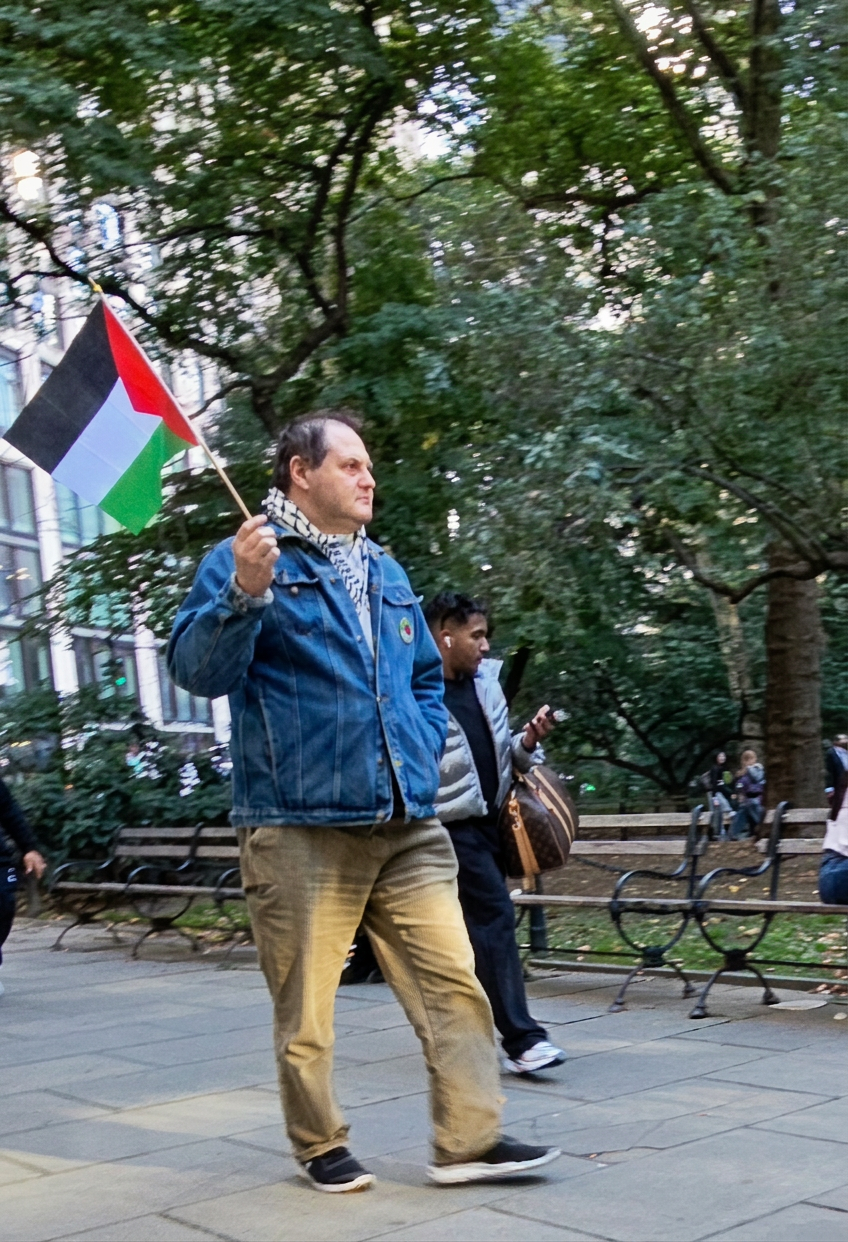
Pro-Palestinian man heading to protest Israel in front of City Hall in Manhattan on October 7, 2026 (photo: First One Through)
Jihad Joe celebrates the murder of Americans and American allies. He/ she uses anniversaries of the massacres of civilians – like 9/11/01 and 10/7/23 – to mock the death of thousands of innocent civilians. The Jihad Joes cheer ISIS, Hamas and the Islamic Republic of Iran.
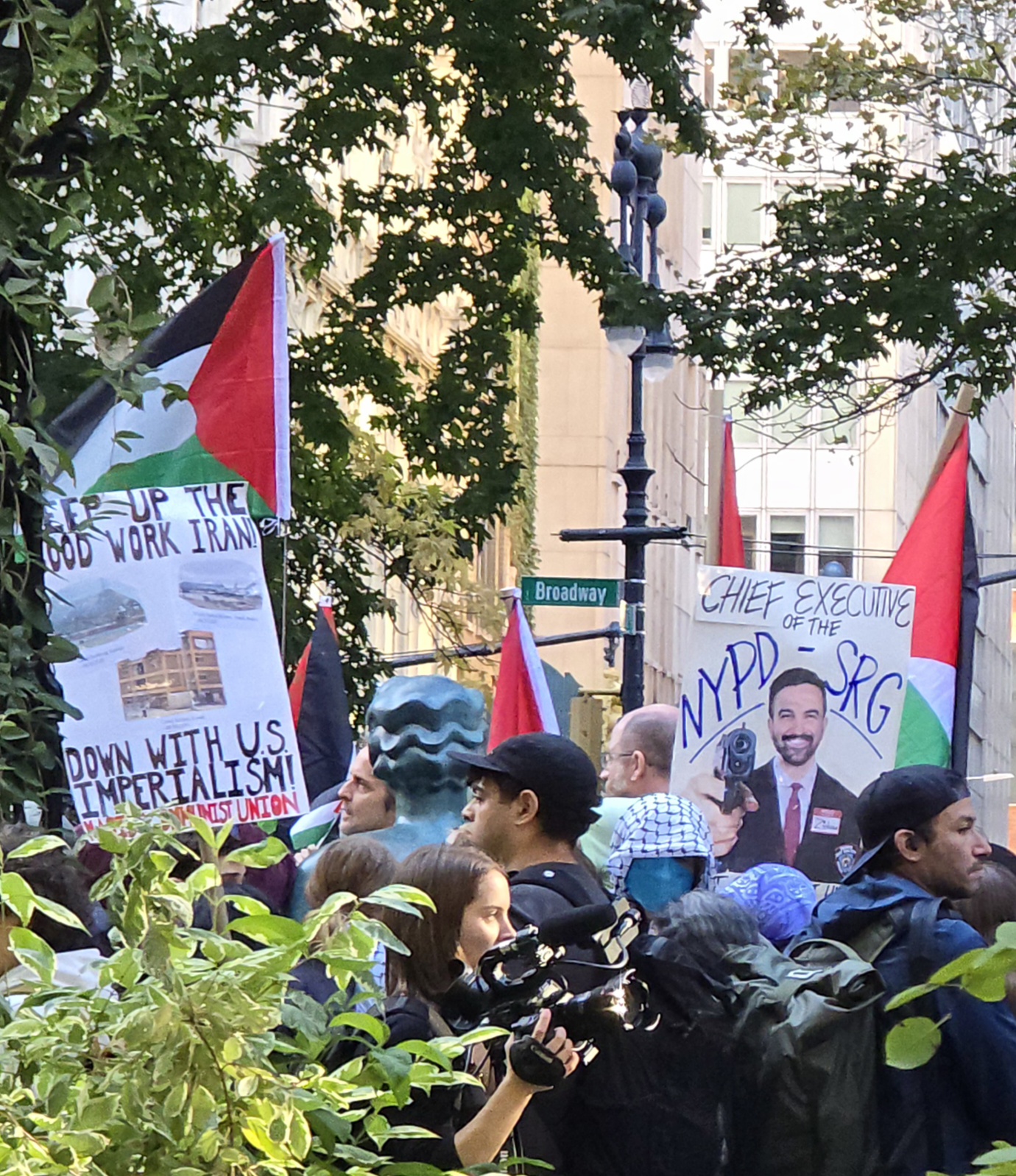
Anti-Israel protestors at City Hall in NYC on October 7, 2026 with posters mocking Mayor Zohran Mamdani as a Zionist and “Keep up the good work Iran! Down with U.S. Imperialism!” (photo: First One Through)
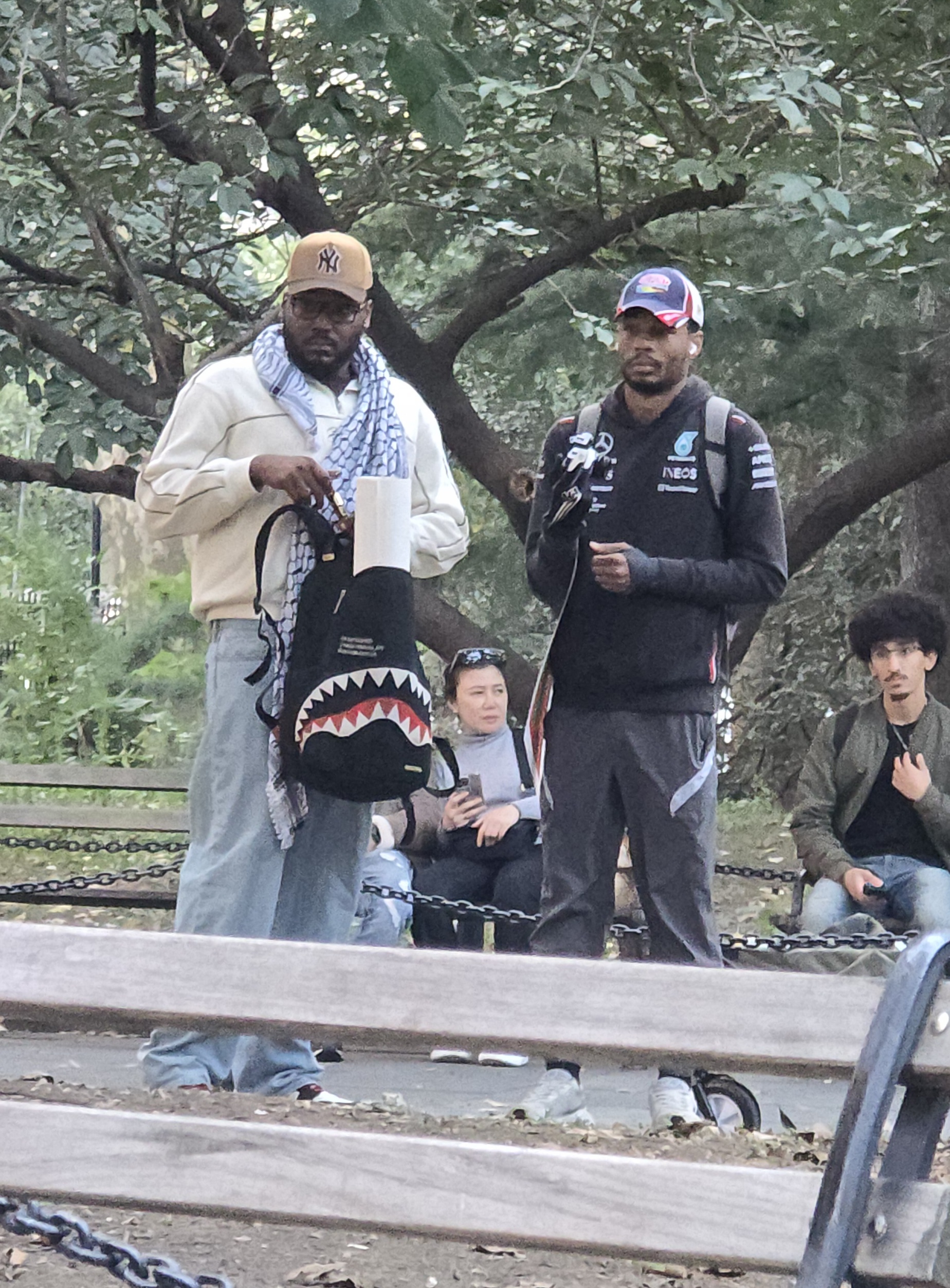
The crowd that gathered on October 7, 2026 at City Hall in New York City was mixed, with religious Muslims and anti-Israel Neturei Karta posing for the media. But there were also many White people in their 20s to 40s sporting Hamas headbands, chanting for the destruction of Israel, and that Jews are pedophiles.
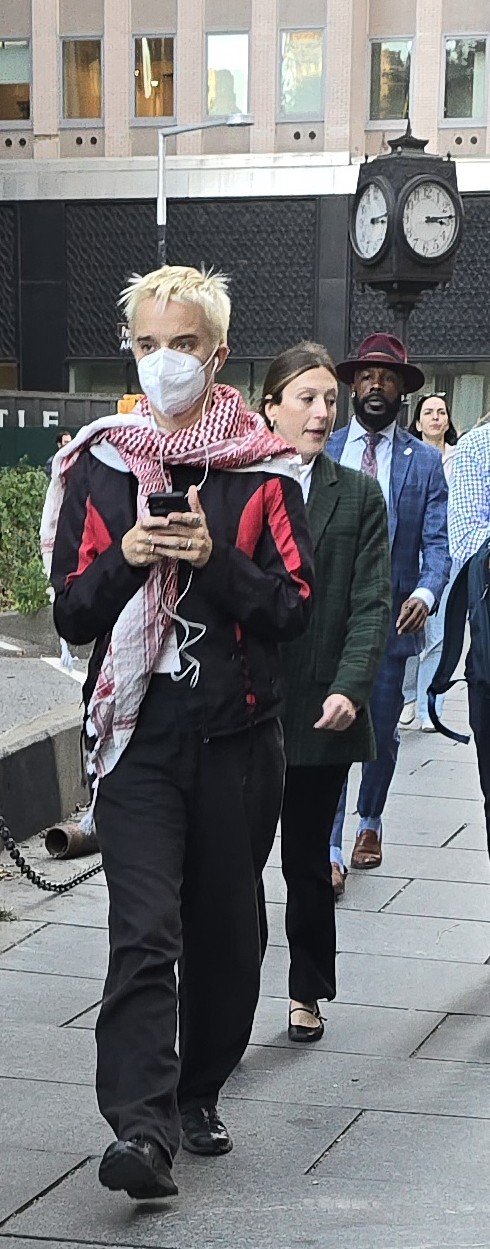
Woman with press credentials sporting a keffiyeh walking to anti-Israel protest at City Hall on October 26, 2026, ahead of group from Neturei Karta holding a Palestinian flag (photo: First One Through)Woman getting ready to join the anti-Israel protest, pulling out her keffiyeh at City Hall on October 7, 2026 (photo: First One Through)
A group of students from nearby Pace University came by with placards to “Free Palestine” and “Zionism is not Judaism.” They joined crowds yelling things much more violent:
“Intifada revolution!”
“Zionism will fall!”
“Liberation is near!”
“We don’t want two states. We want ’48!”
“Mobilize the Intifada!”
Students from Pace University join an anti-Israel protest at City Hall on the anniversary of the slaughter of roughly 1,200 people in Israel and seizure of 251 hostages,on October 7, 2026 (photo: First One Through)
Today’s Jihad Joe doesn’t put his life at risk for America, American allies or American values. He mocks all of those things. Jihad Joe wishes them vanquished, celebrates their setbacks and chants for the jihadi vision for the U.S. and Israel, all from the quiet and comfortable streets that affords the freedom of speech and assembly not found in Islamic republics.
Jihad Joe sees G.I. Joe as an old and racist dead White man.
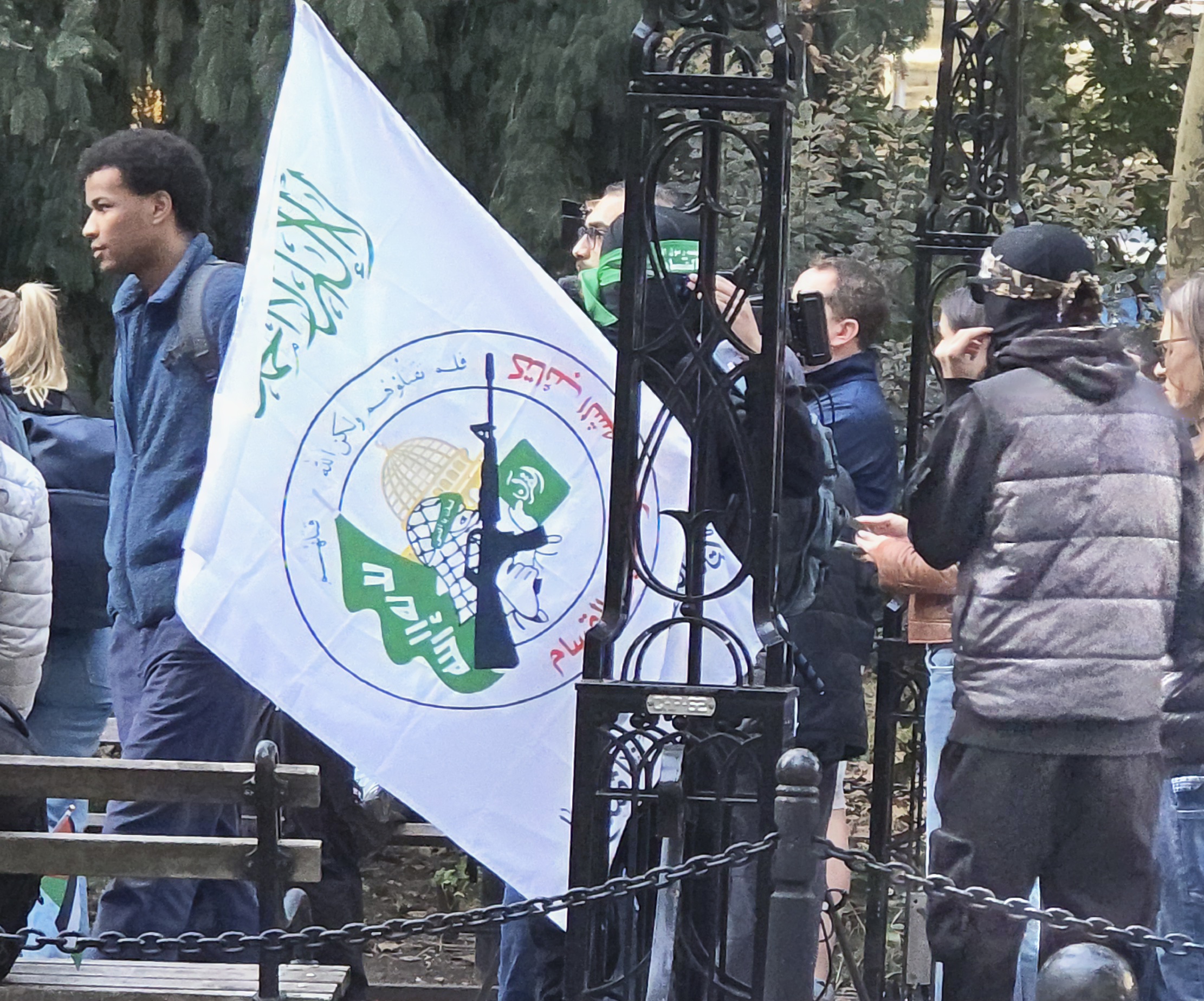
Two young men covering faces and sporting headbands with Hadiths for MohammedYoung men waving flag of armed Arab before Dome of the Rock
Imagine Canadians holding a march on September 11, 2026 cheering the work of the jihadists who killed nearly 3,000 people in the U.S., calling for the destruction of America. Yes, it is protected speech; but so what? It is repulsive and sick.
More, it reveals the depravity of a significant swath of Americans.
Crowd of people scream support for the antisemitic genocidal jihadists of Hamas, on third anniversary of the October 7 massacre (photo: First One Through)
Eighty years ago, America produced the Greatest Generation. G.I. Joe was its everyman: the ordinary American who put on his country’s uniform, crossed an ocean and fought against fascism and tyranny. Today we see a very different American archetype walking the streets of New York. He puts on the keffiyeh, embraces the symbols and slogans of foreign jihadist revolutionary movements, and mocks America, its allies and the rape and slaughter of its citizens.
In less than a century, we have descended from G.I. Joe to Jihad Jane.
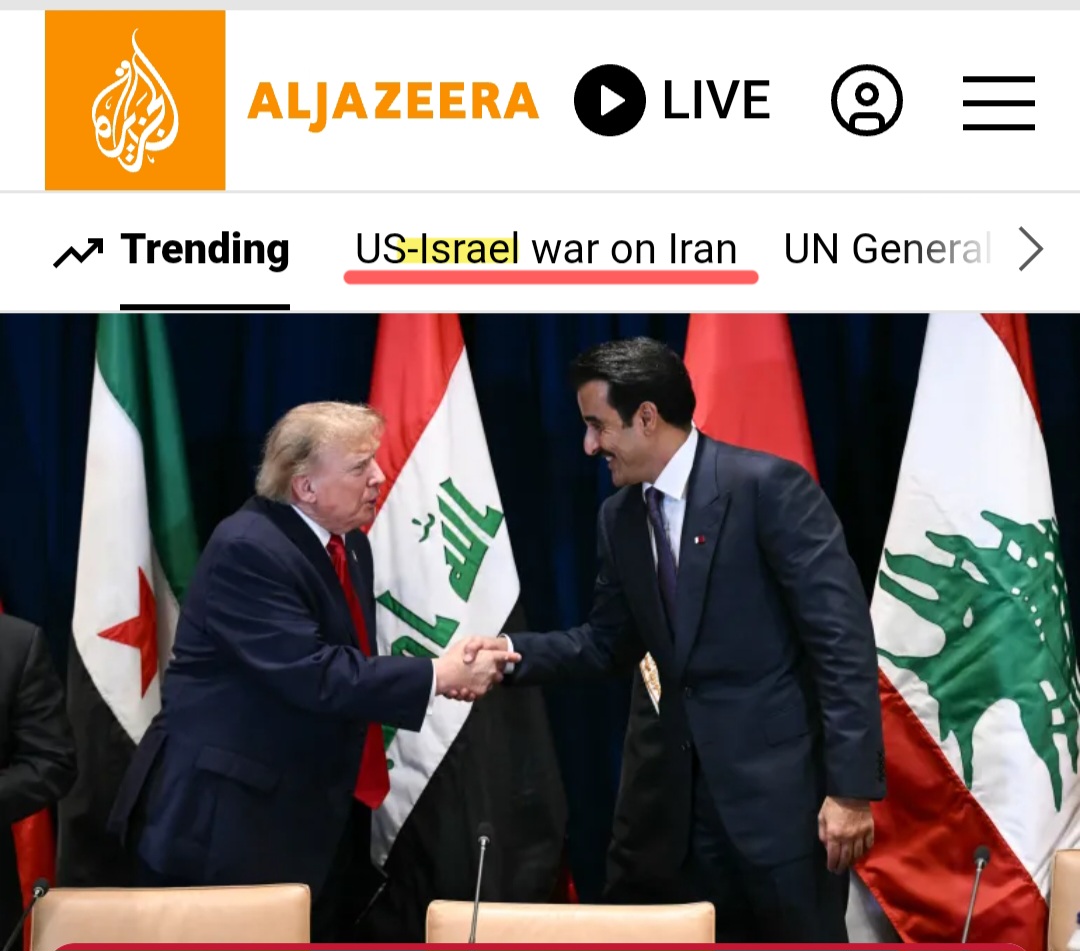
The Guardian continues to place its Iran coverage under the banner: “US-Israel war on Iran.”
Al Jazeera uses the same formulation.
It was an accurate description when the war began. It isn’t anymore.
The United States and Israel attacked Iran on February 28. Iran retaliated against both countries. For the opening weeks, the United States and Israel were both directly at war with Iran. That fighting ended with the April 8 ceasefire.
There was one brief interruption. In June, after Israel attacked Hezbollah in Beirut, Iran fired missiles at Israel. Israel responded by striking Iran. The exchange lasted roughly two days ans stopped.
The Congressional Research Service says the June 7–8 fighting “appears to be the last direct exchange of fire between the two countries as of September 2026.”
The United States and Iran, meanwhile, have continued fighting.
That makes the media labeling increasingly strange.
The Guardian and Al Jazeera maintain an entire section called “US-Israel war on Iran” even when it is clear even in their own articles that Israel is no longer involved. Even more, it is Iran and its proxies that have waged war ON ISRAEL, not the reverse.
Why?
Does keeping Israel permanently attached to the war serve a purpose — reinforcing the idea that every American bomb dropped on Iran is also somehow an Israeli bomb, and every American decision to continue the war is part of an Israeli-American campaign? That every spike in energy prices is Israel’s fault?
For outlets whose audiences are already intensely hostile toward Israel, the distinction is not trivial. It is propaganda to inflame millions.
At 10:15, she invoked Gaza and said “if borders can be changed by force, if sovereignty can be set aside when inconvenient, or upheld only when politics allows, then no Member State can sleep peacefully anymore.” She repeated Gaza alongside Ukraine as she closed her remarks at 17:00.
Israel is a UN member state. Gaza is not. Palestine is not. Yet the UN increasingly discusses this war as though those roles were reversed.
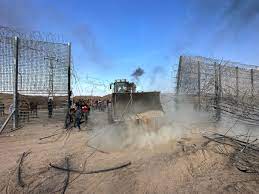
On October 7, 2023, Hamas, the government of Gaza alongside thousands of Gazans invaded Israel. Thousands of terrorists attacked communities and military installations, killed roughly 1,200 people and abducted 251 into Gaza.
Members of Hamas tear down fence and invade Israel on October 7, 2023
If Baerbock wanted an example of a member state’s border being violated by force, she had one.
Instead, the UN performs a remarkable double inversion. It starts the clock after October 7, making the war appear to begin with Israel’s campaign in Gaza. Then it treats Gaza as the territory whose sovereignty and borders are paramount, while the actual member state that was invaded becomes the accused.
Territorial integrity cannot be a foundational principle when Russia enters Ukraine and an inconvenient technicality when Gazans invade Israel. A rule whose application depends upon who is doing the invading is not a principle. It is politics dressed up as international law.
The organization created to protect member states has demonstrated that when Israel, a member state, is invaded and its civilians raped, slaughtered and kidnapped, by some evil orchestration and institutional design, the terrorist enclave from which the attack emerged can be turned into the aggrieved party.
The UN has not merely failed its own basic test. It has exposed the fine print in its supposedly universal principles: borders are inviolable, sovereignty is sacred, and member states must be protected – unless the member state is Israel.
Hamas terrorist in Israeli kibbutz on October 7, 2023
Hamas has been a U.S.-designated Foreign Terrorist Organization since 1997, when the list was first developed. On October 7, 2023, Hamas-led attackers invaded Israel, deliberately murdered civilians and kidnapped over 250 people.
It was designated terrorists committing terrorism.
Yet “terrorist” became a troublesome word for mainstream media and alt-left politicians.
The Associated Press advises journalists to describe specific acts and generally attribute the terms terrorism and terrorist to people or organizations, rather than independently apply them. Amnesty International has gone further, explaining that it generally avoids the terms because they lack an agreed legal definition and carry strong political and emotional connotations.
That restraint evaporates around “genocide.”
Genocide is the more demanding accusation. Death, destruction and even war crimes do not establish it. The Genocide Convention requires the specific intent to destroy, in whole or in part, a protected group as such. Israel emphatically denies that intent, maintaining that it went to war to defeat Hamas – the terrorists which had committed mass terrorism – and recover its hostages, not destroy Palestinian Arabs.
Amnesty nevertheless declares that Israel is committing genocide. The same organization that will not call Hamas a terrorist organization after its deliberate slaughter and kidnapping of civilians has no hesitation resolving the vastly more difficult question of Israeli intent.
Progressive politicians follow the same linguistic path. Rashida Tlaib (D-MI) was accusing Israel of genocide within weeks of October 7 and later called Benjamin Netanyahu a “genocidal maniac.” Zohran Mamdani repeatedly describes the October 7 massacre as a “horrific war crime” rather than a terrorist act, while calling Israel’s war “genocide” and Netanyahu the “architect of a horrific genocide.”
The burden of proof has been turned upside down.
Calling October 7 terrorism requires looking simply at what Hamas did: a designated terrorist organization deliberately murdered and kidnapped civilians for political and ideological purposes. It is plainly terrorism.
Calling Israel’s war genocide requires establishing why Israel fought it: that its actual intent was to destroy Palestinian Arabs as a people rather than defeat Hamas in a defensive war.
Yet the first conclusion is treated as dangerously judgmental while the second is repeated as established fact.
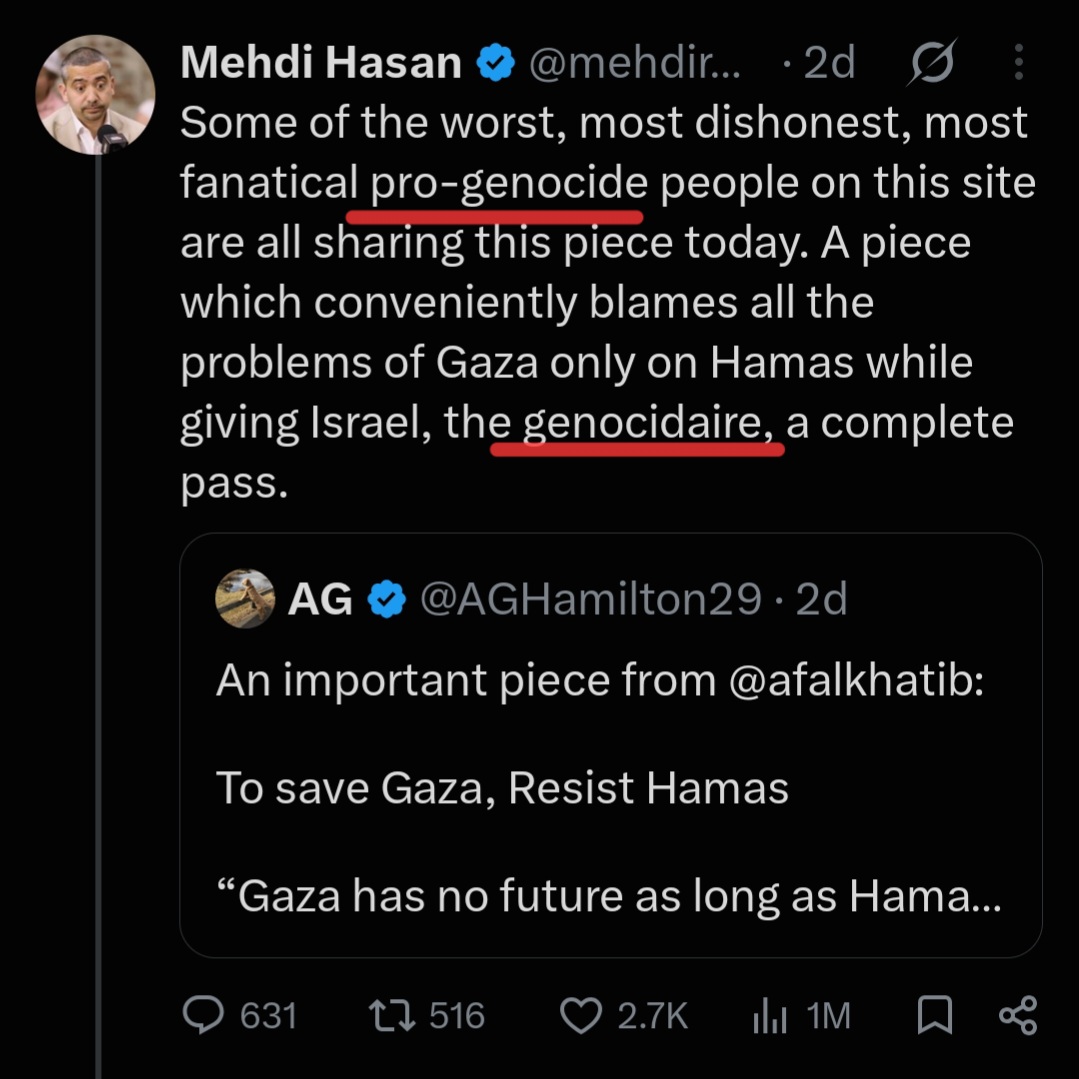
Mehdi Hasan offered an almost grotesque demonstration this week while attacking a New York Times essay by Gazan Palestinian Ahmed Fouad Alkhatib urging Palestinians to resist Hamas. Hasan called people sharing the essay “pro-genocide people,” Israel “the genocidaire,” the essay “a pro genocide piece” and the war “this current genocide.”
Hasan suffers a genocide stutter.
He cannot bring himself to say clearly and unambiguously that Hamas is a terrorist group and committed a heinous terrorist act, but cannot get the word “genocide” out of his mouth as he tries to hypnotize viewers into believing the unbelievable about Israel.
And the accusation does not remain attached to Israel’s government. Once genocide becomes the premise, anyone defending Israel can become pro-genocide. Even a Palestinian Arab arguing that his own people must resist Hamas can produce a pro-genocide piece for the obsessive compulsive stutterer.
That is how a defamatory vocabulary spreads.
Genocide is among the gravest accusations that can be made against a people or state. Repeating it as established fact without establishing the specific intent the crime requires does more than distort a war. It tells millions of people that Israel is deliberately destroying Palestinian Arabs and that those who defend Israel are defending that destruction.
That is an incendiary allegation in a world where Jews and Israelis are already threatened and attacked over Gaza.
Meanwhile, terrorist is handled delicately when describing the organization that deliberately slaughtered civilians on October 7 in the worst slaughter of Jews since the Holocaust.
The asymmetry is morally grotesque. Hasan, Tlaib, Mamdani are trafficking in the asymmetry of whataboutery as a heinous veneer to protect antisemitic terrorists, plain and simple.
Everyone knows why October 7, 2023 changed Israel. But an obscure Ottoman law makes another date worth watching: October 7, 2026.
In 1858, the Ottoman Empire enacted a land code under which three consecutive years without cultivationcould have consequences for rights to certain agricultural land.
Now, three years after October 7, that old rule may suddenly matter.
The Three-Year Rule
Much of the agricultural land of the Ottoman Empire was classified as miri. The sovereign retained ultimate title (“state land”) while individuals could acquire valuable rights of possession and use, known as tasarruf.
Active use of the land mattered.
Article 68 of the Ottoman Land Code addressed agricultural land left uncultivated for three consecutive years without a valid excuse. The original Ottoman mechanism was more complicated than “three years and the government automatically owns your land,” involving tapu, the status of the holder and opportunities to recover the right.
But the underlying principle was clear: continued cultivation could matter to continued land rights.
Ottoman term
Meaning
Relevance
Miri
State land carrying individual possession/use rights
Much agricultural land
Tasarruf
Right of possession and use
The individual’s valuable land right
Mahlul
Lapsed/reverted possessory right
Potential consequence of qualifying non-cultivation
Tapu
Land registration/title system
Documentary evidence of rights
This is not merely an Ottoman historical curiosity. It passed on to the British, Jordanians and then Israel with few modifications.
In 2020, Israel’s Supreme Court addressed the rule directly in HCJ 5426/17, Barakat v. Head of the Civil Administration in the West Bank (Nov. 29, 2020). The Court held that under the Jordanian land law still applicable in the territory, an unregisteredtasarruf right acquired through cultivation could be extinguished if the land was left uncultivated for three consecutive years, causing the land to revert to the government under Article 68’s mahlul doctrine. By contrast, a tasarruf right that had been formally registered generally was not lost merely because the land subsequently lay fallow.
So the three-year rule remains relevant to unregistered land in Judea and Samaria today.
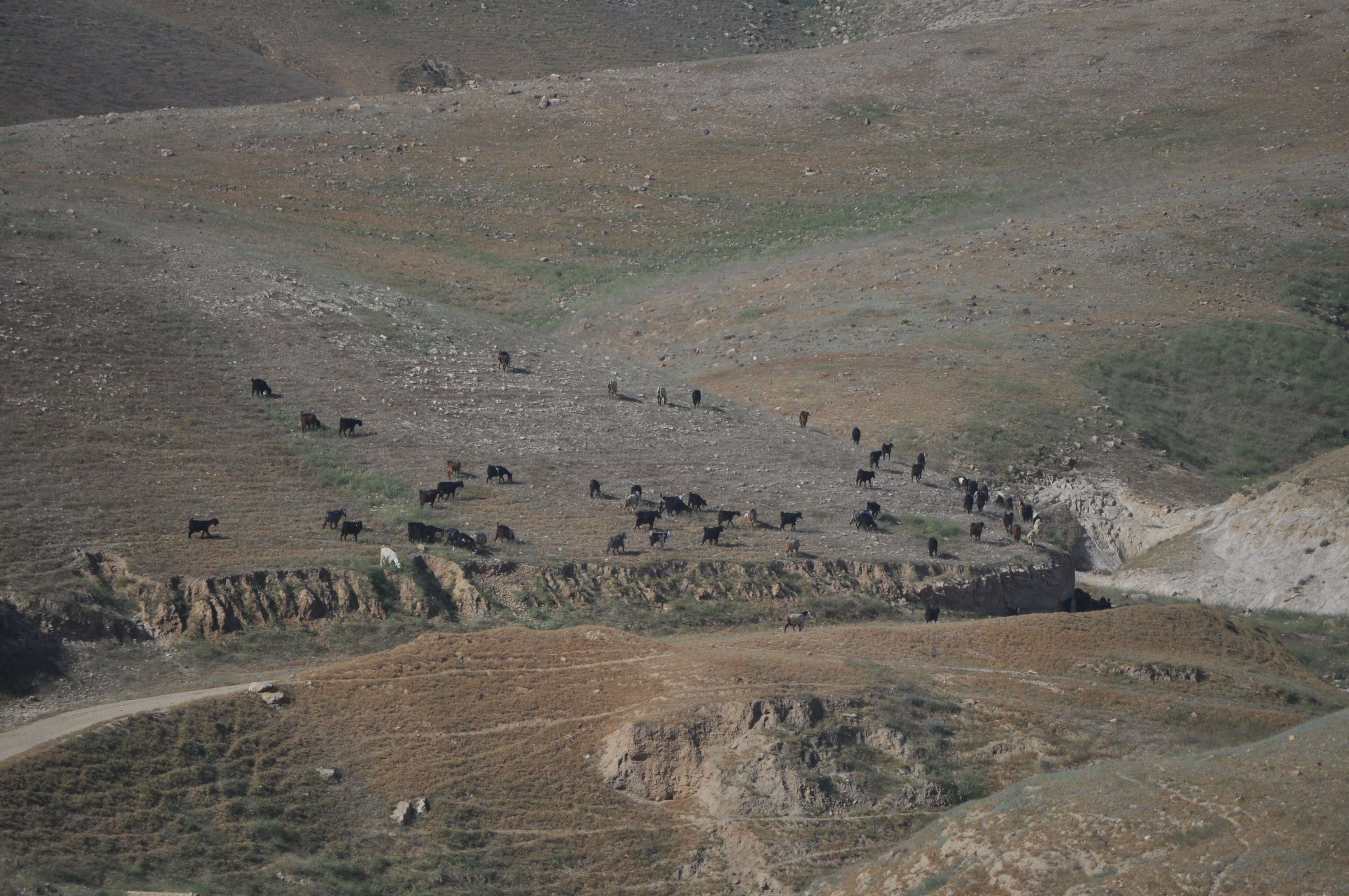
Goats owned by Bedouins graze in Judea and Samaria (photo: FirstOneThrough)
Then Came October 7
After the October 7 massacre by Gazans, security conditions dramatically changed access to agricultural land across the region. OCHA reported that more than 96,000 dunams of olive-cultivated land went unharvested during the 2023 season following access restrictions and violence. By the 2025 olive harvest, OCHA was reporting that farmers from multiple villages had been completely denied access for the third consecutive year to certain olive groves.
That creates the question: How much unregistered agricultural land has actually gone uncultivated since October 7, 2023?
The Eye in the Sky
There is something unusual about these particular three years.
Israel has had extraordinary security reasons since October 7 to maintain extensive aerial surveillance of Judea and Samaria.
At the same time, the Civil Administration already uses sophisticated geographical information in determining land status. Its Surveying Unit maintains cadastral and mapping information, while its Supervision Unit operates a team whose stated function is examining land through survey procedures “aimed at locating state land in the area, for declaration as such.”
The Civil Administration therefore potentially possesses an extraordinarily detailed record of whether cultivation occurred.
Request For Access
Consider two claimants whose land appears uncultivated in aerial photographs for three years. One produces repeated applications showing: I wanted to cultivate my land. Israel prevented me from reaching it. The other has no comparable record.
Those are materially different factual cases based on the background discussed above.
OCHA reports that Palestinian liaison authorities submit farmers’ access requests to Israeli authorities and tracks approvals, denials and pending requests in particular areas. Those applications coupled with the aerial documentation, may move the land into a different legal category.
Meanwhile, Israel Is Looking for State Land
This is where the 1858 law meets 2026.
The Civil Administration openly maintains a Survey Lands team charged with examining whether land can be declared government property. Its newly published procedures show that potential survey areas are placed on a priority list requiring approval by the head of the Civil Administration and the Defense Minister or an authorized representative.
The State Comptroller describes the same team’s purpose as locating and marking land in Judea and Samaria that can be declared government property.
And Israel has dramatically accelerated state-land declarations.
In February 2026, the Israeli government approved the resumption of systematic land-registration proceedings in Area C, allocating approximately NIS 244 million to the effort—the first such broad registration initiative since Israel suspended the previous settlement-of-title process after 1967.
Peace Now calculates that approximately 27,119 dunams had been declared state land under the current government by June 2026, nearly as much as it says had been declared during the entire period since the Oslo Accords. A Palestinian Authority commission consequently calculates that approximately 29,335 dunams have been included in state-land declarations since October 7, 2023.
And we haven’t yet reached the anniversary when many West Bank Arabs encountered more restrictions on movement due to the war their Gazan brothers waged on Israel.
October 7, 2026
That is what makes the third anniversary different.
Consider the ramifications of Ottoman law to this point in time:
1858: Ottoman law makes three years of non-cultivation legally significant for certain land rights.
2020: Israel’s Supreme Court confirms that the Article 68 mahlul doctrine remains relevant to unregistered tasarruf rights in Judea and Samaria.
2023: October 7 is followed by enormous disruption of access to agricultural land.
2023–2026: Israel accumulates an extraordinary photographic record of what is happening on the ground.
2024–2026: state-land declarations accelerate.
2026: Israel funds a major new land-registration initiative.
October 7, 2026: three years have elapsed for when many West Bank Arabs accessed land they had used previously.
Nothing automatically changes ownership at midnight of 10/7. Many questions remain.
How much affected land is actually unregistered miri land? Was it legally “uncultivated”? What constitutes a sufficient excuse? What happens when Israeli security restrictions themselves prevented cultivation? And what evidence exists showing that individual claimants continued asserting their rights?
Those questions will have to be answered parcel by parcel.
But after October 7, something will exist that did not exist before: three complete post-massacre years of evidence.
October 7, 2023 changed the security map of the Middle East. October 7, 2026 may begin changing the actual map of Judea and Samaria as well.
In Greek mythology, the Hydra was almost impossible to kill.
It had many heads. Cut one off and more grew in its place. Heracles eventually understood that killing the monster required more than endlessly chopping at whichever head was attacking him. Each severed neck had to be cauterized so it could not regenerate.
Heracles battling the Lernean Hydra
For nearly three years, Israel has been told that Hamas is a Hydra. Kill its leaders. Destroy its tunnels. Eliminate its fighters. It won’t matter. Hamas—or something worse—will simply grow back.
Queen Rania of Jordan articulated the underlying argument shortly after the October 7 massacre, that Israel’s actions against Hamas:
“create a new generation of resistance that is fiercer and more violent” – Queen Rania of Jordan
Retired U.S. Army Colonel Peter Mansoor was more explicit, predicting that “Hamas 2.0 will rise” from the destruction.
They identified a real danger. But regeneration is not immortality.
Hamas is more than leaders, tunnels, rockets and gunmen. It is a political and military organization built around an ideology. Destroy the organization while preserving everything capable of regenerating it and another head may indeed grow.
The question is whether everything capable of regenerating it must also be allowed to survive.
Nearly three years of Palestinian polling shows the problem.
As detailed recently in Palestinian Arabs Turn Inward, But Not Away From Hamas, Palestinian Arabs have dramatically lowered their expectations after three years of war. Support for Hamas and armed struggle has fallen sharply from the extraordinary levels recorded after October 7. But losing faith in Hamas’s ability to win is not the same thing as rejecting Hamas.
In the August 2026 PCPSR poll, 72% opposed Hamas disarming before a complete Israeli withdrawal from Gaza. Asked what Hamas would become if it gave up its weapons, 53% envisioned it remaining both armed and political and another 36% solely political. In all, 89% envisioned Hamas surviving in some form.
That is the Hydra problem.
And Hamas is only one head.
Hezbollah sits to Israel’s north. The Houthis attack from Yemen. Palestinian Islamic Jihad fights alongside Hamas. Above them, the Islamic Republic of Iran spent decades financing, arming and connecting organizations surrounding Israel.
October 7 exposed not simply a Hamas problem, but an ecosystem.
That is why eliminating Hamas militarily cannot be the entire definition of victory. As FirstOneThrough argued in From a Hamas Double Standard to the Hamas Dangerous Standard, an organization cannot maintain an independent army committed to destroying another state while simultaneously being normalized as an ordinary participant in democratic politics.
And military defeat addresses only part of what allows another head to grow.
FirstOneThrough addressed another part in The Only Way The Conflict Can End: the Palestinian claim to a so-called “right of return” into Israel itself.
A Palestinian state alongside Israel cannot simultaneously mean millions of Palestinians receive a state of their own while millions more retain a claim to move into Israel. That is 1.5 states for Arabs and 0.5 of a state for Jews.
American policy once said this plainly.
The 2004 Democratic Party platform called for Palestinian refugees to settle in a Palestinian state “rather than in Israel.” The 2008 platform repeated the position before the language was omitted in 2012.
President George W. Bush made the same commitment directly to Israeli Prime Minister Ariel Sharon in April 2004 as Sharon prepared the Gaza disengagement. A realistic solution, Bush wrote, would involve establishing a Palestinian state and “the settling of Palestinian refugees there, rather than in Israel.”
The principle was straightforward: Palestinian statehood was supposed to resolve Palestinian statelessness, not provide another mechanism for eliminating the Jewish State.
Defeating the Hydra therefore requires ending not only Hamas’s ability to wage war, but the expectation that Israel is temporary.
History offers another model.
Nazi Germany did not fight alone, and victory did not consist of killing Hitler while leaving the Axis intact. Germany and its allies were defeated or surrendered.
Then came political defeat. The Nazi military and political apparatus was dismantled. The Nazi Party was outlawed. Its leaders were prosecuted. Germany was not invited to preserve a rebranded Nazi Party so its supporters could recover through elections what they had lost through war.
The Axis was defeated as a system.
The same principle should define the defeat of Hamas.
Hamas cannot be permitted to lose its army, change clothes and emerge as an internationally accepted political party. Global institutions and governments should treat Hamas as one organization, dismantle its financing and international infrastructure, and isolate organizations that materially finance or facilitate its terrorism.
Prohibition is only half the answer.
Muslim governments, religious leaders and international institutions should strengthen Muslim movements committed to peaceful coexistence, religious equality and acceptance of Jewish sovereignty. Muslim-majority countries that have made peace with Israel already demonstrate that Islam and permanent war against Jewish sovereignty are not synonymous. Isolate the jihadis in the Jihadi-Israel Conflict and empower the moderate Arab and Muslim countries.
Make the institutions of coexistence stronger while making the institutions of violent supremacy militarily, financially and politically untenable.
The Hydra has many heads.
Hamas is a head. Hezbollah is a head. The Houthis are a head. The Islamic Republic supplies the Hydra with blood. The ideology gives it reason to regenerate.
The Hamas 2.0 warning should therefore be taken seriously—but not accepted as prophecy.
The Hydra is difficult to kill. It is not immortal.
Eight Muslim countries issued a joint statement Sunday condemning Israel’s rejection of the latest roadmap for implementing President Donald Trump’s Gaza peace plan. They are: Saudi Arabia, Egypt, Jordan, Qatar, the United Arab Emirates, Turkey, Pakistan and Indonesia.
They have no formal collective name. So call them the Muslim Eight — the M8.
Together, the M8 countries have roughly 817 million people and contain forty percent of the world’s Muslims. Indonesia and Pakistan alone are two of the world’s largest Muslim-majority countries.
The M8 was assembled by U.S. President Donald Trump with a specific purpose.
On September 23, 2025, on the sidelines of the United Nations General Assembly, Trump convened the leaders and senior officials of these eight Arab and Muslim countries. The goal was to end the Gaza War and build a day-after framework. Trump needed Muslim and Arab countries with street-cred in Gaza to make that happen, as well as a history of operating functioning governments.
Egypt controlled the critical border with Gaza and, together with Qatar, was central to negotiations with Hamas. Jordan brought its relationship with Israel, the Palestinian Authority and sensitive holy sites in Jerusalem. Saudi Arabia brought money, Arab leadership and the enormous prize of possible normalization with Israel. The UAE brought capital, administrative expertise and an existing relationship with Israel. Turkey brought regional power and channels to Hamas. Pakistan and Indonesia brought two enormous Muslim populations and legitimacy extending well beyond the Arab world.
Trump assembled M8 to be directed at the problem in Gaza. Help end the war. Get the hostages released. Stabilize the ceasefire. Keep Hamas from returning to power. Reconstruct Gaza. Support a new Palestinian administration. Reform the Palestinian Authority. Create a workable security structure.
Six days after Trump’s meeting, the M8 jointly welcomed his Gaza peace proposal and committed themselves to working with the United States and the parties to implement it.
When Hamas responded to Trump’s proposal in October, the M8 responded together. When disputes developed over Rafah, the M8 responded together. When Trump established his Board of Peace to oversee Gaza’s transition, all eight announced together that they would join.
Trump had created a Muslim steering committee for Gaza. But soon, the M8 discovered it could steer other things.
By December, it was collectively defending UNRWA, even as Trump’s postwar architecture was establishing new institutions to govern, finance and rebuild Gaza.
In March 2026, the M8 jointly condemned Israeli restrictions at Al-Aqsa Mosque/ the Jewish Temple Mount. Later that month, it issued another statement about Muslim and Christian access to Jerusalem’s holy sites.
In April, it jointly declared that the entire 144-dunam Temple Mount/Haram al-Sharif compound was exclusively a Muslim place of worship and backed the Jordanian Waqf’s authority there.
The M8 began issuing collective positions on Israeli settlements, Israeli sovereignty measures, “settler violence” in Judea and Samaria.
None of that was why Trump assembled the M8.
The Board of Peace was created around a specific Gaza program: maintain the ceasefire, demilitarize Gaza, establish transitional Palestinian governance, rebuild the territory, reform Palestinian institutions and create conditions for a different future.
Yet the M8 now speaks on subjects well outside of Gaza with the institutional weight it acquired by becoming Trump’s chosen Arab-Muslim partner. A coalition created to solve Gaza has become a platform to pressure Israel over Jerusalem, Judea and Samaria, UNRWA and Palestinian statehood.
Trump gave the M8 a mandate to help fix Gaza. The M8 is turning it into a mandate to lecture Israel.
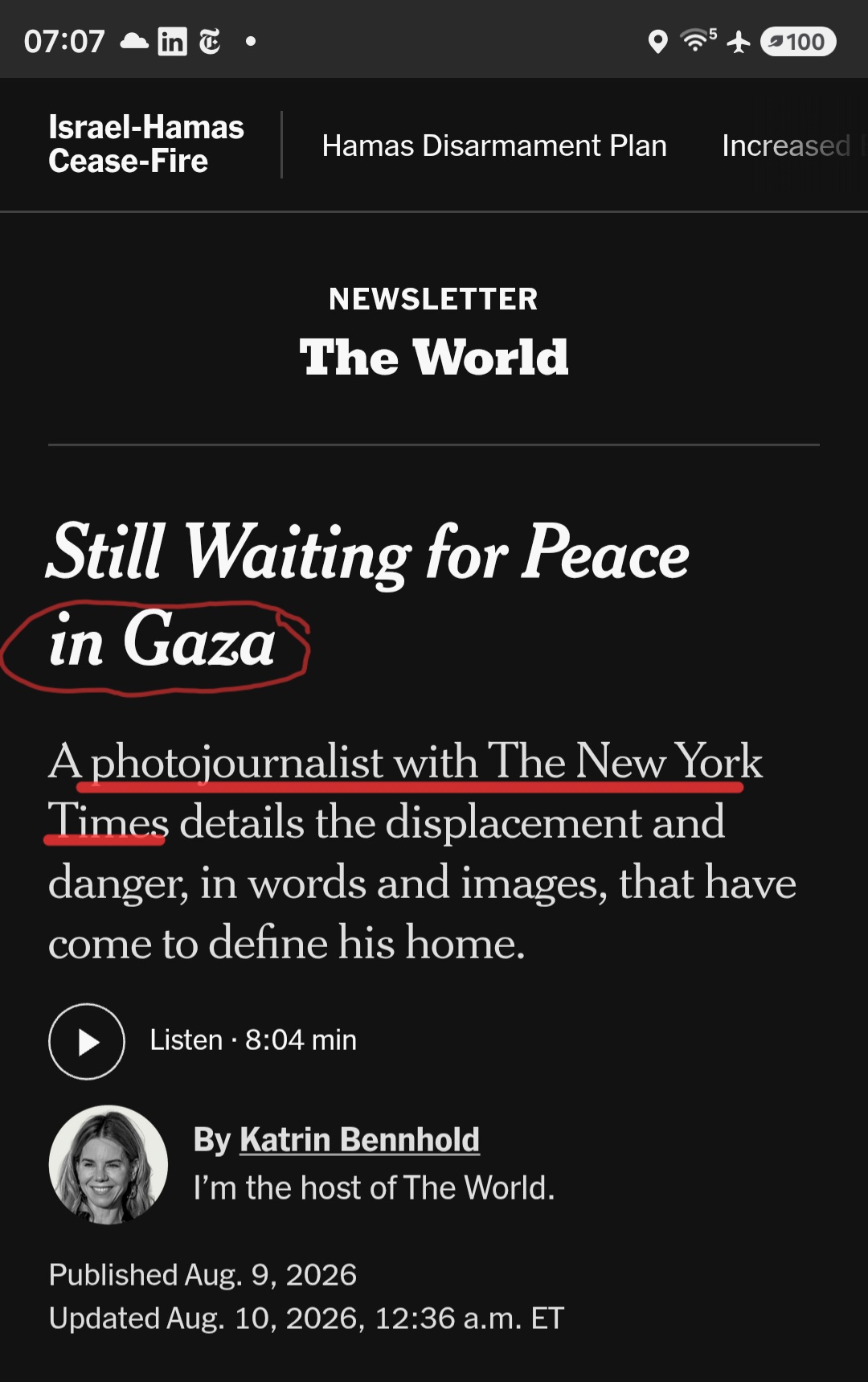
The New York Times published a photo essay under the headline “Still Waiting for Peace in Gaza.” Its Palestinian Arab photojournalist documents the world around him: shattered buildings, displaced families, rubble and danger. The photographs powerfully show what war looks like from inside Gaza.
But what does peace look like?
For Israelis living a few miles away, peace means sleeping without rockets overhead. It means children not watching their parents gunned down before them. It means young adults attending a music festival without being hunted, families living on kibbutzim without gunmen entering their homes, and civilians never again being murdered or dragged across the border as hostages.
Those images are outside the Times’ frame. And their absence raises the central question: Are Gazans waiting for peace with Israel, or peace from Israel?
Palestinian Arab polling makes the distinction important. After October 7, the Palestinian Center for Policy and Survey Research repeatedly asked whether Hamas had been correct to launch its attack. In March 2024, 71 percent of Gazans said yes. Three months later, after enormous destruction inside Gaza, 57 percent still considered the decision correct. Support showed a desire to live with violence inside Gaza if it led to the destruction of Israel.
The pattern predates October 7. Palestinian polling over decades has repeatedly recorded substantial support for attacks against Israelis, including civilians. The question of peace therefore cannot be answered simply by photographing people who desperately want the war around them to end.
Peace is reciprocal. It requires imagining security for the people across the border as well as for oneself.
A revealing photo essay would turn its lens outward. Ask Gazans whether Jewish families should live safely in Sderot and Kfar Aza. Whether Israelis should be able to dance near Gaza without fear of armed Palestinian Arabs crossing the border. Whether rockets should stop permanently. Whether Hamas should disarm. Whether the future they envision includes Jews living securely beside them.
Those answers would tell us whether Gazans are waiting for an end to war or waiting for peace.
And this is where the New York Times itself enters the frame. This is the newspaper’s own photojournalist, presented under the Times’ own headline and editorial framing. By calling the desire for calm inside Gaza “waiting for peace,” the newspaper takes one side’s desire for relief from war and gives it the language of reconciliation between two parties. It portrays the Palestinian Arabs as desirous of coexistence when it is plainly not so.
That framing is particularly consequential when the war began with Hamas crossing into Israel on October 7 to murder and abduct civilians. When thousands of Arab civilians invaded Israel to rape women and abduct children and spit on their corpses as they arrived in Gaza. Removing Israel from a story about “peace” reduces peace to what happens to Gaza after the attack, rather than what Gazans want to happen to Israelis in the future.
The Times reinforces a distorted understanding of the conflict: Palestinian peace becomes the absence of Israeli violence against Palestinians, while the Palestinian attitude toward violence against Israelis disappears beyond the edge of the photograph.
A camera pointed only into Gaza can show us what Gazans want to stop seeing. Peace begins with asking what they want Israelis to stop seeing too.