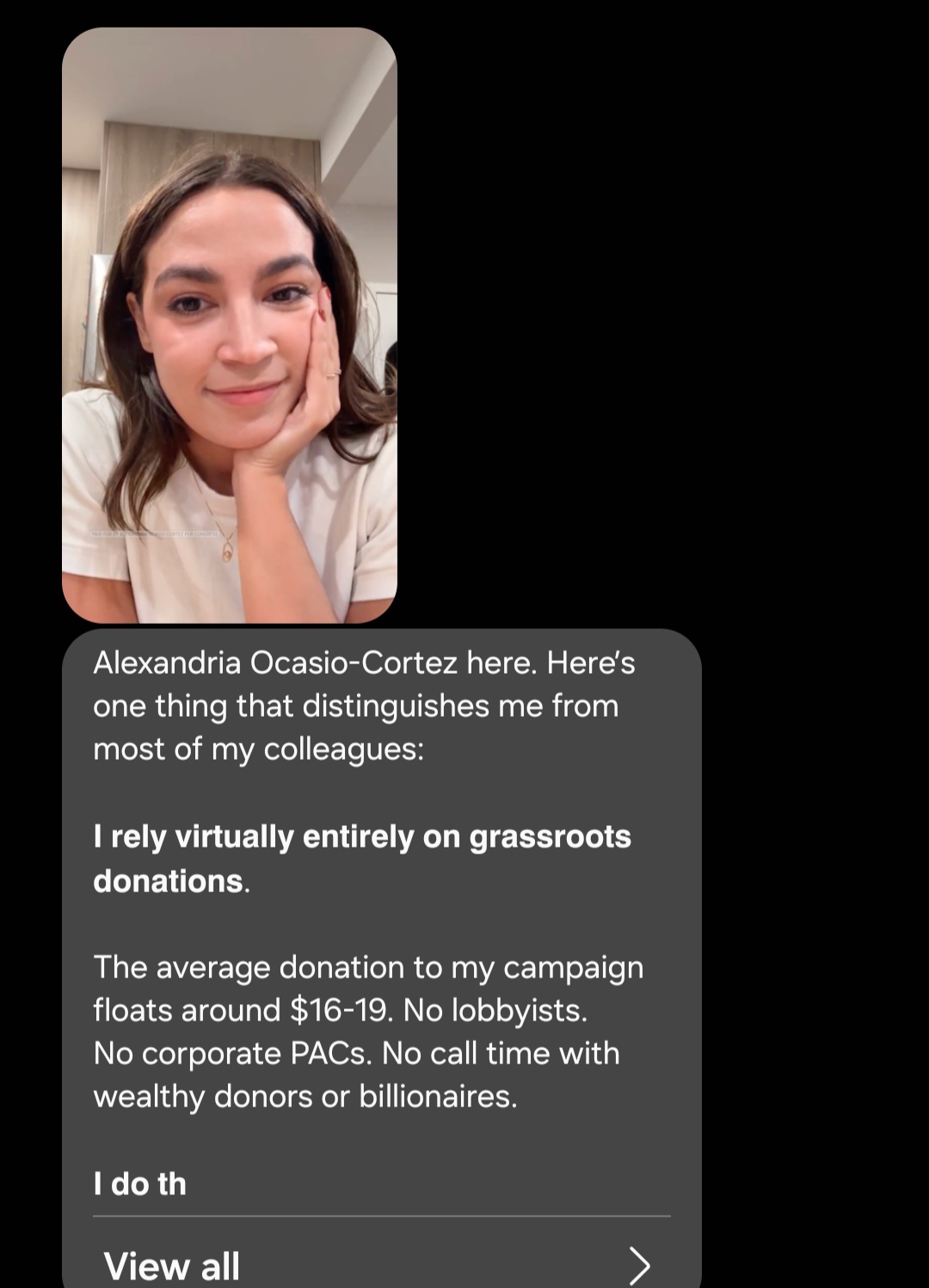
A text message arrived from Alexandria Ocasio-Cortez asking for money.
The appeal struck her familiar tone of class warfare.
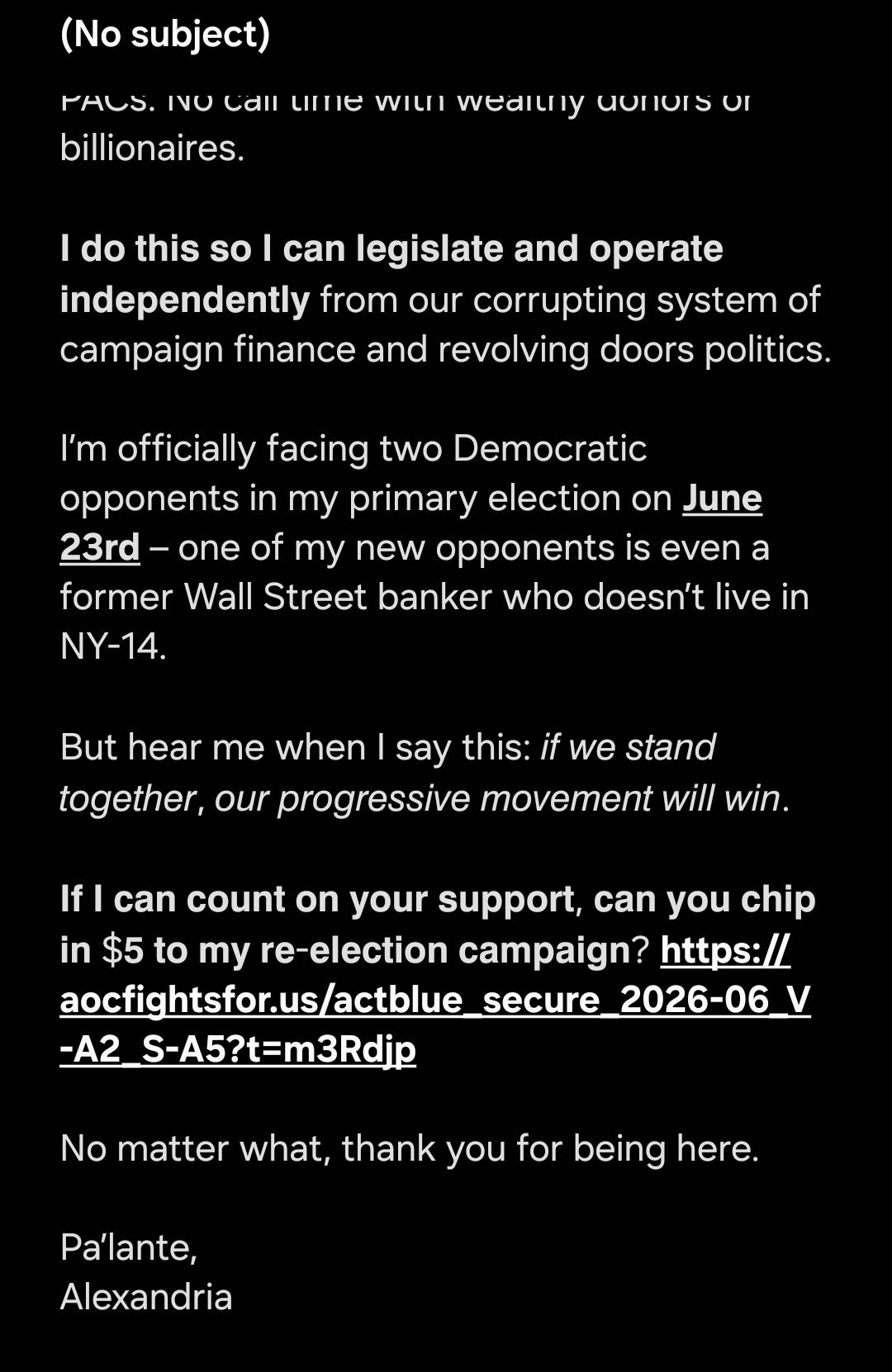
“I don’t spend hours every day calling wealthy people to ask them for money,” she wrote. “No call time with wealthy donors or billionaires.” Instead, she said, her campaign is powered by “regular people giving what they can.”
The imagery is deliberate: a grassroots insurgent taking on powerful interests.
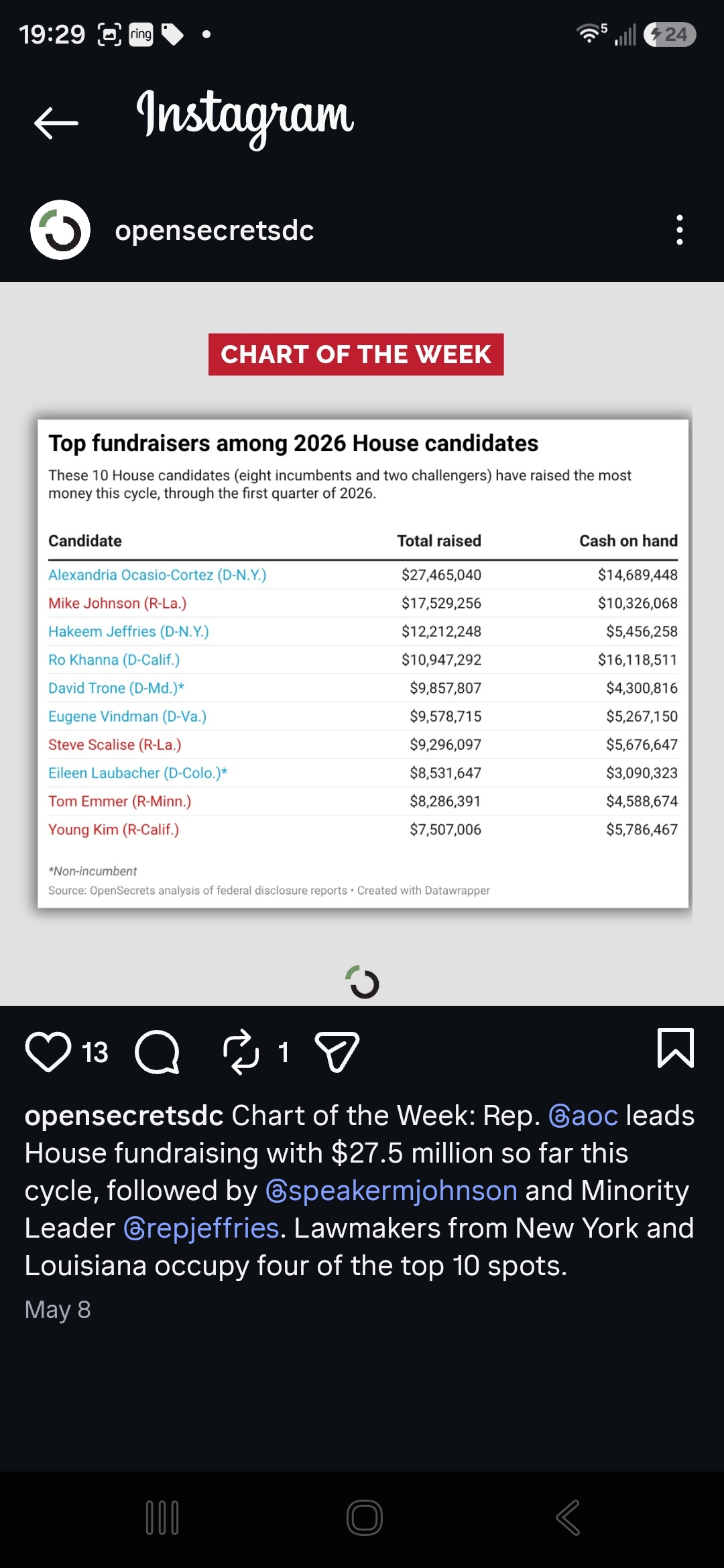
The reality is that that Ocasio-Cortez is so 2018. Today, she has become one of the most powerful fundraising forces in American politics.
According to campaign finance disclosures, she has raised roughly $27.5 million this election cycle—more than the two largest Republican House fundraisers combined. Nearly 88% of that money came from outside New York. Even the portion of her fundraising that comes from larger individual donors totals roughly $8.4 million, a figure that by itself would rank among the strongest fundraising efforts in New York politics.
Those are not the numbers of a beleaguered local fighter. They are the numbers of the richest campaign in the nation.
The irony becomes even sharper later in the appeal. Ocasio-Cortez warns supporters that one of her primary opponent is “a former Wall Street banker.”
The phrase is meant to tell readers everything they need to know: Wall Street. Banker. Establishment.
But AOC is the money. She’s the power in politics. She’s the institutional heavyweight.
That is what makes the fundraising appeal so jarring. Millions of Americans are struggling with rent, mortgages, groceries, tuition, insurance bills, and credit-card debt. Yet the wealthiest campaign in Congress continues to ask ordinary people for another $5, pretending that it’s the underdog.
On November 1, 2026, Palestinians are scheduled to elect a new Palestinian National Council (PNC), the legislative body of the Palestine Liberation Organization.
Before they can choose their leaders, however, they must answer a more fundamental question: Who gets to vote?
The PNC claims to represent Palestinians everywhere, not merely those living in the West Bank and Gaza. Its members help determine the leadership and direction of the Palestinian national movement itself. The question of voter eligibility is therefore inseparable from the question of who is represented.
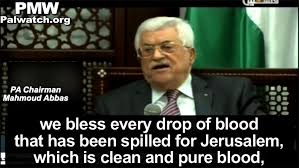
The new electoral framework approved by President Mahmoud Abbas reserves 200 seats for Palestinians living in the West Bank, Gaza, and Jerusalem, and 150 seats for the diaspora.
The allocation itself reveals a dilemma.
The Palestinian national movement claims to represent over fourteen million people worldwide. Yet more than nine million live outside the territories. A fully proportional system could allow voters in Jordan, Europe, North America, and elsewhere to dominate institutions that claim to represent Palestinians living in Ramallah, Hebron, Nablus, and Gaza. The 200-150 split appears to give preference to those who live with the consequences of Palestinian political decisions over the larger voices from around the world.
That raises a more difficult question.
Who qualifies as Palestinian?
Should Jordanian citizens of Palestinian origin – like Queen Rania – vote? What about Americans, Canadians, or Europeans whose grandparents left the region decades ago? How many generations removed from Palestine remain eligible?
Queen Rania of Jordan, also a Palestinian
The question may be most consequential in Jordan, where millions of people of Palestinian origin – estimated at 70% of the population – already participate in the political life of another state. Would Jordanian citizens vote in elections for a body that claims to represent Palestinians globally? If so, how many generations removed from Palestine remain eligible?
The question becomes even more complicated inside Israel.
Roughly two million Israeli Arabs vote in Israeli elections and participate in Israeli political life. Many also identify as Palestinian. Will they vote in elections for the Palestinian National Council?
Jerusalem creates an additional complication. Palestinian leaders seek participation from Arab residents of eastern Jerusalem, which they view as part of a future Palestinian state. Israel considers Jerusalem part of Israel, and many Arab residents of eastern Jerusalem hold Israeli citizenship.
If eastern Jerusalem residents vote while Arab citizens of Israel elsewhere do not, Palestinian leaders will be drawing distinctions that many people may find difficult to explain. Why should an Israeli citizen in eastern Jerusalem participate while an Israeli citizen in Haifa, Nazareth, Acre, or Jaffa cannot?
Arabs in the Old City of Jerusalem. Some are Israeli citizens while others only residents. Who will be invited to participate in Palestinian elections? (photo: First One Through)
The Jerusalem question raises another issue Palestinian leaders will eventually have to address.
If current residency in eastern Jerusalem or the West Bank is enough to qualify someone to participate in Palestinian national elections, what about the hundreds of thousands of Jews who live in those same areas?
Palestinian leaders consider eastern Jerusalem and the West Bank part of the territory of a future Palestinian state. More than 700,000 Israeli Jews live there today. Will any of them be eligible to vote for the Palestinian National Council?
The issue extends beyond contemporary residents. Before 1948, the term Palestinian was often used in a geographic sense. Jews living in Mandatory Palestine carried Palestinian passports and considered themselves Palestinian.
A descendant of an Arab family that left Jaffa, Haifa, or Jerusalem generations ago may be eligible to vote despite never having lived there. A descendant of a Jewish family that lived continuously in Jerusalem, Hebron, Safed, or Tiberias for centuries almost certainly will not be allowed to participate in PNC elections.
The distinction reveals that eligibility is not based solely on current residence, geography, or even historical presence in the land. The electorate is being defined through a more specific combination of ancestry, identity, and connection to a particular historical community.
For decades, Palestinian leaders have often left the boundaries of Palestinian identity deliberately broad. Political movements can operate with ambiguity. Elections cannot.
The voter rolls will reveal whether Palestinian nationhood is principally based on residence, citizenship, ancestry, ethnicity, geography, national affiliation, or some combination of all six. Ethnicity alone cannot fully explain the answer. Palestinians, Jordanians, Syrians, Lebanese, and many others share substantial linguistic, cultural, familial, and ethnic ties. The decisive factor appears to be a connection to a particular place and to people who lived there at a particular moment in history.
That is what makes the exercise so unusual. A Palestinian born in Chile, Canada, or the United States may qualify because a grandparent once lived in Jaffa or Jerusalem. A Jordanian or Syrian whose family never lived in Mandatory Palestine may not qualify despite sharing many of the same cultural and ethnic characteristics. A Jew – regardless of where he currently or historically lived – may be excluded.
Every eligibility rule will draw a line. Some people will be included while others will be excluded. Every decision will reveal how Palestinian leaders understand nationality, citizenship, ancestry, and belonging.
In many ways, Palestinians are attempting something few modern national movements have ever attempted: defining a political nation across multiple countries, generations, and citizenships while simultaneously deciding who belongs to it.
Imagine a movement claiming to represent all Black people whose families lived in North Carolina before 1948. Descendants living in California, London, or Johannesburg could vote even if they had never visited the state. Non-Black current residents of North Carolina could not. The electorate would be defined by ancestry tied to a place and a moment in history.
Whether one finds that model compelling or problematic, the Palestinian election will force its architects to explain where they draw those lines.
Whatever rules emerge, millions of people will discover whether they are considered part of the Palestinian political nation, observers of it, or something in between.
Most elections choose leaders. This election may do something far rarer: define the nation itself.
Before Palestinians can elect their leaders, they must first answer a more difficult question:
One of the most important political developments in America is happening long before Election Day.
Across the country, congressional districts have become so politically lopsided that the general election is often a foregone conclusion. The real contest takes place in party primaries, where turnout is lower, activists are more influential, and crowded fields can allow candidates to prevail with only a fraction of the vote.
New Jersey’s 12th Congressional District offers a striking example.
The district is one of the safest Democratic seats in the state. Thirteen Democrats entered the race to succeed Representative Bonnie Watson Coleman. When the votes were counted, Adam Hamawy emerged victorious with roughly a quarter of the vote. In most elections, winning 25 percent would mean defeat. In a heavily gerrymandered district where the Democratic primary effectively determines the winner, it may be enough to send someone to Congress.
Egyptian-born Adam Hamawy wins Democratic primary in NJ12 with backing of popular anti-Israel streamer Hasan Piker and alt-left politicians Sen. Bernie Sanders and Rep. Alexandria Ocasio-Cortez
That reality changes the type of candidates who can reach Washington.
Candidates who would struggle to build broad support across an entire electorate can succeed by assembling a passionate faction within a low-turnout primary. Once nominated in a safe district, they often face little risk in November.
Hamawy’s victory illustrates the dynamic.
Critics pointed to Hamawy’s testimony as a defense witness for jihadist Sheikh Omar Abdel-Rahman, the “Blind Sheikh” convicted for his role in terrorist plots linked to the 1993 World Trade Center bombing. They highlighted his volunteer work in Bosnia with the Benevolence International Foundation, an organization later shut down after investigators linked it to Al Qaeda. They questioned statements he made during the Blind Sheikh trial and raised concerns about past associations with individuals and organizations connected to radical Islamist movements.
Controversies like these that would likely receive intense scrutiny in a competitive district carried relatively little political cost in a race where winning roughly one quarter of a divided primary electorate may be sufficient to secure a seat in Congress.
The problem is not unique to Democrats. Deep-red districts have produced candidates whose views would struggle in a competitive statewide race. Deep-blue districts increasingly do the same. The common factor is not ideology. It is political geography.
Every society contains fringe movements. The question is whether political institutions force those movements to persuade a broader public before gaining power.
When candidates must compete for swing voters, controversial ideas are subjected to wider scrutiny. When victory depends on energizing a narrow slice of primary voters, the incentives change. Candidates can thrive by appealing to activists rather than assembling broad coalitions.
This feels much like social media. Inside echo chambers, radical ideas become normalized. As algorithms reward engagement, more extreme ideas ultimately push out the normalized-radical in the quest for eyeballs. Moderation is lost, and dissent is met with expulsion.
Ideological social media communities are the online equivalent of heavily gerrymandered deeply blue or red districts.
That dynamic helps explain a puzzle in modern American politics.
Polls consistently show that overt antisemitism remains a minority view in the United States. Yet some of the most visible antisemitic and anti-Israel voices in American politics emerge from districts where the decisive election is the primary rather than the general election.
Most Americans do not spend their time vilifying Jews, questioning Jewish belonging, or treating the world’s only Jewish state as uniquely illegitimate. Yet politicians can gain prominence by appealing to activist networks – online around the nation and local physically – where those themes carry political currency.
That does not mean those views represent America. It means they do not need to represent America; only enough primary voters in enough safe districts.
The same political system that elevated Adam Hamawy in New Jersey has elevated figures such as Rashida Tlaib and, on the Republican side, Marjorie Taylor Greene. Their ideologies differ dramatically, but the electoral formula is remarkably similar. A candidate builds an intense following within a safe district, wins a primary, and arrives in Congress with little need to appeal beyond that niche radical base.
NOVEMBER 30, 2018: (L-R) Rep. Rashida Tlaib (D-MN), Rep. Ilhan Omar (D-MN) and Rep. Jamaal Bowman (D-NY) take questions during a news conference about Islamophobia. (Photo by Drew Angerer/Getty Images)
The result is a Congress increasingly populated by politicians whose views are more representative of the most motivated primary voters than of the broader American public.
The problem is bigger than any one candidate. It is a system in which winning 25 percent of a primary electorate can matter more than winning the confidence of the country.
ACTION ITEM
Demand a change to primaries.
Any election in which the winning candidate fails to receive 40% of the vote automatically requires a run-off between the two highest vote getters
Stop radical gerrymandering and mid-decade gerrymandering
Enable open primaries in which everyone can vote, regardless of party afiliation
Institute ranked-choice voting, especially in races with more than four people running
Ban entities that negotiate with municipalities (like teacher unions) from endorsing or donating to candidates
New York State is putting forward a proposal on the November ballot to change the state’s constitution. Specifically, it adds categories of “protected classes” and enables judges to override them if they feel that a situation is warranted.
Concurrent Resolution of the Senate and Assemblyproposing an amendment to section 11 of article 1 of the constitution, in relation to equal protection
Section 1. Resolved (if the Assembly concur), That section 11 of article 1 of the constitution be amended to read as follows:
§ 11. a.No person shall be denied the equal protection of the laws of this state or any subdivision thereof. No person shall, because of race, color, ethnicity, national origin, age, disability, creed [or], religion, or sex, including sexual orientation, gender identity, gender expression, pregnancy, pregnancy outcomes, and reproductive healthcare and autonomy,be subjected to any discrimination in [his or her] theircivil rights by any other person or by any firm, corporation, or institution, or by the state or any agency or subdivision of the state, pursuant to law.
b. Nothing in this section shall invalidate or prevent the adoption of any law, regulation, program, or practice that is designed to prevent or dismantle discrimination on the basis of a characteristic listed in this section, nor shall any characteristic listed in this section be interpreted to interfere with, limit, or deny the civil rights of any person based upon any other characteristic identified in this section.
§ 2. Resolved (if the Assembly concur), That the foregoing amendment be submitted to the people for approval at the general election to be held in the year 2024 in accordance with the provisions of the election law.
Explanation – Matter in underscored is new; matter in brackets [ ] is old law to be omitted.
New York State is a Democratic super-majority trifecta: The Democratic Party controls the office of governor and both chambers of the state legislature, of Assembly (100 to 48) and Senate (42-21). Democrats are using their muscle to push forward a controversial proposal which sounds benign but gives judges wide latitude to advance preferred classes of people over others.
Advocates for the constitutional amendment like Governor Hochul argue that its about abortion rights. Yet many have written articles suggesting that such argument is absurd as New York already amended the constitution to permit an abortion until the moment of birth for any reason. Asian New Yorkers see the proposition as “reverse racism” which will kick qualified Asian students out of better schools in favor of preferred minorities. Others argue that this is a “pernicious” attempt to “throw out the New York human rights act,” in favor of pushing DEI everywhere (diversity, equity and inclusion).
Religious institutions are alarmed by the proposition and urging voters to vote ‘no.’
The president of Houghton University, a 141-year-old Christian university, said “the proposed amendments to the state constitution would adversely affect our institution, our students and our employees. The most significant of those adverse effects are related to parental rights, women’s athletics and religious liberty…. Proposal 1 and other similar inclusion measures overstep constitutional religious liberty protections when they prevent people of faith from freely exercising their religion. It is not inclusive to force people of faith to believe or behave in a manner that is inconsistent with their religious beliefs, to force them to raise their children in a manner that contradicts their religious beliefs, or for the state to attempt to raise their children in a manner that contradicts their religious beliefs while hiding state actions from their parents.”
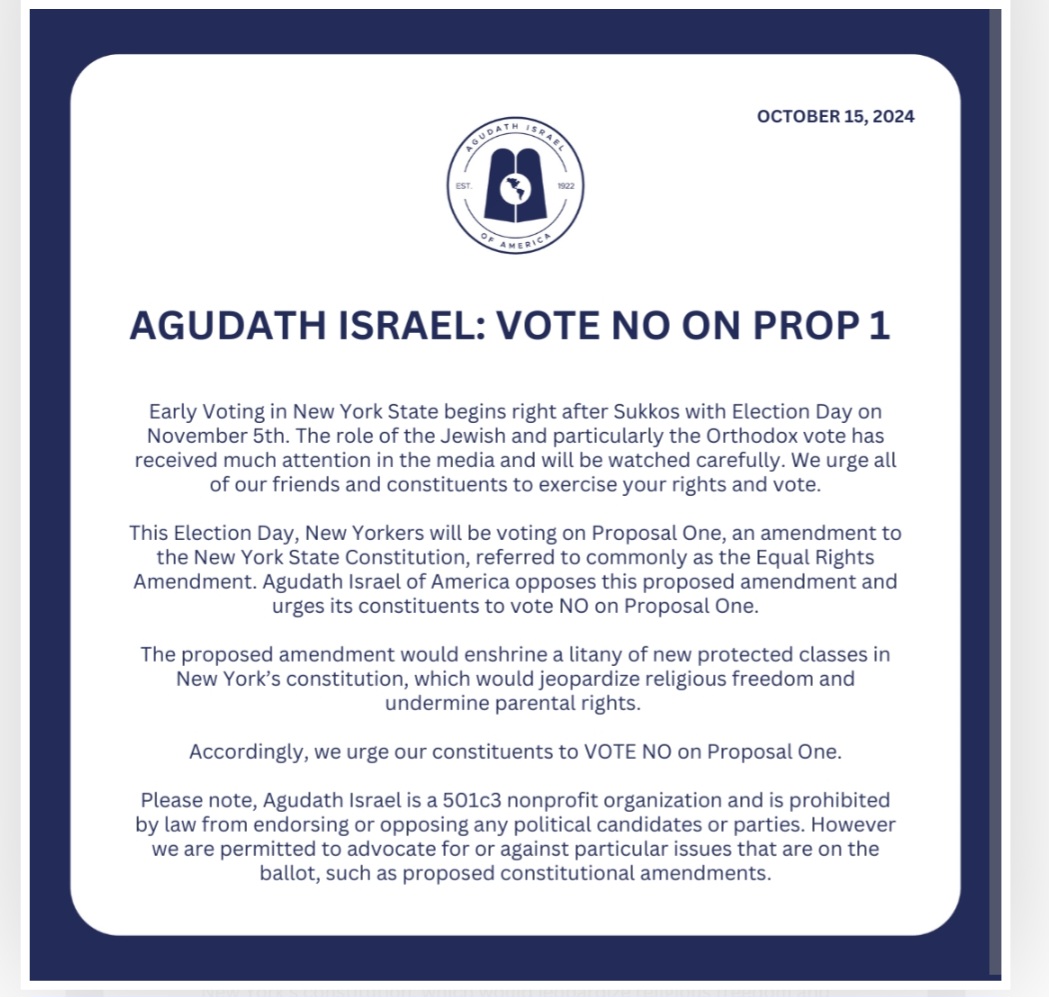
Jewish institutions are similarly against the proposition, with Agudath Israel releasing a statement on October 15 urging everyone to reject the amendment to the constitution.
The Empire Center produced a detailed and balanced analysis of equal rights laws and the ramification of Prop 1. It concluded that the language in this proposition is so vague that it will pit one class of protected persons against another, spur constant litigation and give judges tremendous leeway to create policy of their personal preferences. It suggested that New Yorkers vote ‘no’ and “hold out for an equal rights amendment that solves more problems than it creates.”
The Deep Blue super-majority trifecta of New York State government is attempting to upend protections that have existed since 1938 to enforce DEI mandates in every aspect of New Yorker’s day-to-day lives. Vote ‘no’ to Proposition 1 and send a clear message that New Yorkers reject the government pitting citizens against each other.
American citizens in 43 states will have no say on the presidential election in November 2024. Seven “purple” states – Arizona (11), Georgia (16), Michigan (15), Nevada (6), North Carolina (16), Pennsylvania (19) and Wisconsin (10) – with a collective total of 93 electoral votes, will ultimately decide the election. All of the other states are deeply Democratic or Republican so an individual’s vote there will not change anything, despite how vocal or passionately they feel about the candidates.
It does not mean that there is nothing for the vast majority of Americans to do.
For those who are moderate and do not want to see the country continue its divisive path towards the fringes, it is incumbent to try to help separate the party of Congress from that of the presidency. That means, that as Democratic nominee Vice President Harris continues to gain momentum and looks to secure the White House, people should try to ensure that Republicans are the majority in the House and/or Senate to avoid a Democratic administration tacking to the socialist-jihadi extreme of the party.
House of Representatives
The current split in the House of Representatives is 221 Republicans and 213 Democrats. Of these, fifteen are running for a different office (12 of which are Democrats), fourteen are retiring (8 of whom are Democrats) and three are resigning (1 Democrat).
Roll Call identified ten of the most contested races in the House of Representatives; I have added one more, NY17. In every race, the pro-Israel bipartisan lobbying group AIPAC endorsed the incumbent, of which seven are Republican. Those races are (incumbent listed first, AIPAC endorsed in bold, Republicans endorsed by AIPAC in red):
NY22: Brandon Williams (R) v. John Mannion (D)
CA13: John Duarte (R) v. Adam Gray (D)
NY4: Anthony D’Esposito (R) v. Laura Gillen (D)
WA3: Marie Gluesenkamp Perez (D) v. Joe Kent (R)
NC1: Don Davis (D) v. Laurie Buckhout (R)
OR5: Lori Chavez-DeRemer (R) v. Janelle Bynum (D)
NE2: Don Bacon (R) v. Tony Vargas (D)
AK: Mary Peltola (D) v. Nick Begich (R)
CA27: Mike Garcia (R) v. George Whitesides (D)
PA8: Matt Cartwright (D) v. Rob Bresnahan (R)
NY17: Mike Lawler (R) v. Mondaire Jones (D)
Senate
The Senate is currently divided with 51 Democrats and 49 Republicans. According to Bloomberg, “of the 34 Senate elections currently scheduled for 2024, Democrats and allied Independents are the defending party in 23 contests, while the Republicans are defending just 11 seats. Democrats Joe Manchin of West Virginia, Jon Tester of Montana, and Sherrod Brown of Ohio are all up for re-election in states President Joe Biden lost in 2020. Trump won all 10 states where Republicans are defending Senate seats, all but two of them by double-digit percentage-point margins. Nebraska will have two races in 2024, including a special election triggered by the resignation of Ben Sasse (R).”
According to Real Clear Polling, there are seven toss up races in the Senate in 2024. They are:
Arizona: [open] Ruben Gallego (D) v. Kari Lake (R)
Florida: Rick Scott (R) v. Debbie Mucarsel-Powell (D)
Maryland: [open] Larry Hogan (R) v. Angela Alsobrooks (D)
Michigan: [open] Elissa Slotkin (D) v. Mike Rogers (R)
In summary, the top ten races people should get behind to stem the anti-Israel and antisemitic tide are: Bacon (NE2); Chavez-DeRemer (OR5); D’Esposito (NY4); Duarte (CA13); Garcia (CA27); Lawler (NY17); Williams (NY22); and in the Senate, Moreno (OH), Rogers (MI) and Scott (FL).
Runner-up to the top ten is also a somewhat tight race in NJ7 where incumbent Tom Kean (R) is running against Sue Altman (D).
To be clear, I am not suggesting that these individuals have great records overall; I am saying that a balanced Congress is the best antidote for extremist policies, and donating or volunteering for these candidates may provide a path for a more moderate administration.
One can donate to the candidates via the AIPACPAC portal. The two non-AIPAC endorsed candidates should be contacted directly at Mike Rogers and Bernie Moreno. Volunteering should also be done directly at the person’s website. Early action is highly recommended, as it takes time to build the local momentum needed to win these races.
Mondaire Jones, a former congressman who served lower Westchester, came out against the incumbent Jamaal Bowman, saying the time had come to “rebuke the extremists that some would have take over the Democratic Party.”
Jones is a black, gay progressive, and made clear that Bowman represents a fringe element advanced by revolutionary groups that seek to tear the country apart, and not part of a liberal tradition.
Jones’s point rings true for Westchester County, where Biden beat Trump in 2020 by 67.6% to 31.3%. The county is liberal but not ‘burn it down’ woke radical like Bowman.
Would a progressive mock women who were raped to a chanting crowd, the way Bowman did on the streets of White Plains?
Would a progressive taunt a small minority-minority, a fraction of the size of the country’s Black and Hispanic population, the way Bowman does?
Would a progressive be hostile and ignore of a minority group which suffers more hate crimes than any other group in the United States, as Bowman does repeatedly?
The National Black Empowerment Action Fund is embarrassed by the divisive actions of Jamaal Bowman. The group just donated half a million dollars to his opponent, a 70-year old white man, Westchester County Executive George Latimer. The founder of the group said “we could have stayed out of it, but the need was too great, the sense of urgency was too high. We’re trying to champion an effort to help amplify the voices of black voters who are focused on safe communities, good-paying jobs, driving down the cost of living, having school choice for their kids, healthcare and just realizing better life outcomes, and it’s going to take responsible leadership that’s keenly focused on those priorities as opposed to far-flung ideologies and agendas.”
Bowman’s agenda and ideology has more than a tinge of Jew hatred.
White Plains Councilman Justin Brasch said about Bowman “I have felt antisemitism from him. I felt such a strong degree of antagonism towards the Jewish community and its leadership that, yes, it feels antisemitic and insensitive.”
Bowman has called Republicans “Nazis,” as has his staff in attempting to divert attention away from Bowman’s pulling a fire alarm. It is an insult not only to the targeted individuals but Jews who consider the casual usage of the term a form of Holocaust denial.
Jamaal Bowman defended the antisemitic comments of Rep. Rashida Tlaib by calling Republicans racists, cold and stupid, November 7, 2023
Bowman embraces his position as an extremist. In May 2023 he scolded President Biden saying “I’m concerned because the president has, every now and then, moved to the right, if you will, to acquiesce to a so-called independent voter.” His hyper-partisan voting record places well outside of the mainstream, which is why the far-left group Justice Democrats made Bowman the top recipient of their funding in the 2022 and 2024 election cycles.
Westchester County Executive George Latimer has broad support among the residents of lower Westchester County who have known him to be a tireless advocate for decades. They have adorned their lawns with signs showing their support in his congressional race in New York’s 16th Congressional District which has a Democratic primary on June 25.
But the Latimer signs keep disappearing.
All over White Plains, people are taking down signs for George Latimer, whether they are one feet or ten feet from the curb.
Residents have been taking pictures using cameras as well as capturing stills from video surveillance of people climbing onto lawns and pulling out signs. Seemingly, some of the people removing signs have been from the White Plains Code of Enforcement.
According to a representative in the department, they remove signs when they are located in the city’s “right of way” which can be up to eight feet from the curb.
But the city is doing this very selectively, leaving non-political signs up while taking away George Latimer signs.
Several signs left untouched while Latimer signs were removed from lawn next door which were the same distance from the curb
Some Latimer supporters have had signs taken multiple times and are resorting to nailing their signs onto trees.
Several realtor and construction signs left by city while Latimer signs next door removedLatimer sign nailed to a tree after signs removed several times
The White Plains Code of Enforcement (914) 422-1208, said that they placed all of the removed Latimer signs in the Recycling Center at 85 Gedney Way, but they would not explain why they left so many other non-political signs in place.
Are Jamaal Bowman’s supporters robbing constituents of their free speech rights and stealing Latimer signs? Bowman has long proven himself to be an embarrassment and unfit to serve in Congress and his actions continue to draw the ire of the people in the district. Bowman’s supporters are further fueling anger against the unhinged incumbent.
One of the major primaries being discussed in the media is the race in New York’s 16th Congressional District between Rep. Jamaal Bowman of the far-left “squad” and Westchester County Executive George Latimer, a seasoned progressive. The media has portrayed this as a “microcosm of party split over Israel-Hamas conflict,” but that misses the mark.
This is about NY-16 being redistricted from a mix of northern Bronx and some of lower Westchester in 2020, to a predominantly Westchester district with a nub of the Bronx in Co-op City in 2024.
Bowman won the seat in 2020 securing the seat with many votes from the Bronx and some liberals in Westchester looking for a change and progressive voice. When the 2020 census moved NY-16 into more of a Westchester-focused population in 2022, two Westchester Democratic contenders fought to challenge Bowman, Westchester County Legislature Catherine Parker and Westchester County Legislature Vedat Gashi. Parker and Gashi split the anti-Bowman vote who had proven himself to be a radical with his chant to “Defund the Police” and vote against the Infrastructure Bill and then lying to his constituents that he actually supported it.
As soon as Bowman won the 2022 Democratic primary, people in Westchester started planning on who to run against him. This website, PrimaryBowman.com, posted ideas and articles including Beating Bowman, which called for finding a popular Westchester politician EARLY, to avoid splitting the vote again.
THAT WAS IN SEPTEMBER 2022.
Many local people in Westchester got involved to draft George Latimer to run against Bowman. It was not AIPAC, Democratic Majority for Israel or any other group. It was a grassroot effort of people who thought that Latimer had years of providing quality service to Westchester constituents, and while a liberal, appealed to the more centrist District 16 residents than the extremist Bowman.
The conversations with Latimer began in earnest in April of 2023 and people expected him to make a decision by June. Being a methodical politician, Latimer spent time canvassing the district to see if there was broad support for ousting a sitting Democrat, especially a Black man since Latimer is White. The responses were nearly universal: Bowman is detested in wide swaths of Westchester and politicians and the local Democratic establishment were going to back Latimer.
All of this was months before the barbaric October 7 Hamas attacks against Israel.
Latimer was quick to raise lots of money from inside Westchester, which is more affluent than the Bronx former-constituents who had voted for Bowman in 2020. Latimer raised almost twice as much money as Bowman in both the fourth quarter of 2023 and the first quarter of 2024. Even more telling, Bowman did not even have 10% of his donations from inside the district.
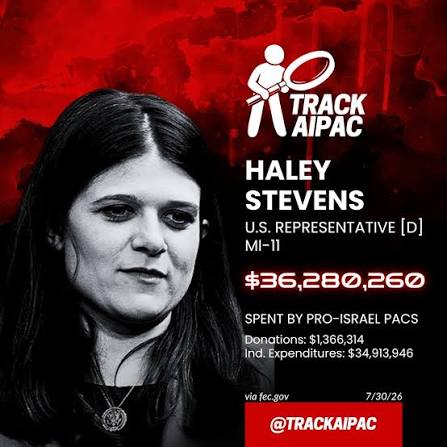
Sensing his vulnerability, Bowman latched onto the fundraising of Rep. Rashida Tlaib who is hauling in money from pro-Palestinian groups. Running unopposed, she funnels the excess money to Bowman, essentially buying a district hundreds of miles and four states away from her district in Michigan, cashing another anti-Israel vote.
Rep. Rashida Tlaib and her tool, Jamaal Bowman
Bowman is faithfully serving his Palestinian money master. He had anti-Zionists at his launch party, voted against Israel in all congressional votes, defended Tlaib’s gross antisemitism on the floor of congress, and refused to loudly condemn antisemitism on college campuses at a congressional hearing. Further, he would not attend a rally when antisemitic graffiti showed up on Jewish stores in his district, nor would he attend Jewish rallies in synagogues.
Latimer attended all of them.
Westchester County Executive George Latimer at a bipartisan Westchester Jewish Council dinner. Bowman was invited and did not attend (Photo: PrimaryBowman.com)
Do Westchester Jews favor Latimer over Bowman because of Israel? Absolutely, but not solely. Bowman has years of earning his disrespect, including collecting a bipartisan censure from congress for pulling a fire alarm.
Bowman’s calling Westchester Jews “racist” for backing a White challenger is offensive and yet another sign of his moral failures. District 16 Jews support neighboring NY-15’s Rep. Ritchie Torres, a Black-Latino gay politician, for standing up the mob destroying property at Columbia University and for inciting violence against Jews, while Bowman supports the anarchists. Lower Westchester elected Mondaire Jones, a Black gay progressive in 2020 when the district lines put lower Westchester into NY-17.
Tweets on April 30, 2024 by Reps. Torres and Bowman about the pro-Hamas / anti-Israel violence at Columbia University
New York’s 16th Congressional District has sought to replace Bowman as their representative since lines were redrawn to cover most of lower Westchester in 2022. Bowman’s latest anti-Israel antics are disgusting appeals to get money from anti-Zionists outside of the district. Even if October 7 never happened, lower Westchester would still rally to unseat the unpopular extremist Bowman.
Members of the far-left “squad” in congress like to portray themselves as for the working people in a grassroots movement fighting against the rich and corporations.
The data of where some of them rake in the money tells a different story.
According to collection records assembled by the non-partisan group OpenSecrets, only two members of the squad did not take most of their contributions from large donors, Ilhan Omar (42.2% from large donors) and Alexandria Ocasio-Cortez (25.6% from large donors). All of the rest went for the big donor checks.
Summer Lee took in the vast majority of her fundraising – a whopping 71.5% – from large contributions. Rashida Tlaib was just behind her at 69.2% and Jamaal Bowman at 64.4%.
It is interesting to look at the overall fundraising for the candidates as well. AOC continues to be the major fundraiser as she’s been for years. However, this year, Rashida Tlaib and Ilhan Omar are close behind, likely because of Democrats funding the two Muslim members of congress who are upset about the destruction in Gaza (rather than disgust for Hamas). Cori Bush and Ayanna Pressley have barely been able to raise any money.
Taking the two charts together points to a frightening realization about Summer Lee and Jamaal Bowman: they’ve raised a small amount of money and it’s mostly coming from major donors. They are essentially “owned” by a few big contributors. For Bowman it’s worse, as most of the contributors are from out of his district.
As the left-wing extremists launch a “Protect the Squad” campaign with appeals for money, keep in mind that Summer Lee and Jamaal Bowman are the embodiment of unpopular, big money politicians who pretend to have the backs and backing of their constituents.
For a detailed review of New York’s Democrat and Republican spending in the 2022 congressional races, click here.
To visit social media during election season is to be barraged by smear campaigns of the extremists. Nowhere is this more apparent than the alt-woke group called Justice Democrats.
Justice Democrats was established to help elect far-left progressives into political office. Rather than form their own party like the Working Families Party with whom they align, they have sought to infiltrate the Democratic Party by ousting moderate Democratic politicians in deeply Democratic congressional districts.
Their poster child is Alexandria Ocasio-Cortez who was by far the biggest money-hauler in the 2022 election cycle, raising nearly $10 million. She has used her deep pockets to influence other races outside of her district, often being the king-maker alongside the Justice Democrats’ “Dr. Frankenstein.” With eight politicians in Congress now, the alt-left beast is very much “alive” in the Democratic Party.
In contrast to the extremism of the Justice Democrats’ “Squad” which seeks to elect non-White, women and LGBT+ people who seek to dismantle America in a broad redistribution of wealth, there are many political movements which believe that the United States is an amazing country, and support and welcome everyone who empowers America. One of those groups is AIPAC, which seeks to strengthen the U.S.-Israel alliance.
AIPAC supports Whites, Blacks, Hispanics and Asians. It backs progressives, liberals, moderates and conservatives. It has endorsed every type of American that makes up this great country, as long as they believe in the unique greatness here, and want to strengthen it and the U.S.-Israel alliance.
The Justice Democrats in Congress think America is an atrocious, racist and horrible country that must be ripped down. They see Republicans and White men as the embodiment of the system that must be toppled in a broad redistribution of wealth from those pockets of the “patriatchy” to those the enlightened “woke” deem more worthy.
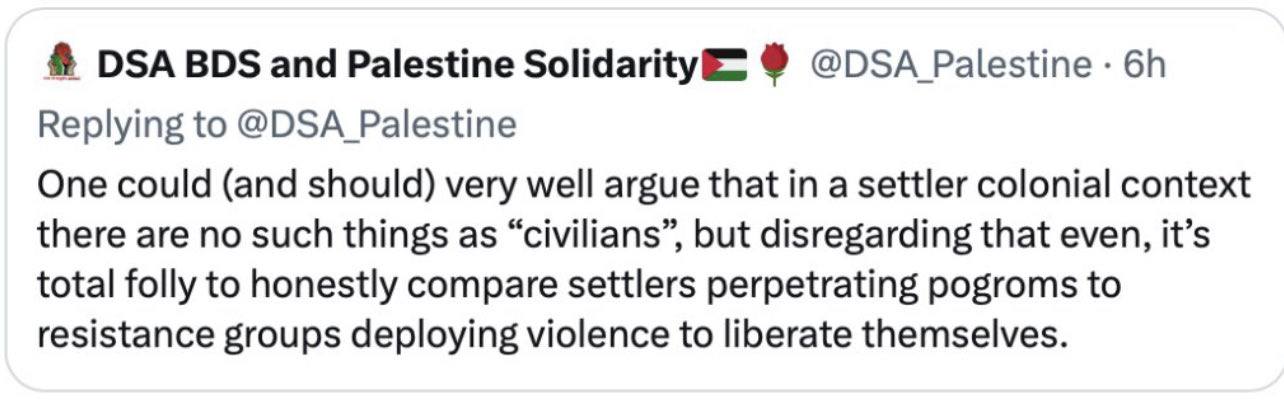
For some reason, those same alt-ledt people who hate America also hate the Jewish State. They believe that Israel is a “White European Settler Colonialist” country in an antisemitic whitewashing of thousands of years of Jewish history and false accounting of the population of Israel which has a plurality of Jews of color.
The Justice Democrats are now pouring millions of dollars into campaigns against AIPAC, rather than promote their candidates.
Justice Democrats has falsely stated that AIPAC is against “Black and Brown progressives” when, in fact, it endorses many, including Rep. Ritchie Torres (D-NY15) who represents one of the poorest districts in the country.
Justice Democrats unleashed a campaign called RejectAIPAC, and the alt-left politicians they support have leaned into the theme. They are seeking to pressure the United States to stop supporting Israel in its defensive war against the terrorist group Hamas, to enable the antisemitic group to survive the war.
Justice Democrats and sister groups like the Democratic Socialists of America are no longer just anti-White, anti-Republican and anti-America but anti-Israel and anti-Jewish. They have launched a smear campaign against the bipartisan group AIPAC and will certainly come after other pro-America organizations as they seek to tear down America in a campaign to redistribute wealth to the people they consider most worthy.