He Said, She Said, Rover Said

A satire.

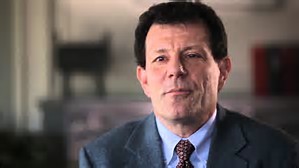
The New York Times’ Nicholas Kristoff caused a stir when he reported on the daily rape of Palestinian Arabs by Israeli dogs while incarcerated. Pro-Palestinians were appalled and pro-Israelis were shocked at the charge – what kind of inanity? How is this even possible?

New York Times’ Nicholas Kristoff

Let me tell everyone about the ugly reality. I have been investigating this for years. I have a mole (an actual one) as well as a source inside the Zionist security apparatus. Let me just call him Colonel Klink to protect his identity, and I will fully expose what Kristoff only touched upon.

The Israeli prisons have vast storehouses of Bamba that they crumble and smear all over their Arab captives for interrogations. The peanut butter smell drives the dogs wild as they sexually maul the exposed Gazans and West Bank Arabs. The Israeli guards allow the abuse to go on until the Arab prisoners reveal the sordid plans they have for Israeli Jews, which the guards write down and then sell to Lior Raz for plots for the next season of Fauda.

Lior Raz of Fauda during a fundraiser for the Zionist ambulance service

This is only the tip of the canine iceberg.

Israeli border collies have been herding Palestinian sheep into “open air prisons” for years. The Israel Guide Dog Center for the Blind offers the yellow Labradors and Golden Retrievers to Jews, while reserving the black Labradors for Israeli Arabs because of the deep racism embedded in Israeli society – even for blind people.

The animal cruelty knows no bounds.

ASPCA locations around the United States have been used as Mossad safe houses since the founding of the Zionist state. Dogs that people adopt have chips in them which the Israeli government uses to track millions of Americans.

The colonialists have even established an elite cat unit trained in pickpocketing, emotional manipulation, and knocking over glasses of water during hostage negotiations. One tabby roaming tourist cafes allegedly stole three passports, two vapes, and an unopened yogurt from a Scandinavian journalist.

In New York, Israeli units have dispatched Portuguese Water Dogs in Times Square where they operate Thee Card Monte tables to rob tourists. The same unit uses Standard Poodles to sell knock-off Gucci handbags while they gather intel on Muslim Halal food cart vendors, who are in turn, casing American streets for easy targets.

In the Holy Land, Palestinian Authority President-for-life Mahmoud Abbas has accused Israel of “weaponizing pigeons” to deliberately defecate across public spaces in Palestinian cities. “This is organized biological warfare,” Abbas reportedly declared. “The pigeons target only Palestinian vehicles, Palestinian balconies, and Palestinian laundry.”

The humanitarian crisis expanded into the political sphere this week after activists accused Israel of operating what one NGO called “a sophisticated interspecies apartheid system” stretching across land, sea, air, and now apparently pollination networks, as Israeli bees are chemically treated to be unable to approach plants in Arab fields.

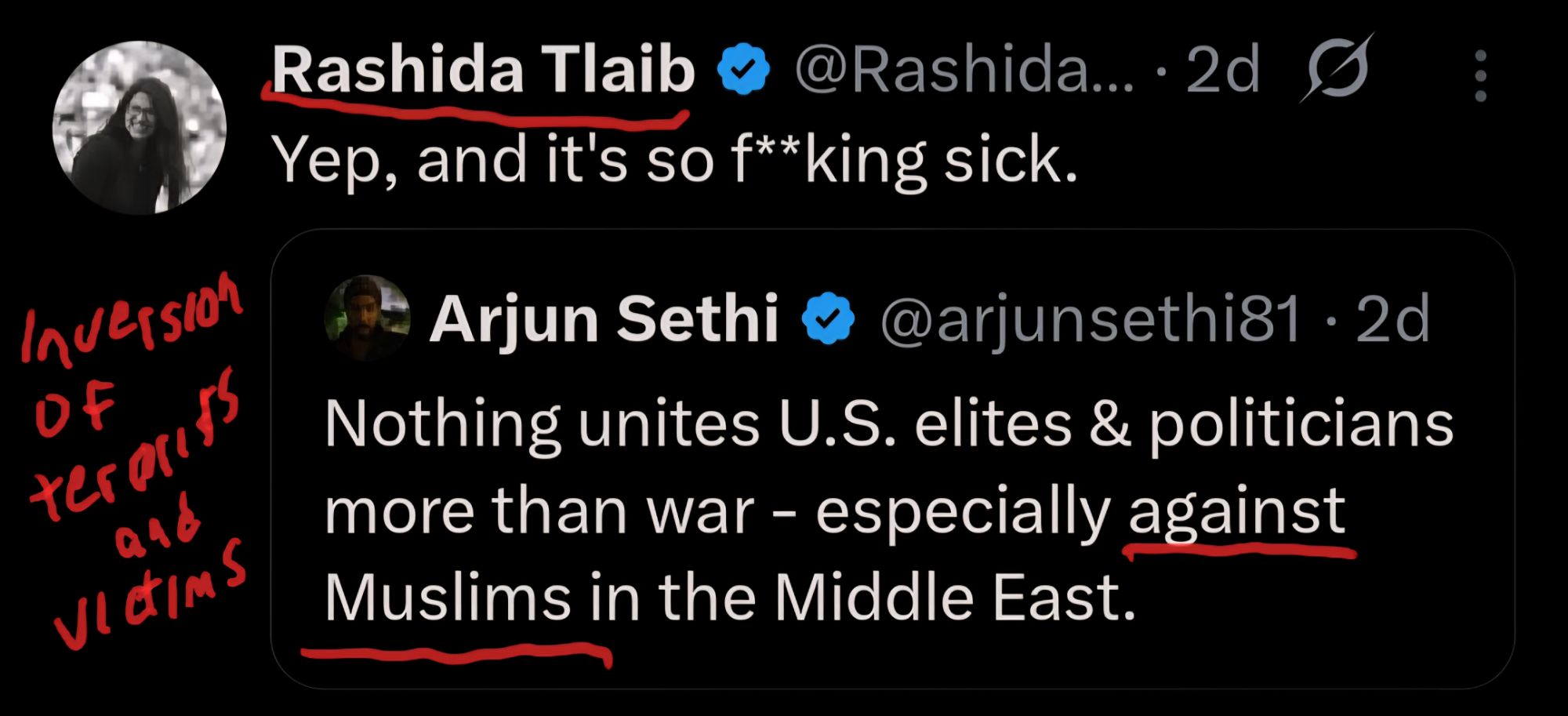
Speaking emotionally before reporters, Rep. Rashida Tlaib (D-MI) condemned what she described as “the ongoing Animal Nakba. Not only are Palestinians suffering under the imperialist Zionist regime,” she declared, “the indigenous animals and insects are suffering too.”

One Gazan who was set free in a prisoner exchange told me that he witnessed parrots repeatedly curse prisoners in multiple languages to degrade the Palestinian spirit. Worst of all, the parrots deliberately spoke in Arabic with a lisp, which made several Palestinians admit to raping Israelis.

Students for Justice in Palestine at Harvard, having heard of this, set up in the center of the campus with placards “Polly want a ceasefire!” Brown University faculty followed launching a new course “Decolonizing Veterinary Power Structures.” Col. Klink has been drafted to be one of the lecturers. The university is seemingly unaware that he is a double agent, trashing the Jewish State to progressive audiences while simultaneously surveilling them.

Brown University online lecture about decolonizing Palestine, seeking to replicate Hamas around the world

Francesca Albanese of the United Nations said the latest findings are deeply upsetting and more evidence regarding the “occupation of bees, apartheid Labradors, militant parrots, and psychologically traumatized hamsters,” although no reports of hamsters being involved in Zionist oppression have emerged. Yet.

Anti-Israel members of New York City’s Mayor Zohran Mamdani’s team have urged the mayor to stop the Celebrate Israel Parade, which the mayor is reportedly considering. He has also suggested banning all Jews from adopting pets in the city, but his lawyers said that crossed the line into antisemitism. Zohran reportedly just shrugged and said “so what?”

In Washington, DC, President Trump has reportedly asked Israeli Prime Minister Benjamin Netanyahu about deploying the specially trained animal units in the Islamic Republic of Iran and against various anti-American groups inside the United States. “Bibi” is expected to not only comply, but share data from the sleeper pet cells in millions of American homes.

A new front in the Zionist war has been exposed which runs much deeper than even the most virulently anti-Israel groups ever imagined. It’s inter-species, which Candace Owens claimed further proved that Jews aren’t even 100 percent human. (Her agent continues to state that she is not antisemitic).

Normalized Violence

This was the third assassination attempt against Donald Trump. He survived but the deeper story lies elsewhere. By the third attempt, the country barely pauses. The first attack should have shaken a nation to its core; the second should have deepened the sense of alarm. By the third, something more dangerous has taken hold: familiarity. Political violence begins to feel woven into the atmosphere, another storm system passing through.

That is the shift in American life. Political violence has moved from rupture to expectation. The country has grown accustomed to the possibility that power will be contested through force.

The evidence stretches across the last several years. There was the attempted kidnapping of Gretchen Whitmer, where executive authority itself became the target. There was the hammer attack on Paul Pelosi, where proximity to political authority was enough to invite violence. There was the arson attack on the home of Governor Josh Shapiro. There was the assassination of Charlie Kirk.

Each attack carried its own political coloration. Different grievances, different ideologies, different enemies.

Yet they share the same underlying grammar. The human being is transformed into an idea.

The governor becomes the state. The executive becomes capital. The politician becomes the regime.

That transformation is the hinge upon which violence swings. A person who stands as an abstraction for a hated system becomes easier to strike. Violence acquires moral clothing. The blow feels righteous because the target has already been converted into a symbol.

That is why the public reaction to United Healthcare CEO Brian Thompson’s killing mattered so much. The killing itself was one event. The social response revealed the deeper current. The alleged killer, Luigi Mangione, became a hero in corners of the internet. Memes spread. Fundraisers appeared. Admiration followed. A killer became an instrument of vengeance against a hated system.

It felt like the movie Joker come to life. In Joker, an unstable man carries the plot forward, but the real engine is the crowd waiting to celebrate him. The mob grants moral legitimacy to the violence. The killer becomes a vessel for collective resentment.

That is the deeper American drift. Violence increasingly invites sympathy, reinterpretation, and applause. The act becomes secondary to the story society tells itself about why the victim represented something worth destroying.

This can be seen in the Middle East as well.

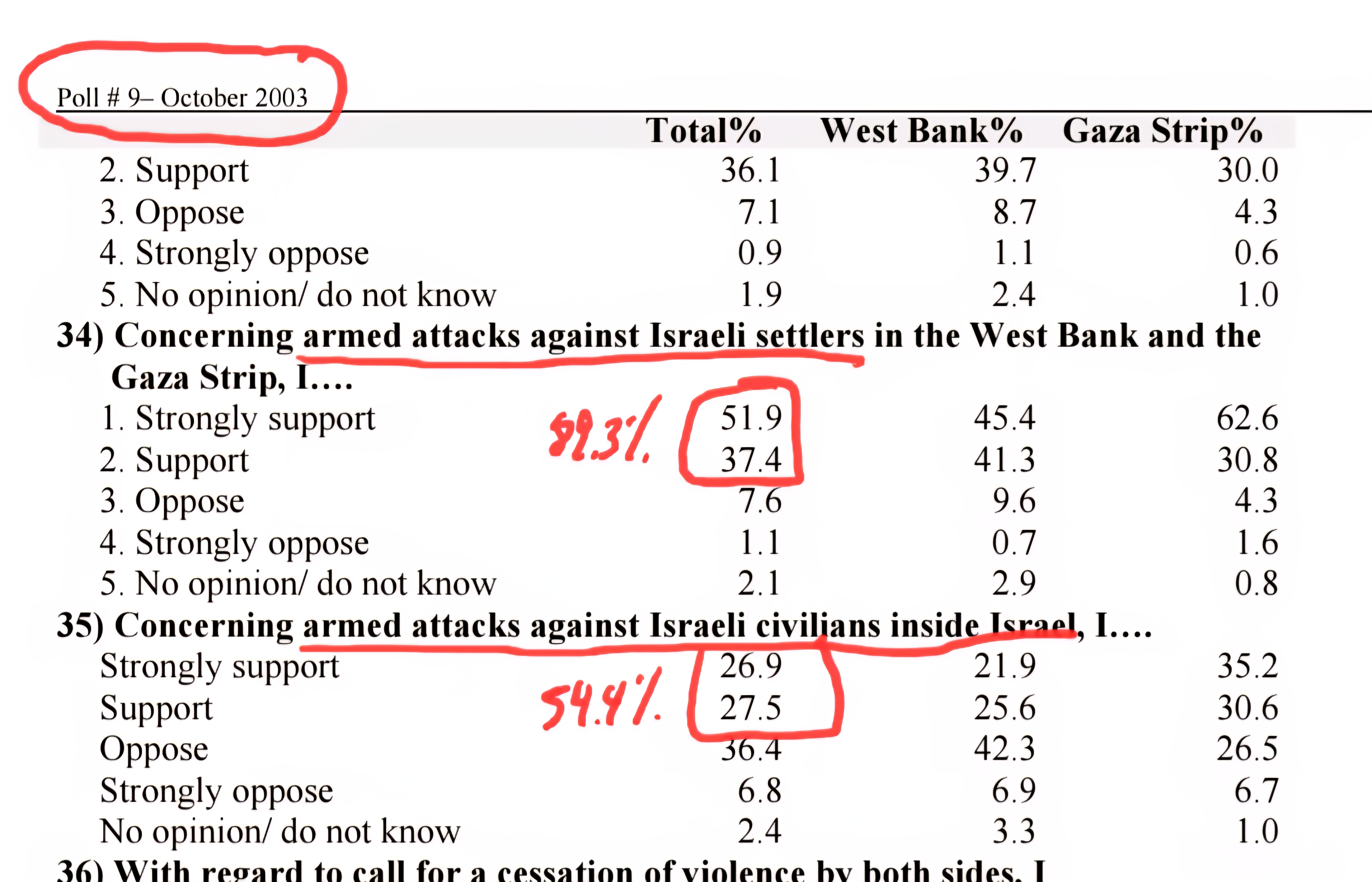
Palestinian political culture offers a longer and starker example of how this process unfolds. For roughly twenty-five years, polling by the Palestinian Center for Policy and Survey Research has repeatedly shown majority support for violence against Jewish civilians inside Israel. This stretches back before the Gaza blockade and before the present war. The permission structure came first.

PCPSR poll from October 2003 asking whether Palestinian Arabs supported armed attacks against civilians in Israel

Then politics followed.

In 2006, Palestinians elected Hamas to a parliamentary majority, fully aware of its openly antisemitic and eliminationist charter. October 7 emerged from that political soil. The massacre fit within a culture that had long accepted the killing of Jewish civilians as part of political struggle.

That is why it was celebrated.

And the celebration reached far beyond Gaza. American campuses, Western cities, and activist spaces erupted with demonstrations that folded the massacre into broader narratives of liberation. The same reduction had already taken place. Jews had been recast as symbols of systems: colonialism, finance, whiteness, Western power, institutional dominance.

Rep. Rashida Tlaib (D-MI) goes on antisemitic rant at Democratic Socialists of America conference, invoking Nazi imagery of Jews “operating behind the curtain… to make money off of racism.”

This is the ancient machinery of antisemitism. Jews become the human face of structural resentment.

The FBI hate-crime statistics show the physical consequences of that social logic. Americans often picture hate crime through property damage: a swastika painted on a synagogue, a church defaced, a mosque vandalized. Yet for more than a decade, the majority of hate crimes in America have been crimes against persons.

In 2019, 62.6 percent of hate-crime offenses targeted people. In 2020, the FBI recorded 7,750 crimes against persons, with nearly half involving direct physical assault. The figures jumped to over 11,000 in 2023 and 2024, with Jewish accounting for the vast majority of hate crimes by religion.

The reason sits in plain sight. Jews occupy a permanent place in political imagination as concentrated power: finance, media, institutions, influence. Even when stated softly, the accusation remains the same: too much influence, too much reach, too much control.

Once power itself is treated as morally suspect, violence against those imagined to embody it starts to feel cleansing. Society begins teaching itself that rage against elites is a form of justice. Institutions become enemies. Authority becomes corruption. Violence becomes political purification.

That moral structure echoes the French Revolution. The crowd gathers. The elite are marched into the square. Their status dissolves. Their destruction becomes public theater.

That is the destination of normalized violence.

The warning sign is larger than the incident. The warning lies in the crowd, in the cultural ecosystem that grants permission, supplies applause, and tells itself that the target stood for something hateful enough to justify blood.

Society has normalized violence as the media and school systems falsely rebranded America as a deeply unfair caste system. In the masses attempt for a complete redistribution of power and wealth, those with or with perceived power – politicians and Jews – will be open game for the angry mob.

Related:

The Broke-n Generation (December 2024)

The Long Shadow of 1492

In a sharp escalation of transatlantic tensions, U.S. President Donald Trump announced that the United States will “cut off all trade with Spain, publicly castigating the Spanish government for refusing to allow U.S. military bases on its soil to be used in operations linked to strikes against the Islamic Republic of Iran and for what he termed Spain’s failure to contribute sufficiently to NATO defense spending. Trump declared that he “doesn’t want anything to do with Spain,” framing the dispute as a response to Madrid’s resistance to what he described as confronting evil in the Middle East and paying its fair share for collective defense. 

What follows is not about this immediate crisis. It’s about deeper historical currents that help explain some of the underlying dynamics in Spanish public life that stretch back to the fifteenth century and still matter today.


In Western Europe outside Scandinavia and the United Kingdom, the two countries with the smallest Jewish presence relative to population are Spain and Portugal (about 0.02% of each countries’ overall populations).

That is not a statistical curiosity. It is a civilizational fact.

Five centuries ago, the Iberian Peninsula expelled its Jews. What had been one of the great centers of Jewish life vanished over a five and a half year short window. The Alhambra Decree in 1492 ordered practicing Jews out of Spain. Portugal followed with forced conversions and the Inquisition. Open Jewish life disappeared. What had been woven into the intellectual, commercial, and spiritual fabric of the peninsula was purged.

And it stayed removed.

Unlike other parts of Western Europe where Jewish communities, even after catastrophe, remained visible and rebuilt, Iberia entered the modern era with almost no Jews at all. Medieval synagogues became churches, then museums. Sephardic music became heritage. Jewish quarters became tourist sites. The living community remained tiny.

Fast forward to the present.

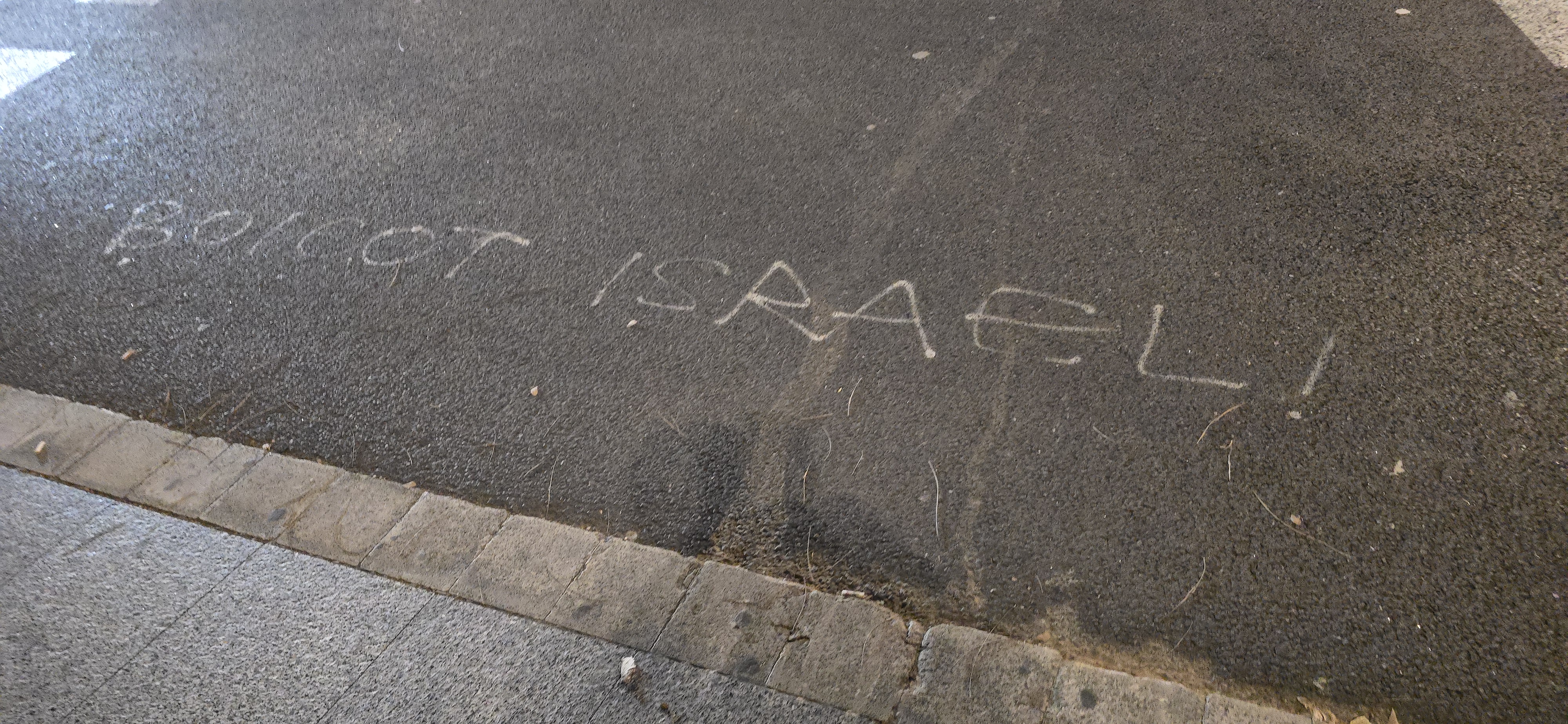
In Spain, large protests erupt over the Israeli-Stateless Arabs from Palestine (SAPs) conflict. Municipal councils pass symbolic measures aligned with boycotts. Parliament debates recognition of Palestine. Streets fill with Palestinian flags while graffiti targets Israel.

Anti-Israel graffiti on Barcelona street in March 2026 (photo: First One Through)

In Portugal, while public demonstrations are generally smaller, political and diplomatic critiques of Israeli policy align with broader European debates.

And yet.

There are no comparable national protest cultures around Sudan. No sustained marches over Somalia. No municipal votes over Afghanistan. Iran’s repression and mass slaughter of its citizens cannot find a sympathetic voice in Iberian plazas, and the Rohingya tragedy never became a regular mobilizing cause.

The difference is not just geopolitical proximity or media cycles. It is structural.

Germany, by contrast, carries the Holocaust in living memory. Its leaders speak of Israel’s security as part of state responsibility. Jewish life is visible, rebuilt, acknowledged. The past is recent enough to shape policy language. The moral vocabulary is immediate.

Spain does not carry that twentieth-century reckoning. Its rupture with Jewish life occurred in 1492, so there is no generational memory of deportation trains. The story of Jews is medieval, not modern.

When a society has lived five hundred years without Jews, when Jewish presence is primarily historical exhibit rather than daily reality, does Israel become easier to turn into abstraction? Does outrage attach more easily to a distant Jewish state when there is little lived Jewish experience at home?

Or is it even worse than detachment?

A peninsula that removed its Jews in the fifteenth century now hosts some of the smallest Jewish communities in Western Europe, public squares with the most intensely anti-Israel protests, and a government unwilling to mobilize in the slightest manner to defang the leading state sponsor of terror, especially against Jews.

Five centuries is not only long enough for history to fade; it is long enough for it to harden into culture.

The New Model of a Modern Major General

Gilbert and Sullivan once mocked a Major General who knew everything except how to wage war. He dazzled with recitations while sidestepping reality. The humor lived in the gap between words and consequences.

That song has inverted.

With the coordinated U.S. and Israeli strikes that killed Iran’s Supreme Leader, Ayatollah Ali Khamenei, the model shifted. Fleets were moved. Air defenses aligned. Hardened targets were hit. Decades of negotiation, sanction cycles, enrichment disputes, and proxy escalation culminated in direct consequence.

For forty years, the Islamic Republic built power through Hezbollah, Hamas, Iraqi militias, and the Houthis while advancing missile capability and nuclear enrichment. Diplomacy stretched. Deadlines slipped. Centrifuges continued spinning.

At some point deterrence must be visible.

The modern major general is no longer measured by speeches about red lines but by whether adversaries recalculate. Does sponsorship of terror slow. Does enrichment reverse.

Does escalation pause.

Khamenei’s death marks a rupture. It introduces instability, succession uncertainty, and the risk of retaliation. It also forces Tehran to confront survival in ways it has avoided for decades.

The nineteenth century satire mocked leaders who substituted knowledge for action. The twenty first century test asks whether action, applied decisively, can alter the behavior of a regime that fused revolutionary ideology with missile technology.

This is not opera. There is no chorus to soften it.

The new model of a modern major general does not sing about military matters.
He imposes them.

Rep. Rashida Tlaib (D-MI) tried to cast America and Israel as racist, and invert the reality of the fight against genocidal jihadists

The End of Capitalism, Summer 2031

History has a grim rhythm. The most destructive ideas rarely hatch overnight but stew in society. They are excused as rhetoric, theater, or “just politics.” Then—roughly five and a half years later—they explode.

This is not numerology. It is pattern recognition.

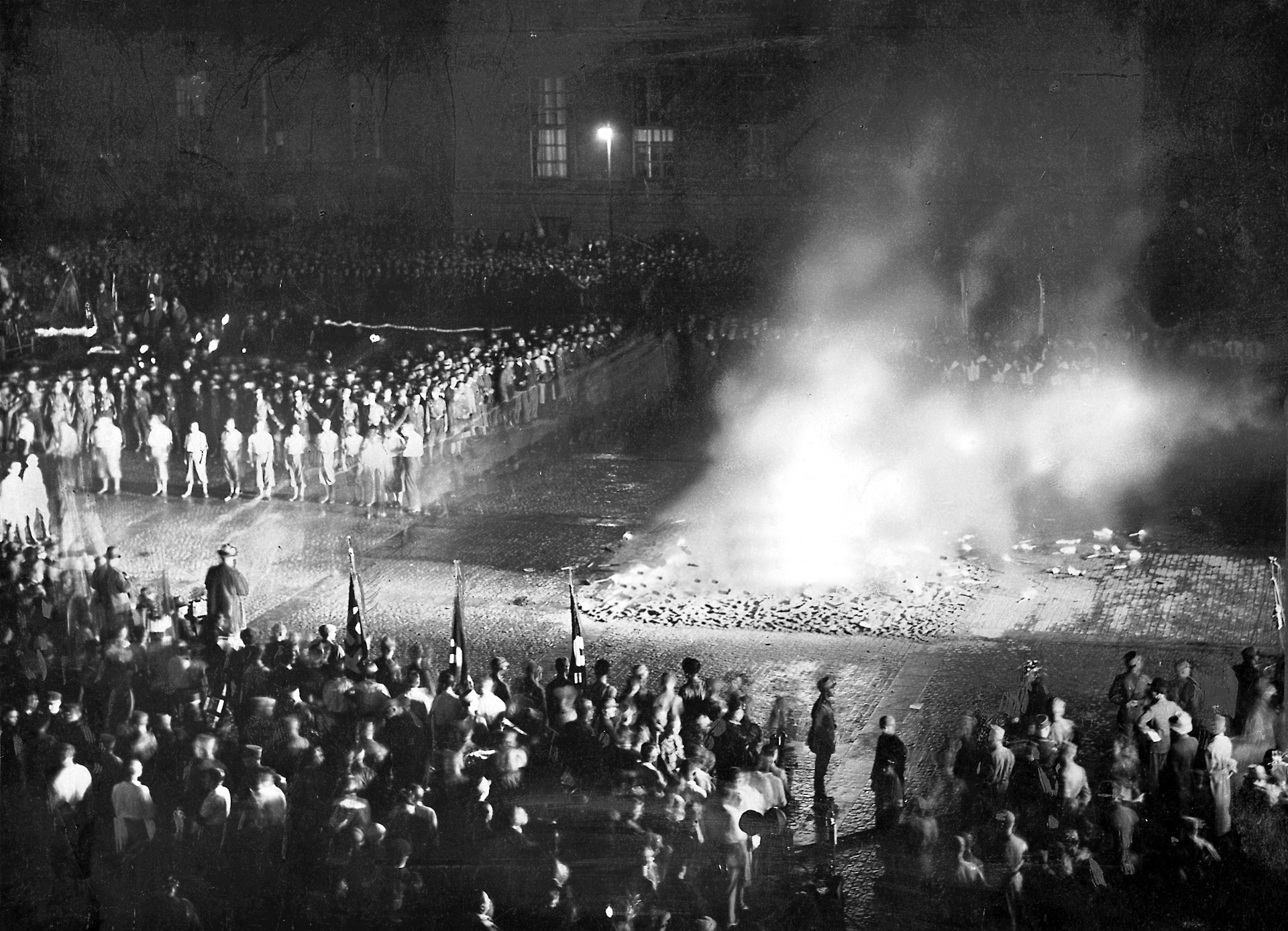
In 1933, Germans burned Jewish books in public squares. It initiated the cultural permission for the destruction of Jews. Five and a half years later, that permission hardened into the machinery of the Final Solution.

Als Höhepunkt einer von Joseph Goebbels initiierten ‘Aktion wider den undeutschen Geist’ werden auf dem Opernplatz in Berlin von Studenten und SA-Einheiten Bücher von Autoren verbrannt, die den Nationalsozialisten mißliebig waren.

In 2018, Gaza launched the so-called “Great March of Return.” It acted as a trial run to invade Israel and slaughter Jews. Five and a half years later, October 7 arrived—mass murder, rape, kidnapping—exactly as promised and practiced.

Ideas announce themselves early. The damage arrives later.

Today, in America, a new idea is being spoken aloud with disturbing ease: personal property is conditional.

Property Is the Load-Bearing Wall

Private property is not a side feature of capitalism; it is the load-bearing wall. Remove it and the structure collapses—investment freezes, contracts become jokes, and capital flees to wherever the rules still mean something.

Yet in recent years, voices across the ideological spectrum have started to say the quiet part out loud.

On the progressive left, figures like Zohran Mamdani and his partners in crime like Cea Weaver have openly argued that housing and land can be seized or overridden by the state in the name of moral urgency. Ownership becomes a social inconvenience. “Use” replaces title. Force replaces consent.

On the populist right, Donald Trump has flirted with the same heresy from a different direction—embracing sweeping government power over land, contracts, and assets when it suits political goals. The rhetoric differs. The result converges.

When the left and right agree that property rights are optional, the center cannot hold.

From Rhetoric to Ruin

Every historical catastrophe begins with intellectual laundering.

Book burning was framed as cleansing culture.
The Gaza marches were framed as civil resistance.
Property seizure is framed as compassion or patriotism.

Once a society accepts that ownership is contingent on political favor, every asset becomes provisional. Homes, farms, factories, patents—nothing is safe from the next emergency, the next slogan, the next election.

Capital responds rationally. It leaves. Innovation slows. Black markets thrive. Strongmen fill the vacuum. What follows is not equality but scarcity enforced by power. And there will be a scapegoat, and Jews have proven the most convenient.

July 2031 Is Not Far Away

Count forward five and a half years.

Ideas being normalized today will be policy tomorrow. Policies will become enforcement. Enforcement will become precedent. By the summer of 2031, the damage will no longer be theoretical.

This is how capitalism dies—not with tanks in the streets, but with applause for confiscation. This is how world order fractures—not through invasion, but through the voluntary abandonment of the rules that made prosperity possible.

This is how the Global North will collapse-not through open country borders, but the eradication of personal property lines.

The lesson of history is brutally clear: destruction is foretold in dangerous gestures towards property that eventually comes for the persons who own them.

Does Civilization Deserve A Robust Moderate Defense

The world likes to pretend it is debating policy. In many ways, it is actually debating whether civilization itself deserves defense—whether restraint remains a virtue or has become a liability.

That choice is one individuals are weighing, and on a macro scale, it now runs through the United Nations, through the rhetoric of reform and revolution, and through a relentless fixation on one small country—Israel—which has been made the moral test case for the survival of a rules-based order.


An Ancient Conflict, Restated

In 1944 as World War II raged, Reinhold Niebuhr described the permanent struggle of politics in The Children of Light and the Children of Darkness. The children of light believe in higher law, institutions, and restraint and try to build a just civilization. The children of darkness believe power is the only reality. They understand fear, pride, resentment—and how to use them.

Niebuhr’s delivered an unsentimental warning: civilization fails not because darkness appears, but because light refuses to learn how aggressively darkness operates.


As Portrayed Today in the Arts

That moral tension is dramatized—accidentally, but perfectly—in Game of Thrones.

Petyr Baelish (“Littlefinger”) believes nothing is sacred. Institutions are illusions; morality is theater. When order breaks, the ambitious climb. His worldview that “Chaos is a ladder” is not poetry—it is strategy. He does not want to fix the system. He wants to use its collapse to gain power.

Opposite him stands Varys, who believes in “the realm”—stability, continuity, restraint. Varys is not innocent. He lies and plots as much as Littlefinger. But he does so defensively, to preserve something larger than himself. Chaos, to him, is not liberation; it is mass suffering.

“Chaos isn’t a pit. Chaos is a ladder. Many who try to climb it fail and never get to try again. The fall breaks them.
And some are given a chance to climb. They refuse, they cling to the realm or the gods or love. Illusions. Only the ladder is real. The climb is all there is.”- Littlefinger

This is the argument now playing out on the world stage.


The United Nations and the “Age of Chaos”

In September 2025, Antonio Guterres warned that the world had entered an “Age of Chaos,” where multilateralism failed repeatedly. His message was neither complacent nor revolutionary. The post-1945 order, he acknowledged, was built by Western powers and often abused. It needs reform and broader inclusion. But it must be preserved.

Guterres is a modern Varys: clear-eyed about corruption, fearful of what replaces restraint. The tragedy is that he delivers this warning while presiding over an institution that enables the very chaos he names, and where lies and bias are systemic.


The UN’s Open Hostility to Israel

No clearer example exists than the United Nations open hostility to Israel.

One empirical anchor suffices: the UN General Assembly and Human Rights Council have passed more condemnatory resolutions against Israel than against all other countries combined, including regimes responsible for mass atrocities. The Human Rights Council even maintains a permanent agenda item singling out Israel alone.

The most damaging legal symbol of this hostility is UN Security Council Resolution 2334. Its failures are distinct—and profound:

  • Moral failure: It erases Jewish indigeneity and recasts Jewish self-determination as a moral crime.
  • Legal failure: It treats 1949 armistice lines as borders, declares “flagrant violation” absent negotiations, and invents a categorical illegality applied nowhere else.
  • Institutional failure: It weaponizes international law through selective enforcement, degrading the credibility of law itself.

UNSC 2334 is not merely flawed. It is structurally antisemitic, legally incoherent, and corrosive to the rules it claims to uphold. Any serious effort to defend and remake the UN must begin by rejecting and discarding UNSC 2334—not as a political concession, but as a moral necessity. No legitimate order can be rebuilt on a prominent pernicious lie.


The Global South’s Demand—and the Line It Cannot Cross

The Global South is right about one thing: the UN reflects a Global North power structure frozen in time. Representation must change. Influence must broaden. That reckoning is overdue.

But reform cannot be purchased by sacrificing the most vulnerable and attacked minority on earth.

Using Israel as the symbol of colonial evil is not reform; it is delegitimization by fiction. It turns history upside down, rebrands violence as virtue, and tells Jews that their survival is negotiable. Israel is targeted not because it is uniquely guilty, but because it is symbolically central.

Israel has become the ladder.


Modern Littlefingers

This logic spans ideologies.

On the left, movements such as the Democratic Socialists of America argue that markets, property, and liberal institutions are inherently illegitimate—delegitimize first, rebuild later. On the right, Donald Trump treats international norms as inconveniences, speaking casually about seizing Venezuelan oil and replacing rules with deals.

They oppose each other rhetorically, but share a premise: restraint is weakness; destruction is honesty. Chaos creates leverage.

They are modern Littlefingers.


The Failure of Passive Moderation

Between these forces stand moderates who see hypocrisy, feel exhaustion, and withdraw in disgust. That retreat feels virtuous. It is not.

As David Brooks argues by drawing on Niebuhr, moderation without courage becomes complicity. When decent people refuse to defend flawed institutions, they leave the field to those who understand power best.

Niebuhr’s answer was not extremism, but what he called a sublime madness in the soul”—a fierce commitment to liberal institutions precisely because they restrain human savagery. The children of light must learn the wisdom of the serpent without inheriting its malice.


An Ancient Return—and a Choice

Modern politics, which prides itself on being post-religious, has returned to the oldest moral frame: absolute light versus absolute darkness. One side is pure; the other illegitimate. Violence becomes cleansing; institutions corrupt by definition. This language was written two thousand years ago in the land of Israel and discovered in caves as the Jewish State was being reestablished. And now that rebirthed country is being falsely accused of embodying the darkness.

The choice before us is not between justice and injustice. It is between reform and rupture.

  • Children of light today defend law and restraint aggressively while reforming them honestly.
  • Children of darkness weaponize grievance and moral absolutism to climb amid collapse.

Defending and remaking the UN must start with basic truths: reject antisemitic falsehoods, discard UNSC 2334, and pursue inclusion without scapegoats. Multipolarity cannot be built on moral nihilism. Reform cannot be purchased with lies.

The reckoning Niebuhr warned of is here. The ladder is already standing and it is being climbed by both right and left. Civilization survives only if those who believe in it act—clearly, courageously, and now.

Venezuela in NYC, Twice

Venezuela has arrived in New York City in two forms.

One arrives carrying the wreckage of a socialist system that hollowed out a country by redefining private property as moral corruption and state control as virtue. That experiment ended in scarcity, corruption, and mass flight. Its leaders now face judgment far from home, a coda to a long collapse.

The other arrival is quieter, bureaucratic, and far more consequential. It moves through City Hall.


Words That Become Policy

Private property — especially homeownership — is a weapon of white supremacy masquerading as wealth-building public policy.

Those words were written by Cea Weaver, who now holds authority inside New York City government over housing regulation, landlord enforcement, and real estate policy.

This is a moral judgment about ownership itself. Homeownership is framed as harm. Property is recast as a moral hazard. The implication is straightforward: what has long been treated as legitimate must be dismantled.

Knowing full well her position about private real estate and home ownership, Weaver was elevated into a role designed to shape housing outcomes by Democratic Socialist Mayor Zohran Mamdani.


Real Estate as the Lever

Because housing is where ideology becomes operational.

Weaver’s portfolio centers on real estate because real estate concentrates independence, savings, and permanence. It is immobile, heavily regulated, and politically sensitive. Those traits make housing the easiest sector in which to normalize forced redistribution through regulation rather than spectacle.

Within Democratic Socialist thought, housing functions as the primary front for structural change. The stated objective is “decommodification” — removing housing from private markets through eminent domain and insulating it permanently from profit. Achieving that objective requires stripping ownership of legitimacy and transferring control to the state or state-backed collectives.


Jacobin Makes the Case Explicit

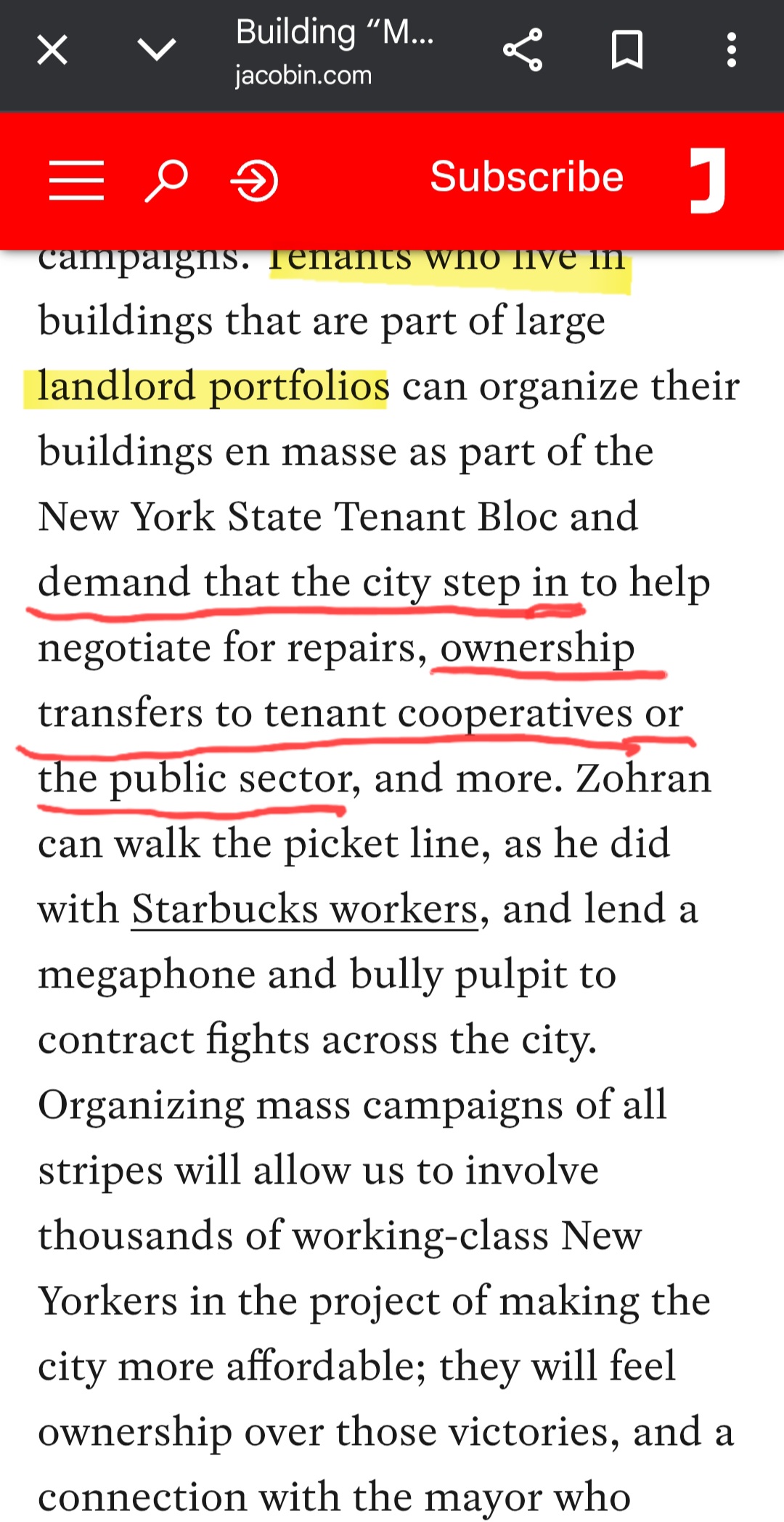
That program is reinforced repeatedly in Jacobin, the flagship publication of democratic socialism. Its housing coverage goes well beyond expanding public housing or strengthening tenant protections. It openly endorses removing homes from private ownership.

Jacobin has praised campaigns such as Berlin’s Deutsche Wohnen & Co Enteignen, which was approved by voters in 2021, calling for the expropriation of privately owned residential housing and its transfer to public control. It regularly argues that landlord property rights must yield to collective ownership if housing justice is to be achieved.

The logic is consistent: justice requires taking housing out of private hands.


Venezuela’s Sequence Is Familiar

Venezuela followed this same sequence.

Ownership was recast as exploitation.
Returns were constrained.
Controls expanded.
Maintenance collapsed.
Scarcity spread.

By the time property was openly seized, the groundwork had already been laid. Confiscation felt justified because ownership had already been condemned. Language prepared the public long before policy completed the transfer.

History records this pattern with grim consistency.


Ideological Alignment at City Hall

Zohran Mamdani placed Weaver precisely where her beliefs carry consequence.

“Impoverish the “white” middle class. Homeownership is racist/failed public policy.” – Cea Weaver

Democratic Socialists today debate pace and scope more than premise. Housing is the testing ground because it touches wealth, stability, and autonomy simultaneously. Alter the rules of ownership there, and broader economic control becomes easier to assert.


Donald Trump Begins to Align with Democratic Socialists on housing

And it seems that President Donald Trump is getting on board.

Trump just announced that he will ban institutional investors from buying single family homes. The goal is to keep the housing market acting rationally based on normal individual demand, rather than bowing to the force of massive realtors controlling rent prices.

It is not stripping individuals of their homes the way Weaver desires, but a first step in meeting the mission part way.


Naming the Mechanism

When government redefines private assets as illegitimate and reallocates them through enforcement, penalties, and regulatory attrition, the economic effect remains consistent regardless of branding.

Control shifts away from owners.
Value erodes.
Decision-making migrates to the state.

“As landlords exit the market, using state action to acquire properties and leverage divestment to convert thousands of homes into publicly and democratically controlled land/housing.” – Cea Weaver

“The president and his team are discussing a range of options to pursue this important foreign policy goal [of seizing Greenland], and of course, utilizing the U.S. military is always an option at the commander-in-chief’s disposal.” – Trump’s White House

Language about equity or justice does not change outcomes for families whose homes become conditional assets rather than protected property. Redistribution through regulation or seizure is theft.

People think of Donald Trump as a true Conservative; he is not. He spent years as a Democratic real estate developer in New York City. Owning, controlling and licensing property is in his bloodstream.

We are entering a dangerous moment when government leaders of the right and left are converging on the thesis that the state is the arbiter of private property, including your house.


The Question That Matters

A society either treats private property as legitimate or places it at the discretion of the state.

Once ownership depends on ideological approval, it no longer functions as a right. Capital withdraws. Investment slows. Stability erodes. Liberty disappears.

Venezuela already supplied the answer.

History rarely announces itself as collapse. It usually arrives disguised as compassion, long before the consequences become unavoidable.

Abraham Accords Versus UK and France

Europe is declaring peace while America is building it.

As Britain and France rush to recognize a Palestinian state to pressure Israel, the United States is doing something more durable: expanding the Abraham Accords. With Kazakhstan now actively promoting its joining Muslim-majority nations normalizing ties with Israel, the U.S. is advancing a vision that builds relationships rather than rhetoric.

US President Donald Trump meets with Kazakh President Qasym-Zhomart Toqaev

European leaders say recognition will balance the scales and restart diplomacy. But what exactly are they recognizing? The Palestinians remain divided between an unpopular and corrupt authority in the West Bank and Hamas in Gaza—an antisemitic terrorist group that thrives on conflict and rejects coexistence. There are no elections, no functioning institutions, no borders, and no credible security force. Declaring this fractured reality a “state” doesn’t bring peace any closer. It just flatters the fantasy that paperwork can substitute for progress.

For Palestinians, European gestures feel validating, but validation without change is illusion. No declaration from Paris or London can rebuild Gaza, reform leadership, or disarm Hamas. It’s diplomacy as performance—morally satisfying to distant audiences but meaningless in practice.

The Abraham Accords take a different approach. They focus on cooperation. Each new country that signs—Bahrain, Morocco, the UAE, and now Kazakhstan—proves that Israel can be accepted across the Muslim world without waiting for Hamas’s permission. This shift is reshaping the region. It turns rejection into partnership, slogans into investment, and isolation into integration. Every handshake chips away at the myth that the Middle East must remain hostage to its oldest conflict.

But peace will never advance while Hamas holds power. Hamas doesn’t just oppose Israel; it opposes peace itself. It rejects every agreement, glorifies violence, and sacrifices its own civilians to preserve control. Allowing Hamas to participate in elections or continue ruling Gaza ensures that destruction will repeat everywhere. Disarming Hamas and excluding it from Palestinian politics isn’t an Israeli condition—it’s a Palestinian necessity. Without that step, there can be no state, no sovereignty, and no future.

Alas, Palestinians disagree. In the latest PCPSR October 2025 poll, Hamas remains the most popular political party (60% approval) and Khaled Mashal, the leader of Hamas would trounce Fatah’s Mahmoud Abbas by 63% to 27%. Palestinian Arabs (69%) remain adamant that Hamas not give up its arms. Even after the decimation of Gaza, a majority (53%) still approves the October 7 massacre. And imagine that now, as the ceasefire appears to be bringing the end of the war, a remarkable 39% of Palestinians still think Hamas will win.

The choice is clear. Europe can keep recognizing an idea of Palestine that doesn’t exist and that the Palestinian Arabs are more moderate than they really are, or the U.S. can keep building the conditions for a reformed Palestinian society. The road to peace will not run through European parliaments; it runs through a changed Palestinian worldview, normalization between Israel and Muslim countries, economic growth, and a regional consensus that leaves Hamas behind.

The pathway to peace in the Middle East is the Abraham Accords, not European theater.

The Weight of Nations

“Why do the nations rage, and the peoples plot in vain?” — Psalm 2:1

Saudi Arabia – the kingdom which Israel hoped would next join the Abraham Accords – sought to pressure Israel into ending its defensive war in Gaza by rallying nations of the Global North to recognize a State of Palestine. It found a partner in France, which successfully pulled the United Kingdom, Canada, and Australia into the orbit of recognition. In September 2025 at the United Nations, the group jointly declared their acknowledgment of a Palestinian state—with caveats—but the symbolism was unmistakable.

Israel did not budge. It viewed the coordinated announcement as an alarming reward for the genocidal Hamas regime that had unleashed war on October 7 two years earlier.

Enter the United States. President Donald Trump had tasked developer and confidant Steve Witkoff to lead a back-channel negotiation with Hamas for the release of Israeli hostages and an end to hostilities. Jared Kushner joined the effort more forcefully in September, unveiling a “20-point plan” aimed at ending the two-year war and reshaping the region’s political future.

To counter the Saudi-French gambit, Trump built his own coalition. The U.S. secured the backing of several Arab and Muslim nations from the Global South—including Qatar, Jordan, the United Arab Emirates, Indonesia, Pakistan, Türkiye, Saudi Arabia, and Egypt —for its peace framework. By October, the administration succeeded in gathering the leaders of 27 countries from across the North and South, including some that had just recognized Palestine, to fly to Egypt to sign what was billed as a ceasefire agreement.

A summit to support ending the more than two-year Israel-Hamas war in Gaza after a breakthrough ceasefire deal, Monday, Oct. 13, 2025, in Sharm El Sheikh, Egypt labeled “Peace 2025”

It was a mirage. Neither of the warring parties—Israel or Hamas—attended. The event was instead diplomatic theater, meant to transform a ceasefire proposal into a movement for regional peace. Trump designed the event to flip the script.

Where Saudi Arabia and France tried to impose the weight of the Global North on Israel, the United States sought to use the combined weight of both hemispheres on Hamas. The former demanded an immediate path to a two-state solution; the latter demanded the end of Hamas rule.

The Moral Gravity

The story of this moment is not only about geopolitics, but about moral gravity. The nations of the world have grown accustomed to weighing Israel’s every move while ignoring the crimes of its enemies. They call for “balance” in a war that began with mass murder, rape, and hostage-taking. They lecture the victim to compromise while the aggressor reloads. The UN Security Council could have easily passed resolutions to push for an end to the war if they had just condemned Hamas, but repeatedly refused to do so.

The weight of nations once meant the defense of justice and the pursuit of peace. Today, it is too often the ballast of perfidy—dragging down the innocent under the pretense of even-handedness.

Israel, standing increasingly alone, may yet prove that the true measure of a nation is not in the number of its allies, but in the steadiness of its conscience. It is fortunate to have President Trump in the White House as it shoulders this weight once again.

The tight bond between Israel and the United States has continued, despite Americans starting to sour on Israel since 2015.

The Embarrassment and Lies of the Palestinian Authority in Trump’s Peace Plan

The Palestinian Authority (PA) has perfected the art of self-deception — and the spectacle has become an embarrassment to watch. Its leaders trade in fantasies while their people – and the entire region – suffer the consequences of their delusions.

When President Donald Trump released his 20-point Comprehensive Plan to End the Gaza Conflict, it was explicit: the focus was on fixing Gaza and the PA would have no role. The document said in plain language that the PA would need to be overhauled and reformed before it could ever be trusted as a partner for peace. It deliberately withheld any credit or recognition for the current leadership, recognizing its corruption, incitement, and support for terror. “A technocratic, apolitical Palestinian committee” headed by Trump himself would be the day-after plan for Gaza. Only “qualified Palestinians” would get to sit on such committee, not the UN-lauded PA.

President Trump’s peace plan specifically did not hand control of Gaza to the PA and said the group had to “complete its reform program.”

The plan’s very structure was layered with conditionality — each potential step toward a Palestinian state contingent on verifiable reforms, renunciation of violence and demilitarization. Even then, the most it offered was that maybe one day, post-reform, there could be a pathway to a two-state solution.

The Trump plan layered conditions of “when,” “may” and “pathway” to Palestinian “statehood”

And yet, in a surreal twist, the official PA news agency WAFA ran an article in which Mahmoud Abbas claimed that Trump stood ready to endorse a Palestinian state with “East Jerusalem” as its capital. It was an astonishing fabrication — a complete lie, meant to mask Abbas’s very public humiliation and preserve his illusion of relevance.

Official PA media lied that Trump’s peace plan would establish a new Palestinian State which would follow the “June 4, 1967 borders, with East Jerusalem as its capital”

This distortion was not a misunderstanding; it was intentional misrepresentation, propaganda designed to convince Palestinian Arabs that Abbas still holds the key to their future. But everyone can see through the act. All Abbas and Hamas have delivered is destruction, division, and hatred.

The PA’s falsehoods no longer even convince its own people. Each new lie only underscores its impotence — a government in name only, ruling by inertia and deceit. The tragedy – like the lies – has layers of corruption, hatred, murder and deceit.

The Palestinian people, too, bear responsibility for their choices. They voted for Hamas, a genocidal terrorist movement to 58% of the parliamentary seats which brought death and destruction not only to Israelis but to Palestinians themselves – which the vast majority supported. They elected Mahmoud Abbas, a Holocaust denier and an ineffective president, and now watch him recycle lies and propaganda instead of leadership and reform. The Palestinians voted for failure — and the region has paid the price.

WAFA called the Israeli government an “occupation government”, clearly showing the PA was upset by being sidelined because it sorely needs reform

The Trump plan recognized that hard truth. It was not a welcome mat for Fatah or Hamas, nor a reward for decades of violence and corruption. The plan envisioned a different future entirely. The “day after” will not be another PA regime or HAMAS ruling Gaza, but the first step in a new chapter of deradicalization, where education replaces indoctrination, coexistence replaces hate, and peace is no longer a slogan but a shared reality.

Trump’s plan – as endorsed by Qatar, Jordan, the United Arab Emirates, Indonesia, Pakistan, Türkiye, Saudi Arabia, and Egypt – states clearly that a possible Palestinian State will come as a BYPRODUCT of deradicalization and peace, not in order to CREATE the forum for coexistence as offered by France and the United Kingdom. All of which may or may not happen, and most likely after Abbas is long gone.