Normalized Violence

This was the third assassination attempt against Donald Trump. He survived but the deeper story lies elsewhere. By the third attempt, the country barely pauses. The first attack should have shaken a nation to its core; the second should have deepened the sense of alarm. By the third, something more dangerous has taken hold: familiarity. Political violence begins to feel woven into the atmosphere, another storm system passing through.

That is the shift in American life. Political violence has moved from rupture to expectation. The country has grown accustomed to the possibility that power will be contested through force.

The evidence stretches across the last several years. There was the attempted kidnapping of Gretchen Whitmer, where executive authority itself became the target. There was the hammer attack on Paul Pelosi, where proximity to political authority was enough to invite violence. There was the arson attack on the home of Governor Josh Shapiro. There was the assassination of Charlie Kirk.

Each attack carried its own political coloration. Different grievances, different ideologies, different enemies.

Yet they share the same underlying grammar. The human being is transformed into an idea.

The governor becomes the state. The executive becomes capital. The politician becomes the regime.

That transformation is the hinge upon which violence swings. A person who stands as an abstraction for a hated system becomes easier to strike. Violence acquires moral clothing. The blow feels righteous because the target has already been converted into a symbol.

That is why the public reaction to United Healthcare CEO Brian Thompson’s killing mattered so much. The killing itself was one event. The social response revealed the deeper current. The alleged killer, Luigi Mangione, became a hero in corners of the internet. Memes spread. Fundraisers appeared. Admiration followed. A killer became an instrument of vengeance against a hated system.

It felt like the movie Joker come to life. In Joker, an unstable man carries the plot forward, but the real engine is the crowd waiting to celebrate him. The mob grants moral legitimacy to the violence. The killer becomes a vessel for collective resentment.

That is the deeper American drift. Violence increasingly invites sympathy, reinterpretation, and applause. The act becomes secondary to the story society tells itself about why the victim represented something worth destroying.

This can be seen in the Middle East as well.

Palestinian political culture offers a longer and starker example of how this process unfolds. For roughly twenty-five years, polling by the Palestinian Center for Policy and Survey Research has repeatedly shown majority support for violence against Jewish civilians inside Israel. This stretches back before the Gaza blockade and before the present war. The permission structure came first.
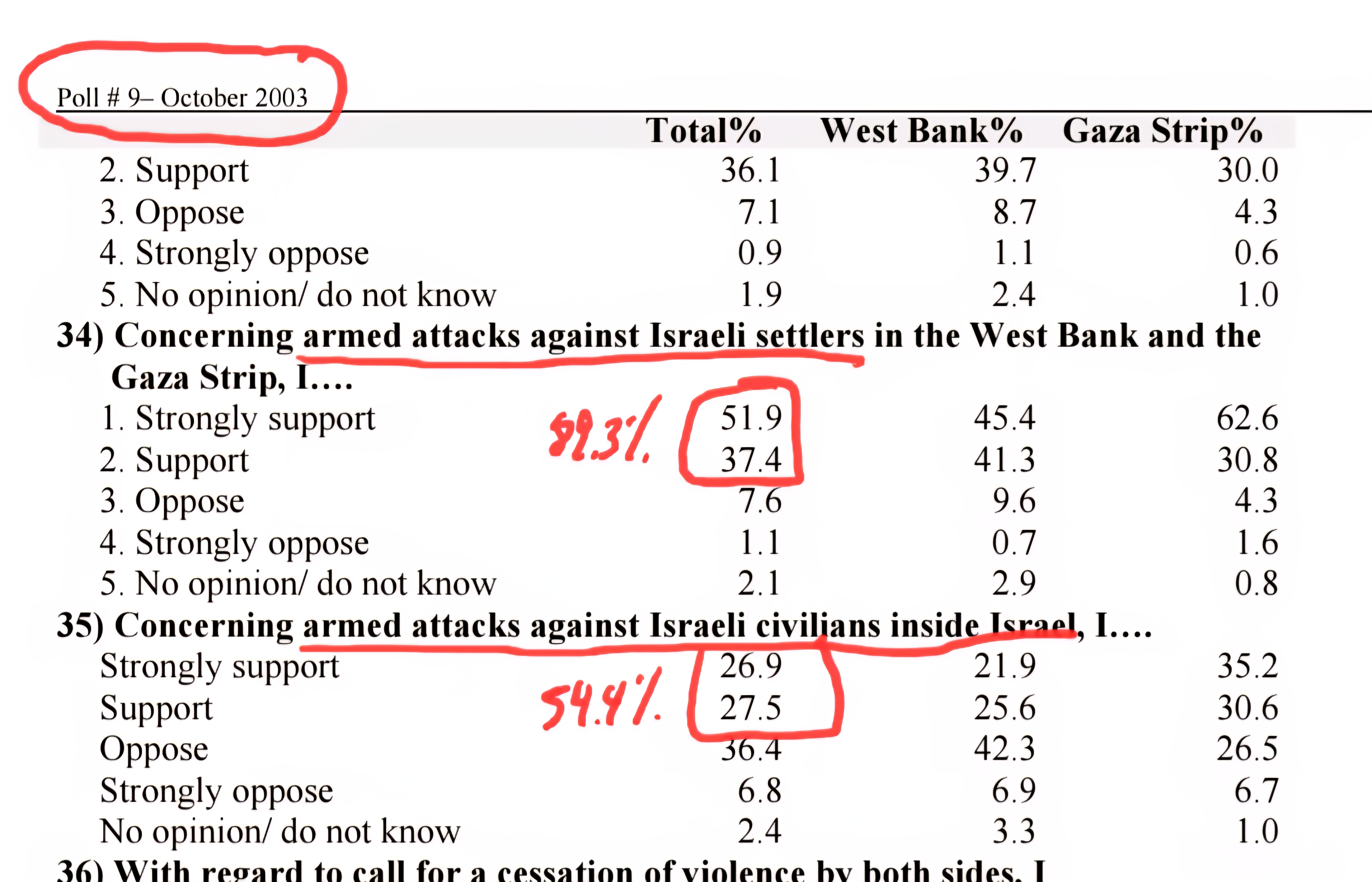
PCPSR poll from October 2003 asking whether Palestinian Arabs supported armed attacks against civilians in Israel

Then politics followed.

In 2006, Palestinians elected Hamas to a parliamentary majority, fully aware of its openly antisemitic and eliminationist charter. October 7 emerged from that political soil. The massacre fit within a culture that had long accepted the killing of Jewish civilians as part of political struggle.

That is why it was celebrated.

And the celebration reached far beyond Gaza. American campuses, Western cities, and activist spaces erupted with demonstrations that folded the massacre into broader narratives of liberation. The same reduction had already taken place. Jews had been recast as symbols of systems: colonialism, finance, whiteness, Western power, institutional dominance.

Rep. Rashida Tlaib (D-MI) goes on antisemitic rant at Democratic Socialists of America conference, invoking Nazi imagery of Jews “operating behind the curtain… to make money off of racism.”

This is the ancient machinery of antisemitism. Jews become the human face of structural resentment.

The FBI hate-crime statistics show the physical consequences of that social logic. Americans often picture hate crime through property damage: a swastika painted on a synagogue, a church defaced, a mosque vandalized. Yet for more than a decade, the majority of hate crimes in America have been crimes against persons.

In 2019, 62.6 percent of hate-crime offenses targeted people. In 2020, the FBI recorded 7,750 crimes against persons, with nearly half involving direct physical assault. The figures jumped to over 11,000 in 2023 and 2024, with Jewish accounting for the vast majority of hate crimes by religion.

The reason sits in plain sight. Jews occupy a permanent place in political imagination as concentrated power: finance, media, institutions, influence. Even when stated softly, the accusation remains the same: too much influence, too much reach, too much control.

Once power itself is treated as morally suspect, violence against those imagined to embody it starts to feel cleansing. Society begins teaching itself that rage against elites is a form of justice. Institutions become enemies. Authority becomes corruption. Violence becomes political purification.

That moral structure echoes the French Revolution. The crowd gathers. The elite are marched into the square. Their status dissolves. Their destruction becomes public theater.

That is the destination of normalized violence.

The warning sign is larger than the incident. The warning lies in the crowd, in the cultural ecosystem that grants permission, supplies applause, and tells itself that the target stood for something hateful enough to justify blood.
Society has normalized violence as the media and school systems falsely rebranded America as a deeply unfair caste system. In the masses attempt for a complete redistribution of power and wealth, those with or with perceived power – politicians and Jews – will be open game for the angry mob.

Related:

The Broke-n Generation (December 2024)

Reparations Is Not About the Past. It Is About Power.

For years, reparations has been framed as moral accounting — a long-overdue reckoning with colonial crimes, slavery, and historical trauma. That framing no longer captures what is actually unfolding. The modern reparations movement has evolved into something far more consequential: a Global South demand on the Global North to rebalance power, wealth, and legitimacy, amplified by a coalition that blends post-colonial nationalism, socialism, and jihadist anti-Western ideology.

This is not accidental. It is strategic.

Across Africa, the Caribbean, Latin America, and parts of Asia, governments are no longer asking quietly for acknowledgment or symbolic regret. They are issuing demands. Reparations, apologies, restitution, debt relief, technology transfer, and capital flows are increasingly bundled into a single argument: the prosperity of the Global North is illegitimate and must be paid back.


From Memory to Leverage

Consider Algeria, where colonial grievance is not episodic but foundational. French violence, nuclear testing, and cultural erasure are not invoked merely to heal wounds. They are reasserted whenever diplomacy stalls or domestic legitimacy frays.

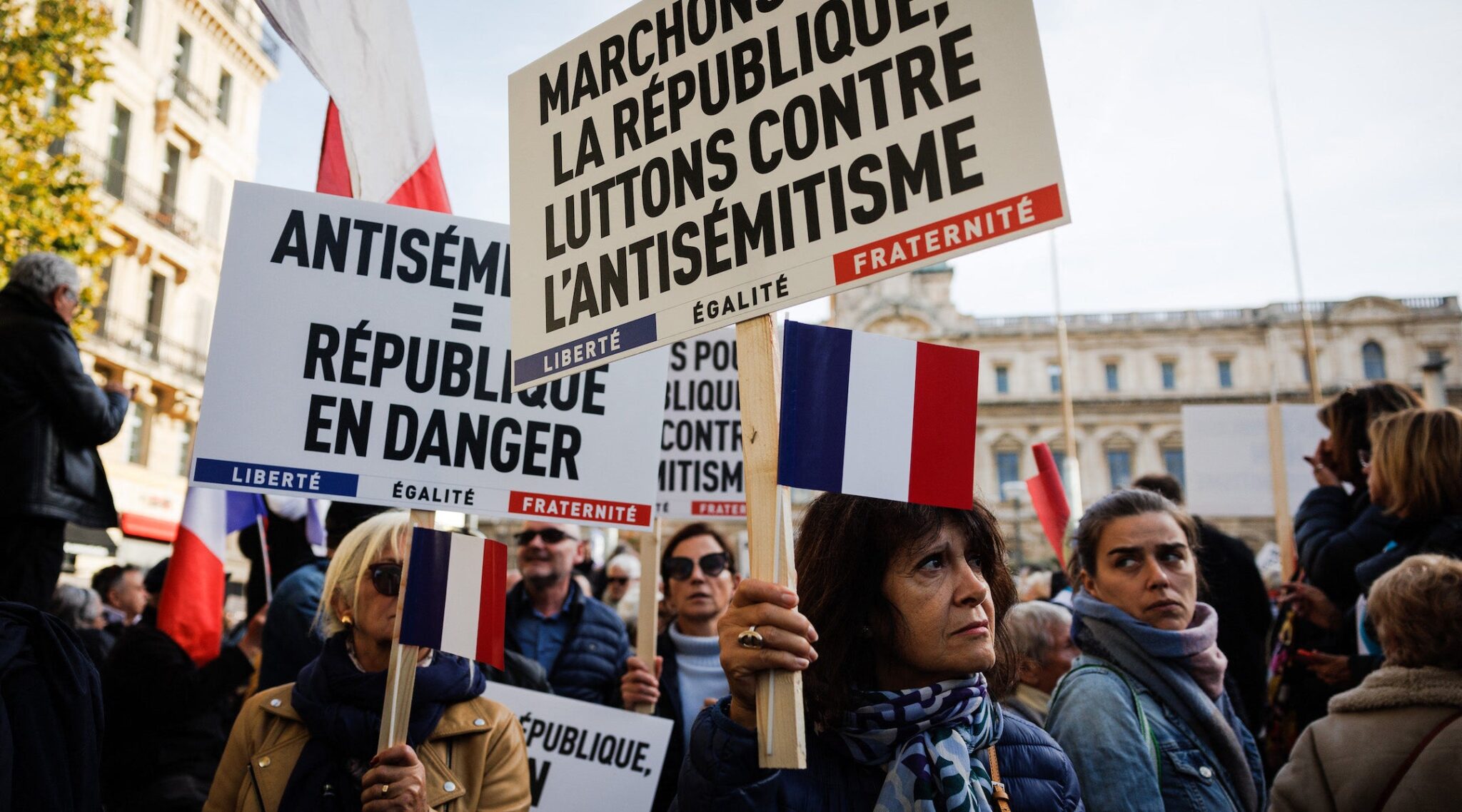
Demonstration in Marseille, France against antisemitism, much coming from Muslim immigrants from former French colonies including Algeria

Or Namibia, which rejected Germany’s €1.1 billion offer precisely because it was labeled “development aid” rather than “reparations.” Aid preserves hierarchy. Reparations invert it. Reparations place the former colonizer in the position of debtor — morally, legally, and politically.

Across the Caribbean, reparations has become collective bargaining. Jamaica, Barbados, and Haiti are not asking for apologies alone. Haiti’s claim that France repay the 1825 “independence ransom” reframes national birth itself as extortion requiring reversal.

In India, reparations rhetoric fits neatly into civilizational nationalism — extracting moral and economic concessions from Britain while rejecting Western liberal tutelage.

This is not nostalgia. It is leverage. And it is gaining momentum.


The Socialist–Jihadi Convergence

What gives this movement its new force is the coalition that amplifies it.

On one flank are socialist movements that treat capitalism itself as a colonial crime. On the other are Islamist and jihadist ideologies that frame Western dominance as a civilizational sin. Their vocabularies differ, but their conclusions align.

Both see the Global North as illegitimate, wealth accumulation as theft, liberal democracy as camouflage for domination, and historical grievance as a renewable political resource. Reparations becomes the bridge — translating resentment into claims and memory into entitlement. It offers redistribution without admitting failure, a bloodless substitute where revolution stalled.

That is why reparations rhetoric now travels alongside calls to dismantle Western institutions, forgive sovereign debt, nationalize industries, and replace a rules-based order with “multipolar justice.”


From States to Peoples

Once nations inherit grievance, groups of people inevitably follow.

In the United States, descendants of enslaved Africans argue that wealth extracted centuries ago still compounds today — in land, capital, education, and political power. The logic mirrors the international model: systematic harm, identifiable beneficiaries, ongoing effects, and a moral requirement for redistribution.

In the Middle East, Arab claims against Israel for homes and land lost in the 1948 war are framed not as consequences of war initiated, but as perpetual moral debts transferable across generations and insulated from counter-claims.

Here reparations is not merely compensation. It is recognition, reversal, and re-legitimation of identity.

UNRWA offices in Jerusalem (photo: First One Through)

For individuals without a banner to rally around, reparations is the escape hatch, and there’s little selfish downside in crushing the Global North.


The Question No One Wants to Ask

If reparations reach back to slavery, empire, and war — how far back do they go?

Will Jews demand reparations from Saudi Arabia and other Arab states for Islamic conquest, dhimmi subjugation, and the twentieth-century expulsion of ancient Jewish communities from Iraq, Yemen, Egypt, and Morocco? If Arabs displaced in 1948 may claim restitution, Jews dispossessed from Arab lands must be able to claim the same (and why doesn’t the United Nations say as much?)

If slavery justifies restitution, does conquest?
If conquest counts, does ancient conquest count less than modern conquest?
And who decides?

These questions expose the framework’s central fault line: there is no principled stopping point.


Reparations as a Substitute for the Meritocracy Debate

Before reparations becomes the closing argument, it must be understood as something else as well: a way to bypass the hardest debate of all — meritocracy, accountability, and performance.

Reparations offers a sweeping explanatory shortcut. Systems that may be inefficient, corrupt, poorly governed, or badly executed are recast as inevitable products of historical oppression. Failure ceases to reflect choices or incentives. It becomes proof of theft.

Once inequality is framed entirely as inherited structural injustice, there are no consequences for present-day decisions. Policy failure is absolved. Cronyism becomes resistance. Capital flight becomes colonial residue. Authoritarianism becomes post-colonial trauma.

Meritocracy itself becomes suspect. Success is not earned; it is inherited privilege. Competence is irrelevant; power imbalance is decisive. Agency dissolves — and with it, responsibility.


Why This Is Gaining Power Now — and Who It Alienates

This framework has surged as the wealth gap widens and upward mobility weakens. When capital compounds faster than wages and education no longer guarantees security, reparations offers a clean explanation: inequality is not complex or contingent — it is an unpaid historical debt.

That logic now collides with social reality in the West, especially for young men. College has become exorbitantly expensive. Returns feel uncertain. Many feel pressure to earn now rather than invest years in institutions that increasingly tell them they are part of the problem. If reparations is the moral language of the moment, some will try to join it. Those who cannot — particularly young white men — are cast as beneficiaries of a corrupt system, criticized for underperforming despite “privilege,” and then asked to atone anyway.

The result is a triple bind: vilified for advantage, shamed for underperformance, and burdened with inherited guilt — despite having done nothing other than be born where and how they were. This convergence helps explain male dropout from universities, the turn toward trades and online hustle, and the simmering anger of those who feel targeted by a moral framework that offers neither dignity nor exit.


The End State

If reparations becomes the dominant moral currency of global politics, the result will not be justice. It will be permanent contestation — a world where every border is provisional, every inheritance suspect, every success morally contingent.

Reparations promises closure. In practice, it offers none.

It turns history into an endless claims process, civilization into a courtroom, and the future into a hostage of the past.