Two Israeli soldiers were killed by Palestinian terrorists near Hebron on Friday. Staff Sergeant Ron Yonatan Roytman, 23, and Sergeant Yuval Shai Svilem, 20, were killed, and three other soldiers wounded.
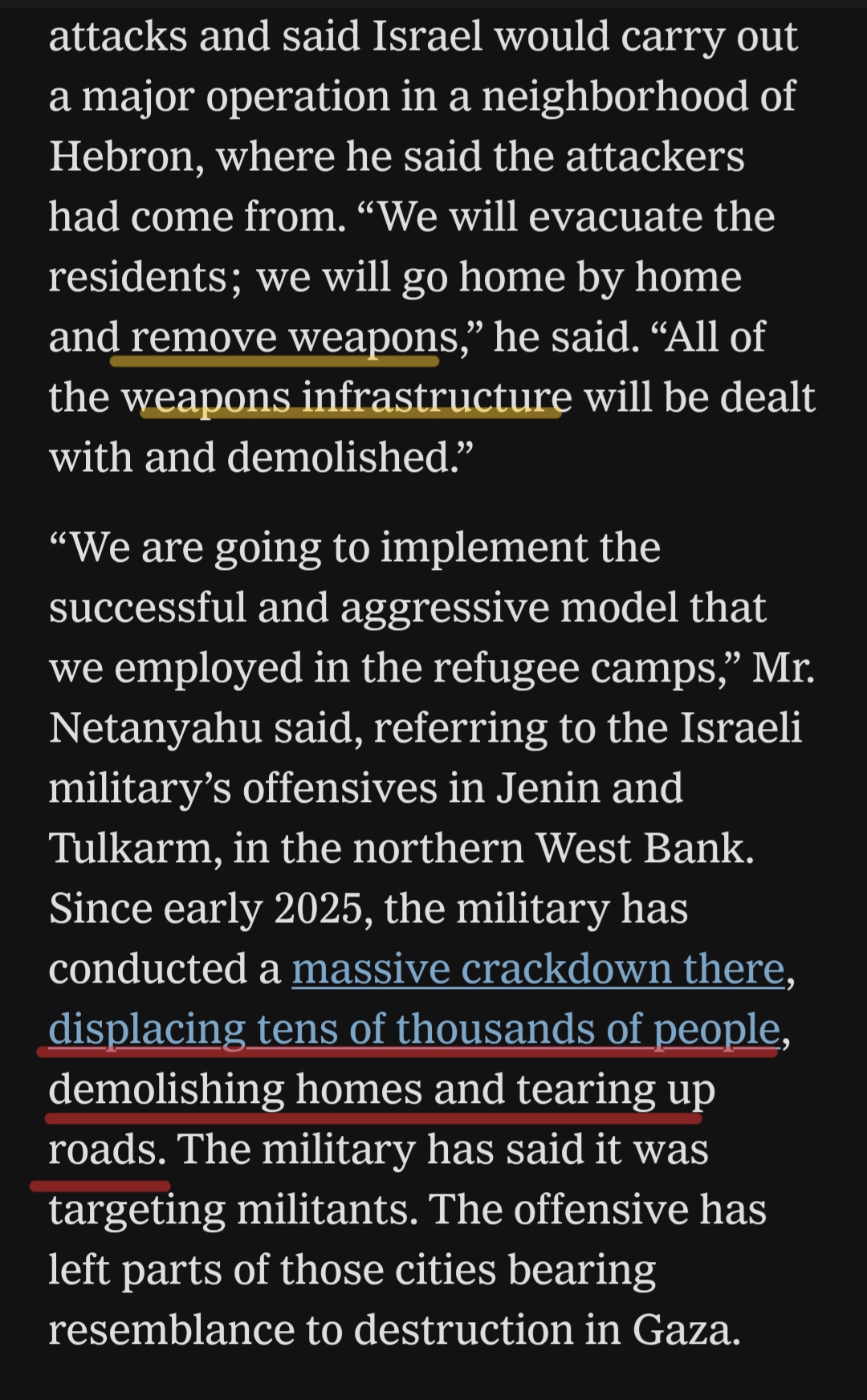
Prime Minister Benjamin Netanyahu announced a major operation in the Hebron neighborhood from which the attackers came. Soldiers would search homes, confiscate weapons and demolish terrorist infrastructure, repeating the model employed in Jenin and Tulkarm.
What exactly had Israel uncovered in those Palestinian cities?
In Jenin, Israeli soldiers reported discovering more than 100 explosive devices in just two days, along with a weapons-manufacturing workshop and a command center containing materials for making bombs. Explosives were even found hidden inside a washing machine.
In Tulkarm, soldiers found a weapons storage facility containing approximately 100 pipe bombs, eight additional explosive devices and equipment for detonating explosives. They discovered a drone-production laboratory and another bomb-making facility. Some 45 explosive devices had been planted beneath roads to attack Israeli soldiers and vehicles.
Across the broader northern West Bank operation, the Israeli military reported seizing more than 1,300 weapons and destroying over 50 terrorist infrastructure sites.
And how did the New York Times describe these discoveries?
Following Netanyahu’s announcement, the newspaper characterized Israel’s earlier operations in Jenin and Tulkarm as a massive crackdown, emphasizing that tens of thousands of Palestinians had been displaced, homes demolished and roads torn apart. It compared the destruction to Gaza, adding that the Israeli military said it was targeting militants.
The weapons factories, drone laboratories and explosives caches disappeared from its account when it was providing context to that specific account.
New York Times claims that Israeli military simply displaced people and ripped up roads without discussing the enormous weapons the IDF cleared out WHEN SPECIFICALLY GIVING CONTEXT TO THAT OPERATION
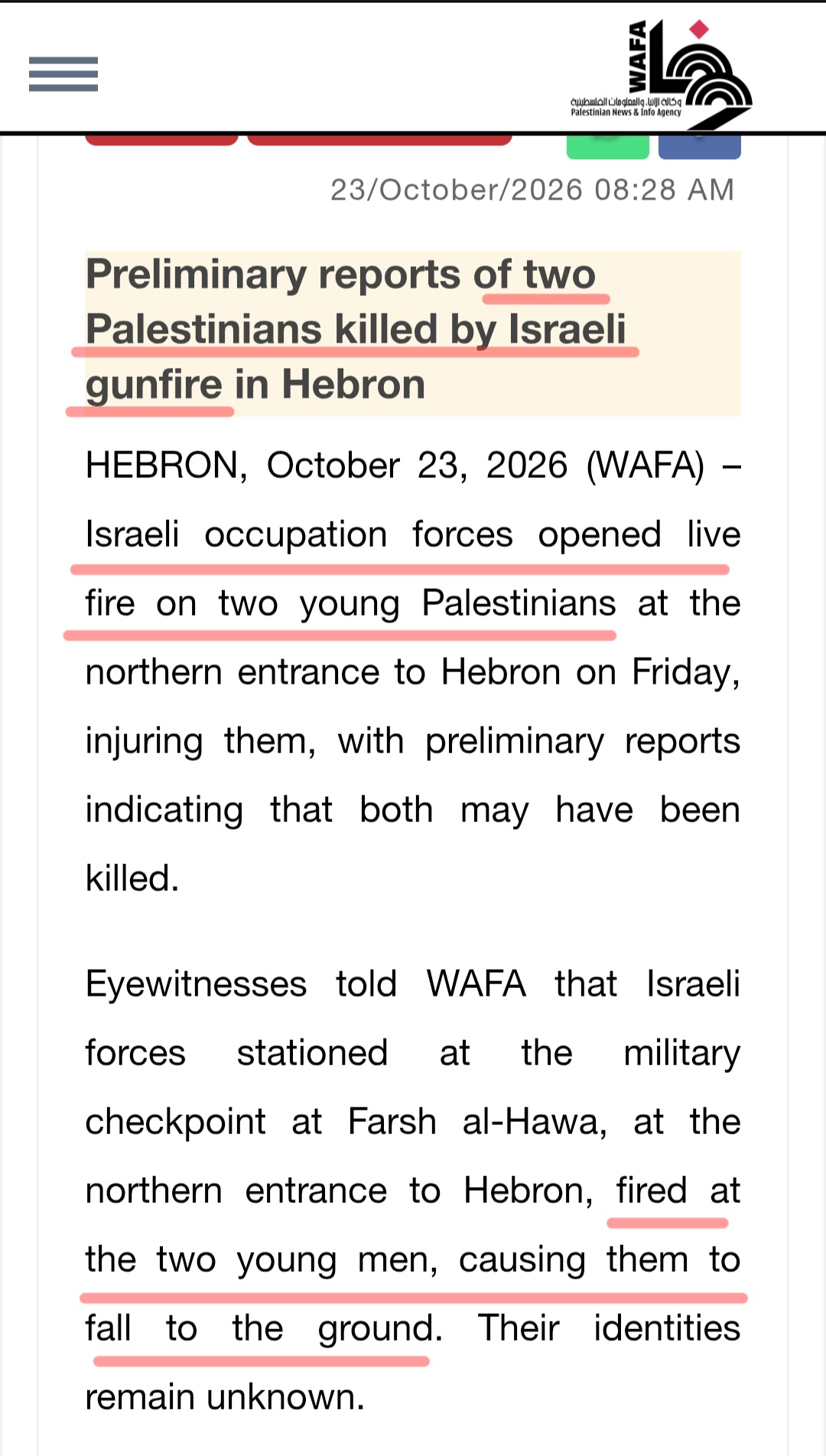
The Palestinian Authority’s official news agency, WAFA, offered an even more extraordinary account of Friday’s shooting. Its headline declared, “Preliminary reports of two Palestinians killed by Israeli gunfire in Hebron.”
The article described Israeli forces opening fire on “two young Palestinians,” causing them to fall to the ground. It omitted the two Israeli soldiers killed in the attack and the gunfire reportedly initiated by the Palestinians.
Two Palestinian gunmen who killed Israeli soldiers became two young Palestinians shot by Israeli forces.
According to Palestinian Authority media, Israelis shot and killed “two young Palestinians” without stating that they were armed and killed Israelis first
WAFA turned Palestinian gunmen who killed Israeli soldiers into victims of Israeli gunfire. The New York Times turned the dismantling of terrorist weapons factories into seemingly senseless destruction of Palestinian neighborhoods.
Different newspapers. The same distortion: remove the Palestinian terrorism, and Israel becomes the aggressor.
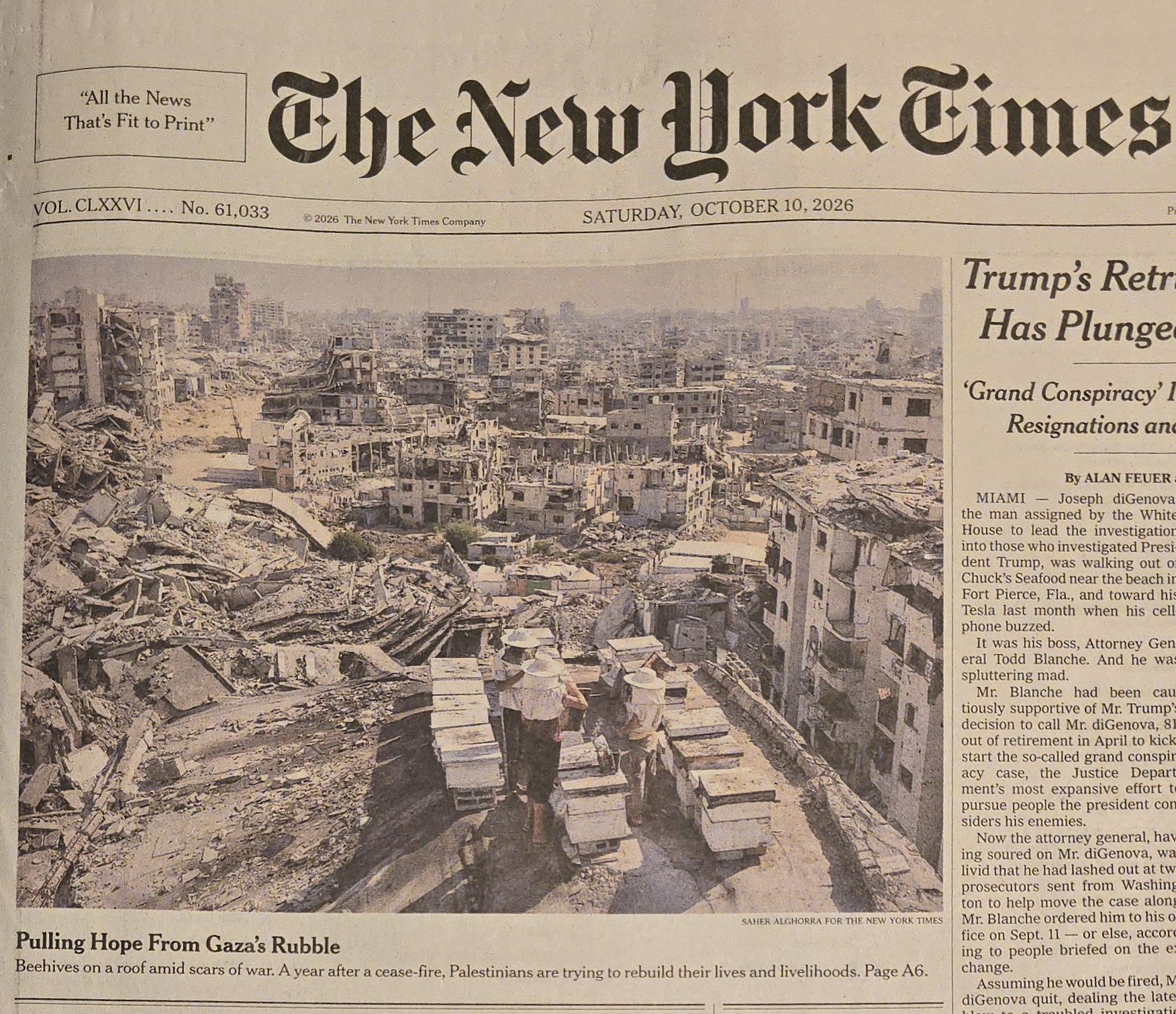
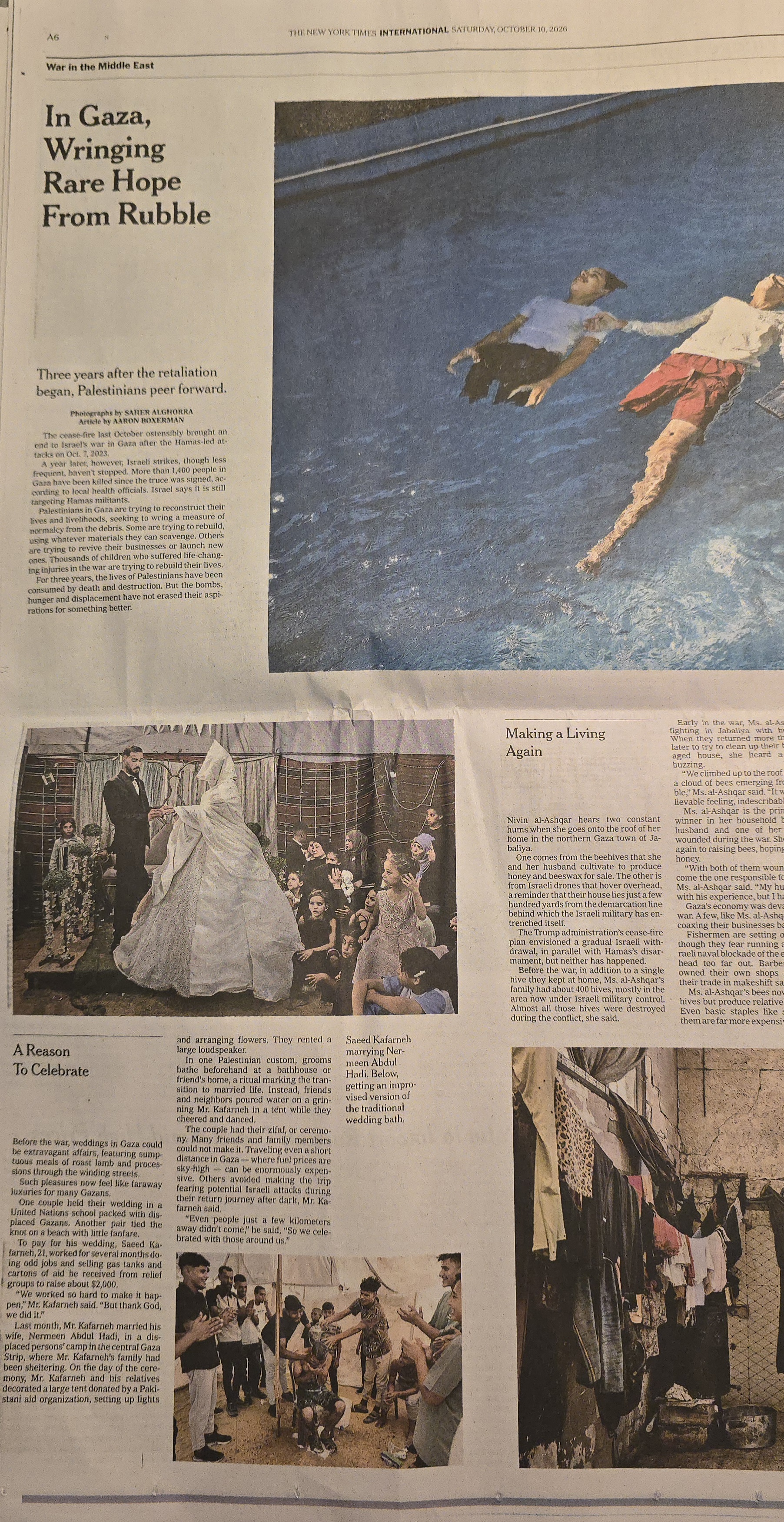
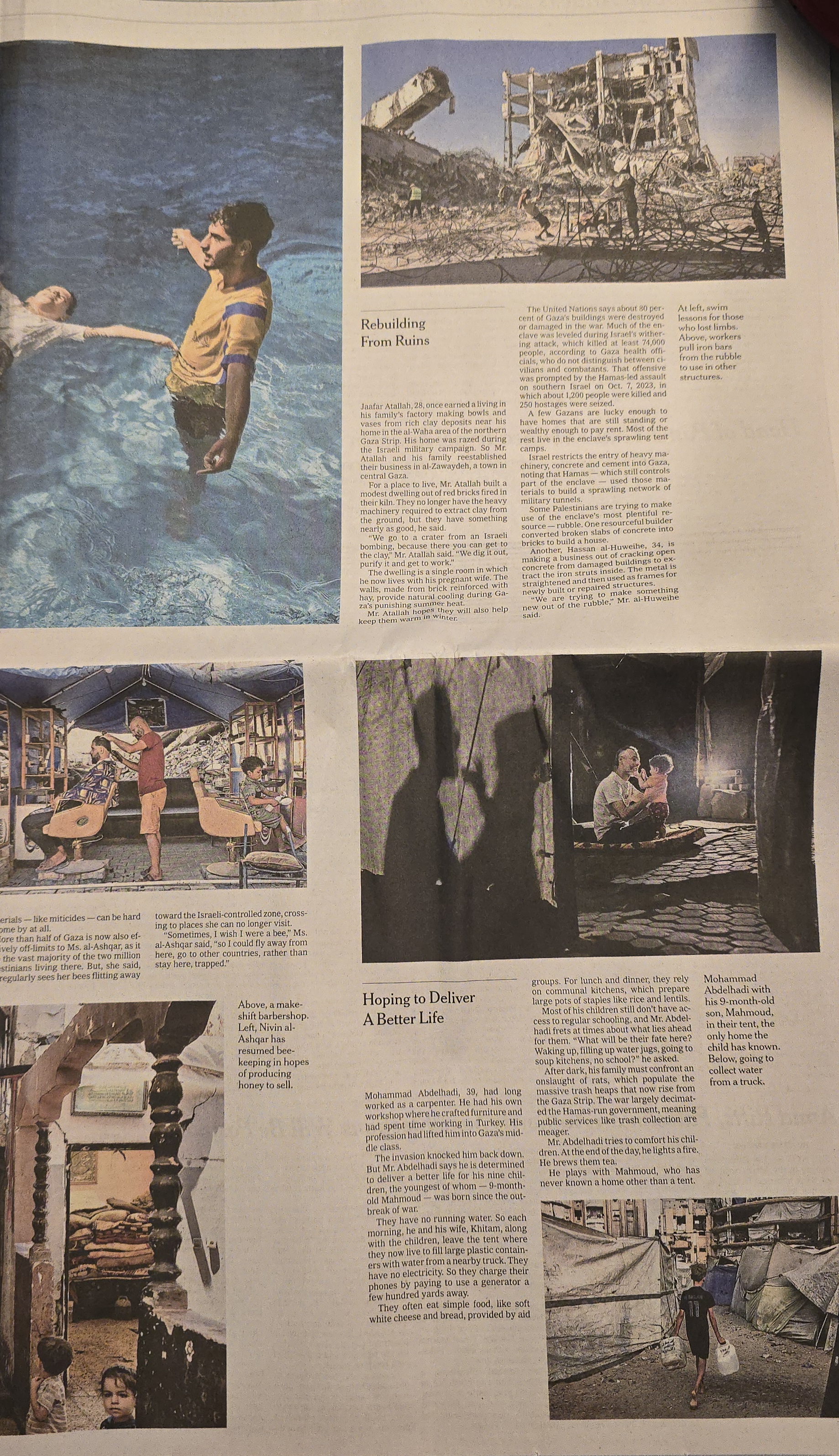
Three days after the third anniversary of Hamas’s October 7 massacre, The New York Times devoted its dominant front-page photograph and two full inside pages to the “hopes” and aspirations of Gazans. There were weddings, swimming, barbershops, reopened businesses and families trying to rebuild their lives amid the rubble.
It was a touching portrait of ordinary dreams – at least for normal people in the western world. But what about the extraordinary support among Gazans for killing Israeli civilians that preceded the war?
In June 2022, the Palestinian Center for Policy and Survey Research found that 73% of Gazans supported armed attacks inside Israel similar to those had been recently carried out. Fifteen months later, Hamas invaded Israel, slaughtered civilians, kidnapped families and celebrated the massacre. By March 2024, five months into the war and amid Gaza’s devastation, 71% of Gazans still considered Hamas’s decision to launch October 7 correct, according to the same polling organization.
Two-thirds of Gazans on average since 2001 have supported killing Jewish civilians inside of Israel according to PCPSR polls
These were majority attitudes, measured before the massacre and after its consequences became devastatingly clear.
Hamas is Gaza’s government, controlling the territory since 2007. It operated ministries, schools, police and security forces alongside its military apparatus. It is Gaza’s political life. Before October 7, PCPSR polling showed Hamas leading Fatah in hypothetical Palestinian parliamentary voting and Hamas leader Ismail Haniyeh defeating Mahmoud Abbas in a two-candidate presidential contest. Hamas continues to lead Fatah, which is why PA President Mahmoud Abbas continues to delay elections.
Yet the Times’ sprawling photographic treatment of Gaza’s aspirations ignored the genocidal ideology that permeates Gaza and helped produce October 7. The newspaper deliberately failed to show what Gazans truly hope for: dead Jews and the destruction of the Jewish State.
Imagine the same treatment of Sudan’s Rapid Support Forces. Three days after the anniversary of an RSF massacre, would the Times devote its front page and two inside pages to swimming, weddings and employment in communities governed by the militia, with little examination of the violence and political support behind it?
The Times showed readers Gazans dreaming of a swim. Its own society’s polling shows overwhelming support for killing Jewish civilians both before and after the October 7 massacre.
The Times has whitewashed the genocidal ideology of Gazans and portrayed them as victims of the jihadi war they launched. Doing so is not just anti-Israel, it is a promotion of radical Islam deployed against Jews.
Or perhaps worse – the Times is educating its readers that those who want to rape and kill Jews are very much like us.
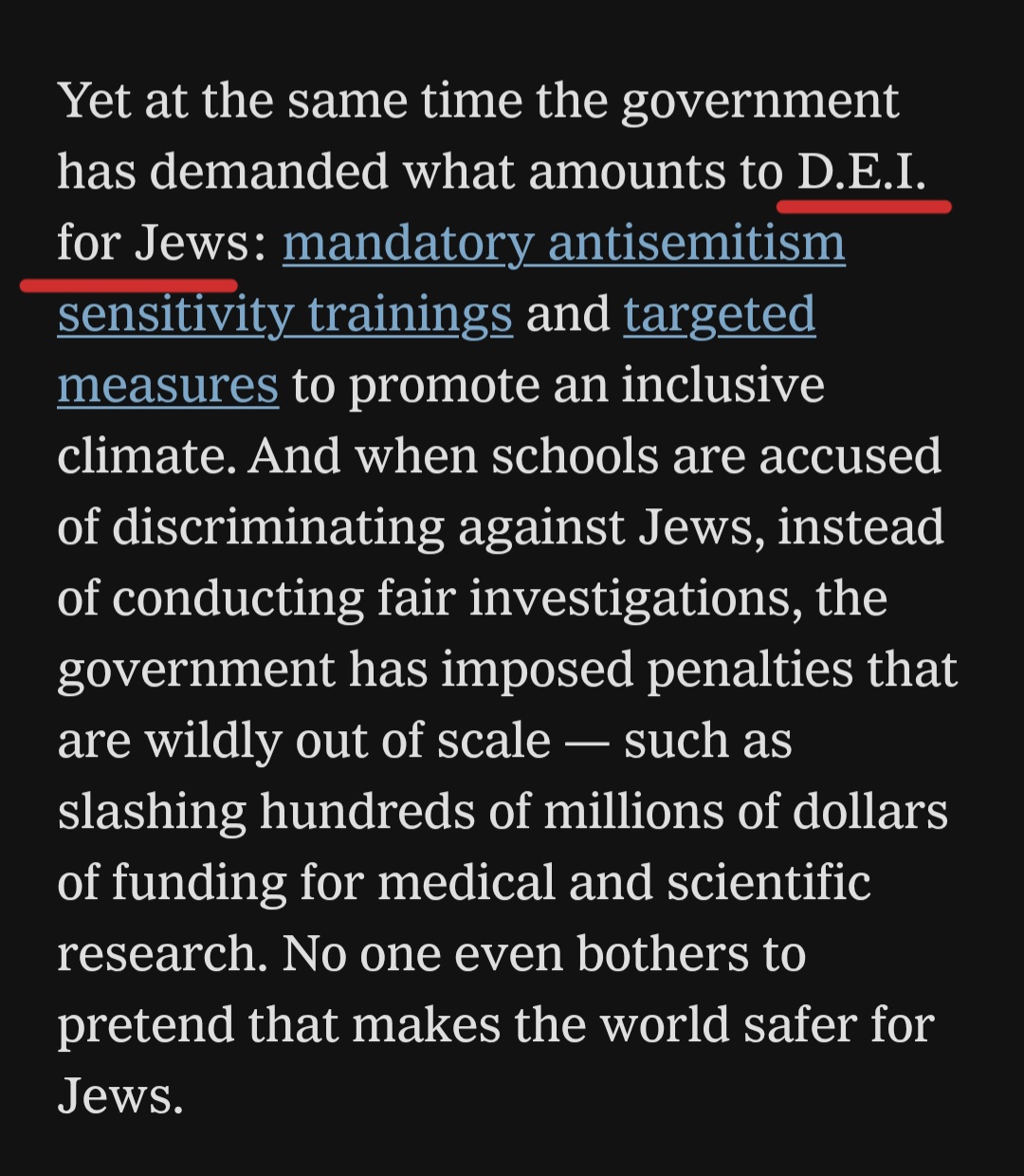
The Trump administration, he writes, has demanded “what amounts to D.E.I. for Jews.”
What he means is antisemitism training and measures intended to ensure that Jewish students can attend classes, use campus facilities and participate in university life without harassment or intimidation.
That is not D.E.I. It is equal protection.
D.E.I. programs may use identity-conscious policies to pursue representation or other preferred outcomes. On the other hand, civil-rights law imposes a simpler rule: institutions receiving federal funds may not discriminate against students because of their race, ethnicity or shared ancestry.
Preferred outcomes and equal protection are not just not the same thing.They are opposites.
If Black students are targeted, the law protects them. If Muslim or Arab students are targeted, the law protects them. If Jewish students are targeted, the law protects them. Applying the same rule to Jews does not create a Jewish preference.
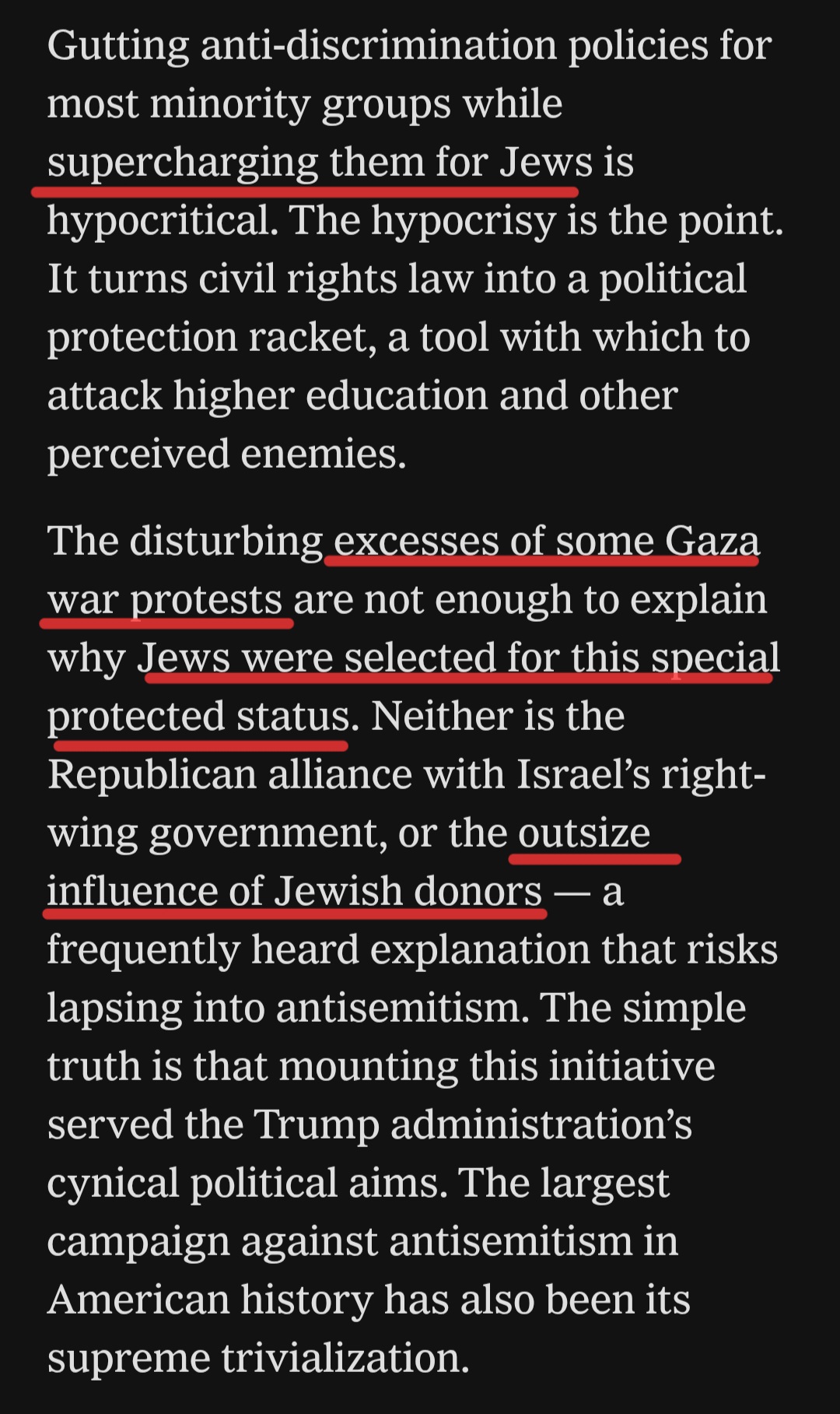
Loeffler nevertheless describes Jews as having been selected for special protection. That is absurd. Title VI has long covered antisemitic discrimination, just as it covers comparable discrimination against other groups. Whether a particular penalty is proportionate is a separate question from whether protecting Jewish students constitutes D.E.I.
Loeffler avoids that basic distinction by reducing the conduct surrounding Gaza protests to “excesses.” But the issue was not criticism of Israel or a few offensive placards. Jewish students faced ongoing intimidation, exclusion, celebrations of Hamas murderers and rapists, and chants invoking violence while universities failed to enforce their own rules.
The relevant question is whether universities tolerated treatment of Jewish students that they would have confronted had another minority been targeted. Instead, Loeffler makes the government’s response the scandal. His essay moves away from the students suffering harassment toward theories about Trump, demographic change, white panic and “Jewish donors.” The people seeking protection disappear into an argument about the motives of those enforcing the law.
That this comes from a professor of modern Jewish history is difficult to understand. Loeffler is not an uninformed commentator stumbling over the difference between a preference and a right. His credentials rest on Jewish history, antisemitism and civil liberties. He is a research fellow at the Shalom Hartman Institute which promoted the article on its website.
How does a scholar with that background look at the present condition of American Jews and identify their protection as the suspicious development? How does he see Jewish students threatened and excluded, yet reserve his strongest language for the government finally acting? How does an authority on antisemitism mistake equal treatment for Jewish favoritism?
The New York Times paraded an “As A Jew” with Trump Derangement Syndrome to encourage students coming back to school to come after their Jewish classmates once more and vote against Republicans in the mid-term elections.
Disliking the administration enforcing the law does not transform the law into D.E.I. Equal protection does not become preferential treatment when the people receiving it are Jews.
You can also share your thoughts with the Shalom Hartman Institute for having Loeffler be an ongoing research fellow and promoting his article at 212-268-0300.
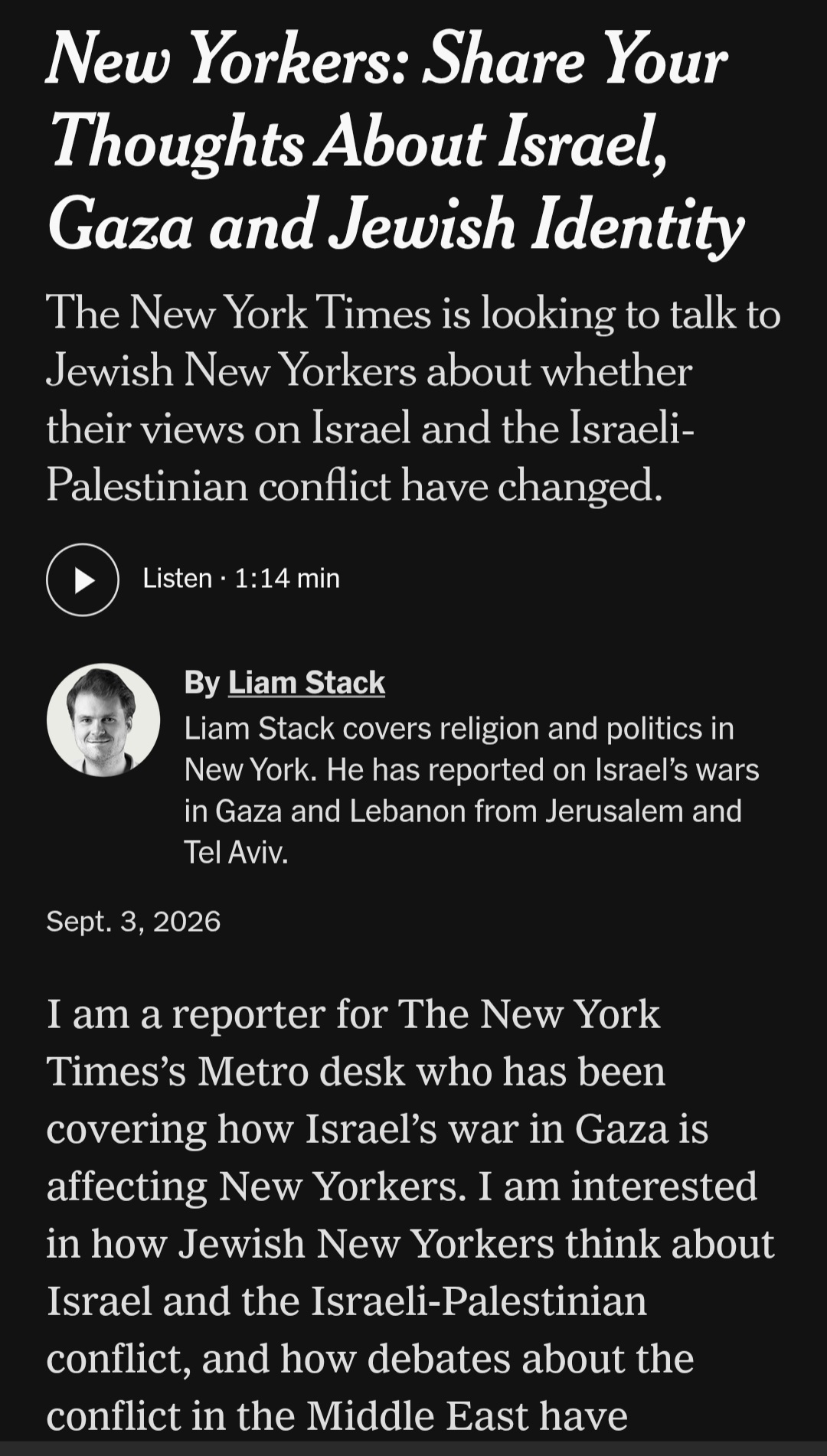
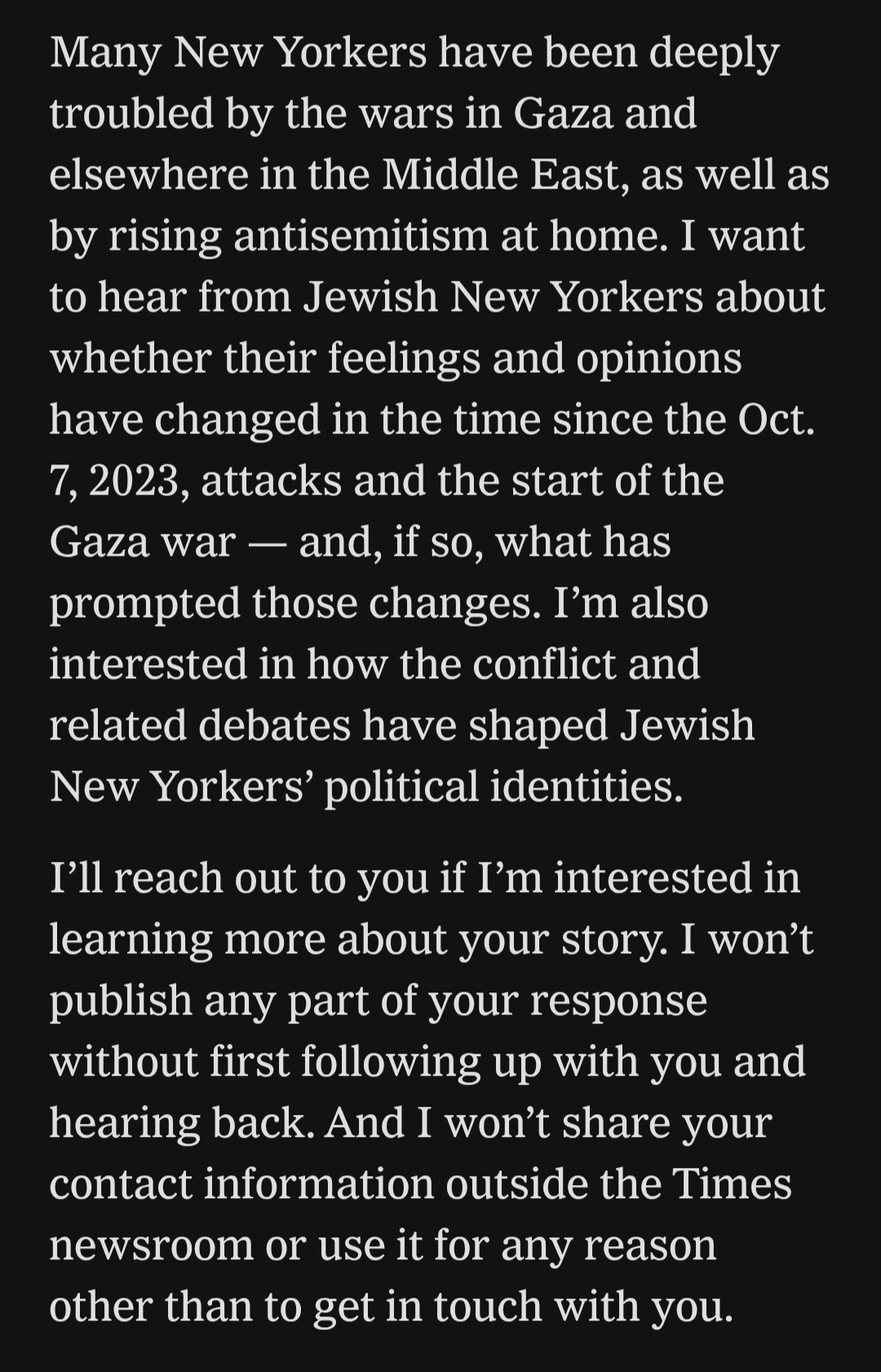
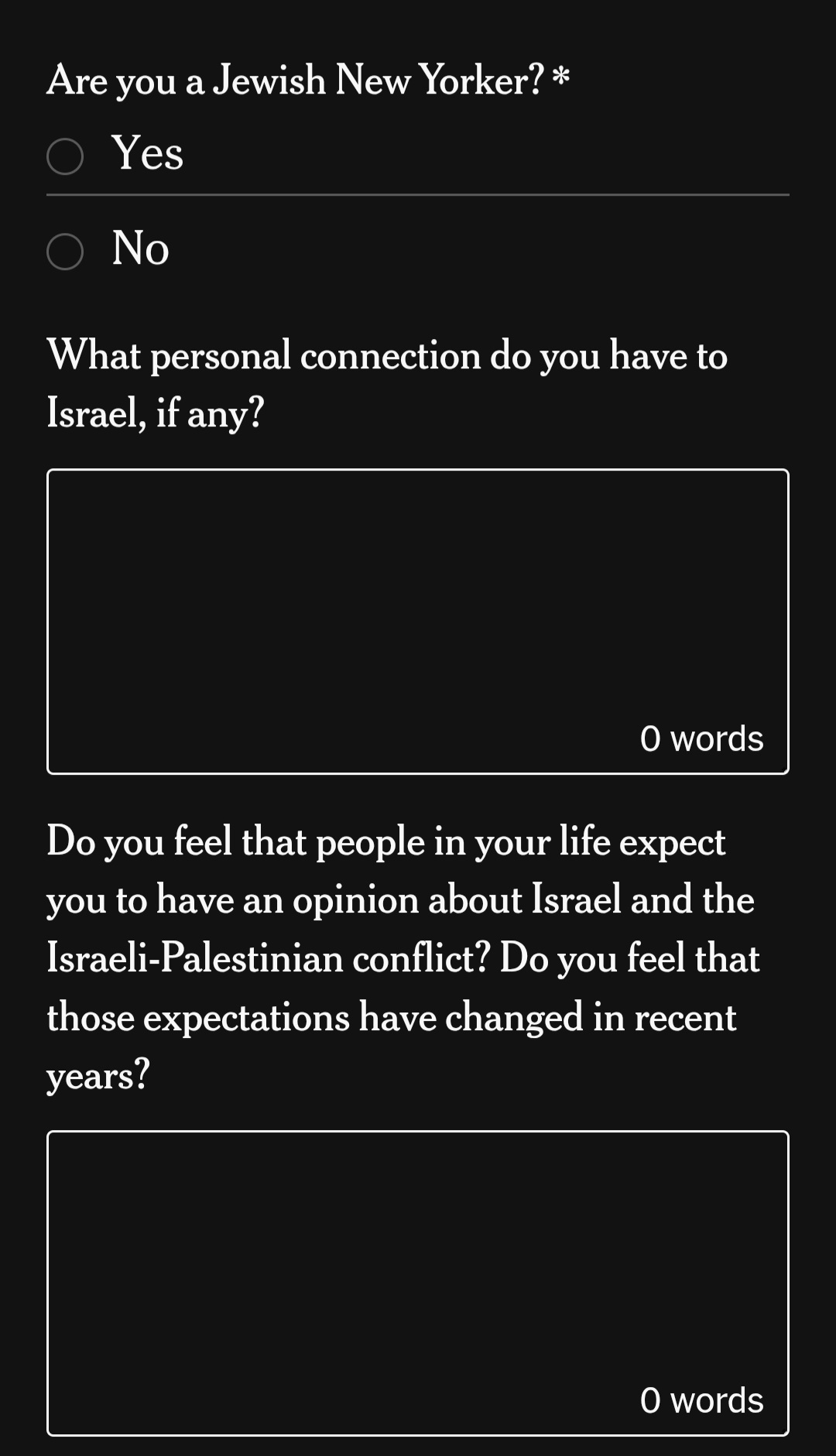
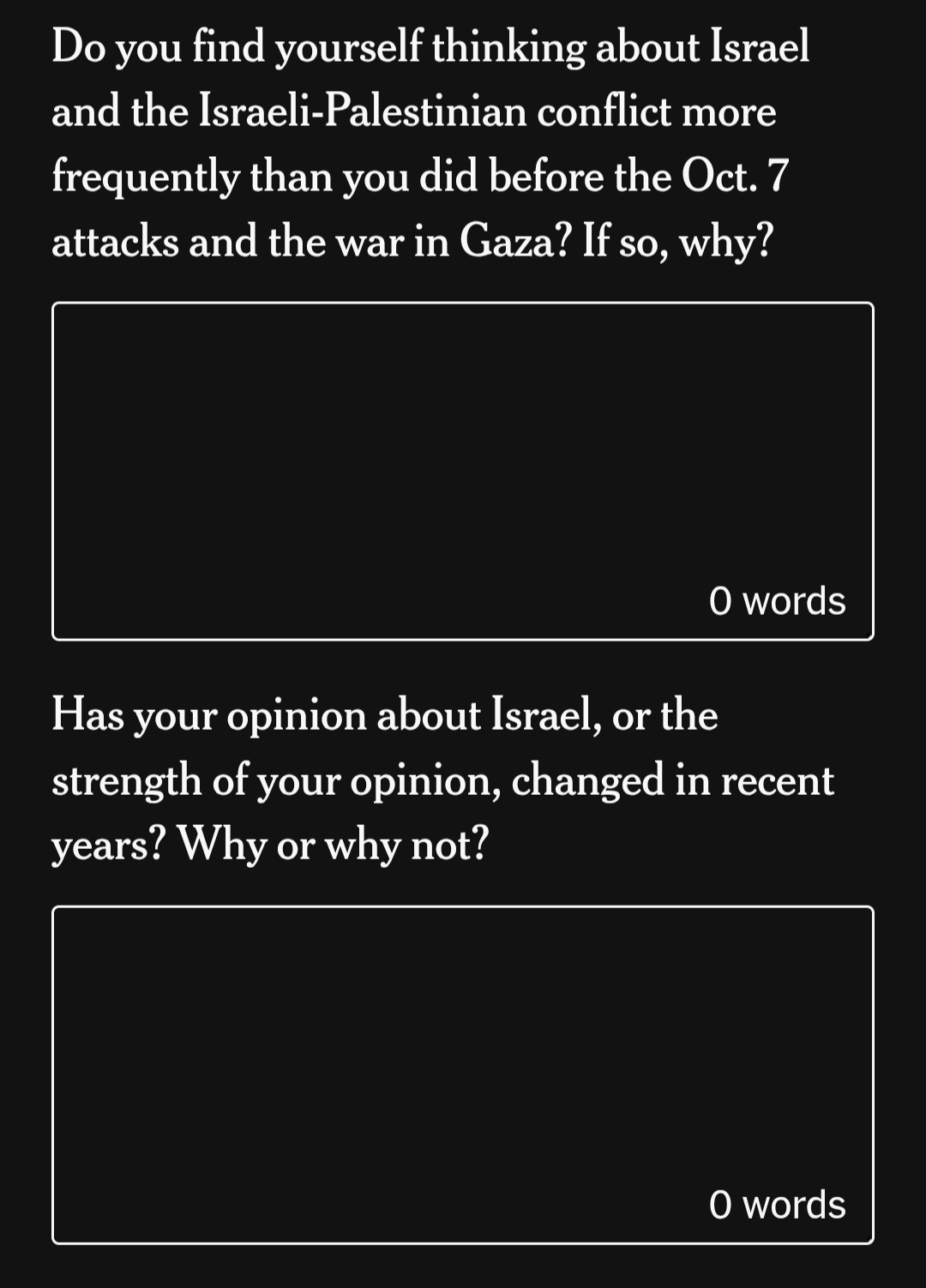
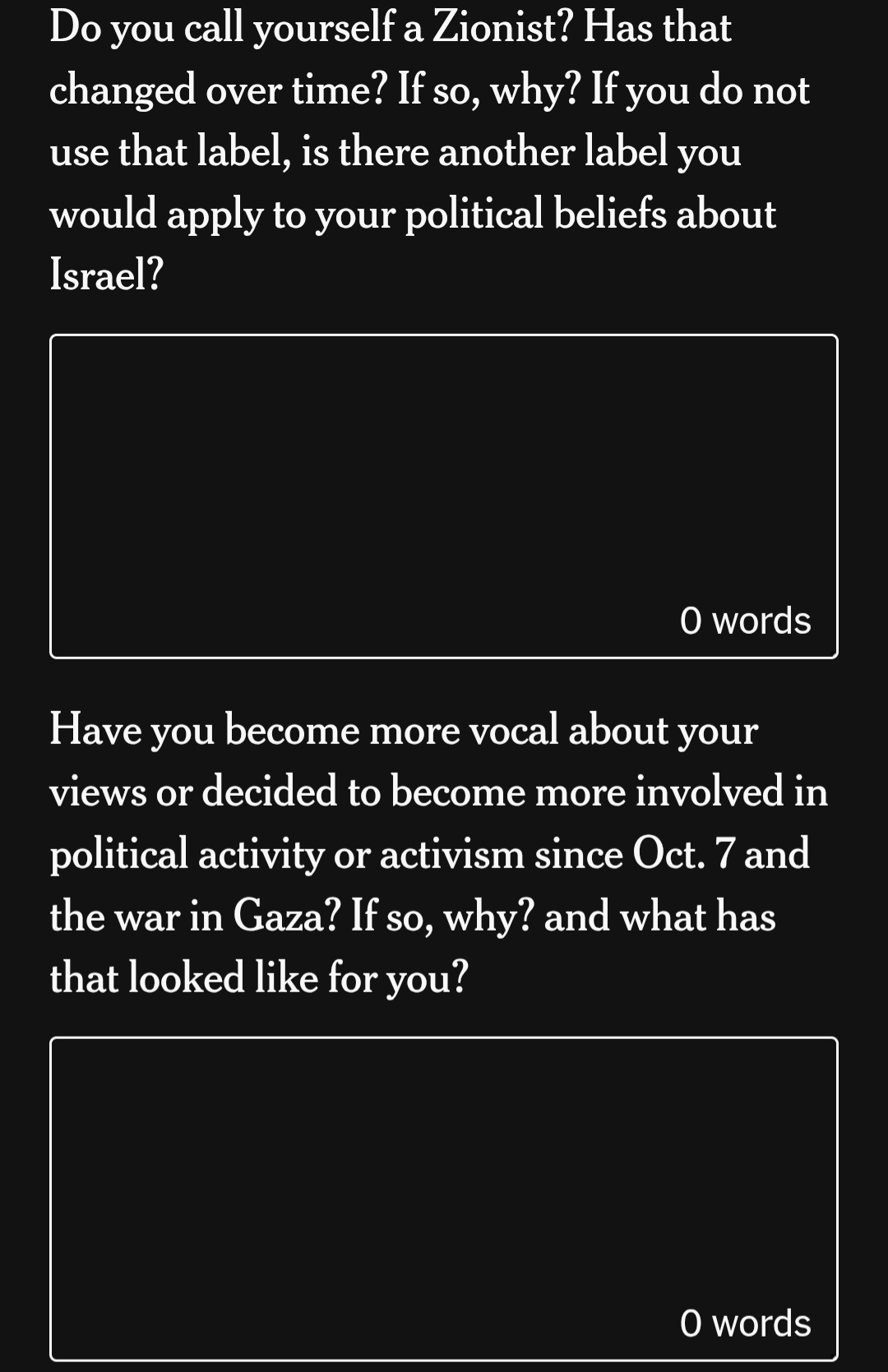
The New York Times wants to know what New York Jews think about Israel.
Its new questionnaire asks Jewish New Yorkers whether they think about Israel more since October 7. Whether their opinion of Israel has changed. Whether they call themselves Zionists. Whether they have become more vocal or politically active.
The frame is revealing.
The Times wants to know how Israel has changed the Jews.
It does not ask whether October 7 changed their opinion of Hamas.
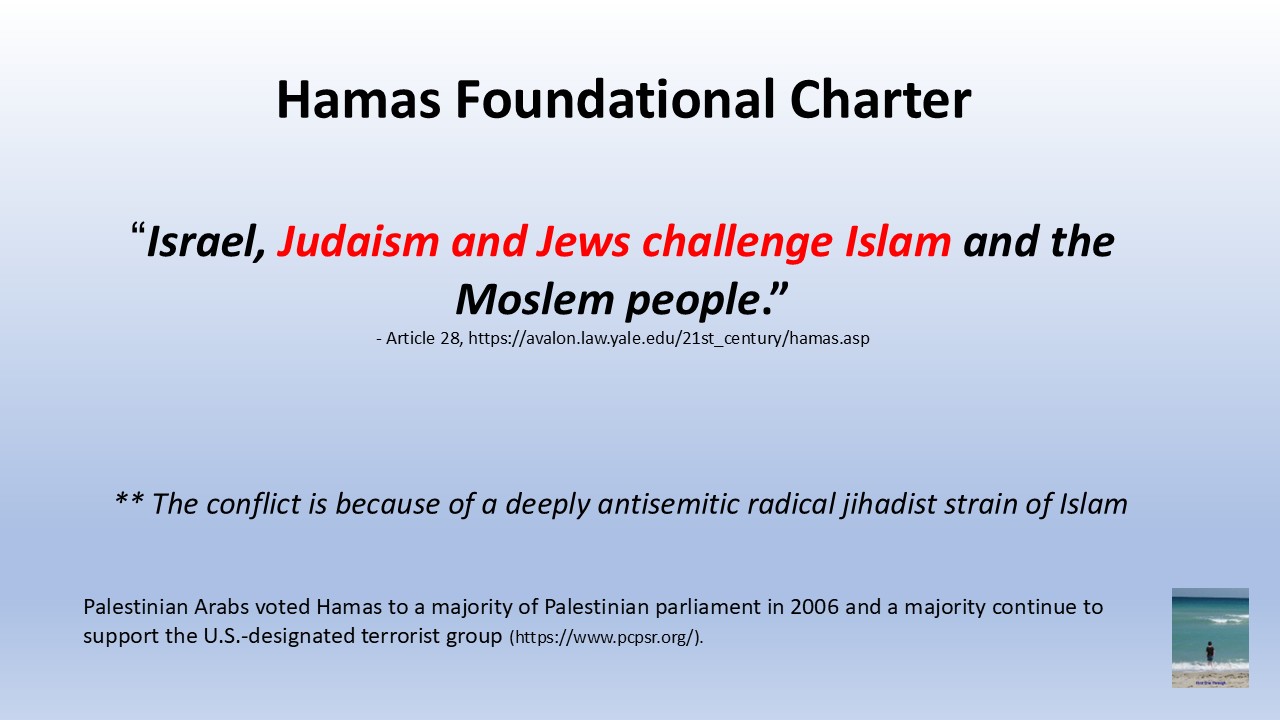
Did the murder, rape and kidnapping of Israelis change their understanding of the conflict? Did years of Israelis held hostage in Gaza change it? What have they learned about Hamas, its genocidal antisemitic foundational charter, Palestinian politics or jihadist movements committed to Israel’s destruction?
Those questions aren’t there.
Neither is another actor in the past three years: the New York Times.
Has its coverage changed your trust in the newspaper? Do you believe its reporting on Israel and Gaza has been fair? Has its treatment of antisemitism changed your relationship with the paper? Has its language surrounding “genocide”, “occupation” and “resistance” changed how you understand the conflict or how you perceive of the media?
The newspaper wants to know what changed the Jews without asking whether the newspaper helped change them.
Then there is the matter of which Jews.
The questionnaire asks whether you are a Jewish New Yorker. It does not ask whether you are 22 or 72. Orthodox, Conservative, Reform or secular. Democrat, Republican or independent. Progressive, moderate or conservative. Those differences may explain the answers, as discussed in many other polls.
More important, this is an open call published by the New York Times. It is not a random survey of New York Jews. For years, parts of the Jewish community have fought bitterly with the paper over its coverage of Israel and antisemitism. Many longtime Jewish readers have publicly canceled their subscriptions over that coverage. Thousands more privately.
The Jews most alienated by the Times may also be the least likely to see its callout, trust its reporter or volunteer their thoughts. Jews comfortable with the newspaper and its worldview may be more inclined to respond, biasing the poll results. It could collect hundreds of responses showing its Jewish respondents moving away from Israel without knowing whether the Jews moved or its sample did.
Then comes the missing questionnaire.
Where are the questions for Arab and Muslim New Yorkers?
Did October 7 change your opinion of Hamas? Do you consider Hamas a terrorist organization? Do you believe Jews are entitled to national self-determination? Should Jews be allowed to freely access and pray at their holiest site? Should Hamas and other Palestinian armed groups surrender their weapons? Has your opinion of Israel changed? Of Jews?
Those answers would tell New Yorkers quite a lot too.
And the timing is particularly ugly.
Hasan Piker has recently been asking his own version of precisely this question: How attached are American Jews to Israel?
Piker has called Israel “Jewish ISIS” and previously said Hamas was “a thousand times better” than Israel. More recently, he warned that if American Jews continue presenting themselves as deeply invested in Israel, eventually someone may take action against American Jews rather than Israel.
That is antisemitism dressed up as a warning.
And now the New York Times arrives with a questionnaire measuring whether Jewish New Yorkers still call themselves Zionists and whether their feelings about Israel have changed.
The disturbing convergence is the question itself: How attached are the Jews to Israel now? The New York Times wants to know. Millions of antisemites that follow Piker want to know.
ACTION ITEM
So answer the poll. But not their questions.
Tell the Times exactly how October 7 changed your thinking.
Tell it what you think about Hamas. Tell it what you have learned about jihadism, hostage-taking and fighters operating among civilians. Tell it whether Palestinian Arabs support for the October 7 massacre and Hamas have changed your understanding of the conflict.
Then tell it about the New York Times.
Tell it whether its coverage has increased or destroyed your trust in the newspaper—its language, its emphasis, its omissions, its telling of the Jihadi-Israel conflict.
Hasan Piker and The New York Times are polling Jews for their attachment towards Israel. Tell them what you think of the global jihad sweeping the world.
From his perch at The New York Times, Thomas Friedman wants to be “very clear” about Hamas. Instead, his formulation gets the moral order backwards.
“Hamas is a terrible organization,” he writes, “first and foremost for Palestinians.”
Hamas is not primarily a terrible organization. It is a terrorist organization whose foundational ideology targeted Israel and Jews.
Hamas said so itself. Its 1988 charter declares that “Israel will exist and will continue to exist until Islam will obliterate it.” Article 7 invokes a religious tradition about Muslims fighting and killing Jews. Article 13 rejects negotiated settlements: “There is no solution for the Palestinian question except through Jihad.”
October 7 was the depravity of those words turned into action. Hamas terrorists crossed into Israel, attacked civilian communities, murdered families and kidnapped hundreds of people. Terrorism was not an unfortunate byproduct of Hamas rule. It was the method of an organization whose charter had openly described its enemy and objective.
Nor was Hamas imposed upon Palestinian Arabs. In the 2006 Palestinian legislative elections, voters handed Hamas 56% of the seats in parliament — 74 of 132 — and control of the legislature.
October 7 did not sever that political connection. In December 2023, the Palestinian Center for Policy and Survey Research found that 72% of Palestinians believed Hamas’s decision to launch the October 7 attack was correct, including 57% in Gaza and 82% in the West Bank. Even in October 2025, 53% still called the decision correct.
That context makes Friedman’s criticism of Western Hamas apologists particularly revealing. He calls the “free pass” Hamas receives from some pro-Palestinian progressives “shameful.”
The issue runs much deeper than shame.
There is a straight line from a charter describing the destruction of Israel and the killing of Jews, to terrorists carrying out a massacre in Israel, to people defending the decision to launch that attack. The depravity lies in the ideology, the terrorism committed in its name and the willingness to celebrate or excuse it afterward.
And that depravity has migrated into American politics. The Democratic Socialists of America and radical left-wing university professors describe Israel as a colonial project and Israelis as “colonialists,” a framework to erase the distinction between combatants and civilians and recast violence against Israeli Jews as “resistance.” This movement is no longer confined to demonstrations and campuses; DSA member Zohran Mamdani has ridden the democratic-socialist movement into the New York City mayoralty and is now helping other left-wing candidates like Mohamed El-Zayed in Michigan win office.
Friedman’s formulation reverses the danger. Hamas becomes “terrible” rather than terrorist. Palestinians become its primary victims rather than a population which supports Hamas. And those in the United States and elsewhere who give Hamas political cover are merely “shameful.”
That formulation grants absolution to terrorists and their knowing supporters.
The endorsement and celebration of mass violence against Jews — a tiny minority-minority — is becoming a motivating force in American politics. That should terrify Thomas Friedman. It should terrify every decent American.
Because when a movement can watch the mass murder of Jews and explain why their killers were engaged in “resistance,” the problem is no longer simply Hamas.
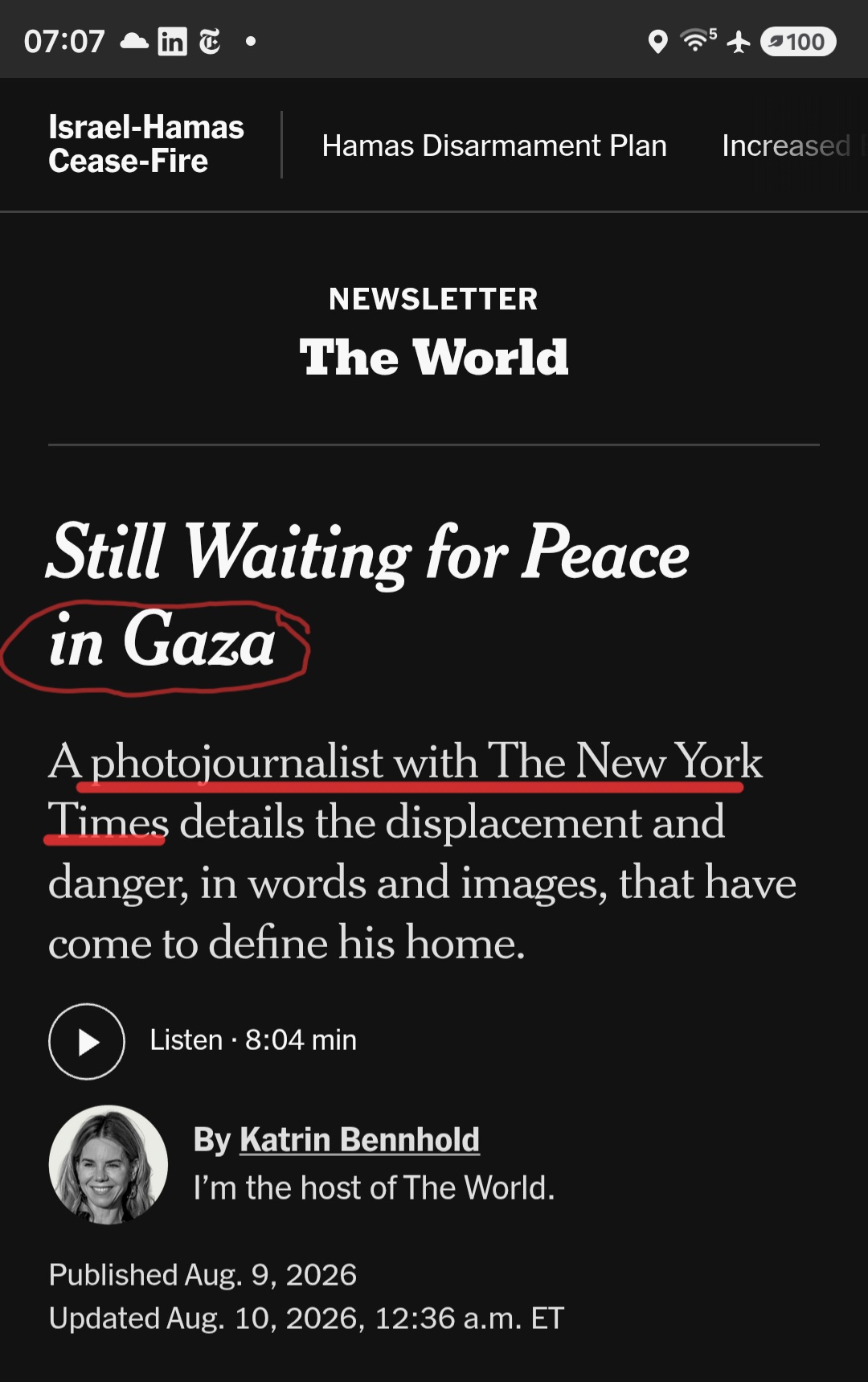
The New York Times published a photo essay under the headline “Still Waiting for Peace in Gaza.” Its Palestinian Arab photojournalist documents the world around him: shattered buildings, displaced families, rubble and danger. The photographs powerfully show what war looks like from inside Gaza.
But what does peace look like?
For Israelis living a few miles away, peace means sleeping without rockets overhead. It means children not watching their parents gunned down before them. It means young adults attending a music festival without being hunted, families living on kibbutzim without gunmen entering their homes, and civilians never again being murdered or dragged across the border as hostages.
Those images are outside the Times’ frame. And their absence raises the central question: Are Gazans waiting for peace with Israel, or peace from Israel?
Palestinian Arab polling makes the distinction important. After October 7, the Palestinian Center for Policy and Survey Research repeatedly asked whether Hamas had been correct to launch its attack. In March 2024, 71 percent of Gazans said yes. Three months later, after enormous destruction inside Gaza, 57 percent still considered the decision correct. Support showed a desire to live with violence inside Gaza if it led to the destruction of Israel.
The pattern predates October 7. Palestinian polling over decades has repeatedly recorded substantial support for attacks against Israelis, including civilians. The question of peace therefore cannot be answered simply by photographing people who desperately want the war around them to end.
Peace is reciprocal. It requires imagining security for the people across the border as well as for oneself.
A revealing photo essay would turn its lens outward. Ask Gazans whether Jewish families should live safely in Sderot and Kfar Aza. Whether Israelis should be able to dance near Gaza without fear of armed Palestinian Arabs crossing the border. Whether rockets should stop permanently. Whether Hamas should disarm. Whether the future they envision includes Jews living securely beside them.
Those answers would tell us whether Gazans are waiting for an end to war or waiting for peace.
And this is where the New York Times itself enters the frame. This is the newspaper’s own photojournalist, presented under the Times’ own headline and editorial framing. By calling the desire for calm inside Gaza “waiting for peace,” the newspaper takes one side’s desire for relief from war and gives it the language of reconciliation between two parties. It portrays the Palestinian Arabs as desirous of coexistence when it is plainly not so.
That framing is particularly consequential when the war began with Hamas crossing into Israel on October 7 to murder and abduct civilians. When thousands of Arab civilians invaded Israel to rape women and abduct children and spit on their corpses as they arrived in Gaza. Removing Israel from a story about “peace” reduces peace to what happens to Gaza after the attack, rather than what Gazans want to happen to Israelis in the future.
The Times reinforces a distorted understanding of the conflict: Palestinian peace becomes the absence of Israeli violence against Palestinians, while the Palestinian attitude toward violence against Israelis disappears beyond the edge of the photograph.
A camera pointed only into Gaza can show us what Gazans want to stop seeing. Peace begins with asking what they want Israelis to stop seeing too.
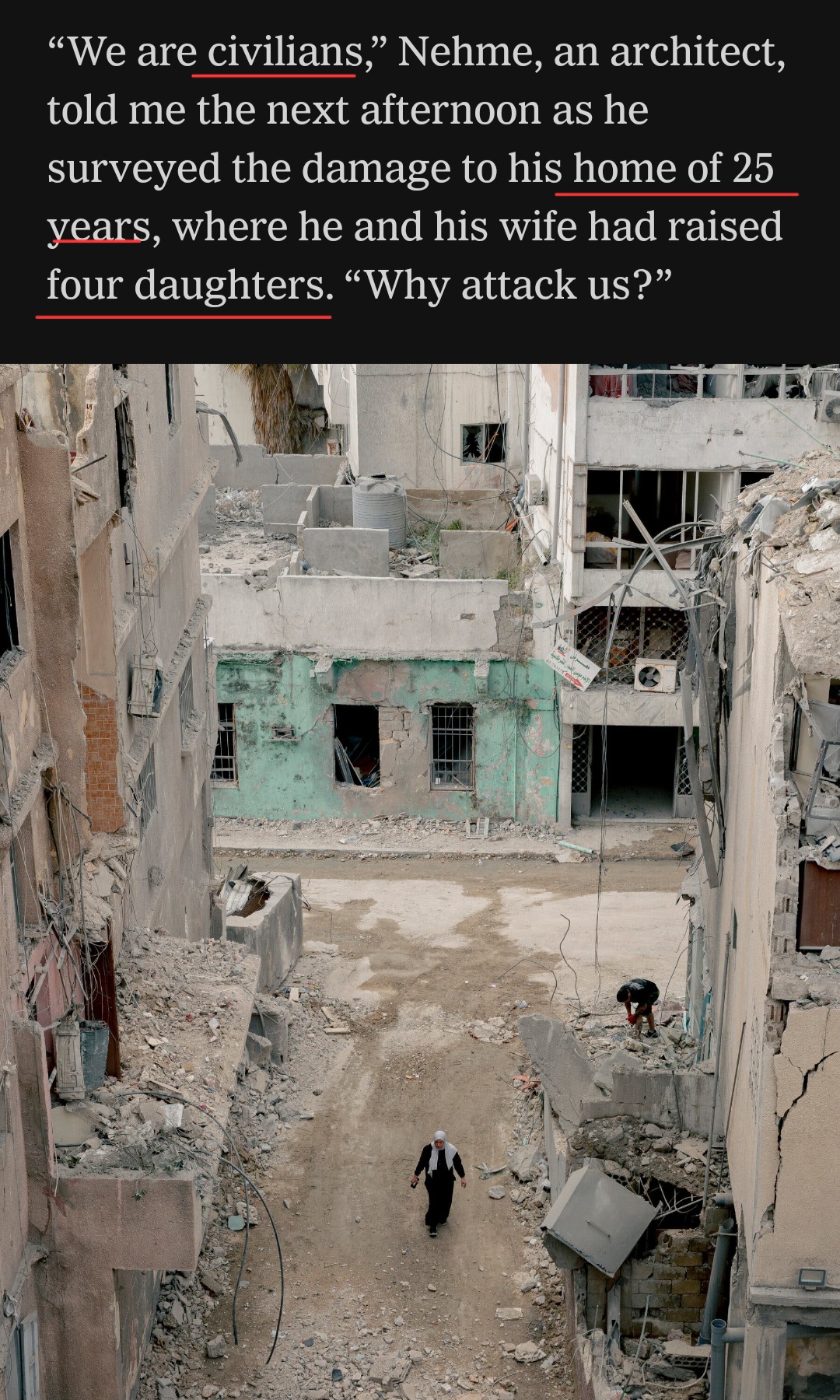
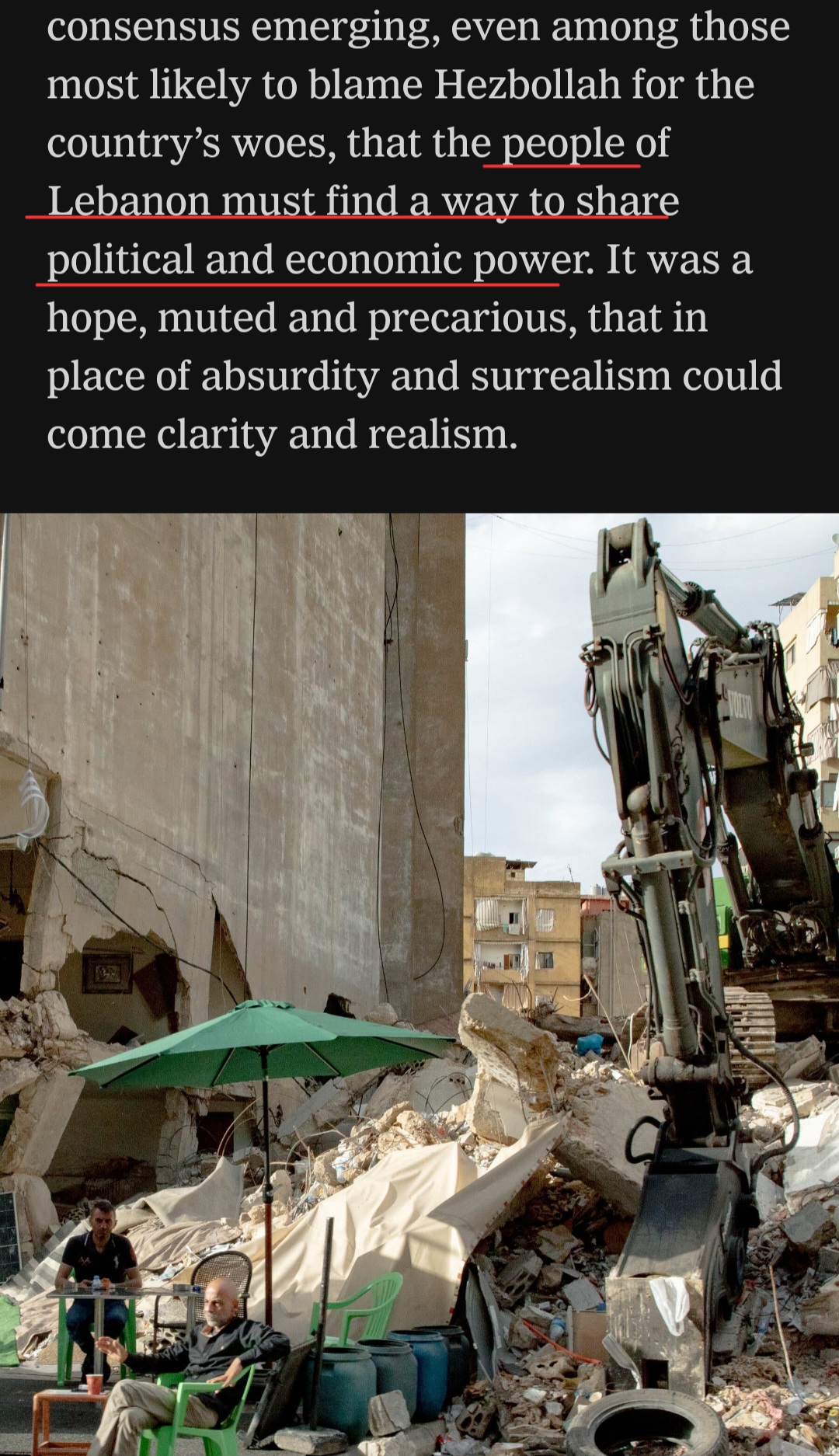
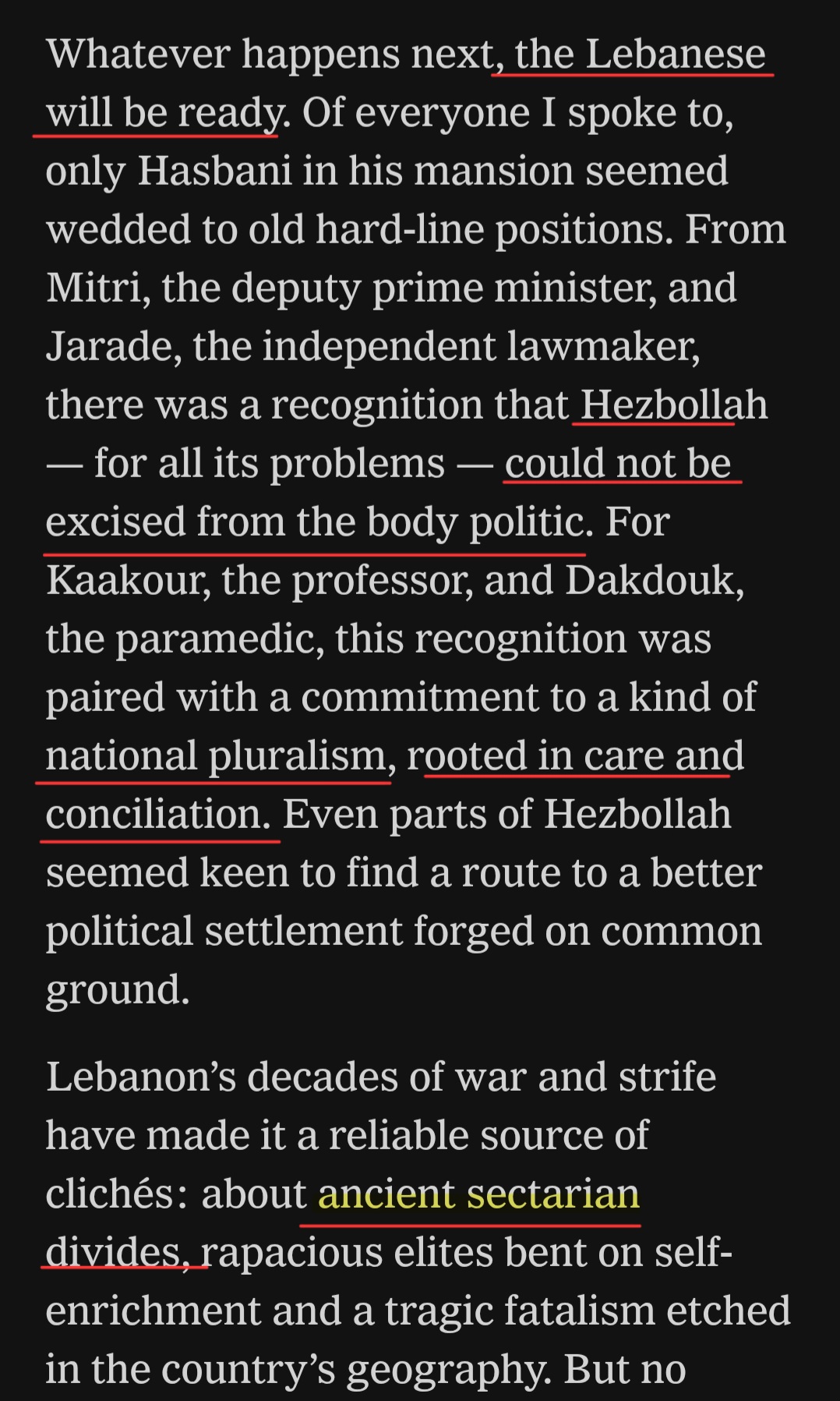
Readers are taken through a long 3,200-word editorial about an “ancient” country recovering from war. They meet civilians, politicians, intellectuals, and even Hezbollah supporters. They hear about sovereignty, reconstruction, and national renewal.
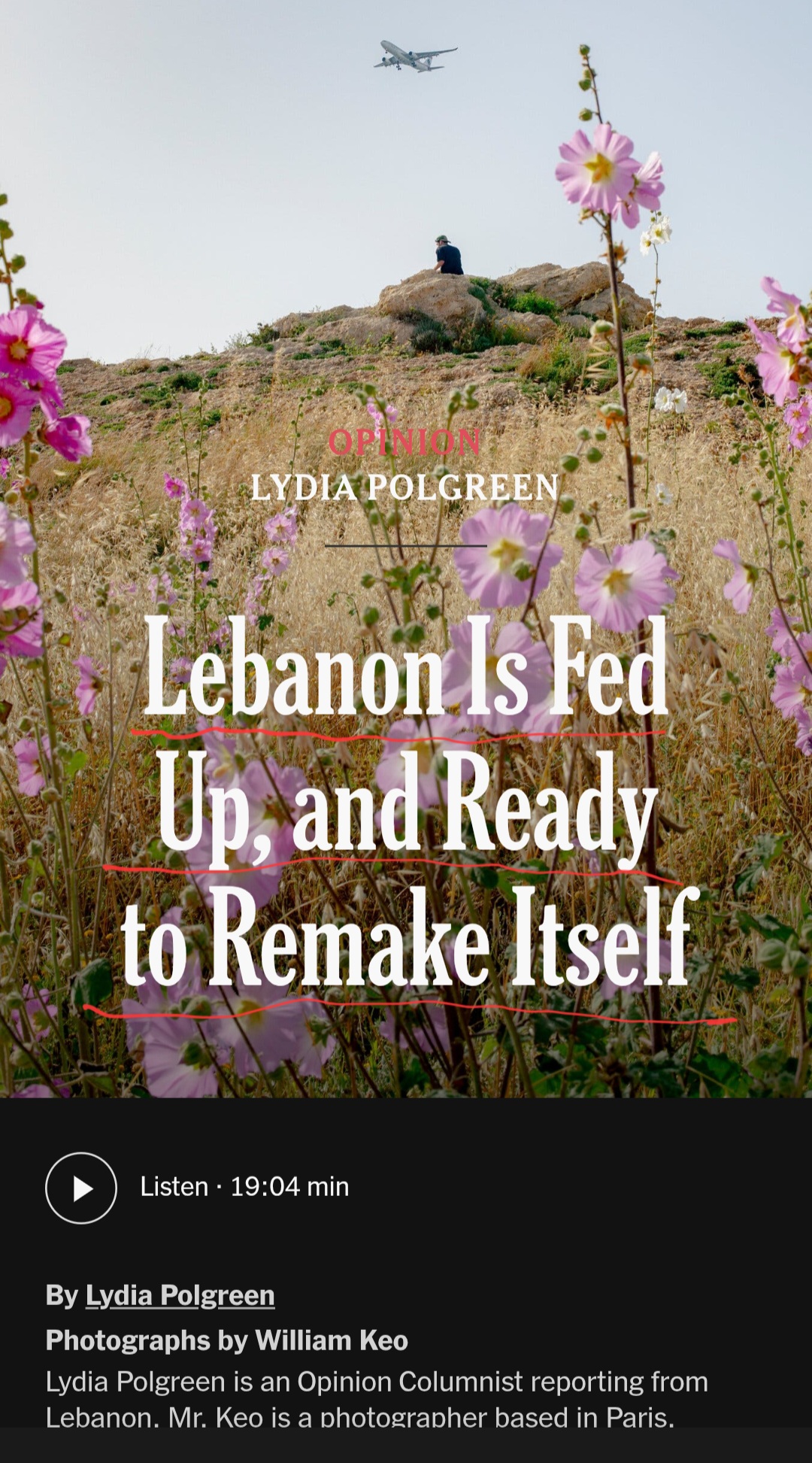
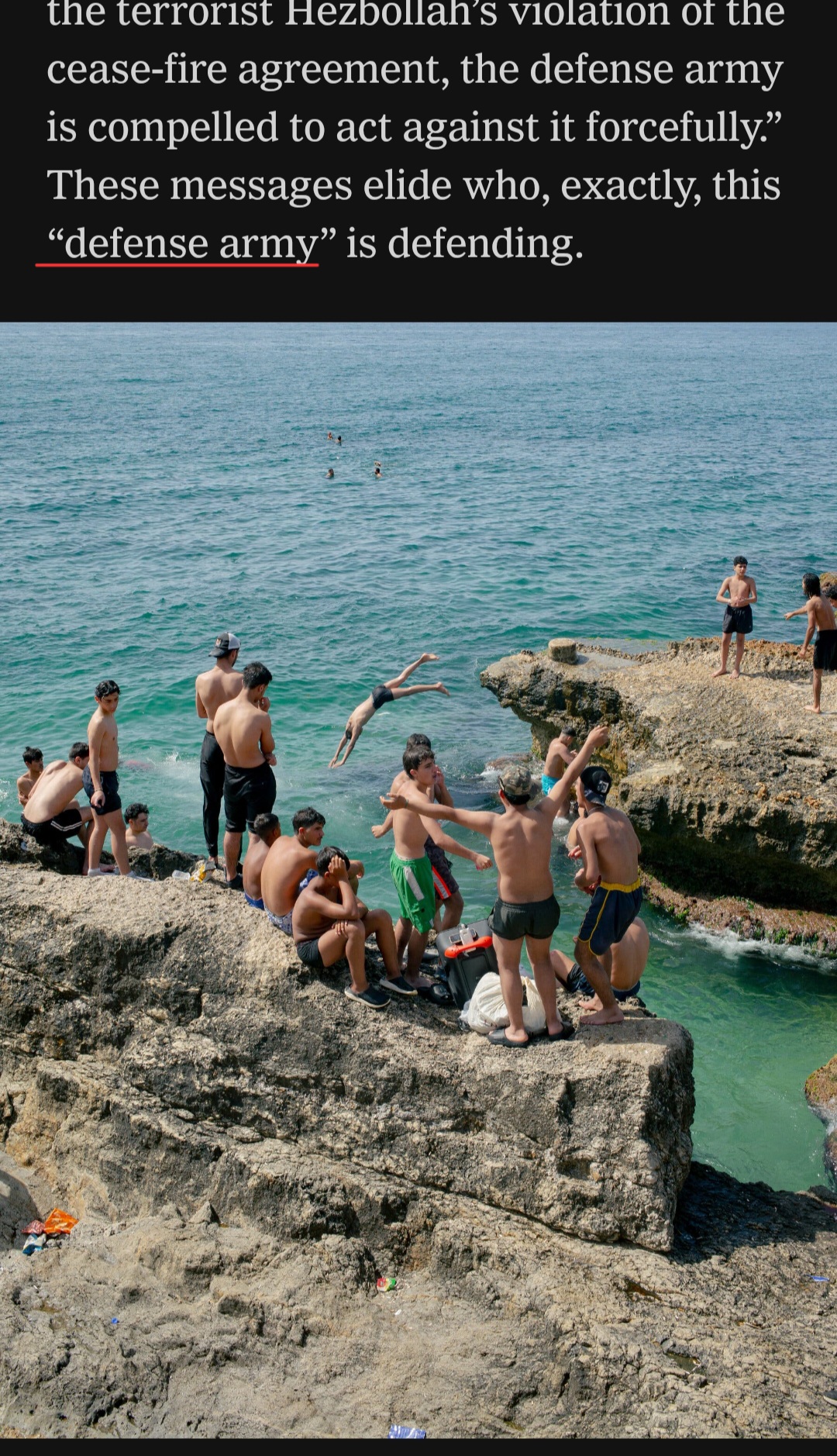
Picture accompanying 3,200-word article by Lydia Polgreen, placing a person sitting on a rock between a field of flowers and a plane overhead, a metaphor between its “ancient” beautiful land and foreign forces overhead or the temptation of leaving out of fear and disgust.
Then the focus shifts.
What begins as a reflection on Lebanon’s future gradually becomes a discussion of whether Israel should continue to exist in its present form.
That turn reveals the essay’s central assumption.
Lebanon is introduced through the language of continuity. Tyre is an “ancient city.” Villages are “ancestral.” Sectarian divisions are “ancient.” The country is presented as a society with deep roots struggling to reclaim its future.
Israel receives a different vocabulary.
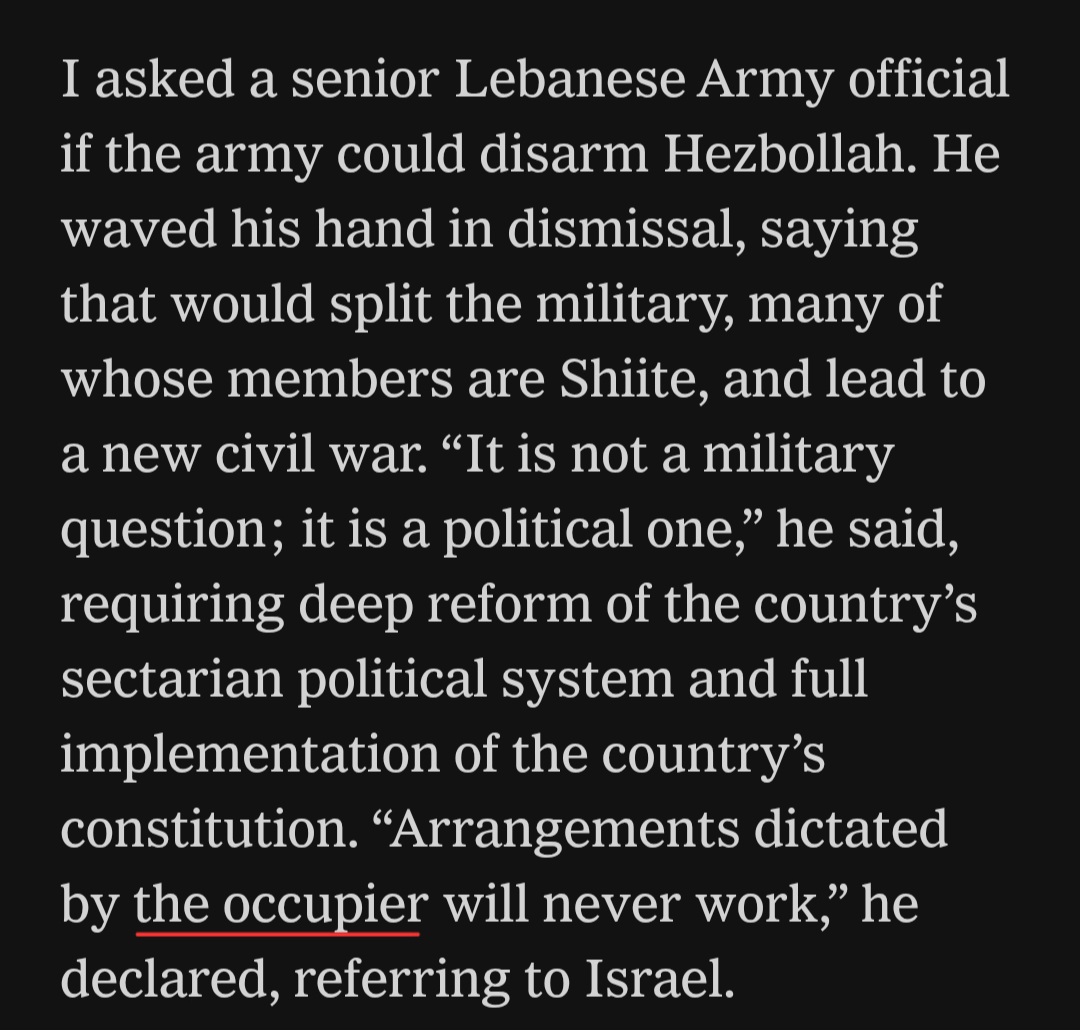
Israel occupies. Israel expands. Israel bombs. Israeli troops hold an “ever-expanding swath” of territory. The Israel is a “foreign military” operating inside another country. Israeli actions are repeatedly interpreted through ideological labels such as a “maximum-war doctrine.”
One nation is described through history and belonging. The other through power and force.
The contrast becomes more striking when the essay turns to sovereignty.
The preferred frame is Israeli intrusion into Lebanese sovereignty. Yet the defining political reality of modern Lebanon is that sovereignty itself remains unresolved.
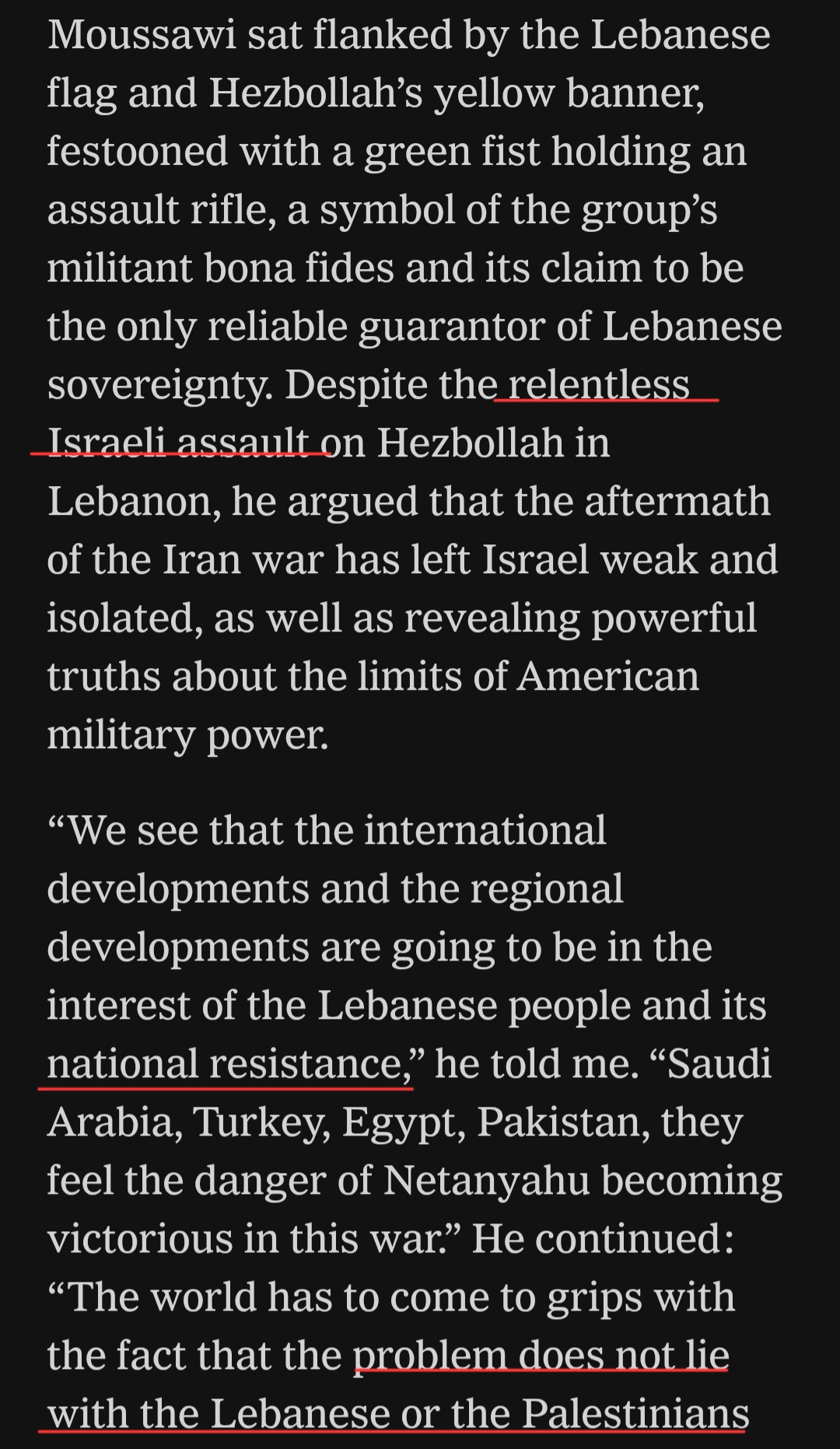
Hezbollah maintains an independent army outside the authority of Beirut. It receives funding, weapons, and strategic direction from Iran. It launched attacks on Israel after October 7 without authorization from the Lebanese government. For decades, Lebanese governments have struggled to establish a monopoly on force within their own borders.
The central question facing Lebanon is not merely reconstruction. It is sovereignty. Who governs southern Lebanon? Who decides questions of war and peace? Who controls the country’s most powerful armed force?
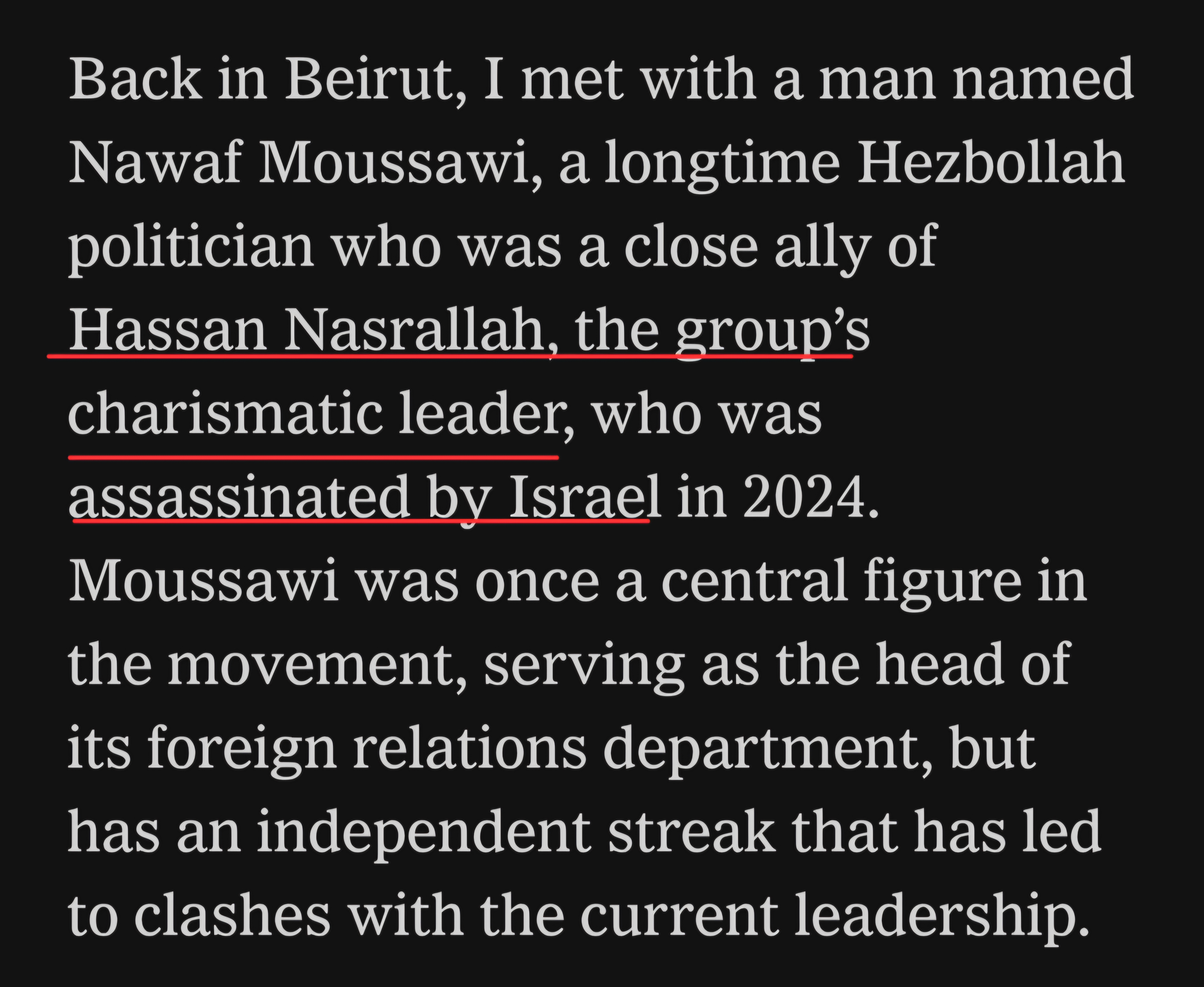
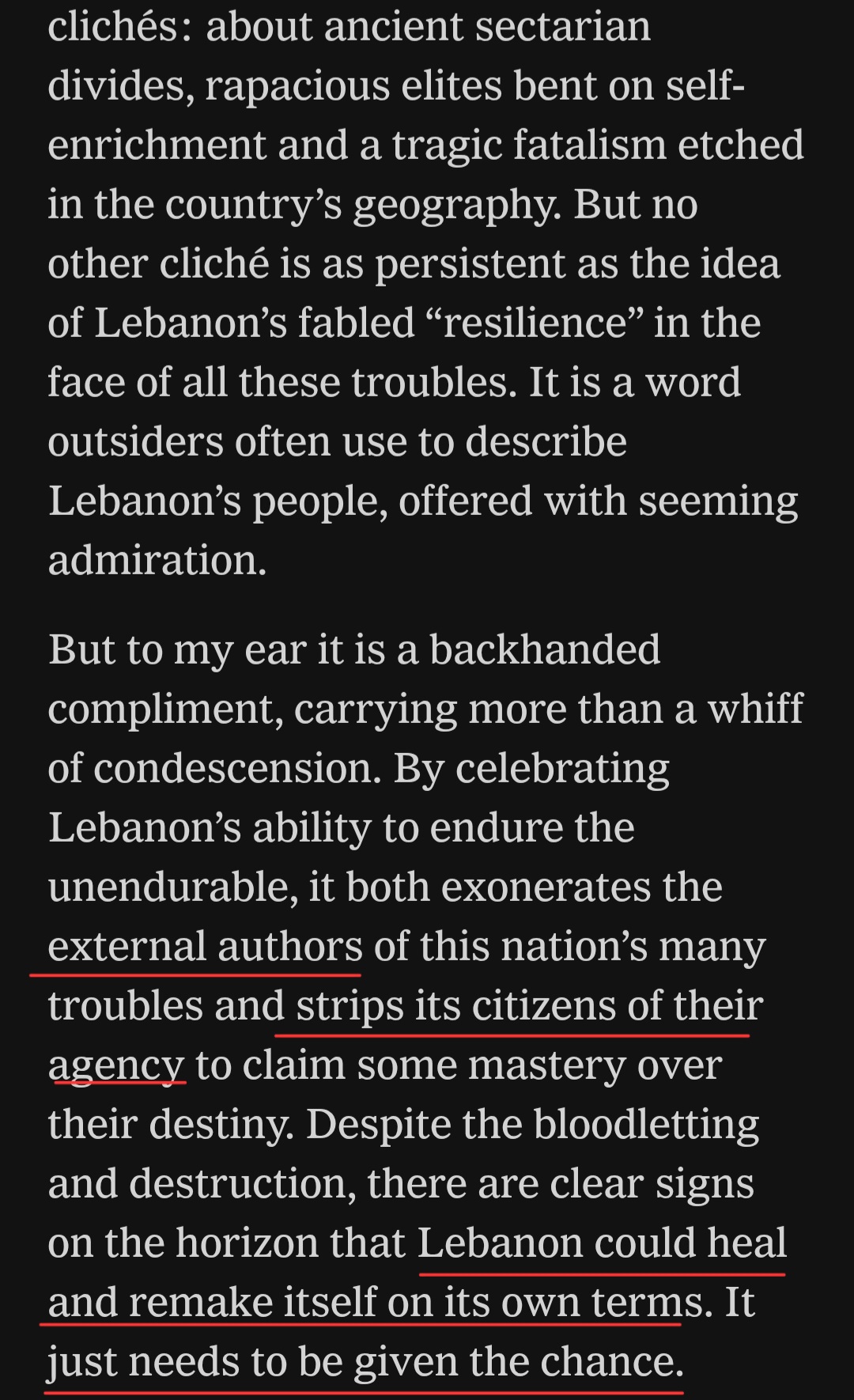
Those questions sit surprisingly close to the margins of the essay. Polgreen concludes that Hezbollah – even after the demise of its “charismatic leader” Hassan Nasrallah – will endure and be part of a “pluralistic” Lebanese society (“pluralism” and “pluralistic” show up four times in the article).
Readers learn far more about Israeli power than about Lebanese weakness.
Near the end, the essay abandons its own logic.
At one point readers are told that Hezbollah “could not be excised from the body politic.” Political reality, in other words, must be acknowledged. Hezbollah has supporters, influence, institutions, and representation. Lebanon’s future must somehow accommodate that reality.
Yet that principle vanishes when the discussion turns to Israel.
After thousands of words about Lebanon, readers are introduced to arguments for a one-state future that would effectively end Israel as the Jewish nation-state. An “emerging international consensus” suddenly becomes relevant to determining Israel’s future.
The contrast is revealing.
When discussing Lebanon, the essay asks Lebanese people what they want. Readers hear from civilians, intellectuals, politicians, and Hezbollah supporters. Their aspirations become the measure of Lebanon’s future, which we are informed will be pluralistic and peaceful, even when including Hezbollah.
When discussing Israel, Israelis are nowhere to be found. Readers have no context what the average Israeli wants. They are not told that overwhelming majorities support maintaining Israel as a Jewish state. Instead, the relevant question becomes what an international consensus believes should happen.
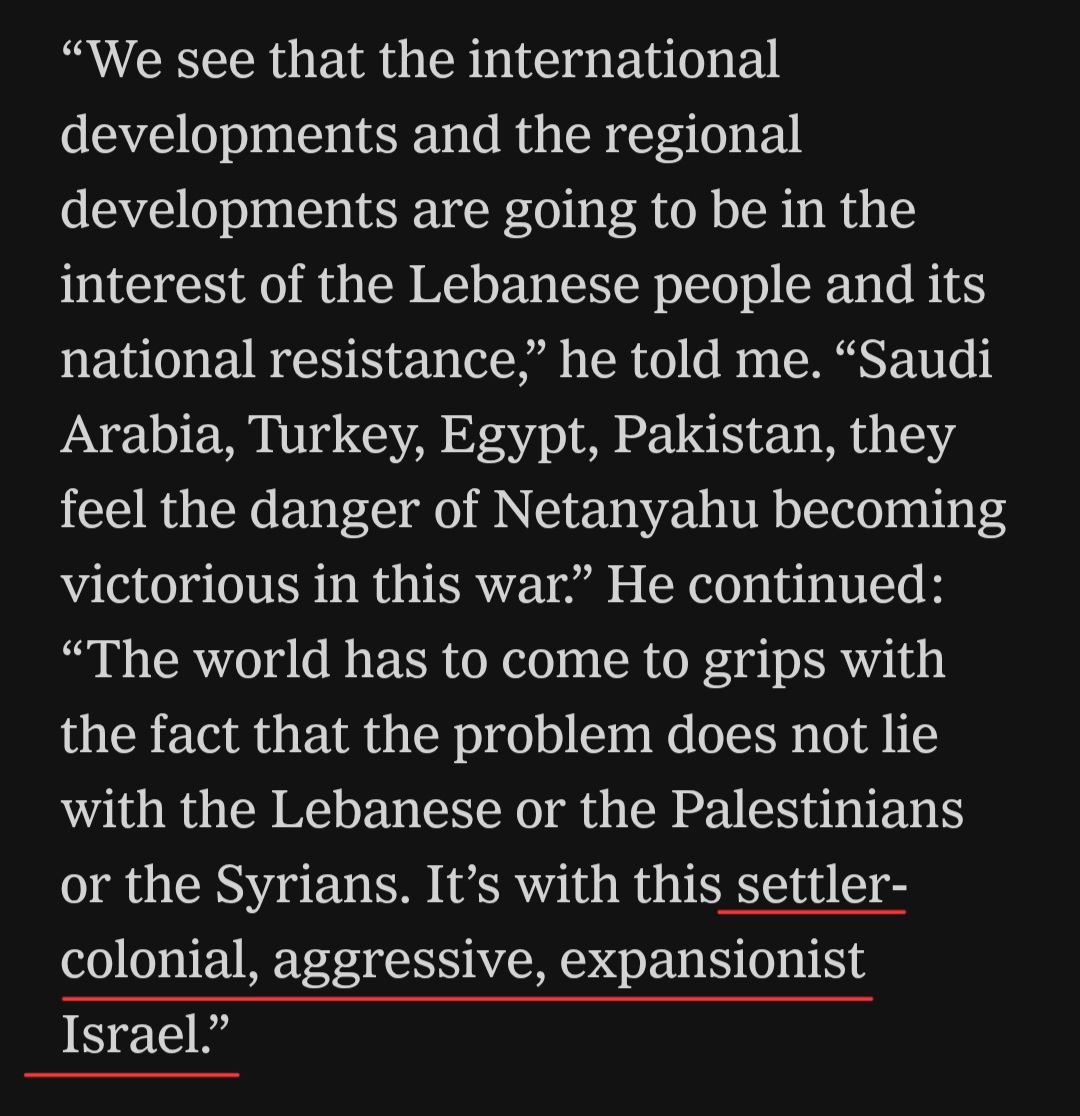
The people whose “settler-colonial, aggressive, expansionist” state is cast as being temporary are absent from the discussion. Presumably, the readers are being led to the conclusion that international pressure must be placed on Israel to let Lebanon live.
Lebanon’s future belongs to the Lebanese. Israel’s future belongs to everyone else.
By the end, readers know that Lebanon is an ancient nation whose sovereignty deserves restoration. Hezbollah is an enduring political reality that must be accommodated. Israel is a state whose identity should be reshaped by outside opinion.
Hezbollah is never properly labeled a US-designated foreign terrorist organization. Israel is never described as an American ally. Lebanon is not painted as a failed country which cannot control its failed economy or borders or manage a distinct military force outside governmental control.
A country that struggles to control its own territory is granted unquestioned legitimacy. A country with functioning institutions, competitive elections, and one of the region’s strongest economies is presented as a candidate for political reinvention.
The essay asks readers to accept permanence for Hezbollah, self-determination for Lebanon, and international supervision for Israel.
It begins by asking how Lebanon should recover from war. It ends by asking whether Israel should remain Israel.
For an essay about Lebanon, that is an oddly revealing destination.
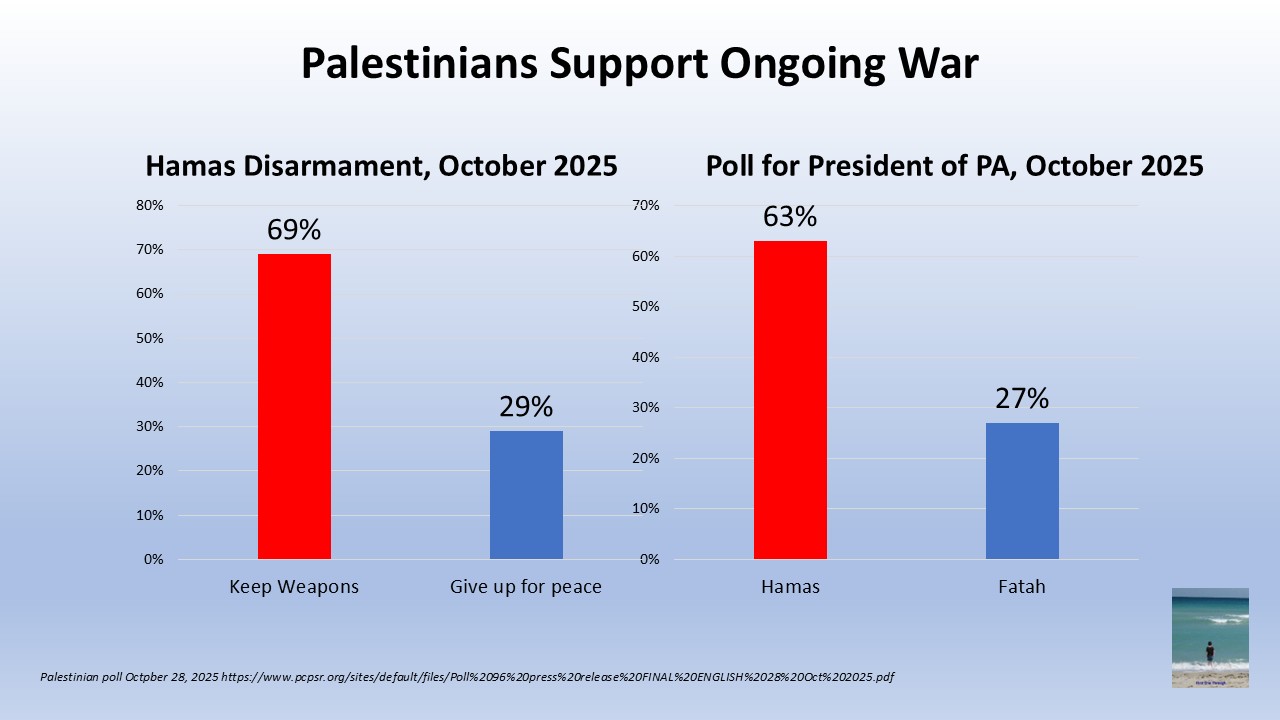
In October 2025, after two years of war and the devastation of Gaza, the Palestinian Center for Policy and Survey Research published findings that should have dominated headlines around the world:
Hamas remained the most popular Palestinian political movement.
More than half of Palestinians continued to view October 7 as the correct decision.
Nearly seven in ten opposed Hamas disarmament even if disarmament would prevent another war.
After two years of destruction, support for Hamas remained strong. Support for October 7 remained widespread. Opposition to disarmament remained overwhelming.
These findings did not come from Israeli politicians or government spokesmen. They came from Palestinians speaking to Palestinian pollsters.
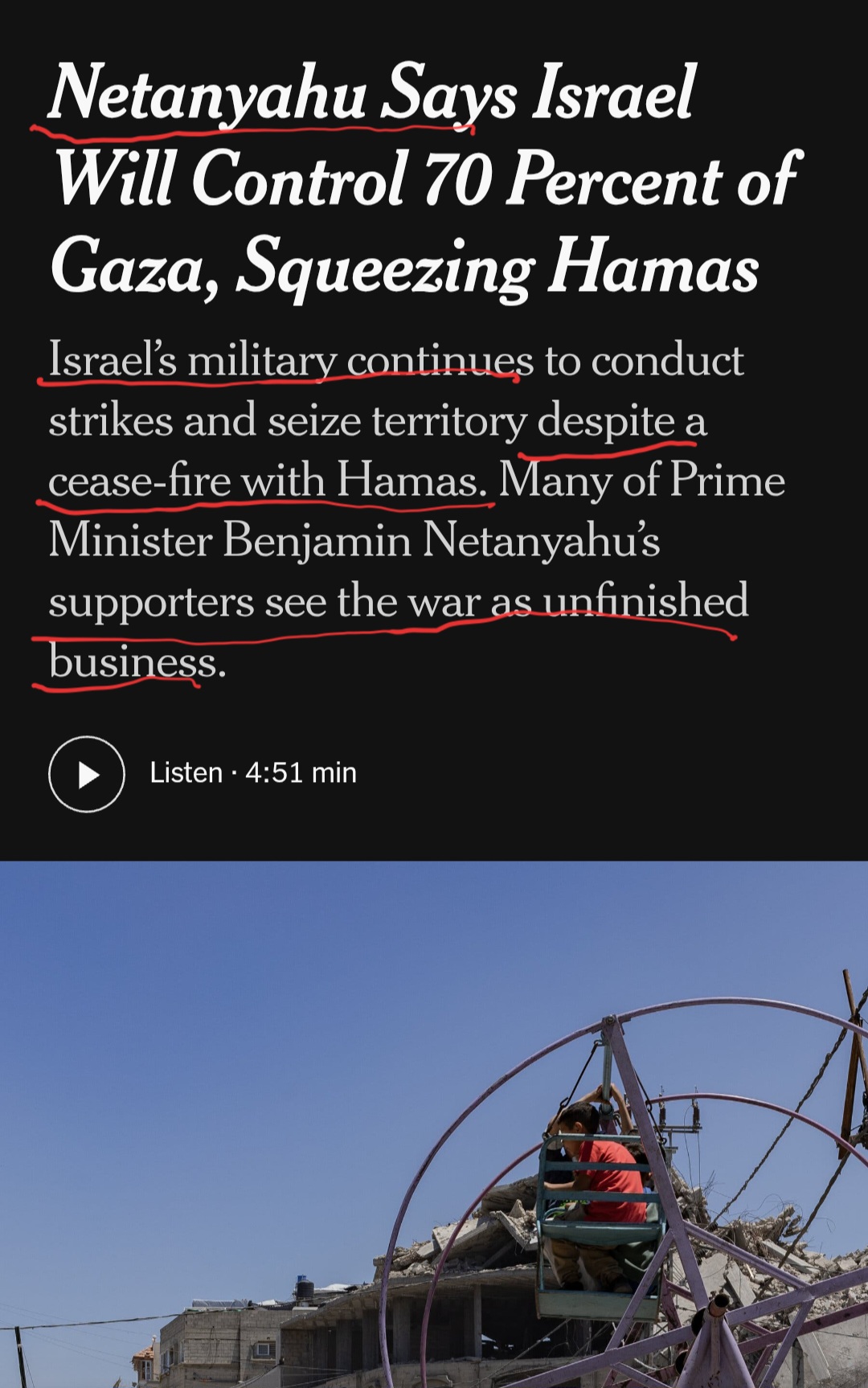
Yet still, the New York Times publishes lengthy articles that the Gaza war continues because of Israel.
Readers were taken inside Benjamin Netanyahu’s political calculations. They learned about coalition pressures, right-wing ministers, territorial ambitions, and supporters who view the war as unfinished business.
By the end, a clear narrative emerged: the war continues because Israelis want it to continue. Because of greed for land, for power.
There was no mention that Gazans want Hamas to remain armed and for the war to continue. That is the political reality that keeps a ceasefire from taking hold.
The omission matters because it changes the reader’s understanding of the conflict. It places blame solely on Israel when a majority of Palestinians continue to seek the destruction of Israel despite the devastation in Gaza.
Until journalists devote the same attention to Palestinian motivations that they devote to Israeli motivations, Americans will continue receiving a false explanation for why this war endures.
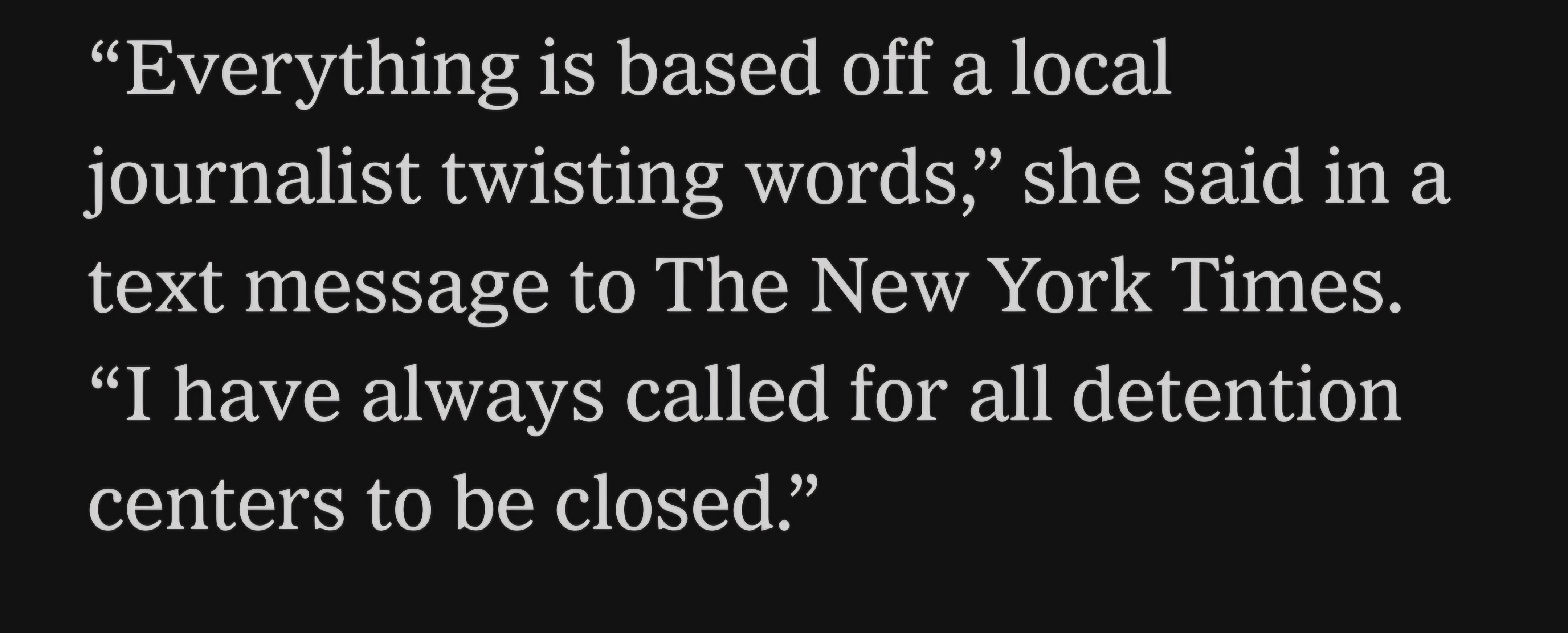
Imagine a congressional candidate proposing detention camps for members of another minority group.
Imagine accusing that group of criminality, depravity, and collective guilt. Imagine that candidate finishing first in a major-party primary and having a realistic path to Congress.
What would journalists focus on? The candidate? Or everyone around her?
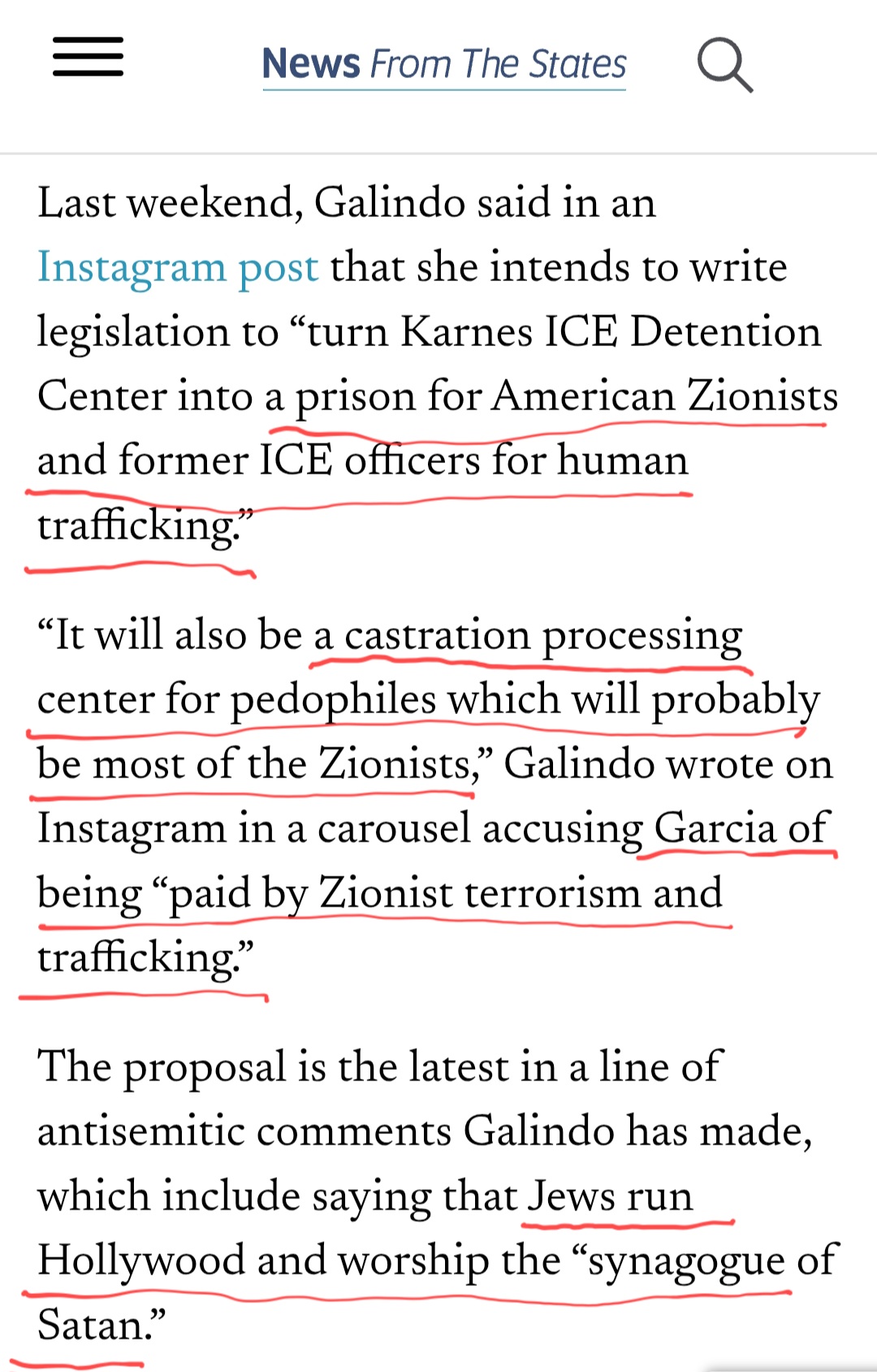
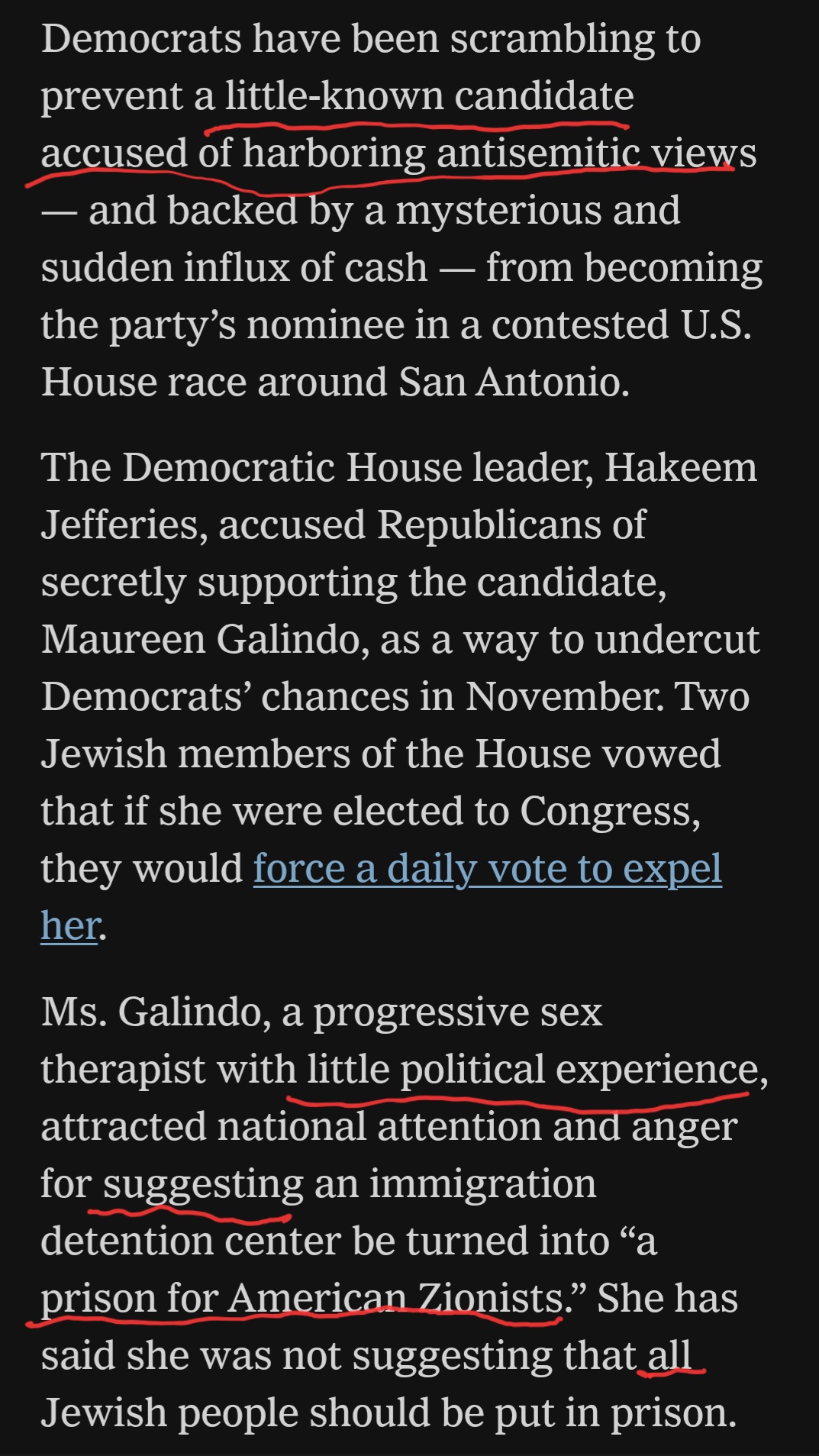
“turn Karnes ICE Detention Center into a prison for American Zionists” – Maureen Galindo, leading Democrat for TX-35
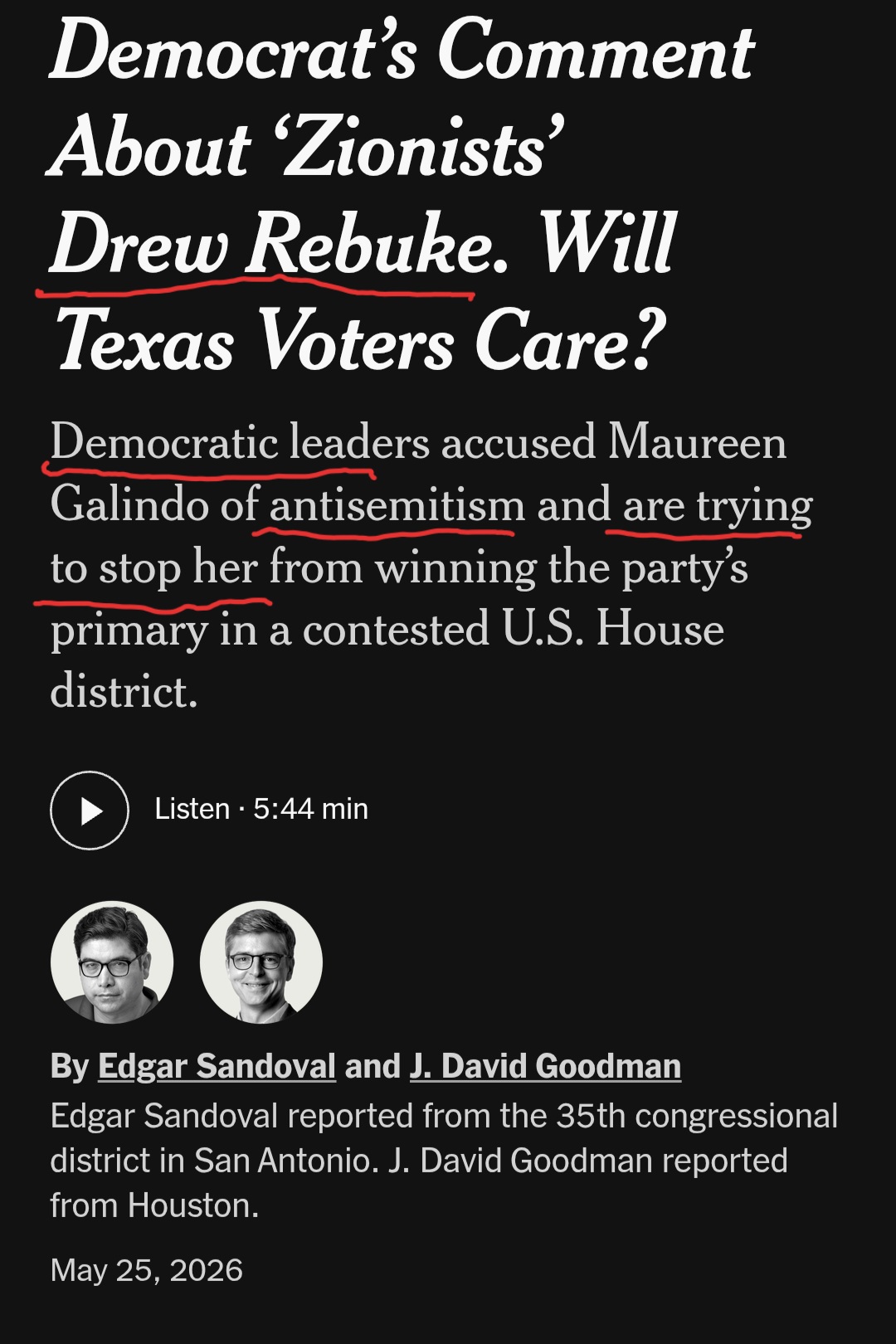
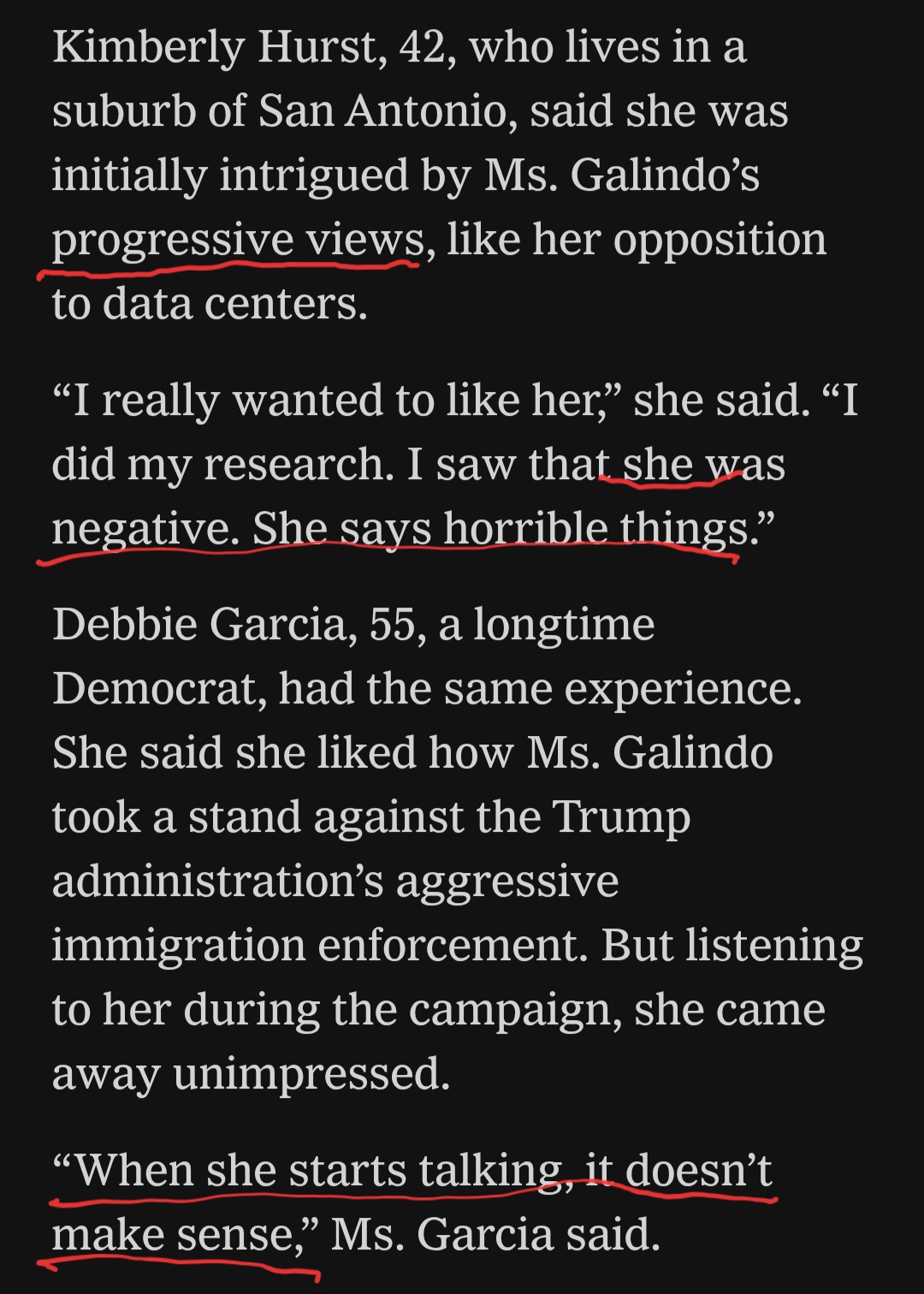
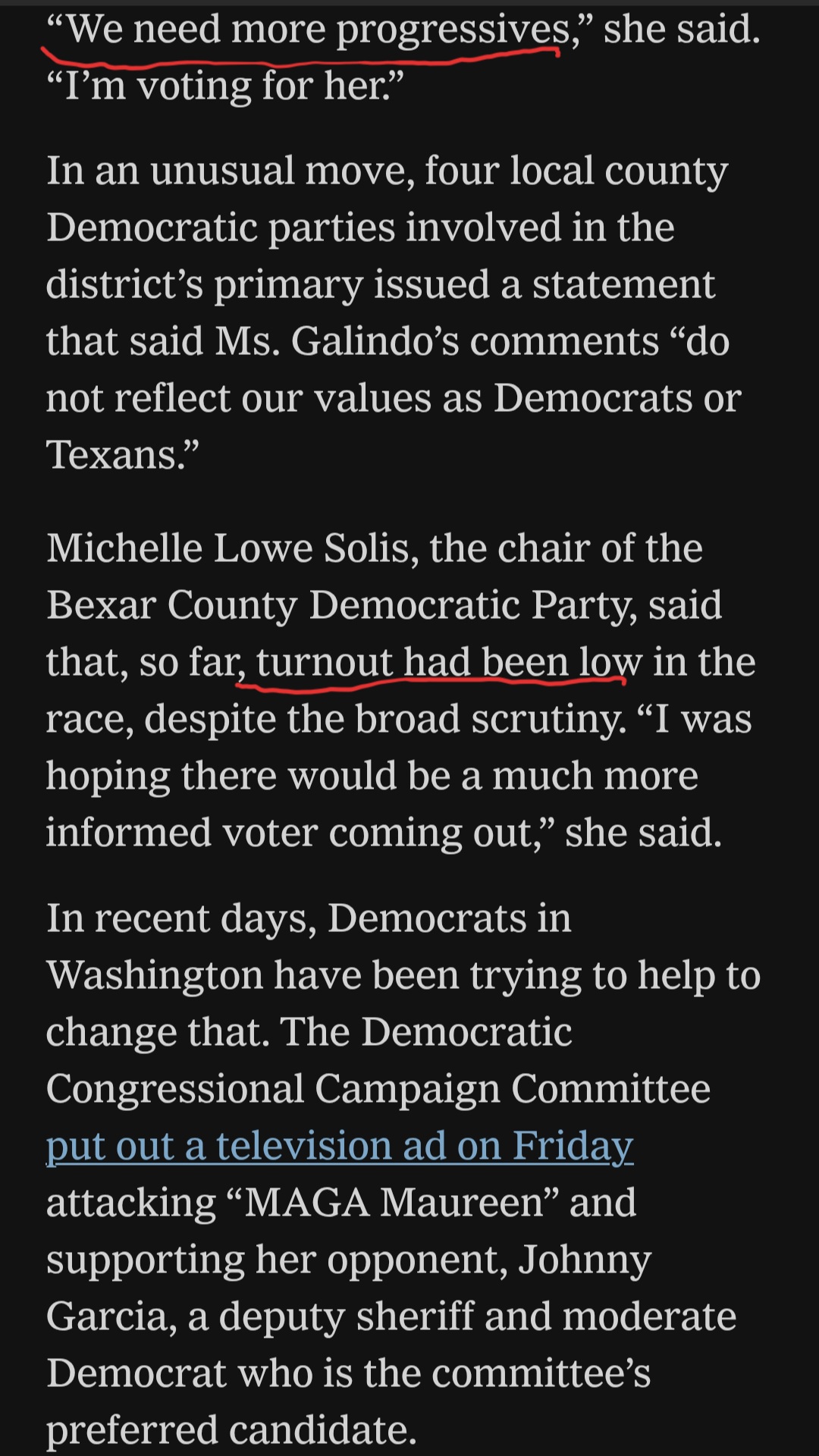
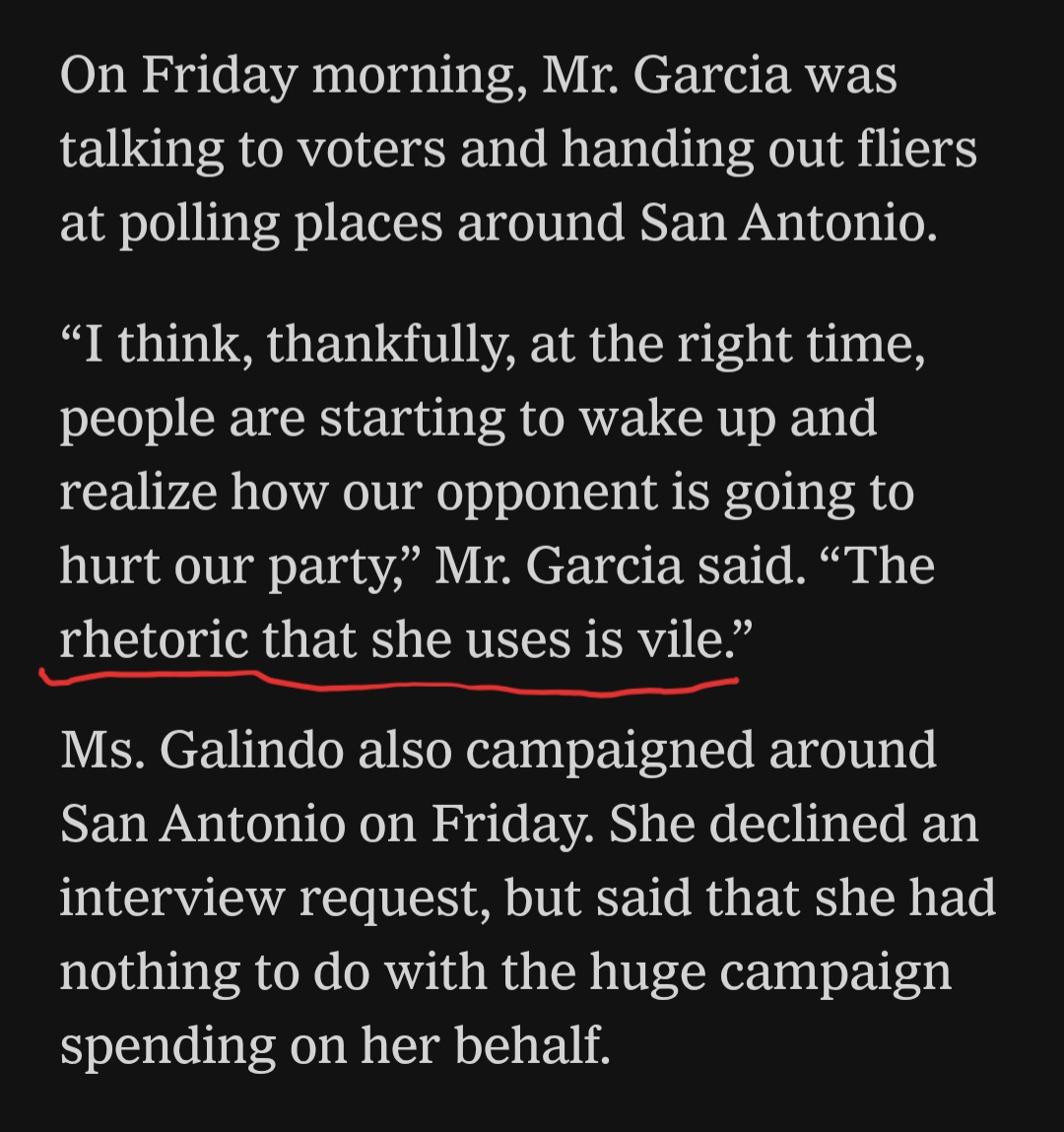
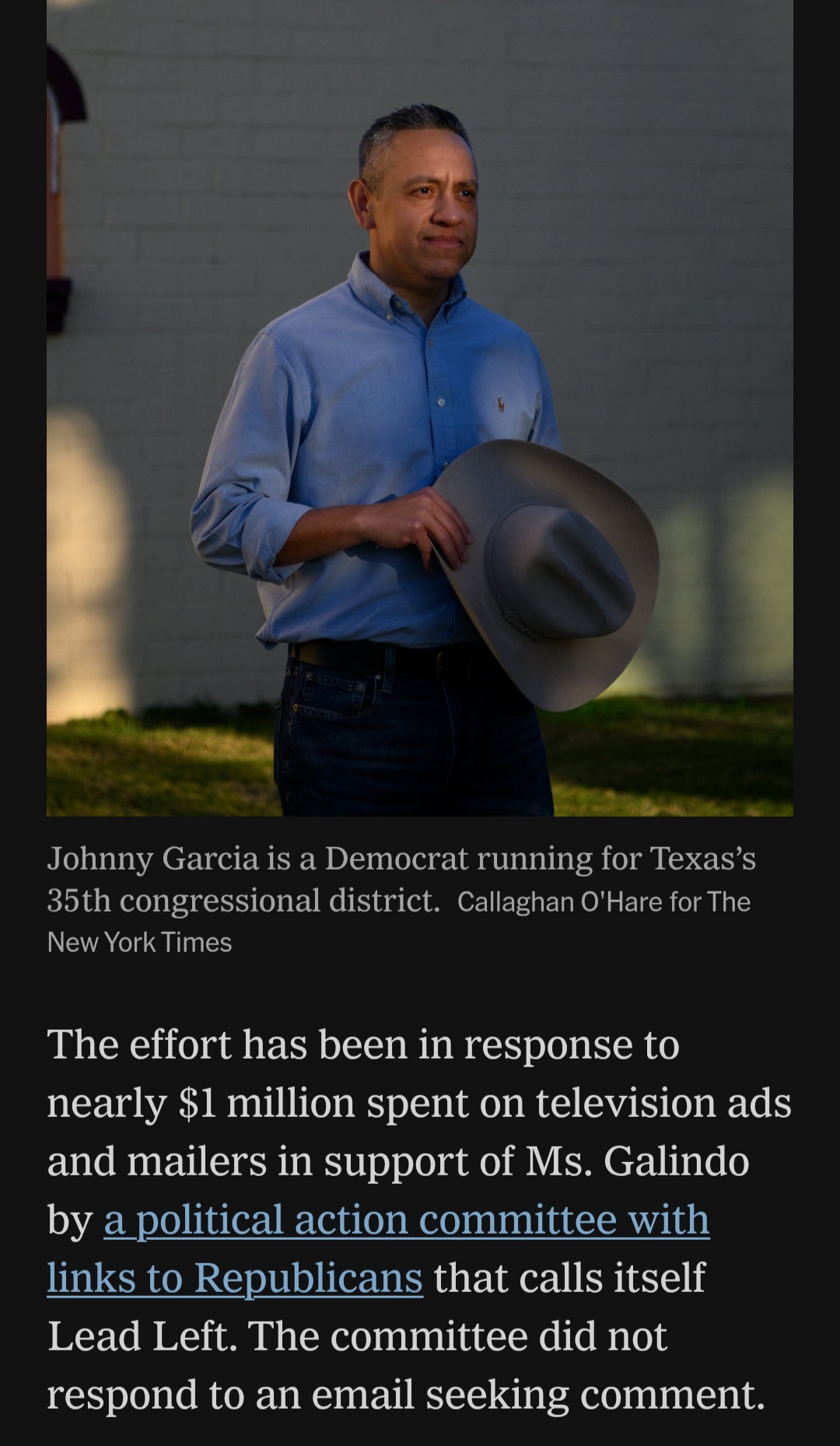
That question hovered over the New York Times coverage of Texas congressional candidate Maureen Galindo. Readers learned about Republican efforts to boost her candidacy. They learned that Democratic leaders denounced her. They learned of fears that she could become a liability for her party.
What they largely did not receive was a full accounting of Galindo herself.
accused her opponent of being “paid by Zionist terrorism and trafficking.” – Maureen Galindo, leading Democrat for TX-35
The article informed readers that Galindo had made inflammatory remarks. It offered a glimpse of the controversy. Yet it spent remarkably little time exposing the breadth and character of the rhetoric that made her candidacy so extraordinary. Galindo’s own words appeared only in fragments. Her worldview remained mostly offstage.
The effect was subtle but significant. Readers were encouraged to view Galindo as a political problem rather than as a political phenomenon.
Jews run Hollywood and worship at the “synagogue of Satan.” – Maureen Galindo, leading Democrat for TX-35
The frame became Republican meddling.
The story should have been why thousands of Democratic voters found her acceptable.
Republican spending may have increased Galindo’s visibility. Democratic leaders may have condemned her. Neither explains why a candidate whose rhetoric would once have ended a political career finished first in a Democratic primary.
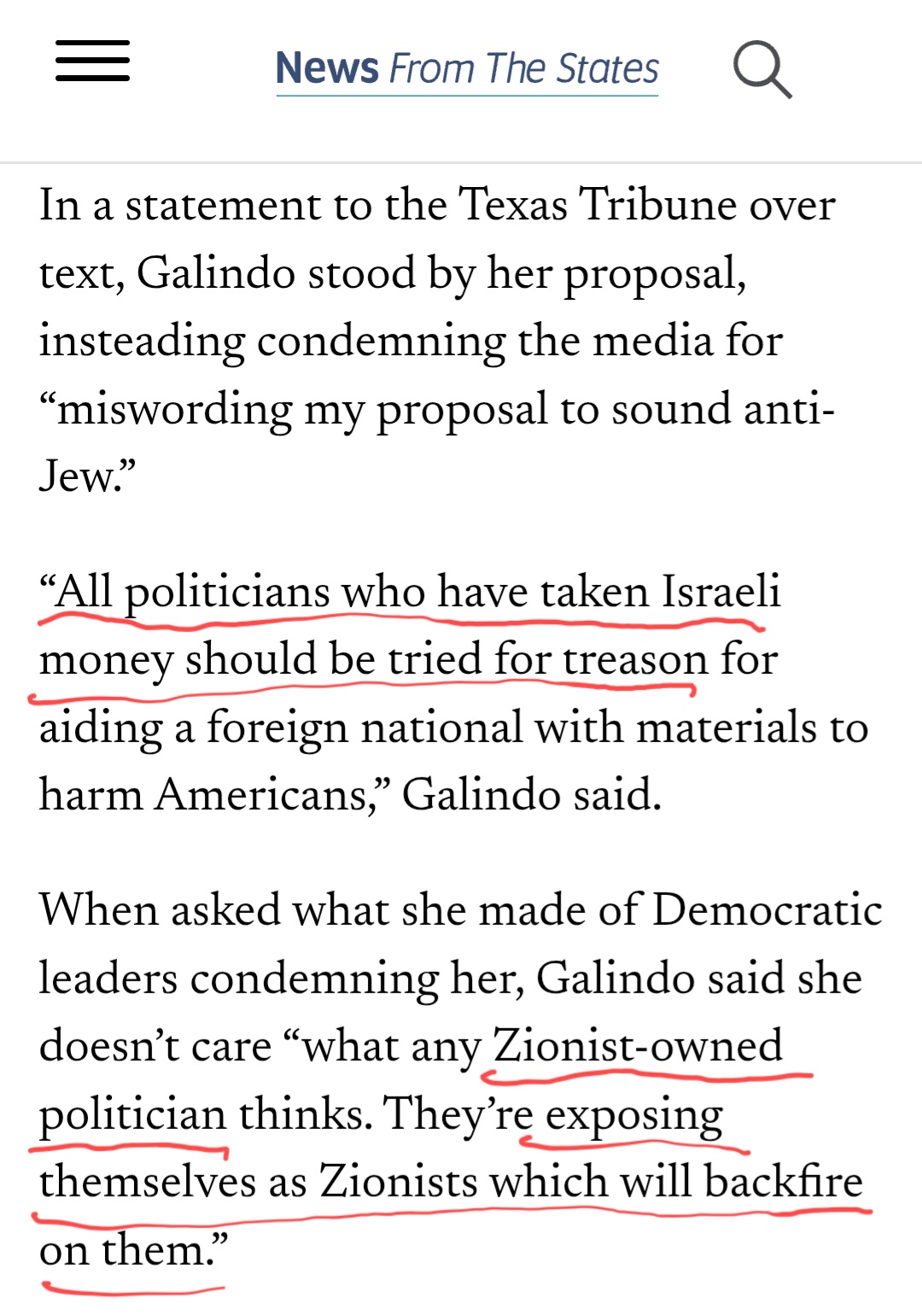
“All politicians who have taken Israeli money should be tried for treason” – Maureen Galindo, leading Democrat for TX-35
That is the question the article never seriously explored.
The answer may lie in a reality that many journalists remain reluctant to confront that antisemitism is increasingly treated differently from other forms of prejudice.
When politicians target most minority groups, journalists lead with the offensive remarks themselves. Readers see the words and judge them accordingly.
When Jews or Zionists are the target, the instinct often shifts toward explanation. The discussion moves to grievances, movements, funding, coalitions, and historical forces. The prejudice becomes something to interpret rather than confront.
I don’t care “what any Zionist-owned politician thinks. They’re exposing themselves as Zionists which will backfire on them.” – Maureen Galindo, leading Democrat for TX-35
This pattern has become particularly visible in discussions surrounding Zionism. For years, much of the political and academic world insisted that anti-Zionism and antisemitism occupy entirely separate categories. One concerns a state. The other concerns a people.
Galindo’s rhetoric collapses that distinction.
Her remarks are not primarily arguments about settlements, borders, military policy, or diplomatic arrangements. They concern Zionists in the United States. They assign collective characteristics to an enormous population. They transform a political identity into a moral category. They depict entire groups as uniquely dangerous and deserving of extraordinary treatment.
That is why her candidacy matters.
Not because she is representative of all progressives. She clearly is not.
Not because every critic of Israel shares her views. They plainly do not.
She matters because she demonstrates how rhetoric that would be instantly recognized as bigotry in almost any other context can find an audience when directed at Zionists and Jews.
And that audience is no longer hypothetical.
Galindo finished first because real voters chose her. That fact should have been the center of the story.
Instead, the NY Times coverage drifted toward a more comfortable explanation: Republicans boosted her campaign because they wanted to embarrass Democrats.
Perhaps they did.
Political parties routinely try to elevate weak or extreme opponents. There is nothing novel about the tactic.
What is novel is the assumption that the tactic itself explains the outcome. It does not.
A campaign contribution can buy advertising. It cannot manufacture belief. A mailer can increase awareness. It cannot create enthusiasm where none exists. Electoral manipulation may shape margins, but it does not explain why a message resonates.
To understand Galindo’s success requires examining the movement that produced her supporters rather than the operatives who noticed them.
That inquiry would lead into uncomfortable territory. It would require asking why anti-Israel activism increasingly attracts rhetoric that once belonged on the fringes of political life. It would require examining how language once considered antisemitic is repackaged as moral virtue. It would require acknowledging that hatred can emerge from the left no less than from the right.
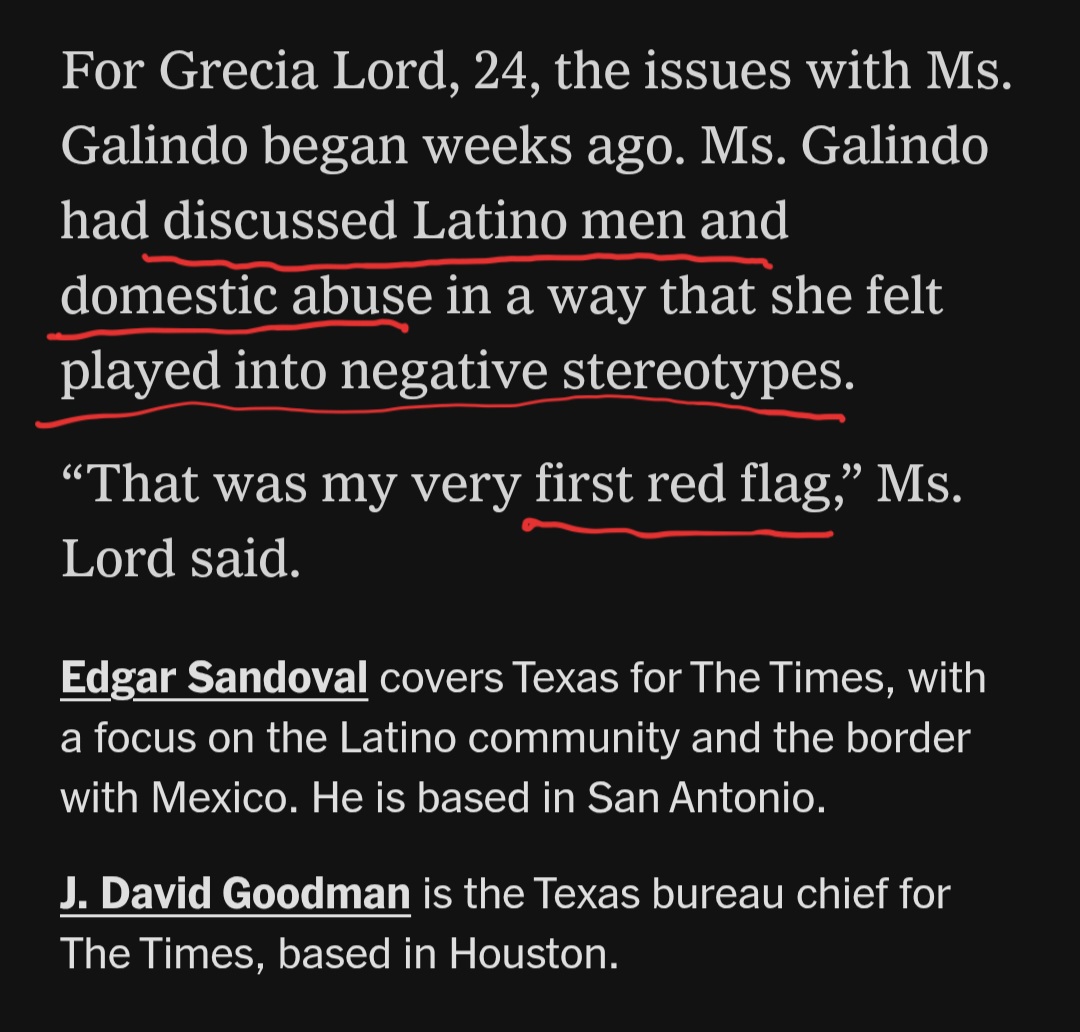
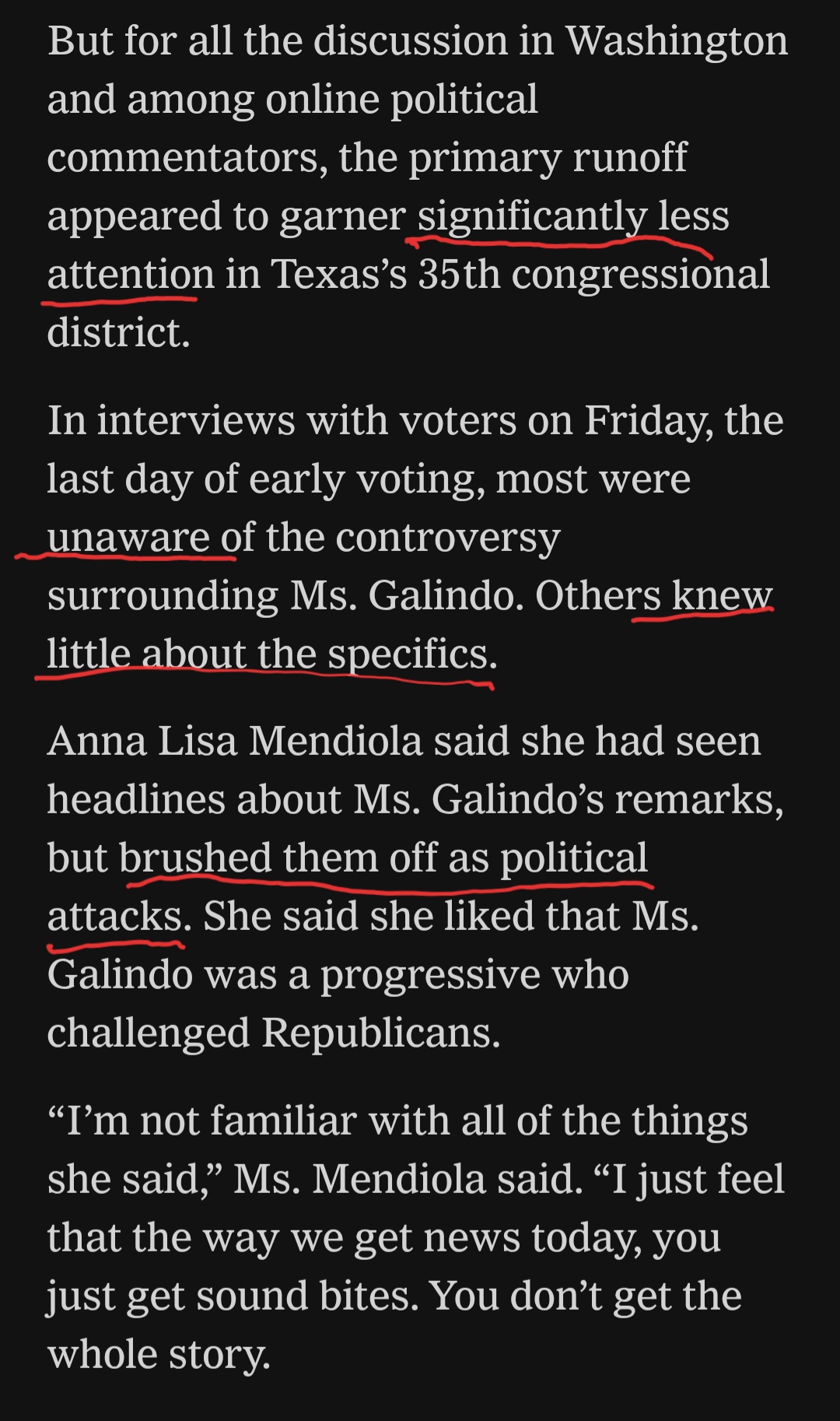
Instead, the Times watered down the belief system of Galindo’s voters. It argued that the bile had “significantly less attention in Texas’s 35th congressional district.” It claimed that “most were unaware of the controversy,” and “knew little about the specifics.” It quoted a progressive who heard about Galindo’s smears “but brushed them as a political attacks.”
In other words, the Times deliberately sought to portray the progressive voters for Galindo as NOT antisemitic nor anti-Israel, just unaware.
This is journalistic malfeasance. It would never happen for any other minority group, and certainly not one experiencing a wave of hate crimes.
Journalists are trained to recognize certain forms of extremism instantly and warn readers about their implications.
The danger is not only the prejudice they recognize. It is also the prejudice they explain until it begins to sound normal.
Maureen Galindo may or may not win her race. What matters is that a candidate who trafficked in rhetoric that would have dominated headlines if directed at almost any other minority group finished first in a Democratic primary.
The New York Times’ Nicholas Kristoff caused a stir when he reported on the daily rape of Palestinian Arabs by Israeli dogs while incarcerated. Pro-Palestinians were appalled and pro-Israelis were shocked at the charge – what kind of inanity? How is this even possible?
New York Times’ Nicholas Kristoff
Let me tell everyone about the ugly reality. I have been investigating this for years. I have a mole (an actual one) as well as a source inside the Zionist security apparatus. Let me just call him Colonel Klink to protect his identity, and I will fully expose what Kristoff only touched upon.
The Israeli prisons have vast storehouses of Bamba that they crumble and smear all over their Arab captives for interrogations. The peanut butter smell drives the dogs wild as they sexually maul the exposed Gazans and West Bank Arabs. The Israeli guards allow the abuse to go on until the Arab prisoners reveal the sordid plans they have for Israeli Jews, which the guards write down and then sell to Lior Raz for plots for the next season of Fauda.
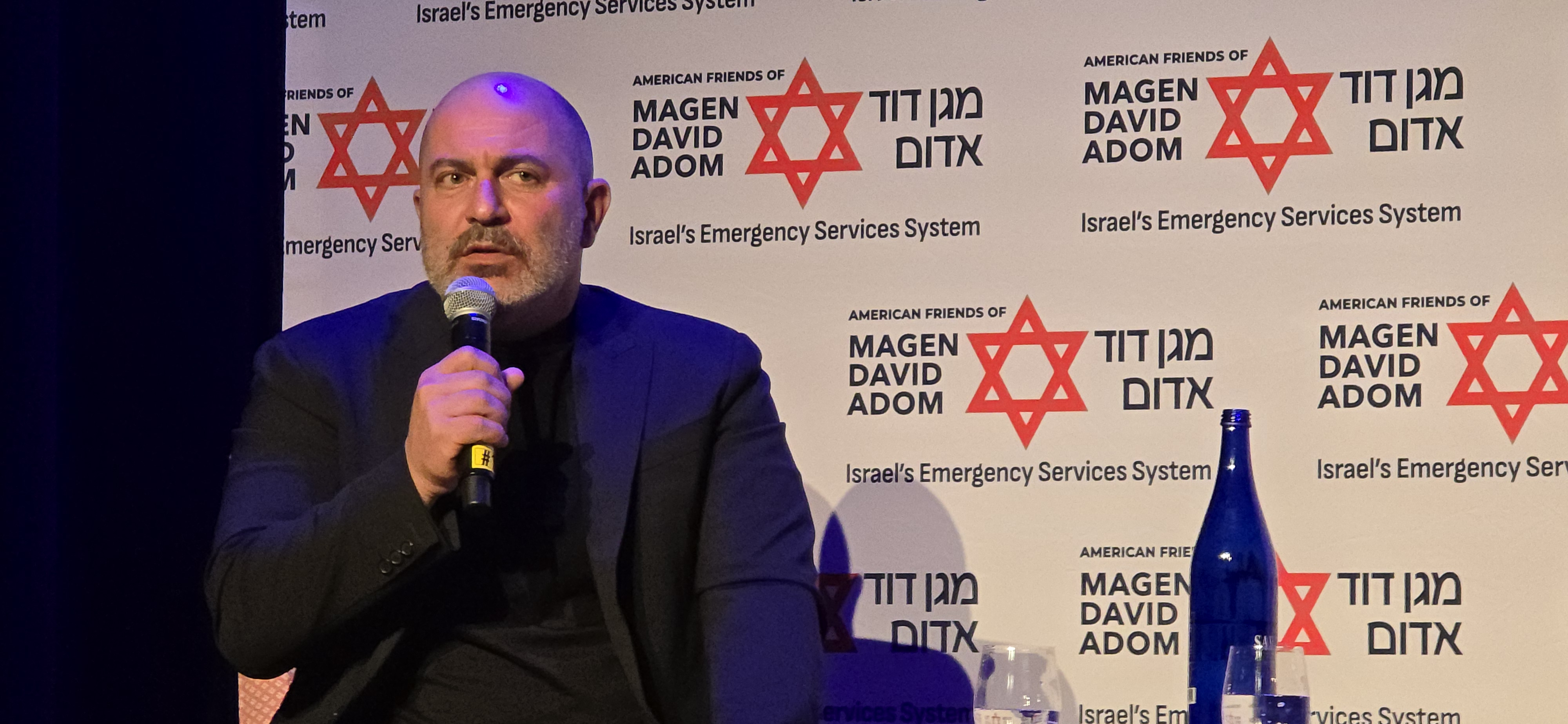
Lior Raz of Fauda during a fundraiser for the Zionist ambulance service
This is only the tip of the canine iceberg.
Israeli border collies have been herding Palestinian sheep into “open air prisons” for years. The Israel Guide Dog Center for the Blind offers the yellow Labradors and Golden Retrievers to Jews, while reserving the black Labradors for Israeli Arabs because of the deep racism embedded in Israeli society – even for blind people.
The animal cruelty knows no bounds.
ASPCA locations around the United States have been used as Mossad safe houses since the founding of the Zionist state. Dogs that people adopt have chips in them which the Israeli government uses to track millions of Americans.
The colonialists have even established an elite cat unit trained in pickpocketing, emotional manipulation, and knocking over glasses of water during hostage negotiations. One tabby roaming tourist cafes allegedly stole three passports, two vapes, and an unopened yogurt from a Scandinavian journalist.
In New York, Israeli units have dispatched Portuguese Water Dogs in Times Square where they operate Thee Card Monte tables to rob tourists. The same unit uses Standard Poodles to sell knock-off Gucci handbags while they gather intel on Muslim Halal food cart vendors, who are in turn, casing American streets for easy targets.
In the Holy Land, Palestinian Authority President-for-life Mahmoud Abbas has accused Israel of “weaponizing pigeons” to deliberately defecate across public spaces in Palestinian cities. “This is organized biological warfare,” Abbas reportedly declared. “The pigeons target only Palestinian vehicles, Palestinian balconies, and Palestinian laundry.”
The humanitarian crisis expanded into the political sphere this week after activists accused Israel of operating what one NGO called “a sophisticated interspecies apartheid system” stretching across land, sea, air, and now apparently pollination networks, as Israeli bees are chemically treated to be unable to approach plants in Arab fields.
Speaking emotionally before reporters, Rep. Rashida Tlaib (D-MI) condemned what she described as “the ongoing Animal Nakba. Not only are Palestinians suffering under the imperialist Zionist regime,” she declared, “the indigenous animals and insects are suffering too.”
One Gazan who was set free in a prisoner exchange told me that he witnessed parrots repeatedly curse prisoners in multiple languages to degrade the Palestinian spirit. Worst of all, the parrots deliberately spoke in Arabic with a lisp, which made several Palestinians admit to raping Israelis.
Students for Justice in Palestine at Harvard, having heard of this, set up in the center of the campus with placards “Polly want a ceasefire!” Brown University faculty followed launching a new course “Decolonizing Veterinary Power Structures.” Col. Klink has been drafted to be one of the lecturers. The university is seemingly unaware that he is a double agent, trashing the Jewish State to progressive audiences while simultaneously surveilling them.
Brown University online lecture about decolonizing Palestine, seeking to replicate Hamas around the world
Francesca Albanese of the United Nations said the latest findings are deeply upsetting and more evidence regarding the “occupation of bees, apartheid Labradors, militant parrots, and psychologically traumatized hamsters,” although no reports of hamsters being involved in Zionist oppression have emerged. Yet.
Anti-Israel members of New York City’s Mayor Zohran Mamdani’s team have urged the mayor to stop the Celebrate Israel Parade, which the mayor is reportedly considering. He has also suggested banning all Jews from adopting pets in the city, but his lawyers said that crossed the line into antisemitism. Zohran reportedly just shrugged and said “so what?”
In Washington, DC, President Trump has reportedly asked Israeli Prime Minister Benjamin Netanyahu about deploying the specially trained animal units in the Islamic Republic of Iran and against various anti-American groups inside the United States. “Bibi” is expected to not only comply, but share data from the sleeper pet cells in millions of American homes.
A new front in the Zionist war has been exposed which runs much deeper than even the most virulently anti-Israel groups ever imagined. It’s inter-species, which Candace Owens claimed further proved that Jews aren’t even 100 percent human. (Her agent continues to state that she is not antisemitic).