Names and Narrative: Terrorist and Genocide

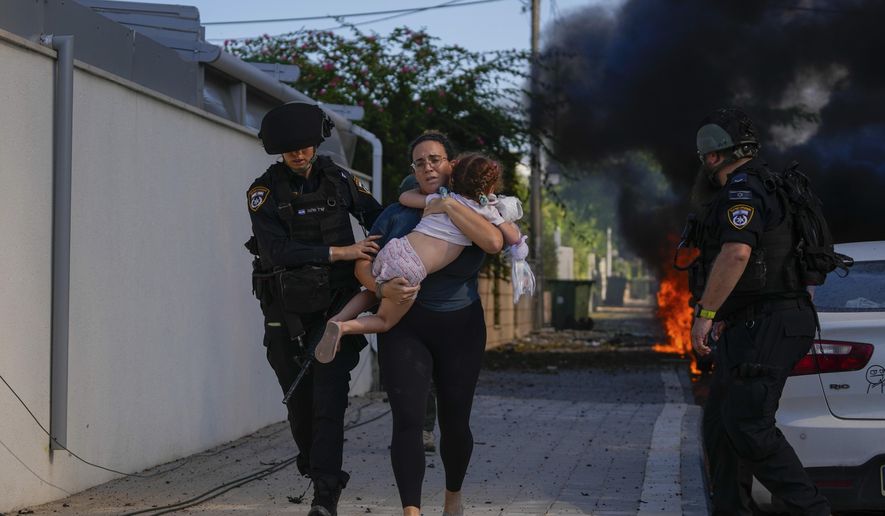
Hamas has been a U.S.-designated Foreign Terrorist Organization since 1997, when the list was first developed. On October 7, 2023, Hamas-led attackers invaded Israel, deliberately murdered civilians and kidnapped over 250 people.

It was designated terrorists committing terrorism.

Yet “terrorist” became a troublesome word for mainstream media and alt-left politicians.

The Associated Press advises journalists to describe specific acts and generally attribute the terms terrorism and terrorist to people or organizations, rather than independently apply them. Amnesty International has gone further, explaining that it generally avoids the terms because they lack an agreed legal definition and carry strong political and emotional connotations.

That restraint evaporates around “genocide.”

Genocide is the more demanding accusation. Death, destruction and even war crimes do not establish it. The Genocide Convention requires the specific intent to destroy, in whole or in part, a protected group as such. Israel emphatically denies that intent, maintaining that it went to war to defeat Hamas – the terrorists which had committed mass terrorism – and recover its hostages, not destroy Palestinian Arabs.

Amnesty nevertheless declares that Israel is committing genocide. The same organization that will not call Hamas a terrorist organization after its deliberate slaughter and kidnapping of civilians has no hesitation resolving the vastly more difficult question of Israeli intent.

Progressive politicians follow the same linguistic path. Rashida Tlaib (D-MI) was accusing Israel of genocide within weeks of October 7 and later called Benjamin Netanyahu a “genocidal maniac.” Zohran Mamdani repeatedly describes the October 7 massacre as a “horrific war crime” rather than a terrorist act, while calling Israel’s war “genocide” and Netanyahu the “architect of a horrific genocide.”

The burden of proof has been turned upside down.

Calling October 7 terrorism requires looking simply at what Hamas did: a designated terrorist organization deliberately murdered and kidnapped civilians for political and ideological purposes. It is plainly terrorism.

Calling Israel’s war genocide requires establishing why Israel fought it: that its actual intent was to destroy Palestinian Arabs as a people rather than defeat Hamas in a defensive war.

Yet the first conclusion is treated as dangerously judgmental while the second is repeated as established fact.

Mehdi Hasan offered an almost grotesque demonstration this week while attacking a New York Times essay by Gazan Palestinian Ahmed Fouad Alkhatib urging Palestinians to resist Hamas. Hasan called people sharing the essay “pro-genocide people,” Israel “the genocidaire,” the essay “a pro genocide piece” and the war “this current genocide.”

Hasan suffers a genocide stutter.
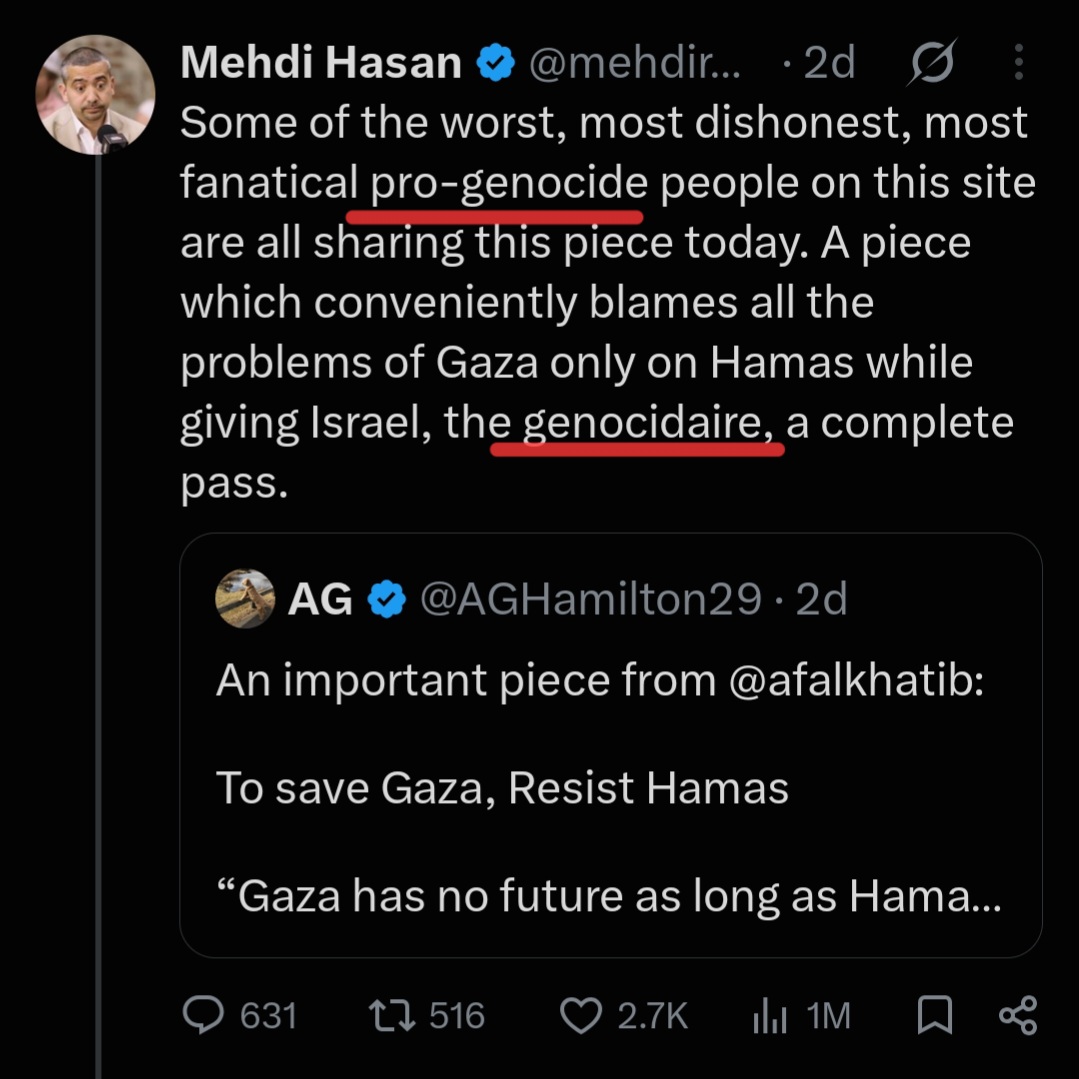
He cannot bring himself to say clearly and unambiguously that Hamas is a terrorist group and committed a heinous terrorist act, but cannot get the word “genocide” out of his mouth as he tries to hypnotize viewers into believing the unbelievable about Israel.

And the accusation does not remain attached to Israel’s government. Once genocide becomes the premise, anyone defending Israel can become pro-genocide. Even a Palestinian Arab arguing that his own people must resist Hamas can produce a pro-genocide piece for the obsessive compulsive stutterer.

That is how a defamatory vocabulary spreads.

Genocide is among the gravest accusations that can be made against a people or state. Repeating it as established fact without establishing the specific intent the crime requires does more than distort a war. It tells millions of people that Israel is deliberately destroying Palestinian Arabs and that those who defend Israel are defending that destruction.

That is an incendiary allegation in a world where Jews and Israelis are already threatened and attacked over Gaza.

Meanwhile, terrorist is handled delicately when describing the organization that deliberately slaughtered civilians on October 7 in the worst slaughter of Jews since the Holocaust.

The asymmetry is morally grotesque. Hasan, Tlaib, Mamdani are trafficking in the asymmetry of whataboutery as a heinous veneer to protect antisemitic terrorists, plain and simple.

Genocide Math

We know that every death is a tragedy. We all wish there wasn’t war. Yet wars happen.

There have been several attempts to portray the current Gazans war against Israel in various lights. Some people have used the civilian-to-death ratio in this war of roughly 2-to-1 as historically low compared to any urban combat in modern times, especially one in which the army hides underneath the homes and hospitals of the civilian population.

Here, we lay out the civilian death figures relative to other modern wars which had many civilian deaths.

Assuming:

  • 73,356 reported total deaths in Gaza from October 7, 2023 to August 2, 2026
  • 25,000 of those were Hamas or other militants (a rough figure supplied by the Israeli army in January 2026)
  • Civilian deaths = 48,356
  • Prewar population = 2.2 million
  • Duration = 34 months

The calculation is:

  • Overall civilian mortality: 48,356 ÷ 2,200,000 = 2.19% of Gaza’s population.
  • Average civilian mortality per month: 2.19% ÷ 34 = 0.055% per month.

That yields the following comparison:

CaseEstimated monthly percentage killedMultiple of Gaza civilian rate (0.055%/month)
Gaza [2023-present]0.055%
Guatemala (Ixil) [1981-3]0.10%1.8×
Darfur [2003-5]0.11%–0.17%2.0-3.1x
Roma genocide [1939-45]0.20%–0.69%3.6–12.5×
Anfal (Kurds) [1987-8]0.22%–0.44%4–8×
Ustaše genocide [1941-5]0.36%6.5×
Cambodia [1975-9]0.44%–0.59%8–10.7×
Rohingya [2017-8]at least 0.67%12.1×
Holodomor [1932-3]0.73%–1.04%13.2–18.9×
Holocaust [1941-5]1.32%24×
Yazidi genocide [2014-7]0.65%–2.5%11.8–45.4×
Rwanda [1994]13.8%–22%250.9–400×
Srebrenica (monthly equivalent) [1995]~80%~1,454×
Monthly toll of civilian deaths in wars over last 100 years, as a percentage of the total population, in comparison to current Gazan war against Israel
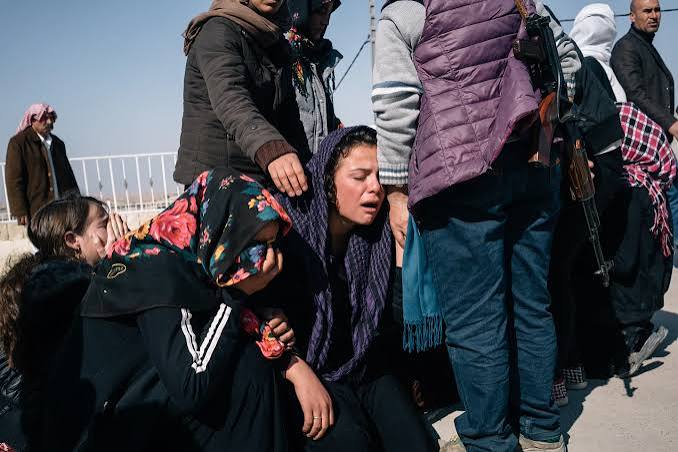
Yazidis are a non-Muslim ethnic group in and around Iraq targeted for persecution and annihilation by ISIS. They continue to suffer persecution from Muslims in Turkey and Iraq.

“IS fighters invaded Yazidi villages and towns in Northern Iraq and Iraqi Kurdistan, rounding up men, women, and children. Yazidi men were ordered to convert to Islam; those who did not, and even some who did, were executed in mass graves. Yazidi women and girls were abducted and sold into sexual slavery, being forcibly “married” to jihadists and other individuals in Iraq, Syria, and other countries. Yazidi boys were also kidnapped by the Islamic State and sent to training camps, where they were indoctrinated into the group’s severe interpretation of Islam and trained to become soldiers. IS glorified its atrocities online in gruesome videos, propaganda magazines, and religious publications, emphasizing its commitment to eradicating Yazidi identity.” – Vicken Cheterian, “ISIS Genocide against the Yazidis and Mass Violence in the Middle East,” British Journal of Middle Eastern Studies 48, no. 4 (2019): 1-7, doi:10.1080/13530194.2019.1683718.

Measured against the last century’s ethnic group civilian deaths, the war in Gaza has produced a far smaller death toll than the wars that shaped recent history. Yet few conflicts of comparable scale have generated such an extraordinary level of international media attention, UN action, street protests, and campus activism.

The conflict has spilled far beyond the battlefield. Around the world, Israelis and Jewish communities have increasingly become targets of hostility, harassment, and violence tied to the war. Whatever one’s views of the prosecution of the war, the global reaction has extended well beyond criticism of a government and the borders of Israel unlike every other conflict, raising profound questions about why this war has become so singular in international political and cultural life.

The numbers remind us that history matters. A world that loses its sense of proportion does not become more moral but selective, narrow and biased.

Related:

We Let Minorities Die In The Middle East (July 2025)

When Words Erase a People

The United Nations is right about one thing.

Words matter.

This week, the UN will commemorate the genocide at Srebrenica under the theme From Words to Violence. The lesson is that language is never merely language. The words societies choose shape how they understand people, history, and ultimately what actions become acceptable.

That lesson should not stop with Srebrenica.

Over the past month, another campaign of words has accelerated – not directly aimed at the destruction of lives, but at the erasure of history.

A month ago, I wrote about the battle over Solomon’s Pools. At the time, the concern was that one of Judaism’s great archaeological treasures was being detached from the people who built it.

Today, the campaign has moved far beyond stewardship.

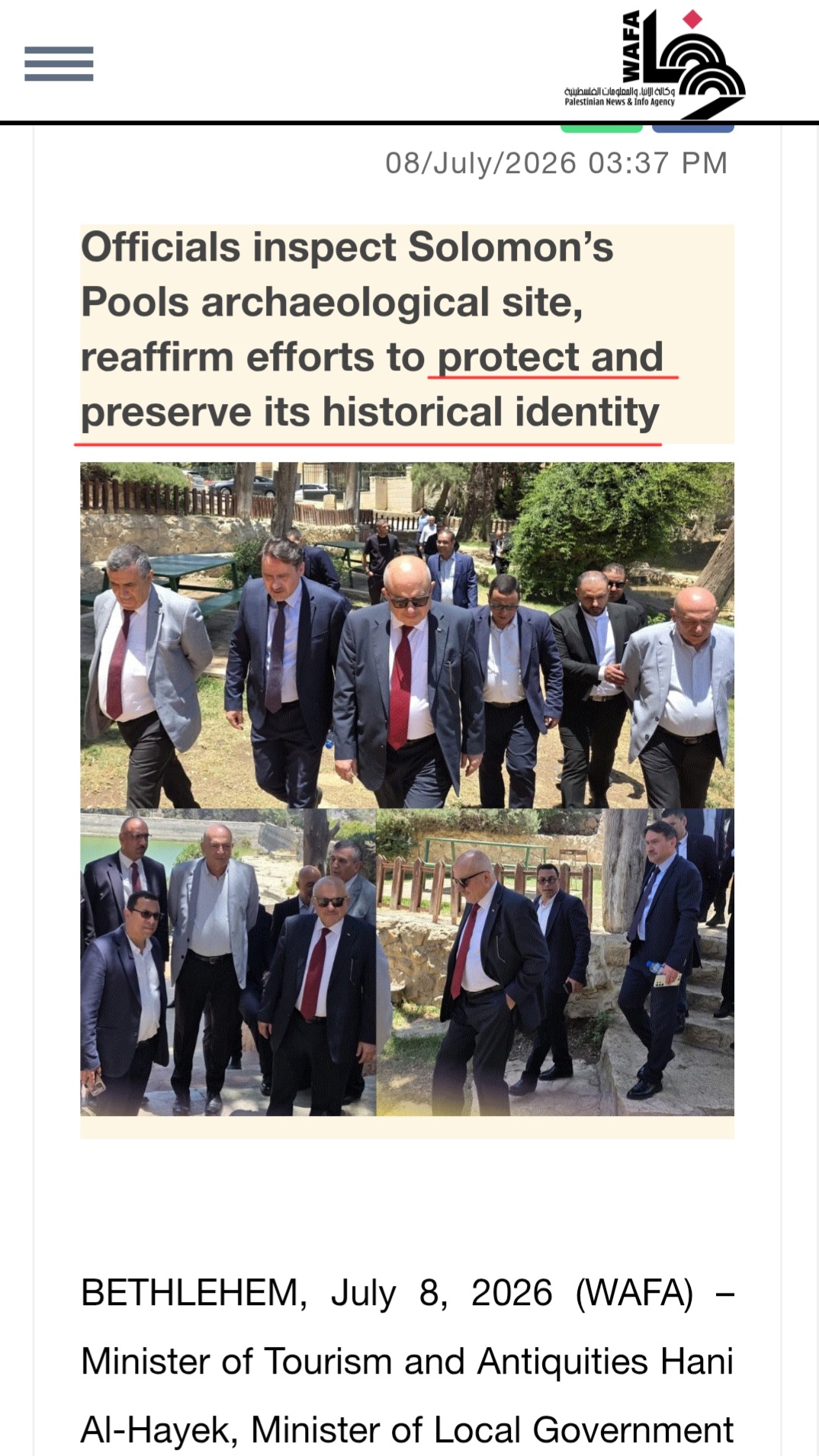
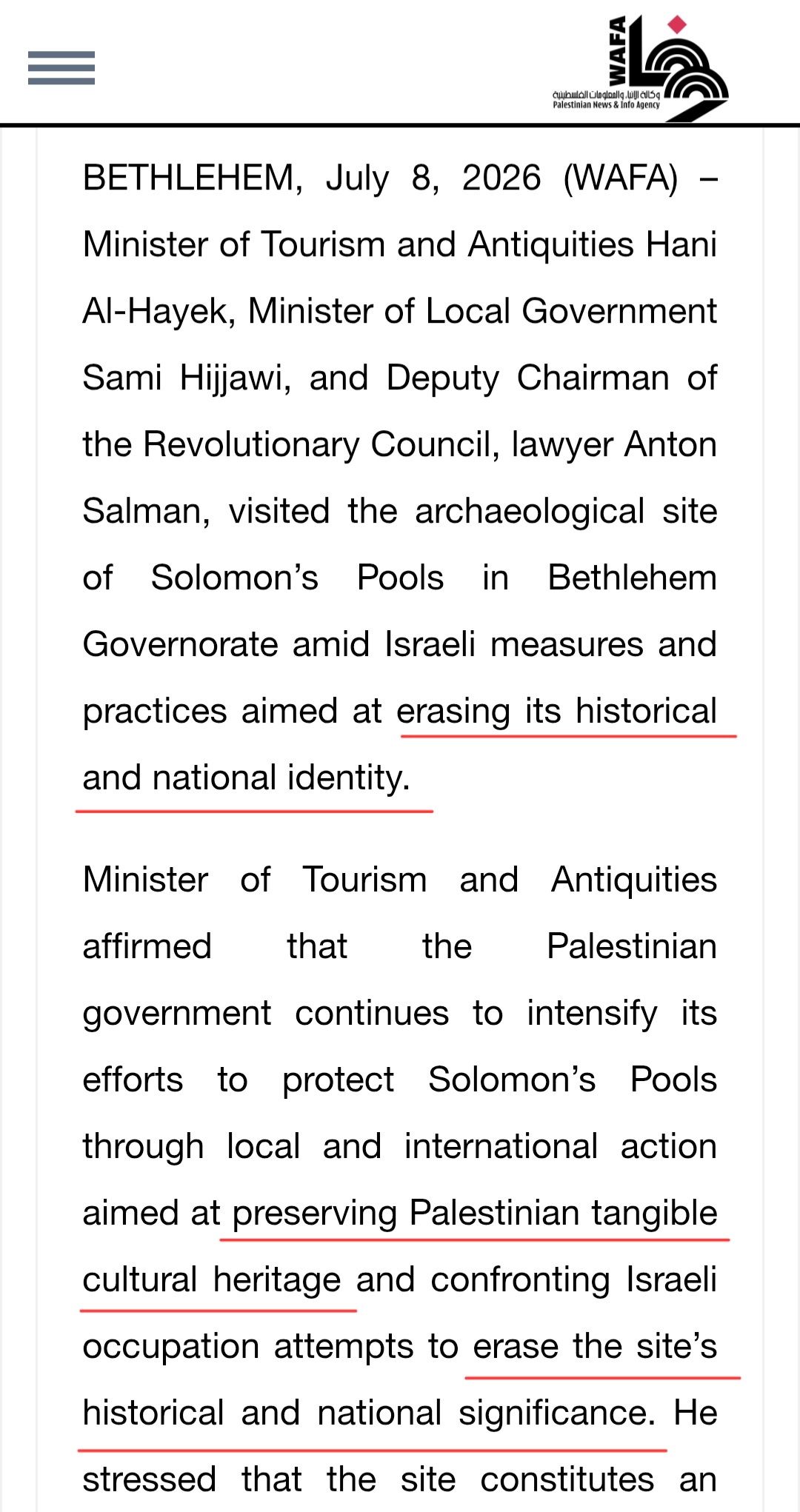
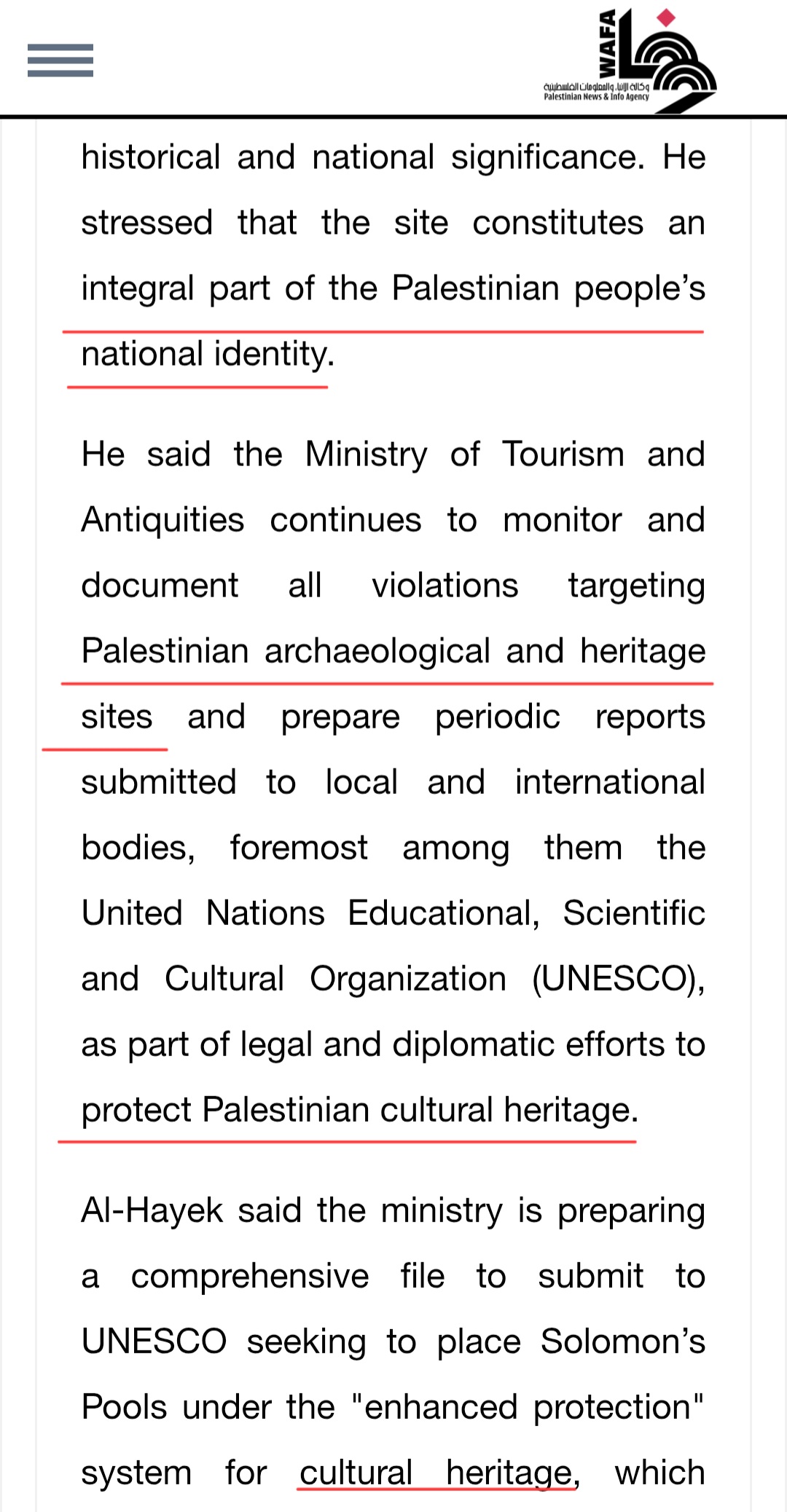
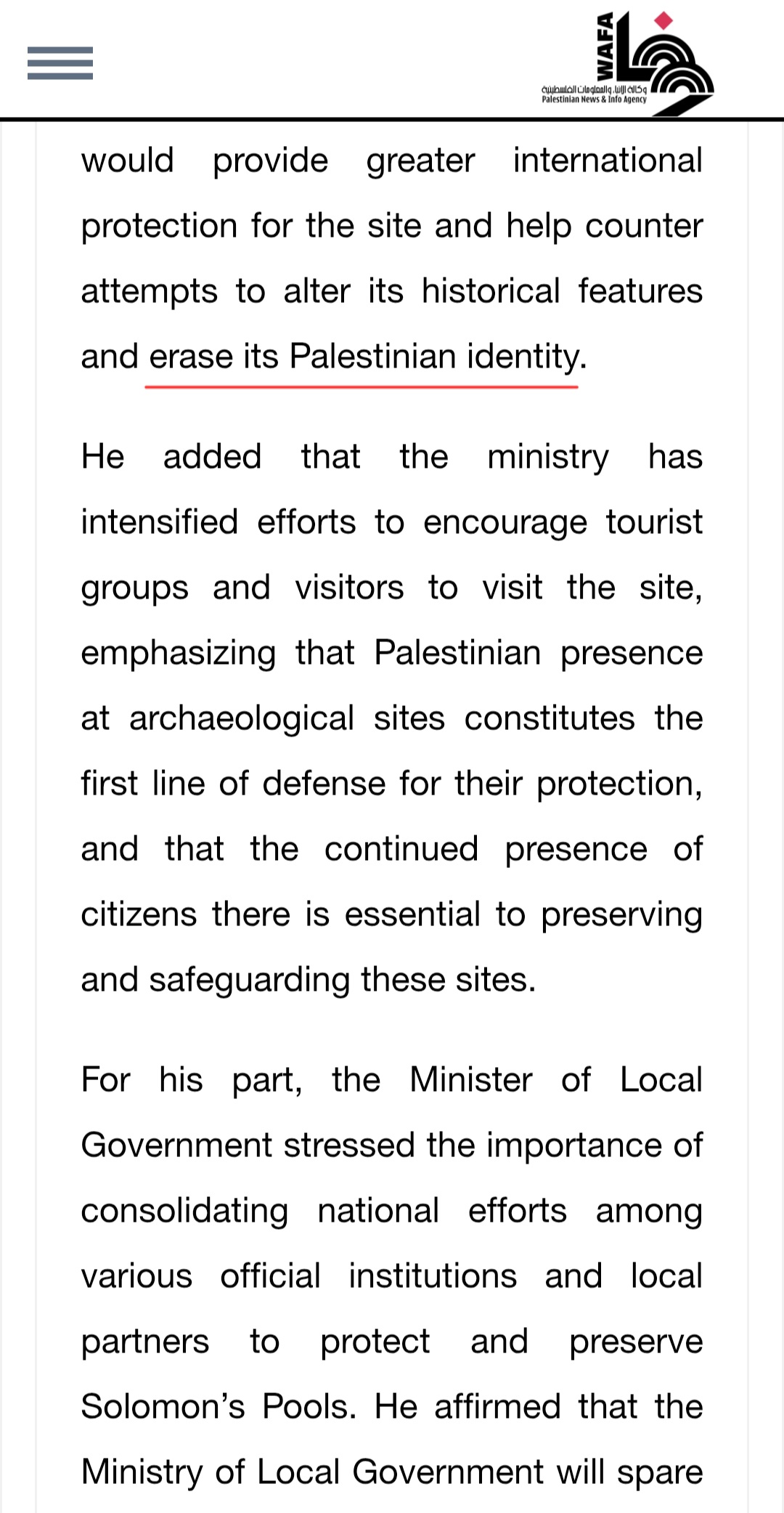
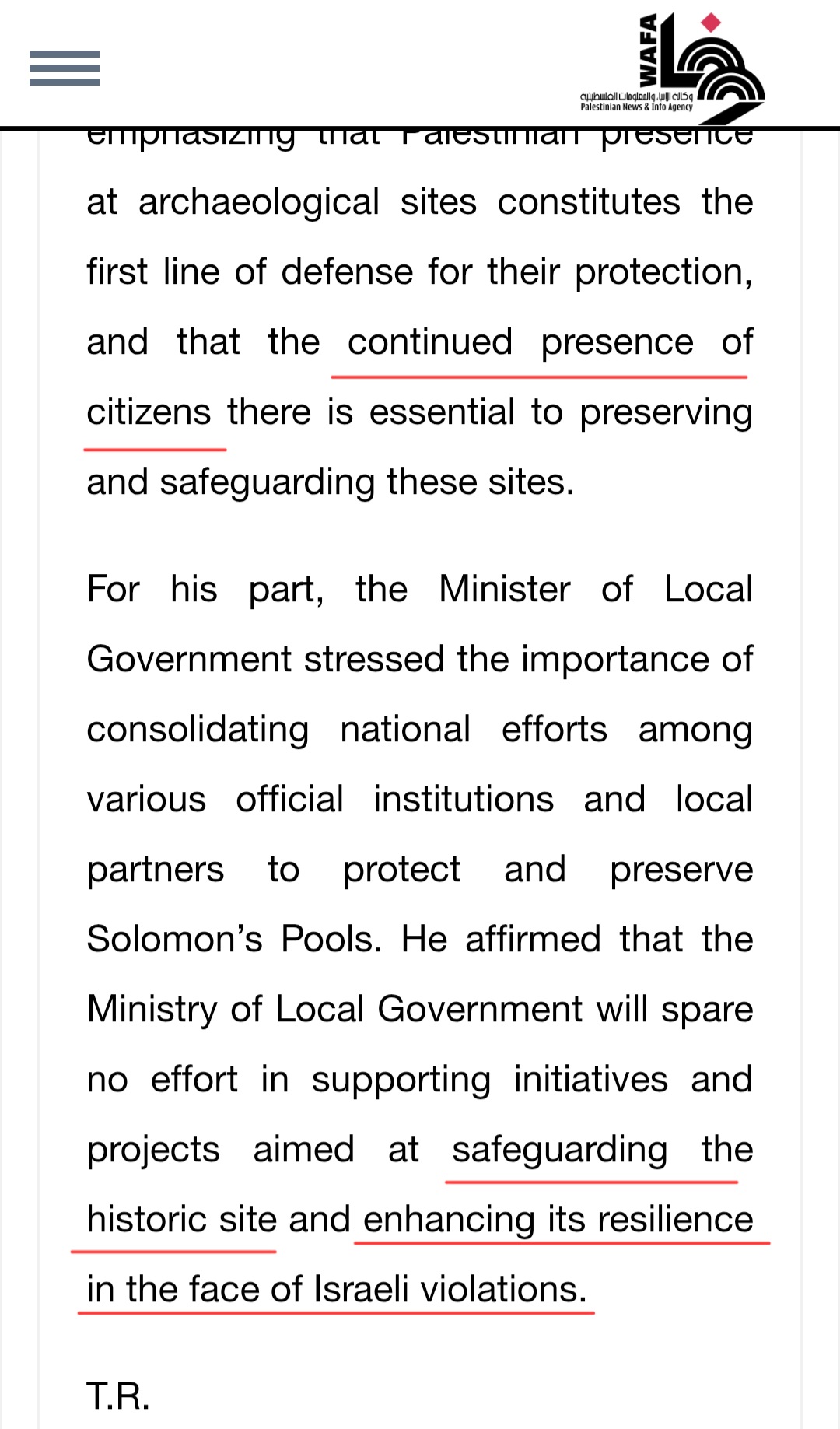
The Palestinian Authority’s official news agency, WAFA, now repeatedly describes Solomon’s Pools as “Palestinian archaeological and heritage sites,” “Palestinian cultural heritage,” and “an integral part of the Palestinian people’s national identity.” It accuses Israel of attempting to erase the site’s Palestinian identity while announcing plans to seek UNESCO protection for that very narrative.

This is historical revisionism.

For more than two thousand years, Solomon’s Pools have been recognized as part of the ancient water system that supplied Jerusalem and the Second Temple. Yet the new narrative increasingly erases that Jewish history while attempting to replace it with a Palestinian Arab one.

That is how historical erasure begins, with words.

It continues with cultural appropriation – taking another civilization’s achievements and presenting them as one’s own. A site built to sustain Jewish Jerusalem is no longer described as part of Jewish civilization, but as an expression of “Palestinian national identity.”

Solomon’s Pools is not an isolated example.

Over the years, Palestinian rhetoric has increasingly described biblical figures and ancient Jewish sites through a Palestinian national lens.

Individually these statements may appear rhetorical. Collectively they reveal a sustained and malicious effort to replace one people’s historical memory with another’s national story.

When a people’s documented history is systematically erased, it reveals a bigotry directed not only against living Jews but against Jewish civilization itself. It reflects national chauvinism, elevating one national identity by absorbing the achievements of another.

And it does this with particular purpose: to strip Jews of their indigeneity in their holy land, to recast them as interlopers and “European settler colonizers” which is deeply infused with a righteous sense of xenophobia.

That is why UNESCO’s role matters.

An organization created to preserve humanity’s cultural heritage should never become an instrument of historical revisionism. If it legitimizes narratives that obscure the well-documented Jewish origins of sites like Solomon’s Pools, it is no longer merely protecting monuments. It is helping redefine what future generations believe those monuments represent.

Turkish media TRT lies to the world that Solomon’s Pools are a 6,000 year-old Canaanite site, as Palestinian Arabs have attempted to recast themselves as ancient Canaanites to pre-date the Jewish forefather Abraham

The danger is larger than a single archaeological site. Words are attempting to erase Jewish history and heritage throughout the Jewish homeland.

The United Nations is correct: words can lead to terrible consequences.

And these words and actions have a particularly dangerous strain of antisemitism. It does not involve attacking Jews physically, which Palestinian Arabs have done repeatedly at scale. It is an insidious attempt to get the world to endorse a narrative that Jews are foreigners in the land to frame a future without the Jewish State. This is the destruction and genocide that emerges from language.

When international institutions lend their authority to that process, they cease to be guardians of history and become participants in its erasure.

Palestinian Authority Mocks Jewish Children Murdered in Holocaust

How do you comprehend six million murdered Jews? One million murdered children?

The numbers are so large that the human mind struggles to grasp it. Six million becomes a statistic. A statistic becomes an abstraction. And an abstraction risks becoming forgettable.

For decades, Holocaust educators wrestled with that problem. Their answer was simple: stop counting and start remembering.

Programs such as Names, Not Numbers were created in Jewish schools to teach students that every Holocaust victim was an individual human being. Students interviewed survivors, recorded testimonies, learned family histories, and transformed statistics back into people. The goal was not merely to teach history. It was to restore identity to those whom the Nazis sought to erase.

The same idea appeared in the remarkable documentary Paper Clips.

In the film, students in a small town in Tennessee learned that six million was too large a number to understand. They discovered that Norwegians had worn paper clips as symbols of resistance to Nazi occupation and decided to collect six million paper clips – one for every murdered Jew.

As the clips accumulated, the students began to understand something profound. It was hard to gather millions of ordinary clips – it required enormous resources and participation of people and organizations far and wide. That millions of people could be exterminated deliberately was terrifying.

The educational programs also sought to do more than humanize the victims and demonstrate the scale of the atrocities.

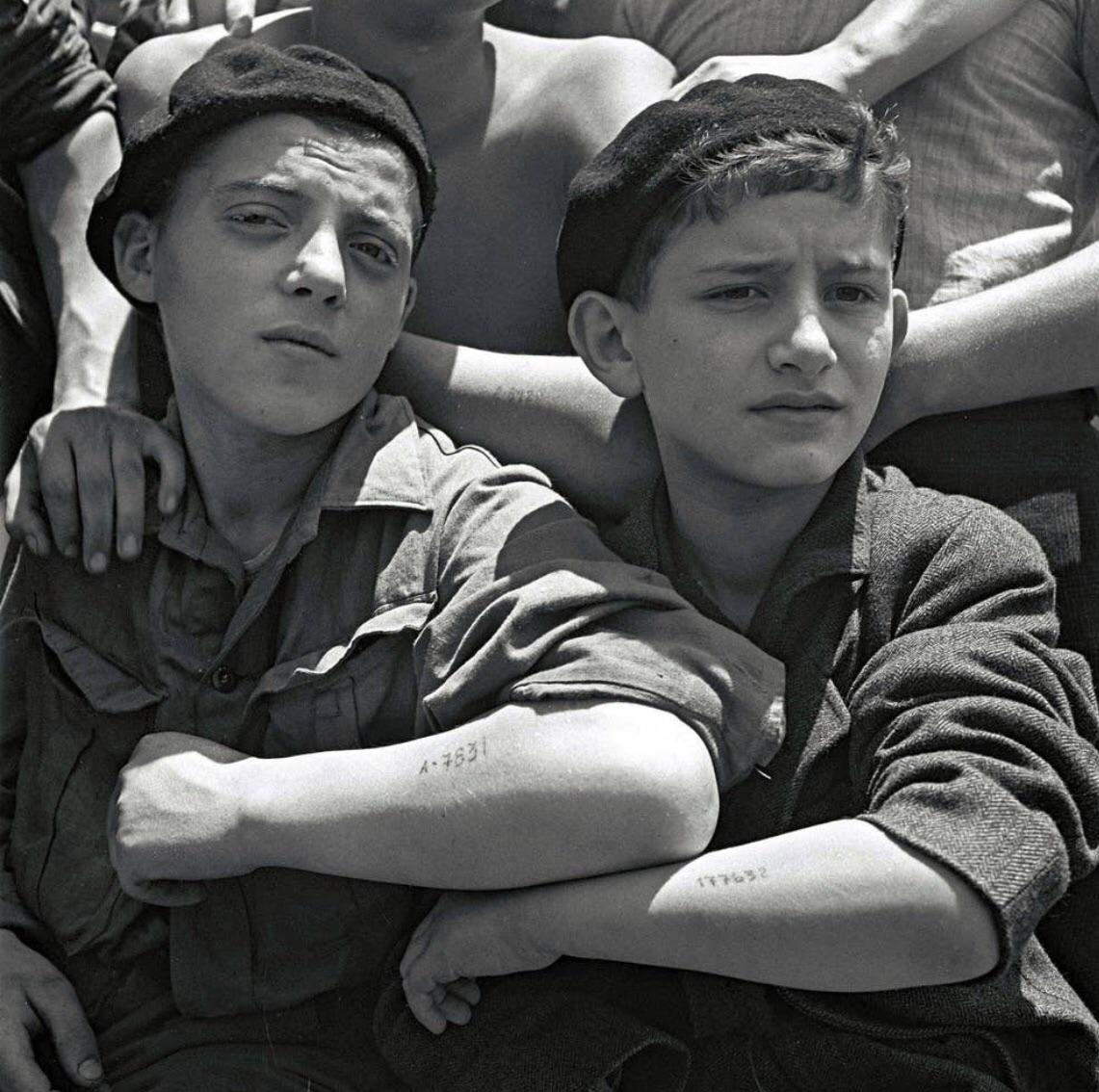
Nazis literally transformed people into numbers. Upon arrival at Auschwitz, many prisoners were stripped of their names and tattooed with identification numbers. It was part of a larger project to erase individuality, dignity, and humanity. The Holocaust was not only a campaign to murder Jews. It was a campaign to reduce them to anonymous units in a machinery of extermination.

Jewish children display tattooed numbers that Nazis put on their arms during the Holocaust

The Holocaust was not simply a story within a war. More than one million Jewish children were murdered not because they were caught in a battlefield, not because they belonged to an opposing army, but because they were Jewish. The Nazi regime actively hunted them for liquidation. Jewish babies, toddlers, and schoolchildren were marked for death from birth.

They were not collateral damage. They were targets.

For decades, educators, museums, survivors, and Jewish communities worked to preserve those names and those stories. The idea that victims should be remembered as human beings rather than statistics became one of the defining themes of Holocaust education around the world.

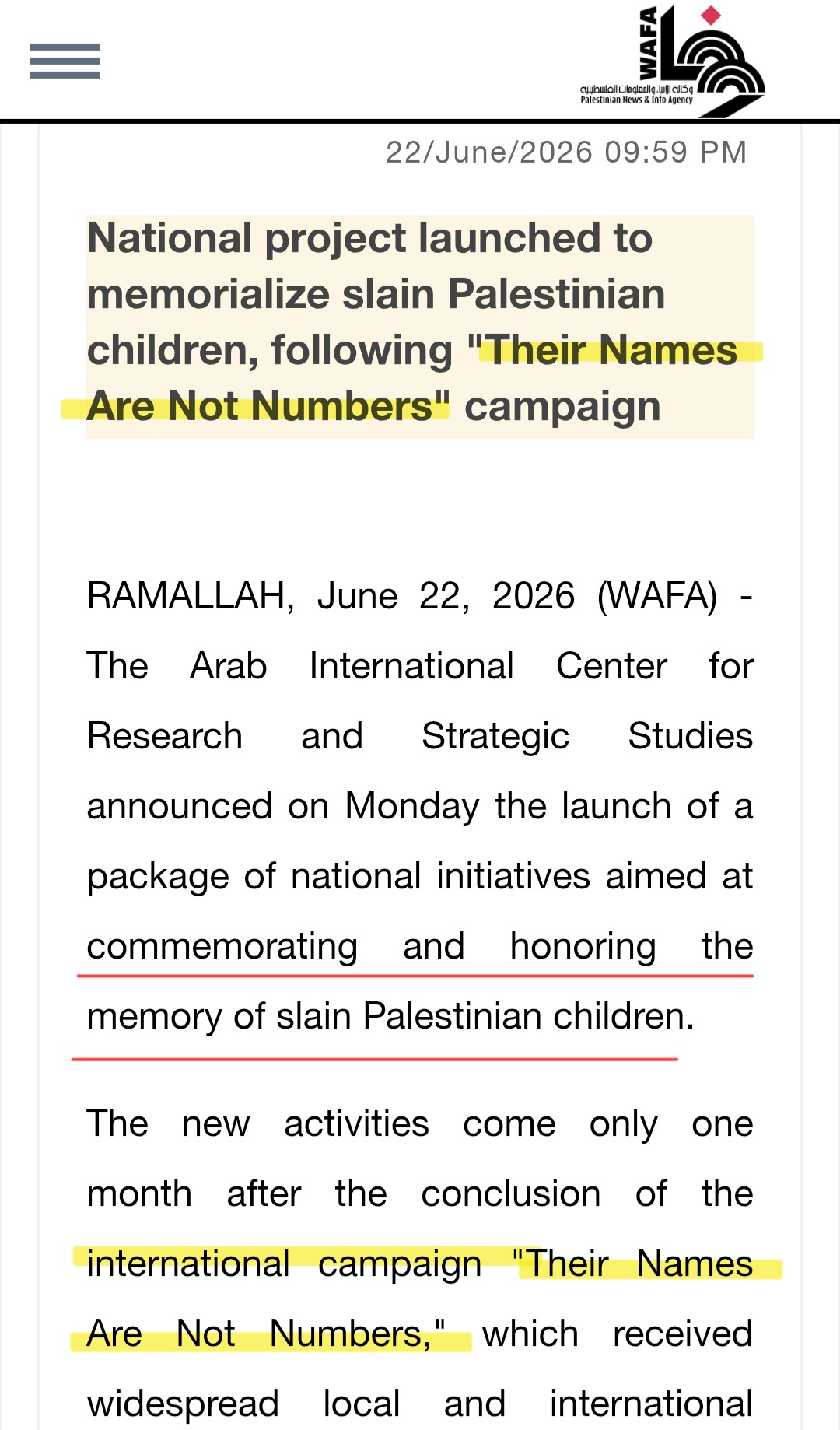
Which is why the recent Palestinian campaign, “Their Names Are Not Numbers,” is so striking.

The slogan echoes language that Holocaust educators spent generations developing. It draws upon a framework created to explain why victims of genocide should be remembered as individuals rather than numbers.

Palestinian Arabs are using a cruel tool in a flimsy attempt to wipe away their own guilt for launching a genocidal war with broad support, and for deliberately banning children from entering the tunnel infrastructure that leadership spent years and billions of dollars constructing. The Palestinian Authority is not merely making the dead children martyrs at someone else’s hands rather than their own, but deliberately lifting the campaign from an actual genocide. They have turned Holocaust remembrance against the Jewish state.

This is a moral perversion.

The Holocaust was a state-directed project of extermination whose goal was the disappearance of the Jewish people. Israel’s war against Hamas is a war against an armed movement that invaded Israel, massacred civilians, took hostages, and openly declares its intention to destroy the Jewish state.

Equating those realities with the Holocaust is not simply immoral but antisemitic. Borrowing the language developed to remember murdered Jews is not simply appropriation but sadistic.

Names, Not Numbers was created to ensure that the victims of history’s greatest campaign of anti-Jewish extermination would never be reduced to statistics. To take that language and deploy it as part of a campaign that casts Israel as Nazi Germany not only vilifies Israel unjustly but negates the Holocaust of its meaning and mocks the memory of a million murdered Jewish children.

Holocaust – and Hamas – Remembrance Day

Six Million Jews were slaughtered in Europe by Nazi Germany and its enablers in the 1930s and 1940s. One-third of European Jewry was wiped from the earth for the sick reason that people detested them and wanted them gone “by any means necessary.” The scale and the barbarity of the genocide was revolting and a permanent stain on humankind.

The Nazi Party did not rise alone. It was carried by a culture that softened language and normalized hatred. The machinery of murder arrived last. The permission came first.

We have watched that permission be rebuilt.

People often comment that the Palestinian Arab massacre of Israeli Jews on October 7, 2023 was the worst killing of Jews since the Holocaust. It is true, in terms of scale, a statistical fact. But the underlying reason is not discussed enough: a systemic hatred became embedded in a society that elected a government to carry out a genocide.

October 7 was not a rogue event by a gang. It was a popular movement by a sitting ruling authority that had years of preparation to carry out a genocide of local Jews.

Hamas’ 1988 foundational charter is the single most antisemitic political document ever written. The Stateless Arabs from Palestine (SAPs) voted Hamas to 56% of parliament with full knowledge of the group’s position and mission. When Hamas took control of Gaza in 2007, the area became a terrorist enclave, building an infrastructure and culture dedicated to the annihilation of Jews.

And when it acted out its plans in full on October 7, the people celebrated.

A “Holocaust Remembrance Day” that confines memory to ceremonies and candles misses the point. Remembrance without recognition of the present is ritual without responsibility. The lesson was never only about what was done. It was about how quickly societies create the conditions that allow it to be done again.

So what does responsibility look like now?

It begins with clarity. A group that openly declares and executes the mass killing of Jews is genocidal. That word should not be negotiated away, let alone flipped onto the victims.

It continues with institutions. Universities, media and cultural organizations must stop laundering advocacy for such groups through euphemism. Speech has consequences; platforms are choices.

It requires enforcement. Governments must treat material support, incitement, and coordination for designated terrorist organizations as what they are: threats to public safety, not protected abstractions.

It demands civic courage. Communities, leaders, and peers must refuse the social comfort of silence when celebration of violence surfaces in their midst.

And it insists on moral consistency. If the targeting of civilians is intolerable anywhere, it is intolerable everywhere—without qualifiers, without footnotes.

Democratic Socialist of America believe that violence against Jewish civilians is appropriate

It is important to remember the past: the millions of Jewish victims and the culture that touched Europe from Vienna to Vilna. It is also important to remember the environment that allowed it to happen, and actively confront the antisemitic infrastructure that enables the genocide of Jews.

Rep. Rashida Tlaib (D-MI) openly traffics in antisemitism – and gets reelected

The Bomb Shelters Gazans Were Never Allowed to Use

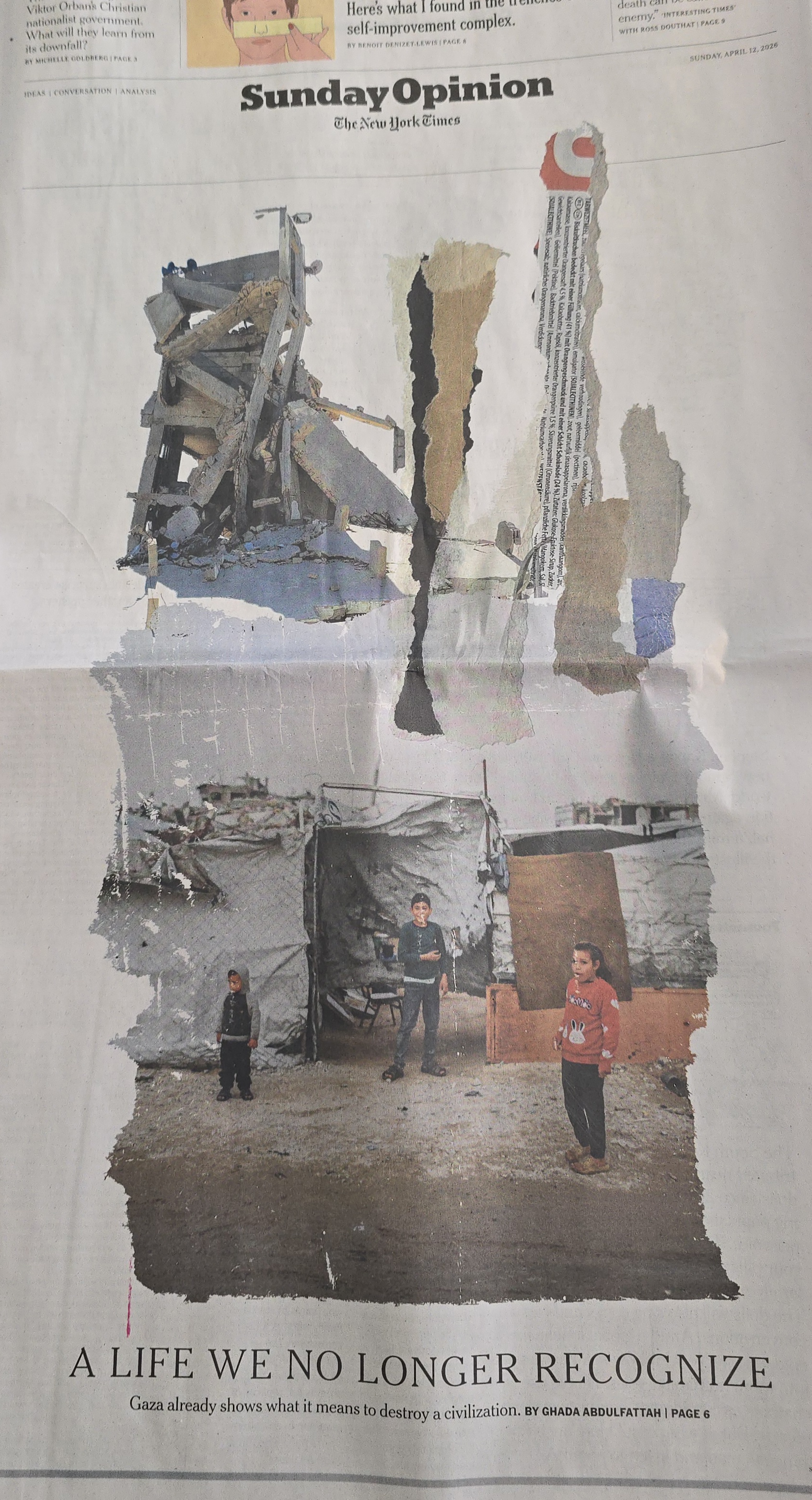
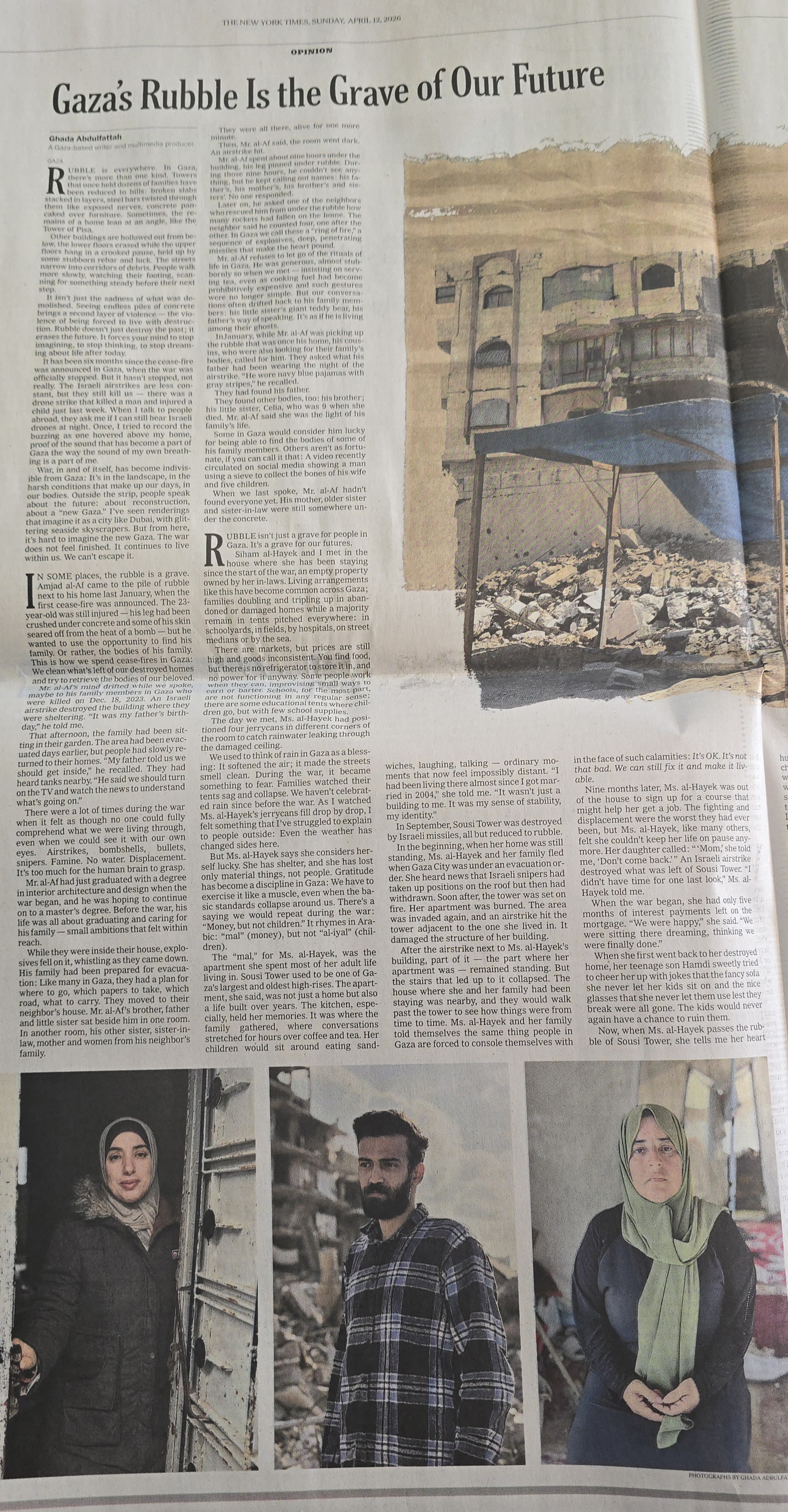
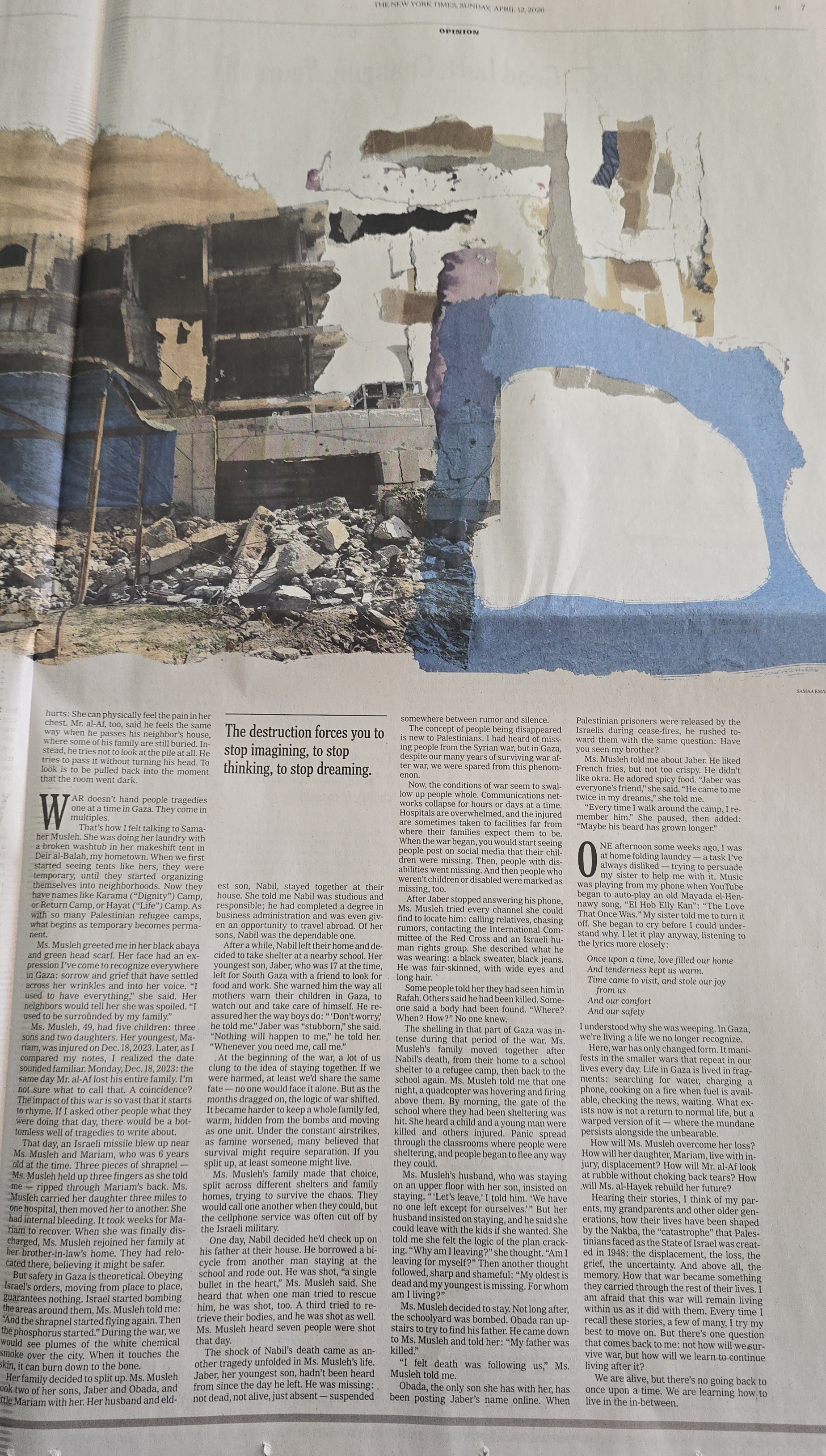
The images out of Gaza arrive stripped of their foundation. Open the The New York Times opinion pages this week and the story feels preassembled: civilians suffer, Israel strikes, outrage follows. It reads cleanly because something essential has been left out. This war does not begin and end on the surface.

It runs underground.

Beneath Gaza sits one of the most extensive underground military networks in the modern world, built by Hamas over years with money, materials, and time that could have gone elsewhere. The elaborate system of reinforced corridors, command centers, weapons depots, communications lines was designed to survive bombardment and keep a war going no matter what happens above.

Call it what it is: a vast network of bomb shelters.

Now say the part that rarely gets said clearly: Those shelters were never meant for civilians. They were never opened to families. They were never opened to children. They were never opened to the elderly. They were reserved—by design—for fighters, for leadership, for the preservation of the war machine itself.

In any other place, that would be unthinkable. Governments build shelters to protect their populations. When sirens sound, people go underground. Here, the system was inverted. Protection went below ground for those prosecuting the war. Exposure remained above ground for those living in it.

So when the bombs fall, the images follow. Families in rubble. Crowded rooms. Children pulled from collapsed buildings. The world reacts to an outcome shaped long before the first strike in this round of fighting. The protection existed. It was built. And Gazans were never allowed to use it.

That is the story that flips the frame.

This is not only a story of what Israel is doing. It is a story of what Hamas chose to build, and who it chose to protect with it. The tunnels are not just military infrastructure. They are a hierarchy set in concrete. Survival below ground for the regime. Exposure above ground for everyone else.

Once you see that, it becomes impossible to unsee. The destruction remains devastating but it has critical context. It sits alongside a governing strategy that hardened one layer of Gaza while leaving the other to absorb the war.

And that strategy is not finished. It points directly to what comes next. If Hamas remains, Gaza does not rebuild in the way people hope. It continues in the direction it has already taken. More tunnels. More infrastructure embedded beneath dense civilian areas. More resources pulled downward into war instead of upward into life.

The future of Gaza is not being debated. It has already been built.

It just was never built for the people living above it.

And the socialist-jihadi media like The New York Times, will paint a picture of pure fiction, one in which Gazans are the victims of rubble, not tunnels; victims of the Jewish State, not Hamas; victims of “genocide,” not perpetrators of genocide.

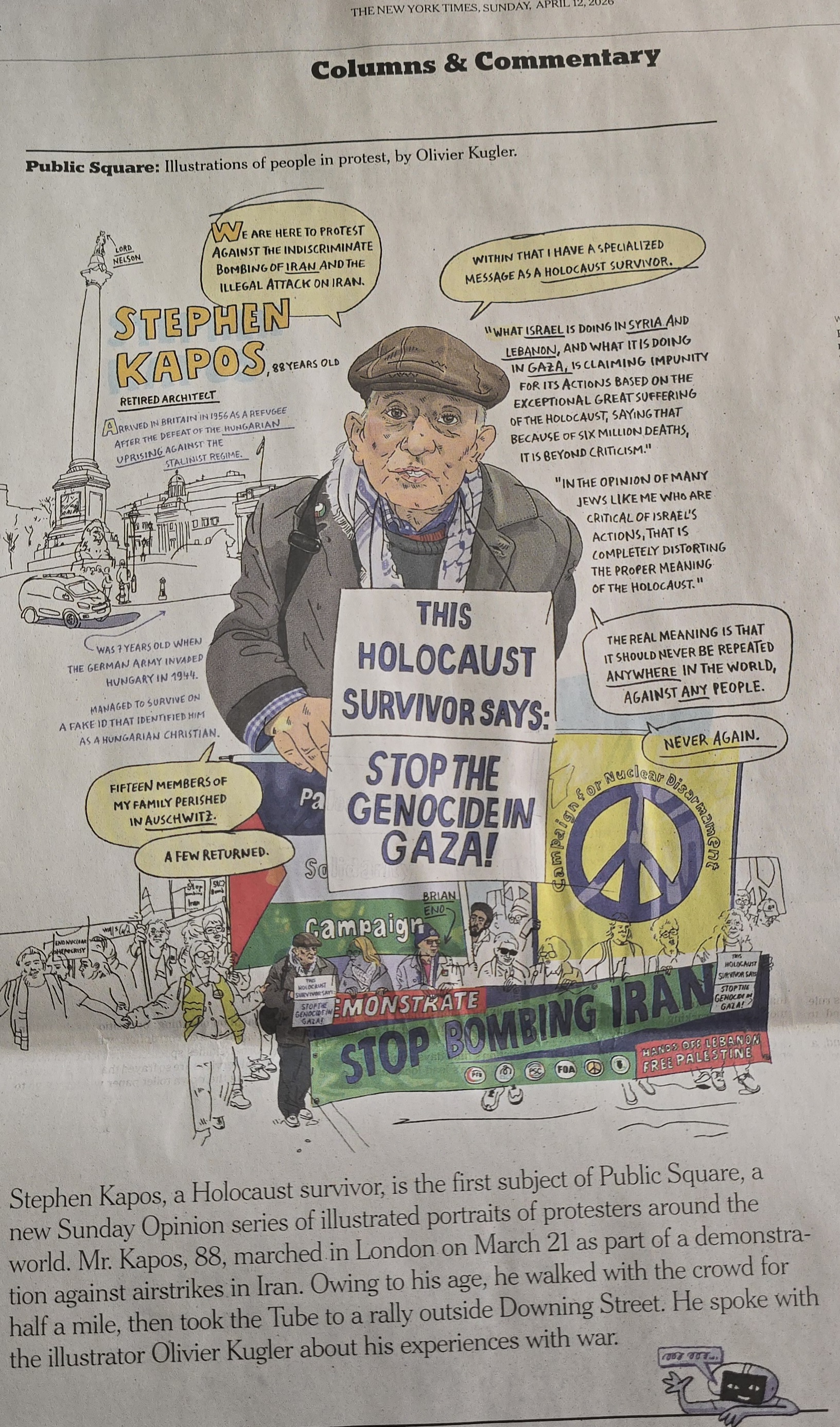
And for good measure, it will add a cartoon of a Jewish Holocaust survivor protesting about Israel committing a genocide in Gaza, to completely embalm its inversion of genocide.

Hamas built bomb shelters for the exclusive use of its terrorist army while it let women and children get attacked overhead. We are similarly witnessing the socialist-jihadi media build narrative shelters for those same jihadi terrorists, leaving Jews to take the brunt of the antisemitic tidal wave.

The Ghosts of Genocide

To visit Poland is to walk among ghosts.
The thriving Jewish civilization that once filled its towns and marketplaces was almost completely erased. Three million Jews were targeted for extermination — a number too vast to grasp by walking through silent cemeteries. The absence alone cannot speak the full horror.

To stand where synagogues were razed, where schools once taught Torah and arithmetic, where playgrounds once rang with Yiddish laughter, is to feel the emptiness press against your chest. It forces the imagination to repopulate the void — to summon the Jewish ghosts who linger, waiting for conscience to remember them.

It is easier to look at the living.
Many Poles today are the grandchildren of those who watched as their Jewish neighbors were rounded up — and sometimes finished the work themselves when survivors returned seeking their homes. They became stand-ins for the killers of yesteryear, heirs to silence, envy, and complicity.

Now another people walks amid ruins.
In Gaza, millions return to their shattered neighborhoods under a ceasefire, and we are told they have survived a “genocide” at the hands of Jews. Yet the number of Palestinian Arabs has grown, not diminished — a population larger than before the war they themselves began. They tread among the skeletons of broken buildings built atop their army’s tunnels, while ghosts — Israeli civilians burned alive in their kibbutzim and those taken hostage and murdered in Gaza — cry out from the ashes.

The Bibas family from Israel was taken hostage by Gazans on October 7, 2023. The mother and two children were murdered in captivity

I ponder the ghosts of genocide:
the murdered and the murderers;
the societies that spawned the slaughter;
the peaceful towns that became infernos.

Infrastructure shelters ghosts. Societies are haunted by the ones they create, both killer and killed. The unseen dead can no longer showcase their dancing on the one hand, or lust to murder, on the other.

There are scarcely any Jews left in Poland; their ghosts appear only to those who seek them.
In Gaza, the ghosts are not gone. They walk the streets, armed and unrepentant — not spirits of victims, but kinsmen of murderers, now turning on one another.

Poland’s haunting is one of silence — an absence so total it chills the air. The ghosts there do not cry out; they wait to be remembered. Gaza’s haunting is the opposite: a cacophony of rage that refuses reflection. Its ghosts are not silent but screaming — not victims unburied, but hatreds unrepented.

Poland’s soil holds the murdered; Gaza’s streets still host the spirit of the murderers.
One ghost asks to be mourned; the other demands to be judged.

The haunting does not end with time.
It lingers wherever truth is buried,
and it deepens each time the living deny the past that shaped them.

Only when a people can face its ghosts —
naming both the murdered and the murderers —
can it begin to live freely again.

George Carlin And Durban’s Infamous Words

The late comedian George Carlin had a famous routine about “the seven words you can’t say on television.” It was funny because everyone knew the words, and everyone knew the absurdity of pretending they didn’t exist. Then came cable television — HBO, Showtime, and the rest — and suddenly those words were everywhere. What once felt taboo became common, even boring.

So it is with the language used against Israel.

In 1991, after intense U.S. diplomatic pressure, the United Nations revoked its infamous “Zionism is racism” resolution. For a moment, it seemed like the libel had been buried. There was hope that the relentless delegitimization campaign against Israel would fade, that the language of hate would finally be retired.

But in 2001, just days before the jihadist terror attacks of September 11, the Durban Conference in South Africa blew the doors wide open again. A coalition of NGOs issued a statement accusing Israel of no fewer than five of the gravest crimes known to humanity:

  • Apartheid
  • Genocide
  • Ethnic cleansing
  • Racism
  • Crimes against humanity

This wasn’t fringe rhetoric. It was delivered under the UN umbrella, with global media present. Durban made it “respectable” to say the unsayable — and to say it loudly.

Since then, those accusations have seeped into mainstream discourse. Palestinian “human rights” groups echo the smears repeatedly. They are repeated on college campuses, in international tribunals, in op-eds from major newspapers, and by activists on social media. What was once a shocking smear has become routine — as casual as an f-bomb on late-night cable TV.

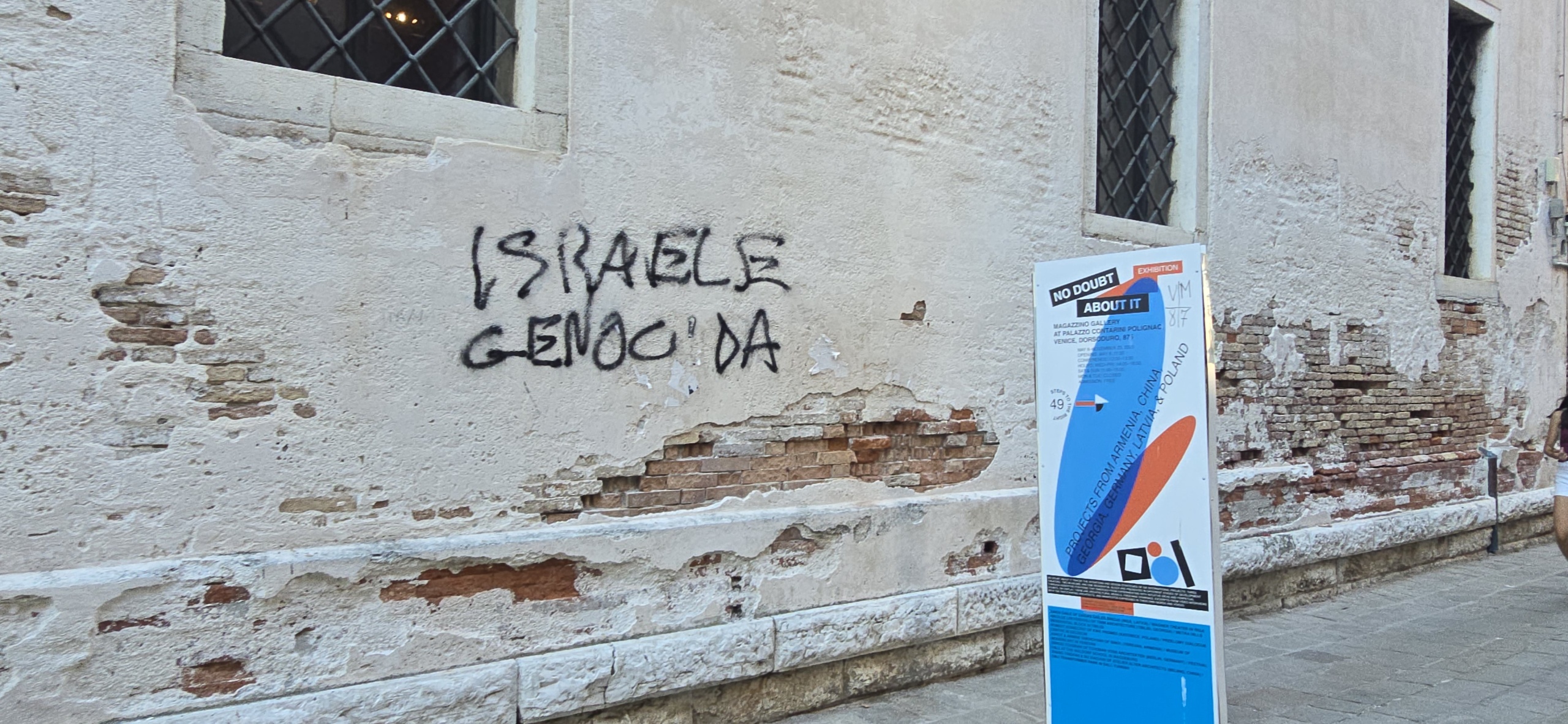
Graffiti that Israel is committing “Genocide” in Venice, August 2025

Durban didn’t just make it acceptable to slander Israel — it made it obligatory for the “serious” activist class. To not accuse Israel of apartheid or genocide – and now especially after Israel’s defensive war against Gaza – is to risk being called naive, a sellout, or worse. The same way edgy comics feel compelled to swear to prove they’re authentic, self-styled “human rights defenders” now compete over who can level the most outrageous accusation against the Jewish state.

The world has gone from debating Israel’s policies to cheering on its demonization. The libels have become cultural wallpaper — so constant that people stop noticing they’re lies. Durban didn’t merely open the floodgates. It built a sewer main, hooked it up to the global conversation, and has been pumping raw hate through it ever since — with the United Nations playing plumber, making sure the pipes never run dry.

The medieval accusation of Jews poisoning wells has been updated: now the “poison” is alleged genocide, apartheid, and crimes against humanity — and once again, the world is drinking it without question.

Anti-Israel Horde Has Called Israel “Genocidal” For Years

Many pro-Israel people are outraged by Amnesty International calling Israel’s current actions in Gaza a “genocide,” by highlighting that Israel never wanted the war and would end it immediately if the hostages were released and Hamas surrenders. As there is no “intent to destroy, in whole or in part, a national, ethnical, racial or religious group,” as the term is defined in the Genocide Convention, the basic premise falls flat on its face before even getting to the physical nature of the battlefield and fatalities.

But that is exactly the point that anti-Israel people are making in their own narrative. Whether Israel’s current war is defensive or not is irrelevant. Whether the number of civilians-to-militants killed is the lowest ratio of any urban combat is dismissed.

Israeli police officers evacuate a woman and a child from a site hit by a rocket fired from the Gaza Strip, in Ashkelon, southern Israel, Saturday, Oct. 7, 2023(AP Photo/Tsafrir Abayov)

The anti-Israel crowd ties colonization to ethnic cleansing to apartheid to genocide. It is one big ball of “European White Supremacy” and “settler imperialism” that has been internalized as gospel by the anti-Israel mob.

Consider that in 2016, sixty different groups in the Black Lives Matter movement penned a manifesto labeling Israel as “an apartheid state with over 50 laws on the books that sanction discrimination against the Palestinian people,” and that America’s aid to Israel made it complicit “in the genocide taking place against the Palestinian people.”

Even when there was no war, and the Israeli Arab AND West Bank Arab AND Gazan Arab all had populations which skyrocketed decade after decade – dwarfing the growth of Israeli Jews and of Arab populations of surrounding countries – the BLM movement ignored any physical requirement of a “genocide” and rallied around perceived intent.

Whether the Jewish State is the most liberal country for a thousand miles in any direction was considered misdirection. Pointing out basic pluralistic truths was considered PinkWashing or GreenWashing or a rainbow of other colors meant to serve as red herrings to the core issue.

The anti-Israel community considers the creation of Israel an original sin that can never be righted until it is destroyed. To give Palestinian Arabs dignity requires a genocide of Israeli Jews, and their supporters.

The “axis of resistance” of Iran, Hezbollah, Hamas and its global supporters is against the Jewish State, which it considers a foreign “cancer” inside the purely Arab Middle East. Today’s war is the same as 1948, to annihilate the Jewish entity in their midst.

A growing number of pro-Palestinian activists are echoing the Hamas narrative, even as the military capabilities of the terrorist Palestinian party dwindle. They have internalized a lie which offers Israel no escape other than dissolution.

The “genocide” claims and cases against Israel now have a veneer of credibility as “human rights” groups accuse the country amidst a difficult defensive war. In truth, they are tools to arm the second wave – of judicial and economic attacks – to destroy the Jewish State, as the axis’ military offensives end in defeat.

Stop Genocide. Destroy Hamas

Pundits throw around a phrase that one cannot use a military or force to destroy an ideology.

That’s true. But irrelevant.

Hate and evil movements will never disappear from mankind as long as there are more than three people in the world.

There are still Nazis alive today but they don’t control a government, an army or a territory. As such, the grotesque ideology directly impacts few people.

The evil of ISIL was sharply curtailed when their developing “caliphate” was defeated. It was accomplished by several countries coming together to lay waste to their military, not by sitting down and trying to placate their “grievances.”

That’s the goal with Hamas, the evil government that rules the Gaza Strip. Together with various other jihadi militant groups like Palestinian Islamic Jihad, Hamas spends their efforts instilling antisemitism into their schools and building a military infrastructure to destroy Israel. That control must be ended.

There is one way to stop genocide in the near-term: destroy Hamas’s ability to do battle and hold territory.

To reduce the probability of another war in the region in the longer-term, the United Nations and Saudi Arabia must clearly state that there is no right of return of Palestinian refugees and their descendants into Israel. None.

Shortly thereafter, UNRWA should be deconstructed whereby the facilities administered by UNRWA in the West Bank and Gaza are transferred to the Palestinian Authority, those in Jordan are handed to the government of Jordan, and those in Lebanon and Syria are transferred to the global refugee agency, UNHCR.

To stop genocide, the world should work with Israel to move civilians out of harm’s way, and empower the Israeli military to dismantle Hamas’s ability to fight and govern again.

Related articles:

Stop Genocide. End UNRWA (January 2024)

The Only Way The Conflict Can End (November 2023)

UNRWA Is A Prison (November 2021)

Excerpt of Hamas Charter to Share with Your Elected Officials (May 2021)

Shut UNRWA in Gaza Immediately (August 2018)

Time to Dissolve Key Principles of the “Inalienable Rights of Palestinians” (December 2017)

Names and Narrative: Genocide / Intifada (March 2016)

Help Refugees: Shut the UNRWA, Fund the UNHCR (September 2014)

First One Through video:

Jordan’s Hypocrisy: Queen Rania on Palestinians and UNRWA