Correcting An UNRWA School

A school in Jerusalem’s Shuafat refugee camp is reopening. The building is the same but UNRWA is no longer running it.

The school is now affiliated with Israel’s Ministry of Education and the Jerusalem Municipality. Jerusalem Deputy Mayor Aryeh King posted video of UNRWA signs being removed as the school prepared to open.
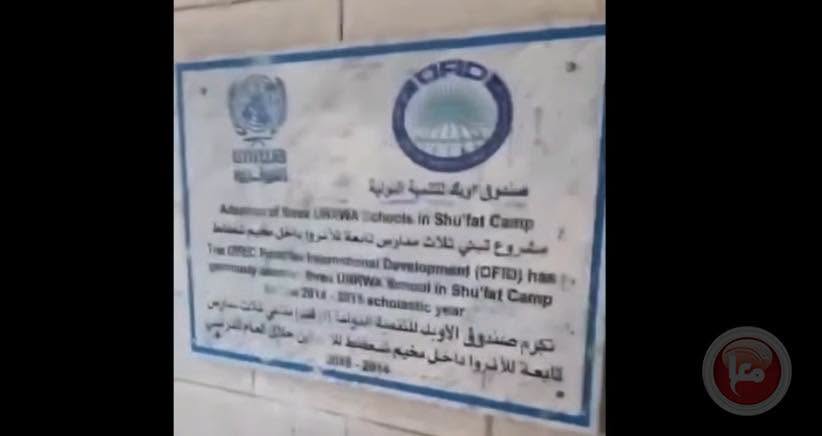
Sign of UNRWA run school in Shu’afat, Jerusalem

The change ends an educational arrangement dating back more than sixty years.

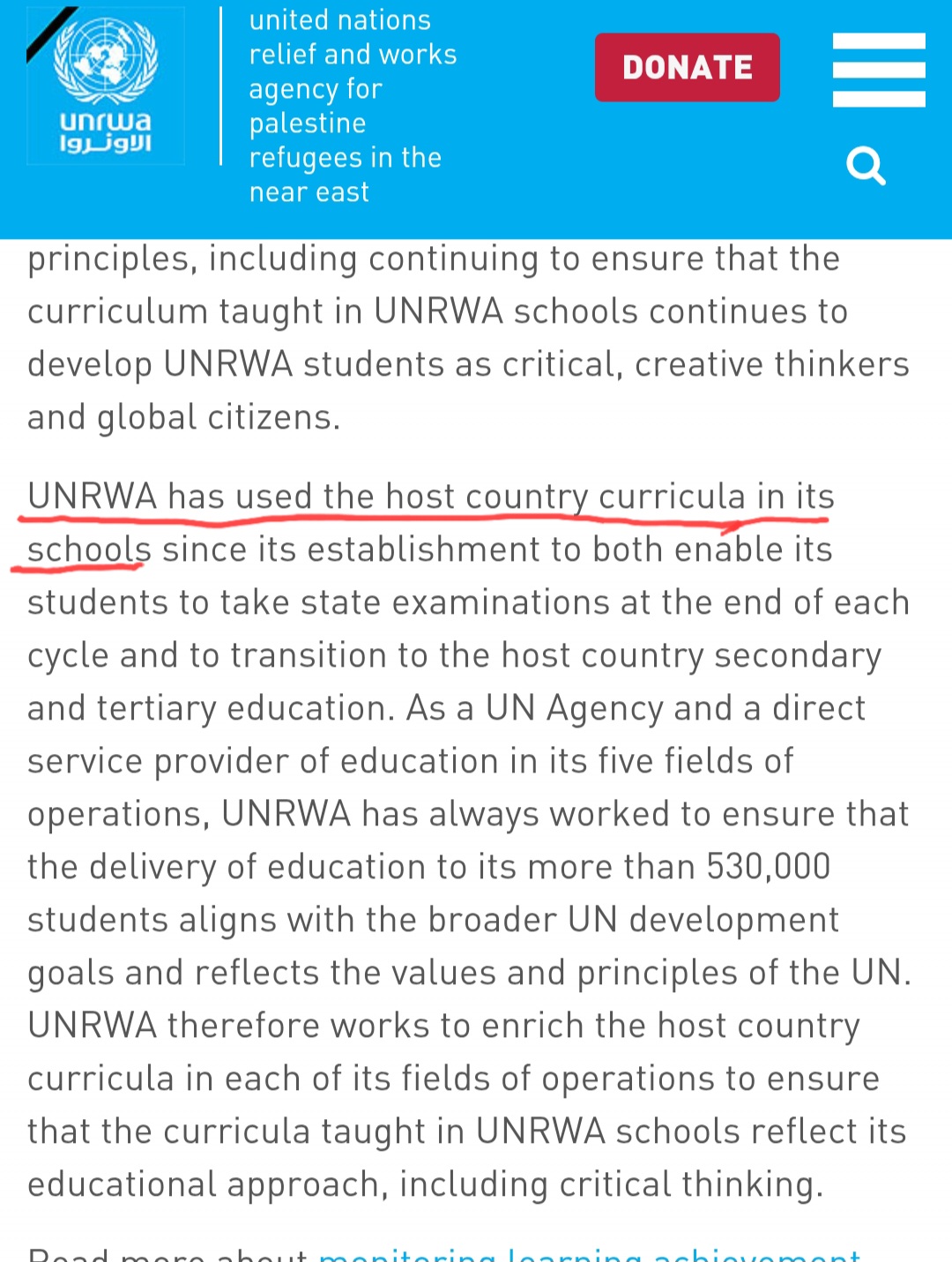
UNRWA established the Shuafat refugee camp in 1965, when Jordan controlled “East Jerusalem.” UNRWA’s educational policy, dating to 1952, has been to use the curriculum of the “host countries,” allowing refugee children to take local examinations and continue into local schools and universities.

So UNRWA worked with Jordan at that time.

There was nothing internationally settled about Jordan’s sovereignty over Jerusalem. Jordan seized eastern Jerusalem in 1948 and annexed the West Bank – including East Jerusalem in 1950. Even Britain, one of only two countries (along with Pakistan) which recognized Jordan’s illegal annexation of the West Bank, specifically withheld recognition of Jordanian sovereignty over Jerusalem. It only recognized Jordan’s de facto authority there.

Yet Jordan administered East Jerusalem, so UNRWA worked with Jordan there.

Then came 1967.

Israel captured East Jerusalem and became the government actually administering Shuafat, much like Jordan had previously. But UNRWA did not treat Israel the same way as the de facto administrating authority.

The Jordanian curriculum continued for years. After the Palestinian Authority was established, UNRWA increasingly coordinated its West Bank education program with it and ultimately used the Palestinian Authority curriculum.

That is difficult to square with the simple explanation that UNRWA follows the curriculum of its host country. The Palestinian Authority did not govern Jerusalem; Israel did. Yet UNRWA chose the PA curriculum for schools there.

The contrast is particularly striking today. Israel has nine foreign embassies located in Jerusalem, with Nauru announced as the tenth. Jordan never enjoyed anything approaching that level of international recognition of its rule over Jerusalem. Yet UNRWA had been willing to work with the authority actually administering the city when that authority was Jordan.
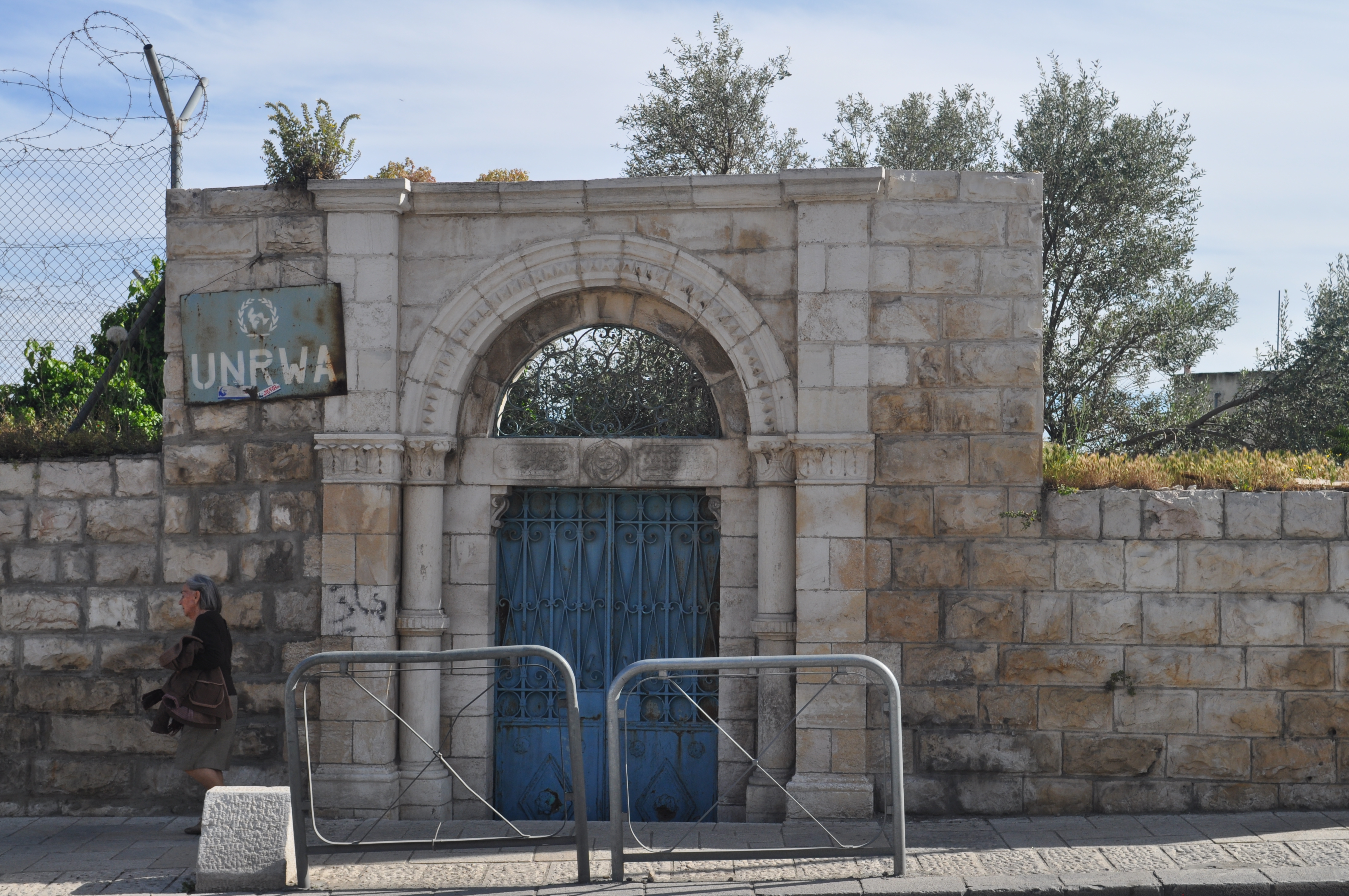
UNRWA offices in Jerusalem (photo: First One Through)

But the problem at Shuafat went beyond which government UNRWA chose to recognize educationally. It was what children at this particular school were saying they learned.

UNRWA says its curriculum framework must reflect UN principles of neutrality, human rights, tolerance, equality and non-discrimination.

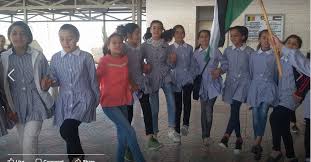
Footage recorded at an UNRWA school in Shuafat in 2022 and published by Ynet in 2024 showed something very different.

Students said that stabbing and running over Jews brought Palestinians honor. One said he was prepared to carry out a suicide attack. Another said they were taught that Jews were terrorists. Another said they were taught that Jews were deceitful and evil and that he would stab and run them over.

The videos offer a horrifying vision of what is taught at UN schools.

Israel eventually acted.

In May 2025, Israeli authorities closed six UNRWA schools in eastern Jerusalem, including three in Shuafat. UNRWA protested that hundreds of Palestinian children were being deprived of education. Israel said alternative schooling would be provided through the Jerusalem education system.

Now that alternative is becoming tangible.

A former UNRWA school in Shuafat is reopening under the Israeli Ministry of Education and Jerusalem Municipality.

The choice was never between UNRWA and no education. What can change is the system educating them and the content of that education.

The UNRWA sign coming down in the Shuafat school is symbolic. What the children learn when they walk back through those doors will determine whether the real change happened inside.

One UN Agency for Every Nation in Waiting

If you want to understand an institution, don’t begin with its speeches. Begin with its organization chart.

Permanent agencies, permanent committees, permanent staff, permanent budgets, and permanent mandates reveal what an institution considers exceptional.

The United Nations generally operates through universal institutions. Refugees fall under the UN High Commissioner for Refugees (UNHCR). Racism is addressed through broad human rights mechanisms. Humanitarian crises are handled through agencies with global mandates.

Except in one case.

The Palestinian cause has an institutional architecture unlike any other.

Palestinian refugees have their own dedicated refugee agency, UNRWA. Every other refugee population in the world falls under UNHCR.

UNRWA offices in Jerusalem (photo: First One Through)

The General Assembly maintains the Committee on the Exercise of the Inalienable Rights of the Palestinian People, supported by the Division for Palestinian Rights within the UN Secretariat. Their mission is not to monitor or audit the Palestinian national movement, but to advance Palestinian rights, organize conferences, maintain documentation, and sustain international engagement.

The Human Rights Council appoints a permanent Special Rapporteur on the situation of human rights in the Palestinian territories occupied since 1967, dedicated exclusively to that issue. The Office for the Coordination of Humanitarian Affairs maintains a permanent office for the occupied Palestinian territory. The Human Rights Council also has Agenda Item 7, the only standing country-specific agenda item focused on a single member state.

That is the institutional asymmetry.

Institutions produce what they were built to produce. Permanent offices generate permanent reports. Permanent committees convene permanent meetings. Permanent mandates create permanent attention. The result shapes which stories are told, which voices are amplified, and which narratives become part of the world’s diplomatic conversation.

Since October 7, Palestinian voices have benefited from this enduring institutional infrastructure, while Israeli victims have had fewer dedicated mechanisms through which their experiences are consistently presented.

This institutional framework for the vilification of Israel was built over decades, setting the stage for antisemitism to permeate societies thousands of miles from the Middle East and those with no Jews even living there.

It is time for a fundamental change.

The United Nations is home to MANY peoples who aspire to statehood.

Kurds. Somalilanders. Sahrawis in Western Sahara. Tibetans. Kosovars. Taiwanese. Independence movements persist in Catalonia, Scotland, Greenland, the Faroe Islands, and elsewhere.

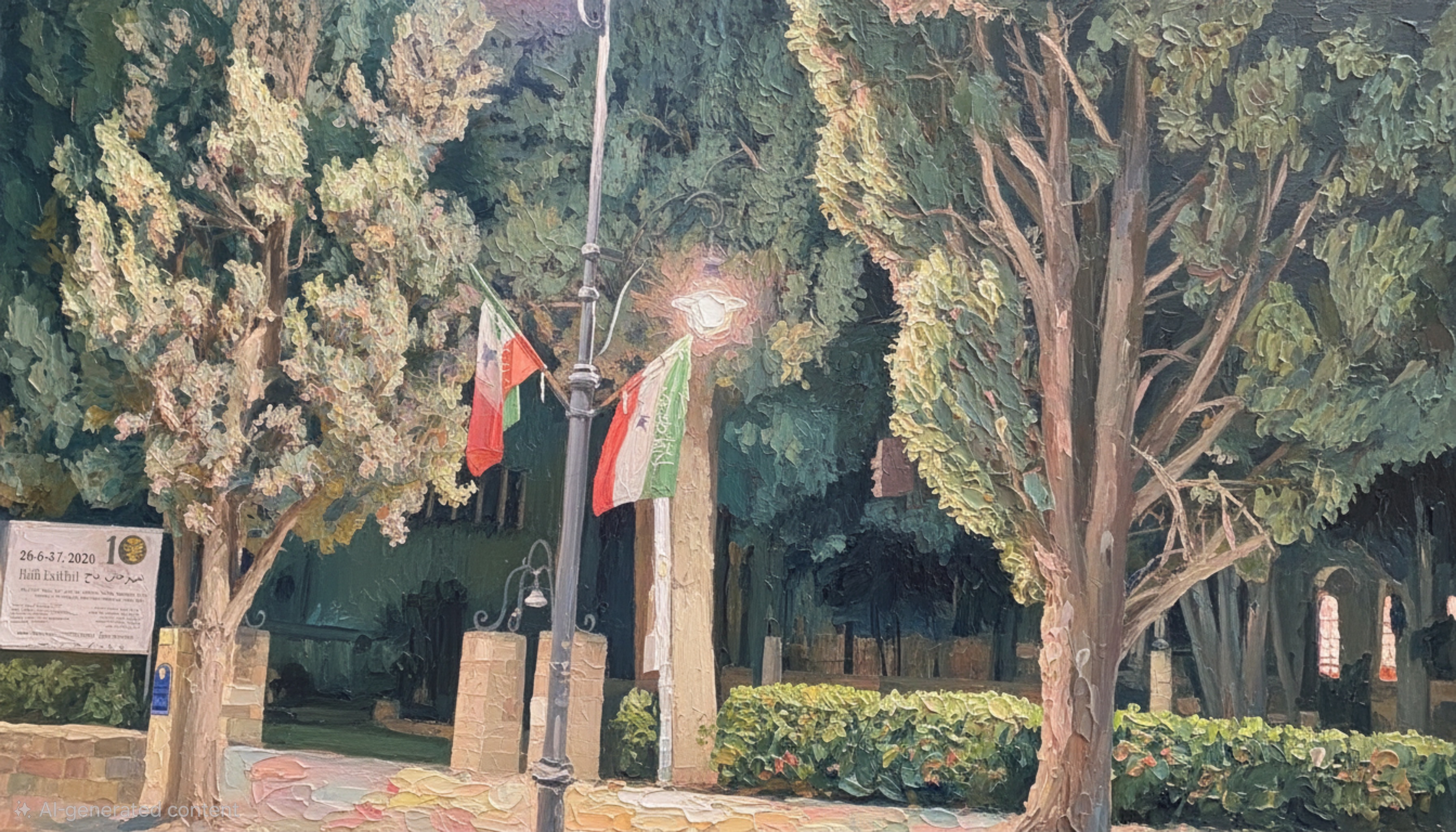
Flags of Somaliland hang in streets of Jerusalem, June 2026 (created by First One Through)

If the United Nations truly believes in the universal principle of self-determination, it should apply that principle universally.

Abolish the maze of Palestinian-specific institutions and replace them with a single body: The United Nations Agency for Nations in Waiting (UNNW).

Its mission would be straightforward: evaluate every national movement using the same transparent standards: effective governance, respect for human rights, peaceful conduct, democratic legitimacy, protection of minorities, and economic viability.

The Stateless Arabs from Palestine would remain part of the process – but alongside Kurds, Somalilanders, Tibetans, Sahrawis, Taiwanese, Kosovars, and every other people seeking recognition.

One standard. One agency. No exceptions.

Such a reform would move the UN away from political favoritism and toward institutional fairness. It would reward good governance instead of diplomatic influence and demonstrate that universal principles truly are universal.

If the United Nations wishes to champion nations in waiting, it should do so for all of them – not just one, and stem the tide of antisemitism at the same time.

UNRWA Is Not What You Think It Is

Most people think UNRWA exists to care for Palestinian refugees until a Palestinian state is created.

Not so.

If that were its purpose, its schools, healthcare, and social services would have gradually been transferred to the Palestinian Authority as Palestinian self-government expanded these past many years, especially in the “West Bank” / East of the 1949 Armistice Lines.

UNRWA’s mission would shrink as Palestinian institutions grew stronger. Instead, UNRWA has remained a permanent parallel system that continues to grow every year.

Unlike every other refugee agency in the world, UNRWA passes refugee status across generations, creating an ever-growing population of registered refugees. That population’s political claim is not to a future Palestinian state, but to a claimed so-called “right of return” to towns in Israel.

That distinction is critical.

A “two-state solution” is based on two peoples exercising self-determination in two states. A mass movement of millions of Arabs who never lived in Israel into Israel would produce 1.5 states for Arabs and 0.5 states for Jews. Further, stripping Israel of its right to determine who gets to enter its country means it doesn’t have basic sovereignty.

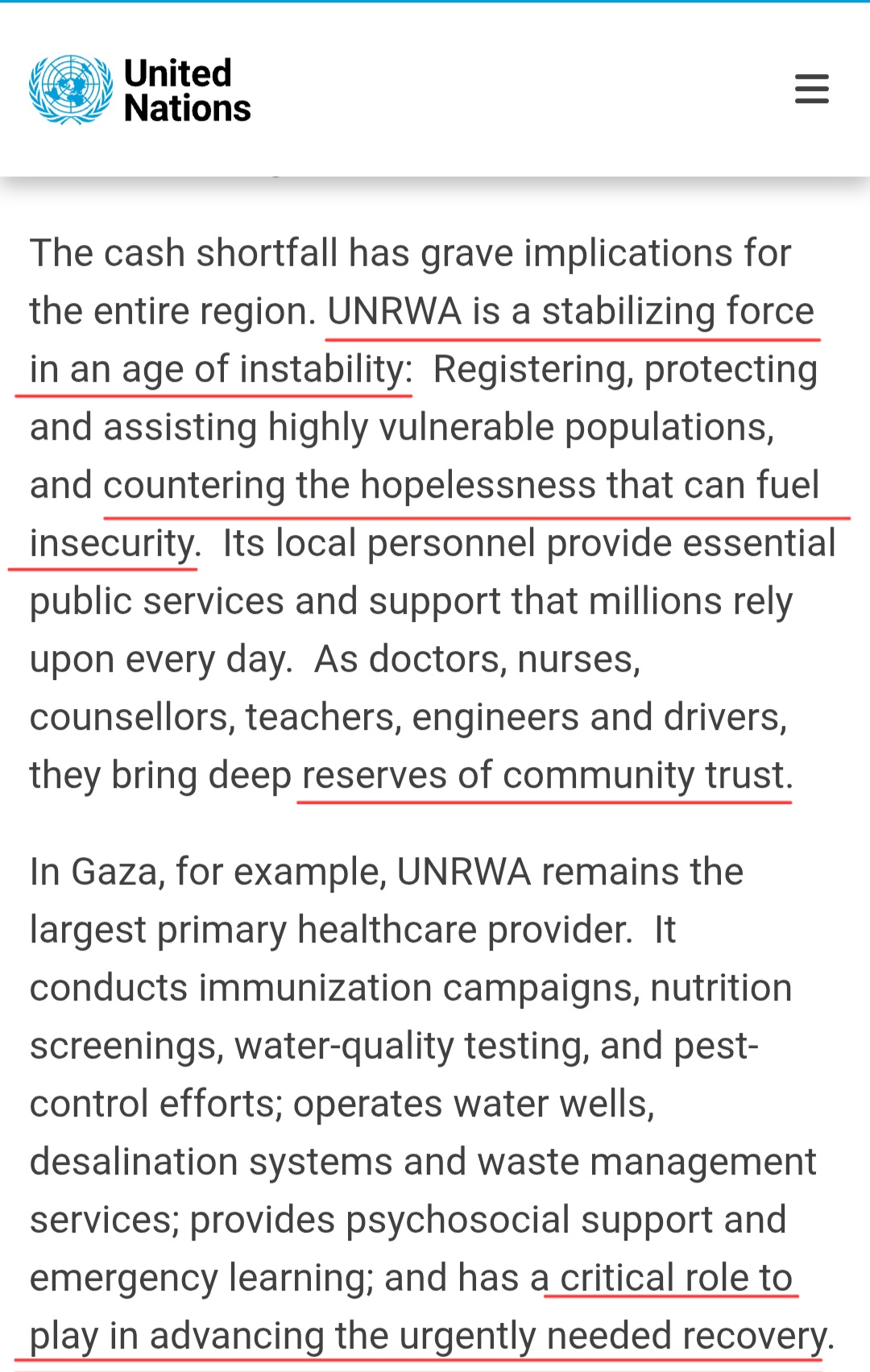
While UN Secretary-General Antonio Guterres claims that “UNRWA is a stabilizing force” it is precisely the opposite. As he urges the world to fund the immoral project, he lies that the agency is the force for “countering the hopelessness that can fuel insecurity.”

UNRWA has fed the lie that – and demands that it will continue to exist until – 6 million Arabs will move into Israel. Such mission is precisely opposite the goal of an Arab and Jewish state living in coexistence.

At its core, UNRWA is a political organization that negates Israel’s sovereignty, cloaked as a humanitarian organization. If the goal is truly a Palestinian state living alongside Israel, then UNRWA must be closed permanently as well as the discussion of a so-called “right of return” .

The Myth of Pocketbooks

The United Nations has chosen the wrong enemy.

António Guterres wants the world to believe that peace can be engineered with a spreadsheet — that inequality is the disease, redistribution the cure, and justice a matter of financial rearrangement. In his January 15 address, he warned that concentrated wealth corrupts institutions and that most low-development countries are in conflict. The implication is unmistakable: balance the books and peace will follow.

“The top 1 per cent holds 43 per cent of global financial assets.  And last year alone, the richest 500 individuals added $2.2 trillion to their fortunes.

Increasingly, we see a world where the ultra-wealthiest and the companies they control are calling the shots like never before — wielding outsized influence over economies, information, and even the rules that govern us all.

When a handful of individuals can bend global narratives, sway elections, or dictate the terms of public debate, we are not just facing inequality — we are facing the corruption of institutions and our shared values.” – UNSG Antonio Guterres

But choosing the wrong enemy guarantees the wrong war.

Because evil is not an accounting problem.

The UN’s failure begins in its diagnosis. It treats terrorism as a social pathology when it is, in fact, an ideological one.

Terrorism is not born in empty wallets. It is born in minds captured by belief.

Two decades of research have demolished the claim that poverty causes terror. Terrorists are rarely the poorest of the poor. They are often educated, middle-class, and technically trained — the engineers of jihad, the lawyers of holy war. The suicide bomber is seldom starving. He is convinced.

If poverty produced terrorism, the poorest societies would be its factories. They are not. Many desperately poor states remain largely untouched by global jihad, while terror movements arise from politically radicalized societies with functioning middle classes and ideological incubators.

What correlates with terrorism is not poverty, but ideas combined with power: religious absolutism, revolutionary nationalism, grievance cultures, and failed identity — not failed GDP.

This is not an academic distinction. It is the fault line between clarity and catastrophe.

If money could defeat jihad, Gaza would be the proof. It is not — it is the refutation.

Gaza has received billions in international aid. What emerged was not prosperity, but the most elaborate terrorist war machine ever embedded in a civilian population: tunnels beneath hospitals, command bunkers under schools, rockets from playgrounds, children trained for martyrdom.

This was not a failure of funding. It was the success of ideology. And the UN instigates that very ideology claiming that Israel should have no sovereign control of who enters its country, and specifically that almost every Arab living in Gaza will move into Israel with UN support.

“We are totally committed in the cause of peace in Gaza, Ukraine, Sudan and far beyond.” – UNSG Antonio Guterres

Hamas did not build tunnels because Gazans were poor. Hamas built tunnels because its charter demands Israel’s destruction, because martyrdom is sacred, because jihad is identity. Money did not create this worldview — it merely financed its execution.

You can flood a society with aid, but if its governing ideology is annihilationist, all you finance is a more capable war machine.

Once the UN misdiagnoses ideology as economics, the next failure becomes inevitable.

For decades, it has constructed and sustained a grievance system around the Stateless Arabs from Palestine (SAPs) that functions symbiotically with jihadist aims. Through its agencies and resolutions, it has promised millions of SAPs who have never lived in Israel that they will one day “return” en masse into Israel — effectively proposing Israel’s demographic erasure through mass population transfer via international decree.

No state can survive if an external body claims authority over who may enter it and redefine its citizenship from the outside. Yet the UN has made this assault on sovereignty a central plank of its Palestine policy — while calling it “humanitarian.”

Through UNRWA’s unique multigenerational refugee status, displacement becomes inherited identity rather than a temporary humanitarian condition. Grievance becomes doctrine. Statelessness becomes culture. A territorial dispute becomes a perpetual weapon.

And then the UN asks for more money to sustain it.

Why does the UN persist in this inversion?

Because it refuses to judge belief systems.

It will not confront jihad as an ideology.
It will not describe Islamic terrorism as such.
It will not wade into cultural or civilizational dynamics because it sees itself as a neutral global body.

But neutrality toward ideology does not produce peace. It produces permission.

And because the UN will not fight belief systems, it substitutes economics.

It reframes terror as inequality.
It reframes jihad as deprivation.
It reframes mass murder as misallocated capital.

In doing so, it becomes part of a broader machinery seeking to shift wealth and power from the Global North to the Global South — not merely for development, but as moral rebalancing, regardless of whether this addresses the real drivers of violence.

Redistribution becomes its ritual response whenever violence erupts.

Which means: more authority, more money, more relevance for the UN.

This is not accidental. It is institutional self-preservation dressed as virtue.

So the world is invited to believe the problem is billionaires rather than beheaders. That terror is born from inequality rather than indoctrination. That peace will come from redistribution rather than defeating enemies.

Evil is not a pocketbook problem.
It is an ideology.

And no amount of redistribution will make a death cult lay down its weapons.

UNRWA’s Jerusalem Exception

Every UN humanitarian agency coordinates with the authority that governs where it operates—except in Jerusalem. That exception is not a footnote. It is the story. And it exposes a mandate failure driven by politics, not humanitarian necessity.


UNRWA holds that humanitarian work requires coordination with governing authorities. In practice, it does so almost everywhere: with Jordan, Lebanon, Syria, the Palestinian Authority—and even with Hamas in Gaza, despite Hamas’s terrorist designation by the United States, the EU, the UK, and others.

In Jerusalem alone, UNRWA refuses to coordinate with Israel, the authority exercising full municipal, policing, and regulatory control over the city.

Call it “coordination for access” if you like. It is still coordination. And municipal coordination is not a sovereignty concession (if one believes that Israel does not have sovereignty over eastern Jerusalem despite annexing it in 1980); it is a humanitarian necessity.

How the Facilities Came to Exist

UNRWA’s Jerusalem facilities were established between 1949 and 1967, when Jordan seized and annexed the eastern half of the city in a move not recognized by the UN or the international community. UNRWA nonetheless coordinated with the Hashemite authorities to build schools, clinics, and service centers—because humanitarian work requires coordination with whoever governs in fact.

That history matters. UNRWA’s Jerusalem footprint exists specifically because it once coordinated with an unrecognized occupier.

UNRWA offices in Jerusalem (photo: First One Through)

The Reversal

In 1967, Jordan entered the war, violated the armistice, and lost control of Jerusalem. Israel assumed governance and unified the city. Palestinian Arab residents became permanent residents with access to Israeli courts, healthcare, municipal services, and the right to apply for citizenship.

At that point, UNRWA reversed its logic. Where it coordinated with Jordan despite non-recognition, it now refuses to coordinate with Israel—by labeling eastern Jerusalem “occupied Palestinian territory,” theoretically negating its obligation to work with Israel.

That label sits uneasily with the UN’s own history. The 1947 Partition Plan never intended Jerusalem—east or west—to belong to an Arab state. The city was designated a corpus separatum, an internationally administered entity. Jerusalem was never meant to be Arab sovereign territory.

The contours of “Corpus Separatum” (in pink) in the United Nations 1947 Partition Plan stretched over Greater Bethlehem and Greater Jerusalem, marking the region as an international Holy Basin to be administered by the UN

An Outlier by Design

UNRWA’s mandate emphasizes cooperation with local authorities to ensure access, security, and civilian protection. That cooperation exists everywhere except Jerusalem. UNRWA coordinates with armed groups and unrecognized authorities elsewhere, yet refuses coordination with the governing authority in the city where coordination is most essential.

Refusing to coordinate with the authority responsible for public safety is not neutrality. It is an affirmative political act—one that inverts humanitarian logic by privileging narrative over civilian protection. UN immunity exists to facilitate coordination, not to replace it.

Continuity of Care—and the Standoff

Israel has enacted laws to shutter UNRWA offices in Jerusalem. UNRWA refuses to comply, invoking immunity and operating facilities largely outside municipal oversight. The confrontation exists because UNRWA chose inconsistency in the one city where consistency matters most.

“The UNRWA Jerusalem Health Centre, which serves hundreds of Palestine refugee patients every day is, for most of them, their only possibility of having access to primary healthcare….
These [Israeli] measures are a violation of the inviolability of United Nations premises and an obstacle to the implementation of the clear mandate of the General Assembly for UNRWA’s continued operations in the Occupied Palestinian Territory, including East Jerusalem.” – UN Secretary General Antonio Guterres January 15, 2026

The closure of UNRWA offices in Jerusalem would not create a humanitarian vacuum. Education, healthcare, and social services are already provided through municipal systems, national institutions, other UN bodies, and a dense NGO network operating in the city. What would end is not care delivery, but UNRWA’s parallel governance model.

Palestinian Arabs in Jerusalem rely daily on municipal emergency services, hospitals, and courts. UNRWA’s non-coordination removes the safety mechanisms coordination is meant to provide—for civilians, staff, students, and patients alike.

The Reckoning

UNRWA coordinated with Jordan when Jordan’s rule was unrecognized. It coordinates with Hamas despite terrorist designations. Yet it refuses to coordinate with Israel while Israel governs the city, extends legal status to its Arab residents, and has a network of service providers which can easily replace UNRWA in Jerusalem.

That is not humanitarian principle. It is selective politics.

Consistency is the minimum requirement of a mandate.
A mandate that works everywhere but Jerusalem is not a mandate—it is a message, and it is that UNRWA is not a humanitarian organization.

UNRWA remains a rusty tool of the 1947 Partition Plan which insists that holy sites in Jerusalem never fall under Jewish rule.

It’s Not You, It’s UN

Of the many classic lines from the TV sitcom Seinfeld, “it’s not you, it’s me,” is a great one, used as an excuse to get out of a relationship. It’s a phrase familiar to anyone who has ever been in a relationship which one party simply does not enjoy and wants to terminate gently.

There is no relationship so poorly constructed and toxic today as between Israel and the United Nations, harmonious at the start but broken bit by bit since that time. In an effort to complete it’s desire of completing the creation of two states, a Jewish one and Arab one as conceived in the General Assembly vote of partition in November 1947, the institution has fabricated lies and noxious resolutions against Israel and Jewish dignity everywhere.

Follow what the UN does, and what it says, and a stark pattern emerges: Palestinian Arabs are granted surplus political rights across the entire map, while Israel is denied the basic attributes of sovereignty. This is not mediation. It is architecture, scaffolding producing a permanent conflict.


1) Start with the most basic injustice: where Jews may live and pray

Begin where ideology becomes lived reality.

Across territory, the UN labels Palestinian Arab non-Jewish residence as inherently legitimate everywhere, while Jewish residence is declared subject in advance, legal where a Jewish State was once allotted but illegal everywhere else. Through instruments like United Nations Security Council Resolution 2334, Jewish civilians are criminalized simply for living beyond armistice lines—before borders are agreed, before negotiations conclude, before sovereignty is determined.

This is unprecedented. In every other territorial dispute on earth, civilian life is separated from sovereignty. Here, it is collapsed—selectively.

Then comes the religious core.

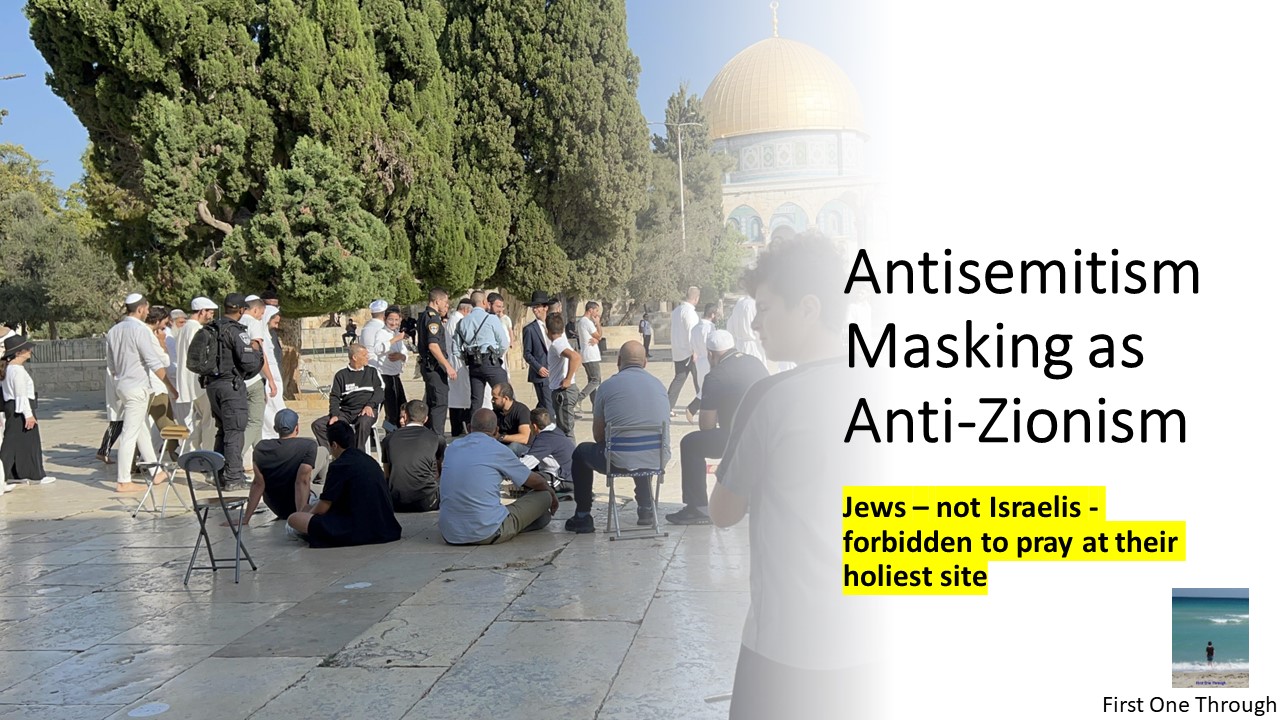
At Judaism’s holiest site—the Temple Mount / Al-Haram al-Sharif—the UN endorses a so-called “status quo” that allows Muslim prayer as a matter of course while forbidding Jewish prayer outright. Jews may visit in finite numbers. They may not worship.

No neutral body sanctifies a regime where one faith’s prayer is normal and another’s is treated as provocation. That is not stability. It is hierarchy—polished with diplomatic language.


2) Escalate to sovereignty itself: borders without control

Every sovereign state controls who enters and who becomes a citizen. Israel is uniquely told this right is negotiable.

Through endless reaffirmations of a mass “right of return,” the UN demands that Israel absorb millions of Palestinian Arabs who never lived there—descendants of a war launched to destroy the state—thereby erasing Jewish self-determination by arithmetic rather than war.

No other UN member is ordered to commit demographic self-nullification as a condition of legitimacy. Only Israel is told that survival itself is subject to international approval. International demand.

A state that cannot control entry is not sovereign. A state treated this way is not being mediated in a peace process—it is being managed.


3) Why this only happens here: permanent UN wardship

The cause is clear.

The UN did not simply sympathize with Palestinian Arabs; it adopted them as permanent wards, institutionalized most clearly through UNRWA—a bespoke agency unlike anything else in the world.

Refugee status became hereditary. Dependency became intergenerational. There is no sunset, no graduation, no expectation of resolution. Failure carries no cost because accountability is externalized.

A guardian cannot be an honest broker. An institution whose relevance depends on a client’s grievance cannot afford peace. This isn’t humanitarianism anymore. It’s custodianship—and custodianship is the enemy of compromise.


4) The doctrinal rupture: inventing a “right to a state”

Only after the machinery is in place does the UN supply its legal fiction.

International law recognizes self-determination, not an inherent entitlement to sovereign statehood. Statehood is an outcome—earned through borders, reciprocity, and mutual recognition.

The UN rewrote this rule only and specifically for Palestinian Arabs, treating sovereignty as a pre-awarded verdict because of a partition plan it voted upon in 1947 that the party refused to accept. Once the destination is guaranteed, compromise becomes optional. Negotiations become theater. Pressure flows in only one direction.

No other people receive this upgrade. Only here does the UN convert aspiration into entitlement—and then insist it is merely being neutral.


5) The smoking gun: December 1990 recasting the conflict and the legitimation of violence

Then the mask slips.

In December 1990, the UN General Assembly adopted Resolution 45/130, reaffirming “the legitimacy of the struggle of peoples … for liberation from colonial and foreign domination by all available means.” The resolution was designed to close the chapter of apartheid in South Africa, but took a heavy detour into the Israel-Palestine conflict, recasting the entire partition plan of 1947. It referenced “colonial” entities fifteen times, “Palestinians” twenty-five times, and made the establishment of an Arab state a matter of freedom from racist and external oppression, not a discussion about self-determination.

In UN practice, this language cast Israel as a colonial entity and Palestinian Arabs as a people entitled to armed struggle to dismantle it.

From that moment on, terror could be reframed as resistance, and compromise as collaboration. The UN crossed the line from mediator to moral endorser of one side’s maximalist narrative.


6) The arithmetic of the fraud

Add it up and the numbers don’t lie.

Under the UN framework, Palestinian Arabs receive:

  • A guaranteed future state
  • Political rights inside Israel
  • A trans-sovereign right of return into Israel
  • Permanent UN patronage and advocacy
  • International legitimation of “armed struggle” against Israel

Israel, meanwhile, is left with:

  • Provisional borders
  • Conditional legitimacy
  • Criminalized civilian residence in disputed territory
  • Restricted religious freedom
  • Denied control over immigration
  • Violence against it rhetorically excused

In this jaundiced framework, Jerusalem, which was NEVER designated to be a Palestinian city even under the 1947 partition plan, can be called “occupied Palestinian territory,” a complete fabrication even according to the  UN itself.

This is not a formula for two states. It is one-and-a-half states for Arabs and half a state for Israel—and the imbalance is enforced, not accidental.


The conclusion the UN avoids

The United Nations is not an honest broker; it is an interested architect whose rules ensure the conflict cannot end, and Jewish dignity remains conditional around the world.

By sanctifying exclusion, denying sovereignty, adopting one side as a permanent ward, inventing rights it had no authority to grant, and legitimizing violence as “anti-colonial,” the UN has guaranteed perpetual war—then blamed one of the parties for refusing peace.

In Seinfeld, one party is afforded the opportunity to end the relationship; one party has the option of providing a face-saving excuse to part ways quickly and smoothly. Not so for Israel and the United Nations, where the UN continues to manufacture obstacles and then gaslight the Jewish State that it is the root of the problem.

The UN speaks as if it is a “moral compass” in an “age of chaos.” Perhaps it once was, at least directionally. It is definitely not in the Middle East today, where its votes and actions have led to the death and misery of millions.

UN Secretary General Antonio Guterres speaks at the UN headquarters in New York in September 2025

UNRWA Now is For ALL Arabs

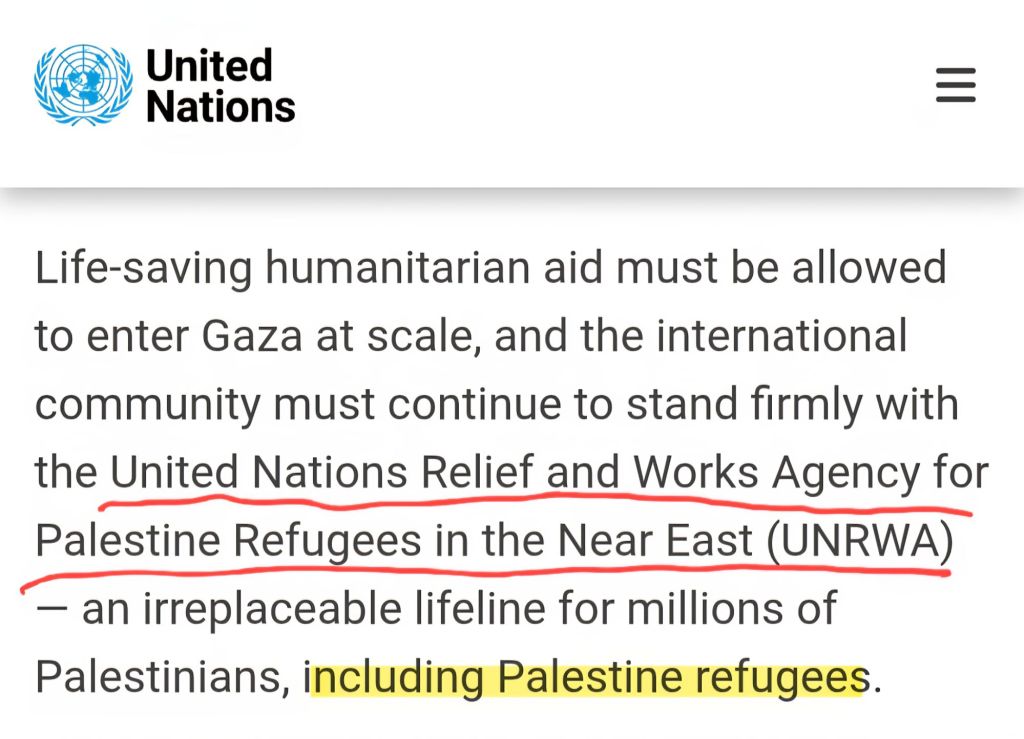
The United Nations has now openly confirmed what critics long understood: UNRWA isn’t an agency for a specific class of 1948 refugees—it exists for ALL Palestinian Arabs.

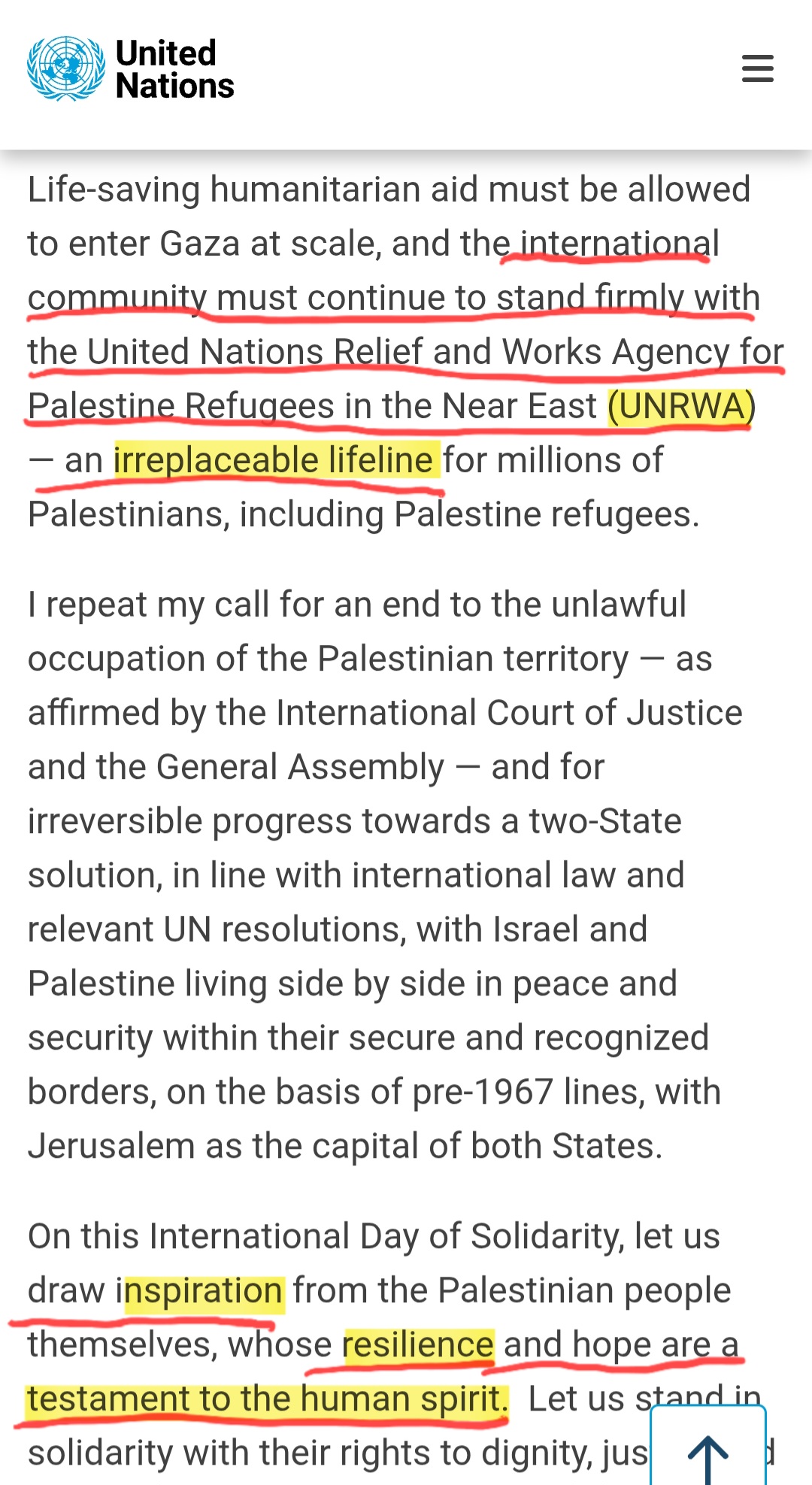
In a recent statement, the UN described UNRWA as essential for “millions of Palestinians, including Palestine refugees,” collapsing even the agency’s own elastic definition. The distinction has vanished. The entire population is the constituency.

UN admits that UNRWA is “irreplaceable lifeline” for every single Palestinian Arab.

This is a fundamental admission.
UNRWA was created in 1949 as temporary relief for Arabs – and only Arabs – displaced in a particular conflict. Twisted at its start, it has evolved into a hereditary, permanent system—unlike any refugee regime in the world—preserving grievance rather than enabling the “two state solution” the same UN purports to advance. Now the UN goes further, implying UNRWA’s mandate covers every Palestinian Arab regardless of any manufactured refugee criteria.

That is not humanitarian work. It is political infrastructure.

By broadening its mission to one entire group, the UN reveals UNRWA’s true function: a nation-building institution for Palestinians, not a neutral welfare agency. The “refugee” label is just a cudgel to wage war against the Jewish State.

The UN’s own wording now confirms that UNRWA is not designed to end a refugee situation; it is designed to expand it—to serve all Palestinian Arabs whether they fit the already-distorted definition or not.

A system once justified as emergency relief is a highly partisan political project.
And the UN has finally said so out loud.

Guterres Sickening “Inspiration”

United Nations Secretary-General António Guterres crossed a moral line when he called Palestinian Arabs an “inspiration” and a model of “resilience” this week. Inspiring how? By the crowds who celebrated the October 7 massacre? By polls showing majorities still glorifying the murders of Israeli civilians? By a culture whose media, schools, and leaders reject coexistence and sanctify violence?

Statement by UNSG Guterres about Palestinian Arabs on November 18, 2025

Guterres didn’t qualify his praise. He erased the difference between the paltry few who seek peace and the dominant culture that cheers attacks on Jews. He took a society steeped in martyrdom worship and Jew-hatred — a culture that teaches children to dream of a land without Jews — and wrapped it in moral language.

That isn’t nuance. It’s whitewashing.

And the moral preening about UNRWA, the “irreplaceable lifeline for millions of Palestinians, including Palestine refugees“, which by his own admission is not just about an agency for descendants of displaced people from 75 years ago, but for ALL ARABS? That agency which was intimately engaged in fighting a war against Israel? He insists that the international “stand firmly” with the agency which fosters the violence and perpetual state of war?

Guterres has dignified the ideology that drives repeated attacks on Israeli families. He has signaled to the world that Jewish suffering is incidental, and Palestinian rejectionism is to be emulated.

If the Secretary-General looks at a society that celebrates slaughter and sees “a testament to the human spirit”, what won’t he excuse next?

It’s time for moral clarity. If Hamas supporters chant, “There is only one solution! Intifada Revolution!’— then outside the UN, people should gather in front of the campus with the truth:

“There is only one response — eradication of Hamas!”

Peace will never come from praising a culture of violence. Only from defeating it.

UNRWA: The Antithesis of Its Mission

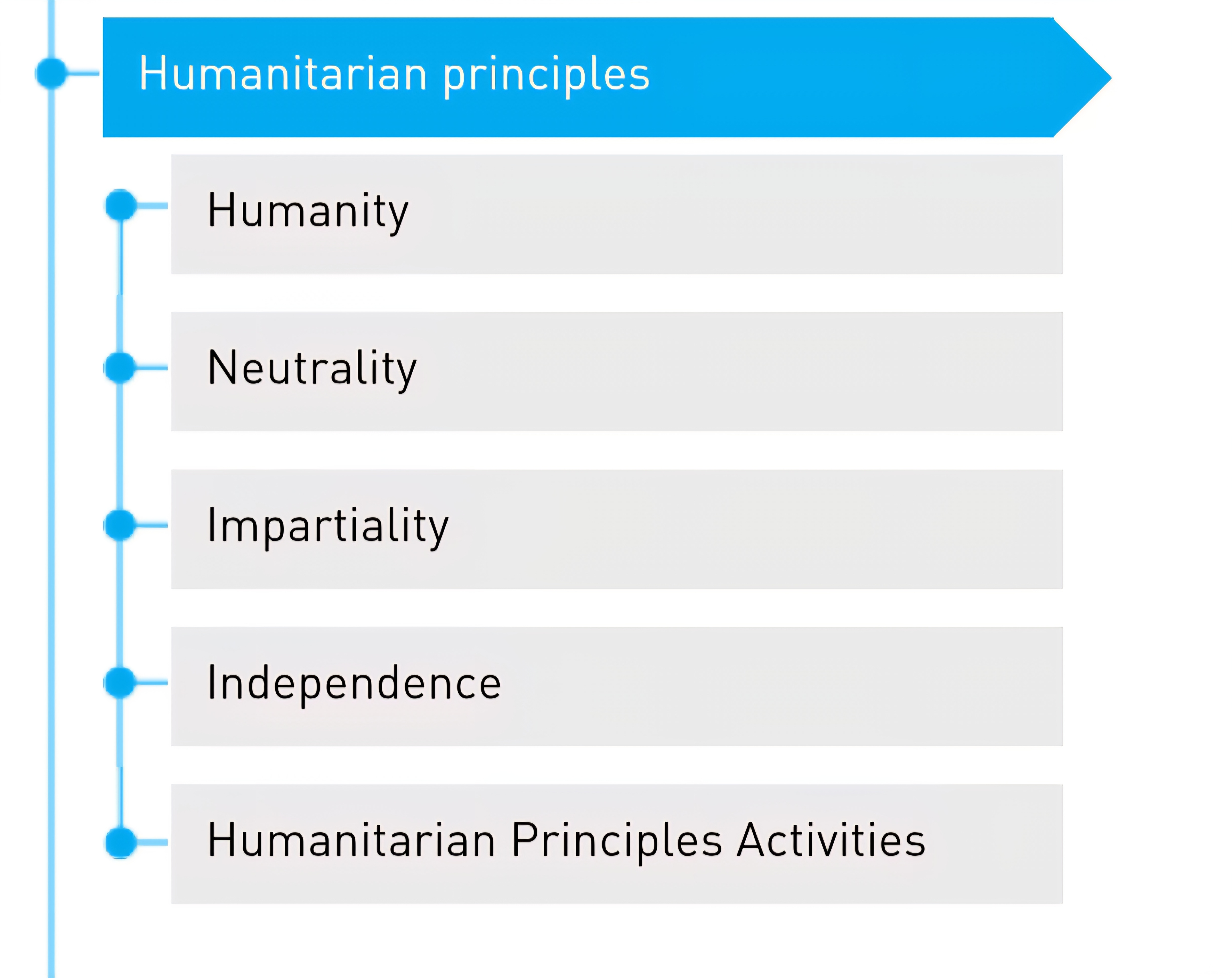
The United Nations Relief and Works Agency, UNRWA, declares that it operates on four humanitarian principles — humanity, neutrality, impartiality, and independence.
It is none of those things.

UNRWA is unlike any other UN agency. It is not the UNHCR, which manages refugees from every nation and conflict on earth. UNRWA is a creature of exception — created for a particular people, in a particular region, in a particular war.

The agency claims it was established to address the plight of refugees from Palestine following the 1948–49 Arab-Israeli War. But was that truly its purpose?
When the fighting ended, thousands of Jews were also expelled from their homes east of the 1949 Armistice Lines (E49AL) — from Jerusalem’s Old City, from Hebron, and across Transjordan’s illegally occupied territory. They, too, were refugees from Palestine. Did UNRWA help any of them? No.

Jews expelled from the Old City of Jerusalem via the Zion Gate by the army of Transjordan

From its inception, UNRWA was built to serve Arabs alone. Even when those same Arabs became full Jordanian citizens, the agency continued to provide them with housing, food, education, and medical care — benefits that by any logical standard should have ended once citizenship was granted. Instead, UNRWA preserved refugeehood as an inheritance, not a temporary condition.

Over time, UNRWA’s mission has morphed from relief to perpetuation.
It has shown itself highly partisan, politically entangled, and morally compromised. Its schools and clinics may operate under the UN flag, but the agency’s allegiance is often indistinguishable from the politics of rejectionism that dominate its host territories.

The entrance to UNRWA’s Aida “Refugee” Camp, near Bethlehem, with a key atop a keyhole, to demonstrate that the pathway to moving to Israel is via UNRWA

During the 2023 Gaza war, UNRWA boasted that only it had the infrastructure to provide food, education, and healthcare to the Gazan population.
Yet when 250 Israelis were dragged into Gaza as hostages, where was this agency of “humanity”? Did it deliver a single bandage or calorie to the kidnapped Israelis held underground? Did it condemn their abduction, or even acknowledge their suffering?
It did not.
UNRWA’s humanity proved selective, its independence nonexistent.

Its operations in Gaza function only through integration with Hamas, the political-terrorist organization that rules the territory. Schools double as weapons depots; employees have been implicated in massacres; aid is distributed by political loyalty, not human need. Leaders at the OCHA, another UN “humanitarian” group, are not shy to say they view Hamas a legitimate political representatives of Palestinians, not as a terrorist group.

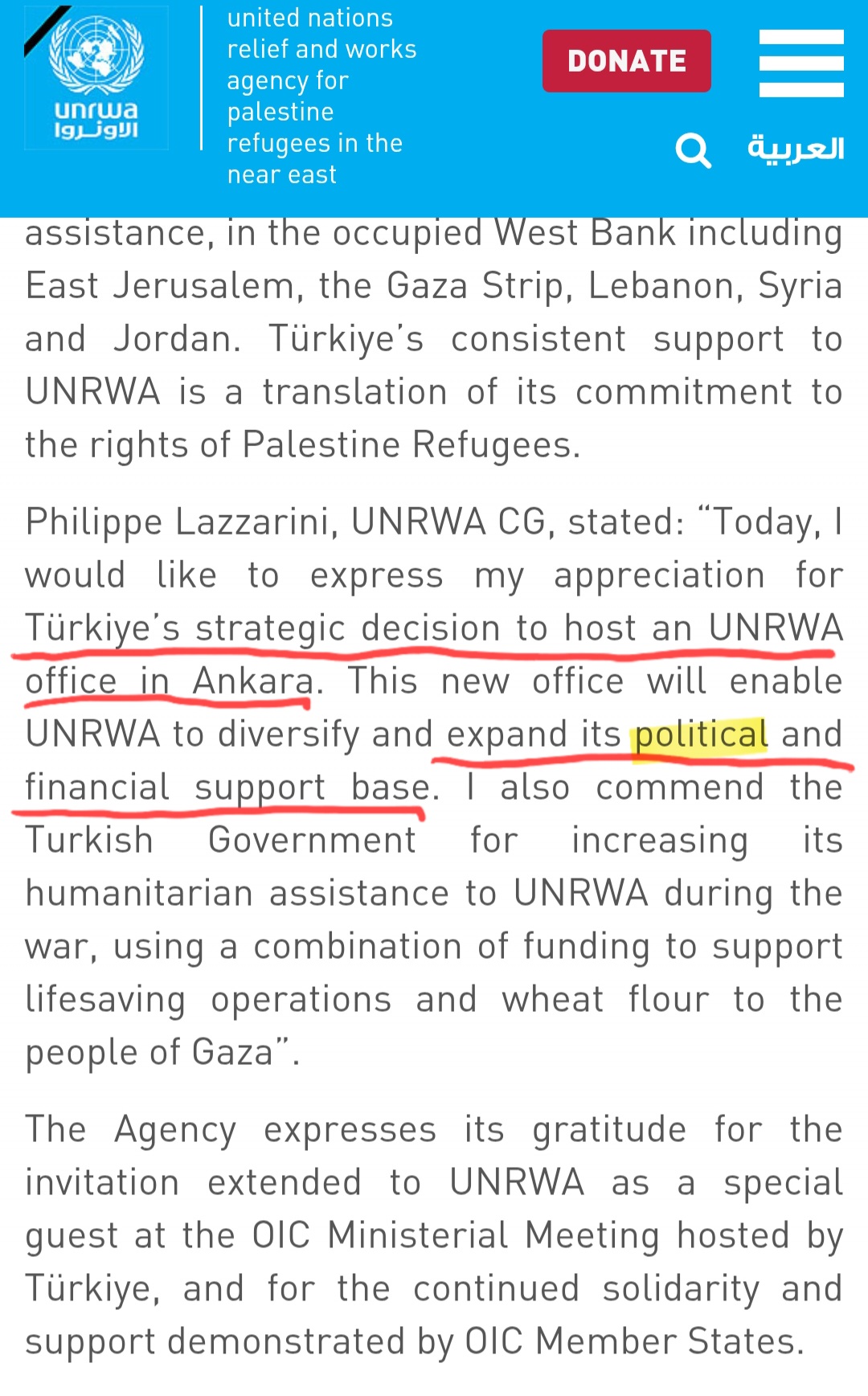
UNRWA now has additional offices outside of its field operations. It opened an office in Turkey to “expand its political and financial support base,” backed by the Organization of Islamic Cooperation (OIC), a political group. Very political. Neither independent nor neutral.

UNRWA is not a neutral humanitarian actor. It is a political instrument masquerading as one.
It fails every principle it proclaims.

It should be closed permanently.
Its essential services — food, healthcare, and education — can be absorbed either by host countries where these so-called “refugees” have lived for generations, or by the UNHCR, the global refugee agency that serves all peoples without prejudice.

So long as UNRWA exists, it will preserve resentment, dependency and hatred.
That agency founded in the shadow of war is the leading obstacle to peace.

UNRWA, Hamas, and Genocide: A Lesson in Propaganda Over Truth

As accusations of genocide in Gaza dominate global headlines, it’s important to revisit a revealing episode that exposes the deeper priorities of Palestinian political culture—from Hamas to institutions like UNRWA and even the Palestinian Authority.

Starting in 2009, the United Nations Relief and Works Agency (UNRWA) made multiple attempts to introduce Holocaust education into its school curriculum. Hamas, which governs Gaza, unequivocally rejected the idea. Its officials declared that teaching about the Holocaust would “poison the minds of Palestinian children.”

  • Yunes al-Astal, member of the Hamas faction in the Palestinian Legislative Council said teaching the Holocaust in UNRWA schools would lead to “marketing and spreading a lie.” He said that adding the subject to the curriculum was “a war crime” and “support and service of the Zionists” (Filastin al-Yawm, August 30, 2009).
  • Sami Abu Zuhri, Hamas spokesman in the Gaza Strip, said that Hamas opposed adding Holocaust to the curriculum because its objective was to justify the “Israeli the occupation” of the land of the Palestinian territories (Reuters, August 30, 2009).
  • Abd al-Rahman al-Jamal, head of the Palestinian Legislative Council’s education committee for Hamas, told a BBC correspondent that the Holocaust was “a big lie.”
  •  Mustafa Sawaf, editor of Hamas’ Felesteen, wrote an editorial (September 1) entitled slamming UNRWA’s intention to teach the Holocaust an attempt to brainwash the younger generation in the Gaza Strip and to “prettify the image of the murderous, criminal Jews.”
  • Jamila Al-Shanti, Hamas Minister of Education, said that “Talk about the Holocaust and the execution of the Jews contradicts and is against our culture, our principles, our traditions, values, heritage and religion.” (Washington Post, September 2, 2009).
  • The Hamas-affiliated Popular Committees for Refugee Affairs denounced UNRWA, claiming that the Holocaust had not yet been scientifically proven and that teaching it was liable to cause students to identify with the Jews. Members of the committee absolute refused to have their children “learn the lie invented by the Zionists” (Filastin al-‘An website, August 30, 2009). According to the Committees, “the Holocaust was not real and outstanding Western scholars have proved that.” (PalToday website, August 30, 2009). It added “Holocaust studies in refugee camps is a contemptible plot and serves the Zionist entity with a goal of creating a reality and telling stories in order to justify acts of slaughter against the Palestinian people.”

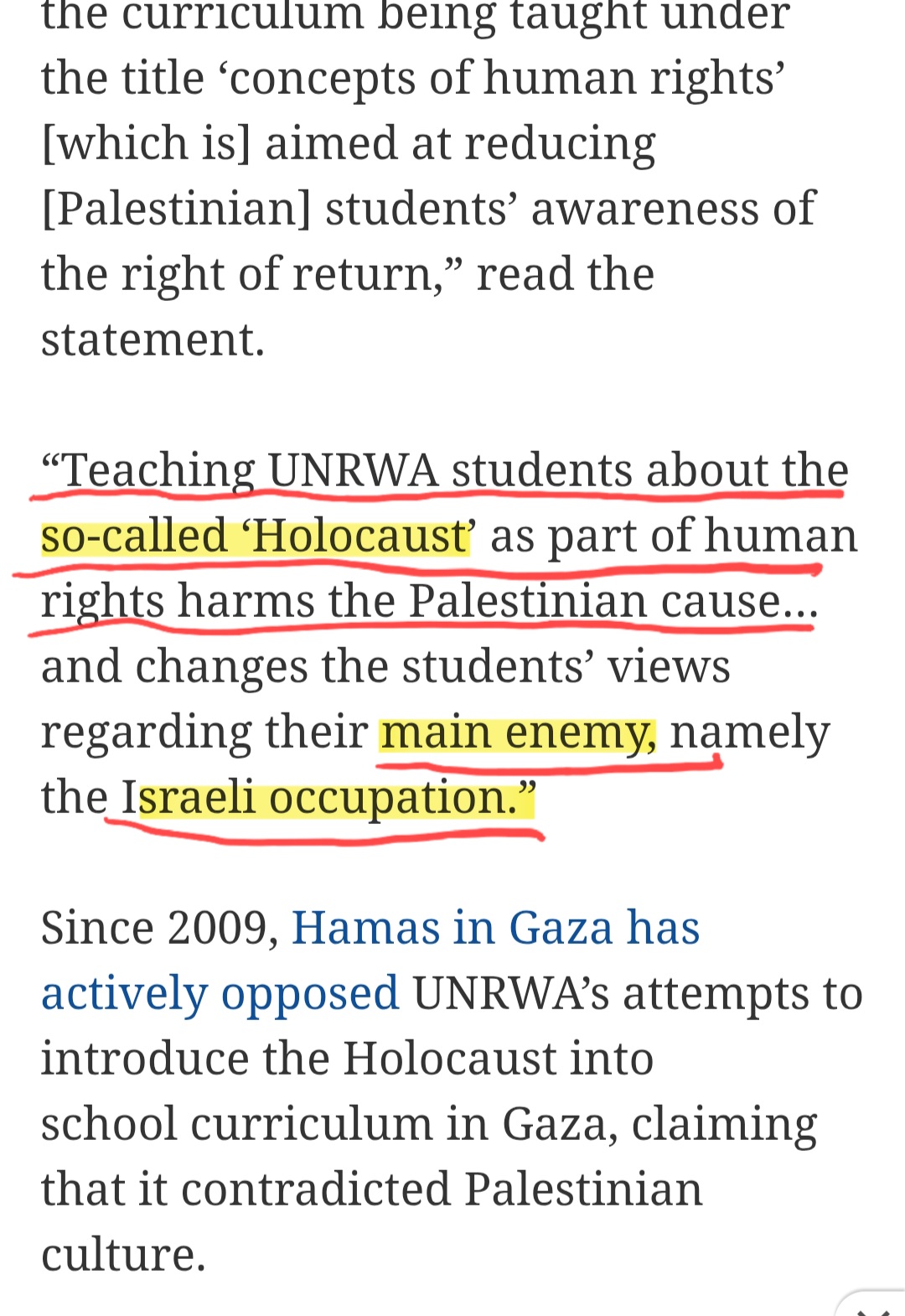
UNRWA teachers in Jordan also refused to teach about the Holocaust, saying “teaching UNRWA students about the so-called ‘Holocaust’ as part of human rights harms the Palestinian cause… and changes the students’ views regarding their main enemy, namely the Israeli occupation.”

The Palestinian Authority remained silent or dismissive about Holocaust education in the West Bank.

Consequently, UNRWA held back from pushing the issue, as its mantra is to work within the framework of the “host countries” in which it operates.

This episode illustrates three key realities:

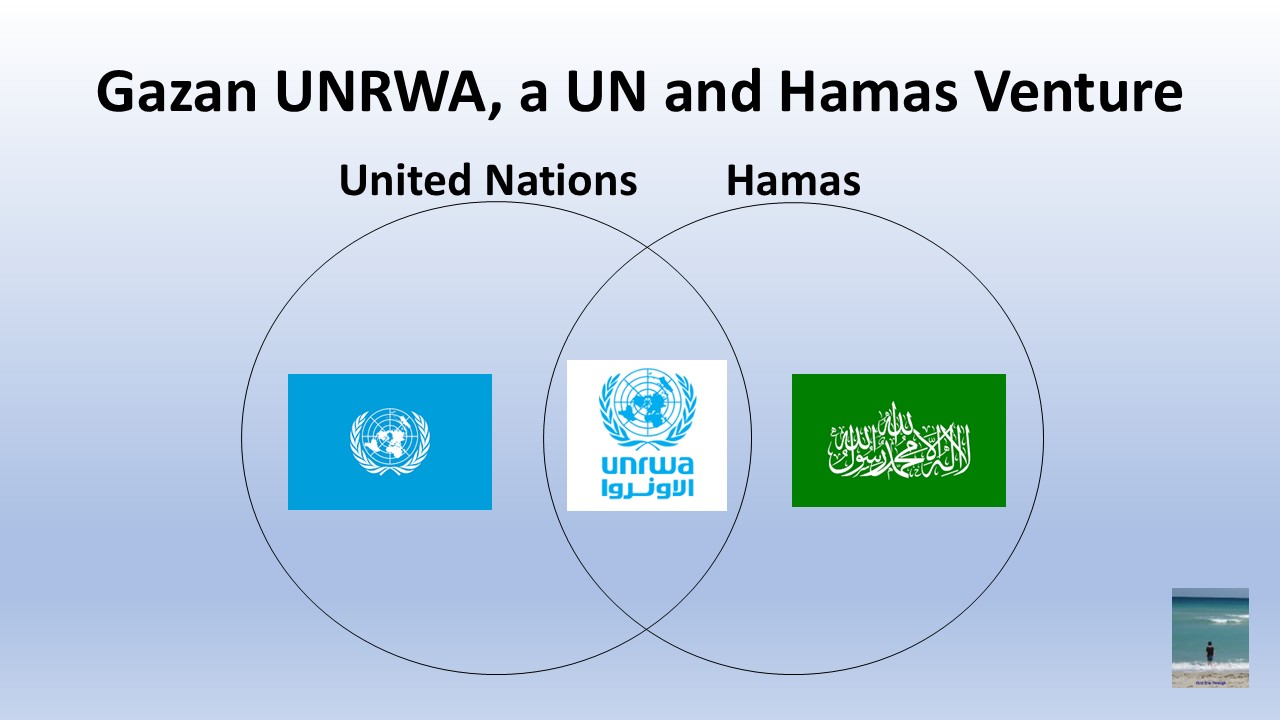
  1. UNRWA and Hamas are not the same—but not separate either. UNRWA claims neutrality, but its own documents state that it must work with the local authorities—in Gaza, that’s Hamas. This means Hamas effectively vetoes what UNRWA can teach and what it can do, no matter what UN policy says.

2. Antisemitic attitudes aren’t limited to Hamas. The resistance to teaching the Holocaust spans Palestinian political and educational institutions well beyond Gaza.

3. Propaganda overrides fact. From Holocaust denial to blood libel-style rhetoric, the dominant trend has been the elevation of anti-Israel and antisemitic narratives over historical truth. Even Columbia professor Edward Said – who vilified the State of Israel – acknowledged the antisemitic and conspiratorial discourse in Palestinian circles regarding Holocaust denial. James Zogby went so far as to call the violent antisemitic obsession, a “tragic deformity in Palestinian political culture,” when speaking at the United Nations in June 2023.

Whether or not what is happening in Gaza today constitutes a genocide is a matter of intense debate. But what is beyond dispute is the long-standing, systemic preference in Palestinian political culture to weaponized falsehoods to spread propaganda to destroy the Jewish State.