An agency created to provide temporary relief now needs $70 million to cover its employees’ salaries over just two months. How did UNRWA become so large, expensive and financially dependent?
The United Nations Relief and Works Agency for Palestine Refugees in the Near East (UNRWA) is appealing for another $70 million to cover a financial shortfall, with employee salaries for the final months of 2026 at risk.
It is a remarkable moment for an institution established in 1949 to address the immediate humanitarian needs of refugees from the 1948 Arab-Israeli war.
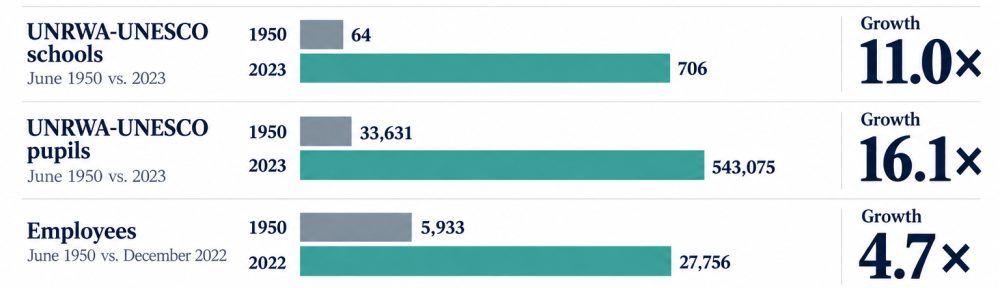
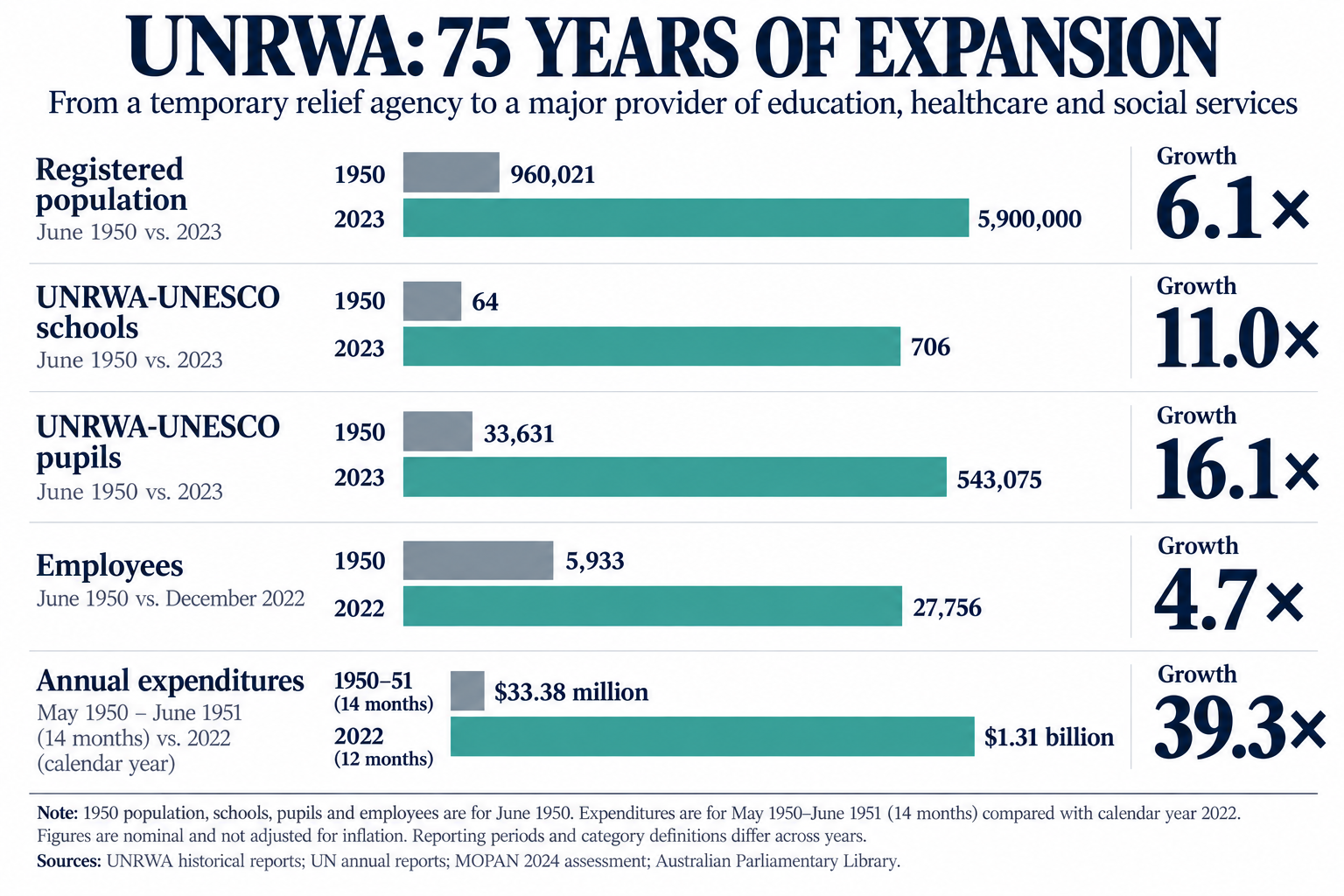
UNRWA began operations in 1950 with approximately 960,000 people on its registration rolls, distributing food, providing shelter and delivering basic medical assistance. Seventy-five years later, its register approaches six million people, its workforce numbers roughly 27,000, and its annual expenditure has exceeded $1 billion.
Along the way, it became an education system, a healthcare provider, a social-services agency and a major employer with retirement benefits serving people beyond its original refugee population.
The scale of this transformation deserves examination, particularly as UNRWA once again asks donors to finance obligations accumulated over decades.
What Changed in 75 Years?
| Measure | Beginning | Later | Change |
|---|---|---|---|
| Registered population | 960,021 (1950) | ~5.9 million (2023) | 6.1× |
| Employees | 5,933 (1950) | 27,756 (2022) | 4.7× |
| Annual expenditure | $33.38 million (1950–51) | $1.31 billion (2022) | 39.3× nominal |
| Schools | 64 (1950) | 706 (2023) | 11.0× |
| Students | 33,631 (1950) | 543,075 (2023) | 16.1× |
| Education share of regular spending | ~1% (1950) | ~60% (2002) | 60-fold share |
| Relief share of regular spending | ~97% (1950) | 9.5% (2002) | Down 87.5 percentage points |
| Teachers | ~800 (1950) | 16,965 (2002) | ~21× |
| Students per teacher | ~51 (1950) | ~29 (2002) | 44% lower |
| Employer retirement contributions | — | $63.5 million (2024) | Recurring annual cost |
| Personnel expenditure | — | $735 million (2024) | 57.7% of total spending |
UNRWA’s registered population grew approximately sixfold, while student enrollment expanded sixteenfold and its teaching workforce roughly 21-fold. The agency’s educational responsibilities grew far faster than its registered population, illustrating how profoundly its mission changed.
From Refugees to Generations of “Refugees”
UNRWA’s original registration population consisted primarily of people displaced by the 1948 war. Over subsequent decades, qualifying descendants became eligible for registration, creating a multigenerational population.
By 2023, nearly six million people were registered, including children, grandchildren and great-grandchildren of the original refugees and internally-displaced people. This increase reflects births, successive generations, migration and registration practices, rather than six million people personally displaced in 1948.
UNRWA also expanded eligibility beyond that original population. Following the 1967 war, the United Nations authorized the agency to assist additional displaced people, including individuals outside its registered refugee population.
By 1970, UNRWA was distributing approximately 217,000 monthly food rations to displaced people outside its refugee register, financed by the Jordanian government.
Registration also differs from actual service utilization. In 2023, approximately 2.02 million individuals used UNRWA healthcare services, compared with nearly six million registered “refugees.” Others used education, social services or emergency assistance, while some relied on alternative providers.
So even with the large budget, it doesn’t even cover all of the UNRWA registrants.
From Food Rations to Schools and Clinics
The greatest transformation occurred in what UNRWA actually did.
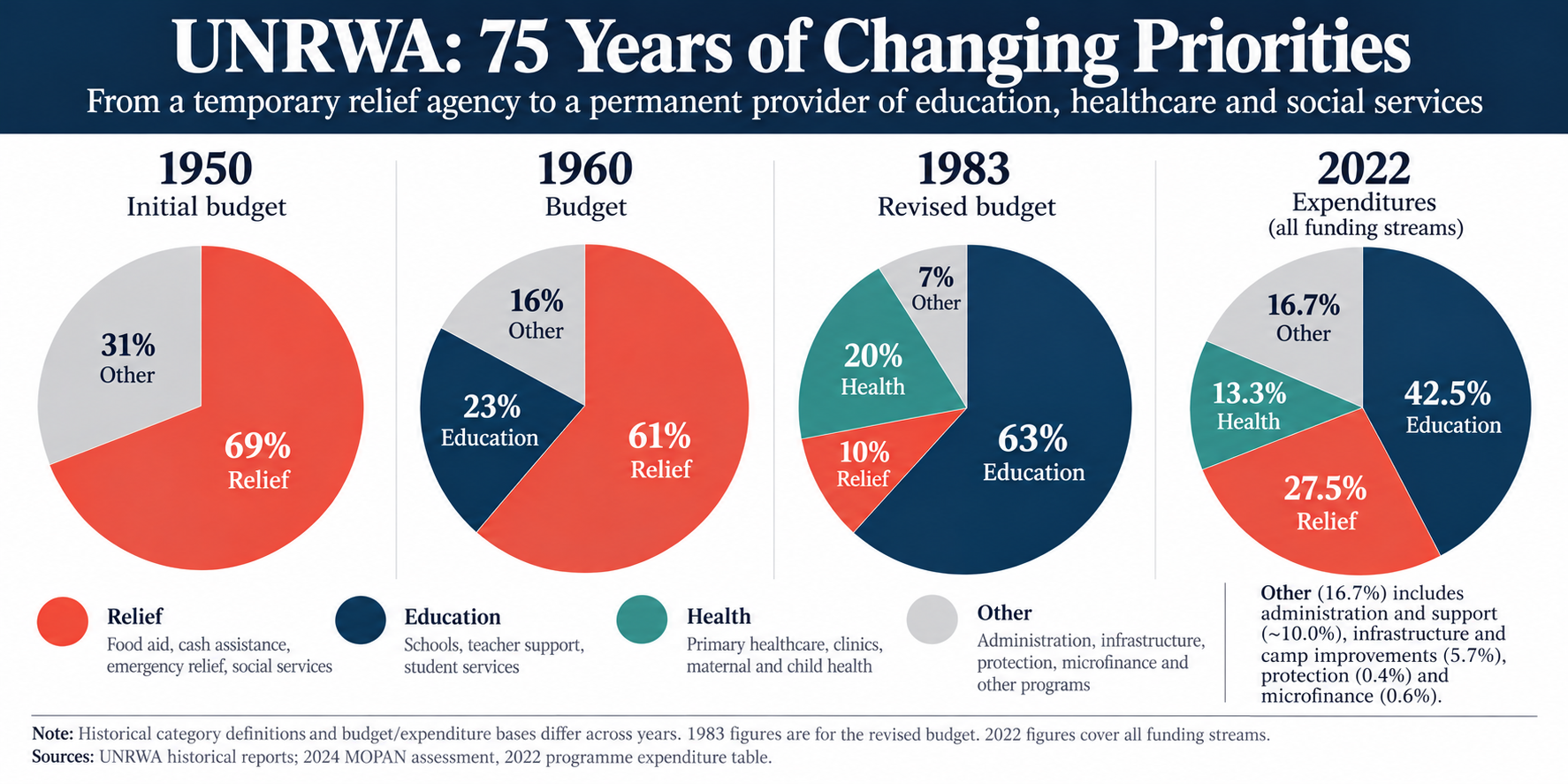
In 1950, approximately 97% of its regular programme spending went toward relief. Education accounted for roughly 1%.
By 1970, education had overtaken relief as the largest expenditure category. By 2002, education represented approximately 60% of regular programme expenditure, while relief had fallen to 9.5%.
UNRWA had become a substantial education system, with teachers, administrators, buildings, maintenance requirements and recurring operating expenses. Healthcare similarly evolved from emergency treatment into ongoing clinics, preventive medicine, maternal care and treatment of chronic illnesses.
Meanwhile, refugee camps themselves changed. The approximately 30,580 tents recorded in 1950 had largely disappeared by 1961, replaced by established residential communities and permanent structures.
UNRWA’s services increasingly resembled those normally provided by public institutions.
In 1983, UNRWA discontinued its general food-ration programme, shifting toward education, healthcare and targeted assistance. By its revised 1983 budget, education accounted for approximately 63% and relief for 10%. Emergency food distribution would return during subsequent conflicts, but the regular mission had fundamentally changed.
By 2022, however, relief and social services represented approximately 27.5% of total expenditures. This increase reflected a new generation of humanitarian crises, most having NOTHING to do with Israel.
The Syrian civil war beginning in 2011, Lebanon’s economic collapse beginning in 2019, and the COVID-19 pandemic beginning in 2020 created enormous additional demands for food assistance, emergency cash payments and support for displaced families. These crises, alongside continuing emergency assistance in Gaza and the West Bank, substantially expanded UNRWA’s relief operations.
The 2022 figures also include regular operations, emergency appeals and special projects, whereas the earlier historical budgets used different accounting categories. UNRWA spent approximately $387 million through emergency appeals in 2022. The larger relief share therefore reflects both newer crises and a broader accounting of expenditures, while education and healthcare remained its principal permanent services.
Emergency Spending That Became Permanent
The 1967 war illustrates how emergency responsibilities could become recurring expenses. For 1968, UNRWA proposed an ordinary budget of $40.2 million and an additional $5.7 million for expanded operations, representing 12.4% of the combined budget. Some emergency activities were incorporated into the ordinary program within a short period.
Subsequent conflicts, including the Gulf War, Second Intifada, Syrian civil war and successive Gaza wars, added further responsibilities. Temporary emergency responses developed into continuing facilities, services and employment obligations.
This institutional evolution creates a financial consequence: permanent services require permanent funding, even as UNRWA continues to operate under a refugee-relief 1949 mandate and depends heavily on voluntary donor contributions.
A Relief Agency Becomes a Major Employer
Education became UNRWA’s largest employer. By 2002, roughly three-quarters of its workforce worked in education.
Salaries and employee benefits consequently became central to its finances. In 2024, UNRWA reported approximately $735 million in personnel expenditure, representing 57.7% of its $1.27 billion total expenditure.
The agency also developed substantial retirement and employment obligations, financed through the contributions of governments and other international donors.
Most local employees participate in a Provident Fund, supported by employee and employer contributions. UNRWA’s employer contributions totaled approximately $63.5 million in 2024, money ultimately financed through its operating resources, principally donor contributions. Employees also contribute from their salaries. International employees generally participate in the United Nations Joint Staff Pension Fund, supported by employee and employer contributions.
Beyond retirement savings, UNRWA owes qualifying employees end-of-service and termination benefits. These obligations can require substantial payments when employees retire, leave or are laid off. Its audited accounts have recorded hundreds of millions of dollars in accrued employee-benefit liabilities, some of which lack dedicated funding reserves.
The United Nations’ 2025 strategic assessment estimated that mass termination of staff could generate approximately $278 million in indemnity payments, without available reserves to meet them. That figure is distinct from the broader accrued employee-benefit liabilities reported in UNRWA’s financial statements.
An organization created to provide emergency assistance has become a long-term employer whose workforce carries financial obligations extending well beyond any immediate humanitarian crisis.
What Should Happen After Another $70 Million?
UNRWA’s history raises questions that extend beyond the latest appeal.
How many of its nearly six million registered “refugees” actually depend on each service? What proportion of expenditure supports education, healthcare, emergency relief and administration? How much of its operating budget benefits people outside the original refugee registration system?
Could some established services be transferred to existing public institutions, and what would such a transition cost? How should employee retirement and termination obligations be financed? What would constitute a sustainable funding model for the services that remain?
These questions require answers grounded in audited expenditure, service usage, educational outcomes and the practical consequences of institutional change.
The United Nations itself has examined options ranging from predictable multiyear financing to changes in service delivery and transfers of responsibilities.
The $70 million appeal is a symptom of a much larger institutional problem. UNRWA has spent 75 years evolving from temporary relief into a billion-dollar-plus permanent education, healthcare and employment system, financed through international contributions. Another emergency payment may cover the next round of salaries. The harder question is whether the world intends to finance this structure indefinitely—or finally decide who should provide these services, under what mandate, and at what cost.
Related:


