When Israel declared independence in 1948, it had roughly 717,000 Jews and roughly 156,000 Arab citizens and residents. Those numbers were small, but what they carried was enormous: the ambition to reverse two thousand years of Jewish dispersion and gather a scattered people back into sovereignty.
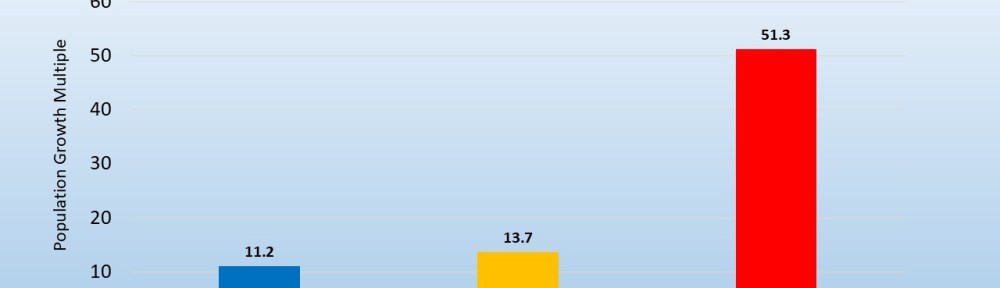
Yet the first demographic fact that emerges from Israel’s modern history cuts against so much of the political mythology surrounding it. Since 1948, Israel’s Arab minority expanded at a faster proportional rate than its Jewish majority. The Jewish population grew from 717,000 to nearly 8 million, roughly elevenfold. Israel’s Arab population grew from 156,000 to more than 2.1 million, more than thirteenfold.
That fact strips away one of the central distortions in the debate over Israel. The rise of the Jewish state did not require the disappearance of its Arab minority. Quite the opposite. Israel’s Arab population expanded dramatically under Israeli sovereignty. Two populations grew inside the same state, but through entirely different engines. The Jewish story was one of ingathering, especially during the early years.
Today, Israel stands at more than 10.2 million people, nearly 8 million Jews and more than 2.1 million Arabs. A state born in scarcity became a fully formed society. But the road from 1948 to 2026 can best be understood through four distinct demographic phases: ingathering, expansion, retention, and preservation.
The first phase was ingathering. At first, Israel was an immigration state, and its earliest years were powered by catastrophe. The survivors of Europe came first, the broken remnant of the Holocaust arriving in a country still fighting its first war. Then came the collapse of Jewish life across the Arab world. Ancient Jewish communities in Iraq, Yemen, Morocco, Egypt, and Libya emptied under expulsion, violence, and state pressure. More than 800,000 Jews left the Arab world, many rebuilding their lives in Israel.
Then came the Soviet opening. The collapse of the Soviet Union released nearly one million Jews into the largest migration wave since the founding of the state. Europe’s destruction, the Arab world’s expulsion, and the Soviet opening formed the three great waves of Jewish ingathering. Three different historical ruptures, one destination. That is how Jewish Israel was built.
Population Growth, 1948–2026
Jews
1948    ████ 0.72m
1970    █████████ 2.6m
1990    ███████████████ 4.8m
2000    ███████████████████ 5.2m
2026    ███████████████████████████ 7.97m
Arabs
1948    █ 0.16m
1970    ██ 0.47m
1990    ████ 0.95m
2000    █████ 1.2m
2026    █████████ 2.15m
While Jewish Israel was growing through migration, Israel’s Arab population was growing through birth. Higher fertility and falling mortality created uninterrupted expansion over decades. That is why the proportional growth of Israel’s Arab population exceeded the proportional growth of the Jewish population.
Then the second phase began: expansion. At first, Jewish growth depended on aliyah. Over time, it depended increasingly on birth. The immigrants became citizens, the citizens became parents, and the children of refugees became the country itself. The engine of Jewish demographic growth shifted from the airport to the maternity ward. That is the deepest demographic transition in Israel’s history.
In 2025, Israel recorded approximately 177,000 births. Immigration that year stood at roughly 24,600. Births now outnumber immigration by more than seven to one. What would have been unimaginable in 1948 has become ordinary in 2026. Israel began as a refuge. It now reproduces itself.
Annual drivers of growth, 2025
Births        ███████████████████████
Immigration   ███
Deaths        ██████
That changes the meaning of the state. Political Israel started as the answer to Jewish vulnerability, a place Jews could flee to when the world closed. That remains true. But demographically, it is no longer Israel’s primary function. Israel is no longer merely where Jews go when exile fails. It is where Jewish continuity principally lives.
And here, another old assumption collapsed. For decades, Israeli politics was shaped by demographic anxiety: would Arab fertility permanently outpace Jewish fertility? Would a demographic clock eventually run down the Jewish majority? That fear shaped strategy, borders, and diplomacy. For years, the numbers seemed to support it.
Then the numbers changed. Arab fertility declined as Arab society modernized. Jewish fertility remained unusually strong for an advanced economy. Today, Jewish fertility has reached parity with, and in some years slightly exceeded, Arab fertility. The demographic trajectory shifted. A generation of political strategy was shaped by a demographic clock that slowed while everyone kept hearing it tick.
Fertility Shift
1990
Arab     █████
Jewish   ███
2026
Arab     ███
Jewish   ████
But demographic success creates its own new challenge.
For most of Israeli history, migration remained positive. Even when aliyah slowed, more Jews came than left. That changed in the last two years. In 2022, Israel absorbed more than 74,000 immigrants, driven heavily by war in Ukraine and departures from Russia. That surge faded quickly. By 2024 and 2025, net migration turned negative – more Israelis left than new immigrants arrived.
This is not a demographic crisis. Births still overwhelm migration losses, and Israel continues to grow. But the Zionist test has changed. For decades, the question was how many Jews Israel could gather. Now the question is how many it can keep.
Net Migration Trend
2022     +++++++++++++++++++++++
2023     +++++++
2024     ----------
2025     --------
The founding generations came because they had to. Future generations stay because they choose to. That is a different kind of national test. And the retention question is not merely numerical. If those leaving are disproportionately engineers, doctors, founders, investors, and elite military talent, the demographic issue changes shape. A state can absorb numerical loss. It feels the loss of capability much faster.
Above all these numbers sits the larger civilizational shift. In 1948, around six percent of world Jewry lived in Israel. Today, around 45% does. Soon it may be the majority.
Share of World Jewry Living in Israel
1948    ██ 6%
1970    ████ 18%
1990    ███████ 30%
2010    ██████████ 42%
2026    ████████████ 45%
There is one more demographic question hanging over Israel in 2026, larger than fertility, migration, or retention. It sits beneath almost every diplomatic formula and every argument about the future of the conflict.
The question is the scale and meaning of the Stateless Arabs from Palestine (SAPs) having a “right of return.”
For decades, the Palestinian Authority and the United Nations have insisted on a “right of return” for Palestinian “refugees” and their descendants. The number most commonly cited is roughly 5.9 million. That number matters because it clarifies what the argument actually means in demographic terms.
Israel today has roughly 10.2 million people. Add 5.9 million Palestinian Arabs to that number and the demographic map changes overnight. Israel would become a country of more than 16 million people. Its Arab population would jump from 2.1 million to more than 8 million. Its Jewish population would remain just under 8 million. The Jewish majority would collapse into parity or slightly minority status.
That is not a marginal adjustment. It is a structural transformation of the state itself.
Put into historical perspective, the scale becomes even sharper. In 1948, Israel’s Arab population stood at roughly 156,000. By 2026, it had already grown to more than 2.1 million, more than thirteenfold growth, already exceeding Jewish proportional growth over the same period. Add 5.9 million more, and that Arab population would stand at more than 8 million, representing more than fiftyfold growth since the founding of the state.
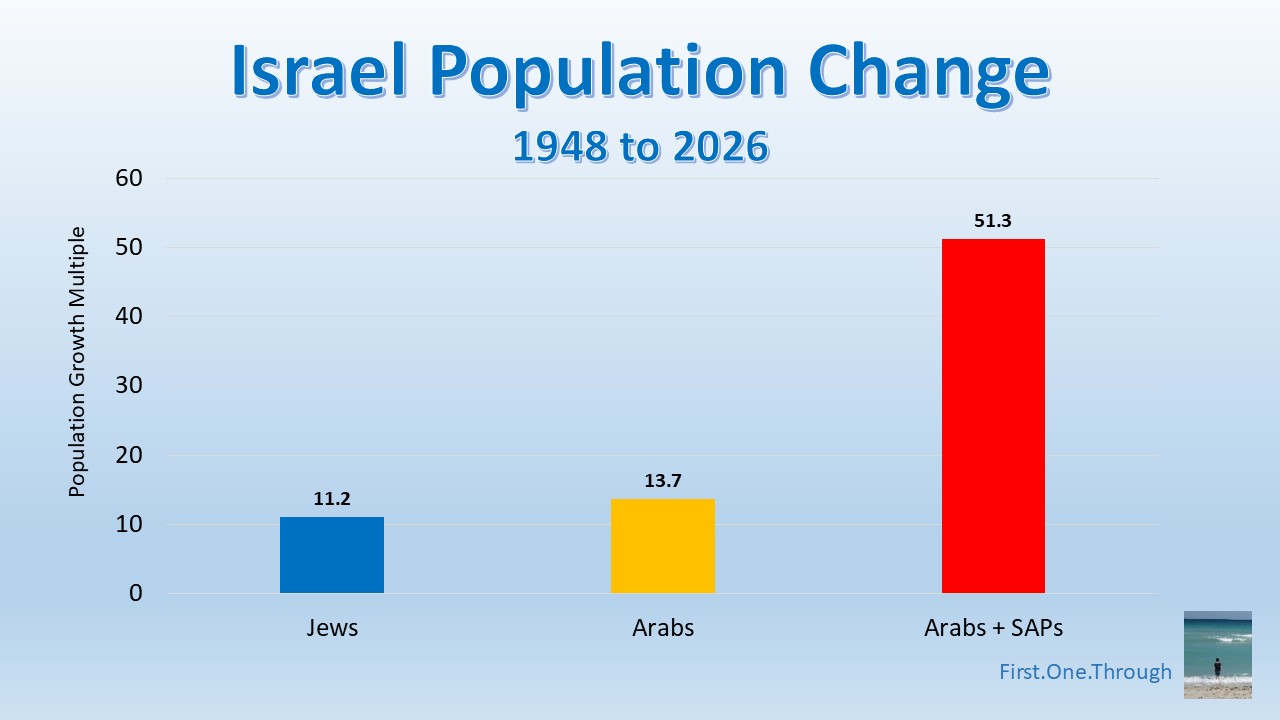
A “right of return” on this scale is not simply an immigration proposal, already stripping Israel a basic right of sovereignty to determine who to admit into the country. It further demands that the Jewish State cease to be one.
That is why this issue forms the fourth demographic challenge: preservation. Preservation of the demographic framework that allowed Jewish self-determination to return after two thousand years of dispersion and discrimination.
For most of Jewish history, survival meant enduring dispersion. In Israel, survival became concentration, then continuity, and now choice. The next phase may determine whether it remains preservation.
Very few countries have grown by over 10 times since 1948, and none in the developed “Global North”, with Australia and Canada leading the group at 2.5x and 1.9x, respectively (no European country even doubled its population). In the Middle East and North Africa (MENA) region which saw explosive growth due to the discovery of oil, no country has had the minority populations grow faster than the majority.
Israel is a true anomaly, a developed country with explosive growth, sitting in the MENA region which suppresses the growth of minority groups but the Jewish State still saw oversaw a faster growth of non-Jews. Despite the basic facts, the world still pressures the country to admit even more people adding to the population density, and with minorities who never lived in the country, in particular, undermining the demographic status quo.
As Israel considers its plans for the years ahead, retaining educated talent and ending the so-called SAP “right of return” rank as the leading causes to maintain a thriving democracy.


Pingback: The Polls Tell a Very Different Story About Israeli Arabs | First One Through