This is Part One of a series examining the surge in antisemitism, starting with an analytical perspective, and following it to find its basis and track its progression.
Ten countries, six years of data, and a striking change in the global pattern
Antisemitism is often discussed through individual incidents: an attack on a synagogue, harassment of Jewish students, vandalism of a Jewish business, or threats directed at Jewish families. Each event tells us something about the experiences of Jews in a particular place. Looking at thousands of incidents across several countries and multiple years can tell us something different.
It can reveal patterns.
I examined reported antisemitic incidents in ten countries over six years, from 2019 through 2024. The objective was to understand how antisemitism changed over time, whether countries followed similar trajectories, and what happened around October 7, 2023, when the political-terrorist group Hamas attacked Israel and the subsequent war began.
I began with the numbers themselves, before considering possible explanations.
The Ten Countries
The ten countries chosen were the United States, United Kingdom, France, Germany, Canada, Australia, Italy, the Netherlands, Belgium and Argentina. Each has an established Jewish community of more than 25,000 people and an organization or government agency that regularly publishes statistics on antisemitic incidents. Together, they provide a geographically diverse sample spanning North America, South America, Europe and Australia.
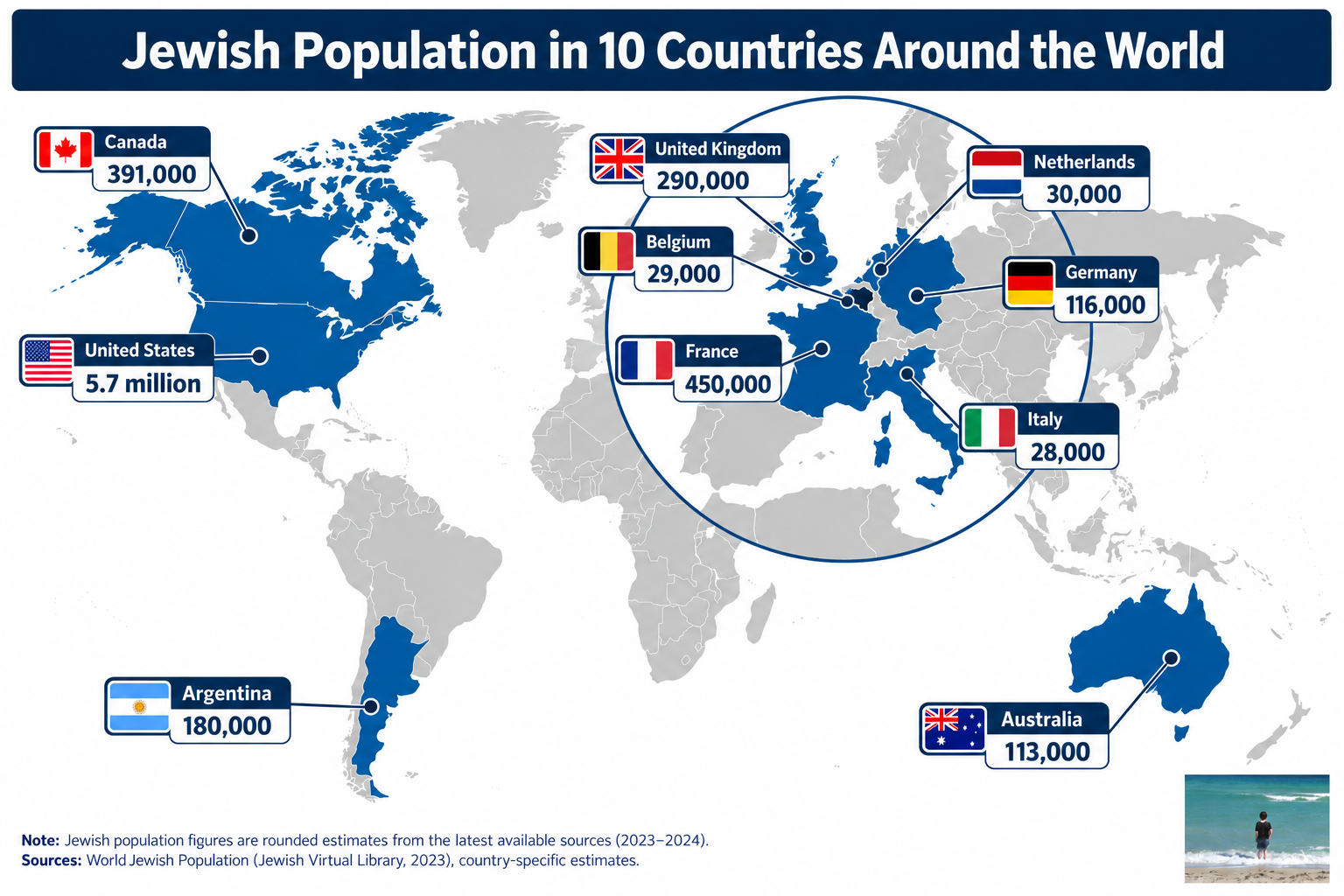
The countries also offer useful differences. Their Jewish populations range from tens of thousands to millions. They have different political systems, histories, cultures and approaches to recording antisemitism.
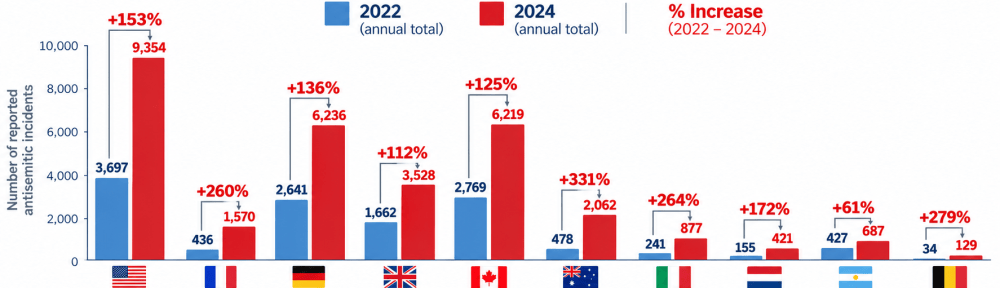
Before October 7, the ten countries were moving in different directions. Some had experienced years of increasing antisemitism, while others had seen substantial declines. By 2024, every one of them was reporting more antisemitic incidents than in 2022.
What could explain such a consistent change across countries with such different histories?
I used statistics from the Anti-Defamation League in the United States, Community Security Trust in Britain, the French Interior Ministry, German police, B’nai Brith Canada, the Executive Council of Australian Jewry, Italy’s CDEC, the Netherlands’ CIDI and Argentina’s DAIA.
What Happened Between 2019 and 2024?
The first question was straightforward: how many antisemitic incidents were recorded each year?
| Country | 2019 | 2022 | 2024 | Change 2022–2024 |
|---|---|---|---|---|
| United States | 2,107 | 3,697 | 9,354 | +153% |
| United Kingdom | 1,805 | 1,662 | 3,528 | +112% |
| France | 687 | 436 | 1,570 | +260% |
| Germany | 2,032 | 2,641 | 6,236 | +136% |
| Canada | 2,207 | 2,769 | 6,219 | +125% |
| Australia* | 368 | 478 | 2,062 | +331% |
| Italy | 251 | 241 | 877 | +264% |
| Netherlands | 182 | 155 | 421 | +172% |
| Argentina | 918 | 427 | 687 | +61% |
| Belgium | 92 | 34 | 129 | +279% |
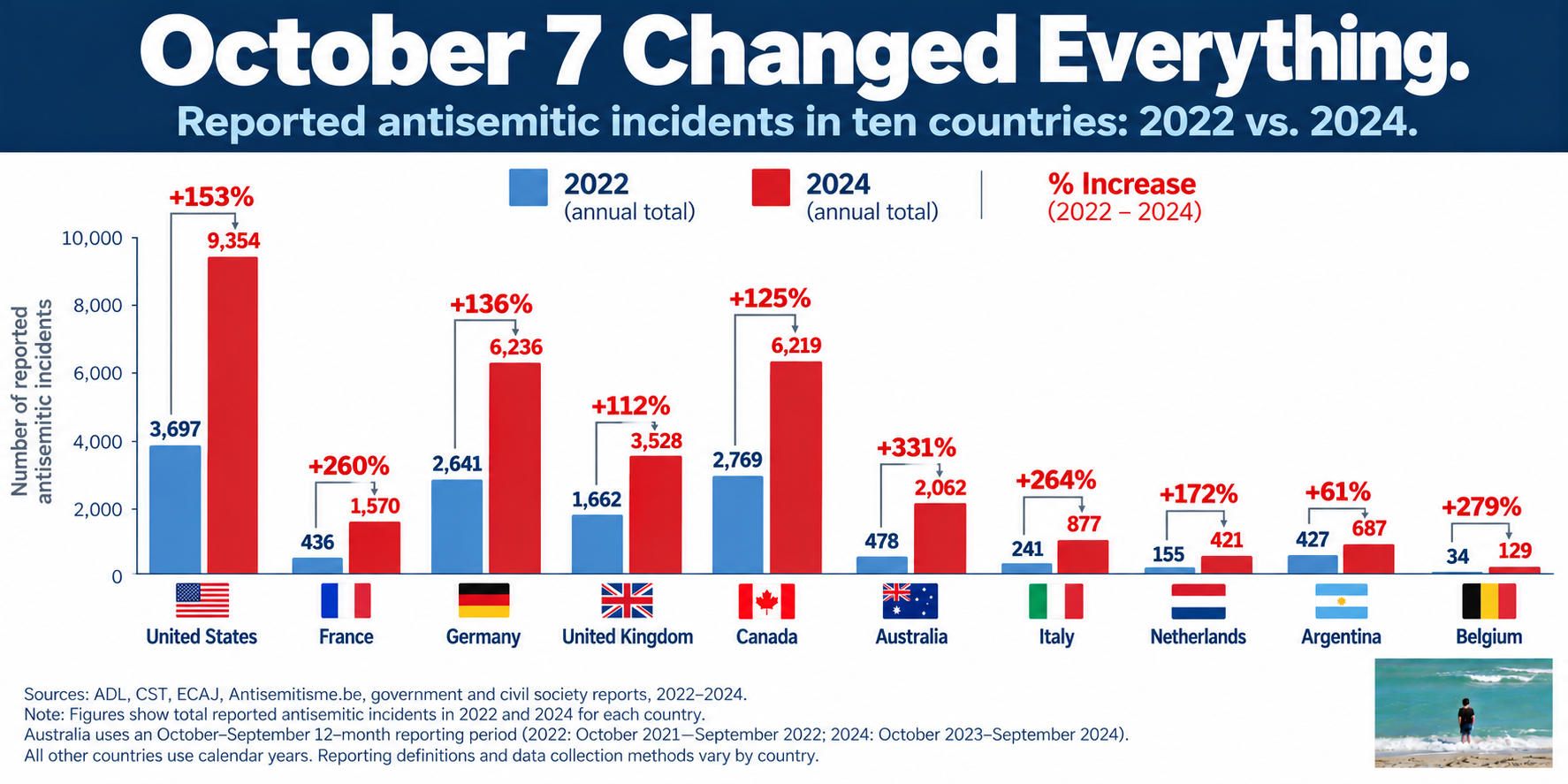
Taken together, there were roughly 12,500 antisemitic incidents in 2022 and 31,000 in 2024, an increase of approximately 148%. Although reporting definitions vary between countries, the combined total offers another perspective on the scale of the increase.
Every country recorded more incidents in 2024 than in 2022.
The increases ranged from 61% in Argentina to more than 300% in Australia. The median increase was approximately 153%, meaning the middle country experienced roughly two and a half times as many recorded incidents in 2024 as in 2022.
Yet the countries had arrived at 2022 by very different paths.
Some Countries Had Been Rising. Others Had Been Declining.
Between 2019 and 2022, antisemitic incidents increased in four countries: the United States, Germany, Canada and Australia. The United States experienced particularly substantial growth, with incidents rising 75%.
The other six countries were moving in the opposite direction. France recorded 687 incidents in 2019 and 436 in 2022, a decline of 37%. Argentina fell from 918 to 427, a decline of 53%. Britain, Italy, Belgium and the Netherlands also recorded lower totals in 2022 than in 2019.
Despite their trajectories, all ten countries had experienced substantial increases from their 2022 levels.
We tested whether countries with the fastest increases before 2023 also experienced the fastest increases afterward. The statistical relationship was extremely weak, with a correlation of just +0.13.
In practical terms, knowing whether a country’s antisemitism had previously been rising or falling told us remarkably little about the size of its subsequent increase.
How Unusual Was the Increase?
I next compared the 2024 figures with the historical patterns established between 2019 and 2022. I tested three approaches: comparing 2024 with the earlier four-year average, extending the earlier trend forward in a straight line, and projecting the earlier compound annual growth rate.
Every country recorded 2024 totals ABOVE all three benchmarks.
The size of the difference varied depending on the method, particularly in countries where earlier incidents had been declining. Extending a short downward trend can produce unrealistically low projections, so no single forecast should be treated as a definitive estimate of what would otherwise have happened.
But the important finding is that the conclusion remained consistent when we changed the mathematical assumptions: 2024 was substantially above the levels suggested by earlier reporting patterns.
When Did the Pattern Change?
Annual totals show the scale of a change. Monthly figures help establish its timing.
In France, 39 antisemitic incidents were recorded in October 2022. In October 2023, the number was 563, more than fourteen times as many. October 2024 recorded 157 incidents, substantially below the extraordinary October 2023 peak but still approximately four times the October 2022 level.
Britain offers another useful comparison. Community Security Trust reported an average of approximately 154 incidents per month during the year preceding October 7, 2023. The average during 2024 was approximately 294 per month, an increase of 91%.
Australia recorded 495 incidents in the reporting year ending September 2023 and 2,062 in the following reporting year, which began six days before the Hamas attack. That represents more than a fourfold increase.
These observations show two related developments: a dramatic initial increase around October 2023 and continued elevated reporting levels during 2024.
The timing is particularly interesting because the countries were experiencing the same international event despite having different domestic histories and earlier antisemitism trends.
Was the Increase Temporary?
A sudden event can produce a brief surge in incidents that quickly subsides. It can also be followed by a more lasting change.
The 2023 and 2024 numbers allow us to begin distinguishing those possibilities.
Britain, France and Belgium recorded fewer incidents in 2024 than in 2023, indicating that their initial peaks had moderated. Yet all remained substantially above their 2022 levels.
The United States, Germany, Canada, Italy, the Netherlands and Argentina recorded higher totals in 2024 than in 2023. Australia’s reporting calendar places nearly the entire first post-October 7 year in its 2024 total.
Thus, the immediate surge was followed by different national trajectories, but elevated incident levels persisted across the sample through 2024.
What Have We Learned?
The ten countries began with different histories, different Jewish populations and different trajectories. Yet all experienced substantial increases in recorded antisemitism during the same period. The available monthly records place the sharpest change around October 2023, with elevated levels continuing through 2024.
The statistical pattern is plainly visible. Antisemitic attacks have always existed but spiked around the world after October 7, 2023. People around the world came for their local Jews who had nothing to do with an event thousands of miles away. This is a unique global phenomena, as people do not attack other diaspora communities for wars involving their homelands anywhere else.
Related:
Chumming For Antisemites (December 2023)


