The Binding of Isaac (Akeidat Yitzchak) stands at the heart of Judaism. Abraham and Isaac ascended Mount Moriah together, prepared to sacrifice everything in obedience to God. Their devotion became a lasting source of merit for future generations, invoked in Jewish prayers for divine mercy.
The ram sacrificed in Isaac’s place is remembered every Rosh Hashanah through the sounding of the shofar, traditionally made from a ram’s horn. Christianity interprets the binding as foreshadowing Jesus’s sacrifice, while Islamic tradition often identifies Ishmael rather than Isaac as the intended offering. Across all three Abrahamic religions, the story remains a defining encounter between Abraham, his son and God.
But what if another sacrifice has been overlooked?
Consider the familiar biblical story through the surrealist art of Salvador Dalí (1904–1989), a man whose life was shaped by the death of a brother he never knew.
Salvador Dalí: Living in Another Child’s Shadow
Salvador Dalí was born nine months after the death of his older brother, also named Salvador, a name shared by their father. His parents took him to his brother’s grave and told him he was the dead child’s reincarnation. He grew up struggling to establish an identity separate from the brother he had replaced.
The experience haunted him throughout his life, eventually appearing in his 1963 painting Portrait of My Dead Brother.
His beloved mother died when he was sixteen, devastating the young artist. His relationship with his authoritarian father deteriorated into bitter estrangement. Death, substitution and troubled family relationships became recurring themes in Dalí’s life and art.
For Dalí, the notion of one child taking the place of another was deeply personal.
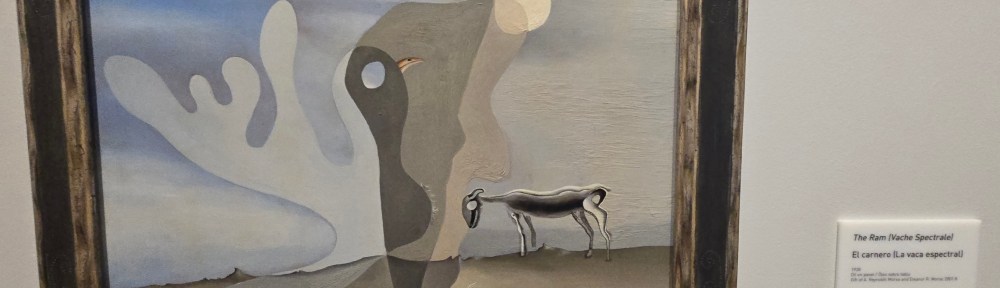
The Ram (The Spectral Cow), 1928
In 1928, at just 24 years old, Dalí painted The Ram (The Spectral Cow), an early work in his exploration of Surrealism. The painting recalls the mysterious compositions of Giorgio de Chirico (1888–1978), placing seemingly unrelated objects in a strange, theatrical setting.
Surrealist artists drew heavily on the theories of Sigmund Freud (1856–1939), who viewed dreams as windows into unconscious fears and desires. The artists invited viewers to become dream interpreters, examining unusual objects and their relationships to discover hidden meanings.
Dalí’s painting offers an intriguing puzzle.
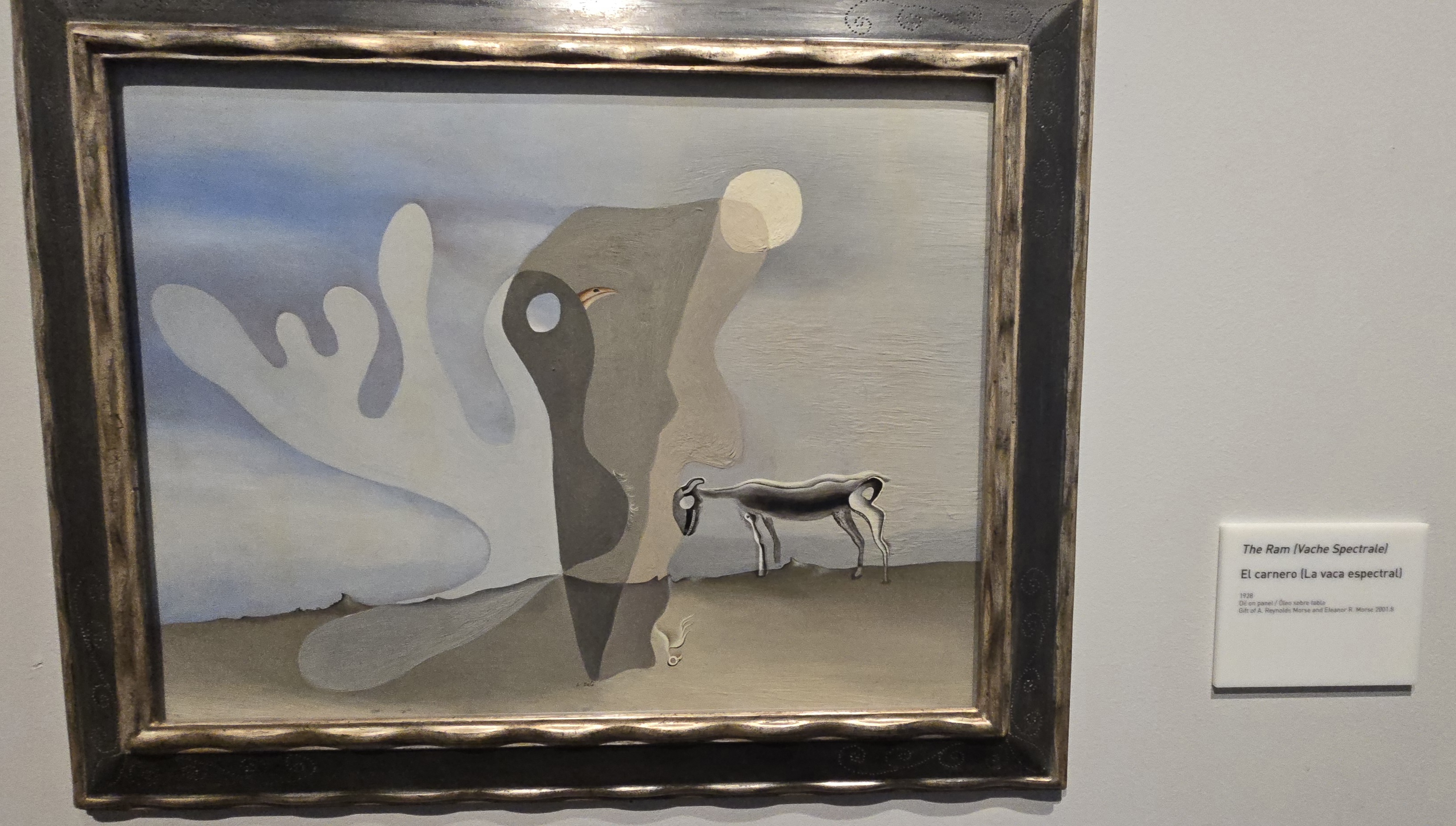
An enormous bird occupies the left side of the canvas, balanced by a skeletal ram on the right. A strange cloud rises between them, while a mysterious heavenly orb watches over the scene. A tiny dead bird lies almost unnoticed on the ground.
What connects these objects?
Reading the Painting
Consider first the enormous bird dominating the painting. Its wing resembles a giant five-fingered hand reaching toward the heavens and away from the activity unfolding to the right and below. The bird’s head and body occupy the center of the composition, partially hidden by a strange, dark cloud. Its gaze appears fixed on the mysterious orb above.
Is the bird praying? Pleading? And what is it seeking?
The bird’s enormous head is balanced by a gaunt ram, skeletal and seemingly more dead than alive. The two creatures share hollow eye sockets and small curved features: the bird’s beak and the ram’s horn.
But they are looking in different directions.
While the bird gazes toward heaven, the ram stares at the bird’s swollen belly. Curious wisps of hair mark the space between them, drawing our attention to their point of contact. The ram seems transfixed by the bird’s body, seemingly oblivious to the enormous head towering above it.
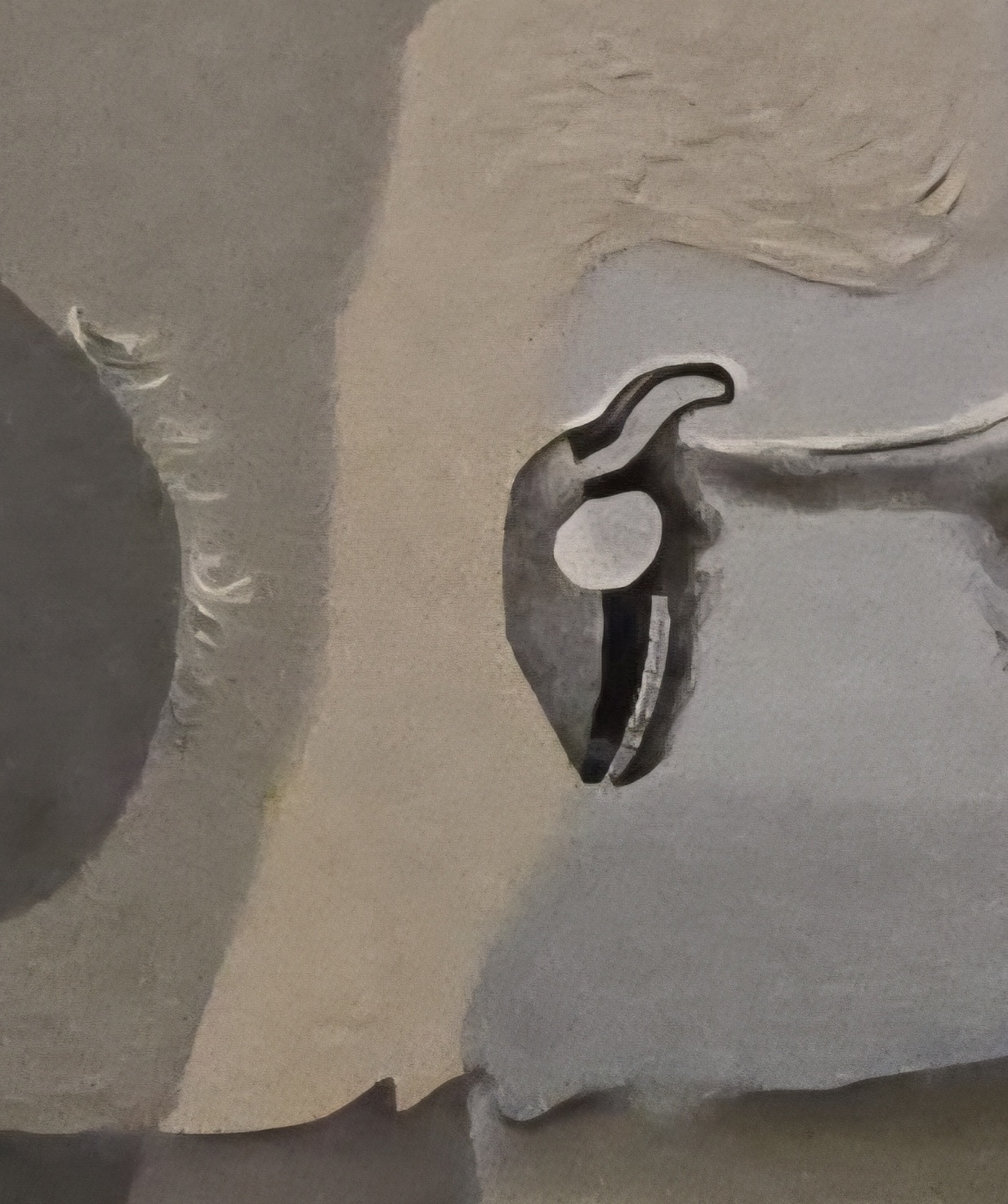
Why would Dalí have the ram stare at the bird’s belly rather than its face?
The mysterious cloud separating them is equally curious. It conceals much of the enormous bird’s head and body, while the ram’s head barely touches its edge. One creature seems to disappear into the cloud, while the other remains almost entirely outside it.
The cloud itself appears divided in two. A darker mass rises from the ground and envelops the bird on the left, while lighter mist occupies the ram’s side. The dark cloud stretches diagonally upward, nearly touching the heavenly orb, while the lighter cloud obscures its lower edge.
The effect makes the orb itself almost drawn downward, peering through the mist at the mysterious activity below.
And what do we notice as our eyes descend?
Just outside the cloud, a tiny dead bird lies on the ground beneath the ram, seemingly staring upward. It is so small that it barely registers in the composition.
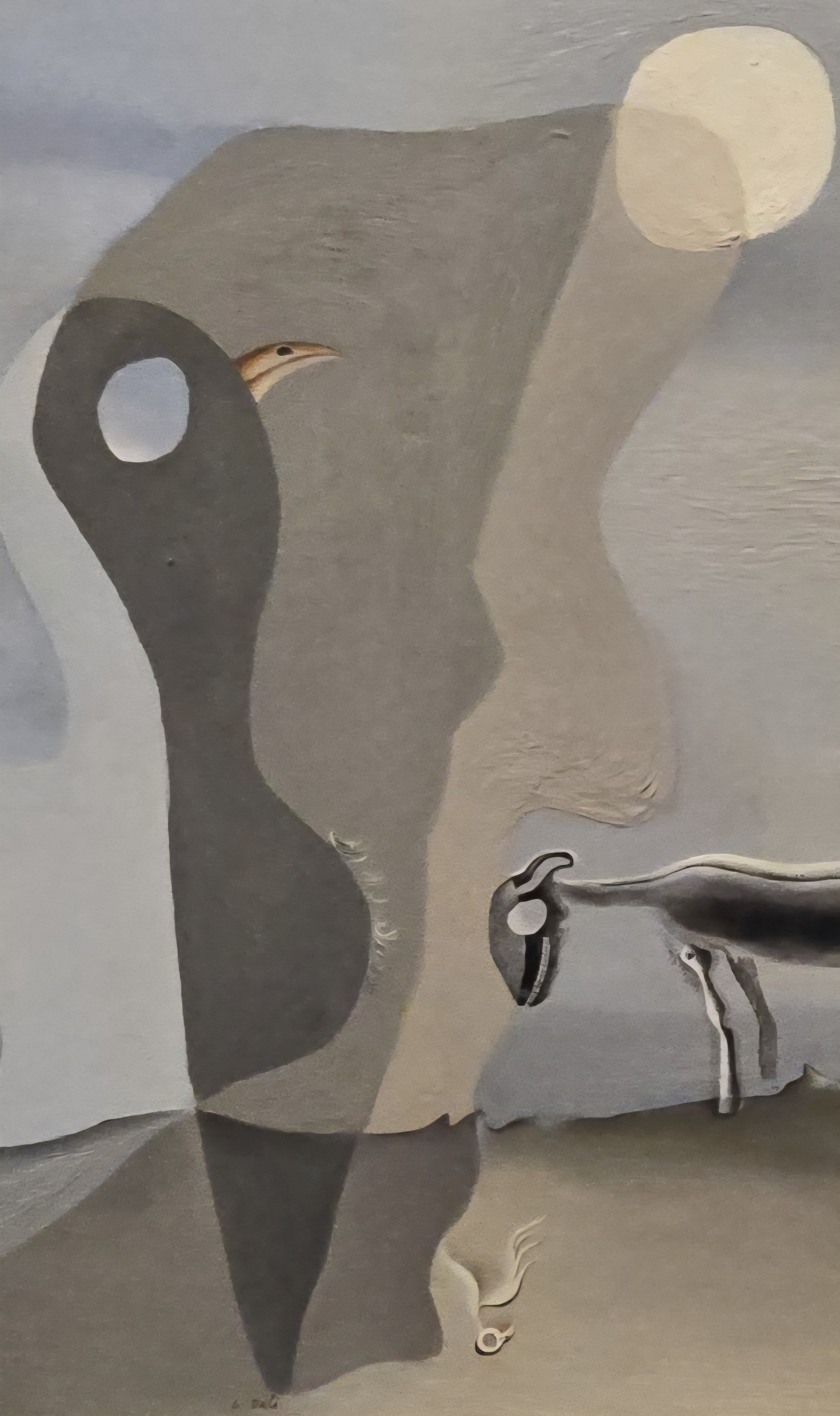
Our eyes have traveled from the enormous bird on the left, full of movement and reaching toward heaven, to the almost invisible lifeless creature on the ground. The two birds appear strikingly different in size and vitality, yet their placement invites us to consider a connection.
Could the tiny dead bird be the fate of the enormous one?
The Child Who Replaced Another
Dalí knew very well the idea of substituting one child for another. He was the replacement for a brother he never knew, born into a family still mourning the loss of its first son.
How might such an artist have viewed the biblical matriarch Sarah?
Sarah had waited decades to bear Isaac, the son through whom God promised Abraham’s covenant would continue. Yet Isaac was not Abraham’s first son. Ishmael, born to Hagar, was already part of the family.
Sarah feared for Isaac’s safety and demanded that Abraham cast out Ishmael and his mother. In protecting Isaac, she effectively made him the substitute for Ishmael, removing Abraham’s first son from the household to protect her own. She was the ultimate protective mother, willing to break apart Abraham’s family to keep her son safe.
Yet in one of the most consequential stories in Judaism, Christianity and Islam, Sarah is entirely absent.
When Abraham takes Isaac to Mount Moriah, Sarah never gets to raise her hand toward heaven, plead for her son or beg Abraham to stop. The woman who so wanted a child and had fought to protect Isaac from his brother has no voice when his father prepares to sacrifice him.
Where was Sarah? What happened to the mother whose entire life had been devoted to securing Isaac’s future?
Deciphering the Dream
Now we can understand the mysterious cloud at the center of Dalí’s painting.
It is the altar, rising from the ground as smoke toward heaven.
The lighter smoke ascends above the ram, seemingly carrying its sacrifice to God. The white smoke almost looks like a nose inhaling the ram, signifying the pleasing aroma of an accepted offering. The ram has taken Isaac’s place, preserving the life of Abraham’s beloved son.
But what is hidden in the darker smoke?
Consider the enormous bird reaching toward heaven. Its swollen belly recalls Sarah, who waited until old age to bear Isaac. Its outstretched wing resembles a hand raised in desperate prayer, while the skeletal ram stares directly at the womb that brought Isaac into the world.
The bird is Sarah.
And what of the tiny dead bird beneath the ram?
It is Sarah after the Akeidah.
The Torah records that Abraham returned from Mount Moriah, while Isaac’s fate after the binding is left unstated until he reappears later in the narrative. The ram had been sacrificed, and God’s promise to Abraham reaffirmed.
But the next Torah portion, Chayei Sarah, opens with Sarah’s death.
Jewish tradition has long connected these events. Rashi (1040–1105), drawing on earlier midrash, explains that Sarah died upon hearing news of Isaac’s near-sacrifice. The shock of learning what had almost happened to her beloved son caused her death.
Here, the painting’s dark smoke conceals the death of Sarah, while its lighter smoke carries the ram toward heaven. The enormous bird reaching upward and the tiny lifeless creature below become two images of the same mother, before and after the Akeidah.
The ram was sacrificed in Isaac’s place. Sarah died because Isaac was nearly sacrificed.
The Voice of Sarah
For thousands of years, Jews have sounded the ram’s horn on Rosh Hashanah, recalling Abraham’s willingness to sacrifice his son and God’s mercy in sparing him. The ram became a permanent symbol of devotion, its sacrifice remembered with every blast of the shofar.
But Sarah’s sacrifice presents a more troubling question. Abraham was commanded to offer Isaac, and Isaac was spared. Sarah received no command, made no choice and was given no opportunity to intervene. The mother who had spent her life protecting her son may have been the only person to die because of the Akeidah.
Jewish tradition celebrates Abraham’s obedience and Isaac’s willingness. Yet through Dalí’s surrealist lens, the story also becomes one of a mother whose devotion was no less profound, but whose suffering remained outside the biblical narrative.
Perhaps the shofar’s haunting cry recalls more than the ram that died. Perhaps it also gives voice to Sarah, whose sacrifice was never requested, whose consent was never sought, and whose life was never spared.


