Israel held five national elections between April 2019 and November 2022, an exhausting cycle that cost billions of shekels, distracted the country from pressing challenges and produced a succession of short-lived governments.
The problem lies partly in Israel’s parliamentary system. Parties must win at least 3.25% of the national vote to enter the 120-seat Knesset. Forming a stable government generally requires a coalition of at least 61 members, giving smaller parties considerable leverage over larger ones.
When coalition negotiations fail, Israel can return to the polls under essentially the same rules, often producing another fragmented parliament and another round of political paralysis.
What if Israel changed the rules to make political deadlock increasingly costly for the politicians responsible?
Here is a proposal:
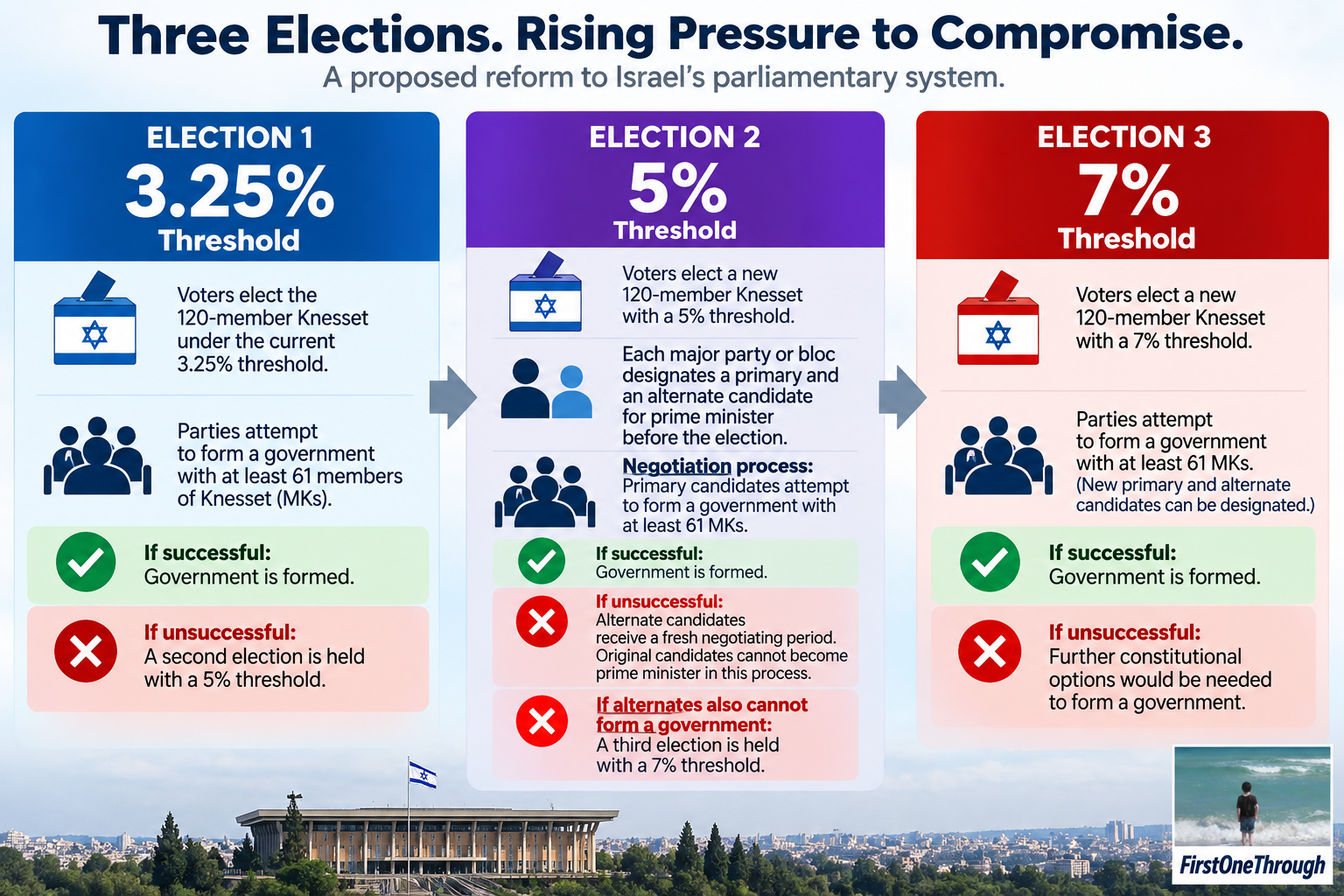
- the first election would retain the existing 3.25% threshold. If no government could be formed, a second election would raise the threshold to 5%, encouraging smaller parties to merge, form alliances or consolidate around larger political blocs.
- Each major party or bloc would designate both a primary and an alternate candidate for prime minister before the second election.
The primary candidates would have a defined period to assemble a governing coalition. If they failed, their designated alternates would receive a fresh negotiating period, while the original candidates would lose their opportunity to become prime minister during that government-formation process.
This could be particularly consequential in Israel, where political deadlock has frequently centered on personalities as well as policy. During the 2019–2022 elections, opposition to Benjamin Netanyahu personally contributed to repeated deadlock, even among parties sharing substantial policy positions.
Under the proposed system, Likud could retain its electoral strength while another leader attempted to assemble a government. Rival blocs would face the same pressure to compromise. Negotiators could also agree to rotate the premiership after two years, sharing leadership over a four-year term.
If both leadership rounds failed, a third election would raise the threshold to 7%. Smaller parties would face even greater pressure to consolidate, while larger parties would have to reconsider whether their leadership disputes justified another election.
The rising threshold carries a cost: smaller political constituencies could lose direct representation. Joint electoral lists would offer a way to preserve their voices while encouraging broader political alliances.
Israel’s electoral system currently allows political leaders to return to voters without fundamentally changing the conditions that produced the deadlock. A rising electoral threshold, combined with leadership succession, would make each failure more consequential.
Voters should choose the country’s political direction. Politicians should be responsible for forming a government. When negotiations fail, the burden of compromise should fall on those seeking power, rather than repeatedly on the citizens who elected them.


