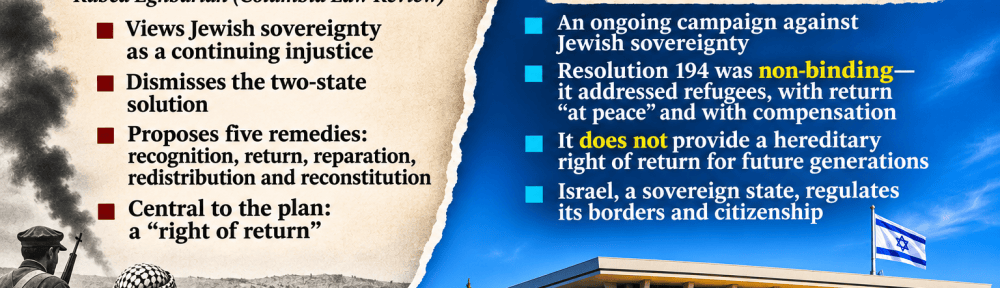
In 2024, Palestinian Arab legal scholar Rabea Eghbariah advanced a theory in the Columbia Law Review that shares two fundamental premises with FirstOneThrough’s Nakba Is a Verb: Nakba is not a historical event confined to 1948, and it is intrinsically connected to Zionism.
We disagree entirely on the direction of the aggression.
In his article, Toward Nakba as a Legal Concept, Eghbariah titles his first section “Zionism as Nakba.” He views Jewish sovereignty as integral to a continuing injustice. FirstOneThrough views Nakba as the continuing assault on Jewish sovereignty.
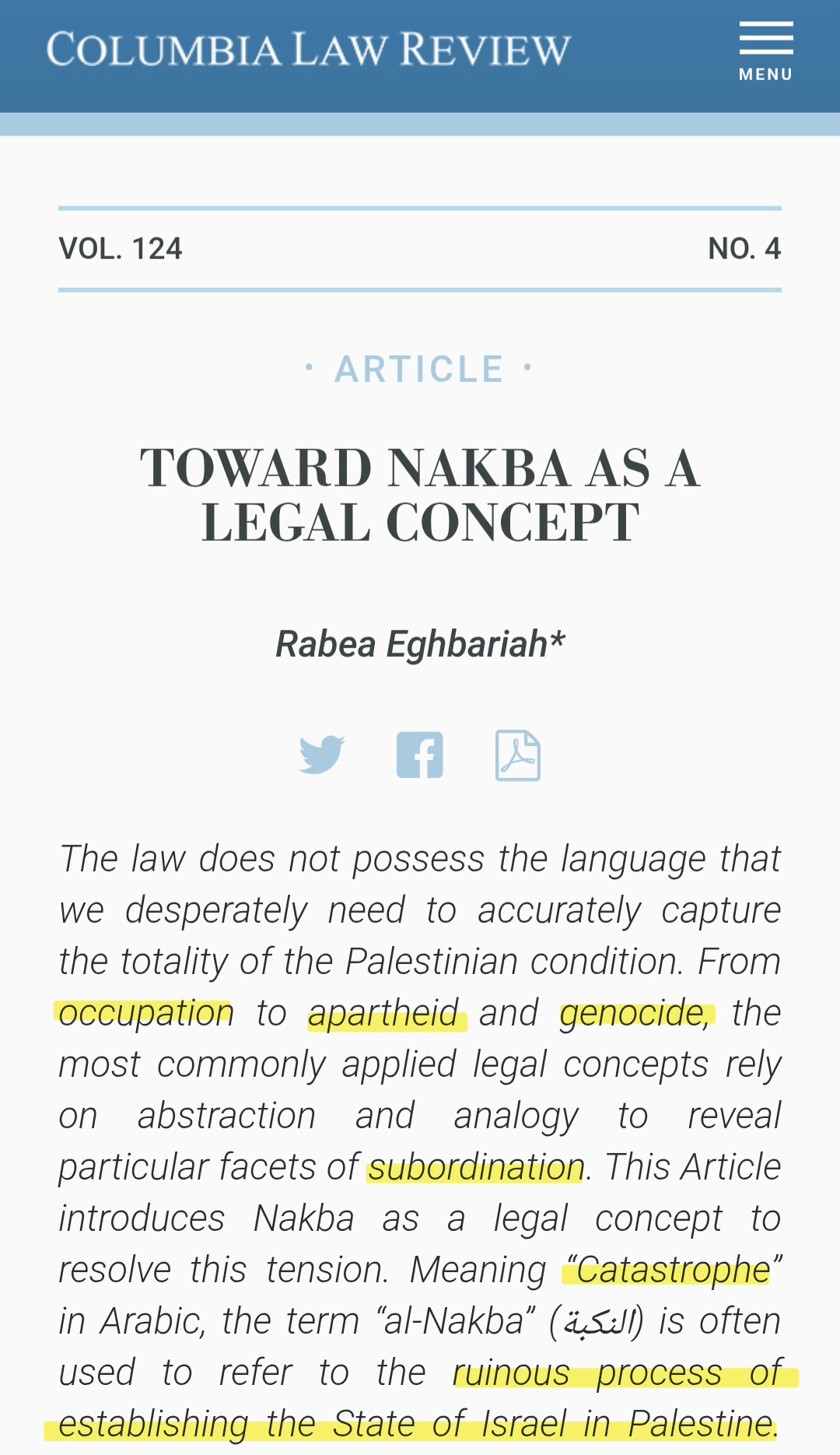
Consider the date chosen to commemorate the so-called “Nakba.” May 15 marks the first full day of Israel’s independence, the very day that neighboring Arab armies invaded the fledgling Jewish state. Is the “Nakba” grievance the displacement of Palestinian Arabs or the establishment of Jewish sovereignty?
Eghbariah’s proposed remedies illuminate his position. Dismissing the conventional two-state solution as an international fantasy, he advances five remedies: recognition, return, reparation, redistribution and reconstitution.
“Taken together, these components ultimately mean dismantling the regime of domination and reconstructing an egalitarian political framework (or
several such frameworks) based on a recognition of the Nakba’s historical and ongoing injustice; the implementation of the right of return; and a combination of reparations and redistribution as a material remedy to the
persisting harms of the Nakba.” – Rabea Eghbariah
The so-called “right of return” is a twisted notion from the December 1948 United Nations General Assembly adopted Resolution 194. Paragraph 11 stated that refugees wishing to return to their homes and “live at peace with their neighbours” should be permitted to do so at the earliest practicable date. It also addressed compensation for property, resettlement and rehabilitation.
From that nonbinding resolution emerged an extraordinary political demand. A provision addressing refugees from a particular war was transformed into an asserted perpetual entitlement for successive generations never mentioned in the resolution. The condition of peaceful coexistence and the provisions for compensation received considerably less attention.
Millions of descendants who have never lived in Israel now claim a “right of return” to it.
Refugee status, property ownership and immigration rights are three distinct matters. Registering successive generations as refugees does not itself establish their entitlement to enter another country. Inheriting a property claim does not mean inheriting citizenship.
The international community is being asked to remedy the “Nakba-as-a-noun” while being enlisted to advance “Nakba-as-a-verb.”
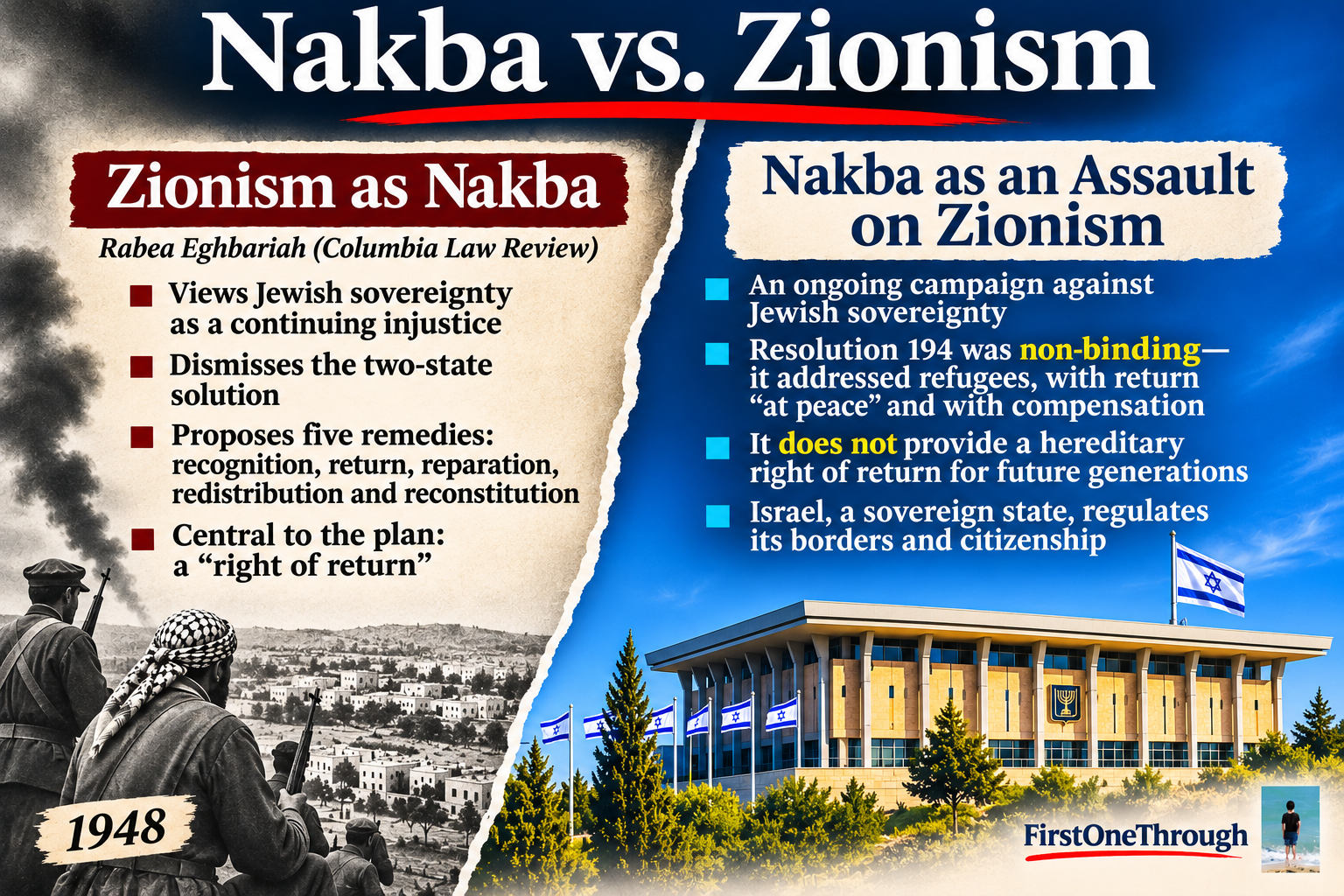
Israel is a sovereign country and has been a member of the United Nations since 1949. Its authority to regulate immigration and determine citizenship is a fundamental attribute of statehood.
Legitimate claims for lost property can be addressed through monetary compensation, a remedy contemplated in the very resolution invoked by proponents of return. Resolution 194 establishes no unrestricted hereditary entitlement to immigrate to Israel.
Why should Israel be expected to surrender a fundamental attribute of sovereignty to remedy the consequences of a war launched to prevent its sovereignty in the first place?
The international community cannot credibly advocate two states for two peoples while perpetuating an expectation that millions of Palestinian Arabs are entitled to settle in the Jewish one. Palestinian Arab independence does not require the dissolution of Jewish independence. Recognizing this, Eghbariah and other pro-Palestinian advocates have begun to pivot their advocacy to a single state and label the founding of Israel as an inherently racist endeavor.
Knowing that Israel is a sovereign state and will not grant entry and citizenship to millions of people who have repeatedly gone to war to destroy the very state in question, the anti-Zionist horde have therefore not only called Zionism a form of racism, but that Israel was never a nation in good standing at its founding. And further, is not a legitimate entity today, as it commits so-called “genocide” and “ethnic cleansing.”
In short, it uses Nakba-as-a-verb as a vehicle to destroy the Jewish State.
Eghbariah and FirstOneThrough agree that Nakba is ongoing and inseparable from Zionism. We differ fundamentally on what must end.
The unrestricted hereditary “right of return” into Israel must be rejected explicitly, not preserved as a political aspiration for another generation. Jewish sovereignty is not a provisional arrangement awaiting Palestinian Arab consent.
The Nakba will end not with the dismantling of Jewish sovereignty in the Jewish homeland, but with the abandonment of the campaign to dismantle it.


