
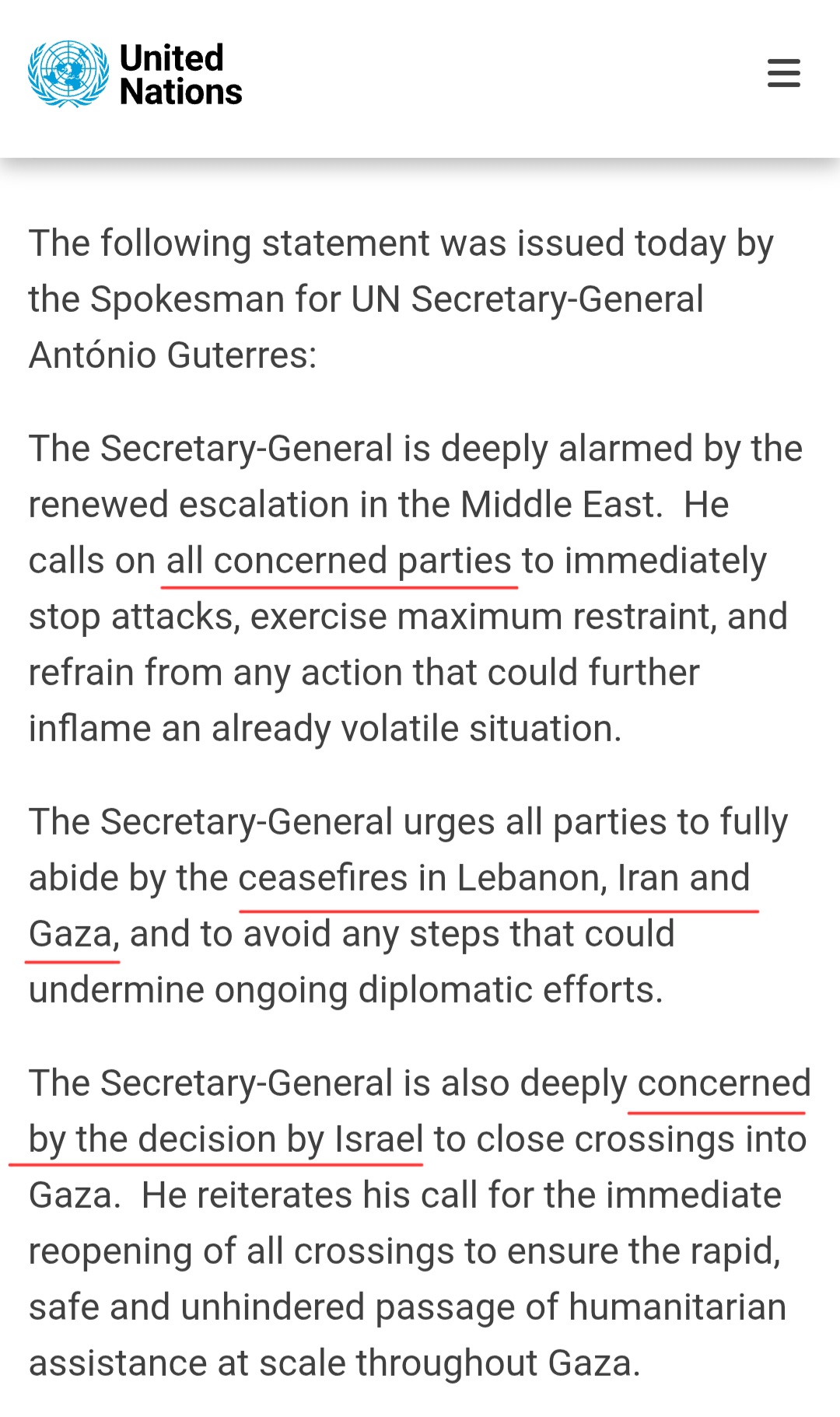
The UN Secretary-General’s latest statement on June 8 warns about conflict in Lebanon, Iran, and Gaza.
Yet Israel appears only as the actor, never as the target.
Iranian missiles are fired at Israel. Hezbollah drones cross into Israel. Houthi missiles target Israeli cities. Millions of Israelis live under the threat of attack.
But in much of the international conversation, the war is always somewhere else.
The fighting is “in Lebanon.” It is “in Iran.” It is “in Gaza.”
The reality is that Israel enters the story primarily when it responds.
This framing matters. It transforms Israel from a country under attack into a country that simply attacks. The missiles disappear. The drones disappear. The civilians running to shelters disappear.
A missile launched from Iran toward Haifa is not a conflict “in Iran.”
A drone launched from Lebanon toward Kiryat Shmona is not a conflict “in Lebanon.”
They are attacks on Israel.
Yet too often Israel appears in international statements only after it fires back.
That does not merely distort the geography of the war. It distorts who started it.
The UN Secretary General once again showed its victims of preference and that the global body is not concerned about the fate of Israelis.


Pingback: Der Krieg, den es nur außerhalb Israels gibt | abseits vom mainstream - heplev