
The United Nations Secretary-General issued a statement yesterday condemning Israeli strikes on Hezbollah targets in Beirut.
That was expected.
What was remarkable was his explanation.
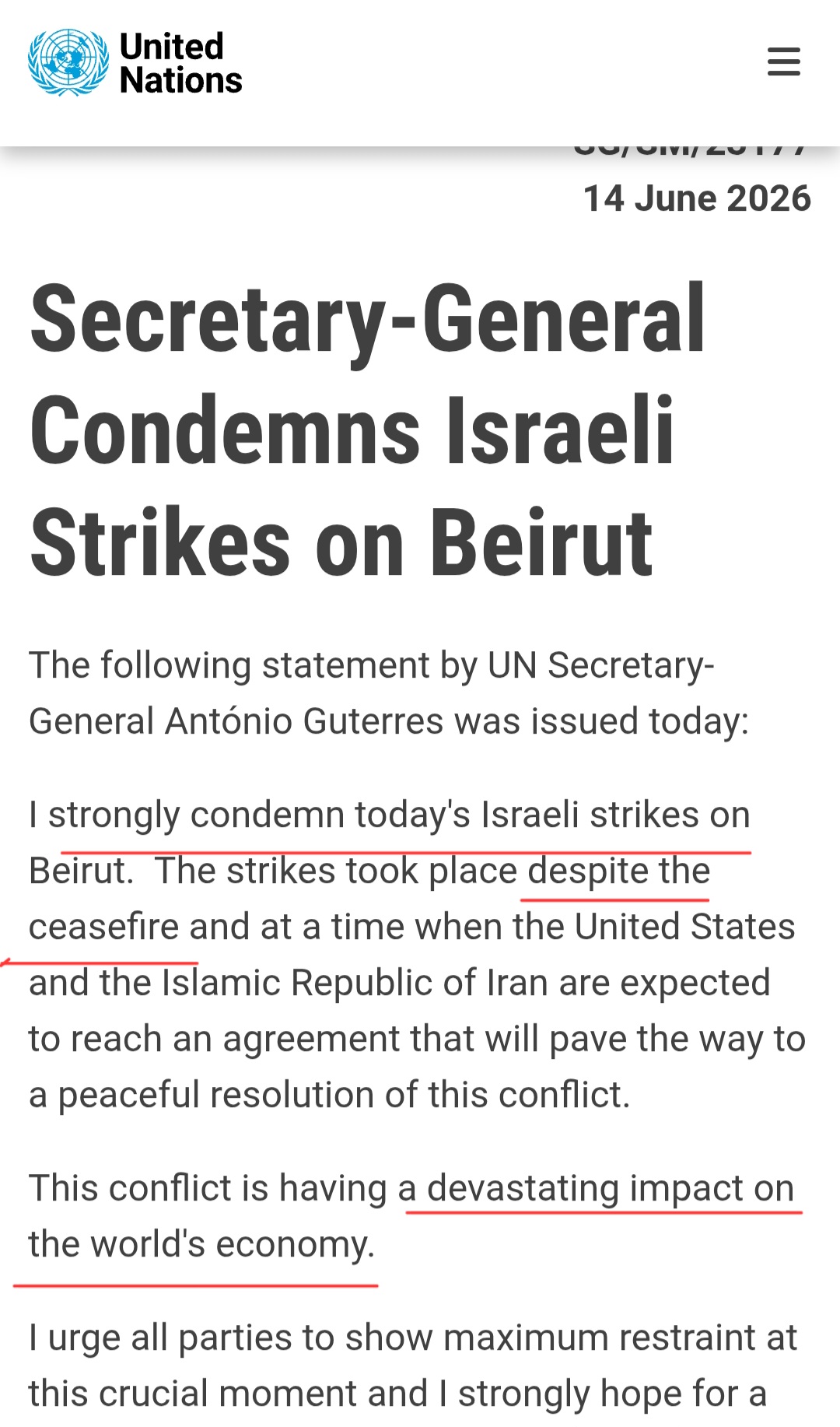
Guterres wrote that the strikes occurred “despite the ceasefire” and at a moment when the United States and Iran were expected to reach an agreement that would “pave the way to a peaceful resolution of this conflict.” He then added that “this conflict is having a devastating impact on the world’s economy.”
The statement raises an obvious question: what do his comments have to do with Israel and Hezbollah?
The negotiations were between the United States and Iran. Israel was not a participant. Israel did not negotiate the terms. Israel did not sign the agreement. American officials themselves stated that Israeli withdrawal from Lebanon was not a condition of the deal.
Yet Guterres presented Israel’s actions as though they were undermining an agreement to which Israel was never a party.
The logic becomes even stranger when he turns to the economy.
The conflict affecting global markets is not the war between Israel and Hezbollah. The economic concern revolves around the American war with Iran which threatens energy supplies and disrupts shipping routes. Markets do not react because Hezbollah fires rockets into northern Israel or because Israel strikes Hezbollah positions in Beirut.
But in the Secretary-General’s telling, Israel is the root cause.
A Hezbollah-Israel clash suddenly becomes a threat to the world economy. A U.S.-Iran negotiation suddenly becomes Israel’s responsibility. An agreement Israel never joined suddenly becomes grounds to condemn Israel.
This is absurd.
But it is a continuation of the farce that is the United Nations.
The UN Secretary General is so obsessed with vilifying Israel and getting the world to join in, that he manufactures reasons that are devoid of any logic.


