
Three people sat beneath words that Jews have been reading for more than three thousand years.
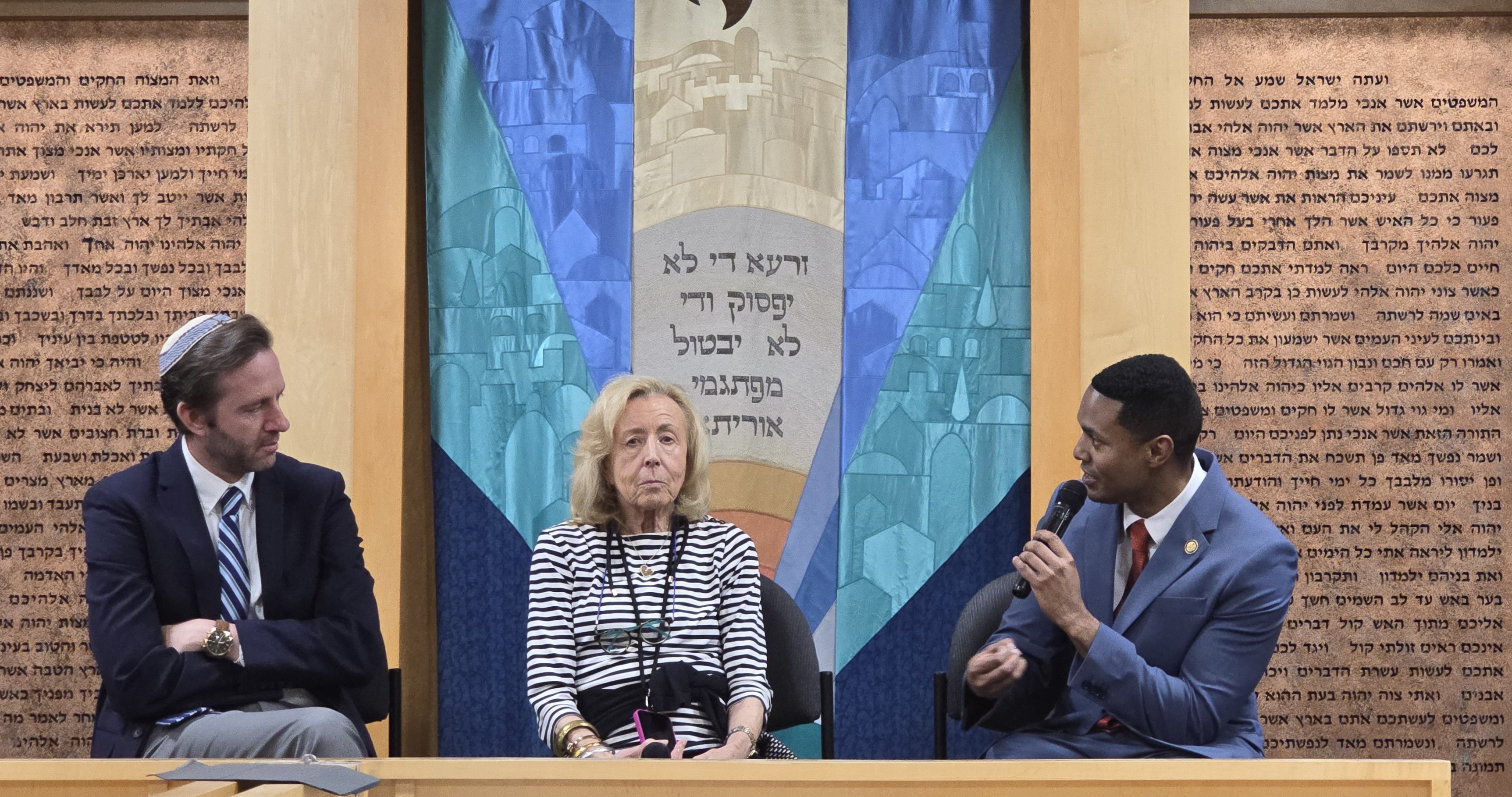
Congressman Ritchie Torres (D-NY) held a microphone. Beside him sat Hadassah Lieberman, widow of Senator Joe Lieberman. Next to her sat Rabbi Ethan Tucker, her son and Joe’s stepson. Behind them rose towering Hebrew letters from the Torah, framing a conversation about faith, citizenship, and public life.
The audience at the SAR High School had just watched Centered, a documentary chronicling the remarkable political career of Joe Lieberman. Yet as the discussion unfolded, it became clear that the evening was about something larger than one senator.
It was about a style of politics that increasingly feels as though it belongs to another country.
The film recounts the milestones most Americans remember. Lieberman became the first Jew nominated to a major party national ticket when Al Gore selected him as his running mate in 2000. He served decades in the Senate. Forty years in public office. He championed causes that frequently crossed ideological lines. He possessed a rare ability to frustrate Democrats and Republicans in equal measure.
But Centered is not ultimately a story about elections, legislation, or political strategy.
It is a story about a worldview.
Joe Lieberman belonged to a generation that regarded compromise as a civic achievement. In today’s politics, compromise often carries the stigma of surrender. Politicians fear being labeled weak. Activists reward purity. Social media celebrates confrontation.
Lieberman viewed compromise differently.
For him, compromise was almost a sacred act: imperfect people finding enough common ground to govern a free society. The goal of politics was not personal victory. The goal was preserving a country in which millions of people with competing interests and beliefs could continue living together.
That conviction repeatedly led him down unusual paths. In 2006, after losing the Democratic primary, he successfully ran for reelection as an Independent. In 2008, he endorsed Republican John McCain for president despite decades of Democratic affiliation. These decisions angered former allies and delighted opponents.
Yet they were never acts of political opportunism. They reflected a deeper conviction that principle mattered more than party and that loyalty to country could occasionally require disappointing one’s own side.
As Hadassah Lieberman and Rabbi Tucker reflected on his life, another theme emerged. Joe Lieberman never viewed Judaism and America as competing loyalties.
To him, they were inseparable. Orthodox Judaism did not pull him away from American life. It pushed him deeper into it.
The covenant at Sinai teaches obligations. It teaches that freedom carries responsibilities. It teaches that human beings answer to standards beyond personal preference or political convenience. Lieberman carried those lessons into public service. Citizenship was never merely a collection of rights. It was a series of duties owed to neighbors, institutions, and future generations.
At a moment when religion is often portrayed as a force that divides citizens into competing tribes, Lieberman embodied a different possibility. His faith expanded his sense of responsibility. It compelled him to engage people who disagreed with him. Religious conviction gave him confidence in his beliefs without requiring contempt for those who held different ones.
The discussion in Riverdale felt less like a political event than a remembrance of a disappearing civic culture.
A few weeks earlier, another screen had presented a similarly painful reflection.
On 60 Minutes, former Senator Ben Sasse (R-NE) discussed the devastating illness that has transformed his life. Viewers could see the physical toll. The interview was heartbreaking.
Yet there was another loss visible beneath the medical diagnosis.
Sasse spent much of his public career defending a style of politics that increasingly feels endangered. A committed Christian, a constitutional conservative, and an intellectual by temperament, he repeatedly challenged members of his own party when he believed they were wrong. He valued debate. He welcomed disagreement. He seemed genuinely interested in understanding opposing arguments rather than simply defeating them.
Watching Sasse confront mortality was difficult.
Watching the worldview he represents fade from public life may be even more painful.
Joe Lieberman and Ben Sasse.
One was an Orthodox Jew from Connecticut. The other an evangelical Christian from Nebraska. One progressive frequently frustrated progressives. One conservative frequently frustrated conservatives.
Both believed faith should make a person more secure, more curious, and more capable of engaging opponents with dignity. Both understood politics as a means rather than an identity. Both believed citizenship imposed obligations. Both sought to persuade rather than humiliate. Neither confused cruelty with strength nor public shaming with moral courage.
Most importantly, both loved America in a way that transcended election results.
That form of patriotism increasingly feels like an endangered species.
The disappearance of politicians like Lieberman and Sasse did not happen by accident.
The institutions that helped produce them have weakened. Religious participation among America’s youth has declined significantly. Americans increasingly inhabit separate informational universes. Politicians answer national activist audiences rather than neighbors gathered in town halls, churches, synagogues, and community organizations.
Every one of these changes rewards performance over persuasion.
The result is a politics rich in outrage and poor in trust.
Compromise becomes betrayal. Nuance becomes weakness. Certainty becomes a substitute for wisdom. Political identity expands until it consumes every other identity.
And yet the deepest irony is that many of the figures who shaped America’s democratic traditions understood politics very differently.
They believed vigorous disagreement strengthened democracy. They expected conflict. They accepted that free citizens would hold competing visions of the good society. What mattered was preserving enough mutual respect to continue sharing a common future.
Lieberman and Sasse more than understood this; they lived it.
As America approaches its 250th birthday, the nation will spend the coming year celebrating constitutional structures, founding documents, and historical achievements. Those accomplishments deserve celebration.
But republics survive on more than institutions.
They depend on habits of character.
They require leaders willing to lose arguments without losing respect for opponents. They require citizens capable of disagreement without hatred. They require people whose religious convictions deepen their sense of obligation to their country rather than narrowing it. They require men and women who view compromise as an honorable necessity in a diverse democracy.
Joe Lieberman spent his life trying to embody those virtues. Ben Sasse has spent his public career defending them.
One man is gone. The other is fighting for his life.
Watching them forces an uncomfortable question upon the rest of us.
Perhaps what is dead and dying is not merely a generation of public servants.
Perhaps it is the civic faith they carried with them: the belief that America is strongest when principled people of different convictions sit together, argue honestly, listen carefully, and leave the room still recognizing one another as fellow citizens.
As the audience filed out into the night in Riverdale, the Torah verses still stood behind the empty chairs. The conversation had ended and the questions remained.
The country that will celebrate its 250th birthday next year must decide whether those virtues are merely aging – or whether we are preparing to bury them alongside the generation that practiced them.


