
Every July, as heat waves grip North America, Europe, and much of Asia, Earth reaches one of the least intuitive moments of its annual journey.
It is at its greatest distance from the Sun.
Around July 3-5, Earth reaches aphelion, approximately 94.5 million miles (152.1 million kilometers) from the Sun. Six months earlier, around January 3-5, Earth passes through perihelion, just 91.4 million miles (147.1 million kilometers) away.
The difference is roughly 3.1 million miles – about a 3.3% change in distance. Earth actually receives about 7% more solar energy in early January than it does in early July.
Yet July is the hottest time of year across most of the Northern Hemisphere.
The explanation reveals something profound about our planet and it is not that we have internalized the Global North’s view of seasons.
Distance matters far less than direction.
Orientation. Earth is tilted approximately 23.4 degrees on its axis. During the Northern Hemisphere’s summer, that tilt turns us toward the Sun. The midday Sun climbs much higher into the sky, allowing its rays to strike the ground more directly instead of spreading over a larger area. At the same time, daylight stretches for hours longer, giving the land far more time to absorb heat.
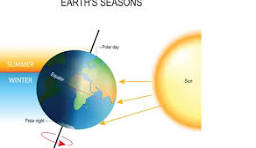
A tilt of just 23.4 degrees overwhelms a separation of more than three million miles.
The proof is visible every day.
When New York swelters in July, Buenos Aires shivers through winter. Both cities are essentially the same distance from the Sun. Only their orientation has changed.
Tilt, not distance, governs the seasons.
One might assume the Northern Hemisphere, basking in these long summer days, must also be the warmer half of the planet. Yet the opposite is closer to the truth.
Makeup. The Southern Hemisphere is covered by approximately 81 percent ocean, while the Northern Hemisphere is only about 61 percent ocean. Water absorbs enormous amounts of heat, releases it slowly, and moderates temperature throughout the year. Land behaves very differently. It heats rapidly under summer sunshine and cools just as quickly during winter.
The Northern Hemisphere is a hemisphere of continents. The Southern Hemisphere is a hemisphere of oceans.
That is why the Northern Hemisphere experiences the world’s greatest seasonal extremes, from scorching deserts to bitter continental winters. The Southern Hemisphere, despite receiving slightly more solar energy during its summer because Earth is closest to the Sun in January, enjoys a far more moderate climate because its vast oceans absorb and redistribute that energy.
There is another layer to the story.
Movement. The 23.4-degree tilt that shapes our seasons is not fixed. Over approximately 41,000 years, Earth’s axis naturally oscillates between about 22.1 degrees and 24.5 degrees. Today the planet sits near 23.4 degrees and is slowly moving toward its minimum tilt, a journey that will take roughly another 10,000 years.
As the tilt decreases, summers become slightly cooler and winters somewhat milder, particularly in the higher latitudes. These subtle changes alter where sunlight falls on Earth and have helped drive the slow rhythm of glacial and interglacial periods over millions of years. Left to these natural orbital cycles alone, Earth is presently in a phase that favors an extremely gradual cooling over many thousands of years.
Yet perhaps the most remarkable character in this story is neither the Sun nor the Earth.
It is the Moon.
Background. Earth’s relatively large Moon acts as a gravitational stabilizer, quietly holding our planet’s axial tilt within a remarkably narrow range. Without the Moon, simulations suggest Earth’s axis could have wandered chaotically by tens of degrees over geological time, perhaps swinging from nearly upright to more than 60 degrees. The resulting climate would have been far less stable, with vastly more extreme and unpredictable seasons.
Instead, our planet gently rocks back and forth by only a couple of degrees over tens of thousands of years. That stability has allowed climates to remain sufficiently consistent for forests to mature, civilizations to emerge, agriculture to flourish, and complex life to evolve under recognizable seasons.
The hottest days of July, arriving when Earth is farthest from the Sun, remind us how often nature overturns our assumptions. Climate is not governed by a single variable but by an intricate interplay of orbital distance, axial tilt, oceans, continents, and the quiet gravitational influence of a companion world orbiting nearly a quarter of a million miles away.
Perhaps there is a lesson beyond astronomy.
We often assume influence is primarily a matter of proximity. The closer something is, the more powerful it must be.
Nature suggests otherwise.
Those who shape us most are not always the ones nearest to us. They are the ones toward whom we are oriented – the people whose character we admire, whose ideas we embrace, and whose example we choose to follow.
Then there is the Moon. Nearly 240,000 miles away, it quietly stabilizes Earth’s axis, preserving the rhythm of the seasons over millions of years. So too, the most enduring influences in our lives are often the quietest: timeless principles, faithful mentors, strong families, and lasting institutions that keep us steady without demanding attention.
Relative to the Earth’s oceans and continents, is our personal makeup – how each of us absorbs ideas and the actions we are inclined to take. While our consistency drives us towards or away particular personalities and concepts, it also impacts the way we consider such variables that are subtly different than the people around us.
The deepest influences are not always the closest. They are the ones that orient us and keep us pointed in the right direction.


