America’s Greatest – and Quietest – Military Victory in Nearly a Century

The debate over American support for Ukraine and Israel has largely focused on the cost. Politicians argue over billions of dollars appropriated, weapons transferred, and whether American taxpayers are carrying too much of the burden. Far less attention has been paid to the return on that investment.

Since 2022, the United States has authorized roughly $195 billion related to Ukraine and approximately $16–22 billion in supplemental wartime assistance for Israel. Critics see enormous expenditures. Strategically, however, those dollars have enabled two allies to inflict historic damage on two of America’s principal adversaries – Russia and Iran – without the United States deploying large combat formations or suffering the thousands of battlefield casualties that defined Vietnam, Iraq, and Afghanistan.

That comparison matters.

The wars in Iraq and Afghanistan cost the United States more than $5 trillion in direct and related costs, with broader post-9/11 war obligations rising above $8 trillion when future veteran care, interest, and long-term commitments are included. Nearly 7,000 American service members were killed. More than 52,000 were wounded.

And what was the lasting strategic benefit?

Afghanistan ended with the Taliban back in power. Iraq removed Saddam Hussein, but the aftermath empowered Iran, fractured the region, drained American credibility, and produced years of instability. The United States paid in terrible blood and treasure, and the final balance sheet is hard to defend.

Ukraine and Israel present a very different model.

Consider Russia.

More than four years after launching its invasion of Ukraine, Russia has suffered an estimated 1.4 million military casualties, including approximately 450,000 dead. Its armored forces have been severely depleted. The Black Sea Fleet has largely been driven from its historic operating areas. Ukraine has repeatedly demonstrated the ability to strike deep inside Russian territory. The military once regarded as NATO’s greatest conventional threat has been dramatically weakened.

“The number of Russian casualties and fatalities are astonishing. Since World War II, no major power has suffered anywhere near these numbers of casualties or fatalities in any war…. Russia’s economy is in distress, and Russia’s wartime spending may be increasingly untenable.” – Center for Strategic and International Studies July 2026

Now consider Iran.

For four decades the leading state sponsor of terrorism invested billions of dollars constructing what it proudly called the “Axis of Resistance” – a network stretching from Iran through Iraq and Syria to Lebanon and Gaza. Hamas, Hezbollah, Shiite militias, the Houthis, and the Assad regime were components of a single strategy designed to project Iranian power, surround Israel and challenge American influence in the region and threaten much of the global oil supply.

That strategy has suffered a tremendous setback.

Hamas has lost much of its military and infrastructure. Hezbollah has absorbed devastating blows to its command structure and missile capabilities. The Assad regime in Syria – Tehran’s indispensable Arab ally and the geographic bridge connecting Iran to Hezbollah – has fallen, shattering the land corridor that Iran spent decades building. The regional network that once appeared to surround Israel and terrorize America’s Arab allies now is dramatically weakened.

Iran’s nuclear ambitions have suffered major setbacks as well. Israeli and American strikes severely damaged key nuclear facilities, disrupted important elements of Iran’s enrichment infrastructure, and forced Tehran to devote enormous resources simply to rebuilding capabilities it once assumed were secure. Intelligence agencies continue to debate precisely how long the program has been delayed, but there is broad agreement that it suffered one of the most significant setbacks in its history.

None of this diminishes the immense human suffering. Ukraine has endured staggering casualties and destruction. Israel suffered the deadliest attack in its history on October 7 and has paid a heavy military, economic, and emotional price ever since.

But viewed through an American lens of grand strategy, another reality emerges.

Rather than sending hundreds of thousands of American troops to fight Russia or Iran directly as was done in Afghanistan and Iraq, the United States enabled allies already under attack to defend themselves. Those allies have imposed extraordinary military and strategic costs on governments that have spent decades challenging American interests.

This is what is so often missing from the public debate.

The wars are typically discussed separately. Ukraine is presented as a European conflict while Israel is portrayed as a Middle Eastern conflict. Yet both Russia and Iran were strategic partners, cooperating militarily, economically, and diplomatically while sharing an interest in weakening the United States and the Western alliance. Seen together, Ukraine and Israel have not merely been fighting for their own survival, they have been successfully degrading two pillars of a powerful anti-Western axis.

The long-term upside could be enormous. A surviving, Western-aligned Ukraine would become one of Europe’s most battle-tested militaries, a major reconstruction market, an energy and agricultural partner, and a permanent barrier to Russian expansion. A stronger Israel, with Iran weakened and Syria and Lebanon no longer functioning as Tehran’s strategic bridge, could help reshape the Middle East around technology, defense cooperation, energy corridors, trade, and normalization with Arab states that increasingly fear Iran more than they resent Israel.

That is the opportunity Iraq and Afghanistan never produced. Those wars consumed American power and America left no assets behind. These wars, fought by allies, may extend American power with powerful allies at the vanguard.

History may conclude that this period represents one of the most effective uses of American alliance power in generations. For roughly $215 billion – less than one-twentieth of the direct and related cost of Iraq and Afghanistan – the United States helped enable allies to severely weaken Russia’s conventional military, fracture Iran’s regional proxy empire, remove Syria and Lebanon from Tehran’s sphere of influence, and significantly set back Iran’s nuclear program, all without committing large American ground forces or sustaining the massive battlefield casualties that characterized previous generations of U.S. warfare.

America’s greatest military victory in the past 75 years may ultimately be its most subtle.

Israel Is Surrounded by Failed States – and Failed States in Waiting

Much of the discussion about Israel’s security focuses on borders, settlements, or ceasefires. Less attention is paid to a more fundamental reality: Israel is surrounded by governments that have failed – or have yet to demonstrate they can function as sovereign states.

To Israel’s north lies Lebanon, a country where the government spent years unable to enforce a monopoly on force within its own territory. While the Lebanese Army wore the national uniform, Hezbollah built an independent army, amassed an enormous missile arsenal, dug tunnels, launched drones, and ultimately dragged the country into war. A sovereign state that cannot control its own territory has surrendered one of the defining responsibilities of statehood.

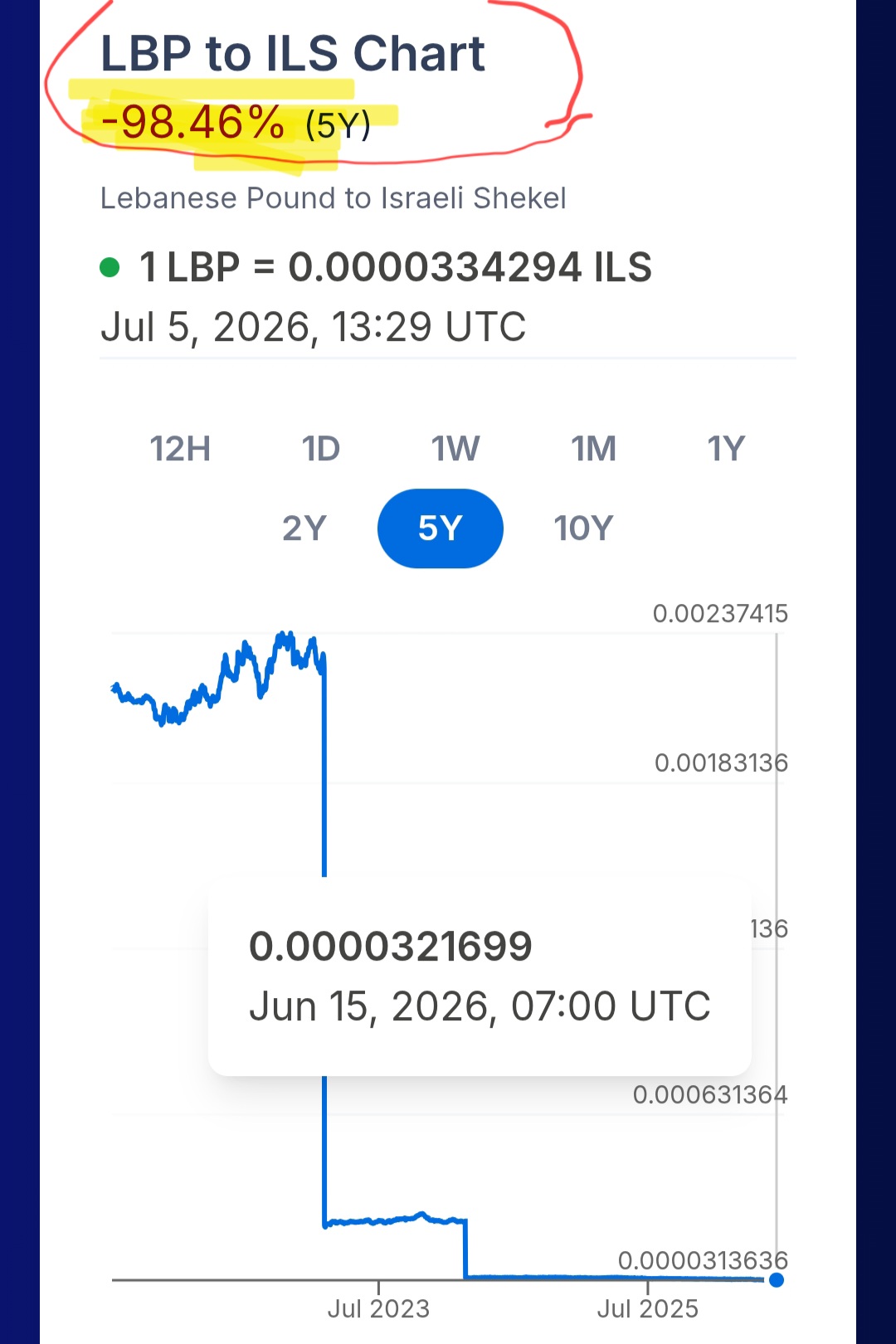
Lebanese pound to Israeli shekel exchange rate, defaulting on debt in March 2020, enormous explosion in Beirut for stored Hezbollah weapons in August 2020. The bank devalued currency by 90% in February 2023 and again in February 2024

Next to Lebanon is Syria. More than a decade of civil war shattered the country’s institutions, fractured its territory among competing armed groups and foreign militaries, and left millions displaced. Syria has long stood as one of the clearest examples of state failure in the modern Middle East.

Syrian civil war killed nearly 600,000 and dispersed 13 million. It is now ruled by Abu Mohammad al-Jolani who headed ISIS in the region

To Israel’s south lies Gaza. Hamas spent years and billions of dollars to build an underground military fortress instead of a functional society. The result was war after war after war. Destruction and death.

Hamas on October 7, 2023 slaughtered 1,200 people in Israel and brought over 250 people as hostages into Gaza to cheering crowds.

In the West Bank, the picture is different but equally troubling. The Palestinian Authority maintains civil institutions in parts of the territory, yet it has never established a monopoly on force or unified governance. Rival armed factions continue to operate, political legitimacy remains deeply contested, and governance has been divided from Gaza for nearly two decades.

recent poll shows a majority of Palestinians rejecting moderate leadership, despairing of peaceful change and now favouring armed struggle? That tragic deformity in Palestinian political culture is the result of the continued brutality of the occupation.” – James Zogby, President of the Arab American Institute at the United Nations Security Council on June 27, 2023

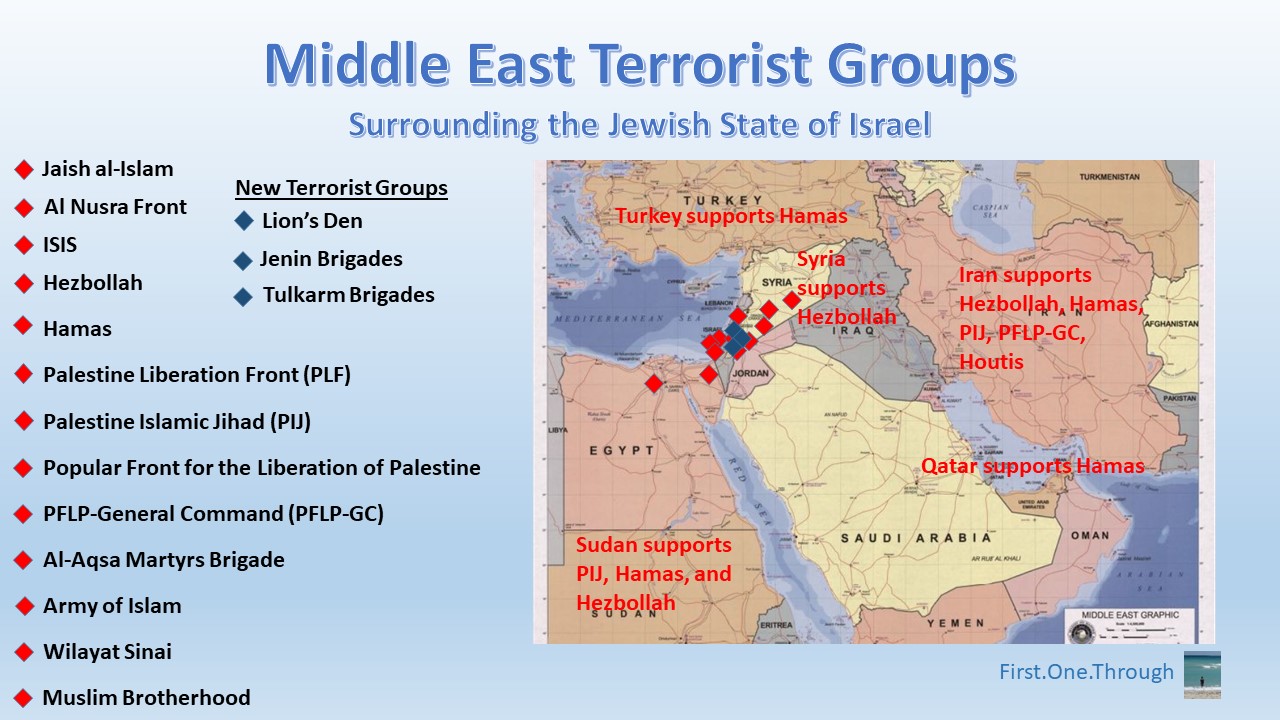
The collapse of governance in the states surrounding Israel has turned the region into one of the world’s greatest concentrations of terrorist groups. This is the strategic reality Israel faces every day.

Its neighbors are not peaceful democracies with settled borders and accountable institutions. They are governments weakened by civil war, dominated by militias, or unable to establish unified authority. Israel is repeatedly asked to take security risks on the assumption that these entities will prevent terrorism and enforce agreements, even though their recent history demonstrates the opposite.

The tragedy is not only Israel’s. The greatest victims of failed governance are the Lebanese, Syrians, and Stateless Arabs from Palestine (SAPs) themselves. They deserve governments that build economies instead of militias, schools instead of tunnels, courts instead of armed factions, and national institutions instead of perpetual conflict.

Peace agreements are negotiated between states because states can make commitments and enforce them. Militias cannot. Failed governments cannot. A failed state in waiting cannot.

Until the governments surrounding Israel control their territory, uphold the rule of law, and prioritize their people over perpetual conflict, Israel’s security challenges will remain the consequence of failed governance, not simply hostile neighbors.

Expendable Civilians: the Warning Signs in 2026

Modern conflict is collapsing into a single, repeatable failure mode: when armed power replaces legitimacy, civilian life becomes expendable—and the international system normalizes the outcome rather than correcting it.

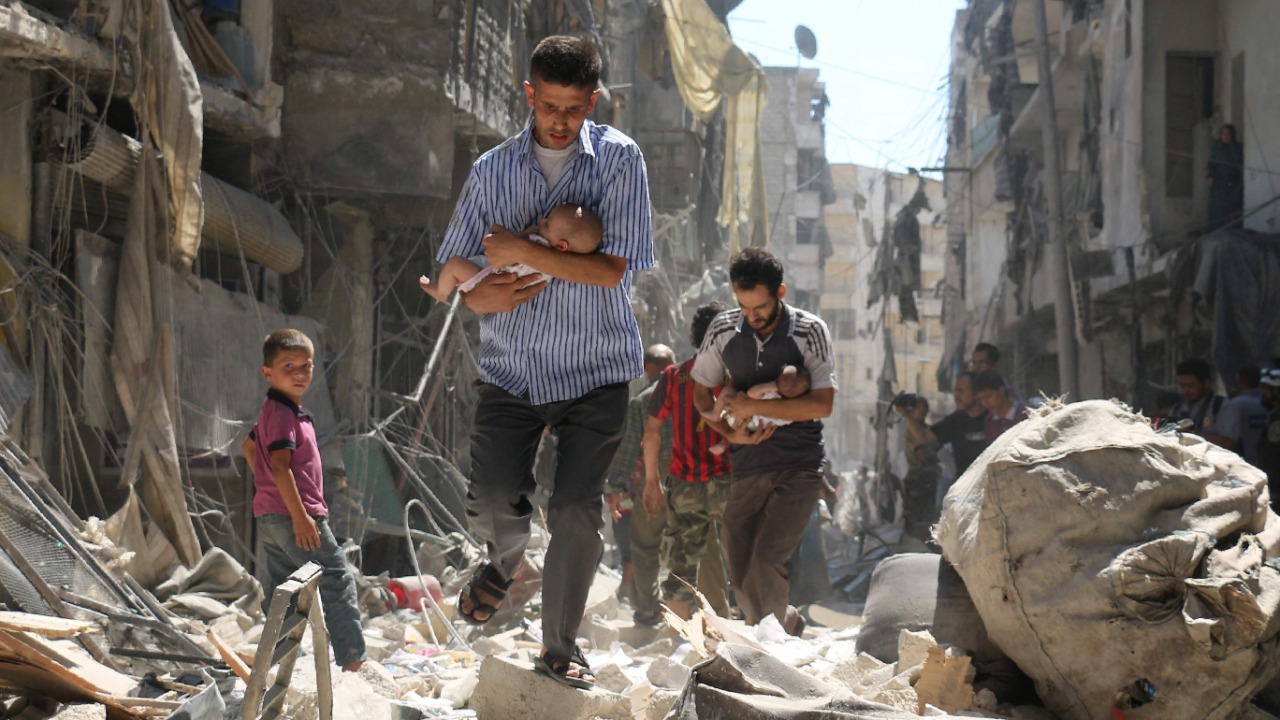
From Syria to Yemen, from the Gaza Strip to Somalia and Sudan, different wars follow the same script. Flags and slogans change; outcomes do not. Cities empty, economies collapse, millions flee, and societies become permanent humanitarian wards while armed elites persist.


The mechanics of collapse

Across all five regions, the structure repeats with grim consistency. Power flows from weapons rather than consent, with ideology serving as authority instead of constraining it. Civilians become leverage—through hunger, displacement, and terror—while the outside world manages suffering rather than ending the conditions that cause it.

These dynamics differ in context and scale. They converge in result.


Different conflicts, identical results

Syria survives by sacrificing its cities and people.
Yemen turns famine into strategy in a proxy war.
Gaza shows armed rule embedded among civilians, shifting the cost of war onto the population.
Somalia normalizes permanent instability under jihadist entrenchment.
Sudan mirrors the same logic through rival armed elites hollowing out cities and driving mass displacement.

The human outcome is uniform.


A shared demographic reality

Each of these societies is overwhelmingly Muslim-majority— above 90 percent. This matters for clarity. These disasters do not arise from religious diversity or minority rule. They unfold in largely homogeneous societies where armed authority crowds out the chance for peaceful legitimate governance. Shared faith does not restrain violence. Only accountable institutions do—and they are absent across all five.


Two warnings for 2026

First: recognition divorced from reality.
The push to recognize Palestine as a sovereign state reflects a dangerous inversion. Recognition is meant to affirm effective governance, restraint of armed actors, and protection of civilians. Gaza demonstrates the opposite. Armed rule persists, civilians absorb the cost, and failure deepens. Recognition under these conditions elevates symbolism over survival and legitimizes collapse.

Second: repression without war.
In Iran, an ideological regime in power since 1979 faces economic decline and eroding legitimacy. The response has been internal violence—security forces firing on civilians, mass arrests, repression replacing consent. Iran shows the same pattern without a battlefield: when legitimacy collapses, violence becomes governance.


The United Nations: institutionalizing failure

The United Nations was founded to prevent this exact depravity. Eighty years on, it increasingly fosters it.

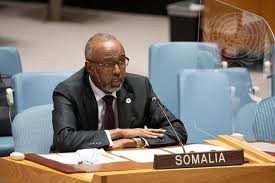
The UN grants equal procedural authority—votes, committee chairs, agenda control—to entities regardless of whether they govern responsibly or sacrifice their populations. Collapse carries no institutional penalty. In January 2026, the UN Security Council, the highest body at the UN, handed the gavel to Somalia, a state unable to protect its citizens or control its territory. Committee chairs shape agendas, manage debate, and mute scrutiny. The signal was unmistakable: mass failure has no consequence.

Somalia assumes head of UN Security Council in January 2026

This structure protects actors who weaponize civilians, including groups like Hamas, while rewarding states that export instability. Humanitarian agencies attempt to save lives on the ground, but UN governance shields the forces that endanger them. Through regional rotation, states implicated in mass civilian harm routinely gain seats, votes, and leadership roles across UN committees—including those charged with protecting human rights—without meeting any threshold of civilian protection.

Entities that systematically sacrifice civilians should lose voting rights and committee authority until they demonstrate basic standards of governance and restraint. Without consequences, international law becomes theater and failure becomes permanent.


The verdict

Syria, Yemen, Gaza, Somalia, Sudan—and the trajectory now visible in Iran—show what follows when sovereignty outweighs civilian life and armed power is indulged as politics. By preserving authority for collapsing entities, the United Nations has become part of the problem it was created to solve.

Civilian survival and protection must be the minimum requirement for legitimacy. If the UN cannot reform to enforce that standard INTERNALLY, then eighty years after its founding, it stands as a faint shadow of its founding principles at best, and an enabler of mass atrocities at worst.

Inside The Failed Syrian State, The UN Zeroes In On Israel

There is probably no greater example of a failed state in the world today than Syria.

A bloody civil war killed an estimated 600,000 people and displaced many millions internally and around the world. Headed by a ruthless leader who gassed his own people, backed by a leading state sponsor of terror in Iran, the Syrian government fell quickly to a US-designated terrorist organization, Hay’at Tahrir al-Sham (HTS). In its wake (and before), many actors took over swaths of Syria.

The United Nations Security Council met to address the failed Syrian state on January 8, 2025, to consider how to stabilize the situation.

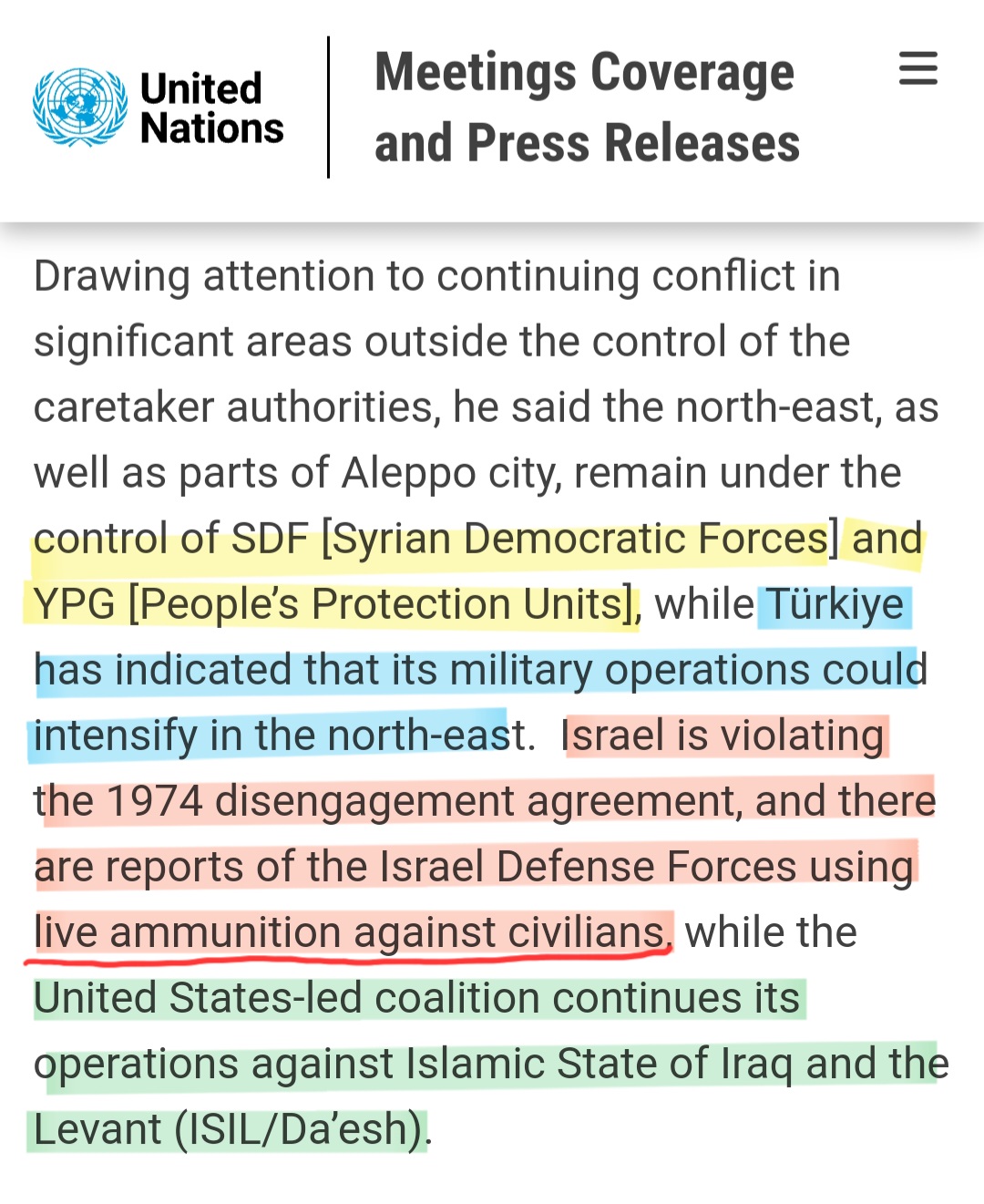
Geir O. Pedersen, Special Envoy of the U.N. Secretary-General for Syria, spoke to the committee about the various parties who are operating in Syria beyond HTS including: the Syrian Democratic Forces and YPG, a US-backed Kurdish militant group, who operate in the northeast; the government of Turkey which has taken over much of northeast Syria along the border of Turkey; a U.S.-led coalition which is fighting ISIL in the northwest; and Israel which has been taking out military sites and chemical weapons in the south.

During his review of the situation, Pedersen only cast Israel as a bad actor, both in “violating the 1974 disengagement agreement,” (with a government that no longer exists), and in “using live ammunition against civilians,” echoing a theme of the U.N. that Israel is seeking a genocide of Arabs in the region.

Report to the UN Security Council about Syria on January 8, 2025

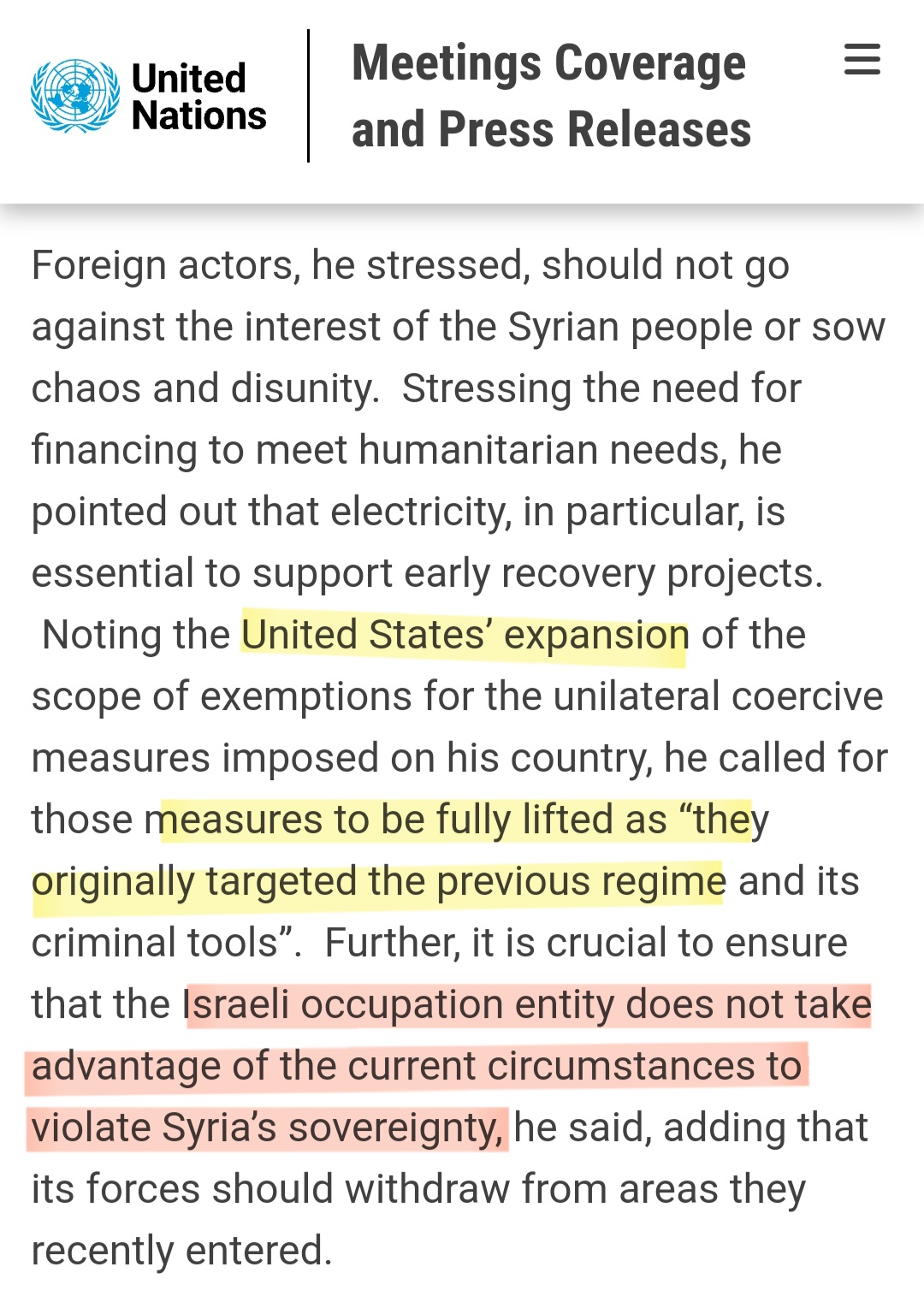
Tom Fletcher, Under Secretary General for Humanitarian Affairs and Emergency Relief Coordinator also addressed the council. He similarly spoke of challenges in Syria and only highlighted Israel as a rogue actor harming civilians.

Tom Fletcher report to UNSC highlighted Israel impacting “civilians, including children”

Other countries weighed in, including Syria, Iran and Russia, which took aim at Israel and the United States. No one mentioned Turkey’s seizing land and killing Kurds in Syria.

Syria at the UNSC points finger at the US and Israel only

Turkey addressed the Council even though it is not a member and leveled attacks against Israel, the Kurdish army and ISIS.

Israel did not address the council.

In a failed state with a terrorist group in charge, many terrorist groups operating openly, and several foreign governments with military personnel fighting in Syria, Israel was the spotlight at the U.N. for harming civilians and children.

In the 1970s, the United Nations was seized with the notion that Zionism is racism. Today it is awash in the belief that Israel is a genocidal state. It will most certainly distract the global body from addressing root causes of instability and death in Syria and beyond.

Related articles:

The Axis Of Nonexistence (December 2024)

The Deep Flaws In The UN’s “Peace” Coordinator (August 2024)

United Kingdom’s Home Grown Terrorism, Abroad (June 2023)

Imagining Israel’s Neighbors For The United States (March 2023)

The Anti-Semitism In Anti-Zionism (March 2023)

UN Secretary General Throws Shade on Israel from Lebanon (December 2021)

The Moral Bankruptcy Of The UN In A Single X Screenshot

The United Nations has long shown its anti-Israel bias in its various agencies. The global leader of the UN has also shows his disregard for civilians around the Middle East, preferring to coddle vile dictators as his clients.

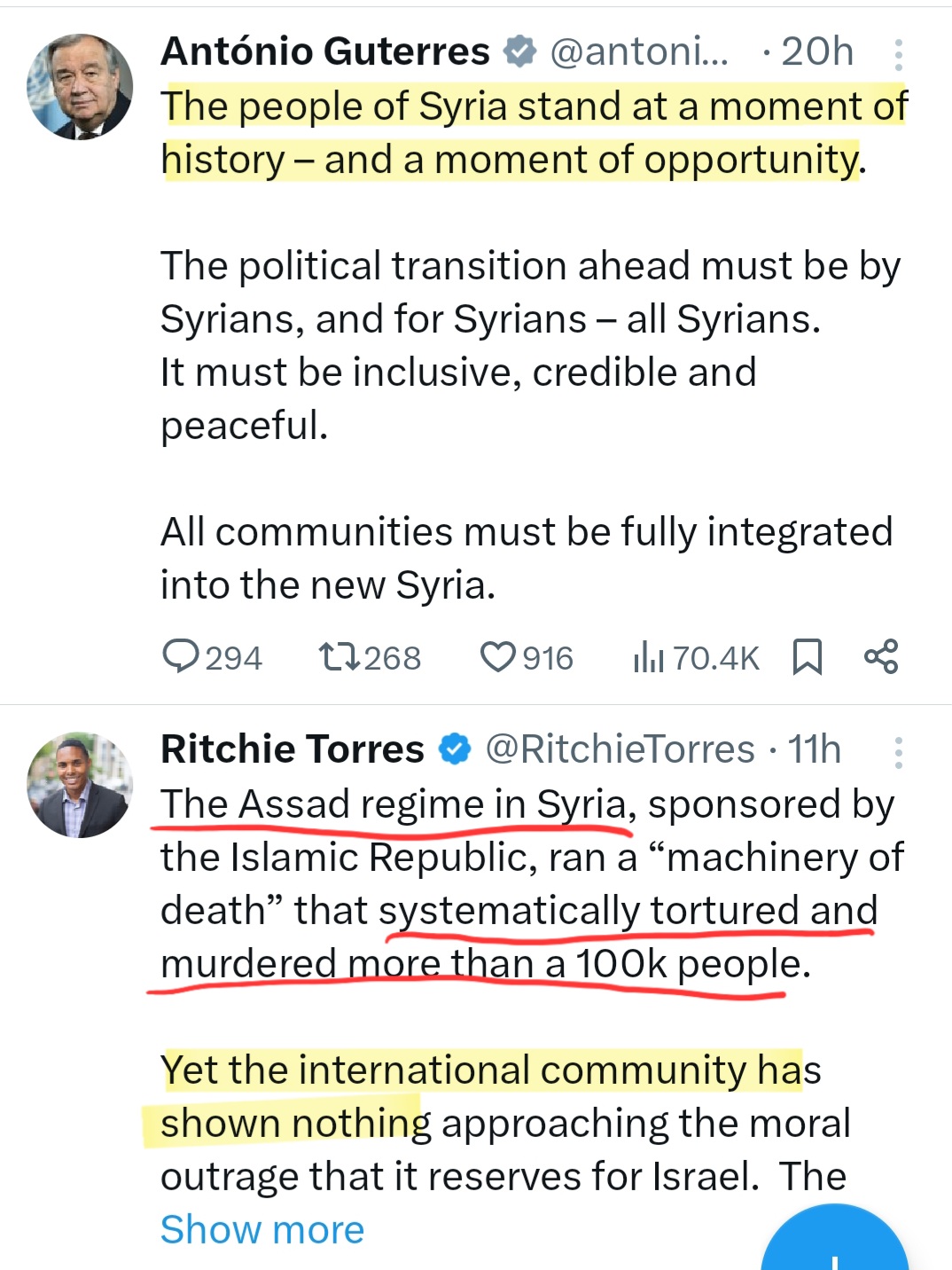
In the aftermath of unveiling of the brutal torture regime of Bashar al-Assad’s prison system which killed over 100,000 people, UN Secretary General Antonio Guterres chose to highlight the historic opportunity for the Syrian people as the country was taken over by a hybrid of jihadi terrorist groups of ISIS and Al Qaeda.

While he was making his absurd comments, a young US Congressman named Ritchie Torres was rebuking Syria and its sponsor of Iran’s “machinery of death,” and also called out the “international community” which ignored and continues to ignore the axis’ crimes against humanity, preferring to expend its energy on Israel’s defensive battles.

We know that Iran, Syria and the “axis of resistance” is evil. We must also acknowledge that the United Nations is an enabler of their atrocities and consider how to shrink the global body’s menacing actions.

Related:

Islamic Privilege (March 2022)

Asma al-Assad is a hypocrite on violence (October 2013)

The UN Secretary General Doesn’t Want Israel Fighting ISIS In Syria

The United Nations has long come together to fight only two terrorist groups, ISIS (Da-esh) and Al Qaeda. The UN tracked and sanctioned individuals and groups associated with the terrorist groups for decades.

ISIS continues to be very active, with 153 attacks in the first six months of 2024 between Syria and Iraq. It is projected that the group may have double the number of attacks in 2024 as 2023.

So it is no surprise that Israel is worried about the Islamist militant group, Hayat Tahrir al-Sham (HTS), taking over Syria, to Israel’s immediate northeast. According to the BBC, “HTS was set up under a different name, Jabhat al-Nusra, in 2011 as a direct affiliate of al-Qaeda. The leader of the self-styled Islamic State (IS) group, Abu Bakr al-Baghdadi, was also involved in its formation.”

The United States is playing close attention.

On December 9, shortly after HTS took over Syria, the U.S. Department of Defense issued a release that “Centcom, together with allies and partners in the region, will continue to carry out operations to degrade ISIS capabilities, even during this dynamic period in Syria.” U.S. Air Force fighter and bomber aircraft struck more than 75 targets on December 7 as part of the effort to denigrate ISIS.  

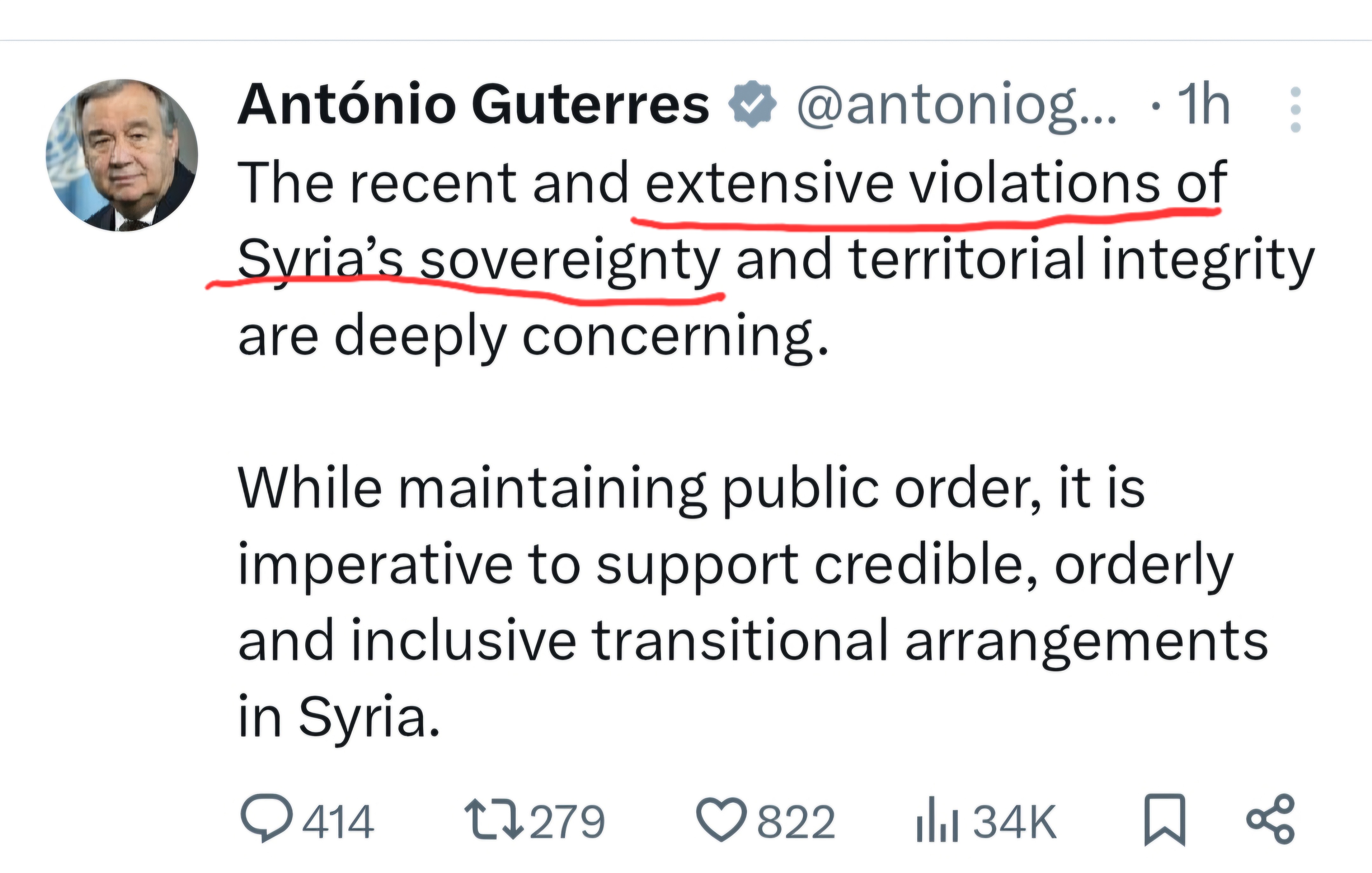
The United Nations Secretary General suddenly was worried about foreign involvement in Syria. Despite the UN stating clearly that ISIS and Al Qaeda are a global threat, UNSG Guterres tweeted that he was deeply concerned about the “recent and extensive violations of Syria’s sovereignty and territorial integrity.”

The U.S. has been operating in Syria for years, so it would be strange for Guterres to suddenly admonish the U.S.’s efforts to destroy ISIS. Turkey has conducted many raids inside Syria since 2016 and controls large swaths of northern Syria directly and through proxies.

Turkey-controlled areas in northern Syria

One must therefore assume that Guterres sudden interest was in regards to Israel’s attack on Syria’s air force, navy and chemical weapons stockpiles, as the Jewish State does not want the new Al Qaeda-linked regime to have such destructive capabilities next door.

Even though the UN labeled ISIS and Al Qaeda dangerous terrorist groups for years and said nothing about the United States and Turkey fighting in Syria for a long time, the head of the UN suddenly became concerned about Israel removing weapons from Al Qaeda-linked jihadi groups.

It is another sign of the depravity at the United Nations, and why it should be neutered in terms of funding and voice in international law.

Comparing Coverage Of Golan Heights and “West Bank”

The media has begun paying more attention to Syria as the country’s 54-year old regime has fallen to insurgents tied to ISIS and Turkey. As part of its coverage, it has marked the Golan Heights on its maps. It makes this an opportune time to review the very different coverage of two contested areas – Golan Heights and West Bank – between Israel and its neighbors.

In the Media

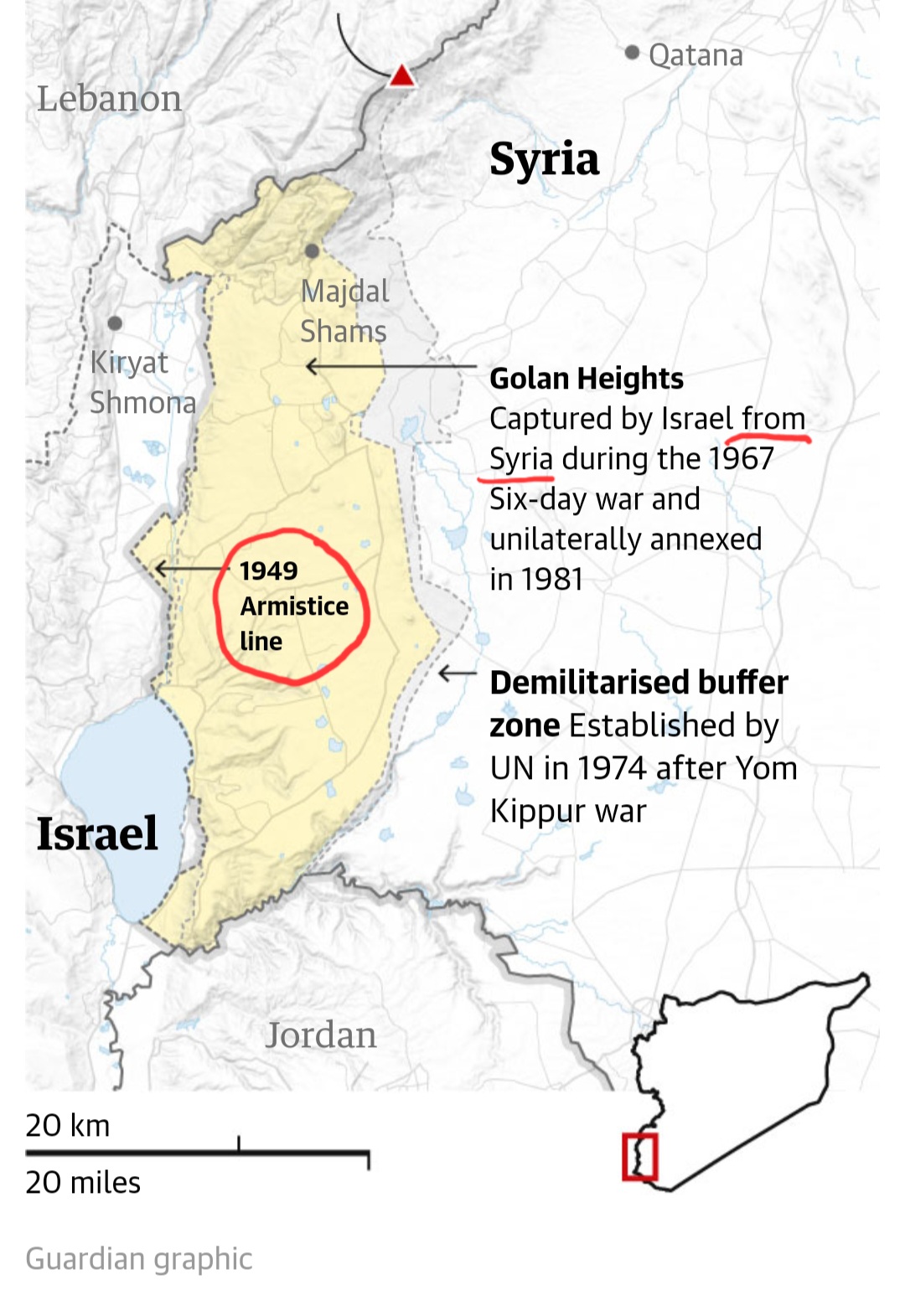
The Guardian’s map of the Golan Heights in December 2024

The Guardian presented a map of the Golan Heights calling the separation between Israel and Syria as the “1949 Armistice line.” It also noted that the Heights were “captured by Israel from Syria during the 1967 Six-day war.” Both of these statements are factually correct.

And completely divorced from how the media describes the “West Bank.”

Rather than use the term “1949 Armistice line”, the press calls it the “1967 border” even though it was never a border nor meant to be a border. As described in the 1949 Israel-Jordan Armistice Agreement in Article VI, “The Armistice Demarcation Lines defined in articles V and VI of this Agreement are agreed upon by the Parties without prejudice to future territorial settlements or boundary lines or to claims of either Party relating thereto.” In other words, the lines were simply set to separate the warring parties but political negotiations would craft the contours of the land in the future.

In regards to the phrase “from Syria,” the media never notes that Israel didn’t capture the “West Bank” land from Palestine but from Jordan, as Palestine did not exist.

The media – and the United Nations – mislead people that Israel took the West Bank from Palestine in an aggressive war. That is completely untrue, and obfuscated by terminology.

Geography

The Golan Heights are an actual topographical piece of earth. The large hills and mountains shoot up from the Sea of Galilee and beyond from volcanic activity.

Not so for the “West Bank.” It has no geographical or historical significance, other than being east of the 1949 Armistice line. It wasn’t even called the “West Bank” until after the 1967 Six-day war, as Jordan had illegally annexed it in 1950 and the UN just called it part of Jordan.

Arab States Breaking the Armistice Agreements

The Israel-Syria and Israel-Jordan Armistice Agreements specifically called on all parties to not take military action against the other. Both Arab states violated those agreements.

Syria shelled the farmlands of Israel’s Galilee for years, forcing Israel to defend itself and take the Golan Heights to keep Syria from repeating the attacks. Similarly, Jordan attacked Israel in June 1967 and Israel captured the region in a defensive action during the Six-day war.

Internationally Defined Borders

International powers created the various lines for Lebanon, Syria, Iraq and Palestine after World War I. Each region slowly declared independence but not without difficulties. Each has gone through several wars, including civil wars. A populace more comfortable with tribes and clans operating under the umbrella of the Ottoman Empire for centuries were thrust into statehood. While modern academics blame the regional powers for “colonialization” and “imperialism” which left the locals bereft of natural resources, it was actually the imposition of statehood that has confounded much of the Middle East. Syria, Iraq and Lebanon are perfect examples of the internal strife which has killed millions over the decades.

“Palestine” was similarly crafted by world powers, and then quickly divided further by chopping off the region east of the Jordan River for the Hashemite Kingdom to rule. The balance of the land (which most people think of as pre-1948 Palestine) was designed to be “a national home for the Jewish people,” in the Palestine Mandate as adopted by the League of Nations. While the Golan Heights was marked by the powers to be part of Syria, those same powers marked the “West Bank” to be part of the Jewish homeland.

On one hand, Israel captured the Golan Heights after Syria broke the Armistice Agreement, and on the other, Israel RECAPTURED the West Bank/ area east of the 1949 Armistice Lines, in 1967 after Jordan broke its Armistice Agreement.

Names

Republicans in the United States are putting forward resolutions to stop calling the land “West Bank” and instead refer to it as “Judea and Samaria.” Sen. Tom Cotton (R-AK) said in introducing the resolution that “The Jewish people’s legal and historic rights to Judea and Samaria goes back thousands of years. The U.S. should stop using the politically charged term West Bank to refer to the biblical heartland of Israel.” That is partially true.

Judea and Samaria have historical context and are much bigger contours than the “West Bank.” The West Bank is an artifice of war; it is just the land the the Jordanians took in the 1948-9 war in which they attempted to destroy the nascent Jewish State. The more accurate term for political purposes would be to call it E49JAL, for the area east of the 1949 Jordanian Armistice Lines.

Conclusion

The media is correctly referring to the Golan Heights, an actual region with topographical significance, as having an Israeli side captured FROM SYRIA, across the “1949 Armistice line.” It should similarly stop using the terms “borders,” “West Bank” and “from Palestine” which are all factually incorrect and attempt to frame the conflict with the Stateless Arabs from Palestine (SAPs) in a duplicitous manner that portrays Israel as the aggressor.

On Syria’s Assad And The Former ‘Axis Of Resistance’

Media outlets will discuss the roughly 600,000 people in Syria who were killed in the civil war and the millions of people who were internally displaced. They will recount how Syrian President Bashar al-Assad used chemical weapons on his own civilian population. They may even trot out videos of London-educated Asma al-Assad, Bashar’s wife, on how she stood by her husband.

I would like to share one name: Hamza al-Khateeb, a 13-year old boy taken by Syrian forces in April 2011, whose corpse was returned to his family a month later.

Here is the story as relayed on May 31, 2011 by Al Jazeera:

In the hands of President Bashar al-Assad’s security forces, however, Hamza found no such compassion, his humanity degraded to nothing more than a lump of flesh to beat, burn, torture and defile, until the screaming stopped at last.

Arrested during a protest in Saida, 10km east of Daraa, on April 29, Hamza’s body was returned to his family on Tuesday 24th May, horribly mutilated.

The child had spent nearly a month in the custody of Syrian security, and when they finally returned his corpse it bore the scars of brutal torture: Lacerations, bruises and burns to his feet, elbows, face and knees, consistent with the use of electric shock devices and of being whipped with cable, both techniques of torture documented by Human Rights Watch as being used in Syrian prisons during the bloody three-month crackdown on protestors.

Hamza’s eyes were swollen and black and there were identical bullet wounds where he had apparently been shot through both arms, the bullets tearing a hole in his sides and lodging in his belly.

On Hamza’s chest was a deep, dark burn mark. His neck was broken and his penis cut off.
Hamza al-Khateeb, 13 year old boy in Syria tortured by Syrian forces

The scale and savagery of the attacks in the Middle East are sometimes reduced to numbers such as the million who were killed in the Iran-Iraq war. As Syria falls, it is worth remembering a single soul who was brutally maimed and killed to comprehend the deep moral depravity that permeates – and must be expunged from – the region.

The Axis Of Nonexistence

Iran and its associates have long referred to the United States and Israel as “Great Satan” and “Little Satan”, respectively. The jihadi extremists positioned themselves as the “axis of resistance” against western influence in what they perceive to be a purely Islamic Middle East.

The leading edge of the warmongering jihadists are rapidly fading.

Hamas, the Popular Islamic Palestinian Arab Terrorist Group

Hamas has been listed by the United States as a foreign terrorist group (FTO) since the US began the list in 1997. The Palestinian Arab group which ran Gaza and has a majority position in the Palestinian parliament since 2006, has the most antisemitic foundational charter of any country. It is sworn to the destruction of Israel.

Hamas invaded the Jewish State on October 7, 2023 and slaughtered 1,200 people and took over 250 hostages. In Israel’s response to the assault, it has decimated Hamas’s leadership including Yahya Sinwar, Ismail Haniyeh and Mohammed Deif. Hamas’s arsenal and tunnel infrastructure has virtually been eliminated and thousands of its members are either dead or in Israeli jails.

Hezbollah in Lebanon

Hezbollah, like Hamas, is sponsored by Iran. The Lebanese-based US FTO launched an attack on Israel on October 8, and Israel began responding more aggressively over the past few months. During this time, Israel killed much of Hezbollah’s leadership including Hassan Nasrallah, Ali Karaki, Ibrahim Qubaisi, Fuad Shukr, Ahmed Mahmud Wahbi and Ibrahim Aqil.

After Israel incapacitated much of Hezbollah’s fighting force in southern Lebanon, the group accepted a ceasefire agreement. Israel hopes that the government of Lebanon will assume military control of its territory, expunge Hezbollah from parliament and emerge from decades of being a failed state.

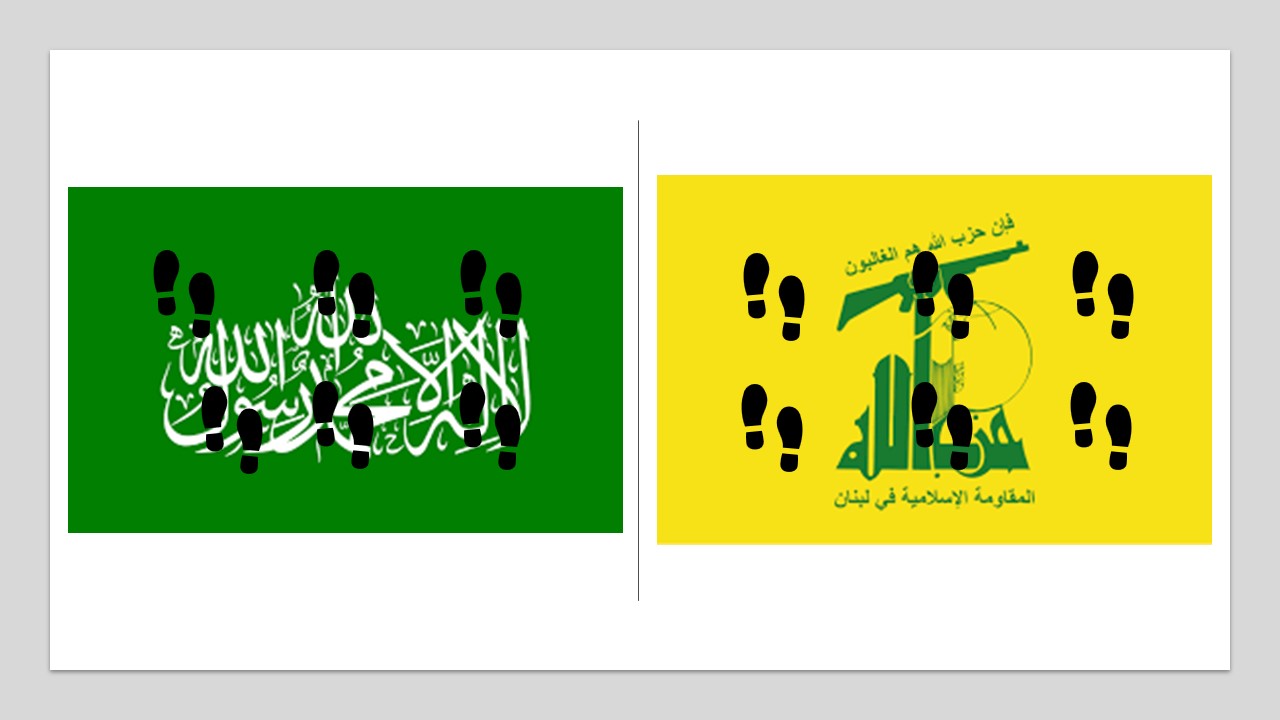
Hamas and Hezbollah flags, under foot

Syria

The Iranian-backed government of Bashar al-Assad has overseen a brutal civil war which has left over 600,000 dead and millions displaced since 2011. Since Hezbollah’s ceasefire, Syrian resistance forces have overtaken many of the large cities of western Syria and are closing in on Damascus. It is possible that Assad’s regime may fall as Russia is too weakened by its war with Ukraine, and Iran is too vulnerable to extend resources to its proxy.

Islamic Republic of Iran

The leading state sponsor of terrorism is fully exposed after Israel launched a massive air strike in late October. While Israel has not followed up with additional attacks to remove the Iranian nuclear weapons program at this time, Iran has pulled back on its attacks against Israel, out of fear of being highly vulnerable.


What began as a massive war of Iran and its proxies to eradicate the Jewish State and prevent its integration with Sunni Arab countries including the UAE and Saudi Arabia, is becoming a rout of the jihadi regimes. The “axis of resistance” is vanishing into the “axis of nonexistence.”

It remains to be seen if the vanquished jihadists will repeat the “three Nos” slogan from 1967, or consider accepting the basic human rights and dignity of the Jewish State. Unlike 57 years ago, the incoming US president and Saudi Arabia will be important factors in shaping the contours of the regional relationships into the future.

Imagining Israel’s Neighbors For The United States

The United States is blessed in many ways.

One manifestation is that despite the country’s enormous size, it has only two bordering countries. One of them, Canada, is so closely tied to the U.S. in terms of language, culture, trade and military reliance, people often joke that it can be viewed as the 51st state, with 90% of its population living within 100 miles of the U.S. border.

In sharp contrast, small Israel is surrounded by several entities, all of which have gone to war to destroy the country within the last decades. Two of them – Lebanon and Syria – are broken and broke states, with Syria still engaged in its own civil war.

The small sliver of a country has 1,068 kilometers of boundaries with adjacent countries and territories. The breakdown is as follows:

regionboundary (km)percentage
Lebanon817.6%
Syria837.8%
Jordan30728.7%
Egypt20819.5%
West Bank33030.9%
Gaza595.5%
Length of Israel’s boundaries

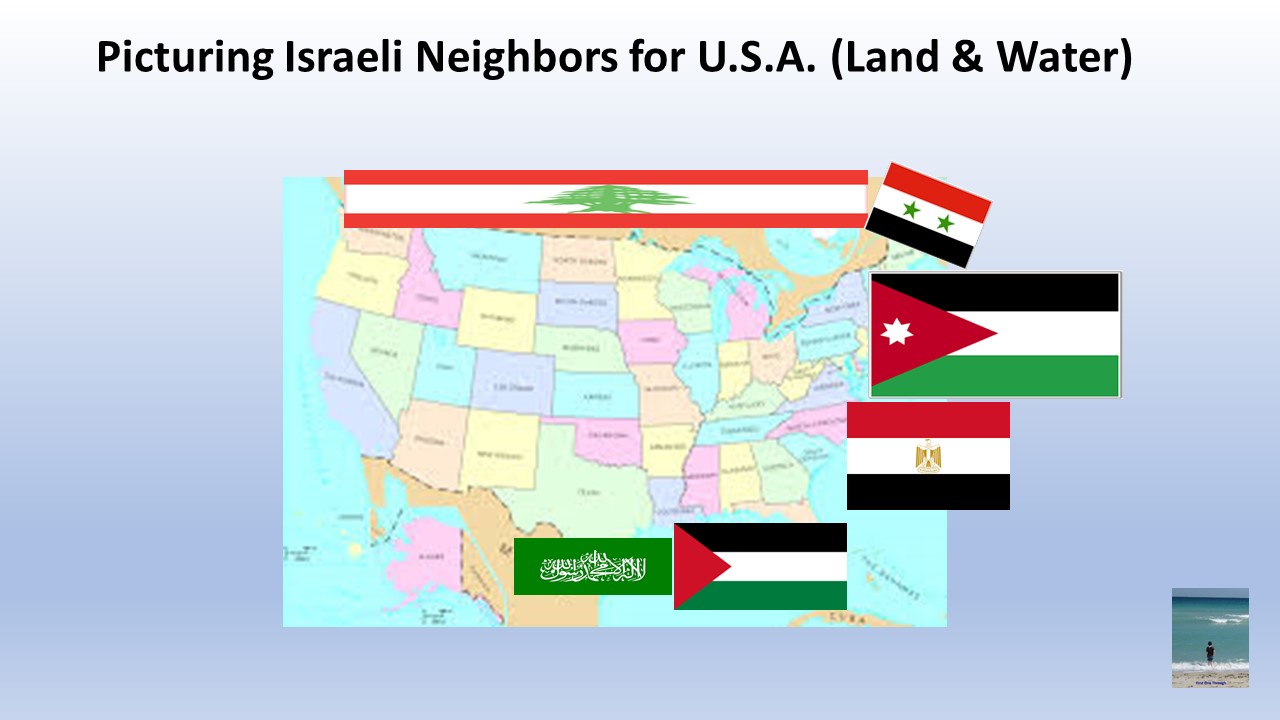
To apply these percentages with the United States’ lower 48 state’s 9,560km land border with Canada and Mexico, would yield the following map:

Lebanon is led by an Iranian-backed terrorist organization, Hezbollah. It has roughly 150,000 missiles and rockets aimed at Israel. It devalued its currency by 90% last month, as its unemployment rate has rapidly increased each year, now reaching about 15%. The country is a shell of its former self.

Imagine such a neighbor for the states of Washington and Idaho!

It doesn’t get better.

Syria has even a longer border with Israel – it would equivalently cover the Montana-Canadian border. Syria’s genocidal leader slaughtered over half a million of his own citizens, in a civil war that has seen millions of people flee the country and millions of others internally displaced. The destructive leader attempted to build a covert nuclear weapons facility with North Korea a few years ago. The country remains in an active state of war with Israel, as it has been since the modern Jewish State came into existence.

At least not that many people in Montana!

Much of the rest of America’s northern border would be with two countries with a cold peace, Jordan and Egypt. While not at war, little economic activity or tourism exists, and the two countries almost always vote against you at the United Nations. A far cry from friendly Canada.

At America’s southern border, there is strain of millions of migrants coming into the country from Central America. They are coming looking for a better life than they had in Mexico, Nicaragua and elsewhere. They are not looking to upend the United States and overthrow it.

Not so with Fatah in the West Bank and Hamas-ruled Gaza. Hamas is actively looking to destroy its neighbor from its vantage point south of California and half of Arizona. The Palestinian Authority pays its people who kill its neighbor’s citizens and claim the country as its own.

This ugly theoretical snapshot of America’s neighbors were based on keeping America’s huge water boundaries. If one were to use Israel’s actual percentage of coastline, the map would look like this:

Lebanon would cover almost all of America’s northern border. Syria would wrap Maine’s land and water boundaries. Jordan would abut the New England states down to Virginia, while Egypt would extend southward to Georgia. The Palestinian Authority would envelope all of Florida and the Gulf states and the terrorist enclave of Gaza would border much of Texas. The balance would be coastline.

Now further imagine that instead of a large, tall and wide country that is the USA, it was flattened into a pancake with those same neighbors.

If you think Texans like guns now, imagine if they had Hamas digging tunnels under their homes and firing rockets at their schools!

This is Israel’s reality every day. Terrorist-led broken countries and territories surrounding a small sliver of land, attempting to destroy the only Jewish state through a variety of means, including militarily, economically, legally and via public opinion.

Related articles:

Israel: Security in a Small Country

Seeing Security through a Screen

Gaza, The Terrorist Enclave

Islamic Privilege

Wilayat Sinai: The Other Terrorist Group Abutting Israel