Israel Is Surrounded by Failed States – and Failed States in Waiting

Much of the discussion about Israel’s security focuses on borders, settlements, or ceasefires. Less attention is paid to a more fundamental reality: Israel is surrounded by governments that have failed – or have yet to demonstrate they can function as sovereign states.

To Israel’s north lies Lebanon, a country where the government spent years unable to enforce a monopoly on force within its own territory. While the Lebanese Army wore the national uniform, Hezbollah built an independent army, amassed an enormous missile arsenal, dug tunnels, launched drones, and ultimately dragged the country into war. A sovereign state that cannot control its own territory has surrendered one of the defining responsibilities of statehood.
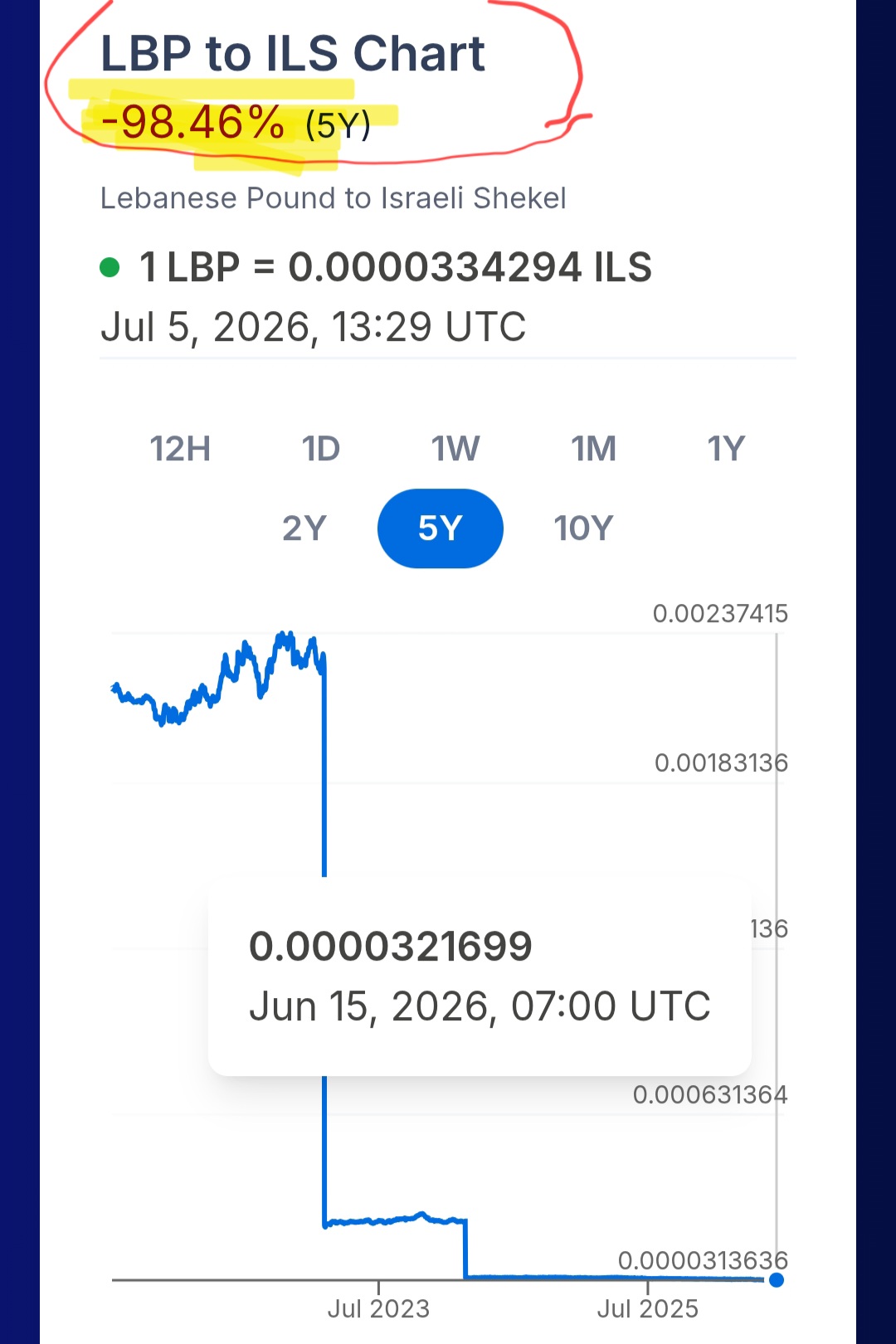
Lebanese pound to Israeli shekel exchange rate, defaulting on debt in March 2020, enormous explosion in Beirut for stored Hezbollah weapons in August 2020. The bank devalued currency by 90% in February 2023 and again in February 2024

Next to Lebanon is Syria. More than a decade of civil war shattered the country’s institutions, fractured its territory among competing armed groups and foreign militaries, and left millions displaced. Syria has long stood as one of the clearest examples of state failure in the modern Middle East.
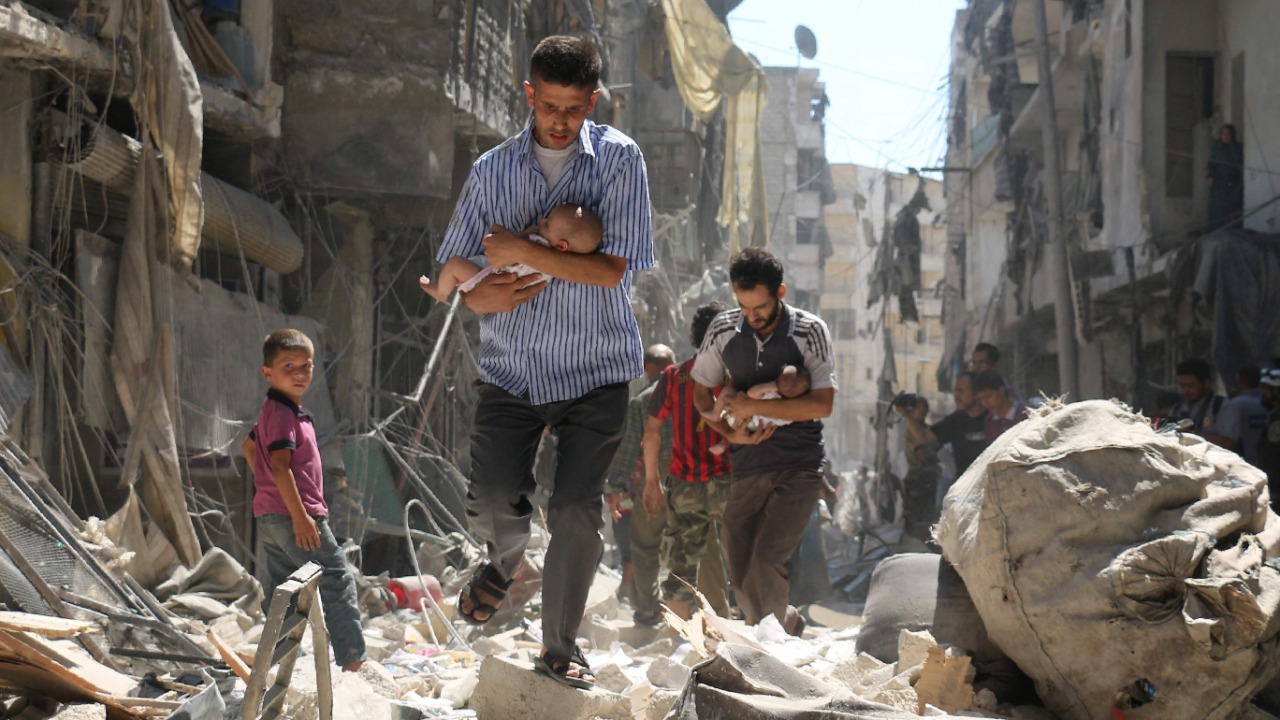
Syrian civil war killed nearly 600,000 and dispersed 13 million. It is now ruled by Abu Mohammad al-Jolani who headed ISIS in the region

To Israel’s south lies Gaza. Hamas spent years and billions of dollars to build an underground military fortress instead of a functional society. The result was war after war after war. Destruction and death.

Hamas on October 7, 2023 slaughtered 1,200 people in Israel and brought over 250 people as hostages into Gaza to cheering crowds.

In the West Bank, the picture is different but equally troubling. The Palestinian Authority maintains civil institutions in parts of the territory, yet it has never established a monopoly on force or unified governance. Rival armed factions continue to operate, political legitimacy remains deeply contested, and governance has been divided from Gaza for nearly two decades.

recent poll shows a majority of Palestinians rejecting moderate leadership, despairing of peaceful change and now favouring armed struggle? That tragic deformity in Palestinian political culture is the result of the continued brutality of the occupation.” – James Zogby, President of the Arab American Institute at the United Nations Security Council on June 27, 2023

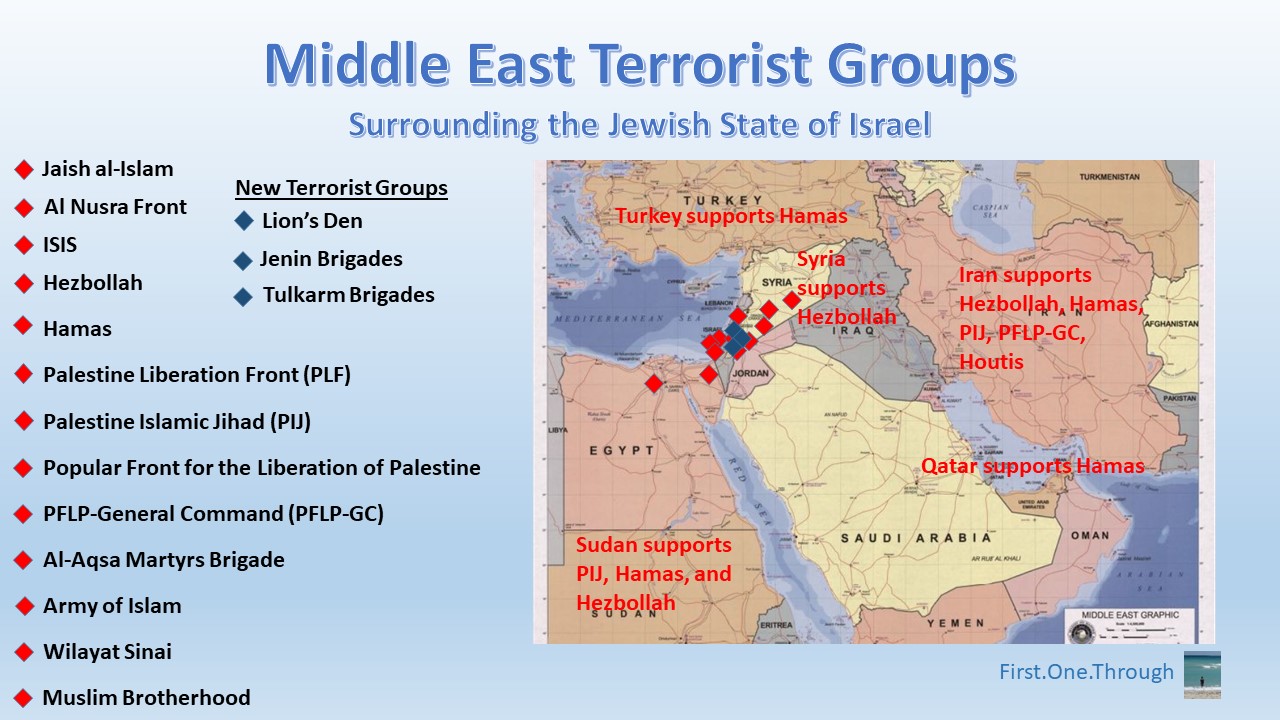
The collapse of governance in the states surrounding Israel has turned the region into one of the world’s greatest concentrations of terrorist groups. This is the strategic reality Israel faces every day.
Its neighbors are not peaceful democracies with settled borders and accountable institutions. They are governments weakened by civil war, dominated by militias, or unable to establish unified authority. Israel is repeatedly asked to take security risks on the assumption that these entities will prevent terrorism and enforce agreements, even though their recent history demonstrates the opposite.

The tragedy is not only Israel’s. The greatest victims of failed governance are the Lebanese, Syrians, and Stateless Arabs from Palestine (SAPs) themselves. They deserve governments that build economies instead of militias, schools instead of tunnels, courts instead of armed factions, and national institutions instead of perpetual conflict.

Peace agreements are negotiated between states because states can make commitments and enforce them. Militias cannot. Failed governments cannot. A failed state in waiting cannot.

Until the governments surrounding Israel control their territory, uphold the rule of law, and prioritize their people over perpetual conflict, Israel’s security challenges will remain the consequence of failed governance, not simply hostile neighbors.

Considering a Failed Palestinian State

Failed Countries
On July 9, 2011, the world welcomed a new country, South Sudan, which separated from Sudan. South Sudan rapidly became a failed state, one in which the central government lost the ability to control the security and economy of the country.
Failed states suffer from many terrible and unstable features: lack of governmental control; factional militias and armies; lack of border integrity and gross poverty. These societies often see rampant human rights abuses as various parties assert control over parts of the country and seek vengeance and control over minorities and local populations.
Consider some reports from South Sudan over the past year:
Ten thousand people have been killed and more than 1.6 million have been internally displaced since civil war broke out in South Sudan in December 2013.
June 2015: South Sudanese army may have caused widespread human rights abuses according to the UN
May 2015: At least 129 children killed, boys castrated and girls raped
July 2014: Food crisis declared worst in the world by UN Security Council
According to Business Insider, the worst failed states include: South Sudan; Sudan; Somalia; Congo; Chad and Yemen. The populations of these countries are forced to flee, suffer or die.

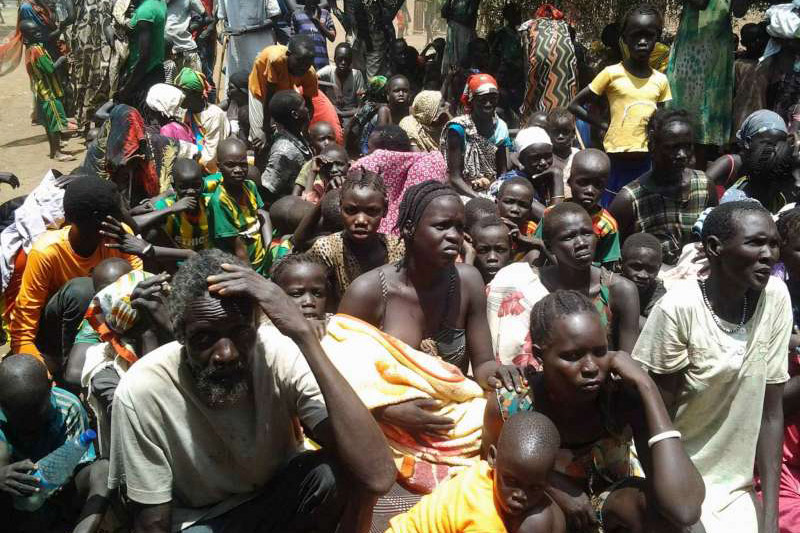
South Sudanese refugees wait to be registered at a crossing into Ethiopia earlier in 2015. (Photo: UNHCR/R. Riek)
Considering a Palestinian State
Many countries in the United Nations would like to see the Palestinian Arabs gain self-determination and have their own country. However, many of the ingredients for a failed state currently reside in the political structure of the Palestinian Authority:
The Palestinian territories have various stand-alone armies and militias including Hamas and Islamic Jihad
No central government, as the west bank of the Jordan River and Gaza strip are administered independently
Internal fighting as witnessed in the 2007 rout of Fatah by Hamas forces in Gaza, and various extrajudicial killings between those parties that continued since then
No border integrity as bedlam prevails in Gaza, Sinai and Israeli towns near the border of Gaza
Lack of functioning economy and widespread unemployment due: to the extremely high percentage of people under 25 years old; and constant war to destroy Israel
No presidential or legislative elections, as they were suspended due to the splits mentioned above. The presidential election was last held in 2005 and the president’s term expired a long time ago.
A country built on this framework would likely deteriorate. Factional fighting to dictate the future of the country would exacerbate. Unemployment would further skyrocket. Cross-border battles with Israel would escalate and also include the area east of the Green Line, EGL/ west bank of the Jordan River. This region, which already leads the world in the “honor killings” of women, would likely continue to see such murders increase.
It would be a country built in chaos, with people’s dreams dying alongside their lives.
Concrete Steps to Avoid a Failed Palestinian State
Should the Palestinian Arabs hope to achieve a functioning state after self-determination, important steps need to be instituted before the state is formed:
Remove all weaponry from Hamas and other groups. A functioning government must only have a single army. There cannot be a society in which various entities wage internal and external wars.
Ban Hamas. No entity which advocates for murder of minorities should be allowed to sit in any elected office, and no country should have any dealings with any country that seeks destruction of another country. As Hamas advocates for the killing of Jews and calls for the complete destruction of Israel, the party should be banned in its entirety until it renounces both positions completely.
Form new Political Parties and Hold Elections. The Palestinian Arabs have not held presidential elections since 2005 and legislative elections since 2006. As Hamas won legislative elections in 2006 and have polled to win future elections, new parties should be organized that can compete in new elections.
These are the basic steps that must occur for the Palestinian Authority to have a functioning government. Once the central authority rests in a representative body, that entity can negotiate a final status agreement with Israel to create a new state. To minimize the chances that it slip into a failed state, the Palestinian government should further consider the following:
Peace Agreement with Israel. A viable government should have a strong economy, including a flow of people and goods. Due to the separation of the Palestinian territories, it would be most efficient for the government to have a good working relationship with Israel to facilitate commerce.
Minimize Incoming Youth. A Palestinian state would likely want to welcome Arabs whose families once lived in the region. As a large population below age 25 often leads to rampant unemployment and instability, the emphasis on incoming people should be on professionally-trained adults.
Transitional control from UNRWA. UNRWA has kept infant mortality, immunizations, life expectancy and literacy of Palestinian Arabs at among the best rates in the world. Over a period of years, the UN should cede control of the schools and hospitals to Palestinian control.
While the world celebrated the founding of a new country four years ago in South Sudan, the declaration proved a hollow victory for the people. It would be a mistake to push forward another declaration for Palestinian Arabs at this time which would ultimately lead to further suffering. Mayhem with a flag benefits no one.

Related First.One.Through article:
A “Viable” Palestinian State