
When a head of state opens a student conference, the message extends far beyond procedural remarks. It is a statement about the values and aspirations a society hopes to pass to its next generation.
That is why Palestinian Authority President Mahmoud Abbas’s patronage of the 11th General Conference of the General Union of Palestinian Students (GUPS) deserves careful attention. In its official announcement, the conference proudly celebrated the organization’s history by declaring that it produced leaders including Yasser Arafat, George Habash, Nayef Hawatmeh, Faisal Husseini, Hanan Ashrawi, and Walid Khalidi.
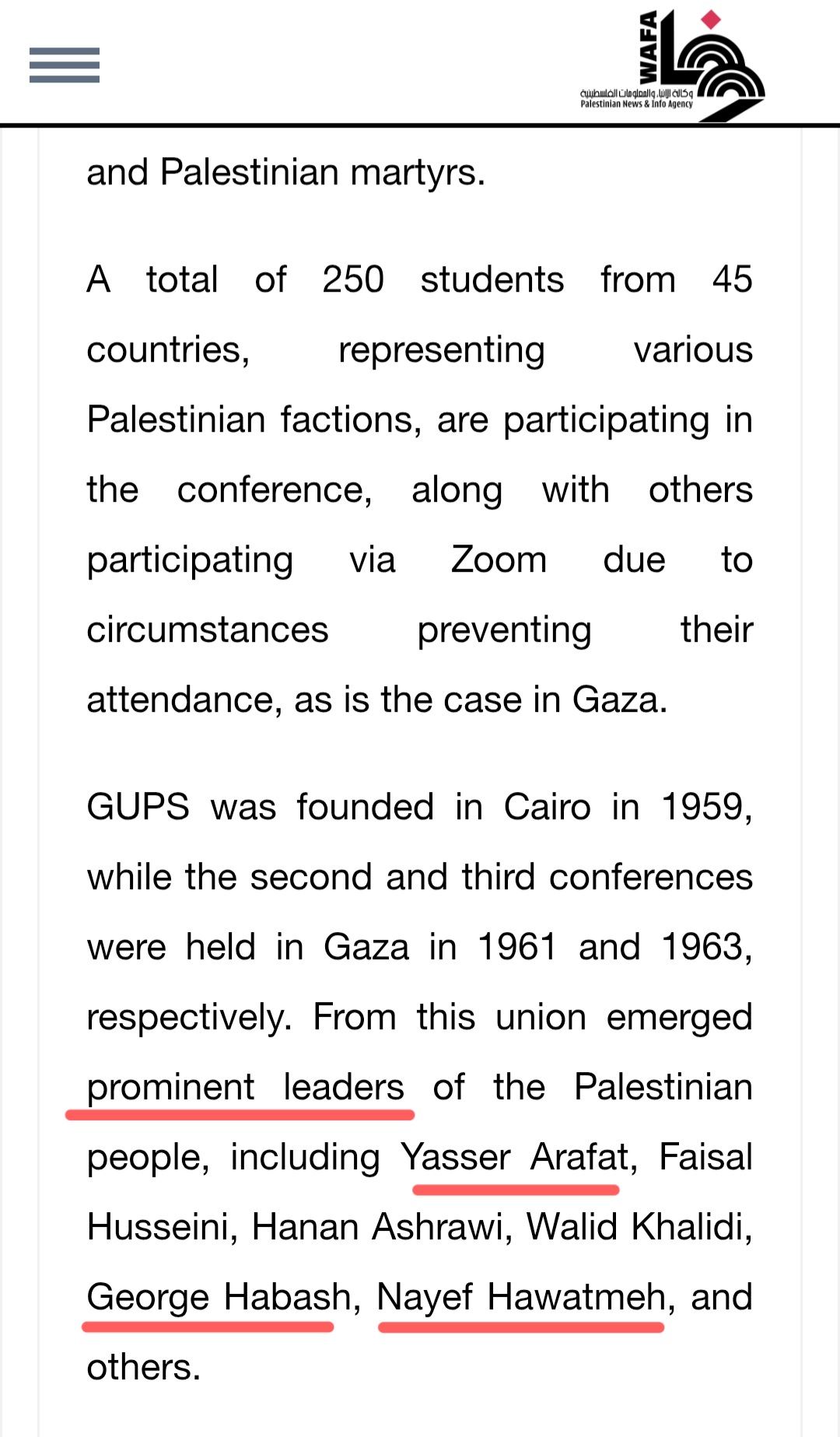
Three of those names stand apart.
George Habash founded and led the Popular Front for the Liberation of Palestine (PFLP), responsible for airline hijackings, bombings, and attacks on civilians. Nayef Hawatmeh founded the Democratic Front for the Liberation of Palestine (DFLP), whose history likewise includes attacks targeting civilians. Yasser Arafat led Fatah during decades in which its armed wing carried out numerous attacks against civilians before the Oslo era.
No one reading the official announcement could miss the point. This was not merely a history lesson. It was an effort to present these figures as part of the proud lineage of Palestinian student leadership.
That should concern anyone who hopes for a future of coexistence.
Every society chooses whom to celebrate before its young people. Some elevate scientists, entrepreneurs, doctors, artists, and peacemakers. Others elevate military heroes. But when organizations whose leaders orchestrated attacks on civilians are held up as exemplars at a student conference, the lesson is unmistakable: these are people worthy of admiration and emulation.
PA President Mamoud Abbas continued that the program is “a school for developing future leaders, and a bridge connecting generations of Palestinian students in the homeland and the diaspora,” and the hope that Palestinian Arabs who “invest in the education and awareness of their youth cannot be defeated by occupation or have their cause extinguished.”
Defenders may argue that these figures are important because they shaped the Palestinian national movement. History should indeed be taught honestly. But there is an important distinction between teaching history and celebrating it. Germany teaches students about Adolf Hitler without holding him up as a model. The United States studies the Ku Klux Klan without celebrating its founders. Context matters. So does moral judgment.
A student organization launching a new generation of leaders has every opportunity to highlight Palestinians who built universities, hospitals, businesses, charities, diplomatic institutions, or scientific achievements. Instead, its official narrative deliberately included men whose names are inseparable from campaigns of terrorism.
If Palestinian leaders genuinely seek to prepare young people for peace, they should be encouraging students to surpass the generation that embraced violence—not to walk in its footsteps.
Peace requires more than negotiations. It requires choosing different heroes.


