Listen to many of today’s most prominent progressive Jewish organizations—T’ruah, Bend the Arc, Jewish Voice for Peace, and many rabbis who speak in similar terms—and a pattern quickly emerges. Their Judaism is explained through a familiar vocabulary.
- Justice.
- Human dignity.
- Welcoming the stranger.
- Repairing the world (Tikkun Olam).
- Compassion.
These are presented not simply as Jewish values, but as the defining Jewish values.
It is an appealing message. It is also one the modern Western world already overwhelmingly believes.
Nearly every university, corporation, NGO, church, and democratic government affirms human dignity, equality, compassion, caring for refugees, and social justice. Whether one agrees with every application of those ideals is beside the point. They are no longer uniquely Jewish insights. They have become the common moral language of much of the modern world.
The progressive Jewish rabbis and organizations often remind audiences that many of those ideals trace their roots to the Hebrew Bible. That observation is true. Judaism profoundly shaped Western moral thought. Therefore the comment of them being Jewish values is seemingly to educate the western world that they only have their own universal values because of Jews. Also perhaps true, but to what end is the observation? Is it to inform those listening that Jews alone carry the essence of justice, with a transmission extending back thousands of years? That they alone are the actual guardians of values?
Or that they are all on the same page – that the values the West holds dear and the progressive rabbis are one and the same? That one or the other may take the lead on a subject – say condemning genocide, for example – and the other will echo the sentiment?
That approach deliberately strips anything uniquely Jewish from values. It makes the adjective superfluous. Redundant.
Many non-progressive rabbis and the mainstream Jewish organizations have a different view, one that affirms the Jewish component of values. Those are values that are woven into the covenant between God and the Jewish people, as laid out in the Bible and holy books, and debated for thousands of years.
In such telling, justice is not equity as progressive rabbis champion, but based on fairness and balance.
Charity is not generosity. It is tzedakah – an obligation, and one in which helping someone get a paying job and being able to care for themselves is viewed as much greater than making them addicted to welfare.
Rest is not work-life balance. It is Shabbat, a holy day that interrupts commerce, technology, and ordinary life every seventh day because God commanded it. The notion of people adding holiness to something inanimate – like an idol – is actually prohibited in Judaism, while it is encouraged for something specified and incorporeal like the seventh day.
Environmental stewardship is not merely “sustainability.” It includes shmita, allowing the Land of Israel itself to rest every seventh year, because it is a special gift to the Jewish people, much like Shabbat.
Family is not simply important. Marriage, children, circumcision, honoring parents, and transmitting Torah from one generation to the next are sacred obligations.
The list goes on. Some Jewish values are absent from the umbrella of tikkun olam, while others stand in direct contrast to the T’ruah placards.
Recovering the definition matters. Otherwise, “Jewish values” risks becoming little more than progressive ethics wrapped in Hebrew vocabulary—a faith whose unique contribution is remembered mainly as history, while its living covenant is quietly left behind.
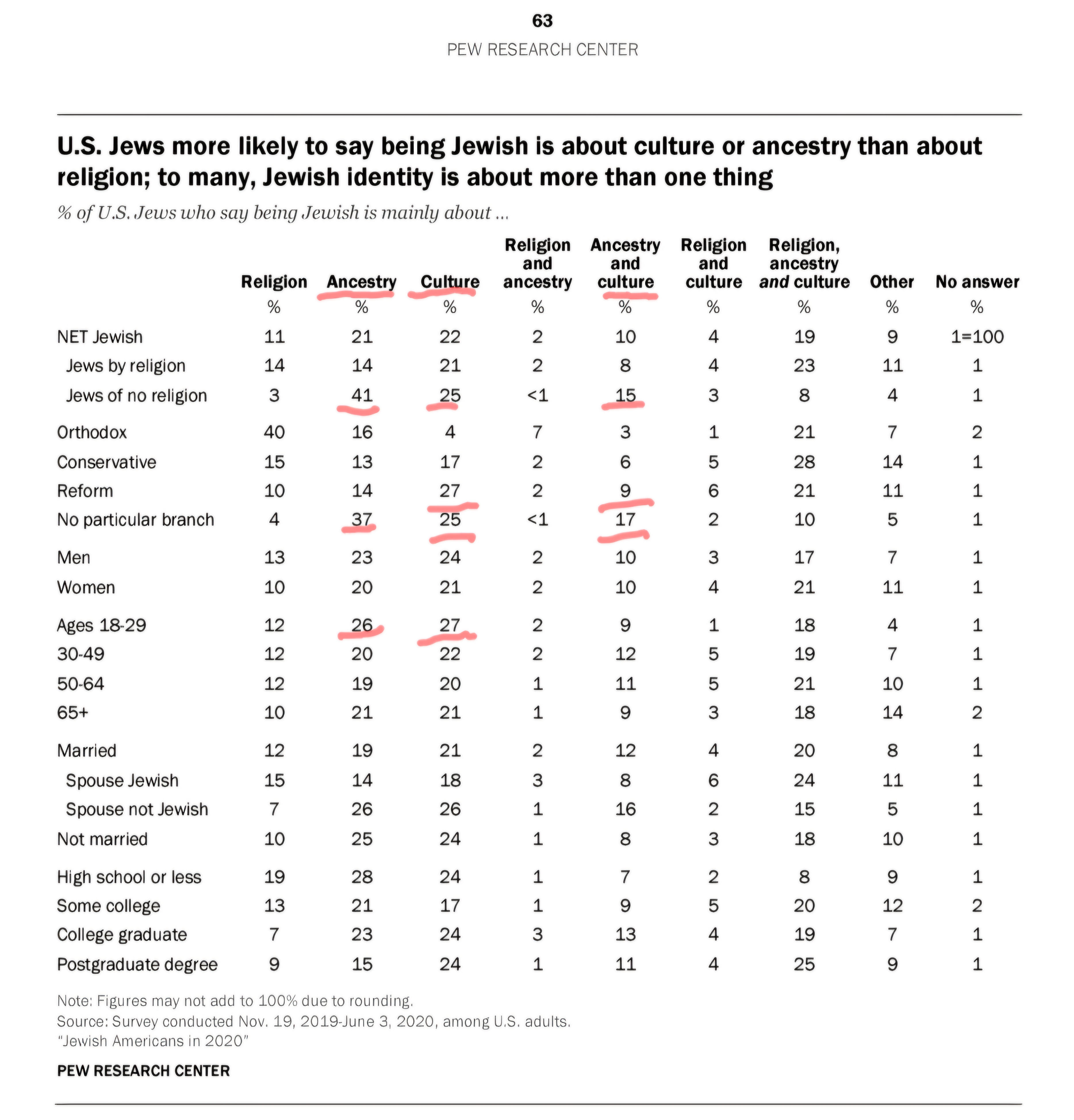
“U.S. Jews do not have a single, uniform answer to what being Jewish means…. Many American Jews prioritize cultural components of Judaism over religious ones…. Orthodox Jews are a striking exception…. A plurality of Orthodox Jews say that being Jewish is mainly about religion alone (40%), and they are the only subgroup in the survey who overwhelmingly feel that observing halakha is essential to their Jewishness (83%)… The vast majority of Jews of no religion say that for them, being Jewish is mainly a matter of ancestry (41%), culture (25%) or both (15%).” – Pew Research May 2021
At this moment in time, the distinction is not theoretical or esoteric. Many progressive left Jewish organizations have adopted stridently anti-Israel positions, some arguing that the Jewish State should be destroyed. They knowingly lock arms with antisemites to advance such future vision.
And should it be a surprise? If the essence of Jewish values for the non-Orthodox far-left is that there is nothing particular about Jews, and that both the noun and adjective “Jew” and “Jewish” are simply historic words without meaning, why should Jews have self-determination any more than left-handed people?
“Supporting Israel is not a battle of political orientation between liberal and conservative Jews. It is a philosophical break in the Jewish community with a fault line regarding the uniqueness of Jews and the Jewish State. The non-Orthodox denominations’ religious philosophy will only let it embrace an Israel that is: about people, not God; about rights not rituals; more secular than religious; more democratic than Jewish; and more universal than particular.” – The Non-Orthodox Jewish Denominations Fight Israel, January 2018
The broader Jewish community should be clear and confident to say that this simply untrue. Judaism and Jewish values are not ancient rock carvings on a cave from which sprang forth the Judeo-Christian values of today. Jews are a living people with a belief in an ongoing covenant which have particular Jewish values that extend beyond universal morality. We should not accept self-erasure in the current environment of cancelling Jews.
More, everyone should fight this approach. Not only Jews but every people who care about their own unique culture and perspective. The lure of the “melting pot” is great but needn’t be absolute. Appreciate the universal AND the particular for Jews and every neighbor.
Judaism helped shape the modern vocabulary of universal values. But Judaism’s enduring contribution is not simply to teach those ideals but show how they are woven into a sacred way of living. One that sanctifies time through Shabbat, family through covenant, body through mitzvot, land through shmita and pilgimmage, and elevates communal responsibilities to a daily obligation.
Jewish values are not simply universal values. And we should not be ashamed to state it clearly.
Related:
Progressive Jews as the New Apostles (August 2025)


