
Iran did not remake the Middle East by conquering it. It reshaped sovereignty from within.
Through the Islamic Revolutionary Guard Corps and its expeditionary arm, the Quds Force, Tehran spent decades cultivating armed movements inside other countries. Groups like Hezbollah, Hamas, and the Houthis operate locally while drawing training, funding, and strategic direction from Iran.
The method repeated. Build armed actors inside weak systems. Arm them. Fund them. Legitimize them. Let them grow until they rival the state itself.
The outcome depends on how far that process runs.
Start with Yemen.
The Houthis moved from insurgency to control, seizing the capital and displacing the recognized government. Authority fractured across multiple centers while regional powers deepened the conflict. The country unraveled into competing zones of control, each backed by different patrons.
Yemen reflects the far end of the spectrum. Sovereignty has fractured, authority is dispersed, and the state exists largely in name while power is contested on the ground.
Lebanon presents a more intricate equilibrium.
The government still operates. Ministries function. The army deploys. Daily life continues within the framework of a state.
Power, however, runs on a parallel track.
Hezbollah has evolved from militia to dominant armed and political actor. It maintains a military force outside state control, exerts significant influence within the political system, and operates along the southern frontier with Israel.
In a system where power sits outside the state, accountability thins out.
The Beirut port explosion laid that reality bare. The blast- largely attributable to Hezbollah stockpiling of weapons – devastated the capital and accelerated economic collapse.
Lebanon endures as a state whose authority is constrained and divided. Institutions remain, while decisive power is shared, contested, and at times displaced.
Gaza and the West Bank reflect an earlier phase of the same pattern.
Here, no single authority controls territory, force, and governance at once. Hamas governs Gaza, while the Palestinian Authority administers parts of the West Bank. Armed groups operate alongside political structures, and internal divisions prevent the emergence of a unified system.
Under these conditions, sovereignty never fully coheres.
Iran’s role reinforces these fractures. Support to armed factions strengthens one side of divided systems and complicates any path toward unified governance.
Three arenas. Three outcomes.
Yemen: the state fractures.
Lebanon: the state is captured from within.
Gaza and the West Bank: the state never coheres.
Systems that weaken the state at home rarely stay contained. They travel.
In Yemen, fragmentation has produced a prolonged humanitarian crisis. In Lebanon, economic collapse and institutional weakness have eroded daily life and public trust. In Gaza, civilians live within a structure where governance and armed control are tightly fused, with recurring cycles of conflict.
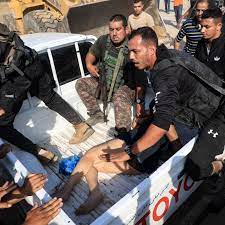
These same structures project force outward. Hamas, Hezbollah and the Houthis have all attacked Israel over the past few years. As has Iran.
And these forces are now all degraded, perhaps on their way to being defeated. The regional implication extends beyond Israel’s immediate security.
Weakening these groups can shift the balance inside the countries they inhabit. Space can reopen for state authority—unevenly, imperfectly, and with no guarantee—but space nonetheless.
Israel is acting out of its own security needs. It is very possible that the entire region will benefit once the Iranian proxies are removed.


