
Palestinian Arabs are scheduled to vote on November 28 in their first legislative election in twenty years. International observers will naturally ask whether the election is free and fair. But there is a more fundamental question:
Will Palestinians actually be electing a government capable of governing?
The problem begins with the Palestine Liberation Organization.
The PLO was established in 1964, decades before there was a Palestinian Authority. In 1993, it was the PLO—not the Palestinian Authority—that entered the Oslo process with Israel. Those agreements established the framework for Palestinian self-government in the West Bank and Gaza and contemplated an elected Palestinian Council. The Palestinian Authority and the executive institutions emerged from that process as the interim governing apparatus.
The PLO is the institutional skeleton on which the Palestinian political system was built.
And that makes the coming election peculiar.
Electing People Who Reject the System
The August modification to the election law requires candidates to commit to recognition of the PLO as the sole legitimate representative of the Palestinian people, as well as its political and national program and relevant international resolutions.
Yet Palestinians overwhelmingly reject that requirement.
According to the Palestinian Center for Policy and Survey Research, two-thirds oppose requiring candidates to accept the PLO’s commitments, including its agreements with Israel. Only 27% support the requirement.
That is not an opinion related to dissatisfaction with Mahmoud Abbas, Fatah or the incumbent government. That is an outright rejection of the entire government structure and institutions. Palestinians want to elect the government while leaving unsettled whether the people elected to run it accept the foundations of the system they are entering.
It is a election whose foundation is anarchy.
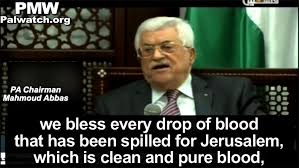
If insufficient, the Arabs want to vote for terrorism.
Ballots Without Giving Up the Guns
Democratic government requires more than elections. Ultimately, the elected government must possess political authority and a monopoly on legitimate force. Yet Palestinian politics continues to blur the distinction between a political party and an armed organization.
Hamas is the clearest example.
The devastation of the Gaza war appears to have changed Palestinian calculations. Only 20% now say Hamas won the war, compared with 39% ten months earlier. Support for “armed struggle” (terrorism) as the most effective means of achieving Palestinian statehood has fallen from 41% to 27%, which was around two-thirds immediately after October 7, 2023. Meanwhile, support for negotiations has risen from 36% to 44%, its highest level in four years.
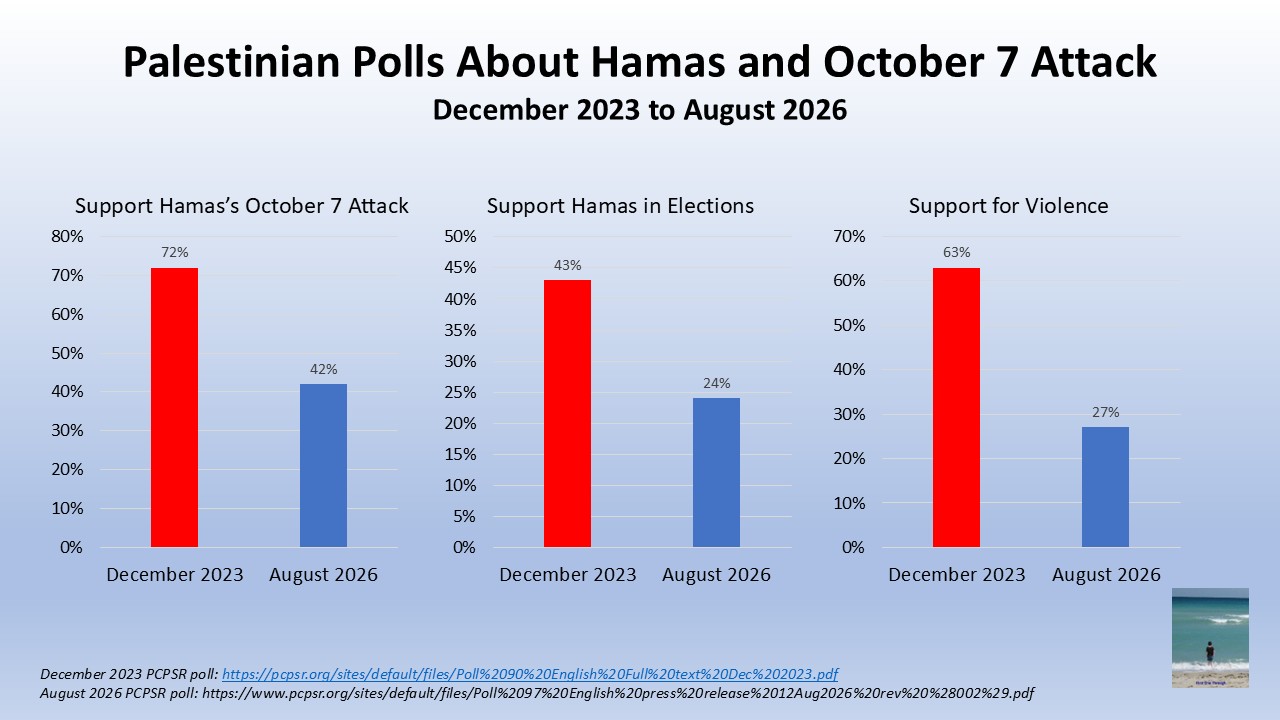
That all sounds encouraging. But look more closely at what changed.
Palestinians only moved toward negotiations as violence has proven devastating and unsuccessful. Yet even after that experience, 72% oppose Hamas disarming before Israel completely withdraws from Gaza. And 53% believe that even if Hamas gives up its weapons, it will remain both an armed resistance movement and a political movement. Only 36% expect it to become solely political. So 89% (basically everyone) thinks the group that most of the Global North has labeled a terrorist organization, will be part of the Palestinian government.
That holds true for the various Palestinian terrorist groups. A society established in which various militias will be free to operate their own foreign affairs and military engagements.
An Elected Government That May Not Govern
If not appalling enough, there is another revealing number.
If elections are held and a new Palestinian government is formed, only 28% of Palestinians say they would prefer that elected government to administer Gaza. Thirty-two percent prefer the separate National Committee, while 34% prefer neither.
Consider these three facts:
- Palestinians are preparing to elect a legislature for a political system whose foundational commitments most do not want imposed on candidates.
- They may elect factions that retain independent armed power outside the government’s control.
- They do not want the resulting elected government to govern Gaza.
Combined, this is not merely an imperfect election in the shadow of war of a fledgling state.
It is a vote for anarchy with a veneer of cohesion.
Related:
Israel Is Surrounded by Failed States – and Failed States in Waiting (July 2026)
Before Palestinians Can Hold an Election, They Must Decide Who Is Palestinian (June 2026)


