Sanctioned for Bidding to Build Homes

An Israeli construction company sees a government tender to build residential housing. It prepares a bid and submits it.

It does not have to win the tender or break ground. Merely submitting the bid would be enough to expose it to American sanctions.

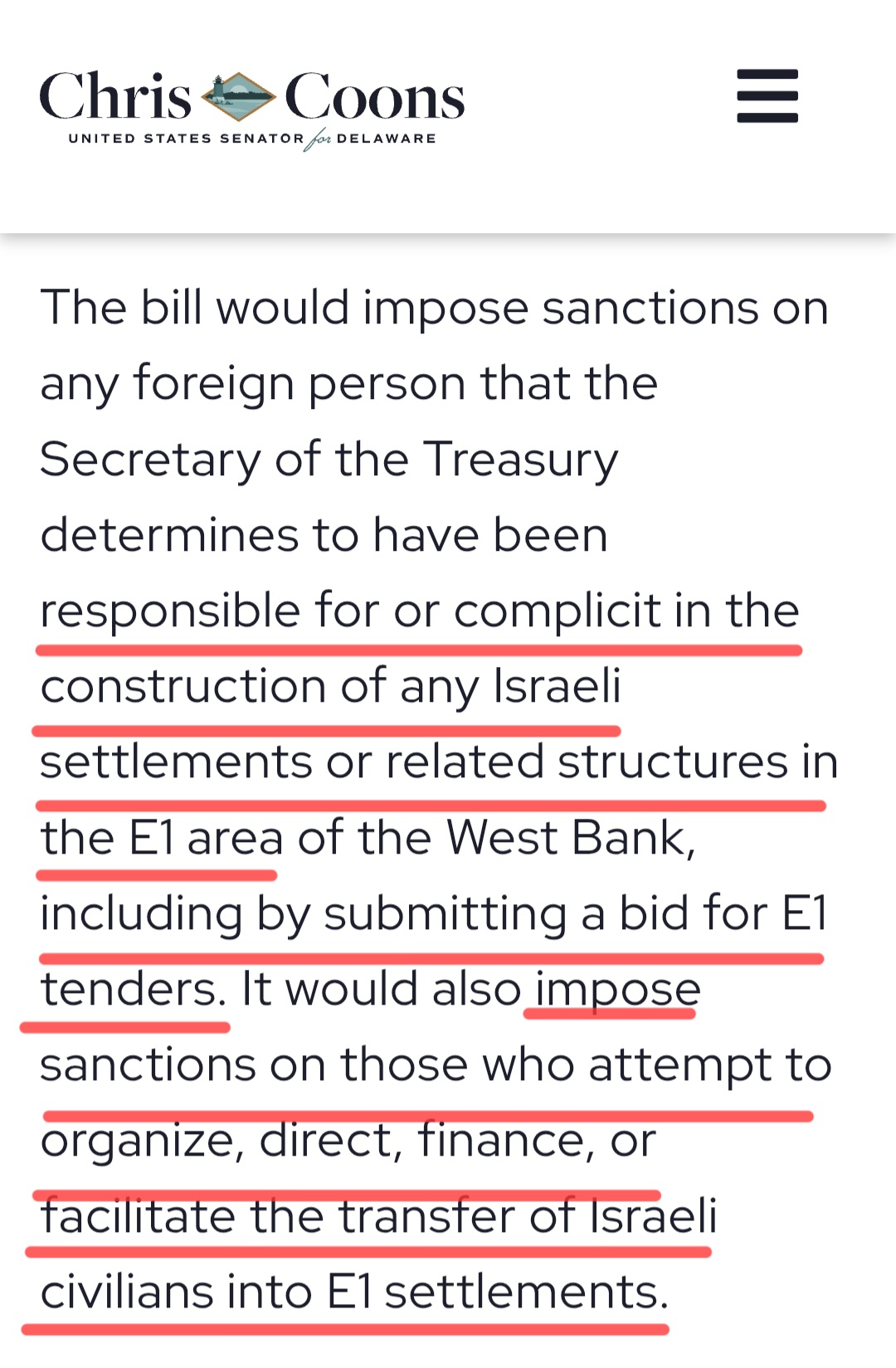
Senators Chris Coons (Delaware), Elizabeth Warren (Massachusetts), Ron Wyden (Oregon) and Ruben Gallego (Arizona) have introduced legislation targeting construction in E1, the area between Jerusalem and Ma’ale Adumim. The legislation would impose sanctions on foreign persons involved in construction there, expressly including those “submitting a bid for E1 tenders.”
Warren makes the consequence explicit: those who facilitate construction in E1 should understand that they “risk losing access to the U.S. financial system.”

That is an extraordinary penalty for bidding to build homes in an allied country.

And the piece of land that has generated this response is remarkably small. E1 covers roughly 12 square kilometers, or 4.6 square miles. The entire West Bank is roughly 5,655 square kilometers. E1 therefore represents about 0.2% of the West Bank—roughly one five-hundredth of its territory.

And that sliver of undeveloped land has generated calls to reach for one of America’s most powerful economic weapons.

The United States has long used its dominance of the international financial system as one of its most powerful foreign-policy tools. Iran has faced sanctions over its nuclear program and other activities. North Korea has been subjected to extensive sanctions over its nuclear and ballistic-missile programs. Russia has faced sweeping sanctions connected to its military aggression.

American sanctions can also reach companies outside those countries. Do business with an American adversary and a foreign company may discover that it has to choose between that relationship and access to the American financial system.

Congress has occasionally been willing to impose that choice on allies.

Turkey is a NATO member. Yet the United States sanctioned Turkey’s Presidency of Defense Industries after Ankara purchased Russia’s S-400 air-defense system from Rosoboronexport, Russia’s state arms exporter. The transaction involved an advanced weapons system, an American adversary and concerns about the security of American military technology.

European companies encountered the same American financial power over Nord Stream 2. Congress enacted sanctions aimed at companies participating in construction of the pipeline, including businesses from American allies, for engaging with a Russian pipeline carrying Russian gas into Europe. Congress viewed it as increasing European dependence on Russian energy and strengthening Moscow’s geopolitical leverage.

E1 presents something completely different.

There is no Russia on the other side of the transaction. No Iran. No North Korea. No weapons purchase or nuclear technology. No American adversary receiving the proceeds.

There is an Israeli government tender to construct residential homes in the immediate suburb of its capital.

Nor is this simply an initiative of four senators.

Fifteen additional Democratic senators have joined them: Michael Bennet (Colorado), Tammy Duckworth (Illinois), Martin Heinrich (New Mexico), Tim Kaine (Virginia), Mark Kelly (Arizona), Andy Kim (New Jersey), Jeff Merkley (Oregon), Chris Murphy (Connecticut), Patty Murray (Washington), Jack Reed (Rhode Island), Brian Schatz (Hawaii), Adam Schiff (California), Elissa Slotkin (Michigan), Chris Van Hollen (Maryland) and Peter Welch (Vermont).

That brings the proposal’s Democratic Senate support to 19 senators.

Senators Elizabeth Warren and Chris Coons

The United States developed financial sanctions to confront hostile states, weapons programs and transactions with American adversaries. It is a powerful tool meant to confront grave risks to America. Yet in this proposal, the triggering transaction is an Israeli housing project occupying roughly one five-hundredth of the West Bank, which poses zero threat to the United States.

The Democratic senators sponsoring the legislation describe E1 construction as a threat to a future Palestinian state, presumably because the Palestinian Authority demands a country devoid of any Jews and it must include Jerusalem. Their proposed response is to make companies and individuals participating in that construction grounds for exclusion from the American financial system.

For these 19 Democratic senators, countering Palestinian Arab aspirations has become a threat to the United States.

That is the question their bill puts before Congress: Should the financial weapon America has used against adversaries and national-security threats now be turned against businesses of a close ally because they bid to build homes on 0.2% of the West Bank?

ACTION ITEM

Contact these senators about their proposed bill on E1 and find out whether the Democratic Party has become so unmoored from its mission of protecting Americans that it is using its greatest financial weapon to serve Palestinian Arabs objecting to Jewish homes.

Sen. Chris Coons Washington office (202) 224-5042, Wilmington (302) 573-6345, Dover (302) 736-5601

Sen. Elizabeth Warren Washington office (202) 224-4543, Boston (617) 565-3170, Springfield (413) 788-2690

Related:

What Is Actually Being Built in E1? (August 2026)

What Is Actually Being Built in E1?

Israel’s decision to move forward with construction in E1 produced the familiar headlines: settlers, seized Palestinian land, displacement and the death of a Palestinian state.

WAFA reported that Israel issued a tender for 1,234 “settlement units” in E1, presenting it as “one of the most controversial settlement schemes” in a colonial project designed to fragment Palestinian territory.

Before debating E1, start with what is actually being built, where, on whose property and for whom.

An Extension of Ma’ale Adumim

E1 is an approximately 12,000-dunam, or 12-square-kilometer, planning area between Jerusalem and the existing community of Ma’ale Adumim.

It lies in Area C, where the Palestinian Authority and Israel agreed under the Oslo framework would be under Israeli security control and civil administration. Israel is building within the municipal planning jurisdiction of Ma’ale Adumim, not a new area. E1 has not been annexed to Israel.

The current project is E1 South, one part of that larger area. The 1,234 units are in apartment blocks adjacent to the existing city, not isolated houses spread across 12 square kilometers of West Bank hills. The plans contemplate the infrastructure of a normal urban community: elementary schools, kindergartens and daycare, synagogues and a mikveh, community buildings, parks and gardens, commercial facilities, roads and infrastructure.

E1 is not a new project of the current Israeli government. Its planning dates back roughly three decades to the Rabin era. Roads and the Judea and Samaria District police headquarters were built there years ago, even as residential construction remained frozen under international pressure.

Building Does Not Draw the Border

Area C was created under Oslo as an interim administrative arrangement, not a permanent international border. Borders, settlements and Jerusalem were reserved for permanent-status negotiations, and Israel subsequently transferred authority over the major Palestinian population centers to the Palestinian Authority as part of Area A.

E1 South could therefore ultimately remain with Israel, become part of a Palestinian state, or be addressed through a negotiated territorial exchange. Construction changes the facts future negotiators confront; it does not establish sovereignty.

E1 does not make a Palestinian state geographically impossible simply because it creates a narrow connection between northern and southern Palestinian population centers. Israel itself has long existed with a narrow neck across its principal population center, historically only about nine miles wide at its narrowest point. If a narrow neck makes statehood impossible, Israel itself should have been geographically impossible for decades.

Palestinian north-south travel east of the 1949 Armistice Lines (E49)/ Judea and Samaria already happens and is being made easier. A route already exists east of Ma’ale Adumim, and Israel is constructing additional roads intended to connect current Palestinian Arab communities around E1.

A Land System Older Than Israel

Much of E1 is classified by Israel as state or government land, but Israel did not invent that category in 1967.

The underlying system begins with the Ottoman Land Code of 1858, which established categories of land and rules involving government ownership, registration, possession and cultivation. The Ottomans created the system, the British Mandate retained and amended it, and Jordan continued administering and registering West Bank land under it. Israel inherited that legal structure after 1967 and subsequently administered and modified it through military orders.

Private Palestinian Property Was Excluded

Approximately 775 dunams — about 6.5% of E1 — consist of recognized private Palestinian parcels interspersed through the area.

Israel did not classify those parcels as state land, and they were excluded from the official E1 plans. Bimkom, an Israeli planning organization opposed to E1, notes the importance of continued agricultural cultivation to the status of some private parcels.

Critics argue that surrounding development could make access to some excluded private parcels more difficult. That is a legitimate issue, but does not suddenly turn building these apartments into theft of privately owned Palestinian land.

1.55% of E1

The scale of the current project is considerably smaller than the overall E1 map suggests.

On August 18, 2026, Israel issued Tender 186/2026 for E1 South, Plan 420/4/7: 1,234 apartments divided among seven construction complexes. Bids are due October 19, 2026.

The current development parcels therefore occupy about 22.7% of E1 South and only 1.55% of the entire E1 planning area.

A companion residential plan, 420/4/10, contemplates another 2,173 apartments. The current tender, however, is specifically for the 1,234 units in E1 South.

The Bedouin Question

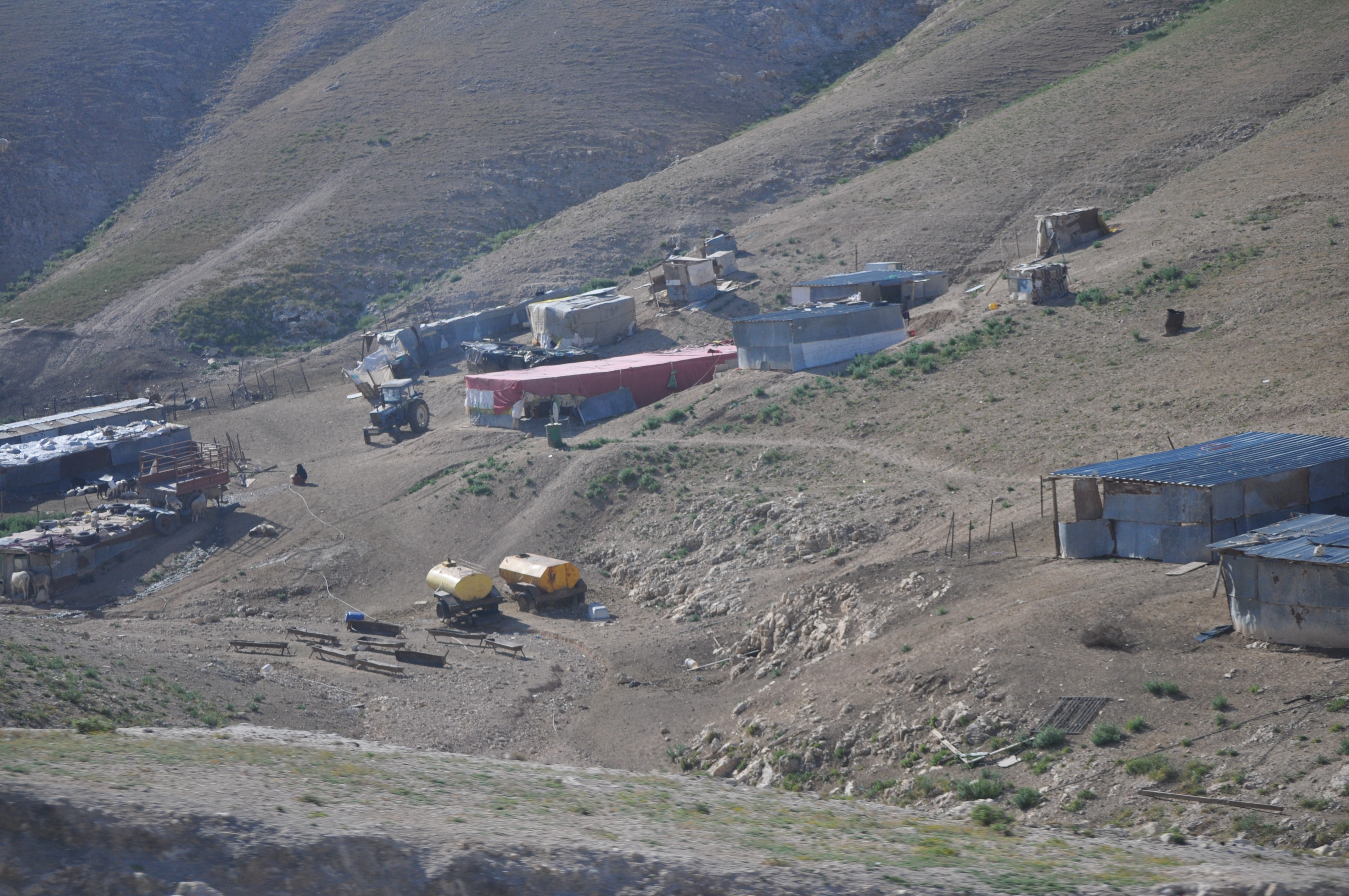
There is a separate Bedouin issue. Jahalin Bedouin communities live and graze animals throughout the broader Ma’ale Adumim/E1 area, and B’Tselem and OCHA argue that development, roads, demolition orders and restrictions threaten their residence, grazing and movement. Israel has previously considered relocating Jahalin families, including a 2005 plan involving approximately 200 families that was never implemented.

Bedouins in E1 (photo: FirstOneThrough)

Who Owns It — and Who Can Live There?

The seven parcels are being marketed in the tender as government/state land. Developers receive development rights over government property. The precise ultimate leasehold or ownership structure for apartment purchasers depends on the final land agreements.

Tender 186/2026 is a regular public tender, not a direct allocation to a religious or ideological organization. Foreign-controlled developers may face additional governmental approval requirements, but there is no requirement that bidders be Jewish-owned.

Nor do the E1 planning and tender provisions identify a religious or ethnic restriction reserving the apartments for Jews. Israeli Arabs could purchase or develop these apartments.

A Palestinian Arab resident presents a more complicated property-law question because the West Bank retains layers of Jordanian law, including a 1953 Jordanian law restricting certain sales and long-term leases to foreigners. The ability of a Palestinian from Abu Dis or a Jahalin Bedouin to acquire and register the same long-term property interest as an Israeli citizen therefore depends on the applicable land and registration rules. That complication is because of old Jordanian law, not Israeli.

Three Questions, Not One

The E1 controversy really involves three different legal questions: whether privately owned Palestinian property is being taken; whether Israel properly classified government land under the inherited Ottoman-British-Jordanian system; and whether international law permits Israel to use even legitimately public land in Area C for Israeli civilian development.

The first concerns ownership. The second concerns land law. The third concerns the law of occupation and sovereignty.

They are not the same question.

What Does “Palestinian Land” Mean?

That brings the argument back to WAFA’s description of E1 as Israeli construction on “Palestinian land” via “land seizure.”

The phrase can mean property privately owned by a Palestinian, public land geographically located in the West Bank, or territory Palestinians want incorporated into a future Palestinian state.

Those are three very different things.

E1 can be challenged because of its impact on future negotiations, Israel’s interpretation of inherited land law, international law or nearby Bedouin communities. But none of those arguments turns government property into privately owned Palestinian land, an urban extension of Ma’ale Adumim into the destruction of a Palestinian village, or housing without a religious purchaser restriction into “Jewish-only” apartments.

And construction today does not determine where tomorrow’s negotiated border must run.

E1 is controversial enough on the facts. There is no reason to blur them.

Next Paradigm Shift In Israel-Palestinian Conflict

President-elect Donald Trump has threatened to unleash “hell” on the U.S.-designated Palestinian terrorist group Hamas if it does not immediately release all of the hostages it took from Israel. These pages have talked about possible actions which include labeling the Hamas-dominated Palestinian Authority and Hamas-affiliated UNRWA as terrorist groups, stripping tax-exempt status for organizations which support them, and banning Hamas-mouthpiece Al Jazeera from U.S. government briefings.

On the heels of such actions in the international arena, Hamas’s normalization of mass-scale atrocities and rank antisemitic genocidal aspirations must be forever quashed in the holy land. Therefore, the United States should greenlight Israel’s development of the area known as “E1” just east of Jerusalem, all the way until the town of Ma’ale Adumim.

No country in the world places its capital city on a border as it makes the nerve center of a country vulnerable to attack. This is especially true for the Jewish State which is surrounded by countries intent on destroying it.

The region has gone through many paradigm shifts since the end of the Ottoman Empire. The October 7, 2023 massacre by thousands of Palestinian Arab terrorists, the support for the terrorists, their aims, and their continued insistence on perpetuating the war by not surrendering the hostages is another reminder that the end of the conflict will require the decimation of the terrorists and guardrails against an ability to accomplish their objectives.

The “Al Aqsa Flood’ in which the genocidal jihadists sought to ethnically cleanse Jews from their holiest city could be extinguished with the building of homes throughout E1, protecting Jerusalem from malevolent actors.

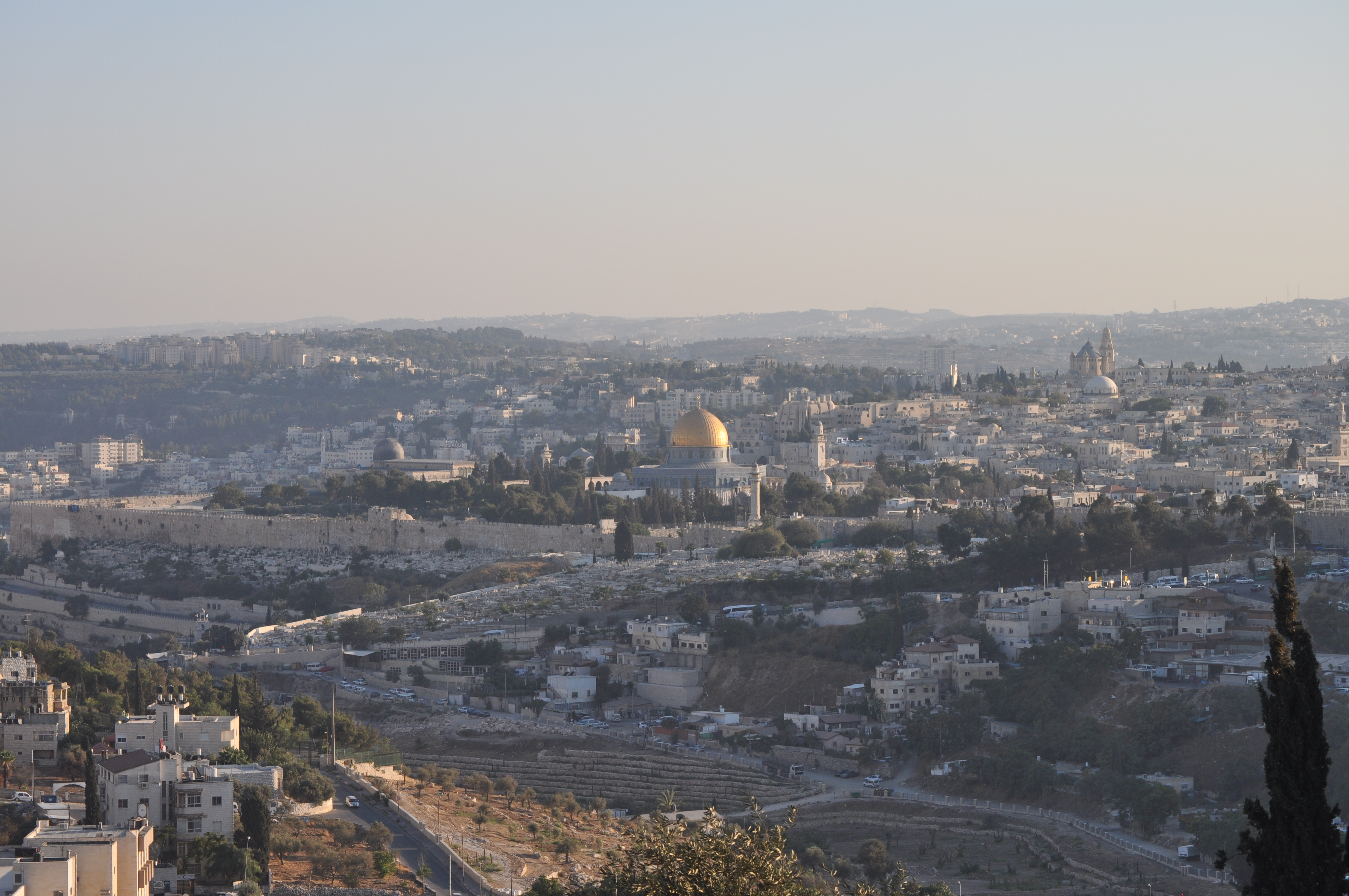
Jerusalem as seen from Hebrew University (photo: First One Through)