An Israeli construction company sees a government tender to build residential housing. It prepares a bid and submits it.
It does not have to win the tender or break ground. Merely submitting the bid would be enough to expose it to American sanctions.
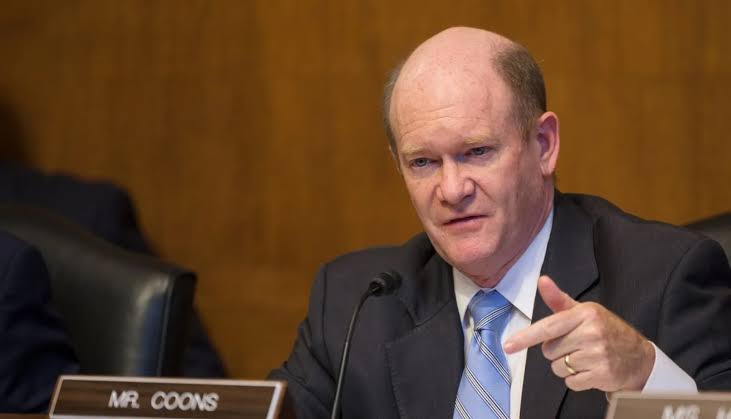
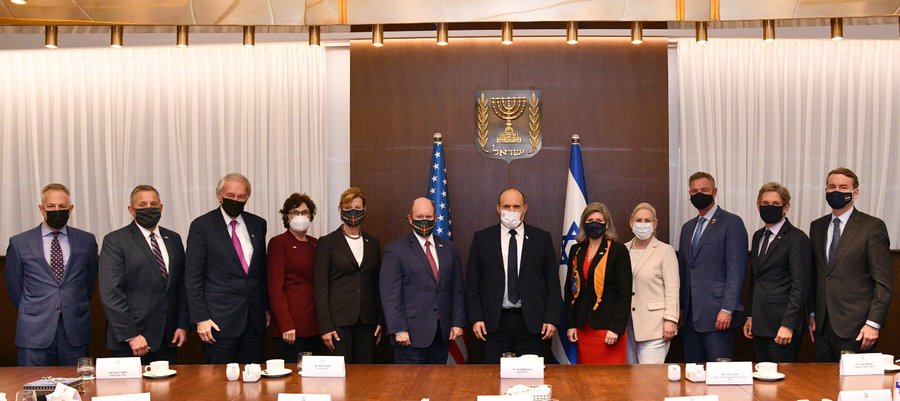
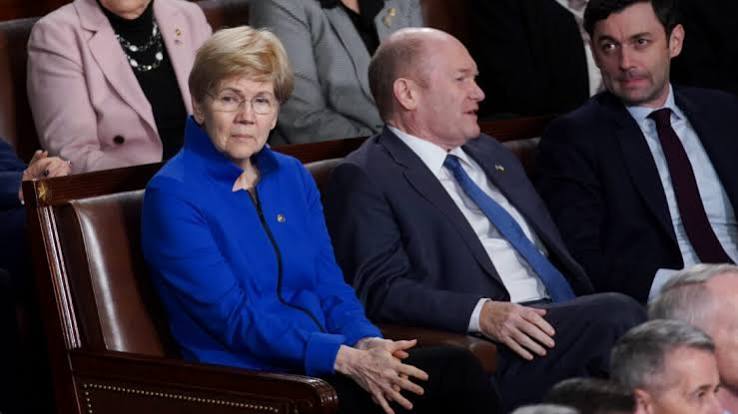
Senators Chris Coons (Delaware), Elizabeth Warren (Massachusetts), Ron Wyden (Oregon) and Ruben Gallego (Arizona) have introduced legislation targeting construction in E1, the area between Jerusalem and Ma’ale Adumim. The legislation would impose sanctions on foreign persons involved in construction there, expressly including those “submitting a bid for E1 tenders.”
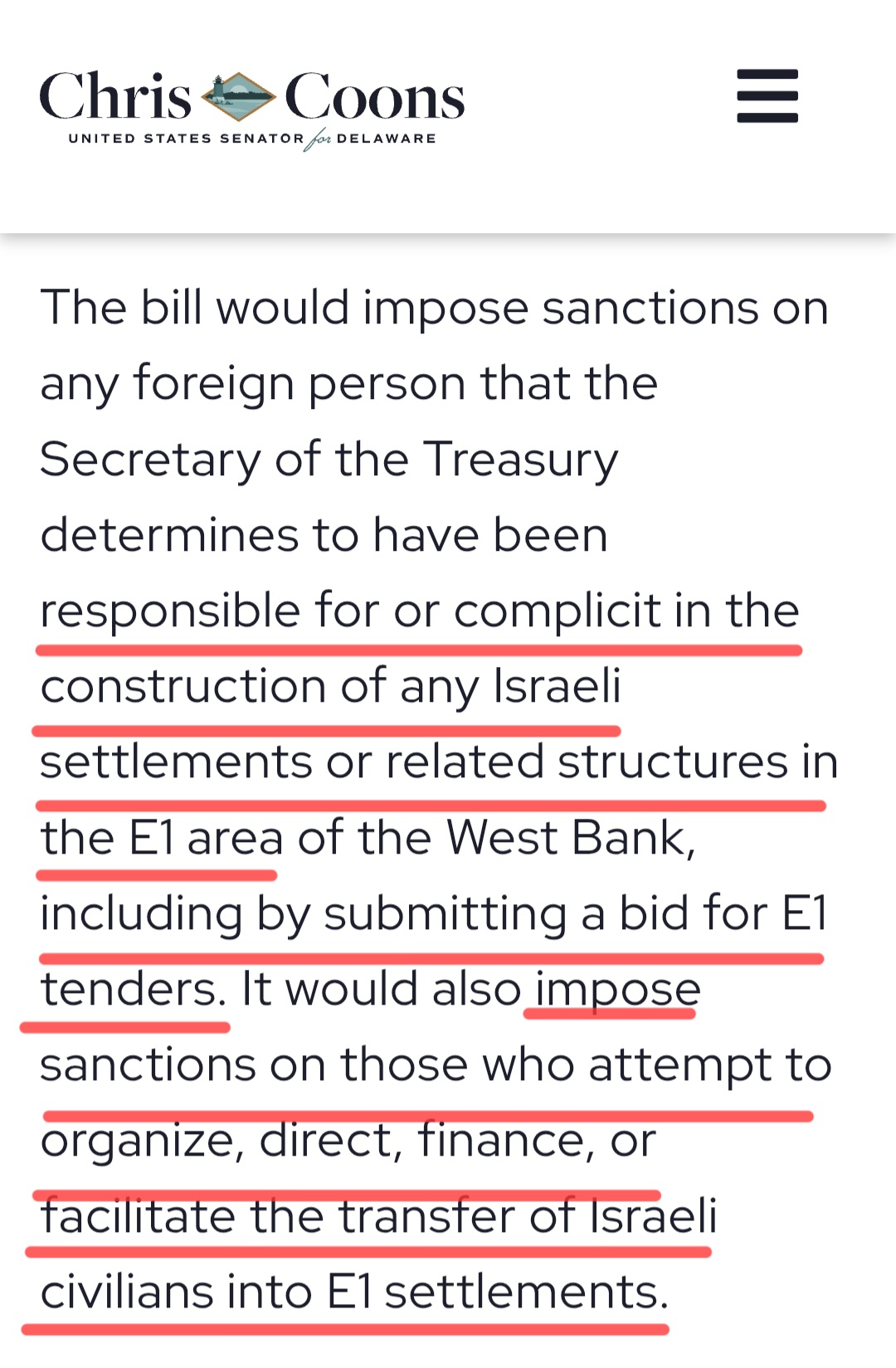
Warren makes the consequence explicit: those who facilitate construction in E1 should understand that they “risk losing access to the U.S. financial system.”
That is an extraordinary penalty for bidding to build homes in an allied country.
And the piece of land that has generated this response is remarkably small. E1 covers roughly 12 square kilometers, or 4.6 square miles. The entire West Bank is roughly 5,655 square kilometers. E1 therefore represents about 0.2% of the West Bank—roughly one five-hundredth of its territory.
And that sliver of undeveloped land has generated calls to reach for one of America’s most powerful economic weapons.
The United States has long used its dominance of the international financial system as one of its most powerful foreign-policy tools. Iran has faced sanctions over its nuclear program and other activities. North Korea has been subjected to extensive sanctions over its nuclear and ballistic-missile programs. Russia has faced sweeping sanctions connected to its military aggression.
American sanctions can also reach companies outside those countries. Do business with an American adversary and a foreign company may discover that it has to choose between that relationship and access to the American financial system.
Congress has occasionally been willing to impose that choice on allies.
Turkey is a NATO member. Yet the United States sanctioned Turkey’s Presidency of Defense Industries after Ankara purchased Russia’s S-400 air-defense system from Rosoboronexport, Russia’s state arms exporter. The transaction involved an advanced weapons system, an American adversary and concerns about the security of American military technology.
European companies encountered the same American financial power over Nord Stream 2. Congress enacted sanctions aimed at companies participating in construction of the pipeline, including businesses from American allies, for engaging with a Russian pipeline carrying Russian gas into Europe. Congress viewed it as increasing European dependence on Russian energy and strengthening Moscow’s geopolitical leverage.
E1 presents something completely different.
There is no Russia on the other side of the transaction. No Iran. No North Korea. No weapons purchase or nuclear technology. No American adversary receiving the proceeds.
There is an Israeli government tender to construct residential homes in the immediate suburb of its capital.
Nor is this simply an initiative of four senators.
Fifteen additional Democratic senators have joined them: Michael Bennet (Colorado), Tammy Duckworth (Illinois), Martin Heinrich (New Mexico), Tim Kaine (Virginia), Mark Kelly (Arizona), Andy Kim (New Jersey), Jeff Merkley (Oregon), Chris Murphy (Connecticut), Patty Murray (Washington), Jack Reed (Rhode Island), Brian Schatz (Hawaii), Adam Schiff (California), Elissa Slotkin (Michigan), Chris Van Hollen (Maryland) and Peter Welch (Vermont).
That brings the proposal’s Democratic Senate support to 19 senators.
The United States developed financial sanctions to confront hostile states, weapons programs and transactions with American adversaries. It is a powerful tool meant to confront grave risks to America. Yet in this proposal, the triggering transaction is an Israeli housing project occupying roughly one five-hundredth of the West Bank, which poses zero threat to the United States.
The Democratic senators sponsoring the legislation describe E1 construction as a threat to a future Palestinian state, presumably because the Palestinian Authority demands a country devoid of any Jews and it must include Jerusalem. Their proposed response is to make companies and individuals participating in that construction grounds for exclusion from the American financial system.
For these 19 Democratic senators, countering Palestinian Arab aspirations has become a threat to the United States.
That is the question their bill puts before Congress: Should the financial weapon America has used against adversaries and national-security threats now be turned against businesses of a close ally because they bid to build homes on 0.2% of the West Bank?
ACTION ITEM
Contact these senators about their proposed bill on E1 and find out whether the Democratic Party has become so unmoored from its mission of protecting Americans that it is using its greatest financial weapon to serve Palestinian Arabs objecting to Jewish homes.
Sen. Chris Coons Washington office (202) 224-5042, Wilmington (302) 573-6345, Dover (302) 736-5601
Sen. Elizabeth Warren Washington office (202) 224-4543, Boston (617) 565-3170, Springfield (413) 788-2690
Related:
What Is Actually Being Built in E1? (August 2026)