Western governments have developed a familiar vocabulary.
- “Hate is rising.”
- “Religious intolerance is increasing.”
- “Antisemitism and Islamophobia must be confronted.”
Every minority deserves protection. But treating victims equally does not require pretending they are being targeted equally.
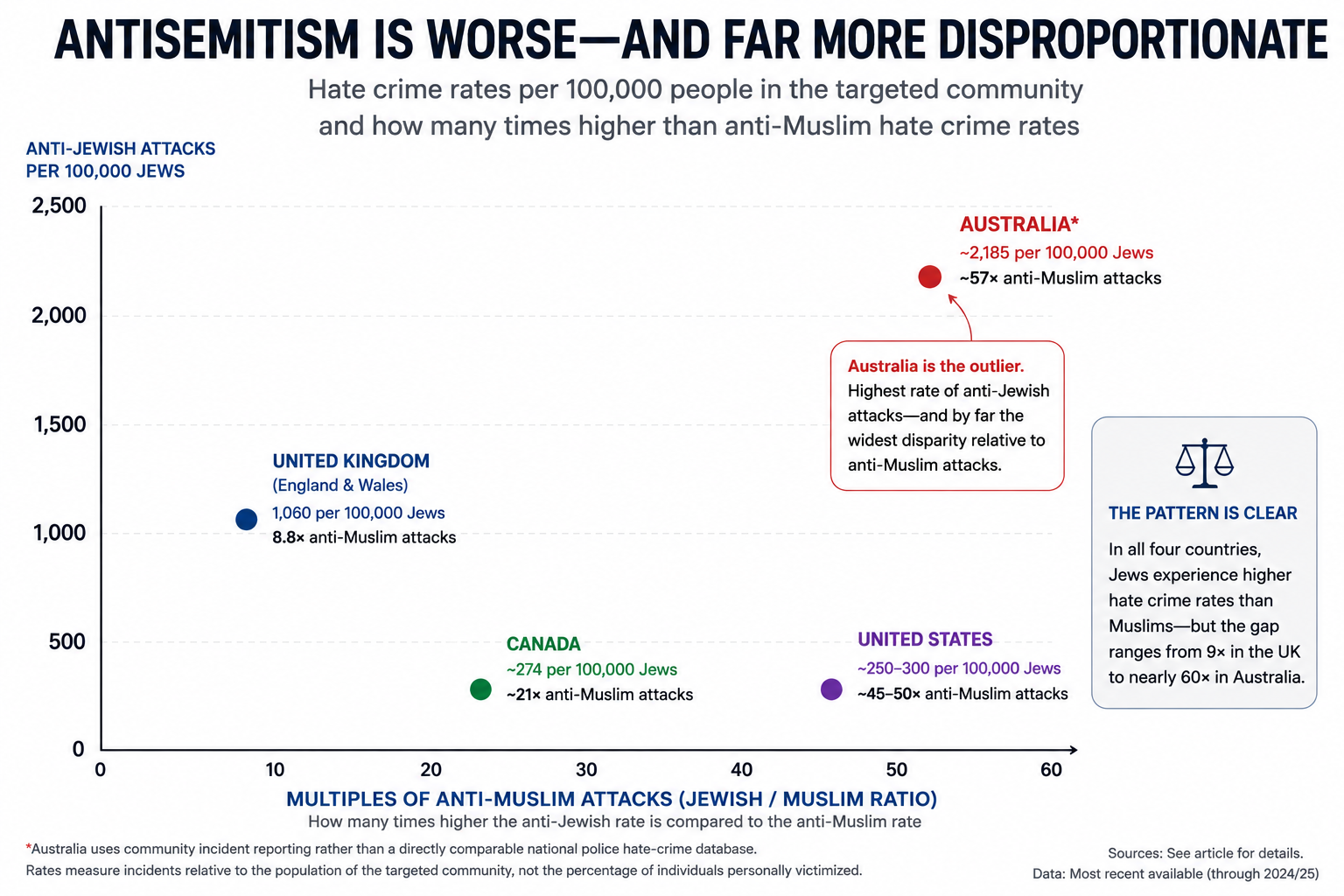
| Country | Anti-Jewish | Anti-Muslim | Jewish / Muslim Ratio |
|---|---|---|---|
| UK (England & Wales) | 1,060 per 100,000 | 120 per 100,000 | 8.8× |
| Canada | ~274 per 100,000 | ~13 per 100,000 | ~21× |
| United States | ~250–300 per 100,000 | ~5–6 per 100,000 | ~45–50× |
| Australia* | ~2,185 per 100,000 | ~38 per 100,000 | ~57× |
*Australia uses community incident reporting rather than a directly comparable national police hate-crime database.
Britain clearly has a religious-hatred problem. Muslims and Jews suffer substantial levels of hate crime, well above that of other English-speaking countries, while Jews are targeted at almost nine times the rate of Muslims. Canada and USA show fewer hate crimes per population, and a wider disparity between Jews and Muslims being attacked.
Then there is Australia.
For the decade before October 7, 2023, Australia averaged 342 reported anti-Jewish incidents annually. That exploded to 2,062 in 2023/24 and remained at 1,654 in 2024/25. In New South Wales, police-recorded hate incidents against Jews rose from 40 in 2020 to 841 in 2025.
Then statistics became bodies.
On December 14, 2025, gunmen attacked Chanukah by the Sea at Bondi Beach. Fifteen people were murdered while celebrating the Jewish holiday.
Australia subsequently established a Royal Commission on Antisemitism and Social Cohesion, which is examining the circumstances surrounding the attack and whether authorities adequately recognized the threat to Jewish events.
Australia had been warned.
It had also begun responding. The government appointed Jewish communal leader Jillian Segal as Special Envoy to Combat Antisemitism. Her national plan followed extensive consultation with Australian Jews, and the government adopted all 13 recommendations.
Yet Australia continues to struggle with whether antisemitism is a distinct threat or another part of generalized “hate.”
Its Combatting Antisemitism, Hate and Extremism Act puts antisemitism in the title – along with more generic terms of “hate” and “extremism.” There is nothing wrong with fighting all forms of hatred. The question is whether symmetry in government policy reflects the reality on the ground.
Australia’s available community data indicate roughly 38 anti-Muslim incidents per 100,000 Muslims and 2,185 anti-Jewish incidents per 100,000 Jews.
That is roughly 57-to-1.
Indeed, Australia’s Islamophobia envoy (in a federal post strictly devoted to “Islamophobia” and no other forms of hate) has urged the Royal Commission on Antisemitism to approach antisemitism through the broader causes of identity-based hatred and the common roots of antisemitism, Islamophobia and other prejudice.
“antisemitism, Islamophobia and other forms of prejudice share common causes, such as polarisation, online environments and declining trust in institutions. Tackling these underlying factors can strengthen outcomes for all communities.” – Australia’s Special Envoy to Combat Islamophobia, Aftab Malik, June 2026
What? If they were all the same, why are Jews attacked at a 57-to-1 ratio?
Australia does not have a generic hate problem that happens to include Jews. It has an extraordinary antisemitism problem that generic language about hate must not be allowed to hide.
Related:
Bondi Attack: Can Jews Be Victims in the Media? (December 2025)
Global Jewry Is Losing Australia, Canada, France, Germany and UK (December 2024)


Pingback: Stop, Hey, What’s That Sound? | First One Through
Pingback: Stop, Hey, What’s That Sound? | First One Through
Pingback: Krasser Antisemitismus in der englischsprachigen Welt | abseits vom mainstream - heplev