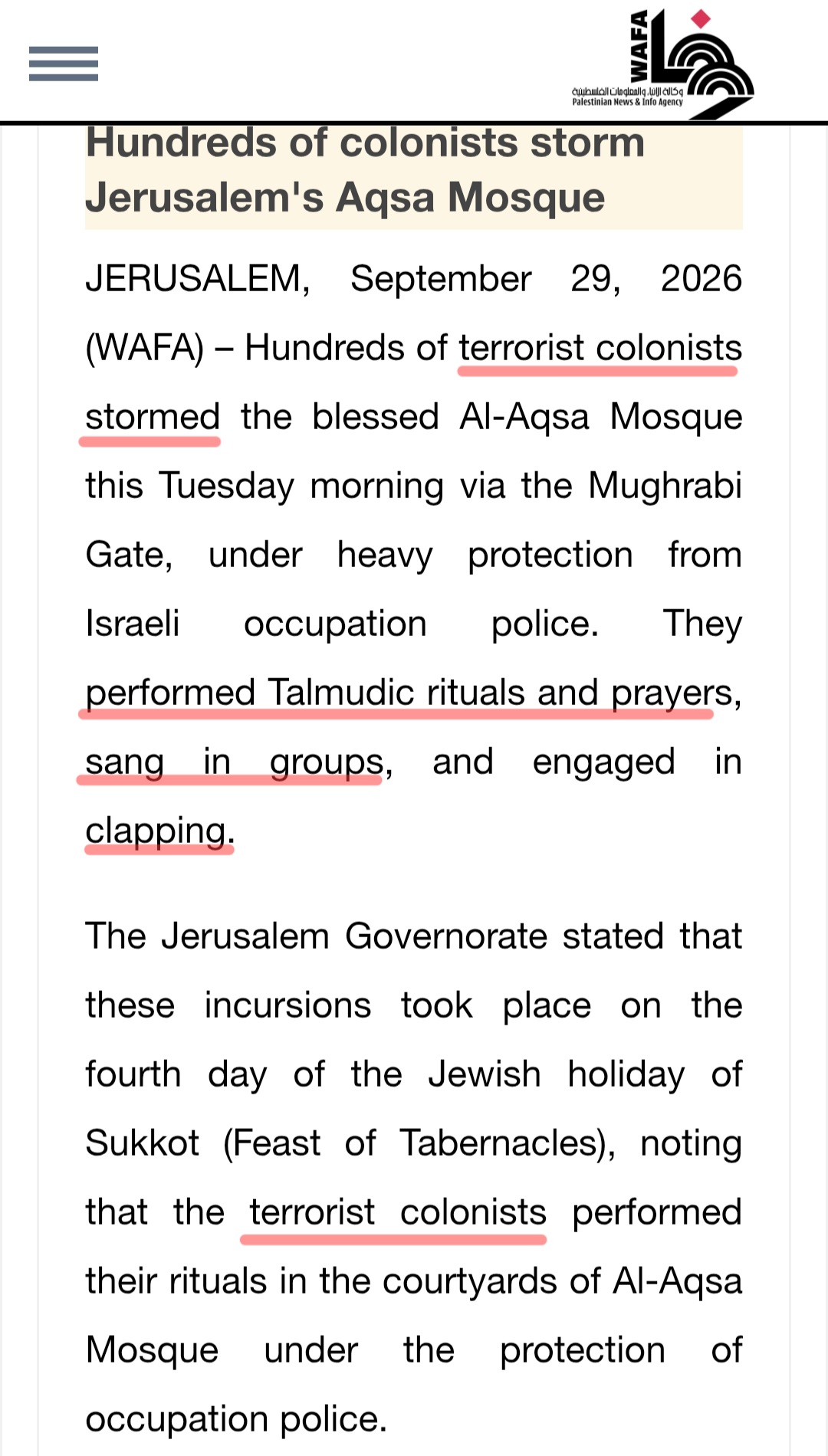
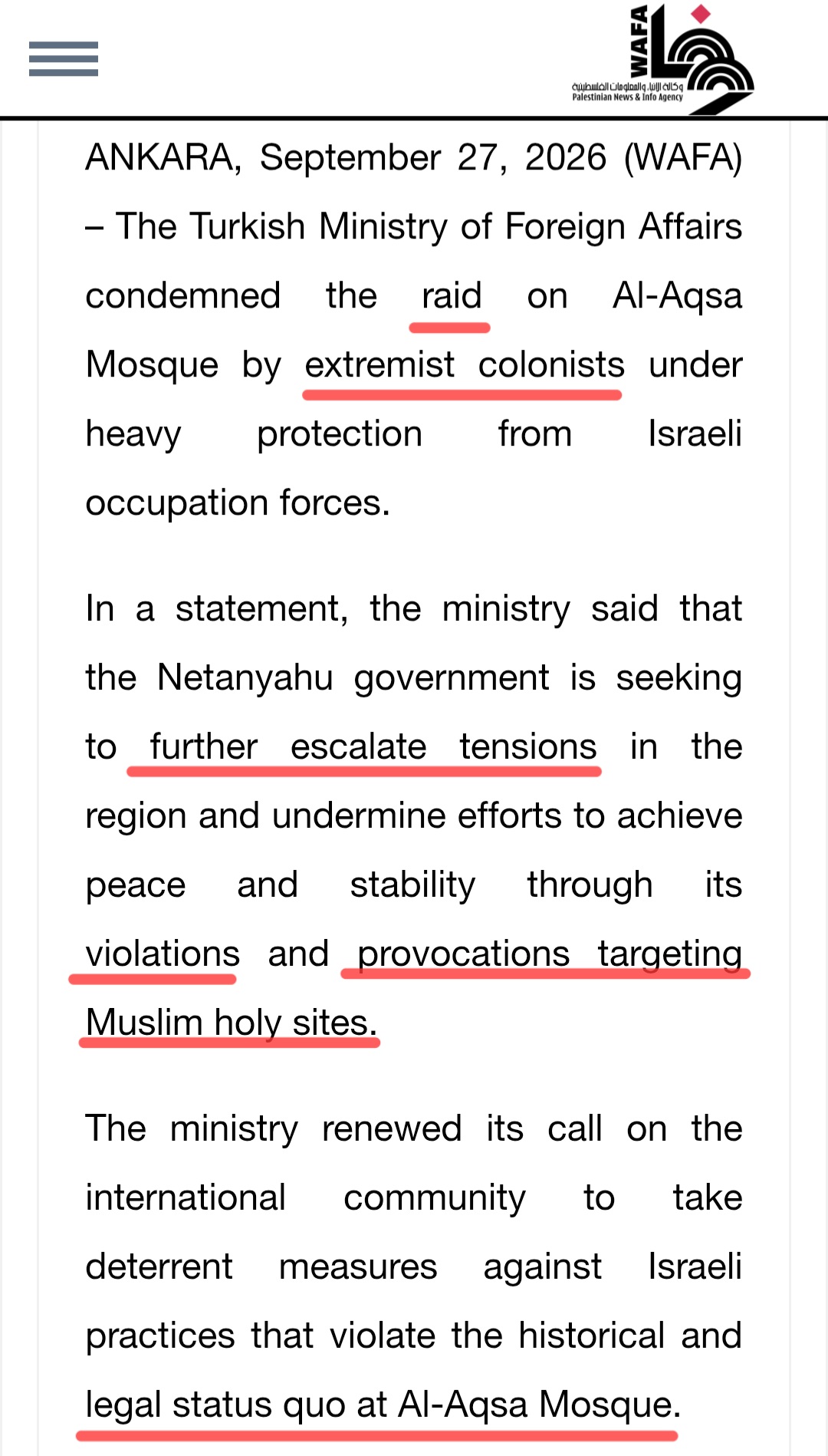
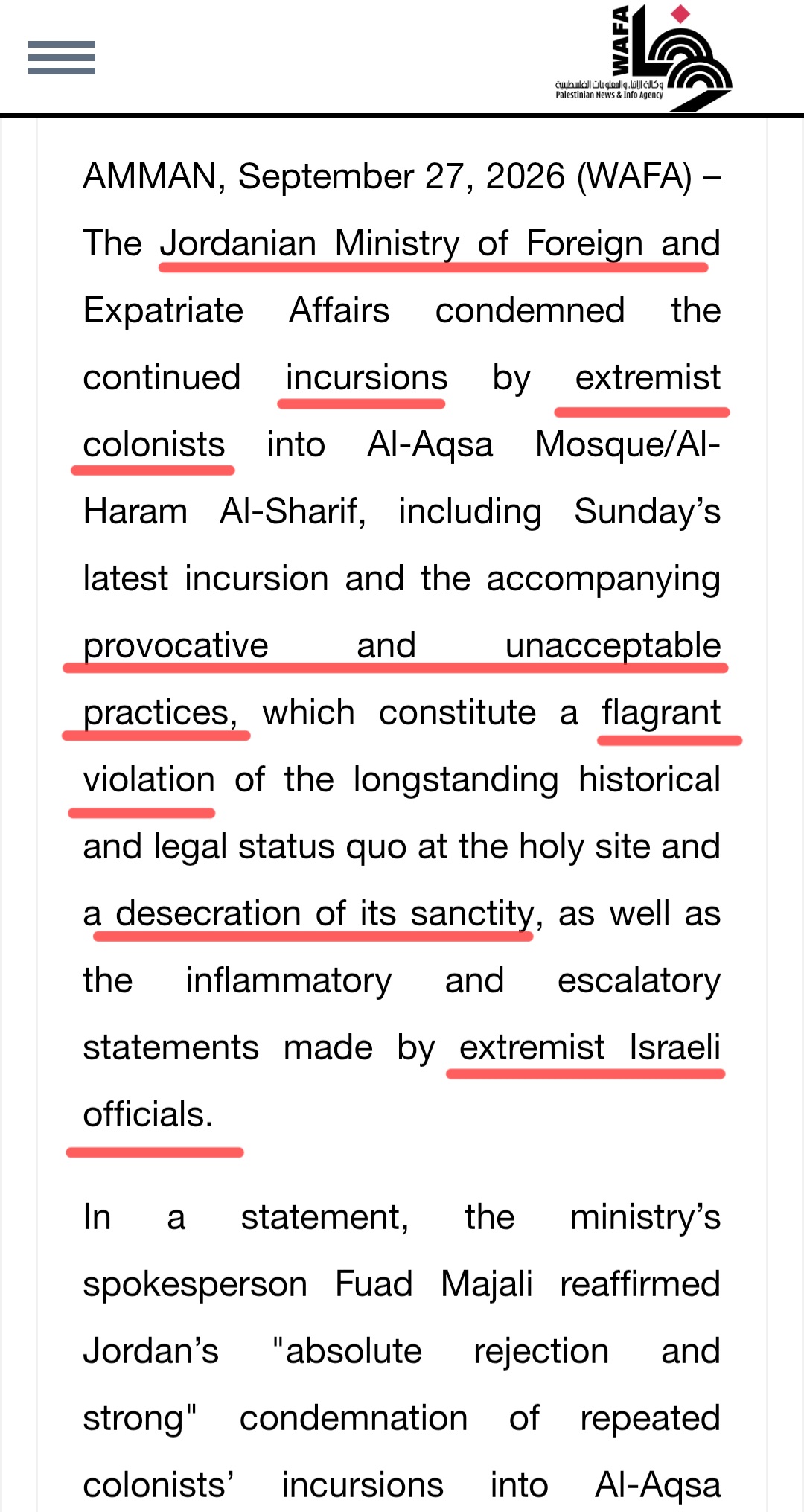
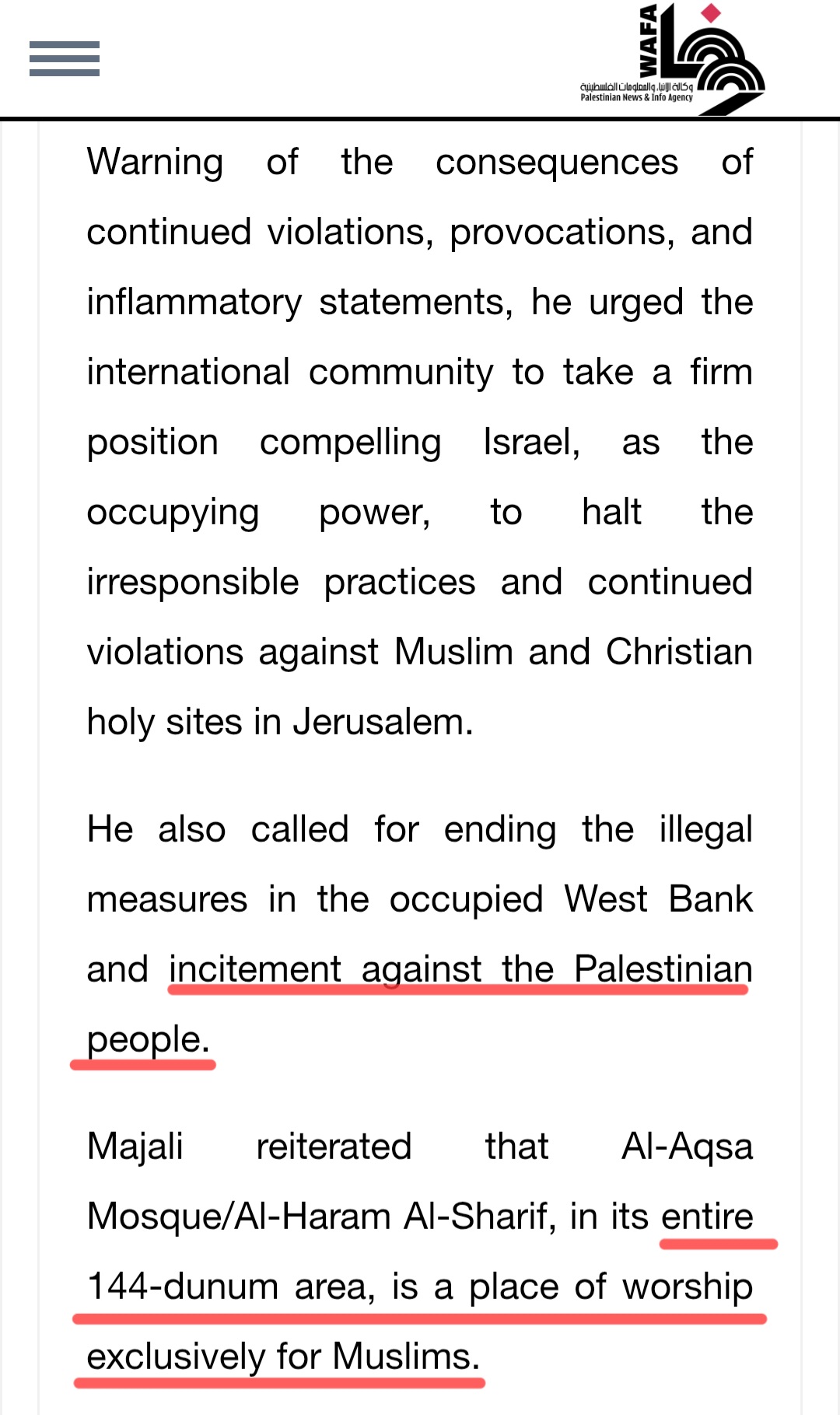
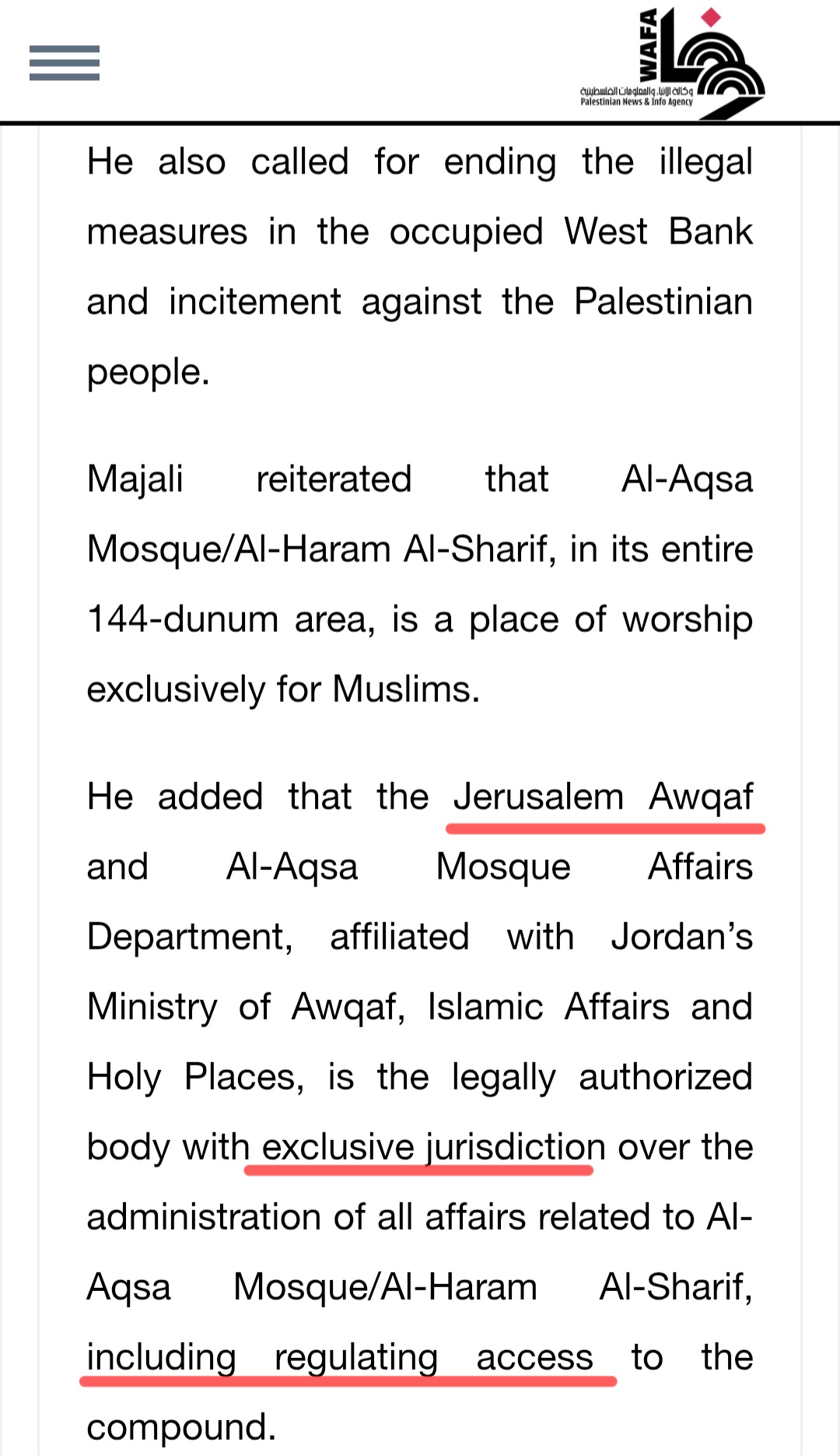
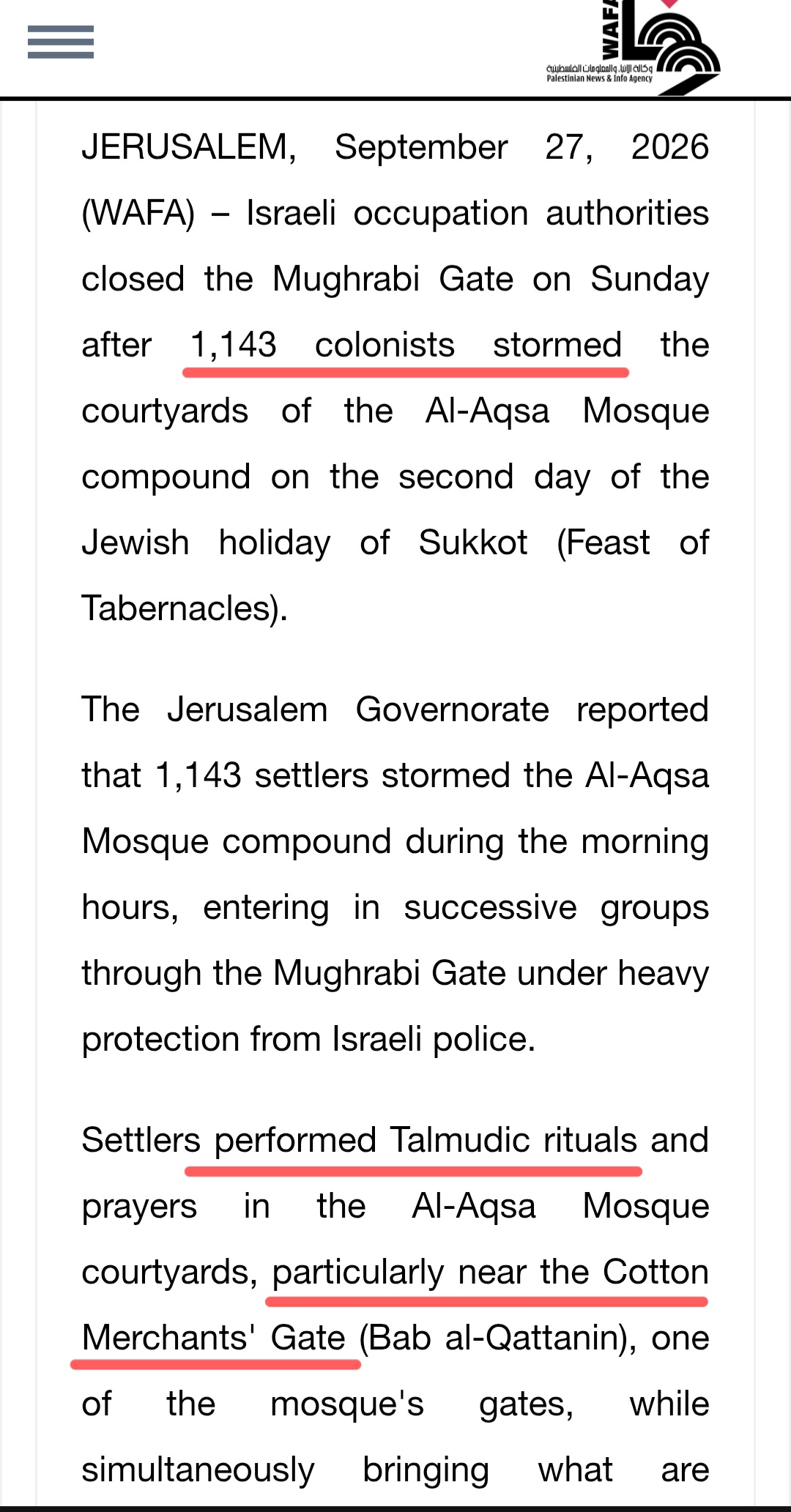
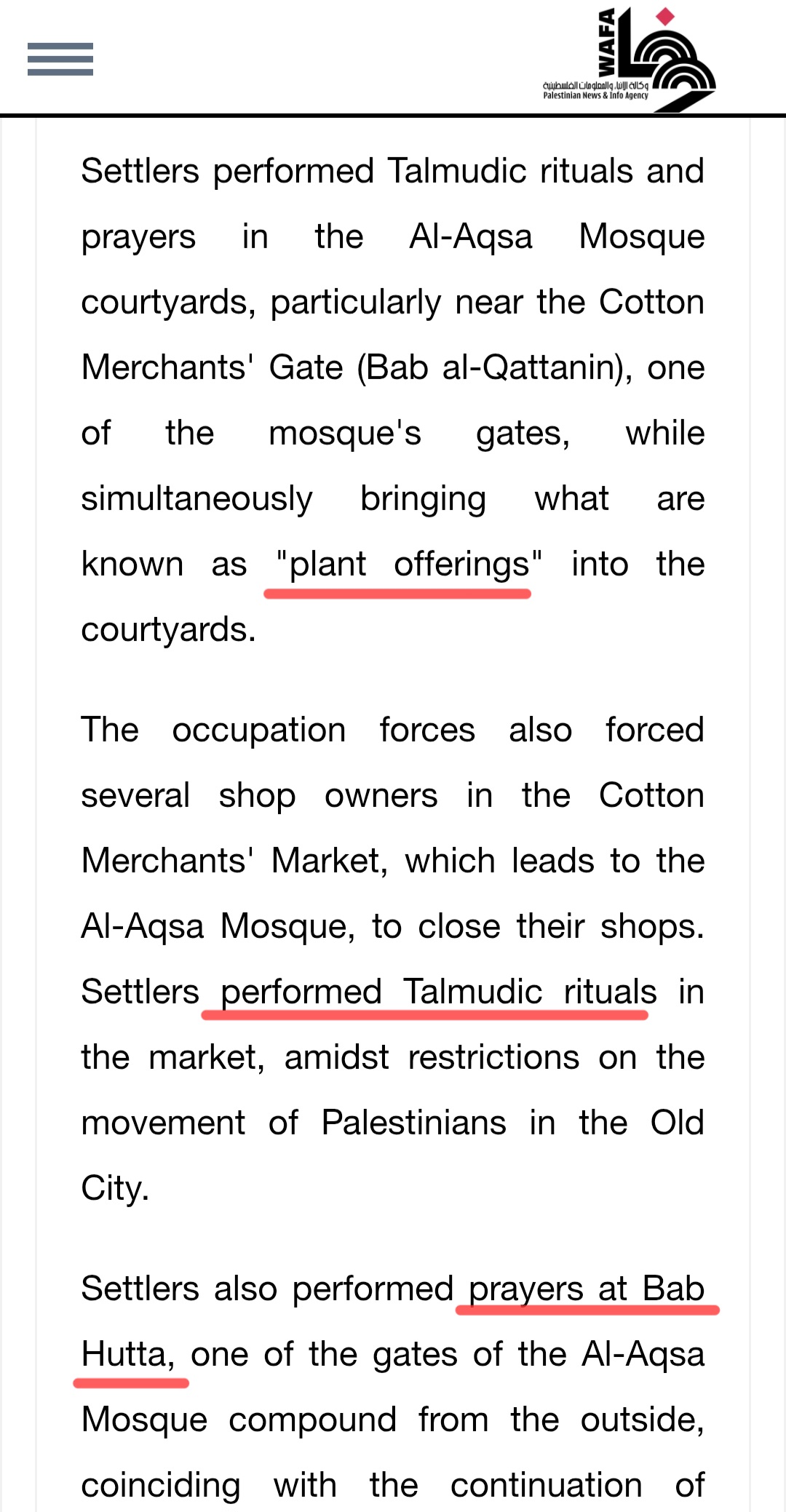
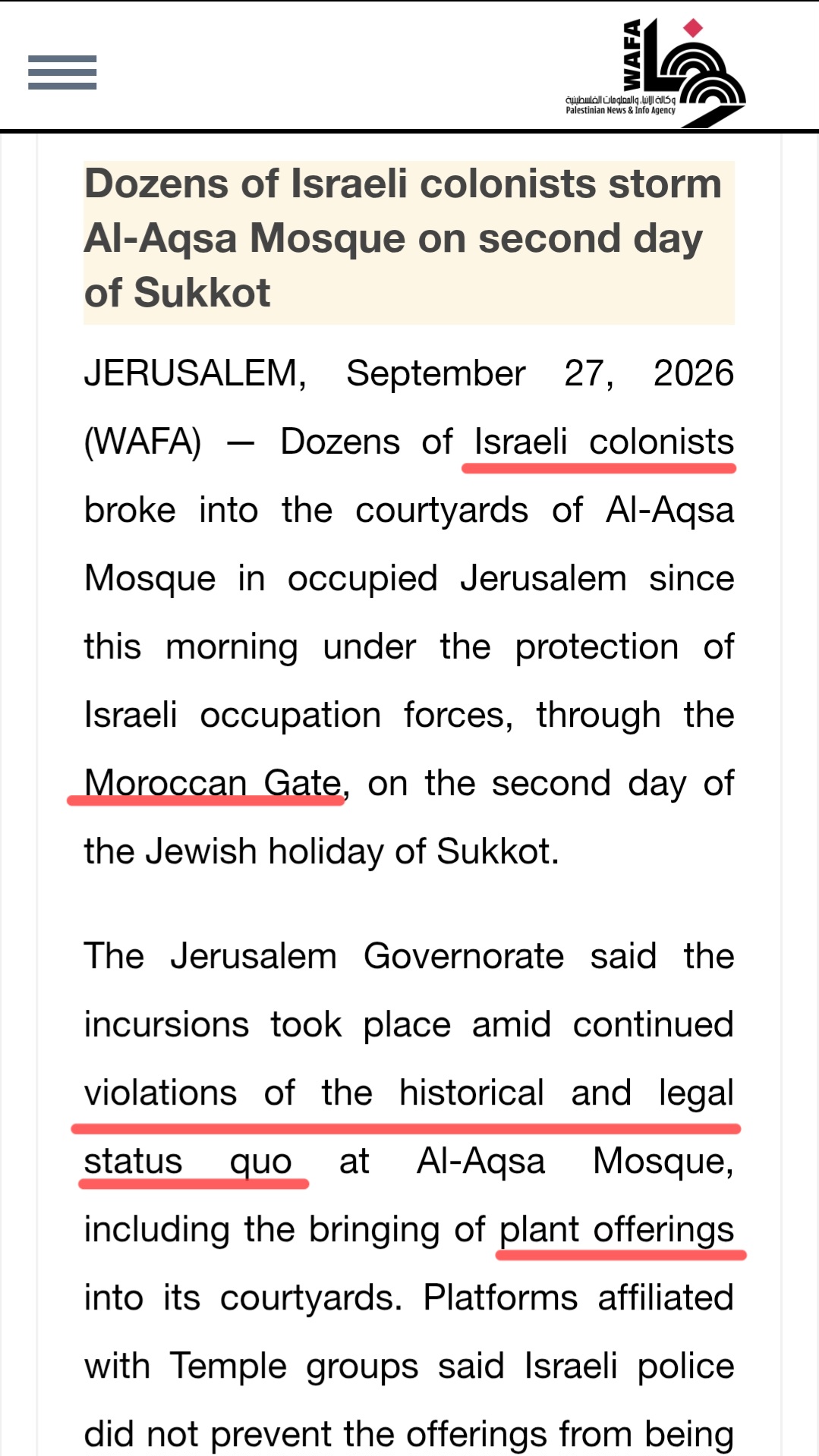
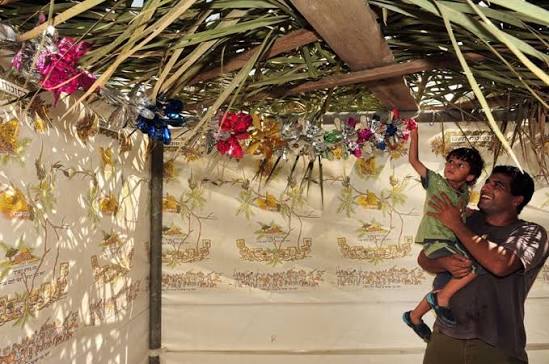
For the Palestinian Authority, Jews who visit Jerusalem during Sukkot, one of Judaism’s three pilgrimage holidays, are “terrorist colonists.”
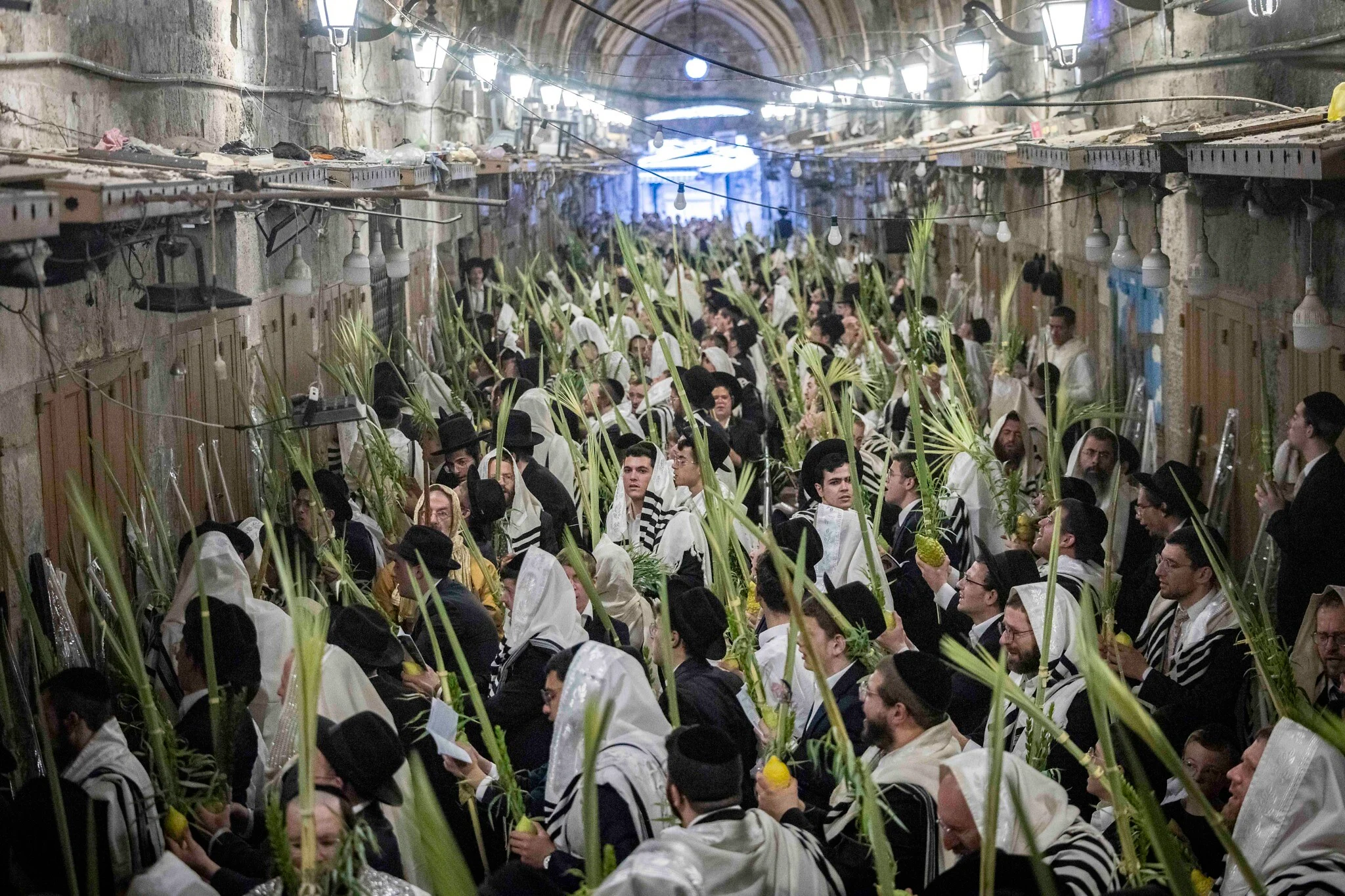
What did these Jewish “terrorists” do? According to WAFA, the Palestinian Authority’s official news agency, they prayed, sang and clapped together. They gathered among themselves for peaceful Jewish worship at Judaism’s holiest site during a Jewish pilgrimage holiday.
This is terrorism?
This is the language of jihad. It begins by transforming ordinary religious practice into aggression. A Jew praying becomes a provocateur. A group singing together becomes a threat. A religious pilgrimage becomes an invasion. Once worshippers have been labeled “terrorists,” hostility toward them has already been given a vocabulary of supposed self-defense.
That is radical Islam applied to one of the most contested religious sites in the world: not simply insisting upon Muslim rights, but denying equivalent Jewish religious rights and portraying their exercise as an attack.
Every global leader taking the podium at the United Nations should condemn this screed. So should political leaders around the world asking voters to believe they oppose antisemitism and religious extremism.
The question is simple: Do you condemn the Palestinian Authority calling Jews engaged in prayer at their holiest site “terrorist colonists”?
Ignoring this rhetoric while rallying to the defense of the Palestinian Authority encourages the targeting of Jews around the world. The people WAFA describes are not firing weapons or fighting soldiers. They are Jews praying, singing and observing Sukkot.
Islamic supremacy does not only call for expelling every Jew. It also means insisting that Jews remain religiously subordinate – that Muslim prayer is a right while Jewish prayer is a provocation.
Calling Jewish worship terrorism is where the demand for Islamic domination becomes even darker. It turns Jews practicing Judaism into the enemy and fuels a global jihad.
In July, 2026 the United Nations and the Organization of Islamic Cooperation convened a conference in Cairo devoted to Jerusalem. The UN described Jerusalem as sacred to the three monotheistic religions and the conference as an “important platform for interreligious dialogue.”
Then it offered a remarkable description of what that dialogue looked like: “Muslim and Christian leaders reflected on Jerusalem’s profound significance to the three monotheistic faiths.”
Three religions. Two of them discussing what Jerusalem means to all three.
This was not a conference where religion was incidental. Its first substantive session was a two-hour panel titled “Saving the Holy City, Safeguarding the historic status quo at the Holy Sites.” The speakers included representatives of the Hashemite Fund for the Restoration of Al-Aqsa Mosque and the Dome of the Rock, Al-Azhar, the Latin Patriarchate, the Jerusalem Awqaf and Al-Aqsa, and the Coptic Orthodox Church.
There was no Jewish religious representative.
That absence was consistent with the conference’s design. The UN announcement said the gathering would highlight the “concerns of Christian and Muslim leaders regarding restrictions on worship and threats to Holy Sites.”
Not Jewish leaders.
That left an empty chair at precisely the discussion where a Jewish voice might have asked some uncomfortable questions.
Start with the name of the place being discussed.
The conference repeatedly spoke of Al-Aqsa Mosque and Al-Haram al-Sharif. But this same 144-dunam platform is the Temple Mount, location of the First and Second Temples and the holiest site in Judaism. Yet throughout the conference, the Islamic name and Islamic religious administration were the starting point for discussing the site. Where was the Temple Mount? A conference devoted to Jerusalem’s “multireligious character” could have acknowledged both names.
Then there is the considerably larger question of worship.
The Cairo conference repeatedly invoked freedom of worship and access to sacred places. Yet the historic status quo it sought to protect has restricted Jewish prayer on the Temple Mount. Muslims worship there. Jews have historically been allowed to visit only during restricted periods but denied the same right to pray.
At Cairo, former Jerusalem Awqaf official Atallah Naser warned about “settler incursions and rituals” and what he considered an emerging “temporal and spatial division” of Al-Aqsa. Another speaker complained about increased “religious rituals” by Jews at the site.
At a conference about religious freedom, that should have produced an obvious question: Why is peaceful Jewish prayer at Judaism’s holiest site itself treated as a threat?
Nobody on the panel was there to ask it.
Nor was anyone there to ask why the practical restrictions on Jewish worship received so little attention:
Why should Jewish visits be confined to particular hours?
Why are Jews only allowed to enter the Temple Mount via single portal while Muslims can use any?
Why should Jewish religious practice require close police management?
Why does a conference concerned with restrictions imposed upon Muslim and Christian worshippers not apply the same scrutiny to restrictions affecting Jews?
Then there is the question of who administers the site.
Cairo speakers repeatedly defended the Islamic Waqf and Jordan’s Hashemite custodianship. The Waqf retains the central religious administrative role at a site that is the holiest place in Judaism. Why?
Why should Judaism’s holiest site have an Islamic religious authority but no corresponding Jewish religious authority? Why should Jewish representatives have no formal role in decisions involving Jewish worship there? Why not shared administration? Why not a multifaith governing or consultative structure? Why not Muslim administration of the mosques alongside recognized Jewish religious rights elsewhere on the enormous platform?
Those possibilities were apparently not part of Cairo’s “interreligious dialogue.”
Instead, the conference treated preservation of the “historic status quo” and protection of “freedom of worship” as though they necessarily meant the same thing.
They do not.
If the status quo restricts the religious practice of one faith at its holiest location, preserving that restriction is not the same question as protecting religious freedom.
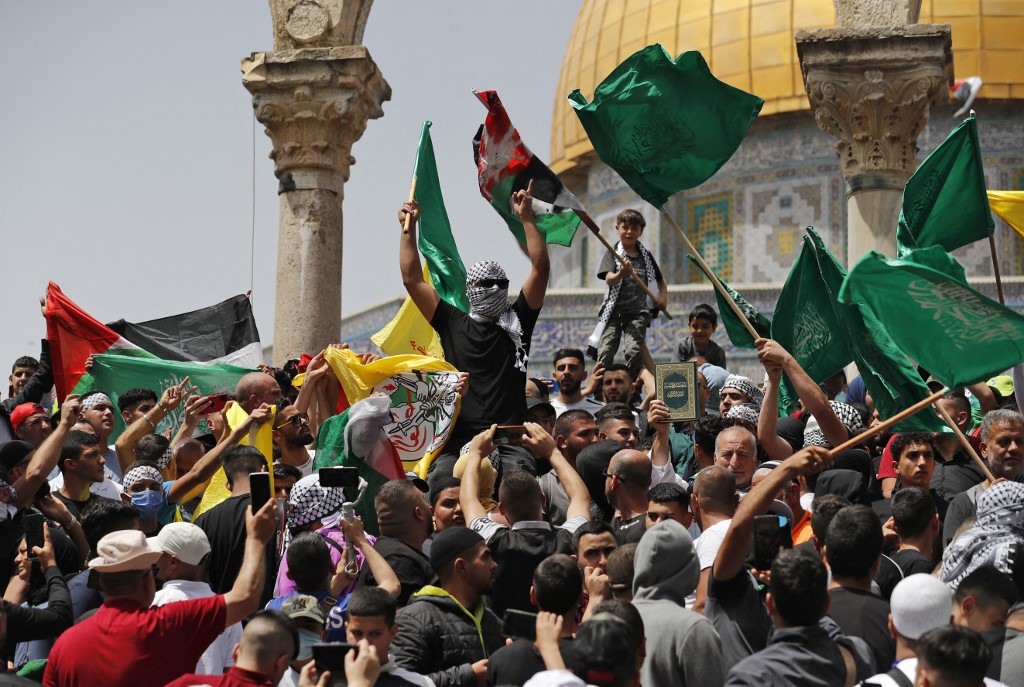
Palestinian protesters wave Palestinian and Islamic flags as they rally at the Dome of the Rock following the last Friday prayers of the Muslim month of Ramadan, on April 29, 2022. (Photo by Ahmad GHARABLI / AFP)
UN Committee Chairman Coly Seck supplied the principle that should have started this discussion. “For Muslims, Christians and Jews,” he said, “Jerusalem carries prayers, history and hope.” He declared that freedom of worship is a right and that “No worshipper should be stopped because of who they are. No community should feel that its faith is being pushed out of its own city. Jerusalem’s religious character must not be used as a tool of control. It must remain a bridge connecting people from the three major faiths. A meeting point. A shared responsibility.”
Those words raise obvious questions about Jewish worship on the Temple Mount.
Cairo simply lacked someone at the table to ask them.
The United Nations called Jerusalem sacred to three religions and convened an interreligious dialogue in Cairo about protecting their holy places. But only Muslim and Christian representatives came. They pretended to discuss the religious interests of three faiths, while using it as an opportunity to blame all religious tension on the Jews not in the room.
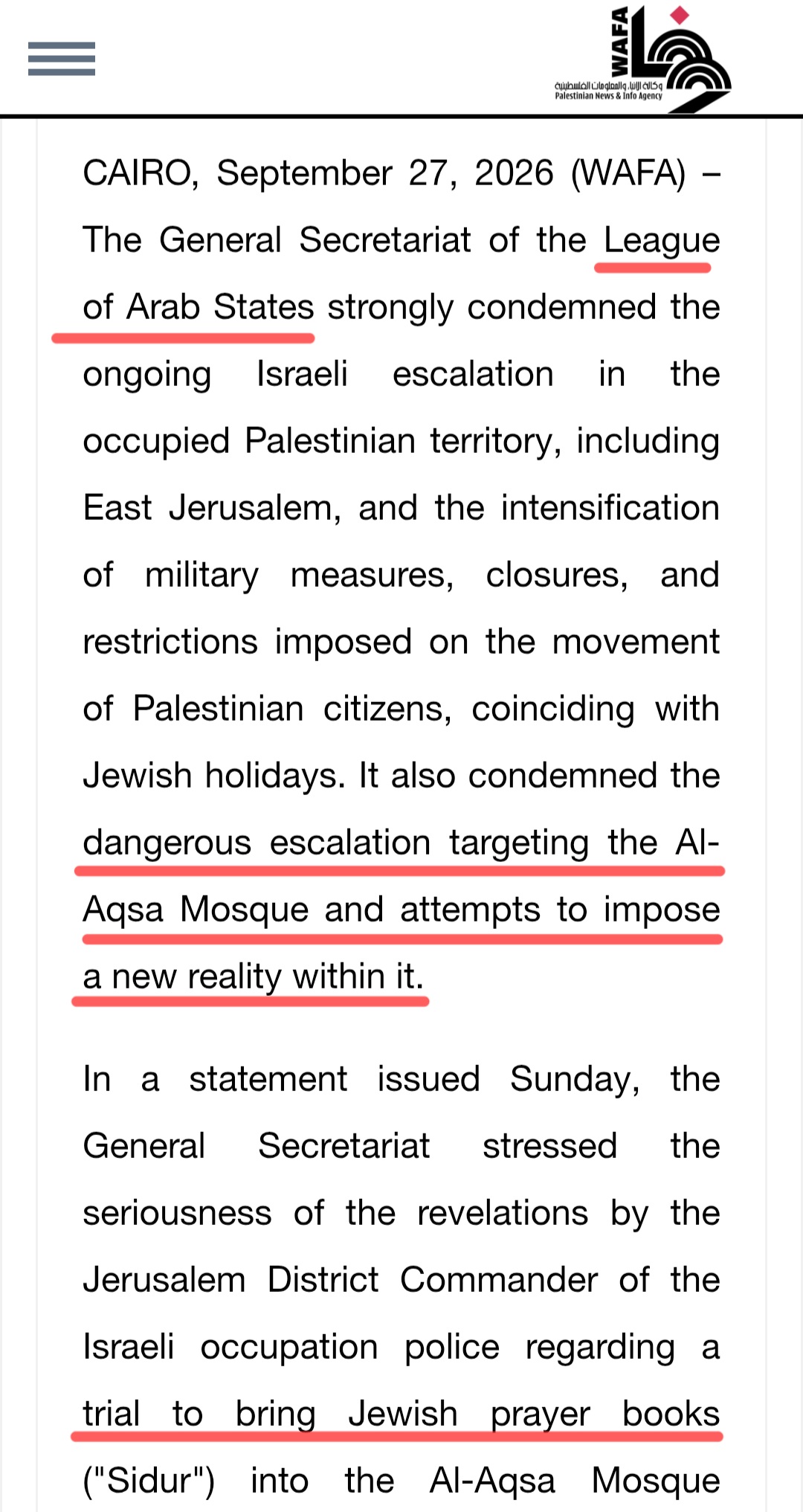
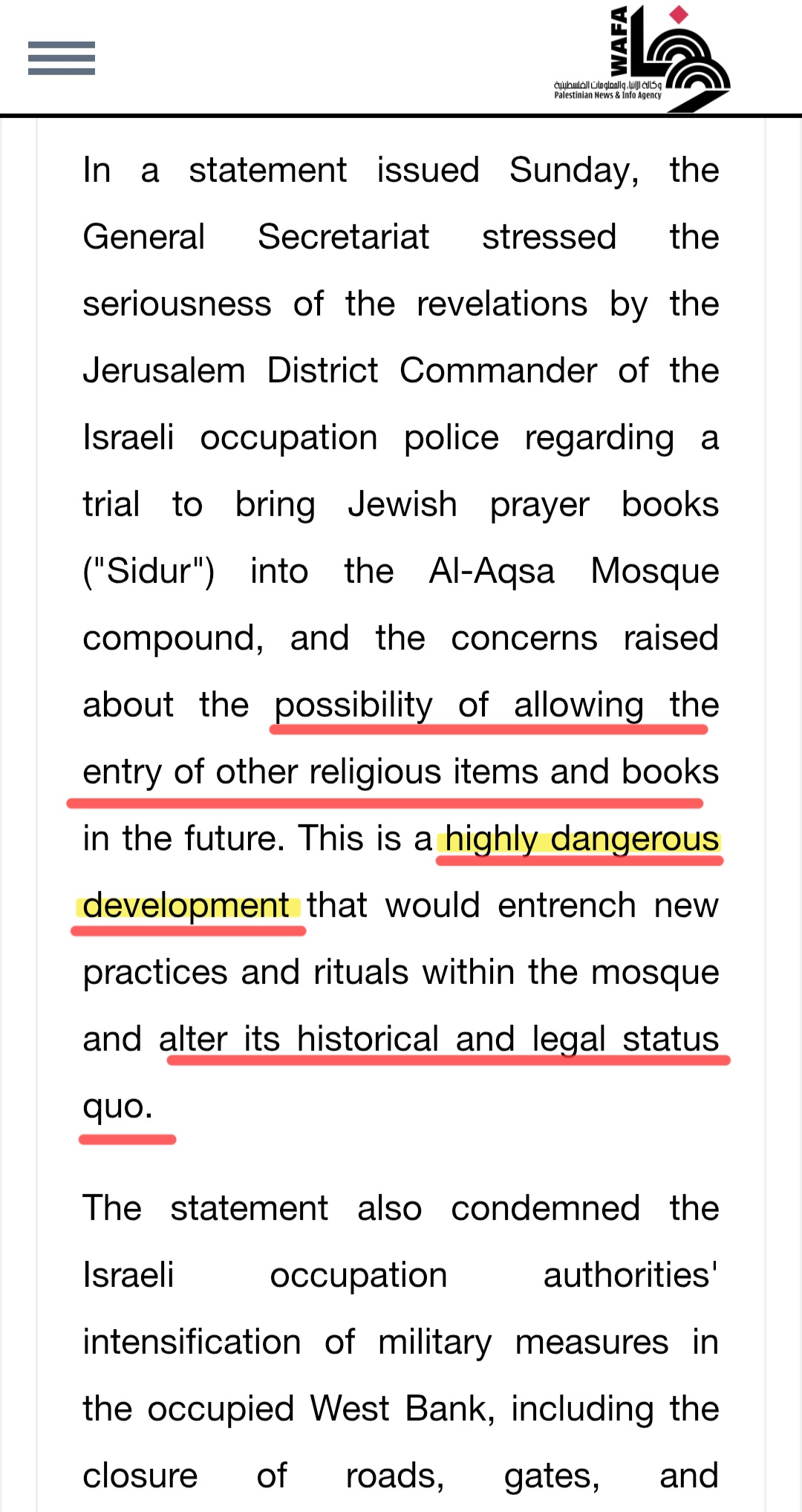
A Jewish prayer book is now a “highly dangerous development” in the Middle East according to the region’s Muslim leaders.
That was the Arab League’s description Sunday of reports that Israeli police are testing allowing Jewish prayer books — siddurim — onto the Temple Mount. The League warned that allowing them could establish new Jewish religious practices and alter the “historical and legal status quo.”
It wasn’t the only alarm sounded during Sukkot.
Over 1,000 Jews visited the Temple Mount on Sunday, with some openly praying and carrying the Four Species.
For perspective, roughly 80,000 Muslims attended the first Friday prayers at Al-Aqsa during Ramadan earlier this year. In normal years, Ramadan Friday attendance can reach 200,000.
For the Muslim world, Muslims were “worshippers” while Jews were “extremist” Israelis conducting “Talmudic rituals.”
Jewish men covered in prayer shawls hold the Four Species as they take part in morning prayers during the holiday of Sukkot at the Cotton Merchant’s Gate entrance to the Temple Mount in Jerusalem’s Old City, September 27, 2026. (Chaim Goldberg/Flash90)
Palestinian Authority spokesman Nabil Abu Rudeineh warned that Israel risked transforming the political conflict into a “religious war.” He declared the entire 144 dunams of the Temple Mount an exclusively Muslim place of worship that cannot be divided or shared.
The reaction extends well beyond the Palestinian Authority.
Jordan condemned Sunday’s Jewish visits and again declared all 144 dunams exclusively Muslim. And Turkey, Egypt, Indonesia, Jordan, Pakistan, Qatar, Saudi Arabia and the United Arab Emirates have jointly used the same formulation: the entire compound is exclusively for Muslim worship and the Jordanian Waqf has exclusive jurisdiction to administer it and regulate entry.
Three weeks ago, I wrote about the effort to redefine the Temple Mount “status quo,” transforming restrictions on Jewish prayer into a broader claim that the entire compound is exclusively Muslim.
Sukkot takes the story further.
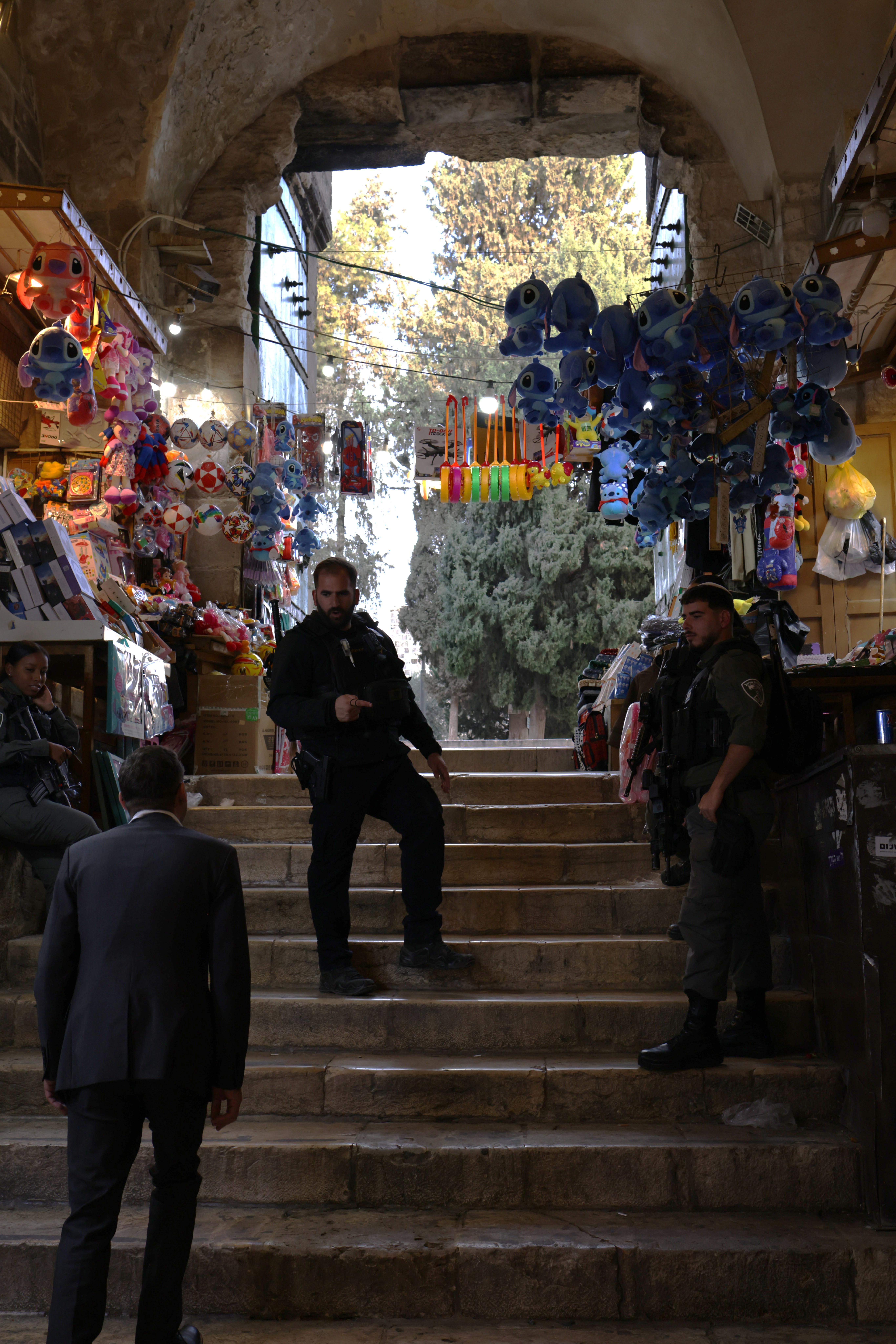
There is no question that Israel is changing its own practice. For decades, Israeli governments maintained the policy that Muslims prayed on the Temple Mount while non-Muslims visited. Israeli police restricted Jewish prayer and barred siddurim and other Jewish religious objects.
Israel observed those restrictions for decades. But it never enacted a permanent statutory ban on Jewish prayer or agreed that the entire Temple Mount would forever be exclusively Muslim.
Now Israel is allowing some Jews to worship at Judaism’s holiest site.
The response is not simply a demand that Israel return to its previous practice. Multiple Muslim governments are declaring that all 144 dunams are exclusively Muslim. The possibility of a Jew carrying a siddur is described as a “desecration of its sanctity,” and jihadi calls for a “religious war.”
And this is happening during Sukkot, one of Judaism’s three biblical pilgrimage festivals, historically centered on Jews traveling to Jerusalem and the Temple. Jews were making pilgrimage there during Sukkot more than a thousand years before Islam existed.
A small number of Jews praying peacefully at their holiest site during their pilgrimage holiday is used as incitement to jihad. And Muslim governments demanded that the “international community” take actions against the Jews.
Perhaps it is time for the international community to explain to radical Islamists what coexistence means.
We are in the middle of the Jewish holiday season, and Judaism has demanded a lot from us.
Rosh Hashanah asked us to stand in judgment. The Ten Days of Repentance asked us to examine ourselves. Yom Kippur demanded confession, fasting and repentance.
And then Judaism tells us to be happy.
Sukkot is zman simchateinu — the time of our joy.
The pivot can feel jarring. The melodies of Yom Kippur are still in our heads when we leave the synagogue, eat, begin building the sukkah and prepare for a holiday explicitly defined by happiness.
Kohelet, which Jews read on Sukkot, provides an answer: “There is a time for everything, and a season for every activity under the heavens.”
A time to weep and a time to laugh. A time to mourn and a time to dance. A time to be silent and a time to speak. A time for war and a time for peace.
Kohelet does not suggest that human beings experience only one emotion at a time. We can mourn and feel gratitude. We can love and be angry. We can be frightened and hopeful.
But Kohelet points somewhere else: that emotions and activities do not only exist in time, but time is defined by emotion and activity.
Different moments call for different responses. The emotions we might personally carry do not relieve us of the obligation to recognize what the present moment demands.
Israel offers a powerful example today.
Israel has inflicted extraordinary damage on enemies that sought its destruction. Hamas and Hezbollah have been badly degraded, and Iran has suffered devastating blows. Israelis can feel enormous relief at what Israel has survived and accomplished.
At the same time, Israel faces extraordinary international hostility and diplomatic isolation. The image at the United Nations this week captured that reality starkly: as Prime Minister Benjamin Netanyahu took the podium, dozens of delegations walked out, leaving him addressing a largely empty chamber.
So what should Israelis feel today? Relief? Alarm? Both?
Kohelet does not require one feeling to vanquish the other. The challenge is recognizing which response the present moment calls for.
Rabbi Lord Jonathan Sacks captured something similar in describing the distinctive nature of joy: “Joy lives in the moment. It asks no questions about tomorrow. It celebrates the power of now.”
That may explain why Sukkot follows Yom Kippur so quickly. Judaism does not give us weeks to transition from solemnity to celebration. We finish fasting and begin building a sukkah. We do not need to resolve every worry before experiencing joy. As Rabbi Sacks continued, joy “knows that yesterday has gone and tomorrow is unknown.”
Tomorrow will bring whatever tomorrow brings. Kohelet asks us to recognize today.
One points to June 1967 for borders, East Jerusalem and the West Bank.
Another points to 1948 for refugees and their descendants.
Another reaches to 1947, before the United Nations proposed dividing Mandatory Palestine into Jewish and Arab states.
Another reaches to 1917, before the Balfour Declaration endorsed a Jewish national home in Palestine.
And when even that is too late, the clock can be wound back to the Ottoman era, when Palestine was governed by a Muslim empire.
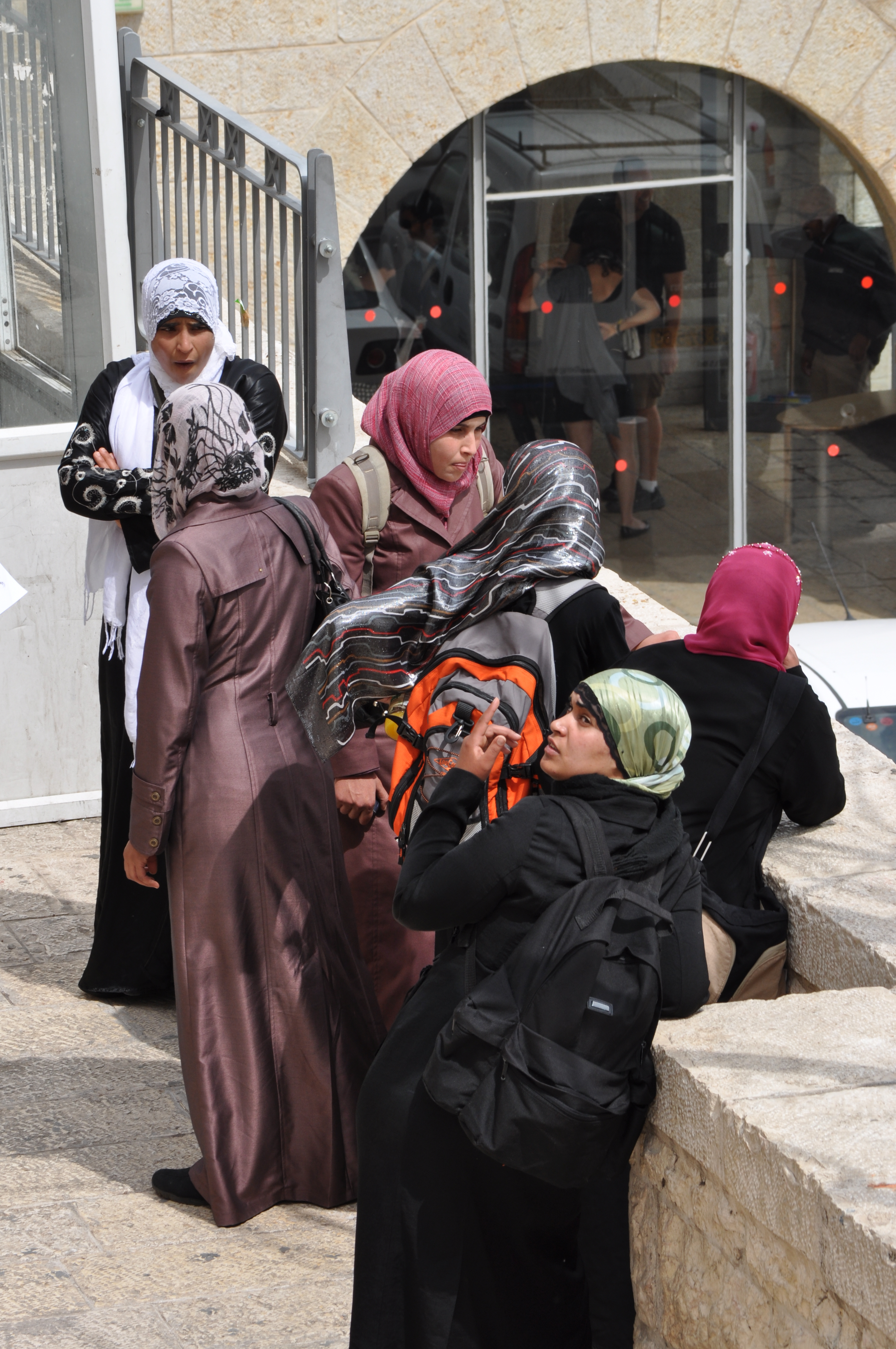
Muslim women prepare to enter the Western Wall Plaza in 2010 (photo: First One Through)
The hands do not need to agree. They serve different purposes.
The President of the Palestinian Authority, Mahmoud Abbas has spent decades demonstrating how it works.
1967: The Border Hand
For the borders of a Palestinian state, Abbas is precise.
In his 2016 address to the United Nations, he said the PLO had accepted a Palestinian state on the “4 June 1967 borders with East Jerusalem as its capital.”
He has repeated the formulation for years. In 2014, he called for Palestinian independence over the “entire Palestinian Territory occupied in the 1967 war,” with East Jerusalem as its capital. In 2022, standing beside President Joe Biden, Abbas again called for a Palestinian state “with East Jerusalem as its capital, on the 1967 borders.”
Why June 4, 1967? Look at the picture the clock produces.
There were no Jews living in the Jewish Quarter of the Old City. Its Jewish residents had been expelled after the Quarter fell to Jordanian forces in 1948. By June 1967, Hebron’s centuries-old Jewish community no longer existed either, evacuated after Palestinian Arabs massacred them in 1929.
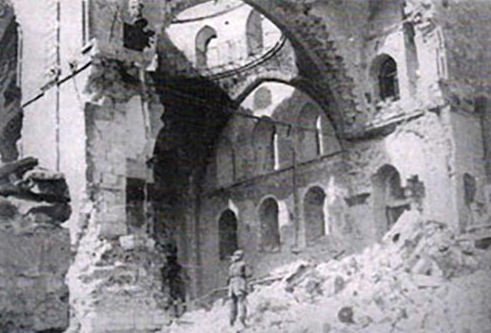
Jordanian soldiers destroyed the Hurva Synagogue in the Old City of Jerusalem
So June 4, 1967 creates a remarkably convenient baseline. The Jewish communities that exist today in eastern Jerusalem, Hebron and throughout the West Bank disappear from the photograph.
But the Palestinian clock has another hand.
1948: The Refugee Hand
When Abbas talks about Arab refugees, June 1967 suddenly becomes useless. So the clock jumps backward another nineteen years.
In 2021, Abbas appeared before the United Nations holding up the deed to his family’s property and said Palestinians still possess deeds and keys to their former homes. He argued that Palestinian refugees have the right to “return to their homeland” and recover their properties.
In 2025, he was even more explicit. Abbas said there were now more than seven million Palestine refugees and declared that the “right of return” was an inalienable right that Palestinian Arabs “will not forsake.”
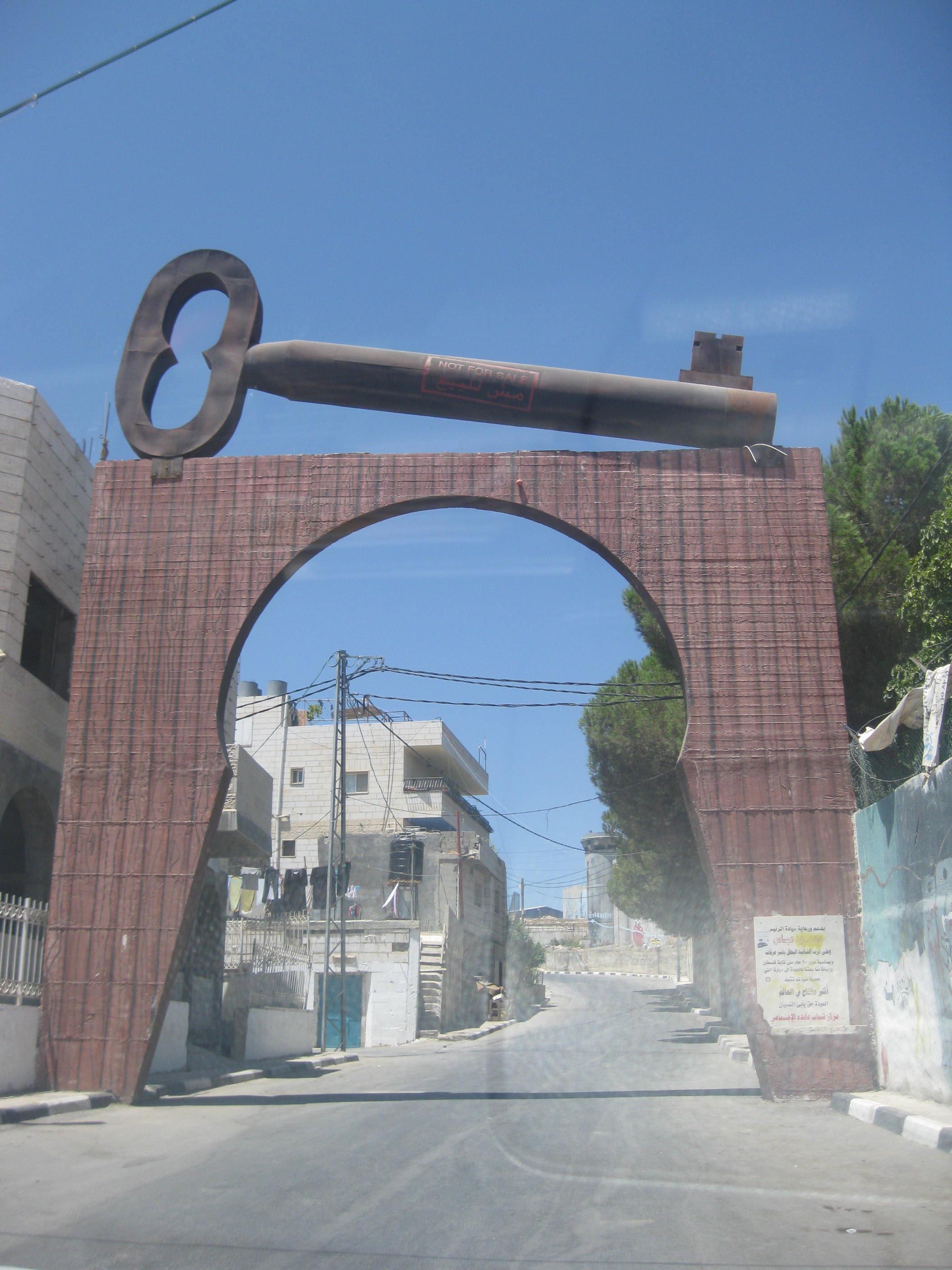
Entrance to UNRWA “refugee camp” in Bethlehem with a key on top representing that UNRWA is the portal for descendants of internally displaced Arabs to move into grandparents’ houses in Israel
Watch the hands.
For the territory of a new Palestinian state, the clock says 1967.
For Palestinians claiming homes and property inside Israel, it says 1948.
Apply 1967 consistently and the mass refugee claim reaching into Israel loses its 1948 baseline. Apply 1948 consistently and Jewish communities and property claims erased by the 1967 baseline return to the picture.
The clock cannot stay on either date.
It has to move with the argument.
1947: The Sovereignty Hand
Israel already exists in 1948, a bone in the throat of Palestinian Arabs, or a “painful settlement” to quote Abbas. So the sovereignty hand moves to 1947.
In November of that year, the United Nations proposed partitioning Mandatory Palestine into a Jewish state and an Arab state. So the clock reaches a moment before Israeli sovereignty.
But international recognition of Jewish national aspirations predates partition by decades.
Move the hand again.
The Holocaust: The Colonial Hand
Abbas wrote his doctoral thesis on Holocaust denial. He dismisses the entire victimization of Jews and argued that Jews brought the Holocaust upon themselves – and Palestinian Arabs have been forced to pay the price for it.
In an April 2018 speech in Ramallah he said “the reason for the hatred of the Jews is not their religion but their function in society…. So the Jewish question, which was prevalent in all European countries, the anti-Jewish (sentiment) was not because of their religion, but because of their function in society, which had to do with usury, banks, and so on…. So their narrative about coming to this country because of their longing for Zion, or whatever – we’re tired of hearing this. The truth is that this is a colonialist enterprise, aimed at planting a foreign body in this region…”
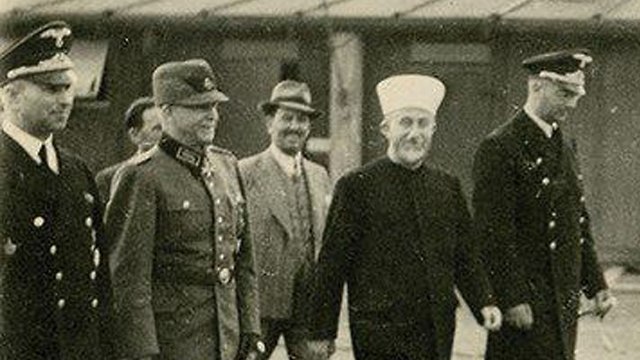
Haj Amin al-Husseini, the Grand Mufti of Jerusalem, visiting Nazi Germany in 1943
1917: The Zionism Hand
In his 2016 United Nations address, Abbas attacked not the borders created by the 1967 war or the displacement of 1948, but the Balfour Declaration of 1917.
He called it the “notorious Balfour Declaration” and demanded that Britain apologize for the “catastrophes, miseries and injustices” he said it had created.
Look how far the clock has moved. A century.
A time when there was no modern state of Israel. There was no 1948 refugee crisis. There was no occupation resulting from the 1967 war. There wasn’t even a British Mandate for Palestine yet.
The objection has reached the international recognition of Jewish national aspirations themselves.
Still too late.
The Ottoman Hand
Before Balfour, Palestine was part of the Ottoman Empire. Even though there was no sovereign Palestinian Arab state, the land was totally controlled by Muslims. Jews remained a small minority.
Abbas’ longtime adviser on Religious and Islamic Affairs and the PA’s Supreme Shari’ah Judge, Mahmoud al-Habbash said in 2014 that “The entire land of Palestine is [Islamic] waqf and is blessed land… it is prohibited to sell, bestow ownership or facilitate the occupation of even a millimeter of it.” In 2016 he said about Jerusalem “We cannot allow or agree to it being under sovereignty that is not Muslim sovereignty.”
Israeli police block Jewish man from ascending to the Temple Mount because he is a Jew, in Novemnber 2025 (photo: First One Through)
Abbas referenced the Ottoman period in a speech in 2014 when he said “Jews, Christians and Muslims have lived peacefully together in Palestine for centuries. So peace between religions runs through the heart of the most sacred City in the world, Jerusalem. Peace between the world’s religions runs through Jericho the Oldest City on Earth. Peace between the world’s religions runs through Palestine.”
Hamas’s 1988 foundational charter makes the point clear: “raise the banner of Allah over every inch of Palestine, for under the wing of Islam followers of all religions can coexist in security and safety where their lives, possessions and rights are concerned. In the absence of Islam, strife will be rife.”
Watch the Hands
There is one time the Palestinian clock rarely points to: today. Because today leaves too many Jews in the picture.
Jews live in Jerusalem, Hebron and throughout the West Bank. Israel exists as a Jewish state. Jewish sovereignty and self-determination are facts rather than historical proposals.
To say openly that Jews should be removed from those places, that the Jewish state is illegitimate or that Jews should be denied national rights would make the prejudice difficult to disguise.
History offers a more respectable vocabulary. Just choose an earlier date when the particular Jews, Jewish sovereignty or Jewish rights inconvenient to the argument were absent.
That is why the Palestinian clock needs so many hands. No single date erases everything neatly.
History provides the dates. Antisemitism chooses the hand.
For the sin of allowing the word “genocide” to become so casually attached to Israel that actual genocidal intentions against Jews became background noise;
For the sin of allowing people who celebrated, excused or contextualized October 7 to reinvent themselves as authorities on Jewish morality;
For the sin of allowing “Zionist” to become a socially acceptable substitute for things people would be embarrassed to say using the word “Jew”;
For the sin of advocating Jewish-Arab coexistence while objecting when Jews actually move next to Arabs in the Galilee;
For the sin of allowing the world to mark the 25th anniversary of Durban without forcing a reckoning with what Durban became for Jews;
For the sin of allowing the descendants of people who once lived in Israel to claim an unlimited right to enter it while treating Jewish return to the same land as colonialism;
For the sin of confusing being worried about the Jewish people with doing something for the Jewish people.
Terrorism, Jihadism and Language
For the sin of allowing September 11 to be taught without clearly teaching the jihadi ideology of the people who committed September 11;
For the sin of treating white supremacy as an ideology that must be named while treating jihadism as a subject requiring euphemisms;
For the sin of allowing “terrorist” to become a complicated word precisely when the terrorist is trying very hard to make his intentions uncomplicated.
United Nations / International Institutions
For the sin of accepting international descriptions of the Temple Mount that progressively erase the Jewish Temple from the Mount;
For the sin of reaching the United Nations’ 80th General Assembly without insisting on the basic distinction between a member state attacked on October 7 and the non-member entity whose governing terrorist organization launched the attack;
For the sin of watching countries recognize a state of “Palestine” without stating clearly that there is no “Right of Return” for Arabs into Israel.
America
For the sin of confusing an apology with repentance;
For the sin of believing that another statement, conference or task force constitutes a strategy against antisemitism;
For the sin of asking politicians to affirm our connection to Israel more loudly than we affirm it ourselves;
For the sin of performative protests rather then developing coherent strategies;
For the sin of assuming that because American Jewry has lived through a Golden Age, the wheel could never turn.
Media / Culture
For the sin of treating calls for violence against Jews as a debate over free speech rather than first acknowledging what was actually being said;
For the sin of watching the meaning of “terrorist” narrow while the meaning of “genocide” expanded;
For the sin of continuing to confuse greater sophistication of vocabulary with greater clarity of thought;
For the sin of listening to music of obvious antisemites.
Ourselves
For the sin of expecting others to understand Jewish history that we have not bothered to learn;
For the sin of spending more time reading about antisemitism than studying Judaism;
For the sin of arriving late to shul and being annoyed that someone is sitting in my seat;
For the sin of pretending to say any of the prayers in the morning right before Rabbi Yishamel says;
For the sin of praying at home at a speed that beats boiling a soft-boiled egg;
For the sin of assuming that the person davening too quickly is less sincere than I am;
For the sin of assuming that the person davening too slowly is showing off;
For the sin of taking another bencher from a simcha when I already have 250 sitting in a drawer;
For the sin of expecting my rabbi to speak like Lord Jonathan Sachs;
For the sin of opening the Chumash when the rabbi starts speaking and pretending I am looking up a source;
For the sin of looking around during the rabbi’s sermon to see who else thinks it is going too long;
For the sin of saying Shabbat Shalom to someone whose name I should know after twenty years;
For the sin of deciding whether I like a shul based on the kiddush;
For the sin of drinking scotch at 9:15 in the morning because apparently that is something Jews who go to early minyan do;
For the sin of believing calories consumed on Shabbat are somehow accounted for differently;
For the sin of dropping off fifty Jewish books at the door of the synagogue and running away like a cartoon of someone leaving a baby at a fire house;
For the sin of complaining there is too much food at a simcha and then asking if there is dessert;
For the sin of putting a bottle of wine aside because it is too good to open and then keeping it for eleven years;
For the sin of not knowing how to engage with friends who are going through difficult times;
For the sin of joining a Tehillim WhatsApp group and considering the work done even when never saying a single chapter;
For the sin of composing a response to a family WhatsApp, deleting it, and then sending it anyway;
For the sin of using a realtor for eighteen months, then buying a place with someone else, and not ever giving the first realtor a courtesy gift certificate for all the time spent;
For the sin of checking how many people read something I wrote while pretending I do not care;
For the sin of believing that because I did not post my good deed, I deserve additional credit for humility;
For the sin of apologizing for “anything I may have done” rather than remembering what I actually did;
For the sin of spending Al Chet thinking about everyone who should be saying Al Chet;
For the sin of reaching the end of Al Chet feeling considerably better about everyone else’s sins.
Moses’ final message to the Jewish people was not another law but a song.
As Israel prepared to enter its land, Moses called heaven and earth as witnesses and described a future in which prosperity would lead to complacency, complacency to ingratitude and ingratitude to decline. The people who had depended upon God for water, food and protection in the desert would settle the land, enjoy its abundance and eventually mistake blessing for entitlement. “Jeshurun grew fat and kicked.” The danger Moses foresaw was not that hardship would break the Jews, but that success would cause them to forget who they were.
Haazinu was intended as protection against that forgetting. God instructed Moses to write the song, teach it to the Israelites and place it in their mouths so that it would remain a witness among them. The Torah had already been given, the commandments were known and the covenant had been renewed, yet one final safeguard was required. The people had to internalize a warning about themselves that prosperity would otherwise make easy to dismiss.
This makes Haazinu the mirror image of the Torah’s other great song. At the sea, the Israelites were trapped between Pharaoh’s army and the water, free from slavery but not yet able to imagine themselves as a free people. When the sea opened and they crossed on dry land, gratitude rose naturally from within them and was directed toward God. A miracle entered their hearts and emerged through their mouths as the Song of the Sea.
Haazinu travels in the opposite direction. It does not rise spontaneously from the Jewish people but comes from God through Moses and is placed into their mouths so that it may eventually enter their hearts. The Song of the Sea is the Jews expressing to God what they have just experienced; Haazinu is God telling the Jews what they must learn about themselves. One is exuberant and immediate, sung at the moment terror gives way to triumph. The other is measured and unsettling, looking beyond victory toward the temptations victory will create. One moves from the heart to the mouth. The other must move from the mouth into the heart.
That difference may explain why Moses’ final instruction takes the form of song rather than another commandment. Law can remain external to the person who possesses it. A scroll may be stored, honored and ignored, while a commandment may be studied without becoming instinct. A song enters through repetition, settles into memory and returns when the book is closed. Haazinu was written to remain inside the Jewish people as their circumstances changed, so that when later generations prospered and forgot, declined and wondered why, the warning would already be present in words they had learned to sing. The Torah was not insufficient as law, but it also had to become memory.
The two songs describe opposite movements of the wheel of Jewish history. At the sea, Israel stood at the bottom: former slaves, defenseless and pursued by the most powerful army they knew. The sea opened and the wheel turned upward, carrying them from slavery to freedom, terror to triumph. Haazinu addresses a people traveling in the other direction. Israel is about to possess a land, build a society and enjoy an abundance unavailable in the desert, but Moses warns that prosperity may produce forgetfulness and that the wheel can turn down as quickly as it turned up. The Song of the Sea gives hope to Jews trapped at the bottom; Haazinu gives warning to Jews comfortable at the top.
Song at the sea
Ha’azinu
Israelites to God
God to Israelites
Internal expression outward
External message to be interlized
Heart to mouth
Mouth to heart
Deliverance already experienced
Danger not yet recognized
Spontaneous, grateful and triumphant
Deliberate, cautionary and prophetic
From the bottom toward the top
A warning that the top can become the bottom
Recited every morning
Read primarily through the annual Torah cycle
For much of the postwar period, particularly in the United States, many Jews came to believe that the wheel had finally stopped turning. Legal barriers fell, universities and professions opened, and open antisemitism became disreputable. Each generation appeared more secure and integrated than the one before it, until the dangers of Jewish history remained vivid in memory but increasingly remote from daily experience. The central questions became how fully Jews could participate in the surrounding society and how little distinctiveness that participation required. The golden age was not merely enjoyed; its permanence was assumed.
That assumption has become harder to sustain. American Jewish life remains strong, but its direction no longer feels assured as hatreds thought driven to the margins return to streets, campuses, politics and culture. Crowds celebrate the murder of Jews, universities explain away their intimidation and public figures revive ancient accusations in the language of contemporary justice. None of this means that catastrophe is inevitable or that American Jewish life is ending. It does mean that uninterrupted progress can no longer be treated as a law of history, and that Jews who spent generations asking how much further they might rise must now consider whether the wheel has begun moving the other way.
There is something remarkable about the place of the two songs in Jewish life. The Song of the Sea, born as the spontaneous response of one generation, is recited every morning, while Haazinu, composed to warn future generations, is generally heard once a year. The upward song became daily prayer, while the warning from the top became an annual interruption.
Hanan Ben Ari concert in Jerusalem, dedicated to members of his crew who died on October 7, 2023 (photo: First One Through)
Perhaps that balance served a people that needed constant reassurance that redemption remained possible. It is less obviously sufficient for Jews who have known extraordinary acceptance and are only beginning to recognize its fragility. The danger is not that Jews have forgotten the Song of the Sea. It is that they have mistaken it for the entire story.
Hanan Ben Ari asks everyone who lost someone during the war to raise their cellphones – almost the entire audience does. He then begins to sing, and the camera turns to capture him and the thousands of lights from the crowd.
On Friday morning, students from SAR, Ramaz, Kehilath Jeshurun and other Jewish institutions will gather outside Gracie Mansion for Shacharit. They will pray, sing and speak about their love for New York, their love for Israel and their right to feel safe in the city where they were born.
Rabbi Binyamin Krauss, principal of SAR Academy, explains that the gathering is both prayer and statement. Its location is intentional: many Jewish New Yorkers believe that the mayor’s rhetoric about Israel and not condemning the phrase shouted at city universities “globalize the intifada” has made them easy targets. Prayer outside his residence ensures that the message cannot easily be ignored.
Yet Friday falls within the Ten Days of Repentance, when Jews should be especially clear about whom they are addressing. Gracie Mansion may be the location, but the mayor is not the audience. God is.
Prayer expresses the Jewish belief that political power is never the highest power. During these ten days, Jews repeatedly say Avinu Malkeinu – Our Father, Our King. They gather before God.
The Torah reading the following morning makes that message unmistakable. Haazinu is Moses’ final song, delivered as the Jewish people prepare to enter the Land of Israel. It calls heaven and earth as witnesses and describes the entire movement of Jewish history: God finds Israel in the wilderness, protects it, brings it to a fertile land and warns that prosperity can produce complacency.
Then comes one of the song’s most famous lines:
“Jeshurun grew fat and kicked.” – Deuteronomy 32:15
Jeshurun is an affectionate name for Israel. The warning is directed at successful Jews who have become so secure that they mistake comfort for permanence. They enjoy the land’s bounty, forget its source and abandon the Rock of their salvation.
The presence of Kehilath Jeshurun and Rabbi Chaim Steinmetz makes the verse impossible to miss. The very congregation joining the prayer bears the name invoked by Moses. This week, the children of Jeshurun will walk from their schools and shuls in one of the most prosperous Jewish neighborhoods in the world and pray in the public square.
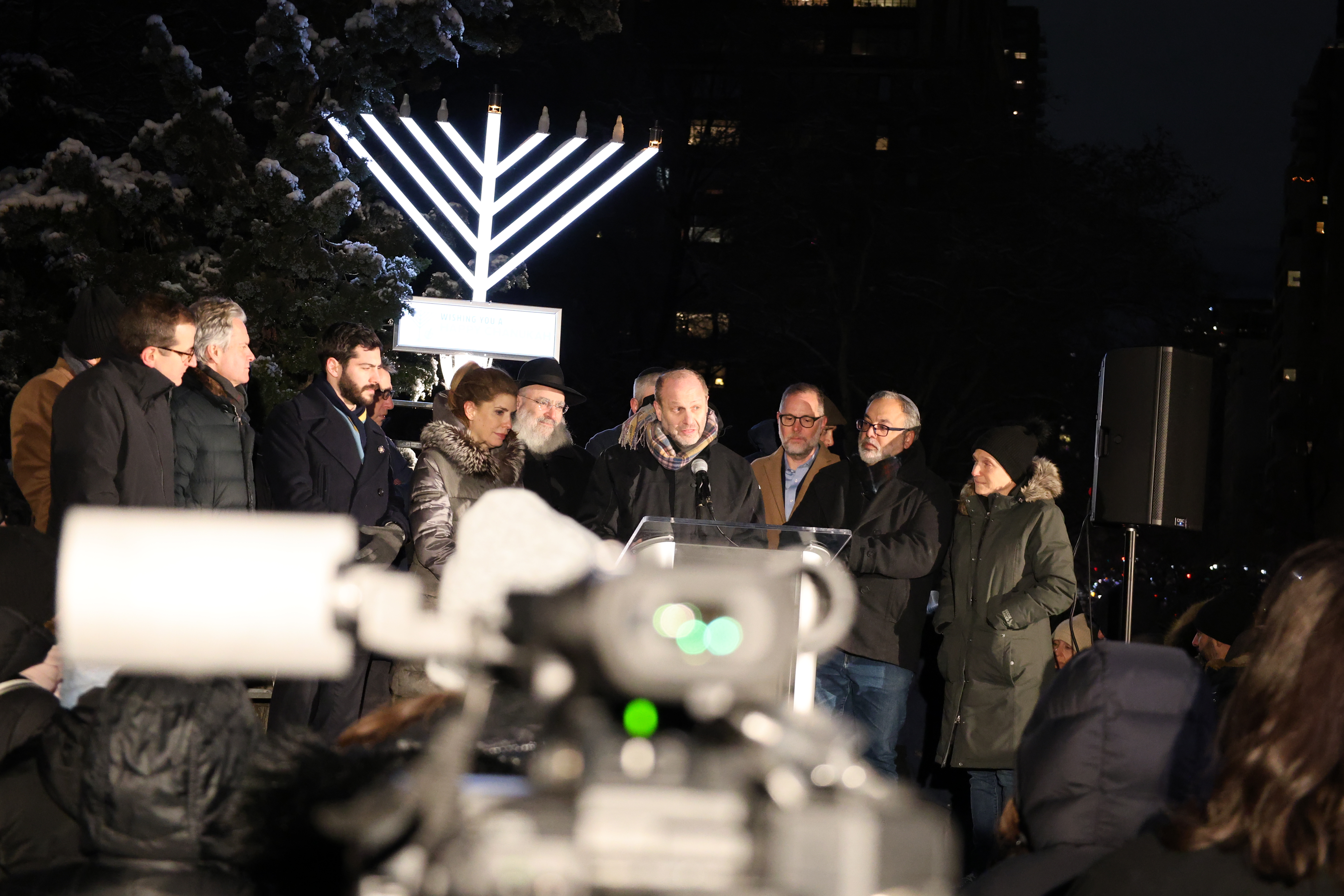
Rabbi Chaim Steinmetz of Kehilat Jeshrun lighting Chanukah candles next to Gracie Mansion in December 2025 before a crowd and reporters, alluding to the new mayor’s anti-Jewish opinions and statements (photo: First One Through)
These Jews are heirs to what may have been one of the greatest Diaspora golden ages in Jewish history. New York Jews built synagogues, schools, hospitals, charities, businesses and cultural institutions. They rose to the highest levels of civic life and came to regard their acceptance as a permanent feature of the city. Their children could be openly Jewish, openly Zionist and fully American without perceiving any contradiction.
Recent attacks and an increasingly hostile public climate have shaken that confidence. Rabbi Krauss writes that students returned to school carrying both fear and a need to answer it. That answer should not be a plea for acceptance from a mayor. It should be a declaration that Jewish identity does not depend upon a mayor’s approval.
Haazinu does not teach that Jewish survival rests upon the favor of rulers. It teaches that the Jewish relationship with God, Torah and the Land of Israel survives the rise and fall of political powers. Moses delivers the song while standing outside the land he will never enter, yet he speaks of the connection between Israel and its land as something deeper than temporary possession or political recognition. Governments may contest it, enemies may attack it and Jews themselves may neglect it, but the covenant remains.
That should be the meaning of Friday’s public prayer. The students should not perform Judaism for the mayor. They should show New York what Judaism looks like: children praying openly, affirming their faith, facing Jerusalem and refusing to sever their attachment to Israel in exchange for political comfort.
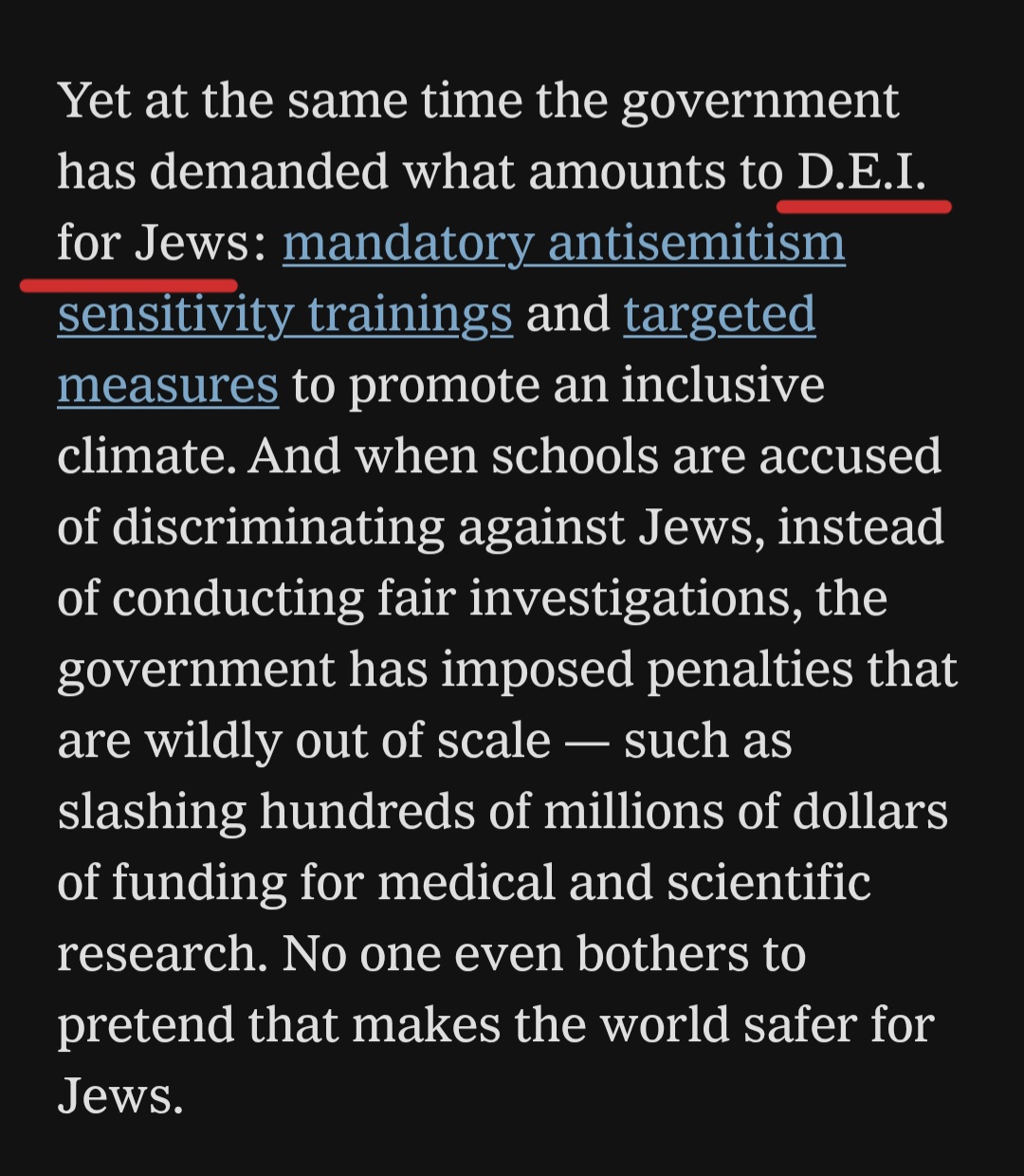
The Trump administration, he writes, has demanded “what amounts to D.E.I. for Jews.”
What he means is antisemitism training and measures intended to ensure that Jewish students can attend classes, use campus facilities and participate in university life without harassment or intimidation.
That is not D.E.I. It is equal protection.
D.E.I. programs may use identity-conscious policies to pursue representation or other preferred outcomes. On the other hand, civil-rights law imposes a simpler rule: institutions receiving federal funds may not discriminate against students because of their race, ethnicity or shared ancestry.
Preferred outcomes and equal protection are not just not the same thing.They are opposites.
If Black students are targeted, the law protects them. If Muslim or Arab students are targeted, the law protects them. If Jewish students are targeted, the law protects them. Applying the same rule to Jews does not create a Jewish preference.
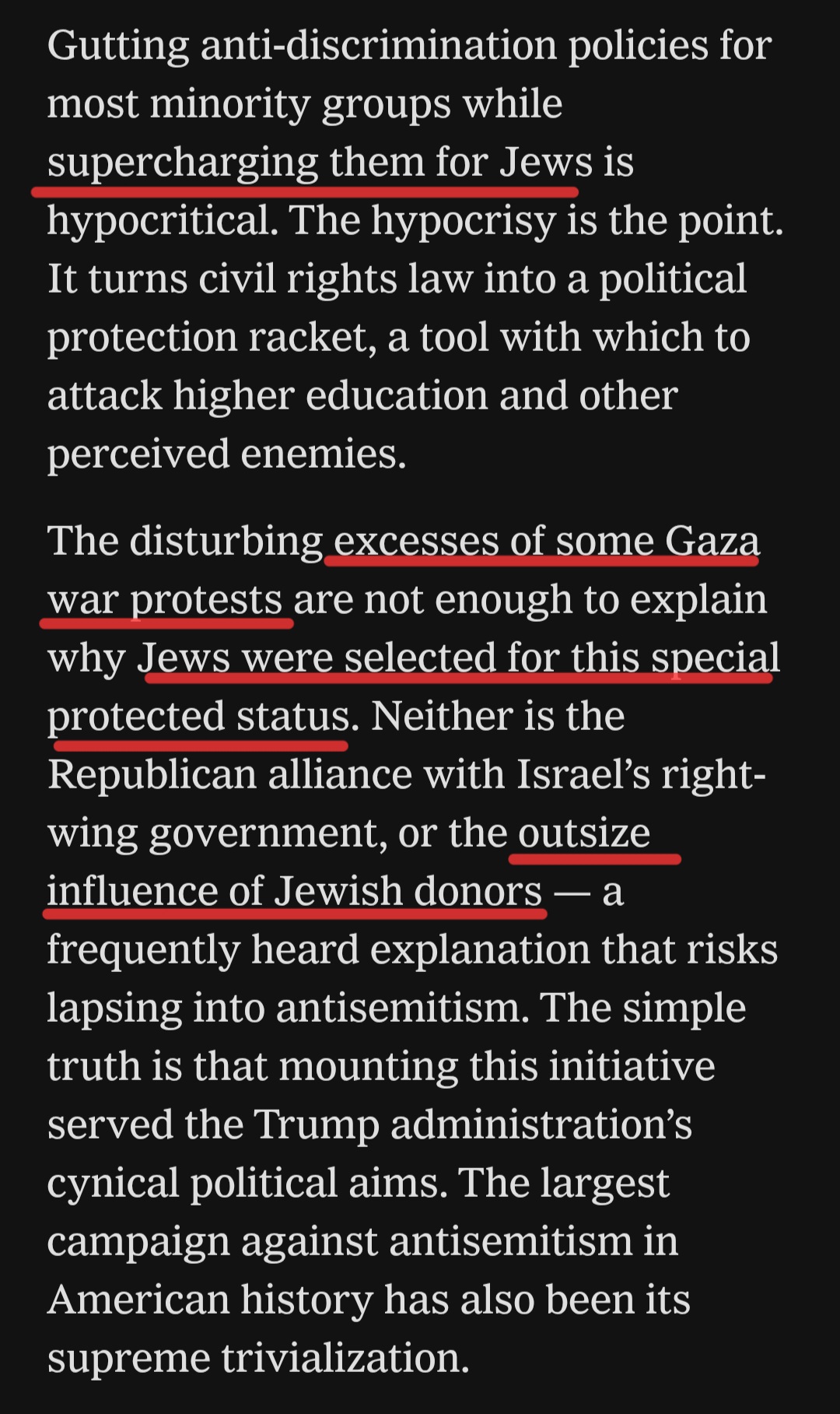
Loeffler nevertheless describes Jews as having been selected for special protection. That is absurd. Title VI has long covered antisemitic discrimination, just as it covers comparable discrimination against other groups. Whether a particular penalty is proportionate is a separate question from whether protecting Jewish students constitutes D.E.I.
Loeffler avoids that basic distinction by reducing the conduct surrounding Gaza protests to “excesses.” But the issue was not criticism of Israel or a few offensive placards. Jewish students faced ongoing intimidation, exclusion, celebrations of Hamas murderers and rapists, and chants invoking violence while universities failed to enforce their own rules.
The relevant question is whether universities tolerated treatment of Jewish students that they would have confronted had another minority been targeted. Instead, Loeffler makes the government’s response the scandal. His essay moves away from the students suffering harassment toward theories about Trump, demographic change, white panic and “Jewish donors.” The people seeking protection disappear into an argument about the motives of those enforcing the law.
That this comes from a professor of modern Jewish history is difficult to understand. Loeffler is not an uninformed commentator stumbling over the difference between a preference and a right. His credentials rest on Jewish history, antisemitism and civil liberties. He is a research fellow at the Shalom Hartman Institute which promoted the article on its website.
How does a scholar with that background look at the present condition of American Jews and identify their protection as the suspicious development? How does he see Jewish students threatened and excluded, yet reserve his strongest language for the government finally acting? How does an authority on antisemitism mistake equal treatment for Jewish favoritism?
The New York Times paraded an “As A Jew” with Trump Derangement Syndrome to encourage students coming back to school to come after their Jewish classmates once more and vote against Republicans in the mid-term elections.
Disliking the administration enforcing the law does not transform the law into D.E.I. Equal protection does not become preferential treatment when the people receiving it are Jews.
You can also share your thoughts with the Shalom Hartman Institute for having Loeffler be an ongoing research fellow and promoting his article at 212-268-0300.
In May 2014, Macklemore walked onto a Seattle stage wearing a large prosthetic nose, dark wig, beard and black suit. Then he performed “Thrift Shop,” a song about being cheap.
Macklemore in Jewface in 2014, singing about being cheap
It would be difficult to construct a more recognizable antisemitic spectacle: the exaggerated Jewish nose, the beard, the dark clothes, all while singing about bargain hunting. Actor Seth Rogen mocked Macklemore’s explanation that it was merely a random disguise: if someone were instructed to assemble an antisemitic Jewish costume, Rogen wrote, “they’d have that exact shopping list.”
As criticism mounted, Macklemore apologized. He acknowledged that the outfit could be understood as a Jewish caricature but maintained that no Jewish stereotype had crossed his mind.
Yeah, right. That should have been a simple moment for the Anti-Defamation League to clearly denounce the spectacle.
Instead, the ADL chose absolution.
“We take him at his word that he did not have any ill intent,” then-ADL director Abraham Foxman said, “and unreservedly accept his apology.” And then Macklemore gave the ADL a promotional shout-out. “Through this situation I’ve got hip to some incredible groups like the ADL,” he wrote, encouraging people to check out their “great work.”
The country’s best-known antisemitism organization publicly and “unreservedly” accepted his apology and also his advertisement. It is unclear whether there was a quid-pro-quo and whether the ADL was trying to promote its antisemitism study it released the week before.
As they say in text-land: “WTF?”
Twelve Years Later
It is now 2026, and antisemitism is raging through American public life. Much of it no longer arrives wearing a fake nose and beard. It travels under political banners, frequently through rhetoric about Zionists and Israel.
And Macklemore is back on a concert stage.
Opening for Ed Sheeran at MetLife Stadium, he told tens of thousands of people why he had joined the tour: so that he could stand in stadiums and say, “Free Palestine.” He accused Israel of genocide, performed “Hind’s Hall” against a backdrop of footage from pro-Palestinian campus encampments and turned part of the concert into a political demonstration.
This time, the ADL wasn’t offering absolution.
“They came for a concert, not performative, biased and hateful anti-Israel ‘activism’ from his opener, Macklemore,” the organization declared. It pointed to what it describes as his record of demonizing Israel and Israelis, falsely accusing Israel of genocide and engaging in antisemitic rhetoric and behavior.
When Macklemore was subsequently removed from the remainder of Sheeran’s tour, head of ADL Jonathan Greenblatt applauded the decision, saying that “for years, Macklemore has pushed antisemitic tropes and demonized Israel and Israelis.”
What a difference twelve years makes.
The Permission Slip
The problem in 2014 wasn’t only that the ADL accepted an apology. It was that it seemingly confused forgiving the man with minimizing the act.
America’s leading antisemitism organization effectively told the public that Macklemore’s updated and revised intentions settled the matter. A concocted and forced apology after multiple attempts to satisfy the offended, became another chip on the accused – I’m sorry you were offended, not I’m sorry that I have done something terrible that offended you.
Jews are the subject. Always. The antisemite is a victim of Jewish sensitivity.
The ADL granted a permission slip of sorts to this vulgarity and inanity. Permission for American culture to treat an astonishingly recognizable Jewish caricature as something that could be quickly explained away if the right person said he hadn’t meant it.
Now, the ADL that once took Macklemore at his word is no longer particularly interested in his assurances about what he means. It considers impact. The false charge of “genocide” against Israel in Israel’s defensive war is a common pretext to attack Jews today. Macklemore’s appeal to thousands wasn’t a call for peace but incitement to pogrom.
But that was precisely the lesson the ADL could have taught in 2014.
There is an important role for forgiveness in fighting hatred. People must be allowed to recognize mistakes, apologize and change. That is what the Ten Days of Repentance we are in right now is about.
But forgiveness without the party internalizing the matter coupled with contrition is meaningless. It is actually much worse. It is a wink with a get-out-of-jail card. Carry on with spreading antisemitism; we’ll only call it out when the situation becomes intolerable.
Neither October 7, 2023 nor October 8 appeared magically. First One Through has been writing about this phenomenon nearly every day since those same days in May 2014, when it wrote about the UN’s Richard Falk stating that Israel’s “criminal intention [toward Palestinians] is genocidal.”
Does that word have a familiar ring to it? The UN has been using it constantly for well over a decade; before the wars of 2014, 2021 or 2023.