
There is something almost miraculous about Operation Wings of Dawn.
This week, Israel began bringing the first members of the Bnei Menashe community from northeast India to Israel, the latest chapter in one of the most improbable stories in Jewish history. These are Jews who have long understood themselves as descendants of the Tribe of Manasseh, one of the Ten Lost Tribes of Israel, exiled by the Assyrian Empire nearly 2,700 years ago. Across centuries, empires, languages, and continents, they preserved fragments of ritual, memory, and identity tied to ancient Israel. In modern times, after study, rabbinic engagement, and formal recognition, thousands have made aliyah. Hundreds more are now on their way. For the Jewish world, it is an extraordinary scene: a people scattered to the farthest reaches of the earth still finding their way home.
That is the Jewish story in miniature.
Exile was never meant to be permanent. The Jewish calendar, Jewish prayer, and Jewish memory are saturated with return. From The Hebrew Bible to the modern Zionist movement, the idea of ingathering has been the central thread of Jewish continuity. Operation Wings of Dawn is not an immigration program in the ordinary sense. It is the continuation of that ancient civilizational arc.
It is also a reminder that Jewish peoplehood never fit modern racial categories. Jews came back to Israel from Ethiopia, from Iraq, from Yemen, from Russia, from France, and now again from India. Different languages. Different appearances. Different histories of exile. One people.
That should be a remarkable human story.
And yet, in some corners of the media world, it became something else.
Quds News Network ran a story framing the arrival as a “settlement push” of “new colonizers” in northern “Occupied Palestine”, reducing the Bnei Menashe to instruments of a political project rather than recognizing them as Jews returning to join the Jewish people in the Jewish state. The framing is familiar: Jewish return is recoded as colonial expansion.

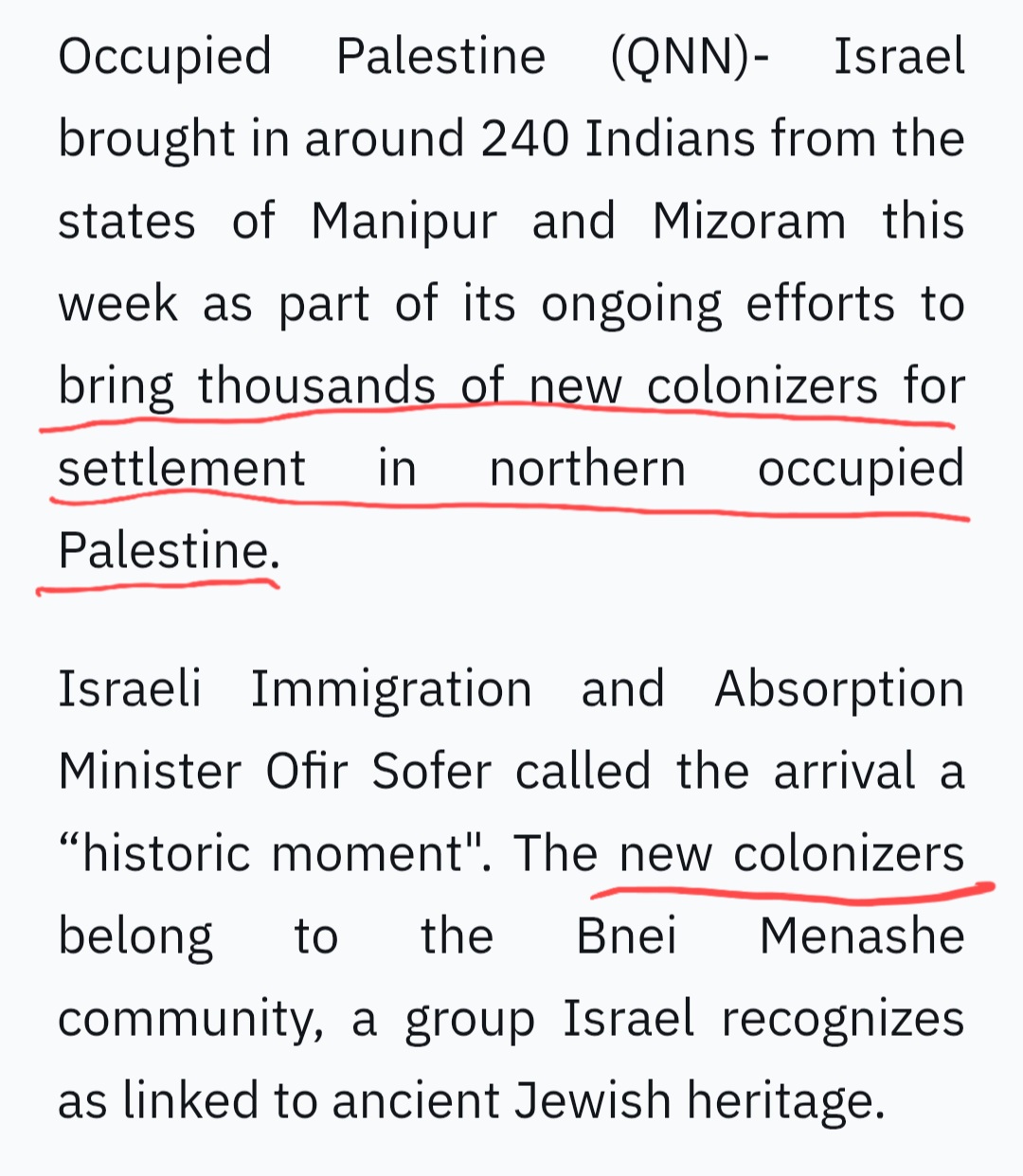
This is not an isolated habit of language. Across anti-Israel activist media and parts of the NGO ecosystem, Jewish presence in Israel is increasingly interpreted through a “settler-colonial” framework in “Occupied Palestine,” meaning anywhere in Israel. Amnesty International’s apartheid framework leans heavily on this vocabulary, turning Jewish sovereignty itself into a structural offense rather than a legitimate act of national self-determination. That language then migrates outward, shaping how journalists, activists, and political movements speak about Jews in Israel. The result is a moral inversion in which Jewish return becomes aggression by definition.

And this is where the word colonizer collapses under its own weight.
Colonialism has an actual meaning. It is when an imperial center sends its people outward to dominate foreign land for extraction and rule. Britain in India. Spain in the Americas. France in Algeria.
Operation Wings of Dawn is the reverse movement: A dispersed people carrying an ancient memory of Israel, choosing to gather into the one Jewish homeland.
Calling that colonialism empties the word of meaning.
And the asymmetry is impossible to ignore.
When Palestinian Arabs preserve the memory of villages lost 77 years ago, the world treats it as sacred inheritance, a claim passed from generation to generation. Even when those same Arabs live just a few miles away from their grandparents’ homes, in the same land, with the same people, language and culture, people advocate for their relocation.
Yet when Jews preserve the memory of exile in distant lands and act on it, the same world increasingly calls it colonization.
That difference tells you everything.
The issue has never been whether Jews are European or Middle Eastern, white or brown, indigenous or diasporic. The Bnei Menashe expose how flimsy those categories always were. Indian Jews arriving in Israel should shatter the lazy caricature of Zionism as European implantation.
Instead, the caricature simply repeats the mantra:
A Jew from Poland returns as a colonizer.
A Jew from Iraq returns as a colonizer.
A Jew from Ethiopia returns as a colonizer.
A Jew from India returns as a colonizer.
For those committed to denying Jewish belonging, even a homecoming from India must be rewritten as invasion.


