
Claude Monet (1840-1926) spent his life chasing light.
He helped launch Impressionism by shifting painting away from fixed objects and toward the unstable conditions of the act of seeing itself. Through a variety of subjects – haystacks, cathedrals, train stations, coastlines – Monet returned again and again, capturing what never held still: morning light, evening shadow, fog, heat, atmosphere. The object remained. Perception changed.
And then, late in life, he turned almost entirely to water.
At Claude Monet’s House and Gardens in Giverny, France, Monet painted the pond in his garden more than 250 times, producing the vast Water Lilies series that consumed the final decades of his life. These were far more than decorative studies of flowers on water. They became his great final act, culminating in enormous panoramic canvases so large they stop functioning like ordinary paintings.
They become environments.
Stand inside the oval rooms at Musée de l’Orangerie in Paris and something unusual happens: you lose orientation.
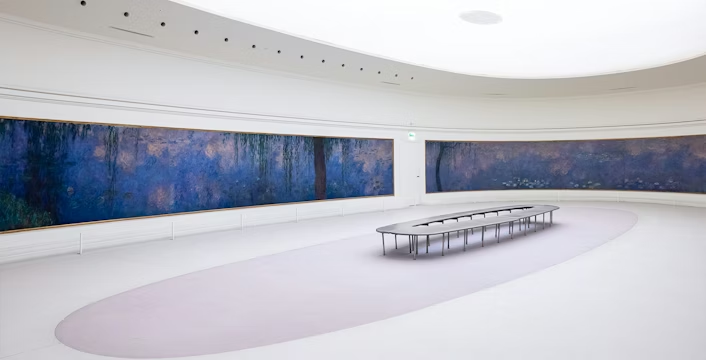
There is no horizon line to stabilize the eye. No clear beginning or end. Water stretches outward without boundary. Sky descends into the pond as reflection. Trees fracture into color and light. Surface and depth collapse into one another.
You are no longer looking at a pond. You are inside a field of undifferentiated perception.
That is what makes the late Water Lilies so unsettling. And beautiful.
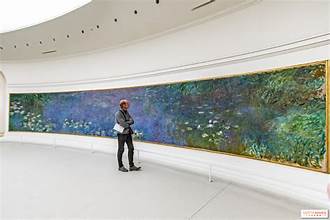
Monet strips away the architecture of the ordinary. In most painting, the world arrives in layers: foreground, middle ground, background. Here, those distinctions dissolve. What is above enters below. What is solid becomes liquid. What seems stable flickers and shifts.
The eye searches for boundaries and cannot quite find them. One is left with colors, sometimes sharp and other times diffuse, as solid and liquid vie for primacy.
And that is where the Bible begins. In tohu va-vohu.
The phrase describes a world before distinction. Existence is present, but unformed. Darkness over the deep. Water everywhere. No stable land, no horizon, no orienting line for human perception in the world before humans.
A world new and present, but unreadable.
Genesis begins in the same visual condition Monet creates: immersion in undifferentiated reality.
In the Bible, God focuses on creation through separation. Light from darkness. Waters above from waters below. Sea from dry land. Creation is manifest by distinction. Reality becomes intelligible because boundaries emerge.
This is the radical claim of Genesis: the natural world emerged from chaos, from the topsy-turvy world of tohu va-vohu. And Monet performs the reverse. He takes the natural world and loosens its boundaries, dissolving it back into its primal elements: light, water, color, reflection.
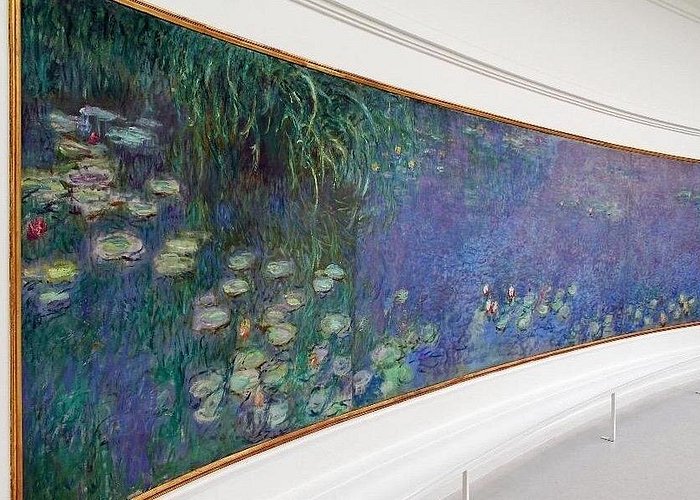
And yet it remains nature. That is the wonder of the Water Lilies.
They allow us to see the natural world as if it were returning to its chaotic first condition, before edges hardened, before boundaries settled, before the eye could fully distinguish one thing from another.
Monet, at the end of his life, took the simple beauty of his backyard garden and let humanity imagine the entire natural world at the moment of creation, before there were objects, before perception was even possible.
It was a remarkable end of a career for the gifted painter who chased light throughout his days, to conclude at the very First Day.


Lovely essay.Sent from my iPhone
LikeLike
So glad you enjoyed. Please share. I will write more about art from a Jewish perspective if people enjoy it.
LikeLike