Checkpoint in California and Checkpoint in the West Bank. Only One Sparked Outrage.

There are many ways to measure whether politicians are guided by principle or politics. One is to compare what provokes their outrage and what does not.

In April 2024, a Jewish student at UCLA tried to walk across his own campus.

Pro-Palestinian protesters physically blocked his path and decided, on their own authority, who could and could not pass. UCLA security officers stood by and did nothing. A federal judge later ruled that UCLA could not permit Jewish students to be excluded from parts of campus because of their identity or beliefs, calling such exclusion “unimaginable” and “abhorrent.”

Where were California’s Democratic members of Congress about the incident? Other “progressive” members of Congress? Where were the press conferences, the demands for investigations and the flood of social media condemnations?

Their silence was striking.

Then came Rep. Ro Khanna’s recent 7,500-mile trip to the West Bank in July 2026.

Khanna claimed that armed settlers and Israeli soldiers prevented his delegation from proceeding and that U.S. Embassy involvement helped resolve the situation. Israeli officials, the U.S. embassy, and various parties dispute key parts of that account, saying the delegation entered a restricted security area without proper coordination and denying Khanna’s characterization of the encounter.

Yet progressive members of Congress like Ilhan Omar quickly rallied behind Khanna, condemning Israel and amplifying his account around the world.

The comparison is not between two people who were blocked. It is between two very different reasons for being blocked and the reactions that followed.

At UCLA, private protesters established their own checkpoint and allegedly decided which Americans could pass based on who they were or what they believed. A federal court concluded that a public university could not allow that to happen.

In the West Bank, the issue was about security. The area was subject to access restrictions because it was an active conflict zone. The dispute is over whether those security measures were properly applied not whether Ro Khanna had a right to unrestricted entry.

One concerns equal treatment under American law, the other concerns the exercise of security authority in a foreign conflict zone. Yet the louder political outrage came in response to the latter.

If elected officials cannot summon the same moral urgency when a Jewish American student is excluded from his own campus as they do when a colleague encounters a disputed security checkpoint overseas, the question is no longer whether they oppose injustice. It is what kinds of injustice – and for whom – they choose to notice.

We are witnessing more and more of the elected progressive wing marking American and Israeli Jews as “absolutely vile” people unworthy of basic protections and rights who “must be stopped.”

The Jewish Anti-Zionist Congress and the Divide on the Future of Israeli Jews

From June 26–28, 2026, activists, academics, politicians, lawyers, and religious figures gathered in Dublin, Ireland for the Second Jewish Anti-Zionist Congress (JAZIC). The stated purpose was to build an international movement dedicated to dismantling Zionism and replacing the State of Israel with a different political order in the region of historic Palestine.

Despite its name, the congress was far from exclusively Jewish. The program featured well-known Jewish anti-Zionists such as Rabbi Brant Rosen, Ilan Pappé, Haim Bresheeth-Žabner, Ronnie Barkan, and Andrew Feinstein alongside prominent non-Jewish figures including Palestinian journalist Ramzy Baroud, UN Special Rapporteur Francesca Albanese, former UN official Craig Mokhiber, rocker Roger Waters, Irish parliamentarians, South African activists, and other international advocates.

On the central questions, there was remarkable agreement: Jewish and non-Jewish speakers alike described Israel as an apartheid state engaged in genocide. Both groups rejected Zionism as the legitimate expression of Jewish self-determination. Both endorsed Palestinian Arab “liberation” and opposed the continued existence of Israel as a Jewish state. Discussions of Hamas were comparatively limited; the conference overwhelmingly focused on Israeli conduct rather than Hamas’s governance of Gaza or the October 7 massacre. They spoke about the defeat of Zionism as the key to dismantling “western imperialism.”

Yet beneath this broad consensus was a subtle but revealing difference.

The Jewish speakers generally spent considerable time describing what they believed should replace Israel. Rabbi Brant Rosen, Ilan Pappé, and others spoke of a single democratic state in which Jews and Palestinians would remain together as equal citizens. Whether one finds that vision realistic or not, it was at least an attempt to answer a fundamental question: If Israel ceases to exist as a Jewish state, what becomes of the millions of Jews who live there?

In contrast, most of the non-Jewish speakers spoke of “liberation,” “decolonization,” “resistance,” “return,” and dismantling Zionism. In almost all of these presentations, the future political status, security, and place of Israel’s Jewish population after “decolonization” received little or no attention.

The silence is significant. If a movement calls for replacing an existing state, one of its most basic responsibilities is to explain what protections, rights, and security will exist for the people who currently live there. At JAZIC, that question received far more attention from the Jewish speakers than from their non-Jewish counterparts.

Many progressive Zionist Jews in the United States woke up on October 8, 2023 to realize that the people with whom they had fought together as allies really wanted them dead. At some point in the future, far-left anti-Zionist Jews will have their own awakening of their current comrades-in-arms.

Palestinians and Their Supporters in the Global South Hunt Jews

On June 27, 1976, Palestinian terrorists hijacked Air France Flight 139, a civilian airliner traveling from Tel Aviv to Paris. The operation by the Popular Front for the Liberation of Palestine‘s external operations network diverted the aircraft to Entebbe, Uganda, where the hijackers, aided by Idi Amin’s regime, held more than one hundred civilians hostage while demanding the release of imprisoned terrorists.

Then came the moment that revealed the deeper nature of the conflict.

The hijackers separated Israeli and non-Israeli Jewish passengers from the rest of those on board. Many other passengers were eventually released. The Israelis and Jews remained in captivity.

Had nationality been the only issue, non-Israeli Jews would have been released alongside the other foreign passengers. Instead, Jewish identity itself became grounds for continued imprisonment. The selection demonstrated that the target extended beyond the State of Israel to the Jewish people themselves. Decades after the Holocaust, Jewish civilians once again found themselves sorted from their fellow passengers because they were Jews.

The crimes committed during the hijacking were numerous. Palestinian terrorists seized a civilian aircraft, held innocent men, women and children hostage, threatened mass murder to secure political concessions, and singled out Jews for continued captivity. Three hostages died during the Israeli rescue operation, and Dora Bloch, an elderly Jewish hostage who had been taken to a hospital in Kampala, was later murdered by Ugandan authorities.

Hostages saved from Palestinian terrorists in Entebbe Airport, Uganda, July 4, 1976

Palestinian terrorists and their sympathizers have often come for non-Israeli Jews. Synagogues and Jewish community centers were attacked in cities far removed from the Middle East battlefield. Rome. Athens. Istanbul. Hezbollah and Iran often acted in support of Palestinian Arabs, just as they have since October 7, 2023.

Palestinian Arab opened fire in the Great Synagogue in Rome, Italy October, 1982, killing a 2-year old and wounding 37

And the Palestinian Arabs don’t hide it. The 1988 Hamas Charter is not simply a terrorist manifesto, but a deeply antisemitic one. Palestinians voted Hamas to 56% of parliament with such screed and continue to vote for the group over Fatah in every poll.

Fifty years ago, on July 4, 1976, the Israeli Defense Forces saved over 100 Israeli and non-Israeli Jews who were held hostage by terrorists. The rescue operation only killed Ugandan soldiers and the terrorists themselves – no Ugandan nor Gazan civilian was harmed.

Yet countries still rebuked Israel in the week that followed:

  • Libya: “Israel’s wanton aggression is a serious and grave crime against international law.”
  • Benin: “act of aggression committed by Israel against Uganda.”
  • Somalia: “Israel’s flagrant aggression against the sovereignty and territorial integrity of Uganda.”
  • Cuba: “The action of Israel… unquestionably constitutes a flagrant violation of the basic provisions of the United Nations Charter.”
  • Mauritius: “act of aggression.”
  • Pakistan: “the Council should demand that compensation for the great loss of life and property caused by the Israeli action be paid to Uganda.”
  • Mauritania, sponsored the complaint on behalf of the African Group.

“the Western Powers have manifested a racist and fanatic solidarity with the white minority settlement in Palestine. For them, the Israeli aggression merely demonstrated a highly successful operation performed by the white man against the blacks of Africa and against the browns of the Arab lands -against the blacks and the browns of another and hostile world, that of the Arab-African community.” – Libya regarding Israeli rescue of 100+ hostages held by Palestinian Arabs in Uganda

The total populations of Uganda and the countries above is roughly 373 million. The Jewish population in all of these countries combined is under 5,000, 0.001%. They are unwelcome and unwanted.

Wheelchair-bound, 69-year old American Leon Klinghoffer, killed by Palestinian terrorists October 8, 1985

Palestinian Arabs and their supporters in the Global South are ingrained with a deeply hostile view of Jews and the Global North. The latest manifestation has been seen since the barbaric attacks of October 7, 2023, but can be seen just as clearly fifty years ago, when Israel rescued other Jewish hostages.

Why Is Jewish Identity Treated Differently?

New York has embraced an important idea: identity deserves respect.

Its laws explicitly protect both gender identity and gender expression, recognizing that identity is not merely an internal characteristic but something people live and communicate publicly through appearance, speech, names, clothing, and behavior.

That principle is admirable but is it applied consistently?

The Jewish people also possess an identity that is both internal and external. Jews express that identity through religion, language, holidays, history, culture, family traditions, symbols, and connection to their ancestral homeland.

For many Jews, that expression includes Zionism.

Contrary to its frequent caricature, Zionism is not a political opinion. It rests on two historical facts and one political principle: Jews are a people; they originated in the Land of Israel; and therefore they are entitled to national self-determination and sovereignty in their ancestral homeland.

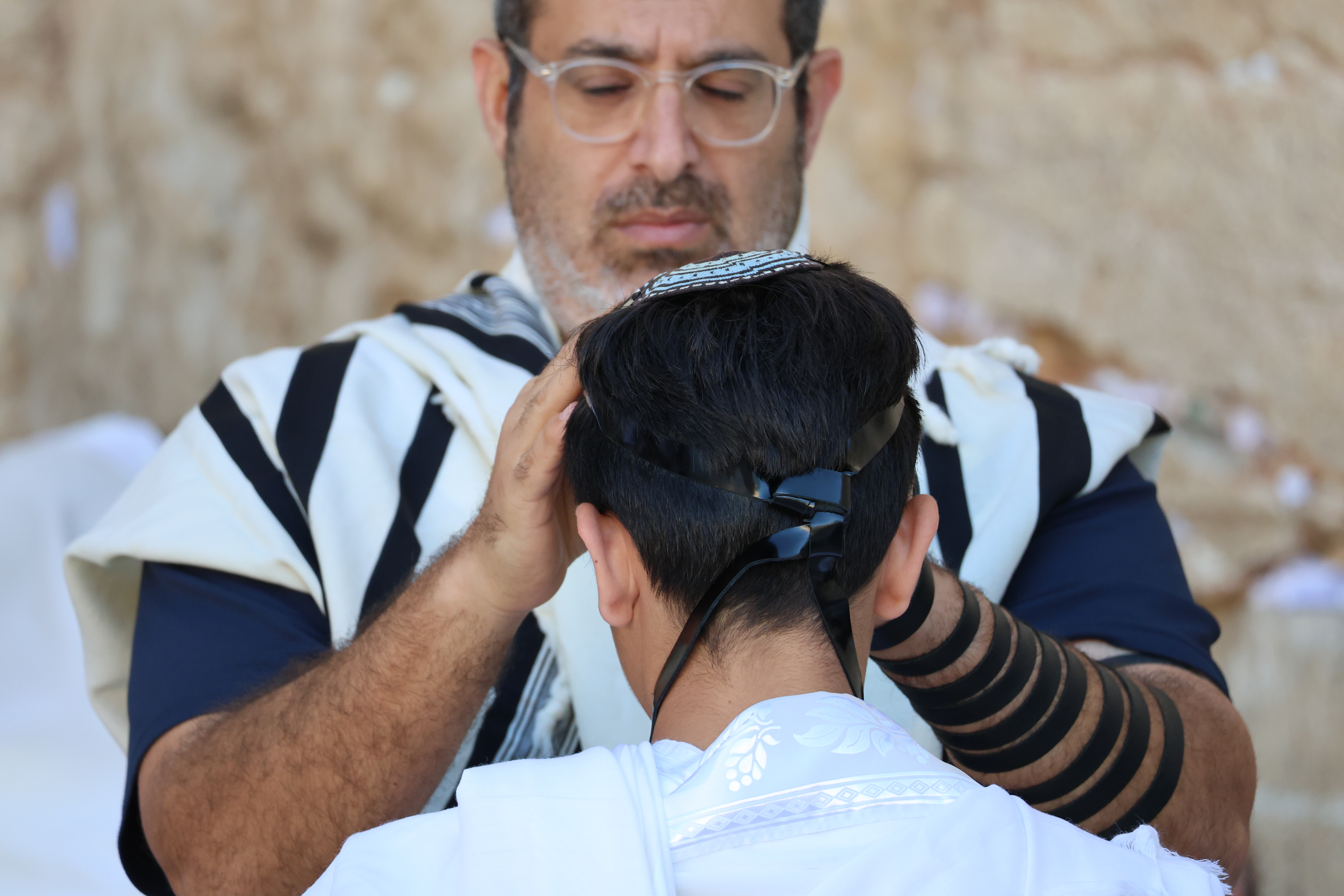
Like wearing a kippah, lighting Shabbat candles, speaking Hebrew, or displaying a Star of David, affirming the Jewish people’s right to their homeland is, for many Jews, a basic expression of Jewish identity.

Yet this expression is increasingly treated as unacceptable.

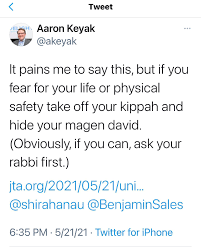
President Biden’s U.S. Deputy Special Envoy to Monitor and Combat Antisemitism at the State Department, told Jews to hide expressions of their Judaism on May 21, 2021

Across universities, workplaces, and public institutions, “Zionist” is often used to describe a political viewpoint and as a label for exclusion. Students are told Zionists are unwelcome. Employees are pressured to distance themselves from Zionism. Organizations adopt anti-Zionist litmus tests that, for many Jews, require repudiating a central expression of their identity.

New York City subway where anti-Israel protestors call for Zionists to get out

If society recognizes that identity includes both who a person is and how that person expresses that identity, why should that principle stop with gender?

No one should be expected to abandon a central expression of identity in order to participate in public life, attend a university, or feel welcome in a workplace.

“Zionists don’t deserve to live,” and “Be grateful that I’m not just going out and murdering Zionists.” – Columbia University student Khymani James

This is not a request for special treatment. It is a request for consistency.

If identity deserves dignity, then every community’s identity deserves dignity. If expression deserves respect, then that principle should not end where Jewish identity begins.

A Pact for the Future of Religious Heritage

The United Nations has a Pact for the Future. It looks ahead to artificial intelligence, digital governance, climate change, sustainable development, financing, debt and even discussions of global taxation. The underlying premise is that humanity faces challenges unlike those of previous generations and that international cooperation must evolve accordingly.

Yet there is one omission that is difficult to ignore. While the international community has developed increasingly sophisticated frameworks to protect biodiversity, endangered languages, cultural artifacts and World Heritage Sites, it has produced no comparable vision for preserving one of humanity’s oldest living inheritances: its religions.

We have become remarkably good at preserving the products of civilization. Archaeologists restore temples after earthquakes. UNESCO protects historic churches, synagogues and mosques. Museums conserve ancient manuscripts while linguists race to document disappearing languages before the last native speakers die. We understand instinctively that once these treasures are lost, they cannot truly be recreated. Yet we devote far less attention to the living communities that gave those monuments meaning. A restored monastery is no substitute for the monks who once prayed there. An ancient synagogue is just beautiful stone if the Jewish community that sustained it for centuries has vanished. Preserving the architecture while allowing the faith itself to disappear is to save the shell while losing the civilization.

This is no longer a hypothetical concern. In only a generation, ISIS nearly exterminated the Yazidis while devastating ancient Christian communities whose roots stretched back to the earliest centuries of Christianity. The Taliban’s return to power accelerated the disappearance of Afghanistan’s Hindu and Sikh communities and forced Christians even deeper underground. Across parts of Africa, jihadist movements have burned churches, murdered clergy and displaced entire Christian villages. Indigenous and tribal religions continue to fade through modernization, migration and demographic collapse, while Jewish communities that had flourished across much of the Middle East and North Africa (MENA) for two millennia have largely disappeared. These are different stories unfolding on different continents, but together they reveal the same pattern: humanity’s religious diversity is steadily shrinking.

There were once an estimated 250,000 Jews in Morocco. They are have almost all left since 1948

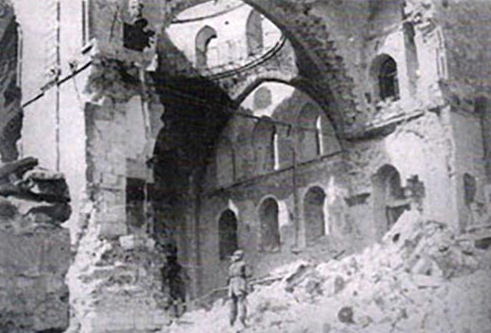
Recent years have demonstrated how fragile minority religious and ethnic groups can be. Christians have seen ancient churches destroyed or emptied by war. Pilgrimages have been disrupted by conflict in multiple regions. Jews continue to be barred from praying openly at the Temple Mount in Jerusalem, the holiest site in Judaism.

The legal foundations for religious liberty already exist. Article 18 of the Universal Declaration of Human Rights recognizes the freedom of thought, conscience and religion, including the right to change one’s religion. Yet millions still live where that freedom exists only on paper. Apostasy remains punishable under law or through the application of religious law in several countries, while blasphemy laws continue to imprison people or expose them to severe punishment simply for changing or expressing their beliefs. At the same time, digital surveillance, online incitement and transnational extremist movements have created entirely new forms of religious persecution that the architects of the postwar human rights system could scarcely have imagined.

Radical Islamists call for killing converts from Islam

Perhaps the world needs a Pact for the Future of Religious Heritage – one that treats living religious communities with the same urgency that we reserve for endangered species, disappearing languages and historic monuments. Such a framework would protect sacred sites, preserve endangered faith traditions, defend freedom of conscience, encourage the repeal of laws criminalizing apostasy and blasphemy, establish rapid international responses to religious persecution, and affirm that followers of every religion should be able to freely, safely and openly worship at their sacred sites and undertake traditional pilgrimages.

Civilizations are remembered not only for the monuments they leave behind, but for the beliefs that inspired them and the communities that kept those beliefs alive. Humanity has learned to preserve forests, wildlife, manuscripts and archaeological treasures. The next step is to preserve something even older and even more fragile: the living faiths that have shaped civilizations for thousands of years.

Was the JNS International Policy Summit Worthwhile?

A friend noticed I had attended the JNS International Policy Summit in Jerusalem and asked if it was worthwhile.

I paused. “That’s actually a harder question than it sounds. I have too many thoughts for a text message.”

This article is my answer.

The event. Alex Traiman, CEO of JNS, and Richard Heideman, Chairman of the JNS International Policy Summit, assembled an impressive three-day program. Israeli Prime Minister Benjamin Netanyahu, President Isaac Herzog, U.S. Ambassador Mike Huckabee, the “Green Prince” Mosab Hassan Yousef and dozens of leading policymakers, legal experts and advocates discussed nearly every dimension of Israel’s current challenges.

Topics: The summit covered twelve main topics with a few breakaway panels for each so people could listen to various subjects. It covered everything from antisemitism and regional security to international law, Judea and Samaria, Israel’s democracy, Christian-Israel relations and the narrative war playing out across traditional and social media.

JNS panel discussion on Regional Security

What makes a conference worthwhile? Many conferences share the discussions online – as did JNS – so people often question the value of devoting so much time to listening to so many speakers. I usually attend conferences to become energized and to meet like-minded people. That has been my experience at Tikvah events in New York, for example. I will share that it was not my feeling at this JNS conference.

For one thing, the attendees here were much more engaged in politics professionally than at a Tikvah Leadership Conference. Most of the people at the Waldorf Astoria knew everyone on the panels, worked with them and could have joined any of the discussions. It felt like the crowd was full of understudies ready to assume an empty chair on stage, or ready to have working sessions in side rooms. It made talking to fellow attendees extremely interesting for anyone looking to fully engage in the various subject matters.

However, the vibe of the Jerusalem News Syndicate conference was much more right-wing than I had anticipated. I had thought of JNS as simply an alternative to AP and Reuters, providing an Israeli perspective on the news. While I expected it to be right-of-center, I was surprised at how many deeply right-wing people were both speakers and attendees.

Two Themes: Trump-Iran/Lebanon: The backdrop for the event must be set, as events in the Middle East move quickly.

At the time of the conference, June 21-23, it appeared that the Trump Administration was striking a deal with Iran that was viewed by the speakers as profoundly weak regarding Iran, and deeply flawed as it related to Israel’s war with Hezbollah. Speakers went out of their way to say how much they love Donald Trump and Israel could never ask for a better friend, so such a skilled negotiator obviously just needed to buy time through July 4 celebrations and the World Cup, and would then return to finishing the Iranian nuclear and ballistic threats. Speakers avoided smearing Vice President JD Vance in public, but the quiet discussions near the cookies in the hallway were that they would like to see Marco Rubio as the president after Trump.

The opinions were definitely hawkish: Israel needs to maintain a buffer in Lebanon until Hezbollah is disarmed and terrorist infrastructure is removed. The same format is required in Gaza for Hamas. Iran must continue to be attacked until a long-term favorable deal can be struck.

It was interesting to hear how the various speakers thought of the regimes and people in each theater: In Iran, the government is horrible and must be removed while the people are intelligent and wonderful allies-in-waiting. Hezbollah is a rogue Iranian proxy that must be expunged so Israel can develop a long-term peace with the legitimate government of Lebanon. However, the situation in Gaza had no rainbow at the end. While the determination to finish Hamas and disarm it was viewed as non-negotiable, the prognosis for peace with everyday Gazans was viewed as so distant in the future to not even warrant near-term discussions.

Antisemitism/ Narrative: The “eighth front” of the current war is sometimes referred to as the narrative war in the global media and social media by Netanyahu. I believe Israel’s deteriorating image around the world has fueled antisemitism, even if hostility toward Israel and hatred of Jews ultimately remain distinct phenomena.

Michal Cotler-Wunsh, CEO of the International Legal Forum, called “October 7 the Kristallnacht of our times” that will ultimately “come for all democracies.” Lori Lowenthal Marcus of the Deborah Project said that “teacher unions are like the Hamas tunnels in American education,” part of an insidious infrastructure that systemically vilifies Israel. David Brog of the Maccabee Task Force suggested bringing social media influencers to Israel to see the truth, and that those people will become strong advocates when they realize that they’ve been fed lies for years. Miss Israel, Melanie Shiraz suggested changing the entire dynamic: to engage in sports, cultural events and other places where people engage directly in a common arena. “Let them see Israel, not as an argument to be won but a beauty to be shared…. Not with better corrections but better invitations.”

Sara Friedman, CEO WJC Israel; Lori Lowenthal Marcus, Legal Director of the Deborah Project; David Brog, Executive Director of Macabee task Force, and Elan Carr, CEO Israeli-American Council

She received one of only a handful of standing ovations.


So, was the JNS International Policy Summit worthwhile?

Yes, but not for the reason I expected.

The speeches were informative, and many are available online for anyone willing to invest the time. What cannot be livestreamed are the conversations over lunch, the chance encounters in the hallway, and the immersion in an ecosystem of people who have dedicated their lives to defending Israel and Jews in ways most of us never see. Some fight in courtrooms. Others rewrite school textbooks, monitor the United Nations, expose campus antisemitism, advocate for terror victims, build alliances with Christians, or wage the daily battle for truth on social media.

Miss Israel, Melanie Shiraz, surprised the crowd with passionate advocacy for greater cultural exchanges and received a standing ovation

Like any gathering of passionate people, I did not agree with everyone. Some speakers left me inspired; others left me shaking my head. But perhaps that is part of the value of attending in person. A conference is not worthwhile because it confirms everything you already believe. It is worthwhile because it exposes you to the people, personalities, and competing ideas that shape a movement.

The summit reminded me that the defense of Israel and Jewish people around the world is no longer just the work of soldiers and diplomats. It is also carried by lawyers, educators, journalists, researchers, politicians, influencers, and ordinary citizens who understand that ideas, narratives, and public opinion have become battlefields of their own.

That, more than any individual panel, was the lasting lesson I brought home from Jerusalem.

Who Gets to Define the Jewish People?

Parashat Balak contains one of the most unusual narratives in the Torah. For almost the entire portion, the Jewish people disappear from the story.

Throughout the Torah, we experience events through Moses, the Israelites, or God speaking directly to His people. This week is different. The Israelites continue their journey completely unaware of the drama unfolding around them. Instead, the Torah lifts us to the mountaintops of Moab, where King Balak and the prophet Balaam stand overlooking the Israelite camp below.

For the only time in the Torah, we see the Jewish people entirely through the eyes of outsiders.

That perspective is striking. The story told reminds us that long before anyone attempts to destroy a people, they first seek to define them.

Balak does not look upon Israel and see the descendants of Abraham returning to the land God promised their forefathers. He does not see a nation recently liberated from slavery or a people carrying a covenant that would shape the moral foundations of civilization. Looking down from the mountain, he sees only a threat. Once he reaches that conclusion, everything else follows naturally. A dangerous people deserve to be weakened. A dangerous people deserve to be cursed.

Before there is violence, there is narrative.

Balak understands that words have power. If Israel can be portrayed as an illegitimate menace, hostility becomes easier to justify. He therefore summons Balaam, believing that the right words can reshape reality itself.

But the Torah teaches exactly the opposite lesson.

Each time Balaam opens his mouth to curse Israel, God compels him to describe what he actually sees rather than what Balak wishes were true. The curses become blessings. The accusations become admiration. Instead of condemning Israel, Balaam proclaims, “How goodly are your tents, O Jacob, your dwelling places, O Israel.”

The battle in Parashat Balak is ultimately not over land or military strength. It is over definition. Who has the authority to describe the Jewish people? A fearful king looking down from a distant mountain, or the God who entered into covenant with them?

Rembrandt Harmenszoon van Rijn’s “Balaam’s Ass”, 1626

That ancient struggle continues today.

Many of the loudest voices speaking about the Jewish people insist on defining them for themselves. Jewish history is recast as though the connection between the Jewish people and the Land of Israel were a modern political invention rather than the foundation of Jewish civilization. Jerusalem is detached from the people who have been praying toward it for thousands of years. The descendants of ancient Israel become foreign colonizers in the very land where their national story began.

European Jewish Zionists claimed to be descendants of the ancient Palestinian Hebrews and to be merely “returning” to their ancient land.” – Columbia University professor Joseph Massad, July 2022

The same impulse appears in discussions of antisemitism. Increasingly, others claim the authority to determine what Jews should consider antisemitic while dismissing the experience of Jewish communities themselves. The people who are the object of hatred are told they cannot define the hatred directed against them.

The pattern is remarkably familiar.

Balak first decided the Israelites were a threat and concluded they deserved condemnation. The false identity justified the action.

The Torah overturns that process.

The only outsider whose words are remembered for eternity is the one whom God compels to abandon prejudice and speak truth. Balaam climbed the mountain intending to curse Israel, but he remained a prophet. He still recognized that there was a Judge above him. When God commanded him to bless, his own desires gave way to a higher truth.

Today’s loudest critics acknowledge no such authority beyond themselves. They do not seek God’s judgment but the approval of crowds, political movements, or academic fashions. Their words may echo through universities, international institutions, social media, and the halls of government, but they carry no weight in Heaven. They resonate only among fellow travelers who have already chosen contempt over truth.

Three thousand years ago, God refused to allow those who hated Israel to define Israel. That remains the enduring lesson of Parashat Balak. The Jewish people are not who their enemies say they are. They are who God says they are.

Palestinian Authority Mocks Jewish Children Murdered in Holocaust

How do you comprehend six million murdered Jews? One million murdered children?

The numbers are so large that the human mind struggles to grasp it. Six million becomes a statistic. A statistic becomes an abstraction. And an abstraction risks becoming forgettable.

For decades, Holocaust educators wrestled with that problem. Their answer was simple: stop counting and start remembering.

Programs such as Names, Not Numbers were created in Jewish schools to teach students that every Holocaust victim was an individual human being. Students interviewed survivors, recorded testimonies, learned family histories, and transformed statistics back into people. The goal was not merely to teach history. It was to restore identity to those whom the Nazis sought to erase.

The same idea appeared in the remarkable documentary Paper Clips.

In the film, students in a small town in Tennessee learned that six million was too large a number to understand. They discovered that Norwegians had worn paper clips as symbols of resistance to Nazi occupation and decided to collect six million paper clips – one for every murdered Jew.

As the clips accumulated, the students began to understand something profound. It was hard to gather millions of ordinary clips – it required enormous resources and participation of people and organizations far and wide. That millions of people could be exterminated deliberately was terrifying.

The educational programs also sought to do more than humanize the victims and demonstrate the scale of the atrocities.

Nazis literally transformed people into numbers. Upon arrival at Auschwitz, many prisoners were stripped of their names and tattooed with identification numbers. It was part of a larger project to erase individuality, dignity, and humanity. The Holocaust was not only a campaign to murder Jews. It was a campaign to reduce them to anonymous units in a machinery of extermination.

Jewish children display tattooed numbers that Nazis put on their arms during the Holocaust

The Holocaust was not simply a story within a war. More than one million Jewish children were murdered not because they were caught in a battlefield, not because they belonged to an opposing army, but because they were Jewish. The Nazi regime actively hunted them for liquidation. Jewish babies, toddlers, and schoolchildren were marked for death from birth.

They were not collateral damage. They were targets.

For decades, educators, museums, survivors, and Jewish communities worked to preserve those names and those stories. The idea that victims should be remembered as human beings rather than statistics became one of the defining themes of Holocaust education around the world.

Which is why the recent Palestinian campaign, “Their Names Are Not Numbers,” is so striking.

The slogan echoes language that Holocaust educators spent generations developing. It draws upon a framework created to explain why victims of genocide should be remembered as individuals rather than numbers.

Palestinian Arabs are using a cruel tool in a flimsy attempt to wipe away their own guilt for launching a genocidal war with broad support, and for deliberately banning children from entering the tunnel infrastructure that leadership spent years and billions of dollars constructing. The Palestinian Authority is not merely making the dead children martyrs at someone else’s hands rather than their own, but deliberately lifting the campaign from an actual genocide. They have turned Holocaust remembrance against the Jewish state.

This is a moral perversion.

The Holocaust was a state-directed project of extermination whose goal was the disappearance of the Jewish people. Israel’s war against Hamas is a war against an armed movement that invaded Israel, massacred civilians, took hostages, and openly declares its intention to destroy the Jewish state.

Equating those realities with the Holocaust is not simply immoral but antisemitic. Borrowing the language developed to remember murdered Jews is not simply appropriation but sadistic.

Names, Not Numbers was created to ensure that the victims of history’s greatest campaign of anti-Jewish extermination would never be reduced to statistics. To take that language and deploy it as part of a campaign that casts Israel as Nazi Germany not only vilifies Israel unjustly but negates the Holocaust of its meaning and mocks the memory of a million murdered Jewish children.

From Jesus the Jew to Gaza: The Vatican’s Dangerous Narrative

For years, pro-Palestinian activists have promoted the false claim that Jesus was a Palestinian.

Jesus was a Jew, born to a Jewish family, living in the Jewish homeland, speaking to Jewish audiences, teaching from the Hebrew Bible, and making pilgrimages to the Jewish Temple in Jerusalem. The word “Palestine” was not even the name of the province during His lifetime. The Roman renaming of Judea to Syria Palaestina occurred about a century after His death.

Yet the claim persists because it serves an ahistorical but political purpose: If Jesus can be transformed from a Jew into a Arab, then the central figure of Christianity can be detached from Jewish history and reinserted into a modern political narrative. Suddenly, Jews are no longer obvious indigenous people in the Holy Land, but Arabs – who did not arrive en masse to region for another six centuries – are the real Jews.

The recent Vatican News article about Gaza takes that process one step further.

The article does not explicitly call Jesus a Palestinian. Instead, it wraps a Gazan narrative in the language of Christ’s passion, death, and resurrection. Gaza becomes the tomb. The refugee becomes the suffering servant. The journey out becomes resurrection.

The symbolism is unmistakable.

For centuries, Christians looked to the suffering of Jesus as a uniquely sacred story. Increasingly, anti-Israel agitators are attempting to woo parts of the Christian world by recasting that story through the lens of the Israeli-Palestinian conflict, with Palestinian Arabs occupying the role once reserved for Christ Himself.

The war in Gaza did not begin with suffering descending from heaven. It began with decisions made by thousands of Gazans. Hamas invaded Israel, murdered civilians and took hostages. Hamas launched a war that it knew would bring devastating consequences to Gaza as it hid it tunnels and refused to let women and children enter the shelters.

Does that resemble Jesus?

Genocidal psychopaths are being transformed into the innocent sufferer. The political and military context disappears from view. Agency gives way to symbolism.

What makes this especially troubling for many Jews is that the institution promoting this narrative is no longer just fringe anti-Israel groups or university protest movements.

It is the Vatican itself.

For two thousand years, the Church has wrestled with the consequences of separating Christianity from its Jewish roots. In recent decades, Catholic-Jewish relations made enormous progress by reaffirming the Jewishness of Jesus and Christianity’s historical connection to the Jewish people.

That progress is undermined when contemporary narratives replace Jesus the Jew with a new symbolic figure: the Palestinian sufferer who cheered Jews being burned alive.

Let Israel Live

Israel is home to nearly 10 million people.

They are Jews, Muslims, Christians, Druze, Bedouin, and others. They are children going to school, parents going to work, soldiers defending their country, and grandparents hoping to see their families thrive. Like people everywhere, they seek safety, opportunity, dignity, and peace.

Those aspirations should not be controversial.

Yet few nations are asked to justify their existence as frequently as Israel.

That is why the phrase “Let Israel Live” matters.

At its most basic level, it is an affirmation of a simple principle: a people has the right to live in security in its homeland. Israeli children should not grow up under the threat of rockets, missiles, terrorism, kidnappings, or calls for their destruction. Families should not have to wonder whether a bus ride, a concert, or a holiday celebration will become the target of violence.

In October 2003 – well before there was a blockade of Gaza – 89% of Palestinian Arabs supported killing Jewish civilians in the West Bank and Gaza; 54% supported killing Jewish civilians inside of Israel. Gazans were much more blood-thirsty than West Bank Arabs.

Security is not a privilege. It is a right.

To say “Let Israel Live” is to recognize that Israelis are human beings rather than symbols in a political debate. Discussions about Israel often revolve around governments, borders, diplomacy, and conflict. Lost in those discussions are the millions of ordinary people whose lives are directly affected by them.

The phrase carries an even deeper meaning for the Jewish people.

For centuries, Jews lived at the mercy of rulers, empires, and majorities. Again and again they were expelled, persecuted, or denied the ability to determine their own future. Israel represents the restoration of Jewish self-determination in the ancestral homeland of the Jewish people.

To say “Let Israel Live” is therefore not merely a statement about physical security. It is an affirmation that the Jewish people, like all peoples, possess the right to govern themselves and shape their own destiny.

The phrase “Let Israel Live” asks for nothing extraordinary.

It asks that Israel be granted what every people seeks for itself: the right to live, the right to flourish, and the right to exist in peace.