“This day you have become a people to the Lord your God.” (Deuteronomy 27:9)
It is a strange declaration in this week’s parsha, Ki Tavo.
Why now?
God had already called the Israelites “My people” while they were slaves in Egypt. They left Egypt together and crossed the sea together.
At Sinai, they received the Torah and entered a covenant with God. There, they were called “a kingdom of priests and a holy nation.” (Exodus 19:6)
Yet forty years later, as they prepare to enter Israel, Moses declares: “This day you have become a people.”
What changed?
Ki Tavo opens with the answer:
“When you enter the land that the Lord your God is giving you as an inheritance, and you possess it and settle in it…” (Deuteronomy 26:1)
Only then begins the commandment of Bikkurim, bringing the first fruits. Standing on the Land with its produce in his hands, the farmer must recount Jewish history: the descent into Egypt, suffering, liberation and finally:
Palm trees in the Jordan Valley (photo: FirstOneThrough)
“He brought us to this place and gave us this land.” (Deuteronomy 26:9)
The Exodus was not simply about leaving Egypt. It was part of a journey toward somewhere.
Egypt gave us freedom. Sinai gave us the covenant. The Land gave us responsibility.
Israel was already a people in Egypt and a covenantal community at Sinai. But entering the Land changed the nature of that covenant.
Now Jews would have land, property, businesses, courts, borders, wealth and poverty. They would no longer simply receive God’s laws. They would be responsible for effectuating them through a society of their own.
That is why Bikkurim matters. Sovereignty does not permit the successful farmer to begin his story with himself. Holding what he grew on his own land, he must recite the history that put him there.
History creates the claim. Covenant creates the obligation. Sovereignty makes both real.
That gives “this day you have become a people” particular resonance after nearly two thousand years without Jewish sovereignty.
A people is not fully defined by what happened to it, what it believes or even the laws it accepts. It is also defined by what it takes responsibility for building.
Stephen Stills wrote those words sixty years ago for Buffalo Springfield’s For What It’s Worth. He did not tell listeners exactly what was happening. He told them to notice.
“Stop, hey, what’s that sound?”
For Jews today, it is becoming increasingly difficult not to hear it.
In Britain, years of anti-Israel demonstrations were followed by attacks on synagogues and Jewish institutions, the murder of two Jews at a Manchester synagogue on Yom Kippur and the stabbing of two visibly Jewish men in Golders Green.
Finally, Prime Minister Keir Starmer told Britain to “open their eyes to Jewish pain, Jewish suffering and Jewish fear.”
He was even more explicit about a slogan common at anti-Israel demonstrations: “If you stand alongside people who say globalise the intifada, you are calling for terrorism against Jews.”
“Everybody look what’s going down.”
Australia had its warnings too. Antisemitism surged after October 7. Jewish institutions were targeted. Then came Bondi Beach.
On December 14, 2025, gunmen opened fire on Jews celebrating Chanukah by the Sea. Fifteen victims were murdered. Prime Minister Anthony Albanese called it an “act of evil antisemitism.”
The warnings had become bodies.
The question is no longer whether every protester is an antisemite or every criticism of Israel antisemitic.
The question is whether something is happening here.
Britain’s leaders now say so. Australia’s leaders now say so.
American Jews should not need another massacre before believing their own eyes and ears.
America has already had Pittsburgh, where 11 Jews were murdered in synagogue; Poway, where a woman was murdered at Passover services; and Jersey City, where Jews were hunted inside a kosher market.
In 2025, two Israeli Embassy employees were murdered outside the Capital Jewish Museum in Washington, D.C. Days later, Jews demonstrating in Boulder, Colorado, for Israeli hostages were attacked with Molotov cocktails. Hostages were taken in a synagogue in Texas. An armed man rammed his truck into a Jewish school in Michigan.
The ADL recorded 6,274 antisemitic incidents in America in 2025—17 every day. Antisemitic assaults reached a record high.
Yet some institutions still debate the meaning of the sound.
In 2023, the presidents of Harvard, Penn and MIT were asked before Congress whether calling for the genocide of Jews violated their universities’ rules. Instead of an immediate yes came answers about context.
The Second Intifada meant suicide bombers on buses and in cafés and restaurants. It meant the deliberate murder of Jewish civilians. Now the slogan is shouted in America while American Jews are assaulted and Jewish institutions require armed guards.
Stephen Stills’s sixty-year-old warning suddenly sounds less like history. “There’s something happening here.”Now.
The university presidents wanted context. The mayor of the American city with the largest Jewish population wanted to explain intifada.
Jews have context. Pittsburgh is context. Poway is context. Jersey City is context. Boulder is context. Washington is context. Britain is context. Australia is context.
Stop. Hey. What’s that sound?Everybody look what’s going down.
Western governments have developed a familiar vocabulary.
“Hate is rising.”
“Religious intolerance is increasing.”
“Antisemitism and Islamophobia must be confronted.”
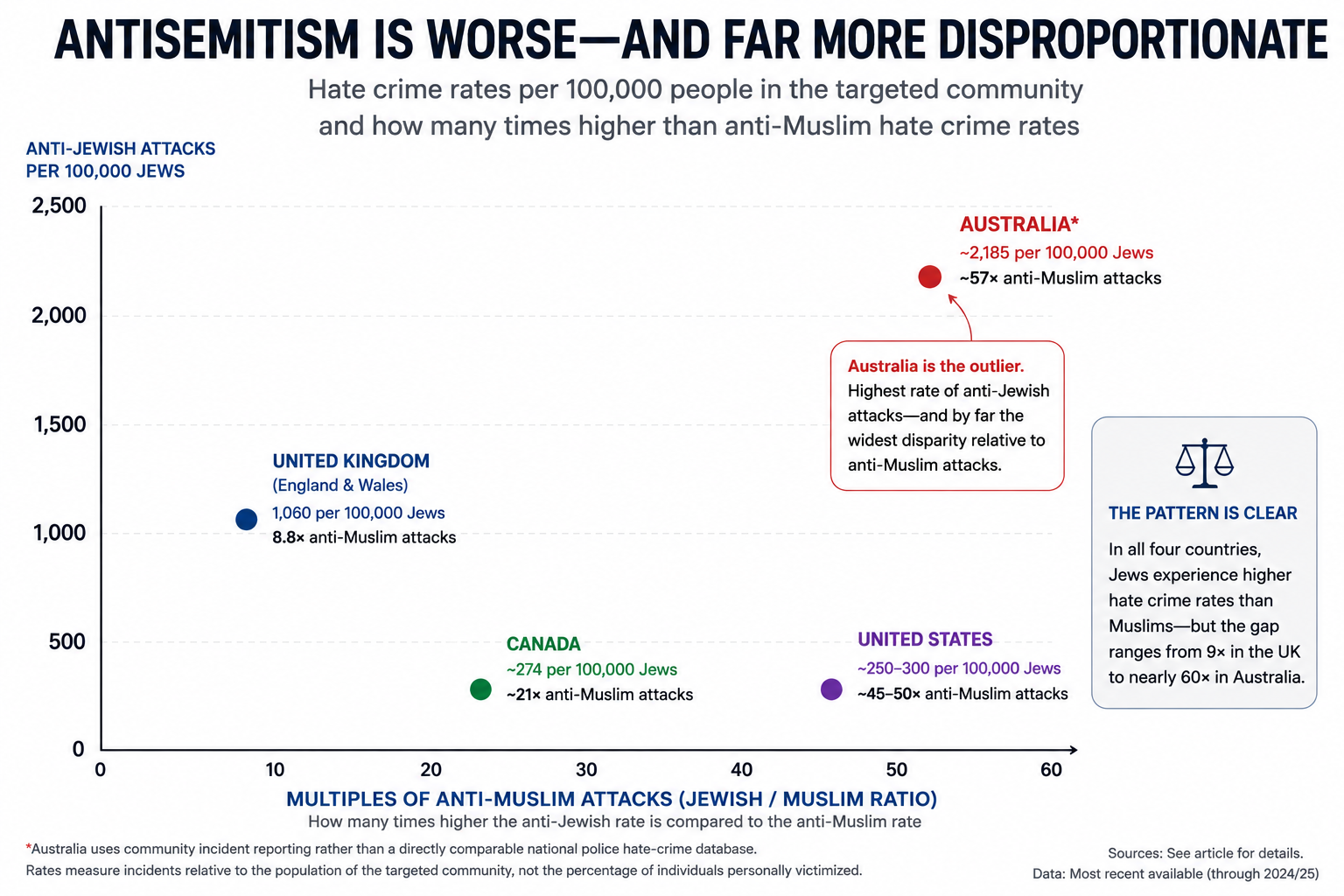
Every minority deserves protection. But treating victims equally does not require pretending they are being targeted equally.
Country
Anti-Jewish
Anti-Muslim
Jewish / Muslim Ratio
UK (England & Wales)
1,060 per 100,000
120 per 100,000
8.8×
Canada
~274 per 100,000
~13 per 100,000
~21×
United States
~250–300 per 100,000
~5–6 per 100,000
~45–50×
Australia*
~2,185 per 100,000
~38 per 100,000
~57×
*Australia uses community incident reporting rather than a directly comparable national police hate-crime database.
Britain clearly has a religious-hatred problem. Muslims and Jews suffer substantial levels of hate crime, well above that of other English-speaking countries, while Jews are targeted at almost nine times the rate of Muslims. Canada and USA show fewer hate crimes per population, and a wider disparity between Jews and Muslims being attacked.
Then there is Australia.
For the decade before October 7, 2023, Australia averaged 342 reported anti-Jewish incidents annually. That exploded to 2,062 in 2023/24 and remained at 1,654 in 2024/25. In New South Wales, police-recorded hate incidents against Jews rose from 40 in 2020 to 841 in 2025.
Then statistics became bodies.
On December 14, 2025, gunmen attacked Chanukah by the Sea at Bondi Beach. Fifteen people were murdered while celebrating the Jewish holiday.
Australia subsequently established a Royal Commission on Antisemitism and Social Cohesion, which is examining the circumstances surrounding the attack and whether authorities adequately recognized the threat to Jewish events.
Australia had been warned.
It had also begun responding. The government appointed Jewish communal leader Jillian Segal as Special Envoy to Combat Antisemitism. Her national plan followed extensive consultation with Australian Jews, and the government adopted all 13 recommendations.
Yet Australia continues to struggle with whether antisemitism is a distinct threat or another part of generalized “hate.”
Its Combatting Antisemitism, Hate and Extremism Act puts antisemitism in the title – along with more generic terms of “hate” and “extremism.” There is nothing wrong with fighting all forms of hatred. The question is whether symmetry in government policy reflects the reality on the ground.
Australia’s available community data indicate roughly 38 anti-Muslim incidents per 100,000 Muslims and 2,185 anti-Jewish incidents per 100,000 Jews.
That is roughly 57-to-1.
Indeed, Australia’s Islamophobia envoy (in a federal post strictly devoted to “Islamophobia” and no other forms of hate) has urged the Royal Commission on Antisemitism to approach antisemitism through the broader causes of identity-based hatred and the common roots of antisemitism, Islamophobia and other prejudice.
“antisemitism, Islamophobia and other forms of prejudice share common causes, such as polarisation, online environments and declining trust in institutions. Tackling these underlying factors can strengthen outcomes for all communities.” – Australia’s Special Envoy to Combat Islamophobia, Aftab Malik, June 2026
What? If they were all the same, why are Jews attacked at a 57-to-1 ratio?
Australia does not have a generic hate problem that happens to include Jews. It has an extraordinary antisemitism problem that generic language about hate must not be allowed to hide.
Israel is discussed with hyperbole and adjectives: massive settlements, enormous American aid, rampant settler violence, Jewish encroachment, disproportionate war.
Between 700,000 and 750,000 Palestinian Arabs became refugees when they fled the battlefield as they awaited fellow Muslim Arab armies to destroy the nascent Jewish State during the 1948-9 war. In the same era, roughly 850,000 Jews left or were expelled from Arab countries with many more leaving non-Arab Muslim countries like Iran and Afghanistan.
Even though the Jewish refugee population was larger, we never speak of it today.
Today, UNRWA registers 5.9 million Palestinian Arab refugees, predominantly consisting of descendants of the original refugees, and those who married or were adopted by refugees. The comparable number of registered Jewish refugees from Arab and Muslim countries and their descendants is zero.
The Jews were absorbed as citizens of Israel and other countries. Their children, grandchildren and great-grandchildren were not perpetuated as refugees, they way Palestinian Arabs have been forced by those same “brotherly” Arab countries which went to war with Israel in 1948-9, in order to perpetuate the war they initiated and lost.
650 Times — Arab League Territory to Israel
Israel covers roughly 22,000 square kilometers and the 22 members of the Arab League collectively cover roughly 13–14 million square kilometers.
The territory of the Arab League is approximately 650 times the size of Israel.
127 Times — Muslims to Jews
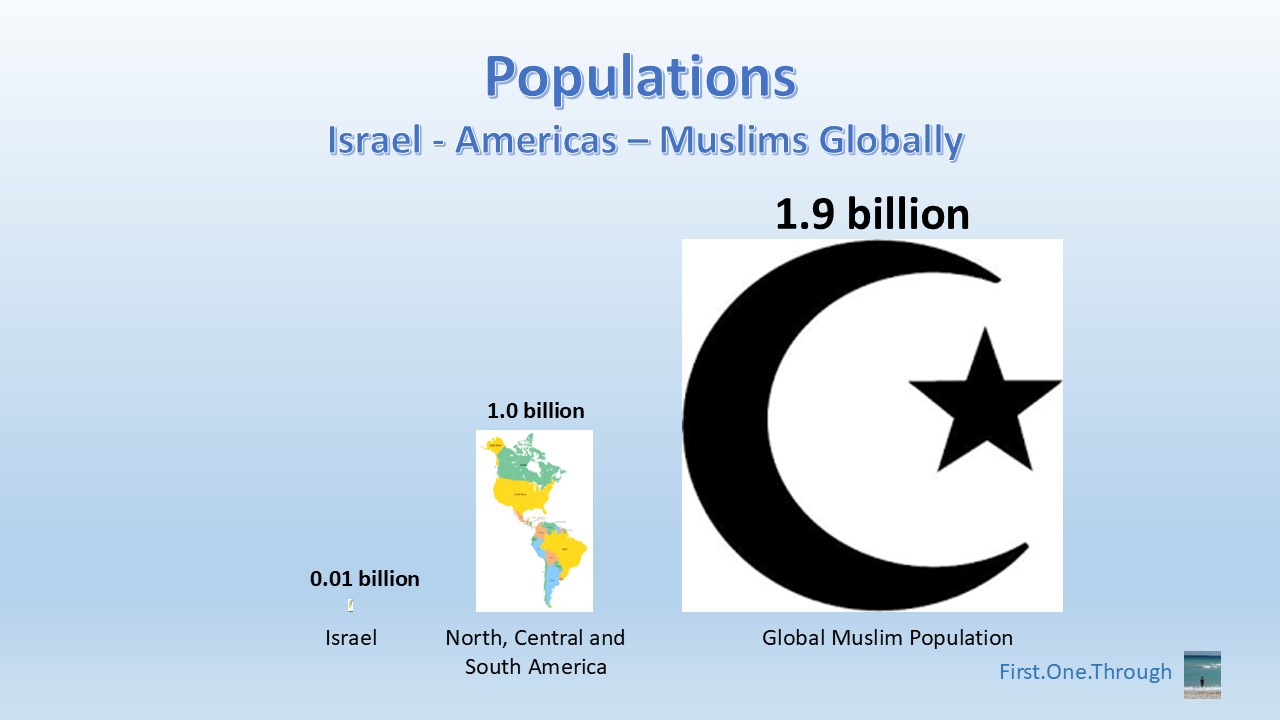
There are roughly 2 billion Muslims in the world, twice the size of the entire populations of North, Central and South America.
There are roughly 15.8 million Jews.
That is approximately 127 Muslims for every Jew.
Muslims account for roughly one-quarter of humanity. Jews account for about 0.2%.
Yet people in the West refer to Muslims as a “minority.”
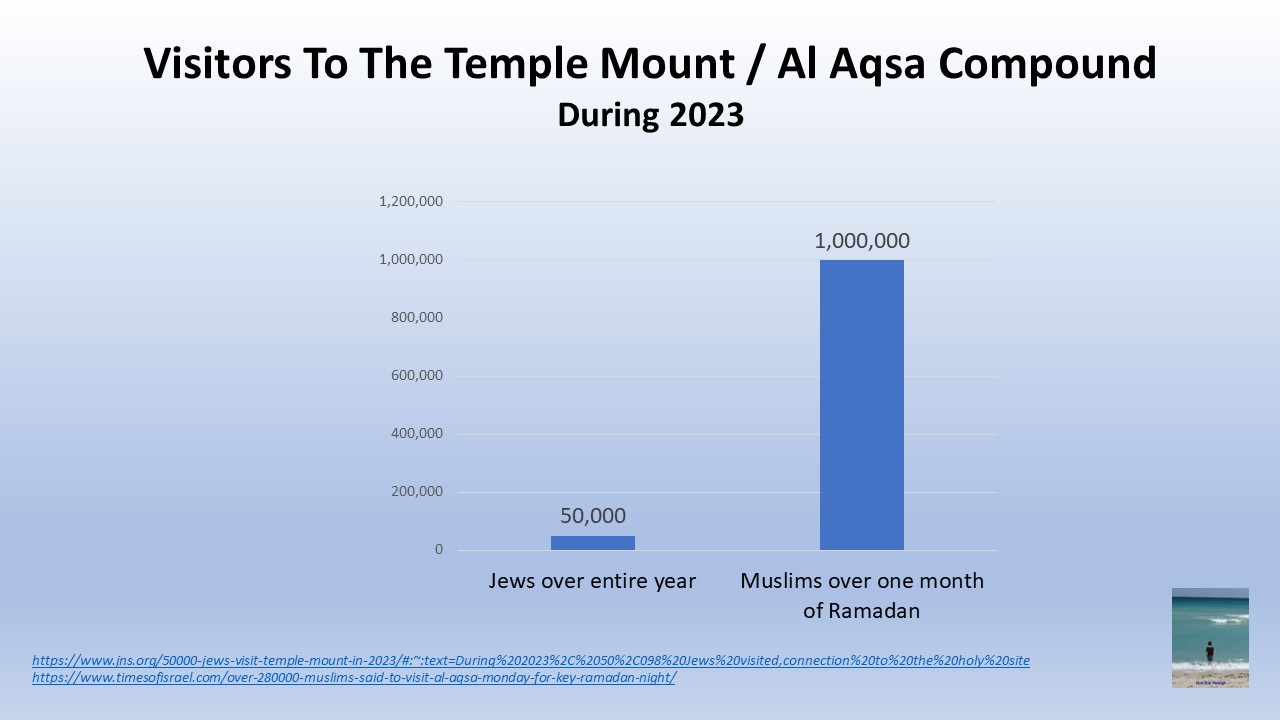
60 to 1 — Muslims to Jews Ascending the Temple Mount
Before COVID, roughly 1.8 million to 2 million Muslims visited the Temple Mount annually, compared with approximately 30,000 Jewish visits in 2019. That is roughly 60 Muslim visits for every Jewish visit.
The more recent figures of 2025 after the October 7 massacre launched by Gazans has roughly halved the visits by Muslims and doubled those by Jews, lowering the figure to about 15 times at Judaism’s holiest site.
57 to 1 — OIC States to the Jewish State
There are 57 countries in the Organisation of Islamic Cooperation that perpetually lambasts Israel. There is one Jewish state.
The Jewish state exists alongside a Muslim world dozens of times larger in countries, population and territory.
25 to 1 — American Defense Spending Outside Israel
Israel receives about $3.8 billion annually under the U.S.-Israel security assistance agreement. For every dollar America spends annually on Israel’s defense, roughly $25 is spent on defense elsewhere—defending the United States, maintaining forces abroad, supporting allies and providing security assistance around the world.
Even more striking, there are over 220,000 military personnel stationed around the world, of which slightly over 100 are in Israel. The baseline ratio is over 1,500-to-1, rising to 2,200-to-1 when reserve personnel are included.
The anti-Israel discussion focuses solely on Israel while ignoring the enormous American monies and personnel in Japan, Qatar, Germany and elsewhere.
14 Times — The Growth of Israel’s Arab Population
Approximately 156,000 Arabs lived in Israel in 1948 when the modern Jewish State was reestablished. Today, approximately 2.16 million Arabs live in Israel.
Israel’s Arab population has grown almost 14-fold since the establishment of the Jewish state. Meanwhile, the number of Jews inside Israel hasn’t even grown 12-times in that same time.
And people accuse Israel of “ethnic-cleansing.”
12 Times — Israeli Arabs Killed by Israeli Arabs Versus West Bank Arabs Killed by West Bank Jews
Thus far in 2026, Arab Israelis are murdered by other Arab Israelis at roughly 12 times the number of Palestinian Arabs killed by West Bank Jewish civilians in Judea and Samaria.
Hundreds of Arab Israelis have been murdered amid the organized-crime epidemic inside Israel over the last few years. Yet the international narrative solely focuses on settler violence.
10 to 1 — Muslim Gates to the Jewish Entrance
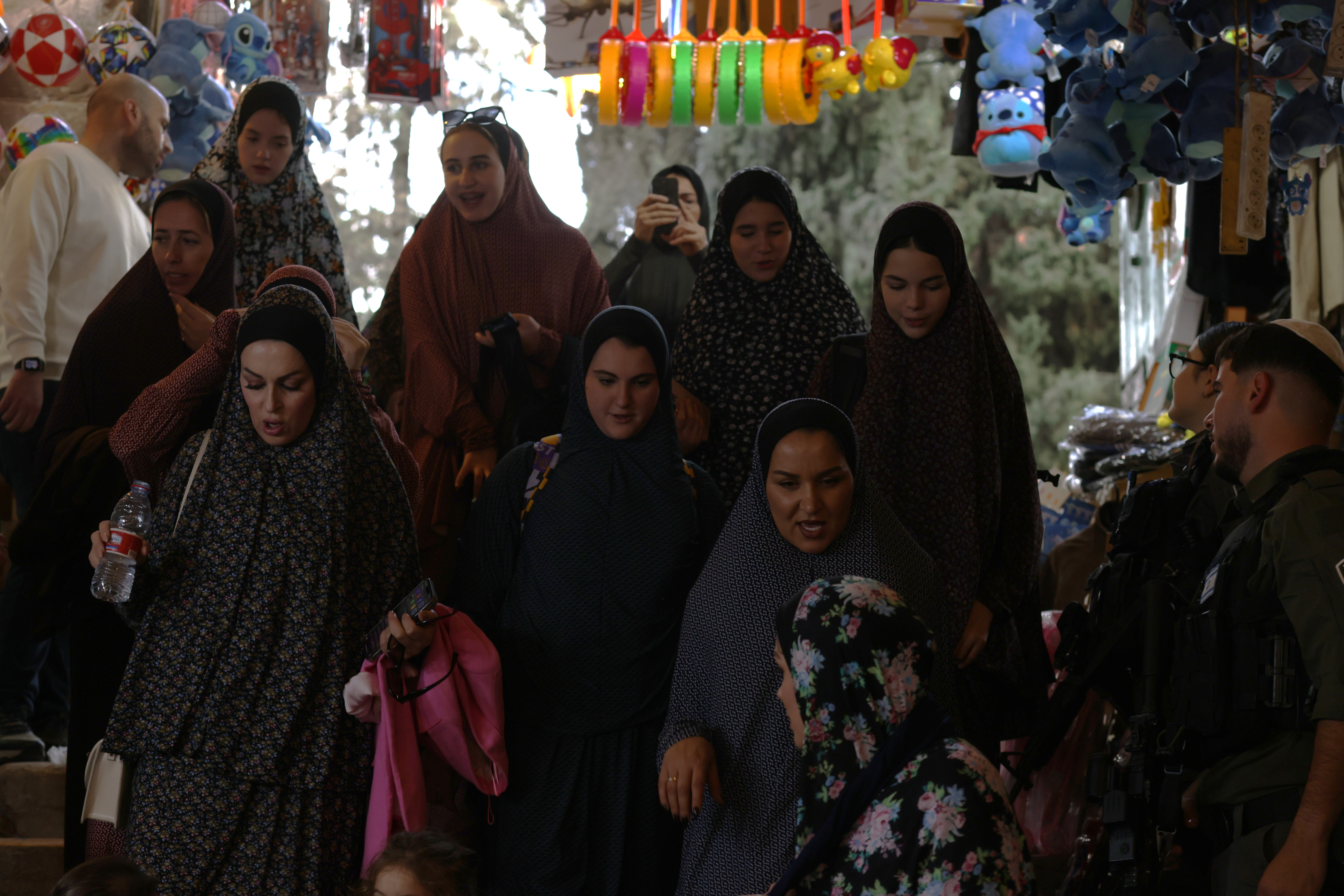
Muslims have access to the Jewish Temple Mount in the Old City of Jerusalem through ten gates. Jews and other non-Muslims enter through one: the Mughrabi Gate. There, Jews must pass through metal detectors and security clearance at only specified times of the day, even as Muslims ascend and descend at will through every other portal.
Muslim women descending from the Temple Mount through one of the many gates exclusively available for Muslims (photo: First One Through)
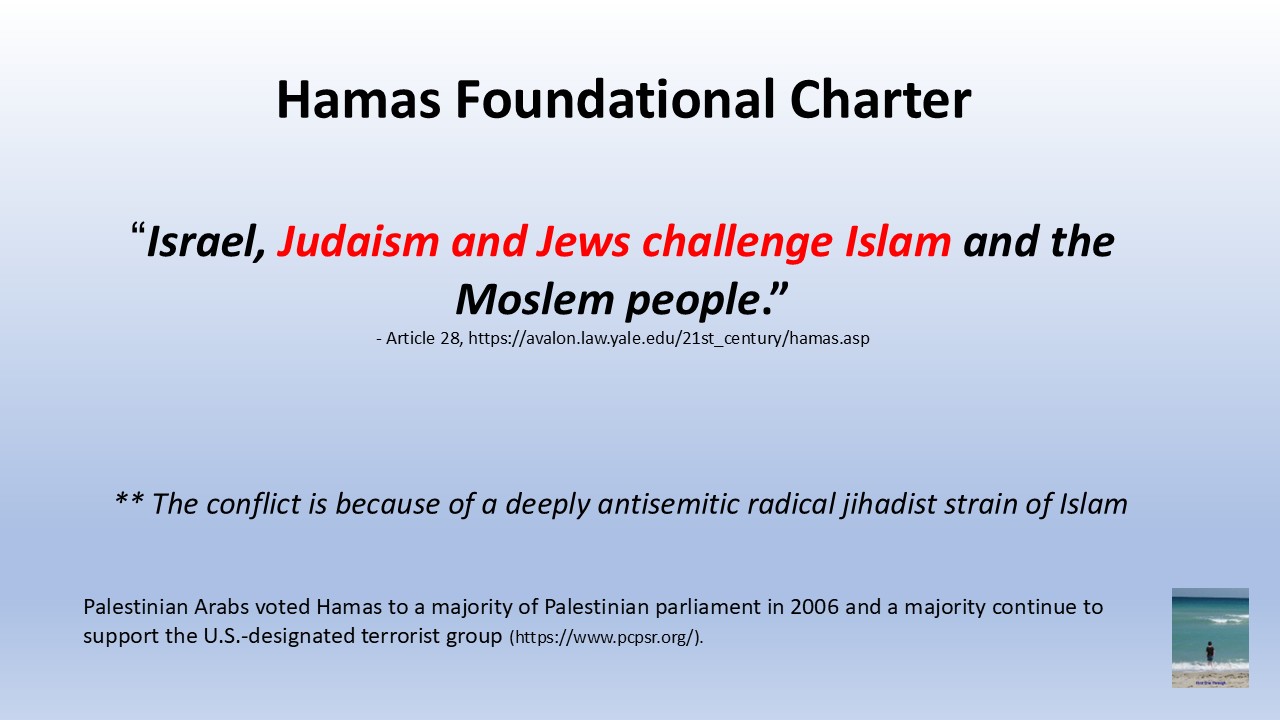
9 — Number of Times Hamas Charter Refers to Jews and Judaism
Hamas’s 1988 foundational charter is replete with antisemitic rhetoric. The opening lines begin with “Our struggle against the Jews…” and continues throughout its genocidal jihadist call to wipe out the Jewish people and Jewish State.
While the anti-Israel crowd pretends that the conflict is merely over land which can easily be compromised and carved up, they ignore the deep antisemitic ideology embedded in the Palestinian Arab culture.
8 Times — U.S.’s Ukraine War Spending Versus Gaza War Spending
The United States has spent roughly eight times more in connection with the Ukraine war with Russia than the Gaza war against Israel.
America has made roughly $195 billion available for Ukraine since Russia’s 2022 invasion. American expenditures associated with Israel and the Gaza war are a fraction of that amount.
Yet it is spending associated with Israel that is routinely presented as uniquely extraordinary.
6 to 0 — UN Bodies for Palestinians Versus Israelis
The United Nations maintains six standing bodies, offices or mechanisms focused specifically on Palestinian Arabs and Israel’s treatment of said Arabs: UNRWA; the Committee on the Exercise of the Inalienable Rights of the Palestinian People; the Division for Palestinian Rights; the Special Committee to Investigate Israeli Practices; the Special Rapporteur on the Palestinian territories; and the Human Rights Council’s permanent Agenda Item 7.
There is no comparable UN agency, committee or permanent agenda item devoted to protecting Israelis from the conflict, nor is there any group in the entire world (think the Kurds) so over-represented at the global organization.
5 — Gaza Wars Since Hamas Took Control
Israel withdrew every Jewish civilian and military asset from Gaza in 2005. Hamas subsequently took control of Gaza in 2007. Since then, it has launched five major rounds of war with Israel: in2008–09, 2012, 2014, 2021, 2023-.
Five wars in sixteen years.
2.5 to 1 — Israel Versus the Rest of the World at the UN
In 2024, the UN General Assembly adopted 18 resolutions focused on Israel. It adopted seven country-specific resolutions concerning the rest of the world combined.
That is roughly 2.5 to 1. One country received more than twice as many resolutions as every other country combined.
1 to 1 — An Equivalency of 15 Kilometers Which Matters for One But Not the Other
At its narrowest along the pre-1967 lines, Israel is roughly 15 kilometers wide. It is a stretch that continues along its major population centers.
After Ma’ale Adumim to Jerusalem’s east, the remaining West Bank corridor is also roughly 15 kilometers wide at a single narrow point where virtually no West Bank Arabs live.
15 kilometers versus 15 kilometers. Over a million Jews in the narrow stretch versus a few thousand Arabs.
Israel’s narrow waist is never described as dangerously vulnerable, while the West Bank neck is cast as making a two-state solution “impossible.”
1 — The Jewish State Whose Capital the World Challenges
There is only one country in the world whose national anthem is all about its capital.
Israel’s national anthem, Hatikvah, expresses the Jewish people’s ancient longing for Zion and Jerusalem.
The Knesset is there. The president is there. The prime minister is there. The Supreme Court is there. The government ministries are there.
Yet most countries still refuse to locate their embassies in Jerusalem or fully accept Israel’s designation of Jerusalem as its capital.
The numbers are there. Before accepting the narrative which is infused with anti-Israel bias, look at them.
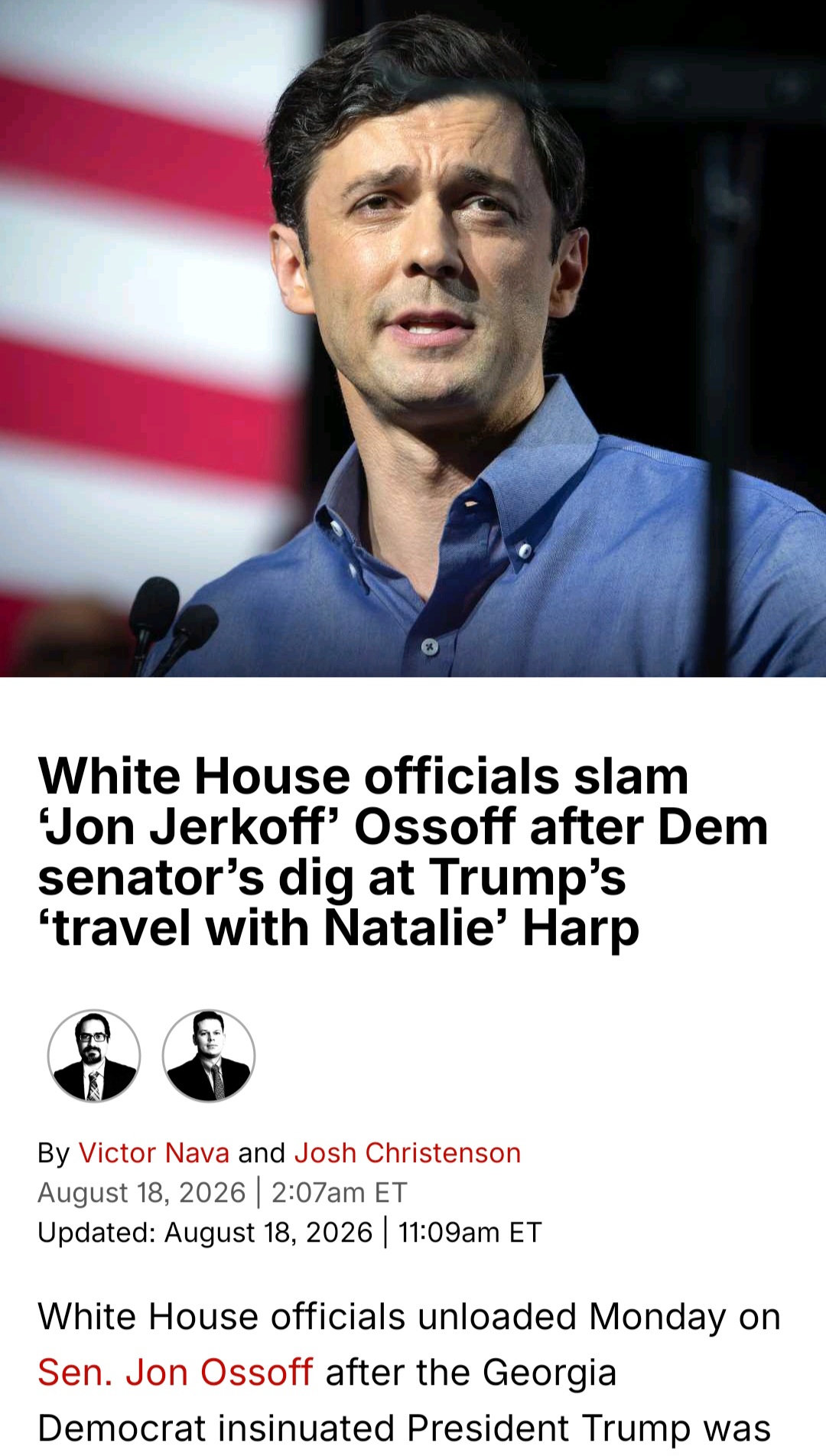
It is very strange that Sen. Jon Ossoff would make fun of Donald Trump.
Trump has many more followers and, candidly, is much better at insulting people than just about anyone. So it begs the question as to Ossoff’s motivation.
At an Atlanta rally, Ossoff mocked Trump for supposedly not wanting to do the job of president, saying Trump wanted to “build his ballroom and travel with Natalie on their apparently defenseless flying palace,” referring to Trump aide Natalie Harp. He later doubled down, describing Harp and other aides around Trump as a kind of “security blanket” to make him feel good about himself.
Ossoff had to know that would provoke Trump’s ire and generate targeted insults.
And it did.
Trump mocked Ossoff as a “Pee-wee Herman” look-alike, while White House officials piled on with insults of their own.
But those insults would go out to millions of Trump followers. Ossoff’s supporters and anti-Trump people would simultaneously pile on online. Suddenly, Ossoff becomes the topic of conversation, and people start talking about him running for president in 2028. Indeed, that is already part of the discussion surrounding the episode.
It is all manufactured to improve his visibility.
Ugly. Vapid. And that’s politics.
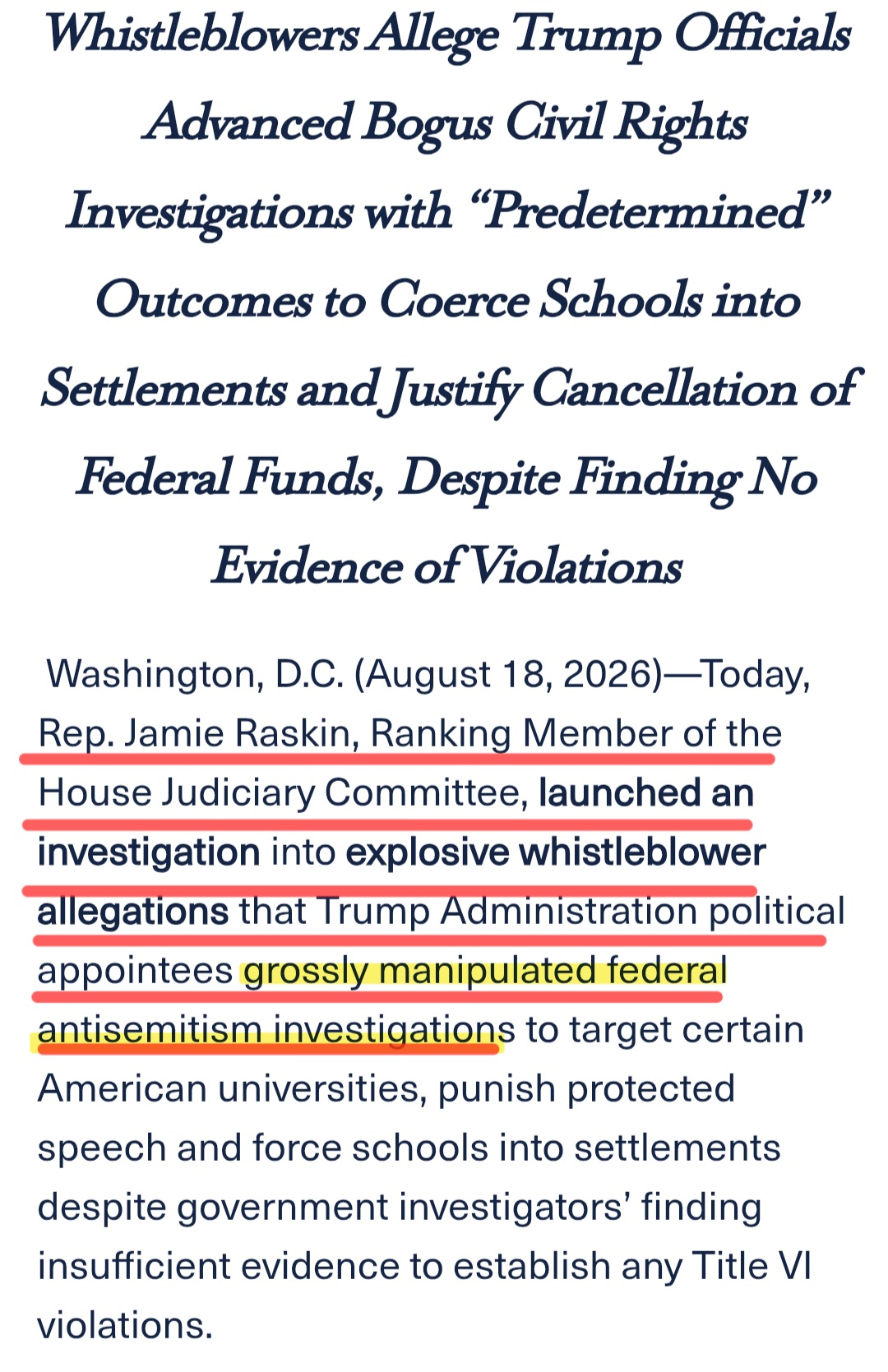
But what about Rep. Jamie Raskin claiming that Trump manufactured the antisemitism-in-schools narrative?
Raskin seized on a whistleblower complaint from former Justice Department attorney Haley Van Erem, who alleged that the Trump administration’s investigations of antisemitism at Harvard, Brown and Columbia were driven by predetermined political objectives and, in some instances, pursued without sufficient factual or legal grounds. The Justice Department disputes those allegations and stands behind its investigations.
Raskin went considerably further in describing what the report meant. He accused Trump officials of abusing Title VI investigations to attack universities while using “antisemitic discrimination as a pretext and a ‘ruse.’”
That is not a silly swipe at Trump. It is an anti-factual smear about Jews under attack.
Why would Raskin do that?
In politics, it is to generate views and, consequently, power. He might get picked up by Hasan Piker or others who trade in Jew hatred online. He chums for antisemites to get their support for his own personal brand while simultaneously scrubbing any scent of Jew from his person.
That is a whole different kettle of fish than silly insults about Trump.
And it says terrible things about the state of the Democratic Party, that Jewish progressive politicians are whitewashing antisemitism in an appeal to votes from antisemites.
From his perch at The New York Times, Thomas Friedman wants to be “very clear” about Hamas. Instead, his formulation gets the moral order backwards.
“Hamas is a terrible organization,” he writes, “first and foremost for Palestinians.”
Hamas is not primarily a terrible organization. It is a terrorist organization whose foundational ideology targeted Israel and Jews.
Hamas said so itself. Its 1988 charter declares that “Israel will exist and will continue to exist until Islam will obliterate it.” Article 7 invokes a religious tradition about Muslims fighting and killing Jews. Article 13 rejects negotiated settlements: “There is no solution for the Palestinian question except through Jihad.”
October 7 was the depravity of those words turned into action. Hamas terrorists crossed into Israel, attacked civilian communities, murdered families and kidnapped hundreds of people. Terrorism was not an unfortunate byproduct of Hamas rule. It was the method of an organization whose charter had openly described its enemy and objective.
Nor was Hamas imposed upon Palestinian Arabs. In the 2006 Palestinian legislative elections, voters handed Hamas 56% of the seats in parliament — 74 of 132 — and control of the legislature.
October 7 did not sever that political connection. In December 2023, the Palestinian Center for Policy and Survey Research found that 72% of Palestinians believed Hamas’s decision to launch the October 7 attack was correct, including 57% in Gaza and 82% in the West Bank. Even in October 2025, 53% still called the decision correct.
That context makes Friedman’s criticism of Western Hamas apologists particularly revealing. He calls the “free pass” Hamas receives from some pro-Palestinian progressives “shameful.”
The issue runs much deeper than shame.
There is a straight line from a charter describing the destruction of Israel and the killing of Jews, to terrorists carrying out a massacre in Israel, to people defending the decision to launch that attack. The depravity lies in the ideology, the terrorism committed in its name and the willingness to celebrate or excuse it afterward.
And that depravity has migrated into American politics. The Democratic Socialists of America and radical left-wing university professors describe Israel as a colonial project and Israelis as “colonialists,” a framework to erase the distinction between combatants and civilians and recast violence against Israeli Jews as “resistance.” This movement is no longer confined to demonstrations and campuses; DSA member Zohran Mamdani has ridden the democratic-socialist movement into the New York City mayoralty and is now helping other left-wing candidates like Mohamed El-Zayed in Michigan win office.
Friedman’s formulation reverses the danger. Hamas becomes “terrible” rather than terrorist. Palestinians become its primary victims rather than a population which supports Hamas. And those in the United States and elsewhere who give Hamas political cover are merely “shameful.”
That formulation grants absolution to terrorists and their knowing supporters.
The endorsement and celebration of mass violence against Jews — a tiny minority-minority — is becoming a motivating force in American politics. That should terrify Thomas Friedman. It should terrify every decent American.
Because when a movement can watch the mass murder of Jews and explain why their killers were engaged in “resistance,” the problem is no longer simply Hamas.
Words matter. They do more than describe reality. They shape it.
This week, the Palestinian Authority’s WAFA news agency reported that Israel had advanced a housing plan that would “further isolate Jerusalem from Bethlehem.”
The proposal involves building homes, roads, and infrastructure between Jerusalem and Bethlehem. In almost any other place on earth, connecting two urban areas with transportation and housing would be described as integration, development, or greater connectivity.
But not for West Bank Arabs. They object to more Jews living in the corridor connecting them.
In this narrative, Jewish presence itself is an obstacle, an impediment. Jewish life is redefined as separation.
The inversion is striking.
The 1947 UN Partition Plan once envisioned Jerusalem and Bethlehem as a single Corpus Separatum—an internationally administered area shared by Jews, Christians, and Muslims. Whatever one thinks of that proposal, its premise was coexistence, not exclusion. Yet today, not only have the local Arabs refused coexistence, but so has the United Nations.
Contours from the 1947 Partition Plan which included Greater Bethlehem and Greater Jerusalem under a “Corpus Separatum”
Instead of asking how Jews and Arabs can both live, work, worship, and travel throughout the Jerusalem-Bethlehem region, many arguments begin with the assumption that Jewish communities are inherently illegitimate. Under that framework, the more Jews who live or travel there, the more “isolated” the majority-Arab areas are said to become.
When the Partition Plan was being conceived on February 18, 1947, Secretary of State for Foreign Affairs, Ernest Bevin (1881-1951) said “for the Arabs, the essential point of principle is to resist to the last the establishment of Jewish sovereignty in any part of Palestine.” Today, we are not only witnessing the continued entrenchment of that tenet, but the profound hostility to the basic presence of Jews.
Don’t let the word isolation fool you. It is not describing geography. It is describing Jews as obstacles, not neighbors.
For generations, antisemitism sought to remove Jews from the future. Today, it increasingly seeks to remove them from the past.
That is the deeper significance of the growing campaign to recast Jewish history as Palestinian history. It is not simply a dispute over archaeology or competing national narratives. It is an effort to strip the Jewish people of their origins, their memory, and ultimately their legitimacy and basic human rights.
The examples are becoming impossible to ignore.
The Holocaust—the systematic murder of six million Jews—is routinely appropriated as a metaphor for Palestinian suffering. Jewish victims become a rhetorical device rather than a people with a unique history. The descendants of Holocaust survivors are cast as the new Nazis, while the actual genocide of European Jewry is emptied of its historical meaning.
Some Europeans have taken the Jewish girl, Anne Frank, and dressed her in an Arab kefiyeh as if she were a Palestinian Arab or would have supported the murder of Jews. During World War II, Anne hid in an attic while Nazis hunted her and other Jews for years, before the Nazis took her and murdered her in a concentration camp.
Now even Jesus is being rewritten.
Rather than acknowledging the historical reality that Jesus was a Jew who lived, taught, and died among the Jewish people in Judea, activists increasingly describe him as “Palestinian.” The purpose is to transplant one of history’s most influential Jews from the Jewish story into a Palestinian national narrative that not only didn’t exist in his lifetime, but Arabs didn’t invade the Jewish holy land until the seventh and eighth century CE, hundreds of years after Jesus lived.
The same pattern extends across nearly every cornerstone of Jewish civilization.
The First and Second Temples become myths or located in far-way lands. The Western Wall is detached from Jewish history. Jerusalem is reframed as an exclusively Muslim city. The Jewish patriarchs and matriarchs are recast. Ancient Israel is dismissed as colonial fiction. Hebrew becomes a borrowed language rather than the indigenous language of the Jewish people. Even Jewish holy sites are repeatedly described as exclusively Islamic or Christian.
United Nations 1949 map of of holy sites in Jerusalem lists the Jewish Temple Mount as only holy to Muslims
Each claim may appear isolated. Together they reveal a coherent project.
The goal is not simply to elevate a Palestinian Arab identity or an Islamic one. Every people is entitled to tell its own story. But no national movement has the right to build its identity by erasing another people’s history, heritage and human rights.
If a Palestinian Arab national identity is legitimate, it should be able to stand on its own. It shouldn’t require denying that Jews are indigenous to the Land of Israel. It does not require pretending the Temples never stood in Jerusalem. It does not require transforming Jesus into an Arab. It wouldn’t require appropriating appropriating words and people from their national tragedies.
Anti-Israel author Susan Abulhawa repeatedly uses terms like “Holocaust” to turn Jews into Nazis, in an attempt at misdirection from the popular Palestinian Arab political-terrorist group Hamas, which are actual modern-day Nazis
Yet this pattern of historical theft has increasingly been accompanied by something darker: the revival of some of Europe’s oldest antisemitic ideas.
The Hamas Charter drew explicitly from antisemitic conspiracy theories and echoed themes long propagated by Nazi ideology. Since October 7, the world has again witnessed chants, slogans, and propaganda that do not merely oppose Israeli government policies but deny the legitimacy of Jewish peoplehood itself. Public figures, writers, and activists have too often trafficked in narratives that portray Jews not as an indigenous people with a continuous history, but as impostors who fabricated their past.
If Jews can be separated from Jerusalem, from the Temple, from Abraham and Sarah, from David, from Hebrew, from the Holocaust, and even from Jesus, then they become a people without roots. A nation without ancestors is easier to portray as foreign. A foreign people is easier to cast as colonizers. And colonizers, in the moral framework of today’s activists, can be removed. Should be removed.
Historical negation is not an academic exercise. It prepares the ground for political exclusion, eviction, and violence.
The attempt to steal Jewish history is not ultimately about the past. It is about deciding whether the Jewish people have any legitimate place in the future.
Listen to many of today’s most prominent progressive Jewish organizations—T’ruah, Bend the Arc, Jewish Voice for Peace, and many rabbis who speak in similar terms—and a pattern quickly emerges. Their Judaism is explained through a familiar vocabulary.
Justice.
Human dignity.
Welcoming the stranger.
Repairing the world (Tikkun Olam).
Compassion.
These are presented not simply as Jewish values, but as the defining Jewish values.
It is an appealing message. It is also one the modern Western world already overwhelmingly believes.
Nearly every university, corporation, NGO, church, and democratic government affirms human dignity, equality, compassion, caring for refugees, and social justice. Whether one agrees with every application of those ideals is beside the point. They are no longer uniquely Jewish insights. They have become the common moral language of much of the modern world.
The progressive Jewish rabbis and organizations often remind audiences that many of those ideals trace their roots to the Hebrew Bible. That observation is true. Judaism profoundly shaped Western moral thought. Therefore the comment of them being Jewish values is seemingly to educate the western world that they only have their own universal values because of Jews. Also perhaps true, but to what end is the observation? Is it to inform those listening that Jews alone carry the essence of justice, with a transmission extending back thousands of years? That they alone are the actual guardians of values?
Or that they are all on the same page – that the values the West holds dear and the progressive rabbis are one and the same? That one or the other may take the lead on a subject – say condemning genocide, for example – and the other will echo the sentiment?
That approach deliberately strips anything uniquely Jewish from values. It makes the adjective superfluous. Redundant.
Many non-progressive rabbis and the mainstream Jewish organizations have a different view, one that affirms the Jewish component of values. Those are values that are woven into the covenant between God and the Jewish people, as laid out in the Bible and holy books, and debated for thousands of years.
In such telling, justice is not equity as progressive rabbis champion, but based on fairness and balance.
Charity is not generosity. It is tzedakah – an obligation, and one in which helping someone get a paying job and being able to care for themselves is viewed as much greater than making them addicted to welfare.
Rest is not work-life balance. It is Shabbat, a holy day that interrupts commerce, technology, and ordinary life every seventh day because God commanded it. The notion of people adding holiness to something inanimate – like an idol – is actually prohibited in Judaism, while it is encouraged for something specified and incorporeal like the seventh day.
Environmental stewardship is not merely “sustainability.” It includes shmita, allowing the Land of Israel itself to rest every seventh year, because it is a special gift to the Jewish people, much like Shabbat.
Family is not simply important. Marriage, children, circumcision, honoring parents, and transmitting Torah from one generation to the next are sacred obligations.
The list goes on. Some Jewish values are absent from the umbrella of tikkun olam, while others stand in direct contrast to the T’ruah placards.
Recovering the definition matters. Otherwise, “Jewish values” risks becoming little more than progressive ethics wrapped in Hebrew vocabulary—a faith whose unique contribution is remembered mainly as history, while its living covenant is quietly left behind.
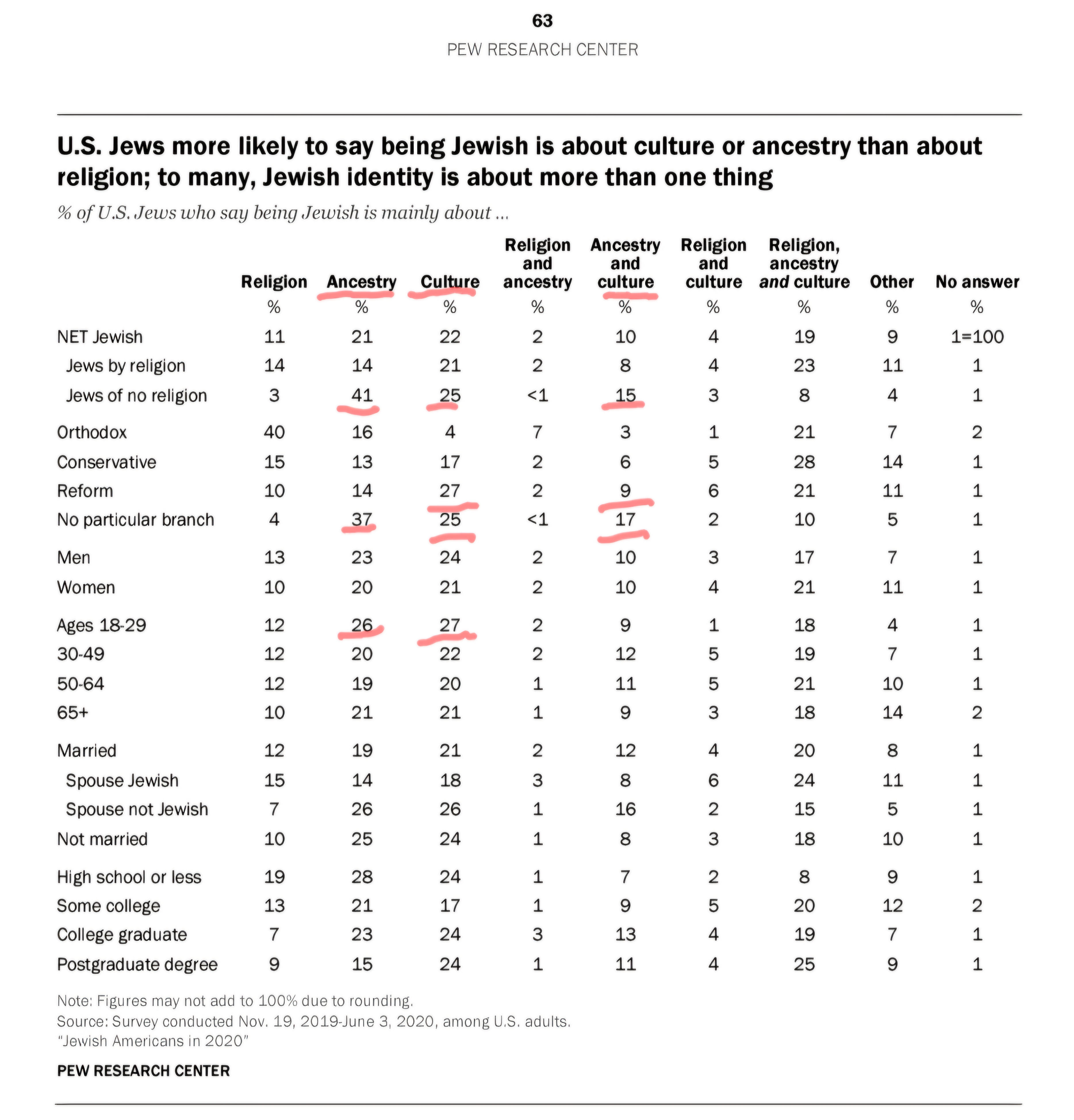
“U.S. Jews do not have a single, uniform answer to what being Jewish means…. Many American Jews prioritize cultural components of Judaism over religious ones…. Orthodox Jews are a striking exception…. A plurality of Orthodox Jews say that being Jewish is mainly about religion alone (40%), and they are the only subgroup in the survey who overwhelmingly feel that observing halakha is essential to their Jewishness (83%)… The vast majority of Jews of no religion say that for them, being Jewish is mainly a matter of ancestry (41%), culture (25%) or both (15%).” – Pew Research May 2021
At this moment in time, the distinction is not theoretical or esoteric. Many progressive left Jewish organizations have adopted stridently anti-Israel positions, some arguing that the Jewish State should be destroyed. They knowingly lock arms with antisemites to advance such future vision.
And should it be a surprise? If the essence of Jewish values for the non-Orthodox far-left is that there is nothing particular about Jews, and that both the noun and adjective “Jew” and “Jewish” are simply historic words without meaning, why should Jews have self-determination any more than left-handed people?
“Supporting Israel is not a battle of political orientation between liberal and conservative Jews. It is a philosophical break in the Jewish community with a fault line regarding the uniqueness of Jews and the Jewish State. The non-Orthodox denominations’ religious philosophy will only let it embrace an Israel that is: about people, not God; about rights not rituals; more secular than religious; more democratic than Jewish; and more universal than particular.” – The Non-Orthodox Jewish Denominations Fight Israel, January 2018
The broader Jewish community should be clear and confident to say that this simply untrue. Judaism and Jewish values are not ancient rock carvings on a cave from which sprang forth the Judeo-Christian values of today. Jews are a living people with a belief in an ongoing covenant which have particular Jewish values that extend beyond universal morality. We should not accept self-erasure in the current environment of cancelling Jews.
More, everyone should fight this approach. Not only Jews but every people who care about their own unique culture and perspective. The lure of the “melting pot” is great but needn’t be absolute. Appreciate the universal AND the particular for Jews and every neighbor.
Judaism helped shape the modern vocabulary of universal values. But Judaism’s enduring contribution is not simply to teach those ideals but show how they are woven into a sacred way of living. One that sanctifies time through Shabbat, family through covenant, body through mitzvot, land through shmita and pilgimmage, and elevates communal responsibilities to a daily obligation.
Jewish values are not simply universal values. And we should not be ashamed to state it clearly.
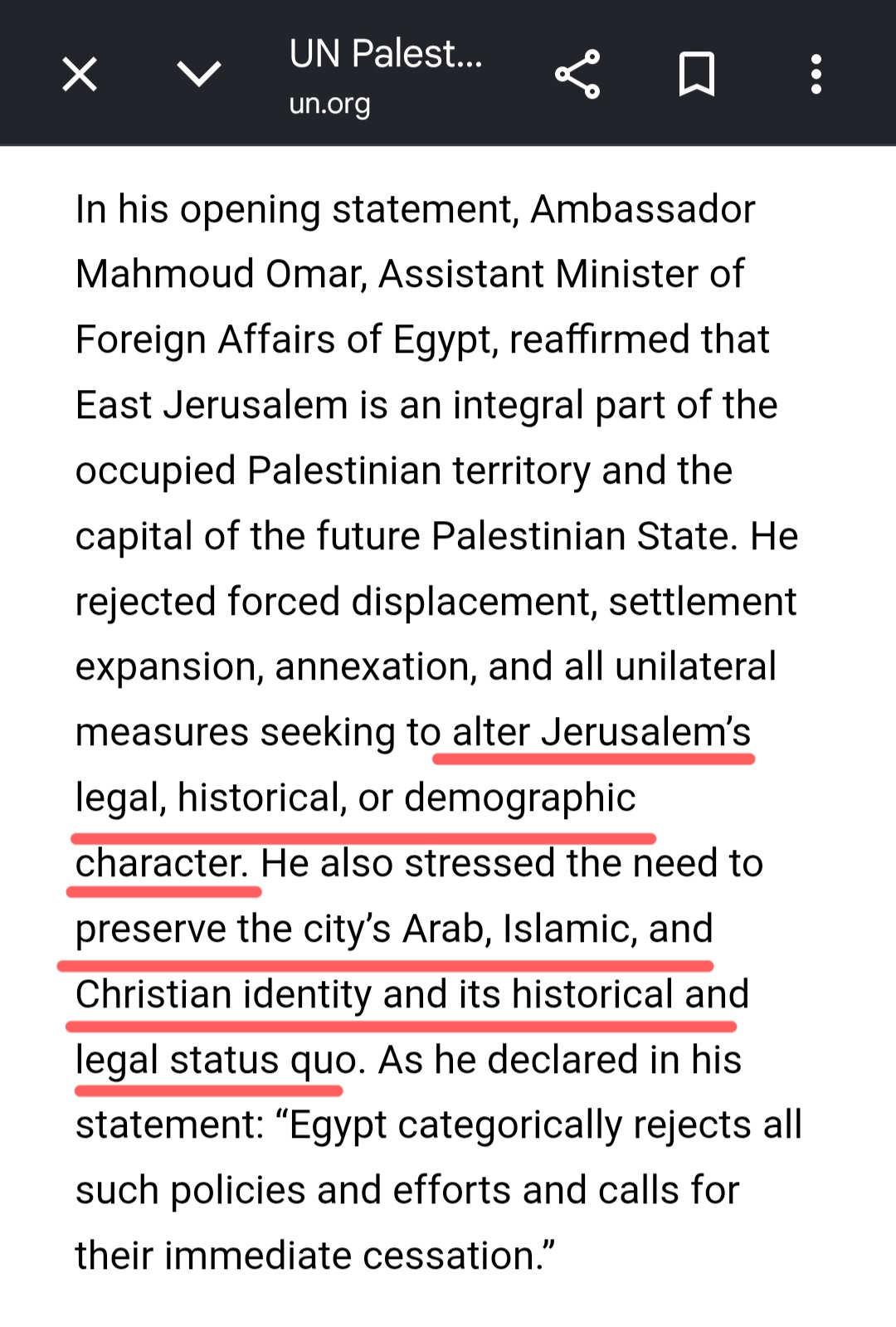
The United Nations speaks constantly of justice, equality and freedom of worship in Jerusalem. Yet when confronted with the denial of the most basic religious freedom at Judaism’s holiest site, it demands that the discrimination continue.
This is not the position of one committee or one conference. It is the official position of the United Nations.
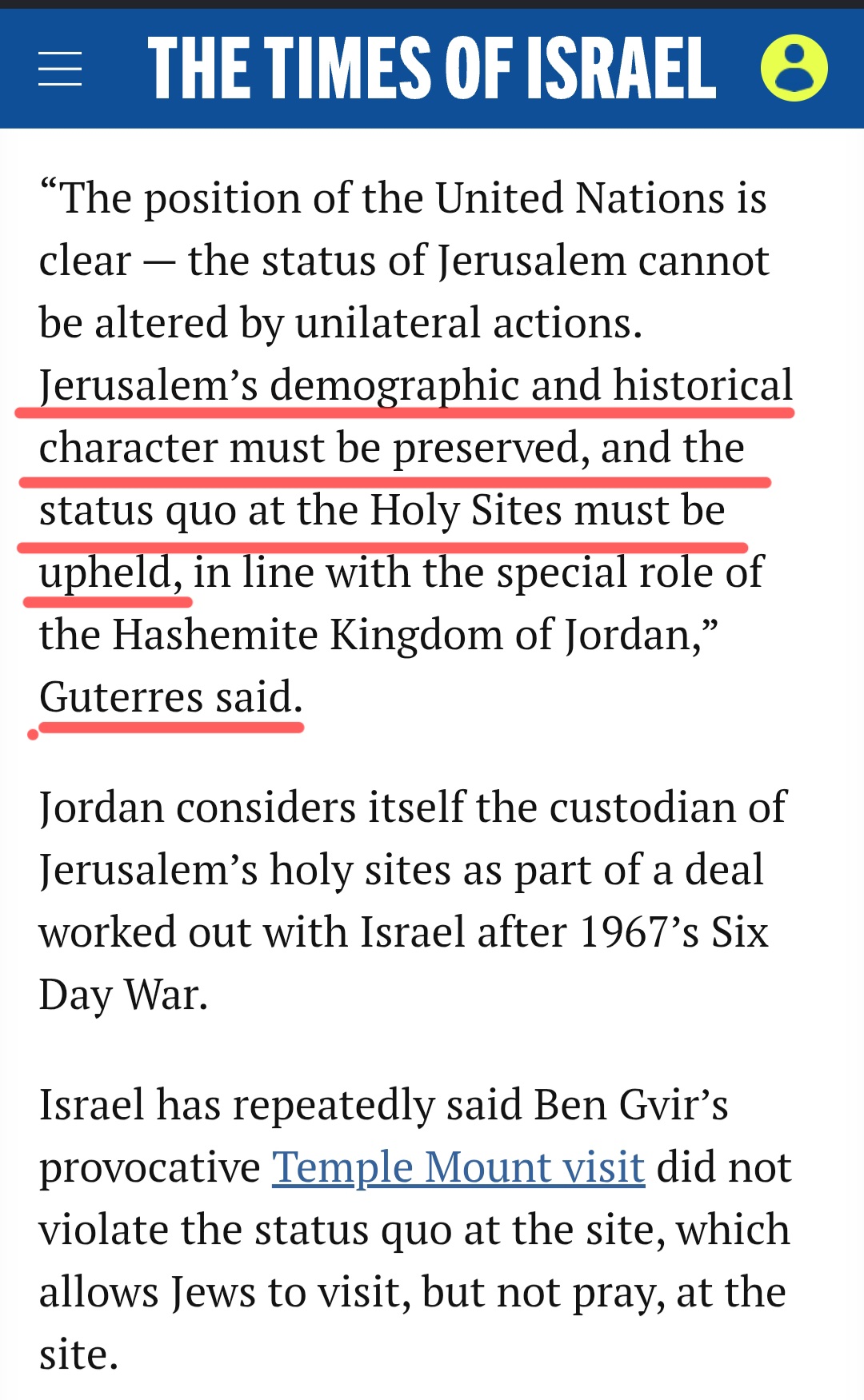
Following a recent visit by Israel’s National Security Minister to the Temple Mount, Secretary-General António Guterres declared that “the status quo at the Holy Sites must be upheld.” His spokesman, Stéphane Dujarric, went further on July 23, insisting that “there is a status quo regarding the holy sites of Judaism, Christianity and, of course, Islam in Jerusalem” and that “the faithful of all religions are able to interact with those sites… in a free manner.”
Those statements cannot both be true.
On the Temple Mount—the holiest site in Judaism—the “status quo” bars Jews from praying openly. Jews may visit during limited hours, but they are prohibited from conducting public prayer under the religious administration of the Islamic Waqf.
The United Nations therefore advocates preserving a system that denies Jews the freedom to pray at their holiest site while simultaneously claiming that people of all faiths are able to worship freely.
That is not religious equality. It is institutionalized religious discrimination.
Imagine the United Nations calling for the preservation of a system that prohibited Christians from praying at the Church of the Holy Sepulchre or Muslims from praying at the Al-Aqsa Mosque. Such a position would rightly be condemned around the world. Yet when the restriction applies to Jews, it is described as preserving the “status quo.”
The phrase has become a euphemism for unequal rights. For sanctioned antisemitism.
The UN states that the “Palestinian people” have “inalienable rights” in Jerusalem, while insisting that Jews have none
Peace is not built by requiring one religion alone to surrender the right to pray at its holiest place.
The United Nations should stop demanding preservation of the Temple Mount status quo and instead demand its reform.
The UN Human Rights Council should establish a permanent agenda item asking a single question: Why are Jews still barred from praying openly at Judaism’s holiest site?
Every report by the Secretary-General on Jerusalem should state whether that prohibition remains in force.
Every General Assembly debate on Jerusalem should require Jordan and the Islamic Waqf to explain why the ban continues and what concrete steps are being taken to end it.
Every UNESCO discussion of the Temple Mount should address not only Jewish history at the site, but whether Jewish freedom of worship is being respected there today.
Every UN conference on Jerusalem should repeat the same demand until the answer changes:
End the prohibition on peaceful Jewish prayer on the Temple Mount.
The United Nations cannot credibly champion freedom of worship while defending a religious order that denies Jews that very freedom at Judaism’s holiest site.